
Psalms 66:18

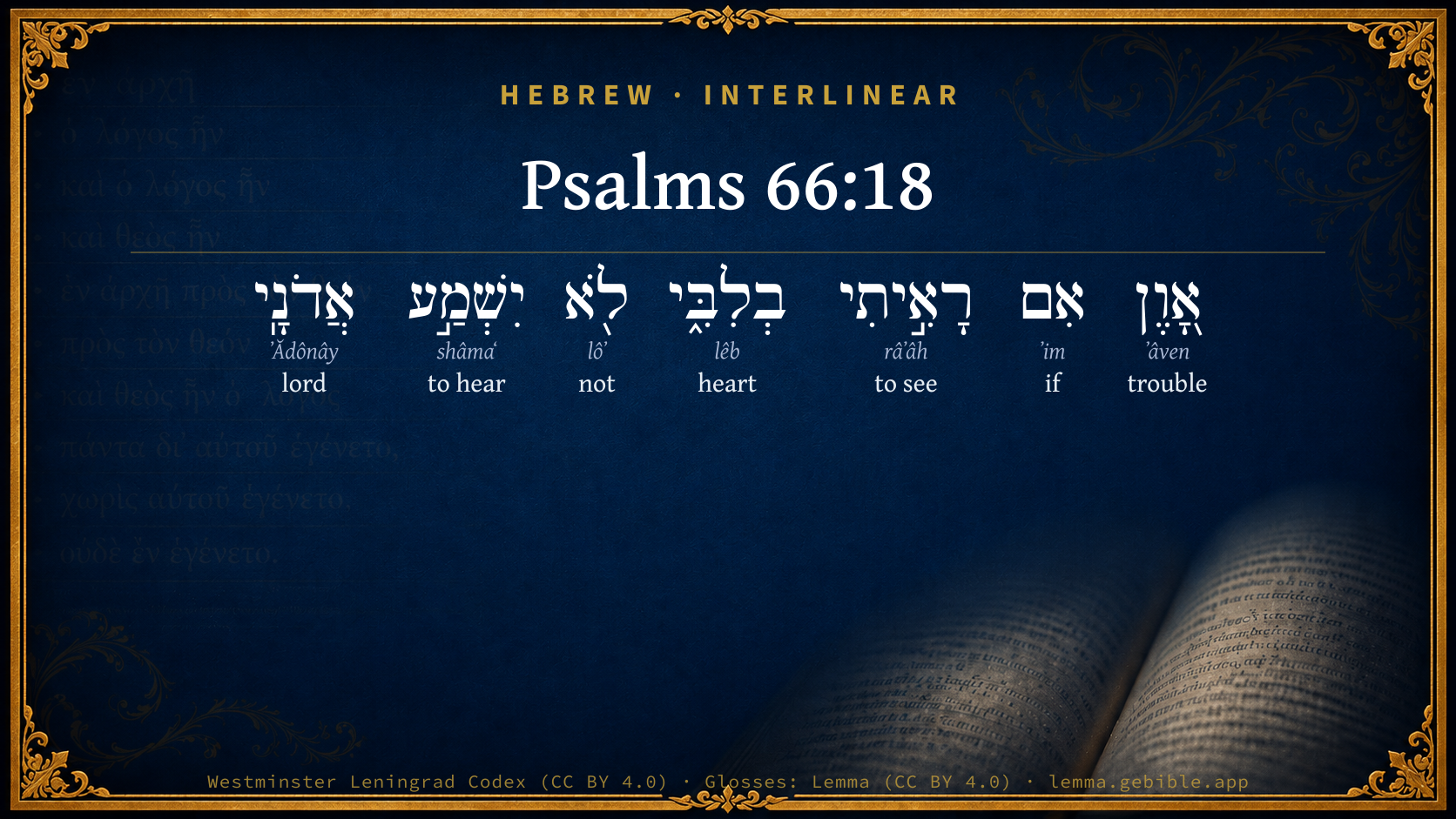
Hebrew (Westminster Leningrad Codex) Psalms 66:18 appears in the Hebrew Old Testament. The text above is from the Westminster Leningrad Codex. Each word links to its Strong’s number, a concise gloss, and parsing drawn from the Open Scriptures Hebrew Bible morphology. Click any word for its full Brown-Driver-Briggs (BDB) entry.
Download image
Cite this verse

Psalms 66:18 (World English Bible). Public Domain. Lemma interlinear Bible study tool, https://lemma.gebible.app/v/psalms/66/18.

Show BibTeX & RIS
BibTeX
RIS
English Translation
If I cherished sin in my heart, The Lord wouldn't have listened.
World English Bible · Public Domain
Download a study sheet

One document with this verse’s original text, its word-by-word gloss line, the meaning frame, cross-references with their text, attributed commentary, and full source and license credits — printable, and it pastes into notes with its structure intact.

This verse Autodidact and up

Study sheet (.html) Plain text (.txt)

A passage Seminary Student

Up to 50 verses in one chapter. A passage sheet keeps up to 6 commentary sources and 12 cross-references per verse, in the order this page ranks them, and says so on the sheet whenever that leaves anything out. Ask for a single verse and you get the Autodidact verse sheet above.

Everything on this page stays free to read, with no account — the sheet is a download of what is already on screen, not access to it.

Want to remove ads? Support Godless Engineer
Compare translations 3

The same verse in 3 English versions, stacked beneath the original-language interlinear above. Click any original word for its lexicon entry.

Each is an independent rendering of the whole verse — the interlinear is not word-aligned to these translations.

Highlighted words mark where these versions differ — a whole-verse word diff, not a word-by-word alignment.

  • World English Bible Public Domain
    If I cherished sin in my heart, The Lord wouldn't have listened.
  • King James Version Public Domain
    If I regard iniquity in my heart, the Lord will not hear me:
  • unfoldingWord Literal Text CC BY-SA 4.0
    If I had regarded iniquity in my heart, the Lord would not have heard.

unfoldingWord Literal Text — © unfoldingWord, licensed CC BY-SA 4.0. Word-aligned USFM3 via Door43 (git.door43.org/unfoldingWord/en_ult).

Versions to compare (up to 4)

3 of 4 selected

Show all 18 translations

Every available English version of this verse, each an independent rendering of the whole verse.

  • World English Bible Public Domain
    If I cherished sin in my heart, The Lord wouldn't have listened.
  • Berean Standard Bible Public Domain
    If I had cherished iniquity in my heart, the Lord would not have listened.
  • Majority Standard Bible Public Domain
    If I had cherished iniquity in my heart, the Lord would not have listened.
  • King James Version Public Domain
    If I regard iniquity in my heart, the Lord will not hear me:
  • American Standard Version (1901) Public Domain
    If I regard iniquity in my heart, The Lord will not hear:
  • Revised Version (1885) Public Domain
    If I regard iniquity in my heart, the Lord will not hear:
  • Geneva Bible (1599) Public Domain
    If I regard wickednesse in mine heart, the Lord will not heare me.
  • Douay-Rheims (1899) Public Domain
    If I have looked at iniquity in my heart, the Lord will not hear me.
  • Young's Literal Translation Public Domain
    Iniquity, if I have seen in my heart, The Lord doth not hear.
  • Literal Standard Version CC BY-SA 4.0
    Iniquity, if I have seen in my heart, || The Lord does not hear.
  • Unlocked Literal Bible CC BY-SA 4.0
    If I had seen sin within my heart, the Lord would not have listened to me.
  • unfoldingWord Literal Text CC BY-SA 4.0
    If I had regarded iniquity in my heart, the Lord would not have heard.
  • Darby Bible Public Domain
    Had I regarded iniquity in my heart, the Lord would not hear.
  • World Messianic Bible Public Domain
    If I cherished sin in my heart, the Lord wouldn’t have listened.
  • Webster's Bible Public Domain
    If I regard iniquity in my heart, the Lord will not hear me:
  • Free Bible Version CC BY-SA 4.0
    If I had focused my mind on evil, the Lord would not have listened to me.
  • Bible in Basic English Public Domain
    I said in my heart, The Lord will not give ear to me:
  • JPS Tanakh (1917) Public Domain
    If I had regarded iniquity in my heart, the Lord would not hear;

Literal Standard Version (2020), Covenant Press — licensed CC BY-SA 4.0. Text via the HelloAO Bible API (eBible.org). Unlocked Literal Bible (unfoldingWord) — licensed CC BY-SA 4.0. Text via the HelloAO Bible API (eBible.org). unfoldingWord Literal Text — © unfoldingWord, licensed CC BY-SA 4.0. Word-aligned USFM3 via Door43 (git.door43.org/unfoldingWord/en_ult). Free Bible Version, Dr. Jonathan Gallagher — licensed CC BY-SA 4.0. Text via the HelloAO Bible API (eBible.org).

Word by word

More ways to search: Search by grammar → Find every occurrence → Compare this word →

Practice this passage: Drill this verse → Learn its vocabulary →

About this verse

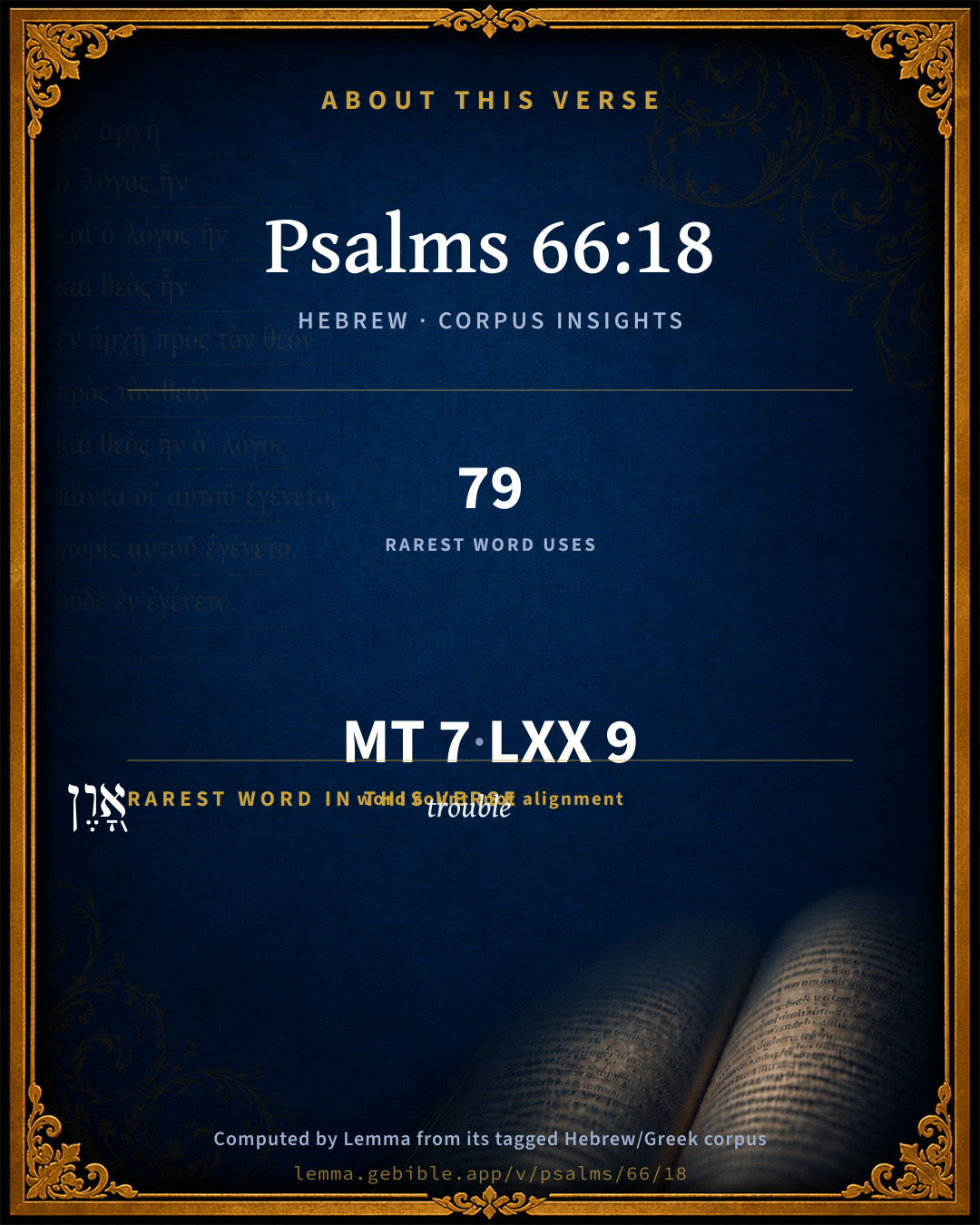
These counts appear in no published source. They are computed here, from the morphology-tagged text and Lemma’s own curated glosses. What Lemma adds →

7
words
7
distinct lemmas
Wisdom
section

Grammatical profile

  • 2 verbs
  • 3 nouns
  • 1 conjunction
  • 1 particle

Verb forms

  • רָאִ֣יתִי Qal · Perfect
  • יִשְׁמַ֣ע Qal · Imperfect

Hebrew & Septuagint length

In English translation the verse runs 12 words from the Hebrew and 15 from the Septuagint (LXX English) — closely comparable.

A rough comparison of the two English renderings, which tokenize alike — not a word-level alignment.

Word counts can differ between the Hebrew and the Greek without any difference in meaning — e.g. the Hebrew direct-object marker אֵת has no separate Greek word, and Greek often adds the article ὁ.

In the original languages it is 7 Hebrew tokens and 9 Greek tokens — but the two are counted differently (Hebrew bundles its prefixes and suffixes into one token; the Greek is in lemma form), so that isn’t a like-for-like length.

Cross-references

9

Topical passages linked to Psalms 66:18 in the Treasury of Scripture Knowledge — connected by theme and wording, ordered by reader-vote popularity; previews shown in the World English Bible.

  • John 9:31 We know that God doesn't listen to sinners, but if anyone is a worshipper of God, and does his will, he listens to him.
  • Proverbs 28:9 He who turns away his ear from hearing the law, Even his prayer is an abomination.
  • Proverbs 15:29 Yahweh is far from the wicked, But he hears the prayer of the righteous.
  • Proverbs 15:8 The sacrifice made by the wicked is an abomination to Yahweh, But the prayer of the upright is his delight.
  • Isaiah 1:15 When you spread forth your hands, I will hide my eyes from you; Yes, when you make many prayers, I will not hear. Your hands are full of blood.
  • James 4:3 You ask, and don't receive, because you ask with wrong motives, so that you may spend it for your pleasures.
  • Job 27:8–9 For what is the hope of the godless, when he is cut off, When God takes away his life?
  • Proverbs 21:13 Whoever stops his ears at the cry of the poor, He will also cry out, but shall not be heard.
  • Job 36:21 Take heed, don't regard iniquity; For this you have chosen rather than affliction.

Cross-references courtesy of OpenBible.info (CC BY 4.0).

Hebrew and Greek witnesses Masoretic Hebrew ↔ Greek Septuagint

The same verse in the two great witnesses to the Old Testament, shown verse-for-verse.

You’re reading Greek Psalm 65 (Hebrew Psalm 66). The Septuagint counts the superscription, so verse numbers can differ from the Hebrew — chapter-level alignment, not verse-by-verse. Numbering follows Rahlfs.

These are two independent witnesses, not word-aligned to each other, and the Septuagint is shown in lemma (dictionary) form.

Hebrew Psalms 66:18 Masoretic · Westminster Leningrad Codex

אָ֭וֶן אִם רָאִ֣יתִי בְלִבִּ֑י לֹ֖א יִשְׁמַ֣ע אֲדֹנָֽי

If I cherished sin in my heart, The Lord wouldn't have listened.

World English Bible · Public Domain

Greek LXX Greek Psalm 65:18 Septuagint · lemma form

ἀδικία εἰ θεωρέω ἐν καρδία ἐγώ μή εἰςἀκούω κύριος

If I have regarded iniquity in my heart, let not the Lord listen to me.

LXX2012 (modern English Septuagint) · Public Domain

Hebrew: Westminster Leningrad Codex (CC BY 4.0). Greek: Septuagint (public domain); English from LXX2012 (modern English Septuagint) (Public Domain). How the Septuagint differs from the Hebrew →

Commentary

Notes on Psalms 66:18 from classic Christian and Jewish commentators (each source and its license shown beneath its notes). The classic Christian expositions comment on the surrounding passage and are grouped to its opening verse, so a note may address several verses; the Jewish commentaries on the Tanakh (Rashi and others) are per-verse, so they appear only where the commentator wrote on this verse.

Lemma curates 59 commentaries, every one of them public domain or Creative Commons licensed, each selected and text-cleaned for this edition rather than reprinted as found. About our sources →

Trapp's Complete Commentary

John Trapp

Psa 66:18 If I regard iniquity in my heart, the Lord will not hear [me]:

Ver. 18. If l regard iniquity in my heart] If I have but a month’s mind to it, as we say; if I cast but a leering look towards it; if there be in me but an irresolution against it; how much more, then, if I allow it and wallow in it? He who chooseth to hold fast sin doth, by his own election, forsake mercy, Jon 2:8, neither let such a man think that he shall receive anything at the hands of God, Jas 1:7. As in a wound, a plaster prevaileth not while the iron remaineth within; so neither prayer while sin rankleth. God will never accept a good motion from a bad mouth, as that State in story would not. A man may deliver an excellent speech, but, because of his stinking breath, we may have no pleasure to hear him; so in this case. Prayer as a pouring out of the heart, as hath been already, observed. If iniquity harbour there, prayer is obstructed, and if it do break out, it will have the scent and savour of that iniquity upon it, and thereby displease. Kimchi maketh this strange sense (quite from the purpose, and from the truth), If I regard iniquity only in my heart, so that I break not forth into outward act, God will not hear, i.e. so hear, as to impute it, or to account it a sin. Pharisaice.

John Trapp, A Commentary or Exposition upon All the Books of the Old and New Testament (1647–1656) — public domain. Text from a community e-Sword module.

The Biblical Illustrator

Joseph S. Exell

Psa_66:18

If I regard iniquity in my heart, the Lord will not hear me.

The petitions of the insincere unavailing

I. Consider what is implied in regarding iniquity in the heart. The words do not point to open, profane and scandalous sinners. But there are many who maintain a fair character before men, who, before God, shall be found wanting indeed. They are deceiving themselves, and say they have peace when they have none really. But--

1. These regard iniquity in their hearts who secretly practise it, fearing the world, but not God. They forget Jer_23:24.

2. Who indulge the desire of sin though they may be restrained from the actual commission of it. Many do this in regard to impurity, sensuality and malice. But see the words of our Lord (Mat_5:27-28; Mat_5:21-22). And--

3. They who reflect upon past sins with delight, or without sincere humiliation of mind. Perhaps our real disposition, both towards sin and duty, may be as certainly discovered by the state of our minds after, as in the trine of action. For sudden temptation may sweep a man away; but the question which determines what the man is, is what are his thoughts and feelings in regard to his sin afterwards (Job_13:26; Psa_25:7).

4. Those who look upon the sins of others with approbation or without grief. Not as in Psa_119:136; Psa_119:158; Jer_13:17; 2Pe_2:7-8. Some there are who find mirth in others sins (Pro_14:9). And--

5. They are to be suspected who are loth to bring themselves to real searching of heart, or that God should try them (Psa_19:12). Now, all such do more or less regard iniquity in their hearts. But--

II. God will not hear them. This means--

1. When they cry for deliverance from affliction. God does hear the cry of His children (Psa_91:15; Psa_50:15). There are three different objects of desire to a good man while in affliction--the Divine presence to support him under it; the sanctified use of it for the improvement of the spiritual life; and, in due time, complete deliverance from it. The two first, he that regards iniquity in his heart will hardly ask; and the last he shall not be able to obtain (Hos_7:14).

2. He will not hear them when they intercede for others (Joh_9:31). It is the prayer of the believing righteous man that availeth (Jam_5:15-16). How terrible not to be able to intercede for others because we are of those whom God will not hear. How diligent we should be, who have to pray for others, to see to it that we walk with God.

3. When they draw near to Him in worship (Isa_1:14-15; Pro_15:8). Nor--

4. When they cry for mercy at the last (Gal_6:7; Mat_7:22-23; Pro_1:24; Pro_1:28).

Conclusion.

1. Let the ungodly be alarmed: it only regarding iniquity in the heart cause men to be rejected of God, how shall you appear who are living in open and gross sin?

2. Let us each and all examine ourselves whether we be of those spoken of here. Do we mourn over secret sins, and grieve because of the sin of others? Ask God to search and try your ways. Guard against your besetting sins and live continually as in the presence of God. (J. Witherspoon.)

The evil of regarding iniquity in the heart

I. A supposition stated. When may it be said that iniquity is regarded in the heart?

1. When it is permitted to reign in the life.

2. When we offer apologies for its existence.

3. When we evince no solicitude for its destruction.

4. When we make provision for its desires.

II. A consequence deduced. The Lord will not hear me (Psa_66:19-20). This supposes--

1. That prayer may be offered to God, even when iniquity is regarded in the heart.. Sinners pray when they are in trouble; Pharaoh confessed his sin (Exo_9:27-28); the Pharisee stood and prayed in the temple, but his language evinced the pride and haughtiness of his heart.

2. That where iniquity is regarded in the heart, the prayer is unacceptable to God.

3. That the man whose prayer God will not hear is in a most pitiable state.

Inferences.

1. How utterly impossible it is to deceive God (2Ch_16:9).

2. That there may be a fair show of religious profession, even where iniquity is regarded in the heart.

3. That the most effectual way to secure success in our prayers, is to hate iniquity and put away our sin, and beseech God to prove us, etc.

4. That if God has not answered our prayers, we should be solicitous to know the cause, and find out the hindrance. (Sketches of Four Hundred Sermons.)

When God will be found

There is a great deal of praying that is merely a form, and of the lips only. And a great deal that is abomination to the Lord, because the heart is not right. God wile not hear prayer that does not fulfil the conditions of prayer. They are--

I. Obedience. So long as I knowingly refuse obedience, no amount or vehemence of prayer will avail. I must lift up clean hands, or He will turn away in righteous anger.

II. Wholeheartedness. They that seek Him with the whole heart will find Him. None other. God is a jealous God. Therefore halfheartedness will find no favour with Him. How often does God find it necessary to try His people and keep them waiting, till their hearts wax warm and in dead earnest, and their whole being goes out to Him in prayer.

III. A cleansed heart. See the text. An evil heart--of unbelief, of cherished sin, of impure desire, of malice, envy, worldliness--may spoil all our prayers and make them a very snare and a cursing. Oh, it is a fearful thing to come before God in prayer By our very prayers we shall be judged, both now and at the day of judgment. What wonder, then, that so many prayers are unanswered? (J. M. Sherwood, D. D.)

Prayer answered only when offered in sincerity

I. What it is for a man to regard sin in his heart.

1. It is to have a constant and habitual love of it. This true of all the unregenerate. It is born with him and he loves it (Eph_5:29).

2. An unmortified habit or course of sin. Even a child of God may have this: David had (Psa_38:5).

3. An actual retention of the mind upon sin.

II. What it is to have our prayers accepted with God. It is to prevail with God for the obtaining of what we desire.

III. How it is that such regard of sin hinders our prayers.

1. Because in such case we cannot pray by the Spirit, and no other prayers find answer.

2. We cannot pray in faith.

3. Nor with fervour

IV. Application. Let all seek when they pray to have sincere hearts, free from hypocrisy and the love of sin. For otherwise our prayers cannot prosper, and, moreover, we incur the danger of a heavy curse (Gen_27:12). Therefore, before prayer, let us examine ourselves. This, if anything, will clear the coast. Sift yourselves by examining as Satan does by tempting. (R. South, D.D.)

The hindrances to acceptable prayer

I. The blessing designed--that the Lord will hear us. This supposes--

1. That our prayer be rightly endorsed and presented, which can only be through the atonement of Christ. True, when men, like Balaam, are set on their iniquity, God will at times let them have their way. But the text speaks of a right answer to a right prayer.

2. That our prayers are for permitted things.

II. The declared hindrance to prayer--If I regard iniquity in my heart. Now--

1. This is not sin in the life so much as in the heart which is contemplated. The blind mans reasoning was right (Joh_9:31). And yet men will keep up the form of prayer though purposing to sin.

2. And it need not be some definite sin that is designed, but if the desires of the mind be turned to sin, then prayer is hindered.

III. The reason of this declared connection between sin and disregarded prayer. Because in such state of heart we cannot pray. We may recite words, but we cannot pray. Let us deal honestly with God in our prayers. (Daniel Moore, M. A.)

Prayer with iniquity in the heart

If iniquity is regarded in the heart--

I. Prayer must be insincere.

1. For the most part, when men engage in prayer, they ask those things for which they are taught to pray.

2. If they regard iniquity in their heart, they cannot be sincere.

3. For they cannot really desire such blessings.

II. Prayer must be faithless.

1. Without faith, there is no prayer.

2. Faith, if it exists, is one of many graces, and itself purifies.

3. If we regard iniquity in our hearts, we cannot have faith, and, therefore, God cannot hear us.

III. Prayer cannot be in accordance with the Divine will.

1. Supposing that the man who regards iniquity in his heart be sincere, his prayer must be for what, etc.

2. He must be rejected.

IV. God will show His displeasure by refusing to hear.

1. Supposing that the man, etc., is offering a prayer for promised blessings, and--

2. That he is sincere, yet--

3. God has a controversy with him.

V. The ends of which we seek the accomplishment, through the blessings asked, must be discountenanced by God.

1. The man asks what is right.

2. He asks sincerely. But--

3. He asks right things for an improper end. We plead the glory of God--the name of Christ. (J. Stewart.)

When may iniquity be said to be in the heart? -

I. There would be iniquity in the heart, in professing to be penitentially humbled on account of any course of action, with which we have had nothing to do, or that is right in itself.

II. There would be iniquity in the heart, if we committed ourselves to any enterprise, without consulting Gods will at the outset.

III. There would be iniquity in the heart, in imploring the Almighty to bless means essentially inadapted to the end.

IV. There would be iniquity in the heart, in supplicating the almighty to enable one class of his sinful creatures to inflict injuries upon another.

V. There would be iniquity in the heart, in entreating Him to bless any instrumentality which He has prohibited. If Christianity expresses the will of God, and if Christianity is embodied in the life of Christ, then war is prohibited. And to ask Him to bless it, is to ask Him to promote rebellion against Himself. (Homilist.)

Iniquity in the heart a hindrance to prayer

Is there any difficulty in seeing why the utterances of one that cherisheth sin can never be wafted thus on high? How comes it that we weak men can ever engage in a work so lofty, so hard, as prayer, a work requiring the putting forth of all the powers of mind and soul? Is it not because there is a Spirit who helpeth our infirmities? Shall His voice be heard from the chamber of a heart in which the love of sin reigns? Will He, the Spirit of purity, work with a heart which is the willing slave of corruption? Again. As the man who regards iniquity in his heart cannot pray in the strength of God the Holy Ghost, so he cannot pray in faith. It is only when our heart, honestly questioned, carefully examined by the rule of Gods commandment, does not condemn us, that we can have confidence towards God. As the Spirit will not inspire, nor faith give wings to the prayer of the lover of sin, so neither can the prayer of such have any glow of life. In such prayers there can be none of that violence to which-alone the kingdom of heaven will yield; none of that seeking, knocking, striving, without which we can never find, never have heaven open to us, never enter by the strait gate. A great teacher of the Early Church, one who by Gods grace was rescued from a sinful life, and was enabled when he was converted to strengthen his brethren, confessed that at one time he had been in the habit of praying against a foul sin, nursing all the while a secret hope that his prayer might not be granted. Let those whose first thought on hearing this is one of incredulous horror diligently ask themselves whether, were they as honest as he in the task of learning to know themselves, they would not have to fall under the same condemnation. I dread to sacrifice to the gods with unwashed hands, said a grand old heathen warrior, nor is it comely to present my supplication besmeared with blood and strife. Besmeared with blood and strife we surely are as often as we come into Gods presence by our bedside or in His House of Prayer with thoughts and deeds of cruelty, of pride, of selfishness, of meanness and unkindness unrepented of; unwashed our hands surely are when our spirits are defiled with the stains of sin which we do not loathe, and in which we acquiesce, instead of being unwilling to rest until they be blotted out. Forgiving, tranquil, pure must his breast be who would worship the Lord in the beauty of holiness; he that would take upon him the name of Christ must see to it that his steps depart from iniquity; he that would pray aright must sift his heart ere he kneel, lest he offer the sacrifice of fools; he that would rise from addressing God and joyfully cry with the psalmist, Blessed be God which hath not cast out my prayer, nor turned His mercy from me, must first approach Gods awful presence with fear and trembling and a reverent heed that the hands which he lifts up be holy hands, that the heart whose desires his lips are to declare be one that regardeth not iniquity. (G. H. Whitaker, M. A.)

.

Psa_67:1-7

The Biblical Illustrator, edited by Joseph S. Exell (c. 1880s–1900s) — public domain. Text from a community e-Sword module.

The Treasury of David

Charles H. Spurgeon

Ver. 18. If I regard iniquity in my heart. If, having seen it to be there, I continue to gaze upon it without aversion; if I cherish it, have a side glance of love toward it, excuse it, and palliate it;

The Lord will not hear me. How can he? Can I desire him to connive at my sin, and accept me while I wilfully cling to any evil way? Nothing hinders prayer like iniquity harboured in the breast; as with Cain, so with us, sin lieth at the door, and blocks the passage. If thou listen to the devil, God will not listen to thee. If you refuse to hear God's commands, he will surely refuse to hear thy prayers. An imperfect petition God will hear for Christ's sake, but not one which is wilfully miswritten by a traitor's hand. For God to accept our devotions, while we are delighting in sin, would be to make himself the God of hypocrites, which is a fitter name for Satan than for the Holy One of Israel.

Ver. 18. If I regard iniquity in my heart, the Lord will not hear me. The very supposition that "if he regarded iniquity in his heart, the Lord would not hear him, "implies the possibility that such may be the state even of believers; and there is abundant reason to fear that it is in this way their prayers are so often hindered, and their supplications so frequently remain unanswered. Nor is it difficult to conceive how believers may be chargeable with regarding iniquity in their heart, even amidst all the solemnity of coming into the immediate presence of God, and directly addressing him in the language of prayer and supplication. It is possible that they may put themselves into such a situation, in a state of mind but little fitted for engaging in that holy exercise; the world, in one form or another, may for the time have the ascendancy in their hearts; and there may have been so much formality in their confessions, and so much indifference in their supplications, that when the exercise is over, they could not honestly declare that they really meant what they acknowledged, or seriously desired what they prayed for. A Christian, it is true, could not be contented to remain in a state like this; and, when he is awakened from it, as he sooner or later will be, he cannot fail to look back upon it with humiliation and shame. But we fear there are seasons in which believers themselves may make a very near approach to such a state; and what then is the true interpretation of prayers offered up at such a moment? It is in fact saying, that there is something which, for the time, they prefer to what they are formally asking of God; that, though the blessing which they do ask may be for a time withheld, yet they would find a compensation in the enjoyment of the worldly things which do at the moment engross their affections; and that, in reality, they would not choose to have at that instant such an abundant communication of spiritual influence imparted to them, as would render these worldly objects less valuable in their estimation, and would turn the whole tide of their affections towards spiritual things... The Christian may sometimes betake himself to prayer, to ask counsel of God in some perplexity regarding divine truth, or to seek direction in some doubtful point of duty; but, instead of being prepared fairly to exercise his judgment in the hope that, while doing so, the considerations that lie of the side of truth will be made to his mind clear and convincing; he may have allowed his inclinations so to influence and bias his judgment towards the side of error, or in favour of the line of conduct which he wishes to pursue, that when he asks counsel it may only be in the hope that his previous opinion will be confirmed, and when he seeks direction it is in reality on a point about which he was previously determined... Another case is, I fear, but too common, and in which the believer may be still more directly chargeable with regarding iniquity in his heart. It is possible that there may be in his heart or life something which he is conscious is not altogether as it should be--some earthly attachment which he cannot easily justify--or some point of conformity to the maxims and practices of the world, which he finds it difficult to reconcile with christian principle; and yet all the struggle which these have from time to time cost him, may only have been an effort of ingenuity on his part to retain them without doing direct violence to conscience --a laborious getting up of arguments whereby to show how they may be defended, or in what way they may lawfully be gone into; while the true and simple reason of his going into them, namely, the love of the world, is all the while kept out of view. And, as an experimental proof of how weak and inconclusive all these arguments are, and at the same time how unwilling he still is to relinquish his favourite objects, he may be conscious that in confessing his sins he leaves them out of the enumeration, rather because he would willingly pass them over, than because he is convinced that they need not be there; he may feel that he cannot and dare not make them the immediate subject of solemn and deliberate communing with God; and, after all his multiplied and ingenuous defences, he may be reconciled to them at last, only by ceasing to agitate the question whether they are lawful or not. Robert Gordon, D.D., 1825.

Ver. 18. Whence is it that a man's regarding or loving sin in his heart hinders his prayers from acceptance with God?

I. The first reason is, because in this case he cannot

pray by the Spirit. All prayers that are acceptable

with God are the breathings of his own Spirit with us.

Ro 8:26. As without the intercession of Christ we

cannot have our prayers accepted, so without the

intercession of the Spirit we cannot pray...

II. The second reason is, because as long as a man

regards iniquity in his heart he cannot pray in faith;

that is, he cannot build a rational confidence upon any

promise that God will accept him. Now, faith always

respects the promise, and promise of acceptance is made

only to the upright: so long, therefore, as men cherish

a love of sin in their heart, they either understand

not the promises, and so they pray without

understanding, or they understand them, and yet

misapply them to themselves, and so they pray in

presumption: in neither case, they have little cause to

hope for acceptance...

III. The third reason is, because while we regard iniquity

in our hearts we cannot pray with fervency; which, next

to sincerity, is the great qualification of prayer, to

which God has annexed a promise of acceptance

(Mt 11:12): "The kingdom of heaven suffereth

violence, and the violent take it by force." Mt 7:7:

those only that seek are like to find, and those that

knock to have admittance; all which expressions

denote vehemence and importunity. Now, the cause of

vehemence, in our prosecution of any good, is our

love of it; for proportionable to the affection we

bear to anything is the earnestness of our desires

and the diligence of our pursuit after it. So long,

therefore, as the love of sin possesses our hearts,

our love to spiritual things is dull, heavy,

inactive, and our prayers for them must needs be

answerable. O the wretched fallacy that the soul

will here put upon itself! At the same time it will

love its sin and pray against it; at the same time it

will entreat for grace, with a desire not to prevail:

as a father confesses of himself, that before his

conversion he would pray for chastity, with a secret

reserve in his wishes that God would not grant his

prayer. Such are the mysterious, intricate

treacheries by which the love of sin will make a soul

deceive and circumvent itself. How languidly and

faintly will it pray for spiritual mercies;

conscience, in the meanwhile, giving the lie to every

such petition! The soul, in this case, cannot pray

against sin in earnest; it fights against it, but

neither with hope nor intent to conquer; as lovers,

usually, in a game one against another, with a desire

to lose. So, then, while we regard iniquity, how is

it possible for us to regard spiritual things, the

only lawful object of our prayers? and, if we regard

them not, how can we be urgent with God for the

giving of them? And where there is no fervency on

our part, no wonder if there is no answer on God's. Robert South, 1633-1716.

Ver. 18. If I regard iniquity in my heart, the Lord will not hear me. Though the subject matter of a saint's prayer be founded on the word, yet if the end he aims at be not levelled right, this is a door at which his prayer will be stopped: "Ye ask, and receive not, because ye ask amiss, that ye may consume it upon your lusts." Jas 4:3. Take, I confess, a Christian in his right temper, and he aims at the glory of God; yet, as a needle that is touched with a loadstone may be removed from its point to which nature hath espoused it, though trembling till it again recovers it; so a gracious soul may in a particular act and request vary from this end, being jogged by Satan, yea, disturbed by an enemy nearer home--his own unmortified corruption. Do you not think it possible for a saint, in distress of body and spirit, to pray for health in the one, and comfort in the other, with too selfish a respect to his own ease and quiet? Yes, surely; and to pray for gifts and assistance in some eminent service, with an eye to his own credit and applause; to pray for a child with too inordinate a desire that the honour of his house may be built up in him. And this may be understood as the sense, in part, of that expression, If I regard iniquity in my heart, the Lord will not hear me. For though to desire our own health, peace, and reputation, be not an iniquity, when contained within the limits that God hath set; yet, when they overflow at such a height, as to overtop the glory of God, yea, to stand but in a level with it, they are a great abomination. That which in the first or second degree is wholesome food, would be rank poison in the fourth or fifth: therefore, Christian, catechize thyself, before thou prayest: O, my soul, what sends thee on this errand? Know but thy own mind what thou prayest for, and thou mayest soon know God's mind how thou shalt speed. Secure God his glory, and thou mayest soon know God's mind how thou shalt speed. William Gurnall.

Ver. 18. If I regard iniquity in my heart, the Lord will not hear me.

1. They regard iniquity in their heart, who practise it secretly, who are under restraint from the world, but are not possessed of an habitual fear of the omniscient God, the searcher of all hearts, and from whose eyes there is no covering of thick darkness where the workers of iniquity may hide themselves. Jer 23:24.

2. They regard iniquity in the heart, who entertain and indulge the desire of sin, although in the course of providence they may be restrained from the actual commission of it. I am persuaded the instances are not rare, of men feeding upon sinful desires, even when through want of opportunity, through the fear of man, or through some partial restraint of conscience, they dare not carry them into execution.

3. They regard iniquity in their heart, who reflect upon past sins with delight, or without sincere humiliation of mind. Perhaps our real disposition, both towards sin and duty, may be as certainly discovered by the state of our minds after, as in the time of action. The strength and suddenness of temptation may betray even a good man into the commission of sin; the backwardness of heart and power of inward corruption may make duty burdensome and occasion many defects in the performance; but every real Christian remembers his past sins with unfeigned contrition of spirit, and a deep sense of unworthiness before God; and the discharge of his duty, however difficult it may have been at the time, affords him the utmost pleasure on reflection. It is otherwise with many; they can remember their sins without sorrow, they can speak of them without shame, and sometimes even with a mixture of boasting and vain glory. Did you never hear them recall their past follies, and speak of them with such relish, that it seems to be more to renew the pleasure than to regret the sin? Even supposing such persons to have forsaken the practice of some sin, if they can thus look upon them with inward complacency, their seeming reformation must be owing to a very different cause from renovation of heart.

4. They regard iniquity in their heart, who look upon the sins of others with approbation; or, indeed, who can behold them without grief. Sin is so abominable a thing, so dishonouring to God, and so destructive to the souls of men, that no real Christian can witness it without concern. Hence it is so frequently taken notice of in Scripture, as the character of a servant of God, that he mourns for the sins of others. Ps 119:136, 158.

5. In the last place, I suspect that they regard sin in the heart, who are backward to bring themselves to the trial, and who are not truly willing that God himself would search and try them. If any, therefore, are unwilling to be tried, if they are backward to self examination, it is an evidence of a strong and powerful attachment to sin. It can proceed from nothing but from a secret dread of some disagreeable discovery, or the detection of some lust which they cannot consent to forsake... There are but too many who though they live in the practice of sin, and regard iniquity in their hearts, do yet continue their outward attendance on the ordinances of divine institution, and at stated times lay hold of the seals of God's covenant. Shall they find any acceptance with him? No. He counts it a profane mockery; he counts it a sacrilegious usurpation. Ps 50:16-17. Shall they have any comfort in it? No: unless in so far as in righteous judgment he suffers them to be deceived; and they are deceived, and they are most unhappy, who lie longest under the delusion. Ps 50:21. Shall they have any benefit by it? No: instead of appeasing his wrath, it provokes his vengeance; instead of enlightening their minds, it blinds their eyes; instead of sanctifying their nature, it hardens their hearts. See a description of those who had been long favoured with outward privileges and gloried in them. Joh 12:39-40. So that nothing is more essential to an acceptable approach to God in the duties of his worship in general, and particularly to receiving the seals of his covenant, than a thorough and universal separation from all known sin. Job 11:13-14. John Witherspoon (1722-1749), in a Sermon entitled "The Petitions of the Insincere Unavailing."

Ver. 18-20. Lord, I find David making a syllogism, in mood and figure, two propositions he perfected. If I regard iniquity in my heart, the Lord will not hear me; but verily God hath heard me; he hath attended to the voice of my prayer. Now I expected that David should have concluded thus: "Therefore I regard not wickedness in my heart; but far otherwise he concludes": Blessed be God, which hath not turned away my prayer, nor his mercy from me. Thus David had deceived, but not wronged me. I looked that he should have clapped the crown on his own, and he puts it on God's head. I will learn this excellent logic; for I like David's better than Aristotle's syllogisms, that whatsoever the premise be, I make God's glory the conclusion. Thomas Fuller.

Ver. 18-19.

I. The test admitted.

II. The test applied.

III. The test approved.

Psalms 66:19*

Ver. 18-20. See Psalms on "Ps 66:18" for further information.

Ver. 18-19.

I. The test admitted.

II. The test applied.

III. The test approved.

Ver. 18-20. See Psalms on "Ps 66:18" for further information.

Charles H. Spurgeon's The Treasury of David (1869–1885) — public domain. Psalms only. Text from a community e-Sword/MySword module.

Joseph Benson's Commentary

Psa 66:18. If I regard iniquity in my heart, &c. — God’s hearing and granting my petitions hath brought along with it a testimony of my sincerity in serving him, far more valuable than my kingdom; for, if I had been guilty of known iniquity, or had entertained in my heart a desire or intention to commit it, the Lord, who hates iniquity, would have denied my request. What the psalmist here observes merits our deep attention. From this, and many other passages in the Old Testament, we learn that the religion of the Holy Scriptures has always been the same in substance, and that in the time when various sacrifices and divers ceremonies were enjoined, the truly pious were persuaded that sincerity of heart and purity of intention, with a conscientious care to abstain from all known sin, were things absolutely necessary in order to their pleasing God, and being acceptable in his sight: and that without these, thousands of sacrifices and burnt-offerings, and the most scrupulous observance of outward ceremonies, were of no signification before him who searches the heart, and requires truth in the inward parts.

Joseph Benson's Commentary on the Old and New Testaments (1811–1818) — public domain. Text from a community e-Sword module.

J. A. Alexander on Psalms

Joseph Addison Alexander

18. (Psa 66:18) Iniquity if I have seen in my heart, the Lord will not hear. If I had any wicked end in view, God would not hear my prayer. The same idea is expressed in Pro 15:29, Isa 1:15; Isa 59:2, Joh 9:31, 1Jn 3:22. It is here stated as the ground on which he means to argue his own innocence of any such corrupt design, and actually does so in the next verse.

Joseph Addison Alexander, The Psalms Translated and Explained (1850) — public domain. Text from a community e-Sword module.

Tyndale Open Study Notes

Tyndale Open Resources

66:18 Confession leads to restoration (see 32:5).

Tyndale Open Study Notes — © Tyndale Open Resources, licensed CC BY-SA 4.0. Text via the HelloAO Bible API.

Geneva Bible (1599)

Geneva Bible translators

If I delight in wickedness, God will not hear me, but if I confess it, he will receive me.

Geneva Bible (1599) marginal notes — public domain. Text via Bolls.life.

Jamieson, Fausset & Brown

Robert Jamieson, A. R. Fausset & David Brown

If I regard iniquity in my heart--literally, "see iniquity with pleasure."

Next: Psalms Chapter 67

Jamieson, Fausset & Brown — Commentary Critical and Explanatory on the Whole Bible (1871) — public domain (CC PDM 1.0). Text via the HelloAO Bible API.

Adam Clarke's Commentary

Verse 18. If I regard iniquity in my heart] "If I have seen (ראיתי raithi) iniquity in my heart," if I have known it was there, and encouraged it; if I pretended to be what I was not; if I loved iniquity, while I professed to pray and be sorry for my sin; the Lord, אדני Adonai, my Prop, Stay, and Supporter, would not have heard, and I should have been left without help or support.

Adam Clarke's Commentary on the Bible (1810–1826) — public domain. Text from a community e-Sword/MySword module.

Ellicott's Commentary for English Readers

(18) If I regard . . .—Rather, if I had seen evil (i.e., had had it purposely in view) in my heart, the Lord would not have heard me. One may not “be pardoned and retain the offence.” The reference may be either to the forming of wicked schemes, or to the complacent view of wickedness in others.

The protestation of innocence in this verse, being made by or for the community at large, marks a late period for the composition. (See Introduction, and Psalms 44, Introduction and Notes.)

A Bible Commentary for English Readers, edited by Charles John Ellicott (1878–1897) — public domain. Text from a community e-Sword module.

The Cambridge Bible for Schools and Colleges

gen. ed. J. J. S. Perowne

18, 19. If I had regarded iniquity in my heart,

The Lord would not hear:

But verily God hath heard.

Hypocrisy disqualifies the suppliant, but he is confident that he is no hypocrite, and the answer to his prayer justifies him. There is no self-righteousness in this, but the simplicity of “a conscience void of offence toward God and men.” Cp. Hezekiah’s plea, Isa_38:3; and Psa_17:1 ff; Psa_18:20 ff; Job_16:17; Isa_1:15; Isa_59:2-3; 1Jn_3:21; &c.; and Isa_1:13 (R.V.), “I cannot away with iniquity and the solemn meeting”; i.e. tolerate the union of religious observances and iniquitous conduct.

The Cambridge Bible for Schools and Colleges (gen. ed. J. J. S. Perowne; Cambridge University Press, 1878–1918) — public domain. Text from a community e-Sword module.

John Gill's Exposition

If I regard iniquity in my heart,.... There was iniquity in his heart, as there is in every good man's heart, and a great deal too; it is full of it; and it should be regarded in some sense, so as to guard against it, and pray to be kept from it, that it may not break forth into action; and so as to loath it, abhor it, and be humbled for it; but not so as to nourish and cherish it, to take delight and pleasure in it: or "if I look upon it" (h), as it may be rendered; that is, with approbation of it, and satisfaction in it, and ordered his conversation according to it; or acted the deceitful and hypocritical part in prayer; or had any evil intention in his petitions, to consume on his lusts what he asked for;

the Lord will not hear me; for the Lord hears not sinners that delight in sin, and live in it; neither profane sinners nor hypocrites; see Joh 9:31.

(h) "si vidi", Pagninus, Montanus; "si aspexi", V. L. "si conspexi", Gejerus.

John Gill's Exposition of the Whole Bible (1746–1763) — public domain (CC PDM 1.0). Text via the HelloAO Bible API.

Albert Barnes' Notes on the Bible

If I regard iniquity in my heart - literally, “If I have seen iniquity in my heart.” That is, If I have indulged in a purpose of iniquity; if I have had a wicked end in view; if I have not been willing to forsake all sin; if I have cherished a purpose of pollution or wrong. The meaning is not literally, If I have “seen” any iniquity in my heart - for no one can look into his own heart, and not see that it is defiled by sin; but, If I have cherished it in my soul; if I have gloated over past sins; if I am purposing to commit sin again; if I am not willing to abandon all sin, and to be holy.

The Lord will not hear me - That is, He will not regard and answer my prayer. The idea is, that in order that prayer may be heard, there must be a purpose to forsake all forms of sin. This is a great and most important principle in regard to prayer. The same principle is affirmed or implied in Psa 18:41; Psa 34:15; Pro 1:28; Pro 15:29; Pro 28:9; Isa 15:1-9; Jer 11:11; Jer 14:12; Zec 7:13; Joh 9:31. It is also especially stated in Isa 58:3-7. The principle is applicable

(a) to secret purposes of sin; to sinful desires, corrupt passions. and evil propensities;

(b) to acts of sin in individuals, as when a man is pursuing a business founded on fraud, dishonesty, oppression, and wrong;

(c) to public acts of sin, as when a people fast and pray Isa 58:1-14, and yet hold their fellow-men in bondage; or enact and maintain unjust and unrighteous laws; or uphold the acts of wicked rulers; or countenance and support by law that which is contrary to the law of God; and

(d) to the feelings of an awakened and trembling sinner when he is professedly seeking salvation.

If there is still the love of evil in his heart; if he has some cherished purpose of iniquity which he is not willing to abandon; if there is any one sin, however small or unimportant it may seem to be, which he is not willing to forsake, he cannot hope that God will hear his prayer; he may be assured that he will not. All prayer, to be acceptable to God, must be connected with a purpose to forsake all sin.

Albert Barnes' Notes on the Bible (1834–1885) — public domain. Text from a community e-Sword/MySword module.

Matthew Poole's English Annotations

If I regard, Heb. if I have or had seen, or looked upon, to wit, with approbation and affection, as Job 31:26; Hab 1:13. Men look upon what they like, and turn away their face from what they loathe or hate.

Iniquity; any sin whatsoever, and especially idolatry, which is oft expressed by this word, to which the Israelites were very prone, and to which they had most powerful temptations from the examples, and counsels, and promises, and threats of the idolaters, in whose land and power they had been. And so this is a purgation of themselves from that crime, somewhat like that Psa 44:20,21, and in general from those gross and reigning sins whereof they had been guilty formerly.

In my heart; if my heart was false to God, and did cleave to idols or to any wickedness, although I might for some prudential reasons forbear the gross and outward acts. Compare Psa 44:17,18. If I had been guilty of that hypocrisy wherewith mine enemies charged me, and had been a secret favourer of wickedness when I pretended great piety. Or, If I did not cry unto God with my heart, but only howled for corn and wine, &c.; and whilst I cried to God with my tongue, my heart was set upon sin, or I desired only that which I resolved in my heart to spend upon my lusts.

Will not hear me; or, would not have heard me; as divers learned interpreters translate it; the future being put potentially, as is usual among the Hebrews. For God heareth not sinners, Joh 9:31, nor hypocrites, Job 27:8,9; Pr 15:29.

Matthew Poole's English Annotations on the Holy Bible (1683–1685) — public domain. Text from a community e-Sword/MySword module.

The Pulpit Commentary

If I regard iniquity in my heart, the Lord will not hear me. This is the inward conviction of every simple, unsophisticated soul. It is confirmed by numerous passages of Holy Writ. (Job_27:9 Job_31:27 Pro_15:29 Pro_28:9 Isa_1:15 Zec_7:13Jo Zec 9:31, etc.)

Prayer hindered by allowed sin.

"If I regard iniquity," etc. If we read the text as in the margin of Revised Version, "If I had regarded... God would not hear or, "have heard; this makes no practical difference. It only substitutes a special for a general statement. The lesson taught is the sameSin allowed in the heart a fatal hindrance to our prayers being answered.

I SIN CONSCIOUSLY INDULGED DISABLES FROM PRAYER. Inconsistent with that sincerity essential to the reality of prayer. (1Jn_3:19-21) One has known men who were afterwards discovered to have been living in secret a wicked life, fluent in the language of what seemed fervent prayer. But such prayer is "abomination". (Pro_21:27 Pro_28:9) It is a fearful aggravation of guilt.

II EVEN SINS IGNORANTLY, OR WITH PARTIAL KNOWLEDGE, indulged, put the spirit out of tune for prayer; grieve and quench the Holy Spirit, by whose teaching alone we can pray aright; put coldness between the heart and God.

III SIN INDULGED HINDERS THE ANSWERS TO PRAYER.

1. By rendering us incapable of spiritual blessing. As long as David refused to confess his sin to God, forgiveness and spiritual joy were impossible. (Psa_32:3-5)

2. By rendering it often unwise for God to grant the temporal blessings we ask. God could not grant David"s prayer for the life of his child, even after he had repented, because of the scandal his crimes had brought on religion. (2Sa 13, etc.) All David"s great after troubles sprang from his sin. A Christian who has sinned, repented, and been forgiven is not to regard his troubles as punishment except, indeed, that they may be sin"s inevitable fruit and consequence. But they may be a wise and needful, though merciful, chastisement. (1Co_11:31, 1Co_11:32)

The Pulpit Commentary (1880–1919), ed. H.D.M. Spence-Jones & Joseph S. Exell — public domain. Text from a community e-Sword module.

John Wesley's Explanatory Notes

Iniquity - Any sin. In heart - If my heart had been false to God, although I might have forborne outward acts. If I had been guilty of that, by heart was set upon sin, or I desired only that which I resolved in my heart to spend upon my lusts.

John Wesley, Explanatory Notes Upon the Whole Bible (1754–1765) — public domain. Text via the GEBible commentary corpus.

Rashi

Rabbi Shlomo Yitzchaki (Rashi)

If I saw iniquity, etc. He did not deal with us according to our sins, but He made Himself as though He neither saw nor heard the iniquity that was in our hearts.

Rashi on the Tanakh — English translations: “The Judaica Press complete Tanach with Rashi, translated by A. J. Rosenberg” (CC BY 4.0); “Pentateuch with Rashi's commentary by M. Rosenbaum and A.M. Silbermann, 1929-1934” (public domain); “The Metsudah Tanach series, Lakewood, N.J” (CC BY 4.0); and “The Book of Joshua, Metsudah Publications, 1997” (CC BY 4.0). Text via Sefaria.

Lesson kit

Teaching starters — assembled from the data on this page, not authored interpretation. Every prompt links to the verse data it draws on. Edit before teaching.

Psalms, in the Wisdom, opens this verse with 7 words (7 distinct Hebrew lemmas). Its most distinctive word is ʼâven (“trouble”). A historical commentator’s framing appears above. Read the whole chapter for the surrounding context.

Discussion questions

  1. How does “trouble” (ʼâven) shape what this verse is saying?
  2. How does John 9:31, which shares this passage’s theme, read alongside this verse?
  3. The translations on this page render this verse differently — a whole-verse word diff, not a word-by-word alignment. What might account for the different wordings?
  4. «רָאִ֣יתִי» is a Qal Perfect verb. How does that grammatical form shape the action described?
  5. Compare how Trapp's Complete Commentary and The Biblical Illustrator read this verse. Where do they agree or differ?

Things to notice

Reading settings

Reading text

Shown beneath each verse's original-language words.

Old Testament
Old Testament edition

Read the OT as the Masoretic Hebrew (MT) or the Greek Septuagint (LXX).

English shown for the Greek Septuagint (in the Hebrew ↔ Greek comparison).

Comparing translations? Open the Compare panel on any verse page to stack up to four side by side.