
Psalms 22:30

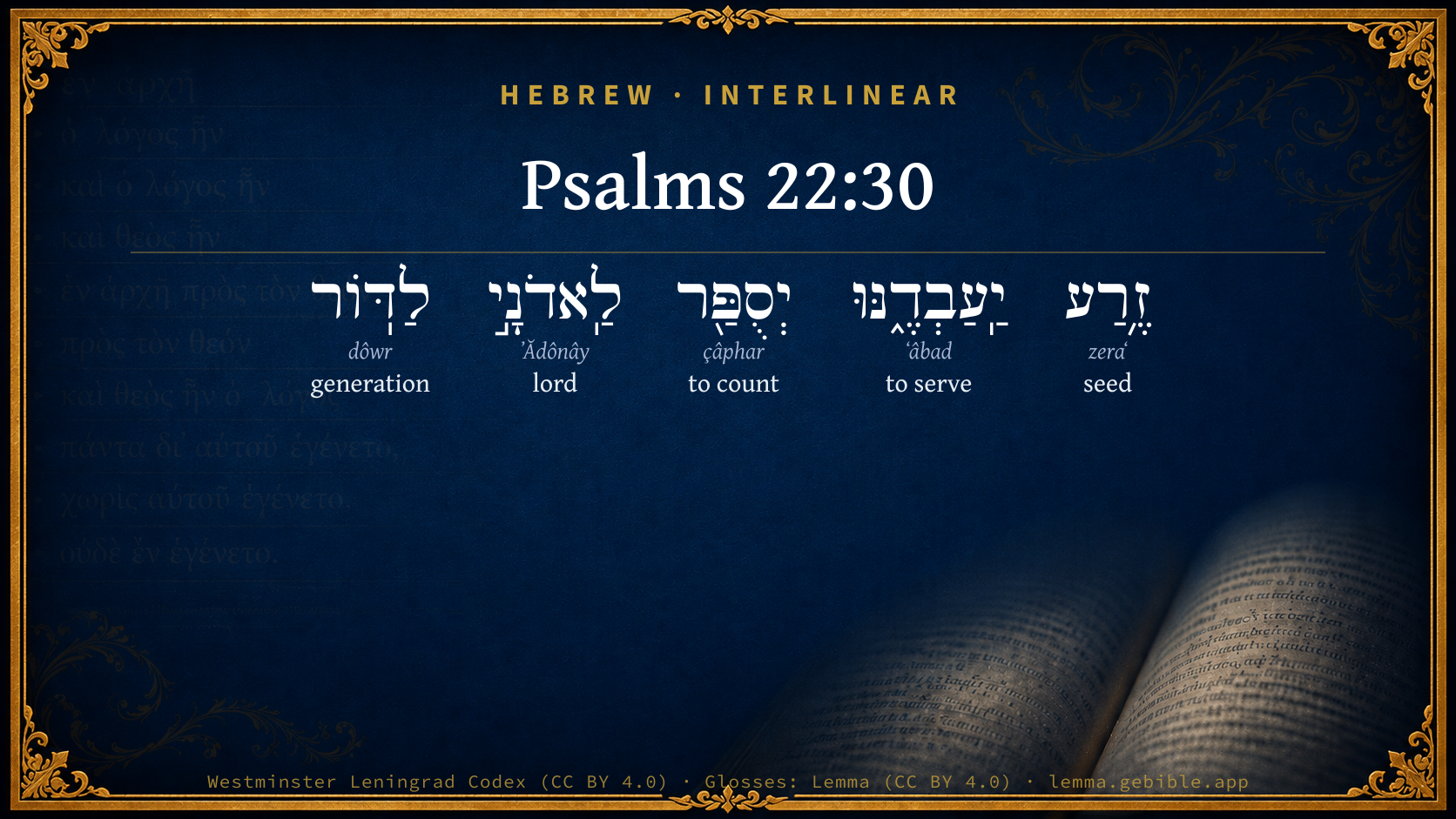
Hebrew (Westminster Leningrad Codex) Psalms 22:30 appears in the Hebrew Old Testament. The text above is from the Westminster Leningrad Codex. Each word links to its Strong’s number, a concise gloss, and parsing drawn from the Open Scriptures Hebrew Bible morphology. Click any word for its full Brown-Driver-Briggs (BDB) entry.
Download image
Cite this verse

Psalms 22:30 (World English Bible). Public Domain. Lemma interlinear Bible study tool, https://lemma.gebible.app/v/psalms/22/30.

Show BibTeX & RIS
BibTeX
RIS
English Translation
Posterity shall serve him. Future generations shall be told about the Lord.
World English Bible · Public Domain
Download a study sheet

One document with this verse’s original text, its word-by-word gloss line, the meaning frame, cross-references with their text, attributed commentary, and full source and license credits — printable, and it pastes into notes with its structure intact.

This verse Autodidact and up

Study sheet (.html) Plain text (.txt)

A passage Seminary Student

Up to 50 verses in one chapter. A passage sheet keeps up to 6 commentary sources and 12 cross-references per verse, in the order this page ranks them, and says so on the sheet whenever that leaves anything out. Ask for a single verse and you get the Autodidact verse sheet above.

Everything on this page stays free to read, with no account — the sheet is a download of what is already on screen, not access to it.

Want to remove ads? Support Godless Engineer
Compare translations 3

The same verse in 3 English versions, stacked beneath the original-language interlinear above. Click any original word for its lexicon entry.

Each is an independent rendering of the whole verse — the interlinear is not word-aligned to these translations.

Highlighted words mark where these versions differ — a whole-verse word diff, not a word-by-word alignment.

  • World English Bible Public Domain
    Posterity shall serve him. Future generations shall be told about the Lord.
  • King James Version Public Domain
    A seed shall serve him; it shall be accounted to the Lord for a generation.
  • unfoldingWord Literal Text CC BY-SA 4.0
    Seed will serve him; it will be told of the Lord to the generation.

unfoldingWord Literal Text — © unfoldingWord, licensed CC BY-SA 4.0. Word-aligned USFM3 via Door43 (git.door43.org/unfoldingWord/en_ult).

Versions to compare (up to 4)

3 of 4 selected

Show all 18 translations

Every available English version of this verse, each an independent rendering of the whole verse.

  • World English Bible Public Domain
    Posterity shall serve him. Future generations shall be told about the Lord.
  • Berean Standard Bible Public Domain
    Posterity will serve Him; they will declare the Lord to a new generation.
  • Majority Standard Bible Public Domain
    Posterity will serve Him; they will declare the Lord to a new generation.
  • King James Version Public Domain
    A seed shall serve him; it shall be accounted to the Lord for a generation.
  • American Standard Version (1901) Public Domain
    A seed shall serve him; It shall be told of the Lord unto the `next' generation.
  • Revised Version (1885) Public Domain
    A seed shall serve him; it shall be told of the Lord unto the next generation.
  • Geneva Bible (1599) Public Domain
    Their seede shall serue him: it shalbe counted vnto the Lord for a generation.
  • Douay-Rheims (1899) Public Domain
    All the fat ones of the earth have eaten and have adored: all they that go down to the earth shall fall before him.
  • Young's Literal Translation Public Domain
    A seed doth serve Him, It is declared of the Lord to the generation.
  • Literal Standard Version CC BY-SA 4.0
    A seed serves Him, || It is declared of the Lord to the generation.
  • Unlocked Literal Bible CC BY-SA 4.0
    A generation to come will serve him; they will tell the next generation of the Lord.
  • unfoldingWord Literal Text CC BY-SA 4.0
    Seed will serve him; it will be told of the Lord to the generation.
  • Darby Bible Public Domain
    A seed shall serve him; it shall be accounted to the Lord for a generation.
  • World Messianic Bible Public Domain
    Posterity shall serve him. Future generations shall be told about the Lord.
  • Webster's Bible Public Domain
    \\22:29\\All they that are fat upon earth shall eat and worship: all they that go down to the dust shall bow before him: and none can keep alive his own soul.
  • Free Bible Version CC BY-SA 4.0
    Our descendants will serve him; they will tell the next generation about the Lord.
  • Bible in Basic English Public Domain
    A seed will be his servant; the doings of the Lord will be made clear to the generation which comes after.
  • JPS Tanakh (1917) Public Domain
    (22-31) A seed shall serve him; it shall be told of the Lord unto the next generation.

Literal Standard Version (2020), Covenant Press — licensed CC BY-SA 4.0. Text via the HelloAO Bible API (eBible.org). Unlocked Literal Bible (unfoldingWord) — licensed CC BY-SA 4.0. Text via the HelloAO Bible API (eBible.org). unfoldingWord Literal Text — © unfoldingWord, licensed CC BY-SA 4.0. Word-aligned USFM3 via Door43 (git.door43.org/unfoldingWord/en_ult). Free Bible Version, Dr. Jonathan Gallagher — licensed CC BY-SA 4.0. Text via the HelloAO Bible API (eBible.org).

Word by word

More ways to search: Search by grammar → Find every occurrence → Compare this word →

Practice this passage: Drill this verse → Learn its vocabulary →

יְסֻפַּ֖ר
çâphar
H5608
“to count”
Verb, Pual, Imperfect, 3rd Person, Masculine, Singular
Part of Speech
Verb
Stem
Pual
Form
Imperfect
Person
3rd Person
Gender
Masculine
Number
Singular
Full BDB Definition

Origin: a primitive root

TWOT: 1540 , 1540c

to count, recount, relate (verb) - (Qal) - to count (things) - to number, take account of, reckon - (Niphal) to be counted, be numbered - (Piel) to recount, rehearse, declare - to recount (something), rehearse - to talk - to count exactly or accurately - (Pual) to be recounted, be rehearsed, be related - enumerator, muster-officer, secretary, scribe (noun masculine) - enumerator, muster-officer, secretary - learned man, scribe
  1. זֶ֥רַע zeraʻ H2233 “seed” Noun, Common, Masculine, Singular, Absolute
  2. יַֽעַבְדֶ֑נּוּ ʻâbad H5647 “to serve · him” Verb, Qal, Imperfect, 3rd Person, Masculine, Singular + Suffix, Personal, 3rd Person, Masculine, Singular
  3. לַֽאדֹנָ֣י ʼĂdônây H136 “to/for · Lord · my” Preposition + Noun, Common, Masculine, Plural, Construct + Suffix, Personal, 1st Person, Common, Singular
  4. לַדּֽוֹר dôwr H1755 “to/for the · generation” Preposition, Determined + Noun, Common, Masculine, Singular, Absolute

About this verse

These counts appear in no published source. They are computed here, from the morphology-tagged text and Lemma’s own curated glosses. What Lemma adds →

5
words
5
distinct lemmas
Wisdom
section

Grammatical profile

  • 2 verbs
  • 3 nouns

Verb forms

  • יַֽעַבְדֶ֑נּוּ Qal · Imperfect
  • יְסֻפַּ֖ר Pual · Imperfect

Hebrew & Septuagint length

In English translation the verse runs 12 words from the Hebrew and 17 from the Septuagint (LXX English) — closely comparable.

A rough comparison of the two English renderings, which tokenize alike — not a word-level alignment.

Word counts can differ between the Hebrew and the Greek without any difference in meaning — e.g. the Hebrew direct-object marker אֵת has no separate Greek word, and Greek often adds the article ὁ.

Cross-references

10

Topical passages linked to Psalms 22:30 in the Treasury of Scripture Knowledge — connected by theme and wording, ordered by reader-vote popularity; previews shown in the World English Bible.

  • Hebrews 2:13 Again, "I will put my trust in him." Again, "Behold, here am I and the children whom God has given me."
  • 1 Peter 2:9 But you are a chosen race, a royal priesthood, a holy nation, a people for God's own possession, that you may show forth the excellencies of him who called you out of darkness into his marvelous light:
  • Psalms 102:28 The children of your servants will continue. Their seed will be established before you."
  • Galatians 3:26–29 For you are all children of God, through faith in Christ Jesus.
  • Psalms 14:5 There they were in great fear, For God is in the generation of the righteous.
  • Psalms 24:6 This is the generation of those who seek Him, Who seek your face--even Jacob. Selah.
  • Psalms 73:15 If I had said, "I will speak thus;" Behold, I would have betrayed the generation of your children.
  • Psalms 87:6 Yahweh will count, when he writes up the peoples, "This one was born there." Selah.
  • Isaiah 53:10 Yet it pleased Yahweh to bruise him; he has put him to grief: when you shall make his soul an offering for sin, he shall see [his] seed, he shall prolong his days, and the pleasure of Yahweh shall prosper in his hand.
  • Matthew 3:9 Don't think to yourselves, 'We have Abraham for our father,' for I tell you that God is able to raise up children to Abraham from these stones.

Cross-references courtesy of OpenBible.info (CC BY 4.0).

Hebrew and Greek witnesses Masoretic Hebrew ↔ Greek Septuagint

The same verse in the two great witnesses to the Old Testament, shown verse-for-verse.

You’re reading Greek Psalm 21 (Hebrew Psalm 22). The Septuagint counts the superscription, so verse numbers can differ from the Hebrew — chapter-level alignment, not verse-by-verse. Numbering follows Rahlfs.

These are two independent witnesses, not word-aligned to each other, and the Septuagint is shown in lemma (dictionary) form.

Hebrew Psalms 22:30 Masoretic · Westminster Leningrad Codex

זֶ֥רַע יַֽעַבְדֶ֑נּוּ יְסֻפַּ֖ר לַֽאדֹנָ֣י לַדּֽוֹר

Posterity shall serve him. Future generations shall be told about the Lord.

World English Bible · Public Domain

Greek LXX Greek Psalm 21:30 Septuagint · lemma form

ἐσθίω καί προςκυνέω πᾶς ὁ πίων ὁ γῆ ἐνώπιον αὐτός προπίπτω πᾶς ὁ καταβαίνω εἰς ὁ γῆ καί ὁ ψυχή ἐγώ αὐτός ζάω

And my seed shall serve him: the generation that is coming shall be reported to the Lord.

LXX2012 (modern English Septuagint) · Public Domain

On this verse, The Cambridge Bible for Schools and Colleges discusses the Septuagint’s reading. Read the note in Commentary ↓

Hebrew: Westminster Leningrad Codex (CC BY 4.0). Greek: Septuagint (public domain); English from LXX2012 (modern English Septuagint) (Public Domain). How the Septuagint differs from the Hebrew →

Commentary

Notes on Psalms 22:30 from classic Christian and Jewish commentators (each source and its license shown beneath its notes). The classic Christian expositions comment on the surrounding passage and are grouped to its opening verse, so a note may address several verses; the Jewish commentaries on the Tanakh (Rashi and others) are per-verse, so they appear only where the commentator wrote on this verse.

Lemma curates 59 commentaries, every one of them public domain or Creative Commons licensed, each selected and text-cleaned for this edition rather than reprinted as found. About our sources →

The Cambridge Bible for Schools and Colleges

gen. ed. J. J. S. Perowne

30. It shall be accounted &c.] i.e. as R.V. marg., It shall be counted unto the Lord for his generation. Better, however, as R.V. text, It shall be told of the Lord unto the next generation. But here again it seems best slightly to alter the text, and following the LXX to connect the first word of Psa_22:31 with Psa_22:30 : It shall be told of the Lord unto the generation that shall come: for (1) the generation needs the qualification which R.V. supplies by inserting next: and (2) they shall come absolutely in the sense of they shall come into being is doubtful.

The Cambridge Bible for Schools and Colleges (gen. ed. J. J. S. Perowne; Cambridge University Press, 1878–1918) — public domain. Text from a community e-Sword module.

Trapp's Complete Commentary

John Trapp

Psa 22:30 A seed shall serve him; it shall be accounted to the Lord for a generation.

Ver. 30. A seed shall serve him] And be saved by him, a remnant reserved for royal use, a chosen generation, Rom 9:20 Isa 53:10.

John Trapp, A Commentary or Exposition upon All the Books of the Old and New Testament (1647–1656) — public domain. Text from a community e-Sword module.

The Biblical Illustrator

Joseph S. Exell

Psa_22:30

A seed shall serve Him.

Good men as seeds

This figurative expression signifies Christ and His people, who yield true obedience to God,--they are called by this name in a spiritual and figurative, but most appropriate sense. The idea is taken from the operations of the husbandman, who carefully reserves every year a portion of his grain for seed. Though it be small, compared with all the produce of his harvest, yet he prizes it very highly and estimates it by the value of that crop which it may yield in the succeeding autumn. Nor does he look only to the quantity; he pays particular regard to the quality of the seed. He reserves only the best, nay, he will put away his own if spoiled, that he may procure better. The very smallest quantity of really good seed is, to him, an object of great desire, and if by grievous failure of crops he should not be able to procure more than a single grain, yet would he accept it thankfully, preserve it carefully, and plant it in the most favourable soil. Such is the source from which the metaphor is taken. (John Stevenson.)

The Biblical Illustrator, edited by Joseph S. Exell (c. 1880s–1900s) — public domain. Text from a community e-Sword module.

Joseph Benson's Commentary

Psa 22:30. A seed shall serve him — Christ shall not want a seed or posterity, for though the Jewish nation will generally reject him, the Gentiles shall come in their stead. It shall be accounted for a generation — That believing seed shall be reputed, both by God and men, the generation, or people of the Lord, as the Jews formerly were.

Joseph Benson's Commentary on the Old and New Testaments (1811–1818) — public domain. Text from a community e-Sword module.

J. A. Alexander on Psalms

Joseph Addison Alexander

31. (Psa 22:30). Posterity shall serve him; it shall be related of the Lord to the (next) generation. The last restriction to be done away is that of time. The effects of this salvation shall no more be confined to the present generation than to the higher classes of society, or the natural descendants of the patriarchs.—A seed, i.e. posterity, the seed of those who witness or first hear of the event.—Shall serve him, i.e. worship and obey Jehovah, the same thing that is expressed by eating and bowing down in Psa 22:30 (29) above. The means of this conversion shall be the perpetuated knowledge of what God has done.—Generation is used absolutely, as in Psa 71:18, where it means not this generation, but the next. The complete phrase occurs below, Ps. 28:14 (13), Psa 78:4. The Lord. The original is not Jehovah, but Adhonai, the divine name properly denoting sovereignty. See above, on Psa 2:4; Psa 21:2. The exposition above given of the verse before us is equally agreeable to usage, and much better suited to the context, than the one which makes it mean that a seed shall be reckoned by the Lord (as belonging) to the generation, i. e. to the generation of his people. (See below, on Psa 24:6.) It is highly improbable that the passive verb has a meaning wholly different from that of the corresponding active form in Psa 22:23 (22) above.

Joseph Addison Alexander, The Psalms Translated and Explained (1850) — public domain. Text from a community e-Sword module.

Tyndale Open Study Notes

Tyndale Open Resources

22:30 Future generations will join those from the past who praised the Lord (22:3-5). The descendants of the godly will receive blessings (22:30-31), unlike the offspring of the wicked (21:10).

Tyndale Open Study Notes — © Tyndale Open Resources, licensed CC BY-SA 4.0. Text via the HelloAO Bible API.

Geneva Bible (1599)

Geneva Bible translators

Meaning, the prosperity, which the Lord keepeth as a seed to the Church to continue his praise among men.

Geneva Bible (1599) marginal notes — public domain. Text via Bolls.life.

Jamieson, Fausset & Brown

Robert Jamieson, A. R. Fausset & David Brown

it shall be accounted to the Lord for, &c.--or, "it shall be told of the Lord to a generation." God's wonderful works shall be told from generation to generation.

Jamieson, Fausset & Brown — Commentary Critical and Explanatory on the Whole Bible (1871) — public domain (CC PDM 1.0). Text via the HelloAO Bible API.

Adam Clarke's Commentary

Verse 30. Shall be accounted to the Lord for a generation.] They shall be called Christians after the name of Christ.

Adam Clarke's Commentary on the Bible (1810–1826) — public domain. Text from a community e-Sword/MySword module.

John Calvin's Commentaries

30. Their seed shall serve him. The more to exalt the greatness of the benefit, he declares that it will be of such a character that posterity will never forget it. And he shows how it will come to be perpetuated, namely, because the conversion of the world, of which he has spoken, will not be for a short time only but will continue from age to age. Whence we again conclude, that what is here celebrated is not such a manifestation of the glory of God to the Gentile nations as proceeds from a transitory and fading rumor, but such as will enlighten the world with its beams, even to the end of time. Accordingly, the perpetuity of the Church is here abundantly proved, and in very clear terms: not that it always flourishes or continues in the same uniform course through successive ages, but because God, unwilling that his name should be extinguished in the world, will always raise up some sincerely to devote themselves to his service. We ought to remember that this seed, in which the service of God was to be preserved, is the fruit of the incorruptible seed; for God begets and multiplies his Church only by means of his word.

The expression, To be registered to the Lord for a generation, is explained in two ways. Some take the Hebrew word דור, dor, for a succession of ages, and explain the clause thus: They shall be registered to the Lord age after age. Others take it for generation, in the sense in which the word natio [nation] is used in the Latin tongue. As both these senses suit very well, and come almost to the same thing, I leave my readers at liberty to choose between them. I am, however, I admit, rather inclined to the opinion, that by this word is designated God’s chosen people and peculiar nation, which may be accounted the heritage of God. Farther, as the name Jehovah, which is expressive of God’s essence, is not here used as it is a little before, but the word Adonai, I do not disapprove of the opinion of those who think that Christ is here expressly invested with authority over The Hebrew word Adonai is derived from a verb which signifies to direct, rule, judge; and it therefore signifies director, ruler, judge.

John Calvin's Commentaries (1540-1563) — public domain. Text from the Calvin Translation Society English edition (1840s-50s) via the Christian Classics Ethereal Library (ccel.org). Calvin's coverage is partial (roughly two-thirds of the Bible); uncommented books and verses are honest gaps, never fabricated. The 19th-century editor's footnotes and remarks are omitted so the notes are faithfully Calvin's own voice.

Ellicott's Commentary for English Readers

(30) A seed . . .—Better, Posterity shall serve Him. About Jehovah it shall be told to the (coming) generation. The article makes for this interpretation. Others, as in Psa_87:6, understand a reference to the census; but the parallelism is against this reference. The next verse repeats the same thought in another form.

A Bible Commentary for English Readers, edited by Charles John Ellicott (1878–1897) — public domain. Text from a community e-Sword module.

John Gill's Exposition

A seed shall serve him,.... That is, Christ shall always have a seed to serve him in every age; a remnant according to the election of grace; see Rom 9:29; so that as the former verses speak of the amplitude of Christ's kingdom, through the calling of the Gentiles, these words and the following express the duration of it: and this "seed" either means Christ's seed; so the Septuagint version, and others that follow it, render it, "my seed"; the spiritual seed and offspring of Christ, which the Father has given him, and which shall endure for ever, Isa 53:10; or else the church's seed, which comes to the same thing; not the natural seed of believers, but a succession of godly men in the church, who are born in her, and nursed up at her side; see Isa 59:21; such shall, and do, in every age serve Christ, willingly and cheerfully, in righteousness and true holiness, without slavish fear, and yet with reverence and godly fear. The Chaldee paraphrase is, "the seed of Abraham shall serve before him"; but this seed designs not the Jews only, but the Gentiles also, and chiefly;

it shall be accounted to the Lord for a generation; of his people, his children whom he accounts of, reckons, and esteems as such; or the seed shall be reckoned to the Lord, as belonging to him, "unto generation"; that is, in every generation (q), throughout all ages, to the end of time; so the Targum, "to an after generation"; or "a generation to come".

(q) "in quacunque generatione", Noldius, p. 236. No. 1076.

John Gill's Exposition of the Whole Bible (1746–1763) — public domain (CC PDM 1.0). Text via the HelloAO Bible API.

Albert Barnes' Notes on the Bible

A seed shall serve him - A people; a race. The word used here, and rendered “seed” - זרע zera‛ - means properly “a sowing;” then, a planting, a plantation; then. seed sown - of plants, trees, or grain; and then, a generation of men - children, offspring, posterity: Gen 3:15; Gen 13:16; Gen 15:5, Gen 15:13; et al. Hence, it means a race, stock, or family. It is used here as denoting those who belong to the family of God; his children. Compare Isa 6:13; Isa 65:9, Isa 65:23. The meaning here is, that, as the result of the work performed by the sufferer, many would be brought to serve God.

It - To wit, the seed mentioned; the people referred to.

Shall be accounted to the Lord for a generation - The word here rendered “Lord” is not יהוה Yahweh, but אדני 'Âdônay, a word which is often used as a name of God - and should not be printed here in small capitals. Prof. Alexander renders this, it seems to me improperly, “It shall be related of the Lord to the next generation.” So DeWette and Hengstenberg. But the common rendering appears to me to furnish a better signification, and to be more in accordance with the meaning of the original. According to this the idea is, that the seed - the people referred to - would be reckoned to the Lord as a generation of his own people, a race, a tribe, a family pertaining to him. They would be regarded as such by him; they would be so estimated by mankind. They would not be a generation of aliens and strangers, but a generation of his people and friends. Compare Psa 87:6.

Albert Barnes' Notes on the Bible (1834–1885) — public domain. Text from a community e-Sword/MySword module.

Matthew Poole's English Annotations

Christ shall not want a seed or posterity, Heb 2:13; for though the Jewish nation should generally reject and forsake him, which may seem to be here implied, Christ shall have many disciples or followers, and the Gentiles shall come in their stead. Compare this promise with that, he shall see his seed, Isa 53:10. Or, their

seed, i.e. the seed of the Gentile worshippers last mentioned. Christian religion shall not be the business of one age, but, as the Gentiles shall believe in Christ, so shall their posterity in succeeding generations; this being God’s usual method, to take children into covenant with their parents, of which see Deu 10:15; 30:19; Psa 69:36; Isa 43:5; 44:3. And as when the Jews refused Christ, their children were cast out of the covenant with them; so when the Gentiles embraced the gospel covenant, their children were admitted with them.

It shall be accounted to the Lord for a generation; that believing seed shall be reputed, both by God and men, the generation, or children, or people of the Lord, as the Jews formerly were. But upon the Jews’ contempt of Christ and the gospel, the Gentiles shall come in their stead, and enjoy their titles and privileges. Compare this place with Psa 87:5.

Matthew Poole's English Annotations on the Holy Bible (1683–1685) — public domain. Text from a community e-Sword/MySword module.

The Treasury of David

Charles H. Spurgeon

Ver. 30. A seed shall serve him. Posterity shall perpetuate the worship of the Most High. The kingdom of truth on earth shall never fail. As one generation is called to its rest, another will arise in its stead. We need have no fear for the true apostolic succession; that is safe enough.

It shall be accounted to the Lord for a generation. He will reckon the ages by the succession of the saints, and set his accounts according to the families of the faithful. Generations of sinners come not into the genealogy of the skies. God's family register is not for strangers, but for the children only.

Ver. 30. A seed shall serve him. This figurative expression signifies Christ and his people, who yield true obedience to Godthey are called by this name in a spiritual and figurative, but most appropriate sense. The idea is taken from the operations of the husbandman who carefully reserves every year a portion of his grain for seed. Though it be small, compared with all the produce of his harvest, yet he prizes it very highly and estimates it by the value of that crop which it may yield in the succeeding autumn. Nor does he look only to the quantity, he pays particular regard to the quality of the seed. He reserves only the best, nay, he will put away his own if spoiled, that he may procure better. The very smallest quantity of really good seed, is, to him, an object of great desire, and if by grievous failure of crops, he should not be able to procure more than a single grain, yet would he accept it thankfully, preserve it carefully, and plant it in the most favourable soil. Such is the source from which the metaphor is taken. John Stevenson.

Ver. 30. The perpetuity of the church.

Ver. 30. (last clause). Church history, the marrow of all history.

Psalms 22:31*

Charles H. Spurgeon's The Treasury of David (1869–1885) — public domain. Psalms only. Text from a community e-Sword/MySword module.

Whedon's Commentary on the Bible

Daniel D. Whedon

30. A seed shall serve him—Posterity shall serve him—the descendants of the first generation of worshippers and their converts who succeed them. No limitation of time shall be fixed to Messiah’s honour and dominion.

It shall be accounted—Numbered and registered, as the word denotes.

To the Lord—Unto Adonah, not Jehovah; a title of dominion, and applies to Christ here, as in Psa_110:1; Psa_110:5, where see notes.

For a generation— For the generation. The definite article belongs here, but is syncopated by the preposition. The “generation” is equal to “a peculiar people,” or purchased people. 1Pe_2:9. “Generation,” here, is not used of time, but of kind, quality, species, (as Psa_14:5; Psa_24:6; Psa_73:15;) running through all generations of time. Psa_48:13; Psa_78:4

Daniel D. Whedon (gen. ed.), Commentary on the Old and New Testaments (1874–1909) — public domain. Text from a community e-Sword module.

The Pulpit Commentary

A seed shall serve him. The Church is founded on a rock, and the gates of hell shall not prevail against it. So long as the world endures, Christ shall always have worshippers a "seed" which will "serve" him. It shall be accounted to the Lord for a generation. If we accept this rendering, we must understand that the seed of the first set of worshippers shall be the Lord"s people for one generation, the seed of the next for another, and so on. But it is suggested that the true meaning is, "This shall be told of the Lord to generation after generation" (so Hengstenberg, Kay, Alexander, and our Revisers).

The Pulpit Commentary (1880–1919), ed. H.D.M. Spence-Jones & Joseph S. Exell — public domain. Text from a community e-Sword module.

John Wesley's Explanatory Notes

A seed - Christ shall not want a seed or posterity, for though the Jewish nation will generally reject him, the Gentiles shall come in their stead. A generation - That believing seed shall be reputed both by God and men, The generation, or people of the Lord, as the Jews formerly were.

John Wesley, Explanatory Notes Upon the Whole Bible (1754–1765) — public domain. Text via the GEBible commentary corpus.

unfoldingWord translationNotes

Door43 World Missions Community

A generation to come

Here "A generation" represents the people of a generation. The phrase "to come" speaks about a future time as if it were something that travels and arrives somewhere. AT: "People in the future generations" (See: Metonymy and Metaphor)

the next generation

Here "generation" represents the people of that generation. AT: "the people of the next generation" or "their children" (See: Metonymy)

of the Lord

"about the Lord" or "about what the Lord has done"

tell of his righteousness

The abstract noun "righteousness" can be stated as an adjective. AT: "tell of the righteous things he has done" (See: Abstract Nouns)

translationWords

generation

servant

lord

righteous

people group

unfoldingWord translationNotes — © Distant Shores Media and the Door43 World Missions Community, licensed CC BY-SA 4.0. Source: git.door43.org/Door43/en_tn.

Rashi

Rabbi Shlomo Yitzchaki (Rashi)

They shall eat all the best of the earth and prostrate themselves Lit. they shall eat and prostrate themselves all the best of the earth. This is a transposed verse. The humble shall eat all the best of the earth and prostrate themselves to the Lord with praise and thanksgiving for the good. דשני means the good, the fat of the earth. [People at] all the ends of the earth will see all this and return to the Lord.

before Him shall...kneel Then all the dead of nations [will kneel] from Gehinnom but He will not have mercy upon them to revive their souls from Gehinnom.

his soul [The soul] of each one.

He will not quicken Lit. He did not quicken. Our Sages (Mid. Ps. 22:32) derived from this verse that the dead, before their death, at the time their soul is taken, see the countenance of the Shechinah.

Rashi on the Tanakh — English translations: “The Judaica Press complete Tanach with Rashi, translated by A. J. Rosenberg” (CC BY 4.0); “Pentateuch with Rashi's commentary by M. Rosenbaum and A.M. Silbermann, 1929-1934” (public domain); “The Metsudah Tanach series, Lakewood, N.J” (CC BY 4.0); and “The Book of Joshua, Metsudah Publications, 1997” (CC BY 4.0). Text via Sefaria.

Radak

Rabbi David Kimhi (Radak)

All the fat ones of earth shall eat and worship: All that go down to the dust shall bow before Him, even he who cannot keep his soul alive. – My revered father of blessed memory explained the verse as having two applications: that the Gentiles – those, that is, who are prosperous and flourishing and who turn to the Lord – shall remain so then, for God will accept them on their repentance, and they shall eat, and worship God, and praise Him for all the goodness; but there are some of the Gentiles whom He will not receive, even if they should bow before Him – those, namely, who have harried Israel; for they are those that go down to the dust, meaning they shall be in Gehenna; neither will God preserve alive the soul of one of them, as the Prophet says (Joel 4:21): “I will cleanse – (but of) their blood I do not cleanse.” For for all the evil things they have done to Israel they shall be able to give indemnity, as it says (Is. 60:17): “For brass I will bring gold”; but the blood of man they shall not be able to indemnify, therefore their life shall be (taken) in the place of their life: and this interpretation is correct. The learned Rabbi Abraham, however, has expounded the whole verse in another sense. He says: “the fat ones of the earth are those who enjoy themselves in this world, in eating every kind of delicacy; and if they have their delight in this world, in their latter days they shall worship and bow down before the angel who gathers their spirit, and not one of them shall be able to save his soul alive. And this is an intimation that their soul shall perish in the world to come, in contradistinction to the meek, of whom he says that their soul shall live for ever.” And what he says about (bowing down) “before the angel who gathers their spirit” is Midrashic (interpretation): and so they say in the Haggadic interpretation (Babli, Niddah 30 b; Shoher Tob, with a slight change): “For to Me every knee shall bow” (Is. 45:23) that is, at the day of death, as it is said, “before Him shall they bow, all that go down to the dust.”

Radak on the Tanakh — English translations: “Sefaria Community Translation” (CC0 1.0 (public-domain dedication)); “Eliyahu Munk, HaChut Hameshulash” (CC BY 4.0); “Rabbi Mike Feuer, Jerusalem Anthology” (CC BY 4.0); and “R. David Kimhi on the first book of Psalms, Translated by R.G. Finch, London, 1919” (public domain). Text via Sefaria.

Lesson kit

Teaching starters — assembled from the data on this page, not authored interpretation. Every prompt links to the verse data it draws on. Edit before teaching.

Psalms, in the Wisdom, opens this verse with 5 words (5 distinct Hebrew lemmas). Its most distinctive word is çâphar (“to count”). A historical commentator’s framing appears above. Read the whole chapter for the surrounding context.

Discussion questions

  1. What does “to count” (çâphar) contribute to the verse as a whole?
  2. How does Hebrews 2:13, which shares this passage’s theme, read alongside this verse?
  3. These translations render this verse differently; the difference is in the English rendering, not the original. What questions does that raise?
  4. «יַֽעַבְדֶ֑נּוּ» is a Qal Imperfect verb. How does that grammatical form shape the action described?
  5. Compare how The Cambridge Bible for Schools and Colleges and Trapp's Complete Commentary read this verse. Where do they agree or differ?

Things to notice

Reading settings

Reading text

Shown beneath each verse's original-language words.

Old Testament
Old Testament edition

Read the OT as the Masoretic Hebrew (MT) or the Greek Septuagint (LXX).

English shown for the Greek Septuagint (in the Hebrew ↔ Greek comparison).

Comparing translations? Open the Compare panel on any verse page to stack up to four side by side.