
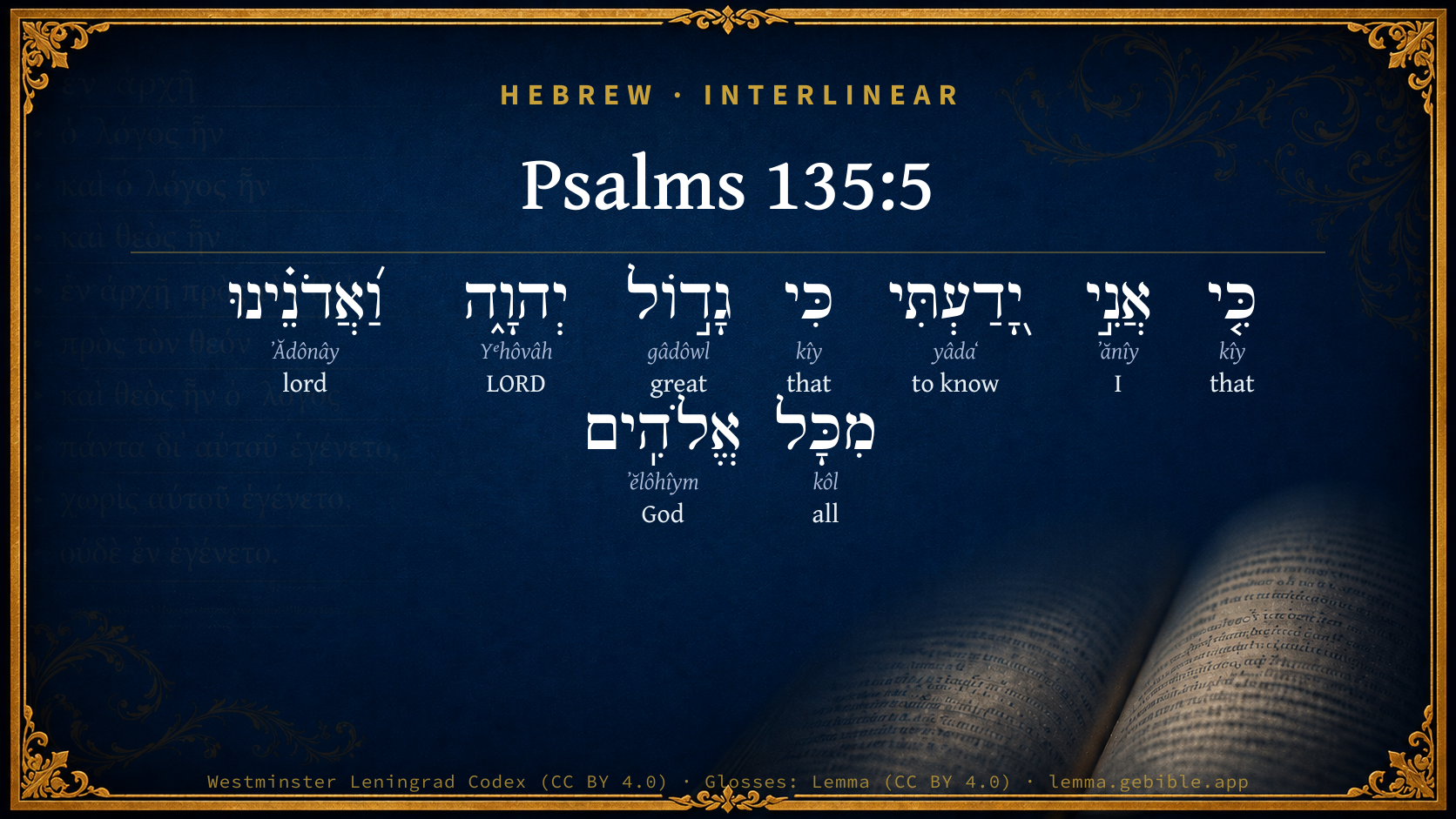
Psalms 135:5

Hebrew (Westminster Leningrad Codex) Psalms 135:5 appears in the Hebrew Old Testament. The text above is from the Westminster Leningrad Codex. Each word links to its Strong’s number, a concise gloss, and parsing drawn from the Open Scriptures Hebrew Bible morphology. Click any word for its full Brown-Driver-Briggs (BDB) entry.
Download image
Cite this verse

Psalms 135:5 (World English Bible). Public Domain. Lemma interlinear Bible study tool, https://lemma.gebible.app/v/psalms/135/5.

Show BibTeX & RIS
BibTeX
RIS
English Translation
For I know that Yahweh is great, That our Lord is above all gods.
World English Bible · Public Domain
Download a study sheet

One document with this verse’s original text, its word-by-word gloss line, the meaning frame, cross-references with their text, attributed commentary, and full source and license credits — printable, and it pastes into notes with its structure intact.

This verse Autodidact and up

Study sheet (.html) Plain text (.txt)

A passage Seminary Student

Up to 50 verses in one chapter. A passage sheet keeps up to 6 commentary sources and 12 cross-references per verse, in the order this page ranks them, and says so on the sheet whenever that leaves anything out. Ask for a single verse and you get the Autodidact verse sheet above.

Everything on this page stays free to read, with no account — the sheet is a download of what is already on screen, not access to it.

Want to remove ads? Support Godless Engineer
Compare translations 3

The same verse in 3 English versions, stacked beneath the original-language interlinear above. Click any original word for its lexicon entry.

Each is an independent rendering of the whole verse — the interlinear is not word-aligned to these translations.

Highlighted words mark where these versions differ — a whole-verse word diff, not a word-by-word alignment.

  • World English Bible Public Domain
    For I know that Yahweh is great, That our Lord is above all gods.
  • King James Version Public Domain
    For I know that the LORD is great, and that our Lord is above all gods.
  • unfoldingWord Literal Text CC BY-SA 4.0
    For I, I know that Yahweh great, and our Lord than all gods.

unfoldingWord Literal Text — © unfoldingWord, licensed CC BY-SA 4.0. Word-aligned USFM3 via Door43 (git.door43.org/unfoldingWord/en_ult).

Versions to compare (up to 4)

3 of 4 selected

Show all 17 translations

Every available English version of this verse, each an independent rendering of the whole verse.

  • World English Bible Public Domain
    For I know that Yahweh is great, That our Lord is above all gods.
  • Berean Standard Bible Public Domain
    For I know that the LORD is great; our Lord is above all gods.
  • Majority Standard Bible Public Domain
    For I know that the LORD is great; our Lord is above all gods.
  • King James Version Public Domain
    For I know that the LORD is great, and that our Lord is above all gods.
  • American Standard Version (1901) Public Domain
    For I know that Jehovah is great, And that our Lord is above all gods.
  • Revised Version (1885) Public Domain
    For I know that the LORD is great, and that our Lord is above all gods.
  • Geneva Bible (1599) Public Domain
    For I know that the Lord is great, and that our Lord is aboue all gods.
  • Young's Literal Translation Public Domain
    For I have known that great `is' Jehovah, Yea, our Lord `is' above all gods.
  • Literal Standard Version CC BY-SA 4.0
    For I have known that YHWH [is] great, || Indeed, our Lord [is] above all gods.
  • Unlocked Literal Bible CC BY-SA 4.0
    I know that Yahweh is great, that our Lord is above all gods.
  • unfoldingWord Literal Text CC BY-SA 4.0
    For I, I know that Yahweh great, and our Lord than all gods.
  • Darby Bible Public Domain
    For *I* know that Jehovah is great, and our Lord is above all gods.
  • World Messianic Bible Public Domain
    For I know that the LORD is great, that our Lord is above all gods.
  • Webster's Bible Public Domain
    For I know that the LORD is great, and that our Lord is above all gods.
  • Free Bible Version CC BY-SA 4.0
    I know how great the Lord is—our Lord is greater than all gods.
  • Bible in Basic English Public Domain
    I know that the Lord is great, and that our Lord is greater than all other gods.
  • JPS Tanakh (1917) Public Domain
    For I know that the LORD is great, and that our Lord is above all gods.

Literal Standard Version (2020), Covenant Press — licensed CC BY-SA 4.0. Text via the HelloAO Bible API (eBible.org). Unlocked Literal Bible (unfoldingWord) — licensed CC BY-SA 4.0. Text via the HelloAO Bible API (eBible.org). unfoldingWord Literal Text — © unfoldingWord, licensed CC BY-SA 4.0. Word-aligned USFM3 via Door43 (git.door43.org/unfoldingWord/en_ult). Free Bible Version, Dr. Jonathan Gallagher — licensed CC BY-SA 4.0. Text via the HelloAO Bible API (eBible.org).

Word by word

More ways to search: Search by grammar → Find every occurrence → Compare this word →

Practice this passage: Drill this verse → Learn its vocabulary →

וַ֝אֲדֹנֵ֗ינוּ
ʼĂdônây
H136
“and · Lord · our”
Conjunction + Noun, Common, Masculine, Plural, Construct + Suffix, Personal, 1st Person, Common, Plural
Part of Speech
Conjunction + Noun
Type
Common
Gender
Masculine
Number
Plural
State
Construct
Full BDB Definition

Origin: am emphatic form of H113

TWOT: 27b

my lord, lord - of men - of God - Lord - title, spoken in place of Yahweh in Jewish display of reverence
  1. כִּ֤י kîy H3588 “that” Conjunction
  2. אֲנִ֣י ʼănîy H589 “I” Pronoun, Personal, 1st Person, Common, Singular
  3. יָ֭דַעְתִּי yâdaʻ H3045 “to know” Verb, Qal, Perfect, 1st Person, Common, Singular
  4. כִּי kîy H3588 “that” Conjunction
  5. גָד֣וֹל gâdôwl H1419 “great” Adjective, Adjective, Masculine, Singular, Absolute
  6. יְהוָ֑ה Yᵉhôvâh H3068 “LORD” Noun, Proper
  7. מִכָּל kôl H3605 “from · all of” Preposition + Noun, Common, Masculine, Singular, Construct
  8. אֱלֹהִֽים ʼĕlôhîym H430 “God(s)” Noun, Common, Masculine, Plural, Absolute

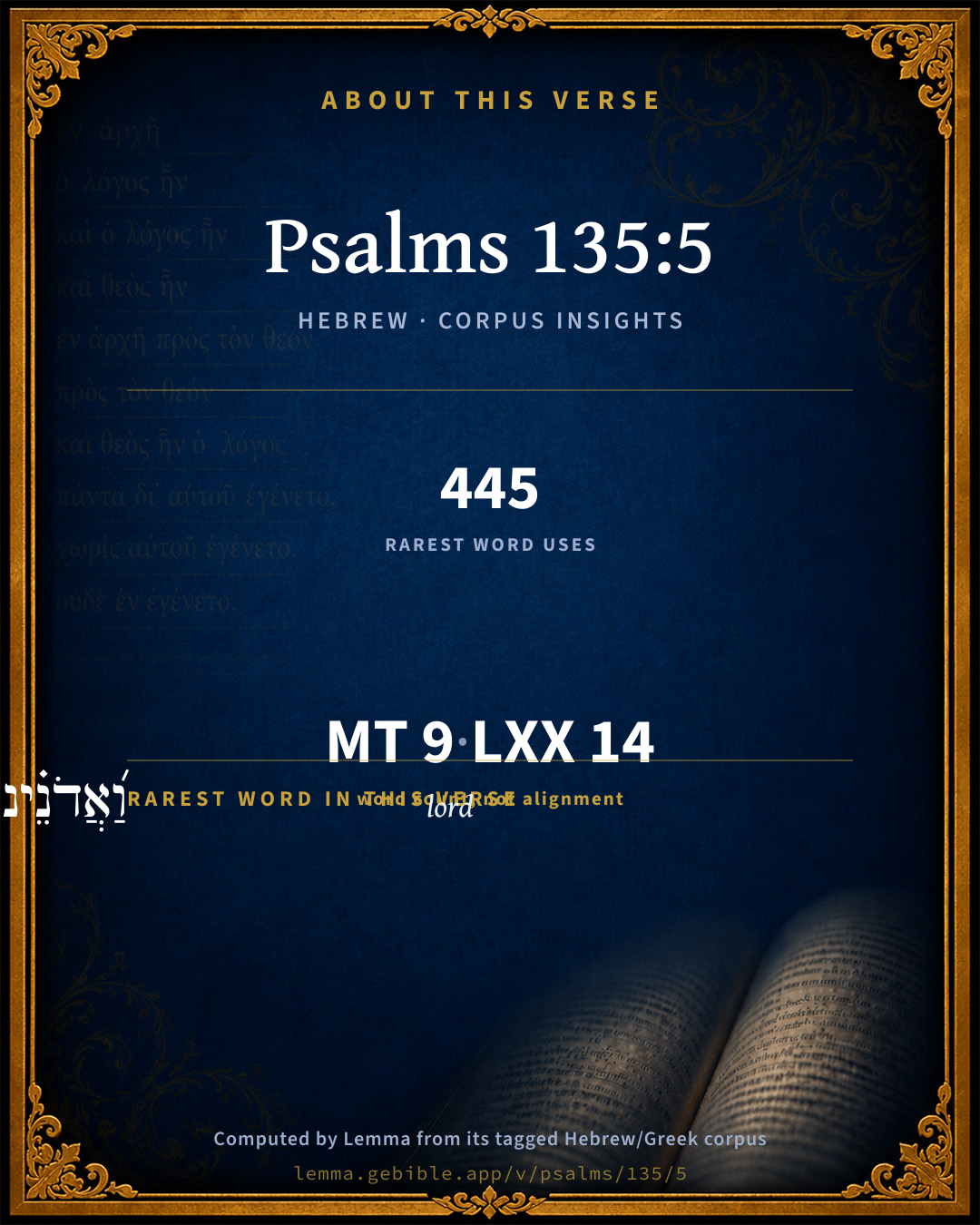
About this verse

These counts appear in no published source. They are computed here, from the morphology-tagged text and Lemma’s own curated glosses. What Lemma adds →

9
words
8
distinct lemmas
Wisdom
section

Grammatical profile

  • 1 verb
  • 4 nouns
  • 1 adjective
  • 1 pronoun
  • 2 conjunctions

Verb forms

  • יָ֭דַעְתִּי Qal · Perfect

Repetition

A word recurs within this verse — often emphatic in Hebrew:

  • כִּ֤י that H3588 ×2

Hebrew & Septuagint length

In English translation the verse runs 14 words from the Hebrew and 15 from the Septuagint (LXX English) — closely comparable.

A rough comparison of the two English renderings, which tokenize alike — not a word-level alignment.

Word counts can differ between the Hebrew and the Greek without any difference in meaning — e.g. the Hebrew direct-object marker אֵת has no separate Greek word, and Greek often adds the article ὁ.

In the original languages it is 9 Hebrew tokens and 14 Greek tokens — but the two are counted differently (Hebrew bundles its prefixes and suffixes into one token; the Greek is in lemma form), so that isn’t a like-for-like length.

Cross-references

12

Topical passages linked to Psalms 135:5 in the Treasury of Scripture Knowledge — connected by theme and wording, ordered by reader-vote popularity; previews shown in the World English Bible.

  • Psalms 95:3 For Yahweh is a great God, A great King above all gods.
  • Deuteronomy 10:17 For Yahweh your God, he is God of gods, and Lord of lords, the great God, the mighty, and the awesome, who doesn't regard persons, nor takes reward.
  • Psalms 48:1 Great is Yahweh, and greatly to be praised, In the city of our God, in his holy mountain.
  • Psalms 97:9 For you, Yahweh, are most high above all the earth. You are exalted far above all gods.
  • Psalms 86:8–10 There is no one like you among the gods, Lord, Nor any deeds like your deeds.
  • Daniel 6:26–27 I make a decree, that in all the dominion of my kingdom men tremble and fear before the God of Daniel; for he is the living God, and steadfast forever, His kingdom that which shall not be destroyed; and his dominion shall be even to the end.
  • Psalms 89:6 For who in the skies can be compared to Yahweh? Who among the sons of the heavenly beings is like Yahweh,
  • Psalms 96:4–5 For great is Yahweh, and greatly to be praised! He is to be feared above all gods.
  • Isaiah 40:22 [It is] he who sits above the circle of the earth, and the inhabitants of it are as grasshoppers; who stretches out the heavens as a curtain, and spreads them out as a tent to dwell in;
  • Isaiah 40:25 To whom then will you liken me, that I should be equal [to him]? says the Holy One.
  • Daniel 3:29 Therefore I make a decree, that every people, nation, and language, which speak anything evil against the God of Shadrach, Meshach, and Abednego, shall be cut in pieces, and their houses shall be made a dunghill; because there is no other god who is able to deliver after this sort.
  • Jeremiah 10:10–11 But Yahweh is the true God; he is the living God, and an everlasting King: at his wrath the earth trembles, and the nations are not able to abide his indignation.

Cross-references courtesy of OpenBible.info (CC BY 4.0).

Hebrew and Greek witnesses Masoretic Hebrew ↔ Greek Septuagint

The same verse in the two great witnesses to the Old Testament, shown verse-for-verse.

You’re reading Greek Psalm 134 (Hebrew Psalm 135). The Septuagint counts the superscription, so verse numbers can differ from the Hebrew — chapter-level alignment, not verse-by-verse. Numbering follows Rahlfs.

These are two independent witnesses, not word-aligned to each other, and the Septuagint is shown in lemma (dictionary) form.

Hebrew Psalms 135:5 Masoretic · Westminster Leningrad Codex

כִּ֤י אֲנִ֣י יָ֭דַעְתִּי כִּי גָד֣וֹל יְהוָ֑ה וַ֝אֲדֹנֵ֗ינוּ מִכָּל אֱלֹהִֽים

For I know that Yahweh is great, That our Lord is above all gods.

World English Bible · Public Domain

Greek LXX Greek Psalm 134:5 Septuagint · lemma form

ὅτι ἐγώ γιγνώσκω ὅτι μέγας κύριος καί ὁ κύριος ἐγώ παρά πᾶς ὁ θεός

For I know that the Lord is great, and our Lord is above all gods;

LXX2012 (modern English Septuagint) · Public Domain

Hebrew: Westminster Leningrad Codex (CC BY 4.0). Greek: Septuagint (public domain); English from LXX2012 (modern English Septuagint) (Public Domain). How the Septuagint differs from the Hebrew →

Commentary

Notes on Psalms 135:5 from classic Christian and Jewish commentators (each source and its license shown beneath its notes). The classic Christian expositions comment on the surrounding passage and are grouped to its opening verse, so a note may address several verses; the Jewish commentaries on the Tanakh (Rashi and others) are per-verse, so they appear only where the commentator wrote on this verse.

Lemma curates 59 commentaries, every one of them public domain or Creative Commons licensed, each selected and text-cleaned for this edition rather than reprinted as found. About our sources →

Matthew Henry's Commentary

The psalmist had suggested to us the goodness of God, as the proper matter of our cheerful praises; here he suggests to us the greatness of God as the proper matter of our awful praises; and on this he is most copious, because this we are less forward to consider.

I. He asserts the doctrine of God's greatness (Psa 135:5): The Lord is great, great indeed, who knows no limits of time or place. He asserts it with assurance, "I know that he is so; know it not only by observation of the proofs of it, but by belief of the revelation of it. I know it; I am sure of it; I know it by my own experience of the divine greatness working on my soul." He asserts it with a holy defiance of all pretenders, though they should join in confederacy against him. He is not only above any god, but above all gods, infinitely above them, between him and them there is no comparison.

II. He proves him to be a great God by the greatness of his power, Psa 135:6. 1. He has an absolute power, and may do what he will: Whatsoever the Lord pleased, that did he, and none could control him, or say unto him, What doest thou? He does what he pleases, because he pleases, and gives not an account of any of his matters. 2. He has an almighty power and can do what he will; if he will work, none shall hinder. 3. This absolute almighty power is of universal extent; he does what he will in heaven, in earth, in the seas, and in all the deep places that are in the bottom of the sea or the bowels of the earth. The gods of the heathen can do nothing; but our God can do any thing and does do every thing.

III. He gives instances of his great power,

1. In the kingdom of nature, Psa 135:7. All the powers of nature prove the greatness of the God of nature, from whom they are derived and on whom they depend. The chain of natural causes was not only framed by him at first, but is still preserved by him. (1.) It is by his power that exhalations are drawn up from the terraqueous globe. The heat of the sun raises them, but it has that power from God, and therefore it is given as an instance of the glory of God that nothing is hidden from the heat of the sun, Psa 19:6. He causes the vapours to ascend (not only unhelped, but unseen, by us) from the earth, from the ends of the earth, that is, from the seas, by which the earth is surrounded. (2.) It is he who, out of those vapours so raised, forms the rain, so that the earth is no loser by the vapours it sends up, for they are returned with advantage in fruitful showers. (3.) Out of the same vapours (such is his wonderful power) he makes lightnings or the rain; by them he opens the bottles of heaven, and shakes the clouds, that they may water the earth. Here are fire and water thoroughly reconciled by divine omnipotence. They come together, and yet the water does not quench the fire, nor the fire lick up the water, as fire from heaven did when God pleased, Kg1 18:38. (4.) The same exhalations, to serve another purpose, are converted into winds, which blow where they list, from what point of the compass they will, and we are so far from directing them that we cannot tell whence they come nor whither they go, but God brings them out of his treasuries with as much exactness and design as a prudent prince orders money to issue out of his exchequer.

2. In the kingdoms of men; and here he mentions the great things God had formerly done for his people Israel, which were proofs of God's greatness as well as of his goodness, and confirmations of the truth of the scriptures of the Old Testament, which began to be written by Moses, the person employed in working those miracles. Observe God's sovereign dominion and irresistible power, (1.) In bringing Israel out of Egypt, humbling Pharaoh by many plagues, and so forcing him to let them go. These plagues are called tokens and wonders, because they came not in the common course of providence, but there was something miraculous in each of them. They were sent upon Pharaoh and all his servants, his subjects; but the Israelites, whom God claimed for his servants, his son, his first-born, his free-born, were exempted from them, and no plague came nigh their dwelling. The death of the first-born both of men and cattle was the heaviest of all the plagues, and that which gained the point. (2.) In destroying the kingdoms of Canaan before them, Psa 135:10. Those that were in possession of the land designed for Israel had all possible advantages for keeping possession. The people were numerous, and warlike, and confederate against Israel. They were great nations. Yet, if a great nation has a meek and mean-spirited prince, it lies exposed; but these great nations had mighty kings, and yet they were all smitten and slain - Sihon and Og, and all the kingdoms of Canaan, Psa 135:10, Psa 135:11. No power of hell or earth can prevent the accomplishment of the promise of God when the time, the set time, for it has come. (3.) In settling them in the land of promise. He that gives kingdoms to whomsoever he pleases gave Canaan to be a heritage to Israel his people. It came to them by inheritance, for their ancestors had the promise of it, though not the possession; and it descended as an inheritance to their seed. This was done long before, yet God is now praised for it; and with good reason, for the children were now enjoying the benefit of it.

IV. He triumphs in the perpetuity of God's glory and grace. 1. Of his glory (Psa 135:13): Thy name, O God! endures for ever. God's manifestations of himself to his people have everlasting fruits and consequences. What God doeth it shall be for ever, Ecc 3:14. His name endures for ever in the constant and everlasting praises of his people; his memorial endures, has endured hitherto, and shall still endure throughout all generations of the church. This seems to refer to Exo 3:15, where, when God had called himself the God of Abraham, Isaac, and Jacob, he adds, This is my name for ever and this is my memorial unto all generations. God is, and will be, always the same to his church, a gracious, faithful, wonder-working God; and his church is, and will be, the same to him, a thankful praising people; and thus his name endures for ever. 2. Of his grace. He will be kind to his people. (1.) He will plead their cause against others that contend with them. He will judge his people, that is, he will judge for them, and will not suffer them to be run down. (2.) He will not himself contend for ever with them, but will repent himself concerning his servants, and not proceed in his controversy with them; he will be entreated for them, or he will be comforted concerning them; he will return in ways of mercy to them and will delight to do them good. This verse is taken from the song of Moses, Deu 32:36.

Matthew Henry's Commentary on the Whole Bible (1708–1710) — public domain (CC PDM 1.0). Text via the HelloAO Bible API.

Trapp's Complete Commentary

John Trapp

Psa 135:5 For I know that the LORD [is] great, and [that] our Lord [is] above all gods.

Ver. 5. For I know that the Lord is great] As well as good, Psa 135:3. This I believe and know, {Joh 6:69} saith the psalmist; and do therefore make it my practice to praise him.

And that our Lord is above all gods] Whether they be so deputed, as magistrates, or reputed, as idols.

John Trapp, A Commentary or Exposition upon All the Books of the Old and New Testament (1647–1656) — public domain. Text from a community e-Sword module.

The Biblical Illustrator

Joseph S. Exell

Psa_135:5

I know that the Lord is great.

A great God

Right views of God lie at the foundation of all right religion. If our views of God are spiritual, scriptural--if they have a sanctifying tendency in our souls--we are right in other things. If we are wrong in this, we are wrong in all things: like the error in the proof-sheet, all goes through wrong. If we are right here, we are at the foundation of all that is right.

I. The greatness of God. God is great. If I look at Him in His being, He is great; if I look at Him in His perfections, He is great; if I look at Him in creation, He is great; if I look at Him in His providence, He is great; if I look at Him in His law, He is great; and still more gloriously does He appear great in the greatness of His Gospel.

II. The certainty which David seemed to feel of this being the truth. I know it, he says. There was a special inspiration, I doubt not; but he was led into the school of holy experience; he knew that God was great; and so does every child of God. He knows that He is great in His regenerating grace. Equally great is the work of revealing Christ. He has given you His Son, He has given you His Spirit, He has given you Himself, He has given you His Word, He has given you His promises, He has given you the foretastes of heaven; and He expects from you the very best that you have, to be given up to Him to be His own, because He is a great God. (J. H. Evans, M. A.)

The Biblical Illustrator, edited by Joseph S. Exell (c. 1880s–1900s) — public domain. Text from a community e-Sword module.

J. A. Alexander on Psalms

Joseph Addison Alexander

5. (Psa 135:5) For I know that great is Jehovah, and our Lord (more) than all Gods. However ignorant the world may be of his superiority, I, the representative of Israel, and as such speaking in his name, know and am assured of the truth from my own observation and experience.

Joseph Addison Alexander, The Psalms Translated and Explained (1850) — public domain. Text from a community e-Sword module.

Tyndale Open Study Notes

Tyndale Open Resources

135:5 The Lord is superior to any real or imagined supernatural being (see 95:3-5; 115:4-8).

Tyndale Open Study Notes — © Tyndale Open Resources, licensed CC BY-SA 4.0. Text via the HelloAO Bible API.

Adam Clarke's Commentary

Verse 5. The Lord is great] Unlimited in his power: another reason.

Is above all gods.] Every class of being, whether idolized or not; because he is the Fountain of existence. This is a fifth reason.

Adam Clarke's Commentary on the Bible (1810–1826) — public domain. Text from a community e-Sword/MySword module.

John Calvin's Commentaries

5. For I know that Jehovah is great We have here a general description of the power of God, to show the Israelites that the God they worshipped was the same who made the world, and rules over all according to his will, neither is there any other besides him. He would not exclude others when he speaks of having known himself the greatness of God, but is rather to be considered as taking occasion from his own experience to stir up men generally to attend to this subject, and awake to the recognition of what lies abundantly open to observation. The immensity of God is what none can comprehend; still his glory, so far as was seen fit, has been sufficiently manifested to leave all the world without excuse for ignorance. How can one who has enjoyed a sight of the heavens and of the earth shut his eyes so as to overlook the Author of them without sin of the deepest dye? It is with the view, then, of stirring us up more effectually, — that the Psalmist makes reference to himself in inviting us to the knowledge of God’s glory; or rather he reprehends our carelessness in not being alive enough to the consideration of it. The second part of the verse makes the truth of the observation which I have already stated still more apparent, — that the Psalmist’s design was to retain the Israelites in the service and fear of the one true God, by a declaration to the effect that the God who covenanted with their Fathers was the same who created heaven and earth, No sooner had he made mention of Jehovah than he adds his being the God of Israel. It follows as a necessary consequence, that all who depart from this God prefer a god who has no claim to the title, and that Jews and Turks, for example, in our own day, are guilty of mere trifling when they pretend to worship God the Creator of the world. Where persons have diverged from the law and from the gospel, any show of piety they may have amounts to a renunciation of the true God. The Psalmist had, therefore, in his eye when he clothed God with a specific title,, to limit the Israelites to that.God who was set forth in the doctrine of the Law. If by אלהים, Elohim, we understand the false gods of the Gentiles — the title is given them only by concession, for it could not be properly assigned to what are mere lying’ vanities; and the meaning is, that God’s greatness altogether eclipses any pretended deity. But the expression would seem to include the angels, as has been already observed, in whom there is some reflection of divinity, as being heavenly principalities and powers, but who are exalted by God, and assigned such a subordinate place as may not interfere with his glory. “Tellement qu’il les embrasse et range en leur ordre, afin que sa grandeur ne soit nullement obscurcie par eux.” — Fr.

John Calvin's Commentaries (1540-1563) — public domain. Text from the Calvin Translation Society English edition (1840s-50s) via the Christian Classics Ethereal Library (ccel.org). Calvin's coverage is partial (roughly two-thirds of the Bible); uncommented books and verses are honest gaps, never fabricated. The 19th-century editor's footnotes and remarks are omitted so the notes are faithfully Calvin's own voice.

Ellicott's Commentary for English Readers

(5, 6) Adapted from Psa_115:3.

A Bible Commentary for English Readers, edited by Charles John Ellicott (1878–1897) — public domain. Text from a community e-Sword module.

The Cambridge Bible for Schools and Colleges

gen. ed. J. J. S. Perowne

5. For I know] A further reason for praising Jehovah. I is emphatic. Though the nations are ignorant of it, Israel in whose name the Psalmist speaks, knows the supreme greatness of Jehovah.

above all gods] It is clear from Psa_135:15 ff. that the Psalmist does not intend by this comparison to imply that the gods of the heathen have any real existence.

5–7. Jehovah’s greatness and sovereignty exhibited in Nature.

The Cambridge Bible for Schools and Colleges (gen. ed. J. J. S. Perowne; Cambridge University Press, 1878–1918) — public domain. Text from a community e-Sword module.

John Gill's Exposition

For I know that the Lord is great,.... Jehovah the Father is great in his perfections; in his power, wisdom, faithfulness, grace, and goodness; and in his works of creation, providence, and grace: and so is Jehovah the Son, who seems chiefly designed, who is called "our Lord" or "Adon" in the next clause; he is great, having the same perfections his Father has; and doing the same works, besides the miracles he wrought here on earth, and the great work of our redemption: he is the great God and our Saviour, and a great Saviour he is; and indeed he is great in all his offices of Prophet, Priest, and King: and so is the blessed Spirit, who is equal to the Father and Son, and greater than he that is in the world. Now all this the psalmist could say from his own knowledge; he knew the Lord was great, from the consideration and meditation of his wondrous works; he knew the greatness of Christ, from the revelation made to him of his person, offices, and grace; he knew the greatness of the divine Spirit, from the inward experience of his upon his heart, as well as from his being divinely inspired by him; and because of this greatness of the Lord, as well as his goodness, he is to be praised; it is mentioned as a reason of it;

and that our Lord is above all gods; the Lord our righteousness; Immanuel, God with us: our Lord, not only by right of creation, but of redemption; he is above all that the Heathens called gods, even the greatest of them; not the idols their hands made only, but the heavens and all the host of them, the sun, moon, and stars; his glory is above them, being the Maker of them, as God; and he is made higher than they, as man and Mediator: he is above civil magistrates, princes, and kings of the earth, called gods, Psa 82:5; he is King of kings, and Lord of lords, he is higher than they; by him they reign, and to him they are accountable; and he is above the angels, sometimes called "Elohim", or gods, Psa 8:5; he has a more excellent name and nature than they; he is the Creator of them, the object of their worship, to whom they minister, whose servants they are; and he is now exalted above them in the human nature, at the right hand of God; see Heb 1:4.

John Gill's Exposition of the Whole Bible (1746–1763) — public domain (CC PDM 1.0). Text via the HelloAO Bible API.

Albert Barnes' Notes on the Bible

For I know - I, as the representative of Israel, and speaking in the, name of the people. This is said as the foundation or the reason for praise. It was the thorough conviction of the psalmist that God was great above all who were claimed to be gods, and that he only was worthy of worship.

That the Lord is great - See the notes at Psa 95:3.

And that our Lord is above all gods - All that are worshipped as gods.

Albert Barnes' Notes on the Bible (1834–1885) — public domain. Text from a community e-Sword/MySword module.

Matthew Poole's English Annotations

Above all that are called

gods, or worshipped as gods by the heathen people. And therefore seeing they commonly praise and extol their idols, it becometh you not to be silent as to the praises of your God.

Matthew Poole's English Annotations on the Holy Bible (1683–1685) — public domain. Text from a community e-Sword/MySword module.

The Treasury of David

Charles H. Spurgeon

Ver. 5. For I know that the LORD is great, and that our Lord is above all gods. The greatness of God is as much a reason for adoration as his goodness, when we are once reconciled to him. God is great positively great comparatively, and great superlatively "above all gods." Of this the Psalmist had an assured personal persuasion. He says positively, "I know." It is knowledge worth possessing. He knew by observation, inspiration, and realization; he was no agnostic, he was certain and clear upon the matter. He not only knows the greatness of Jehovah, but that as the Adonai, or Ruler, "our Lord" is infinitely superior to all the imaginary deities of the heathen, and to all great ones besides.

"Let princes hear, let angels know,

How mean their natures seem;

Those gods on high, and gods below,

When once compared with him."

Many have thought to worship Jehovah, and other gods with him; but this holy man tolerated no such notion. Others have thought to combine their religion with obedience to the unrighteous laws of tyrannical princes; this, also, the sweet singer of Israel denounced; for he regarded the living God as altogether above all men, who as magistrates and princes have been called gods. Observe here the fourth of the five "fors." Ps 135:3-5, 14 contain reasons for praise, each set forth with "for." A fruitful meditation might be suggested by this.

Ver. 5. For I know. The word "I" is made emphatic in the original. Whatever may be the case with others, I have had personal and precious experience of the greatness of Jehovah's power, and of his infinite supremacy above all other gods. The author of the Psalm may either speak for all Israel as a unit, or he may have framed his song so that every worshipper might say this for himself as his own testimony. Henry Cowles.

Ver. 5. For I know that the LORD is great, etc. On what a firm foundation does the Psalmist plant his foot"I know!" One loves to hear men of God speaking in this calm, undoubting, and assured confidence, whether it be of the Lord's goodness or of the Lord's greatness. You may perhaps say, that it required no great stretch of faith or knowledge, or any amount of bravery, to declare that God was great; but I think that not many wise nor mighty had in the Psalmist's days attained unto his knowledge or made his confession, that Jehovah, the God of Israel, was "above all gods." Baal and Chemosh, and Milcom and Dagon, claimed the fealty of the nations round about; and David, in the Court of Achish, would have found his declaration as unwelcome, as it would have been rejected as untrue. Moses once carried a message from Jehovah to the king of Egypt, and his reply was, "Who is the Lord, that I should obey his voice? I know not the Lord; "and even of Jehovah's peculiar treasure, all were not Israel that were of Israel.

There is a knowledge that plays round the head, like lightning on a mountain's summit, that leaves no trace behind; and there is a knowledge that, like the fertilizing stream, penetrates into the very recesses of the heart, and issues forth in all the fruits of holiness, of love, and peace, and joy for evermore. Barton Bouchier.

Ver. 5. I know that the LORD is great.

1. By observing nature and providence.

2. By reading his word.

3. By my own conversion, comfort, and regeneration.

4. By my after experience.

5. By my overpowering communion with him.

Ver. 5. Delicious dogmatism. "I know", etc.

1. What I know.

a) The Lord,

b) That he is great.

c) That he is above all.

2. Why I know it.

a) Because he is "our Lord."

b) By his operations in nature, providence, and grace (Ps 135:6-13).

3. My incorrigible obstinacy in this regard is proof against worshippers of all other gods: which gods are effeminate; without sovereignty; no god, or any god. W. B. H.

Psalms 135:6*

Charles H. Spurgeon's The Treasury of David (1869–1885) — public domain. Psalms only. Text from a community e-Sword/MySword module.

Whedon's Commentary on the Bible

Daniel D. Whedon

5. For I know that the Lord is great—The word “great,” means absolutely supreme, as Psa_135:6 and the whole following argument show. This is advanced as the ground and reason of all praise and adoration. The confident knowledge of this greatness is the language of experience, and is sustained by what follows.

Daniel D. Whedon (gen. ed.), Commentary on the Old and New Testaments (1874–1909) — public domain. Text from a community e-Sword module.

The Pulpit Commentary

For I know that the Lord is great, and that our Lord is above all gods. Here is the second reason why God should be praised he is great, greater far than any other being all gods to be feared than all gods". (Psa_96:4) This greatness is shown, firstly, in his power over nature, which is the subject of vers. 7, 8; and secondly, in his dealings with mankind, which form the subject of vers. 8-12.

The Pulpit Commentary (1880–1919), ed. H.D.M. Spence-Jones & Joseph S. Exell — public domain. Text from a community e-Sword module.

Keil & Delitzsch

C. F. Keil & F. Delitzsch

The praise itself now begins. כּי in Psa 135:4 set forth the ground of the pleasant duty, and the כי that begins this strophe confirms that which warrants the summons out of the riches of the material existing for such a hymn of praise. Worthy is He to be praised, for Israel knows full well that He who hath chosen it is the God of gods. The beginning is taken from Psa 115:3, and Psa 135:7 from Jer 10:13 (Psa 51:16). Heaven, earth, and water are the three kingdoms of created things, as in Exo 20:4. נשׂיא signifies that which is lifted up, ascended; here, as in Jeremiah, a cloud. The meaning of בּרקים למּטר עשׂה is not: He makes lightnings into rain, i.e., resolves them as it were into rain, which is unnatural; but either according to Zac 10:1 : He produces lightnings in behalf of rain, in order that the rain may pour down in consequence of the thunder and lightning, or poetically: He makes lightnings for the rain, so that the rain is announced (Apollinaris) and accompanied by them. Instead of מוצא (cf. Psa 78:16; Psa 105:43), which does not admit of the retreating of the tone, the expression is מוצא, the ground-form of the part. Hiph. for plurals like מחצרים, מחלמים, מעזרים, perhaps not without being influenced by the ויּוצא in Jeremiah, for it is not מוצא from מצא that signifies "producing," but מוציא = מפיק. The metaphor of the treasuries is like Job 38:22. What is intended is the fulness of divine power, in which lie the grounds of the origin and the impulses of all things in nature.

Keil & Delitzsch — Biblical Commentary on the Old Testament (1861–1891) — public domain (CC PDM 1.0). Text via the HelloAO Bible API. (Old Testament only.)

unfoldingWord translationNotes

Door43 World Missions Community

that our Lord is above all gods

"I know that our Lord is above all gods." Being greater than something is spoken of as being above it. AT: "that our Lord is greater than all gods" (See: Metaphor)

translationWords

know

lord

false god

heaven

unfoldingWord translationNotes — © Distant Shores Media and the Door43 World Missions Community, licensed CC BY-SA 4.0. Source: git.door43.org/Door43/en_tn.

Lesson kit

Teaching starters — assembled from the data on this page, not authored interpretation. Every prompt links to the verse data it draws on. Edit before teaching.

Psalms, in the Wisdom, opens this verse with 9 words (8 distinct Hebrew lemmas). Its most distinctive word is ʼĂdônây (“lord”). A historical commentator’s framing appears above. Read the whole chapter for the surrounding context.

Discussion questions

  1. The word ʼĂdônây carries the sense “lord.” How does it shape the verse?
  2. Psalms 95:3 shares this passage’s theme. How do the two illuminate each other?
  3. “that” occurs 2× in this one verse. What is the effect of the repetition?
  4. The translations on this page render this verse differently — a whole-verse word diff, not a word-by-word alignment. What might account for the different wordings?
  5. The verb «יָ֭דַעְתִּי» is Qal Perfect. How does its form color the action?
  6. Reading how Matthew Henry's Commentary and Trapp's Complete Commentary read this verse, where do the two commentators agree and where do they part?

Things to notice

Reading settings

Reading text

Shown beneath each verse's original-language words.

Old Testament
Old Testament edition

Read the OT as the Masoretic Hebrew (MT) or the Greek Septuagint (LXX).

English shown for the Greek Septuagint (in the Hebrew ↔ Greek comparison).

Comparing translations? Open the Compare panel on any verse page to stack up to four side by side.