
Psalms 57:9

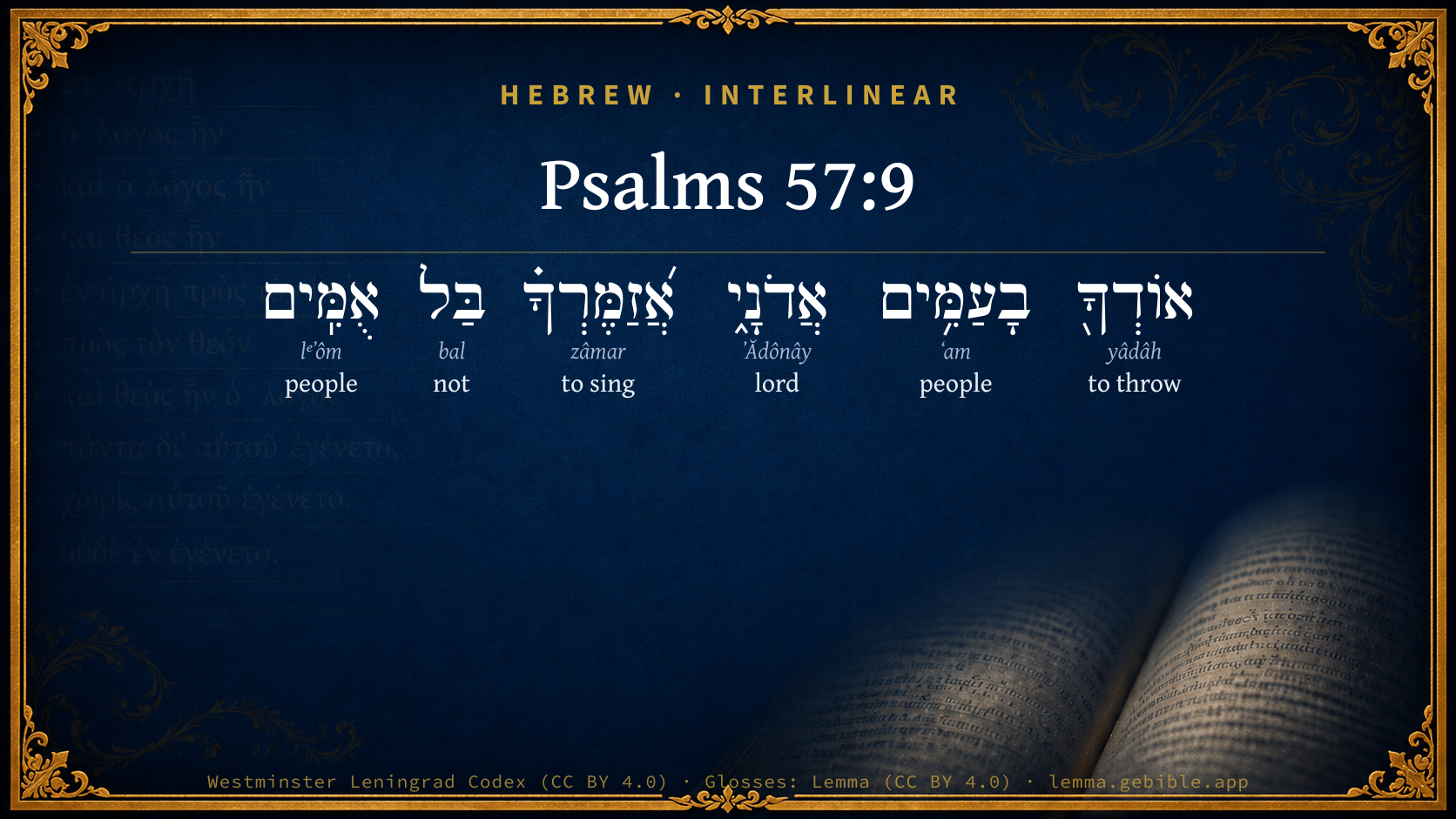
Hebrew (Westminster Leningrad Codex) Psalms 57:9 appears in the Hebrew Old Testament. The text above is from the Westminster Leningrad Codex. Each word links to its Strong’s number, a concise gloss, and parsing drawn from the Open Scriptures Hebrew Bible morphology. Click any word for its full Brown-Driver-Briggs (BDB) entry.
Download image
Cite this verse

Psalms 57:9 (World English Bible). Public Domain. Lemma interlinear Bible study tool, https://lemma.gebible.app/v/psalms/57/9.

Show BibTeX & RIS
BibTeX
RIS
English Translation
I will give thanks to you, Lord, among the peoples. I will sing praises to you among the nations.
World English Bible · Public Domain
Download a study sheet

One document with this verse’s original text, its word-by-word gloss line, the meaning frame, cross-references with their text, attributed commentary, and full source and license credits — printable, and it pastes into notes with its structure intact.

This verse Autodidact and up

Study sheet (.html) Plain text (.txt)

A passage Seminary Student

Up to 50 verses in one chapter. A passage sheet keeps up to 6 commentary sources and 12 cross-references per verse, in the order this page ranks them, and says so on the sheet whenever that leaves anything out. Ask for a single verse and you get the Autodidact verse sheet above.

Everything on this page stays free to read, with no account — the sheet is a download of what is already on screen, not access to it.

Want to remove ads? Support Godless Engineer
Compare translations 3

The same verse in 3 English versions, stacked beneath the original-language interlinear above. Click any original word for its lexicon entry.

Each is an independent rendering of the whole verse — the interlinear is not word-aligned to these translations.

Highlighted words mark where these versions differ — a whole-verse word diff, not a word-by-word alignment.

  • World English Bible Public Domain
    I will give thanks to you, Lord, among the peoples. I will sing praises to you among the nations.
  • King James Version Public Domain
    I will praise thee, O Lord, among the people: I will sing unto thee among the nations.
  • unfoldingWord Literal Text CC BY-SA 4.0
    I will thank you, Lord, among the peoples; I will make music to you among the nations.

unfoldingWord Literal Text — © unfoldingWord, licensed CC BY-SA 4.0. Word-aligned USFM3 via Door43 (git.door43.org/unfoldingWord/en_ult).

Versions to compare (up to 4)

3 of 4 selected

Show all 18 translations

Every available English version of this verse, each an independent rendering of the whole verse.

  • World English Bible Public Domain
    I will give thanks to you, Lord, among the peoples. I will sing praises to you among the nations.
  • Berean Standard Bible Public Domain
    I will praise You, O Lord, among the nations; I will sing Your praises among the peoples.
  • Majority Standard Bible Public Domain
    I will praise You, O Lord, among the nations; I will sing Your praises among the peoples.
  • King James Version Public Domain
    I will praise thee, O Lord, among the people: I will sing unto thee among the nations.
  • American Standard Version (1901) Public Domain
    I will give thanks unto thee, O Lord, among the peoples: I will sing praises unto thee among the nations.
  • Revised Version (1885) Public Domain
    I will give thanks unto thee, O Lord, among the peoples: I will sing praises unto thee among the nations.
  • Geneva Bible (1599) Public Domain
    I will prayse thee, O Lord, among the people, and I wil sing vnto thee among the nations.
  • Douay-Rheims (1899) Public Domain
    Arise, O my glory, arise psaltery and harp: I will arise early.
  • Young's Literal Translation Public Domain
    I thank Thee among the peoples, O Lord, I praise Thee among the nations.
  • Literal Standard Version CC BY-SA 4.0
    I thank You among the peoples, O Lord, || I praise You among the nations.
  • Unlocked Literal Bible CC BY-SA 4.0
    I will give thanks to you, Lord, among the peoples; I will sing praises to you among the nations.
  • unfoldingWord Literal Text CC BY-SA 4.0
    I will thank you, Lord, among the peoples; I will make music to you among the nations.
  • Darby Bible Public Domain
    I will give thee thanks among the peoples, O Lord; of thee will I sing psalms among the nations:
  • World Messianic Bible Public Domain
    I will give thanks to you, Lord, among the peoples. I will sing praises to you among the nations.
  • Webster's Bible Public Domain
    \\57:8\\Awake, my glory; awake, psaltery and harp: I myself will awake early.
  • Free Bible Version CC BY-SA 4.0
    I will thank you among the peoples, Lord; I will sing your praises among the nations.
  • Bible in Basic English Public Domain
    I will give you praise, O Lord, among the peoples; I will make songs to you among the nations.
  • JPS Tanakh (1917) Public Domain
    (57-10) I will give thanks unto Thee, O Lord, among the peoples; I will sing praises unto Thee among the nations.

Literal Standard Version (2020), Covenant Press — licensed CC BY-SA 4.0. Text via the HelloAO Bible API (eBible.org). Unlocked Literal Bible (unfoldingWord) — licensed CC BY-SA 4.0. Text via the HelloAO Bible API (eBible.org). unfoldingWord Literal Text — © unfoldingWord, licensed CC BY-SA 4.0. Word-aligned USFM3 via Door43 (git.door43.org/unfoldingWord/en_ult). Free Bible Version, Dr. Jonathan Gallagher — licensed CC BY-SA 4.0. Text via the HelloAO Bible API (eBible.org).

Word by word

More ways to search: Search by grammar → Find every occurrence → Compare this word →

Practice this passage: Drill this verse → Learn its vocabulary →

About this verse

These counts appear in no published source. They are computed here, from the morphology-tagged text and Lemma’s own curated glosses. What Lemma adds →

6
words
6
distinct lemmas
Wisdom
section

Shared distinctive vocabulary

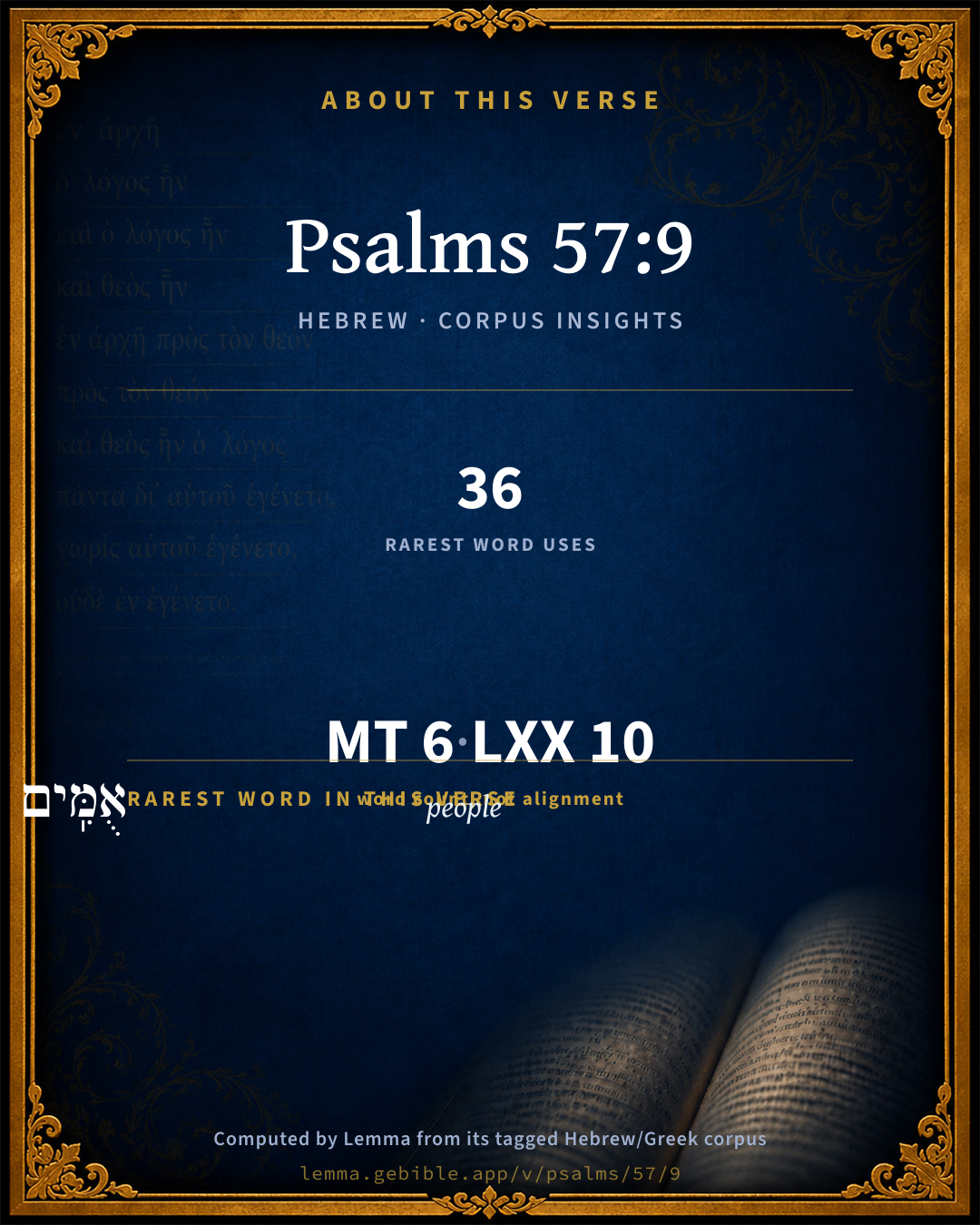
אֻמִּֽים people H3816 occurs in 31 verses of the Hebrew Bible. Also found in:

Grammatical profile

  • 2 verbs
  • 3 nouns
  • 1 particle

Verb forms

  • אוֹדְךָ֖ Hiphil · Imperfect
  • אֲ֝זַמֶּרְךָ֗ Piel · Imperfect

Hebrew & Septuagint length

In English translation the verse runs 19 words from the Hebrew and 19 from the Septuagint (LXX English) — the same length.

A rough comparison of the two English renderings, which tokenize alike — not a word-level alignment.

Word counts can differ between the Hebrew and the Greek without any difference in meaning — e.g. the Hebrew direct-object marker אֵת has no separate Greek word, and Greek often adds the article ὁ.

In the original languages it is 6 Hebrew tokens and 10 Greek tokens — but the two are counted differently (Hebrew bundles its prefixes and suffixes into one token; the Greek is in lemma form), so that isn’t a like-for-like length.

Cross-references

8

Topical passages linked to Psalms 57:9 in the Treasury of Scripture Knowledge — connected by theme and wording, ordered by reader-vote popularity; previews shown in the World English Bible.

  • Psalms 18:49 Therefore I will give thanks to you, Yahweh, among the nations, And will sing praises to your name.
  • Psalms 22:22–23 I will declare your name to my brothers. In the midst of the assembly, I will praise you.
  • Psalms 96:3 Declare his glory among the nations, His marvelous works among all the peoples.
  • Psalms 138:1 I will give you thanks with my whole heart. Before the gods, I will sing praises to you.
  • Psalms 138:4–5 All the kings of the earth will give you thanks, Yahweh, For they have heard the words of your mouth.
  • Psalms 2:1 Why do the nations rage, And the peoples plot a vain thing?
  • Romans 15:9 and that the Gentiles might glorify God for his mercy. As it is written, "Therefore will I give praise to you among the Gentiles, And sing to your name."
  • Psalms 145:10–12 All your works will give thanks to you, Yahweh. Your saints will extol you.

Cross-references courtesy of OpenBible.info (CC BY 4.0).

Hebrew and Greek witnesses Masoretic Hebrew ↔ Greek Septuagint

The same verse in the two great witnesses to the Old Testament, shown verse-for-verse.

You’re reading Greek Psalm 56 (Hebrew Psalm 57). The Septuagint counts the superscription, so verse numbers can differ from the Hebrew — chapter-level alignment, not verse-by-verse. Numbering follows Rahlfs.

These are two independent witnesses, not word-aligned to each other, and the Septuagint is shown in lemma (dictionary) form.

Hebrew Psalms 57:9 Masoretic · Westminster Leningrad Codex

אוֹדְךָ֖ בָעַמִּ֥ים אֲדֹנָ֑י אֲ֝זַמֶּרְךָ֗ בַּל אֻמִּֽים

I will give thanks to you, Lord, among the peoples. I will sing praises to you among the nations.

World English Bible · Public Domain

Greek LXX Greek Psalm 56:9 Septuagint · lemma form

ἐκἐγείρω ὁ δόξα ἐγώ ἐκἐγείρω ψαλτήριον καί κιθάρα ἐκἐγείρω ὄρθρος

O Lord, I will give thanks to you among the nations: I will sing to you among the Gentiles.

LXX2012 (modern English Septuagint) · Public Domain

Hebrew: Westminster Leningrad Codex (CC BY 4.0). Greek: Septuagint (public domain); English from LXX2012 (modern English Septuagint) (Public Domain). How the Septuagint differs from the Hebrew →

Commentary

Notes on Psalms 57:9 from classic Christian and Jewish commentators (each source and its license shown beneath its notes). The classic Christian expositions comment on the surrounding passage and are grouped to its opening verse, so a note may address several verses; the Jewish commentaries on the Tanakh (Rashi and others) are per-verse, so they appear only where the commentator wrote on this verse.

Lemma curates 59 commentaries, every one of them public domain or Creative Commons licensed, each selected and text-cleaned for this edition rather than reprinted as found. About our sources →

Trapp's Complete Commentary

John Trapp

Psa 57:9 I will praise thee, O Lord, among the people: I will sing unto thee among the nations.

Ver. 9. I will praise thee, O Lord … among the nations] This was done by Christ calling the Gentiles, Psa 18:49 Rom 15:9.

John Trapp, A Commentary or Exposition upon All the Books of the Old and New Testament (1647–1656) — public domain. Text from a community e-Sword module.

The Biblical Illustrator

Joseph S. Exell

Psa_57:9-11

I will praise Thee, O Lord, among the people.

Exemplary praise

I. Its theme. Mercy and truth.

1. The blessings which flow from them reach to all men.

2. They are worthy of the unreserved confidence of all men.

II. The spirit of its offerer.

1. Strong confidence in God.

2. Fervent gratitude and reverent admiration towards God.

III. Its enthusiasm. Seen in his resolution to praise God--

1. With the noblest powers of his being.

2. With choice instrumental accompaniment.

3. With affectionate zeal.

IV. Its sphere. Universal.

V. Its imperfection (Psa_57:5). Our most reverent and most enthusiastic praise is inadequate to so sublime and glorious a theme. (Anon.)

.

Psa_58:1-11

The Biblical Illustrator, edited by Joseph S. Exell (c. 1880s–1900s) — public domain. Text from a community e-Sword module.

J. A. Alexander on Psalms

Joseph Addison Alexander

10. (Psa 57:9). I will thank thee among the nations, Lord; I will praise thee among the peoples. The divine interposition to be celebrated is so great and glorious as to be entitled to the praises of the whole world. See above, on Psa 18:49.

Joseph Addison Alexander, The Psalms Translated and Explained (1850) — public domain. Text from a community e-Sword module.

Jamieson, Fausset & Brown

Robert Jamieson, A. R. Fausset & David Brown

As His mercy and truth, so shall His praise, fill the universe.

Next: Psalms Chapter 58

Jamieson, Fausset & Brown — Commentary Critical and Explanatory on the Whole Bible (1871) — public domain (CC PDM 1.0). Text via the HelloAO Bible API.

Adam Clarke's Commentary

Verse 9. Among the people] The Israelites.

Among the nations.] The Gentiles at large. A prophecy either relating to the Gospel times, Christ being considered as the Speaker: or a prediction that these Divine compositions should be sung, both in synagogues and in Christian churches, in all the nations of the earth. And it is so: wherever the name of Christ is known, there is David's known also.

Adam Clarke's Commentary on the Bible (1810–1826) — public domain. Text from a community e-Sword/MySword module.

John Calvin's Commentaries

9. I will praise thee, O Lord! among the peoples. As the nations and peoples are here said to be auditors of the praise which he offered, we must infer that David, in the sufferings spoken of throughout the psalm, represented Christ. This it is important to observe, as it proves that our own state and character are set before us in this psalm as in a glass. That the words have reference to Christ’s kingdom, we have the authority of Paul for concluding, (Romans 15:9,) and, indeed, might sufficiently infer in the exercise of an enlightened judgment upon the passage. To proclaim the praises of God to such as are deaf, would be an absurdity much greater than singing them to the rocks and stones; it is therefore evident that the Gentiles are supposed to be brought to the knowledge of God when this declaration of his name is addressed to them. He touches briefly upon what he designed as the sum of his song of praise, when he adds, that the whole world is full of the goodness and truth of God. I have already had occasion to observe, that the order in which these divine perfections are generally mentioned is worthy of attention. It is of his mere goodness that God is induced to promise so readily and so liberally. On the other hand, his faithfulness is commended to our notice, to convince us that he is as constant in fulfilling his promises as he is ready and willing to make them. The Psalmist concludes with a prayer that God would arise, and not suffer his glory to be obscured, or the audacity of the wicked to become intolerable by conniving longer at their impiety. The words, however, may be understood in another sense, as a prayer that God would hasten the calling of the Gentiles, of which he had already spoken in the language of prediction, and illustrate his power by executing not only an occasional judgment in Judea for the deliverance of distressed innocence, but his mighty judgments over the whole world for the subjection of the nations.

John Calvin's Commentaries (1540-1563) — public domain. Text from the Calvin Translation Society English edition (1840s-50s) via the Christian Classics Ethereal Library (ccel.org). Calvin's coverage is partial (roughly two-thirds of the Bible); uncommented books and verses are honest gaps, never fabricated. The 19th-century editor's footnotes and remarks are omitted so the notes are faithfully Calvin's own voice.

The Cambridge Bible for Schools and Colleges

gen. ed. J. J. S. Perowne

9. I will give thanks unto thee, O Lord, among the peoples:

I will make melody unto thee among the nations.

This verse at any rate, it is said, could never have been written by David, and is only really intelligible, if the Psalmist speaks in the name of the nation. But the words are not unsuitable for one who was chosen to be king over a nation which had a special calling in relation to the nations of the world. If the nations were to be brought under the sway of Israel that they might be taught to know Jehovah, it was fitting that they should hear of Jehovah’s faithfulness exhibited in the deliverance of His servant. Cp. Psa_18:49 (with the context); Psa_9:11.

The Cambridge Bible for Schools and Colleges (gen. ed. J. J. S. Perowne; Cambridge University Press, 1878–1918) — public domain. Text from a community e-Sword module.

John Gill's Exposition

I will praise thee, O Lord, among the people,.... Either among the people of Israel, as Aben Ezra, when each of the tribes meet together; and so it denotes the public manner in which he would praise God for his salvation: or among the Gentiles, as the following clause shows;

I will sing unto thee among the nations: the Apostle Paul seems to have reference to this passage in Rom 15:9; which he produces as a proof of the Gentiles glorifying God for his mercy in sending the Gospel among them, and calling them by his grace; by which they appeared to be his chosen and redeemed ones; and in forming them into Gospel churches, among whom his praise was sung: for this supposes something to be done among the Gentiles, which should occasion praise; and here the psalmist represents the Messiah, who in his ministers and members praise God for his wonderful mercy to the Gentile world, as follows.

John Gill's Exposition of the Whole Bible (1746–1763) — public domain (CC PDM 1.0). Text via the HelloAO Bible API.

Albert Barnes' Notes on the Bible

I will praise thee, O Lord, among the people - So great a deliverance as he here hoped for, would make it proper that he should celebrate the praise of God in the most public manner; that he should make his goodness known as far as possible among the nations. See the notes at Psa 18:49.

Albert Barnes' Notes on the Bible (1834–1885) — public domain. Text from a community e-Sword/MySword module.

Matthew Poole's English Annotations

Among the people; in the great congregations; amongst the Israelites of all tribes, who are called by this name, Deu 33:19, and amongst the heathens, as I shall have occasion, as he often had.

Matthew Poole's English Annotations on the Holy Bible (1683–1685) — public domain. Text from a community e-Sword/MySword module.

The Treasury of David

Charles H. Spurgeon

Ver. 9. I will praise thee, O Lord, among the people. Gentiles shall hear my praise. Here is an instance of the way in which the truly devout evangelic spirit overleaps the boundaries which bigotry sets up. The ordinary Jew would never wish the Gentile dogs to hear Jehovah's name, except to tremble at it; but this grace taught psalmist has a missionary spirit, and would spread the praise and fame of his God.

I will sing unto thee among the nations. However far off they may be, I would make them hear of thee through my glad psalmody.

Ver. 9. I will praise thee, O Lord, among the people. The Spirit of God who indited this scripture, made his penman know that the Gentiles should have the use of his Psalms. David Dickson.

Ver. 9. The people--the nations. The Hebrew church was neither called nor qualified to be a missionary society, but it never ceased to desire and hope for the conversion of the nations. This is seen in those passages in which the psalmists betray a consciousness that they shall one day have all the world for auditors. How boldly does David exclaim, I will sing unto thee among the nations. In the same spirit, a later psalmist summons the church to lift up her voice, so that all the nations may hear her recital of the Lord's mighty acts: O give thanks unto the Lord; call upon his name: make known his deeds among the people. Ps 105:1. The full import of this class of texts is often hidden from the English reader by the circumstance that our translators have hardly ever used the word people in its plural form. Twice in the Revelation they venture to write peoples; everywhere else the singular form has to do duty for both numbers; so that in not a few passages the sense is greatly obscured to those who have no access either to the original or to other versions. In the Psalms, in particular, the mention of the Gentiles is more frequent than the English reader is made aware of. It is to be observed, moreover, that in addition to this strain of indirect prediction, the conversion of the world is articulately celebrated in many glorious Psalms. Indeed, so numerous are these, and so generally distributed over the centuries between David and Ezra, that it would seem that at no time during the long history of inspired Psalmody, did the Spirit cease to indite new songs in which the children of Zion might give utterance to their world embracing hopes. William Binnie, D.D., in "The Psalms: their History, Teachings, and Use, "1870.

Ver. 9. Who? I. What? Will praise. Whom? Thee, O Lord. Where? Among the people. Why?

Ver. 9. Public profession.

I. A necessity.

II. A privilege.

III. A duty. R. A. G.

Psalms 57:10*

Charles H. Spurgeon's The Treasury of David (1869–1885) — public domain. Psalms only. Text from a community e-Sword/MySword module.

Whedon's Commentary on the Bible

Daniel D. Whedon

9. People… nations—In each place the original word is the same. The repetition is for emphasis, and the plural (peoples, nations) must be understood of the Gentile nations. David’s deliverance should be so great, and its effects so public and glorious, that the nations around would be led to recognise the hand of God and to fear him. The psalmist suddenly rises to the sublime conception of the triumph of theocratic principles, which is the common stepping stone, as here, for an anticipation of the gathering of the nations by the gospel.

Daniel D. Whedon (gen. ed.), Commentary on the Old and New Testaments (1874–1909) — public domain. Text from a community e-Sword module.

The Pulpit Commentary

I will praise thee, O Lord, among the people (rather, peoples); I will sing unto thee among the nations. The psalmist"s joy is toe great to be confined within any narrower limits than those of the entire earth. He will have his hymn of praise go forth to all "peoples," "nations," and languages. Michaelis notes that his desire has had a full accomplishment.

The Pulpit Commentary (1880–1919), ed. H.D.M. Spence-Jones & Joseph S. Exell — public domain. Text from a community e-Sword module.

John Wesley's Explanatory Notes

The people - Among the Israelites, and among the Heathens, as I shall have occasion.

John Wesley, Explanatory Notes Upon the Whole Bible (1754–1765) — public domain. Text via the GEBible commentary corpus.

unfoldingWord translationNotes

Door43 World Missions Community

For great is your unfailing love, reaching to the heavens ... your faithfulness to the clouds

These two phrases are very similar in meaning. The greatness of God's unfailing love and the greatness of his faithfulness are spoken of as if they could be measured in distance. (See: Parallelism and Metaphor)

For great is your unfailing love, reaching to the heavens

The greatness of God's unfailing love is spoken of as if it could be measured in distance. AT: "Your unfailing love is as great as the distance from the earth to the heavens" (See: Metaphor)

your faithfulness to the clouds

The words "great is your" and "reaching" are understood from the previous phrase. AT: "great is your faithfulness, reaching to the clouds" or "your faithfulness is as great as the distance from the earth to the clouds" (See: Ellipsis and Metaphor)

Be exalted, God, above the heavens

The psalmist is asking God to show that he is exalted. Being exalted above the heavens represents being great. AT: "God, show that you are exalted above the heavens" or "God, show that you are great in the heavens" (See: Metaphor)

may your glory be exalted over all the earth

The psalmist is asking God to show his glory. AT: "show your glory over all the earth"

translationWords

lord

people group

nation

covenant faithfulness

heaven

faithful

exalt

glory

earth

unfoldingWord translationNotes — © Distant Shores Media and the Door43 World Missions Community, licensed CC BY-SA 4.0. Source: git.door43.org/Door43/en_tn.

Rashi

Rabbi Shlomo Yitzchaki (Rashi)

Awaken, my honor and let me not sleep until three hours [of the day have passed], as other kings do.

awaken [me], lyre and harp Awaken me, you lyre and harp hanging on my bed, open to the north side. And as soon as midnight arrived, the north wind would blow on it, and David would get up and engage in Torah.

I will awaken the dawn I awaken the dawn; the dawn does not awaken me.

Rashi on the Tanakh — English translations: “The Judaica Press complete Tanach with Rashi, translated by A. J. Rosenberg” (CC BY 4.0); “Pentateuch with Rashi's commentary by M. Rosenbaum and A.M. Silbermann, 1929-1934” (public domain); “The Metsudah Tanach series, Lakewood, N.J” (CC BY 4.0); and “The Book of Joshua, Metsudah Publications, 1997” (CC BY 4.0). Text via Sefaria.

Lesson kit

Teaching starters — assembled from the data on this page, not authored interpretation. Every prompt links to the verse data it draws on. Edit before teaching.

Psalms, in the Wisdom, opens this verse with 6 words (6 distinct Hebrew lemmas). Its most distinctive word is lᵉʼôm (“people”). A historical commentator’s framing appears above. Read the whole chapter for the surrounding context.

Discussion questions

  1. What does “people” (lᵉʼôm) contribute to the verse as a whole?
  2. How does Genesis 25:23, which shares the word «people», read alongside this verse?
  3. These translations render this verse differently; the difference is in the English rendering, not the original. What questions does that raise?
  4. «אוֹדְךָ֖» is a Hiphil Imperfect verb. How does that grammatical form shape the action described?
  5. Compare how Trapp's Complete Commentary and The Biblical Illustrator read this verse. Where do they agree or differ?

Things to notice

Reading settings

Reading text

Shown beneath each verse's original-language words.

Old Testament
Old Testament edition

Read the OT as the Masoretic Hebrew (MT) or the Greek Septuagint (LXX).

English shown for the Greek Septuagint (in the Hebrew ↔ Greek comparison).

Comparing translations? Open the Compare panel on any verse page to stack up to four side by side.