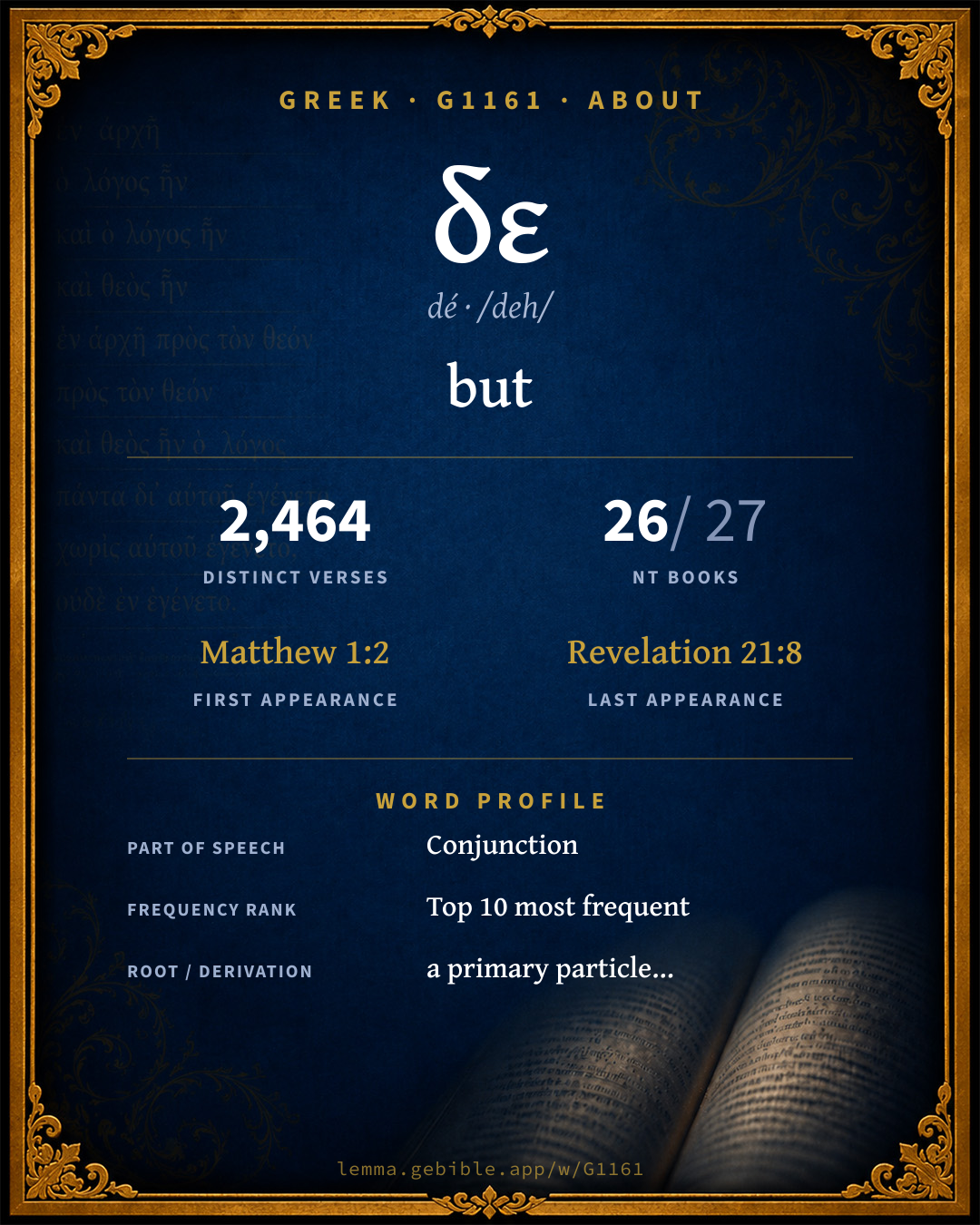
δέ
but
Full lexicon entry — Thayer's Greek Lexicon
From Thayer's Greek Lexicon
Where this word appears
Grammar key — what these labels mean
Part of speech
- Conjunction
- A joining word linking words or clauses.
Page 2 of 3 — showing verses 201–400 of 433 distinct verses where G1161 appears in the Book of Matthew. Click any verse to open its interlinear word-by-word view. Verse text shown in the World English Bible for context — . Each verse’s Greek form is shown with its reference; the English is not keyword-highlighted, since the data carries no word-level English alignment. Use “Compare translations” on any verse to read it across multiple English versions. This concordance covers the Greek New Testament; Septuagint (Greek Old Testament) occurrences of this word are not indexed here.
Matthew
- Matthew 15:20 δὲ conj These are the things which defile the man; but to eat with unwashed hands doesn't defile the man."
- Matthew 15:23 δὲ conj But he answered her not a word. His disciples came and begged him, saying, "Send her away; for she cries after us."
- Matthew 15:24 δὲ conj But he answered, "I wasn't sent to anyone but the lost sheep of the house of Israel."
- Matthew 15:25 δὲ conj But she came and worshiped him, saying, "Lord, help me."
- Matthew 15:26 δὲ conj But he answered, "It is not appropriate to take the children's bread and throw it to the dogs."
- Matthew 15:27 δὲ conj But she said, "Yes, Lord, but even the dogs eat the crumbs which fall from their masters' table."
- Matthew 15:32 δὲ conj Jesus summoned his disciples and said, "I have compassion on the multitude, because they continue with me now three days and have nothing to eat. I don't want to send them away fasting, or they might faint on the way."
- Matthew 15:34 δὲ conj Jesus said to them, "How many loaves do you have?" They said, "Seven, and a few small fish."
- Matthew 15:36 δὲ conj and he took the seven loaves and the fish. He gave thanks and broke them, and gave to the disciples, and the disciples to the multitudes.
- Matthew 15:38 δὲ conj Those who ate were four thousand men, besides women and children.
- Matthew 16:2 δὲ conj But he answered them, "When it is evening, you say, 'It will be fair weather, for the sky is red.'
- Matthew 16:3 δὲ conj In the morning, 'It will be foul weather today, for the sky is red and threatening.' Hypocrites! You know how to discern the appearance of the sky, but you can't discern the signs of the times!
- Matthew 16:6 δὲ conj Jesus said to them, "Take heed and beware of the yeast of the Pharisees and Sadducees."
- Matthew 16:7 δὲ conj They reasoned among themselves, saying, "We brought no bread."
- Matthew 16:8 δὲ conj Jesus, perceiving it, said, "Why do you reason among yourselves, you of little faith, 'because you have brought no bread?'
- Matthew 16:11 δὲ conj How is it that you don't perceive that I didn't speak to you concerning bread? But beware of the yeast of the Pharisees and Sadducees."
- Matthew 16:13 δὲ conj Now when Jesus came into the parts of Caesarea Philippi, he asked his disciples, saying, "Who do men say that I, the Son of Man, am?"
- Matthew 16:14 δὲ δὲ δὲ conj conj conj They said, "Some say John the Baptizer, some, Elijah, and others, Jeremiah, or one of the prophets."
- Matthew 16:15 δὲ conj He said to them, "But who do you say that I am?"
- Matthew 16:16 δὲ conj Simon Peter answered, "You are the Christ, the Son of the living God."
- Matthew 16:17 δὲ conj Jesus answered him, "Blessed are you, Simon Bar Jonah, for flesh and blood has not revealed this to you, but my Father who is in heaven.
- Matthew 16:18 δέ conj I also tell you that you are Peter, and on this rock I will build my assembly, and the gates of Hades will not prevail against it.
- Matthew 16:23 δὲ conj But he turned, and said to Peter, "Get behind me, Satan! You are a stumbling-block to me, for you are not setting your mind on the things of God, but on the things of men."
- Matthew 16:25 δ’ conj For whoever desires to save his life will lose it, and whoever will lose his life for my sake will find it.
- Matthew 16:26 δὲ conj For what will it profit a man, if he gains the whole world, and forfeits his life? Or what will a man give in exchange for his life?
- Matthew 17:2 δὲ conj He was transfigured before them. His face shone like the sun, and his garments became as white as the light.
- Matthew 17:4 δὲ conj Peter answered, and said to Jesus, "Lord, it is good for us to be here. If you want, let's make three tents here: one for you, one for Moses, and one for Elijah."
- Matthew 17:8 δὲ conj Lifting up their eyes, they saw no one, except Jesus alone.
- Matthew 17:11 δὲ conj Jesus answered them, "Elijah indeed comes first, and will restore all things,
- Matthew 17:12 δὲ conj but I tell you that Elijah has come already, and they didn't recognize him, but did to him whatever they wanted to. Even so the Son of Man will also suffer by them."
- Matthew 17:17 δὲ conj Jesus answered, "Faithless and perverse generation! How long will I be with you? How long will I bear with you? Bring him here to me."
- Matthew 17:20 δὲ conj He said to them, "Because of your unbelief. For most assuredly I tell you, if you have faith as a grain of mustard seed, you will tell this mountain, 'Move from here to there,' and it will move; and nothing will be impossible for you.
- Matthew 17:22 δὲ conj While they were staying in Galilee, Jesus said to them, "The Son of Man is about to be delivered up into the hands of men,
- Matthew 17:24 δὲ conj When they had come to Capernaum, those who collected the didrachma coins came to Peter, and said, "Doesn't your teacher pay the didrachma?"
- Matthew 17:26 δέ conj Peter said to him, "From strangers." Jesus said to him, "Therefore the children are exempt.
- Matthew 17:27 δὲ conj But, lest we cause them to stumble, go to the sea, and cast a hook, and take up the first fish that comes up. When you have opened its mouth, you will find a stater coin. Take that, and give it to them for me and you."
- Matthew 18:6 δ’ conj but whoever causes one of these little ones who believe in me to stumble, it would be better for him that a huge millstone should be hung around his neck, and that he should be sunk in the depths of the sea.
- Matthew 18:8 δὲ conj If your hand or your foot causes you to stumble, cut it off, and cast it from you. It is better for you to enter into life maimed or crippled, rather than having two hands or two feet to be cast into the eternal fire.
- Matthew 18:15 δὲ conj "If your brother sins against you, go, show him his fault between you and him alone. If he listens to you, you have gained back your brother.
- Matthew 18:16 δὲ conj But if he doesn't listen, take one or two more with you, that at the mouth of two or three witnesses every word may be established.
- Matthew 18:17 δὲ δὲ conj conj If he refuses to listen to them, tell it to the assembly. If he refuses to hear the assembly also, let him be to you as a Gentile or a tax collector.
- Matthew 18:24 δὲ conj When he had begun to reconcile, one was brought to him who owed him ten thousand talents.
- Matthew 18:25 δὲ conj But because he couldn't pay, his lord commanded him to be sold, with his wife, his children, and all that he had, and payment to be made.
- Matthew 18:27 δὲ conj The lord of that servant, being moved with compassion, released him, and forgave him the debt.
- Matthew 18:28 δὲ conj "But that servant went out, and found one of his fellow servants, who owed him one hundred denarii, and he grabbed him, and took him by the throat, saying, 'Pay me what you owe!'
- Matthew 18:30 δὲ conj He would not, but went and cast him into prison, until he should pay back that which was due.
- Matthew 19:4 δὲ conj He answered, "Haven't you read that he who made them from the beginning made them male and female,
- Matthew 19:8 δὲ conj He said to them, "Moses, because of the hardness of your hearts, allowed you to divorce your wives, but from the beginning it has not been so.
- Matthew 19:9 δὲ conj I tell you that whoever divorces his wife, except for sexual immorality, and marries another, commits adultery; and he who marries her when she is divorced commits adultery."
- Matthew 19:11 δὲ conj But he said to them, "Not all men can receive this saying, but those to whom it is given.
- Matthew 19:13 δὲ conj Then little children were brought to him, that he should lay his hands on them and pray; and the disciples rebuked them.
- Matthew 19:14 δὲ conj But Jesus said, "Allow the little children, and don't forbid them to come to me; for to such belongs the Kingdom of Heaven."
- Matthew 19:17 δὲ δὲ conj conj He said to him, "Why do you call me good? No one is good but one, that is, God. But if you want to enter into life, keep the commandments."
- Matthew 19:18 δὲ conj He said to him, "Which ones?" Jesus said, "'You shall not murder.' 'You shall not commit adultery.' 'You shall not steal.' 'You shall not offer false testimony.'
- Matthew 19:22 δὲ conj But when the young man heard the saying, he went away sad, for he was one who had great possessions.
- Matthew 19:23 δὲ conj Jesus said to his disciples, "Most assuredly I say to you, a rich man will enter into the Kingdom of Heaven with difficulty.
- Matthew 19:24 δὲ conj Again I tell you, it is easier for a camel to go through a needle's eye, than for a rich man to enter into the Kingdom of God."
- Matthew 19:25 δὲ conj When the disciples heard it, they were exceedingly astonished, saying, "Who then can be saved?"
- Matthew 19:26 δὲ δὲ conj conj Looking at them, Jesus said, "With men this is impossible, but with God all things are possible."
- Matthew 19:28 δὲ conj Jesus said to them, "Most assuredly I tell you that you who have followed me, in the regeneration when the Son of Man will sit on the throne of his glory, you also will sit on twelve thrones, judging the twelve tribes of Israel.
- Matthew 19:30 δὲ conj But many will be last who are first; and first who are last.
- Matthew 20:2 δὲ conj When he had agreed with the laborers for a denarius a day, he sent them into his vineyard.
- Matthew 20:5 δὲ δὲ conj conj Again he went out about the sixth and the ninth hour, and did likewise.
- Matthew 20:6 δὲ conj About the eleventh hour he went out, and found others standing idle. He said to them, 'Why do you stand here all day idle?'
- Matthew 20:8 δὲ conj When evening had come, the lord of the vineyard said to his steward, 'Call the laborers and pay them their wages, beginning from the last to the first.'
- Matthew 20:10 δὲ conj When the first came, they supposed that they would receive more; and they likewise each received a denarius.
- Matthew 20:11 δὲ conj When they received it, they murmured against the master of the household,
- Matthew 20:13 δὲ conj "But he answered one of them, 'Friend, I am doing you no wrong. Didn't you agree with me for a denarius?
- Matthew 20:14 δὲ conj Take that which is yours, and go your way. It is my desire to give to this last just as much as to you.
- Matthew 20:21 δὲ conj He said to her, "What do you want?" She said to him, "Command that these, my two sons, may sit, one on your right hand, and one on your left hand, in your Kingdom."
- Matthew 20:22 δὲ conj But Jesus answered, "You don't know what you are asking. Are you able to drink the cup that I am about to drink, and be baptized with the baptism that I am baptized with?" They said to him, "We are able."
- Matthew 20:23 δὲ conj He said to them, "You will indeed drink my cup, and be baptized with the baptism that I am baptized with, but to sit on my right hand and on my left hand is not mine to give; but it is for whom it has been prepared by my Father."
- Matthew 20:24 δὲ conj When the ten heard it, they were indignant with the two brothers.
- Matthew 20:25 δὲ conj But Jesus summoned them, and said, "You know that the rulers of the Gentiles lord it over them, and their great ones exercise authority over them.
- Matthew 20:31 δὲ δὲ conj conj The multitude rebuked them, telling them that they should be quiet, but they cried out even more, "Lord, have mercy on us, you son of David!"
- Matthew 20:34 δὲ conj Jesus, being moved with compassion, touched their eyes; and immediately their eyes received their sight, and they followed him.
- Matthew 21:3 δὲ conj If anyone says anything to you, you shall say, 'The Lord needs them,' and immediately he will send them."
- Matthew 21:4 δὲ conj All this was done, that it might be fulfilled which was spoken through the prophet, saying,
- Matthew 21:6 δὲ conj The disciples went, and did just as Jesus commanded them,
- Matthew 21:8 δὲ δὲ conj conj A very great multitude spread their clothes on the road. Others cut branches from the trees, and spread them on the road.
- Matthew 21:9 δὲ conj The multitudes who went before him, and who followed kept shouting, "Hosanna to the son of David! Blessed is he who comes in the name of the Lord! Hosanna in the highest!"
- Matthew 21:11 δὲ conj The multitudes said, "This is the prophet, Jesus, from Nazareth of Galilee."
- Matthew 21:13 δὲ conj He said to them, "It is written, 'My house shall be called a house of prayer,' but you have made it a den of robbers!"
- Matthew 21:15 δὲ conj But when the chief priests and the scribes saw the wonderful things that he did, and the children who were crying in the temple and saying, "Hosanna to the son of David!" they were indignant,
- Matthew 21:16 δὲ conj and said to him, "Do you hear what these are saying?" Jesus said to them, "Yes. Did you never read, 'Out of the mouth of babes and nursing babies you have perfected praise?'"
- Matthew 21:18 δὲ conj Now in the morning, as he returned to the city, he was hungry.
- Matthew 21:21 δὲ conj Jesus answered them, "Most assuredly I tell you, if you have faith, and don't doubt, you will not only do what is done to the fig tree, but even if you told this mountain, 'Be taken up and cast into the sea,' it would be done.
- Matthew 21:24 δὲ conj Jesus answered them, "I also will ask you one question, which if you tell me, I likewise will tell you by what authority I do these things.
- Matthew 21:25 δὲ conj The baptism of John, where was it from? From heaven or from men?" They reasoned with themselves, saying, "If we say, 'From heaven,' he will ask us, 'Why then did you not believe him?'
- Matthew 21:26 δὲ conj But if we say, 'From men,' we fear the multitude, for all hold John as a prophet."
- Matthew 21:28 δὲ conj But what do you think? A man had two sons, and he came to the first, and said, 'Son, go work today in my vineyard.'
- Matthew 21:29 δὲ conj He answered, 'I will not,' but afterward he changed his mind, and went.
- Matthew 21:30 δὲ δὲ conj conj He came to the second, and said the same thing. He answered, 'I go, sir,' but he didn't go.
- Matthew 21:32 δὲ δὲ conj conj For John came to you in the way of righteousness, and you didn't believe him, but the tax collectors and the prostitutes believed him. When you saw it, you didn't even repent afterward, that you might believe him.
- Matthew 21:34 δὲ conj When the season for the fruit drew near, he sent his servants to the farmers, to receive his fruit.
- Matthew 21:35 δὲ δὲ conj conj The farmers took his servants, beat one, killed another, and stoned another.
- Matthew 21:37 δὲ conj But afterward he sent to them his son, saying, 'They will respect my son.'
- Matthew 21:38 δὲ conj But the farmers, when they saw the son, said among themselves, 'This is the heir. Come, let's kill him, and seize his inheritance.'
- Matthew 21:45 δὲ conj When the chief priests and the Pharisees heard his parables, they perceived that he spoke about them.
- Matthew 22:5 δὲ δὲ conj conj But they made light of it, and went their ways, one to his own farm, another to his merchandise,
- Matthew 22:6 δὲ conj and the rest grabbed his servants, and treated them shamefully, and killed them.
- Matthew 22:7 δὲ conj When the king heard that, he was angry, and he sent his armies, destroyed those murderers, and burned their city.
- Matthew 22:8 δὲ conj "Then he said to his servants, 'The wedding is ready, but those who were invited weren't worthy.
- Matthew 22:11 δὲ conj But when the king came in to see the guests, he saw there a man who didn't have on wedding clothing,
- Matthew 22:12 δὲ conj and he said to him, 'Friend, how did you come in here not wearing wedding clothing?' He was speechless.
- Matthew 22:14 δὲ conj For many are called, but few chosen."
- Matthew 22:18 δὲ conj But Jesus perceived their wickedness, and said, "Why do you test me, you hypocrites?
- Matthew 22:19 δὲ conj Show me the tax money." They brought to him a denarius.
- Matthew 22:25 δὲ conj Now there were with us seven brothers. The first married and died, and having no seed left his wife to his brother.
- Matthew 22:27 δὲ conj After them all, the woman died.
- Matthew 22:29 δὲ conj But Jesus answered them, "You are mistaken, not knowing the Scriptures, nor the power of God.
- Matthew 22:31 δὲ conj But concerning the resurrection of the dead, haven't you read that which was spoken to you by God, saying,
- Matthew 22:34 δὲ conj But the Pharisees, when they heard that he had put the Sadducees to silence, gathered themselves together.
- Matthew 22:37 δὲ conj Jesus said to him, "'You shall love the Lord your God with all your heart, and with all your soul, and with all your mind.'
- Matthew 22:41 δὲ conj Now while the Pharisees were gathered together, Jesus asked them a question,
- Matthew 23:3 δὲ conj All things therefore whatever they tell you to observe, observe and do, but don't do their works; for they say, and don't do.
- Matthew 23:4 δὲ δὲ conj conj For they bind heavy burdens that are grievous to be borne, and lay them on men's shoulders; but they themselves will not lift a finger to help them.
- Matthew 23:5 δὲ conj But all their works they do to be seen by men. They make their phylacteries broad, enlarge the fringes of their garments,
- Matthew 23:6 δὲ conj and love the place of honor at feasts, the best seats in the synagogues,
- Matthew 23:8 δὲ δὲ conj conj But don't you be called 'Rabbi,' for one is your teacher, the Christ, and all of you are brothers.
- Matthew 23:11 δὲ conj But he who is greatest among you will be your servant.
- Matthew 23:12 δὲ conj Whoever exalts himself will be humbled, and whoever humbles himself will be exalted.
- Matthew 23:13 δὲ conj "Woe to you, scribes and Pharisees, hypocrites! For you devour widows' houses, and as a pretense you make long prayers. Therefore you will receive greater condemnation.
- Matthew 23:16 δ’ conj "Woe to you, you blind guides, who say, 'Whoever swears by the temple, it is nothing; but whoever swears by the gold of the temple, he is obligated.'
- Matthew 23:18 δ’ conj 'Whoever swears by the altar, it is nothing; but whoever swears by the gift that is on it, he is obligated.'
- Matthew 23:24 δὲ conj You blind guides, who strain out a gnat, and swallow a camel!
- Matthew 23:25 δὲ conj "Woe to you, scribes and Pharisees, hypocrites! For you clean the outside of the cup and of the platter, but within they are full of extortion and unrighteousness.
- Matthew 23:27 δὲ conj "Woe to you, scribes and Pharisees, hypocrites! For you are like whitened tombs, which outwardly appear beautiful, but inwardly are full of dead men's bones, and of all uncleanness.
- Matthew 23:28 δέ conj Even so you also outwardly appear righteous to men, but inwardly you are full of hypocrisy and iniquity.
- Matthew 24:2 δὲ conj But he answered them, "Don't you see all of these things? Most assuredly I tell you, there will not be left here one stone on another, that will not be thrown down."
- Matthew 24:3 δὲ conj As he sat on the Mount of Olives, the disciples came to him privately, saying, "Tell us, when will these things be? What is the sign of your coming, and of the end of the age?"
- Matthew 24:6 δὲ conj You will hear of wars and rumors of wars. See that you aren't troubled, for all this must happen, but the end is not yet.
- Matthew 24:8 δὲ conj But all these things are the beginning of birth pains.
- Matthew 24:13 δὲ conj But he who endures to the end, the same will be saved.
- Matthew 24:19 δὲ conj But woe to those who are with child and to nursing mothers in those days!
- Matthew 24:20 δὲ conj Pray that your flight will not be in the winter, nor on a Sabbath,
- Matthew 24:22 δὲ conj Unless those days had been shortened, no flesh would have been saved. But for the sake of the chosen ones, those days will be shortened.
- Matthew 24:29 δὲ conj But immediately after the oppression of those days, the sun will be darkened, the moon will not give its light, the stars will fall from the sky, and the powers of the heavens will be shaken;
- Matthew 24:32 δὲ conj "Now from the fig tree learn this parable. When its branch has now become tender, and puts forth its leaves, you know that the summer is near.
- Matthew 24:35 δὲ conj Heaven and earth will pass away, but my words will not pass away.
- Matthew 24:36 δὲ conj But no one knows of that day and hour, not even the angels of heaven, but my Father only.
- Matthew 24:37 δὲ conj "As the days of Noah were, so will be the coming of the Son of Man.
- Matthew 24:43 δὲ conj But know this, that if the master of the house had known in what watch of the night the thief was coming, he would have watched, and would not have allowed his house to be broken into.
- Matthew 24:48 δὲ conj But if that evil servant should say in his heart, 'My lord is delaying his coming,'
- Matthew 24:49 δὲ conj and begins to beat his fellow-servants, and eat and drink with the drunken,
- Matthew 25:2 δὲ conj Five of them were foolish, and five were wise.
- Matthew 25:4 δὲ conj but the wise took oil in their vessels with their lamps.
- Matthew 25:5 δὲ conj Now while the bridegroom delayed, they all slumbered and slept.
- Matthew 25:6 δὲ conj But at midnight there was a cry, 'Behold! The bridegroom is coming! Come out to meet him!'
- Matthew 25:8 δὲ conj The foolish said to the wise, 'Give us some of your oil, for our lamps are going out.'
- Matthew 25:9 δὲ conj But the wise answered, saying, 'What if there isn't enough for us and you? You go rather to those who sell, and buy for yourselves.'
- Matthew 25:10 δὲ conj While they went away to buy, the bridegroom came, and those who were ready went in with him to the marriage feast, and the door was shut.
- Matthew 25:11 δὲ conj Afterward the other virgins also came, saying, 'Lord, Lord, open to us.'
- Matthew 25:12 δὲ conj But he answered, 'Most assuredly I tell you, I don't know you.'
- Matthew 25:15 δὲ δὲ conj conj To one he gave five talents, to another two, to another one; to each according to his own ability. Then he went on his journey.
- Matthew 25:18 δὲ conj But he who received the one went away and dug in the earth, and hid his lord's money.
- Matthew 25:19 δὲ conj "Now after a long time the lord of those servants came, and reconciled accounts with them.
- Matthew 25:24 δὲ conj "He also who had received the one talent came and said, 'Lord, I knew you that you are a hard man, reaping where you did not sow, and gathering where you did not scatter.
- Matthew 25:26 δὲ conj "But his lord answered him, 'You wicked and slothful servant. You knew that I reap where I didn't sow, and gather where I didn't scatter.
- Matthew 25:29 δὲ conj For to everyone who has will be given, and he will have abundance, but from him who has not, even that which he has will be taken away.
- Matthew 25:31 δὲ conj "But when the Son of Man comes in his glory, and all the holy angels with him, then he will sit on the throne of his glory.
- Matthew 25:33 δὲ conj He will set the sheep on his right hand, but the goats on the left.
- Matthew 25:38 δέ conj When did we see you as a stranger, and take you in; or naked, and clothe you?
- Matthew 25:39 δέ conj When did we see you sick, or in prison, and come to you?'
- Matthew 25:46 δὲ conj These will go away into eternal punishment, but the righteous into eternal life."
- Matthew 26:5 δέ conj But they said, "Not during the feast, lest a riot occur among the people."
- Matthew 26:6 δὲ conj Now when Jesus was in Bethany, in the house of Simon the leper,
- Matthew 26:8 δὲ conj But when his disciples saw this, they were indignant, saying, "Why this waste?
- Matthew 26:10 δὲ conj But Jesus, knowing this, said to them, "Why do you trouble the woman? Because she has done a good work for me.
- Matthew 26:11 δὲ conj For you always have the poor with you; but you don't always have me.
- Matthew 26:15 δὲ conj and said, "What are you willing to give me, that I should deliver him to you?" They weighed out for him thirty pieces of silver.
- Matthew 26:17 δὲ conj Now on the first day of unleavened bread, the disciples came to Jesus, saying to him, "Where do you want us to prepare for you to eat the Passover?"
- Matthew 26:18 δὲ conj He said, "Go into the city to a certain person, and tell him, 'The Teacher says, "My time is at hand. I will keep the Passover at your house with my disciples."'"
- Matthew 26:20 δὲ conj Now when evening had come, he was reclining at the table with the twelve disciples.
- Matthew 26:23 δὲ conj He answered, "He who dipped his hand with me in the dish, the same will betray me.
- Matthew 26:24 δὲ conj The Son of Man goes, even as it is written of him, but woe to that man through whom the Son of Man is betrayed! It would be better for that man if he had not been born."
- Matthew 26:25 δὲ conj Judas, who betrayed him, answered, "It isn't me, is it, Rabbi?" He said to him, "You said it."
- Matthew 26:26 δὲ conj As they were eating, Jesus took bread, gave thanks for it, and broke it. He gave to the disciples, and said, "Take, eat; this is my body."
- Matthew 26:29 δὲ conj But I tell you that I will not drink of this fruit of the vine from now on, until that day when I drink it anew with you in my Father's Kingdom."
- Matthew 26:32 δὲ conj But after I am raised up, I will go before you into Galilee."
- Matthew 26:33 δὲ conj But Peter answered him, "Even if all will be made to stumble because of you, I will never be made to stumble."
- Matthew 26:41 δὲ conj Watch and pray, that you don't enter into temptation. The spirit indeed is willing, but the flesh is weak."
- Matthew 26:48 δὲ conj Now he who betrayed him gave them a sign, saying, "Whoever I kiss, he is the one. Seize him."
- Matthew 26:50 δὲ conj Jesus said to him, "Friend, why are you here?" Then they came and laid hands on Jesus, and took him.
- Matthew 26:56 δὲ conj But all this has happened, that the Scriptures of the prophets might be fulfilled." Then all the disciples left him, and fled.
- Matthew 26:57 δὲ conj Those who had taken Jesus led him away to Caiaphas the high priest, where the scribes and the elders were gathered together.
- Matthew 26:58 δὲ conj But Peter followed him from a distance, to the court of the high priest, and entered in and sat with the officers, to see the end.
- Matthew 26:59 δὲ conj Now the chief priests, the elders, and the whole council sought false testimony against Jesus, that they might put him to death;
- Matthew 26:60 δὲ conj and they found none. Even though many false witnesses came forward, they found none. But at last two false witnesses came forward,
- Matthew 26:63 δὲ conj But Jesus held his peace. The high priest answered him, "I adjure you by the living God, that you tell us whether you are the Christ, the Son of God."
- Matthew 26:66 δὲ conj What do you think?" They answered, "He is worthy of death!"
- Matthew 26:67 δὲ conj Then they spit in his face and beat him with their fists, and some slapped him,
- Matthew 26:69 δὲ conj Now Peter was sitting outside in the court, and a maid came to him, saying, "You were also with Jesus, the Galilean!"
- Matthew 26:70 δὲ conj But he denied it before them all, saying, "I don't know what you are talking about."
- Matthew 26:71 δὲ conj When he had gone out onto the porch, someone else saw him, and said to those who were there, "This man also was with Jesus of Nazareth."
- Matthew 26:73 δὲ conj After a little while those who stood by came and said to Peter, "Surely you are also one of them, for your speech makes you known."
- Matthew 27:1 δὲ conj Now when morning had come, all the chief priests and the elders of the people took counsel against Jesus to put him to death:
- Matthew 27:4 δὲ conj saying, "I have sinned in that I betrayed innocent blood." But they said, "What is that to us? You see to it."
- Matthew 27:6 δὲ conj The chief priests took the pieces of silver, and said, "It's not lawful to put them into the treasury, since it is the price of blood."
- Matthew 27:7 δὲ conj They took counsel, and bought the potter's field with them, to bury strangers in.
About this entry
At a glance — auto-summarized from this page’s data, not written by a person. Every figure links to its source below. This summary describes the numbers; it doesn’t interpret them.
δε — transliterated dé — is a Greek conjunction carrying the sense “but.” Its earliest occurrence is Matthew 1:2. It appears 2,464 verses across 26 books of the Greek New Testament, among its most common vocabulary. It shares a root with δη. Each statement above links to its evidence; the full detail follows below.
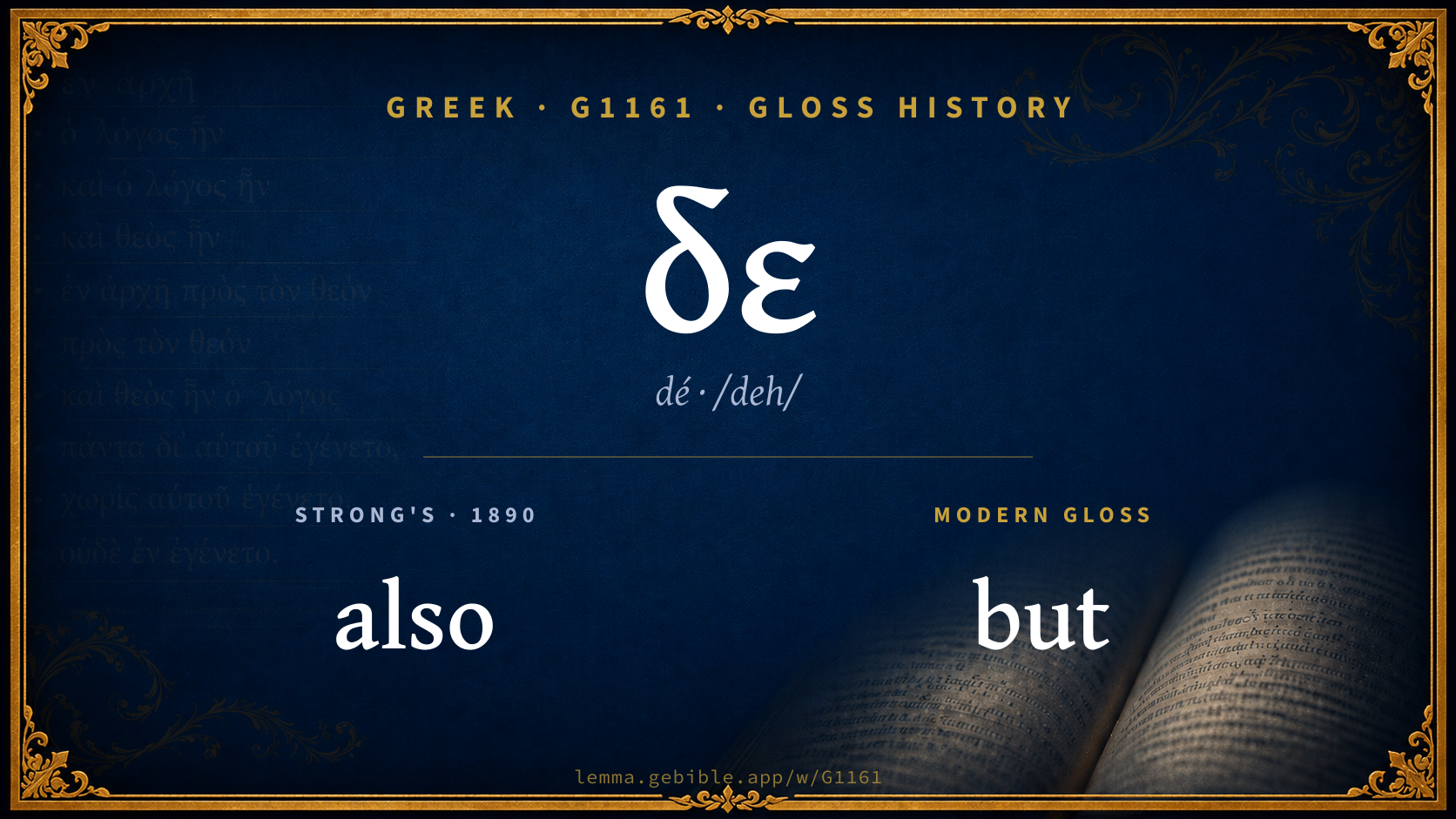
Gloss history
Strong's 1890 vs modern scholarship
About this word
Strong's G1161 catalogs a Greek word from the Greek New Testament.
These counts are not copied from any lexicon or concordance. They are computed here, from the morphology-tagged Greek New Testament. What Lemma adds →
- 2,464
- distinct verses
- The word appears in 2,464 distinct verses.
- 26 / 27
- NT books
- The word appears in 26 of 27 New Testament books.
- #4
- by frequency
- Top 10 most frequent Greek words (rank 4 of 5,347 Greek words by occurrence).
View all 2,464 occurrences in the concordance →
By section of the New Testament
By traditional corpus
Conventional, traditional groupings — biblical authorship is debated, so this is a traditional corpus grouping, not an authorship claim. Some books belong to more than one corpus (Luke is in both the Gospels and the Lukan corpus, and so on), so these shares overlap and need not total 100%. Each figure is a share of the word’s 2,464 distinct verses.
- Gospels 1,258 verses · 51%
- Lukan (Luke–Acts) 971 verses · 39%
- Pauline corpus 547 verses · 22%
- Johannine 211 verses · 9%
- General (Catholic) Epistles 93 verses · 4%
- Hebrews 68 verses · 3%
- Revelation 7 verses · 0%
How translations render this word
Counts come from each version’s own published word-to-Strong’s tagging or interlinear alignment — an approximate guide to how each version renders this word, not a word-level alignment the data otherwise carries. Because each total is that version’s own tagged count, the per-version totals vary from one another and need not match the appearance or distinct-verse counts above. These counts may also differ from a printed concordance because Lemma counts each distinctly tagged rendering and does not collapse phrase taggings into a single head-word total. This is a fixed set of word-tagged versions (KJV, ASV, BSB, ULT) and does not change with the reading translation you choose elsewhere. Each version’s license is shown beside its name below (and on Sources).
- King James Version: And 1,228×, But 929×, Now 166×
- American Standard Version: And 1,179×, But 999×, Now 171×
- Berean Standard Bible: But 784×, And 339×, Now 116×
- unfoldingWord Literal Text: But 1,407×, And 745×, Now 419×
King James Version Public Domain
Renders G1161 across 2,711 tagged occurrences — most commonly:
Plus other, less common renderings. Plus 42 renderings that appear only once — usually multi-word phrases or single function words the recovered tagging swept in, not distinct renderings. Not rendered by a distinct English word in 159 further occurrences.
American Standard Version Public Domain
Renders G1161 across 2,640 tagged occurrences — most commonly:
Plus other, less common renderings. Plus 75 renderings that appear only once — usually multi-word phrases or single function words the recovered tagging swept in, not distinct renderings. Not rendered by a distinct English word in 34 further occurrences.
Berean Standard Bible Public Domain
Renders G1161 across 1,643 tagged occurrences — most commonly:
Plus other, less common renderings. Plus 38 renderings that appear only once — usually multi-word phrases or single function words the recovered tagging swept in, not distinct renderings. Not rendered by a distinct English word in 1,112 further occurrences.
unfoldingWord Literal Text CC BY-SA 4.0
Renders G1161 across 2,802 tagged occurrences — most commonly:
Plus other, less common renderings. Plus 9 renderings that appear only once — usually multi-word phrases or single function words the recovered tagging swept in, not distinct renderings.
Senses in Thayer's
The 1 sense Thayer's distinguishes for this word, in lexicon order (not ranked by frequency or importance). The full entry — with sub-senses — is in the Lexicon Entry tab.
- but, moreover, and, etc.
Word origin
Origin: a primary particle (adversative or continuative)
A primary particle (adversative or continuative); but and etc. : - also and but moreover now [ often unexpressed in English ].
— Strong’s Exhaustive Concordance (1890), public domain.
Forms in the corpus
The 3 distinct written forms G1161 takes in the Greek New Testament, most frequent first — each parse links to that case’s occurrences in the concordance.
| Form | Parsing | Example | Uses |
|---|---|---|---|
| δὲ dè | Conjunction | Matthew 1:2 | 2,602 |
| δέ dé | Conjunction | Matthew 5:31 | 147 |
| δ’ d | Conjunction | Matthew 5:19 | 22 |
Same root — word family
Other Thayer's entries built from the same root as G1161, grouped by Strong’s listed origin. These share a root / origin per the lexicon — not necessarily a shared meaning. Each links to that word’s own entry.
Derived from this word
Compare all same-root words → They share a root, not necessarily a meaning.
Septuagint usage
The same Greek word δε appears 3,556 times in the Greek Old Testament (Septuagint), across 3,042 verses in 35 books.
- 3,556
- LXX occurrences
- Tagged occurrences of this Greek word in the Septuagint.
- 3,042
- verses
- Distinct Septuagint verses containing this word.
- 35 / 39
- OT books
- The word appears in 35 of the 39 Old Testament books.
Sample Septuagint occurrences
- Genesis 1:2 δέ
- Exodus 1:5 δέ
- Leviticus 1:9 δέ
- Numbers 1:47 δέ
- Deuteronomy 4:4 δέ
- Joshua 1:14 δέ
- Judges 1:11 δέ
- Ruth 1:14 δέ
- 1 Samuel 7:17 δέ
- 2 Samuel 3:30 δέ
- 1 Kings 1:17 δέ
- 2 Kings 3:15 δέ
Septuagint occurrences (same lexeme)
Every verse where the same Strong’s number (G1161) appears in the Greek Septuagint — showing the first 50 of 3,042. Verse text shown in the World English Bible for context; the Greek form is the matched word — the English is not keyword-highlighted.
- Genesis 1:2 δέ Now the earth was formless and empty. Darkness was on the surface of the deep. God's Spirit was hovering over the surface of the waters.
- Genesis 2:6 δέ but a mist went up from the earth, and watered the whole surface of the ground.
- Genesis 2:10 δέ A river went out of Eden to water the garden; and from there it was parted, and became four heads.
- Genesis 2:12 δέ and the gold of that land is good. There is aromatic resin and the onyx stone.
- Genesis 2:14 δέ The name of the third river is Hiddekel: this is the one which flows in front of Assyria. The fourth river is the Euphrates.
- Genesis 2:17 δέ but of the tree of the knowledge of good and evil, you shall not eat of it: for in the day that you eat of it you will surely die."
- Genesis 2:20 δέ The man gave names to all cattle, and to the birds of the sky, and to every animal of the field; but for man there was not found a helper suitable for him.
- Genesis 3:1 δέ Now the serpent was more subtle than any animal of the field which Yahweh God had made. He said to the woman, "Yes, has God said, 'You shall not eat of any tree of the garden?'"
- Genesis 3:3 δέ but of the fruit of the tree which is in the midst of the garden, God has said, 'You shall not eat of it, neither shall you touch it, lest you die.'"
- Genesis 3:17 δέ To Adam he said, "Because you have listened to your wife's voice, and have eaten of the tree, of which I commanded you, saying, 'You shall not eat of it,' cursed is the ground for your sake. In toil you will eat of it all the days of your life.
- Genesis 4:1 δέ The man knew Eve his wife. She conceived, and gave birth to Cain, and said, "I have gotten a man with Yahweh's help."
- Genesis 4:2 δέ Again she gave birth, to Cain's brother Abel. Abel was a keeper of sheep, but Cain was a tiller of the ground.
- Genesis 4:5 δέ but he didn't respect Cain and his offering. Cain was very angry, and the expression on his face fell.
- Genesis 4:7 δέ If you do well, will it not be lifted up? If you don't do well, sin crouches at the door. Its desire is for you, but you are to rule over it."
- Genesis 4:9 δέ Yahweh said to Cain, "Where is Abel, your brother?" He said, "I don't know. Am I my brother's keeper?"
- Genesis 4:16 δέ Cain went out from Yahweh's presence, and dwelt in the land of Nod, on the east of Eden.
- Genesis 4:18 δέ To Enoch was born Irad. Irad became the father of Mehujael. Mehujael became the father of Methushael. Methushael became the father of Lamech.
- Genesis 4:22 δέ Zillah also gave birth to Tubal Cain, the forger of every cutting instrument of brass and iron. Tubal Cain's sister was Naamah.
- Genesis 4:23 δέ Lamech said to his wives, "Adah and Zillah, Hear my voice, You wives of Lamech, listen to my speech, For I have slain a man for wounding me, A young man for bruising me.
- Genesis 4:24 δέ If Cain will be avenged seven times, Truly Lamech seventy-seven times."
- Genesis 4:25 δέ Adam knew his wife again. She gave birth to a son, and named him Seth. For, she said, "God has appointed me another child instead of Abel, for Cain killed him."
- Genesis 4:26 δέ There was also born a son to Seth, and he named him Enosh. Then men began to call on Yahweh's name.
- Genesis 5:3 δέ Adam lived one hundred thirty years, and became the father of a son in his own likeness, after his image, and named him Seth.
- Genesis 5:4 δέ The days of Adam after he became the father of Seth were eight hundred years, and he became the father of sons and daughters.
- Genesis 5:6 δέ Seth lived one hundred five years, and became the father of Enosh.
- Genesis 5:22 δέ Enoch walked with God after he became the father of Methuselah three hundred years, and became the father of sons and daughters.
- Genesis 6:2 δέ that God's sons saw that men's daughters were beautiful, and they took for themselves wives of all that they chose.
- Genesis 6:3 δέ Yahweh said, "My Spirit will not strive with man forever, because he also is flesh; yet will his days be one hundred twenty years."
- Genesis 6:4 δέ The Nephilim were in the earth in those days, and also after that, when God's sons came to men's daughters. They bore children to them: the same were the mighty men who were of old, men of renown.
- Genesis 6:5 δέ Yahweh saw that the wickedness of man was great in the earth, and that every imagination of the thoughts of his heart was only evil continually.
- Genesis 6:8 δέ But Noah found favor in Yahweh's eyes.
- Genesis 6:9 δέ This is the history of the generations of Noah. Noah was a righteous man, blameless among the people of his time. Noah walked with God.
- Genesis 6:10 δέ Noah became the father of three sons: Shem, Ham, and Japheth.
- Genesis 6:11 δέ The earth was corrupt before God, and the earth was filled with violence.
- Genesis 6:16 δέ You shall make a roof in the ark, and to a cubit shall you finish it upward. You shall set the door of the ark in the side of it. You shall make it with lower, second, and third levels.
- Genesis 6:17 δέ I, even, I do bring the flood of waters on this earth, to destroy all flesh having the breath of life from under the sky. Everything that is in the earth will die.
- Genesis 6:18 δέ But I will establish my covenant with you. You shall come into the ark, you, your sons, your wife, and your sons' wives with you.
- Genesis 6:21 δέ Take with you of all food that is eaten, and gather it to you; and it will be for food for you, and for them."
- Genesis 7:2 δέ You shall take seven pairs of every clean animal with you, the male and his female. Of the animals that are not clean, take two, the male and his female.
- Genesis 7:6 δέ Noah was six hundred years old when the flood of waters came on the earth.
- Genesis 7:7 δέ Noah went into the ark with his sons, his wife, and his sons' wives, because of the waters of the flood.
- Genesis 7:19 δέ The waters prevailed exceedingly on the earth. All the high mountains that were under the whole sky were covered.
- Genesis 8:5 δέ The waters receded continually until the tenth month. In the tenth month, on the first day of the month, the tops of the mountains were seen.
- Genesis 8:14 δέ In the second month, on the twenty-seventh day of the month, the earth was dry.
- Genesis 9:7 δέ Be fruitful, and multiply. Bring forth abundantly in the earth, and multiply in it."
- Genesis 9:18 δέ The sons of Noah who went forth from the ark were Shem, Ham, and Japheth. Ham is the father of Canaan.
- Genesis 9:24 δέ Noah awoke from his wine, and knew what his youngest son had done to him.
- Genesis 9:28 δέ Noah lived three hundred fifty years after the flood.
- Genesis 10:1 δέ Now this is the history of the generations of the sons of Noah and of Shem, Ham, and Japheth. Sons were born to them after the flood.
- Genesis 10:6 δέ The sons of Ham: Cush, Mizraim, Put, and Canaan.
These are occurrences of the same Greek lexeme (G1161) in the Septuagint — not a translation of any one Hebrew word. The store carries no word-level Hebrew↔Greek alignment, so no Hebrew original is asserted here. Counts come from the recovered LXX Strong's tagging — high-frequency vocabulary is well covered, while rare or late forms may be untagged — so they reflect tagged occurrences and may slightly undercount.