
Matthew 17:2

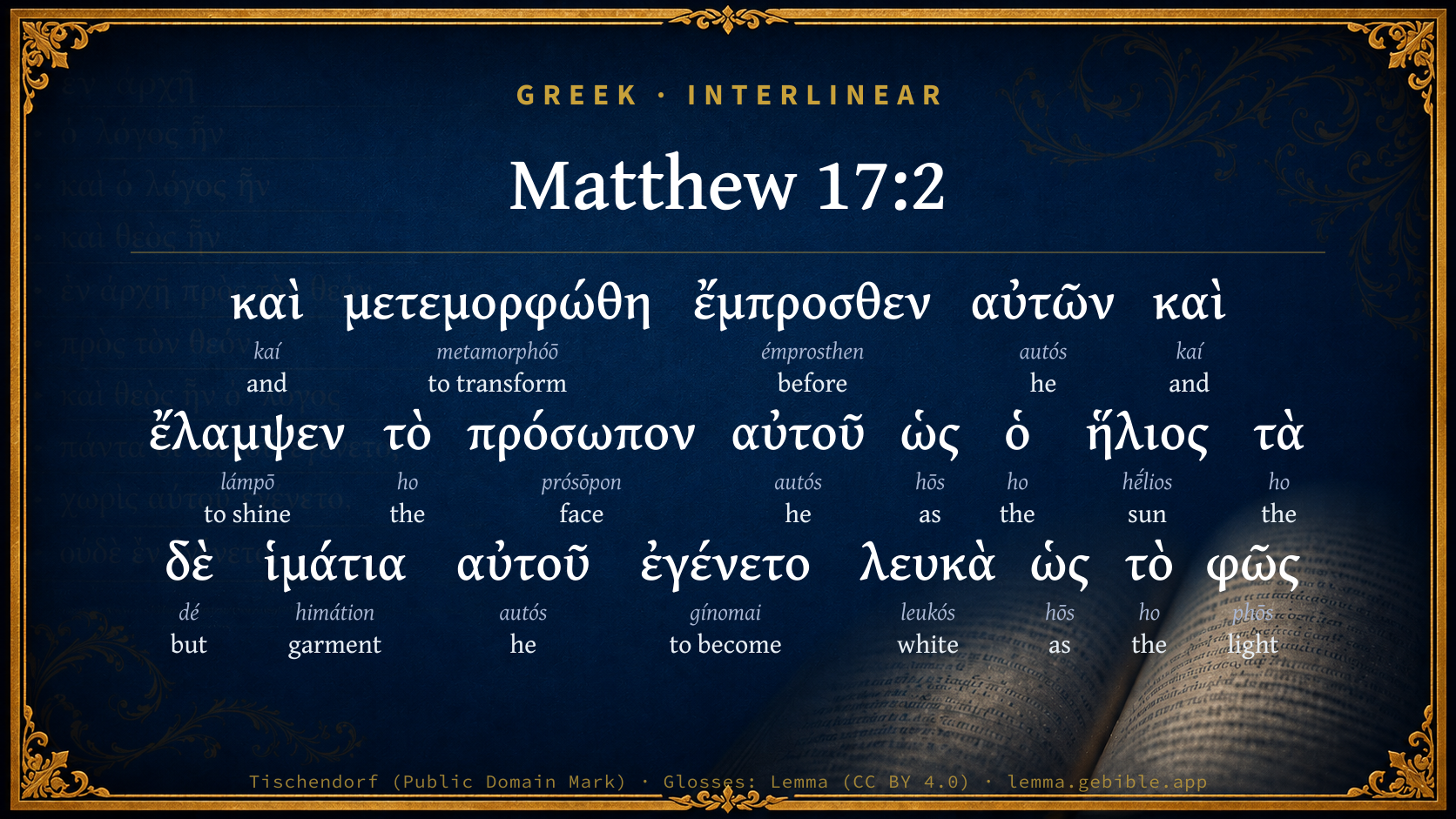
Greek (Tischendorf 8th ed.) Matthew 17:2 appears in the Greek New Testament. The text above is from the Tischendorf 8th edition. Each word links to its Strong’s number and a concise gloss. Click any word for its full Thayer’s Greek Lexicon entry.
Download image
Cite this verse

Matthew 17:2 (World English Bible). Public Domain. Lemma interlinear Bible study tool, https://lemma.gebible.app/v/matthew/17/2.

Show BibTeX & RIS
BibTeX
RIS
English Translation
He was transfigured before them. His face shone like the sun, and his garments became as white as the light.
World English Bible · Public Domain
Highlights
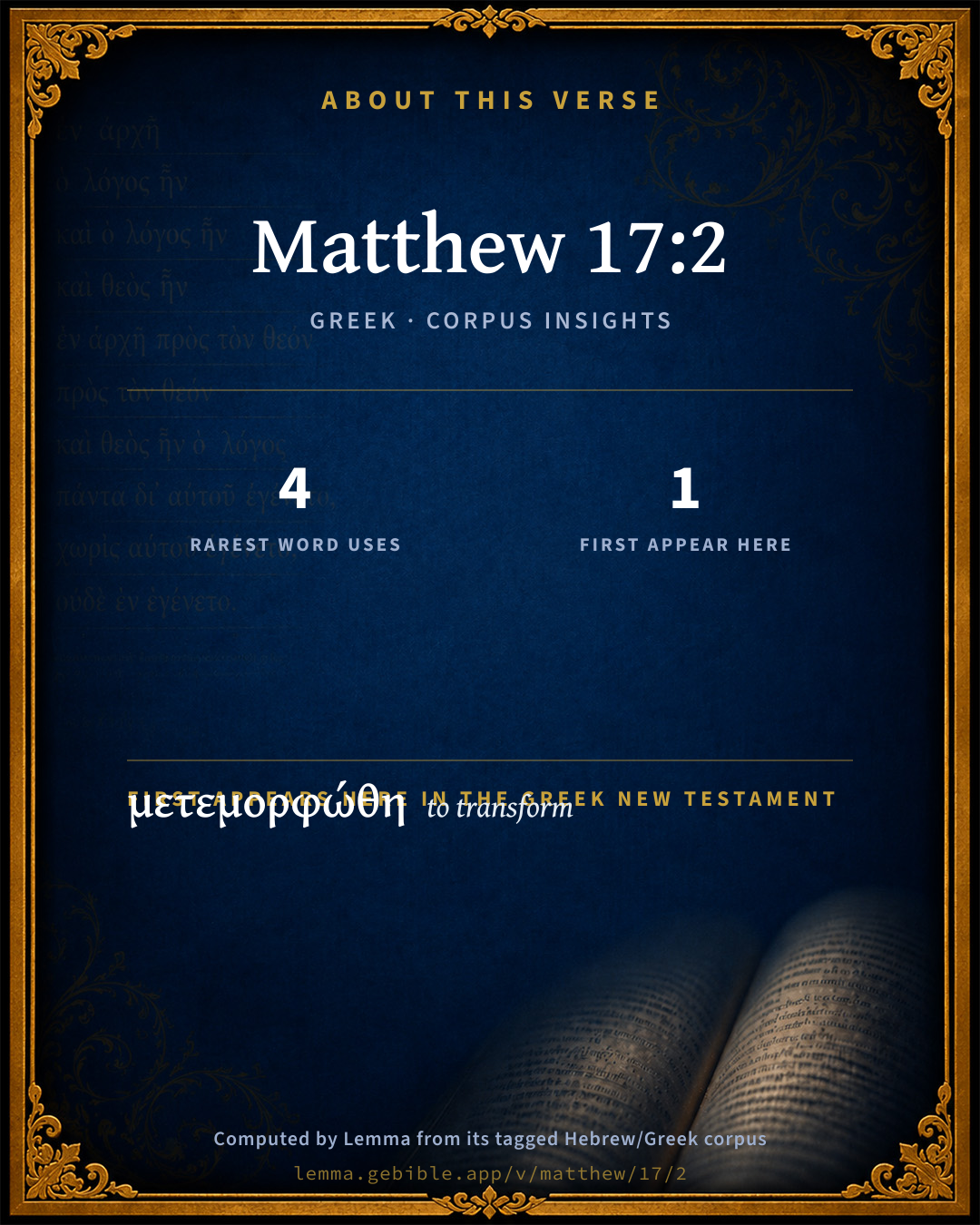
  • 1 first appearance in the Greek New Testament
Full analysis ↓
Download a study sheet

One document with this verse’s original text, its word-by-word gloss line, the meaning frame, cross-references with their text, attributed commentary, and full source and license credits — printable, and it pastes into notes with its structure intact.

This verse Autodidact and up

Study sheet (.html) Plain text (.txt)

A passage Seminary Student

Up to 50 verses in one chapter. A passage sheet keeps up to 6 commentary sources and 12 cross-references per verse, in the order this page ranks them, and says so on the sheet whenever that leaves anything out. Ask for a single verse and you get the Autodidact verse sheet above.

Everything on this page stays free to read, with no account — the sheet is a download of what is already on screen, not access to it.

Want to remove ads? Support Godless Engineer
Compare translations 3

The same verse in 3 English versions, stacked beneath the original-language interlinear above. Click any original word for its lexicon entry.

Each is an independent rendering of the whole verse — the interlinear is not word-aligned to these translations.

Highlighted words mark where these versions differ — a whole-verse word diff, not a word-by-word alignment.

  • World English Bible Public Domain
    He was transfigured before them. His face shone like the sun, and his garments became as white as the light.
  • King James Version Public Domain
    And was transfigured before them: and his face did shine as the sun, and his raiment was white as the light.
  • unfoldingWord Literal Text CC BY-SA 4.0
    And he was transfigured before them, and his face shone as the sun, and his garments became white as the light.

unfoldingWord Literal Text — © unfoldingWord, licensed CC BY-SA 4.0. Word-aligned USFM3 via Door43 (git.door43.org/unfoldingWord/en_ult).

Versions to compare (up to 4)

3 of 4 selected

Show all 19 translations

Every available English version of this verse, each an independent rendering of the whole verse.

  • World English Bible Public Domain
    He was transfigured before them. His face shone like the sun, and his garments became as white as the light.
  • Berean Standard Bible Public Domain
    There He was transfigured before them. His face shone like the sun, and His clothes became as white as the light.
  • Majority Standard Bible Public Domain
    There He was transfigured before them. His face shone like the sun, and His clothes became as white as the light.
  • King James Version Public Domain
    And was transfigured before them: and his face did shine as the sun, and his raiment was white as the light.
  • American Standard Version (1901) Public Domain
    and he was transfigured before them; and his face did shine as the sun, and his garments became white as the light.
  • Revised Version (1885) Public Domain
    and he was transfigured before them: and his face did shine as the sun, and his garments became white as the light.
  • Geneva Bible (1599) Public Domain
    And was transfigured before them: and his face did shine as the Sunne, and his clothes were as white as the light.
  • Douay-Rheims (1899) Public Domain
    And he was transfigured before them. And his face did shine as the sun: and his garments became white as snow.
  • Young's Literal Translation Public Domain
    and he was transfigured before them, and his face shone as the sun, and his garments did become white as the light,
  • Literal Standard Version CC BY-SA 4.0
    and He was transfigured before them, and His face shone as the sun, and His garments became white as the light,
  • Unlocked Literal Bible CC BY-SA 4.0
    He was transfigured before them. His face shone like the sun, and his garments became as brilliant as the light.
  • unfoldingWord Literal Text CC BY-SA 4.0
    And he was transfigured before them, and his face shone as the sun, and his garments became white as the light.
  • Darby Bible Public Domain
    And he was transfigured before them. And his face shone as the sun, and his garments became white as the light;
  • World Messianic Bible Public Domain
    He was changed before them. His face shone like the sun, and his garments became as white as the light.
  • Webster's Bible Public Domain
    And he was transfigured before them: and his face shone as the sun, and his raiment was white as the light.
  • Free Bible Version CC BY-SA 4.0
    He was transformed in front of them. His face was shining like the sun. His clothes turned white as light.
  • Bible in Basic English Public Domain
    And he was changed in form before them; and his face was shining like the sun, and his clothing became white as light.
  • Text-Critical English NT CC BY 4.0
    There he was transfigured before them; his face shone like the sun, and his garments became as white as light.
  • Tyndale New Testament (1534) Public Domain
    and was transfygured before them: and his face did shyne as the sunne and his clothes were as whyte as the light.

Literal Standard Version (2020), Covenant Press — licensed CC BY-SA 4.0. Text via the HelloAO Bible API (eBible.org). Unlocked Literal Bible (unfoldingWord) — licensed CC BY-SA 4.0. Text via the HelloAO Bible API (eBible.org). unfoldingWord Literal Text — © unfoldingWord, licensed CC BY-SA 4.0. Word-aligned USFM3 via Door43 (git.door43.org/unfoldingWord/en_ult). Free Bible Version, Dr. Jonathan Gallagher — licensed CC BY-SA 4.0. Text via the HelloAO Bible API (eBible.org).

Word by word

More ways to search: Search by grammar → Find every occurrence → Compare this word →

Practice this passage: Drill this verse → Learn its vocabulary →

μετεμορφώθη
metamorphóō
G3339
“to transform”
Verb, Aorist, Passive, Indicative, 3rd person, Singular
Part of Speech
Verb
Tense
Aorist
Voice
Passive
Mood
Indicative
Person
3rd person
Number
Singular
Full Thayer's Definition

Origin: from G3326 and G3445

TDNT: 16:35,6

1. to change into another form, to transform, to transfigure a. Christ appearance was changed and was resplendent with divine brightness on the mount of transfiguration
  1. καὶ kaí G2532 “and” Conjunction
  2. ἔμπροσθεν émprosthen G1715 “before” Preposition
  3. αὐτῶν autós G846 “he” Personal pronoun, Genitive, Plural, Masculine
  4. καὶ kaí G2532 “and” Conjunction
  5. ἔλαμψεν lámpō G2989 “to shine” Verb, Aorist, Active, Indicative, 3rd person, Singular
  6. τὸ ho G3588 “the” Article, Nominative, Singular, Neuter
  7. πρόσωπον prósōpon G4383 “face” Noun, Nominative, Singular, Neuter
  8. αὐτοῦ autós G846 “he” Personal pronoun, Genitive, Singular, Masculine
  9. ὡς hōs G5613 “as” Adverb
  10. ὁ ho G3588 “the” Article, Nominative, Singular, Masculine
  11. ἥλιος hḗlios G2246 “sun” Noun, Nominative, Singular, Masculine
  12. τὰ ho G3588 “the” Article, Nominative, Plural, Neuter
  13. δὲ dé G1161 “but” Conjunction
  14. ἱμάτια himátion G2440 “garment” Noun, Nominative, Plural, Neuter
  15. αὐτοῦ autós G846 “he” Personal pronoun, Genitive, Singular, Masculine
  16. ἐγένετο gínomai G1096 “to become” Verb, Aorist, Middle deponent, Indicative, 3rd person, Singular
  17. λευκὰ leukós G3022 “white” Adjective, Nominative, Plural, Neuter
  18. ὡς hōs G5613 “as” Adverb
  19. τὸ ho G3588 “the” Article, Nominative, Singular, Neuter
  20. φῶς phōs G5457 “light” Noun, Nominative, Singular, Neuter

About this verse

These counts appear in no published source. They are computed here, from the morphology-tagged text and Lemma’s own curated glosses. What Lemma adds →

21
words
14
distinct lemmas
Gospels
section

Notable vocabulary

The rarest word here is μετεμορφώθη to transform G3339 — appearing just 4 times in the whole Greek New Testament.

First appearance in Scripture

This word makes its first canonical appearance in the Greek New Testament here:

  • μετεμορφώθη to transform G3339

Shared distinctive vocabulary

μετεμορφώθη to transform G3339 occurs in 4 verses of the Greek New Testament. Also found in:
Repetition

Words recur within this verse:

Cross-references

14

Topical passages linked to Matthew 17:2 in the Treasury of Scripture Knowledge — connected by theme and wording, ordered by reader-vote popularity; previews shown in the World English Bible.

  • Psalms 104:2 He covers himself with light as with a garment. He stretches out the heavens like a curtain.
  • Matthew 28:3 His appearance was like lightning, and his clothing white as snow.
  • Luke 9:29 As he was praying, the appearance of his face was altered, and his clothing became white and dazzling.
  • John 1:14 The Word became flesh, and lived among us. We saw his glory, such glory as of the one and only Son of the Father, full of grace and truth.
  • Revelation 10:1 I saw a mighty angel coming down out of the sky, clothed with a cloud. A rainbow was on his head. His face was like the sun, and his feet like pillars of fire.
  • John 17:24 Father, I desire that they also whom you have given me be with me where I am, that they may see my glory, which you have given me, for you loved me before the foundation of the world.
  • Revelation 20:11 I saw a great white throne, and him who sat on it, from whose face the earth and the heaven fled away. There was found no place for them.
  • Mark 9:3 His clothing became glistening, exceedingly white, like snow, such as no launderer on earth can whiten them.
  • Revelation 19:12–13 His eyes are a flame of fire, and on his head are many crowns. He has names written and a name written which no one knows but he himself.
  • Exodus 34:29–35 It happened, when Moses came down from Mount Sinai with the two tablets of the testimony in Moses' hand, when he came down from the mountain, that Moses didn't know that the skin of his face shone by reason of his speaking with him.
  • Acts 26:13–15 at noon, O King, I saw on the way a light from the sky, brighter than the sun, shining around me and those who traveled with me.
  • Philippians 2:6–7 who, existing in the form of God, didn't consider it robbery to be equal with God,
  • Revelation 1:13–17 And among the lampstands was one like a son of man, clothed with a robe reaching down to his feet, and with a golden sash around his chest.
  • Romans 12:2 Don't be conformed to this world, but be transformed by the renewing of your mind, so that you may prove what is the good, well-pleasing, and perfect will of God.

Cross-references courtesy of OpenBible.info (CC BY 4.0).

Commentary

Notes on Matthew 17:2 from classic Christian and Jewish commentators (each source and its license shown beneath its notes). The classic Christian expositions comment on the surrounding passage and are grouped to its opening verse, so a note may address several verses; the Jewish commentaries on the Tanakh (Rashi and others) are per-verse, so they appear only where the commentator wrote on this verse.

Lemma curates 59 commentaries, every one of them public domain or Creative Commons licensed, each selected and text-cleaned for this edition rather than reprinted as found. About our sources →

Scofield Reference Notes

C. I. Scofield

was transfigured

The transfiguration scene contains, in miniature, all the elements of the future kingdom in manifestation:

(1) the Lord, not in humiliation, but in glory (Mat 17:2).

(2) Moses, glorified, representative of the redeemed who have passed through death into the kingdom. Mat 13:43; Luk 9:30; Luk 9:31.

(3) Elijah, glorified, representative of the redeemed who have entered the kingdom by translation. 1Co 15:50-53; 1Th 4:14-17.

(4) Peter, James, and John, not glorified, representatives (for the moment) of Israel in the flesh in the future kingdom Eze 37:21-27.

(5) The multitude at the foot of the mountain Mat 17:2, representative of the nations who are to be brought into the kingdom after it is established over Israel Isa 11:10-12, etc.

The Scofield Reference Bible (1917 edition), notes by C. I. Scofield — public domain. Text from a community e-Sword module.

Tyndale Open Study Notes

Tyndale Open Resources

17:2 Jesus’ appearance was transformed: Jesus’ inner, divine nature, previously veiled, was now disclosed so that the three caught a glimpse of his glory (see Exod 34:29-35; Ps 104:2; 2 Cor 3:12-18; Rev 1:16). Jesus’ followers will one day share in this glory (Matt 13:43).

Tyndale Open Study Notes — © Tyndale Open Resources, licensed CC BY-SA 4.0. Text via the HelloAO Bible API.

Bengel's Gnomon

Johann Albrecht Bengel

Mat 17:2. Μετεμορφώθη, was transfigured) This verb implies that our Lord had always possessed the glory within Himself. The force of the verb μετασχηματίζεσθαι is different, as in Php 3:21 and 2Co 11:14; cf. also the distinction between μορφὴ and σχῆμα, in Php 2:6-8.[777]—φῶς light,) inferior to that of the sun;[778] for His garments diluted the splendour of His body.

[777] Sc. ἐν μορφῇ Θεοῦ ὑπάρχων—μορφὴν δούλου λαβὼν—καὶ σχήματι εὑρεθεὶς ὡς ἄνθρωπος.

[778] Whereas His face shone as the sun, His raiment was only white as the light.—ED.

Μορφὴ, forma, according to Beng. l. c., expresses something absolute. Σκῆμα, habitus, refers to the aspect and feeling (refertur ad aspectum et sensum). I think as habitus is from habeo, so σχῆμα from ἔχω, σχῶ; and therefore σκῆμα is the whole external condition of man, as seen in his form (μορφὴ), gesture, and gait,—the bearing and state of a man.—ED.

Bengel's Gnomon of the New Testament — English translation (T&T Clark, Edinburgh, 1860) — public domain. Text from a community e-Sword module.

Meyer's Critical & Exegetical Commentary

Heinrich August Wilhelm Meyer

Mat_17:2. Μετεμορφ.] was transfigured, in the way about to be described. That is to say, His external aspect was changed (non substantialis, sed accidentalis fuit transformatio, Calovius); His face gleaming like the sun, and His raiment being so white that it shone like light. He appeared in outward heavenly δόξα, which μεγαλειότης (2Pe_1:16) was the foreshadowing of His future glorified state (Joh_12:16; Joh_12:23; Joh_17:5; Joh_21:24; 2Co_3:18; Mat_13:43). The analogy presented by Exo_34:29 comes short in this respect, that, whereas the brightness on the face of Moses was the result of Gods having appeared before him, in the case of Christ it proceeded from His own divine nature and life, the δόξα of which radiated from within.

ὡς τὸ φῶς] The aspect of it, therefore, was luminous, radiant.

Meyer — Critical and Exegetical Commentary on the New Testament — English translation by Peter Christie, edited by Frederick Crombie (T&T Clark, 1880) — public domain. Text from a community e-Sword module.

Expositor's Greek Testament

ed. W. Robertson Nicoll

Mat 17:2 . μετεμορφώθη , transfiguratus est , Vulgate; became altered in appearance. Such transformation in exalted states of mind is predicated of others, e.g. , of Iamblichus (Eunapius in I. Vitâ. 22, cited by Elsner), and of Adam when naming the beasts (Fabricius, Cod. Pseud. V. T. , p. 10). ἔμπροσθεν αὐτῶν , so as to be visible to them, vide Mat 6:1 . Luke’s narrative seems to imply that the three disciples were asleep at the beginning of the scene, but wakened up before its close. καὶ ἔλαμψε … φῶς : these words describe the aspect of the transformed person; face sun-bright, raiment pure white.

The Expositor's Greek Testament, edited by W. Robertson Nicoll (1897–1910) — public domain. Text from a community e-Sword module.

Geneva Bible (1599)

Geneva Bible translators

Changed into another hue.

Geneva Bible (1599) marginal notes — public domain. Text via Bolls.life.

Adam Clarke's Commentary

Verse 2. Was transfigured] That fulness of the Godhead, which dwelt bodily in Christ, now shone forth through the human nature, and manifested to his disciples not only that Divinity which Peter had before confessed, Mt 16:16, but also the glorious resurrection body, in which they should exist in the presence of God to eternity.

White as the light.] But the Cod. Bezae, some of the ancient versions, and several of the fathers, read ως χιων, as snow; and this is the reading in Mr 9:3.

Adam Clarke's Commentary on the Bible (1810–1826) — public domain. Text from a community e-Sword/MySword module.

Ellicott's Commentary for English Readers

(2) And was transfigured before them.—Elsewhere in the New Testament (with the exception of the parallel, Mar_9:2) the word is used only in its spiritual sense, and is there rendered “transformed.” St. Luke does not use the word, but describes the change which it implies, “the fashion of His countenance became other than it had been” (Luk_9:29). He adds the profoundly significant fact that this was while He was in the act of prayer. It was in that act of communion with His Father that the divine glory flowed out into visible brightness. Transcendent as the manifestation was, it has its lower analogies in the radiance which made the face of Stephen “as the face of an angel” (Act_6:15); yet more in the glory which shone on the face of Moses when he came down from the mount (Exo_34:29); in some faint measure, in what may be called the metamorphic power of prayer which invests features that have no form or comeliness with the rapture of devout ecstacy. And it is no over-bold speculation to see in the fact thus noted that which gives its meaning to the Transfiguration as a stage in the training of the disciples. Prayers like those which were offered for Peter that his “faith might not fail” (Luk_22:31-32) at least suggest something as to the intercession of the Master for His disciples, and this, we must remember, was a crisis in their spiritual history. They had risen to the highest faith; they had been offended by the announcement of His rejection, His sufferings, His death. Something was needed which might sustain their faith, on which they might look back in after years as the earnest of a future glory. It was well for them that they should, at least once in His life of lowliness, gaze on the glory as of the only-begotten of the Father (Joh_1:14), and feel that they were not “following cunningly-devised fables,” but had been “eye-witnesses of His majesty” (2Pe_1:16). To those who believe that our Lord’s human nature was in very deed, sin only excepted, like unto ours, it will not seem over-bold to suggest that for Him too this might have been a time of conflict and of trial, a renewal of the Temptation in the wilderness (Mat_16:23), an anticipation of that of the agony of Gethsemane, and that even for Him, in his humanity, there might be in the excellent glory and in the voice from heaven the help and comfort which strengthened Him for the cross and passion. Following the narrative in its details, we may trace its several stages in some such sequence as follows:—After six days, spent apparently with their Lord in the mountain district near Cæsarea Philippi, but not in the work of preaching or working miracles, the rest of the disciples are left at the foot of the mountain, and the three follow Him, as the evening closes, to its summit. There, as afterwards in Gethsemane, He withdraws from them “about a stone’s throw” (Luk_22:41), and they “watch with Him.” and gaze on Him, as He, standing or kneeling (the first was, we must remember, the more common attitude of prayer, Luk_18:11), intercedes for them and for Israel, and, we may add, for mankind. And then, as they gaze, form and features shine with a new glory, bright as the sun, as though the Shechinah cloud had wrapt Him round. Even His garments are “white as the light,” “white as snow” (the reading in St. Mark is doubtful, but if genuine the snows of Hermon may have suggested the comparison), as St. Mark adds with his usual descriptive vividness, “so as no fuller on earth can whiten them.” Nothing, however, it may be added, suggests the vision of three forms floating in the air with which Raffaelle’s glorious picture has made us familiar.

A Bible Commentary for English Readers, edited by Charles John Ellicott (1878–1897) — public domain. Text from a community e-Sword module.

The Cambridge Bible for Schools and Colleges

gen. ed. J. J. S. Perowne

2. was transfigured before them] St Luke mentions that this was “as He prayed.” The glorified change may be illustrated by Mar_16:12, “He appeared in another form unto two of them.” The word implies more than a change of mere outward semblance.

as the light] A hint that the Transfiguration took place at night, which is also rendered probable by the statement of St Luke that the three apostles were “heavy with sleep,” that they “kept awake,” that they descended “the next day,” ch. Mat_9:32; Mat_9:37.

The Cambridge Bible for Schools and Colleges (gen. ed. J. J. S. Perowne; Cambridge University Press, 1878–1918) — public domain. Text from a community e-Sword module.

John Gill's Exposition

And was transfigured before them,.... Peter, James, and John, before whom he was metamorphosed, or changed into another form; for not the substance of his body was changed, nor even the shape of it altered, only it received a more glorious form; that whereas before he appeared in the form of a servant, and looked mean and despicable, now he appeared in the form and majesty of God; or there was a divine glory; which from his deity showed itself in a visible manner through his flesh:

and his face did shine as the sun it had still the same appearance of an human face, but had such a dazzling glory upon it, as equalled the sun shining in its full strength:

and his raiment was white as the light: he did not put off his clothes, nor were the nature and substance, and fashion of them changed; but such rays of glory darted through his flesh, and through his clothes, as made them as bright and shining, as the light of the sun at noon day. Mark says, they became "exceeding white as snow, so as no fuller on earth can white them". The Vulgate Latin reads, "as snow", here; and so do the Ethiopic version, and Munster's Hebrew Gospel. Snow has a peculiar whiteness in it, and is therefore made use of, to express the glittering brightness of Christ's raiment; and the fuller is mentioned, who by the Jews (a) is called and means one that whitens wool, or raiment, and such an one is here designed: not that any fuller makes garments of another colour white; for though this may be done, it is not the work of fullers, but dyers: but fullers, whatever colour garments are of, if sullied and spotted, can restore them to their native colour; and if white, can bring them to their former whiteness: now Christ's garments were as white, yea, whiter, than any such men could possibly make garments, that were white at first: what colour Christ's garments were of before, is not certain; now they appeared white, to the greatest degree of whiteness. Dr. Hammond (b) has a conjecture, that in the phrase "on earth", reference is had to the earth fullers make use of in cleaning, and which is called "fullers' earth"; and that the words are to be rendered, "as no fuller, by or with earth can white them"; but if this will not bear, the sense is, that there is no fuller, nor ever was, or ever will be upon earth, that can make raiment so white as Christ's was.

(a) Maimon. in Misn. Bava Kama, c. 10. sect. 10, (b) In Mark ix. 3.

John Gill's Exposition of the Whole Bible (1746–1763) — public domain (CC PDM 1.0). Text via the HelloAO Bible API.

Trapp's Complete Commentary

John Trapp

2 And was transfigured before them: and his face did shine as the sun, and his raiment was white as the light.

Ver. 2. And was transfigured before them] This was while he was praying, as St Luke noteth. Prayer, rightly performed, is a parleying with God, εντευξις, interpellatio, 1Ti 2:1, a standing upon interrogatories with him, επερωτημα, 1Pe 3:21, a pouring out of the heart unto him, Psa 62:8, a familiar conference with him; wherein the soul is so carried beyond itself otherwise, ut caro est pene nescia carnis, as St Jerome speaks of certain holy women in his time, that they seemed in place only remote, but in affection to join with that holy company of heaven. So Dr Preston, on his death bed, said he should change his place, but not his company. Peter praying fell into a trance. Cornelius praying saw heavenly visions. Mr Bradford, a little before he went out of the Counter, prayed with such plenty of tears and abundant spirit of prayer, that it ravished the minds of the hearers. Also when he shifted himself in a clean shirt made for his burning, he made such a prayer of the wedding garment, that the eyes of those present were as truly occupied in looking on him, as their ears gave place to hear his prayer. Giles of Brussels, martyr, was so ardent in his prayers, kneeling by himself in some secret place of the prison, that he seemed to forget himself. Being called many times to eat, he neither heard nor saw them that stood by him, till he was lift up by the arms; and then gently he would speak unto them, as one awakened out of a deep sleep. Amor Dei est ecstaticus-sui nec se sinit esse iuris.

John Trapp, A Commentary or Exposition upon All the Books of the Old and New Testament (1647–1656) — public domain. Text from a community e-Sword module.

Albert Barnes' Notes on the Bible

And was transfigured before them - The word “transfigure” means to change the appearance or form. It does not denote the change of the substance of a thing, but simply of its appearance. It puts on a new aspect. What this change was we are expressly told.

1. His face shone as the sun; that is, with a special brightness. A similar appearance is described respecting Moses when he came down from the mount, Exo 34:29-30. See also Heb 1:3, where Christ is called the brightness of the glory of God: in the original, the splendor or shining, like the brightness of the sun.

2. The second change was that of his garments. They were white as the light. Mark says, “exceeding white as snow; so as no fuller on earth could white them.” The word “fuller” means, commonly, one who dresses cloth or fulls it, so as to make it more thick and strong. Here it means one who bleaches cloth or makes it white; one who cleanses garments when by wearing they become soiled. Among the Greeks that was a distinct trade. Luke says, “white and glistering,” that is, resplendent, shining, or a very bright white. There is no evidence here that what is commonly said of him is true, that his body was so changed as to show what his glorified body is. His body, so far as the sacred writers inform us, underwent no change. All this splendor and glory was a change in appearance only. The Scriptures should be taken just as they are, without any attempt to affix a meaning to them which the sacred writers did not intend.

Raiment - Clothing. John may refer to this transfiguration in Joh 1:14, as Peter does in 2Pe 1:16-17.

Albert Barnes' Notes on the Bible (1834–1885) — public domain. Text from a community e-Sword/MySword module.

Haydock's Catholic Bible Commentary

Transfigured. Let no one think that he changed his natural form, laying aside his corporeal, and assuming a spiritual form; but when the evangelist says his countenance shone like the sun, and describes the whiteness of his garments, he shews in what the transfiguration consisted. He added to his former appearance splendour and glory, but laid not aside his substance. ... The Lord was transfigured into that glory with which he will appear again at the day of judgment, and in his kingdom. (St. Jerome) --- Calvin translates Greek: metamorphousthai, transformed, but contrary to the sentiment of the holy fathers. He did not shew them his divinity, which cannot be seen by the eyes of the body, but a certain glimpse or sign of the same: hence the hymn: Quicunque Christum quæritis,

Oculos in altum tollite;

Illic licebit visere

Signum perennis gloriæ.

George Leo Haydock (1774–1849), Haydock's Catholic Family Bible and Commentary, 1859 edition — public domain. Excludes Psalms (Douay-Rheims chapter numbering differs from Protestant) and Deuterocanonical books (Catholic canon only).

Whedon's Commentary on the Bible

Daniel D. Whedon

2. Transfigured — Changed in appearance. Luke tells us that our Lord was praying when the glory began. Before them — As they stood lost in wonder at the phenomenon. It was no transient glimpse. It was a full steady splendour. His face did shine — Compare this with this description of the resurrection glory, when “his countenance was like lightning and raiment white as snow.” Compare also his appearance to John, Rev_1:3-16. Raiment — Luke says it was “white and glistening.” Mark, “shining exceeding white as snow.” That is, his person was shining and his apparel was white.

Daniel D. Whedon (gen. ed.), Commentary on the Old and New Testaments (1874–1909) — public domain. Text from a community e-Sword module.

The Pulpit Commentary

Was transfigured (metemorfwyh); Vulgate, transfiguratus est. The verb is used in classical Greek of transformation, as of a man into an animal. Here it refers to a change of countenance, which is the chief index of any change exterior or interior. St. Luke explains the matter with the words, "The fashion of his countenance was altered." The Word of God allows for a brief space his essential glory to irradiate and shine through the form of a servant which he wore. Not that he showed his Divine nature, or laid aside his human body; his bodily nature remained in its entirety, but permeating it was an effulgence which indicated the Godhead. Perhaps it might be said, as an old writer puts it, that the Transfiguration was less a new miracle than the temporary cessation of an habitual miracle; for the veiling of his glory was the real marvel, the Divine restraint which prohibited the illumination of his sacred humanity. Before them. In their presence. Jesus probably had withdrawn in order to pray in secret, but returned to the waiting three, that they might behold his glory be "eyewitnesses of his majesty," as St. Peter says. (2Pe_1:16) These, indeed, had been heavy with sleep (Luke), but had awoke at his appearance, and beheld the vision in full possession of their senses. St. Matthew mentions specially two points in this transfiguration. His face did shine as the sun. This recalls the appearance of the Son of man in Rev_1:16, "His countenance was as the sun shineth in his strength." And his raiment was white as the light. The light which emanated from his body shone through and glorified his very garments. The Vulgate has sicut nix, and ciwn is read in some few manuscripts in place of fwv : but the word is doubtless introduced here from St. Mark (where, however, it is of doubtful genuineness). If this second evangelist received his account from St. Peter, we recognize the simile in the apostle"s remembrance of the snow clad peak of Hermon, in whose vicinity the event transpired. No candid reader can fail to acknowledge that it is no subjective vision that is here narrated, no merely inward impression on brain or nerve with nothing external to correspond, but a real, objective occurrence, which was beheld by mortal eyes endued with no supernatural or abnormal powers, except in so far as they were enabled to look on this partial emanation of the Divine effulgence.

The Pulpit Commentary (1880–1919), ed. H.D.M. Spence-Jones & Joseph S. Exell — public domain. Text from a community e-Sword module.

John Wesley's Explanatory Notes

And was transfigured - Or transformed. The indwelling Deity darted out its rays through the veil of the flesh; and that with such transcendent splendour, that he no longer bore the form of a servant. His face shone with Divine majesty, like the sun in its strength; and all his body was so irradiated by it, that his clothes could not conceal its glory, but became white and glittering as the very light, with which he covered himself as with a garment.

John Wesley, Explanatory Notes Upon the Whole Bible (1754–1765) — public domain. Text via the GEBible commentary corpus.

The People's New Testament

B. W. Johnson

2. And was transfigured before them. That is, transformed, changed in form. The great object was to reveal to the disciples his Divine glory before they beheld his humiliation upon the cross, in order to sustain their faith in the hour of trial. His face did shine as the sun. Thus John describes the glorified Savior when he beheld him on Patmos: “His face as the sun when he shineth in his strength.” His raiment was white as the light. Mark says, “white as snow.” The comparison may have been suggested by the snow of Hermon. It was a vision of supernatural splendor.

B. W. Johnson's The People's New Testament with Notes (1889–1891) — public domain. Electronic text from the Christian Classics Ethereal Library (CCEL) ThML edition.

Cambridge Greek Testament for Schools and Colleges

2. μετεμορφώθη. ‘Was transformed.’ Here was a change (μετά) of μορφή, ‘the abiding form,’ ‘the manner of existence.’ μεταμορφοῦσθαι ‘involves an inwardness of change, a change not external, not of accidents, but of essence.’ Trench, N.T. Syn. Part II. p. 87. μετασχηματίζειν denotes change of external appearance. See Rom 12:2 and Php 2:6-8, where see Bp Lightfoot’s notes and separate note on μορφὴ and σχῆμα.

St Luke records that the change took place ἐν τῷ προσεύχεσθαι αὐτόν.

ὡς ὁ ἥλιος … ὡς τὸ φῶς. A hint that the Transfiguration took place at night, which is also rendered probable by the statement of St Luke that the three Apostles were ‘heavy with sleep,’ that they ‘kept awake,’ that they descended ‘the next day,’ ch. Mat 9:32; Mat 9:37.

Cambridge Greek Testament for Schools and Colleges (Cambridge University Press, 1896; 21 vols, various authors incl. Carr, Maclear, Plummer, Farrar, Lumby, Moule, M. R. James, Simcox) — public domain. Text from a community e-Sword module.

Alford’s Greek Testament

Henry Alford

2.] μετεμορ. = ἐγένετο τὸ εἶδος τοῦ προσώπου αὐτοῦ ἕτερον Luke. In what way, is not stated; but we may conclude from what follows, by being lighted with radiance both from without and from within.

λευκὰ ὡς τὸ φῶς = λευκὸς ἐξαστράπτων Luke; = λευκὰ λίαν, οἷα γναφεὺς ἐπὶ τῆς γῆς οὐ δύναται οὕτως λευκᾶναι Mark.

Henry Alford, The Greek Testament (1849–1861) — public domain. Text from a community e-Sword module.

International Critical Commentary

2. And was transfigured before them; and His face did shine as the sun, and His raiment became white as the light.] Mk.: “And was transfigured before them; and His raiment became glistening, very white, as a fuller on earth cannot so whiten.”—μετεμορφώθη] Both the later Evangelists seem to have found difficulty in the use of this word in reference to Christ. It was ambiguous, and it might easily be misinterpreted. Lk. omits it, and substitutes ἐγένετο—τὸ εἶδος τοῦ προσώπου αὐτοῦ ἕτερον. For this, cf. Dan 5:6 LXX. ἡ ὅρασις αὐτοῦ ἠλλοιώθη, Theod. ἡ μορφὴ ἠλλοιώθη, Secrets of Enoch 1:7 “the appearance of my countenance was changed.” Mt. retains the word, but explains it by adding καὶ ἔλαμψεν τὸ πρόσωπον αὐτοῦ ὡς ὁ ἥλιος. For this, cf. Secrets of Enoch 1:5 “their faces shone like the sun,” 19:1 “their faces shining more than the rays of the sun,” 2 ES 7:97 “their face shall shine as the sun,” Rev 1:16 “His countenance was as the sun shineth in his strength.” In Enoch 14:20 the simile is used of raiment, “His raiment did shine more brightly than the sun.”—τὰ δὲ ἱμάτια αὐτοῦ ἐγένετο λευκὰ ὡς τὸ φῶς] τὰ δέ for καὶ τά, as often. Mt. omits Mk.’s στίλβοντα. This word is used elsewhere of metals, e.g. brass, Eze 40:3, Dn (Th.) 10:6; or of hills reflecting the sun’s rays, 1 Mac 6:39. Lk. substitutes ἐξαστράπτων, which is the LXX. equivalent of Theodotion’s στίλβοντος in Dan 10:6. For Mk.’s simile of the fuller, which Lk. omits, Mt. substitutes ὡς τὸ φῶς.

(M)

International Critical Commentary — older volumes (1896–1929), various authors — public domain. Text from a community e-Sword module.

Vincent's Word Studies in the New Testament

Marvin R. Vincent

He was transfigured [μετεμορφωθη] , meta, denoting change or transfer, and morfh, form. This latter word denotes the form regarded as the distinctive nature and character of the object, and is distinguished from schma, the changeable, outward fashion : in a man, for instance, his gestures, clothes, words, acts. The morfh partakes of the essence of a thing; the schma is an accident which may change, leaving the form unaffected. Compare Mr 16:12; Christ "appeared in another form" [μορφη] , and 1Co 7:31 : "the fashion [σχημα] of the word passeth away." The distinction passes into the verbs compounded with these two nouns. Thus, Rom 12:2, "Be not conformed to this world," is suschmatizesqe; i e., be not fashioned according to the fleeting fashion of this world. So Rev., fashioned. See, also, 2Co 11:13, 14, 15, where the changes described are changes in outward semblance. False apostles appeared in the outward fashion of apostles of Christ; Satan takes on the outward appearance of an angel. All these changes are in the accidents of the life, and do not touch its inner, essential quality. On the other hand, a change in the inner life is described as a change of morfh, never of schma. Hence, Rom 12:2, " Be ye transformed [μεταμορφουσθε] ; the change taking place by the reviewing of the mind. Compare Rom 8:29; 2Co 3:18; Phi 3:21; and see, further, on Phi 2:6, 7.

Why, then, it may be asked, is a compound of morfh employed in this description of the transfigured Savior, since the change described is a change in his outward appearance ? It may be answered, because a compound of schma, expressing merely a change in the aspect of Christ 's person and garments, would not express the deeper truth of the case, which is, that the visible change gets its real character and meaning from that which is essential in our Lord - his divine nature. A foreshadowing or prophecy of his true form - his distinctive character - comes out in his transfiguration. He passes over into a form identified, so far as revealed, with the divine quality of his being, and prophetic of his revelation "as he is" (1Jo 3:2), in the glory which he had with the Father before the world was (Joh 17:5). In truth, there is a deep and pregnant hint in the use of this word, which easily escapes observation, and which defies accurate definition. The profound and overwhelming impression upon the three disciples was due to something besides the shining of Christ 's face and garments, and the presence of Moses and Elijah; and was deeper and subtler than the effect of all these combined. There was a fact and a power in that vision which mere radiance and the appearance of the patriarchs could not wholly convey : a revelation of Deity breaking out in that glorified face and form, which appealed to something deeper than sense, and confirmed the words from heaven : This is my beloved Son.

The same truth is illustrated in the use of morfh in Mr 16:12, where it is said that Jesus appeared in a different form [εν ετερα μορφη] after his resurrection. The accidents of figure, face, pierced hands and feet, were the same; but an indefinable change had passed upon him, the characteristic of which was that it prefigured his passing into the condition peculiar and appropriate to his essential spiritual and divine being.

Marvin R. Vincent, Word Studies in the New Testament (1887–1900) — public domain. Text from a community e-Sword/MySword module.

Lesson kit

Teaching starters — assembled from the data on this page, not authored interpretation. Every prompt links to the verse data it draws on. Edit before teaching.

Matthew, in the Gospels, opens this verse with 21 words (14 distinct Greek lemmas). Its most distinctive word is metamorphóō (“to transform”). A historical commentator’s framing appears above. Read the whole chapter for the surrounding context.

Discussion questions

  1. How does “to transform” (metamorphóō) shape what this verse is saying?
  2. The word “to transform” first appears here in Scripture. What is being introduced at this debut?
  3. Mark 9:2 shares the word «to transform» with this verse. How do the two illuminate each other?
  4. “the” occurs 4× in this one verse. What is the effect of the repetition?
  5. These translations render this verse differently; the difference is in the English rendering, not the original. What questions does that raise?
  6. Reading how Scofield Reference Notes and Tyndale Open Study Notes read this verse, where do the two commentators agree and where do they part?

Things to notice

  • 1 word makes its first canonical appearance in Scripture here.
  • These translations choose different wording for 7 words in this verse.
  • “the” occurs 4× in this single verse.
  • 14 distinct Greek lemmas span 21 words in this verse.

Reading settings

Reading text

Shown beneath each verse's original-language words.

Old Testament
Old Testament edition

Read the OT as the Masoretic Hebrew (MT) or the Greek Septuagint (LXX).

English shown for the Greek Septuagint (in the Hebrew ↔ Greek comparison).

Comparing translations? Open the Compare panel on any verse page to stack up to four side by side.