

Matthew 22:5
Greek (Tischendorf 8th ed.) Matthew 22:5 appears in the Greek New Testament. The text above is from the Tischendorf 8th edition. Each word links to its Strong’s number and a concise gloss. Click any word for its full Thayer’s Greek Lexicon entry.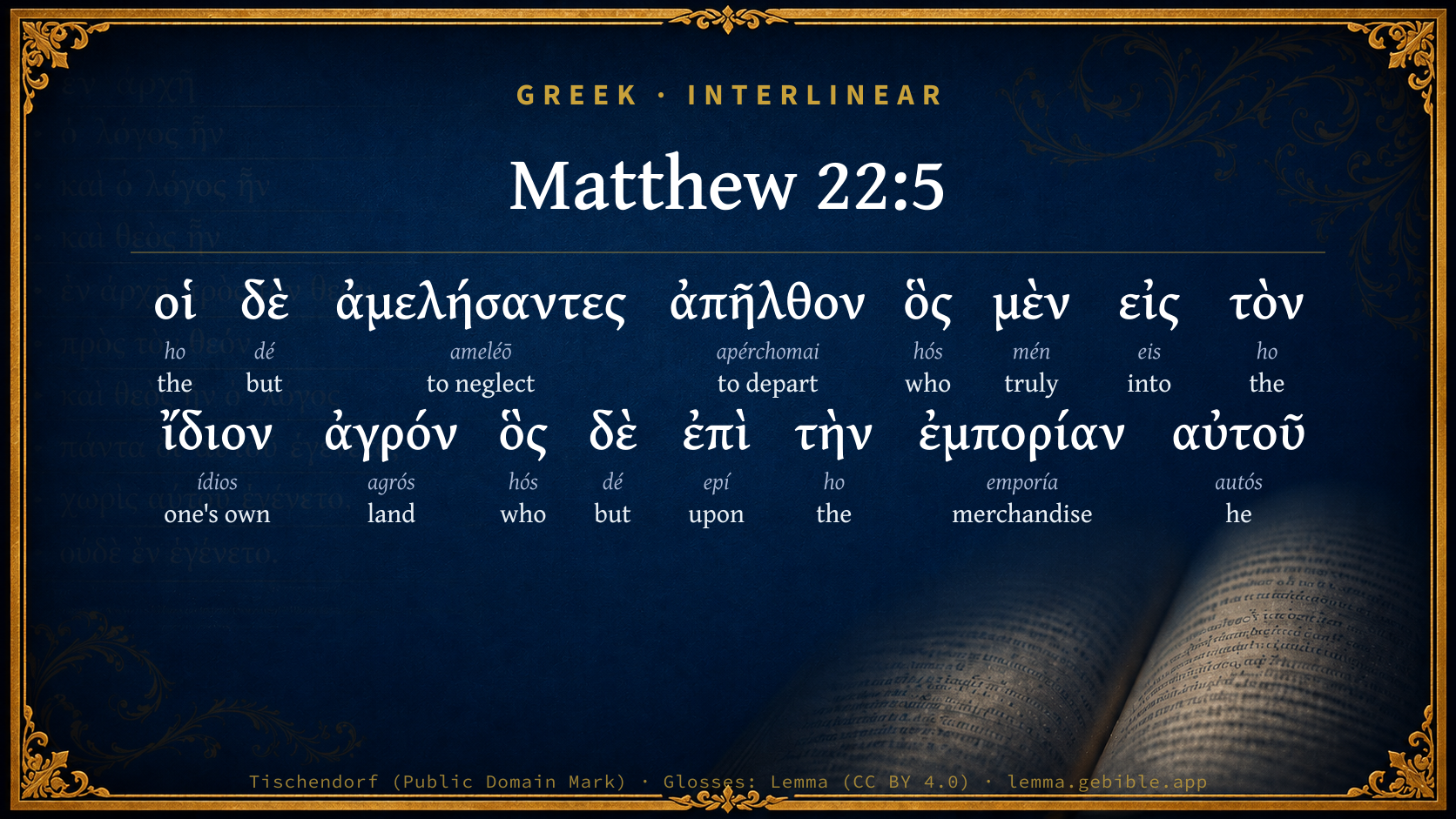
But they made light of it, and went their ways, one to his own farm, another to his merchandise,
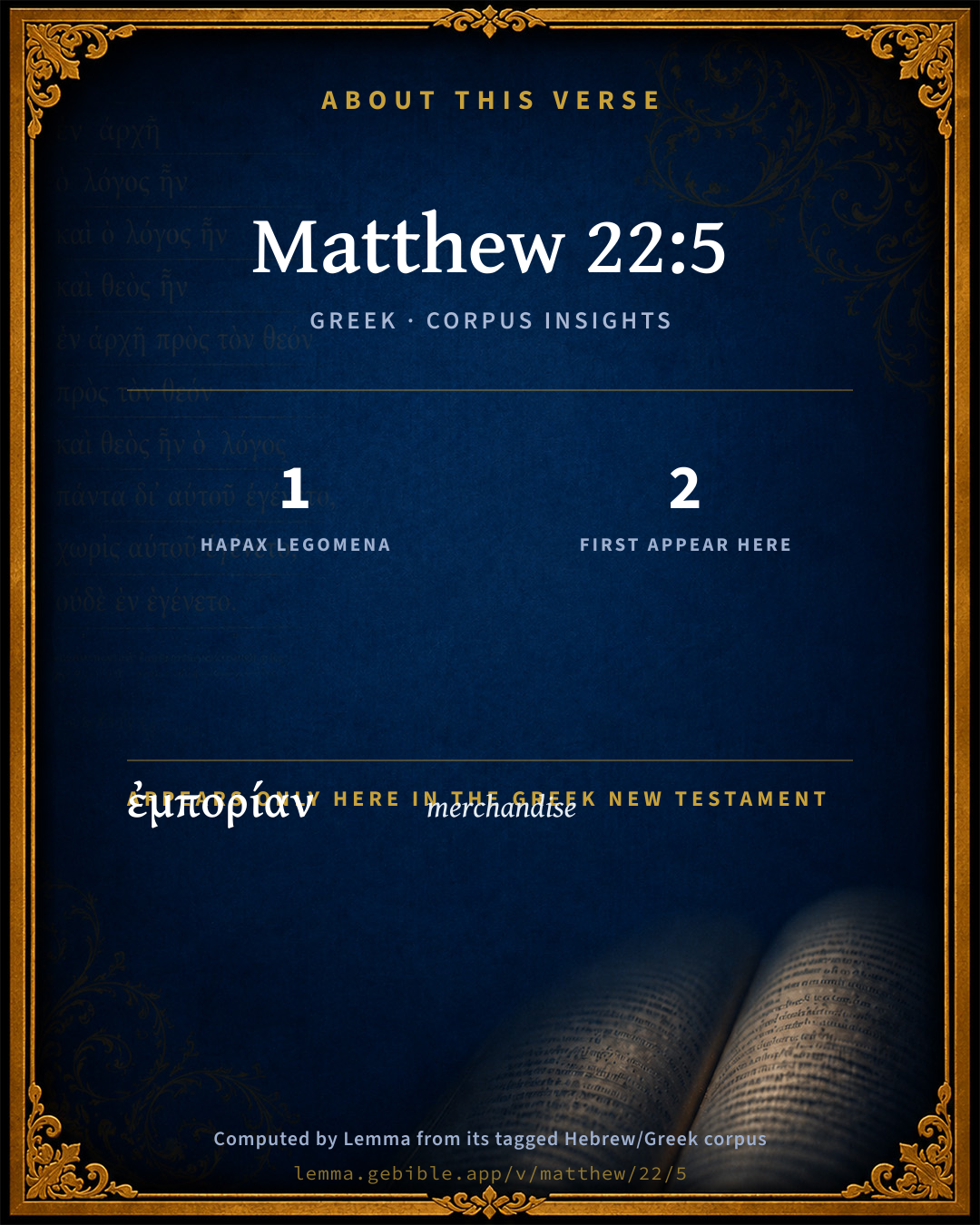
- 1 hapax legomenon — only here in the Greek New Testament
- 2 first appearances in the Greek New Testament
Download a study sheet
One document with this verse’s original text, its word-by-word gloss line, the meaning frame, cross-references with their text, attributed commentary, and full source and license credits — printable, and it pastes into notes with its structure intact.
This verse Autodidact and up
A passage Seminary Student
Up to 50 verses in one chapter. A passage sheet keeps up to 6 commentary sources and 12 cross-references per verse, in the order this page ranks them, and says so on the sheet whenever that leaves anything out. Ask for a single verse and you get the Autodidact verse sheet above.
Everything on this page stays free to read, with no account — the sheet is a download of what is already on screen, not access to it.
Compare translations 3
The same verse in 3 English versions, stacked beneath the original-language interlinear above. Click any original word for its lexicon entry.
Each is an independent rendering of the whole verse — the interlinear is not word-aligned to these translations.
Highlighted words mark where these versions differ — a whole-verse word diff, not a word-by-word alignment.
-
World English Bible Public Domain
But they made light of it, and went their ways, one to his own farm, another to his merchandise,
-
King James Version Public Domain
But they made light of it, and went their ways, one to his farm, another to his merchandise:
-
unfoldingWord Literal Text CC BY-SA 4.0
But they, having paid no attention, went away, one to his own field and one to his business.
unfoldingWord Literal Text — © unfoldingWord, licensed CC BY-SA 4.0. Word-aligned USFM3 via Door43 (git.door43.org/unfoldingWord/en_ult).
Show all 19 translations
Every available English version of this verse, each an independent rendering of the whole verse.
-
World English Bible Public Domain
But they made light of it, and went their ways, one to his own farm, another to his merchandise,
-
Berean Standard Bible Public Domain
But they paid no attention and went away, one to his field, another to his business.
-
Majority Standard Bible Public Domain
But they paid no attention and went away, one to his field, another to his business.
-
King James Version Public Domain
But they made light of it, and went their ways, one to his farm, another to his merchandise:
-
American Standard Version (1901) Public Domain
But they made light of it, and went their ways, one to his own farm, another to his merchandise;
-
Revised Version (1885) Public Domain
But they made light of it, and went their ways, one to his own farm, another to his merchandise:
-
Geneva Bible (1599) Public Domain
But they made light of it, and went their wayes, one to his farme, and another about his marchandise.
-
Douay-Rheims (1899) Public Domain
But they neglected, and went their own ways, one to his farm, and another to his merchandise.
-
Young's Literal Translation Public Domain
and they, having disregarded `it', went away, the one to his own field, and the other to his merchandise;
-
Literal Standard Version CC BY-SA 4.0
and they, having disregarded [it], went away, one to his own field, and the other to his merchandise;
-
Unlocked Literal Bible CC BY-SA 4.0
But they paid no attention and went away, one to his farm, another to his business.
-
unfoldingWord Literal Text CC BY-SA 4.0
But they, having paid no attention, went away, one to his own field and one to his business.
-
Darby Bible Public Domain
But they made light of it, and went, one to his own land, and another to his commerce.
-
World Messianic Bible Public Domain
But they made light of it, and went their ways, one to his own farm, another to his merchandise;
-
Webster's Bible Public Domain
But they made light of it, and went, one to his farm, another to his merchandise.
-
Free Bible Version CC BY-SA 4.0
But they ignored the invitation and left. One went to his fields; another to take care of his business.
-
Bible in Basic English Public Domain
But they gave no attention, and went about their business, one to his farm, another to his trade:
-
Text-Critical English NT CC BY 4.0
But they paid no attention and went away, one to his own field and another to his business.
-
Tyndale New Testament (1534) Public Domain
But they made light of it and went their wayes: one to his ferme place another about his marchaundise
Literal Standard Version (2020), Covenant Press — licensed CC BY-SA 4.0. Text via the HelloAO Bible API (eBible.org). Unlocked Literal Bible (unfoldingWord) — licensed CC BY-SA 4.0. Text via the HelloAO Bible API (eBible.org). unfoldingWord Literal Text — © unfoldingWord, licensed CC BY-SA 4.0. Word-aligned USFM3 via Door43 (git.door43.org/unfoldingWord/en_ult). Free Bible Version, Dr. Jonathan Gallagher — licensed CC BY-SA 4.0. Text via the HelloAO Bible API (eBible.org).
Word by word
More ways to search: Search by grammar → Find every occurrence → Compare this word →
Practice this passage: Drill this verse → Learn its vocabulary →
- Appears 1× in the Greek New Testament
- First appears here
- Part of Speech
- Noun
- Case
- Accusative
- Number
- Singular
- Gender
- Feminine
Full Thayer's Definition
- οἱ ho G3588 “the” Article, Nominative, Plural, Masculine
- δὲ dé G1161 “but” Conjunction
- ἀμελήσαντες ameléō G272 “to neglect” Verb, Aorist, Active, Participle, Nominative, Plural, Masculine
- ἀπῆλθον apérchomai G565 “to depart” Verb, Aorist, Active, Indicative, 3rd person, Plural
- ὃς hós G3739 “who” Relative pronoun, Nominative, Singular, Masculine
- μὲν mén G3303 “truly” Particle
- εἰς eis G1519 “into” Preposition
- τὸν ho G3588 “the” Article, Accusative, Singular, Masculine
- ἴδιον ídios G2398 “one's own” Adjective, Accusative, Singular, Masculine
- ἀγρόν agrós G68 “land” Noun, Accusative, Singular, Masculine
- ὃς hós G3739 “who” Relative pronoun, Nominative, Singular, Masculine
- δὲ dé G1161 “but” Conjunction
- ἐπὶ epí G1909 “upon” Preposition
- τὴν ho G3588 “the” Article, Accusative, Singular, Feminine
- ἐμπορίαν emporía G1711 “merchandise” Noun, Accusative, Singular, Feminine
- αὐτοῦ autós G846 “he” Personal pronoun, Genitive, Singular, Masculine
About this verse
These counts appear in no published source. They are computed here, from the morphology-tagged text and Lemma’s own curated glosses. What Lemma adds →
- 16
- words
- 12
- distinct lemmas
- Gospels
- section
Notable vocabulary
1 hapax legomenon — a word that appears only here in the entire Greek New Testament:
- ἐμπορίαν merchandise G1711
First appearance in Scripture
These words make their first canonical appearance in the Greek New Testament here:
Shared distinctive vocabulary
ἀμελήσαντες to neglect G272 occurs in 4 verses of the Greek New Testament. Also found in:
Cross-references
17Topical passages linked to Matthew 22:5 in the Treasury of Scripture Knowledge — connected by theme and wording, ordered by reader-vote popularity; previews shown in the World English Bible.
- Luke 14:18–20 They all as one began to make excuses. "The first said to him, 'I have bought a field, and I must go and see it. Please have me excused.'
- Hebrews 2:3 how will we escape if we neglect so great a salvation-- which at the first having been spoken through the Lord, was confirmed to us by those who heard;
- 1 John 2:15–16 Don't love the world, neither the things that are in the world. If anyone loves the world, the Father's love isn't in him.
- Genesis 19:14 Lot went out, and spoke to his sons-in-law, who were pledged to marry his daughters, and said, "Get up! Get out of this place, for Yahweh will destroy the city." But he seemed to his sons-in-law to be joking.
- Genesis 25:34 Jacob gave Esau bread and stew of lentils. He ate and drank, rose up, and went his way. So Esau despised his birthright.
- Psalms 106:24–25 Yes, they despised the pleasant land. They didn't believe his word,
- Proverbs 1:7 The fear of Yahweh is the beginning of knowledge; But the foolish despise wisdom and instruction.
- Proverbs 1:24–25 Because I have called, and you have refused; I have stretched out my hand, and no one has paid attention;
- Matthew 13:22 What was sown among the thorns, this is he who hears the word, but the cares of this age and the deceitfulness of riches choke the word, and he becomes unfruitful.
- Matthew 24:38–39 For as in those days which were before the flood they were eating and drinking, marrying and giving in marriage, until the day that Noah entered into the ark,
- Luke 17:26–32 As it happened in the days of Noah, even so will it be also in the days of the Son of Man.
- Acts 2:13 Others, mocking, said, "They are filled with new wine."
- Acts 24:25 As he reasoned about righteousness, self-control, and the judgment to come, Felix was terrified, and answered, "Go your way for this time, and when it is convenient for me, I will summon you."
- Romans 2:4 Or do you despise the riches of his goodness, forbearance, and patience, not knowing that the goodness of God leads you to repentance?
- Romans 8:6 For the mind of the flesh is death, but the mind of the Spirit is life and peace;
- 1 Timothy 6:9–10 But those who are determined to be rich fall into a temptation and a snare and many foolish and harmful lusts, such as drown men in ruin and destruction.
- 2 Timothy 3:4 traitors, headstrong, conceited, lovers of pleasure rather than lovers of God;
Cross-references courtesy of OpenBible.info (CC BY 4.0).
Lesson kit
Teaching starters — assembled from the data on this page, not authored interpretation. Every prompt links to the verse data it draws on. Edit before teaching.
Matthew, in the Gospels, opens this verse with 16 words (12 distinct Greek lemmas). Its most distinctive word is emporía (“merchandise”). A historical commentator’s framing appears above. Read the whole chapter for the surrounding context.
Discussion questions
- What does “merchandise” (emporía) contribute to the verse as a whole?
- 1 word here appears nowhere else in the Greek New Testament. Why might the author reach for such rare wording?
- 2 words make their first appearance in Scripture here. What does this debut establish?
- How does 1 Timothy 4:14, which shares the word «to neglect», read alongside this verse?
- What does the repetition of “the” (3× in this one verse) do in this verse?
- These translations render this verse differently. What is at stake in choosing one wording over another?
- Compare how The Biblical Illustrator and Bengel's Gnomon read this verse. Where do they agree or differ?
Things to notice
- 1 word in this verse appears nowhere else in the Greek New Testament.
- 2 words make their first canonical appearance in Scripture here.
- These translations choose different wording for 13 words in this verse.
- “the” occurs 3× in this single verse.
- 12 distinct Greek lemmas span 16 words in this verse.
Commentary
Notes on Matthew 22:5 from classic Christian and Jewish commentators (each source and its license shown beneath its notes). The classic Christian expositions comment on the surrounding passage and are grouped to its opening verse, so a note may address several verses; the Jewish commentaries on the Tanakh (Rashi and others) are per-verse, so they appear only where the commentator wrote on this verse.
Lemma curates 59 commentaries, every one of them public domain or Creative Commons licensed, each selected and text-cleaned for this edition rather than reprinted as found. About our sources →
The Biblical Illustrator
Joseph S. Exell
The Biblical Illustrator, edited by Joseph S. Exell (c. 1880s–1900s) — public domain. Text from a community e-Sword module.
Bengel's Gnomon
Johann Albrecht Bengel
Bengel's Gnomon of the New Testament — English translation (T&T Clark, Edinburgh, 1860) — public domain. Text from a community e-Sword module.
Meyer's Critical & Exegetical Commentary
Heinrich August Wilhelm Meyer
Meyer — Critical and Exegetical Commentary on the New Testament — English translation by Peter Christie, edited by Frederick Crombie (T&T Clark, 1880) — public domain. Text from a community e-Sword module.
Expositor's Greek Testament
ed. W. Robertson Nicoll
The Expositor's Greek Testament, edited by W. Robertson Nicoll (1897–1910) — public domain. Text from a community e-Sword module.
Jamieson, Fausset & Brown
Robert Jamieson, A. R. Fausset & David Brown
Jamieson, Fausset & Brown — Commentary Critical and Explanatory on the Whole Bible (1871) — public domain (CC PDM 1.0). Text via the HelloAO Bible API.
Ellicott's Commentary for English Readers
A Bible Commentary for English Readers, edited by Charles John Ellicott (1878–1897) — public domain. Text from a community e-Sword module.
John Gill's Exposition
John Gill's Exposition of the Whole Bible (1746–1763) — public domain (CC PDM 1.0). Text via the HelloAO Bible API.
Trapp's Complete Commentary
John Trapp
John Trapp, A Commentary or Exposition upon All the Books of the Old and New Testament (1647–1656) — public domain. Text from a community e-Sword module.
Albert Barnes' Notes on the Bible
Albert Barnes' Notes on the Bible (1834–1885) — public domain. Text from a community e-Sword/MySword module.
Haydock's Catholic Bible Commentary
George Leo Haydock (1774–1849), Haydock's Catholic Family Bible and Commentary, 1859 edition — public domain. Excludes Psalms (Douay-Rheims chapter numbering differs from Protestant) and Deuterocanonical books (Catholic canon only).
Whedon's Commentary on the Bible
Daniel D. Whedon
Daniel D. Whedon (gen. ed.), Commentary on the Old and New Testaments (1874–1909) — public domain. Text from a community e-Sword module.
The Pulpit Commentary
The Pulpit Commentary (1880–1919), ed. H.D.M. Spence-Jones & Joseph S. Exell — public domain. Text from a community e-Sword module.
John Wesley's Explanatory Notes
John Wesley, Explanatory Notes Upon the Whole Bible (1754–1765) — public domain. Text via the GEBible commentary corpus.
Kretzmann's Popular Commentary
Paul E. Kretzmann
Paul E. Kretzmann, Popular Commentary of the Bible (1921–1924) — public domain. Text from a community e-Sword module.
The People's New Testament
B. W. Johnson
B. W. Johnson's The People's New Testament with Notes (1889–1891) — public domain. Electronic text from the Christian Classics Ethereal Library (CCEL) ThML edition.
unfoldingWord translationNotes
Door43 World Missions Community
unfoldingWord translationNotes — © Distant Shores Media and the Door43 World Missions Community, licensed CC BY-SA 4.0. Source: git.door43.org/Door43/en_tn.
International Critical Commentary
International Critical Commentary — older volumes (1896–1929), various authors — public domain. Text from a community e-Sword module.
Vincent's Word Studies in the New Testament
Marvin R. Vincent
Marvin R. Vincent, Word Studies in the New Testament (1887–1900) — public domain. Text from a community e-Sword/MySword module.