
Matthew 26:63

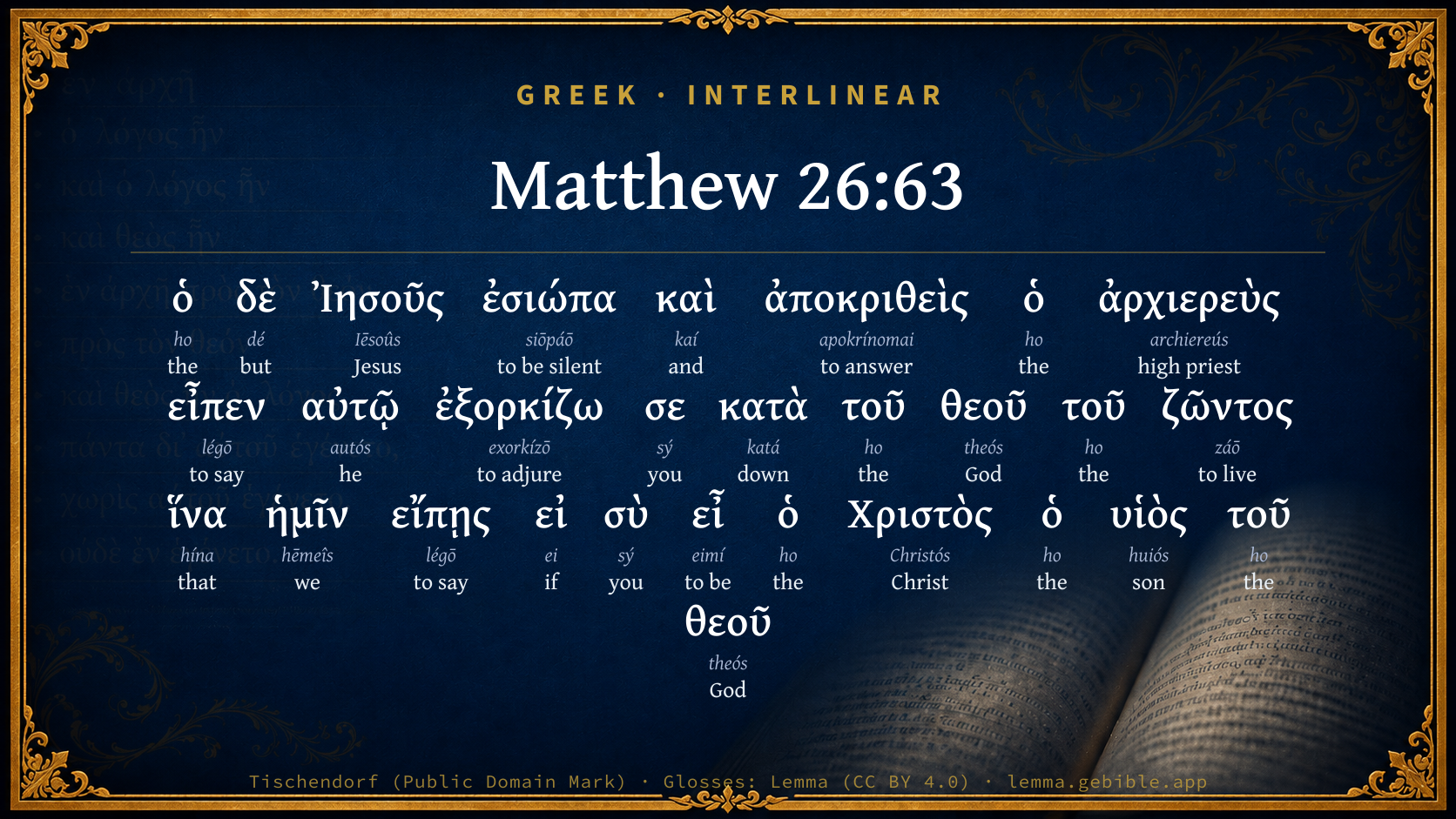
Greek (Tischendorf 8th ed.) Matthew 26:63 appears in the Greek New Testament. The text above is from the Tischendorf 8th edition. Each word links to its Strong’s number and a concise gloss. Click any word for its full Thayer’s Greek Lexicon entry.
Download image
Cite this verse

Matthew 26:63 (World English Bible). Public Domain. Lemma interlinear Bible study tool, https://lemma.gebible.app/v/matthew/26/63.

Show BibTeX & RIS
BibTeX
RIS
English Translation
But Jesus held his peace. The high priest answered him, "I adjure you by the living God, that you tell us whether you are the Christ, the Son of God."
World English Bible · Public Domain
Highlights
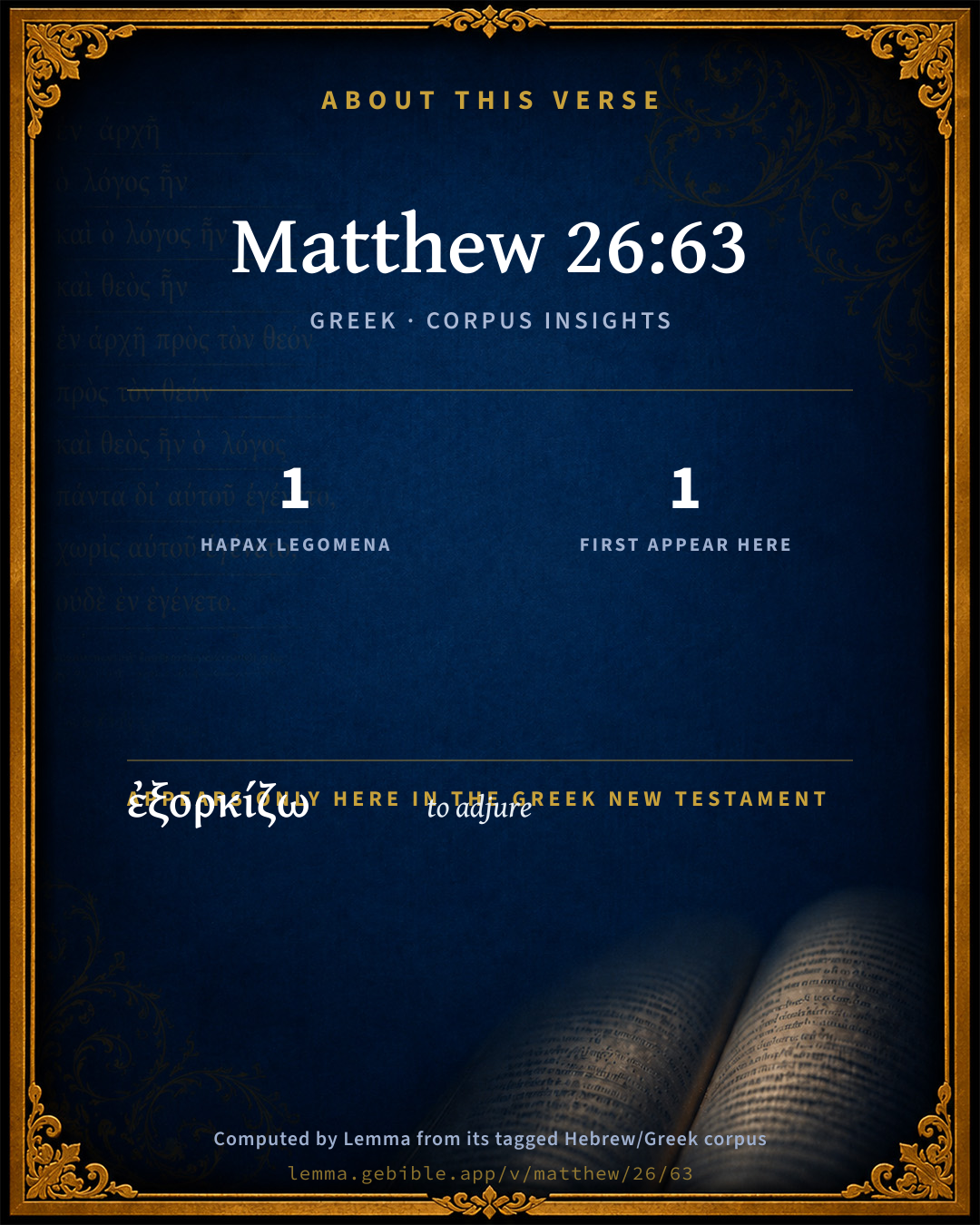
  • 1 hapax legomenon — only here in the Greek New Testament
  • 1 first appearance in the Greek New Testament
Full analysis ↓
Download a study sheet

One document with this verse’s original text, its word-by-word gloss line, the meaning frame, cross-references with their text, attributed commentary, and full source and license credits — printable, and it pastes into notes with its structure intact.

This verse Autodidact and up

Study sheet (.html) Plain text (.txt)

A passage Seminary Student

Up to 50 verses in one chapter. A passage sheet keeps up to 6 commentary sources and 12 cross-references per verse, in the order this page ranks them, and says so on the sheet whenever that leaves anything out. Ask for a single verse and you get the Autodidact verse sheet above.

Everything on this page stays free to read, with no account — the sheet is a download of what is already on screen, not access to it.

Want to remove ads? Support Godless Engineer
Compare translations 3

The same verse in 3 English versions, stacked beneath the original-language interlinear above. Click any original word for its lexicon entry.

Each is an independent rendering of the whole verse — the interlinear is not word-aligned to these translations.

Highlighted words mark where these versions differ — a whole-verse word diff, not a word-by-word alignment.

  • World English Bible Public Domain
    But Jesus held his peace. The high priest answered him, "I adjure you by the living God, that you tell us whether you are the Christ, the Son of God."
  • King James Version Public Domain
    But Jesus held his peace, And the high priest answered and said unto him, I adjure thee by the living God, that thou tell us whether thou be the Christ, the Son of God.
  • unfoldingWord Literal Text CC BY-SA 4.0
    But Jesus was silent. And the high priest said to him, “I make you swear by the living God that you tell us if you are the Christ, the Son of God.”

unfoldingWord Literal Text — © unfoldingWord, licensed CC BY-SA 4.0. Word-aligned USFM3 via Door43 (git.door43.org/unfoldingWord/en_ult).

Versions to compare (up to 4)

3 of 4 selected

Show all 19 translations

Every available English version of this verse, each an independent rendering of the whole verse.

  • World English Bible Public Domain
    But Jesus held his peace. The high priest answered him, "I adjure you by the living God, that you tell us whether you are the Christ, the Son of God."
  • Berean Standard Bible Public Domain
    But Jesus remained silent. Then the high priest said to Him, “I charge You under oath by the living God: Tell us if You are the Christ, the Son of God.”
  • Majority Standard Bible Public Domain
    But Jesus remained silent. Then the high priest said to Him, “I charge You under oath by the living God: Tell us if You are the Christ, the Son of God.”
  • King James Version Public Domain
    But Jesus held his peace, And the high priest answered and said unto him, I adjure thee by the living God, that thou tell us whether thou be the Christ, the Son of God.
  • American Standard Version (1901) Public Domain
    But Jesus held his peace. And the high priest said unto him, I adjure thee by the living God, that thou tell us whether thou art the Christ, the Son of God.
  • Revised Version (1885) Public Domain
    But Jesus held his peace. And the high priest said unto him, I adjure thee by the living God, that thou tell us whether thou be the Christ, the Son of God.
  • Geneva Bible (1599) Public Domain
    But Iesus helde his peace. Then the chiefe Priest answered, and saide to him, I charge thee sweare vnto vs by the liuing God, to tell vs, If thou be that Christ the Sonne of God, or no.
  • Douay-Rheims (1899) Public Domain
    But Jesus held his peace. And the high priest said to him: I adjure thee by the living God, that thou tell us if thou be the Christ the Son of God.
  • Young's Literal Translation Public Domain
    and Jesus was silent. And the chief priest answering said to him, `I adjure thee, by the living God, that thou mayest say to us, if thou art the Christ -- the Son of God.'
  • Literal Standard Version CC BY-SA 4.0
    And Jesus was silent. And the chief priest answering said to Him, “I adjure You, by the living God, that You may say to us if You are the Christ—the Son of God.”
  • Unlocked Literal Bible CC BY-SA 4.0
    But Jesus was silent. The high priest said to him, “I command you by the living God, tell us whether you are the Christ, the Son of God.”
  • unfoldingWord Literal Text CC BY-SA 4.0
    But Jesus was silent. And the high priest said to him, “I make you swear by the living God that you tell us if you are the Christ, the Son of God.”
  • Darby Bible Public Domain
    But Jesus was silent. And the high priest answering said to him, I adjure thee by the living God that thou tell us if *thou* art the Christ the Son of God.
  • World Messianic Bible Public Domain
    But Yeshua stayed silent. The high priest answered him, “I adjure you by the living God that you tell us whether you are the Messiah, the Son of God.”
  • Webster's Bible Public Domain
    But Jesus held his peace. And the high priest answered and said to him, I adjure thee by the living God, that thou tell us whether thou art the Christ the Son of God.
  • Free Bible Version CC BY-SA 4.0
    But Jesus remained silent. The high priest said to Jesus, “In the name of the living God I place you under oath. Tell us if you are the Messiah, the Son of God.”
  • Bible in Basic English Public Domain
    But Jesus said not a word. And the high priest said to him, I put you on oath, by the living God, that you will say to us if you are the Christ, the Son of God.
  • Text-Critical English NT CC BY 4.0
    But Jesus was silent. Then the high priest said to him, “I adjure yoʋ by the living God to tell us if yoʋ are the Christ, the Son of God.”
  • Tyndale New Testament (1534) Public Domain
    But Iesus helde his peace: And the chefe Preeste answered and sayd to him: I charge the in the name of the lyvinge God that thou tell vs whether thou be Christ the sonne of God.

Literal Standard Version (2020), Covenant Press — licensed CC BY-SA 4.0. Text via the HelloAO Bible API (eBible.org). Unlocked Literal Bible (unfoldingWord) — licensed CC BY-SA 4.0. Text via the HelloAO Bible API (eBible.org). unfoldingWord Literal Text — © unfoldingWord, licensed CC BY-SA 4.0. Word-aligned USFM3 via Door43 (git.door43.org/unfoldingWord/en_ult). Free Bible Version, Dr. Jonathan Gallagher — licensed CC BY-SA 4.0. Text via the HelloAO Bible API (eBible.org).

Word by word

More ways to search: Search by grammar → Find every occurrence → Compare this word →

Practice this passage: Drill this verse → Learn its vocabulary →

ἐξορκίζω
exorkízō
G1844
“to adjure”
Verb, Present, Active, Indicative, 1st person, Singular
Part of Speech
Verb
Tense
Present
Voice
Active
Mood
Indicative
Person
1st person
Number
Singular
Full Thayer's Definition

Origin: from G1537 and G3726

TDNT: 12:44,7

1. to extract an oath, to force to an oath 2. to adjure
  1. ὁ ho G3588 “the” Article, Nominative, Singular, Masculine
  2. δὲ dé G1161 “but” Conjunction
  3. Ἰησοῦς Iēsoûs G2424 “Jesus” Noun, Nominative, Singular, Masculine
  4. ἐσιώπα siōpáō G4623 “to be silent” Verb, Imperfect, Active, Indicative, 3rd person, Singular
  5. καὶ kaí G2532 “and” Conjunction
  6. ἀποκριθεὶς apokrínomai G611 “to answer” Verb, Aorist, Passive deponent, Participle, Nominative, Singular, Masculine
  7. ὁ ho G3588 “the” Article, Nominative, Singular, Masculine
  8. ἀρχιερεὺς archiereús G749 “high priest” Noun, Nominative, Singular, Masculine
  9. εἶπεν légō G3004 “to say” Verb, Aorist, Active, Indicative, 3rd person, Singular
  10. αὐτῷ autós G846 “he” Personal pronoun, Dative, Singular, Masculine
  11. σε sý G4771 “you” Personal pronoun, 2nd person, Accusative, Singular
  12. κατὰ katá G2596 “down” Preposition
  13. τοῦ ho G3588 “the” Article, Genitive, Singular, Masculine
  14. θεοῦ theós G2316 “God” Noun, Genitive, Singular, Masculine
  15. τοῦ ho G3588 “the” Article, Genitive, Singular, Masculine
  16. ζῶντος záō G2198 “to live” Verb, Present, Active, Participle, Genitive, Singular, Masculine
  17. ἵνα hína G2443 “that” Conjunction
  18. ἡμῖν hēmeîs G2249 “we” Personal pronoun, 1st person, Dative, Plural
  19. εἴπῃς légō G3004 “to say” Verb, Aorist, Active, Subjunctive, 2nd person, Singular
  20. εἰ ei G1487 “if” Conditional
  21. σὺ sý G4771 “you” Personal pronoun, 2nd person, Nominative, Singular
  22. εἶ eimí G1510 “to be” Verb, Present, Active, Indicative, 2nd person, Singular
  23. ὁ ho G3588 “the” Article, Nominative, Singular, Masculine
  24. Χριστὸς Christós G5547 “Christ” Noun, Nominative, Singular, Masculine
  25. ὁ ho G3588 “the” Article, Nominative, Singular, Masculine
  26. υἱὸς huiós G5207 “son” Noun, Nominative, Singular, Masculine
  27. τοῦ ho G3588 “the” Article, Genitive, Singular, Masculine
  28. θεοῦ theós G2316 “God” Noun, Genitive, Singular, Masculine

About this verse

These counts appear in no published source. They are computed here, from the morphology-tagged text and Lemma’s own curated glosses. What Lemma adds →

29
words
20
distinct lemmas
Gospels
section

Notable vocabulary

1 hapax legomenon — a word that appears only here in the entire Greek New Testament:

  • ἐξορκίζω to adjure G1844

First appearance in Scripture

This word makes its first canonical appearance in the Greek New Testament here:

  • ἐξορκίζω to adjure G1844

Shared distinctive vocabulary

ἐσιώπα to be silent G4623 occurs in 10 verses of the Greek New Testament. Also found in:
Repetition

Words recur within this verse:

Cross-references

38

Topical passages linked to Matthew 26:63 in the Treasury of Scripture Knowledge — connected by theme and wording, ordered by reader-vote popularity; previews shown in the World English Bible.

  • Leviticus 5:1 "'If anyone sins, in that he hears the voice of adjuration, he being a witness, whether he has seen or known, if he doesn't report it, then he shall bear his iniquity.
  • Isaiah 53:7 He was oppressed, yet when he was afflicted he didn't open his mouth; as a lamb that is led to the slaughter, and as a sheep that before its shearers is mute, so he didn't open his mouth.
  • Matthew 16:16 Simon Peter answered, "You are the Christ, the Son of the living God."
  • Matthew 27:12 When he was accused by the chief priests and elders, he answered nothing.
  • 1 Samuel 14:26 When the people were come to the forest, behold, the honey dropped: but no man put his hand to his mouth; for the people feared the oath.
  • John 6:69 We have come to believe and know that you are the Christ, the Son of the living God."
  • 1 Samuel 14:28 Then answered one of the people, and said, Your father directly charged the people with an oath, saying, Cursed be the man who eats food this day. The people were faint.
  • 1 Kings 22:16 The king said to him, How many times shall I adjure you that you speak to me nothing but the truth in the name of Yahweh?
  • 2 Chronicles 18:15 The king said to him, How many times shall I adjure you that you speak to me nothing but the truth in the name of Yahweh?
  • Psalms 2:6–7 "Yet I have set my king on my holy hill of Zion."
  • Psalms 38:12–14 They also who seek after my life lay snares. Those who seek my hurt speak mischievous things, And meditate deceits all day long.
  • Proverbs 29:24 Whoever is an accomplice of a thief is an enemy of his own soul. He takes an oath, but dares not testify.
  • Isaiah 9:6–7 For to us a child is born, to us a son is given; and the government shall be on his shoulder: and his name shall be called Wonderful, Counselor, Mighty God, Everlasting Father, Prince of Peace.
  • Daniel 3:16 Shadrach, Meshach, and Abednego answered the king, Nebuchadnezzar, we have no need to answer you in this matter.
  • Matthew 26:63–66 But Jesus held his peace. The high priest answered him, "I adjure you by the living God, that you tell us whether you are the Christ, the Son of God."
  • Matthew 27:14 He gave him no answer, not even one word, so that the governor marveled greatly.
  • Matthew 27:40 and saying, "You who destroy the temple, and build it in three days, save yourself! If you are the Son of God, come down from the cross!"
  • Matthew 27:43 He trusts in God. Let God deliver him now, if he wants him; for he said, 'I am the Son of God.'"
  • Matthew 27:54 Now the centurion, and those who were with him watching Jesus, when they saw the earthquake, and the things that were done, feared exceedingly, saying, "Truly this was the Son of God."
  • Mark 14:61 But he stayed quiet, and answered nothing. Again the high priest asked him, "Are you the Christ, the Son of the Blessed?"
  • Luke 22:66–71 As soon as it was day, the assembly of the elders of the people was gathered together, both chief priests and scribes, and they led him away into their council, saying,
  • John 1:34 I have seen, and have testified that this is the Son of God."
  • John 1:49 Nathanael answered him, "Rabbi, you are the Son of God! You are King of Israel!"
  • John 3:16–18 For God so loved the world, that he gave his one and only Son, that whoever believes in him should not perish, but have eternal life.
  • John 5:18–25 For this cause therefore the Jews sought all the more to kill him, because he not only broke the Sabbath, but also called God his own Father, making himself equal with God.
  • John 8:25 They said therefore to him, "Who are you?" Jesus said to them, "Just what I have been saying to you from the beginning.
  • John 10:24 The Jews therefore came around him and said to him, "How long will you hold us in suspense? If you are the Christ, tell us plainly."
  • John 10:30 I and the Father are one."
  • John 10:36 Do you say of him whom the Father sanctified and sent into the world, 'You blaspheme,' because I said, 'I am the Son of God?'
  • John 18:37 Pilate therefore said to him, "Are you a king then?" Jesus answered, "You say that I am a king. For this reason I have been born, and for this reason I have come into the world, that I should testify to the truth. Everyone who is of the truth listens to my voice."
  • John 19:7 The Jews answered him, "We have a law, and by our law he ought to die, because he made himself the Son of God."
  • John 19:9 He entered into the Praetorium again, and said to Jesus, "Where are you from?" But Jesus gave him no answer.
  • John 20:31 but these are written, that you may believe that Jesus is the Christ, the Son of God, and that believing you may have life in his name.
  • Acts 8:32–35 Now the passage of the Scripture which he was reading was this, "He was led as a sheep to the slaughter. As a lamb before his shearer is silent, So he doesn't open his mouth.
  • 1 John 5:11–13 The testimony is this, that God gave to us eternal life, and this life is in his Son.
  • Numbers 5:19–21 The priest shall cause her to swear, and shall tell the woman, 'If no man has lain with you, and if you haven't gone aside to uncleanness, being under your husband, be free from this water of bitterness that brings a curse.
  • 1 Samuel 14:24 The men of Israel were distressed that day; for Saul had adjured the people, saying, Cursed be the man who eats any food until it be evening, and I be avenged on my enemies. So none of the people tasted food.
  • 1 Peter 2:23 Who, when he was cursed, didn't curse back. When he suffered, didn't threaten, but committed himself to him who judges righteously;

Cross-references courtesy of OpenBible.info (CC BY 4.0).

Commentary

Notes on Matthew 26:63 from classic Christian and Jewish commentators (each source and its license shown beneath its notes). The classic Christian expositions comment on the surrounding passage and are grouped to its opening verse, so a note may address several verses; the Jewish commentaries on the Tanakh (Rashi and others) are per-verse, so they appear only where the commentator wrote on this verse.

Lemma curates 59 commentaries, every one of them public domain or Creative Commons licensed, each selected and text-cleaned for this edition rather than reprinted as found. About our sources →

The Biblical Illustrator

Joseph S. Exell

Mat_26:63

But Jesus held His peace.

Silence the best reply to slander

It is reported of Titus Vespasian, that when any one spake ill of him he was wont to say that he was above false reports; and if they were true, he had more reason to be angry with himself than the relator. And the good Emperor Theodosius commanded that no man should be punished who spoke against him: for, what was spoken slightly, said he, was to be laughed at; what spitefully, to be pardoned; what angrily, to be pitied; and what truly, he would thank him for. Oh, that there were but such a frame of spirit in this carping age of ours, wherein men, like tinder, are ready to take fire upon the least spark that falls, to quarrel sometimes on the most inoffensive word that can be spoken; whereas the best way is to be silent.

Silence sometimes the wisest policy

A courtier in the retinue of Alexander the Great paid a visit to the studio of Apelles, the celebrated painter, and was received with the consideration due to his rank. This excited his vanity and talkativeness, which, unhappily, sallied forth upon the fine art in questions exposing his own ignorance. Apelles interrupted him at length in an undertone: Do you see those boys that are grinding my colours? While you were silent they admired you, dazzled with the splendour of the purple and gold with which your habit glitters; but ever since you began to talk about what you do not understand, they have done nothing but laugh at you.

The silence of Jesus

We learn that there may often be prudence, wisdom, dignity, and power.

I. It will appear evident that the silence of our Saviour in the midst of His enemies was the most effectual and suitable reply which He could have made to their accusations. These accusations were false and frivolous. His life and doctrine had been a sufficient reply. No verbal defence could have been so powerful.

II. No verbal defence would have availed him anything with those who were determined to procure His condemnation. It was not for Him to join in a war of words; His last hours should be tranquil. How solemnly His silence rebukes the vociferation of the priests and populace.

III. There are seasons and occasions when silence for ourselves may be better than speech, sharper than argument, more effectual than verbal reply.

1. When our characters are attacked. If we are so happy as to own a life which can defend us, let us be silent that the life may speak.

2. Silence is often the best reproof of profane conversation.

3. It is often the only reproof of mere locquaeity.

4. We are apt to talk too much, and lay too much stress on talking. (P. W. P. Greenwood, D. D.)

The silence of Jesus

I. Prejudice, whatever be its source, gets nothing out of the Scriptures.

II. Habitual indulgence in sin will also prevent us from getting any answer to our inquiries from Scripture. The Herods of to-day get no answer from Christ.

III. The influence of scepticism makes the Scriptures silent. Pilate did not believe there was any truth, and if there was it could not be known. (W. M. Taylor, D. D.)

The silence of Christ

I. On one occasion Christ was silent in the presence of an overwhelming sorrow. The Canaanitish woman, He answered her not a word. This was a touching case. This was the silence of love. Sometimes Christ is silent at the beginning of the Christian life; sometimes at its close.

II. On another occasion Christ was silent in the presence of captious inquirers. The woman taken in adultery. This was a critical moment. This was the silence of reserve. There are many occasions in life when silence is golden. Some men are naturally of a quiet disposition.

III. On another occasion Christ was silent in the presence of personal suffering. When arrested. This was a remarkable scene.

1. The time.

2. Place.

3. Persons. This was the silence of submission. (J. T. Woodhouse.)

The silence of Christ

I. It was wonderful He could, by a word, have made the world tremble; judge and witnesses fall dead before Him. Why was He silent? He came not to be His own advocate, but ours.

II. His silence was full of suffering, suffering that was vicarious and expiatory. All who are great sufferers endure most at times when one hears no sound from their lips. It is a relief to pain to cry out.

III. It was ominous. It foreshadowed ills. His silence said, What more can I do unto My vineyard? It is an appalling sign when Christ ceases to plead with us.

IV. Christ was inspired, and thus full of instruction.

1. Take the doctrine of our Lords Deity. This is established by a mass of evidence, but there is no stronger proof of it than the silence of Christ.

2. Apply it to the authenticity of the Old Testament Scriptures, that against which the destructive criticism of our day is making such fierce attacks, and what an argument we find.

3. Apply His silence to the perpetuity of the Sabbath law, and with what force it speaks.

V. Christs silence was beautiful. Difficult to restrain malice before enemies.

VI. It is exemplary. Self-imposed silence often a duty.

1. Because of the perils of speech.

2. Because of the blessings of the discipline of silence. (J. T. Blackburn.)

The Biblical Illustrator, edited by Joseph S. Exell (c. 1880s–1900s) — public domain. Text from a community e-Sword module.

Tyndale Open Study Notes

Tyndale Open Resources

26:63 if you are the Messiah: This question from the high priest was prompted by Zech 6:12, which had predicted that the Messiah would rebuild the Temple (cp. Matt 26:61).

Tyndale Open Study Notes — © Tyndale Open Resources, licensed CC BY-SA 4.0. Text via the HelloAO Bible API.

Bengel's Gnomon

Johann Albrecht Bengel

Mat 26:63. Ὁ Υἱὸς τοῦ Θεοῦ, the Son of God) Caiaphas, in common with the rest of his nation, did not entertain a merely political idea of the promised Messiah.

Bengel's Gnomon of the New Testament — English translation (T&T Clark, Edinburgh, 1860) — public domain. Text from a community e-Sword module.

Meyer's Critical & Exegetical Commentary

Heinrich August Wilhelm Meyer

Mat_26:63. The high priest answers this second refusal to speak by repeating a formal oath, in which Jesus is adjured to declare whether He be the Messiah or not. For this confession would determine how far they would be justified in pronouncing a capital sentence, and such as the Roman procurator would not fail to confirm.

ἐξορκίζω] means, like the earlier form ἑξορκόω: I call upon thee to swear, Dem. 1265, 6; Polyb. iii. 61. 10, vi. 21. 1, xvi. 31. 5. Comp. הִשְּׁבִּיעַ, Gen_24:3, al. To give an affirmative answer to this formula was to take the full oath usually administered in any court of law. Michaelis, Mos. R. § 302; Matthaei, doctr. Christi de jurejur. 1847, p. 8; Keil, Arch. II. p. 256. The fact that Jesus took the oath has been denied, though without any reason whatever, by Wuttke, Döllinger, Steinmeyer.

κατὰ τοῦ θεοῦ, κ.τ.λ.] by the living God. Comp. 1Ki_3:24; Jdt_1:12; common in Greek authors, see Kühner, I. 1, p. 434; also Heb_6:13, and Bleek thereon. The living God as such would not fail to punish the perjured, Heb_10:31. It was the uniform practice in courts of law to swear by God. See Saalschutz, M. R. p. 614.

ὁ υἱὸς τοῦ θεοῦ] ordinary, recognised designation of the Messiah, into which, naturally enough, the metaphysical conception does not enter here, however much it may have been present to the mind of Christ Himself in making the affirmation which follows.

Meyer — Critical and Exegetical Commentary on the New Testament — English translation by Peter Christie, edited by Frederick Crombie (T&T Clark, 1880) — public domain. Text from a community e-Sword module.

Expositor's Greek Testament

ed. W. Robertson Nicoll

Mat 26:63 . ἐσιώπα : Jesus seeing the drift of the questions gave the high priest no assistance, but continued silent. ἐξορκίζω ( ἐξορκόω more common in classics). The high priest now takes a new line, seeing that there is no chance of conviction any other way. He puts Jesus on His oath as to the cardinal question of Messiahship. εἱ σὺ εἰ ὁ Χριστὸς , etc.: not two questions but one, Son of God being exegetical of the title Christ. If He was the one He was the other ipso facto .

The Expositor's Greek Testament, edited by W. Robertson Nicoll (1897–1910) — public domain. Text from a community e-Sword module.

Adam Clarke's Commentary

Verse 63. I adjure thee by the living God] I put thee to thy oath. To this solemn adjuration Christ immediately replies, because he is now called on, in the name of God, to bear another testimony to the truth. The authority of God in the most worthless magistrate should be properly respected. However necessary our Lord saw it to be silent, when the accusations were frivolous, and the evidence contradictory, he felt no disposition to continue this silence, when questioned concerning a truth, for which he came into the world to shed his blood.

Adam Clarke's Commentary on the Bible (1810–1826) — public domain. Text from a community e-Sword/MySword module.

Ellicott's Commentary for English Readers

(63) I adjure thee by the living God . . .—The appeal was one of unusual solemnity. All else had failed to break through the silence, but this would surely rouse Him. Technically, the oath thus tendered to the accused was of the nature of an oath of compurgation, such as that recognised in Exo_22:11, Num_5:19-22, 1Ki_8:31, but it was skilfully worded so as to force upon our Lord the alternative either of denying what indeed He was, or of making a confession which would be treated as blasphemy. The records of St. John’s Gospel (Joh_5:18; Joh_8:58; Joh_9:37; Joh_10:24) show us that they had good means of knowing what answer to expect.

A Bible Commentary for English Readers, edited by Charles John Ellicott (1878–1897) — public domain. Text from a community e-Sword module.

John Gill's Exposition

Jesus saith unto him, thou hast said,.... That is, thou hast said right; or as Mark expresses it, "I am", Mar 14:62, the Christ, the anointed of God, who was so from everlasting, and in time; being before the world was, installed into, and invested with the office of mediator; and in the fulness of time, anointed with the holy Spirit without measure: he might truly say he was the Messiah, since all the characters of him in the books of the prophets, met in him; and all the miracles he was to work in proof of his Messiahship were wrought by him: as also that be was the Son of God, not by creation, as angels and men; nor by adoption, as saints; nor as man, or in the human nature, in which he was the son of man, and not the Son of God; nor was he begotten as man, whereas he is called the only begotten Son, and the begotten of the Father; and was he the Son of God as man not the first, but the third person must be his Father; besides, he was the Son of God before his incarnation: nor as mediator neither; be was the Son of God, antecedent to his office as mediator; his sonship is distinct from it, is an illustration of it, and what puts virtue into it; but he is so as God, as a divine person, by natural and eternal filiation; being begotten of the Father in the divine essence, and of the same nature; and having the same perfections with him, and in all things equal to him; and is the sense in which he always affirmed God to be his Father, and himself to be his Son. For this phrase, "thou hast said", as answering to an affirmation, "I am"; see Gill on Mat 26:25. Now, though Christ had so fully answered to the adjuration, and so strongly affirmed himself to be the Messiah, the Son of God, yet he knew they would not believe; and therefore refers them to an after proof thereof, which whether they would or not, would oblige them to acknowledge the whole:

nevertheless, I say unto you, hereafter shall ye see the son of man, sitting at the right hand of power: the Vulgate Latin, and Munster's Hebrew Gospel, read "the power of God", as in Luk 22:69, though it is not absolutely necessary; for "power" designs God himself, who is all powerful; as appears by the creation of all things out of nothing, the upholding of all things in their being, the redemption of men, the conversion of sinners, and the preservation of his saints. In the Jewish writings (e), God is frequently called,

"the power": such a thing, say they, we have heard,

"from the mouth of power", or might; that is, from God himself: and so he is by the Grecians called "power" (f): by "the son of man", is meant Christ in the human nature; who then appeared at their bar as a mere man, in a very despicable form and condition, but hereafter they should see him in a more glorious one, and at "the right hand of God": a phrase expressive of his exaltation, above all creatures whatever: respect is had to the prophecy of him in Psa 110:1. "Sitting" there, denotes his having done his work; and his continuance in his exalted state, until all enemies are subdued under him: and when he says they should "see" him, his meaning is not, that they should see him at the right hand of God with their bodily eyes, as Stephen did; but that they should, or at least might, see and know by the effects, that he was set down at the right hand of God; as by the pouring forth of the holy Spirit upon his disciples, on the day of pentecost; by the wonderful spread of his Gospel, and the success of it, notwithstanding all the opposition made by them, and others; and particularly, by the vengeance he should take on their nation, city, and temple; and which may be more especially designed in the next clause,

and coming in, the clouds of heaven. So Christ's coming to take vengeance on the Jewish nation, as it is often called the coming of the son of man, is described in this manner, Mat 24:27. Though this may also be understood of Christ's second coming to judgment, at the last day; when as he went up to heaven in a cloud, he will return, and come also in the clouds of heaven; see Act 1:9 Rev 1:7, when he will be seen by the eyes of all, good and bad; and when this sanhedrim, before whom he now was, will see him also, and confess that he is Lord and Christ, and the Son of God. Though the former clause seems to have regard to what would quickly come to pass, and what they should soon observe, and be convinced of; for , rendered "hereafter", may be translated "henceforwards"; or as it is in the Syriac, Persic, and Ethiopic versions, "from this time"; meaning, that in a very little while, they should begin to see the effects of his being set down at the right hand of God, and which would be full proofs of it, and should see him come in the clouds of heaven, at the last day: reference seems to be had to Dan 7:13, where one like unto the son of man is said to come in the clouds of heaven, and which is understood of the Messiah by many, both of the ancient and modern Jews (g): with whom one of his names is "Anani" (h), which signifies "clouds",

(e) T. Bab. Maccot, fol. 24. 1. & Horayot, fol. 8. 1. Debarim Rabba, fol. 245. 4. Maimon. Hilch. Memarim, c. 5. sect. 15. & Melacim, c. 8. sect. 10. & alibi passim. (f) Sententiae Secundi, p. 21. Ed. Gale. (g) Zohar in Gert. fol. 85. 4. Bemidbar Rabba, sect. 13. fol. 209. 4. R. Jeshuah in Aben Ezra, in Dan. vii. 13. & Jarchi & Saadiah Gaon in loc. (h) Targum in 1 Chron. iii. 24. & Beckius in ib. Midrash Tillim apud Galatin. de arcan. Cathol. ver. l. 10. c. 1.

John Gill's Exposition of the Whole Bible (1746–1763) — public domain (CC PDM 1.0). Text via the HelloAO Bible API.

Trapp's Complete Commentary

John Trapp

63 But Jesus held his peace. And the high priest answered and said unto him, I adjure thee by the living God, that thou tell us whether thou be the Christ, the Son of God.

Ver. 63. I adjure thee by the living God] So had the devil done once before, horrendo impudentiae exemplo, Mar 3:7. Sed os Caiaphae et culeus Satanae in eodem sunt praedicamento. It is nothing with the devil and his to pollute and dishallow that nomen maiestativum, as Tertullian styleth it, that "glorious and fearful name of God," as Moses calleth it, Deu 28:58; and to call him in, at all turns, as an author or abettor, at least, of their abominable plots and practises. How much better that holy man that said, My heart, head, and tongue trembleth as often as I speak of God? {a} Yea, the very heathen sages had the same thoughts, that men ought to be better advised than to toss God’s reverend name upon their tongues as a tennis ball, or to wear his image for an ornament. {b} And surely, as St Mark relateth this history, one would think Caiaphas a very conscientious person. For he brings him in saying to our Saviour, "Art thou the son of that blessed one?" Mar 14:61. So he calls God by. a periphrasis, as if he were afraid once to name God, ευλογητου. Baruch hu, quasi ipsum Dei nomen exprimere vereatur; when as yet presently after, he profanely adjureth our blessed Saviour "by the living God, that thou tell us whether thou be the Christ," &c. And this he doth, not out of any desire to know the truth; but as seeking an occasion from his bold and free confession of the truth, to put him to death; so going about to entitle God himself to his villanous enterprizes. See here the hateful nature of damned hypocrisy, and abandon it.

{a} Lingua, mente, et cogitatione horresco quoties de Deo sermonem habeo Nazianzen.

{b} εν δακτυλιω εικονα θεου υν περιφιρειν Praecept. Pyth.

John Trapp, A Commentary or Exposition upon All the Books of the Old and New Testament (1647–1656) — public domain. Text from a community e-Sword module.

Haydock's Catholic Bible Commentary

I adjure thee by the living God. They hoped this might make him own himself God; for which they were for stoning him. (John x. 31.) --- St. Luke tells us, (xxii. 66,) that this question was put to Jesus, when it was day. St. Augustine thinks it was put to him first in the night, and again the next morning. We must not forget that when Christ was examined by the high priest, one of the servants standing by gave our blessed Redeemer a box on the ear, or on the face. See John xviii. 22. (Witham) --- Our divine Saviour as God knew perfectly well, that whatever he said would be condemned; and therefore the more Jesus was silent to what was alleged against him, the more did the high priest try to extort an answer from him, that he might have some accusation against the Lord of glory. Hence he exclaimed in that violent manner: I adjure thee, or I command thee by the living God, Greek: Exorkizo se kata tou Theou zontos. The law for witnesses is to be found in Leviticus v. 1; where the witness is pronounced guilty who should suppress the truth, after he has heard the Greek: phonen orkismou. This is the true meaning of that law, so very ill understood by many. See also Menochius, who on these very words of Leviticus says: if any one shall be called upon to say what he knows of a point that another has confirmed by oath, he shall carry his iniquity, i.e. the punishment of his iniquity, which God will inflict. (Menochius) --- See 1 Kings xiv. 24. 27; Numbers v. 19; 1 Thessalonians v. 27. The confession or denial of a person thus interrogated was decisive. (Challoner)

George Leo Haydock (1774–1849), Haydock's Catholic Family Bible and Commentary, 1859 edition — public domain. Excludes Psalms (Douay-Rheims chapter numbering differs from Protestant) and Deuterocanonical books (Catholic canon only).

Whedon's Commentary on the Bible

Daniel D. Whedon

63. Held his peace — Thus at once defeating the unjust judge, and calling to mind the prediction of the prophet: “As a sheep before her shearers is dumb, so he openeth not his mouth.” How valuable a gift is the talent for judicious silence! I adjure thee — The high priest now takes a new turn. The testimony said something about rebuilding the temple. Now the glorious rebuilding of the temple was one of the popular things ascribed to the Messiah. “This man then,” says the high priest to himself, “I understand to be a claimant to the Messiahship.” He therefore puts the adjuration, which every Jew was bound to answer truly. The Christ, the Son of God — The high priest doubtless knew that these two titles meant, according to prophecy, the same being. He joins the two together, with an air of great solemnity, for the purpose of making the claim to them both appear more formidable.

Daniel D. Whedon (gen. ed.), Commentary on the Old and New Testaments (1874–1909) — public domain. Text from a community e-Sword module.

The Pulpit Commentary

Jesus hold his peace; esiwpa : continued silent. (cf. Mat_27:12-14) "He was oppressed, and he was afflicted, yet he opened not his mouth," etc.. (Isa_53:7; cf. Psa_38:13, Psa_38:14) He knew it was of no use, and was not the moment, to explain the mystery of the words which he had used. Indeed, it was unfair to ask him to explain the discrepancies in the alleged testimony. "Attempts at defence were unprofitable, no man hearing. For this was a show only of a court of justice, but in truth an onset of robbers, assailing him without cause, as in a cave or on the road" (St. Chysostom, in loc. ). The case was best met by a majestic silence. Answered . Puzzled and embarrassed by Christ"s persistent silence, Caiaphas at last proceeds to put to him a question which he must answer, and which must lead to some definite result. I adjure thee by the living God. The high priest now addresses Jesus officially as the minister of Jehovah, and puts him under an oath to make an answer. To such an adjuration a reply was absolutely necessary, and the Law held a man guilty who kept silence under such circumstances. (Lev_5:1) The Christ, the Son of God. It is not to be supposed that Caiaphas by these words intended to imply that Messiah was one with God, of one nature, power, and eternity. It is not likely that he had risen above the popular Jewish conception of Messiah, which was of one inferior to God, though invested with certain Divine attributes. But he had heard that Jesus had more than once claimed God as his Father, so he now, as he hopes, will force a confession from the Prisoner"s lips, which will set the question at rest one way or the other, and give him ground for decisive action, and enable him to denounce Christ either as an acknowledged impostor or a blasphemer. His language is, perhaps, based on the second psalm, vers. 2, 6, etc.

Vers. 63-65. Christ and Caiaphas.

Jesus now stands face to face with the head of the old Jewish religion. The official leader of the nation is for the first time confronted by the Man who claims to be its true King. Caiaphas could not but look upon Christ with the jealousy a selfish man in power feels for his rival. But Jesus was more than a rival of the high priest. He laid claim to a rank which Caiaphas never dreamed of assuming. We do not wonder that the ecclesiastical judge examined his Prisoner with bitter prejudice.

I THE ADJURATION. Caiaphas charged Jesus, on oath, to declare whether he was the Christ, the Son of God.

1. It is most important to know what Jesus Christ claims to be. We have an interest in the high priest"s question quite apart from the judicial process. Our religion is centred in Christ. It is mere than an outgrowth of his life and teaching. It rests upon his Person; it lives in him; it is what he is. We cannot wholly disregard him without abandoning Christianity itself. An imperfect knowledge of Christ may be found with a true and saving faith in him. Still, the faith must be in him, and therefore we must know enough of him to trust him.

2. The greatest question about Christ is as to his Divinity and Messiahship.

(1) Is he the Christ? If he is, he is able to save; if he is, he has a right to claim a loyal following.

(2) Is he the Son of God? If he is, he comes to us clad with Divine power. Then we may trust that he cannot fail, and we have the best of all reasons for submitting to his kingly rule. Such questions as these about his nature and authority cannot be set aside as of merely speculative interest.

II THE REPLY. Jesus did not usually assert his Messiahship; much less did he directly confess his Divine nature, except on certain rare occasions. But he was now at the end of his life, and therefore his revelation of his nature and office could not hinder his work. Moreover, the high priest had a legal right to test his claims, and Jesus never opposed the execution of the law.

1. Jesus accepted the highest names ascribed to him. Could he do this if he did not know they were his by right? He was calm and reasonable, simple and humble, generous and unselfish. Yet he consented to be called "the Christ, the Son of God.

2. Jesus foresaw and predicted his own second advent. It is wonderful that a peasant from Galilee should speak thus before the greatest dignitary of his nation, amid all the pomp and splendour of the high priest"s palace, and in view of his own rejection and death.

III THE RESULT. Caiaphas took the words of Christ as if they were blasphemy and on this account pronounced him to be worthy of death.

1. His conduct was determined by an unjust prejudice. He assumed that the claims of Christ could not be true, and therefore he judged them to be blasphemous. Thus he approached Christ with a closed mind. If we have already made up our minds adversely to the claims of Christ, it is useless for us to examine them. but the only fair method is to approach him with an open mind, ready to weigh all he teaches, ready to accept all that he may give us good warrant for believing.

2. On his own assumption he was right. If the high claims of Christ were false, he was guilty of blasphemy. Caiaphas was more consistent than those people are who reject the Divine claims of Christ, and yet honour him as the best of men. W.F.A.

The Pulpit Commentary (1880–1919), ed. H.D.M. Spence-Jones & Joseph S. Exell — public domain. Text from a community e-Sword module.

Burkitt's Expository Notes on the New Testament

William Burkitt

We observed even now that our Lord was silent, and did make no reply to the false witnesses that evidenced against him at his trial; because being so manifestly contradictory, they did fall to the ground of themselves. But now when the question was solemnly put by the high priest, Art thou the Christ? he said, I am.

Thence learn, That although we are not obliged to answer every cavilling or ensnaring question, yet we are bound faithfully to own and freely to confess the truth, when we are solemnly called thereunto. Christ, who in the former verses was silent, and as a deaf man heard not, now witnesses a good confession; teaching us, both by his example and command, to confess and own both him and his truth, when lawfully required; when our silence would be a denying of the truth, a dishonour to God, and a scandal to our brethren. Christ knew that his answer would cost him his life, and yet he durst not but give it. Art thou the Son of the Blessed? Jesus said, I am.

Yea, farther observe, That as Christ answered directly and plainly at his trial, so he did not refuse to answer upon oath; I adjure thee by the living God, says the judge of the court, that thou tell us whether thou art the Christ; that is, I requie thee to answer this question upon oath; for adjuring a person, or requiring him to answer upon oath, was the manner of swearing among the Jews. Now to this adjuration our Saviour answered plainly and directly, I am, Mar 14:61.

Hence learn, That swearing before a magistrate, upon a just and great occasion, is lawful; if Christ in the fifth of St. Matthew forbid all oaths, then here his practice was contrary to his own doctrine; but it is evident that Christ answered the magistrate upon oath, and so may we.

Observe lastly, The sentence of condemnation which the council passed upon him for owning himself to be the Son of God: He hath spoken blasphemy, and is worthy to die. Hereupon the unruly rabble affront him with the vilest abuses, and most horrid indignities; They spit in his face, they blindfolded him, they smote him with their fists and palms of their hands; and in the way of contempt and mockery, they bid him divine or prophesy who it was that smote him.

Learn hence, That there is no degree of contempt, no mark of shame, no kind of suffering, which we ought to decline or stick at for Christ’s sake, who hid not his face from shame and spitting upon our account. O monstrous impiety! How do they spit on that awful lovely face! How do they revile and blaspheme his noble office of a Prophet of the most high God! Prophesy, say they, in a mocking derision, who was it that smote thee? To such acts of inhumanity did the barbarous rage of the bloody Jews carry them.

William Burkitt's Expository Notes on the New Testament (1700–1703) — public domain. Text from a community e-Sword module.

Cambridge Greek Testament for Schools and Colleges

63. ἐξορκίζω. Here only in N.T. Used in classical authors in the sense of ‘to administer an oath,’ especially the military oath (sacramentum). Possibly the word may be used here in reference to the charge against Jesus, δαιμόνιον ἔχει.

ὁ υἱὸς τοῦ θεοῦ. The Jews might have recognised Jesus as the Messiah, but not as the Son of God.

Cambridge Greek Testament for Schools and Colleges (Cambridge University Press, 1896; 21 vols, various authors incl. Carr, Maclear, Plummer, Farrar, Lumby, Moule, M. R. James, Simcox) — public domain. Text from a community e-Sword module.

Alford’s Greek Testament

Henry Alford

63.] See Lev 5:1.

ἐξορκίζω σε, ‘I put thee under an oath,’ the form of which follows. The junction of ὁ υἱὸς τ. θ. with χριστός must not be pressed beyond the meaning which Caiaphas probably assigned to it—viz. the title given to the Messiah from the purport of the prophecies respecting Him. It is however a very different thing when our Lord by his answer affirms this, and invests the words with their fullest meaning and dignity.

Henry Alford, The Greek Testament (1849–1861) — public domain. Text from a community e-Sword module.

International Critical Commentary

(M) 63. And Jesus was silent.] Mk. has: “And He was silent, and answered nothing.” Mt. omits the last clause as redundant; cf. Introduction, p. xxv.

(M) And the high priest said to Him, I adjure Thee by the livin God, that Thou tell us if Thou art the Anointed, the Son of God?] Mk. has: “Again the high priest was asking Him, and saith to Him, Art Thou the Anointed, the Son of the Blessed?”—ὁ υἱὸς τοῦ θεοῦ] Mk. has ὁ υἱὸς τοῦ εὐλογητοῦ Since, according to Mk., the endeavour to procure the legal number of witnesses had failed, the high priest directly interrogates the accused. He was popularly regarded as one who claimed to be the Messiah, and had been greeted as such by the populace, Mar 11:9, Mar 11:10. It is very doubtful whether the high priests, the Sadducees, held any definite Messianic doctrine, but, no doubt, the Pharisees (cf. Ps.-Sol.) anticipated the coming of a Davidic “king”; and other conceptions of the Messiah were current, as, e.g., in the Apocalyptic literature. Wellhausen argues that the claim to be the Messiah could not, according to Jewish conceptions, have been regarded as a blasphemous claim. But quite apart from the exact meaning of the relationship of the Messiah to God, which is implied in such terms as “Son of God,” “Son of the Blessed,” the nature of the Messiah, as depicted in the literature of the period as of earthly and heavenly origin (cf. Volz, Jüd. Eschat. pp. 214 f.), is such that claims to be Messiah might quite well be regarded as blasphemous, if they were untrue. And the high priest, no doubt, knew quite well that the idea of Messiahship, as used of Himself by Christ, involved and implied the conception of heavenly origin (cf. Mar 12:37). Mk.’s τοῦ εὐλογητοῦ is an abbreviation of a common Rabbinical formula, and is no doubt original. Mt. changes into the Christian and universal τοῦ θεοῦ. “The Son of the Blessed” occurs in the Acta Pauli (Schmidt), p. 26, and “the Blessed,” p. 29.—ἵνα ἡμῖν εἴπῃς] Lk. also has εἰπὸν ἡμῖν.

International Critical Commentary — older volumes (1896–1929), various authors — public domain. Text from a community e-Sword module.

Vincent's Word Studies in the New Testament

Marvin R. Vincent

I adjure thee. I call upon thee to swear. The high - priest put Christ upon oath.

That [ινα] . In order that; signifying the design with which he adjured the Lord.

Marvin R. Vincent, Word Studies in the New Testament (1887–1900) — public domain. Text from a community e-Sword/MySword module.

Lesson kit

Teaching starters — assembled from the data on this page, not authored interpretation. Every prompt links to the verse data it draws on. Edit before teaching.

Matthew, in the Gospels, opens this verse with 29 words (20 distinct Greek lemmas). Its most distinctive word is exorkízō (“to adjure”). A historical commentator’s framing appears above. Read the whole chapter for the surrounding context.

Discussion questions

  1. The word exorkízō carries the sense “to adjure.” How does it shape the verse?
  2. 1 word here appears nowhere else in the Greek New Testament. Why might the author reach for such rare wording?
  3. This is the first place “to adjure” appears in Scripture (first appears here). What does its debut here establish?
  4. How does Matthew 20:31, which shares the word «to be silent», read alongside this verse?
  5. What does the repetition of “to say” (2× in this one verse) do in this verse?
  6. These translations render this verse differently. What is at stake in choosing one wording over another?
  7. Compare how The Biblical Illustrator and Tyndale Open Study Notes read this verse. Where do they agree or differ?

Things to notice

  • 1 word in this verse appears nowhere else in the Greek New Testament.
  • 1 word makes its first canonical appearance in Scripture here.
  • These translations choose different wording for 10 words in this verse.
  • “to say” occurs 2× in this single verse.
  • 20 distinct Greek lemmas span 29 words in this verse.

Reading settings

Reading text

Shown beneath each verse's original-language words.

Old Testament
Old Testament edition

Read the OT as the Masoretic Hebrew (MT) or the Greek Septuagint (LXX).

English shown for the Greek Septuagint (in the Hebrew ↔ Greek comparison).

Comparing translations? Open the Compare panel on any verse page to stack up to four side by side.