Matthew 24:13

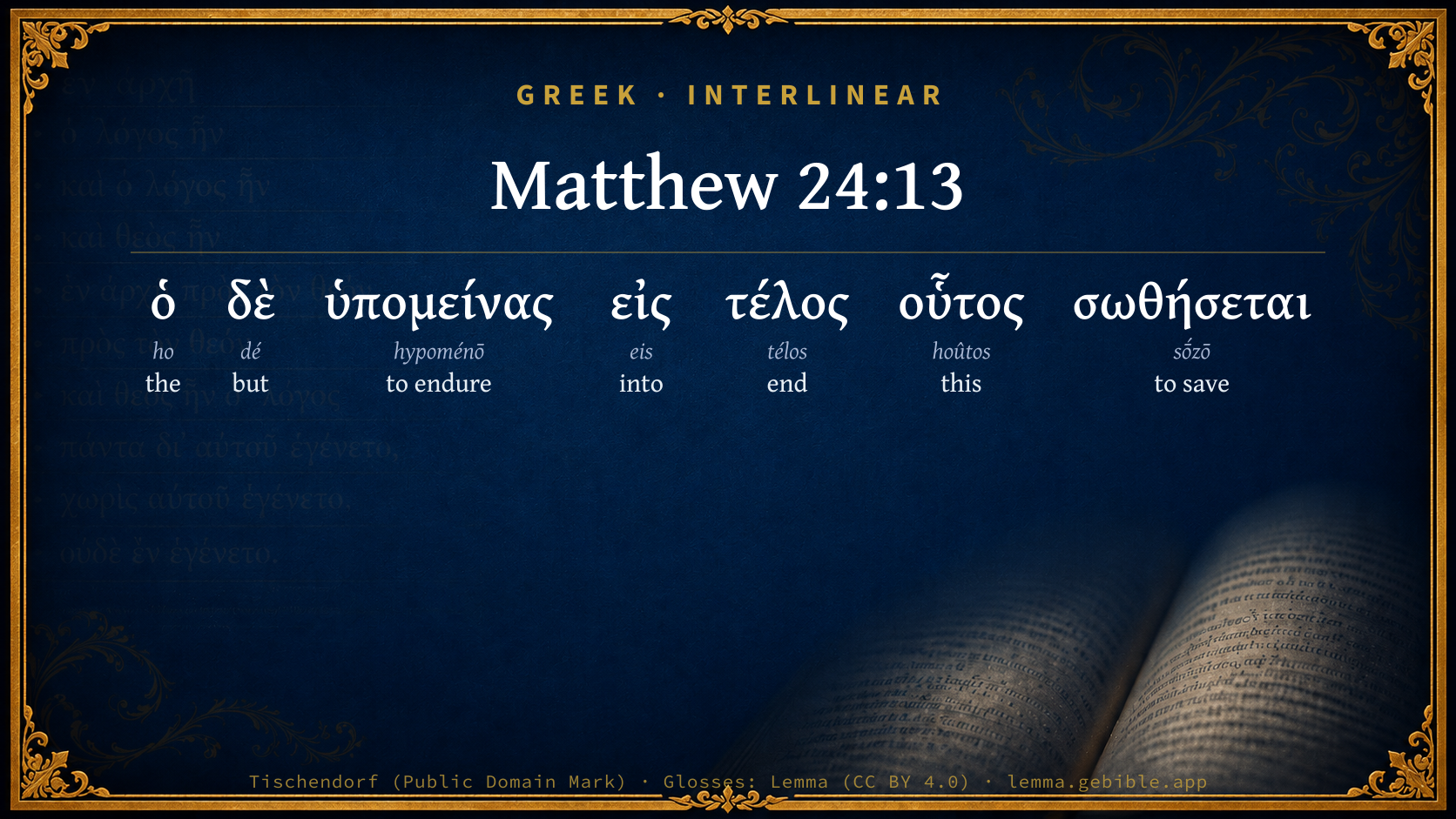
Greek (Tischendorf 8th ed.) Matthew 24:13 appears in the Greek New Testament. The text above is from the Tischendorf 8th edition. Each word links to its Strong’s number and a concise gloss. Click any word for its full Thayer’s Greek Lexicon entry.
Download image
Cite this verse

Matthew 24:13 (World English Bible). Public Domain. Lemma interlinear Bible study tool, https://lemma.gebible.app/v/matthew/24/13.

Show BibTeX & RIS
BibTeX
RIS
English Translation
But he who endures to the end, the same will be saved.
World English Bible · Public Domain
Download a study sheet

One document with this verse’s original text, its word-by-word gloss line, the meaning frame, cross-references with their text, attributed commentary, and full source and license credits — printable, and it pastes into notes with its structure intact.

This verse Autodidact and up

Study sheet (.html) Plain text (.txt)

A passage Seminary Student

Up to 50 verses in one chapter. A passage sheet keeps up to 6 commentary sources and 12 cross-references per verse, in the order this page ranks them, and says so on the sheet whenever that leaves anything out. Ask for a single verse and you get the Autodidact verse sheet above.

Everything on this page stays free to read, with no account — the sheet is a download of what is already on screen, not access to it.

Want to remove ads? Support Godless Engineer
Compare translations 3

The same verse in 3 English versions, stacked beneath the original-language interlinear above. Click any original word for its lexicon entry.

Each is an independent rendering of the whole verse — the interlinear is not word-aligned to these translations.

Highlighted words mark where these versions differ — a whole-verse word diff, not a word-by-word alignment.

  • World English Bible Public Domain
    But he who endures to the end, the same will be saved.
  • King James Version Public Domain
    But he that shall endure unto the end, the same shall be saved.
  • unfoldingWord Literal Text CC BY-SA 4.0
    But the one having endured to the end, this one will be saved.

unfoldingWord Literal Text — © unfoldingWord, licensed CC BY-SA 4.0. Word-aligned USFM3 via Door43 (git.door43.org/unfoldingWord/en_ult).

Versions to compare (up to 4)

3 of 4 selected

Show all 19 translations

Every available English version of this verse, each an independent rendering of the whole verse.

  • World English Bible Public Domain
    But he who endures to the end, the same will be saved.
  • Berean Standard Bible Public Domain
    But the one who perseveres to the end will be saved.
  • Majority Standard Bible Public Domain
    But the one who perseveres to the end will be saved.
  • King James Version Public Domain
    But he that shall endure unto the end, the same shall be saved.
  • American Standard Version (1901) Public Domain
    But he that endureth to the end, the same shall be saved.
  • Revised Version (1885) Public Domain
    But he that endureth to the end, the same shall be saved.
  • Geneva Bible (1599) Public Domain
    But he that endureth to the ende, he shalbe saued.
  • Douay-Rheims (1899) Public Domain
    But he that shall persevere to the end, he shall be saved.
  • Young's Literal Translation Public Domain
    but he who did endure to the end, he shall be saved;
  • Literal Standard Version CC BY-SA 4.0
    but he who endured to the end, he will be saved;
  • Unlocked Literal Bible CC BY-SA 4.0
    But the one who endures to the end will be saved.
  • unfoldingWord Literal Text CC BY-SA 4.0
    But the one having endured to the end, this one will be saved.
  • Darby Bible Public Domain
    but he that has endured to the end, *he* shall be saved.
  • World Messianic Bible Public Domain
    But he who endures to the end will be saved.
  • Webster's Bible Public Domain
    But he that shall endure to the end, the same shall be saved.
  • Free Bible Version CC BY-SA 4.0
    but those who hold out to the end will be saved.
  • Bible in Basic English Public Domain
    But he who goes through to the end will get salvation.
  • Text-Critical English NT CC BY 4.0
    but he who endures to the end will be saved.
  • Tyndale New Testament (1534) Public Domain
    But he that endureth to the ende the same shalbe safe.

Literal Standard Version (2020), Covenant Press — licensed CC BY-SA 4.0. Text via the HelloAO Bible API (eBible.org). Unlocked Literal Bible (unfoldingWord) — licensed CC BY-SA 4.0. Text via the HelloAO Bible API (eBible.org). unfoldingWord Literal Text — © unfoldingWord, licensed CC BY-SA 4.0. Word-aligned USFM3 via Door43 (git.door43.org/unfoldingWord/en_ult). Free Bible Version, Dr. Jonathan Gallagher — licensed CC BY-SA 4.0. Text via the HelloAO Bible API (eBible.org).

Word by word

More ways to search: Search by grammar → Find every occurrence → Compare this word →

Practice this passage: Drill this verse → Learn its vocabulary →

About this verse

These counts appear in no published source. They are computed here, from the morphology-tagged text and Lemma’s own curated glosses. What Lemma adds →

7
words
7
distinct lemmas
Gospels
section

Notable vocabulary

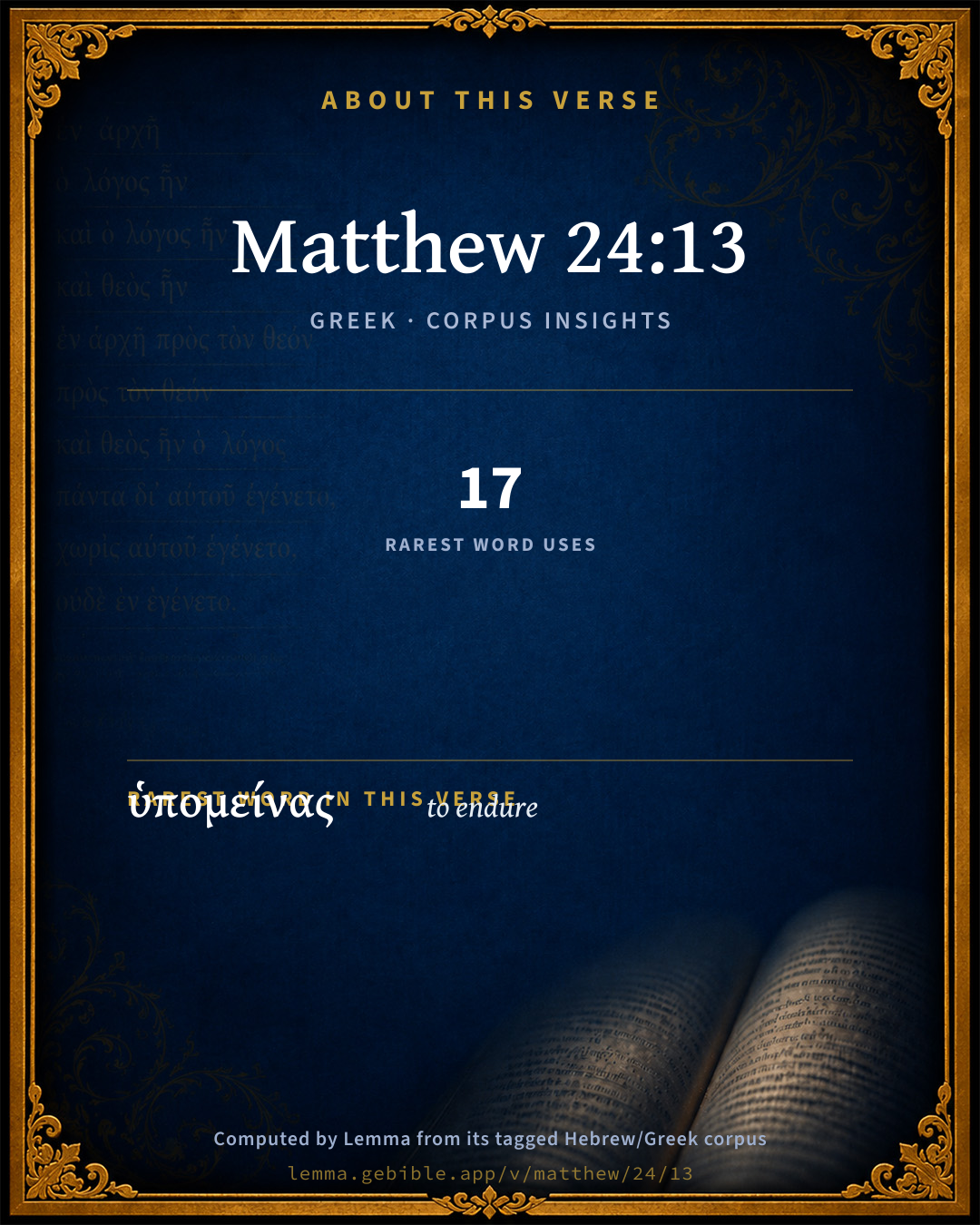
The rarest word here is ὑπομείνας to endure G5278 — appearing just 17 times in the whole Greek New Testament.

Shared distinctive vocabulary

ὑπομείνας to endure G5278 occurs in 16 verses of the Greek New Testament. Also found in:

Cross-references

10

Topical passages linked to Matthew 24:13 in the Treasury of Scripture Knowledge — connected by theme and wording, ordered by reader-vote popularity; previews shown in the World English Bible.

  • Matthew 10:22 You will be hated by all men for my name's sake, but he who endures to the end will be saved.
  • Mark 13:13 You will be hated by all men for my name's sake, but he who endures to the end, the same will be saved.
  • Revelation 2:10 Don't be afraid of the things which you are about to suffer. Behold, the devil is about to throw some of you into prison, that you may be tested; and you will have oppression for ten days. Be faithful to death, and I will give you the crown of life.
  • Hebrews 10:39 But we are not of those who shrink back to destruction, but of those who have faith to the saving of the soul.
  • Romans 2:7 to those who by patience in well-doing seek for glory and honor and incorruptibility, eternal life;
  • Hebrews 3:14 For we have become partakers of Christ, if we hold fast the beginning of our confidence firm to the end:
  • 1 Corinthians 1:8 who will also confirm you until the end, blameless in the day of our Lord Jesus Christ.
  • Luke 8:15 That in the good ground, these are such as in an honest and good heart, having heard the word, hold it tightly, and bring forth fruit with patience.
  • Hebrews 3:6 but Christ is faithful as a Son over his house; whose house we are, if we hold fast our confidence and the glorying of our hope firm to the end.
  • Matthew 24:6 You will hear of wars and rumors of wars. See that you aren't troubled, for all this must happen, but the end is not yet.

Cross-references courtesy of OpenBible.info (CC BY 4.0).

Commentary

Notes on Matthew 24:13 from classic Christian and Jewish commentators (each source and its license shown beneath its notes). The classic Christian expositions comment on the surrounding passage and are grouped to its opening verse, so a note may address several verses; the Jewish commentaries on the Tanakh (Rashi and others) are per-verse, so they appear only where the commentator wrote on this verse.

Lemma curates 59 commentaries, every one of them public domain or Creative Commons licensed, each selected and text-cleaned for this edition rather than reprinted as found. About our sources →

Tyndale Open Study Notes

Tyndale Open Resources

24:13 The one who endures maintains faithful allegiance to Jesus despite persecution. Here, the end may refer to the end of one’s own life, the judgment on Israel in AD 70, or the end of history.

Tyndale Open Study Notes — © Tyndale Open Resources, licensed CC BY-SA 4.0. Text via the HelloAO Bible API.

Bengel's Gnomon

Johann Albrecht Bengel

Mat 24:13. Ὁ δὲ ὑπομείνας, but he that endureth) By constancy, we preserve faith, love, and hope.—εἰς τέλος, unto the end) sc. of the temptation.—οὗτος, this man) i.e., he, I say, being as it were exempted from the general lot; see Mat 24:22.—σωθήσεται, shall be saved) When the city was destroyed, the Christians were saved; see Luk 21:28; Luk 21:31.

Bengel's Gnomon of the New Testament — English translation (T&T Clark, Edinburgh, 1860) — public domain. Text from a community e-Sword module.

Meyer's Critical & Exegetical Commentary

Heinrich August Wilhelm Meyer

Mat_24:13. Ὁ δὲ ὑπομείνας] contrast to what in the σκανδαλισθής. πολλοί of Mat_24:10 and the πλανής. πολλούς of Mat_24:12 is described as apostasy, partly from the faith generally, and partly (Mat_24:12) from the true Christian faith and life. Comp. Mat_10:22. According to Fritzsche, it is only the persevering in love that is meant, so that the contrast has reference merely to ψυχήσεται, κ.τ.λ. But according to our interpretation, the contrast is more thorough and better suited to the terms of the passage.

εἰς τέλος] not perpetuo (Fritzsche), which, as the connection shows (Mat_24:6), is too indefinite; but: unto the end, till the last, until the troubles will have come to an end, which, as appears from the context (σωθήσεται), will, in point of fact, be coincident with the second advent. Comp. Mat_24:30-31; Mat_10:22. The context forbids such interpretations as: unto death (Elsner, Kuinoel, Ebrard), until the destruction of Jerusalem (Krebs, Rosenmüller, R. Hofmann), σωθήσεται being referred in the latter case to the flight of the Christians to Pella (Eusebius, H. E. iii. 5). Of course Mat_24:13 describes the sanam hominis Christiani dispositionem spiritualem ad eschatologiam pertinentem (Dorner), always on the understanding, however, that the second advent is at hand, and that the homo Christianus will live to see it.

Meyer — Critical and Exegetical Commentary on the New Testament — English translation by Peter Christie, edited by Frederick Crombie (T&T Clark, 1880) — public domain. Text from a community e-Sword module.

Expositor's Greek Testament

ed. W. Robertson Nicoll

Mat 24:13 . ὁ ὑπομείνας , he that endureth; the verb used absolutely without object. The noun ὑπομονή is another of the great words of the N. T. Love and Patience, primary virtues of the Christian: doing good, bearing ill. The endurance called for is not merely in love (Fritzsche), but in the faith and life of a Christian in face of all the evils enumerated. εἰς τέλος , to the end, i.e. , of the θλίψις , as long as there are trials to endure. σωθήσεται , shall be saved in the sense of Mat 16:25 . The implied truth underlying this test is that there will be ample time for a full curriculum of trial testing character and sifting the true from the false or temporary Christian.

The Expositor's Greek Testament, edited by W. Robertson Nicoll (1897–1910) — public domain. Text from a community e-Sword module.

Geneva Bible (1599)

Geneva Bible translators

The Gospel shall be spread abroad, rage the devil never so much: and they which do constantly believe, shall be saved.

Geneva Bible (1599) marginal notes — public domain. Text via Bolls.life.

Adam Clarke's Commentary

Verse 13. But he that shall endure] The persecutions that shall come - unto the end; to the destruction of the Jewish polity, without growing cold or apostatizing - shall be saved, shall be delivered in all imminent dangers, and have his soul at last brought to an eternal glory. It is very remarkable that not a single Christian perished in the destruction of Jerusalem, though there were many there when Cestius Gallus invested the city; and, had he persevered in the siege, he would soon have rendered himself master of it; but, when he unexpectedly and unaccountably raised the siege, the Christians took that opportunity to escape. See Eusebius, Hist. Eccles lib. iii. c. 5, and Mr. Reading's note there; and see the note here on Mt 24:20.

Adam Clarke's Commentary on the Bible (1810–1826) — public domain. Text from a community e-Sword/MySword module.

Ellicott's Commentary for English Readers

(13) He that shall endure unto the end . . .—The words have at once a higher and lower sense. Endurance to the end of life is in every case the condition of salvation, in the full meaning of the word. But the context rather leads us to see in the “end” the close of the period of which our Lord speaks, i.e., the destruction of Jerusalem; and so the words “shall be saved” at least include deliverance from the doom of those who were involved in that destruction.

A Bible Commentary for English Readers, edited by Charles John Ellicott (1878–1897) — public domain. Text from a community e-Sword module.

The Cambridge Bible for Schools and Colleges

gen. ed. J. J. S. Perowne

13. he that shall endure] Cp. “In your patience possess ye your souls,” (rather, “by patience ye shall win your lives,”) Luk_21:19.

The Cambridge Bible for Schools and Colleges (gen. ed. J. J. S. Perowne; Cambridge University Press, 1878–1918) — public domain. Text from a community e-Sword module.

John Gill's Exposition

But he that shall endure to the end,.... In the profession of faith in Christ, notwithstanding the violent persecutions of wicked men; and in the pure and incorrupt doctrines of the Gospel, whilst many are deceived by the false teachers that shall arise; and in holiness of life and conversation, amidst all the impurities of the age; and shall patiently bear all afflictions, to the end of his life, or to the end of sorrows, of which the above mentioned were the beginning:

the same shall be saved; with a temporal salvation, when Jerusalem, and the unbelieving inhabitants of it shall be destroyed: for those that believed in Christ, many of them, through persecution, were obliged to remove from thence; and others, by a voice from heaven, were bid to go out of it, as they did; and removed to Pella, a village a little beyond Jordan (u), and so were preserved from the general calamity; and also with an everlasting salvation, which is the case of all that persevere to the end, as all true believers in Christ will.

(u) Euseb. Eccl. Hist. l. 3. c. 5.

John Gill's Exposition of the Whole Bible (1746–1763) — public domain (CC PDM 1.0). Text via the HelloAO Bible API.

Trapp's Complete Commentary

John Trapp

13 But he that shall endure unto the end, the same shall be saved.

Ver. 13. But he that endureth] It is but a he, a single man, that holdeth out; when many lose their love, and therewith their reward, 2Jn 1:8. Ecebolus, Aeneas, Sylvius, Baldwin, Pendleton, Shaxton, and many others, set forth gallantly, but tired ere they came to their journey’s end. Of them that verse was verified, Principium fervet, medium tepet, exitus alget. Beginning hot, middle warm, the end cold. Like the Galli Insubres, they showed all their valour in the first encounter. Like Charles VIII of France, of whom Guicciarden noteth, that in his expedition to Naples he came into the field like thunder and lightning, but went out like a snuff. Like Mandrobulus in Lucian, who the first year offered gold to his gods, the second year silver, the third nothing. Or, lastly, like the lions of Syria, which, as Aristotle reporteth, bring forth first five whelps, next time four, next three, and so on, till at length they become barren. So apostates come at last to nothing, and therefore must look for nothing better than to be cast off for ever; when they that hold out and hold on their way, passing from strength to strength, from faith to faith, &c., shall be as the sun when he goeth forth in his strength; yea, they shall shine forth as the sun in the kingdom of their Father, Mat 13:43. Caleb was not discouraged by the giants, and therefore had Hebron, the place of the giants; so those that hold out in the way of heaven shall be sure to have heaven. Thomas San Paulins, at Paris, a young man of eighteen years, being in the fire, was plucked up again upon the gibbet, and asked whether he would turn. To whom he said that he was in his way toward God, and therefore desired them to let him go. That merchant of Paris, his case was nothing so comfortable, who, for jesting at the friars, was by them condemned to be hanged; but he, to save his life, was content to recant, and so he did. The friars, hearing of his recantation, commended him, saying, If he continued so he should be saved; and so, calling upon the officers, caused them to make haste to the gallows to hang him up, while he was yet in a good way, said they, lest he fall again.

John Trapp, A Commentary or Exposition upon All the Books of the Old and New Testament (1647–1656) — public domain. Text from a community e-Sword module.

Albert Barnes' Notes on the Bible

He that shall endure unto the end, the same shall be saved - The word “end,” here, has by some been thought to mean the destruction of Jerusalem, or the end of the Jewish economy, and the meaning has been supposed to be “he that perseveres in bearing these persecutions to the end of the wars shall be safe. God will protect his people from harm, so that not a hair of the head shall perish.” Others, with more probability, have referred this to final salvation, and refer the end to the close of life. “He that bears afflictions and persecutions faithfully that constantly adheres to his religion, and does not shrink until death shall be saved, or shall enter heaven.” So Luke Luk 21:18 says, “there shall not an hair of your head perish” - that is, they would be saved. “An hair of the head,” or the smallest part or portion, is a proverbial expression, denoting the “certainty and completeness” of their salvation. Luke Luk 21:19 adds further: “In your patience possess ye your souls” - that is, keep your souls “patient;” keep proper possession of patience as your own. It is a part of religion to teach it, and in these trying times let it not depart from you.

Albert Barnes' Notes on the Bible (1834–1885) — public domain. Text from a community e-Sword/MySword module.

Haydock's Catholic Bible Commentary

But he that shall persevere to the end, in the midst of this trying and afflicting scene, in faith and charity, (or as it is in the Greek; he that shall preserve his patience to the end, Greek: o upomeinas, proof against heresies, persecutions, hatreds, or scandals) shall be saved. To perseverance alone this promise is made; for, non quæruntur in Christianis initia sed finis. (Tertullian) A part of this prediction was, beyond all doubt, accomplished with regard to the faithful in the first persecutions raised by the Jews against the infant Christian Church; but the entire and literal completion of it is reserved for the latter times.

George Leo Haydock (1774–1849), Haydock's Catholic Family Bible and Commentary, 1859 edition — public domain. Excludes Psalms (Douay-Rheims chapter numbering differs from Protestant) and Deuterocanonical books (Catholic canon only).

Matthew Poole's English Annotations

We have the same Mar 13:13. We also met with it before, Mat 10:22. It is a promise to perseverance, especially to such perseverance as is joined with fortitude. He that shall not be tempted to apostasy through the afflictions of the gospel, but shall patiently and courageously endure all the sufferings which shall follow the profession of the gospel, shall be saved; if not preserved, and so saved with a temporal salvation, yet he shall be eternally saved.

Matthew Poole's English Annotations on the Holy Bible (1683–1685) — public domain. Text from a community e-Sword/MySword module.

Whedon's Commentary on the Bible

Daniel D. Whedon

13. Shall endure unto the end — This is essentially the same end as is specified in the inquiry, namely, the end of the world. For he who endures through the day of his probation endures to the judgment day. Shall be saved — Not from the destruction of Jerusalem, but from the condemnation at the judgment. This is giving the words precisely the same meaning as in Mat_10:22, where see note. Luke here adds, in view of the persecutions described in this paragraph: “But there shall not a hair of your head perish.” This cannot mean that none of them should be slain, for it is expressly said in Mat_24:9, “They shall kill you.” But the dying martyr, under the express guidance of God, and with the certainty that heaven sees it good, is not perishing. And the reason why the martyr does not perish, and why he may possess his soul in patience, even in the midst of martyrdom, is given in the following verse, namely, his death is the source of triumph to the cause for which he chooses to die.

Daniel D. Whedon (gen. ed.), Commentary on the Old and New Testaments (1874–1909) — public domain. Text from a community e-Sword module.

The Pulpit Commentary

He that shall endure unto the end, the same shall be saved. (Mat_10:22) Here is a note of consolation amid the refrain of woe. Patience and perseverance shall be crowned at the last. "The end" means primarily the destruction of Jerusalem, and the salvation promised is safety in that day of peril. It is believed that no Christians perished in the siege or after it (see ver. 16). But telov , being here used without the article (differently from vers. 6 and, 14), must not be restricted to one allusion, but must be taken more generally, as indeed a universal axiom, equivalent to "finally," as long as endurance is needed. And the salvation must refer to the soul"s sentence at the last day, not to any mere safety of body and life. What the maxim says is this: patient continuance in well doing, resignation under persecutions and afflictions, holding fast the one faith even though it lead to the martyr"s death, this shall win the crown of eternal blessedness. The Christian must not be led astray by false teachers nor offended by the prevalence of scandals, nor let his love be chilled, if he would gain the reward, share in Messiah"s glory, and save his soul.

Final perseverance.

It is evident that our Lord was speaking with especial reference to the series of calamities that was to accompany the death throes of the Jewish state. In them are typified and illustrated the trials which test the fidelity of the Christian in many walks of life.

I WE ARE WARNED TO EXPECT HEAVY TRIALS. No woes can]lave been greater than the troubles of that tragedy of history, the fall of Jerusalem. But Job justly tells us that "man is born unto trouble as the sparks fly upward". (Job_5:7) It is foolish to anticipate calamity, for "sufficient unto the day is the evil thereof;" but it is equally foolish to deny its possibility, or to be astounded and amazed when we have our share of what, after all, is just the common lot of mankind. Most assuredly the feeble faith that will be swamped in the first gale of adversity is not fit to be launched on the uncertain seas of life.

II THESE TRIALS WILL REQUIRE THE GRACE OF CONTINUOUS ENDURANCE. It might be possible to muster courage for the encounter with one huge calamity in a rare crisis of life. The exceptional necessity would call out exceptional energy, and the very excitement of the novel situation would help to brace the spirit of heroism. But in many lives the trial of faith is long and tedious. There is not one brief and brilliant hour of martyrdom, but there are years of repeated difficulties and renewed troubles. To face such experiences a gift of patience and stubborn endurance is requisite. For most of us this is needed, because in some form the whole of life is a course of discipline, although it is not the purgatory pessimists paint it.

III THE ENDURANCE OF ADVERSITY AND TEMPTATION IS NOT INDEPENDENT OF OUR OWN EFFORTS. It is not solely dependent on those efforts. Nobody can stand firm in his own strength alone. If we are enabled to be faithful, this is because God is with us, our Strength and our Stay. There is no possibility of continuous endurance excepting through his presence and help. The trials are certainly too severe for unaided human strength. But this is not all. It is but one side of the situation. The Divine grace is given to those who seek it; it is given according to the measure of faith; and it is given to inspire and energize our efforts, not to supersede them. We must strive, or we shall fail.

IV A GREAT DELIVERANCE WILL CROWN THE ENDURANCE THAT IS PERSEVERED IN TO THE END.

1. There will be an end.

"Now we fight the baffle.

But the battle will not last forever. Patience and courage! The affliction is but brief. It is foolish to risk all rather than stand out its short time.

2. It is necessary to endure to the end. The ship that has weathered many a storm on her long voyage must be prepared to face the last tempest, or she will perish in sight of her haven. It is not enough that we were victorious in bygone days. The fidelity of youth will not excuse the failure of later years. The battle is not over till it is won, and the battle of life is not won till life is finished.

3. Then will be the final victory. Faithful, persistent endurance will issue in the end of the trial and in the salvation of the sufferers. Salvation is perfect and secure for those who are "faithful unto death. W.F.A.

The Pulpit Commentary (1880–1919), ed. H.D.M. Spence-Jones & Joseph S. Exell — public domain. Text from a community e-Sword module.

John Wesley's Explanatory Notes

Matt. x, 22; Mark xiii, 13; Luke xxi, 17.

John Wesley, Explanatory Notes Upon the Whole Bible (1754–1765) — public domain. Text via the GEBible commentary corpus.

The People's New Testament

B. W. Johnson

13. He that endures to the end, etc. The Christian Jews who endured to the end were saved by flight to Pella, beyond the Jordan, at the signal pointed out by the Lord. The principle is generally applicable.

B. W. Johnson's The People's New Testament with Notes (1889–1891) — public domain. Electronic text from the Christian Classics Ethereal Library (CCEL) ThML edition.

Cambridge Greek Testament for Schools and Colleges

13. ὁ ὑπομείνας. ‘He that endureth.’ The meaning of ὑπομένειν and ὑπομονὴ like ἀγάπη grows with the growth of the Church. As classical words they conveyed noble thoughts of constancy in danger, and heroic endurance: ὑπεμείνατε ὑπὲρ τῶν δικαίων τὸν πρὸς ἐκείνους πόλεμον, Dem. Phil. I. 3. See also Polyb. IV. 51. 1. Josephus uses ὑπομονὴ of the heroic endurance of the Maccabees. There, as in the N.T., it is closely and necessarily connected with immortality, it contains the promise of the life to come: ἐν τῇ ὑπομονῇ ὑμῶν κτήσεσθε τὰς ψυχὰς ὑμῶν, ‘by your constancy ye shall win your souls,’ i.e. your higher lives, Luk 21:19. The noun occurs in Luke alone of the Gospels, in John neither verb nor noun; there the thought of ἀγάπη is predominant. In the Epistle to the Hebrews, in the Epistle of St James, and in the Apocalypse (ὑπομονή, not ὑπομένειν), these words are frequent; in the Epistles of St Paul, ὑπομονὴ takes its place in the category of the Christian excellencies: εἰδότες ὅτι ἡ θλίψις ὑπομονὴν κατεργάζεται ἡ δὲ ὑπομονὴ δοκιμήν, ἡ δὲ δοκιμὴ ἐλπίδα, ἡ δὲ ἐλπὶς οὐ καταισχύνει ὅτι ἡ ἀγάπη τοῦ θεοῦ ἐκκέχυται ἐν ταῖς καρδίαις ἡμῶν κ.τ.λ., Rom 5:4.

Cambridge Greek Testament for Schools and Colleges (Cambridge University Press, 1896; 21 vols, various authors incl. Carr, Maclear, Plummer, Farrar, Lumby, Moule, M. R. James, Simcox) — public domain. Text from a community e-Sword module.

Alford’s Greek Testament

Henry Alford

13.] The primary meaning of this seems to be, that whosoever remained faithful till the destruction of Jerusalem, should be preserved from it. No Christian, that we know of, perished in the siege or after it: see below. But it has ulterior meanings, according to which τέλος will signify, to an individual, the day of his death (see Rev 2:10),—his martyrdom, as in the case of some of those here addressed,—to the Church, endurance in the faith to the end of all things. See Luk 21:19, and note.

Henry Alford, The Greek Testament (1849–1861) — public domain. Text from a community e-Sword module.

International Critical Commentary

(M) 13. But he who endured to the end, he shall be saved.] So Mar 13:13. Cf. Dan 12:12 Theod. μακάριος ὁ ὐπομένων (LXX. ἐμμένων); 2 Es 6:25 “And it shall be that whosoever remaineth after all these things … he shall be saved,” 9:7, 8 “And every one that shall be saved … he shall be preserved.”

International Critical Commentary — older volumes (1896–1929), various authors — public domain. Text from a community e-Sword module.

Lesson kit

Teaching starters — assembled from the data on this page, not authored interpretation. Every prompt links to the verse data it draws on. Edit before teaching.

Matthew, in the Gospels, opens this verse with 7 words (7 distinct Greek lemmas). Its most distinctive word is hypoménō (“to endure”). A historical commentator’s framing appears above. Read the whole chapter for the surrounding context.

Discussion questions

  1. How does “to endure” (hypoménō) shape what this verse is saying?
  2. Matthew 10:22 shares the word «to endure» with this verse. How do the two illuminate each other?
  3. These translations render this verse differently; the difference is in the English rendering, not the original. What questions does that raise?
  4. Reading how Tyndale Open Study Notes and Bengel's Gnomon read this verse, where do the two commentators agree and where do they part?

Things to notice

Reading settings

Reading text

Shown beneath each verse's original-language words.

Old Testament
Old Testament edition

Read the OT as the Masoretic Hebrew (MT) or the Greek Septuagint (LXX).

English shown for the Greek Septuagint (in the Hebrew ↔ Greek comparison).

Comparing translations? Open the Compare panel on any verse page to stack up to four side by side.