Matthew 26:59

Greek (Tischendorf 8th ed.) Matthew 26:59 appears in the Greek New Testament. The text above is from the Tischendorf 8th edition. Each word links to its Strong’s number and a concise gloss. Click any word for its full Thayer’s Greek Lexicon entry.
Download image
Cite this verse

Matthew 26:59 (World English Bible). Public Domain. Lemma interlinear Bible study tool, https://lemma.gebible.app/v/matthew/26/59.

Show BibTeX & RIS
BibTeX
RIS
English Translation
Now the chief priests, the elders, and the whole council sought false testimony against Jesus, that they might put him to death;
World English Bible · Public Domain
Download a study sheet

One document with this verse’s original text, its word-by-word gloss line, the meaning frame, cross-references with their text, attributed commentary, and full source and license credits — printable, and it pastes into notes with its structure intact.

This verse Autodidact and up

Study sheet (.html) Plain text (.txt)

A passage Seminary Student

Up to 50 verses in one chapter. A passage sheet keeps up to 6 commentary sources and 12 cross-references per verse, in the order this page ranks them, and says so on the sheet whenever that leaves anything out. Ask for a single verse and you get the Autodidact verse sheet above.

Everything on this page stays free to read, with no account — the sheet is a download of what is already on screen, not access to it.

Want to remove ads? Support Godless Engineer
Compare translations 3

The same verse in 3 English versions, stacked beneath the original-language interlinear above. Click any original word for its lexicon entry.

Each is an independent rendering of the whole verse — the interlinear is not word-aligned to these translations.

Highlighted words mark where these versions differ — a whole-verse word diff, not a word-by-word alignment.

  • World English Bible Public Domain
    Now the chief priests, the elders, and the whole council sought false testimony against Jesus, that they might put him to death;
  • King James Version Public Domain
    Now the chief priests, and elders, and all the council, sought false witness against Jesus, to put him to death;
  • unfoldingWord Literal Text CC BY-SA 4.0
    Now the chief priests and the entire Sanhedrin were seeking false testimony against Jesus so that they might put him to death.

unfoldingWord Literal Text — © unfoldingWord, licensed CC BY-SA 4.0. Word-aligned USFM3 via Door43 (git.door43.org/unfoldingWord/en_ult).

Versions to compare (up to 4)

3 of 4 selected

Show all 19 translations

Every available English version of this verse, each an independent rendering of the whole verse.

  • World English Bible Public Domain
    Now the chief priests, the elders, and the whole council sought false testimony against Jesus, that they might put him to death;
  • Berean Standard Bible Public Domain
    Now the chief priests and the whole Sanhedrin were seeking false testimony against Jesus in order to put Him to death.
  • Majority Standard Bible Public Domain
    Now the chief priests, the elders, and the whole Sanhedrin were seeking false testimony against Jesus in order to put Him to death.
  • King James Version Public Domain
    Now the chief priests, and elders, and all the council, sought false witness against Jesus, to put him to death;
  • American Standard Version (1901) Public Domain
    Now the chief priests and the whole council sought false witness against Jesus, that they might put him to death;
  • Revised Version (1885) Public Domain
    Now the chief priests and the whole council sought false witness against Jesus, that they might put him to death;
  • Geneva Bible (1599) Public Domain
    Nowe the chiefe Priestes and the Elders, and all the whole councill sought false witnesse against Iesus, to put him to death.
  • Douay-Rheims (1899) Public Domain
    And the chief priests and the whole council sought false witness against Jesus, that they might put him to death:
  • Young's Literal Translation Public Domain
    And the chief priests, and the elders, and all the council, were seeking false witness against Jesus, that they might put him to death,
  • Literal Standard Version CC BY-SA 4.0
    And the chief priests, and the elders, and all the council, were seeking false witness against Jesus, that they might put Him to death,
  • Unlocked Literal Bible CC BY-SA 4.0
    Now the chief priests and the whole council were looking for false testimony against Jesus so that they might put him to death.
  • unfoldingWord Literal Text CC BY-SA 4.0
    Now the chief priests and the entire Sanhedrin were seeking false testimony against Jesus so that they might put him to death.
  • Darby Bible Public Domain
    And the chief priests and the elders and the whole sanhedrim sought false witness against Jesus, so that they might put him to death.
  • World Messianic Bible Public Domain
    Now the chief priests, the elders, and the whole council sought false testimony against Yeshua, that they might put him to death,
  • Webster's Bible Public Domain
    Now the chief priests and elders, and all the council, sought false testimony against Jesus, to put him to death;
  • Free Bible Version CC BY-SA 4.0
    The chief priests and the whole council were trying to find some false evidence against Jesus so they could put him to death.
  • Bible in Basic English Public Domain
    Now the chief priests and all the Sanhedrin were looking for false witness against Jesus, so that they might put him to death;
  • Text-Critical English NT CC BY 4.0
    Now the chief priests, the elders, and the whole Sanhedrin were seeking false testimony against Jesus, so that they could put him to death,
  • Tyndale New Testament (1534) Public Domain
    The chefe prestes and the elders and all the counsell sought false witnes agenste Iesus for to put him to deeth

Literal Standard Version (2020), Covenant Press — licensed CC BY-SA 4.0. Text via the HelloAO Bible API (eBible.org). Unlocked Literal Bible (unfoldingWord) — licensed CC BY-SA 4.0. Text via the HelloAO Bible API (eBible.org). unfoldingWord Literal Text — © unfoldingWord, licensed CC BY-SA 4.0. Word-aligned USFM3 via Door43 (git.door43.org/unfoldingWord/en_ult). Free Bible Version, Dr. Jonathan Gallagher — licensed CC BY-SA 4.0. Text via the HelloAO Bible API (eBible.org).

Word by word

More ways to search: Search by grammar → Find every occurrence → Compare this word →

Practice this passage: Drill this verse → Learn its vocabulary →

ψευδομαρτυρίαν
pseudomartyría
G5577
“false testimony”
Noun, Accusative, Singular, Feminine
Part of Speech
Noun
Case
Accusative
Number
Singular
Gender
Feminine
Full Thayer's Definition

Origin: from G5575

TDNT: 12:33,6

1. false witness, false testimony
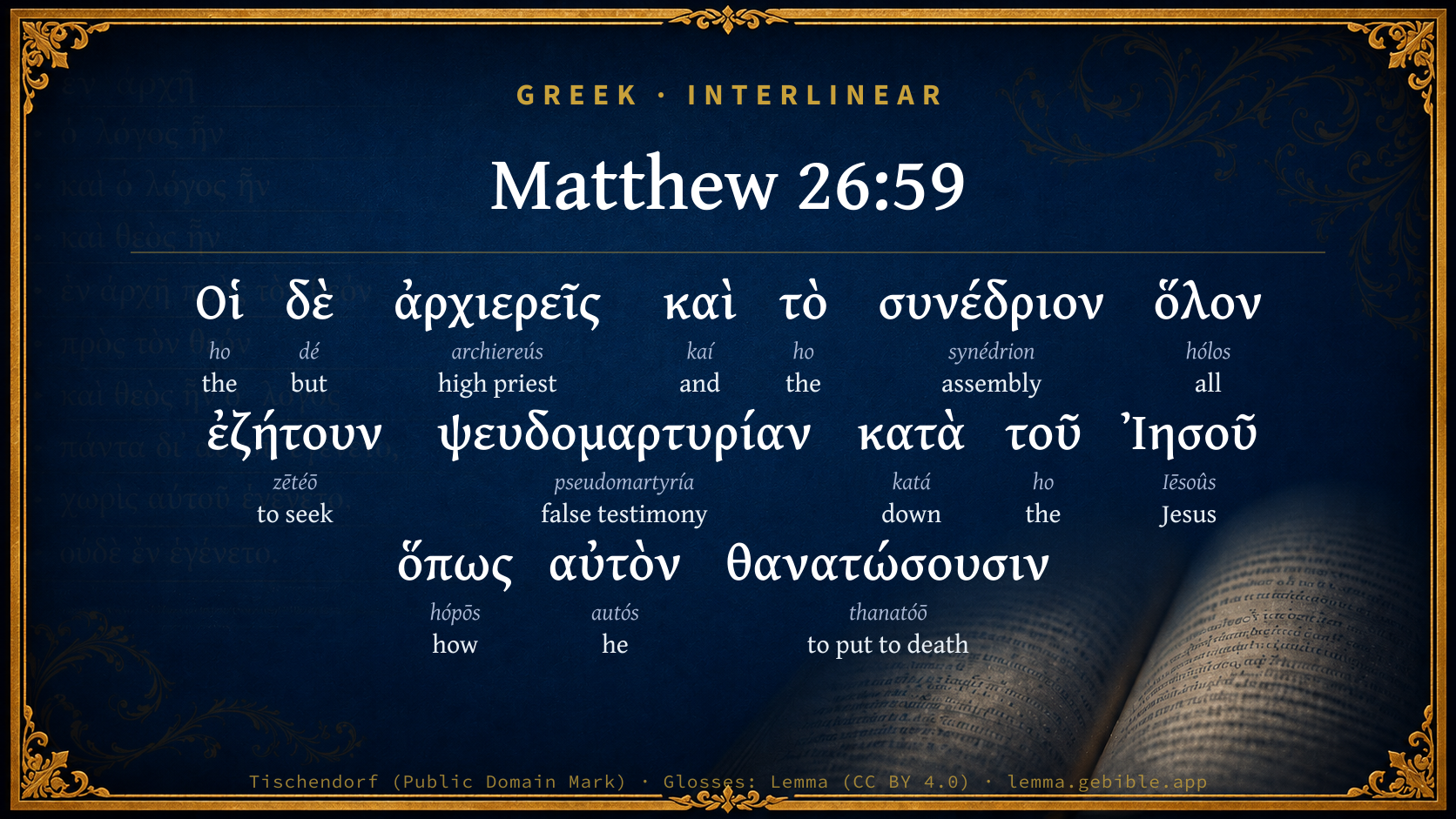
  1. Οἱ ho G3588 “the” Article, Nominative, Plural, Masculine
  2. δὲ dé G1161 “but” Conjunction
  3. ἀρχιερεῖς archiereús G749 “high priest” Noun, Nominative, Plural, Masculine
  4. καὶ kaí G2532 “and” Conjunction
  5. τὸ ho G3588 “the” Article, Nominative, Singular, Neuter
  6. συνέδριον synédrion G4892 “assembly” Noun, Nominative, Singular, Neuter
  7. ὅλον hólos G3650 “all” Adjective, Nominative, Singular, Neuter
  8. ἐζήτουν zētéō G2212 “to seek” Verb, Imperfect, Active, Indicative, 3rd person, Plural
  9. κατὰ katá G2596 “down” Preposition
  10. τοῦ ho G3588 “the” Article, Genitive, Singular, Masculine
  11. Ἰησοῦ Iēsoûs G2424 “Jesus” Noun, Genitive, Singular, Masculine
  12. ὅπως hópōs G3704 “how” Adverb
  13. αὐτὸν autós G846 “he” Personal pronoun, Accusative, Singular, Masculine
  14. θανατώσουσιν thanatóō G2289 “to put to death” Verb, Future, Active, Indicative, 3rd person, Plural

About this verse

These counts appear in no published source. They are computed here, from the morphology-tagged text and Lemma’s own curated glosses. What Lemma adds →

15
words
13
distinct lemmas
Gospels
section

Notable vocabulary

The rarest word here is ψευδομαρτυρίαν false testimony G5577 — appearing just 2 times in the whole Greek New Testament.

Shared distinctive vocabulary

ψευδομαρτυρίαν false testimony G5577 occurs in 2 verses of the Greek New Testament. Also found in:

Repetition

A word recurs within this verse:

Cross-references

10

Topical passages linked to Matthew 26:59 in the Treasury of Scripture Knowledge — connected by theme and wording, ordered by reader-vote popularity; previews shown in the World English Bible.

  • Deuteronomy 19:16–21 If an unrighteous witness rise up against any man to testify against him of wrong-doing,
  • Mark 14:55–56 Now the chief priests and the whole council sought witnesses against Jesus to put him to death, and found none.
  • Acts 6:11–13 Then they secretly induced men to say, "We have heard him speak blasphemous words against Moses and God."
  • 1 Kings 21:8–13 So she wrote letters in Ahab's name, and sealed them with his seal, and sent the letters to the elders and to the nobles who were in his city, [and] who lived with Naboth.
  • Psalms 27:12 Don't deliver me over to the desire of my adversaries, For false witnesses have risen up against me, Such as breathe out cruelty.
  • Psalms 35:11–12 Unrighteous witnesses rise up. They ask me about things that I don't know about.
  • Psalms 94:20–21 Shall the throne of wickedness have fellowship with you, Which brings about mischief by statute?
  • Proverbs 25:18 A man who gives false testimony against his neighbor Is like a club, a sword, or a sharp arrow.
  • Matthew 5:22 But I tell you, that everyone who is angry with his brother without a cause shall be in danger of the judgment; and whoever shall say to his brother, 'Raca!' shall be in danger of the council; and whoever shall say, 'You fool!' shall be in danger of the fire of Gehenna.
  • Acts 24:1–13 After five days, the high priest, Ananias, came down with certain elders and an orator, one Tertullus. They informed the governor against Paul.

Cross-references courtesy of OpenBible.info (CC BY 4.0).

Where the printed editions differ

1 variant

Places in this verse where the major printed Greek editions disagree on the wording in a way that affects the translation — a comparison of editions, not a manuscript-by-manuscript collation. The editions are the modern critical texts (Nestlé-Aland 28/27, SBL, Westcott-Hort, Tregelles, Tyndale House) and the traditional texts behind the KJV (the Textus Receptus and the Byzantine/Majority text). It is not a claim about which reading is original.

  1. Extra text
    οἱ πρεσβύτεροι καὶ

    “<the> elders and”

    In TRByz Not in NA28NA27TynSBLWHTreg

    οἱ πρεσβύτεροι καὶ (hoi presbuteroi kai) ' elders and' is only in traditional manuscripts (TR+Byz)

Textual data: Translators Amalgamated Greek New Testament (STEPBible TAGNT) · CC BY 4.0.

Commentary

Notes on Matthew 26:59 from classic Christian and Jewish commentators (each source and its license shown beneath its notes). The classic Christian expositions comment on the surrounding passage and are grouped to its opening verse, so a note may address several verses; the Jewish commentaries on the Tanakh (Rashi and others) are per-verse, so they appear only where the commentator wrote on this verse.

Lemma curates 59 commentaries, every one of them public domain or Creative Commons licensed, each selected and text-cleaned for this edition rather than reprinted as found. About our sources →

Joseph Benson's Commentary

Mat 26:59-60. The chief priests, and all the council, sought false witness — “When the council found that Jesus declined answering the questions, whereby they would have drawn from him an acknowledgment of his being the Messiah, they examined many witnesses to prove his having assumed that character; for it appears, by what happened afterward, that they considered such a pretension as blasphemy in his mouth, who, being nothing but a man, as they supposed, could not, without affronting the majesty of God, take the title of God’s Son, which of right belonged to the Messiah. But, in examining the witnesses, they acted like interested and enraged persecutors, rather than impartial judges; for they formed their questions after such a manner as, if possible, to draw from them expressions which they might pervert into suspicions of guilt, whereupon they might condemn Jesus. But found none, though many false witnesses came — Notwithstanding they were at the utmost pains to procure such a proof as in the eye of the law would justify the sentence which they were resolved at all hazards to pass upon Jesus, they exerted themselves to no purpose. Because, though they suborned many witnesses, these, in giving their testimony, contradicted one another; a circumstance which the most illiterate person in the court could not but be sensible invalidated their evidence.” “As this was a great proof of Christ’s innocence, so it is a singular instance of the power of God over men’s minds, that, for all the rewards these great men could offer, no two consistent witnesses could be procured to charge him with any gross crime. Possibly, the exertion of his miraculous power, in striking to the ground those that were most forward to seize him, might intimidate the spirits of some who might otherwise have been prevailed upon.” At last came two false witnesses — Such they were, although part of what they said was true, because our Lord did not speak some of the words they mentioned at all; nor any of them in the sense in which they represented them as being spoken. See Macknight and Doddridge.

Joseph Benson's Commentary on the Old and New Testaments (1811–1818) — public domain. Text from a community e-Sword module.

Godbey's Commentary on the New Testament

William B. Godbey

JESUS CONDEMNED BY THE SANHEDRIN

Mat 26:59-68; Mar 14:55-65; Luk 22:63-71;Joh 18:19-24. “Then the high priest asked Jesus concerning His disciples and teaching. Jesus responded to Him, I spoke boldly to the world. I always taught in the synagogue, and in the temple, where all the Jews come together, and I spoke nothing in secret. Why do you ask Me? Ask those who heard what I said to them; behold, they know the things which I said. He, speaking these things, one of the officers standing by struck Jesus with his hand, saying, Do you thus answer the high priest? Jesus responded to him, If I spoke wickedly, testify concerning the wickedness; but if truly, why do you smite Me? Then Annas sent Him bound to Caiaphas the high priest.” Evidently, Annas and Caiaphas had their tribunals in the same great quadrangular building standing on Mount Zion, and now visited by the thirty thousand pilgrims annually going to Jerusalem. Having first been arraigned at the tribunal of Annas, He is now, about day-dawn, led bound to the tribunal of Caiaphas. You see how the high priest endeavored to make Him confess, hoping to utilize His own testimony against Himself, as they had no witnesses to amount to anything, and thus condescended to a very cowardly stratagem, which even if he had succeeded, the law pronounces the weakest of all evidence. It was awfully barbaric for that officer to smite a prisoner in bonds. You see, Jesus vindicates Himself reminding the man of the criminal impropriety of this uncouth assault upon a defenseless prisoner illustrating the right of all His followers to vindicate themselves from false accusation, violence, and tyranny, and refuting the idea somewhat prevalent that we are never to advocate our rights and vindicate ourselves against the oppression of the wicked.

Luk 22:66. “And when it was day, the eldership of the people, the chief priests, and the scribes were assembled, and led Him into the Sanhedrin.” As they had been on His track, like bloodhounds, three years, eager to take, His life (but restrained by the fear of the people; and well they might be, because a bloody civil war would have broken out immediately), such is their fear of the people that they attack Him at midnight, aiming to secure the death-warrant and kill Him before day. In this they are disappointed and woefully disconcerted, being unable to convene the Sanhedrin till day dawn, though keeping couriers running at race-horse speed all night, (notifying and urging them up. The Sanhedrin was the highest court of the politico-ecclesiasticism, the successor of the eldership organized by Jethro, the father-in-law of Moses, during their wilderness peregrinations.

Mar 14:55-59. “And the high priest and all the Sanhedrin continued to seek testimony against Jesus to put him to death, and they found none.” Matthew says “false testimony.” Of course, they preferred true testimony if they could get it; but as there was none, they were anxious to take any kind they could get. “For many continued to testify falsely against Him, and their testimonies were not equal,” i. e., they contradicted one another, which in law invalidates both, so that they are thrown out of court. “And certain ones, rising up, falsely testified against Him, saying, We heard Him saying, That I will destroy this temple, made with hands, and in three days I will build another, made without hands. Indeed their testimony was not equal;” i. e., they contradicted one another. Perhaps some of the witnesses gave it correctly; but you have only to look at Joh 2:19, “Destroy this temple, and I will build it in three days,” to see that the above witnesses were false, as they testified that He said, “I will destroy this temple, made with hands, and build another, made without hands.” By comparison, you see that these witnesses did not quote Him correctly, as their testimony would make it mean that great stone edifice standing on Mount Moriah; while He did not mean that at all, but the temple of His body. Why did He not correct them when so grossly misrepresenting Him? Because it would have done no good, as Satan was in them, and they were thirsting for His blood.

Mat 26:62-66. “The high priest, standing up, said to Him, Do You answer nothing? What are they witnessing against Thee? And Jesus was silent.” Under temptation, the better policy is, like Jesus, to keep silent. You should never speak while under severe provocation. “The high priest, responding, said to Him, I assure Thee by the living God, that Thou mayest tell us if Thou art the Christ, the Son of God. Jesus says to him, Thou sayest it.” That is an Oriental form of affirmation. Here, you see, Jesus answers while under oath of affirmation, administered by the high priest. Hence you see His indirect approval appertaining to the civil oath of affirmation. Paul (1Th 5:23) administers a solemn oath to the Thessalonian saints to read his letter to all the members of the Church.

“Moreover I say unto you, Hereafter you shall see the Son of man sitting on the right hand of power and coming in the clouds of heaven.” The first clause of this wonderful prophecy of our Lord was fulfilled when they saw Him rise from the dead and ascend up to heaven from Mount Olivet; while the second clause, “coming in the clouds of heaven,” will be fulfilled when Jesus shall ride down on a cloud and receive all the kingdoms of this world (Dan 7:9-14) and reign forever. In this wonderful sentence there is not so much as a comma, yet those two clauses are separated by many centuries, the former being verified in a few days, and the latter still pending.

“Then the high priest tore His robes, saying, That He blasphemed; what need of testimony have we yet? Behold, now , you have heard His blasphemy. What seems good to you? And they, responding, said, He is worthy of death.” Mark says this verdict was unanimous, So here you see the issue of His prosecution before the Sanhedrin They unanimously condemned Him to die for blasphemy, according to the law of Moses. (Lev 24:16.) Thus you see, good and just laws become vehicles of tyranny and persecution when in the hands of bad men, and are no guarantee of fight and justice when the devil is in the administrators. Jesus died under the verdict of Divine law, and so did all the martyrs, there being no trouble about the law; but Satan was in the preachers and ruling elders. So it is this day. Some of the brightest saints that walk beneath the skies, have been excommunicated, while drunkards, libertines, blasphemers, and thieves have been retained without impeachment. Such was the case in the days of Luther and Wesley, and always will be so when Diabolus gets into the clergy and official laity.

Luk 22:63-65. “And the men who had charge of Jesus began to mock Him, beating Him; and covering Him, continued to strike His face, and ask Him, saying, Prophesy, who is the one smiting thee? And blaspheming Him as to many other things, they continued to speak against Him.” The truth of it is, Jesus had no trial, it was a mockery; to their infinite shame, barbarically abusing Him while a prisoner in chains, which is revolting to the very idea of civil, not to say ecclesiastical administration. Nicodemus certifies that Jewish law never condemned a man till he met his accusers face to face, and had a fair and impartial trial. Festus, the Roman proconsul, makes the same statement in reference to imperial law. Hence, Jesus was mobbed and outlawed. But did He not come into the world to die? Most assuredly; and He would have died to redeem the world from sin, death, and hell if neither Judas nor Caiphas had ever been born. Yet that is no apology for the diabolical treason, perfidy, and murder which they committed, overtly, without excuse.

William B. Godbey, Commentary on the New Testament (1896–1900) — public domain. Text from a community e-Sword module.

Tyndale Open Study Notes

Tyndale Open Resources

26:59 were trying to find witnesses: The verb tense suggests an extended, perhaps desperate, attempt to find any testimony that could lead to a formal accusation (see Mark 14:55-56).

Tyndale Open Study Notes — © Tyndale Open Resources, licensed CC BY-SA 4.0. Text via the HelloAO Bible API.

Bengel's Gnomon

Johann Albrecht Bengel

Mat 26:59. Ἐζήτουν, sought) Upon this arose that host of false witnesses. No greater act of injustice was ever committed than that against our Lord: in respect of God, however, it was the highest exercise of justice.[1159]

[1159] Inasmuch as the holiness of God demanded such an awful sacrifice for the sins, such a precious ransom for the souls of men.—(I. B.) Rom 3:26.—ED.

Bengel's Gnomon of the New Testament — English translation (T&T Clark, Edinburgh, 1860) — public domain. Text from a community e-Sword module.

Meyer's Critical & Exegetical Commentary

Heinrich August Wilhelm Meyer

Mat_26:59 f. Καὶ τὸ συνέδριον ὅλον] and the whole Sanhedrim generally. This is a legitimate enough use of the words, even although certain individual members (Nicodemus and Joseph of Arimathea) did not concur in this proceeding.

ψευδομαρτυρίαν] so called from the historians own point of view. Euthymius Zigabenus well remarks: ὡς μὲν ἑκείνοις ἐδόκει, μαρτυρίαν, ὡς δὲ τῇ ἀληθείᾳ, ψευδομαρτυρίαν.

ὅπως θανατ. αὐτ.] with a view to putting Him to death, which could only be effected by their pronouncing in the first instance a capital sentence, and then having it ratified by the authority of the imperial procurator.

καὶ οὐχ εὗρον καὶ πολλῶν προσελθόντων ψευδομαρτύρων (see the critical remarks): and they found no means of doing so, even though many false witnesses had come forward. There were many who presented themselves to bear witness against Jesus; yet the Sanhedrim did not find what it wanted to find, doubtless because of the lack of that agreement between two of the witnesses at least which the law required (Num_35:30; Deu_17:6; Deu_19:15). See what immediately follows: ὕστερον δὲ προσελθ. δύο, and comp. Mar_14:56. Though there was a show of complying with the ordinary forms of judicial process, they were nevertheless shamefully violated (in opposition to Salvador, Saalschutz), in that exculpatory evidence (Joh_18:20 f.) was never called for.

Meyer — Critical and Exegetical Commentary on the New Testament — English translation by Peter Christie, edited by Frederick Crombie (T&T Clark, 1880) — public domain. Text from a community e-Sword module.

Expositor's Greek Testament

ed. W. Robertson Nicoll

Mat 26:59-68 . The trial .

Mat 26:59 . τ . συν . ὅλον , the whole Sanhedrim, cf. πάντες in Heb 3:16 , the statement in both cases admitting of a few exceptions. ψευδομαρτυρίαν , false evidence, of course in the first place from the evangelist’s point of view ( μαρτυρίαν in Mk.), but substantially true to the fact. They wanted evidence for a foregone conclusion; no matter though it was false if it only looked true and hung fairly well together. Jesus was apprehended to be put to death, and the trial was only a blind, a form rendered necessary by the fact that there was a Procurator to be satisfied.

The Expositor's Greek Testament, edited by W. Robertson Nicoll (1897–1910) — public domain. Text from a community e-Sword module.

Adam Clarke's Commentary

Verse 59. All the council sought false witness] What a prostitution of justice! - they first resolve to ruin him, and then seek the proper means of effecting it: they declare him criminal, and after that do all they can to fix some crime upon him, that they may appear to have some shadow of justice on their side when they put him to death. It seems to have been a common custom of this vile court to employ false witness, on any occasion, to answer their own ends. See this exemplified in the case of Stephen, Ac 6:11-13.

Adam Clarke's Commentary on the Bible (1810–1826) — public domain. Text from a community e-Sword/MySword module.

Ellicott's Commentary for English Readers

(59) Sought false witness.—The tense of the Greek verb implies a continued process of seeking. The attempt to draw the materials for condemnation from the lips of the accused had failed. The law of Moses required at least two witnesses (Deu_17:6; Deu_19:15), and these, it is natural to believe, were examined independently of each other. The haste which marked all the proceedings of the trial had probably prevented previous concert, and the judges could not, for very shame, convict in the face of a glaring discrepancy, probably as to time and place, between the witnesses who thus offered themselves.

A Bible Commentary for English Readers, edited by Charles John Ellicott (1878–1897) — public domain. Text from a community e-Sword module.

The Cambridge Bible for Schools and Colleges

gen. ed. J. J. S. Perowne

59. sought false witness] See above (1): to seek witnesses at all was against the spirit of the law.

The Cambridge Bible for Schools and Colleges (gen. ed. J. J. S. Perowne; Cambridge University Press, 1878–1918) — public domain. Text from a community e-Sword module.

John Gill's Exposition

But found none,.... That were fit for their purpose,

yea, though many false witnesses came, yet found they none; whose testimonies were sufficient to put him to death, which was what they were resolved upon, or whose witness were not alike and agreed; for according to their law, a man must not die by the mouth of one witness only, but by the mouth of two or three witnesses agreed in a point; and though they might be willing enough to dispense with the law in this case, yet might have some regard to their own character and reputation; and especially as they meant to deliver him to the Roman governor, in order to be condemned by him; they knew they must have a charge, and this supported with a proper evidence, or they could not hope to succeed; for which reason, they could not put up, as they otherwise willingly would, with any sort of witnesses:

at the last came two false witnesses; who were agreed in a point, and whose testimonies were alike; at least, had a greater appearance of truth and agreement than the rest; though Mark says, "neither so did their witnesses agree together", Mar 14:59, as to prove the point, for which it was given.

John Gill's Exposition of the Whole Bible (1746–1763) — public domain (CC PDM 1.0). Text via the HelloAO Bible API.

Trapp's Complete Commentary

John Trapp

59 Now the chief priests, and elders, and all the council, sought false witness against Jesus, to put him to death;

Ver. 59. Sought false witness] Here Christ is convented and examined in the spiritual court with a great deal of injustice and subordination. They first sought false witness, as if they had obeyed our Saviour, who bade them ask those that heard him what he had said unto them, Joh 18:21.

John Trapp, A Commentary or Exposition upon All the Books of the Old and New Testament (1647–1656) — public domain. Text from a community e-Sword module.

Albert Barnes' Notes on the Bible

False witness - That is, they sought for witnesses who would accuse him of crime of violation of the laws of the land or of God. We are not to suppose that “they wished” them to be “false” witnesses. They were indifferent, probably, whether they were true or false, if they could succeed in condemning him. “The evangelist” calls it false testimony. Before these witnesses were sought, we learn from John Joh 18:19-23 that the high priest asked Jesus of his disciples and his doctrine. Jesus replied that he had taught openly in the temple, and in secret had said nothing; that is, he had no “secret doctrines” which he had not been willing openly to teach, and he referred the high priest to those who had heard him. In a firm, dignified manner he put himself on trial, and insisted on his rights. “If I have spoken evil, bear witness of the evil: but if well, why smitest thou me?” Joh 18:23. This conversation took place, probably, before the council was assembled, and during this time the denials by Peter occurred. Luke informs us Luk 22:66 that the council came together as soon as it was day; that is, probably, near the morning, or not far from the break of day - after Peter had denied him and gone out.

Albert Barnes' Notes on the Bible (1834–1885) — public domain. Text from a community e-Sword/MySword module.

Matthew Poole's English Annotations

Mark expounds this latter verse, Mar 14:56, For many bare false witness against him, but their witness agreed not together. It is plain that they had taken up a resolution to destroy Christ one way or another, but they will make a show of justice in the execution of their malice. The council being set, it is not to be thought that they had then leisure to send about for witnesses, but out of their malice they screwed and sifted such witnesses as were brought, to see if they could get of them upon their oaths to affirm any thing against him which by their law was capital.

Many false witnesses came, yet they found none; that is, no two agreeing in the same story, as the law required, Deu 19:15, for a single testimony was none. Vox unius est vox nullius, A single witness is no witness, or none that could testify any thing of a capital nature. Many came and witnessed trivial things, but none witnessed any thing which touched his life; till

at last came two false witnesses.

Matthew Poole's English Annotations on the Holy Bible (1683–1685) — public domain. Text from a community e-Sword/MySword module.

Whedon's Commentary on the Bible

Daniel D. Whedon

59. Sought false witness — The consequences of their haste now alarmed the conspirators. Precipitated by the offer of Judas to betray Jesus, they had him on their hands before the accusation was planned and the evidence arranged. They have a criminal without a crime. As they dare not sentence him to death without some satisfactory inculpation, they are in a strait for charges and evidence.

Daniel D. Whedon (gen. ed.), Commentary on the Old and New Testaments (1874–1909) — public domain. Text from a community e-Sword module.

The Pulpit Commentary

The chief priests, and elders, and all the council. The words in brackets are probably spurious; they are omitted by the best uncials and the Vulgate. The words cannot imply strictly that the whole Sanhedrin was present and consenting to the present proceedings; for we know that such members as Nicodemus and Joseph of Arimathaea did not consent to the infamous deeds of the rest. (Luk_23:51Jo Luk_19:39) Sought ( ezhtoun , were seeking) false witness. The Sanhedrists had decided on Christ"s death; it only remained to find such a charge against him as would compel the Roman authorities to deal summarily with him. For their purpose the truth of the accusation was immaterial, so long as it was established, according to Law, (Deu_17:6 Deu_19:15) by two or three witnesses examined apart. They knew well that Christ could be condemned on no true testimony, hence they scrupled not to seek false. If they had meant to deal fairly, they would have allowed some who knew him to speak in his favour; but this was the very last thing which they desired or would have sanctioned.

The Pulpit Commentary (1880–1919), ed. H.D.M. Spence-Jones & Joseph S. Exell — public domain. Text from a community e-Sword module.

Kretzmann's Popular Commentary

Paul E. Kretzmann

The trial before Caiaphas:

v. 59. Now the chief priests and elders and all the council sought false witness against Jesus to put Him to death;

v. 60. but found none; yea, though many false witnesses came, yet found they none. At the last came two false witnesses

v. 61 and said, This fellow said, I am able to destroy the Temple of God, and to build it in three days.

v. 62. And the high priest arose and said unto Him, Answerest Thou nothing? What is it which these witness against Thee?

v. 63. But Jesus held His peace. And the high priest answered and said unto Him, I adjure Thee by the living God that Thou tell us whether Thou be the Christ, the Son of God.

v. 64. Jesus saith unto him, Thou hast said; nevertheless I say unto you, Hereafter shall ye see the Son of Man sitting on the right hand of Power, and coming in the clouds of heaven.

Note: The enumeration of the several sections of the Sanhedrin brings out all the more strongly the injustice of the proceedings. Men whose business it was to know the Law and to lead in all virtues were here the very ones to subvert right and to make a farce of justice. Also: They deliberately sought false witness. Knowing that the usual method of obtaining testimony against a criminal would have yielded no results, they exerted themselves most diligently to find such testimony as would enable them to judge Him worthy of death, but without success. The more men they examined with their obvious purpose in view, the more thoroughly just and holy Jesus stood before them. Even the last two witnesses that garbled the prophecy of Christ concerning the temple of His body, Joh 2:19, could not make their witness agree. The whole trial threatened to be a glorious justification of Jesus. But here the high priest Caiaphas, for fear of losing his case, forgot the dignity of his position as judge and turned accuser, if not plaintiff. He demanded that Christ defend Himself against the testimony which had been adduced. But Christ remained perfectly quiet, knowing that under the circumstances this silence was the best course. Since they wanted not justice, but His death at all costs, they would have pounced upon every word He might have uttered, and mutilated it beyond recognition. "Here see how unjustly the high priests deal with Christ the Lord. For they are at the same time accusers and judges. Therefore the Lord must be wrong in His case, no matter what He may say or do. In temporal affairs this would be a great dishonesty. But for these holy people nothing is sin, they have power in all things; they can do what they please, and challenge all who would accuse them of wrong or interpret something in an evil way. " And now comes the climax of the sinful farce staged by the Sanhedrin. Most solemnly the high priest challenges Christ to state under oath whether He be in truth the Son of God. He was determined to draw an explanation from Christ which could be used as damaging evidence against Him at any cost. To continue silent now would be tantamount to a denial of a truth which was essential in His Messianic ministry. And so He answered with an emphatic: I am. But just as emphatically, and more so, He added a startling bit of information, namely, that the time would come when He would return in glory; in fact, this glorification was about to begin, with His entering, through suffering and death, into the glory of His Father. When these unjust judges will see Him again, it will be in the role of their Judge. And all the enemies of Christ will tremble and quake when this same Christ whom they have rejected will come to Judgment and demand a reckoning.

Paul E. Kretzmann, Popular Commentary of the Bible (1921–1924) — public domain. Text from a community e-Sword module.

The People's New Testament

B. W. Johnson

59, 60. The whole council. The Sanhedrim. Sought false witness. No one could be condemned legally without at least two witnesses who agreed (Deut. 17:6; 19:15). “One witness,” it was said, “was no witness.” As there was no true testimony to a charge that could be punished with death, they sought false witness.

They found it not. That is, witnesses who would testify to a capital offence and agree in their testimony. Afterward came two. These two gave a perverted version of what Christ had said concerning his death and the resurrection of his own body under the figure of a temple. See John 2:19. But even their testimony disagreed (Mark 14:59).

B. W. Johnson's The People's New Testament with Notes (1889–1891) — public domain. Electronic text from the Christian Classics Ethereal Library (CCEL) ThML edition.

unfoldingWord translationNotes

Door43 World Missions Community

Now

This word is used here to mark a break in the main story line. Here Matthew starts to tell a new part of the story.

so that they

Here "they" refers to the chief priests and the members of the council.

might put him to death

"might have a reason to execute him"

two came forward

"two men came forward" or "two witnesses came forward"

This man said, 'I am able to destroy ... days.'

If your language does not allow quotes within quotes you can rewrite it as a single quote. AT: "This man said that he is able to destroy ... days." (See: Quotations and Quote Margins and Direct and Indirect Quotations)

This man said

"This man Jesus said"

in three days

"within three days," before the sun goes down three times, not "after three days," after the sun has gone down the third time

translationWords

chief priests

council

corrupt witness

temple

unfoldingWord translationNotes — © Distant Shores Media and the Door43 World Missions Community, licensed CC BY-SA 4.0. Source: git.door43.org/Door43/en_tn.

Cambridge Greek Testament for Schools and Colleges

59. The textus receptus adds καὶ οἱ πρεσβύτεροι with AC, and the preponderance of later authority, against אBDL, some Versions and Fathers.

θανατώσουσιν for θανατώσωσι.

59. ἐζήτουν κ.τ.λ. See above (1): to seek witnesses at all was against the spirit of the law. The imperfect ἐζήτουν implies anxious and continued search.

Cambridge Greek Testament for Schools and Colleges (Cambridge University Press, 1896; 21 vols, various authors incl. Carr, Maclear, Plummer, Farrar, Lumby, Moule, M. R. James, Simcox) — public domain. Text from a community e-Sword module.

Alford’s Greek Testament

Henry Alford

59. ψευδομ.] ὡς μὲν ἐκείνοις ἐδόκει, μαρτυρίαν, ὡς δὲ τῇ ἀληθείᾳ, ψευδομαρτυρίαν. Euthym. But is this quite implied? Is it not the intention of the Evangelist to represent that they sought false witness, not that they would not take true if they could get it, but that they knew it was not to be had?

This hearing is altogether omitted in Luke, and only the indignities following related, vv. 63-65.

Henry Alford, The Greek Testament (1849–1861) — public domain. Text from a community e-Sword module.

International Critical Commentary

(M) 59. And the chief priests and all the Sanhedrin were seeking false witness against Jesus, that they might put Him to death.] Mk. has: “And the chief priests and all the Sanhedrin were seeking witness against Jesus, with a view to putting Him to death.”—ψευδομαρτυρίαν] emphasises the treachery of the authorities.

International Critical Commentary — older volumes (1896–1929), various authors — public domain. Text from a community e-Sword module.

Lesson kit

Teaching starters — assembled from the data on this page, not authored interpretation. Every prompt links to the verse data it draws on. Edit before teaching.

Matthew, in the Gospels, opens this verse with 15 words (13 distinct Greek lemmas). Its most distinctive word is pseudomartyría (“false testimony”). A historical commentator’s framing appears above. Read the whole chapter for the surrounding context.

Discussion questions

  1. What does “false testimony” (pseudomartyría) contribute to the verse as a whole?
  2. Matthew 15:19 shares the word «false testimony» with this verse. How do the two illuminate each other?
  3. “the” occurs 3× in this one verse. What is the effect of the repetition?
  4. The translations on this page render this verse differently — a whole-verse word diff, not a word-by-word alignment. What might account for the different wordings?
  5. Reading how Joseph Benson's Commentary and Godbey's Commentary on the New Testament read this verse, where do the two commentators agree and where do they part?

Things to notice

Reading settings

Reading text

Shown beneath each verse's original-language words.

Old Testament
Old Testament edition

Read the OT as the Masoretic Hebrew (MT) or the Greek Septuagint (LXX).

English shown for the Greek Septuagint (in the Hebrew ↔ Greek comparison).

Comparing translations? Open the Compare panel on any verse page to stack up to four side by side.