Matthew 26:33

Greek (Tischendorf 8th ed.) Matthew 26:33 appears in the Greek New Testament. The text above is from the Tischendorf 8th edition. Each word links to its Strong’s number and a concise gloss. Click any word for its full Thayer’s Greek Lexicon entry.
Download image
Cite this verse

Matthew 26:33 (World English Bible). Public Domain. Lemma interlinear Bible study tool, https://lemma.gebible.app/v/matthew/26/33.

Show BibTeX & RIS
BibTeX
RIS
English Translation
But Peter answered him, "Even if all will be made to stumble because of you, I will never be made to stumble."
World English Bible · Public Domain
Download a study sheet

One document with this verse’s original text, its word-by-word gloss line, the meaning frame, cross-references with their text, attributed commentary, and full source and license credits — printable, and it pastes into notes with its structure intact.

This verse Autodidact and up

Study sheet (.html) Plain text (.txt)

A passage Seminary Student

Up to 50 verses in one chapter. A passage sheet keeps up to 6 commentary sources and 12 cross-references per verse, in the order this page ranks them, and says so on the sheet whenever that leaves anything out. Ask for a single verse and you get the Autodidact verse sheet above.

Everything on this page stays free to read, with no account — the sheet is a download of what is already on screen, not access to it.

Want to remove ads? Support Godless Engineer
Compare translations 3

The same verse in 3 English versions, stacked beneath the original-language interlinear above. Click any original word for its lexicon entry.

Each is an independent rendering of the whole verse — the interlinear is not word-aligned to these translations.

Highlighted words mark where these versions differ — a whole-verse word diff, not a word-by-word alignment.

  • World English Bible Public Domain
    But Peter answered him, "Even if all will be made to stumble because of you, I will never be made to stumble."
  • King James Version Public Domain
    Peter answered and said unto him, Though all men shall be offended because of thee, yet will I never be offended.
  • unfoldingWord Literal Text CC BY-SA 4.0
    But answering, Peter said to him, “If all will be caused to stumble on you, I never will be caused to stumble.”

unfoldingWord Literal Text — © unfoldingWord, licensed CC BY-SA 4.0. Word-aligned USFM3 via Door43 (git.door43.org/unfoldingWord/en_ult).

Versions to compare (up to 4)

3 of 4 selected

Show all 19 translations

Every available English version of this verse, each an independent rendering of the whole verse.

  • World English Bible Public Domain
    But Peter answered him, "Even if all will be made to stumble because of you, I will never be made to stumble."
  • Berean Standard Bible Public Domain
    Peter said to Him, “Even if all fall away on account of You, I never will.”
  • Majority Standard Bible Public Domain
    Peter said to Him, “Even if all fall away on account of You, I never will.”
  • King James Version Public Domain
    Peter answered and said unto him, Though all men shall be offended because of thee, yet will I never be offended.
  • American Standard Version (1901) Public Domain
    But Peter answered and said unto him, If all shall be offended in thee, I will never be offended.
  • Revised Version (1885) Public Domain
    But Peter answered and said unto him, If all shall be offended in thee, I will never be offended.
  • Geneva Bible (1599) Public Domain
    But Peter aunswered, and sayde vnto him, Though that al men should be offended by thee, yet will I neuer be offended.
  • Douay-Rheims (1899) Public Domain
    And Peter answering, said to him: Although all shall be scandalized in thee, I will never be scandalized.
  • Young's Literal Translation Public Domain
    And Peter answering said to him, `Even if all shall be stumbled at thee, I will never be stumbled.'
  • Literal Standard Version CC BY-SA 4.0
    And Peter answering said to Him, “Even if all will be stumbled at You, I will never be stumbled.”
  • Unlocked Literal Bible CC BY-SA 4.0
    But Peter said to him, “Even if all fall away because of you, I will never fall away.”
  • unfoldingWord Literal Text CC BY-SA 4.0
    But answering, Peter said to him, “If all will be caused to stumble on you, I never will be caused to stumble.”
  • Darby Bible Public Domain
    And Peter answering said to him, If all shall be offended in thee, *I* will never be offended.
  • World Messianic Bible Public Domain
    But Peter answered him, “Even if all will be made to stumble because of you, I will never be made to stumble.”
  • Webster's Bible Public Domain
    Peter answered and said to him, Though all men shall be offended because of thee, yet will I never be offended.
  • Free Bible Version CC BY-SA 4.0
    But Peter objected, “Even if everyone else abandons you, I'll never abandon you.”
  • Bible in Basic English Public Domain
    But Peter made answer and said to him, Though all may be turned away from you, I will never be turned away.
  • Text-Critical English NT CC BY 4.0
    Peter answered him, “Even if everyone else falls away because of yoʋ, I will never fall away.”
  • Tyndale New Testament (1534) Public Domain
    Peter answered and sayde vnto him: though all men shulde be offended by the yet wolde I never be offended.

Literal Standard Version (2020), Covenant Press — licensed CC BY-SA 4.0. Text via the HelloAO Bible API (eBible.org). Unlocked Literal Bible (unfoldingWord) — licensed CC BY-SA 4.0. Text via the HelloAO Bible API (eBible.org). unfoldingWord Literal Text — © unfoldingWord, licensed CC BY-SA 4.0. Word-aligned USFM3 via Door43 (git.door43.org/unfoldingWord/en_ult). Free Bible Version, Dr. Jonathan Gallagher — licensed CC BY-SA 4.0. Text via the HelloAO Bible API (eBible.org).

Word by word

More ways to search: Search by grammar → Find every occurrence → Compare this word →

Practice this passage: Drill this verse → Learn its vocabulary →

οὐδέποτε
oudépote
G3763
“never”
Adverb, Negative
Part of Speech
Adverb
Degree
Negative
Full Thayer's Definition

Origin: from G3761 and G4218

TDNT: None

1. never
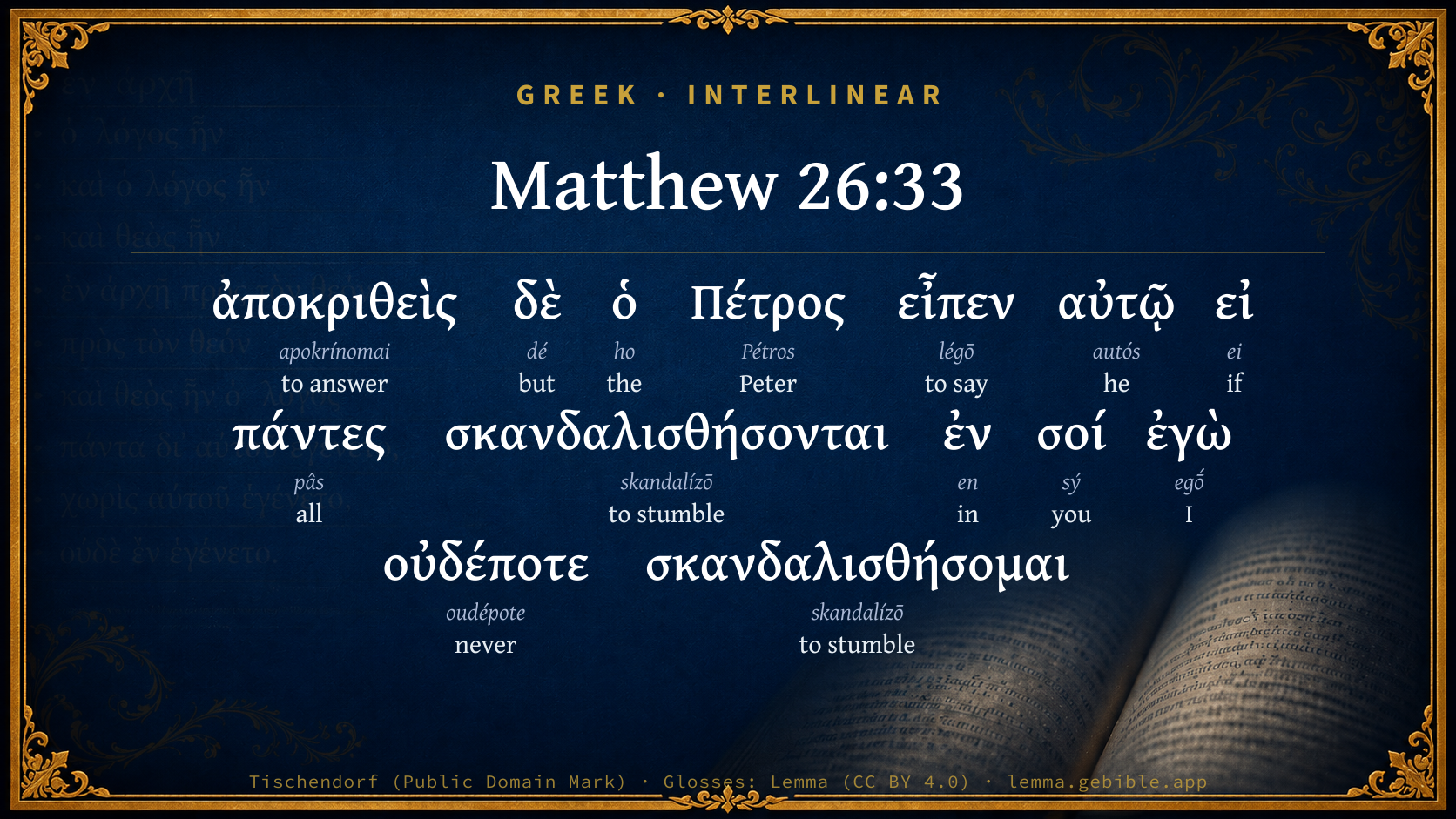
  1. ἀποκριθεὶς apokrínomai G611 “to answer” Verb, Aorist, Passive deponent, Participle, Nominative, Singular, Masculine
  2. δὲ dé G1161 “but” Conjunction
  3. ὁ ho G3588 “the” Article, Nominative, Singular, Masculine
  4. Πέτρος Pétros G4074 “Peter” Noun, Nominative, Singular, Masculine
  5. εἶπεν légō G3004 “to say” Verb, Aorist, Active, Indicative, 3rd person, Singular
  6. αὐτῷ autós G846 “he” Personal pronoun, Dative, Singular, Masculine
  7. εἰ ei G1487 “if” Conditional
  8. πάντες pâs G3956 “all” Adjective, Nominative, Plural, Masculine
  9. σκανδαλισθήσονται skandalízō G4624 “to stumble” Verb, Future, Passive, Indicative, 3rd person, Plural
  10. ἐν en G1722 “in” Preposition
  11. σοί sý G4771 “you” Personal pronoun, 2nd person, Dative, Singular
  12. ἐγὼ egṓ G1473 “I” Personal pronoun, 1st person, Nominative, Singular
  13. σκανδαλισθήσομαι skandalízō G4624 “to stumble” Verb, Future, Passive, Indicative, 1st person, Singular

About this verse

These counts appear in no published source. They are computed here, from the morphology-tagged text and Lemma’s own curated glosses. What Lemma adds →

14
words
13
distinct lemmas
Gospels
section

Notable vocabulary

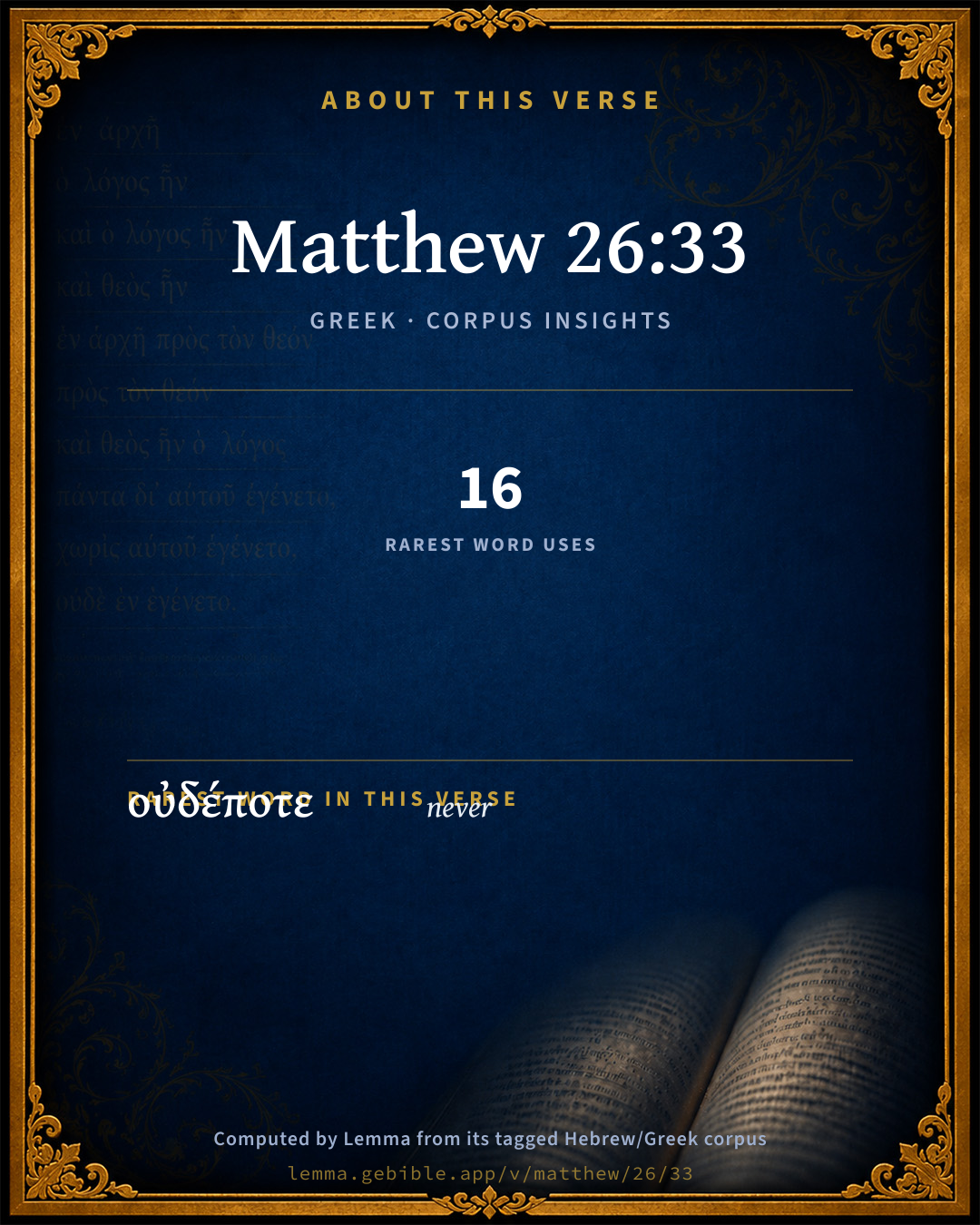
The rarest word here is οὐδέποτε never G3763 — appearing just 16 times in the whole Greek New Testament.

Shared distinctive vocabulary

οὐδέποτε never G3763 occurs in 15 verses of the Greek New Testament. Also found in:

Repetition

A word recurs within this verse:

  • σκανδαλισθήσονται to stumble G4624 ×2

Cross-references

13

Topical passages linked to Matthew 26:33 in the Treasury of Scripture Knowledge — connected by theme and wording, ordered by reader-vote popularity; previews shown in the World English Bible.

  • Luke 22:33 He said to him, "Lord, I am ready to go with you both to prison and to death!"
  • Psalms 17:5 My steps have held fast to your paths, My feet have not slipped.
  • Psalms 119:116–117 Uphold me according to your word, that I may live. Let me not be ashamed of my hope.
  • Proverbs 16:18–19 Pride goes before destruction, And a haughty spirit before a fall.
  • Proverbs 20:6 Many men claim to be men of unfailing love, But who can find a faithful man?
  • Proverbs 28:25–26 One who is greedy stirs up strife; But one who trusts in Yahweh will prosper.
  • Jeremiah 17:9 The heart is deceitful above all things, and it is exceedingly corrupt: who can know it?
  • Mark 14:29 But Peter said to him, "Although all will be offended, yet I will not."
  • John 13:36–38 Simon Peter said to him, "Lord, where are you going?" Jesus answered, "Where I am going, you can't follow now, but you will follow afterwards."
  • Romans 12:10 In love of the brothers be tenderly affectionate one to another; in honor preferring one another;
  • Philippians 2:3 doing nothing through rivalry or through conceit, but in humility, each counting others better than himself;
  • 1 Peter 5:5–6 Likewise, you younger ones, be subject to the elder. Yes, all of you gird yourselves with humility, to subject yourselves to one another; for "God resists the proud, but gives grace to the humble."
  • John 21:15 So when they had eaten their breakfast, Jesus said to Simon Peter, "Simon, son of Jonah, do you love me more than these?" He said to him, "Yes, Lord; you know that I have affection for you." He said to him, "Feed my lambs."

Cross-references courtesy of OpenBible.info (CC BY 4.0).

Commentary

Notes on Matthew 26:33 from classic Christian and Jewish commentators (each source and its license shown beneath its notes). The classic Christian expositions comment on the surrounding passage and are grouped to its opening verse, so a note may address several verses; the Jewish commentaries on the Tanakh (Rashi and others) are per-verse, so they appear only where the commentator wrote on this verse.

Lemma curates 59 commentaries, every one of them public domain or Creative Commons licensed, each selected and text-cleaned for this edition rather than reprinted as found. About our sources →

The Biblical Illustrator

Joseph S. Exell

Mat_26:33-35

Though all men shall be offended because of Thee, yet will I never be offended.

Enthusiasm and its dangers

I. The confidence of inexperience, aided by lack of imagination. How often is this repeated before our eyes! Castles in the air are built by inexperienced virtue, to be demolished, alas! at the first touch of the realities of vice. The country lad who has been brought up in a Christian home, and is coming up to some great business house in London, makes vigorous protestations of what he will, and will not, do in a sphere of life, of the surroundings of which he can, as yet, form no true idea whatever; the emigrant, who is looking forward to spend his days in a young colony, where the whole apparatus of Christian and civilized life is as yet in its infancy, or is wanting altogether, makes plans of a situation, of which he cannot at all as yet, from the nature of the case, take the measure; the candidate for holy orders, who anticipates his responsibilities from afar, gathering them from books and from intercourse with clergymen, makes resolutions which he finds have to be revised by the light of altogether unforeseen experiences.

II. An insufficent sense of the power of new forms of temptation. A man living in a comparatively private position is exemplary. His little failures do but serve to set forth the sterling worth of his general character. He seems to be marked out for some promotion. All predict that he will be a great success, since he has shown on a small scale excellencies which will certainly distinguish him, and will adorn a larger sphere. He is promoted, and he turns out a hopeless failure. How extraordinary! cries out the world. Who could have anticipated this? exclaim his friends. And yet the explanation may be a very simple one. He may have been brought, by the change of circumstances, for the first time in his life, under the influence of a temptation hitherto unknown to him. He may have been tempted in his earlier years by appeals to avarice, illicit desires, or personal vanity; but never, as yet, has he felt the pressure of the fear of man. In that place of prominence he, for the first time, feels the fear of a mass of human opinion which he does not in his conscience and his heart respect, but which he fears only because it is a mass. And this fear is too much for him, too much for his sense of justice, too much for his consistency and his former self. Alas! that new temptation has found a weak place in his moral nature; it has sprung a leak in him; and the disappointment is as keen to-day as the expectations of yesterday were unduly sanguine.

III. St. Peters over-confidence would seek to have been due in part to his natural temperament, and to his reliance on it. A sanguine impetuosity was the basis of his character. In this instance, there was probably a mixture of these dispositions-genuine love of our Lord, stirred to vehemence by the recent defection of Judas, combined with eagerness, the product of temperament. The exact proportions of the combinations we know not; but, at any rate, nature had more to do with his language than grace. And while grace is trustworthy in times of trial, nature may be expected to give way. An instance of this confusion between grace and nature is to be found in the enthusiasm which led to the Crusades. No well-informed and fair-minded man can question the genuine love of our Lord Jesus Christ, which filled such men as Peter the Hermit, and still more that great teacher and writer, St. Bernard. They exerted, these men, some seven centuries ago, an influence upon the populations of Central Europe, to which the modern world affords absolutely no sort of parallel, and at their voice thousands of men, in all ranks of life, left their homes to rescue, if it might be, the sacred soil on which the Redeemer had lived and died, from the hands of the infidel. Who can doubt that of these not a few were animated by a love which is always noble-that of giving the best they had to give from their lives to the God who had made and redeemed them. But alas! who can doubt that many, perhaps a larger multitude, were really impelled by very different considerations which gathered round this central idea, and seemed to receive from it some sort of consecration, and that a love of adventure, a love of reputation, a desire to escape from the troublous times at home, the ambitious hope of acquiring influence or power which might be of use elsewhere than in Palestine, which might found or consolidate a dynasty, also entered into the sum of moral forces, which precipitated the crusading hosts on the coasts of Syria? And how many a crusader could analyse, with any approach to accuracy, the motives which swayed him in an enterprise where there was, indeed, so much of the smoke and dust of earth to obscure the love and light of heaven?

IV. The lessons to be leant from this event.

1. Estimate enthusiasm at its proper value. It is the glow of the soul; the lever by which men are raised above their average level and enterprise, and become capable of a goodness and benevolence which would otherwise be beyond them.

2. Measure well our religious language, especially the language of fervour and devotion. When religious language outruns practice or conviction, the general character is weakened. If Peter had said less as they left the supper-room, he might have done better afterwards in the hall of the palace of the high priest. (Canon Liddon.)

Fickleness of the human heart

In a vessel filled with muddy water, the thickness visibly subsides to the bottom, and leaves the water purer and clearer, until at last it seems perfectly limpid. The slightest motion, however, brings the sediment again to the top, and makes the water thick and turbid as before. Here we have an emblem of the human heart. The heart is full of the mud of sinful lusts and carnal desires, and the consequence is, that no pure water-that is, good and holy thoughts-can flow from it. It is, in truth, a miry pit and slough of sin, in which all sorts of ugly reptiles are bred and crawl. Many a one, however, is deceived by it, and never imagines his heart half so wicked as it really is, because at times its lusts are at rest, and sink, as it were, to the bottom. On such occasions his thoughts appear to be holy and devout, his desires pure and temperate, his words charitable and edifying, and his works useful and Christian. But this lasts only so long as he is not moved; I mean, so long as he is without opportunity or incitement to sin. Let that occur, and worldly lusts rise so thick that his whole thoughts, words, and works show no trace of anything but slime and impurity. This man is meek as long as he is not thwarted; but cross him, and he is like powder, ignited by the smallest spark, and blazing up with a loud report and destructive force. Another is temperate so long as he has no social companions; a third chaste, while the eyes of men are upon him. (Scriver.)

Dangers of impulsiveness

I. Prone to over-estimate self, and underrate others-though all men-yet not I.

II. Natural instability-frequent reactions-can do, but not wait.

III. Violence and rapidity of its changes.

IV. Readiness with which it takes its character from immediately surrounding circumstances. Learn:

1. Let the cool and prudent be gentle in judging of the more fiery.

2. Let the impulsive take warning from this example.

3. Let the man who repents some sin of haste, take encouragement and hope. (Analyst.)

I. No strength of attachment to Jesus can justify such confident promises of fidelity, made without dependence upon Him.

II. That all promises to adhere to Him should be made relying on Him for aid.

III. That we little know how feeble we are till we are tried.

IV. That Christians may be left to great and disgraceful sins to show them their weakness. (A. Barnes, D. D.)

Peters self-confidence

It is a common remark that in the absence of danger all men are heroes. Self-distrust does not enter into our calculations. Presuming upon the strength and permanence of present emotion, we hurl defiance at danger, and challenge circumstances to shake our magnanimity. Peter was not alone in this boast, but his conduct was marked by a more signal exhibition, both of self-confidence and of frailty, than that of his fellow-disciples. Fully, however, to estimate his fall-

I. Look at some of the concomitant circumstances by which his offence was aggravated.

1. He was one of the three disciples whom Jesus honoured with a peculiar intimacy.

2. He appears to have had an earlier and a stronger conviction of our Saviours Messiahship than his brother disciples (Mat_16:13-17).

3. The particular crisis at which his offence was committed. Almost immediately after another of the twelve had betrayed Him, and when, humanly speaking, his Master stood most in need of his support.

II. These facts serve to illustrate the extent of his self-deception, and to impress more forcibly this most important lesson, that No reasonable dependence is to be placed on our mere untried feelings and resolutions; but that the only satisfactory evidence we can possess of the genuineness and stability of our religious principles, is that which our conduct affords. When Peter protested his fidelity, his constancy had not been put to the test. His character rendered him in an especial degree liable to this species of self-deception, still, his case may be selected as a striking illustration of the fallaciousness of mere untried feelings and resolutions, as a satisfactory evidence of religious character, and of the folly and danger of trusting to them as any security for future conduct. Few things are more common. Let us not mistake passion for principle (Joh_14:21; 1Jn_5:3). (J. H. Smith.)

Protesting too much

When the subtle and ambitious John, of Gischala, pursuing his own dark course, as it is traced in the History of the Jews, joined outwardly the party of Arianus, and was active beyond others in council and camp, he yet kept up a secret correspondence with the Zealots, to whom be betrayed all the movements of the assailants. To conceal this secret he redoubled his assiduities, and became so extravagant in his protestations of fidelity to Arianus and his party, that he completely overacted his part, and incurred suspicion. His intended dupes began gradually to look with a jealous eye on their too obsequious, most obedient, and most devoted servant. (F. Jacox.)

Hawthorne

remarks that Italian asseverations of any questionable fact, though uttered with rare earnestness of manner, never vouch for themselves as coming from any depth, like roots drawn out of the substance of the soul, with some of the soil clinging to them. Their energy expends itself in exclamation. The vaulting ambition of their hyperboles overleaps itself, and falls on the other side.

Truth not in need of an oath

Reality cares not to be tricked out with too taking an outside; and deceit, when she intends to cozen, studies disguise. Least of all should we be taken with swearing asseverations. Truth needs not the varnish of an oath to make her plainness credited. (Owen Feltharn.)

Lie following lie

Lie engenders lie. Once committed, the liar has to go on in his course of lying. It is the penalty of his transgression, or one of the penalties. To the habitual liar, bronzed and hardened in the custom, till custom becomes second nature, the penalty may seem no very terrible price to pay. To him, on the other hand, who, without deliberate intent, and against his innermost will, is overtaken with such a fault, the generative power of a first lie to beget others, the necessity of supporting the first by a second and a third, is a retribution keenly to be felt, while penitently owned to be most just. (F. Jacox.)

The Biblical Illustrator, edited by Joseph S. Exell (c. 1880s–1900s) — public domain. Text from a community e-Sword module.

Joseph Benson's Commentary

Mat 26:33-35. Peter answered and said — According to Luk 22:31, our Lord had warned Peter before they left the house, of a violent assault which would be made upon him by Satan; and on Peter’s declaring his readiness to go with Christ to prison and death, Christ had warned him that he would be overcome by the temptation, and would fall. Peter, therefore, now recollecting what Christ had said to him before, and being grieved afresh to find his Master still entertaining such thoughts of him, the vehemence of his temper hurried him to boast a second time of his courageous and close attachment to Jesus. He answered, Though all men shall be offended, &c. — In this protestation, Peter, no doubt, was sincere. Nevertheless, he was greatly to blame for not paying a due attention to his Master’s repeated predictions of his fall; for the preference which he gave himself above his brethren; and for leaning to his own strength, instead of begging assistance of him from whom all human sufficiency is derived. Wherefore, to make him sensible of the pride of his heart, his self- confidence, and carnal security, which Jesus knew would produce unwatchfulness and neglect of prayer, he thought fit to forewarn him of his danger again, and in stronger terms, saying, Verily, this night, before the cock crow — Or rather, before the cock-crowing, that is, before three in the morning, the usual time of cock-crowing; although one cock was heard to crow once after Peter’s first denial of his Lord. Peter — However, not convinced of his weakness, or that any temptation could make him guilty of such base conduct, said — with still greater confidence and vehemence; Though I should die with thee, yet will I not deny thee — And, doubtless, so he thought. Likewise said all the disciples — They all joined Peter in professing their fixed resolution of suffering death, rather than they would deny their Master; yet the event was exactly as Jesus had foretold, and foreknew it certainly would be; nevertheless such was his tenderness, that he would not aggravate their sin by making any reply. From this circumstance we learn how ignorant men frequently are of themselves, and that to be pious and virtuous, it is not sufficient to form the strongest resolutions.

Joseph Benson's Commentary on the Old and New Testaments (1811–1818) — public domain. Text from a community e-Sword module.

Bengel's Gnomon

Johann Albrecht Bengel

Mat 26:33.[1142] ΕἸ ΚΑῚ ΠΆΝΤΕς, Κ.Τ.Λ., Even though all, etc.) He might rather have said—“Even though no one else should deny Thee, yet I will do so.”—οὐδέποτε, never) Not merely, not this night.

[1142] The word καὶ is pronounced by the margin of both Ed. spurious; but the Germ. Vers, answers to the Gnomon.—E. B.

ABCDabc omit καὶ, reading only εἰ. Vulg., however, has “etsi:” and Orig. 4, 412c; 437a, Hil. 742d read εἰ καὶ.—ED.

Bengel's Gnomon of the New Testament — English translation (T&T Clark, Edinburgh, 1860) — public domain. Text from a community e-Sword module.

Expositor's Greek Testament

ed. W. Robertson Nicoll

Mat 26:33 . εἰ πάντες σκανδαλισθήσονται , if, or although, all shall be offended; the future implies great probability of the case sussposed; Peter is willing to concede the likelihood of the assertion in reference to all the rest. ἐγὼ οὐδέποτε , I, never , vehemently spoken and truly, so far as he knows himself ; sincere in feeling, but weaker than he is aware of.

The Expositor's Greek Testament, edited by W. Robertson Nicoll (1897–1910) — public domain. Text from a community e-Sword module.

Adam Clarke's Commentary

Verse 33. Peter - said unto him, Though all men shall be offended - yet will I never] The presumptuous person imagines he can do every thing, and can do nothing: thinks he can excel all, and excels in nothing: promises every thing, and performs nothing. The humble man acts a quite contrary part. There is nothing we know so little of as ourselves - nothing we see less of than our own weakness and poverty. The strength of pride is only for a moment. Peter, though vainly confident, was certainly sincere - he had never been put to a sore trial, and did not know his own strength. Had this resolution of his been formed in the strength of God, he would have been enabled to maintain it against earth and hell. This most awful denial of Christ, and his abandoning him in the time of trial, was sufficient to have disqualified him for ever from being, in any sense, head of the Church, had such a supremacy been ever designed him. Such a supremacy was never given him by Christ; but the fable of it is in the Church of Rome, and the mock Peter, not Peter the apostle, is there and there only to be found.

Adam Clarke's Commentary on the Bible (1810–1826) — public domain. Text from a community e-Sword/MySword module.

Ellicott's Commentary for English Readers

(33) Though all men shall be offended.—St. Matthew and St. Mark place the boast of Peter, and the prediction of his denial, after the disciples had left the guest-chamber; St. Luke (Luk_22:23) and St. John (Joh_13:37) agree in placing it before. It is barely possible that both may have been repeated, but the more probable hypothesis is, that we have here an example of the natural dislocation of the exact order of events that followed one upon another in rapid sequence, and at a time when men’s minds were heavy with confused sorrow.

A Bible Commentary for English Readers, edited by Charles John Ellicott (1878–1897) — public domain. Text from a community e-Sword module.

John Gill's Exposition

Jesus said unto him, verily I say unto thee,.... Christ, the more strongly to asseverate what he was about to say, uses the word verily, or prefixes his "Amen" to it, as being a certain truth, and what Peter might assure himself of would certainly come to pass:

that this night before the cock crow, thou shalt deny me thrice; which is, as if he should say, thou wilt not only be offended because of me, and flee from me, and be scattered with the rest, as will be the case of all of you; but thou wilt deny that thou knowest me, that thou belongest to me, or hast any concern with me; and this thou wilt do not only once, but again and again, even three times, one after another, and that this very night, before the cock has done crowing. In Mark it is said, "that this day, even in this night, before the cock crow twice, thou shalt deny me thrice",

Mar 14:30; which may be reconciled with the words of Matthew, and the other evangelists, by observing, that the word "twice" is not in Beza's ancient copy, which he gave to the university of Cambridge, nor is it in the Ethiopic version; which if allowed to be the true reading, the difficulty is removed at once; but whereas it is in other copies, no stress must be laid on this, nor is there any need of it: for whereas the cock crows twice in the night, once at midnight, and again near break of day; and which latter crowing being louder, and more welcome, and most taken notice of, is, by way of eminence, called the cock crowing; and is what Matthew here has respect to, and so designs the same as Mark does; and the sense of both is, that before the cock crow a second time, which is most properly the cock crowing, Peter should three times deny his master, as he did; see Mar 13:35, where cock crowing is distinguished from midnight, the first time the cock crows, and means the second time of crowing; and where Mark is to be understood in the same sense as Matthew, and both entirely agree. So cock crowing and midnight are distinguished by the Jews, who say (b),

"that on all other days they remove the ashes from the altar, , "at cock crowing", or near unto it, whether before or after; but on the day of atonement,

"at midnight":

and who also speak of the cocks crowing a first and second, and even a third time (c),

"Says R. Shila, he that begins his journey before cock crowing, his blood be upon his head. R. Josiah says, he may not proceed , "until he repeats"; that is, until he crows twice: and there are, who say, until he trebles it, or crows a third time: of what do they speak? of a middling one, i.e. which neither crows too soon, nor too late.

(b) Misn. Yoma, c. 1. sect. 8. (c) T. Bab. Yoma, fol. 21. 1.

John Gill's Exposition of the Whole Bible (1746–1763) — public domain (CC PDM 1.0). Text via the HelloAO Bible API.

Trapp's Complete Commentary

John Trapp

33 Peter answered and said unto him, Though all men shall be offended because of thee, yet will I never be offended.

Ver. 33. Though all men shouht be offended] Peter spake as he meant, but his heart deceived him, as did likewise David’s, Psa 39:1-3, and Orpah’s, Rth 1:10, and those Israelites in the wilderness, that were turned aside "like deceitful bows," Psa 78:57. They levelled both eyes and arrows (that is, both purposes and promises) to the mark of amendment, and thought verily to hit; but their deceitful hearts, as naughty bows, carried their arrows a clean contrary way. So did Peter’s here, so will the best of ours, if we watch them not.

John Trapp, A Commentary or Exposition upon All the Books of the Old and New Testament (1647–1656) — public domain. Text from a community e-Sword module.

Haydock's Catholic Bible Commentary

I will never be. After our Saviour had assured them of the prediction of the prophet, that the flock should be dispersed, and had confirmed it himself, still Peter denied it; and the more Christ assured him of his weakness, the more, according to St. Luke, (chap. xxii.) did Peter affirm that he would not deny him. Whence this confidence in Peter? who when our Lord had said, that one of them would betray him, feared for himself, and though conscious of nothing, still prevailed on St. John to put the question to our Saviour. Freed now from that solicitude and anxiety, which has so much oppressed him concerning the treason of Judas, he began to trust to himself. Let us learn from this fall of the chief of the apostles, ever to assent with the greatest sincerity to the words of God. Let us believe him in every possible circumstance, though it may appear to our senses and understanding contradictory; for, the word of God can never be made void; but our senses may easily be deceived. When, therefore, he says, this is my body, let us without any the least hesitation immediately believe and contemplate the mystery with the eyes of our understanding. (St. John Chrysostom, hom. lxxxiii.)

George Leo Haydock (1774–1849), Haydock's Catholic Family Bible and Commentary, 1859 edition — public domain. Excludes Psalms (Douay-Rheims chapter numbering differs from Protestant) and Deuterocanonical books (Catholic canon only).

Whedon's Commentary on the Bible

Daniel D. Whedon

33. Peter answered — Peter is here, as often elsewhere, an impulsive, self-appointed spokesman. All men — He will stand with Christ against the world. This was the heroism of a brave man vowing fidelity to his chief. Had our Saviour really been a warrior, and allowed this high blood full play, Peter could have been as good as his word. See note on Mat_26:74.

Be offended — See note on Matt 26:31.

34. Verily I say unto thee — Our Lord is forced by Peter’s boasts, nay, gain-sayings, to bring out the clear, precise, sorrowful truth.

Before the cock crow — Mark and Luke say, “before the cock crow twice.” This Matthew omits, because it was the second cock-crowing that was usually and technically called “the cock-crowing.” Our Lord doubtless referred to the usual morning cock-crowing, since the midnight one is seldom heard, or in conversation taken into account. No difficulty can arise from the fact that the Jews kept no gallinaceous or barn fowls. The Romans may have done so, and the crow of the cock may have been heard from the Pretorium.

“In the crowing of a cock,” says Buckhardt, “there are two remarkable things: One, that an animal so small should cry with so loud a voice; the other, that it sings at stated hours, and at such times as other birds are silent in sleep.” He is created nature’s living time-keeper, He is God’s appointed watchman and crier in the midnight and at daylight, knowing and telling the hours by a wonderful instinct. That he is so inspired by a divine faculty, the Arabians expressed by their fancy that there was a white cock before the throne of God, whose voice gives the signal for all cocks on earth to crow. It was such a crier at whose voice the conscience of Peter was to be made to awake. But there was no power in the voice of the bird to express a divine meaning, had it not been interpreted beforehand by our Lord. So the voice of nature speaks with a divine wisdom, when we take God’s word to interpret its language.

Daniel D. Whedon (gen. ed.), Commentary on the Old and New Testaments (1874–1909) — public domain. Text from a community e-Sword module.

The Pulpit Commentary

Peter answered and said unto him. This self-confident answer seems to have been made after he had received the warning recorded by St. Luke, (Luk_22:31) "Simon, Simon, behold, Satan asked to have you, that he might sift you as wheat; but I made supplication for thee, that thy faith fail not." He cannot believe that he, the rock man, can be guilty of such defection. Though all men shall be offended because of (en , ver. 31) thee. The addition of "men" in the Authorized Version alters the intended meaning. Peter contrasts himself with his fellow disciples. Though they all should fall away, he, at any rate, would remain steadfast. He could not endure to be included in the "all ye" of Jesus" warning (ver. 31); and as for failing "this night," he will never at any time (oudepote) be offended in Christ. Commenting on his offence, St. Chrysostom says, "The matters of blame were two: both that he gainsaid Christ, and that he set himself before others; or, rather, a third, too, namely, that he attributed all to himself."

The Pulpit Commentary (1880–1919), ed. H.D.M. Spence-Jones & Joseph S. Exell — public domain. Text from a community e-Sword module.

Burkitt's Expository Notes on the New Testament

William Burkitt

See here what strong purposes and settled resolutions both Peter and all the apostles had, to keep close to Christ; but how did their self-confidence fail them!

Learn thence, That self-confidence is a sin, too, too incident to the holiest and best of men. Though all men forsake thee, yet will not I. Good man, he resolved honestly; but too, too much in his own strength. Little, little did he think what a feather he should be in the wind of temptation, if once God left him to the power and prevalence of his own fears.

Observe farther, That the rest of the apostles had the like confidence of their own strength with St. Peter. Likewise also said they all.

Note thence, That the holiest of men know not their own strength till it comes to the trial. Little did these good men imagine what a cowardly spirit they had in them, till temptation put it to the proof.

William Burkitt's Expository Notes on the New Testament (1700–1703) — public domain. Text from a community e-Sword module.

The People's New Testament

B. W. Johnson

33. Peter answered. With his usual rashness.

B. W. Johnson's The People's New Testament with Notes (1889–1891) — public domain. Electronic text from the Christian Classics Ethereal Library (CCEL) ThML edition.

unfoldingWord translationNotes

Door43 World Missions Community

fall away

See how you translated this in Matthew 26:31.

Truly I say to you

"I tell you the truth." This adds emphasis to what Jesus says next.

before the rooster crows

Roosters often crow about the time the sun comes up, so the hearers might have understood these words as a metonym for the sun coming up. However, the actual crowing of a rooster is an important part of the story later on, so keep the word "rooster" in the translation. (See: Metonymy)

rooster

a male chicken, a bird that calls out loudly around the time the sun comes up

crows

This is the common English word for what a rooster does to make his loud call.

you will deny me three times

"you will say three times that you are not my follower"

translationWords

Peter

amen

disciple

unfoldingWord translationNotes — © Distant Shores Media and the Door43 World Missions Community, licensed CC BY-SA 4.0. Source: git.door43.org/Door43/en_tn.

Alford’s Greek Testament

Henry Alford

33.] Nothing can bear a greater impress of exactitude than this reply. Peter had been before warned (see note on Luke, vv. 31-34); and still remaining in the same spirit of self-confident attachment, now that he is included among the πάντες, not specially addressed,—breaks out into this asseveration, which carries completely with it the testimony that it was not the first. Men do not bring themselves out so strongly (εἰ πάντες, οὐκ ἐγώ: and not only so, but, οὐδέποτε, as opposed to ἐν τῇ νυκτὶ ταύτῃ) unless their fidelity has been previously attainted.

Henry Alford, The Greek Testament (1849–1861) — public domain. Text from a community e-Sword module.

International Critical Commentary

(M) 33. And Peter answered and said to Him, If all shall be made to stumble in Thee, I will never be made to stumble.] Mk. has: “And Peter said, Although all shall be made to stumble, yet (ἀλλά) not I.”—εἶπεν] So Lk. Mk. has ἔφη.

International Critical Commentary — older volumes (1896–1929), various authors — public domain. Text from a community e-Sword module.

Lesson kit

Teaching starters — assembled from the data on this page, not authored interpretation. Every prompt links to the verse data it draws on. Edit before teaching.

Matthew, in the Gospels, opens this verse with 14 words (13 distinct Greek lemmas). Its most distinctive word is oudépote (“never”). A historical commentator’s framing appears above. Read the whole chapter for the surrounding context.

Discussion questions

  1. How does “never” (oudépote) shape what this verse is saying?
  2. Matthew 7:23 shares the word «never» with this verse. How do the two illuminate each other?
  3. “to stumble” occurs 2× in this one verse. What is the effect of the repetition?
  4. These translations render this verse differently. What is at stake in choosing one wording over another?
  5. Reading how The Biblical Illustrator and Joseph Benson's Commentary read this verse, where do the two commentators agree and where do they part?

Things to notice

  • These translations choose different wording for 13 words in this verse.
  • “to stumble” occurs 2× in this single verse.
  • 13 distinct Greek lemmas span 14 words in this verse.

Reading settings

Reading text

Shown beneath each verse's original-language words.

Old Testament
Old Testament edition

Read the OT as the Masoretic Hebrew (MT) or the Greek Septuagint (LXX).

English shown for the Greek Septuagint (in the Hebrew ↔ Greek comparison).

Comparing translations? Open the Compare panel on any verse page to stack up to four side by side.