
Matthew 26:67

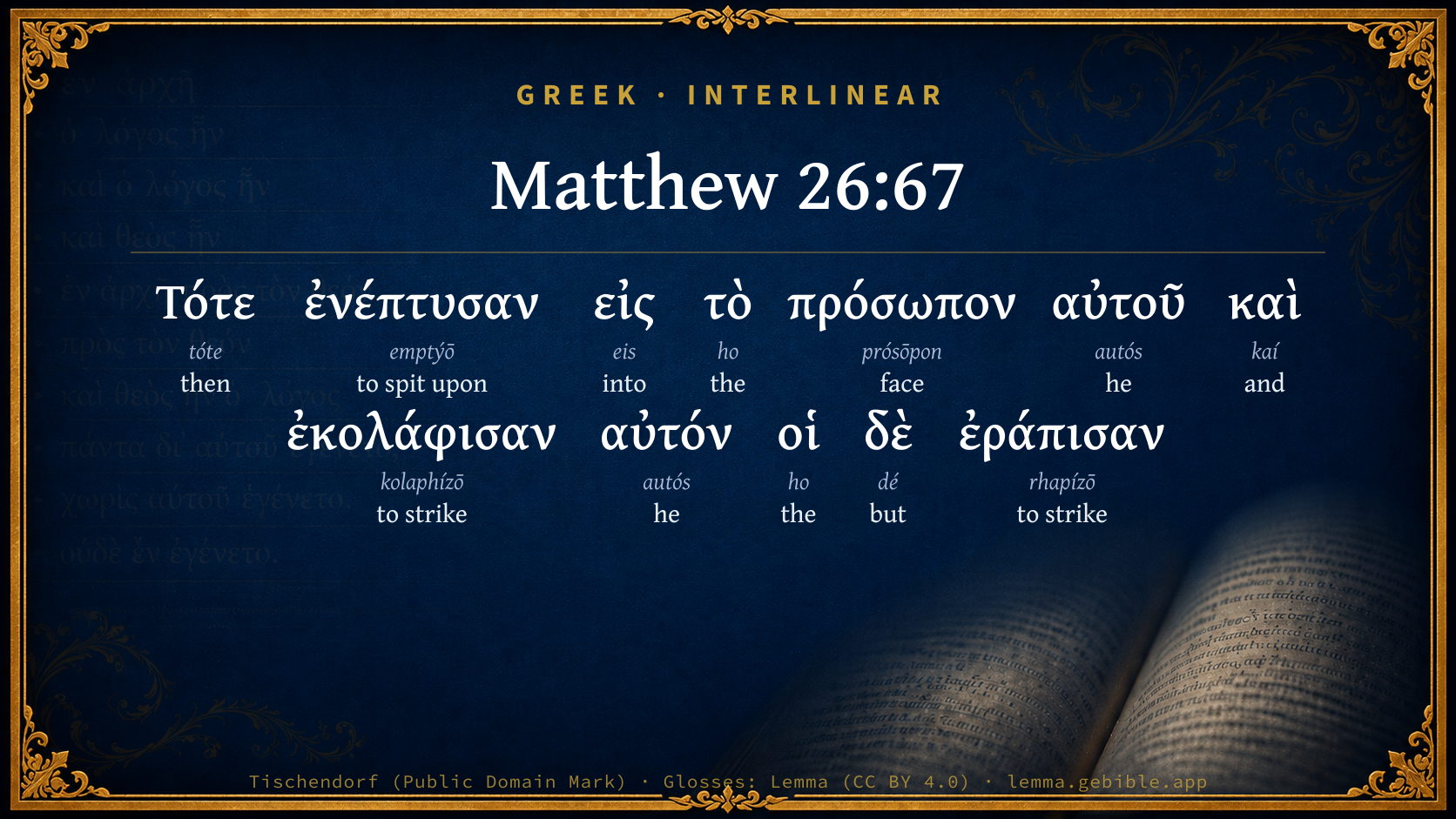
Greek (Tischendorf 8th ed.) Matthew 26:67 appears in the Greek New Testament. The text above is from the Tischendorf 8th edition. Each word links to its Strong’s number and a concise gloss. Click any word for its full Thayer’s Greek Lexicon entry.
Download image
Cite this verse

Matthew 26:67 (World English Bible). Public Domain. Lemma interlinear Bible study tool, https://lemma.gebible.app/v/matthew/26/67.

Show BibTeX & RIS
BibTeX
RIS
English Translation
Then they spit in his face and beat him with their fists, and some slapped him,
World English Bible · Public Domain
Highlights
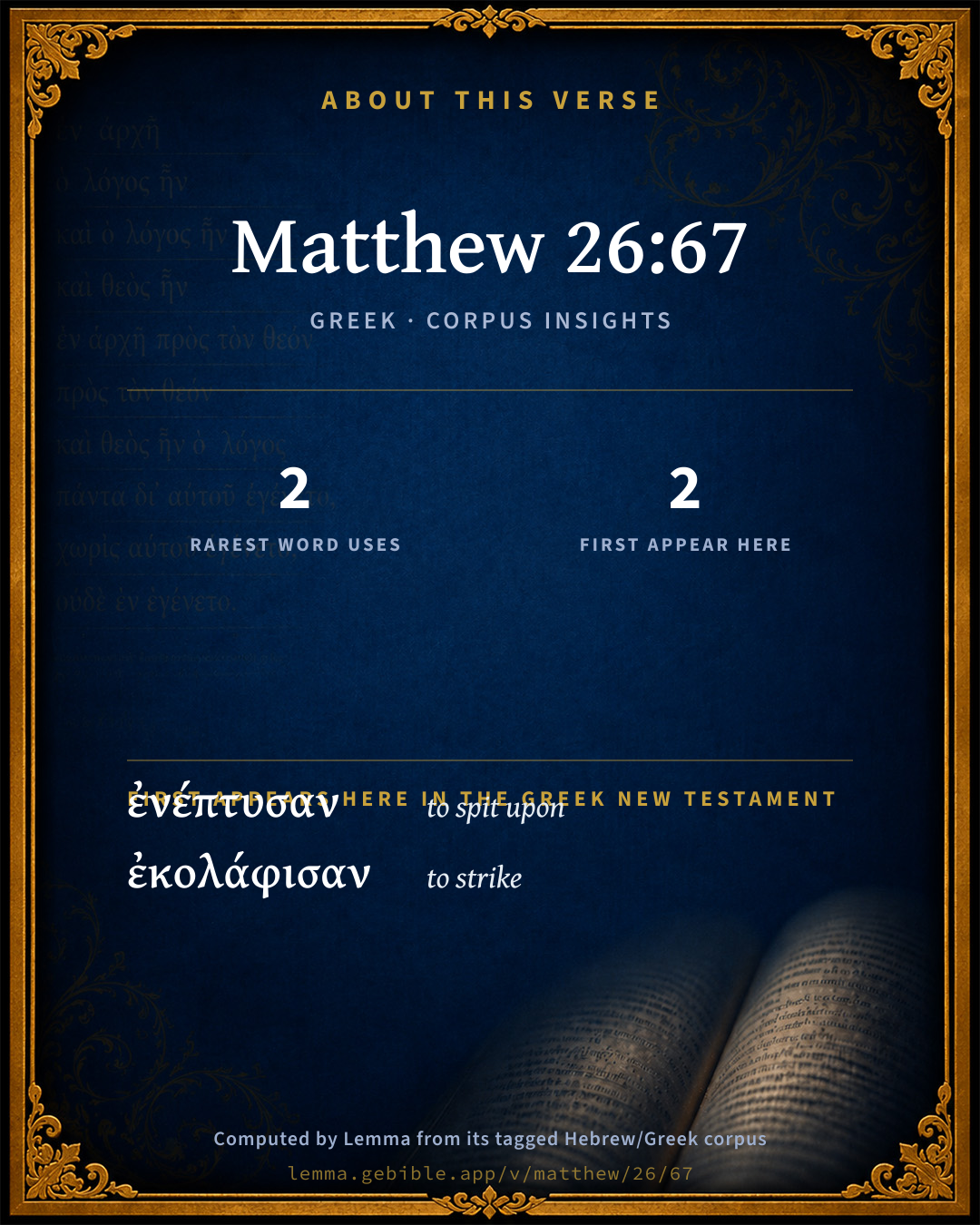
  • 2 first appearances in the Greek New Testament
Full analysis ↓
Download a study sheet

One document with this verse’s original text, its word-by-word gloss line, the meaning frame, cross-references with their text, attributed commentary, and full source and license credits — printable, and it pastes into notes with its structure intact.

This verse Autodidact and up

Study sheet (.html) Plain text (.txt)

A passage Seminary Student

Up to 50 verses in one chapter. A passage sheet keeps up to 6 commentary sources and 12 cross-references per verse, in the order this page ranks them, and says so on the sheet whenever that leaves anything out. Ask for a single verse and you get the Autodidact verse sheet above.

Everything on this page stays free to read, with no account — the sheet is a download of what is already on screen, not access to it.

Want to remove ads? Support Godless Engineer
Compare translations 3

The same verse in 3 English versions, stacked beneath the original-language interlinear above. Click any original word for its lexicon entry.

Each is an independent rendering of the whole verse — the interlinear is not word-aligned to these translations.

Highlighted words mark where these versions differ — a whole-verse word diff, not a word-by-word alignment.

  • World English Bible Public Domain
    Then they spit in his face and beat him with their fists, and some slapped him,
  • King James Version Public Domain
    Then did they spit in his face, and buffeted him; and others smote him with the palms of their hands,
  • unfoldingWord Literal Text CC BY-SA 4.0
    Then they spit in his face and beat him. And they slapped him,

unfoldingWord Literal Text — © unfoldingWord, licensed CC BY-SA 4.0. Word-aligned USFM3 via Door43 (git.door43.org/unfoldingWord/en_ult).

Versions to compare (up to 4)

3 of 4 selected

Show all 19 translations

Every available English version of this verse, each an independent rendering of the whole verse.

  • World English Bible Public Domain
    Then they spit in his face and beat him with their fists, and some slapped him,
  • Berean Standard Bible Public Domain
    Then they spit in His face and struck Him. Others slapped Him
  • Majority Standard Bible Public Domain
    Then they spit in His face and struck Him. Others slapped Him
  • King James Version Public Domain
    Then did they spit in his face, and buffeted him; and others smote him with the palms of their hands,
  • American Standard Version (1901) Public Domain
    Then did they spit in his face and buffet him: and some smote him with the palms of their hands,
  • Revised Version (1885) Public Domain
    Then did they spit in his face and buffet him: and some smote him with the palms of their hands,
  • Geneva Bible (1599) Public Domain
    Then spet they in his face, and buffeted him, and other smote him with roddes,
  • Douay-Rheims (1899) Public Domain
    Then did they spit in his face, and buffeted him: and others struck his face with the palms of their hands,
  • Young's Literal Translation Public Domain
    Then did they spit in his face and buffet him, and others did slap,
  • Literal Standard Version CC BY-SA 4.0
    Then they spit in His face and punched Him, and others slapped,
  • Unlocked Literal Bible CC BY-SA 4.0
    Then they spit in his face and beat him, and struck him with the palms of their hands,
  • unfoldingWord Literal Text CC BY-SA 4.0
    Then they spit in his face and beat him. And they slapped him,
  • Darby Bible Public Domain
    Then they spit in his face, and buffeted him, and some struck him with the palms of their hand,
  • World Messianic Bible Public Domain
    Then they spat in his face and beat him with their fists, and some slapped him,
  • Webster's Bible Public Domain
    Then they spit in his face, and buffetted him; and others smote him with the palms of their hands,
  • Free Bible Version CC BY-SA 4.0
    Then they spat in his face and beat him. Some of them slapped him with their hands,
  • Bible in Basic English Public Domain
    Then they put shame on him, and were cruel to him: and some gave him blows, saying,
  • Text-Critical English NT CC BY 4.0
    Then they spit in his face and struck him. Others slapped him,
  • Tyndale New Testament (1534) Public Domain
    Then spat they in his face and boffeted him with fistes. And other smote him with the palme af their hondes on the face

Literal Standard Version (2020), Covenant Press — licensed CC BY-SA 4.0. Text via the HelloAO Bible API (eBible.org). Unlocked Literal Bible (unfoldingWord) — licensed CC BY-SA 4.0. Text via the HelloAO Bible API (eBible.org). unfoldingWord Literal Text — © unfoldingWord, licensed CC BY-SA 4.0. Word-aligned USFM3 via Door43 (git.door43.org/unfoldingWord/en_ult). Free Bible Version, Dr. Jonathan Gallagher — licensed CC BY-SA 4.0. Text via the HelloAO Bible API (eBible.org).

Word by word

More ways to search: Search by grammar → Find every occurrence → Compare this word →

Practice this passage: Drill this verse → Learn its vocabulary →

About this verse

These counts appear in no published source. They are computed here, from the morphology-tagged text and Lemma’s own curated glosses. What Lemma adds →

12
words
10
distinct lemmas
Gospels
section

Notable vocabulary

The rarest word here is ἐράπισαν to strike G4474 — appearing just 2 times in the whole Greek New Testament.

First appearance in Scripture

These words make their first canonical appearance in the Greek New Testament here:

  • ἐνέπτυσαν to spit upon G1716
  • ἐκολάφισαν to strike G2852

Shared distinctive vocabulary

ἐράπισαν to strike G4474 occurs in 2 verses of the Greek New Testament. Also found in:
Repetition

Words recur within this verse:

  • τὸ the G3588 ×2
  • αὐτοῦ he G846 ×2

Cross-references

23

Topical passages linked to Matthew 26:67 in the Treasury of Scripture Knowledge — connected by theme and wording, ordered by reader-vote popularity; previews shown in the World English Bible.

  • Isaiah 50:6 I gave my back to the strikers, and my cheeks to those who plucked off the hair; I didn't hide my face from shame and spitting.
  • Isaiah 53:3 He was despised, and rejected by men; a man of suffering, and acquainted with disease: and as one from whom men hide their face he was despised; and we didn't respect him.
  • Matthew 27:30 They spat on him, and took the reed and struck him on the head.
  • John 18:22 When he had said this, one of the officers standing by slapped Jesus with his hand, saying, "Do you answer the high priest like that?"
  • Matthew 5:39 But I tell you, don't resist him who is evil; but whoever strikes you on your right cheek, turn to him the other also.
  • Mark 14:65 Some began to spit on him, and to cover his face, and to beat him with fists, and to tell him, "Prophesy!" The officers struck him with the palms of their hands.
  • Isaiah 52:14 Like as many were astonished at you (his visage was so marred more than any man, and his form more than the sons of men),
  • Lamentations 3:30 Let him give his cheek to him who strikes him; let him be filled full with reproach.
  • Mark 15:19 They struck his head with a reed, and spat on him, and bowing their knees, did homage to him.
  • John 19:3 They kept saying, "Hail, King of the Jews!" and they kept slapping him.
  • Hebrews 12:2 looking to Jesus, the author and perfecter of faith, who for the joy that was set before him endured the cross, despising shame, and has sat down at the right hand of the throne of God.
  • Numbers 12:14 Yahweh said to Moses, If her father had but spit in her face, shouldn't she be ashamed seven days? let her be shut up outside of the camp seven days, and after that she shall be brought in again.
  • Deuteronomy 25:9 then his brother's wife shall come to him in the presence of the elders, and loose his shoe from off his foot, and spit in his face; and she shall answer and say, So shall it be done to the man who does not build up his brother's house.
  • 1 Kings 22:24 Then Zedekiah the son of Chenaanah came near, and struck Micaiah on the cheek, and said, Which way went the Spirit of Yahweh from me to speak to you?
  • Job 30:9–11 "Now I have become their song. Yes, I am a byword to them.
  • Jeremiah 20:2 Then Pashhur struck Jeremiah the prophet, and put him in the stocks that were in the upper gate of Benjamin, which was in the house of Yahweh.
  • Lamentations 3:45 You have made us an off-scouring and refuse in the midst of the peoples.
  • Micah 5:1 Now you shall gather yourself in troops, Daughter of troops. He has laid siege against us; They will strike the judge of Israel with a rod on the cheek.
  • Mark 10:34 They will mock him, spit on him, scourge him, and kill him. On the third day he will rise again."
  • Luke 22:63–65 The men who held Jesus mocked him and beat him.
  • 1 Corinthians 4:13 Being defamed, we entreat. We are made as the filth of the world, the dirt wiped off by all, even until now.
  • 2 Corinthians 11:20–21 For you bear with a man, if he brings you into bondage, if he devours you, if he takes you captive, if he exalts himself, if he strikes you on the face.
  • Acts 23:2–3 The high priest, Ananias, commanded those who stood by him to strike him on the mouth.

Cross-references courtesy of OpenBible.info (CC BY 4.0).

Commentary

Notes on Matthew 26:67 from classic Christian and Jewish commentators (each source and its license shown beneath its notes). The classic Christian expositions comment on the surrounding passage and are grouped to its opening verse, so a note may address several verses; the Jewish commentaries on the Tanakh (Rashi and others) are per-verse, so they appear only where the commentator wrote on this verse.

Lemma curates 59 commentaries, every one of them public domain or Creative Commons licensed, each selected and text-cleaned for this edition rather than reprinted as found. About our sources →

Joseph Benson's Commentary

Mat 26:67-68. Then did they spit in his face, &c. — Spitting in the face was the greatest contempt and disgrace which could possibly be shown. See Num 12:14. Buffeting, or striking a person with the fist on the temples, was esteemed one of the most disgraceful punishments by the Greeks, from whom the Romans might have adopted it. Smiting with the open palm of their hands, was such a dishonour as none but a slave ought to endure. “Because Matthew here says, that they who condemned Jesus spit in his face, and buffeted him: and Mar 14:65, mentions the indignities which the servants in particular put upon him; it appears that he was smitten, blindfolded, and buffeted even by some of the council; who, to ridicule him for having pretended to be the great prophet foretold by Moses, bade him exercise his prophetical gift in guessing who it was that struck him; Prophesy unto us, thou Christ — It was hardly possible for those miscreants to invent any thing more expressive of the contempt in which they held our Lord’s pretensions to be the Messiah. Thus was the Judge of the world placed at the bar of his own creatures, falsely accused by the witnesses, unjustly condemned by his judges, and insulted by all. Yet, because it was agreeable to the end of his coming, he patiently submitted, though he could with a frown have made his judges, his accusers, and those who had him in custody, all to drop down dead in a moment, or to shrivel into nothing.” — Macknight.

Joseph Benson's Commentary on the Old and New Testaments (1811–1818) — public domain. Text from a community e-Sword module.

Tyndale Open Study Notes

Tyndale Open Resources

26:67-68 Such abuse fulfills Isa 50:6; 53:4-9 and Jesus’ own predictions (Matt 16:21; 17:22-23; 20:18-19; 26:2; see also Mark 14:65).

Tyndale Open Study Notes — © Tyndale Open Resources, licensed CC BY-SA 4.0. Text via the HelloAO Bible API.

Bengel's Gnomon

Johann Albrecht Bengel

Mat 26:67. Τότε, κ.τ.λ., then, etc.) As if no outrage would now be unjust towards Him. The elders insult Him with greater subtlety, the multitude more grossly. He who assails the honour of God, deserves every contumely. Such an one they considered Jesus to be.—ἐκολάφισαν, they struck Him) with the fist, with the hand.—ἐῤῥάπισαν, they smote Him) with rods, for the attendants carried these. See Mar 14:65. Chrysostom observes, οὐδὲν ταύτης τῆς πληγῆς ἀτιμότερον, nothing is more disgraceful than this blow.

Bengel's Gnomon of the New Testament — English translation (T&T Clark, Edinburgh, 1860) — public domain. Text from a community e-Sword module.

Meyer's Critical & Exegetical Commentary

Heinrich August Wilhelm Meyer

Mat_26:67. Those to whom Matthew here refers are the members of the Sanhedrim (as are also the τινές of Mar_14:65). Μετὰ γὰρ τὴν ἄδικον καταδίκην ὡς ἄτιμόν τινα καὶ τριωβολιμαῖον λάβοντες, κ.τ.λ., Euthymius Zigabenus. Coarse outburst of passion on the verdict being announced. A somewhat different form of the tradition is adopted by Luke (Luk_22:63), who, moreover, represents the maltreatment here referred to as having taken place before the trial. The way in which harmonists have cut and carved upon the individual features of the narrative is altogether arbitrary. The account in Joh_18:22 has no connection with that now before us, but refers to an incident in the house of Annas, which the Synoptists have entirely omitted.

ἐκολάφ.] buffetings, blows with the fist. Comp. the Attic expression κόνδυλος.

ἐῤῥάπτ.] slaps in the face with the palm of the hand; ῥαπισμὸς δὲ τὸ πταίειν κατὰ τοῦ προσώπου, Euthymius Zigabenus; comp. Mat_5:39; Hos_11:5; Isa_50:6; Dem. 787, 23; Aristot. Meteor. ii. 8. 9; 3 Esdr. 4:30; Lobeck, ad Phryn. p. 176; Becker, Anecd. p. 300. It is in this sense that the word is usually taken. But Beza, Bengel, Ewald, Bleek, Lange, maintain that it is a blow with a rod that is meant (Herod. viii. 59; Anacr. vii. 2; Plut. Them. xi.), the sense in which the word is commonly used by Greek authors, and which ought to be preferred here, because οἱ δέ (see on Mat_28:16) introduces the mention of a different kind of maltreatment, and because in Mar_14:65 the ῥαπίζειν is imputed to the officers of the Sanhedrim, which, however, would not warrant us in identifying with the latter the οἱ δέ of Matthew.

Meyer — Critical and Exegetical Commentary on the New Testament — English translation by Peter Christie, edited by Frederick Crombie (T&T Clark, 1880) — public domain. Text from a community e-Sword module.

Expositor's Greek Testament

ed. W. Robertson Nicoll

Mat 26:67-68 : to judicial injustice succeed personal indignities: spitting in the face ( ἐνέπτυσαν ), miting with the fist ( ἐκολάφισαν , not Attic, κονδυλίζω used instead), or with the open hand ( ἐρράπισαν , originally to beat with rods). Euthy. Zig. distinguishes the two last words thus: κολαφισμὸς is a stroke on the neck with the hollow of the hand so as to make a noise, ῥαπισμὸς a stroke on the face. The p petrators of these outrages in Mk. are τινὲς and οἱ ὑπηρέται , the former word presumably pointing to some Sanhedrists. In Mt. the connection suggests Sanhedrists alone. Incredible that they should condescend to so unworthy proceedings, one is inclined to say. Yet it was night, there was intense dislike and they might feel they did God service by disgracing a pretender. Hence the invitation to the would-be christ to prophesy ( προφήτευσον ) who smote him when he was struck behind the back or blindfolded (Mar 14:65 ). Thus did they fill up the early hours of the morning on that miserable night. Sceptical critics, e.g. , Brandt, p. 69, also Holtz., H. C., suggest that the colouring of this passage is drawn from O. T. texts, such as Micah 4:14 (Sept [146] Mat 5:1 , A. V [147] ), Isa 50:6 ; Isa 53:3-5 , 1Ki 22:24 , and that probably the texts created the “facts”. That of course is abstractly possible, but the statement of the evangelist is intrinsically probable, and it is to be noted that not even in Mt. is there a “that it might be fulfilled”.

[146] Septuagint.

[147] Authorised Version.

The Expositor's Greek Testament, edited by W. Robertson Nicoll (1897–1910) — public domain. Text from a community e-Sword module.

Adam Clarke's Commentary

Verse 67. Then did they spit in his face] This was done as a mark of the most profound contempt. See Job 16:10; Job 30:10; Isa 50:6; Mic 5:1. The judges now delivered him into the hands of the mob.

And buffeted him] Smote him with their fists, εκολαφισαν. This is the translation of Theophylact. κολαφιζειν, says he, means, "to beat with the hand, the fingers being clenched. συγκαμτομενων των δακτυλων, or, to speak more briefly, to buffet with the fist."

Smote him with the palms of their hands] ερραπισαν. ραπιζω, says Suidas, means "παταξαι την γναθον απλη τη χειρι, to smite the cheek with the open hand." Thus they offered him indignity in all its various and vexatious forms. Insults of this kind are never forgiven by the world: Jesus not only takes no revenge, (though it be completely in his power,) but bears all with meekness, without even one word of reply.

Adam Clarke's Commentary on the Bible (1810–1826) — public domain. Text from a community e-Sword/MySword module.

Ellicott's Commentary for English Readers

(67) Then did they spit in his face.—We learn from St. Mark (Mar_14:65) and St. Luke (Luk_22:63) that these acts of outrage were perpetrated, not by the members of the Sanhedrin, but by the officers who had the accused in their custody, and who, it would seem, availed themselves of the interval between the two meetings of the council to indulge in this wanton cruelty. Here, also, they were unconsciously working out a complete correspondence with Isaiah’s picture of the righteous sufferer (Isa_1:6). The word “buffeted” describes a blow with the clenched fist, as contrasted with one with the open palm.

A Bible Commentary for English Readers, edited by Charles John Ellicott (1878–1897) — public domain. Text from a community e-Sword module.

The Cambridge Bible for Schools and Colleges

gen. ed. J. J. S. Perowne

67. buffeted him] Struck Him with clenched fist.

The Cambridge Bible for Schools and Colleges (gen. ed. J. J. S. Perowne; Cambridge University Press, 1878–1918) — public domain. Text from a community e-Sword module.

John Gill's Exposition

Saying, prophesy unto us, thou Christ,.... Not that they owned him to be the Messiah; but because he asserted himself to be the Messiah, and his followers believed in him as such, they call him so; and in an ironical and sarcastic way, call upon him to divine, and tell them who the persons were, that used him in this manner; suggesting, that if he was the Christ, or Messiah, he would know all things, and what were done to him:

who is he that smote thee? for they had covered his face, or blindfolded him, as the other Evangelists say, Mar 14:65, and then bid him tell them who smote him last. Christ did not think fit to give them an answer to this question, but he will let them know hereafter, who the particular person, or persons were, that smote him; and when it will appear to all the churches, and to all the world, that he is the Lord God omniscient. Some learned men have observed (a), that there was a play formerly used, called by the ancients, at which, one person having his face covered, the rest smote him; or one put his hands over his eyes, and another smote, and asked him who it was that smote? and such an exercise is yet in being among us, which is commonly called Blindman's Buff; and such pastime as this the Jews had with Christ; in this ludicrous way did they use him, and made him their sport and diversion, as the Philistines did Samson; but it will cost them dear another day,

(a) Braunii Select. Sacr. l. 5. Exerc. 2. sect. 38. p. 622, 623. & Capelt. in loc. e Polluce, l. 9. c. 7.

John Gill's Exposition of the Whole Bible (1746–1763) — public domain (CC PDM 1.0). Text via the HelloAO Bible API.

Trapp's Complete Commentary

John Trapp

67 Then did they spit in his face, and buffeted him; and others smote him with the palms of their hands,

Ver. 67. Then did they spit in his face] Condemned prisoners are sacred things; and by the law of nations, should not be misused and trampled on, but rather pitied and prepared for death. But these barbarous miscreants (not without the good liking of their lords the priests and elders) spare for no kind of cruelty toward Christ, who was content to be spit upon, to cleanse our faces from the filth of sin, to be buffeted with fists, and beaten with staves, {a} to free us from that mighty hand of God, 1Pe 5:6, and from those scourges and scorpions of infernal fiends.

{a} ερραπισαν, bacillis ceciderunt. Beza.

John Trapp, A Commentary or Exposition upon All the Books of the Old and New Testament (1647–1656) — public domain. Text from a community e-Sword module.

Albert Barnes' Notes on the Bible

Then did they spit in his face - This, among the Jews, as among us, was significant of the highest contempt and insult, Num 12:14; Isa 50:6; Job 30:10.

And buffeted him - That is, they struck him with their hands closed, or with the fist.

Others smote him with the palms of their hands - The word used in the original here means literally to strike with rods. It also means to strike the mouth with the open hand, as if to prevent a person’s speaking, or to evince abhorrence of what he had spoken.

Albert Barnes' Notes on the Bible (1834–1885) — public domain. Text from a community e-Sword/MySword module.

Haydock's Catholic Bible Commentary

Then they spat in his face, and buffetted him, &c. Here it was that the wicked council of the Sanhedrim broke up, in order to meet again the next morning. Our blessed Saviour in the mean time was abandoned; that is, had abandoned himself for our sake, to be abused, vilified, beaten and tormented by a crew of miscreants, by all the ways and means their enraged malice could devise or invent: which St. Luke passeth over in a few words, telling us, that, blaspheming, they said many other things against him. Let us, at least, compassionate our blessed Redeemer, and cry out with the angel in the Apocalypse: thou art worthy, O Lord, to receive power and divinity, honour and glory for ever. (Witham) --- Behold with what accuracy the evangelist mentions every, event he most ignominious circumstance, concealing nothing, ashamed of nothing, but esteeming it his glory that the Creator of heaven and earth should suffer so much for man’s redemption. Let us continually meditate upon this; let us ever glory in this, and fix it irrevocably in our minds. (St. John Chrysostom) See Mark xiv. 65; Luke xxii. 64.

Peter’s Denial.

George Leo Haydock (1774–1849), Haydock's Catholic Family Bible and Commentary, 1859 edition — public domain. Excludes Psalms (Douay-Rheims chapter numbering differs from Protestant) and Deuterocanonical books (Catholic canon only).

Matthew Poole's English Annotations

Mark hath much the same, Mar 14:65; And some began to spit on him, and to cover his face, and to buffet him, and to say unto him, Prophesy: and the servants did strike him with the palms of their hands. Though there be nothing more barbarous and inhuman than to add to the affliction of the afflicted, yet this is no more than we ordinarily see done by a rabble of brutish people; spitting in the face was but an ordinary token of contempt, Num 12:14; Deu 25:9. And perhaps in all these indignities Isaiah was a type of Christ, Isa 1:6, if that text be not to be understood of Christ immediately. In the mean time, it lets us see that there is no degree or mark of contempt, or shame, or suffering which we ought to decline and grudge at for the name of Christ; who, through much more excellent than us, yet for our sake endured the cross, and despised the shame.

Matthew Poole's English Annotations on the Holy Bible (1683–1685) — public domain. Text from a community e-Sword/MySword module.

Whedon's Commentary on the Bible

Daniel D. Whedon

67. Then did they spit in his face — Probably upon the retirement of the high priest the apprehenders of Jesus (Luk_22:63) and the crowd proceeded to these insults, He who had at his first arrest plentifully demonstrated his absolute power over his adversaries, now bows his head in complete abandonment to all which their rage pleases to inflict.

Buffeted him — Struck him with the clenched fist, and then with the palms or flat hands.

Daniel D. Whedon (gen. ed.), Commentary on the Old and New Testaments (1874–1909) — public domain. Text from a community e-Sword module.

The Pulpit Commentary

The scene that ensued upon the verdict being pronounced is beyond measure hideous and unexampled. When the meeting broke up, Jesus was for a time left to the brutal cruelty and the unbridled insolence of the guards and servants. Involuntarily, by their profanity and coarseness, they fulfilled the words of the prophet, speaking in the Person of Messiah, "I gave my back to the smiters, and my cheeks to them that plucked off the hair; I hid not my face from shame and spitting". (Isa_50:6) Did they spit in his face. A monstrous indignity, so regarded by all people at all times. (Num_12:14 Deu_25:9 Job_30:10)

Buffeted him (ekolafisan auton); struck him with fists. Smote him with the palms of their hands (errapisan). There is some doubt whether the verb here means "to smite with a rod" or "to slap in the face with the open hand;" but as we have already had mention of striking with the hands, it is probable that beating with a stick is here intended.

The Pulpit Commentary (1880–1919), ed. H.D.M. Spence-Jones & Joseph S. Exell — public domain. Text from a community e-Sword module.

John Wesley's Explanatory Notes

Then - After he had declared he was the Son of God, the sanhedrim doubtless ordered him to be carried out, while they were consulting what to do. And then it was that the soldiers who kept him began these insults upon him.

John Wesley, Explanatory Notes Upon the Whole Bible (1754–1765) — public domain. Text via the GEBible commentary corpus.

The People's New Testament

B. W. Johnson

67. Then did they spit in his face. The maltreatment recorded occurred between this meeting and the one called to meet at daybreak. Spitting was considered among the Jews an expression of the greatest contempt (Deut. 25:9; Num. 12:14). Even to spit before another was regarded as an offense, and treated as such by heathen also. Buffeted him. Struck him with their fists.

B. W. Johnson's The People's New Testament with Notes (1889–1891) — public domain. Electronic text from the Christian Classics Ethereal Library (CCEL) ThML edition.

unfoldingWord translationNotes

Door43 World Missions Community

Then they

Possible meanings are 1) "Then some of the men" or 2) "Then the soldiers."

spit in his face

This was done as an insult.

Prophesy to us

Here "Prophesy to us" means to tell by means of God's power. It does not mean to tell what will happen in the future.

you Christ

Those hitting Jesus do not really think he is the Christ. They call him this to mock him. (See: Irony)

translationWords

prophet

Christ

unfoldingWord translationNotes — © Distant Shores Media and the Door43 World Missions Community, licensed CC BY-SA 4.0. Source: git.door43.org/Door43/en_tn.

Cambridge Greek Testament for Schools and Colleges

67. κολαφίζειν, ‘to strike with clenched fist,’ from κόλαφος, late for Attic κονδυλίζειν (κόνδυλος). Cp. ποῖον γὰρ κλέος εἰ ἁμαρτάνοντες καὶ κολαφιζόμενοι ὑπομενεῖτε, 1Pe 2:20. See also 1Co 4:11; 2Co 12:7.

ῥαπίζειν, from ῥαπίς, ‘a rod,’ ‘to strike with cudgels’ (Hdt. Xen. Dem. Polyb. al.), later, to strike with the flat of the hand.

For οἱ δὲ with οἱ μὲν of the first clause suppressed cp. οἱ δὲ ἐδίστασαν, ch. Mat 28:17.

Cambridge Greek Testament for Schools and Colleges (Cambridge University Press, 1896; 21 vols, various authors incl. Carr, Maclear, Plummer, Farrar, Lumby, Moule, M. R. James, Simcox) — public domain. Text from a community e-Sword module.

Alford’s Greek Testament

Henry Alford

67.] Luke gives these indignities, and in the same place as here, adding, what indeed might have been suspected, that it was not the members of the Sanhedrim, but the men who held Jesus in custody, who inflicted them on Him.

κολαφίζω is to strike with the fist; ῥαπίζω, generally, to strike a flat blow with the back of the hand—but also, and probably here, since another set of persons are described as doing it, to strike with a staff.

Henry Alford, The Greek Testament (1849–1861) — public domain. Text from a community e-Sword module.

International Critical Commentary

(M) 67, 68. Then they spat in His face, and buffeted Him; and some smote Him, saying, Prophesy to us, Thou Anointed One, Who is he who struck Thee ?] Mk. has: “And some began to spit upon Him, and to cover His face, and to buffet Him, and to say to Him, Prophesy. And the servants received Him with blows.”—τότε] see on 2:7.—ἐνέπτυσαν] Mt. frequently avoids Mk.’s ἤρξαντο. He telescopes Mk.’s ἐμπτύειν αὐτῷ καὶ περικαλύπτειν αὐτοῦ τὸ πρόσωπον into ἐνέπτυσαν εἰς τὸ πρόσωπον αὐτου: but his added clause,τίς ἐστιν ὁ παίσας σε, seems to imply reminiscence of the omitted words. In οἱ δὲ ἐράπισαν he abbreviates Mk.’s καὶ οἱ ὑπηρέται ῥαπίσμασιν αὐτὸν ἔλαβον. The addition, “Who is he that struck Thee?” which Lk. also has, is no doubt intended to explain προφήτευσον. It may, however, be doubted whether the verb in Mk. has not a more general reference, such as “Prophesy now the destruction of the Temple”; cf. Mk v. 58. In view of Mt.’s explanatory clause, it is extraordinary that he should have omitted the “covering” of the face.

International Critical Commentary — older volumes (1896–1929), various authors — public domain. Text from a community e-Sword module.

Vincent's Word Studies in the New Testament

Marvin R. Vincent

Buffet [εκολαφισαν] . With the fist.

Smote with the palms of their hands. All expressed by one word, ejrapisan, from rJapiv, a rod, and meaning to smite with rods, not with the palms. The same word is employed Mt 5:39. It came to mean generally to strike.

Marvin R. Vincent, Word Studies in the New Testament (1887–1900) — public domain. Text from a community e-Sword/MySword module.

Lesson kit

Teaching starters — assembled from the data on this page, not authored interpretation. Every prompt links to the verse data it draws on. Edit before teaching.

Matthew, in the Gospels, opens this verse with 12 words (10 distinct Greek lemmas). Its most distinctive word is rhapízō (“to strike”). A historical commentator’s framing appears above. Read the whole chapter for the surrounding context.

Discussion questions

  1. How does “to strike” (rhapízō) shape what this verse is saying?
  2. 2 words make their first appearance in Scripture here. What does this debut establish?
  3. How does Matthew 5:39, which shares the word «to strike», read alongside this verse?
  4. What does the repetition of “the” (2× in this one verse) do in this verse?
  5. These translations render this verse differently; the difference is in the English rendering, not the original. What questions does that raise?
  6. Compare how Joseph Benson's Commentary and Tyndale Open Study Notes read this verse. Where do they agree or differ?

Things to notice

  • 2 words make their first canonical appearance in Scripture here.
  • These translations choose different wording for 10 words in this verse.
  • “the” occurs 2× in this single verse.
  • 10 distinct Greek lemmas span 12 words in this verse.

Reading settings

Reading text

Shown beneath each verse's original-language words.

Old Testament
Old Testament edition

Read the OT as the Masoretic Hebrew (MT) or the Greek Septuagint (LXX).

English shown for the Greek Septuagint (in the Hebrew ↔ Greek comparison).

Comparing translations? Open the Compare panel on any verse page to stack up to four side by side.