
Matthew 16:25

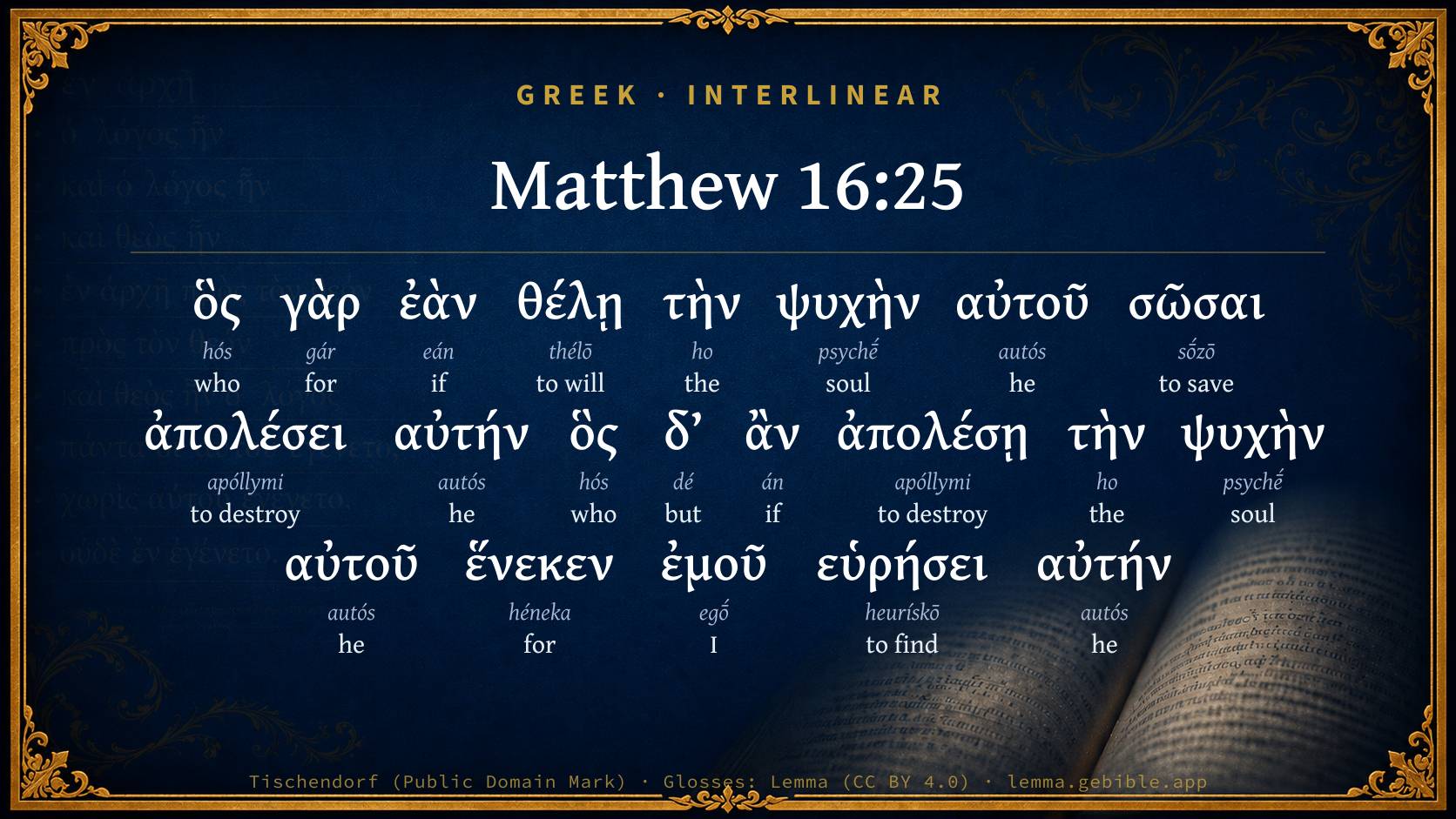
Greek (Tischendorf 8th ed.) Matthew 16:25 appears in the Greek New Testament. The text above is from the Tischendorf 8th edition. Each word links to its Strong’s number and a concise gloss. Click any word for its full Thayer’s Greek Lexicon entry.
Download image
Cite this verse

Matthew 16:25 (World English Bible). Public Domain. Lemma interlinear Bible study tool, https://lemma.gebible.app/v/matthew/16/25.

Show BibTeX & RIS
BibTeX
RIS
English Translation
For whoever desires to save his life will lose it, and whoever will lose his life for my sake will find it.
World English Bible · Public Domain
Download a study sheet

One document with this verse’s original text, its word-by-word gloss line, the meaning frame, cross-references with their text, attributed commentary, and full source and license credits — printable, and it pastes into notes with its structure intact.

This verse Autodidact and up

Study sheet (.html) Plain text (.txt)

A passage Seminary Student

Up to 50 verses in one chapter. A passage sheet keeps up to 6 commentary sources and 12 cross-references per verse, in the order this page ranks them, and says so on the sheet whenever that leaves anything out. Ask for a single verse and you get the Autodidact verse sheet above.

Everything on this page stays free to read, with no account — the sheet is a download of what is already on screen, not access to it.

Want to remove ads? Support Godless Engineer
Compare translations 3

The same verse in 3 English versions, stacked beneath the original-language interlinear above. Click any original word for its lexicon entry.

Each is an independent rendering of the whole verse — the interlinear is not word-aligned to these translations.

Highlighted words mark where these versions differ — a whole-verse word diff, not a word-by-word alignment.

  • World English Bible Public Domain
    For whoever desires to save his life will lose it, and whoever will lose his life for my sake will find it.
  • King James Version Public Domain
    For whosoever will save his life shall lose it: and whosoever will lose his life for my sake shall find it.
  • unfoldingWord Literal Text CC BY-SA 4.0
    For whoever wants to save his life will lose it, but whoever loses his life for my sake will find it.

unfoldingWord Literal Text — © unfoldingWord, licensed CC BY-SA 4.0. Word-aligned USFM3 via Door43 (git.door43.org/unfoldingWord/en_ult).

Versions to compare (up to 4)

3 of 4 selected

Show all 19 translations

Every available English version of this verse, each an independent rendering of the whole verse.

  • World English Bible Public Domain
    For whoever desires to save his life will lose it, and whoever will lose his life for my sake will find it.
  • Berean Standard Bible Public Domain
    For whoever wants to save his life will lose it, but whoever loses his life for My sake will find it.
  • Majority Standard Bible Public Domain
    For whoever wants to save his life will lose it, but whoever loses his life for My sake will find it.
  • King James Version Public Domain
    For whosoever will save his life shall lose it: and whosoever will lose his life for my sake shall find it.
  • American Standard Version (1901) Public Domain
    For whosoever would save his life shall lose it: and whosoever shall lose his life for my sake shall find it.
  • Revised Version (1885) Public Domain
    For whosoever would save his life shall lose it: and whosoever shall lose his life for my sake shall find it.
  • Geneva Bible (1599) Public Domain
    For whosoeuer will saue his life, shall lose it: and whosoeuer shall lose his life for my sake, shall finde it.
  • Douay-Rheims (1899) Public Domain
    For he that will save his life, shall lose it: and he that shall lose his life for my sake, shall find it.
  • Young's Literal Translation Public Domain
    for whoever may will to save his life, shall lose it, and whoever may lose his life for my sake shall find it,
  • Literal Standard Version CC BY-SA 4.0
    for whoever may will to save his life will lose it, and whoever may lose his life for My sake will find it;
  • Unlocked Literal Bible CC BY-SA 4.0
    For whoever wants to save his life will lose it, and whoever loses his life for my sake will find it.
  • unfoldingWord Literal Text CC BY-SA 4.0
    For whoever wants to save his life will lose it, but whoever loses his life for my sake will find it.
  • Darby Bible Public Domain
    For whosoever shall desire to save his life shall lose it; but whosoever shall lose his life for my sake shall find it.
  • World Messianic Bible Public Domain
    For whoever desires to save his life will lose it, and whoever will lose his life for my sake will find it.
  • Webster's Bible Public Domain
    For whoever will save his life, shall lose it: and whoever will lose his life for my sake, shall find it.
  • Free Bible Version CC BY-SA 4.0
    For if you want to save your life you will lose it, and if you lose your life for my sake you will save it.
  • Bible in Basic English Public Domain
    Because whoever has a desire to keep his life safe will have it taken from him; but whoever gives up his life because of me, will have it given back to him.
  • Text-Critical English NT CC BY 4.0
    For whoever wants to save his life will lose it, but whoever loses his life for my sake will find it.
  • Tyndale New Testament (1534) Public Domain
    For who soever wyll save his lyfe shall loose it. And whosoever shall loose his lyfe for my sake shall fynde it.

Literal Standard Version (2020), Covenant Press — licensed CC BY-SA 4.0. Text via the HelloAO Bible API (eBible.org). Unlocked Literal Bible (unfoldingWord) — licensed CC BY-SA 4.0. Text via the HelloAO Bible API (eBible.org). unfoldingWord Literal Text — © unfoldingWord, licensed CC BY-SA 4.0. Word-aligned USFM3 via Door43 (git.door43.org/unfoldingWord/en_ult). Free Bible Version, Dr. Jonathan Gallagher — licensed CC BY-SA 4.0. Text via the HelloAO Bible API (eBible.org).

Word by word

More ways to search: Search by grammar → Find every occurrence → Compare this word →

Practice this passage: Drill this verse → Learn its vocabulary →

ἕνεκεν
héneka
G1752
“for”
Preposition
Part of Speech
Preposition
Full Thayer's Definition

Origin: of uncertain affinity

TDNT: None

1. on account of, for the sake of, for 2. for this cause, therefore
  1. ὃς hós G3739 “who” Relative pronoun, Nominative, Singular, Masculine
  2. γὰρ gár G1063 “for” Conjunction
  3. ἐὰν eán G1437 “if” Conditional
  4. θέλῃ thélō G2309 “to will” Verb, Present, Active, Subjunctive, 3rd person, Singular
  5. τὴν ho G3588 “the” Article, Accusative, Singular, Feminine
  6. ψυχὴν psychḗ G5590 “soul” Noun, Accusative, Singular, Feminine
  7. αὐτοῦ autós G846 “he” Personal pronoun, Genitive, Singular, Masculine
  8. σῶσαι sṓzō G4982 “to save” Verb, Aorist, Active, Infinitive
  9. ἀπολέσει apóllymi G622 “to destroy” Verb, Future, Active, Indicative, 3rd person, Singular
  10. αὐτήν autós G846 “he” Personal pronoun, Accusative, Singular, Feminine
  11. ὃς hós G3739 “who” Relative pronoun, Nominative, Singular, Masculine
  12. δ’ dé G1161 “but” Conjunction
  13. ἂν án G302 “if” Particle
  14. ἀπολέσῃ apóllymi G622 “to destroy” Verb, Aorist, Active, Subjunctive, 3rd person, Singular
  15. τὴν ho G3588 “the” Article, Accusative, Singular, Feminine
  16. ψυχὴν psychḗ G5590 “soul” Noun, Accusative, Singular, Feminine
  17. αὐτοῦ autós G846 “he” Personal pronoun, Genitive, Singular, Masculine
  18. ἐμοῦ egṓ G1473 “I” Personal pronoun, 1st person, Genitive, Singular
  19. εὑρήσει heurískō G2147 “to find” Verb, Future, Active, Indicative, 3rd person, Singular
  20. αὐτήν autós G846 “he” Personal pronoun, Accusative, Singular, Feminine

About this verse

These counts appear in no published source. They are computed here, from the morphology-tagged text and Lemma’s own curated glosses. What Lemma adds →

21
words
14
distinct lemmas
Gospels
section

Shared distinctive vocabulary

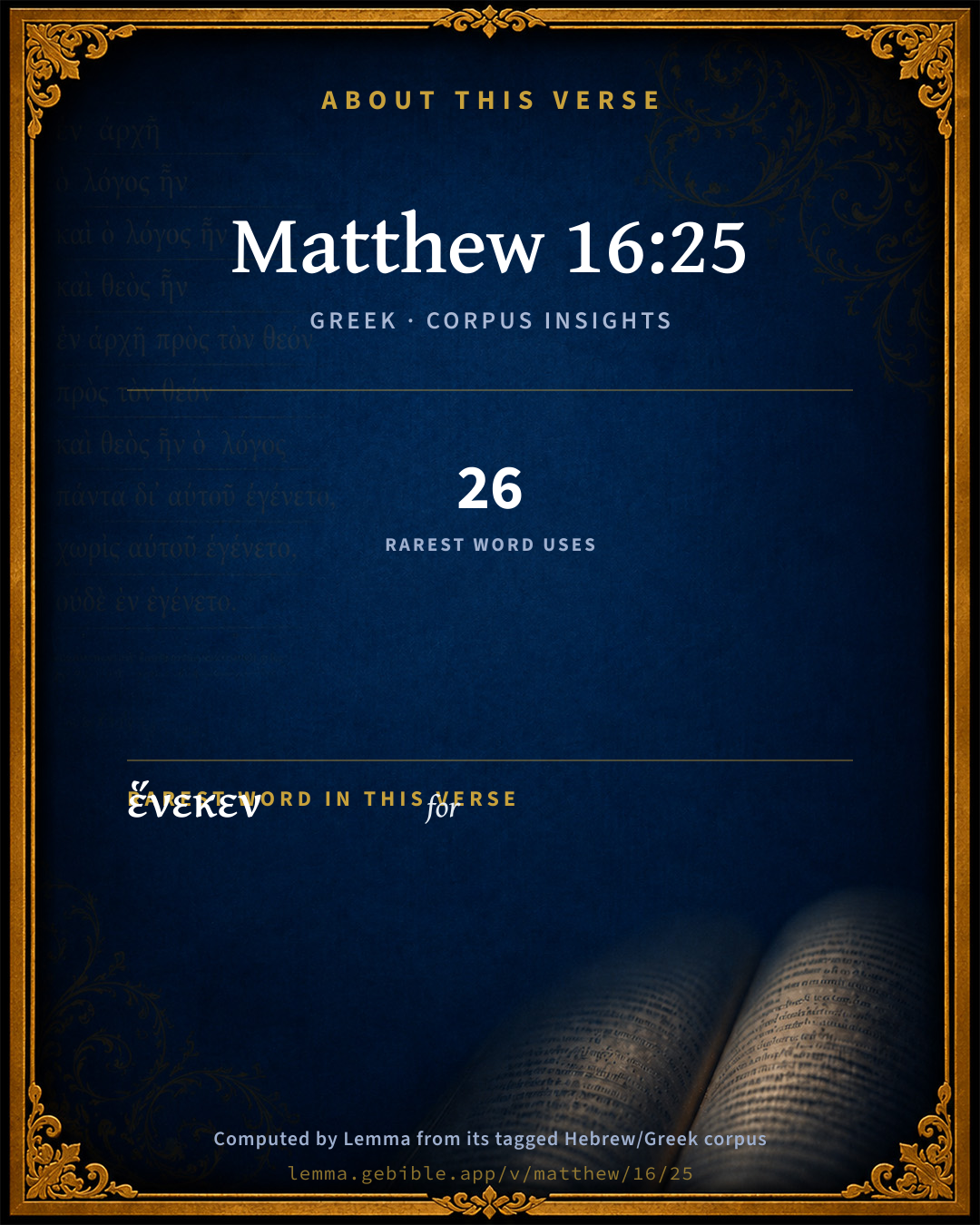
ἕνεκεν for G1752 occurs in 23 verses of the Greek New Testament. Also found in:
Repetition

Words recur within this verse:

  • ψυχὴν soul G5590 ×2
  • ἀπολέσει to destroy G622 ×2
  • αὐτοῦ he G846 ×4
  • ὃς who G3739 ×2
  • τὴν the G3588 ×2

Cross-references

8

Topical passages linked to Matthew 16:25 in the Treasury of Scripture Knowledge — connected by theme and wording, ordered by reader-vote popularity; previews shown in the World English Bible.

  • Matthew 10:39 He who finds his life will lose it; and he who loses his life for my sake will find it.
  • Revelation 12:11 They overcame him because of the Lamb's blood, and because of the word of their testimony. They didn't love their life, even to death.
  • Mark 8:35 For whoever wants to save his life will lose it; and whoever will lose his life for my sake and the Gospel's will save it.
  • John 12:25 He who loves his life will lose it. He who hates his life in this world will keep it to eternal life.
  • Luke 17:33 Whoever seeks to save his life loses it, but whoever loses his life preserves it.
  • Acts 20:23–24 except that the Holy Spirit testifies in every city, saying that bonds and afflictions wait for me.
  • Esther 4:16 Go, gather together all the Jews who are present in Shushan, and fast you for me, and neither eat nor drink three days, night or day: I also and my maidens will fast in like manner; and so will I go in to the king, which is not according to the law: and if I perish, I perish.
  • Esther 4:14 For if you altogether hold your peace at this time, then will relief and deliverance arise to the Jews from another place, but you and your father's house will perish: and who knows whether you haven't come to the kingdom for such a time as this?

Cross-references courtesy of OpenBible.info (CC BY 4.0).

Commentary

Notes on Matthew 16:25 from classic Christian and Jewish commentators (each source and its license shown beneath its notes). The classic Christian expositions comment on the surrounding passage and are grouped to its opening verse, so a note may address several verses; the Jewish commentaries on the Tanakh (Rashi and others) are per-verse, so they appear only where the commentator wrote on this verse.

Lemma curates 59 commentaries, every one of them public domain or Creative Commons licensed, each selected and text-cleaned for this edition rather than reprinted as found. About our sources →

The Biblical Illustrator

Joseph S. Exell

Mat_16:25

For whosoever will save his life.

Losing the soul to save it

One of the moral paradoxes of Scripture-the most decided, the most contradictory, the most reckless (if we may so say) of them all. A complete inversion of language. And it is no isolated expression. It is forced on our attention again and again. We cannot wander far in any direction without encountering this startling signpost, announcing the path of destruction as the only high-road to salvation. The context, moreover, enhances the paradox. We are told that a mans life (or soul, for it is the same word in the original) is absolutely priceless to him; that no exchange can be an equivalent; that no compensation will requite him for the loss: yet in the same breath we are bidden to despise it, to abandon it, to fling it away like a broken potsherd or a rank weed. The contradiction is direct and positive; and in this contradiction the lesson is to be sought.

I. What is meant by this soul or life of man? It is the living principle; the centre of mans capacities, passions, energies; the very seat of his personality. A mans soul is everything to him. Obviously, then, the health or sickness, the saving or the losing, the life or death of this soul, must be a matter of infinite moment, both in time and eternity; for it guides his actions, regulates his affections, influences his feelings. It is to his whole being what the mainspring is to a watch.

II. What are the faculties and duration of the soul? This question cannot be evaded; it must be faced. Its practical consequences are too momentous to admit of delay. If this life which we call life is only a passing moment of an infinite future, only the seed-time of a heavenly harvest, the infancy of an eternal manhood,-then treat it as such, educate and discipline it as such. You cannot go on drifting through life, till you find yourself at the edge of a cataract. No man going on a journey neglects so to arrange his route that at nightfall he shall halt at some place where food and shelter will be obtained. Darkness will overtake him, perhaps, in any case, for even the grateful interposition and warding of the twilight may not be sufficient; but what sane man would not shrink from finding himself in the darkness in a barren, trackless desert, exposed to the pitiless storm?

III. How is the soul to be saved? By losing it. The meaning of these words in their primary application is simple. To Christs disciples and their immediate followers, no comment was necessary. In an age of persecution, the willingness to lose the lower life for the salvation of the higher would be only too often tested in a literal sense. And the corresponding application now need create no difficulty. Whoever purchases ease by dishonesty, or comfort by neglect of duty, or popularity by concession of principle-preferring self where truth, honour, love, purity, or reverence demands self-negation, self-abandonment-that man loses his soul, loses his life, by saving it.

IV. But though the man who saves his soul is sure to lose it, the converse does not necessarily follow. Here an important proviso comes in-for My sake. There are many ways of losing the soul; but only one way of losing it so as to save. The profligate libertine squanders his means, and neglects his health, and flings himself away; but he does it selfishly, and to him the promise does not apply.

V. Loss for Christs sake is gain. This does not merely apply to sacrifices made consciously and directly in the cause of Christianity. If Christ be (as we believe) the very and eternal Word of God; the very expression of the Fathers truth, righteousness, purity, love; then the sacrifice of self to any one of these things is a saving of the soul by losing it; then the martyr to truth, to holiness, to purity, to love, may claim his portion along with the martyr to religion, for he has thrown himself away, has lost his soul for Christs sake.

VI. The same contrast and the same alternative may exist within the sphere of religion itself. It is possible to be anxious about saving the soul, to be extremely religious in a certain sense, but yet to risk the losing of it in the very desire of saving it. The soul must brace itself by vigorous exercise-spend and be spent. The true method of salvation is a great venture of self, a forgetfulness of self, a going out of self. Lose your soul in energy; spend yourself in alleviating some misery, instructing some ignorance, or reforming some vice. Fling your soul away, that, after many days, you may recover it again, purified, strengthened, renewed, living once more. (Bishop J. B. Light foot.)

Temporal gain eternal loss

It hath cost many a man his life, when his house has been on fire, to attempt through covetousness to save some of his stuff; venturing among the flames to preserve this, he has perished himself. Many more have lost their souls, by attempting to carry some of their own stuff-their own self-righteousness-with them to heaven. O sirs! come out, come out; leave what is your own in the fire; flee to Christ naked! (Gurnall.)

Life lost in the effort to save it

It is reported, in connection with a railway accident that happened a few years ago, that the only person who lost his life was a gentleman who jumped out of the train with a view to save it; all the other passengers who kept their seats were preserved.

Temporal loss eternal gain

God can infinitely more than counterbalance all temporal losses by the larger and richer outpouring of His Spirit on the soul. He may demand our worldly wealth; but if He increase our spiritual riches, are we not therein great gainers? Can He not, by the consolations of His Spirit, raise us far above all temporal distresses; and, by opening up a prospect beyond the grave, make us to glory in all tribulations (Rom_5:3-5). It was thus that St. Paul took, as he strongly phrases it, pleasure in infirmities, and persecutions, and distresses, for Christs sake. It was thus that, in ancient days, they took cheerfully the spoiling of their goods, knowing that they had in heaven a better and an enduring substance. Even so may we expect it to be with us in this world. If our afflictions abound, even so shall also our consolations abound by Christ. And the consciousness, the comfortable reflection, that with a single eye we have sought Gods glory, will make every pain a pleasure, every loss a gain. (R. B. Nichol.)

Losses and gains connected with religion.

I. The things of this life men may obtain by rejecting the religion of Christ. They may obtain a considerable portion of earthly riches; the sensual gratifications of life; the distinctions of worldly honour and praise.

II. In what respect these advantages shall be lost to them. They shall often be interrupted in their enjoyment of them. Sometimes they are overtaken with overwhelming calamities. They must all necessarily be forfeited at death. They produce the most appalling consequences in the eternal world.

III. What we may be called to sacrifice in becoming the disciples of jests. Christ called His disciples to lose all will and choice with respect to this worlds good. We may be called to lose the approbation of friends; to endure the frowns of the world; lose life itself.

IV. In what respects we shall find again the things we sacrifice. In the midst of these sacrifices-we have what is better than life; we are attaining a greater assimilation to the life of Christ; all our sacrifices terminate at death; we shall be superabundantly rewarded at the last day. (J. Burns, D. D.)

The Biblical Illustrator, edited by Joseph S. Exell (c. 1880s–1900s) — public domain. Text from a community e-Sword module.

Joseph Benson's Commentary

Mat 16:25-27. Whosoever will save his life — At the expense of his conscience: whosoever, in the very highest instance, that of life itself, will not renounce himself, shall be lost eternally. But can any man hope he should be able thus to renounce himself, if he cannot do it in the smallest instances? And whosoever will lose his life, shall find it — What he loses on earth he shall find in heaven. See note on Mat 10:39, where this sentence is explained more at large. For what is a man profited, &c. —

“To carry home the argument more closely, he puts them in mind of the method according to which men estimate things. If God should offer the riches of Solomon, the strength of Samson, the policy of Ahithophel, the beauty of Absalom, the eloquence of Apollos, universal monarchy, and all kinds of pleasures, and should say, Take them for one hour, and then die; who is the man that would not immediately reject the proposed condition, and reply, that life is better than them all? But will men forego every earthly thing for life, the life of the body? and will they not part with them, nay, and with life itself, for their souls? since the longest any one can enjoy this life with its pleasures, is, in comparison of eternity, no longer than he enjoys the good things mentioned, who dies in the same hour he receives them.” — Macknight. Or, what shall a man give in exchange for his soul — Namely, at the day of judgment? For the Son of man shall come in the glory of his Father — For you may certainly depend upon it that, howsoever he may be now despised and rejected of men, there is a day appointed when he will come in all the glory of the Godhead, encircled in the most pompous manner with his holy angels: and then shall he convene the whole world before him, that he may determine the final happiness or misery of each, and recompense every man according to his conduct. Thus, “that the argument, by which the necessity of self-denial is so clearly established, might have the greater weight, our Lord speaks more particularly concerning the rewards and punishments of a future state, assuring his disciples that they are all to be distributed by himself, the Father having appointed him the universal Judge, so that his enemies cannot flatter themselves with a hope of escaping condign punishment, nor his friends be in the least afraid of losing their reward.”

Joseph Benson's Commentary on the Old and New Testaments (1811–1818) — public domain. Text from a community e-Sword module.

Tyndale Open Study Notes

Tyndale Open Resources

16:25 Jesus’ disciples must relinquish control of their lives, even to the point of being willing to suffer and die for Christ. Jesus promised that those who follow him with such radical abandon, though they may suffer now, will be vindicated at the final judgment (see 1 Pet 2:23).

Tyndale Open Study Notes — © Tyndale Open Resources, licensed CC BY-SA 4.0. Text via the HelloAO Bible API.

Bengel's Gnomon

Johann Albrecht Bengel

Mat 16:25. Θέλῃ—σῶσαι, shall wish—to save) It is not said, “shall save, ψυχὴν, soul) The soul is the man in his animal and human capacity.—σῶσαι, to save) sc. naturally.—ἀπολέσει, shall lose) sc. spiritually, or even corporeally.—ἀπολέσῃ, will lose) sc. naturally, having cast away all egoism[768] by self-abnegation. It is not said, shall wish to lose.—ἕνεκεν Ἐμοῦ, for My sake) This is the object of self-abnegation: but many from other causes lose their lives, sc. for their own sake, or that of the world.—εὑρήσει, shall find) In St Mark and St Luke σώσει, it is shall save, shall save sc. spiritually, or even corporeally. The world is full of danger. The soul that is saved is something that has been found.

[768] “Suitate.”—(I. B.)

Bengel's Gnomon of the New Testament — English translation (T&T Clark, Edinburgh, 1860) — public domain. Text from a community e-Sword module.

Expositor's Greek Testament

ed. W. Robertson Nicoll

Mat 16:25 . ide Mat 10:39 . The Caesarea crisis was the most appropriate occasion for the first promulgation of this great ethical principle. It was Christ’s first contribution towards unfolding the significance of His suffering, setting it forth as the result of a fidelity to righteousness incumbent on all.

The Expositor's Greek Testament, edited by W. Robertson Nicoll (1897–1910) — public domain. Text from a community e-Sword module.

Geneva Bible (1599)

Geneva Bible translators

Shall gain himself: And this is his meaning, they that deny Christ to save themselves, do not only not gain that which they look for, but also lose the thing they would have kept, that is themselves, which loss is the greatest of all: but as for them that doubt not to die for Christ, it fareth far otherwise with them.

Geneva Bible (1599) marginal notes — public domain. Text via Bolls.life.

Jamieson, Fausset & Brown

Robert Jamieson, A. R. Fausset & David Brown

For whosoever will save--is minded to save, or bent on saving.

his life shall lose it, and whosoever will lose his life for my sake shall find it--(See on Mat 10:38-39). "A suffering and dying Messiah liketh you ill; but what if His servants shall meet the same fate? They may not; but who follows Me must be prepared for the worst."

Jamieson, Fausset & Brown — Commentary Critical and Explanatory on the Whole Bible (1871) — public domain (CC PDM 1.0). Text via the HelloAO Bible API.

Adam Clarke's Commentary

Verse 25. For whosoever will save his life] That is, shall wish to save his life-at the expense of his conscience, and casting aside the cross, he shall lose it - the very evil he wishes to avoid shall overtake him; and he shall lose his soul into the bargain. See then how necessary it is to renounce one's self! But whatsoever a man loses in this world, for his steady attachment to Christ and his cause, he shall have amply made up to him in the eternal world.

Adam Clarke's Commentary on the Bible (1810–1826) — public domain. Text from a community e-Sword/MySword module.

Ellicott's Commentary for English Readers

(25) Whosoever will save his life, . . . whosoever will lose his life. . . .—There is a subtle distinction between the two clauses in the Greek which the English fails to represent. “Whoso ever willeth—i.e., wishes—to save his life” (the construction being the same as in Mat_16:24) in the first clause, “Whosoever shall lose his life” in the second. It is as though it was felt that no man could wish to lose his life for the sake of losing it, though he might be ready, if called on, to surrender it. The word rendered “life” is the same as “the soul” of the next verse. For the most part, it means the former rather than the latter with its modern associations, and is never used as a simple equivalent for the spirit of man as the heir of immortality. Strictly speaking, it is the animating principle of the natural as distinguished from the spiritual life. Man, in the fuller trichotomy of the New Testament, consists of “body, soul, and spirit” (1Th_5:23), the soul being the connecting-link between the other two. The truth is, of course, put in the form of a paradox, and hence, with a contrast between the two aspects of the soul, or psyche. To be bent on saving it in its relation to the body, is to lose it in its relation to the higher life of spirit; to be content to part with it in its lower aspect, is to gain it back again in the higher.

A Bible Commentary for English Readers, edited by Charles John Ellicott (1878–1897) — public domain. Text from a community e-Sword module.

The Cambridge Bible for Schools and Colleges

gen. ed. J. J. S. Perowne

25. whosoever will save his life shall lose it] See note, ch. Mat_10:39. Let Christ’s follower lose the lower life on his cross, crucify his earthly affections, and he shall win the higher spiritual life here and hereafter.

will save] Not the mere future, but= “shall resolve to save.”

The Cambridge Bible for Schools and Colleges (gen. ed. J. J. S. Perowne; Cambridge University Press, 1878–1918) — public domain. Text from a community e-Sword module.

John Gill's Exposition

For what is a man profited,.... Such persons, though they are only seeking their own profit, will find themselves most sadly mistaken; for of what advantage will it be to such a man,

if he shall gain the whole world; all that is precious and valuable in it; all the power, pleasures, and riches of it; if with Alexander, he had the government of the whole world, and with Solomon, all the delights of it; and was possessed with the wealth of Croesus, and Crassus,

and lose his own soul? If that should be consigned to everlasting torment and misery, be banished the divine presence, and continually feel the gnawings of the worm of conscience that never dies, and the fierceness of the fire of God's wrath, that shall never be quenched, he will have a miserable bargain of it.

Or what shall a man give in exchange for his soul? Or, "for the redemption" of it, as the Ethiopic version renders it: see Psa 49:8. If he had the whole world to give, and would give it, it would not be a sufficient ransom for it; the redemption of an immortal soul requires a greater price than gold and silver, or any corruptible thing; nothing short of the blood and life of Christ, is a proper exchange, or ransom price for it. But in the other world there will be no redemption; the loss of a soul is irrecoverable: a soul once lost and damned, can never be retrieved. This passage is thought to be proverbial; what comes nearest to it, is the following (x).

"If a scholar dies, we never find an exchange for him; there are four things which are the ministry or service of the world, , if they are lost, they may be changed; and they are these, gold, silver, iron, and brass, Job 28:1 but if a scholar dies, , who will bring us his exchange? or an exchange for him: we lost R. Simon, "who will bring us his exchange?".''

(x) Midrash Kohelet, fol. 72. 3, 4. T. Hieros. Beracot, fol. 5. 3.

John Gill's Exposition of the Whole Bible (1746–1763) — public domain (CC PDM 1.0). Text via the HelloAO Bible API.

Trapp's Complete Commentary

John Trapp

25 For whosoever will save his life shall lose it: and whosoever will lose his life for my sake shall find it.

Ver. 25. For whosoever will save his life] That is parsimonious of it, when Christ calls him to be prodigal of it. Man is naturally a "life loving creature." {a} What man is he that desireth life? I do, and I, and I, as Augustine brings men in, making ready answer. Quis vitam non vult? Life is sweet, we say, and every creature makes much of it, from the highest angel to the lowest worm, as that Father observeth. But life in God’s displeasure is worse than death, as death in his true favour is true life, said Bradford to Gardiner; for such a death lays hold upon eternal life, as St Paul hath it, 1Ti 6:19, or (as other copies read it) upon life indeed (της οντως ζωης). For, aeterna vita vera vita, saith Augustine. "None to that," as David said of Goliath’s sword. "None but Christ, none but Christ," as that martyr cried in the flames. This love of Christ made them sacrifice their dearest lives to his name, yea, profess, as John Ardely did to Bonnet, That if every hair of his head were a man, he would suffer death in them all for his sweet Christ’s sake. My wife and my children are so dearly beloved unto me, that they cannot be bought from me for all the riches and possessions of the Duke of Bavaria; but for the love of my Lord God I will willingly forsake them, said George Carpenter, who was burnt at Munchen in Bavaria.

{a} Ζωον φιλοζωον. Aesop in Fab.

John Trapp, A Commentary or Exposition upon All the Books of the Old and New Testament (1647–1656) — public domain. Text from a community e-Sword module.

Haydock's Catholic Bible Commentary

Whosoever will save his life. Lit. his soul. In the style of the Scriptures, the word soul is sometimes put for the life of the body, sometimes for the whole man. (Witham) --- Whosoever acts against duty and conscience to save the life of his body, shall lose eternal life; and whoever makes the sacrifice of his life, or the comforts and conveniences of life for conscience sake, shall be rewarded with life eternal.

George Leo Haydock (1774–1849), Haydock's Catholic Family Bible and Commentary, 1859 edition — public domain. Excludes Psalms (Douay-Rheims chapter numbering differs from Protestant) and Deuterocanonical books (Catholic canon only).

Matthew Poole's English Annotations

We met with these words in Mat 10:39. See Poole on "Mat 10:39".

Matthew Poole's English Annotations on the Holy Bible (1683–1685) — public domain. Text from a community e-Sword/MySword module.

Whedon's Commentary on the Bible

Daniel D. Whedon

25. Save his life… lose. See note on Mat_10:39. The present paragraph, indeed, is in general a reiteration of the substance of that chapter — apostolic suffering, in view of a future reward, in order that Christ’s kingdom may be established in the earth.

Daniel D. Whedon (gen. ed.), Commentary on the Old and New Testaments (1874–1909) — public domain. Text from a community e-Sword module.

The Pulpit Commentary

Comp. Mat_10:39 Joh_12:25. Whosoever will (ov galh , whosoever wills to) save his life (quchn). Here are set forth the highest motives for courage, endurance, and perseverance in the way of righteousness. The word translated "life" is used four times in this and the following verse, though in the latter it is rendered "soul" in the Anglican Version. The fact is the word is used in two senses: for the life which now is the bodily life: and the life which is to come the spiritual, the everlasting life. These are indeed two stages of the same life that which is bounded by earth and that which is to be passed with the glorified body in heaven; but they are for the moment regarded as distinct, though intimately connected by belonging to the same personality. And the Lord intimates that any one who avoids bodily death and suffering by compromise of duty, by denying Christ and disowning the truth, shall lose everlasting life. On the other hand, whosoever sacrifices his life for the sake of Christ, to promote his cause, shall save his soul and be eternally rewarded. Shall find it. "Find," as the opposite of "lose," is here equivalent to "save." There may, too, be in it a notion of something great and unexpected, a treasure discovered, "salvation far beyond all that they looked for". (RAPC Wis 5:2) Says St. Gregory, "If you keep your seed, you lose it; if you sow it, you will find it again" ("Hom. in Evang.," 32.).

Vers. 25, 26. The gain that is loss, and the loss that is gain.

Great confusion has been introduced into these verses in the Authorized Version by the rendering of the same Greek word as "life" in ver. 25, and "soul" in ver. 26. The Revisers have helped to a better understanding of the passage by translating the word "life" throughout. Christ was not speaking of the soul as we understand it, of the higher nature of man; but of life as opposed to the idea of being killed and so losing one"s life.

I SELF-SEEKING IS SELF-LOSING. Jesus is warning his disciples of the dangers and hardships of his service. Many will be tempted to shrink from the cross in order to save their lives. They are told that a cowardly unfaithfulness under persecution is not the way to save their lives. It is true a violent death may be thus avoided. But what is the use of a life preserved at the cost of honour and fidelity? It is not really saved, for it is so degraded that it has become a worthless thing. Thus it is a wasted life, a lost life. The same is true today under other circumstances. The man who denies Christ for his own convenience lowers himself to the level of worthlessness. He who greedily grasps at his own pleasure to the neglect of higher interests so impoverishes his nature by his mean and narrow way of living that his life is really ruined. This is the case on earth. It will be more apparent in the next world, when Christ comes to "render unto every man according to his deeds" (ver. 27). Even in spiritual things, if a man"s religion is purely selfish it will be of no use to him. If he thinks only of his own salvation, and nothing of the service of Christ and the benefit of his fellow men, he will be lost. It is not the teaching of Christ that our great business is to save ourselves. Religious teachers are greatly to blame for inculcating this most unchristian notion. Christ comes to save us from ourselves; but this will not be effected by the cultivating of a habit of supreme self-seeking in religion. Such a habit is ruinous to all that is worthy in a man. Therefore ver. 26, which is often quoted in favour of a self-seeking religion, should be read in the light of ver. 25.

II SELF-LOSING IS SELF-FINDING. This is the opposite to the principle just considered; it has a positive importance of its own that demands careful consideration. "How is the paradox verified in experience? We must first of all call to mind the immediate circumstances our Lord had in view. His disciples were being warned of coming persecutions. Some of them would lose their lives in martyrdom. Yet then they would most truly find them, for they would be the heirs of life eternal, and would live on in the bright future. That is the first lesson of the words. But they go much further. What is true under persecution is true at all times. The martyr temper is the Christian spirit. We gain the only life worth living on earth when we deny ourselves and embark on a career of unselfish service. The abandonment of selfish aims is the acquisition of heavenly treasures. There is a blessedness in the life of obedience and self-surrender that the selfish can never know. Happiness is not attained by directly aiming at it; it comes in as a surprise to him who is not seeking it when he is busy in unselfish service. Now, these lessons are driven home and clenched by the obvious truth of the following verse (ver. 26). What is the use of a world of wealth to a man who loses his life in acquiring it? The pearl seeker who is drowned in the moment of clutching his gem is a supreme loser even while he is a gainer. Nothing will compensate a man for making shipwreck of his life by self-seeking. W.F.A.

Vers. 25-28. Profit and loss.

As the time of the brief ministry of Jesus drew to its close, he began to show his disciples how he must go to Jerusalem and suffer and be killed, and rise again the third day. The sombre part of this anticipation was a terrible shock to the strong Jewish prejudices of Peter; and he lost sight of the glorious element of the resurrection. So is prejudice blind evermore. He had. the presumption to take Jesus to task, and stoutly protested against any such issue. For this temerity Peter merited a terrible rebuke from Christ, who, after administering it, insisted upon self-denial and cross lifting as essential to his discipleship. Then he proceeded to reason and expostulate in the words of the text.

I WHAT IS THE GAIN? THE WORLD.

1. Not the empire of the universe.

(1) "The whole world," in the largest sense, includes not only this globe, but the sun, the planets, and the moons of this solar system; and, moreover, all the firmaments of such systems within the searching power of telescopes and beyond into immensity.

(2) The proprietorship of the world in this large sense belongs to God alone. Such a sceptre could be wielded only by the Infinite.

2. Not the empire of this earth.

(1) Alexander the Great is said to have "conquered the world," and then to have "wept because he had not another world to conquer." Yet was that empire of Alexander but a small portion of the globe after all. And instead of conquering the other world of his own mind, his evil passions conquered him.

(2) The Romans were said to be "masters of the world," but there were barbarians beyond they could never subdue. There were vast continents they never knew.

(3) The British empire is the most extensive that the sun has seen. Yet are we far from possessing the monopoly of the globe. Universal empire, in this sense, is still reserved for the proper Man.

3. All the pleasures of the worldling.

(1) In his enjoyment of all natural endowments. Health of body; symmetry of proportions; vigour of mind; hilarity of spirits.

(2) All accidental advantages. The inheritance of wealth, of title, of position.

(3) All opportunities of animal indulgence. Luxuries of the table choice wines, rare fruits all in profusion. Every conceivable gratification for the appetite and passion.

(4) All opportunities for intellectual gratification. A taste cultivated to appreciate the finest poetry, the most exquisite music, the noblest eloquence, consummate painting and sculpture, and refinements of art, together with all these things.

4. But hold, the colouring is too high!

(1) Who can have all this with religion? Can it be all indulged if the claims of religion are respected?

(2) But who can have all this without religion? For are there not punitive sequences bound up with indulgence?

(a) Health will not abide it.

(b) Capacity is limited, and to surcharge is to produce revulsion and disgust.

(c) Conscience will have its reckoning.

(d) Fear will intrude with thoughts of the coming of the "Son of man in the glory of his Father with his angels" to "reward to every man according to his deeds." It will bring alarmingly near the judgment in the doom of death.

II WHAT IS THE LOSS? THE SOUL.

1. Its greatness is seen in its achievements.

(1) Those of the astronomer. The calculation of the Nautical Almanac. The discovery of the planet Neptune. Light thrown upon chronology.

(2) Those of the chemist and electrician.

(3) Those of the engineers

(4) What a loss when such great rowers are prostituted, wasted, blighted, damned!

2. It is evident in its capability of God.

(1) Powers to contemplate his being and attributes; his government and his claims.

(2) Enjoying his friendship. Reciprocating his love. Working out his purposes.

(3) Hoping in his promises of heaven.

(4) But all this capability is capability also of suffering. Awful to the sinner is the very justice of his judgment. Thoughts of the being and attributes of an infinite Enemy. How terrible are the fires of his wrath!

3. It is seen in God"s estimate.

(1) He framed the creation for man (see Psalm 8).

(2) He gave himself for man. Became incarnate in our nature. In that nature suffered and died for us.

(3) Carried our nature into heaven. There it is exalted above all principality.

(4) In it he will come forth "in the glory of his Father with his angels.

(5) The distance between heaven"s rapturous height and hell"s horrible depth is the measure of God"s estimate of man.

III WHAT IS THE PROFIT?

1. For what do you barter your soul?

(1) "All that is in the world" is soon summed up. "For all that is in the world, the lust of the flesh, and the lust of the eyes, and the vain glory of life, is not of the Father". (1Jn_2:16)

(2) But what have we here?

(a) Sensuality. Wine. Women.

(b) Covetousness. Gain by meanness. Gain by trend. Gain by oppression.

(c) Ambition.

The esteem of the deceived. Or the esteem of the vain. What does it profit?

2. What is the profit when life is spent?

(1) What would a damned soul give for the opportunity to retrace his steps?

(2) But life is spent before a man is dead. What does the world profit when a man outlives its pleasures when his energy is spent?

3. What must we sacrifice for the soul?

(1) Not the world, in its use.

(2) We must sacrifice the world in its abuse. All sin must go.

(3) Life must be sacrificed if necessary. But then "to die is gain. J.A.M.

The Pulpit Commentary (1880–1919), ed. H.D.M. Spence-Jones & Joseph S. Exell — public domain. Text from a community e-Sword module.

John Wesley's Explanatory Notes

Whosoever will save his life - At the expense of his conscience: whosoever, in the very highest instance, that of life itself, will not renounce himself, shall be lost eternally. But can any man hope he should be able thus to renounce himself, if he cannot do it in the smallest instances? And whosoever will lose his life shall find it - What he loses on earth he shall find in heaven. Matt. x, 39; Mark viii, 35; Luke ix, 24; xvii, 33; John xii, 25.

John Wesley, Explanatory Notes Upon the Whole Bible (1754–1765) — public domain. Text via the GEBible commentary corpus.

Burkitt's Expository Notes on the New Testament

William Burkitt

Observe here, 1. That the love of this temporal life, is a great temptation to men to deny Christ, and renounce his holy religion.

2. That the surest way to attain eternal life, is cheerfully to lay down a mortal life, when the glory of Christ and his service calleth us thereunto.

William Burkitt's Expository Notes on the New Testament (1700–1703) — public domain. Text from a community e-Sword module.

The People's New Testament

B. W. Johnson

25. Whosoever will save his life shall lose it. He who refuses to deny himself, and makes saving and ministering to his present life his chief object, shall lose his life eternally.

B. W. Johnson's The People's New Testament with Notes (1889–1891) — public domain. Electronic text from the Christian Classics Ethereal Library (CCEL) ThML edition.

International Critical Commentary

25. For whosoever wishes to save his life shall lose it, and whosoever shall lose his life for My sake shall find it.] See on 10:39.—ὅς—ἐάν] See on 11:27.—ἕνεκεν ἐμοῦ] Mk. adds καὶ τοῦ εὐαγγελίου. For Mt.’s omission of one of two synonymous clauses, see on 8:16; and cf. 19:29 ἕνεκεν τοῦ ἐμοῦ ὀνόματος for Mk.’s ἕνεκεν ἐμοῦ καὶ ἕνεκεν τοῦ εὐαγγελίυ.—εὑρήσει] Mk. σώσει. Mt. assimilates to 10:39 in order to form an antithesis to ἀπολέσει. For antithesis in Mt., see on 15:2, 3, 4, 5, 19:8, 9.

(M)

International Critical Commentary — older volumes (1896–1929), various authors — public domain. Text from a community e-Sword module.

Lesson kit

Teaching starters — assembled from the data on this page, not authored interpretation. Every prompt links to the verse data it draws on. Edit before teaching.

Matthew, in the Gospels, opens this verse with 21 words (14 distinct Greek lemmas). Its most distinctive word is héneka (“for”). A historical commentator’s framing appears above. Read the whole chapter for the surrounding context.

Discussion questions

  1. The word héneka carries the sense “for.” How does it shape the verse?
  2. Matthew 5:10 shares the word «for» with this verse. How do the two illuminate each other?
  3. “soul” occurs 2× in this one verse. What is the effect of the repetition?
  4. These translations render this verse differently. What is at stake in choosing one wording over another?
  5. Reading how The Biblical Illustrator and Joseph Benson's Commentary read this verse, where do the two commentators agree and where do they part?

Things to notice

  • These translations choose different wording for 6 words in this verse.
  • “soul” occurs 2× in this single verse.
  • 14 distinct Greek lemmas span 21 words in this verse.

Reading settings

Reading text

Shown beneath each verse's original-language words.

Old Testament
Old Testament edition

Read the OT as the Masoretic Hebrew (MT) or the Greek Septuagint (LXX).

English shown for the Greek Septuagint (in the Hebrew ↔ Greek comparison).

Comparing translations? Open the Compare panel on any verse page to stack up to four side by side.