Matthew 18:24

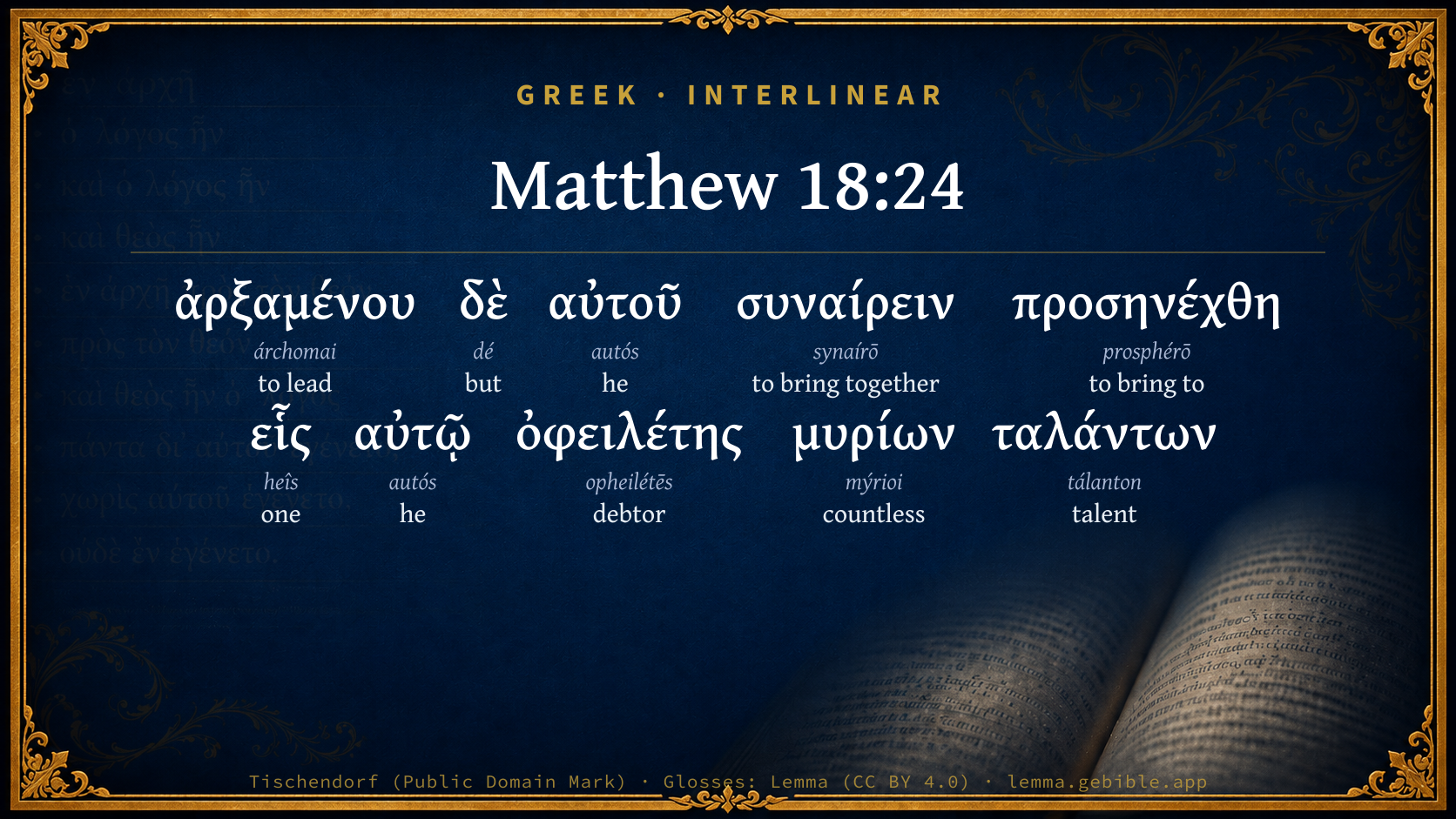
Greek (Tischendorf 8th ed.) Matthew 18:24 appears in the Greek New Testament. The text above is from the Tischendorf 8th edition. Each word links to its Strong’s number and a concise gloss. Click any word for its full Thayer’s Greek Lexicon entry.
Download image
Cite this verse

Matthew 18:24 (World English Bible). Public Domain. Lemma interlinear Bible study tool, https://lemma.gebible.app/v/matthew/18/24.

Show BibTeX & RIS
BibTeX
RIS
English Translation
When he had begun to reconcile, one was brought to him who owed him ten thousand talents.
World English Bible · Public Domain
Highlights
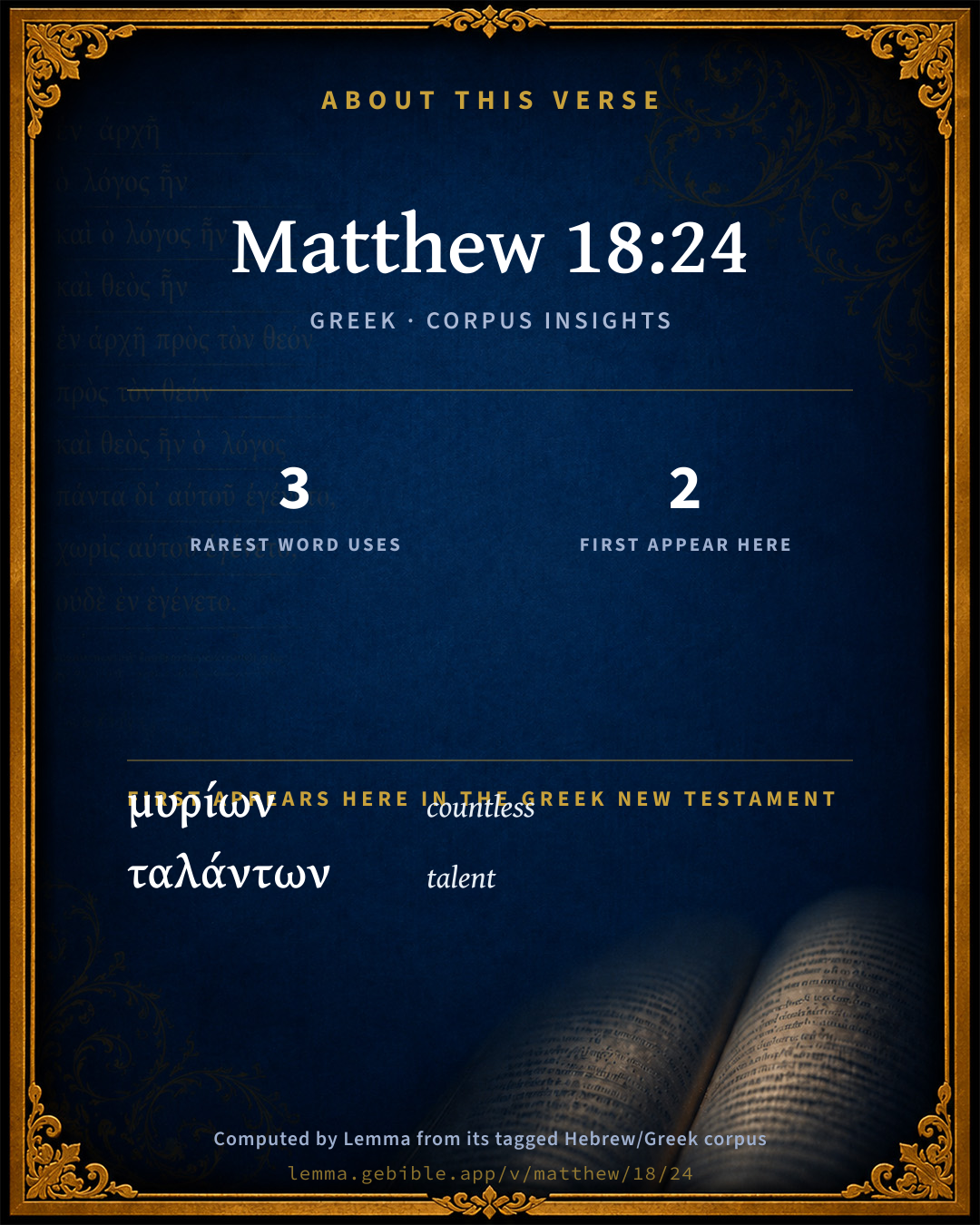
  • 2 first appearances in the Greek New Testament
Full analysis ↓
Download a study sheet

One document with this verse’s original text, its word-by-word gloss line, the meaning frame, cross-references with their text, attributed commentary, and full source and license credits — printable, and it pastes into notes with its structure intact.

This verse Autodidact and up

Study sheet (.html) Plain text (.txt)

A passage Seminary Student

Up to 50 verses in one chapter. A passage sheet keeps up to 6 commentary sources and 12 cross-references per verse, in the order this page ranks them, and says so on the sheet whenever that leaves anything out. Ask for a single verse and you get the Autodidact verse sheet above.

Everything on this page stays free to read, with no account — the sheet is a download of what is already on screen, not access to it.

Want to remove ads? Support Godless Engineer
Compare translations 3

The same verse in 3 English versions, stacked beneath the original-language interlinear above. Click any original word for its lexicon entry.

Each is an independent rendering of the whole verse — the interlinear is not word-aligned to these translations.

Highlighted words mark where these versions differ — a whole-verse word diff, not a word-by-word alignment.

  • World English Bible Public Domain
    When he had begun to reconcile, one was brought to him who owed him ten thousand talents.
  • King James Version Public Domain
    And when he had begun to reckon, one was brought unto him, which owed him ten thousand talents.
  • unfoldingWord Literal Text CC BY-SA 4.0
    Now he had begun to take up together, one debtor of 10,000 talents was brought to him.

unfoldingWord Literal Text — © unfoldingWord, licensed CC BY-SA 4.0. Word-aligned USFM3 via Door43 (git.door43.org/unfoldingWord/en_ult).

Versions to compare (up to 4)

3 of 4 selected

Show all 19 translations

Every available English version of this verse, each an independent rendering of the whole verse.

  • World English Bible Public Domain
    When he had begun to reconcile, one was brought to him who owed him ten thousand talents.
  • Berean Standard Bible Public Domain
    As he began the settlements, a debtor was brought to him owing ten thousand talents.
  • Majority Standard Bible Public Domain
    As he began the settlements, a debtor owing ten thousand talents was brought to him.
  • King James Version Public Domain
    And when he had begun to reckon, one was brought unto him, which owed him ten thousand talents.
  • American Standard Version (1901) Public Domain
    And when he had begun to reckon, one was brought unto him, that owed him ten thousand talents.
  • Revised Version (1885) Public Domain
    And when he had begun to reckon, one was brought unto him, which owed him ten thousand talents.
  • Geneva Bible (1599) Public Domain
    And when he had begun to reckon, one was brought vnto him, which ought him ten thousand talents.
  • Douay-Rheims (1899) Public Domain
    And when he had begun to take the account, one was brought to him, that owed him ten thousand talents.
  • Young's Literal Translation Public Domain
    and he having begun to take account, there was brought near to him one debtor of a myriad of talents,
  • Literal Standard Version CC BY-SA 4.0
    and he having begun to take account, there was brought near to him one debtor of a myriad of talents,
  • Unlocked Literal Bible CC BY-SA 4.0
    As he began the settling, one servant was brought to him who owed him ten thousand talents.
  • unfoldingWord Literal Text CC BY-SA 4.0
    Now he had begun to take up together, one debtor of 10,000 talents was brought to him.
  • Darby Bible Public Domain
    And having begun to reckon, one debtor of ten thousand talents was brought to him.
  • World Messianic Bible Public Domain
    When he had begun to settle, one was brought to him who owed him ten thousand talents.
  • Webster's Bible Public Domain
    And when he had begun to reckon, one was brought to him who owed him ten thousand talents.
  • Free Bible Version CC BY-SA 4.0
    As he began to settle accounts, one servant was brought to him who owed him ten thousand talents.
  • Bible in Basic English Public Domain
    And at the start, one came to him who was in his debt for ten thousand talents.
  • Text-Critical English NT CC BY 4.0
    As he began to settle accounts, one servant who had a debt of ten thousand talents was brought to him.
  • Tyndale New Testament (1534) Public Domain
    And when he had begone to recken one was broughte vnto him whiche ought him ten thousande talentis:

Literal Standard Version (2020), Covenant Press — licensed CC BY-SA 4.0. Text via the HelloAO Bible API (eBible.org). Unlocked Literal Bible (unfoldingWord) — licensed CC BY-SA 4.0. Text via the HelloAO Bible API (eBible.org). unfoldingWord Literal Text — © unfoldingWord, licensed CC BY-SA 4.0. Word-aligned USFM3 via Door43 (git.door43.org/unfoldingWord/en_ult). Free Bible Version, Dr. Jonathan Gallagher — licensed CC BY-SA 4.0. Text via the HelloAO Bible API (eBible.org).

Word by word

More ways to search: Search by grammar → Find every occurrence → Compare this word →

Practice this passage: Drill this verse → Learn its vocabulary →

About this verse

These counts appear in no published source. They are computed here, from the morphology-tagged text and Lemma’s own curated glosses. What Lemma adds →

10
words
9
distinct lemmas
Gospels
section

Notable vocabulary

The rarest word here is συναίρειν to bring together G4868 — appearing just 3 times in the whole Greek New Testament.

First appearance in Scripture

These words make their first canonical appearance in the Greek New Testament here:

  • μυρίων countless G3463
  • ταλάντων talent G5007

Shared distinctive vocabulary

συναίρειν to bring together G4868 occurs in 3 verses of the Greek New Testament. Also found in:

Repetition

A word recurs within this verse:

  • αὐτοῦ he G846 ×2

Cross-references

9

Topical passages linked to Matthew 18:24 in the Treasury of Scripture Knowledge — connected by theme and wording, ordered by reader-vote popularity; previews shown in the World English Bible.

  • Psalms 38:4 For my iniquities have gone over my head. As a heavy burden, they are too heavy for me.
  • Psalms 130:3–4 If you, Yah, kept a record of sins, Lord, who could stand?
  • Ezra 9:6 and I said, my God, I am ashamed and blush to lift up my face to you, my God; for our iniquities are increased over our head, and our guiltiness is grown up to the heavens.
  • Psalms 40:12 For innumerable evils have surrounded me. My iniquities have overtaken me, so that I am not able to look up. They are more than the hairs of my head. My heart has failed me.
  • Luke 13:4 Or those eighteen, on whom the tower in Siloam fell, and killed them; do you think that they were worse offenders than all the men who dwell in Jerusalem?
  • Luke 16:5 Calling each one of his lord's debtors to him, he said to the first, 'How much do you owe to my lord?'
  • 1 Chronicles 29:7 and they gave for the service of the house of God of gold five thousand talents and ten thousand darics, and of silver ten thousand talents, and of brass eighteen thousand talents, and of iron a hundred thousand talents.
  • Luke 7:41–42 "A certain lender had two debtors. The one owed five hundred denarii, and the other fifty.
  • Luke 16:7 Then said he to another, 'How much do you owe?' He said, 'A hundred cors of wheat.' He said to him, 'Take your bill, and write eighty.'

Cross-references courtesy of OpenBible.info (CC BY 4.0).

Commentary

Notes on Matthew 18:24 from classic Christian and Jewish commentators (each source and its license shown beneath its notes). The classic Christian expositions comment on the surrounding passage and are grouped to its opening verse, so a note may address several verses; the Jewish commentaries on the Tanakh (Rashi and others) are per-verse, so they appear only where the commentator wrote on this verse.

Lemma curates 59 commentaries, every one of them public domain or Creative Commons licensed, each selected and text-cleaned for this edition rather than reprinted as found. About our sources →

Joseph Benson's Commentary

Mat 18:24-27. One was brought who owed him ten thousand talents — That is, according to the lowest computation, about two millions sterling. But it is probable, as the Prussian editors say, that the ten thousand talents are here put for an immense sum. Hereby our Lord intimates the vast number and weight of our offences against God, and our utter incapacity of making him any satisfaction. As he had not to pay — Was utterly unable to discharge this immense debt; his lord commanded him to be sold, and his wife and children, &c. — Such was the power which creditors had over insolvent debtors in several countries of Europe, as well as Asia, in ancient times; and payment to be made — With the price of them, as far as it would go. The servant, therefore, fell down and worshipped him — That is, prostrated himself at his master’s feet; saying, Lord, have patience with me, and I will pay thee all — The confusion he was in made him say this without consideration; for the debt which he owed was a sum by far too great for any one, who had nothing, ever to think of acquiring. Then the Lord of that servant — Being of an exceeding generous and merciful disposition; was moved with compassion — Was touched with his distress, and ordered him to be loosed; and forgave him the debt — Discharged him from all obligation to pay it, on condition of his future good behaviour.

Joseph Benson's Commentary on the Old and New Testaments (1811–1818) — public domain. Text from a community e-Sword module.

Tyndale Open Study Notes

Tyndale Open Resources

18:24 millions of dollars (Greek 10,000 talents): The talent was the highest unit of currency, but its value fluctuated. The debt was clearly impossible to pay—this amount exceeded the tax revenue of all Galilee.

Tyndale Open Study Notes — © Tyndale Open Resources, licensed CC BY-SA 4.0. Text via the HelloAO Bible API.

Bengel's Gnomon

Johann Albrecht Bengel

Mat 18:24. Ἀρξαμένου, when He had begun) Before the servant knew what was the condition[838] of his fellow-servants.—εἶς προσηνέχθη Αὐτῷ, there was brought unto Him) though against his will.—εἶς, one) sc. a servant, who owed, etc. How great must be the debts of all, if that of one is so great! Every one ought to consider himself as that one; cf. Mat 18:35; Mat 18:12, ch. Mat 20:13; for the condition[839] of all is equal.—μυρίων ταλάντων, of ten thousand talents[840]) The Greek language cannot express by two words, as a distinct and continuous quantity, a larger sum than this. If we ought to remit an hundred denarii to our brother, i.e. forgive him seventy-seven times, what a vast amount of sins does the Lord forgive us in remitting ten thousand talents! A talent contains about six thousand denarii; therefore a thousand talents contain sixty million denarii, of which how small a part are one hundred denarii! For six denarii make a florin, and nine denarii an imperial dollar, or not much more; one Hebrew talent, or two Attic ones, are two thousand two hundred and fifty florins.[841]

[838] “Ratio,” lit. reckoning—i.e. what was the state of their balance or deficit in the debtor and creditor account with their Lord.—(I. B.)

[839] “Ratio.” See preceding footnote.—(I. B.)

[840] The Jewish talent was about £342, 3s. 9d. The talent of gold was worth about £5475.—(I. B.)

[841] There thus results a sum of 15,000,000 thalers, or 22,500,000 florins. If even one servant can become liable for such a debt—and Peter, as also the other Apostles, ought to have considered that servant as a type, each one of himself—what will not the load amount to, which is made up of the accumulated debts remitted by the Lord to the whole collective body of those who obtain grace? And still more of those sins which must be atoned for in the place of torture by those who are the vast majority, whose debt is not remitted in any measure.—V. g.

Bengel's Gnomon of the New Testament — English translation (T&T Clark, Edinburgh, 1860) — public domain. Text from a community e-Sword module.

Meyer's Critical & Exegetical Commentary

Heinrich August Wilhelm Meyer

Mat_18:24 ff. According to Boeckh, Staatshaush. d. Athener, I. p. 15 ff., an (Attic) talent, or sixty minae, amounted to 1375 thalers [about £206 sterling]. Ten thousand talents, amounting to something considerably over thirteen millions of thalers, are intended to express a sum so large as to be well-nigh incalculable. So great was the debt of one (εἷς).

ἐκέλευσεν αὐτὸν … ἔχει] according to the Mosaic law; Lev_25:39; Lev_25:47; 2Ki_4:1; Exo_22:2. See Michaelis, M. R. § 148; Saalschütz, M. R. p. 706 f. The word αὐτόν is emphatic: that he should be sold, etc. On the present indicative ἔχει (see critical notes), which is derived from the idea of the narrative being direct, comp. Kühner, II. 2, p. 1058.

καὶ ἀποδοθῆναι] and that payment be made. This was the kings command: it must be paid, viz. the sum due. The fact of the proceeds of the sale not proving sufficient for this purpose did not in any way affect the order; hence ἀποδοθ. is not to be referred merely to the proceeds (Fritzsche). The king wants his money, and therefore does the best he can in the circumstances to get it.

πάντα σοι ἀποδώσω] in his distress and anguish he promises far more than he can hope to perform. And the king in his compassion goes far beyond what was asked (ἀφῆκεν αὐτῷ).

For δάνειον, money lent, comp. Deu_24:11; found frequently in classical writers since the time of Demosth. 911. 3.

Meyer — Critical and Exegetical Commentary on the New Testament — English translation by Peter Christie, edited by Frederick Crombie (T&T Clark, 1880) — public domain. Text from a community e-Sword module.

Expositor's Greek Testament

ed. W. Robertson Nicoll

Mat 18:24 . εἷς : one stood out above all the rest for the magnitude of his debt, who, therefore, becomes the subject of the story. ὀφειλέτης μ . τ .: a debtor of, or to the extent of, a thousand talents an immense sum, say millions sterling; payment hopeless; that the point; exact calculations idle or pedantic. It may seem to violate natural probability that time was allowed to incur such a debt, which speaks to malversation for years. But the indolence of an Eastern monarch must be taken into account, and the absence of system in the management of finance. As Koetsveld ( De Gelijk. , p. 286) remarks: “A regular control is not in the spirit of the Eastern. He trusts utterly when he does trust, and when he loses confidence it is for ever.”

The Expositor's Greek Testament, edited by W. Robertson Nicoll (1897–1910) — public domain. Text from a community e-Sword module.

Geneva Bible (1599)

Geneva Bible translators

Here is set down a very great sum of threescore hundred thousand crowns, and a small sum of ten crowns, that the difference may be the greater, for there is no proportion between them.

Geneva Bible (1599) marginal notes — public domain. Text via Bolls.life.

Jamieson, Fausset & Brown

Robert Jamieson, A. R. Fausset & David Brown

And when he had begun to reckon, one was brought unto him, which owed him ten thousand talents--If Attic talents are here meant, 10,000 of them would amount to above a million and a half sterling; if Jewish talents, to a much larger sum.

Jamieson, Fausset & Brown — Commentary Critical and Explanatory on the Whole Bible (1871) — public domain (CC PDM 1.0). Text via the HelloAO Bible API.

Adam Clarke's Commentary

Verse 24. Ten thousand talents] μυριων ταλαντων, a myriad of talents, the highest number known in Greek arithmetical notation. An immense sum, which, if the silver talent be designed, amounts to 4,500,000 sterling; but if the gold talent be meant which is by far the most likely, then the amount is 67,500,000 sterling, a sum equal to the annual revenue of the British empire! See the note on Ex 25:39. The margin above is incorrect.

Adam Clarke's Commentary on the Bible (1810–1826) — public domain. Text from a community e-Sword/MySword module.

Ellicott's Commentary for English Readers

(24) Ten thousand talents.—It is hardly necessary to discuss in detail the value in modern coinage of the sum thus described. Assuming the Greek “talent” to have been rightly used by the LXX. translators for the Hebrew kikar in Exo_38:25-26, we have a basis of calculation which makes the talent equal to 3,000 shekels; and taking the shekel as equal to four drachmæ, this makes the 10,000 talents about £2,500,000 sterling. The sum is evidently named in its vague vastness to indicate the immensity of the debt which man owes to God, the absolute impossibility of his ever clearing off the aggregate, ever-accumulating, of sins of omission and commission which are brought home to his conscience when God “takes account” with him.

A Bible Commentary for English Readers, edited by Charles John Ellicott (1878–1897) — public domain. Text from a community e-Sword module.

The Cambridge Bible for Schools and Colleges

gen. ed. J. J. S. Perowne

24. ten thousand talents] Even if silver talents are meant, the sum is enormous—at least two million pounds of our money. It was probably more than the whole annual revenue of Palestine at this time; see Joseph. Ant. xii. 4, 4. The modern kingdoms of Norway or Greece or Denmark hardly produce a larger national income.

The vast sum implies the hopeless character of the debt of sin.

The Cambridge Bible for Schools and Colleges (gen. ed. J. J. S. Perowne; Cambridge University Press, 1878–1918) — public domain. Text from a community e-Sword module.

John Gill's Exposition

Then the Lord of that servant was moved with compassion,.... Or had compassion on him, showed pity to him, and extended mercy towards him; not that he was moved hereunto by any actions of his, as his prostrating himself before him, and his worshipping him, nor by his cries and entreaties, nor by his promises, which were not at all to be depended on, but by his own goodness, and will; for not to anything that this man said, or did, nor to any deserts of his, but to the pure mercy, and free grace of God, is to be ascribed what is after related:

and loosed him; from obligation to punishment, and from a spirit of bondage, through the guilt of sin, and work of the law upon his conscience:

and forgave him the debt; the whole debt of ten thousand talents: for when God forgives sin, he forgives all sin, original and actual, secret and open, sins of omission and commission, of heart, lip, and life, of thought, word, and deed, past, present, and to come; and that freely, according to his abundant mercy, and the riches of his grace; without any regard to any merits, motives and conditions in the creature; though not without respect to the satisfaction of Christ, which no ways detracts from the grace and mercy of God, since this is owing to his gracious provision and acceptation. It was grace in God that provided, sent, and parted with his Son to be the propitiatory sacrifice for sin, and accepted the satisfaction when made, in the room, and stead of sinners: it was grace in Christ to become a surety for them, to assume their nature, to shed his precious blood, and give himself an offering, and a sacrifice for them; and it is distinguishing grace that this satisfaction should be provided, made, and accepted, not for angels, but for men; and though it is at the expense of Christ's blood and life that this satisfaction is made, and remission of sins obtained, yet the whole is entirely free to those who are partakers of it; they have it without money; and without price. So, that though the satisfaction of Christ is not expressly mentioned in this parable, and forgiveness of sin, which lies in a non-remembrance, and non-imputation of it, in a covering, and blotting it out, and in remitting the obligation to punishment for it, is ascribed to the compassion and mercy of God, yet it is implied; since these two involve each other: the special mercy of God, in the forgiveness of sins, streams only through the blood, righteousness, and sacrifice of Christ; and the sacrifice and satisfaction of Christ largely display the grace and mercy of God.

John Gill's Exposition of the Whole Bible (1746–1763) — public domain (CC PDM 1.0). Text via the HelloAO Bible API.

Trapp's Complete Commentary

John Trapp

24 And when he had begun to reckon, one was brought unto him, which owed him ten thousand talents.

Ver. 24. Which owed him ten thousand talents] A talent is said to be 600 crowns; 10,000 talents are well nigh 12 tons of gold. As often therefore as thy brother offends thee, think with thyself what a price is put into thy hands, what an opportunity is offered thee of gaining so great a prize, of gathering in so rich a harvest.

John Trapp, A Commentary or Exposition upon All the Books of the Old and New Testament (1647–1656) — public domain. Text from a community e-Sword module.

Albert Barnes' Notes on the Bible

Ten thousand talents - A talent was a sum of money, or weight of silver or gold amounting to three thousand shekels. A silver shekel was worth, after the captivity, not far from half a dollar of our money. A talent of silver was worth (circa 1880’s) 1,519.23 =342 British pounds, 3 shillings, 9d.; of gold, 243,098.88 =5,475 British pounds. If these were silver talents, as is probable, then the sum owed by the servant was 15,180,000, or about 3,421, 875 British sterling (circa 1880’s), a sum which proves that he was not a domestic, but some tributary prince. The sum is used to show that the debt was immensely large, and that our sins are so great that they cannot be estimated or numbered. Compare Job 22:5.

Albert Barnes' Notes on the Bible (1834–1885) — public domain. Text from a community e-Sword/MySword module.

Haydock's Catholic Bible Commentary

Ten thousand talents. It is put as an example for an immense sum. It is not certainly agreed what was the value of a talent. A talent of gold is said to be 4900 lb.; of silver 375 lb. See Walton’s Prologomena, Dr. Harris’s Lexicon, &c. (Witham) --- The 10,000 talents, according to some authors, amount to £1,875,000 sterling, i.e., 740,000 times as much as his fellow-servant owed him; the hundred pence amounting to not more than £3 2s. 6d.

George Leo Haydock (1774–1849), Haydock's Catholic Family Bible and Commentary, 1859 edition — public domain. Excludes Psalms (Douay-Rheims chapter numbering differs from Protestant) and Deuterocanonical books (Catholic canon only).

The Pulpit Commentary

When he had begun to reckon. This is the same word which is rendered "take account" in the previous verse, and means to compare receipts, expenditure, and balance. One was brought unto him. The defaulter did not come of himself and own his delinquency, but was brought into his lord"s presence, probably by some who had discovered his defalcations, and desired to see him punished. Otherwise the phrase may refer merely to Oriental etiquette, according to which no one can cuter the royal presence without being formally allowed the interview, and ceremoniously introduced. Ten thousand talents. It is uncertain what is here meant by a talent, whether of silver or gold, of Jewish, or Attic, or Syriac standard; and, of course, the amount intended is variously understood. We must refer to the Bible dictionaries for an explanation of the term "talent," merely remarking here that the highest estimate would give six millions of our pounds, and the lowest more than half that amount. This huge stun must represent the total revenues of a province, and the debtor must have been a high and much-trusted official. It is used by our Lord to signify the infinite debt the sinner owes to God. Thus in the Lord"s Prayer we have, "Forgive us our debts, as we also have forgiven our debtors". (Mat_6:12)

He had not to pay. He was absolutely bankrupt, and had no means whatever of meeting the deficit. To be sold. The Jewish Law ordered such process in the case of an impecunious debtor. (see Exo_22:3 Lev_25:39, Lev_25:41; and the concrete case in 2Ki_4:1; comp. also Isa_50:1 Psa_44:12) But this law was mitigated by the enactment of the jubilee, which in the course of time restored the bondman to liberty. The instance in the parable appertains rather to Oriental depotism than to the proceedings under Mosaic legislation (see ver. 34, which is not in accordance with Jewish practice). The king, by this severity, may have desired to make the defaulter feel the weight of his debt, and to bring him to repentance, as we see that he was ready to accept the submission of the debtor, and to grant him forgiveness (St. Chrysostom). Payment to be made. The verb is put impersonally. Of course, the sale of himself, wife, family, possessions, would not produce enough to satisfy the debt; but the command is to the effect that the proceeds should be taken on account of the debt. The parable; must not be pressed in all its details; a false impression is often produced by fixing spiritual or allegorical meaning upon the unimportant accessories, which, in fact, merely give vividness to the offered picture. The sale of wife and children is of this character, though it may be said generally and experimentally that a man"s sins react on his family in some sort, lowering position and reputation, and reducing to poverty etc.; but this result has no bearing on the lessening of the original debt.

The Pulpit Commentary (1880–1919), ed. H.D.M. Spence-Jones & Joseph S. Exell — public domain. Text from a community e-Sword module.

John Wesley's Explanatory Notes

One was brought who owed him ten thousand talents - According to the usual computation, if these were talents of gold, this would amount to seventy-two millions sterling. If they were talents of silver, it must have been four millions, four hundred thousand pounds. Hereby our Lord intimates the vast number and weight of our offenses against God, and our utter incapacity of making him any satisfaction.

John Wesley, Explanatory Notes Upon the Whole Bible (1754–1765) — public domain. Text via the GEBible commentary corpus.

Kretzmann's Popular Commentary

Paul E. Kretzmann

The staggering debt:

v. 24. And when he had begun to reckon, one was brought unto him which owed him ten thousand talents.

v. 25. But forasmuch as he had not to pay, his lord commanded him to be sold, and his wife, and children, and all that he had, and payment to be made.

v. 26. The servant, therefore, fell down and worshiped him, saying, Lord, have patience with me, and I will pay thee all.

v. 27. Then the lord of that servant was moved with compassion, and loosed him, and forgave him the debt.

With solemn emphasis the Lord says; Hardly had he begun to look over the accounts, the servants appearing before him one after the other with their certificates of debt, when a debtor of a thousand talents was brought forward. The exact sum of money represented by this weight of silver or gold cannot be accurately determined and is immaterial, since the text itself does not state whether the silver or the gold talent is meant. Figures varying from ten to more than three hundred million dollars have been given. The point of the story is that the sum was incalculably great, it staggered the imagination, and purposely so. The proceedings are simple: Since he had not to pay, the lord gave command that he and his wife and his children be sold as slaves, with all their possessions. Thus only could he hope to get a part of the debt paid. It was a hard, but just sentence, in full accord with the absolute power of an Oriental monarch over the lives and property of his subjects, Exo 22:3; Lev 25:39; 2Ki 4:1. The terror and distress of the condemned servant were naturally pitiful, the prospect of his being sold into slavery, perhaps to a hard and cruel master, seared his soul. Throwing himself down, therefore, crouching and almost groveling before the monarch in absolute submission and anxiety, he pleads for an extension of time; he promises to pay all. It was a promise beyond his ability to keep, but this fact did not even occur to him in the greatness of his distress. The king was deeply moved by this picture of terror and misery. He set that servant, whose pitiful plea had touched his heart, free from imprisonment, and the debt he canceled in its totality. The text implies also that he was continued in the service of the king, the latter assuming that the impression made would be a lasting one, that the lesson conveyed to him would never be forgotten.

Paul E. Kretzmann, Popular Commentary of the Bible (1921–1924) — public domain. Text from a community e-Sword module.

The People's New Testament

B. W. Johnson

24. One was brought unto him. Observe that he had to be brought. A defaulter does not willingly come to settle his accounts, any more than a sinner would seek the bar of judgment. Which owed him ten thousand talents. An immense sum. The talent was a weight, not a coin, and its value would depend on the purity of the precious metal used in the coinage. If the Greek silver talent is meant, the ten thousand talents would amout to about $7,500,000. What is meant is that the sum was beyond human ability to pay.

B. W. Johnson's The People's New Testament with Notes (1889–1891) — public domain. Electronic text from the Christian Classics Ethereal Library (CCEL) ThML edition.

Cambridge Greek Testament for Schools and Colleges

24. μυρίων ταλάντων. Even if silver talents are meant, the sum is enormous—at least two million pounds of our money. It was probably more than the whole annual revenue of Palestine at this time; see Joseph. Ant. XII. 4. 4. The modern kingdoms of Norway or Greece or Denmark hardly produce a larger national income.

It is the very sum which Demosthenes records with pride to have been stowed in the Acropolis at the height of Athenian prosperity: πλείω δʼ ἢ μύρια τάλαντα εἰς τὴν ἀκρόπολιν ἀνήγαγον. Olyn. III. 24.

The vast amount implies the hopeless character of the debt of sin.

Cambridge Greek Testament for Schools and Colleges (Cambridge University Press, 1896; 21 vols, various authors incl. Carr, Maclear, Plummer, Farrar, Lumby, Moule, M. R. James, Simcox) — public domain. Text from a community e-Sword module.

Alford’s Greek Testament

Henry Alford

24.] Whether these are talents of silver or of gold, the debt represented is enormous, and far beyond any private man’s power to discharge.

10,000 talents of silver is the sum at which Haman reckons the revenue derivable from the destruction of the whole Jewish people, Est 3:9. Trench remarks (Parables, p. 124) that we can best appreciate the sum by comparing it with other sums mentioned in Scripture. In the construction of the tabernacle, twenty-nine talents of gold were used (Exo 38:24): David prepared for the temple 3000 talents of gold, and the princes 5000 (1Ch 29:4-7): the Queen of Sheba presented to Solomon 120 talents (1Ki 10:10): the King of Assyria laid on Hezekiah thirty talents of gold (2Ki 18:14): and in the extreme impoverishment to which the land was brought at last, one talent of gold was laid on it, after the death of Josiah, by the King of Egypt (2Ch 36:3).

Henry Alford, The Greek Testament (1849–1861) — public domain. Text from a community e-Sword module.

International Critical Commentary

24. And when he began to take account, there was brought to him a debtor to the amount of ten thousand talents.]—εἶς ὀφειλέτης] Cf. Blass, p. 144. And see on 9:18.—μυρίων ταλάντων] The talent was equivalent to 6000 denarii, or £240. 10,000 talents is, therefore, an enormous sum. We must either suppose that the sum is heightened in order to form a literary contrast to the 100 denarii, or suppose that the servants here referred to are the higher officers of the king, through whose hands would pass the imperial taxes.

(L)

International Critical Commentary — older volumes (1896–1929), various authors — public domain. Text from a community e-Sword module.

Vincent's Word Studies in the New Testament

Marvin R. Vincent

Which owed him [οφειλετης] . Lit., a debtor of ten thousand talents. Ten thousand talents. An enormous sum; about twelve millions of dollars.

Marvin R. Vincent, Word Studies in the New Testament (1887–1900) — public domain. Text from a community e-Sword/MySword module.

Lesson kit

Teaching starters — assembled from the data on this page, not authored interpretation. Every prompt links to the verse data it draws on. Edit before teaching.

Matthew, in the Gospels, opens this verse with 10 words (9 distinct Greek lemmas). Its most distinctive word is synaírō (“to bring together”). A historical commentator’s framing appears above. Read the whole chapter for the surrounding context.

Discussion questions

  1. How does “to bring together” (synaírō) shape what this verse is saying?
  2. 2 words make their first appearance in Scripture here. What does this debut establish?
  3. How does Matthew 18:23, which shares the word «to bring together», read alongside this verse?
  4. What does the repetition of “he” (2× in this one verse) do in this verse?
  5. These translations render this verse differently. What is at stake in choosing one wording over another?
  6. Compare how Joseph Benson's Commentary and Tyndale Open Study Notes read this verse. Where do they agree or differ?

Things to notice

  • 2 words make their first canonical appearance in Scripture here.
  • These translations choose different wording for 14 words in this verse.
  • “he” occurs 2× in this single verse.
  • 9 distinct Greek lemmas span 10 words in this verse.

Reading settings

Reading text

Shown beneath each verse's original-language words.

Old Testament
Old Testament edition

Read the OT as the Masoretic Hebrew (MT) or the Greek Septuagint (LXX).

English shown for the Greek Septuagint (in the Hebrew ↔ Greek comparison).

Comparing translations? Open the Compare panel on any verse page to stack up to four side by side.