
Matthew 15:27

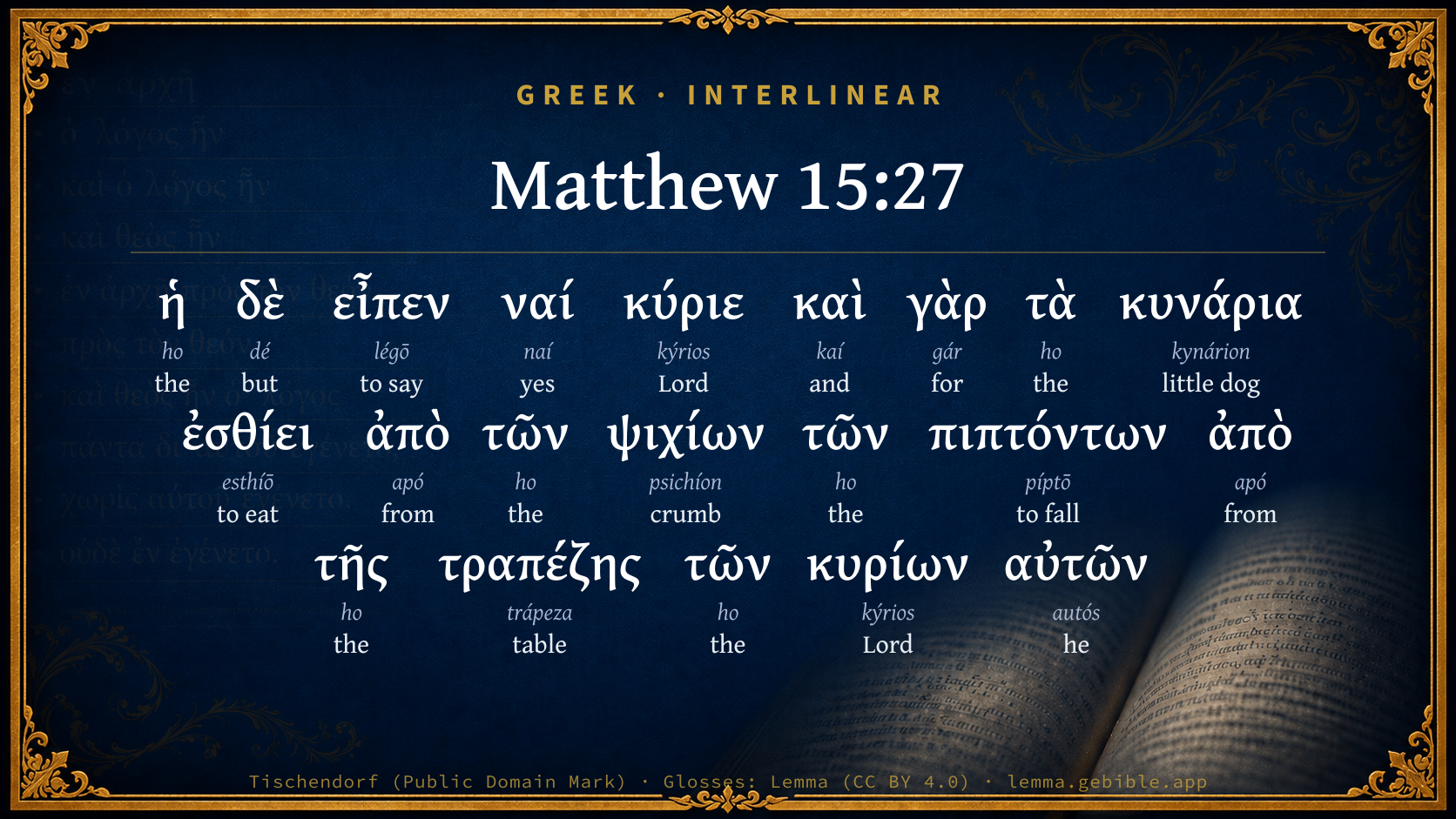
Greek (Tischendorf 8th ed.) Matthew 15:27 appears in the Greek New Testament. The text above is from the Tischendorf 8th edition. Each word links to its Strong’s number and a concise gloss. Click any word for its full Thayer’s Greek Lexicon entry.
Download image
Cite this verse

Matthew 15:27 (World English Bible). Public Domain. Lemma interlinear Bible study tool, https://lemma.gebible.app/v/matthew/15/27.

Show BibTeX & RIS
BibTeX
RIS
English Translation
But she said, "Yes, Lord, but even the dogs eat the crumbs which fall from their masters' table."
World English Bible · Public Domain
Highlights
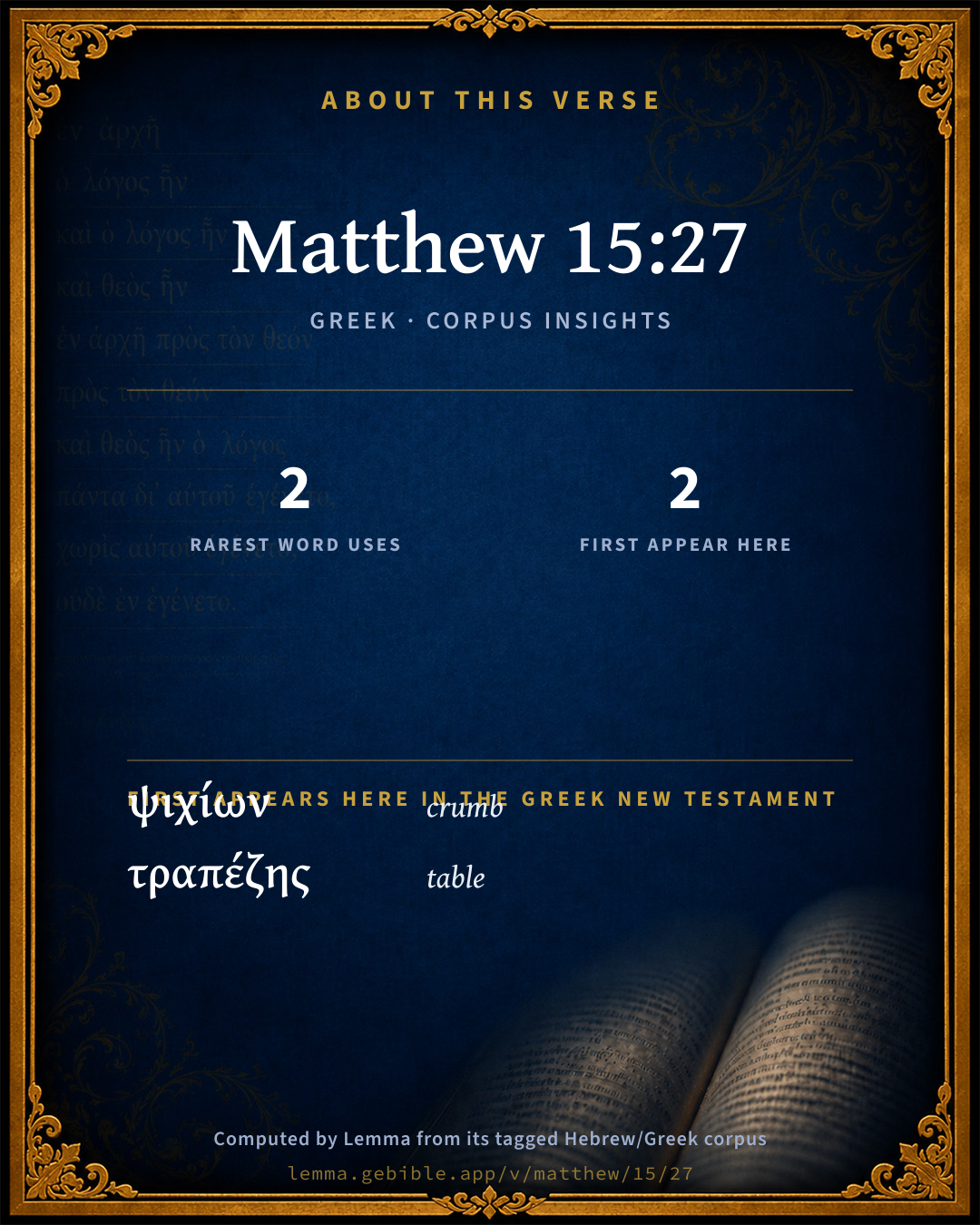
  • 2 first appearances in the Greek New Testament
Full analysis ↓
Download a study sheet

One document with this verse’s original text, its word-by-word gloss line, the meaning frame, cross-references with their text, attributed commentary, and full source and license credits — printable, and it pastes into notes with its structure intact.

This verse Autodidact and up

Study sheet (.html) Plain text (.txt)

A passage Seminary Student

Up to 50 verses in one chapter. A passage sheet keeps up to 6 commentary sources and 12 cross-references per verse, in the order this page ranks them, and says so on the sheet whenever that leaves anything out. Ask for a single verse and you get the Autodidact verse sheet above.

Everything on this page stays free to read, with no account — the sheet is a download of what is already on screen, not access to it.

Want to remove ads? Support Godless Engineer
Compare translations 3

The same verse in 3 English versions, stacked beneath the original-language interlinear above. Click any original word for its lexicon entry.

Each is an independent rendering of the whole verse — the interlinear is not word-aligned to these translations.

Highlighted words mark where these versions differ — a whole-verse word diff, not a word-by-word alignment.

  • World English Bible Public Domain
    But she said, "Yes, Lord, but even the dogs eat the crumbs which fall from their masters' table."
  • King James Version Public Domain
    And she said, Truth, Lord: yet the dogs eat of the crumbs which fall from their masters' table.
  • unfoldingWord Literal Text CC BY-SA 4.0
    But she said, “Yes, Lord, for also the little dogs eat from the crumbs falling from the table of their masters.”

unfoldingWord Literal Text — © unfoldingWord, licensed CC BY-SA 4.0. Word-aligned USFM3 via Door43 (git.door43.org/unfoldingWord/en_ult).

Versions to compare (up to 4)

3 of 4 selected

Show all 19 translations

Every available English version of this verse, each an independent rendering of the whole verse.

  • World English Bible Public Domain
    But she said, "Yes, Lord, but even the dogs eat the crumbs which fall from their masters' table."
  • Berean Standard Bible Public Domain
    “Yes, Lord,” she said, “even the dogs eat the crumbs that fall from their master’s table.”
  • Majority Standard Bible Public Domain
    “Yes, Lord,” she said, “even the dogs eat the crumbs that fall from their master’s table.”
  • King James Version Public Domain
    And she said, Truth, Lord: yet the dogs eat of the crumbs which fall from their masters' table.
  • American Standard Version (1901) Public Domain
    But she said, Yea, Lord: for even the dogs eat of the crumbs which fall from their masters' table.
  • Revised Version (1885) Public Domain
    But she said, Yea, Lord: for even the dogs eat of the crumbs which fall from their masters’ table.
  • Geneva Bible (1599) Public Domain
    But she said, Trueth, Lord: yet in deede the whelpes eate of the crommes, which fall from their masters table.
  • Douay-Rheims (1899) Public Domain
    But she said: Yea, Lord; for the whelps also eat of the crumbs that fall from the table of their masters.
  • Young's Literal Translation Public Domain
    And she said, `Yes, sir, for even the little dogs do eat of the crumbs that are falling from their lords' table;'
  • Literal Standard Version CC BY-SA 4.0
    And she said, “Yes, Lord, for even the little dogs eat of the crumbs that are falling from their lords’ table”;
  • Unlocked Literal Bible CC BY-SA 4.0
    She said, “Yes, Lord, but even the little dogs eat some of the crumbs that fall from their masters' tables.”
  • unfoldingWord Literal Text CC BY-SA 4.0
    But she said, “Yes, Lord, for also the little dogs eat from the crumbs falling from the table of their masters.”
  • Darby Bible Public Domain
    But she said, Yea, Lord; for even the dogs eat of the crumbs which fall from the table of their masters.
  • World Messianic Bible Public Domain
    But she said, “Yes, Lord, but even the dogs eat the crumbs which fall from their masters’ table.”
  • Webster's Bible Public Domain
    And she said, Truth, Lord: yet the dogs eat of the crums which fall from their master's table.
  • Free Bible Version CC BY-SA 4.0
    “Yes, Lord, but even dogs are allowed to eat crumbs that fall from their master's table,” she replied.
  • Bible in Basic English Public Domain
    But she said, Yes, Lord: but even the dogs take the bits from under their masters' table.
  • Text-Critical English NT CC BY 4.0
    She said, “Yes, Lord, yet even the dogs eat the crumbs that fall from the table of their masters.”
  • Tyndale New Testament (1534) Public Domain
    She answered and sayde: truthe Lorde: neverthelesse the whelpes eate of the cromes which fall from their masters table.

Literal Standard Version (2020), Covenant Press — licensed CC BY-SA 4.0. Text via the HelloAO Bible API (eBible.org). Unlocked Literal Bible (unfoldingWord) — licensed CC BY-SA 4.0. Text via the HelloAO Bible API (eBible.org). unfoldingWord Literal Text — © unfoldingWord, licensed CC BY-SA 4.0. Word-aligned USFM3 via Door43 (git.door43.org/unfoldingWord/en_ult). Free Bible Version, Dr. Jonathan Gallagher — licensed CC BY-SA 4.0. Text via the HelloAO Bible API (eBible.org).

Word by word

More ways to search: Search by grammar → Find every occurrence → Compare this word →

Practice this passage: Drill this verse → Learn its vocabulary →

ψιχίων
psichíon
G5589
“crumb”
Noun, Genitive, Plural, Neuter
Part of Speech
Noun
Case
Genitive
Number
Plural
Gender
Neuter
Full Thayer's Definition

Origin: diminutive from a derivative of the base of G5567 (meaning a crumb)

TDNT: None

1. a little morsel, a crumb
  1. ἡ ho G3588 “the” Article, Nominative, Singular, Feminine
  2. δὲ dé G1161 “but” Conjunction
  3. εἶπεν légō G3004 “to say” Verb, Aorist, Active, Indicative, 3rd person, Singular
  4. ναί naí G3483 “yes” Particle
  5. κύριε kýrios G2962 “Lord” Noun, Vocative, Singular, Masculine
  6. καὶ kaí G2532 “and” Conjunction
  7. γὰρ gár G1063 “for” Conjunction
  8. τὰ ho G3588 “the” Article, Nominative, Plural, Neuter
  9. κυνάρια kynárion G2952 “little dog” Noun, Nominative, Plural, Neuter
  10. ἐσθίει esthíō G2068 “to eat” Verb, Present, Active, Indicative, 3rd person, Singular
  11. ἀπὸ apó G575 “from” Preposition
  12. τῶν ho G3588 “the” Article, Genitive, Plural, Neuter
  13. τῶν ho G3588 “the” Article, Genitive, Plural, Neuter
  14. πιπτόντων píptō G4098 “to fall” Verb, Present, Active, Participle, Genitive, Plural, Neuter
  15. ἀπὸ apó G575 “from” Preposition
  16. τῆς ho G3588 “the” Article, Genitive, Singular, Feminine
  17. τραπέζης trápeza G5132 “table” Noun, Genitive, Singular, Feminine
  18. τῶν ho G3588 “the” Article, Genitive, Plural, Masculine
  19. κυρίων kýrios G2962 “Lord” Noun, Genitive, Plural, Masculine
  20. αὐτῶν autós G846 “he” Personal pronoun, Genitive, Plural, Neuter

About this verse

These counts appear in no published source. They are computed here, from the morphology-tagged text and Lemma’s own curated glosses. What Lemma adds →

21
words
14
distinct lemmas
Gospels
section

Notable vocabulary

The rarest word here is ψιχίων crumb G5589 — appearing just 2 times in the whole Greek New Testament.

First appearance in Scripture

These words make their first canonical appearance in the Greek New Testament here:

  • ψιχίων crumb G5589
  • τραπέζης table G5132

Shared distinctive vocabulary

ψιχίων crumb G5589 occurs in 2 verses of the Greek New Testament. Also found in:
Repetition

Words recur within this verse:

Cross-references

21

Topical passages linked to Matthew 15:27 in the Treasury of Scripture Knowledge — connected by theme and wording, ordered by reader-vote popularity; previews shown in the World English Bible.

  • Luke 16:21 and desiring to be fed with the crumbs that fell from the rich man's table. Yes, even the dogs came and licked his sores.
  • Ephesians 3:8 To me, the very least of all saints, was this grace given, to preach to the Gentiles the unsearchable riches of Christ,
  • Job 40:4–5 "Behold, I am of small account. What shall I answer you? I lay my hand on my mouth.
  • Luke 15:18–19 I will get up and go to my father, and will tell him, "Father, I have sinned against heaven, and in your sight.
  • Romans 10:12 For there is no distinction between Jew and Greek; for the same Lord is Lord of all, and is rich to all who call on him.
  • 1 Timothy 1:13–15 although I was before a blasphemer, a persecutor, and insolent. However, I obtained mercy, because I did it ignorantly in unbelief.
  • Matthew 5:45 that you may be children of your Father who is in heaven. For he makes his sun to rise on the evil and the good, and sends rain on the just and the unjust.
  • Matthew 8:8 The centurion answered, "Lord, I'm not worthy for you to come under my roof. Just say the word, and my servant will be healed.
  • Luke 7:6–7 Jesus went with them. When he was now not far from the house, the centurion sent friends to him, saying to him, "Lord, don't trouble yourself, for I am not worthy for you to come under my roof.
  • Luke 18:13 But the tax collector, standing far away, wouldn't even lift up his eyes to heaven, but beat his breast, saying, 'God, be merciful to me, a sinner!'
  • Luke 23:40–42 But the other answered, and rebuking him said, "Don't you even fear God, seeing you are under the same condemnation?
  • Romans 3:29 Or is God the God of Jews only? Isn't he the God of Gentiles also? Yes, of Gentiles also,
  • Psalms 51:4–5 Against you, and you only, have I sinned, And done that which is evil in your sight; That you may be proved right when you speak, And justified when you judge.
  • Ezekiel 16:63 that you may remember, and be confounded, and never open your mouth any more, because of your shame, when I have forgiven you all that you have done, says the Lord Yahweh.
  • Daniel 9:18 My God, turn your ear, and hear; open your eyes, and see our desolations, and the city which is called by your name: for we do not present our petitions before you for our righteousness, but for your great mercies' sake.
  • Romans 3:4 May it never be! Yes, let God be found true, but every man a liar. As it is written, "That you might be justified in your words, And might prevail when you come into judgment."
  • 1 Corinthians 15:8–9 and last of all, as to the child born at the wrong time, he appeared to me also.
  • Genesis 32:10 I am not worthy of the least of all the loving kindnesses, and of all the truth, which you have shown to your servant; for with just my staff I passed over this Jordan; and now I have become two companies.
  • Job 42:2–6 "I know that you can do all things, And that no purpose of yours can be restrained.
  • Romans 3:19 Now we know that whatever things the law says, it speaks to those who are under the law, that every mouth may be closed, and all the world may be brought under the judgment of God.
  • Ephesians 3:19 and to know Christ's love which surpasses knowledge, that you may be filled with all the fullness of God.

Cross-references courtesy of OpenBible.info (CC BY 4.0).

Commentary

Notes on Matthew 15:27 from classic Christian and Jewish commentators (each source and its license shown beneath its notes). The classic Christian expositions comment on the surrounding passage and are grouped to its opening verse, so a note may address several verses; the Jewish commentaries on the Tanakh (Rashi and others) are per-verse, so they appear only where the commentator wrote on this verse.

Lemma curates 59 commentaries, every one of them public domain or Creative Commons licensed, each selected and text-cleaned for this edition rather than reprinted as found. About our sources →

Bengel's Gnomon

Johann Albrecht Bengel

Mat 15:27. Ναὶ, yea) The woman seizes upon the appellation κυνάρια, for she says immediately, καὶ γὰρ, which must be rendered, for even (etenim). The particle ναὶ partly assents, partly as it were places on our Lord’s tongue the assent to her prayers, i.e. prays. The word is thus used in Phm 1:20, and Jdt 9:12.[699]—ἘΣΘῚΕΙ, eat) since the children often waste their bread.—ἀπὸ τῶν ψιχίων, of the crumbs) She does not say the morsels, nor the bread.—τῶν πιπτόντων, which fall) in opposition to λαβεῖν καὶ βαλεῖν, to take and cast, in the last verse. She asks for it as a favour, essential to herself, injurious to no one.—ἀπὸ, from). She does not ask to be admitted to the table, but implies that she was not far distant from it. Her nation was contiguous to Israel.—τῶν κυρίων αὐτῶν, of their masters) This indicates the prerogative of the children, and vet a certain tie of connection (necessitudinem) with them on the part of the little dogs. The language of the Canaanitess corresponds with the curse addressed to Canaan, Gen 9:26: “A servant of servants shall he be,” etc.

[699] Such modes of pleading she could not have learned from books by anticipation. The Spirit of faith supplies the best forms of prayer.—V. g.

Bengel's Gnomon of the New Testament — English translation (T&T Clark, Edinburgh, 1860) — public domain. Text from a community e-Sword module.

Meyer's Critical & Exegetical Commentary

Heinrich August Wilhelm Meyer

Mat_15:27. Ναί, as in Mat_11:9; Mat_11:26, confirms the whole statement of Jesus in Mat_15:26 (not merely the appellation of dogs, Theophylact, Euth. Zigabenus, Erasmus, Maldonatus); and καὶ γάρ means, as everywhere in the New Testament, and even to a far greater extent among classical writers (who use it but rarely in the sense of namque,

καί consequently is connective), for even; see especially, Kühner, II. 2, p. 855. It gives a reason for the ναί; but it is quite according to rule to regard τὰ κυνάρια as the expression to which καί is meant to give prominence. Consequently the passage would run thus: Yes, Lord, Thou art right in what Thou sayest, for even the dogs eat of the crumbs, and so on; or, to express it negatively (with οὐδὲ γάρ): for even the dogs are not sent away empty, and so on. That is to say, this καί, so far as can be seen from the context, cannot be intended to serve any other purpose than to suggest a comparison between the κυνάρια and the τέκνα, so that the passage may be paraphrased as follows: Thou art right, Lord; for not merely the children are filled with bread at the family-meal, butso richly is the table spreadeven the dogs receive their share, inasmuch as they eat of the fragments, and so on. It would therefore be but the more unseemly to take the childrens bread and cast it to the dogs, so as possibly to leave the former unfed. But in thus justifying her ναὶ, κύριε, the woman seeks to suggest the inference to our Lord that He might yet venture to give her that which is hinted at in those ψιχία with which the κυνάρια have to be contented. Of course by this she means a share of His abundant mercy, after the wants of Israel have been fully supplied. Following Grotius and Kuinoel, de Wette explains incorrectly: For it is even usual for the dogs to get nothing but the fragments. In that case we should have expected to find: καὶ γὰρ ἀπὸ τῶν ψιχίων ἐσθίει, κ.τ.λ. Fritzsche (comp. Bleek, Schegg) is likewise wrong when he explains thus: Yes, Lord, it is allowable to give the bread to the dogs, for, and so on. As against this view we have not merely ναί, which can only be taken as a confirming, a justifying of what Jesus had said, not simply the ignoring of καὶ γάρ, which it would involve, but also the repugnandi audacia, which is not to be excused in consideration of the κύριε, and the meaning itself, which would certainly not bear out the idea of a contradiction on the part of the woman. But if there is one thing more than another that must not be associated with the tender language of this woman, it is the appearance of anything like contradiction. Finally, all interpretations are wrong which would necessitate our having ἀλλά instead of καὶ γάρ (Chrysostom, Luther, Vatablus, Glöckler, Baumgarten-Crusius).

The reason why we find Jesus, Mat_15:26, and consequently the woman also, Mat_15:27, making use of the diminutive κυνάρια (a classical term, Plat. Euthyd. p. 298 D; Xen. Cyr. viii. 4. 20, although discarded by Phrynichus, p. 180), is because His idea is that of a family-meal, in connection with which it was not unnatural to think of the little house-dogs that ran about under the table (comp. τραπεζῆες κύνες, Hom. Il. xxiii. 173). The plural τῶν κυρίων may be ascribed to the fact that, in what she says, the woman is understood to be stating what is matter of general experience.

Meyer — Critical and Exegetical Commentary on the New Testament — English translation by Peter Christie, edited by Frederick Crombie (T&T Clark, 1880) — public domain. Text from a community e-Sword module.

Expositor's Greek Testament

ed. W. Robertson Nicoll

Mat 15:27 . ναί , κύριε · καὶ γὰρ , etc.: eager assent, not dissent, with a gleam in the eye on perceiving the advantage given by the comparison = Yes, indeed, Lord, for even, etc. Kypke cites an instance from Xenophon of the combination ναί καὶ γὰρ in the same sense. ψιχίων , dimin. from ψίξ , a bit, crumb, found only in N. T. (here and Mar 7:28 , Luk 16:21 T. R.), another diminutive answering to κυνάρια = the little pet dogs, eat of the minute morsels. Curiously felicitous combination of ready wit, humility and faith: wit in seizing on the playful κυνάρια and improving on it by adding ψιχία , humility in being content with the smallest crumbs, faith in conceiving of the healing asked as only such a crumb for Jesus to give.

The Expositor's Greek Testament, edited by W. Robertson Nicoll (1897–1910) — public domain. Text from a community e-Sword module.

Adam Clarke's Commentary

Verse 27. Truth, Lord] ναικυριε, Yes, Lord. This appears to be not so much an assent, as a bold reply to our Lord's reason for apparently rejecting her suit.

The little dogs share with the children, for they eat the crumbs which fall from their masters' table. I do not desire what is provided for these highly favoured children, only what they leave: a single exertion of thy almighty power, in the healing of my afflicted daughter, is all that I wish for; and this the highly favoured Jews can well spare, without lessening the provision made for themselves. Is not this the sense of this noble woman's reply?

Adam Clarke's Commentary on the Bible (1810–1826) — public domain. Text from a community e-Sword/MySword module.

Ellicott's Commentary for English Readers

(27) Truth, Lord: yet the dogs eat of the crumbs.—The insertion of the conjunction “for” in the Greek gives it a force which it is hard to reproduce in English, “Yet grant what I ask, for the dogs under the table . . .” The woman catches at the form which had softened the usual word of scorn, and presses the privilege which it implied. She did not ask that the “children” might be deprived of any fragment of their portion; but taking her place, contentedly, among the “dogs,” she could still claim Him as her Master, and ask for the “crumbs” of His mercy. The Talmud contains a story so singularly parallel to this that it is worth reproducing. “There was a famine in the land, and stores of corn were placed under the care of Rabbi Jehudah the Holy, to be distributed to those only who were skilled in the knowledge of the Law. And, behold, a man came, Jonathan, the son of Amram, and clamorously asked for his portion. The Rabbi asked him whether he knew the condition, and had fulfilled it, and then the supplicant changed his tone, and said, ‘Nay, but feed me as a dog is fed, who eats of the crumbs of the feast,’ and the Rabbi hearkened to his words, and gave him of the corn.”

A Bible Commentary for English Readers, edited by Charles John Ellicott (1878–1897) — public domain. Text from a community e-Sword module.

The Cambridge Bible for Schools and Colleges

gen. ed. J. J. S. Perowne

27. yet the dogs eat of the crumbs] “Yet,” of the E. V., is misleading. Translate “for even;” the woman takes Jesus at his word, accepts the name of reproach, and claims the little share that falls even to the dogs. No need to cast the children’s bread to the dogs, for even the dogs have crumbs from the Master’s hands.

the crumbs] Probably as in E. V., not, as Trench suggests, the pieces of bread used by the guests to wipe their hands on and then thrown to the dogs.

their masters’ table] The “Masters” must be interpreted to mean God, not, as by some, the Jewish people.

The Cambridge Bible for Schools and Colleges (gen. ed. J. J. S. Perowne; Cambridge University Press, 1878–1918) — public domain. Text from a community e-Sword module.

John Gill's Exposition

And she saith, truth, Lord,.... She owns all that he had said to be true, that he was sent only to the lost sheep of the house of Israel: that she was indeed but a dog, a poor sinful creature, and unworthy of any favour; and that it was not right and fitting that all the children's bread should be taken from them and given to dogs:

yet the dogs eat of the crumbs which fall from their master's table. The Syriac and Persic versions add "and live": thus she wisely lays hold upon and improves in a very beautiful manner, in her own favour, what seemed to be so much against her. It is observed (q) of the Syrophoenicians in general, that they have all, in their common talk, something "pleasant and graceful", as there is indeed in this smart reply of her's, who was one of that people. She suggests that though the Gentiles were but dogs, and she one of them; yet their common Lord and Master had a propriety in them, and they in him; and were to be maintained and fed, and ought to live, though not in such fulness of favours and blessings, as the Jews, the children of God: nor did she desire their affluence, only that a crumb of mercy might be given her, that her poor daughter might be healed; which was but a small favour, in comparison of the numerous ones he heaped upon the children, the Jews: nor would this be any more detrimental to them, than it is to the children, for the dogs, under the table, to eat of the crumbs that fall.

(q) Eunapius in Vita Libanii.

John Gill's Exposition of the Whole Bible (1746–1763) — public domain (CC PDM 1.0). Text via the HelloAO Bible API.

Trapp's Complete Commentary

John Trapp

27 And she said, Truth, Lord: yet the dogs eat of the crumbs which fall from their masters’ table.

Ver. 27. Truth, Lord] Ναι, Κυριε. This is particula assentientis et obsecrantis. How strangely doth God enable and enlarge his weak people many times in prayer! they are carried beyond themselves in a wonderful manner, and though otherwise rude in speech, and unlettered, yet then they have words at will, far above natural apprehension, and such as they are not able to repeat again; being, for the time, lost in the endless maze of spiritual ravishments, and ascending, with the Church, in those pillars of incense, out of this wilderness of the world, Son 5:6.

Yet the dogs eat of the crumbs] Lo, she locks herself within Christ’s denial, and picks an argument of speeding out of a repulse; she gathereth one contrary out of another by the force of her faith. See the like, Deu 32:36; 2Ki 14:26. Going into captivity was a sign of the Israelites returning out of captivity. Be it that I am a dog, saith this brave woman, yet some crumbs of comfort, Lord. Dogs, though they may not eat the children’s meat (if they offer to do it, they are shut out of doors), yet, if children fully fed crumble their meat and make waste of it, as they will, and as the Jews now do, may not the Gentile dogs lick up those leavings? Thus she reasons it, and thus she makes use of anything she can lay hold of, whereby she may hope the better to prevail. Those that are hunger starved are glad to feed upon hedge fruit, and will make hard shift rather than perish. So, faithful hearers are not delicate, hut can "suffer an exhortation," Heb 13:22, hear a reproof, yea, suck honey, with the bee, out of bitter thyme.

John Trapp, A Commentary or Exposition upon All the Books of the Old and New Testament (1647–1656) — public domain. Text from a community e-Sword module.

Matthew Poole's English Annotations

Mark reports it to the same sense, Mar 7:28. She goeth on after three repulses, the last of which was not without a reproach, for our Lord had implicitly called her a dog. These words are as much as if she had said, Lord, I confess the Jews are children; I am a dog, a poor heathen, no proper member of the household of God; and it is truth that it seemeth unreasonable that I, being a dog, should be served before all the children are filled. Lord, I do not beg such a full manifestation of thy power and goodness for the Gentiles. I beg but a crumb of mercy for myself and poor child; and, Lord, though we do not use to give our loaves prepared for our children to the dogs that feed under our table, crumbs of our children’s bread, as Mark expresses it, yet we suffer our dogs to gather them up. Lord, I know thou hast a plenty of grace and blessing, the children may be filled, and yet I may have some crumbs. Three things are remarkable in her answer, besides her faith so eminently expressed.

1. Her humility; she owneth herself a dog.

2. Her modesty; she begs no more than a crumb.

3. Her fervency and importunity after three repulses.

By this we learn our duty in prayer, to go to God humbly, to implore him modestly, and to be instant in prayer, going on in our duty, though we have not presently such an answer as we desire. These things, conjoined with faith, make an acceptable prayer.

Matthew Poole's English Annotations on the Holy Bible (1683–1685) — public domain. Text from a community e-Sword/MySword module.

Whedon's Commentary on the Bible

Daniel D. Whedon

27. Truth, Lord — Desperation almost makes the woman witty. To take your opponent’s words and give them a turn against him is always a dexterous mode of mastering him. The woman admits the dismissing epithet, and proves that it entitles her to his mercy. “Dog is it I am? And the Jews my masters? Then, at least, let me have the crumb that mercy does not deny to the very dog.”

Daniel D. Whedon (gen. ed.), Commentary on the Old and New Testaments (1874–1909) — public domain. Text from a community e-Sword module.

The Pulpit Commentary

And she said, Truth, Lord; or better, but she said, Yea, Lord (Revised Version). Christ"s answer might have seemed the climax of rejection, and to have at once closed the matter forever. But her love for her daughter, and her growing faith in Jesus, overcame all seeming hindrances. With a woman"s ready wit, quickened by urgency and affection, she seizes the opportunity, and turns Christ"s own words against himself. Thou sayest truth, she means; the Jews are the children; we are the dogs; and as dogs we claim our portion. This we can receive without defrauding the children of any of their food. Yet; kai , or kai gar , for even; nam et (Vulgate). The Authorized Version injures the significance of the mother"s reply, as if there were something adversative in the particles, which really introduce the confirmation of her assent. The dogs eat of the crumbs, etc. Dogs in the East have access to the rooms, and live on what they can pick up or on what is thrown to them. The fragments at meals were naturally numerous, the abundance being occasioned by the nature of the food, the use of fingers instead of spoons and forks, and the employment of pieces of bread as platters and napkins. We may paraphrase the Canaanite"s reply thus: By calling us dogs, you virtually grant what I desire. You can do what I wish without infringing your rule, in the justice of which I humbly acquiesce. I claim nothing as a daughter of Abraham; I look only for uncovenanted mercies; I ask only for that portion which falls to the lot of the creatures which hold the lowest place in the household, and the loss of which will never be felt. Truly by humbling her Jesus educated her, taught her that her real plea was her unworthiness, that in acknowledgment of her degradation lay the force of her appeal. And in asking for this one act of mercy she is doing no wrong to the sons of the house.

The Pulpit Commentary (1880–1919), ed. H.D.M. Spence-Jones & Joseph S. Exell — public domain. Text from a community e-Sword module.

Burkitt's Expository Notes on the New Testament

William Burkitt

Observe, how her humility grants all, her patience overcomes all, she meekly desires to possess the dog’s place; not to crowd to the table, but to creep under it, and to partake of the crumbs of mercy that fall from thence. Indeed she shewed one of the best qualities of a dog, in keeping her hold where she had once fastened; not letting go, or giving over, until she had gotten what she desired.

Learn hence, that nothing is so pleasing unto Christ, as to see his people following him with faith and importunity, when he seems to withdraw from them.

William Burkitt's Expository Notes on the New Testament (1700–1703) — public domain. Text from a community e-Sword module.

The People's New Testament

B. W. Johnson

27. Truth, Lord. Observe that she acquiesces heartily in Christ's declaration: it is not fit that the dogs be fed before the children. Yet the dogs eat of the crumbs. The word for crumbs is a diminutive, and means little crumbs.

B. W. Johnson's The People's New Testament with Notes (1889–1891) — public domain. Electronic text from the Christian Classics Ethereal Library (CCEL) ThML edition.

unfoldingWord translationNotes

Door43 World Missions Community

even the little dogs eat some of the crumbs that fall from their masters' tables

The woman responds by using the same imagery as Jesus used in the proverb he just spoke. She means non-Jews should be able to have a small amount of the good things Jews are throwing away. (See: Metaphor)

little dogs

Use words here for dogs of any size that people keep as pets. See how you translated this in Matthew 15:26.

let it be done

This can be stated in active form. AT: "I will do" (See: Active or Passive)

At that hour

This is an idiom. AT: "At exactly the same time" or "Immediately" (See: Idiom)

her daughter was healed

This can be stated in active form. AT: "Jesus healed her daughter" or "her daughter became well" (See: Active or Passive)

translationWords

lord

Jesus

faith

hour, hours

unfoldingWord translationNotes — © Distant Shores Media and the Door43 World Missions Community, licensed CC BY-SA 4.0. Source: git.door43.org/Door43/en_tn.

Cambridge Greek Testament for Schools and Colleges

27. καὶ γάρ. ‘For even’ (‘yet’ of the A.V. is misleading). The woman takes Jesus at His word, admits the truth of what He says, accepts the name of reproach, and claims the little that falls even to the dogs. ‘True, it is not good to cast the children’s bread to the dogs, for even the dogs have their share,—the crumbs that fall from their master’s table.’

τὰ κυνάρια ἐσθίει. St Mark has ἐσθίειν of the dogs and χορτασθῆναι of the children, so completely is the strict use of the two words reversed.

τῆς τραπέζης τῶν κυρίων. The ‘Masters’ must be interpreted to mean God, not, as by some, the Jewish people. Note the turn given by the introduction of the κύριοι. κυνάρια that have κύριοι are not the wretched outcasts of the streets—they have some one to care for them. Even the Gentiles may expect a blessing from the God of Israel.

Cambridge Greek Testament for Schools and Colleges (Cambridge University Press, 1896; 21 vols, various authors incl. Carr, Maclear, Plummer, Farrar, Lumby, Moule, M. R. James, Simcox) — public domain. Text from a community e-Sword module.

Alford’s Greek Testament

Henry Alford

27.] The sense of καὶ γάρ is not given by ‘yet’ in the E. V. The woman, in her humility, accepts the appellation which our Lord gives her, and grounds her plea upon an inference from it. Her words also have a reference to ἄφες πρῶτον χορτασθῆναι τὰ τέκνα, expressed by Mar 7:27. The Vulgate has rightly, ‘Etiam Domine: nam et catelli edunt.’ Yea, Lord: for even the dogs eat: or, for the dogs too eat Our Lord in the use of the familiar diminutive, has expressed not the uncleanness of the dog so much, as his attachment to and dependence on the human family: she lays hold on this favourable point and makes it her own, ‘if we are dogs, then may we fare as such;—be fed with the crumbs of Thy mercy.’ She was, as it were, under the edge of the table—close on the confines of Israel’s feast.

Some say that the ψίχια are the pieces of bread on which the hands were wiped, εἰς ὃ τὰς χεῖρας ἀποματτόμενοι εἶτα κυσὶν ἔβαλλον (Eustathius, cited by Trench on Mir. p. 342); but the πιπτόντων looks more like accidental falling, and the ψίχια like minute crumbs.

Henry Alford, The Greek Testament (1849–1861) — public domain. Text from a community e-Sword module.

International Critical Commentary

27. And she said, Yea, Lord: for even the dogs eat from the crumbs which fall from the table of their masters.] Mk. has: “And she answered and saith to Him, Yea, Lord; even the dogs underneath the table eat from the crumbs of the children.”—Ναί] “Yes, that is true.”—καὶ γάρ] “It is neither good to give the children’s food to the dogs, nor is it necessary; for they eat of the crumbs.” ψιχίων] The word seems to occur here only.—κύριε] occurs here only in Mk., in Mat_19 times, inLk. 16, in Jn. 38.

(M)

International Critical Commentary — older volumes (1896–1929), various authors — public domain. Text from a community e-Sword module.

Lesson kit

Teaching starters — assembled from the data on this page, not authored interpretation. Every prompt links to the verse data it draws on. Edit before teaching.

Matthew, in the Gospels, opens this verse with 21 words (14 distinct Greek lemmas). Its most distinctive word is psichíon (“crumb”). A historical commentator’s framing appears above. Read the whole chapter for the surrounding context.

Discussion questions

  1. How does “crumb” (psichíon) shape what this verse is saying?
  2. 2 words make their first appearance in Scripture here. What does this debut establish?
  3. How does Mark 7:28, which shares the word «crumb», read alongside this verse?
  4. What does the repetition of “Lord” (2× in this one verse) do in this verse?
  5. These translations render this verse differently. What is at stake in choosing one wording over another?
  6. Compare how Bengel's Gnomon and Meyer's Critical & Exegetical Commentary read this verse. Where do they agree or differ?

Things to notice

  • 2 words make their first canonical appearance in Scripture here.
  • These translations choose different wording for 8 words in this verse.
  • “Lord” occurs 2× in this single verse.
  • 14 distinct Greek lemmas span 21 words in this verse.

Reading settings

Reading text

Shown beneath each verse's original-language words.

Old Testament
Old Testament edition

Read the OT as the Masoretic Hebrew (MT) or the Greek Septuagint (LXX).

English shown for the Greek Septuagint (in the Hebrew ↔ Greek comparison).

Comparing translations? Open the Compare panel on any verse page to stack up to four side by side.