
Matthew 26:23

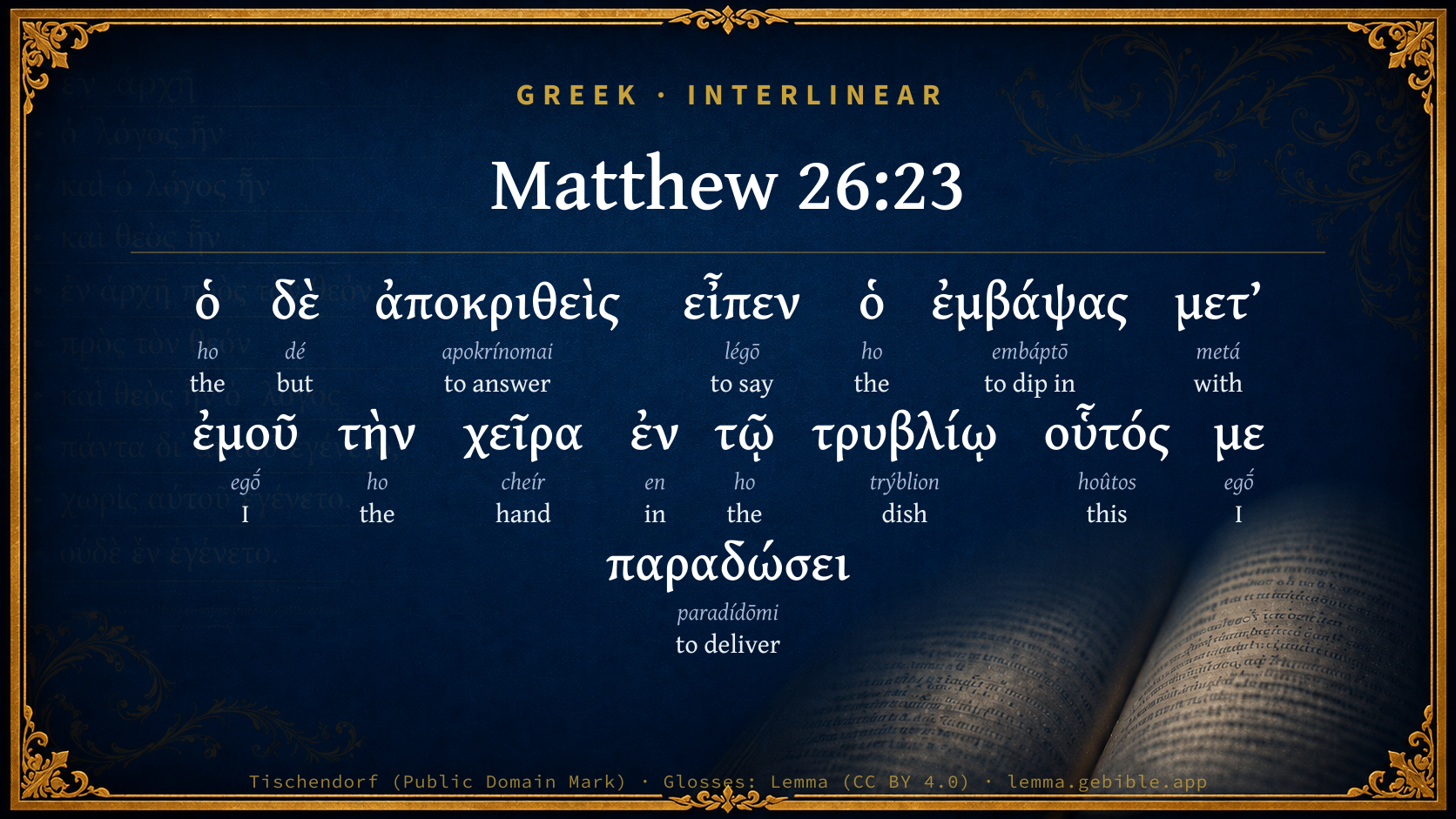
Greek (Tischendorf 8th ed.) Matthew 26:23 appears in the Greek New Testament. The text above is from the Tischendorf 8th edition. Each word links to its Strong’s number and a concise gloss. Click any word for its full Thayer’s Greek Lexicon entry.
Download image
Cite this verse

Matthew 26:23 (World English Bible). Public Domain. Lemma interlinear Bible study tool, https://lemma.gebible.app/v/matthew/26/23.

Show BibTeX & RIS
BibTeX
RIS
English Translation
He answered, "He who dipped his hand with me in the dish, the same will betray me.
World English Bible · Public Domain
Highlights
  • 2 first appearances in the Greek New Testament
Full analysis ↓
Download a study sheet

One document with this verse’s original text, its word-by-word gloss line, the meaning frame, cross-references with their text, attributed commentary, and full source and license credits — printable, and it pastes into notes with its structure intact.

This verse Autodidact and up

Study sheet (.html) Plain text (.txt)

A passage Seminary Student

Up to 50 verses in one chapter. A passage sheet keeps up to 6 commentary sources and 12 cross-references per verse, in the order this page ranks them, and says so on the sheet whenever that leaves anything out. Ask for a single verse and you get the Autodidact verse sheet above.

Everything on this page stays free to read, with no account — the sheet is a download of what is already on screen, not access to it.

Want to remove ads? Support Godless Engineer
Compare translations 3

The same verse in 3 English versions, stacked beneath the original-language interlinear above. Click any original word for its lexicon entry.

Each is an independent rendering of the whole verse — the interlinear is not word-aligned to these translations.

Highlighted words mark where these versions differ — a whole-verse word diff, not a word-by-word alignment.

  • World English Bible Public Domain
    He answered, "He who dipped his hand with me in the dish, the same will betray me.
  • King James Version Public Domain
    And he answered and said, He that dippeth his hand with me in the dish, the same shall betray me.
  • unfoldingWord Literal Text CC BY-SA 4.0
    But he, answering, said, “The one having dipped his hand with me in the bowl, this one will hand me over.

unfoldingWord Literal Text — © unfoldingWord, licensed CC BY-SA 4.0. Word-aligned USFM3 via Door43 (git.door43.org/unfoldingWord/en_ult).

Versions to compare (up to 4)

3 of 4 selected

Show all 19 translations

Every available English version of this verse, each an independent rendering of the whole verse.

  • World English Bible Public Domain
    He answered, "He who dipped his hand with me in the dish, the same will betray me.
  • Berean Standard Bible Public Domain
    Jesus answered, “The one who has dipped his hand into the bowl with Me will betray Me.
  • Majority Standard Bible Public Domain
    Jesus answered, “The one who has dipped his hand into the bowl with Me will betray Me.
  • King James Version Public Domain
    And he answered and said, He that dippeth his hand with me in the dish, the same shall betray me.
  • American Standard Version (1901) Public Domain
    And he answered and said, He that dipped his hand with me in the dish, the same shall betray me.
  • Revised Version (1885) Public Domain
    And he answered and said, He that dipped his hand with me in the dish, the same shall betray me.
  • Geneva Bible (1599) Public Domain
    And hee answered and sayde, Hee that dippeth his hande with me in the dish, hee shall betraie me.
  • Douay-Rheims (1899) Public Domain
    But he answering, said: He that dippeth his hand with me in the dish, he shall betray me.
  • Young's Literal Translation Public Domain
    And he answering said, `He who did dip with me the hand in the dish, he will deliver me up;
  • Literal Standard Version CC BY-SA 4.0
    And He answering said, “He who dipped with Me the hand in the dish, he will deliver Me up;
  • Unlocked Literal Bible CC BY-SA 4.0
    He answered, “The one who dips his hand with me in the dish is the one who will betray me.
  • unfoldingWord Literal Text CC BY-SA 4.0
    But he, answering, said, “The one having dipped his hand with me in the bowl, this one will hand me over.
  • Darby Bible Public Domain
    But he answering said, He that dips his hand with me in the dish, *he* it is who shall deliver me up.
  • World Messianic Bible Public Domain
    He answered, “He who dipped his hand with me in the dish will betray me.
  • Webster's Bible Public Domain
    And he answered and said, He that dippeth his hand with me in the dish, the same will betray me.
  • Free Bible Version CC BY-SA 4.0
    “The one who's dipped his hand into the dish with me will betray me,” Jesus replied.
  • Bible in Basic English Public Domain
    And he made answer and said, He who puts his hand into the plate with me, the same will be false to me.
  • Text-Critical English NT CC BY 4.0
    Jesus answered, “The one who has dipped his hand with me into the dish will betray me.
  • Tyndale New Testament (1534) Public Domain
    He answered and sayde: he that deppeth his honde with me in the disshe the same shall betraye me.

Literal Standard Version (2020), Covenant Press — licensed CC BY-SA 4.0. Text via the HelloAO Bible API (eBible.org). Unlocked Literal Bible (unfoldingWord) — licensed CC BY-SA 4.0. Text via the HelloAO Bible API (eBible.org). unfoldingWord Literal Text — © unfoldingWord, licensed CC BY-SA 4.0. Word-aligned USFM3 via Door43 (git.door43.org/unfoldingWord/en_ult). Free Bible Version, Dr. Jonathan Gallagher — licensed CC BY-SA 4.0. Text via the HelloAO Bible API (eBible.org).

Word by word

More ways to search: Search by grammar → Find every occurrence → Compare this word →

Practice this passage: Drill this verse → Learn its vocabulary →

ἐμβάψας
embáptō
G1686
“to dip in”
Verb, Aorist, Active, Participle, Nominative, Singular, Masculine
Part of Speech
Verb
Tense
Aorist
Voice
Active
Mood
Participle
Case
Nominative
Number
Singular
Gender
Masculine
Full Thayer's Definition

Origin: from G1722 and G911

TDNT: None

1. to dip in
  1. ὁ ho G3588 “the” Article, Nominative, Singular, Masculine
  2. δὲ dé G1161 “but” Conjunction
  3. ἀποκριθεὶς apokrínomai G611 “to answer” Verb, Aorist, Passive deponent, Participle, Nominative, Singular, Masculine
  4. εἶπεν légō G3004 “to say” Verb, Aorist, Active, Indicative, 3rd person, Singular
  5. ὁ ho G3588 “the” Article, Nominative, Singular, Masculine
  6. μετ’ metá G3326 “with” Preposition
  7. ἐμοῦ egṓ G1473 “I” Personal pronoun, 1st person, Genitive, Singular
  8. τὴν ho G3588 “the” Article, Accusative, Singular, Feminine
  9. χεῖρα cheír G5495 “hand” Noun, Accusative, Singular, Feminine
  10. ἐν en G1722 “in” Preposition
  11. τῷ ho G3588 “the” Article, Dative, Singular, Neuter
  12. τρυβλίῳ trýblion G5165 “dish” Noun, Dative, Singular, Neuter
  13. οὗτός hoûtos G3778 “this” Demonstrative pronoun, Nominative, Singular, Masculine
  14. με egṓ G1473 “I” Personal pronoun, 1st person, Accusative, Singular
  15. παραδώσει paradídōmi G3860 “to deliver” Verb, Future, Active, Indicative, 3rd person, Singular

About this verse

These counts appear in no published source. They are computed here, from the morphology-tagged text and Lemma’s own curated glosses. What Lemma adds →

16
words
12
distinct lemmas
Gospels
section

Notable vocabulary

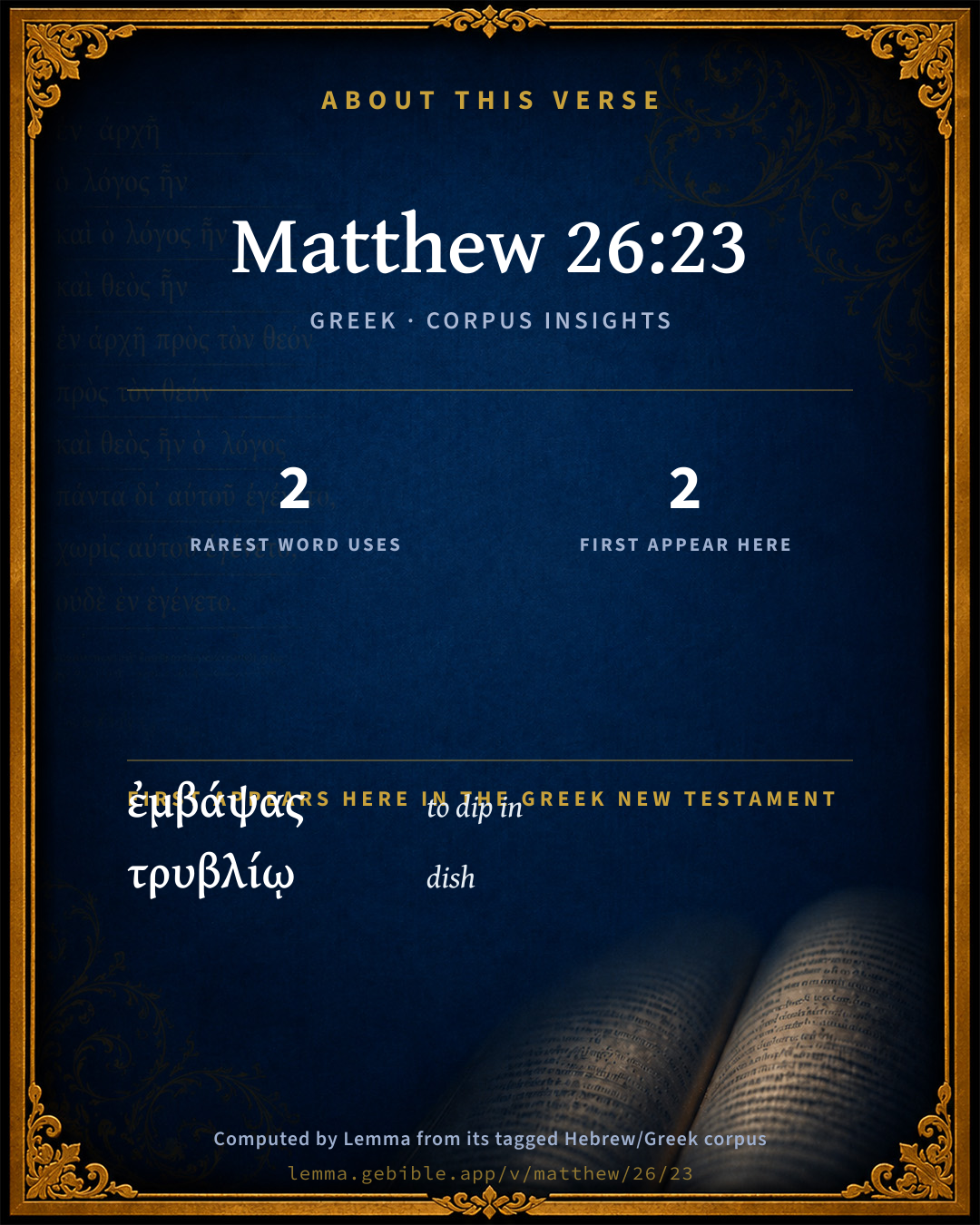
The rarest word here is ἐμβάψας to dip in G1686 — appearing just 2 times in the whole Greek New Testament.

First appearance in Scripture

These words make their first canonical appearance in the Greek New Testament here:

  • ἐμβάψας to dip in G1686
  • τρυβλίῳ dish G5165

Shared distinctive vocabulary

ἐμβάψας to dip in G1686 occurs in 2 verses of the Greek New Testament. Also found in:
Repetition

Words recur within this verse:

Cross-references

4

Topical passages linked to Matthew 26:23 in the Treasury of Scripture Knowledge — connected by theme and wording, ordered by reader-vote popularity; previews shown in the World English Bible.

  • John 13:18 I don't speak concerning all of you. I know whom I have chosen. But that the Scripture may be fulfilled, 'He who eats bread with me has lifted up his heel against me.'
  • Psalms 41:9 Yes, my own familiar friend, in whom I trusted, Who ate bread with me, Has lifted up his heel against me.
  • John 13:26–28 Jesus therefore answered, "It is he to whom I will give this piece of bread when I have dipped it." So when he had dipped the piece of bread, he gave it to Judas, the son of Simon Iscariot.
  • Luke 22:21 But behold, the hand of him who betrays me is with me on the table.

Cross-references courtesy of OpenBible.info (CC BY 4.0).

Commentary

Notes on Matthew 26:23 from classic Christian and Jewish commentators (each source and its license shown beneath its notes). The classic Christian expositions comment on the surrounding passage and are grouped to its opening verse, so a note may address several verses; the Jewish commentaries on the Tanakh (Rashi and others) are per-verse, so they appear only where the commentator wrote on this verse.

Lemma curates 59 commentaries, every one of them public domain or Creative Commons licensed, each selected and text-cleaned for this edition rather than reprinted as found. About our sources →

Tyndale Open Study Notes

Tyndale Open Resources

26:23 eaten from this bowl with me: It was the custom for everyone present to dip their food into a common bowl, which probably contained herbs and fruit puree. Sharing a meal was a sign of friendship and trust, making a betrayer’s presence all the more startling (26:21; but see John 13:26).

Tyndale Open Study Notes — © Tyndale Open Resources, licensed CC BY-SA 4.0. Text via the HelloAO Bible API.

Bengel's Gnomon

Johann Albrecht Bengel

Mat 26:23.[1123] Ὁ ἐμβάψας, he that dippeth) The use of the same small dish, of which there were several on the table, and the dipping of the sop in it at the same moment with our Lord, was to be the distinctive mark of the traitor; see Mat 26:25. St Mark uses ἐμβαπτόμενος (present part. middle) to denote the same idea which St Matthew expresses by ἘΜΒΆΨΑς (1st Aor. part. act.); The former therefore employs the present in an indefinite sense.

[1123] Mat 26:21. ἀμὴν λέγω ὑμῖν Verily I say unto you) Our Lord inserted His complaint as to the approaching treachery and uncleanness [Joh 13:10] of Judas in His discourses connected with the washing of the disciples’ feet, and with the Lord’s Supper, on the following day; but on both days the inquiry of the disciples as to the traitor, follows immediately after that complaint which He uttered. Both the complaint and inquiry of the second day are placed in Matthew and Mark, before the Lord’s Supper: in Luke they are placed after it. They are, therefore, to be regarded as simultaneous with it—that is to say, the institution of the Supper held a middle place between the beginning and continuation (progress) of the complaint and inquiry.—Harm., p. 510, 511.

Bengel's Gnomon of the New Testament — English translation (T&T Clark, Edinburgh, 1860) — public domain. Text from a community e-Sword module.

Meyer's Critical & Exegetical Commentary

Heinrich August Wilhelm Meyer

Mat_26:23. Ὁ ἐμβάψας, κ.τ.λ.] he who has dipped (not: is dipping, Luther, following the Vulgate). We have here no such definite allusion as Joh_13:26 represents Jesus to have made to Judas. For it is not probable that the dipping in question took place subsequent to the intimation by Jesus in Mat_26:21 and the commotion of Mat_26:22,two circumstances calculated to interrupt for a little the progress of the meal,but rather before them, when there may have been others besides Judas dipping into the dish from which Jesus was eating. The allusion can be said to point specially to Judas only in so far as, happening to recline near to Jesus, he must have been eating out of the same dish with Him (for there would be several of such dishes standing on the table). Comp. Grotius. The ἐμβαπτόμενος of Mar_14:20 (see on the passage) is not a substantial variation; neither has it been misunderstood by Matthew (in opposition to Weiss in the Stud. u. Krit. 1861, p. 53 f.), and converted by him into a special means of recognition (Holtzmann). The contents of the dish were the broth charoset (חרוסת), made out of dates, figs, etc., and of the colour of brick (to remind those who partook of it of the bricks of Egypt, Maimonides, ad Pesach. vii. 11). See Buxtorf, Lex. Talm. p. 831.

ἐν τῷ τρυβλίῳ] has dipped in the dish, into which he has put his hand, holding a piece of bread. Hom. Od. ix. 392; Aesch. Prom. 863; LXX. Deu_33:24; Rth_2:14.

Meyer — Critical and Exegetical Commentary on the New Testament — English translation by Peter Christie, edited by Frederick Crombie (T&T Clark, 1880) — public domain. Text from a community e-Sword module.

Expositor's Greek Testament

ed. W. Robertson Nicoll

Mat 26:23 . ὁ ἐμβάψας , he who dipped, dips, or shall have dipped. The aorist participle decides nothing as to time, but merely points to a single act, as distinct from a process ( cf. the present in Mk.). The expression in Mt. does not necessarily identify the man unless we render: who has just dipped, and conceive of Jesus as dipping immediately after. (So Weiss.) In favour of this view it may be said that there was no sense in referring to a single act of dipping, when there would be many in the course of the meal, unless the circumstances were such as to make it indicate the individual disciple. The mere dipping in the same dish would not identify the traitor, because there would be several, three or four, doing the same thing, the company being divided into perhaps three groups, each having a separate dish. τὴν χεῖρα . The ancients used their hands, not knives and forks. So still in the East. τρυβλίῳ . Hesychius gives for this word ὀξοβάφιον = acetabulum, a vessel for vinegar. Hence Elsner thinks the reference is to a vessel full of bitter herbs steeped in vinegar, a dish partaken of at the beginning of the meal. More probably the words point to a dish containing a mixture of fruit dates, figs, etc. vinegar and spices, in which bread was dipped, the colour of bricks or mud, to remind them of the Egyptian bondage ( vide Buxtorf, Lex. Talm. , p. 831). The custom of dipping here referred to is illustrated by the following from Furrer ( Wanderungen , p. 133): “Before us stood two plates, one with strongly spiced macaroni, the other with a dish of fine cut leeks and onions. Spoons there were none. There were four of us who dipped into the same dish.”

The Expositor's Greek Testament, edited by W. Robertson Nicoll (1897–1910) — public domain. Text from a community e-Sword module.

Geneva Bible (1599)

Geneva Bible translators

That is to say, whom I vouchsafed to come to my table, alluding to the place, Ps. 41:9, which is not so to be understood, as though at the selfsame instant that the Lord spake these words, Judas had had his hand in the dish (for that had been an undoubted token) but it is meant of his tabling and eating with them.

Geneva Bible (1599) marginal notes — public domain. Text via Bolls.life.

Adam Clarke's Commentary

Verse 23. He that dippeth his hand] As the Jews ate the passover a whole family together, it was not convenient for them all to dip their bread in the same dish; they therefore had several little dishes or plates, in which was the juice of the bitter herbs, mentioned Ex 12:8, on different parts of the table; and those who were nigh one of these, dipped their bread in it. As Judas is represented as dipping in the same dish with Christ, it shows that he was either near or opposite to him. If this man's heart had not been hardened, and his conscience seared beyond all precedent, by the deceitfulness of his sin, would he have showed his face in this sacred assembly, or have thus put the seal to his own perdition, by eating of this sacrificial lamb? Is it possible that he could feel no compunction? Alas! having delivered himself up into the hands of the devil, he was capable of delivering up his Master into the hands of the chief priests; and thus, when men are completely hardened by the deceitfulness of sin, they can outwardly perform the most solemn acts of devotion, without feeling any sort of inward concern about the matter.

Adam Clarke's Commentary on the Bible (1810–1826) — public domain. Text from a community e-Sword/MySword module.

Ellicott's Commentary for English Readers

(23) He that dippeth his hand with me.—Better, he that dipped, as of an act just passed. It seems probable from what follows that these words also were spoken to a few only of the disciples, say to the four who were nearest to their Master. We can scarcely think of Judas as asking the question of Mat_26:25, if he had heard the words and knew that they pointed to him as the traitor.

A Bible Commentary for English Readers, edited by Charles John Ellicott (1878–1897) — public domain. Text from a community e-Sword module.

The Cambridge Bible for Schools and Colleges

gen. ed. J. J. S. Perowne

23. He that dippeth his hand with me in the dish] “He it is to whom I shall give a sop when I have dipped it,” Joh_13:26; here we have the words of the disciple who heard the reply of Jesus, which was probably whispered and not heard by the rest.

dippeth his hand … in the dish] i. e. in the charoseth, see above, Mat_26:20 (b).

The Cambridge Bible for Schools and Colleges (gen. ed. J. J. S. Perowne; Cambridge University Press, 1878–1918) — public domain. Text from a community e-Sword module.

John Gill's Exposition

The son of man goeth,.... Meaning himself, not to the Mount of Olives, or Gethsemane, or the garden, whither he went a little after this, but out of the world, to his Father: the phrase is expressive of his death, as in Jos 23:14, and denotes the voluntariness of it, and which is no ways inconsistent with the divine determinations about it: nor the violence that was offered to him by his enemies.

As it is written; in the book of God's eternal purposes and decrees; for Luke says, "as it was determined" Luk 22:22, or as it was recorded in the books of the Old Testament; in Psa 22:1, Isa 53:1 and Dan 9:1 for Christ died for the sins of his people, in perfect agreement with these Scriptures, which were written of him:

but woe unto that man by whom the son of man is betrayed; for God's decrees concerning this matter, and the predictions in the Bible founded on them, did not in the least excuse, or extenuate the blackness of his crime; who did what he did, of his own free will, and wicked heart, voluntarily, and to satisfy his own lusts:

it had been good for that man if he had not been born. This is a Rabbinical phrase, frequently, used in one form or another; sometimes thus; as it is said (f) of such that speak false and lying words, and regard not the glory of their Creator, , it would have been better for them they had never come into the world; and so of any other, notorious sinner, it is at other times said (g), , or (h), , "it would have been better for him if he had not been created"; signifying, that it is better to have no being at all, than to be punished with everlasting destruction; and which was the dreadful case of Judas, who fell by his transgression, and went to his own place.

(f) Zohar in Gen. fol. 41. 1. Vid. Misn. Chagiga, c. 2. sect. 1. T. Bab Chagiga, fol. 16. 1. (g) Zohar in Gen. fol, 46. 4. & in Exod. fol. 1. 4. & 36. 3. & 62. 3. & 66. 3. & 105. 4. & 106. 1. (h) T. Hieros. Sabbat, fol. 3. 2. T. Bab. Beracot, fol. 17. 1. & Erubin, fol. 13. 2. Midrash Kobelet, fol. 79. 1.

John Gill's Exposition of the Whole Bible (1746–1763) — public domain (CC PDM 1.0). Text via the HelloAO Bible API.

Trapp's Complete Commentary

John Trapp

23 And he answered and said, He that dippeth his hand with me in the dish, the same shall betray me.

Ver. 23. He that dippeth his hand, &c.] My fellow commoner, my familiar friend, Psa 41:9. This greatly aggravateth the indignity of the matter. He was ex societate Iesu from the company of Jesus that betrayed him. So do the pretended Jesuits, Jebusites, to this day. Julius Caesar was slain in the Senate house by more of his friends than of his enemies, quorum non expleverat spes inexplebiles, of whom he had not offended, saith Seneca. But the wound that went nearest his heart was that he received from his son Brutus. Και συ τεκνον βρουτε, this pierced him worse than any daggar. Queen Elizabeth’s grief and complaint was, that in trust she had found treason.

John Trapp, A Commentary or Exposition upon All the Books of the Old and New Testament (1647–1656) — public domain. Text from a community e-Sword module.

Haydock's Catholic Bible Commentary

He that dippeth. He that is associated to me, that eateth bread with me, shall life up his heel against me, according to the prophecy of the psalmist, cited by St. John, xiii. 18. --- Jesus Christ doe not here manifest the traitor; he only aggravates the enormity and malice of the crime.

George Leo Haydock (1774–1849), Haydock's Catholic Family Bible and Commentary, 1859 edition — public domain. Excludes Psalms (Douay-Rheims chapter numbering differs from Protestant) and Deuterocanonical books (Catholic canon only).

Whedon's Commentary on the Bible

Daniel D. Whedon

23. Dippeth his hand with me in the dish — By this it is intimated that it was one who reclined near him, and even supplied himself from the same dish. This forms the second advance of exposure. At the same time in this expression our Lord seems to have aggravated the crime of the traitor by suggesting the language of the Psalmist: “He that did eat my bread hath lifted up his heel against me.” Psa_41:9. But our Lord did not leave the traitor without a third and still more special detection. John tells us (Joh_13:23-26) that at Peter’s request he himself, as reclining nearest his Lord’s bosom, inquired of Jesus in an under tone, “Lord, who is it?” Our Lord replied, doubtless in the same sub-tone, “He it is to whom I shall give a sop.” He then gave the sop to Judas, by which the two disciples knew, the man for certainty. Judas by some tokens sees that he is individualized, and at last himself puts the question, Is it I? (Mat_26:25,) and receives an affirmative answer, as John adds, by which the whole eleven learn the man. Judas then, full rightly, thinks it time to vacate his place.

Daniel D. Whedon (gen. ed.), Commentary on the Old and New Testaments (1874–1909) — public domain. Text from a community e-Sword module.

The Pulpit Commentary

He that dippeth (dipped) his hand with me in the dish. Even now Jesus does not identify the traitor. Many had put their hands into the dish along with Christ. Judas was one of those who had done so. The fact of eating together made in the Easterns" view, the treachery more monstrous. "Mine own familiar friend, in whom I trusted, which did eat of my bread, hath lifted up his heel against me". (Psa_41:9) The dish was one of large dimensions, from which each guest took his portion with his fingers. It was truly a common meal in which all shared. Our Lord"s words were spoken in answer to John"s question, "Lord, who is it?". (Joh_12:25) The beloved apostle"s position at table, "lying on Jesus" breast," enabled him to ask this without being overheard. There is a mistake commonly made concerning the shape of the table used on such occasions. It was not of a horseshoe form, but oblong. The couches were arranged round three of its sides, and it extended a little way beyond the divans. The Master"s seat was not at the top or middle couch, but at the side; and from what occurred we should infer that John sat on the right of Jesus at the end of the couch, and Judas on the left of Jesus, the strife about precedency having been thus settled. (The correct shape of the table, and the places of Jesus, John, Judas, and Peter, are delineated in Edersheim"s work, vol. 2. p. 494.)

The Pulpit Commentary (1880–1919), ed. H.D.M. Spence-Jones & Joseph S. Exell — public domain. Text from a community e-Sword module.

John Wesley's Explanatory Notes

He that dippeth his hand with me in the dish - Which it seems Judas was doing at that very time. This dish was a vessel full of vinegar, wherein they dipped their bitter herbs.

John Wesley, Explanatory Notes Upon the Whole Bible (1754–1765) — public domain. Text via the GEBible commentary corpus.

Burkitt's Expository Notes on the New Testament

William Burkitt

Here our Saviour acquaints his disciples who it was that had designed his death, even he that dipped with him in the dish, or he to whom he gave the sop.

Observe, The traitor, whom Christ less loved, he has the sop given to him; the other disciples, whom Christ loved better, had no such particular boon. Outward good things are not always given to the children of men in love, but are sometimes bestowed in displeasure; there is no measuring Christ’s affections by temporal blessings, no concluding either love or hatred by these things.

Observe farther, How Judas could sit still and hear the threats of judgment denounced against himself without concern; he hears Christ say, Woe to the man by whom the Son of man is betrayed, and is no more blanked than innocence itself: resolved sinners run on desperately in their wicked courses, and with open eyes see and meet their own destruction; and are neither dismayed at it, nor concerned about it.

Observe farther, That this shameless man had the impudence to say to Christ, Master, is it I? Our Saviour gives him a direct affirmation, Thou hast said. Did Judas, think ye, blush, and cast down his gulty eyes, and let fall his drooping head, at so galling an intimation. Nothing less.

Lord, how does obduracy in sin steel the brow, and make it incapable of all relenting impressions!

Observe lastly, How Christ prefers nonentity before damnation. It had been better for that man if he had never been born. A temporal miserable being is not worse than no being, but an eternal miserable being is worse than no being at all; eternal misery is much worse than nonentity. It had been better for Judas if he had never been born, than to commit such a sin, and lie under such wrath, and that everlasting. O, better to have no being, than not to have a being in Christ.

William Burkitt's Expository Notes on the New Testament (1700–1703) — public domain. Text from a community e-Sword module.

The People's New Testament

B. W. Johnson

23. He that dippeth his hand with me in the dish shall betray me. In Oriental meals, instead of plates being used, each one helps himself with his fingers from the dish as he needs. From John 13:23–26, we learn that these words were spoken to the disciple that leaned on the Savior's bosom and were unheard by Judas and the rest.

B. W. Johnson's The People's New Testament with Notes (1889–1891) — public domain. Electronic text from the Christian Classics Ethereal Library (CCEL) ThML edition.

unfoldingWord translationNotes

Door43 World Missions Community

The Son of Man

Jesus is speaking about himself in the third person. (See: First, Second, or Third Person)

will go

Here "go" is a polite way to refer to dying. AT: "will go to his death" or "will die" (See: Euphemism)

just as it is written about him

This can be stated in active form. AT: "just as the prophets wrote about him in the scriptures" (See: Active or Passive)

that man by whom the Son of Man is betrayed

This can be stated in active form. AT: "the man who betrays the Son of Man" (See: Active or Passive)

Is it I, Rabbi?

"Rabbi, am I the one who will betray you?" Judas may be using a rhetorical question to deny that he is the one who will betray Jesus. AT: "Rabbi, surely I am not the one who will betray you" (See: Rhetorical Question)

You have said it yourself

This is an idiom that Jesus uses to mean "yes" without being completely clear about what he means. AT: "You are saying it" or "You are admitting it" (See: Idiom)

translationWords

betray

Son of Man

written

woe

Judas Iscariot

Rabbi

unfoldingWord translationNotes — © Distant Shores Media and the Door43 World Missions Community, licensed CC BY-SA 4.0. Source: git.door43.org/Door43/en_tn.

Cambridge Greek Testament for Schools and Colleges

23. ὁ ἐμβάψας μετʼ ἐμοῦ κ.τ.λ. Joh 13:26, Ἐκεῖνός ἐστιν ᾦ ἐγὼ βάψω τὸ ψωμίον καὶ δώσω αἠτῷ; here we have the words of the disciple who heard the reply of Jesus, which was probably whispered and not heard by the rest.

Ὁ ἐμβάψας … ἐν τῷ τρυβλίῳ τὴν χεῖρα. i.e. in the charoseth, see above, Mat 26:20 (b).

Cambridge Greek Testament for Schools and Colleges (Cambridge University Press, 1896; 21 vols, various authors incl. Carr, Maclear, Plummer, Farrar, Lumby, Moule, M. R. James, Simcox) — public domain. Text from a community e-Sword module.

Alford’s Greek Testament

Henry Alford

23.] These first words represent the answer of our Lord to John’s question (Joh 13:26). The latter (ver. 24) were not said now, but (Luke, vv. 21, 22) formed part of the previous announcement in our ver. 21.

Henry Alford, The Greek Testament (1849–1861) — public domain. Text from a community e-Sword module.

International Critical Commentary

(M) 23. And He answered and said, He who dipped with Me his hand in the dish, he shall deliver Me up.] Mk. has: “And He said to them, One of the Twelve. He who dippeth with Me into the dish.” “One of the Twelve” reaffirms the treachery of the act. and ὁ ἐμβαπτόμενος, κ.τ.λ., is equivalent to ὁ ἐσθίων μετʼ ἐμοῦ. Not only one of the Twelve, but also a partaker in a common meal. The clause in Mk. does not give any clue to the individuality of the traitor, for probably all dipped into the dish, but only emphasises his treachery. Mt. in substituting ὁ ἐμβάψας—τὴν χεῖρα, and adding οὗτός με παραδώσει, may have understood the words to be a direct clue to the betrayer’s personality. Hastings. DCG. i. p. 464.

International Critical Commentary — older volumes (1896–1929), various authors — public domain. Text from a community e-Sword module.

Vincent's Word Studies in the New Testament

Marvin R. Vincent

The dish [τρυβλιω] . Wyc., platter. A dish containing a broth made with nuts, raisins, dates, figs, etc., into which pieces of bread were dipped.

Marvin R. Vincent, Word Studies in the New Testament (1887–1900) — public domain. Text from a community e-Sword/MySword module.

Lesson kit

Teaching starters — assembled from the data on this page, not authored interpretation. Every prompt links to the verse data it draws on. Edit before teaching.

Matthew, in the Gospels, opens this verse with 16 words (12 distinct Greek lemmas). Its most distinctive word is embáptō (“to dip in”). A historical commentator’s framing appears above. Read the whole chapter for the surrounding context.

Discussion questions

  1. What does “to dip in” (embáptō) contribute to the verse as a whole?
  2. 2 words make their first appearance in Scripture here. What does this debut establish?
  3. How does Mark 14:20, which shares the word «to dip in», read alongside this verse?
  4. What does the repetition of “the” (4× in this one verse) do in this verse?
  5. The translations on this page render this verse differently — a whole-verse word diff, not a word-by-word alignment. What might account for the different wordings?
  6. Compare how Tyndale Open Study Notes and Bengel's Gnomon read this verse. Where do they agree or differ?

Things to notice

  • 2 words make their first canonical appearance in Scripture here.
  • These translations choose different wording for 15 words in this verse.
  • “the” occurs 4× in this single verse.
  • 12 distinct Greek lemmas span 16 words in this verse.

Reading settings

Reading text

Shown beneath each verse's original-language words.

Old Testament
Old Testament edition

Read the OT as the Masoretic Hebrew (MT) or the Greek Septuagint (LXX).

English shown for the Greek Septuagint (in the Hebrew ↔ Greek comparison).

Comparing translations? Open the Compare panel on any verse page to stack up to four side by side.