Matthew 19:25

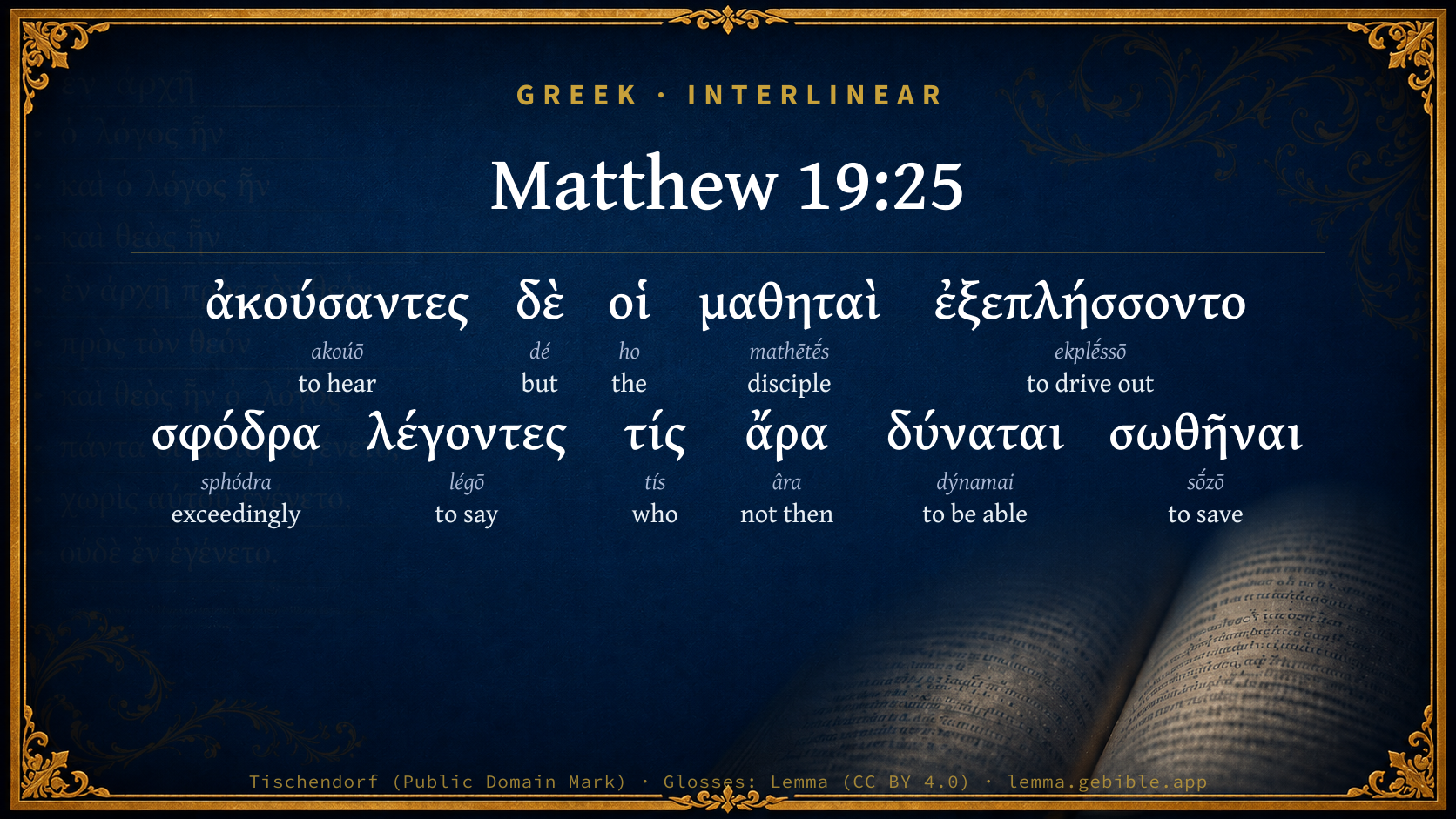
Greek (Tischendorf 8th ed.) Matthew 19:25 appears in the Greek New Testament. The text above is from the Tischendorf 8th edition. Each word links to its Strong’s number and a concise gloss. Click any word for its full Thayer’s Greek Lexicon entry.
Download image
Cite this verse

Matthew 19:25 (World English Bible). Public Domain. Lemma interlinear Bible study tool, https://lemma.gebible.app/v/matthew/19/25.

Show BibTeX & RIS
BibTeX
RIS
English Translation
When the disciples heard it, they were exceedingly astonished, saying, "Who then can be saved?"
World English Bible · Public Domain
Download a study sheet

One document with this verse’s original text, its word-by-word gloss line, the meaning frame, cross-references with their text, attributed commentary, and full source and license credits — printable, and it pastes into notes with its structure intact.

This verse Autodidact and up

Study sheet (.html) Plain text (.txt)

A passage Seminary Student

Up to 50 verses in one chapter. A passage sheet keeps up to 6 commentary sources and 12 cross-references per verse, in the order this page ranks them, and says so on the sheet whenever that leaves anything out. Ask for a single verse and you get the Autodidact verse sheet above.

Everything on this page stays free to read, with no account — the sheet is a download of what is already on screen, not access to it.

Want to remove ads? Support Godless Engineer
Compare translations 3

The same verse in 3 English versions, stacked beneath the original-language interlinear above. Click any original word for its lexicon entry.

Each is an independent rendering of the whole verse — the interlinear is not word-aligned to these translations.

Highlighted words mark where these versions differ — a whole-verse word diff, not a word-by-word alignment.

  • World English Bible Public Domain
    When the disciples heard it, they were exceedingly astonished, saying, "Who then can be saved?"
  • King James Version Public Domain
    When his disciples heard it, they were exceedingly amazed, saying, Who then can be saved?
  • unfoldingWord Literal Text CC BY-SA 4.0
    Now, having heard this, the disciples were very astonished, saying, “Then who is able to be saved?”

unfoldingWord Literal Text — © unfoldingWord, licensed CC BY-SA 4.0. Word-aligned USFM3 via Door43 (git.door43.org/unfoldingWord/en_ult).

Versions to compare (up to 4)

3 of 4 selected

Show all 19 translations

Every available English version of this verse, each an independent rendering of the whole verse.

  • World English Bible Public Domain
    When the disciples heard it, they were exceedingly astonished, saying, "Who then can be saved?"
  • Berean Standard Bible Public Domain
    When the disciples heard this, they were greatly astonished and asked, “Who then can be saved?”
  • Majority Standard Bible Public Domain
    When His disciples heard this, they were greatly astonished and asked, “Who then can be saved?”
  • King James Version Public Domain
    When his disciples heard it, they were exceedingly amazed, saying, Who then can be saved?
  • American Standard Version (1901) Public Domain
    And when the disciples heard it, they were astonished exceedingly, saying, Who then can be saved?
  • Revised Version (1885) Public Domain
    And when the disciples heard it, they were astonished exceedingly, saying, Who then can be saved?
  • Geneva Bible (1599) Public Domain
    And whe his disciples heard it, they were exceedingly amased, saying, Who then can be saued?
  • Douay-Rheims (1899) Public Domain
    And when they had heard this, the disciples wondered very much, saying: Who then can be saved?
  • Young's Literal Translation Public Domain
    And his disciples having heard, were amazed exceedingly, saying, `Who, then, is able to be saved?'
  • Literal Standard Version CC BY-SA 4.0
    And His disciples having heard, were exceedingly amazed, saying, “Who, then, is able to be saved?”
  • Unlocked Literal Bible CC BY-SA 4.0
    When the disciples heard it, they were very astonished and said, “Who then can be saved?”
  • unfoldingWord Literal Text CC BY-SA 4.0
    Now, having heard this, the disciples were very astonished, saying, “Then who is able to be saved?”
  • Darby Bible Public Domain
    And when the disciples heard [it] they were exceedingly astonished, saying, Who then can be saved?
  • World Messianic Bible Public Domain
    When the disciples heard it, they were exceedingly astonished, saying, “Who then can be saved?”
  • Webster's Bible Public Domain
    When his disciples heard it, they were exceedingly amazed, saying, Who then can be saved?
  • Free Bible Version CC BY-SA 4.0
    When the disciples heard this, they were very surprised, and asked, “So who can be saved?”
  • Bible in Basic English Public Domain
    And the disciples, hearing this, were greatly surprised, saying, Who then may have salvation?
  • Text-Critical English NT CC BY 4.0
    When his disciples heard this, they were greatly astonished and said, “Who then can be saved?”
  • Tyndale New Testament (1534) Public Domain
    When his disciples hearde that they were excedingly amased sayinge: who then can be saved?

Literal Standard Version (2020), Covenant Press — licensed CC BY-SA 4.0. Text via the HelloAO Bible API (eBible.org). Unlocked Literal Bible (unfoldingWord) — licensed CC BY-SA 4.0. Text via the HelloAO Bible API (eBible.org). unfoldingWord Literal Text — © unfoldingWord, licensed CC BY-SA 4.0. Word-aligned USFM3 via Door43 (git.door43.org/unfoldingWord/en_ult). Free Bible Version, Dr. Jonathan Gallagher — licensed CC BY-SA 4.0. Text via the HelloAO Bible API (eBible.org).

Word by word

More ways to search: Search by grammar → Find every occurrence → Compare this word →

Practice this passage: Drill this verse → Learn its vocabulary →

About this verse

These counts appear in no published source. They are computed here, from the morphology-tagged text and Lemma’s own curated glosses. What Lemma adds →

11
words
11
distinct lemmas
Gospels
section

Notable vocabulary

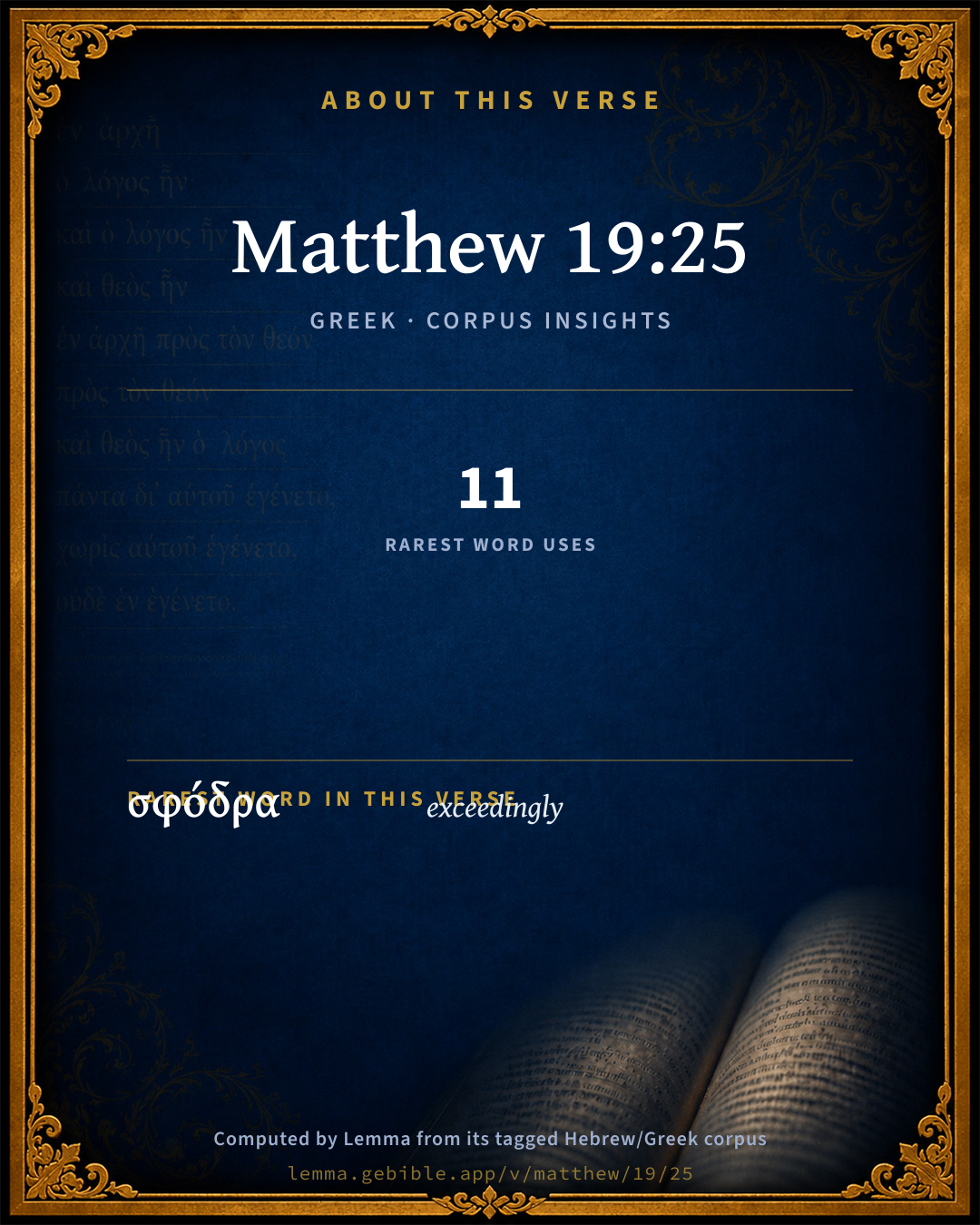
The rarest word here is σφόδρα exceedingly G4970 — appearing just 11 times in the whole Greek New Testament.

Shared distinctive vocabulary

σφόδρα exceedingly G4970 occurs in 11 verses of the Greek New Testament. Also found in:

Cross-references

5

Topical passages linked to Matthew 19:25 in the Treasury of Scripture Knowledge — connected by theme and wording, ordered by reader-vote popularity; previews shown in the World English Bible.

  • Romans 10:13 For, "Whoever will call on the name of the Lord will be saved."
  • Matthew 24:22 Unless those days had been shortened, no flesh would have been saved. But for the sake of the chosen ones, those days will be shortened.
  • Mark 13:20 Unless the Lord had shortened the days, no flesh would have been saved; but for the sake of the chosen ones, whom he picked out, he shortened the days.
  • Luke 13:23–24 One said to him, "Lord, are they few who are saved?" He said to them,
  • Romans 11:5–7 Even so then at this present time also there is a remnant according to the election of grace.

Cross-references courtesy of OpenBible.info (CC BY 4.0).

Commentary

Notes on Matthew 19:25 from classic Christian and Jewish commentators (each source and its license shown beneath its notes). The classic Christian expositions comment on the surrounding passage and are grouped to its opening verse, so a note may address several verses; the Jewish commentaries on the Tanakh (Rashi and others) are per-verse, so they appear only where the commentator wrote on this verse.

Lemma curates 59 commentaries, every one of them public domain or Creative Commons licensed, each selected and text-cleaned for this edition rather than reprinted as found. About our sources →

The Biblical Illustrator

Joseph S. Exell

Mat_19:25

Who, then, can be saved?

Who, then, can be saved?

This sounds as if there were some great difficulty in the way of being saved. How is this, is not salvation free? Yes. Then where is the difficulty? Mans restoration is not merely legal, but moral, and in the latter the real hindrance will be found. Men make excuses, etc.

I. What is meant by being saved? In the narrative connected with the text, our Saviour calls it Entering into the kingdom of heaven. The governing power of true religion over a man. Governed by love. To be saved is to be delivered from the kingdom of Satan, etc. It is a present change. Would you wish to be saved? Or, would you like to compromise this matter in the way of postponement? Or, would you wish to have your love of good society, etc., made secondary to the love of Christ? Let these questions sink deep into your hearts. The Young Ruler.

II. The holy ghost can deal, and does deal, with this moral hindrance in the way of mans salvation as effectually as God the Son has dealt with the legal hindrance by His work of substitution for man. There is hope for us all. To You is the word of this salvation sent. Use the appointed means, for God works by means, etc. (Hugh McNeile, D. D.)

Who can be saved?-

I. To put the question. This inquiry sometimes arises-

1. From partial views of the character of God.

2. It is often suggested by correct and scriptural views of the Divine law.

3. It arises from ignorance of the plan of human redemption.

II. To answer the inquiry.

1. Shall I first tell you who cannot? Not the ignorant, proud worldling, not the impure.

2. Who, then, can be saved? The vilest can. (Dr. T. Raffles.)

Who can be saved?-

I. That men often err as to the real difficulties of salvation, that they are prone to under-estimate its cost, effort, self-sacrifice, and demanded pains. Christ never deceived anybody as to the real cost of discipleship. Salvation under the gospel is not an easy thing.

II. The disciples were left to derive from this incident the lesson that moral uprightness was a different thing from gospel piety. The young man had kept the law. Christ will not be in the heart except He have absolute dominion there.

III. Our particular impediment to salvation. Riches. A wealthy class of men in a community is a social necessity. Greed to be avoided; compassion to be cultivated.

IV. A practical inference is that, however difficult salvation be, IT is never impossible at least, the impossibility is only relative. With man it is impossible; but with God it is possible and promised. (D. Moore, M. A.)

The Biblical Illustrator, edited by Joseph S. Exell (c. 1880s–1900s) — public domain. Text from a community e-Sword module.

Joseph Benson's Commentary

Mat 19:25-26. When his disciples heard it, they were exceedingly amazed — The disciples, who had followed their Master in expectation of becoming rich and great, were exceedingly astonished when they heard him declare that it was next to impossible for a rich man to enter into the kingdom of God. They thought if the rich and the great could not enter his kingdom, he never could have any kingdom at all; and, therefore, they asked one another with great surprise, Who then can be saved — If rich men with all their advantages cannot? “Who? A poor man: a peasant: a beggar: — ten thousand of them,” says Mr. Wesley, “sooner than one that is rich.” But Jesus beheld them — Mark says, looking upon them — To compose their hurried spirits. O what a speaking look was there! Said to them — With the utmost sweetness; With men this is impossible — It is observable, he does not retract what he had said; no, nor soften it in the least degree, but rather strengthens it, by representing the salvation of a rich man as the utmost effort of Omnipotence. The energy of divine grace is able to make a man despise the world, with all that it contains, when no efforts of man, no arguments, eloquence, or persuasions are able to do it.

Joseph Benson's Commentary on the Old and New Testaments (1811–1818) — public domain. Text from a community e-Sword module.

Bengel's Gnomon

Johann Albrecht Bengel

Mat 19:25. Ἀκούσαντες δὲ οἱ μαθηταὶ αὐτοῦ, κ.τ.λ., but when His disciples heard it, etc.) Scripture everywhere shows a middle path between excessive confidence and excessive timidity. See Mat 19:26; Mat 19:28; Mat 19:30; 1Pe 5:7, compared with 6, 8.—τίς ἄρα, κ.τ.λ., who then, etc.) The disciples were anxious, either for themselves, lest other obstacles should equally impede them, or because they entertained the hope of acquiring wealth (see Mat 19:27), or else for others: which fear is far more laudable. Cf. Rev 5:4.

Bengel's Gnomon of the New Testament — English translation (T&T Clark, Edinburgh, 1860) — public domain. Text from a community e-Sword module.

Meyer's Critical & Exegetical Commentary

Heinrich August Wilhelm Meyer

Mat_19:25. Τίς ἄρα] who therefore, if the difficulty is so great in the case of the rich, who have the means of doing much good. The inference of the disciples is a majoribus ad minores. The general expression τίς cannot be intended to mean what rich man (Euthymius Zigabenus, Weiss), as is further evident from what is said by Jesus in Mat_19:23-24.

Meyer — Critical and Exegetical Commentary on the New Testament — English translation by Peter Christie, edited by Frederick Crombie (T&T Clark, 1880) — public domain. Text from a community e-Sword module.

Expositor's Greek Testament

ed. W. Robertson Nicoll

Mat 19:25 . ἐξεπλήσσοντο σφόδρα : the severity of the Master’s doctrine on wealth as on divorce (Mat 19:12 ) was more than the disciples could bear. It took their breath away, so to speak. τίς ἄρα , etc.: it seemed to them to raise the question as to the possibility of salvation generally. The question may represent the cumulative effect of the austere teaching of the Master since the day of Caesarea. The imperfect tense of ἐξεπλήσσοντο may point to a continuous mood, culminating at that moment.

The Expositor's Greek Testament, edited by W. Robertson Nicoll (1897–1910) — public domain. Text from a community e-Sword module.

International Critical Commentary

(M) 25. And the disciples when they heard it, were very astonished, saying, Who then can be saved?] Mk. has: “And they were exceedingly astonished, saying to Him, And who can be saved?” Mt. inserts ἀκούσαντες and μαθηταί, substitutes his favourite σφόδρα for Mk.’s stronger περισσῶς, omits πρὸς αὐτόν, and substitutes τίς ἄρα for καὶ τίς. For τίς ἄρα, cf. 18:1, 19:25, 24:45, Mar 4:41. For Mk.’s πρὸς αὐτόν see Abbott, Johannine Grammar, 2366e.

International Critical Commentary — older volumes (1896–1929), various authors — public domain. Text from a community e-Sword module.

Adam Clarke's Commentary

Verse 25. Who can be saved?] The question of the disciples seemed to intimate that most people were rich, and that therefore scarcely any could be saved. They certainly must have attached a different meaning to what constitutes a rich man, to what we in general do. Who is a rich man in our Lord's sense of the word? This is a very important question, and has not, that I know of, been explicitly answered. A rich man, in my opinion, is not one who has so many hundreds or thousands more than some of his neighbours; but is one who gets more than is necessary to supply all his own wants, and those of his household, and keeps the residue still to himself, though the poor are starving through lack of the necessaries of life. In a word, he is a man who gets all he can, saves all he can, and keeps all he has gotten. Speak, reason! Speak, conscience! (for God has already spoken) Can such a person enter into the kingdom of God? ALL, NO!!!

Adam Clarke's Commentary on the Bible (1810–1826) — public domain. Text from a community e-Sword/MySword module.

Ellicott's Commentary for English Readers

(25) Who then can be saved?—There is an almost child-like naïveté in the question thus asked by the disciples. They, whether among their own people or among strangers, had found the desire of wealth to be the universal passion. Even they themselves, when they had forsaken their earthly goods, had done so (as Peter’s question showed but too plainly, Mat_19:27) as with a far-sighted calculation. They were counting on outward riches in that kingdom as well as outward glory. And now they heard what seemed to them a sweeping condemnation, excluding all who possessed, and, by implication, all who sought after, riches from the kingdom. The feeling which thus showed itself in the disciples has, curiously enough, affected the text of the narrative in St. Mark. What seems an explanatory and softened statement, “How hardly shall they that trust in riches enter into the kingdom of God!” (Mar_10:24), is not found in the best MSS. The omission may have been an accidental error of the copyists, but it is scarcely probable; and its absence from St. Matthew and St. Luke, not less than that it is not our Lord’s usual method to soften or explain His teaching, leads to the conclusion that a marginal note, added by some one who felt as the disciples felt, has here found its way into the text.

A Bible Commentary for English Readers, edited by Charles John Ellicott (1878–1897) — public domain. Text from a community e-Sword module.

The Cambridge Bible for Schools and Colleges

gen. ed. J. J. S. Perowne

25. Who then can be saved?] Salvation seemed to belong by right to the rulers of synagogues and other rich people. It was a notable fact that the gospel should be preached to the poor. The thought of the disciples still lives. Wealth and intellect make men seem better, “Sometimes even supplying the absence of real good with what looks extremely like it.” See a Sermon by Prof. Mozley, on The Reversal of Human Judgment, pp. 85–87.

The Cambridge Bible for Schools and Colleges (gen. ed. J. J. S. Perowne; Cambridge University Press, 1878–1918) — public domain. Text from a community e-Sword module.

John Gill's Exposition

When his disciples heard it..... That is, the difficulty of a rich man's entering into the kingdom of heaven, aggravated by the above proverbial expression,

they were exceedingly amazed. They were surprised at his first words; but when he confirmed them by the proverb of a camel's passing through the eye of a needle, they were, as Mark says, "astonished out of measure": they did not imagine there was any difficulty of rich men coming into the kingdom of the Messiah, which they took to be a worldly one, and would be filled with rich men; for so they understood Christ; though he meant by the kingdom of heaven a spiritual kingdom, a Gospel church state here, or the heavenly glory, or both; but when he expressed, by the proverb, the impracticableness of such men becoming the subjects thereof, their amazement increased;

saying, as in Mark, "among themselves", privately to one another,

who then can be saved? meaning, not with a spiritual and everlasting salvation, but a temporal one: for upon Christ's so saying, they might reason with themselves, that if rich men did not come into the kingdom of the Messiah, they would oppose him and his kingdom, with all their force and strength; and then what would become of such poor men as themselves, who would not be able to stand against them? nor could they hope to be safe long, or enjoy any continued happiness in the expected kingdom, should this be the case.

John Gill's Exposition of the Whole Bible (1746–1763) — public domain (CC PDM 1.0). Text via the HelloAO Bible API.

Trapp's Complete Commentary

John Trapp

25 When his disciples heard it, they were exceedingly amazed, saying, Who then can be saved?

Ver. 25. They were exceedingly amazed] Because they knew that all men either are or would be rich; and that of rich men, scarcely any but trusted in their riches. Therefore, though our Saviour told them, Mar 10:24, that he meant it of those only that relied upon their riches, yet they remained as much unsatisfied as before, and held it a hard case that so many should miss heaven. We have much ado to make men believe that the way is half so hard as ministers make it.

John Trapp, A Commentary or Exposition upon All the Books of the Old and New Testament (1647–1656) — public domain. Text from a community e-Sword module.

Haydock's Catholic Bible Commentary

They wondered very much. The apostles wondered how any person could be saved, not because all were rich, but because the poor were also included, who had their hearts and affections fixed on riches. (St. Augustine and Nicholas de Lyra.)

George Leo Haydock (1774–1849), Haydock's Catholic Family Bible and Commentary, 1859 edition — public domain. Excludes Psalms (Douay-Rheims chapter numbering differs from Protestant) and Deuterocanonical books (Catholic canon only).

Matthew Poole's English Annotations

Mark saith, They were astonished out of measure, saying among themselves, & c. All three evangelists agree in the same substance of the other words. But why are the disciples amazed? or why do they say, Who then can be saved? Are there not in all places more poor than rich persons? The disciples might reasonably conclude, that poor persons were by their poverty also exposed to many great and dangerous temptations; that even they, though they had not riches, yet might too much place felicity in them, and covet what they had not; and from hence collect a difficulty for any to get to heaven. Our Saviour saith unto them,

With men this is impossible; but with God all things are possible. If men indeed were left all to themselves, none would be saved; the blackamoor cannot change his skin, nor the leopard his spots; but God can bring men to heaven by the mighty power of his grace: he can change a rich man’s heart, and take it off from too much love of riches, and make him to despise and contemn his wealth, and to put his trust in the living God; or a poor man’s heart, and make him also poor in spirit and rich in grace.

Matthew Poole's English Annotations on the Holy Bible (1683–1685) — public domain. Text from a community e-Sword/MySword module.

Whedon's Commentary on the Bible

Daniel D. Whedon

25. Who then can be saved? — All have the spirit of this rich man. And when we look around and survey the world, and count how many rich men in the Church are as covetous as they are rich, we seem to doubt the possibility of any man’s salvation by the standard which our Lord here presents. Mr. Webb, the military preacher of the first John-street Church, New York, well said: “I doubt the conversion of the man whose purse is not converted.” The religion that costs the owner nothing is probably worth about its cost. The great mass of rich professors of religion, who live to make their children rich, are in immense danger of ruining their own souls, and destroying their own children.

Daniel D. Whedon (gen. ed.), Commentary on the Old and New Testaments (1874–1909) — public domain. Text from a community e-Sword module.

The Pulpit Commentary

Exceedingly amazed. The stern teaching of vers. 23 and 24 thoroughly dismayed and perhaps offended them. Temporal prosperity had in their Law been held forth as the reward of righteousness and obedience, a foretaste of future happiness. They must unlearn this principle. Here, as they understood it, was a doctrine novel, unheard of, unnatural! Fancy the astonishment that would be displayed nowadays if such a sentiment were solemnly propounded in the Stock Exchange, the bank, the market! The apostles could not minimize its import, or say that it might suit other days and other states of society, but was inapplicable to their age and nation. We can do this in the case of many seemingly stringent requirements of the gospel; but they accepted the announcement in its full and simple meaning, and asked in sorrowful wonder, Who then can be saved? If the way to heaven is barred to the rich man, how shall the poor pass therein? The difficulty seemed to apply to everybody. All who are not rich are hoping and struggling to become rich, and therefore fall under the same category. If the apostles thought not of themselves in this question, they were grieved at the reflection that, under the circumstances, the majority of mankind were recklessly endangering their eternal salvation. With their views of a temporal kingdom, the apostles probably were thinking of their own prospects.

The Pulpit Commentary (1880–1919), ed. H.D.M. Spence-Jones & Joseph S. Exell — public domain. Text from a community e-Sword module.

John Wesley's Explanatory Notes

His disciples were amazed, saying, Who then can be saved? - If rich men, with all their advantages, cannot? Who? A poor man; a peasant; a beggar: ten thousand of them, sooner than one that is rich.

John Wesley, Explanatory Notes Upon the Whole Bible (1754–1765) — public domain. Text via the GEBible commentary corpus.

Scofield Reference Notes

C. I. Scofield

saved

(See Scofield "Rom 1:16") Cf. Mat 13:3-9

The Scofield Reference Bible (1917 edition), notes by C. I. Scofield — public domain. Text from a community e-Sword module.

Burkitt's Expository Notes on the New Testament

William Burkitt

The disciples understanding how naturally and strongly men love the world, and how idolatrously and inordinately their hearts run out upon it, they say unto Christ, Lord, who then can be saved?

Learn, 1. That when the general difficulties which lie in the way of salvation, are laid forth, and sufficiently understood, we may justly wonder that any are or shall be saved.

2. That such are the special and peculiar difficulties in the rich man’s way to heaven, that his salvation is matter of wonder and great admiration to the disciples of Christ. When the disciples heard this, they were exceedingly amazed, saying, Who then can be saved?

William Burkitt's Expository Notes on the New Testament (1700–1703) — public domain. Text from a community e-Sword module.

The People's New Testament

B. W. Johnson

25, 26. With men this is impossible; but with God all things are possible. This means that human efforts alone cannot save a man. The young man was zealous in keeping the commandments, but there was a great lack. The grace of God only can save. It can break down the trust in wealth, take away the love of wealth, and fill the heart with the love of Christ. It is the love of money, not money, that is the root of all evil A pauper may love money as much as a millionaire.

B. W. Johnson's The People's New Testament with Notes (1889–1891) — public domain. Electronic text from the Christian Classics Ethereal Library (CCEL) ThML edition.

unfoldingWord translationNotes

Door43 World Missions Community

they were very astonished

"the disciples were amazed." It is implied that they were astonished because they believed having riches was proof that God approved of someone. (See: Assumed Knowledge and Implicit Information)

Who then can be saved?

The disciples use a question to emphasize their surprise. This can be stated in active form. AT: "Then there is no one whom God will save!" or "Then there is no one who will receive eternal life!" (See: Rhetorical Question and Active or Passive)

we have left everything

"we have left all our wealth" or "we have given up all our possessions"

What then will we have?

"What good thing will God give us?"

translationWords

disciple

amazed

save

Jesus

God

Peter

unfoldingWord translationNotes — © Distant Shores Media and the Door43 World Missions Community, licensed CC BY-SA 4.0. Source: git.door43.org/Door43/en_tn.

Cambridge Greek Testament for Schools and Colleges

25. ἐξεπλήσσοντο σφόδρα. The extreme amazement of the disciples, which can find no echo in souls trained to Christianity, is not quite easy to understand. But there was present to the disciples, perhaps, a latent Jewish thought that external prosperity was a sign of the favour of heaven. Then in a town like Capernaum all the leading religious people would be rich (see note Mat 19:16). There is always a tendency when religious life is at a low ebb to make disciples of the wealthy and to exalt their saintliness. One of the distinctive marks of Christ’s mission was ‘preaching to the poor.’ Cp. St Paul’s words: ἡ κατὰ βάθους πτωχεία αὐτῶν ἐπερίσσευσεν εἰς τὸ πλοῦτος τῆς ἁπλότητος αὐτῶν, 2Co 8:2. Read also St Jas 5:1-11.

τίς ἄρα δύναται σωθῆναι; The thought of the disciples still lives: for the guilt of detected wickedness is mainly brought home to the poor, the sins of the rich and educated seldom result in crime, accordingly wealth and intellect make men seem better, ‘sometimes even supplying the absence of real good with what looks extremely like it.’ See a Sermon by Prof. Mozley, on The Reversal of Human Judgment, pp. 85–87.

Cambridge Greek Testament for Schools and Colleges (Cambridge University Press, 1896; 21 vols, various authors incl. Carr, Maclear, Plummer, Farrar, Lumby, Moule, M. R. James, Simcox) — public domain. Text from a community e-Sword module.

Alford’s Greek Testament

Henry Alford

25.] τίς, not τίς πλούσιος, which would have been a far shallower and narrower enquiry, but a general question—what man? Besides the usual reason given for this question, ‘since all are striving to be rich,’ we must remember that the disciples yet looked for a temporal Kingdom, and therefore would naturally be dismayed at hearing that it was so difficult for any rich man to enter it.

Henry Alford, The Greek Testament (1849–1861) — public domain. Text from a community e-Sword module.

Lesson kit

Teaching starters — assembled from the data on this page, not authored interpretation. Every prompt links to the verse data it draws on. Edit before teaching.

Matthew, in the Gospels, opens this verse with 11 words (11 distinct Greek lemmas). Its most distinctive word is sphódra (“exceedingly”). A historical commentator’s framing appears above. Read the whole chapter for the surrounding context.

Discussion questions

  1. How does “exceedingly” (sphódra) shape what this verse is saying?
  2. How does Matthew 2:10, which shares the word «exceedingly», read alongside this verse?
  3. The translations on this page render this verse differently — a whole-verse word diff, not a word-by-word alignment. What might account for the different wordings?
  4. Compare how The Biblical Illustrator and Joseph Benson's Commentary read this verse. Where do they agree or differ?

Things to notice

Reading settings

Reading text

Shown beneath each verse's original-language words.

Old Testament
Old Testament edition

Read the OT as the Masoretic Hebrew (MT) or the Greek Septuagint (LXX).

English shown for the Greek Septuagint (in the Hebrew ↔ Greek comparison).

Comparing translations? Open the Compare panel on any verse page to stack up to four side by side.