Matthew 26:66

Greek (Tischendorf 8th ed.) Matthew 26:66 appears in the Greek New Testament. The text above is from the Tischendorf 8th edition. Each word links to its Strong’s number and a concise gloss. Click any word for its full Thayer’s Greek Lexicon entry.
Download image
Cite this verse

Matthew 26:66 (World English Bible). Public Domain. Lemma interlinear Bible study tool, https://lemma.gebible.app/v/matthew/26/66.

Show BibTeX & RIS
BibTeX
RIS
English Translation
What do you think?" They answered, "He is worthy of death!"
World English Bible · Public Domain
Download a study sheet

One document with this verse’s original text, its word-by-word gloss line, the meaning frame, cross-references with their text, attributed commentary, and full source and license credits — printable, and it pastes into notes with its structure intact.

This verse Autodidact and up

Study sheet (.html) Plain text (.txt)

A passage Seminary Student

Up to 50 verses in one chapter. A passage sheet keeps up to 6 commentary sources and 12 cross-references per verse, in the order this page ranks them, and says so on the sheet whenever that leaves anything out. Ask for a single verse and you get the Autodidact verse sheet above.

Everything on this page stays free to read, with no account — the sheet is a download of what is already on screen, not access to it.

Want to remove ads? Support Godless Engineer
Compare translations 3

The same verse in 3 English versions, stacked beneath the original-language interlinear above. Click any original word for its lexicon entry.

Each is an independent rendering of the whole verse — the interlinear is not word-aligned to these translations.

Highlighted words mark where these versions differ — a whole-verse word diff, not a word-by-word alignment.

  • World English Bible Public Domain
    What do you think?" They answered, "He is worthy of death!"
  • King James Version Public Domain
    What think ye? They answered and said, He is guilty of death.
  • unfoldingWord Literal Text CC BY-SA 4.0
    What do you think?” And they, answering, said, “He is deserving of death.”

unfoldingWord Literal Text — © unfoldingWord, licensed CC BY-SA 4.0. Word-aligned USFM3 via Door43 (git.door43.org/unfoldingWord/en_ult).

Versions to compare (up to 4)

3 of 4 selected

Show all 19 translations

Every available English version of this verse, each an independent rendering of the whole verse.

  • World English Bible Public Domain
    What do you think?" They answered, "He is worthy of death!"
  • Berean Standard Bible Public Domain
    What do you think?” “He deserves to die,” they answered.
  • Majority Standard Bible Public Domain
    What do you think?” “He deserves to die,” they answered.
  • King James Version Public Domain
    What think ye? They answered and said, He is guilty of death.
  • American Standard Version (1901) Public Domain
    what think ye? They answered and said, He is worthy of death.
  • Revised Version (1885) Public Domain
    what think ye? They answered and said, He is worthy of death.
  • Geneva Bible (1599) Public Domain
    What thinke yee? They answered, and said, He is guiltie of death.
  • Douay-Rheims (1899) Public Domain
    What think you? But they answering, said: He is guilty of death.
  • Young's Literal Translation Public Domain
    what think ye?' and they answering said, `He is worthy of death.'
  • Literal Standard Version CC BY-SA 4.0
    what do you think?” And they answering said, “He is worthy of death.”
  • Unlocked Literal Bible CC BY-SA 4.0
    What do you think?” They answered and said, “He is worthy of death.”
  • unfoldingWord Literal Text CC BY-SA 4.0
    What do you think?” And they, answering, said, “He is deserving of death.”
  • Darby Bible Public Domain
    What think ye? And they answering said, He is liable to the penalty of death.
  • World Messianic Bible Public Domain
    What do you think?” They answered, “He is worthy of death!”
  • Webster's Bible Public Domain
    What think ye? They answered and said, He is guilty of death.
  • Free Bible Version CC BY-SA 4.0
    What's your verdict?” “Guilty! He deserves to die!” they answered.
  • Bible in Basic English Public Domain
    What is your opinion? They made answer and said, It is right for him to be put to death.
  • Text-Critical English NT CC BY 4.0
    What do you think?” They answered, “He deserves death.”
  • Tyndale New Testament (1534) Public Domain
    what thinke ye? They answered and sayd: he his worthy to dye.

Literal Standard Version (2020), Covenant Press — licensed CC BY-SA 4.0. Text via the HelloAO Bible API (eBible.org). Unlocked Literal Bible (unfoldingWord) — licensed CC BY-SA 4.0. Text via the HelloAO Bible API (eBible.org). unfoldingWord Literal Text — © unfoldingWord, licensed CC BY-SA 4.0. Word-aligned USFM3 via Door43 (git.door43.org/unfoldingWord/en_ult). Free Bible Version, Dr. Jonathan Gallagher — licensed CC BY-SA 4.0. Text via the HelloAO Bible API (eBible.org).

Word by word

More ways to search: Search by grammar → Find every occurrence → Compare this word →

Practice this passage: Drill this verse → Learn its vocabulary →

ἔνοχος
énochos
G1777
“liable”
Adjective, Nominative, Singular, Masculine
Part of Speech
Adjective
Case
Nominative
Number
Singular
Gender
Masculine
Full Thayer's Definition

Origin: from G1758

TDNT: 15:48,3

1. bound, under obligation, subject to, liable a. used of one who is held by, possessed with love, and zeal for anything b. in a forensic sense, denoting the connection of a person either with his crime, or with the penalty or trial, or with that against whom or which he has offended 1. guilty, worthy of punishment 2. guilty of anything 3. of the crime 4. of the penalty 5. liable to this or that tribunal i.e. the punishment to by imposed by this or that tribunal 6. of the place where punishment is to be suffered
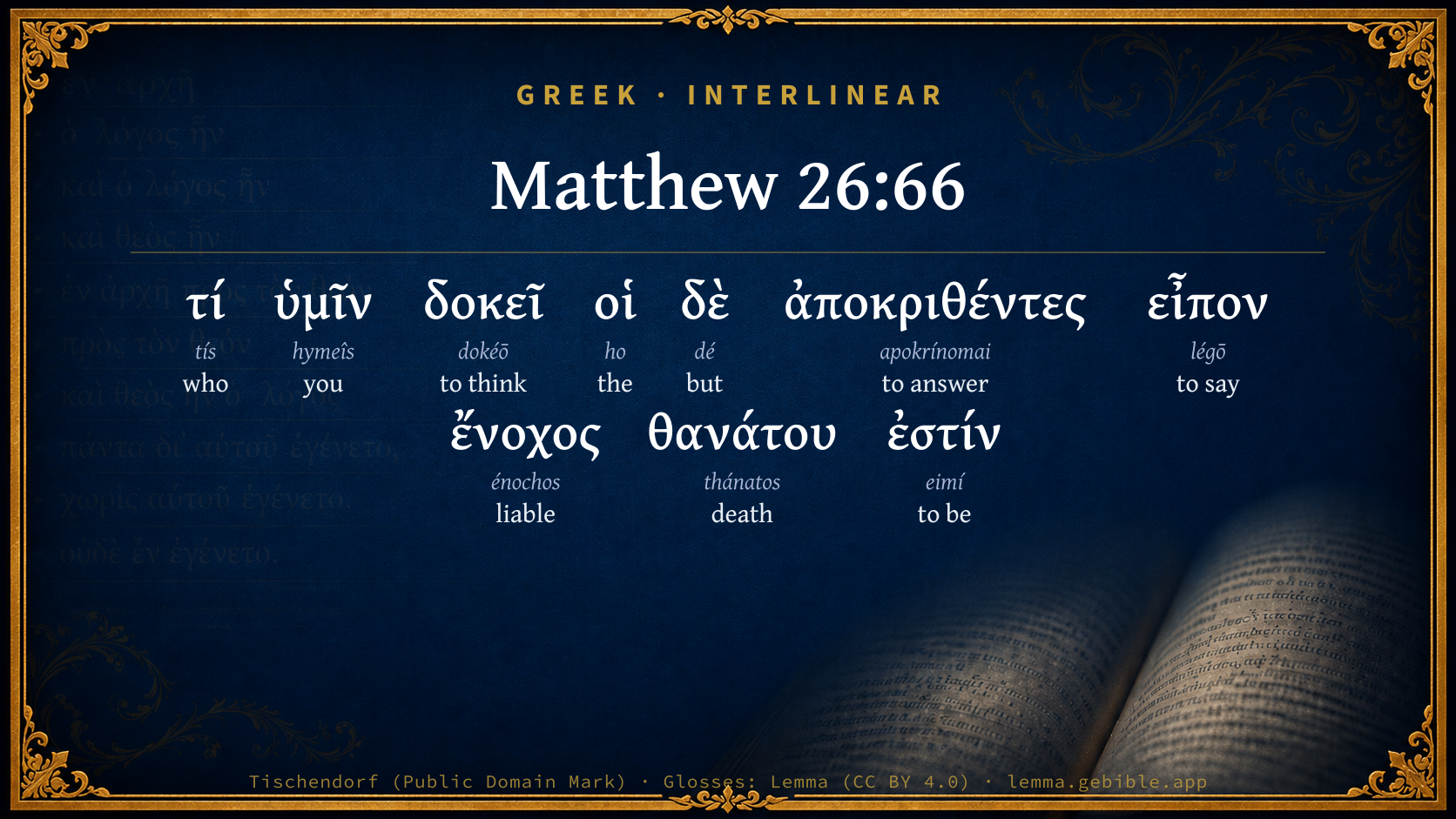
  1. τί tís G5101 “who” Interrogative pronoun, Accusative, Singular, Neuter
  2. ὑμῖν hymeîs G5210 “you” Personal pronoun, 2nd person, Dative, Plural
  3. δοκεῖ dokéō G1380 “to think” Verb, Present, Active, Indicative, 3rd person, Singular
  4. οἱ ho G3588 “the” Article, Nominative, Plural, Masculine
  5. δὲ dé G1161 “but” Conjunction
  6. ἀποκριθέντες apokrínomai G611 “to answer” Verb, Aorist, Passive deponent, Participle, Nominative, Plural, Masculine
  7. εἶπον légō G3004 “to say” Verb, Aorist, Active, Indicative, 3rd person, Plural
  8. θανάτου thánatos G2288 “death” Noun, Genitive, Singular, Masculine
  9. ἐστίν eimí G1510 “to be” Verb, Present, Active, Indicative, 3rd person, Singular

About this verse

These counts appear in no published source. They are computed here, from the morphology-tagged text and Lemma’s own curated glosses. What Lemma adds →

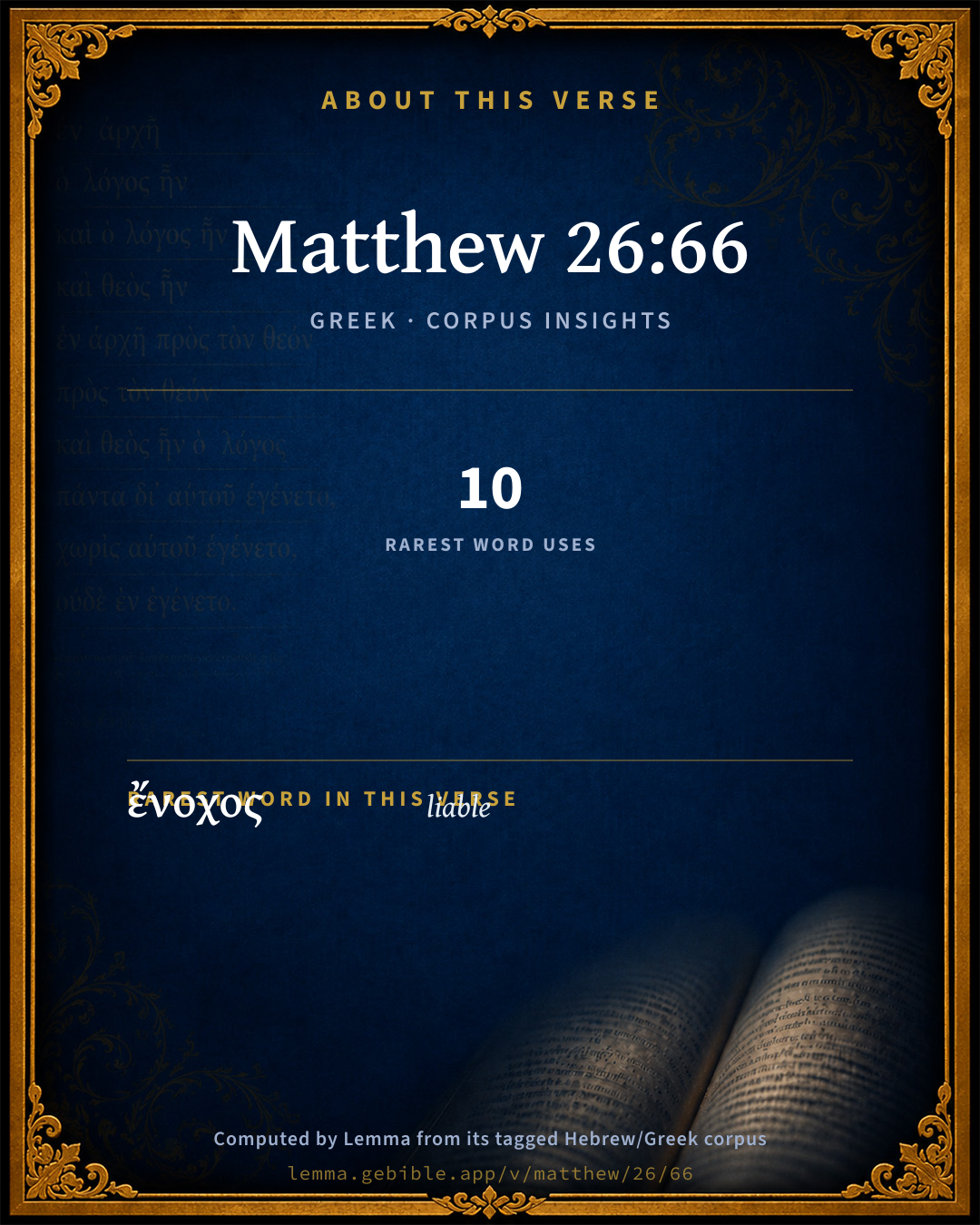
10
words
10
distinct lemmas
Gospels
section

Notable vocabulary

The rarest word here is ἔνοχος liable G1777 — appearing just 10 times in the whole Greek New Testament.

Shared distinctive vocabulary

ἔνοχος liable G1777 occurs in 8 verses of the Greek New Testament. Also found in:

Cross-references

5

Topical passages linked to Matthew 26:66 in the Treasury of Scripture Knowledge — connected by theme and wording, ordered by reader-vote popularity; previews shown in the World English Bible.

  • John 19:7 The Jews answered him, "We have a law, and by our law he ought to die, because he made himself the Son of God."
  • Acts 7:52 Which of the prophets didn't your fathers persecute? They killed those who foretold the coming of the Righteous One, of whom you have now become betrayers and murderers.
  • Leviticus 24:11–16 The son of the Israelite woman blasphemed the Name, and cursed; and they brought him to Moses. His mother's name was Shelomith, the daughter of Dibri, of the tribe of Dan.
  • Acts 13:27–28 For those who dwell in Jerusalem, and their rulers, because they didn't know him, nor the voices of the prophets which are read every Sabbath, fulfilled them by condemning him.
  • James 5:6 You have condemned, you have murdered the righteous one. He doesn't resist you.

Cross-references courtesy of OpenBible.info (CC BY 4.0).

Commentary

Notes on Matthew 26:66 from classic Christian and Jewish commentators (each source and its license shown beneath its notes). The classic Christian expositions comment on the surrounding passage and are grouped to its opening verse, so a note may address several verses; the Jewish commentaries on the Tanakh (Rashi and others) are per-verse, so they appear only where the commentator wrote on this verse.

Lemma curates 59 commentaries, every one of them public domain or Creative Commons licensed, each selected and text-cleaned for this edition rather than reprinted as found. About our sources →

Bengel's Gnomon

Johann Albrecht Bengel

Mat 26:66. Τί ὑμῖν δοκεῖ, what think ye?) He treats the matter as already finished. Moses says, “Let the blasphemer die;” Caiaphas says, “Jesus is a blasphemer;” his assessors, from these premises, draw the conclusion, “Let Jesus die.” St Mark has (ch. Mar 14:64) τί ὑμῖν φαίνεται, how does it seem to you?—θανατου, of death) Such is also their declaration to Pilate. See Joh 19:7.

Bengel's Gnomon of the New Testament — English translation (T&T Clark, Edinburgh, 1860) — public domain. Text from a community e-Sword module.

Meyer's Critical & Exegetical Commentary

Heinrich August Wilhelm Meyer

Mat_26:66. At this point the high priest, notwithstanding the precipitancy with which the trial is being hurried through, and notwithstanding the candid confession just made by the accused, calls for a formal vote, the result of which is a verdict of guilty, and that of an offence deserving to be punished by death. The next thing that had to be considered was the course to be adopted with a view to the carrying out of the sentence. It was this that formed the subject of deliberation at that conclave to which reference is made at Mat_27:1.

Meyer — Critical and Exegetical Commentary on the New Testament — English translation by Peter Christie, edited by Frederick Crombie (T&T Clark, 1880) — public domain. Text from a community e-Sword module.

Expositor's Greek Testament

ed. W. Robertson Nicoll

Mat 26:66 . ἔνοχος θανάτου : death the penalty of blasphemy, Lev 24:15 , and of being a false prophet, Deu 18:20 .

The Expositor's Greek Testament, edited by W. Robertson Nicoll (1897–1910) — public domain. Text from a community e-Sword module.

Adam Clarke's Commentary

Verse 66. He is guilty of death.] ενοχος θανατου εστι, he is liable to death. All the forms of justice are here violated. The judge becomes a party and accuser, and proceeds to the verdict without examining whether all the prophecies concerning the Messiah, and the innumerable miracles which he wrought, did not justify him. Examination and proof are the ruin of all calumnies, and of the authors of them, and therefore they take care to keep off from these two things. See Quesnel.

Adam Clarke's Commentary on the Bible (1810–1826) — public domain. Text from a community e-Sword/MySword module.

Ellicott's Commentary for English Readers

(66) He is guilty of death.—In modern English the word “guilty” is almost always followed by the crime which a man has committed. In older use it was followed by the punishment which the man deserved. (Comp. Num_35:31.) The decision, as far as the meeting went, was unanimous. Sentence was passed. It remained, however, to carry the sentence into effect, and this, while the Roman governor was at Jerusalem, presented a difficulty which had to be met by proceedings of another kind. The Jews, or at least their rulers, who courted the favour of Rome, ostentatiously disclaimed the power of punishing capital offences (Joh_18:31).

A Bible Commentary for English Readers, edited by Charles John Ellicott (1878–1897) — public domain. Text from a community e-Sword module.

The Cambridge Bible for Schools and Colleges

gen. ed. J. J. S. Perowne

66. He is guilty of death] i. e. “has incurred the penalty of death.” The Sanhedrin do not pass sentence, but merely re-affirm their foregone conclusion, and endeavour to have sentence passed and judgment executed by the Procurator.

The Cambridge Bible for Schools and Colleges (gen. ed. J. J. S. Perowne; Cambridge University Press, 1878–1918) — public domain. Text from a community e-Sword module.

John Gill's Exposition

Then did they spit in his face,.... Not the judges, the members of the sanhedrim, but the servants of the high priest, and the officers that had Jesus in hold, and were the guard upon him; see Luk 22:63, who seeing him condemned as guilty of death, thought they might insult him at pleasure, and use him in the most indecent and barbarous manner; and therefore, in a way of contempt, spit in his face; than which nothing was more reproachful and disgraceful: the Jews (x) say, that he that spits before, or in the presence of his master, is guilty of death, so nauseous and filthy was it accounted; and how much more must it be so, to spit in the face of anyone? hereby a prophecy was fulfilled, Isa 50:6, "I hid not my face from shame and spitting": and hereby, together with his sweat and blood, his visage was more marred than any man's, and his form than the sons of men:

and buffeted him; cuffed, or boxed him with their double fists:

and others smote him, with the palms of their hands; gave him many a slap on the face with their open hands, or struck him on the face with rods, as the word will bear to be rendered: they rapped him with the wands they had in their hands, and struck him on the head with the rods or staves they had with them; whereby was accomplished the prophecy, in Mic 5:1, "they shall smite the judge of Israel with a rod upon the cheek". This was very injurious treatment, the Jews themselves being witnesses; who have in their canons enjoined (y), that "if a man strikes his neighbour with his double fist, he must give him a shekel; R. Judah says, on account of R. Jose the Galilean, a pound: if he gives him a slap of the face, he must pay him two hundred zuzims, or pence; and if with the back of his hand (which was accounted (z) the more ignominious) four hundred zuzims: if he plucked him by his ear, or plucked off his hair, or spit, so as that the spittle came upon him, or took away his cloak--he must pay four hundred zuzims, and all according to his honour or dignity.

All these indignities were done to Christ; see Isa 50:6.

(x) T. Bab. Erubin, fol. 99. 1. (y) Misn. Bava Kama, c. 8. sect. 6. (z) Maimon. & Bartenora in ib.

John Gill's Exposition of the Whole Bible (1746–1763) — public domain (CC PDM 1.0). Text via the HelloAO Bible API.

Trapp's Complete Commentary

John Trapp

66 What think ye? They answered and said, He is guilty of death.

Ver. 66. He is guilty of death] Servile souls! they dare do no otherwise than concur with Caiaphas. So in Popish councils and conclaves the bishops and others (those aiones et negones aulici) have no more to do, but simply inclinato capite to say Placet to that which in the pope’s name is proposed unto them. The envoys in the Council of Trent were blamed for suffering the article of priests’ marriage to be disputed. And in Colloquio Possiaceno, after that Beza had spoken much of the eucharist before the young king of France, the queen mother and the princess of the blood, a Spanish Jesuit, having reproached the Protestants, did reprehend the queen mother for meddling in matters that belonged not to her, but to the pope, cardinals, and bishops.

John Trapp, A Commentary or Exposition upon All the Books of the Old and New Testament (1647–1656) — public domain. Text from a community e-Sword module.

Albert Barnes' Notes on the Bible

What think ye? - What is your opinion? What sentence do you pronounce? As President of the Sanhedrin he demanded their judgment.

He is guilty of death - This was the form which was used when a criminal was condemned to die. The meaning is, he is guilty of a crime to which the law annexes death. This sentence was used before the Jews became subject to the Romans, when they had the power of inflicting death. After they were subject to the Romans, though the power of inflicting capital punishment” was taken away, yet they retained the form when they expressed their opinion of the guilt of an offender. The law under which they condemned him was that recorded in Lev 24:10-16, which sentenced him that was guilty of blasphemy to death by stoning. The chief priests, however, were unwilling to excite a popular tumult by stoning him, and they therefore consulted to deliver him to the Romans to be crucified, “under the authority of the Roman name,” and thus to prevent any excitement among the people.

Albert Barnes' Notes on the Bible (1834–1885) — public domain. Text from a community e-Sword/MySword module.

Haydock's Catholic Bible Commentary

He is guilty of death; i.e. of blasphemy, and so deserves to be stoned to death. (Witham)

George Leo Haydock (1774–1849), Haydock's Catholic Family Bible and Commentary, 1859 edition — public domain. Excludes Psalms (Douay-Rheims chapter numbering differs from Protestant) and Deuterocanonical books (Catholic canon only).

Whedon's Commentary on the Bible

Daniel D. Whedon

66. What think ye? — He presses his advantage to an immediate vote. Guilty of death — His crime is blasphemy; that is the charge. He is worthy of death; that is the penalty. And the verdict is unanimous. Now why did not immediate execution follow? The obstruction is a formidable one. The Jews are under the Roman government. The Romans have taken from them the power of life and death. Besides, the Scriptures require that he should suffer death from Gentile hands, a reason of which they are unaware.

Daniel D. Whedon (gen. ed.), Commentary on the Old and New Testaments (1874–1909) — public domain. Text from a community e-Sword module.

The Pulpit Commentary

What think ye? He wishes to get a vote by acclamation, not in a formal way, as to the guilt of Christ and the punishment which he deserved. He is guilty of (euocov , worthy of, liable to) death . This was the punishment pronounced by the Law on blasphemy; (Lev_24:16) the death was, however, to be by stoning. (Act_7:58) This detail, as they considered it, was now exclusively in the hands of the Romans. We see that this meeting, which virtually doomed Christ to death, was not a regular council of the Sanhedrin; for it was not held in the appointed chamber, and was conducted at night, when criminal processes were forbidden. The meeting next morning (Mat_27:1) was convened for the purpose of considering how this informal sentence should be executed.

The Pulpit Commentary (1880–1919), ed. H.D.M. Spence-Jones & Joseph S. Exell — public domain. Text from a community e-Sword module.

MacLaren's Expositions of Holy Scripture

Alexander MacLaren

Matthew

THE REAL HIGH PRIEST AND HIS COUNTERFEIT

Mat 26:57 - Mat 26:68.

John’s Gospel tells us that Jesus was brought before ‘Annas first,’ probably in the same official priestly residence as Caiaphas, his son-in-law, occupied. That preliminary examination brought out nothing to incriminate the prisoner, and was flagrantly illegal, being an attempt to entrap Him into self-accusing statements. It was baffled by Jesus being silent first, and subsequently taking His stand on the undeniable principle that a charge must be sustained by evidence, not based on self-accusation. Annas, having made nothing of this strange criminal, ‘sent Him bound unto Caiaphas.’

A meeting of the Sanhedrin had been hastily summoned in the dead of night, which was itself an illegality. Now Jesus stands before the poor shadow of a judicial tribunal, which, though it was all that Rome had left a conquered people, was still entitled to sit in judgment on Him. Strange inversion, and awful position for these formalists! And with sad persistence of bitter prejudice they proceeded to try the prisoner, all unaware that it was themselves, not Him, that they were trying.

They began wrongly, and betrayed their animus at once. They were sitting there to inquire whether Jesus was guilty or no; they had made up their minds beforehand that He was, and their effort now was but to manufacture some thin veil of legality for a judicial murder. So they ‘sought false witness, . . . that they might put Him to death.’ Matthew simply says that no evidence sufficient for the purpose was forthcoming; Mark adds that the weak point, was that the lies contradicted each other. Christ’s presence has a strange, solemn power of unmasking our falsehoods, both of thought and deed, and it is hard to speak evil of Him before His face. If His calumniators were confused when He stood as Prisoner, what will they be when He sits as a Judge?

Only Matthew and Mark tell us of the two witnesses whose twisted version of the word about ‘destroying the Temple and rebuilding it in three days’ seemed to Caiaphas serious enough to require an answer. Their mistake was one which might have been made in good faith, but none the less was their travesty ‘false witness.’ Their version of His great word shows how easily the teaching of a lofty soul, passed through the popular brain, is degraded, and made to mean the opposite of what he had meant by it. For the destruction of the Temple had appeared in the saying as the Jews’ work, and Jesus had presented Himself in it as the Restorer, not the Destroyer, of the Temple and of all that it symbolised. We destroy, He rebuilds. The murder of Jesus was the suicide of the nation. Caiaphas and his council were even now pulling down the Temple. And that murder was the destruction, so far as men could effect it, of the true ‘Temple of His body,’ in which the fulness of the Godhead dwelt, and which was more gloriously reconstituted in the Resurrection. The risen Christ rears the true temple on earth, for through Him the Holy Ghost dwells in His Church, which is collectively ‘the Temple,’ and in all believing spirits, which are individually ‘the temples’ of God. So the false witnesses distorted into a lie a great truth.

The Incarnate Word was dumb all the while. He ‘was still and refrained’ Himself. It was the silence of the King before a lawless tribunal of rebels, of patient meekness, ‘as a sheep before her shearers’; of innocence that will not stoop to defend itself from groundless accusations; of infinite pity and forbearing love, which sees that it cannot win, but will not smite. Jesus is still silent, but one day, ‘with the breath of His lips shall He slay the wicked.’ Caiaphas seems to have been annoyed as well as surprised at Jesus’ silence, for there is a trace of irritation, as at ‘contempt of court,’ in his words. But our Lord’s continued silence appears to have somewhat awed him, and the dawning consciousness of his dignity is, perhaps, the reason for the high priest’s casting aside all the foolery of false witnessing, and coming at last to the real point,- the Messianic claims of Jesus.

Caiaphas was doing his duty as high priest in inquiring into such claims, but he was somewhat late in the day, and he had made up his mind before he inquired. What he wished to get was a plain assertion on which the death sentence could be pronounced. Jesus knew this, and yet He answered. But Luke tells us that He first scathingly pointed to the unreality and animus of the question by saying, ‘If I tell you, ye will not believe.’ But yet it was fitting that He should solemnly, before the supreme court, representative of the nation, declare that He was the Messiah, and that, if He was to be rejected and condemned, it should be on the ground of that declaration. Before Caiaphas He claimed to be Messiah, before Pilate He claimed to be King. Each rejected Him in the character that appealed to them most. The many-sidedness of the perfect Revealer of God brings Him to each soul in the aspect that most loudly addresses each. Therefore the love in the appeal and the guilt in its rejection are the greater.

But Christ’s self-attestation to the council was not limited to the mere claim to the name of Messiah. It disclosed the implications of that name in a way altogether unlike the conceptions held by Caiaphas. When Caiaphas put in apposition ‘the Christ’ and ‘the Son of God,’ he was not speaking from the ordinary Jewish point of view, but from some knowledge, of Christ’s teaching, and there are two charges combined into one.

But Jesus’ answer, while plainly claiming to be the Messiah, expands itself in regard to the claim to be ‘Son of God,’ and shows its tremendous significance. It involves participation in divine authority and omnipotence. It involves a future coming to be the Judge of His judges. It declares that these blind scribes and elders will see Him thus exalted, and it asserts that all this is to begin then and there {‘henceforth’}, as if that hour of humiliation was to His consciousness the beginning of His manifestation as Lord, or, as John has it, ‘the hour that the Son of Man should be glorified.’ Nor must we leave out of sight the fact that it is ‘the Son of Man’ of whom all this is said, for thereby are indicated the raising of His perfect humanity to participation in Deity, and the possibility that His brethren, too, may sit where He sits. Much was veiled in the answer to the council, much is veiled to us. But this remains,-that Jesus, at that supreme moment, when He was bound to leave no misunderstandings, made the plainest claim to divinity, and could have saved His life if He had not done so. Either Caiaphas, in his ostentatious horror of such impiety, was right in calling Christ’s words blasphemy, and not far wrong in inferring that Jesus was not fit to live, or He is the everlasting ‘Son of the Father,’ and will ‘come to be our Judge.’

Alexander MacLaren, Expositions of Holy Scripture (1904–1910) — public domain. Text from a community e-Sword module.

The People's New Testament

B. W. Johnson

66. He is worthy of death. This is the formal decision of the Sanhedrim to condemn the Lord to death for blasphemy. This was the second trial, the first examination being informal before Annas, and is mentioned only by John. There was a third, named only by Luke, at the dawn of day, because a decision by the Sanhedrim in the night was illegal. See Luke 22:66. This meeting only confirmed the decision reached in the night before three o'clock. It is also referred to in Matt. 27:1.

B. W. Johnson's The People's New Testament with Notes (1889–1891) — public domain. Electronic text from the Christian Classics Ethereal Library (CCEL) ThML edition.

Cambridge Greek Testament for Schools and Colleges

66. ἔνοχος κ.τ.λ. i.e. ‘has incurred the penalty of death.’ The Sanhedrin do not pass sentence, but merely re-affirm their foregone conclusion, and endeavour to have sentence passed and judgment executed by the Procurator. For ἕνοχος see note, ch. Mat 5:22.

Cambridge Greek Testament for Schools and Colleges (Cambridge University Press, 1896; 21 vols, various authors incl. Carr, Maclear, Plummer, Farrar, Lumby, Moule, M. R. James, Simcox) — public domain. Text from a community e-Sword module.

Alford’s Greek Testament

Henry Alford

66.] This was not a formal condemnation, but only a previous vote or expression of opinion. That took place in the morning, see ch. 27:1, and especially Luk 22:66-71.

Henry Alford, The Greek Testament (1849–1861) — public domain. Text from a community e-Sword module.

International Critical Commentary

(M) 66. What think ye ? And they answered and said, He is worthy of death.] Mk. has: “What seemeth it to you? And they all adjudged Him to be worthy of death.”

International Critical Commentary — older volumes (1896–1929), various authors — public domain. Text from a community e-Sword module.

Vincent's Word Studies in the New Testament

Marvin R. Vincent

Guilty of death [ενοχος θανατου] . Rev., worthy of death. See on Mt 23:18. ejn, in, ecw, to hold. The idea is, literally, holden of death; in bonds to death.

Marvin R. Vincent, Word Studies in the New Testament (1887–1900) — public domain. Text from a community e-Sword/MySword module.

Lesson kit

Teaching starters — assembled from the data on this page, not authored interpretation. Every prompt links to the verse data it draws on. Edit before teaching.

Matthew, in the Gospels, opens this verse with 10 words (10 distinct Greek lemmas). Its most distinctive word is énochos (“liable”). A historical commentator’s framing appears above. Read the whole chapter for the surrounding context.

Discussion questions

  1. The word énochos carries the sense “liable.” How does it shape the verse?
  2. Matthew 5:21 shares the word «liable» with this verse. How do the two illuminate each other?
  3. These translations render this verse differently; the difference is in the English rendering, not the original. What questions does that raise?
  4. Reading how Bengel's Gnomon and Meyer's Critical & Exegetical Commentary read this verse, where do the two commentators agree and where do they part?

Things to notice

Reading settings

Reading text

Shown beneath each verse's original-language words.

Old Testament
Old Testament edition

Read the OT as the Masoretic Hebrew (MT) or the Greek Septuagint (LXX).

English shown for the Greek Septuagint (in the Hebrew ↔ Greek comparison).

Comparing translations? Open the Compare panel on any verse page to stack up to four side by side.