
Matthew 18:6

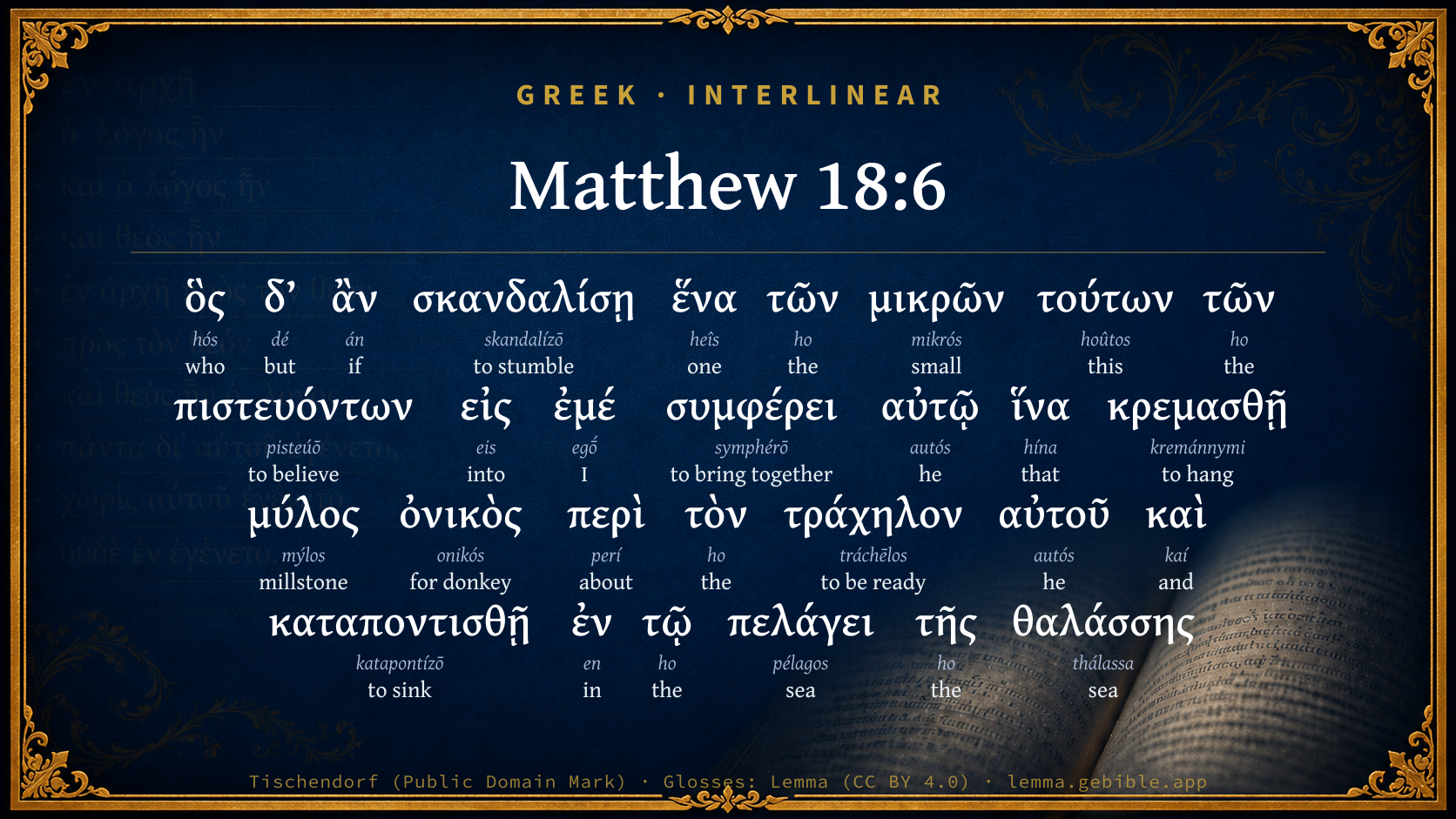
Greek (Tischendorf 8th ed.) Matthew 18:6 appears in the Greek New Testament. The text above is from the Tischendorf 8th edition. Each word links to its Strong’s number and a concise gloss. Click any word for its full Thayer’s Greek Lexicon entry.
Download image
Cite this verse

Matthew 18:6 (World English Bible). Public Domain. Lemma interlinear Bible study tool, https://lemma.gebible.app/v/matthew/18/6.

Show BibTeX & RIS
BibTeX
RIS
English Translation
but whoever causes one of these little ones who believe in me to stumble, it would be better for him that a huge millstone should be hung around his neck, and that he should be sunk in the depths of the sea.
World English Bible · Public Domain
Highlights
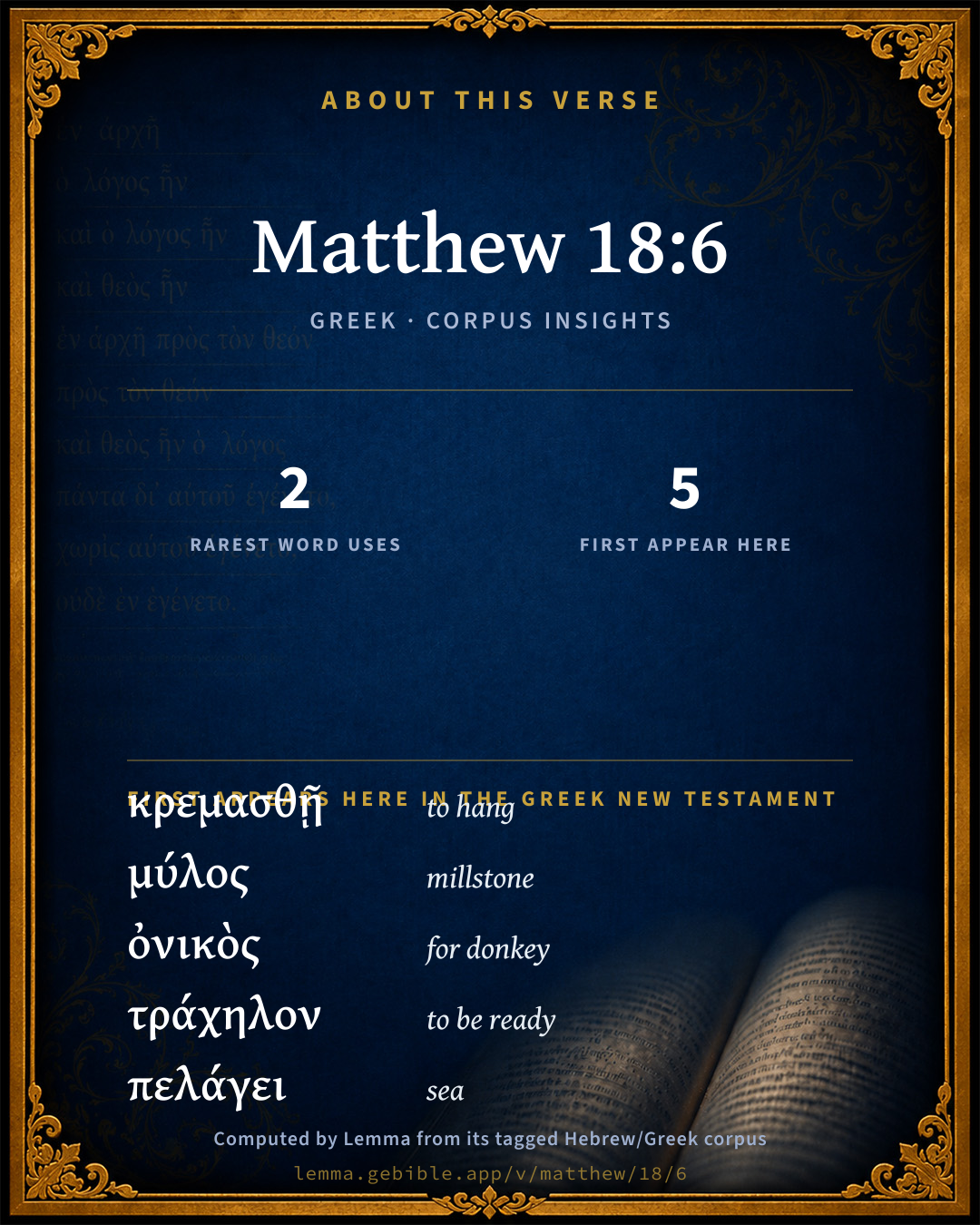
  • 5 first appearances in the Greek New Testament
Full analysis ↓
Download a study sheet

One document with this verse’s original text, its word-by-word gloss line, the meaning frame, cross-references with their text, attributed commentary, and full source and license credits — printable, and it pastes into notes with its structure intact.

This verse Autodidact and up

Study sheet (.html) Plain text (.txt)

A passage Seminary Student

Up to 50 verses in one chapter. A passage sheet keeps up to 6 commentary sources and 12 cross-references per verse, in the order this page ranks them, and says so on the sheet whenever that leaves anything out. Ask for a single verse and you get the Autodidact verse sheet above.

Everything on this page stays free to read, with no account — the sheet is a download of what is already on screen, not access to it.

Want to remove ads? Support Godless Engineer
Compare translations 3

The same verse in 3 English versions, stacked beneath the original-language interlinear above. Click any original word for its lexicon entry.

Each is an independent rendering of the whole verse — the interlinear is not word-aligned to these translations.

Highlighted words mark where these versions differ — a whole-verse word diff, not a word-by-word alignment.

  • World English Bible Public Domain
    but whoever causes one of these little ones who believe in me to stumble, it would be better for him that a huge millstone should be hung around his neck, and that he should be sunk in the depths of the sea.
  • King James Version Public Domain
    But whoso shall offend one of these little ones which believe in me, it were better for him that a millstone were hanged about his neck, and that he were drowned in the depth of the sea.
  • unfoldingWord Literal Text CC BY-SA 4.0
    But whoever causes one of these little ones who believe in me to stumble, it is better for him that a millstone of a donkey would have been hung around his neck and he would have been sunk into the depth of the sea.

unfoldingWord Literal Text — © unfoldingWord, licensed CC BY-SA 4.0. Word-aligned USFM3 via Door43 (git.door43.org/unfoldingWord/en_ult).

Versions to compare (up to 4)

3 of 4 selected

Show all 19 translations

Every available English version of this verse, each an independent rendering of the whole verse.

  • World English Bible Public Domain
    but whoever causes one of these little ones who believe in me to stumble, it would be better for him that a huge millstone should be hung around his neck, and that he should be sunk in the depths of the sea.
  • Berean Standard Bible Public Domain
    But if anyone causes one of these little ones who believe in Me to stumble, it would be better for him to have a large millstone hung around his neck and to be drowned in the depths of the sea.
  • Majority Standard Bible Public Domain
    But if anyone causes one of these little ones who believe in Me to stumble, it would be better for him to have a large millstone hung around his neck and to be drowned in the depths of the sea.
  • King James Version Public Domain
    But whoso shall offend one of these little ones which believe in me, it were better for him that a millstone were hanged about his neck, and that he were drowned in the depth of the sea.
  • American Standard Version (1901) Public Domain
    But whoso shall cause one of these little ones that believe on me to stumble, it is profitable for him that a great millstone should be hanged about his neck, and `that' he should be sunk in the depth of the sea.
  • Revised Version (1885) Public Domain
    But whoso shall cause one of these little ones which believe on me to stumble, it is profitable for him that a great millstone should be hanged about his neck, and that he should be sunk in the depth of the sea.
  • Geneva Bible (1599) Public Domain
    But whosoeuer shall offend one of these litle ones which beleeue in me, it were better for him, that a milstone were hanged about his necke, and that he were drowned in the depth of the sea.
  • Douay-Rheims (1899) Public Domain
    But he that shall scandalize one of these little ones that believe in me, it were better for him that a millstone should be hanged about his neck, and that he should be drowned in the depth of the sea.
  • Young's Literal Translation Public Domain
    and whoever may cause to stumble one of those little ones who are believing in me, it is better for him that a weighty millstone may be hanged upon his neck, and he may be sunk in the depth of the sea.
  • Literal Standard Version CC BY-SA 4.0
    and whoever may cause to stumble one of those little ones who are believing in Me, it is better for him that a weighty millstone may be hanged on his neck, and he may be sunk in the depth of the sea.
  • Unlocked Literal Bible CC BY-SA 4.0
    But whoever causes one of these little ones who believes in me to sin, it would be better for him that a great millstone should be hung about his neck, and that he should be sunk into the depths of the sea.
  • unfoldingWord Literal Text CC BY-SA 4.0
    But whoever causes one of these little ones who believe in me to stumble, it is better for him that a millstone of a donkey would have been hung around his neck and he would have been sunk into the depth of the sea.
  • Darby Bible Public Domain
    But whosoever shall offend one of these little ones who believe in me, it were profitable for him that a great millstone had been hanged upon his neck and he be sunk in the depths of the sea.
  • World Messianic Bible Public Domain
    but whoever causes one of these little ones who believe in me to stumble, it would be better for him if a huge millstone were hung around his neck and that he were sunk in the depths of the sea.
  • Webster's Bible Public Domain
    But whoever shall cause one of these little ones who believe in me, to sin, it were better for him that a millstone were hanged about his neck, and that he were drowned in the depth of the sea.
  • Free Bible Version CC BY-SA 4.0
    But anyone who makes one of these little ones who trust in me sin, it would be better for them to have a large millstone tied around their neck and be drowned in the depths of the sea.
  • Bible in Basic English Public Domain
    But whoever is a cause of trouble to one of these little ones who have faith in me, it would be better for him to have a great stone fixed to his neck, and to come to his end in the deep sea.
  • Text-Critical English NT CC BY 4.0
    But if anyone causes one of these little ones who believe in me to stumble, it would be better for him to have a heavy millstone hung around his neck and to be drowned in the depths of the sea.
  • Tyndale New Testament (1534) Public Domain
    But whosoever offende one of these lytelons which beleve in me: it were better for him that a milstone were hanged aboute his necke and that he were drouned in the depth of the see.

Literal Standard Version (2020), Covenant Press — licensed CC BY-SA 4.0. Text via the HelloAO Bible API (eBible.org). Unlocked Literal Bible (unfoldingWord) — licensed CC BY-SA 4.0. Text via the HelloAO Bible API (eBible.org). unfoldingWord Literal Text — © unfoldingWord, licensed CC BY-SA 4.0. Word-aligned USFM3 via Door43 (git.door43.org/unfoldingWord/en_ult). Free Bible Version, Dr. Jonathan Gallagher — licensed CC BY-SA 4.0. Text via the HelloAO Bible API (eBible.org).

Word by word

More ways to search: Search by grammar → Find every occurrence → Compare this word →

Practice this passage: Drill this verse → Learn its vocabulary →

ὀνικὸς
onikós
G3684
“for donkey”
Adjective, Nominative, Singular, Masculine
Part of Speech
Adjective
Case
Nominative
Number
Singular
Gender
Masculine
Full Thayer's Definition

Origin: from G3688

TDNT: None

1. of or for an ass, turned by an ass a. these beasts were often employed to turn millstones
  1. ὃς hós G3739 “who” Relative pronoun, Nominative, Singular, Masculine
  2. δ’ dé G1161 “but” Conjunction
  3. ἂν án G302 “if” Particle
  4. σκανδαλίσῃ skandalízō G4624 “to stumble” Verb, Aorist, Active, Subjunctive, 3rd person, Singular
  5. ἕνα heîs G1520 “one” Adjective, Accusative, Singular, Masculine
  6. τῶν ho G3588 “the” Article, Genitive, Plural, Masculine
  7. μικρῶν mikrós G3398 “small” Adjective, Genitive, Plural, Masculine
  8. τούτων hoûtos G3778 “this” Demonstrative pronoun, Genitive, Plural, Masculine
  9. τῶν ho G3588 “the” Article, Genitive, Plural, Masculine
  10. πιστευόντων pisteúō G4100 “to believe” Verb, Present, Active, Participle, Genitive, Plural, Masculine
  11. εἰς eis G1519 “into” Preposition
  12. ἐμέ egṓ G1473 “I” Personal pronoun, 1st person, Accusative, Singular
  13. συμφέρει symphérō G4851 “to bring together” Verb, Present, Active, Indicative, 3rd person, Singular
  14. αὐτῷ autós G846 “he” Personal pronoun, Dative, Singular, Masculine
  15. ἵνα hína G2443 “that” Conjunction
  16. κρεμασθῇ kremánnymi G2910 “to hang” Verb, Aorist, Passive, Subjunctive, 3rd person, Singular
  17. μύλος mýlos G3458 “millstone” Noun, Nominative, Singular, Masculine
  18. περὶ perí G4012 “about” Preposition
  19. τὸν ho G3588 “the” Article, Accusative, Singular, Masculine
  20. τράχηλον tráchēlos G5137 “to be ready” Noun, Accusative, Singular, Masculine
  21. αὐτοῦ autós G846 “he” Personal pronoun, Genitive, Singular, Masculine
  22. καὶ kaí G2532 “and” Conjunction
  23. καταποντισθῇ katapontízō G2670 “to sink” Verb, Aorist, Passive, Subjunctive, 3rd person, Singular
  24. ἐν en G1722 “in” Preposition
  25. τῷ ho G3588 “the” Article, Dative, Singular, Neuter
  26. πελάγει pélagos G3989 “sea” Noun, Dative, Singular, Neuter
  27. τῆς ho G3588 “the” Article, Genitive, Singular, Feminine
  28. θαλάσσης thálassa G2281 “sea” Noun, Genitive, Singular, Feminine

About this verse

These counts appear in no published source. They are computed here, from the morphology-tagged text and Lemma’s own curated glosses. What Lemma adds →

29
words
24
distinct lemmas
Gospels
section

Notable vocabulary

The rarest word here is ὀνικὸς for donkey G3684 — appearing just 2 times in the whole Greek New Testament.

First appearance in Scripture

These words make their first canonical appearance in the Greek New Testament here:

  • κρεμασθῇ to hang G2910
  • μύλος millstone G3458
  • ὀνικὸς for donkey G3684
  • τράχηλον to be ready G5137
  • πελάγει sea G3989

Shared distinctive vocabulary

ὀνικὸς for donkey G3684 occurs in 2 verses of the Greek New Testament. Also found in:
Repetition

Words recur within this verse:

  • τῶν the G3588 ×5
  • αὐτῷ he G846 ×2

Cross-references

14

Topical passages linked to Matthew 18:6 in the Treasury of Scripture Knowledge — connected by theme and wording, ordered by reader-vote popularity; previews shown in the World English Bible.

  • Mark 9:42 Whoever will cause one of these little ones who believe in me to stumble, it would be better for him if he was thrown into the sea with a millstone hung around his neck.
  • Luke 17:1–2 He said to the disciples, "It is impossible that no occasions of stumbling should come, but woe to him through whom they come!
  • Matthew 18:10 See that you don't despise one of these little ones, for I tell you that in heaven their angels always see the face of my Father who is in heaven.
  • Matthew 18:14 Even so it is not the will of your Father who is in heaven that one of these little ones should perish.
  • 2 Thessalonians 1:6–9 Since it is a righteous thing with God to repay affliction to those who afflict you,
  • Romans 15:1–3 Now we who are strong ought to bear the weaknesses of the weak, and not to please ourselves.
  • Psalms 105:15 "Don't touch my anointed ones! Do my prophets no harm!"
  • Romans 14:13–15 Therefore let's not judge one another any more, but judge this rather, that no man put a stumbling block in his brother's way, or an occasion for falling.
  • 1 Corinthians 8:9–13 But be careful that by no means does this liberty of yours become a stumbling block to the weak.
  • 1 Corinthians 10:32–33 Give no occasions for stumbling, either to Jews, or to Greeks, or to the assembly of God;
  • Zechariah 2:8 For thus says Yahweh of hosts: 'For honor he has sent me to the nations which plundered you; for he who touches you touches the apple of his eye.
  • Romans 14:21 It is good to not eat meat, drink wine, nor do anything by which your brother stumbles, is offended, or is made weak.
  • Zechariah 13:7 "Awake, sword, against my shepherd, And against the man who is close to me," says Yahweh of Hosts. Strike the shepherd, and the sheep will be scattered; And I will turn my hand against the little ones.
  • Acts 9:5 He said, "Who are you, Lord?" The Lord said, "I am Jesus, whom you are persecuting.

Cross-references courtesy of OpenBible.info (CC BY 4.0).

Commentary

Notes on Matthew 18:6 from classic Christian and Jewish commentators (each source and its license shown beneath its notes). The classic Christian expositions comment on the surrounding passage and are grouped to its opening verse, so a note may address several verses; the Jewish commentaries on the Tanakh (Rashi and others) are per-verse, so they appear only where the commentator wrote on this verse.

Lemma curates 59 commentaries, every one of them public domain or Creative Commons licensed, each selected and text-cleaned for this edition rather than reprinted as found. About our sources →

The Biblical Illustrator

Joseph S. Exell

Mat_18:6

But whoso shall offend one of these little ones.

The claimers of the young upon the Church

1. In presenting these claims I would remind you of the peculiar tenderness which our Lord Himself manifested in relation to children.

2. I would urge the claims of the children upon the care of the Church by reminding you of their peculiar susceptibility to influence, whether for good or for evil.

3. Their claims are strong when we remember that upon them the Church depends for its future workers.

4. They will not always remain little ones. (F. Wagstaff.)

The crime of degrading men

I. Parents are frequently the cause of many of the faults which grow into great depravities in their children.

II. Our pride and inconsideration may, and often do, result in a train of evils to the character of our servants, of our clerks, and of the working men that are under our care.

III. By the inconsiderate use of our liberty we are in danger of causing men to offend, and of essentially damaging human nature.

IV. Men deteriorate their fellow-men, and weaken society, by such conduct as puts men in their commercial intercourse into very tempting relations to each other.

V. Avarice-and that, too, in its rues: ignoble forms-is continually tempting so-called good men to the injury of their fellow-men.

VI. Great damage is done by men professing godliness, as well as men professing honesty, though not avowedly Christian, by the injustice which lurks, and is almost inherent, in their vanity. (H. W. Beecher.)

Mat_18:6; Mat_18:9

Wherefore if thy hand or thy foot offend thee.

Renouncing things that hinder

The every-sided development of all our faculties, the inferior, as well as the more elevated, is certainly to be regarded as the highest attainment, yet he who finds by experience that he cannot cultivate certain faculties-the artistic for example-without injury to his holiest feelings, must renounce their cultivation, and make it his first business, with painstaking fidelity, to preserve entire the innermost life of his soul, that higher life imparted to him by Christ, and which, by the dividing and distracting of his thoughts, might easily be lost, nor must it give him any disturbance, if some subordinate faculty be thus wholly sacrificed by him. Assuredly, however, we must add, that this loss is only in appearance, for, in the development of mans higher life, everything of a subordinate kind which he had sacrificed is again restored with increase of power. (Olshausen.)

Better suffer than sin

It is not merely that we should abstain from actual wrong-doing. That of course. It is not even that we should shun the avenues of sin; but, whatever the pain or loss involved, we are utterly to renounce that which we find to be the occasion of sin. The merely literal and outward is not the thing to dwell open. A man might cut off both hands, or pluck out both eyes, and yet leave the root of sin untouched. What Christ summons to is the surrender of everything, however pleasant, or dear, or seemingly necessary for the present life, and whatever suffering there may be in the surrender, rather than sin against God. The boldly figurative language well expresses the intensity of the change. (Dr. Culross.)

Moral surgery

I. That the sinners sin is his own-a part of himself. Thy right hand. Few people admit the ownership of their sins.

II. That deliverance from sin can be effected only through the sinners own act. Cut it off.

1. Painful. Cut it off.

2. Promptness. Cut with a determined stroke.

3. Persistent. Cut it off.

III. That heroically, in order to make reformation a permanent blessing, must the sinner abandon his sin. Cast it from thee.

1. This figure is suggestive of danger. The last resort.

2. The great Physician Himself urges the operation.

3. Every consideration, past, present, and future calls upon the sinner to decide. It is profitable for thee.

4. The fearful consequences of neglect. Cast into hell. (J. Kelly.)

Self-discipline

The Rev. R. Cecil possessed remarkable decision of character. When he went to Cambridge he made a resolution of restricting himself to a quarter of an hour daily in playing the violin-on which instrument he greatly excelled, and of which he was extravagantly fond; but, on finding it impracticable to adhere to his determination he cut the strings, and never afterwards replaced them. He had studied for a painter; and retained through a life a fondness and taste for the art. He was once called to visit a sick lady, in whose room there was a painting which so strongly attracted his notice, that he found his attention diverted from the sick person and absorbed by the painting; from that moment he formed the resolution of mortifying a taste which he found so intrusive, and so obstructive to him in his nobler pursuits and determined never again to frequent the exhibition.

Self-mortification

This is the circumcision of the heart, the mortifications of earthly members, which is no less hard to be done than for a man with one hand to cut off the other, or to pull out his own eyes, and then rake in the holes where they grew. And yet, hard or not hard, it must be done; for otherwise we are utterly undone for ever. Hypocrites, as artificial jugglers, seem to wound themselves, but do not: as stage-players, they seem to thrust themselves through their bodies, whereas the sword passeth only through their clothes. But the truly religious lets out the life-blood of his beloved lusts, lays them all dead at his feet, and burns their bones to lime, as the king of Moab did the king of Edom (Amo_2:1). As Joshua put down all the Canaanites, so doth grace all corruptions. As Asa deposed his own mother, so doth this, the mother of sin. It destroys them not by halves, as Saul; but hews them in pieces before the Lord, as Samuel. (John Trapp.)

The Biblical Illustrator, edited by Joseph S. Exell (c. 1880s–1900s) — public domain. Text from a community e-Sword module.

Godbey's Commentary on the New Testament

William B. Godbey

RESPONSIBILITY OF OFFENDING THE LITTLE ONES

Mat 18:6-8; Mar 9:42-44. “Whosoever may offend one of these little ones who believe in Me, it is better for him rather if a millstone is hung round his neck, and he has been plunged into the sea. If thy hand may offend thee, cut it off; it is good for thee to enter into life maimed, rather than having two hands to go away into hell, into the fire that can not be quenched, where the worm dieth not, and the fire is not quenched.”

Mat 18:7 : “Woe unto the world because of offenses! It is necessary that offenses come; but woe to that man by whom the offense cometh!” So long as we are on probation, temptation, which is but another name for offense, supervenes as a logical sequence. Our Lord is here speaking primarily of natural infants, but also including the spiritual; i.e., young converts. You see the awful and momentous responsibility devolving on all the people who offend these infants, natural and spiritual. What does this mean? It simply means leading them into sin, by precept or example, nolens, volens. There is a deep sleep on all the world appertaining to this awful responsibility. By the wonderful redeeming grace of Christ, every human being is born in the kingdom of God, and only gets out by sinning out. O what an awful wreckage is everywhere going on! Parents and Churches are blind to these stupendous facts. How long infantile justification is retained depends upon the light shining in the home, and the opportunities available. With some, the age of responsibility is reached much earlier that in case of others. Which should be the grand enterprise of all parents, to so bring up their children in the nurture and admonition of the Lord, so culture and fortify, as to retain them indefinitely in the kingdom. I trow, this will be the normal economy during the millennium, when the generations will look back on their predecessors with horror and astonishment, because they permitted their children to sin away their infantile justification, become backsliders, and take chances between reclamation and damnation. Doubtless the majority who go from earth to populate heaven during these probationary ages, die in their infancy, thus including one-half of the whole human race, in reference to whom there is no defalcation. Awful responsibilities in eternity and judgment await the people who have been instrumental in leading infants to commit sin. How frequently the parents, brothers, and sisters thus inadvertently crimson their hands in the blood of the little ones, actually leading them across the line, out of infantile justification, into the kingdom of Satan! God sets great store on these infants, both natural and spiritual, because His Son left heaven and suffered and died for them. He wants them to glorify Him on earth, people heaven, and do His will through all eternity. Hence the awful responsibility devolving on the audacious person who may prove instrumental in their abduction out of the kingdom. O how reckless, thoughtless, and foolhardy people are in their treatment of the little ones! “Offend” here is scindahzo, from scandalon, and means a stumblingblock. Therefore anything said or done, causing an infant or a young convert to waver or stumble in the rectilinear way of truth, innocence, and righteousness, is the offense here so rigidly stigmatized and terrifically anathematized. We know that infants have evil tempers, which nothing but entire sanctification can remove. The mere existence of this hereditary evil does not vitiate their justification, as they received it by irresponsible heredity; while its arousement would lead to voluntary acts of sin, calculated to forfeit their justification, and occasion stumbling and falling. Paul says: “Fathers, provoke not your children to wrath;” i.e., do nothing to make them angry. The responsibility of parents, permitting their children to associate with evil companions, is simply immeasurable, amounting to the awful reality of giving them a ticket over the Black Valley route to hell.

William B. Godbey, Commentary on the New Testament (1896–1900) — public domain. Text from a community e-Sword module.

Tyndale Open Study Notes

Tyndale Open Resources

18:6 To cause one . . . to fall into sin is to lead believing children (or possibly believing adults who become “like children”; see 18:3) to reject Christ and abandon the faith. • The designation little ones emphasizes their humility (5:3-12; 18:4; 19:13-15). • Though the thought of being drowned with a large millstone around the neck is frightful, Jesus warned that causing another to fall away will bring far greater misery (18:7; 26:24; Rev 18:21; see Matt 22:13).

Tyndale Open Study Notes — © Tyndale Open Resources, licensed CC BY-SA 4.0. Text via the HelloAO Bible API.

Bengel's Gnomon

Johann Albrecht Bengel

Mat 18:6. Σκανδαλίση, shall offend) sc. by putting a stumbling block in the way of either his faith or practice, by provoking to pride or strife, by calling him away from the virtues of that early age. The greatest reverence is due to a child, if you are employed in anything which is wrong.[807] Children are more easily impressible; therefore they are more easily injured.—ΤῶΝ ΠΙΣΤΕΥΌΝΤΩΝ, who believe) Jesus paid great attention to little children, and endued them with faith; see ch. Mat 14:21, Mat 19:13-14, and Mat 21:15-16.—συμφέρει αὐτῷ, it is expedient for him) i.e., it is his interest—it were better for him; for drowning is far less horrible than the fire spoken of in Mat 18:8, or the lake of fire mentioned in Rev 19:20.—μύλος ὀνικὸς, a millstone)[808] An appropriate phrase in a discourse concerning offence, for stumbling is produced by stones.—καταποντισθῇ, be drowned) A frequent and horrible punishment.[809]—ΠΕΛΆΓΕΙ, the sea) sc. the deep; see Gnomon on Act 27:5.—τῆς θαλάσσης, of the sea) which was near at hand; see ch. Mat 17:27.

[807] See Juvenal xiv. 47, 48.—(I. B.)

[808] Literally, an ass millstone—i.e. the millstone of a mill worked by an ass, and therefore larger than a common hand-mill.—(I. B.)

[809] In opposition to the kingdom of heaven.—V. g.

“Maxima debetur puero reverentia, si quid

Turpe paras.”—ED.

Bengel's Gnomon of the New Testament — English translation (T&T Clark, Edinburgh, 1860) — public domain. Text from a community e-Sword module.

Meyer's Critical & Exegetical Commentary

Heinrich August Wilhelm Meyer

Mat_18:6. Comp. Mar_9:42; Luk_17:2.

σκανδαλίσῃ] Opposite of δέξηται, meaning: will have been to him the occasion of his fall, especially of his apostasy from the faith (Mat_5:29, Mat_11:6).

τῶν μικρῶν τούτων] not to be understood, any more than παιδίον τοιοῦτο, Mat_18:5, of literal children (Holtzmann), and consequently not to be used as proof of the faith of little children (Baur, Delitzsch), but as meaning: one of those little ones,a way of designating modest, simple-minded, unassuming believers, that had just been suggested by seeing in the child then present a model of such simplicity. This is not quite the same as τῶν μικρῶν τούτων, Mat_10:42 (Mat_25:40), where the expression is not borrowed from the illustration of a child.

συμφέρει αὐτῷ, ἵνα, κ.τ.λ.] For the construction; comp. note on Mat_5:29. But whoever will have offended one of those little ones,it is of service to him, with a view to, i.e. in hunc finem ut. That, which such a person may have come to deserve, is thus expressed in the form of a divine purpose, which his evil deed must help him to bring about; comp. Joh_11:50. A comparative reference of συμφέρει (Jerome: quam aeternis servari cruciatibus; others: than again to commit such a sin) is a pure importation.

μύλος ὀνικός] The larger mills (in contradistinction to the χειρομύλαι, Mat_24:41) were driven by an ass; Buxtorf, Lex. Talm. p. 2252. Comp. also Anth. Pal. ix. 301; Ovid, A. A. iii. 290.

The καταποντισμός (Wesseling, ad Diod. Sic. xvi. 35; Hermann, Privatalterth. § 72, 26; Casaubon, ad Suet. Oct. 67) was not a Jewish method of putting to death, neither was it a practice in Galilee (Joseph. Antt. xiv. 15. 10), but belonged to the Greeks, Romans, Syrians, and Phoenicians. Consequently it here expresses in a manner all the more vivid and awe-inspiring that punishment of death to which the man in question has become liable, and which is intended to represent the loss of eternal life; comp. Mat_18:7-9.

Meyer — Critical and Exegetical Commentary on the New Testament — English translation by Peter Christie, edited by Frederick Crombie (T&T Clark, 1880) — public domain. Text from a community e-Sword module.

Expositor's Greek Testament

ed. W. Robertson Nicoll

Mat 18:6 . σκανδαλίσῃ : the opposite of receiving; treating harshly and contemptuously, so as to tempt to unbelief and apostasy. The pride and selfish ambition of those who pass for eminent Christians make many infidels. ἕνα τ . μ . τ .: one of the large class of little ones; not merely child believers surely, but all of whom a child is the emblem, as regards social or ecclesiastical importance. Those who are caused to stumble are always little ones: “majores enim scandala non recipiunt,” Jerome. One of them: “frequens unius in hoc capite mentio,” Bengel. This is the one text in which Jesus speaks of Himself as the object of faith ( vide The Kingdom of God , p. 263). συμφέρει … ἵνα : vide on Mat 5:29 . Fritzsche finds here an instance of attraction similar to that in Mat 10:25 καὶ ὁ δοῦλος , ὡς ὁ κ . α . Instead of saying συμφέρει α . κρεμασθῆναι … ἵνα καταποντισθῇ , the writer puts both verbs in the subjunctive after ἵνα . μύλος ὀνικὸς . The Greeks called the upper millstone ὄνος the ass ( ὁ ἀνῶτερος λίθος , Hesychius), but they did not use the adjective ὀνικὸς . The meaning therefore is a millstone driven by an ass, i.e. , a large one, as distinct from smaller-sized ones driven by the hand, commonly used in Hebrew houses in ancient times. “Let such a large stone be hung about the neck of the offender to make sure that he sink to the bottom to rise no more” such is the thought of Jesus; strong in conception and expression, revealing intense abhorrence. ἐν τῷ πελάγει τ . θ .: in the deep part of the sea. So Kypke, who gives examples; another significantly strong phrase. Both these expressions have been toned down by Luke. καταποντισθῇ : drowning was not a form of capital punishment in use among the Jews. The idea may have been suggested by the word denoting the offence, σκανδαλίσῃ . Bengel remarks: “apposita locutio in sermone de scandalo, nam ad lapidem offensio est” = “let the man who puts a stone in the path of a brother have a stone hung about his neck,” etc. Lightfoot suggests as the place of drowning the Dead Sea, in whose waters nothing would sink without a weight attached to it, and in which to be drowned was a mark of execration.

The Expositor's Greek Testament, edited by W. Robertson Nicoll (1897–1910) — public domain. Text from a community e-Sword module.

Geneva Bible (1599)

Geneva Bible translators

We ought to have great respect to our brethren be they never so base: and he that doeth otherwise, shall be sharply punished.

Geneva Bible (1599) marginal notes — public domain. Text via Bolls.life.

Adam Clarke's Commentary

Verse 6. But whoso shall offend one of these little ones] But, on the contrary, whosoever shall cause one of the least of those who believe in me to be stumbled-to go into the spirit of the world, or give way to sin - such a one shall meet with the most exemplary punishment.

Let those who act the part of the devil, in tempting others to sin, hear this declaration of our Lord, and tremble.

A millstone] μυλος ονικος, an ass's millstone, because in ancient times, before the invention of wind and water mills, the stones were turned sometimes by slaves, but commonly by asses or mules. The most ancient kind of mills among the inhabitants of the northern nations, was the quern, or hand-mill. In some places in Ireland, Scotland, and the Zetland Isles, these still exist.

Drowned in the depth of the sea.] It is supposed that in Syria, as well as in Greece, this mode of punishing criminals was practised; especially in cases of parricide; and when a person was devoted to destruction for the public safety, as in cases of plague, famine, &c. That this was the custom in Greece, we learn from the Scholiast on the Equites of Aristophanes, Οταν γαρ κατεποντουν τινας, βαρος απο των τραχηλων εκρεμων. When a person was drowned, they hung a weight, (υπερβολον λιθον, Suidas,) a vast stone about his neck. See the ancient Scholia upon the Equites, lin. 1360, and Suidas, in υπερβολον λιθον. We find also that it was a positive institute of the ancient Hindoo law. "If a woman," says the precept, "causes any person to take poison, sets fire to any person's house, or murders a man, then the magistrate, having bound a stone to her neck, shall drown her." Halhead's Code of Gentoo Laws, 4to. edition, page 306.

Adam Clarke's Commentary on the Bible (1810–1826) — public domain. Text from a community e-Sword/MySword module.

Ellicott's Commentary for English Readers

(6) Whoso shall offend.—The words seem to indicate the thoughts which rise unbidden in the minds of men in proportion as they are Christ-like in character. We gaze on the innocent beauty of childhood with love and admiration. What if that beauty should be marred by the taint of evil? What if those who do the Tempter’s work should cause the “little one” to stumble and to fall?

That a millstone were hanged about his neck.—The word for “millstone” indicates the larger stone-mill, in working which an ass was commonly employed, as distinguished from the smaller handmill of Luk_17:35. The punishment was not recognised in the Jewish law, but it was in occasional use among the Greeks (Diod. Sic. xvi. 35), and had been inflicted by Augustus (Sueton. Aug. lxvii.) in cases of special infamy. Jerome states (in a note on this passage) that it was practised in Galilee, and it is not improbable that the Romans had inflicted it upon some of the ringleaders of the insurrection headed by Judas of Galilee. Our Lord’s words, on this assumption, would come home with a special vividness to the minds of those who heard them. The infamy of offending one of the “little ones” was as great as that of those whoso crimes brought upon them this exceptional punishment. It was obviously a form of death less cruel in itself than many others, and its chief horror, both for Jews and heathen, was, probably, that it deprived the dead of all rites of burial. St. Mark and St. Luke, it may be noted, insert here the complaint of St. John, that he had seen one casting out devils in the name of Jesus, and this must be taken into account as an element in the sequence of thought. He was unconsciously placing himself among those who were hindering the work of Christ, and so “offending” those who believed in him. (See Note on Mar_9:38.)

A Bible Commentary for English Readers, edited by Charles John Ellicott (1878–1897) — public domain. Text from a community e-Sword module.

John Gill's Exposition

But whoso shall offend one of these little ones,.... Not in age, but are little and mean in their own eyes, and contemptible in the esteem of the world; though otherwise men of great grace, gifts, and usefulness; who may be said to be offended, when they are not received; their persons despised, their ministry rejected, and they reproached and persecuted; and everything done to them to discourage, and cause them to stumble and fall, to drop their profession of Christ, to quit his service, and desert his cause: and that such persons are designed, appears by the following descriptive character of them,

which believe in me; which cannot be said of infants, or little ones in age, and who also are not capable of offence; but must be understood of adult persons, of such who by faith look unto, lay hold on, and receive the Lord Jesus Christ, as their Saviour and Redeemer, and who make a profession of their faith in him; and chiefly of such who preach the doctrine of faith, who having believed, therefore speak; and who are generally the butt of the contempt, reproach, and persecution of men.

It were better for him, that a mill stone be hanged about his neck, and that he were drowned in the depth of the sea. The word translated "depth", is sometimes used for the Sea itself, Isa 51:10 and signifies the middle, or deeper path, and answers to the Hebrew phrase, "the heart of the sea"; , used by the Targum, in Psa 46:3 and by Jonathan ben Uzziel, in Exo 15:8. Jerom thinks, that this was a sort of punishment in use among the Jews, that is here referred to; but this does not appear. The four capital punishments inflicted by them were stoning, burning, slaying with the sword, and strangling (z): they had indeed other sorts of punishment, which they borrowed from other nations; and so they might this, either from the Romans, or Greeks, or their neighbours the Syrians. The mill stone, in the original, is called , which may be rendered "the ass mill stone", being either the nether mill stone, as some think, which was called "the ass", because, like an ass, it bears the chief of the weight and burden; or else respects such mill stones as were turned about by an ass, in distinction from those that were turned by the hand; for that it was usual with the Jews to make use of asses in grinding, as well as other nations, is certain: hence we read (a) of "the ass of mills", that were employed in grinding in the mills, and of one that turned his mill with wild asses (b): but it is further to be observed, that mention is made (c) of , "the ass of an handmill": which the commentators say (d), was a beam on which an handmill was fixed, and was called "the ass." Now, I should rather think that this is meant than the other. It does not seem likely that a nether mill stone, or one that required an ass to turn it, should be tied to a man's neck, in order to drown him, when cast into the sea; for our Lord must be thought to refer to a practice somewhere in use: but rather, that such a beam, or log, of an handmill, so called, were wont to be put about the necks of malefactors, in drowning them. Our Lord's sense is, that it was much better for a man to endure the severest temporal punishment, rather than by offending, and evil treating any of his disciples, expose himself to everlasting destruction. The phrase of having a mill stone about the neck, I find, is sometimes used to denote anything very troublesome and burdensome (e).

"The tradition is, a man that marries a wife, and after that learns the law, R. Jochanan says, , "though a mill stone is about his neck", yet he must study in the law: that is, though his worldly circumstances are narrow, and his wife and family are as burdensome as if he had a mill stone about his neck, he must continue his studies.''

(z) Misn. Sanhedrim. c. 7. sect. 1. (a) T. Bab. Moed Katon, fol. 1. 10. 2. Maimon. Hileh. Yom Tob, c. 8. sect. 15. (b) T Bab. Avoda Zara, fol. 16. 2. (c) Mish. Zabim. c. 4. sect. 2. (d) R. Maimon. R. Sampson. & R. Obadiah Bartenora, in. ib. (e) T. Bab. Kiddusbin, fol. 29. 2.

John Gill's Exposition of the Whole Bible (1746–1763) — public domain (CC PDM 1.0). Text via the HelloAO Bible API.

Trapp's Complete Commentary

John Trapp

6 But whoso shall offend one of these little ones which believe in me, it were better for him that a millstone were hanged about his neck, and that he were drowned in the depth of the sea.

Ver. 6. But whoso shall offend, &c.] By false doctrine, or loose life, or making a prey of their simplicity and humility, which many times draws on injury. A crow will stand upon a sheep’s back, pulling off wool from her side. She dare not do so to a wolf or a mastiff. {a}

That a millstone were hanged, &c.] The nether millstone, called in Greek the ass, either because it is the larger and thicker of the two; or because the millstone was drawn about by the help of the ass, μυλος ονικος. This kind of punishment the greatest malefactors among the Jews were in those days put to, as saith St Jerome. And hereby is set forth the heaviest of hell torments. Thus the beast of Rome (that grand offender of Christ’s little ones, whom he worrieth and maketh havoc of) is threatened (by a like kind of punishment) to be cast alive into the burning lake, Rev 19:20. And for his city Babylon, a mighty angel is seen to take up a stone like a great millstone, and cast it into the sea, saying, "Thus with violence shall that great city Babylon be thrown down, and shall be found no more at all." This, by an elegant and emphatic gradation, notably sets forth the remediless ruin of Rome; in that an angel, a strong angel, taketh a stone, and a great stone, even a millstone, which he letteth not barely fall, but casteth, and with impetuous force thrusteth, into the bottom of the sea, whence nothing ordinarily is recovered, much less a millstone, thrust from such a hand with such a force.

Drowned in the depth of the sea] In that part of the sea that is farthest off from the shore: q.d. he is a brat of fathomless perdition, he shall be desperately drowned in destruction, ita ut in aquae summitate rursus non ebulliat, so that he would not bubble again to the surface of the water. So the Romans served their parricides, and the Grecians other grievous malefactors: they wrapped them up in lead, and cast them into the deep.

{a} A large, powerful dog with a large head, drooping ears and pendulous lips, valuable as a watch-dog. ŒD

John Trapp, A Commentary or Exposition upon All the Books of the Old and New Testament (1647–1656) — public domain. Text from a community e-Sword module.

Haydock's Catholic Bible Commentary

But he that shall scandalize, shall by their evil doctrine or example draw others into sinful ways. The words scandalize, and scandal, being sufficiently understood, and authorized by use, both in English and French, might I thought be retained. The words offend and offences, in Protestant translation, do not express sufficiently the sense. (Witham) --- That is, shall put a stumbling-block in their way, and cause them to fall into sin. (Challoner) --- By these strong expressions of our Lord, we may judge of the enormity and malice of scandal. Rather than be the cause of scandal to any of the faithful, and occasion the loss of his soul, we must be ready to undergo every torment, yes, and suffer death itself. (Denis the Carthusian) --- The ancient punishment among the Greeks for sacrilege was drowning, with a mill-stone fastened about the neck, according to Diodorus Siculus.

George Leo Haydock (1774–1849), Haydock's Catholic Family Bible and Commentary, 1859 edition — public domain. Excludes Psalms (Douay-Rheims chapter numbering differs from Protestant) and Deuterocanonical books (Catholic canon only).

Whedon's Commentary on the Bible

Daniel D. Whedon

6. Shall offend — The word offend, at the present day, signifies to irritate or make angry. It here, however, signifies to cause to sin or to apostatize. It is to make one offended with Christ. Hence, as on the one hand he who receives, or cherishes, the humble Christian receives Christ himself; so he who causes the humble Christian to lose his religion and his soul, renders himself liable to unutterable condemnation. See note on Mat_18:7.

A millstone were hanged about his neck… drowned — The millstone here specified was not the domestic hand-stone, turned by women, in grinding. See note on Mat_24:41. Besides this there was among the Jews the heavy sort, of which the upper stone was turned by the ass, and hence in the original called the ass-millstone. Hanged about his neck to secure his sinking. In the depth of the sea — In the main centre of the sea. The capital punishments among the Jews were either burning, stoning, strangling, or beheading. Drowning was and is prevalent among other Eastern nations, and it existed even among the Greeks. This was said to be the punishment for the crime of sacrilege, to which the crime of seducing a soul from Christ is analogous. The intensity of the depth is described as the image of the utter ruin which his crime deserves. It of course implies that he perishes under the divine displeasure, and receives from God the depth of punishment of which the human penalty is so apt an image. Indeed, the whole must be figurative. Our Lord could not mean that in any case a civil or state punishment would be inflicted upon the man who should cause a Christian to fall into sin.

Daniel D. Whedon (gen. ed.), Commentary on the Old and New Testaments (1874–1909) — public domain. Text from a community e-Sword module.

The Pulpit Commentary

There is an opposite side to this picture. Shall offend; cause to stumble give occasion for a fall, i.e. either in faith or morals. This is done by evil example, by teaching to sin, by sneers at piety, by giving soft names to gross offences. One of these little ones. Whether child or adult, a pure, simple soul, which has a certain faith it be not strong enough to resist all attack. Even the heathen recognized the respect due to the young: "Maxima debetur puero reverentia" (Juvenal, "Sat.," 14:47); and guilelessness and purity, wherever found, win some regard, even from worthless and careless observers. To wilfully lead one such astray is a deadly sin, which the Lord denounces in solemn terms. Christ affectionately calls his disciples "little ones". (Mat_10:42) Believe in (eiv) me. We must always distinguish between "believe in" (pisteuein eiv , or en : credo in) and "believe" with the simple dative; the former is applied to faith in God alone. Says St. Augustine, "Credimus Paulo, sed non credimus in Paulum." In the present passage the phrase implies the Divinity of Christ. It were better; literally, it is profitable. The crime specified is so heinous that a man had better incur the most certain death, if by this means he may avoid the sin and save the soul of his possible victim. A millstone; a great millstone such a one as required an ass to inure. The upper, or movable, stone is meant, which was usually turned by the hand. Drowned. We do not know that the Jews punished criminals by drowning (katapontismov), though it is probable that it was practised in some cases; but by other nations this penalty was commonly exacted. Among the Romans, Greeks, and Syrians, it was certainly the practice. Commentators quote Suetonius, "Aug.," 67.; Diod. Sic., 16:35; Livy, 1:51; Aristophanes, "Schol. ad Equit.," 1360. The punishment seems to have been reserved for the greatest criminals; and the size of the stone would prevent any chance of the body rising again to the surface and being buried by friends a consideration which, in the minds of heathens, greatly increased the horror of this kind of death.

Vers. 6-9. Occasions of stumbling.

To stumble is so to trip as to be hindered in faith or to be turned out of the way. (cf. Mat_5:29, 30 11:6 13:21 15:12 24:10 26:31, 33Jo 6:61, 62, 66 16:1) Occasions of stumbling are evil influences allurements, persuasions, temptations, bad example, calumnies, insults, persecutions. The text teaches

I THAT CHRIST HOLDS THE WICKED RESPONSIBLE FOR THE INJURY THEY MAY OCCASION TO THE GOOD. The addition of the words, "which believe on me," shows that Christ is here speaking, not of "little ones" in age. but of his disciples, who are of a humble spirit. Observe:

1. There is no infallible final perseverance of the saints.

(1) The recognition of this truth is the very inspiration of this pathetic discourse. These woes would never have been denounced upon men for the doing of what, otherwise, would be impossible.

(2) Let not the believer in Christ be high-minded. Let him fear. Let him watch. Let him pray.

2. It must needs be that the occasions come.

(1) They are permitted as part of the necessary discipline of our probation. They come from the abuse of free agency.

(2) To the faithful they prove blessed means of grace. They educate passive virtues. The habit of resisting temptation makes a strong character.

3. The instigator to evil is still responsible.

(1) Where he succeeds in causing the saint to stumble he will have to answer for the soul damaged or ruined. There is no impunity for those who turn the simple from their integrity by teaching them to imbibe sentiments subversive of the doctrines of genuine truth, or to indulge in evil practices which destroy or injure the capacity for receiving the graces of the kingdom.

(2) Where the tempter fails he is still responsible for his wickedness.

4. These things need to be emphasized.

(1) Because the wicked are too apt to transfer the blame of their irreligion to the account of the good, by accusing them of apathy and negligence. The good are undoubtedly responsible for the faithfulness of their testimony. They are not, however, beyond this, responsible for results. Noah"s testimony was at once his own justification and the condemnation of the world.

(2) Because the wicked are too slow to recognize their responsibility, not only for their own non-reception of Christ, but for the injury they do in hindering others, and especially for damaging the good. To offend the innocent is to offend innocence.

II THAT SUCH OFFENDERS ARE WARNED BY THE TERROR OF FORMIDABLE PUNISHMENT.

1. The sufferings of antichristian nations are admonitory. "Woe unto the world because of occasions of stumbling!

(1) The Jews filled up the measure of their iniquity in crucifying Christ and persecuting his disciples, and wrath came upon them to the uttermost.

(2) Degradation and ruin have overtaken or are pursuing those nations which have persecuted the witnesses for Christ. The atheism of France, with its horrors and the decadence of that nation, are the reaction of the superstition and wickedness of earlier persecutions. Prosperity smiles upon the nations that have accepted the Reformation. They have been enriched by industries brought to them by Protestant refugees.

(3) All antichristian nations are doomed in the anticipations of prophecy. "Woe" hangs over "the world" in the larger sense.

2. Individuals also are admonished. "Woe to that man through whom the occasion cometh!

(1) The retribution upon those who offend the disciples of Christ is worse than death. Jerome says that Christ here speaks according to the custom of the province in punishing the greatest criminals with drowning. The woe here denounced is worse (ver. 6).

(2) The retribution is as crushing as it is sudden. The culprit had no strength to release himself from the weight of the "great millstone," to turn which, supported in position, required the strength of an ass. "It seems to have grown into a proverb with the Jews for total ruin" (Doddridge).

(3) The more terrible punishment is described as a "Gehenna of fire," in allusion to the sufferings of the victims of Moloch. (cf. 2Ch_33:6) Burning there is more dreadful than drowning in the Lake of Galilee hard by. (cf. Rev_19:20) Those who play the devil in tempting saints may tremble with the devils.

3. But there is yet space for repentance.

(1) The offending hand must be cut off. Wrong doing must cease. However useful as the right hand. However dear.

(2) The offending foot must be cut off. Wrong going must cease. However natural it may have become through habit as the use of the right foot.

(3) The offending eye must be plucked out. Illicit desire must cease, whether instigated by covetousness, envy, pride, or passion. (see Mar_7:22)

(4) These must be cast away. The hand or foot or eye refer to those sins of honour, interest, or pleasure, which men are prone to spare. The godly in this world are lame, deaf, dumb, blind, both to themselves and to others. (see Psa_38:14) The members most mortified here will shine with the greater lustre hereafter. J.A.M.

The Pulpit Commentary (1880–1919), ed. H.D.M. Spence-Jones & Joseph S. Exell — public domain. Text from a community e-Sword module.

Scofield Reference Notes

C. I. Scofield

world

kosmos = world-system. Joh 7:7; Rev 13:3-8 (See Scofield "Rev 13:8").

The Scofield Reference Bible (1917 edition), notes by C. I. Scofield — public domain. Text from a community e-Sword module.

Kretzmann's Popular Commentary

Paul E. Kretzmann

A warning:

v. 6. But whoso shall offend one of these little ones which believe in Me, it were better for him that a millstone were hanged about his neck, and that he were drowned in the depth of the sea.

v. 7. Woe unto the world because of offenses! For it must needs be that offenses come; but woe to that man by whom the offense cometh!

Christ is now fairly launched upon a subject which is very near and dear to Him, because of His love for all the lowly and humble. He has in mind not only the little children, though they are His first consideration, but all the lowly and unassuming, the small ones in the kingdom of heaven, that believe on Him. They may not excel in great intellectual accomplishments, they may not stand out before others in those matters which are commonly accounted great in this world; they are simple, unpretentious Christians. But woe unto him that should offend one of these, that should lay a temptation before them in any form, that should lead them into sin, that should replace their simple faith by doubts regarding the Scriptures and their Savior. Many a Christian has been offended, scandalized, been led into doubt, and thus to misbelief and despair by the bantering, frivolous tone employed by such as pretend great learning, whenever they refer to the Bible and the way of redemption. Christ speaks with great feeling. He suggests a punishment which would approximately fit the crime, a fate which would be preferable to the transgression of offending in the manner shown by Him. Let a large millstone, of the kind used in mills driven by animals, be hung about the neck of such a one as contemplates so heinous a transgression, rather than that the offense be done. The entire subject of offenses is extremely distasteful to Jesus. He pronounces a woe upon the world because of them, for a large part of actual sins committed are due to suggestions, temptations, deliberate attempts at leading astray, coming from without. It is true, indeed, that offenses will come, on account of the perverted heart and mind of natural man. God is not responsible for the evil, but the evil lives in the world since the fall of Adam. Out of the evil hearts proceed the sinful desires, and these break forth in sinful deeds, and so scandals are inevitable. They find their way into the midst of the external Church of God, every heretic claiming for himself the support of Scriptures. "Therefore one should learn to know that scoundrel, the devil, who ornaments and sells himself under the name of God. For all false teachers and heretics claim for themselves the name of God, as you see in the case of the Pope, the sacrament-heretics, the Anabaptists, and all schismatics. But the Christians are not excused if they permit themselves to be led astray. For Christians should indeed be childlike, but in Christ, not outside of Christ. For Christ the Lord has warned them sufficiently against the false schismatics that would come and attempt to seduce them under the name of Christ. " Woe to that man through whom the scandal comes, that is guilty of causing other men to sin!

Paul E. Kretzmann, Popular Commentary of the Bible (1921–1924) — public domain. Text from a community e-Sword module.

The People's New Testament

B. W. Johnson

6. Whoso shall offend one of these little ones which believe in me. The Revision makes this plainer by rendering it “cause to stumble,” or to go astray. The term “little ones” not only embraces children who have learned to believe in Christ, but all lowly and humble disciples. Better for him that a millstone were hanged about his neck. Better that a man should lose his life in so terrible a way than to destroy the souls of others. Drowned in the depth of the sea. Which was within sight. This method of capital punishment was practiced by the Egyptians, Greeks, and Romans, and possibly occasionally by the Jews. It is still practiced by the Turks.

B. W. Johnson's The People's New Testament with Notes (1889–1891) — public domain. Electronic text from the Christian Classics Ethereal Library (CCEL) ThML edition.

Cambridge Greek Testament for Schools and Colleges

6. περὶ (אBL and some of the Fathers) for ἐπὶ of receptus. εἰς is also strongly supported, and περὶ may have come from the parallel passages in Mark and Luke.

6. πιστευόντων εἰς ἐμέ. For the distinction between πιστεύειν εἰς ‘to believe in any one,’ i.e. to put entire faith in him, and πιστεύειν τινί, ‘to believe any one,’ i.e. to give credit to his words, see Prof. Westcott on Joh 8:30 (Speaker’s Commentary). The first construction is characteristic of St John’s gospel and in the Synoptics occurs only here, and in the parallel passage Mar 9:42.

συμφέρει ἵνα, expedit ut. See note ch. Mat 1:22.

μύλος ὀνικός. A millstone turned by an ass, and so larger than the ordinary millstone. Cp. Ovid (Fasti VI. 318): ‘Et quæ pumiceas versat asella molas.’

The manner of death alluded to appears to have been unknown to the Jews. But Plutarch mentions this punishment as being common to Greece and Rome. Cp. Juv. Sat. VIII. 213, where, as in other places, it is named rather than the cross as a swift and terrible penalty for crime. The Scholiast on Aristoph. Equites, 1360, explains ὑπέρβολον, ὅταν γὰρ κατεπόντουν τινὰς βάρος ἀπὸ τῶν τραχήλων ἐκρέμων.

ἐν τῷ πελάγει τῆς θαλάσσης. πέλαγος does not in itself mean the ‘deep sea,’ but either ‘the expanse of open water’ (πλάξ, πλατύς, flat, &c.), or the ‘tossing,’ ‘beating’ sea (πλήσσω from root πλαγ). In this passage, therefore, the sense of depth is rather to be looked for in καταποντισθῇ, though the connection between πόντος and βένθος, βάθος, &c., is doubtful; Curtius prefers the etymology of πάτος, ‘path,’ and Lat. pons. (See Trench, N.T. Syn. 52, 53, and Curtius, Etym. 270 and 278.)

Cambridge Greek Testament for Schools and Colleges (Cambridge University Press, 1896; 21 vols, various authors incl. Carr, Maclear, Plummer, Farrar, Lumby, Moule, M. R. James, Simcox) — public domain. Text from a community e-Sword module.

Alford’s Greek Testament

Henry Alford

6.] Here St. Mark and St. Luke insert the saying of John respecting one casting out dæmons in Jesus’ name, who followed not with the Apostles: which it appears gave rise to the remark in this verse. St. Luke however goes on no further with the discourse: St. Mark inserts also our ch. 10:42.

The verbs κρεμασθῇ, καταποντισθῇ, may perhaps be understood in their strict tenses: it is better for him that a millstone should have been hanged, &c., and he drowned.… before the day when he gives this offence. But this is somewhat doubtful. The aorists more probably, as so often, denote an act complete in itself and accomplished at once: without any strict temporal reference. The punishment here mentioned, drowning, may have been practised in the sea of Galilee (‘secundum ritum provinciæ ejus loquitur, quo majorum criminum ista apud veteres Judæos pœna fuerit, ut in profundum ligato saxo demergerentur.’ Jerome in loc.). De Wette however denies this, saying that it was not a Jewish punishment; but it certainly was a Roman, for Suetonius mentions it as practised by Augustus on the rapacious attendants of Caius Cæsar ( ch. xlvii.):—and a Macedonian (Diod. Sic. xvi. 35, ὁ δὲ Φίλιππος τὸν μὲν Ὀνόμαρχον ἐκρέμασε, τοὺς δʼ ἄλλους ὡς ἱεροσύλους κατεπόντισε). Compare also Livy i. 51, where Turnus Herdonius (“novo genere leti,” it is true) “dejectus ad caput aquæ Ferentinæ, crate superne injecta, saxisque congestis, mergitur.”

ὀνικός, as belonging to a mill turned by an ass, and therefore larger than the stones of a handmill. In the Digests, the ‘mola jumentaria’ is distinguished from the ‘mola manuaria;’ and in Cato, de re rustica, c. 10, we have ‘molas asinarias duas, trusatiles unas.’

πελάγει, i.e. the deep part, in the open sea.

Henry Alford, The Greek Testament (1849–1861) — public domain. Text from a community e-Sword module.

International Critical Commentary

6. And whosoever shall cause to stumble one of these little ones who believe in Me, it is expedient for him that an ass’s millstone be hanged about his neck, and (that) he be sunk into the deep sea.] Mk. has “And whosoever shall cause to stumble one of these little ones who believe in Me, it is good for him rather if an ass’s millstone is placed about his neck, and he is cast into the sea.”—ὃς δέ] for Mk.’s καὶ ὅς, as often.—τῶν πιστευόντων] In Mk. the thought of the discourse has been turned by the insertion of vv. 38-40 from the consideration and treatment of children to that of children in faith and belief.1 In Mt., who has omitted 38-40, the thought is still of children. The editor retains Mk.’s τῶν πιστευόντων εἰς ἐμέ in spite of its incongruity. Mk. has καλόν—μᾶλλον for συμφέρει. Mt. assimilates to 5:29, 30. Lk. in 17:1 has λυσιτελεῖ̀.—ἵνα κρεμασθῇ] Mk. has εἰ περίκειται. So Lk. The ἵνα is an assimilation to 5:29-30.—καταποντισθῇ] Mk. has βέβληται, Lk. ἔρριπται—πέλαγος τῆς θαλάσσης] Mk. has τὴς θάλασσαν, simply. πιστεύειν εἰς occurs only here in Mt. In Mk. It is wrongly omitted by א D Δ a b ff i k. The πιστευόντων εἰς ἐμέ there, immediately after vv. 38-41, can only refer to such as had confidence in the power of Christ, like the man who cast out demons in His name even though he was not an immediate follower of Christ. The construction does not occur again in Mk. nor in Lk. It is common in Jn. The τῶν πιστευόντων εἰς ἐμέ in Mt. is incongruous, and is only explicable as borrowed, i.e. not omitted, from Mk.

(L)

International Critical Commentary — older volumes (1896–1929), various authors — public domain. Text from a community e-Sword module.

Vincent's Word Studies in the New Testament

Marvin R. Vincent

A millstone [μυλος ονικος] . Two kinds of millstones were in use; the one turned by hand, the other, and larger, by an ass [ονος] . Here Jesus says an ass - millstone; or, as Rev., a great millstone; Wyc., millstone of asses.

Marvin R. Vincent, Word Studies in the New Testament (1887–1900) — public domain. Text from a community e-Sword/MySword module.

Lesson kit

Teaching starters — assembled from the data on this page, not authored interpretation. Every prompt links to the verse data it draws on. Edit before teaching.

Matthew, in the Gospels, opens this verse with 29 words (24 distinct Greek lemmas). Its most distinctive word is onikós (“for donkey”). A historical commentator’s framing appears above. Read the whole chapter for the surrounding context.

Discussion questions

  1. What does “for donkey” (onikós) contribute to the verse as a whole?
  2. 5 words make their first appearance in Scripture here. What does this debut establish?
  3. How does Mark 9:42, which shares the word «for donkey», read alongside this verse?
  4. What does the repetition of “the” (5× in this one verse) do in this verse?
  5. The translations on this page render this verse differently — a whole-verse word diff, not a word-by-word alignment. What might account for the different wordings?
  6. Compare how The Biblical Illustrator and Godbey's Commentary on the New Testament read this verse. Where do they agree or differ?

Things to notice

  • 5 words make their first canonical appearance in Scripture here.
  • These translations choose different wording for 23 words in this verse.
  • “the” occurs 5× in this single verse.
  • 24 distinct Greek lemmas span 29 words in this verse.

Reading settings

Reading text

Shown beneath each verse's original-language words.

Old Testament
Old Testament edition

Read the OT as the Masoretic Hebrew (MT) or the Greek Septuagint (LXX).

English shown for the Greek Septuagint (in the Hebrew ↔ Greek comparison).

Comparing translations? Open the Compare panel on any verse page to stack up to four side by side.