
Matthew 25:46

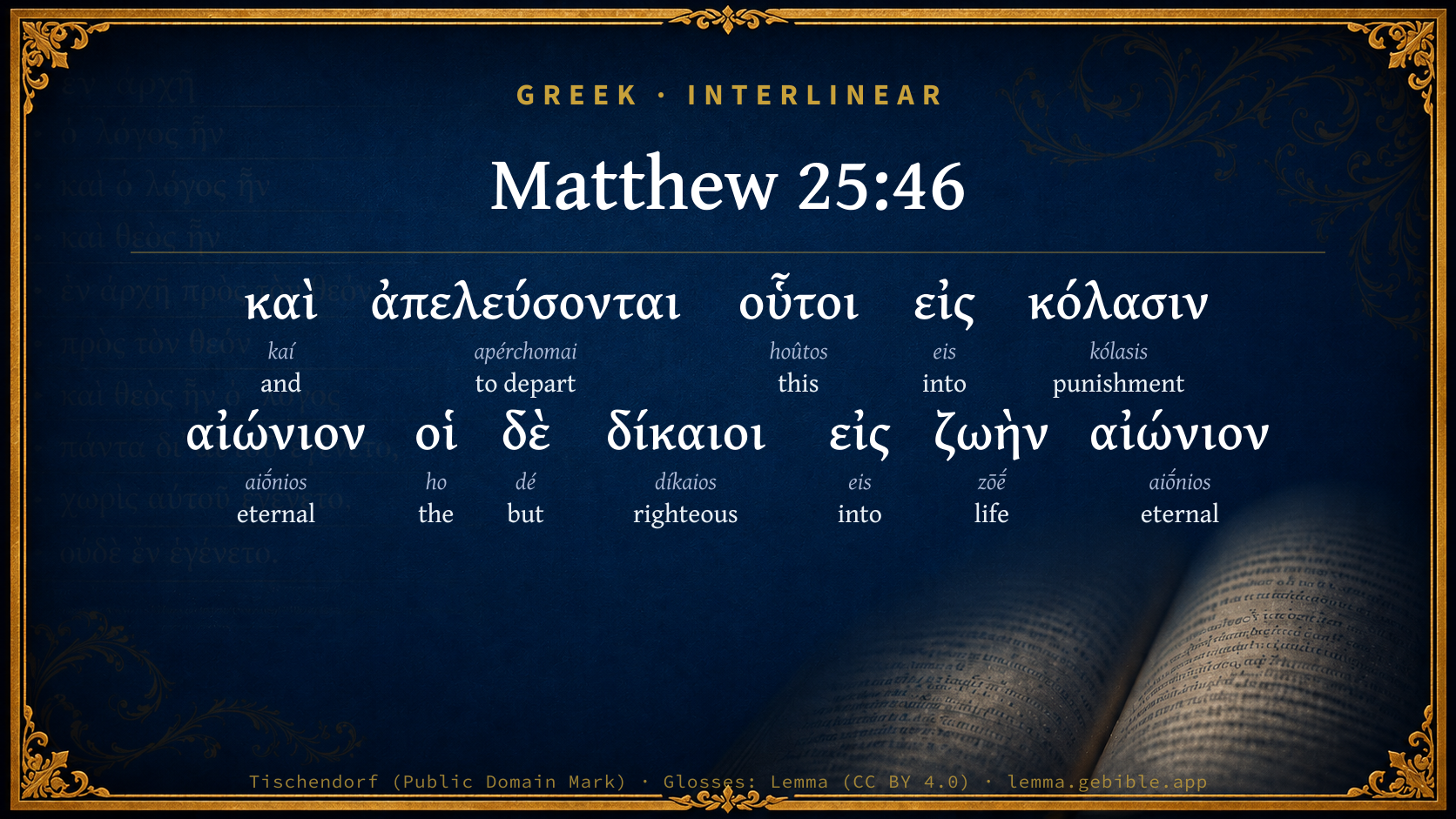
Greek (Tischendorf 8th ed.) Matthew 25:46 appears in the Greek New Testament. The text above is from the Tischendorf 8th edition. Each word links to its Strong’s number and a concise gloss. Click any word for its full Thayer’s Greek Lexicon entry.
Download image
Cite this verse

Matthew 25:46 (World English Bible). Public Domain. Lemma interlinear Bible study tool, https://lemma.gebible.app/v/matthew/25/46.

Show BibTeX & RIS
BibTeX
RIS
English Translation
These will go away into eternal punishment, but the righteous into eternal life."
World English Bible · Public Domain
Highlights
  • 1 first appearance in the Greek New Testament
Full analysis ↓
Download a study sheet

One document with this verse’s original text, its word-by-word gloss line, the meaning frame, cross-references with their text, attributed commentary, and full source and license credits — printable, and it pastes into notes with its structure intact.

This verse Autodidact and up

Study sheet (.html) Plain text (.txt)

A passage Seminary Student

Up to 50 verses in one chapter. A passage sheet keeps up to 6 commentary sources and 12 cross-references per verse, in the order this page ranks them, and says so on the sheet whenever that leaves anything out. Ask for a single verse and you get the Autodidact verse sheet above.

Everything on this page stays free to read, with no account — the sheet is a download of what is already on screen, not access to it.

Want to remove ads? Support Godless Engineer
Compare translations 3

The same verse in 3 English versions, stacked beneath the original-language interlinear above. Click any original word for its lexicon entry.

Each is an independent rendering of the whole verse — the interlinear is not word-aligned to these translations.

Highlighted words mark where these versions differ — a whole-verse word diff, not a word-by-word alignment.

  • World English Bible Public Domain
    These will go away into eternal punishment, but the righteous into eternal life."
  • King James Version Public Domain
    And these shall go away into everlasting punishment: but the righteous into life eternal.
  • unfoldingWord Literal Text CC BY-SA 4.0
    And these will go away into eternal punishment, but the righteous into eternal life.”

unfoldingWord Literal Text — © unfoldingWord, licensed CC BY-SA 4.0. Word-aligned USFM3 via Door43 (git.door43.org/unfoldingWord/en_ult).

Versions to compare (up to 4)

3 of 4 selected

Show all 19 translations

Every available English version of this verse, each an independent rendering of the whole verse.

  • World English Bible Public Domain
    These will go away into eternal punishment, but the righteous into eternal life."
  • Berean Standard Bible Public Domain
    And they will go away into eternal punishment, but the righteous into eternal life.”
  • Majority Standard Bible Public Domain
    And they will go away into eternal punishment, but the righteous into eternal life.”
  • King James Version Public Domain
    And these shall go away into everlasting punishment: but the righteous into life eternal.
  • American Standard Version (1901) Public Domain
    And these shall go away into eternal punishment: but the righteous into eternal life.
  • Revised Version (1885) Public Domain
    And these shall go away into eternal punishment: but the righteous into eternal life.
  • Geneva Bible (1599) Public Domain
    And these shall goe into euerlasting paine, and the righteous into life eternall.
  • Douay-Rheims (1899) Public Domain
    And these shall go into everlasting punishment: but the just, into life everlasting.
  • Young's Literal Translation Public Domain
    And these shall go away to punishment age-during, but the righteous to life age-during.'
  • Literal Standard Version CC BY-SA 4.0
    And these will go away into continuous punishment, but the righteous into continuous life.”
  • Unlocked Literal Bible CC BY-SA 4.0
    These will go away into eternal punishment, but the righteous into eternal life.”
  • unfoldingWord Literal Text CC BY-SA 4.0
    And these will go away into eternal punishment, but the righteous into eternal life.”
  • Darby Bible Public Domain
    And these shall go away into eternal punishment, and the righteous into life eternal.
  • World Messianic Bible Public Domain
    These will go away into eternal punishment, but the righteous into eternal life.”
  • Webster's Bible Public Domain
    And these shall go away into everlasting punishment: but the righteous into life eternal.
  • Free Bible Version CC BY-SA 4.0
    They will go away into eternal condemnation, but those who are good will enter eternal life.”
  • Bible in Basic English Public Domain
    And these will go away into eternal punishment; but the upright into eternal life.
  • Text-Critical English NT CC BY 4.0
    And these will go away into eternal punishment, but the righteous into eternal life.”
  • Tyndale New Testament (1534) Public Domain
    And these shall go into everlastinge payne: And the righteous into lyfe eternall.

Literal Standard Version (2020), Covenant Press — licensed CC BY-SA 4.0. Text via the HelloAO Bible API (eBible.org). Unlocked Literal Bible (unfoldingWord) — licensed CC BY-SA 4.0. Text via the HelloAO Bible API (eBible.org). unfoldingWord Literal Text — © unfoldingWord, licensed CC BY-SA 4.0. Word-aligned USFM3 via Door43 (git.door43.org/unfoldingWord/en_ult). Free Bible Version, Dr. Jonathan Gallagher — licensed CC BY-SA 4.0. Text via the HelloAO Bible API (eBible.org).

Word by word

More ways to search: Search by grammar → Find every occurrence → Compare this word →

Practice this passage: Drill this verse → Learn its vocabulary →

About this verse

These counts appear in no published source. They are computed here, from the morphology-tagged text and Lemma’s own curated glosses. What Lemma adds →

12
words
10
distinct lemmas
Gospels
section

Notable vocabulary

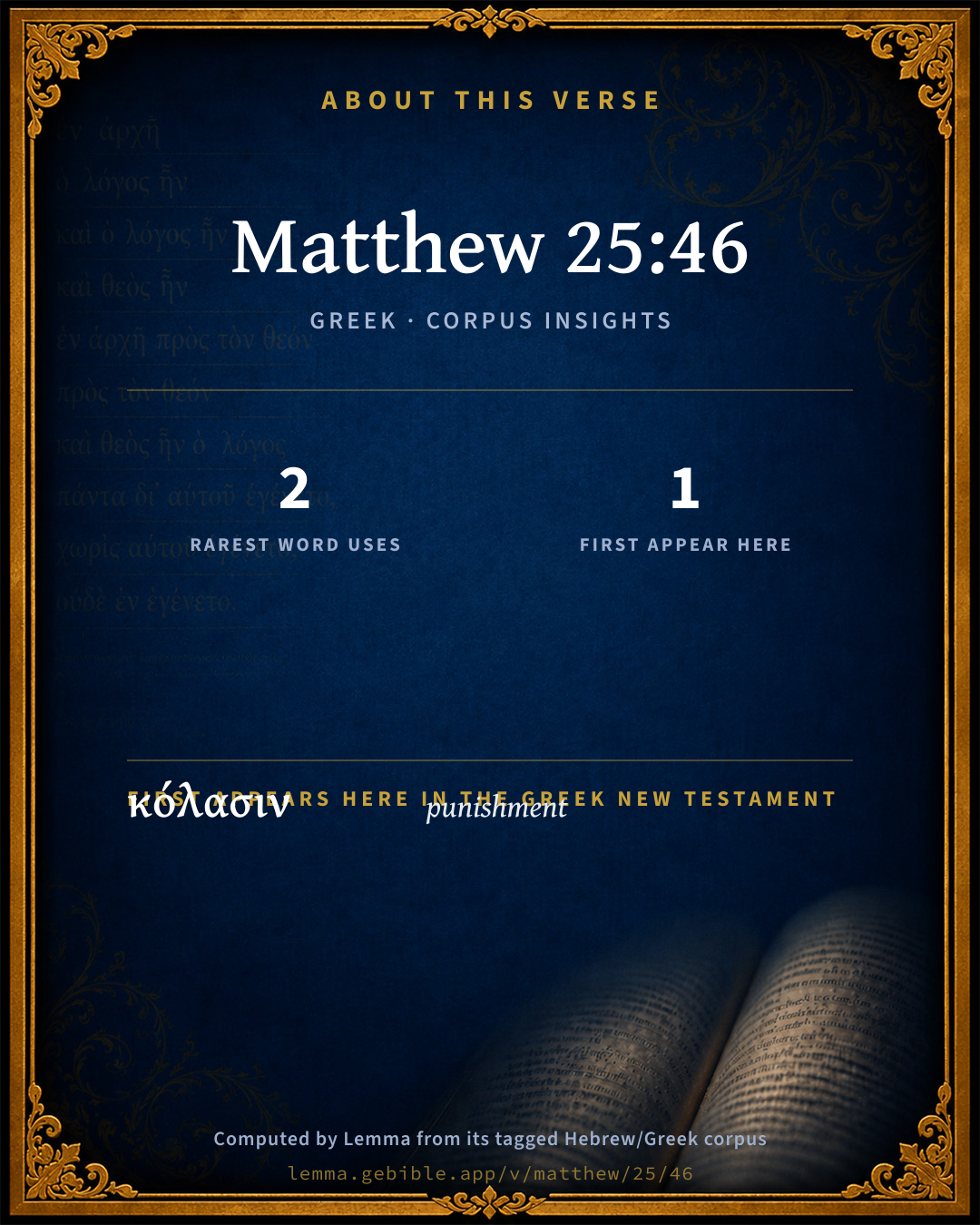
The rarest word here is κόλασιν punishment G2851 — appearing just 2 times in the whole Greek New Testament.

First appearance in Scripture

This word makes its first canonical appearance in the Greek New Testament here:

  • κόλασιν punishment G2851

Shared distinctive vocabulary

κόλασιν punishment G2851 occurs in 2 verses of the Greek New Testament. Also found in:
Repetition

Words recur within this verse:

  • εἰς into G1519 ×2
  • αἰώνιον eternal G166 ×2

Cross-references

26

Topical passages linked to Matthew 25:46 in the Treasury of Scripture Knowledge — connected by theme and wording, ordered by reader-vote popularity; previews shown in the World English Bible.

  • Daniel 12:2 Many of those who sleep in the dust of the earth shall awake, some to everlasting life, and some to shame and everlasting contempt.
  • John 5:29 and will come out; those who have done good, to the resurrection of life; and those who have done evil, to the resurrection of judgment.
  • John 3:36 One who believes in the Son has eternal life, but one who disobeys the Son won't see life, but the wrath of God remains on him."
  • Revelation 21:8 But for the cowardly, unbelieving, sinners, abominable, murderers, sexually immoral, sorcerers, idolaters, and all liars, their part is in the lake that burns with fire and sulfur, which is the second death."
  • Revelation 20:15 If anyone was not found written in the book of life, he was cast into the lake of fire.
  • Romans 6:23 For the wages of sin is death, but the free gift of God is eternal life in Christ Jesus our Lord.
  • 2 Thessalonians 1:9 who will pay the penalty: eternal destruction from the face of the Lord and from the glory of his might,
  • Romans 5:21 that as sin reigned in death, even so might grace reign through righteousness to eternal life through Jesus Christ our Lord.
  • John 3:15–16 that whoever believes in him should not perish, but have eternal life.
  • Revelation 20:10 The devil who deceived them was thrown into the lake of fire and sulfur, where the beast and the false prophet are also. They will be tormented day and night forever and ever.
  • John 10:27–28 My sheep hear my voice, and I know them, and they follow me.
  • Matthew 25:41 Then he will say also to those on the left hand, 'Depart from me, you cursed, into the eternal fire which is prepared for the devil and his angels;
  • Mark 9:48–49 'where their worm doesn't die, and the fire is not quenched.'
  • Mark 9:43–45 If your hand causes you to stumble, cut it off. It is better for you to enter into life maimed, rather than having your two hands to go into Gehenna, into the unquenchable fire,
  • Acts 24:15 having hope toward God, which these also themselves look for, that there will be a resurrection of the dead, both of the just and unjust.
  • Galatians 6:8 For he who sows to his own flesh will from the flesh reap corruption. But he who sows to the Spirit will from the Spirit reap eternal life.
  • 1 John 2:25 This is the promise which he promised us, the eternal life.
  • Matthew 19:29 Everyone who has left houses, or brothers, or sisters, or father, or mother, or wife, or children, or lands, for my name's sake, will receive one hundred times, and will inherit eternal life.
  • Luke 16:26 Besides all this, between us and you there is a great gulf fixed, that those who want to pass from here to you are not able, and that none may cross over from there to us.'
  • John 17:2 even as you gave him authority over all flesh, he will give eternal life to all whom you have given him.
  • Romans 2:7–16 to those who by patience in well-doing seek for glory and honor and incorruptibility, eternal life;
  • 1 John 5:11–12 The testimony is this, that God gave to us eternal life, and this life is in his Son.
  • Revelation 14:10–11 he also will drink of the wine of the wrath of God, which is prepared unmixed in the cup of his anger. He will be tormented with fire and sulfur in the presence of the holy angels, and in the presence of the Lamb.
  • Psalms 16:10–11 For you will not leave my soul in Sheol, Neither will you allow your holy one to see corruption.
  • Matthew 13:43 Then the righteous will shine forth like the sun in the Kingdom of their Father. He who has ears to hear, let him hear.
  • Jude 1:21 Keep yourselves in the love of God, looking for the mercy of our Lord Jesus Christ to eternal life.

Cross-references courtesy of OpenBible.info (CC BY 4.0).

Commentary

Notes on Matthew 25:46 from classic Christian and Jewish commentators (each source and its license shown beneath its notes). The classic Christian expositions comment on the surrounding passage and are grouped to its opening verse, so a note may address several verses; the Jewish commentaries on the Tanakh (Rashi and others) are per-verse, so they appear only where the commentator wrote on this verse.

Lemma curates 59 commentaries, every one of them public domain or Creative Commons licensed, each selected and text-cleaned for this edition rather than reprinted as found. About our sources →

The Biblical Illustrator

Joseph S. Exell

Mat_25:46

And these shall go away into everlasting punishment.

The final state of the saints in heaven

There is a state of happiness which the spirits of just men enter into immediately after their separation from the body, But after the resurrection and the general judgment, then the righteous shall go into life eternal.

I. The state of happiness itself. That good men shall enjoy a state of happiness in the world to come is evident.

1. From the light of nature and reason. General notion among the wiser heathens. Universal desire in mankind. The unequal distribution of things in the present state.

2. From Divine revelation.

II. The eternity of this happiness. Testimony of Scripture. (Outlines of Sermons.)

I. The parties sentenced.

II. The penalties awarded.

1. Positive infliction.

2. Incited passions.

3. Bitter reflection.

4. Painful associations.

5. Mutual recognition.

III. The perpetuity determined.

1. Necessary.

2. Just.

3. Certain. (J. Blackburn.)

For ever

Your opinion about for ever can have no manner of effect upon the reality of that for ever. A party of boatmen on the Niagara river may have a very strong opinion when they are caught by the rapids, that it is very pleasant rowing; but neither their shouts nor their merriment will alter the fact: that the worlds cataract is close at hand. You have a strong opinion that hell-fire is a delusion; that they are superstitious, and cruel, and ignorant who ask you to pause, and awake, and prepare for this coming, this continued retribution; but your opinions will not have the slightest, the remotest, the minutest influence on the tremendous fact. (Reynolds.)

Heaven and hell

I. The everlasting state of the righteous. It will consist of:

(1) Perfect knowledge;

(2)Perfect love;

(3) Perfect purity;

(4) Perfect felicity.

II. The eternal state of the wicked. Includes:

1. The privation of infinite good.

(1) They have lost heaven and all its blessedness at once.

(2) They are strangers to the endearments and consolations of friendship.

(3) Nor is there any, the smallest, rest from pain.

2. The infliction of infinite evil. Tormentors in hell:

(1) Conscience;

(2) Satan;

(3) Fellow-damned;

(4)The sufferer will be his own tormentor;

(5) Memory;

(6) Anticipation. (T. Raffles.)

The nature of true righteousness

The following four particulars are necessary to entitle us to the denomination and character of righteous men.

I. The establishment within us of good principles, and acting from them.

II. The superior efficacy of such principles within us to the efficacy of all other principles.

III. The manifestation of their superiority by avoiding all habitual guilt, and practicing all known duties; and

IV. A constant endeavour to grow better. (Richard Price.)

Eternal life

I. Eternal life, what it is.

1. It is life in the most perfect existence.

2. It is life in its fullest enjoyment. The intellect in its highest flights, the will in its most entire subjugation, and the affections, shall be fully enjoyed there.

3. It is life in its eternal duration.

II. The persons who are to enjoy eternal life-the righteous. They have been stripped of their own righteousness, and are clad in the righteousness of Christ. (J. H. Evans, M. A.)

The Biblical Illustrator, edited by Joseph S. Exell (c. 1880s–1900s) — public domain. Text from a community e-Sword module.

Tyndale Open Study Notes

Tyndale Open Resources

25:46 The Greek term translated eternal can mean either “lasting forever” or “lasting for an age,” in this case “the age to come” (13:39-40, 49; 24:3; John 17:3; 2 Thes 1:9; Phlm 1:15; 1 Jn 5:11, 13). Some hold out hope that the punishment of the damned will, after “an age,” be ended by annihilation or forgiveness. The parallel between eternal life and eternal punishment suggests strongly that it means “lasting forever,” since eternal life does not end (see also Luke 16:19-31; Heb 6:2; Rev 20:10).

Tyndale Open Study Notes — © Tyndale Open Resources, licensed CC BY-SA 4.0. Text via the HelloAO Bible API.

Bengel's Gnomon

Johann Albrecht Bengel

Mat 25:46. Ἀπελεύσονται, shall depart) The place of judgment is distinct from the places into which the two classes will severally depart.—κόλασις, punishment[1105]) There is a difference between τιμωρία, vengeance, and κόλασις, punishment; for punishment is inflicted for the sake of him who suffers: vengeance for the satisfaction of him who inflicts it; see Arist. Rhet. i. 10, n. 31.[1106]—αἰώνιον, eternal) Eternal[1107] signifies that which reaches and passes the limits of earthly time: cf. Gnomon on Rom 16:25.—οἱ δὲ, κ.τ.λ., but the, etc.) Christ the King shall first address the righteous, in the hearing of the unrighteous; but the unrighteous shall first depart, in the sight of the righteous; see ch. Mat 13:49-50. Thus the damned will see nothing of eternal life, though the righteous will see the vengeance inflicted on the damned.—ΔΊΚΑΙΟΙ, righteous) declared to be so by this very judgment.

[1105] “Of fire, see Mat 25:41. Righteous King, grant that I may hereafter find myself standing on the right hand.”—B. G. V.

[1106] In the Oxford edition of 1833, I. 10, § 17.—I. B.

[1107] The Bible has no metaphysical distinctions, therefore it has no one word to express eternity; this it expresses by long periods joined with one another indefinitely. Αἰῶνες = עו̇לָמִים, זva: very long periods, which, multiplied indefinitely, give the only notion we can form of eternity. Ὡρα (Th. ὃρος, terminus), a definite space of time: καιρὸς, the time, the fit time: χρόνος, time, in its actuality, marking succession: αἰὼν, an indefinite course of time, without the notion of an end. See Tittm. Syn. Gr. Test. Ἀπʼ αἰώνων = from all eternity, a parte ante. Εἰς τοὺς αἰῶνας = to all eternity, for ages, for ever, a parte post. As these phrases are applied to the eternity of God Himself, and as, moreover, αἰώνιος is applied to ζωὴ, which none deny to mean everlasting life, no objections (such as have been lately raised), from the meaning of αἰὼν, will hold good against the everlasting duration of punishment.—ED.

Bengel's Gnomon of the New Testament — English translation (T&T Clark, Edinburgh, 1860) — public domain. Text from a community e-Sword module.

Meyer's Critical & Exegetical Commentary

Heinrich August Wilhelm Meyer

Mat_25:46. Comp. Dan_12:2. The absolute idea of eternity, in regard to the punishment of hell (comp. Mat_25:41), is not to be got rid of either by a popular toning down of the force of αἰώνιος (Paulus), or by appealing (de Wette, Schleiermacher, Oetinger) to the figurative character of the term fire and the supposed incompatibility between the idea of eternity and such a thing as evil and its punishment, any more than by the theory that the whole representation is intended simply by way of warning (according to which view it is not meant thereby to throw light upon the eternal nature of things, but only to portray the κρίσις, i.e. the cessation of the conflict between good and evil by the extinction of the latter); but is to be regarded as exegetically established in the present passage (comp. Mat_3:12, Mat_18:8) by the opposed ζωὴν αἰώνιον, which denotes the everlasting Messianic life (Kaeuffer, as above, p. 21); comp. also Weizel in the Stud. u. Krit. 1836, p. 605 ff.; Schmid in the Jahrb. f. D. Theol. 1870, p. 136 ff.

οἱ δὲ δίκαιοι] hoc ipso judicio declarati, Bengel. Comp. Rom_5:19.

REMARK.

Because the judgment is a judgment of Christians (see on Mat_25:31), faith is presupposed though not formally mentioned. The truth is, the Judge regulates His decision according to the way in which faith has been evidenced by love (1Co_13:1 ff.; Joh_13:35), without which as its necessary fruit faith does not save (Gal_5:6). Comp. Apol. Conf. A, p. 138. The manifestations of love, as forming the principle of the Christians life, accordingly constitute the πρᾶξις by which he is to be judged (Mat_16:27; 2Co_5:10). Comp. Mat_5:7. But, in so far as, according to this concrete view of the judgment, Jesus bases His sentence upon the principle that love shown to or withheld from the least of His brethren is the same as love shown to or withheld from Himself, He does so in harmony with the view contained in Mat_18:5, Mat_10:40. Comp. Joh_13:20.

Meyer — Critical and Exegetical Commentary on the New Testament — English translation by Peter Christie, edited by Frederick Crombie (T&T Clark, 1880) — public domain. Text from a community e-Sword module.

Expositor's Greek Testament

ed. W. Robertson Nicoll

Mat 25:46 . κόλασιν , here and in 1Jn 4:18 ( ὁ φόβος κόλασιν ἔχει ), from κολάζω = mutilation or pruning, hence suggestive of corrective rather than of vindictive punishment as its tropical meaning. The use of this term in this place is one of the exegetical grounds rested on by those who advocate the “larger hope”. Another is the strict meaning of αἰώνιος : agelong, not everlasting. From the combination results the phrase: agelong, pruning, or discipline, leaving room for the hope of ultimate salvation. But the doctrine of the future states must ultimately rest on deeper considerations than those supplied by verbal interpretation. Weiss (Mt.-Evang.) and Wendt ( L. J. ) regard Mat 25:46 as an interpolation by the evangelist.

The doctrine of this passage is that love is the essence of true religion and the ultimate test of character for all men Christian or non-Christian. All who truly love are implicit Christians. For such everywhere the kingdom is prepared. They are its true citizens and God is their Father. In calling those who love the Father’s blessed ones Jesus made an important contribution to the doctrine of the Fatherhood, defining by discriminating use the title “Father”.

The Expositor's Greek Testament, edited by W. Robertson Nicoll (1897–1910) — public domain. Text from a community e-Sword module.

Adam Clarke's Commentary

Verse 46. And these shall go away into everlasting punishment] No appeal, no remedy, to all eternity! No end to the punishment of those whose final impenitence manifests in them an eternal will and desire to sin. By dying in a settled opposition to God, they cast themselves into a necessity of continuing in an eternal aversion from him.

But some are of opinion that this punishment shall have an end: this is as likely as that the glory of the righteous shall have an end: for the same word is used to express the duration of the punishment, κολασιν αιωνιον, as is used to express the duration of the state of glory: ζωην αιωνιον. I have seen the best things that have been written in favour of the final redemption of damned spirits; but I never saw an answer to the argument against that doctrine, drawn from this verse, but what sound learning and criticism should be ashamed to acknowledge. The original word αιων is certainly to be taken here in its proper grammatical sense, continued being, αειων, NEVER ENDING. Some have gone a middle way, and think that the wicked shall be annihilated. This, I think, is contrary to the text; if they go into punishment, they continue to exist; for that which ceases to be, ceases to suffer. See Clarke on Ge 21:33, where the whole subject is explained.

A very good improvement of the parable of the wise and foolish virgins is made by Salvian, a very pious writer of the fifth century, (Epist. ad. Ecclus. Cath. lib. ii.,) the substance of which, in Mr. Bulkley's translation, is as follows: -

Ego unum scio, c. "One thing I know, that the lamps of the foolish virgins are said to have gone out for want of the oil of good works but thou, whoever thou art, thinkest that thou hast oil in abundance, and so did they; for, if they had not believed themselves to have had it, they would have provided themselves with it; for since afterwards, as the Lord says, they would gladly have borrowed, and sought it so eagerly, no doubt they would have done so before, had they not been deceived by the confidence of having it. Thou thinkest thyself wise, and these did not imagine themselves to be foolish: thou thinkest that thy lamp has light, and they lost their light because they thought they should have it. For why did they prepare their lamps if they did not think they should be lighted? In a word, their lamps, I suppose, must have afforded some degree of light; for since we read of their being afraid that their lamps should go out, they certainly had something which they feared would be extinguished. Nor was it a groundless fear; their lamps did go out, and that pure light of virginity which appeared profited them nothing, for want of a supply of oil. From whence we understand that what is but a little, is in a manner nothing. You have therefore need of a lamp plentifully filled, that your light may be lasting. And if those which we light up here for a short time so soon fail, unless copiously supplied with oil, how much must thou stand in need of that thy lamp may shine to eternity?"

This writer was a priest of Marseilles, in 430. He bewailed the profligacy of his times so much, and so pathetically, that he has been styled the Jeremiah of the fifth century. Were he still upon earth, he would find equal reason to deplore the wickedness and carelessness of mankind.

From what our Lord has here said, we may see that God indispensably requires of every man to bring forth good fruit; and that a fruitless tree shall be inevitably cut down, and cast into the fire. Let it be also remarked that God does not here impute to his own children the good works which Jesus Christ did for them. No! Christ's feeding the multitudes in Judea will not be imputed to them, while persons in their own neighbourhood are perishing through want, and they have wherewithal to relieve them. He gives them a power that they may glorify his name by it and have, in their own souls, the continued satisfaction which arises from succouring the distressed. Let it be farther remarked, that Christ does not say here that they have purchased the eternal life by these good deeds. No! for the power to work, and the means of working, came both from God. They first had redemption through his blood, and then his Spirit worked in them to will and to do. They were therefore only workers together with him, and could not be said, in any sense of the word, to purchase God's glory, with his own property. But though God works in them, and by them, he does not obey for them. The works of piety and mercy THEY perform, under the influence and by the aid of his grace. Thus God preserves the freedom of the human soul, and secures his own glory at the same time. Let it be remarked, farther, that the punishment inflicted on the foolish virgins, the slothful servant, and the cursed who are separated from God, was not because of their personal crimes; but because they were not good, and were not useful in the world. Their lives do not appear to have been stained with crimes,-but they were not adorned with virtues. They are sent to hell because they did no good. They were not renewed in the image of God; and hence did not bring forth fruit to his glory. If these harmless people are sent to perdition, what must the end be of the wicked and profligate!

Adam Clarke's Commentary on the Bible (1810–1826) — public domain. Text from a community e-Sword/MySword module.

Ellicott's Commentary for English Readers

(46) Everlasting punishment . . . life eternal.—The two adjectives represent one and the same Greek word, αἰώνιος, and we ought therefore to have the same word in both clauses in the English. Of the two words, “eternal” is philologically preferable, as being traceably connected with the Greek, the Latin ætemus being derived from ætas, and that from ævum, which, in its turn, is but another form of the Greek ἀιὼν (æon). The bearing of the passage on the nature and duration of future punishment is too important to be passed over; and though the question is too wide to be determined by a single text, all that the text contributes to its solution should be fully and fairly weighed. On the one hand, then, it is urged that as we hold the “eternal life” to have no end, so we must hold also the endlessness of the “eternal fire.” On the other hand, it must be admitted (1) that the Greek word which is rendered “eternal,” does not in itself involve endlessness, but rather duration, whether through an age or a succession of ages; and that it is therefore applied in the New Testament to periods of time that have had both beginning and ending (Rom_16:25, where the Greek is “from æonian times,” our version giving “since the world began”—comp. 2Ti_1:9; Tit_1:2), and in the Greek version of the Old Testament to institutions and ordinances that were confessedly to wax old and vanish away (Gen_17:8; Lev_3:17); and (2) that in the language of a Greek Father (Gregory of Nyssa, who held the doctrine of the restitution of all things) it is even connected with the word “interval,” as expressing the duration of the penal discipline which was, he believed, to come to an end after an æonian intervening period. Strictly speaking, therefore, the word, as such, and apart from its association with any qualifying substantive, implies a vast undefined duration, rather than one in the full sense of the word “infinite.” The solemnity of the words at the close of the great prophecy of judgment tends obviously to the conclusion that our Lord meant His disciples, and through them His people in all ages, to dwell upon the division which was involved in the very idea of judgment, as one which was not to be changed. Men must reap as they have sown, and the consequences of evil deeds, or of failure to perform good deeds, must, in the nature of the case, work out their retribution, so far as we can see, with no assignable limit. On the other hand, once again, (1) the symbolism of Scriptural language suggests the thought that “fire” is not necessarily the material element that inflicts unutterable torture on the body, and that the penalty of sin may possibly be an intense and terrible consciousness of the presence of God, who is as a “consuming fire” (Heb_12:29) in the infinite majesty of His holiness, united with the sense of being at variance with it, and therefore under condemnation. And (2), assuming the perpetuity of the “punishment,” it does not involve necessarily an equality of suffering for the whole multitude of the condemned at any time, nor for any single soul throughout its whole duration. Without dwelling, as some have done, on the fact that the Greek word here used for “punishment” had acquired a definite significance as used by ethical writers for reformative rather than vindictive or purely retributive suffering (Aristot. Rhet. i. 10), it is yet conceivable that the acceptance of suffering as deserved may mitigate its severity; and we cannot, consistently with any true thoughts of God, conceive of Him as fixing, by an irresistible decree, the will of any created being in the attitude of resistance to His will. That such resistance is fatally possible we see by a wide and painful experience, and as the “hardening” in such cases is the result of a divine law, it may, from one point of view, be described as the act of God (Rom_9:18); but a like experience attests that, though suffering does not cease to be suffering, it may yet lose something of its bitterness by being accepted as deserved, and the law of continuity and analogy, which, to say the least, must be allowed some weight in our thoughts of the life to come, suggests that it may be so there also. (For other aspects of this momentous question, see Notes on Mat_5:26; Mat_18:34.) (3) As to the nature of the “eternal life” which is thus promised to those who follow the guidance of the Light that lighteth every man, we must remember, that within a few short hours of the utterance of these words, it was defined by our Lord in the hearing of those who listened to them: “This is life eternal, that they might know Thee the only true God, and Jesus Christ whom Thou hast sent” (Joh_17:3). That life in its very nature tends to perpetuity, and it is absolutely inconceivable that after having lasted through the ages which the word “eternal,” on any etymological explanation, implies, it should then fail and cease.

A Bible Commentary for English Readers, edited by Charles John Ellicott (1878–1897) — public domain. Text from a community e-Sword module.

The Cambridge Bible for Schools and Colleges

gen. ed. J. J. S. Perowne

46. The same Greek word (aiônios) is translated everlasting (punishment) and (life) eternal; also in each case the adjective in the Greek text follows the noun—the place of emphasis. The adjective aiônios (eternal) = of or belonging to (1) an aiôn or period, (a) past, (b) present, (c) future, or (2) to a succession of aiôns or periods. It does not, therefore, in itself=“unending.” But life eternal, which is “to know the true God and Jesus Christ” (Joh_17:3), can only be conceived of as unending and infinite; cp. “Art thou not from everlasting, O Lord my God, mine Holy One? we shall not die” (Hab_1:12).

punishment] (Greek, kolasis), not “vengeance,” but punishment that checks or reforms.

The Cambridge Bible for Schools and Colleges (gen. ed. J. J. S. Perowne; Cambridge University Press, 1878–1918) — public domain. Text from a community e-Sword module.

Trapp's Complete Commentary

John Trapp

46 And these shall go away into everlasting punishment: but the righteous into life eternal.

Ver. 46. And these shall go away, &c.] The sentence began with the godly, the execution with the wicked: both that the godly may see their desire upon their enemies, Psa 58:10; Psa 79:10; and also, that in the others’ misery they may behold, by the difference, their own felicity; and thereby be moved to lift up many a humble, joyful, and thankful heart to God.

John Trapp, A Commentary or Exposition upon All the Books of the Old and New Testament (1647–1656) — public domain. Text from a community e-Sword module.

Albert Barnes' Notes on the Bible

And these shall go away - These “persons.” Many, holding the doctrine of universal salvation have contended that God would punish sin only. Christ says that “those on his left hand,” shall go away - not “sins,” but “sinners.” Besides, sin, as an abstract thing, cannot be punished. Sin is nothing but an “act” - the act of a transgressor, and, to be reached at all, it must be reached by punishing the offender himself.

Into everlasting punishment - The original word translated here as “punishment” means torment, or suffering inflicted for crime. The noun is used but in one other place in the New Testament - 1Jo 4:18; “Fear hath ‘torment.’” The verb from which the noun is derived is twice used - Act 4:21; 2Pe 2:9. In all these places it denotes anguish, suffering, punishment. It does not mean simply a “state or condition,” but absolute, positive suffering; and if this word does not teach it, no word “could” express the idea that the wicked would suffer. It has been contended that the sufferings of the wicked will not be eternal or without end. It is not the purpose of these notes to enter into debates of that kind further than to ascertain the meaning of the language used by the sacred writers. In regard to the meaning of the word “everlasting” in this place, it is to be observed:

1. That the literal meaning of the word expresses absolute eternity - “always belong,” Mat 18:8; Mat 19:16; Mar 3:29; Rom 2:7; Heb 5:9.

2. That the obvious and plain interpretation of the word demands this signification in this place. The original word - αἰώνιον aionion - is employed in the New Testament 66 times. Of these, in 51 instances it is used of the happiness of the righteous; in two, of God’s existence; in six, of the church and the Messiah’s kingdom; and in the remaining seven, of the future punishment of the wicked. If in these seven instances we attach to the word the idea of limited duration, consistency requires that the same idea of limited duration should be given it in the 51 cases of its application to the future glory of the righteous, and the two instances of its application to God’s existence, and the six eases of its appropriation to the future reign of the Messiah and the glory and perpetuity of the church. But no one will presume to deny that in these instances it denotes unlimited duration, and therefore, in accordance with the sound laws of interpretation and of language itself, the same sense of unlimited duration must be given it when used of future punishment - Owen, in loc.

3. That, admitting that it was the Saviour’s design always to teach this doctrine, this would be “the very word” to express it; and if this does not teach it, it could not be taught.

4. That it is not taught in any plainer manner in any confession of faith on the globe; and if this may be explained away, all those may be.

5. That our Saviour knew that this would be so understood by nine-tenths of the world; and if he did not mean to teach it, he has knowingly led them into error, and his honesty cannot be vindicated.

6. That he knew that the doctrine was calculated to produce “fear and terror;” and if he was benevolent, and actually used language calculated to produce this fear and terror, his conduct cannot be vindicated in exciting unnecessary alarms.

7. That the word used here is the same in the original as that used to express the eternal life of the righteous; if one can be proved to be limited in duration, the other can by the same arguments. “The proof that the righteous will be happy forever is precisely the same, and no other, than that the wicked will, be miserable forever.”

8. That it is confirmed by many other passages of Scripture, 2Th 1:7-9; Luk 16:26; Rev 14:11; Psa 9:17; Isa 33:14; Mar 16:16; Joh 3:36.

Life eternal - Man by sin has plunged himself into death, temporal, spiritual, eternal. Christ, by coming and dying, has abolished death, and brought life and immortality to light, 2Ti 1:10. “Life” is the opposite of death. It denotes, here, freedom from death, and positive holiness and happiness forever.

Albert Barnes' Notes on the Bible (1834–1885) — public domain. Text from a community e-Sword/MySword module.

Haydock's Catholic Bible Commentary

Everlasting punishment. The rewards and torments of a future life are declared by Jesus Christ, who is truth itself, to be eternal. Let no one be found to argue hence against the goodness and mercy of God, for punishing sins committed in time with punishments that are eternal. For 1. according to human laws, we see forgery and other crimes punished by death, which is in some measure an eternal exclusion from society. 2. The will of the sinner is such, that he would sin eternally continuing if he could; it is an eternal God, a God of infinite majesty, who is offended. He essentially hates sin; and as, in hell there is no redemption, the sin eternally continuing, the hatred God bears to sin must eternally continue, and with it eternal punishment. The doctrine of those who pretend, with Origen, to question the eternity of the duration of hell’s torments; who can say with him, video infernum quasi senescentum, must encourage vice and embolden the sinner; for if the conviction of eternal torments is not capable to restrain his malice, the doctrine of temporal punishment would be a much lest restraint. The present world would not be habitable, were there nothing for the wicked to apprehend after this life. There are many questions often proposed with regard to the situation and nature of hell-fire, &c. &c. &c. but in all these and similar objects of curiosity, it is best to adhere to the sage reflection of St. Augustine: "When we dispute upon a point very obscure, without any clear and certain documents from the holy Scripture, the presumption of man should stop short, and lean not more to one than the other side." (lib. ii. de pecc. meritis et remiss. chap. xxxvi. ep. 190. ad Optat. chap. v. No. 16.) --- On a recapitulation of this long and most interesting discourse, we may observe, that in the first place, it treats of those wars and persecutions which are to happen in the latter ages of the world; that it next proceeds to describe the heresies and schisms among Christians; the general propagation of the gospel; the great apostacy at the time of the Antichrist; and lastly, the grand and closing scene of the day of judgment. Thus these grand and momentous events are intimately connected with each other, and all materially regard the Church of Christ.

====================

George Leo Haydock (1774–1849), Haydock's Catholic Family Bible and Commentary, 1859 edition — public domain. Excludes Psalms (Douay-Rheims chapter numbering differs from Protestant) and Deuterocanonical books (Catholic canon only).

Matthew Poole's English Annotations

So then it seems they shall rise as well as the other; though they live in the lands of the Grand Seignior, or the Great Mogul, they shall not (as some filthy dreamers have thought) have such a quiet sleep in the graves, but that the sound of the last trump shall awaken them. Nor are they out of the jurisdiction of him that shall be the Judge both of the quick and the dead. Nor shall they escape a judgment without the law, because they have sinned without the law: For the invisible things of God from the creation of the world are clearly seen, being understood by the things that are made, even his eternal power and Godhead, Rom 1:20. They shall perish (as they have sinned) without the law, Rom 2:12. They shall go into everlasting punishment, not a punishment for a time, as Origen thought.

But the righteous, those who shall be so adjudged, being made so in this life by the imputed righteousness of Christ, and accepted as such for their holy and sincere conversation, though in many things imperfect, shall go

into life eternal; which doth not signify a mere eternal existence, (for so the worst of men shall live eternally, or else they could not be capable of eternal punishment), but a happy and blessed estate, which shall never have an end: and thus eternal life always signifieth in Scripture, being opposed to eternal death, everlasting fire, the worm that never dieth, &c. Thus endeth Christ’s kingdom of grace; or rather, thus shall begin his kingdom of glory; all his enemies being put under his feet, and none remaining but this glorious King, and those who shall be his true subjects. Of which kingdom shall be no end.

Matthew Poole's English Annotations on the Holy Bible (1683–1685) — public domain. Text from a community e-Sword/MySword module.

Whedon's Commentary on the Bible

Daniel D. Whedon

46. And these shall go away — Millenarians, who hold that the righteous are raised from the dead at a first resurrection one thousand years before the resurrection of the wicked at a second resurrection, are unable to explain this entire scene of judgment. Here at our Lord’s next advent, at an unknown distance, stand the righteous and the wicked at once before his bar, listen in common to each other’s trial and sentence before either pass to their final doom. The ordinary subterfuge is to say that this judgment day is a thousand years long. For this there is no support in the passage. Besides, by their view the righteous ought to be acquitted and glorified for a millennial kingdom before the wicked are tried, or even raised from the dead. Whereas by this whole description the wicked are raised, adjudged, and condemned before the righteous enter at all upon their reward.

Everlasting punishment. . . life eternal — The words everlasting and eternal are here in the original precisely the same word, and should have been so translated. Hence the duration of the penalty of the wicked is defined by the same measurement as the duration of the reward of the righteous. One is just as long as the other. The pillars of heaven are no firmer than the foundations of hell. The celestial nature of saint and angels is no more immutable than the infernal nature of devils and sinners. And since the word used is the most expressive of perpetuity that the Greek affords, so we have the strongest assurance here that language can afford. And since the term is used as a measurement of divine duration, we may well infer that the foundations both of the divine rewards and the divine penalties are as perpetual as the foundation of the divine government. Clouds and darkness are indeed round about him; righteousness and justice are the basis of his throne.

The word αιων (we may suggest to scholars) is not derived, as Dr. Clarke, (quoting Aristotle) asserts, from αει, always, and ων, existing; for ων is but the noun termination added to αει. This noun termination is equivalent to the Latin termination um; so that the Latin aevum is (with a digamma inserted) the same word as αιων. The Latin word aevum is the same as our word ever, so that the Greek εις αιωνα is precisely forever. By adding the adjective termination ernus to αει we have (inserting a strengthening t) aeternus, eternal. So that αιων, ever, and eternal, are etymological equivalents.

Daniel D. Whedon (gen. ed.), Commentary on the Old and New Testaments (1874–1909) — public domain. Text from a community e-Sword module.

The Pulpit Commentary

Shall go away. Bengel notes that the King will first address the righteous in the audience of the unrighteous, but these last will be dismissed to their place of punishment before the others actually receive their reward. Thus the evil will see nothing of the life eternal, while the good will be bold the vengeance inflicted on the others. (Mat_13:49) Into everlasting punishment (eiv kolasin aiwnion)... life eternal (everlasting, zwhnion). The same term is used in both places, and ought to have been so translated. The word kolasiv in strict classical usage denotes punishment inflicted for the correction and improvement of the offender, timwria being employed to signify punishment in satisfaction of outraged justice, or to revenge an injury. But it is open to doubt whether the former term is to be taken in its strictest sense in the New Testament. A ceaseless controversy rests on the meaning of aiwniov , some contending that it signifies "everlasting," and nothing else; others that its sense is modified by the idea to which it is attached; and others again that it ought to be rendered by "aeonian," to which is given an indeterminate signification governed by our conception of the duration expressed by men. This is not the place to discuss this perplexing question, nor shall I attempt to dogmatize upon the problem. Suffice it to make these few observations. On the one hand, taking the literal sense of our Lord"s words, and the meaning which his hearers would attach to them, we must believe that the risen life and the second death are equally everlasting. (see RAPC Jdt 16:17; Ecc_7:17 RAPC 4Ma 12:12) And if it is thought that eternity of punishment is incompatible with love and benevolence, and inequitable as the penalty of offences committed in time, it must be remembered that eternity of reward is infinitely beyond all human claims, and bears no proportion to the merits of the recipient. Nor may we reason from our conception of the nature and attributes of God; how these attributes work harmoniously together, though seemingly opposed, we cannot presume to determine. The consequences of sin even in this world are often irretrievable, as are some human punishments. We have no reason to suppose that punishment is inflicted only for the correction of the criminal (see on ver. 41), nor is it possible to conceive how this result could be effected by condemning him to the society of devils. Further, we have to regard the heinousness of sin in God"s sight, remembering the infinite price paid for its expiation. And lastly, the doctrine does not depend upon this passage only, but is supported by many other statements in both the Old and New Testaments: e.g. Isa_66:24 Dan_12:2 Mar_9:44, 46, 48 Rev_21:8. Such are some of the chief arguments in favour of the everlasting nature of future punishment. On the other hand, we have to remark that our Lord is here not concerned with teaching this doctrine of eternity; he assumes the authorized view of the matter, and draws his awful lesson from that view. It is certainly true that the meaning of aiwniov is not fixed and uniform; it is conditioned by the term to which it appertains. No one would say that "everlasting" was applied to God and to a mountain in the same sense; and though it seems incongruous to find a difference of meaning in the same sentence, yet there may be reasons for distinguishing the signification of the qualifying adjective in the terms "eternal life" and "eternal punishment." God, indeed, cannot draw back from his promise, but he may be more merciful than the tenor of his threats seems to imply. It is possible that "aeonian" may denote merely indefinite duration without the connotation of never ending. Such like are the pleas brought forward to lessen the plain enunciation of the awful truth. For myself I do not see any escape from the import of the statement, nor any hope of amelioration in the ease of the lest, when relegated to the scene of their penal existence. (see on Mat_18:8, Mat_18:9) But I set no bounds to the Divine mercy and wisdom; and God may see a mode of reconciling his strict justice with his desire of man"s salvation, which our finite understanding cannot grasp. All we can say here is that infinite misery and infinite happiness are set before us, and that God has thus shown the two ends without reserve or possible modification, in order that we may be aroused to shun the one and to win the other. "From thy wrath, and from ever lasting damnation, good Lord, deliver us.

The eternal future.

This is a fearful subject, and one from which we naturally shrink. Yet if Christ spoke of it he must desire us to study his words; if what he said was true, we can only neglect it at our peril. The difficulty is to take his words just for what he meant them to teach us, without over-weighting them with the fantastic horrors of the mediaeval imagination, and also without diminishing their force when we have set them free from those monkish accretions.

I THE DREADFUL DOOM.

1. This is called punishment. The word in the Greek is not the strongest term that could have been employed, viz. one that stands for vengeance. It is a word that generally signifies chastisement, i.e. remedial punishment. But whether such an idea was in the mind of our Lord it is impossible for us to say, especially as he did not speak in Greek, but used the less definite Aramaic language. It is sufficient to know that his language plainly teaches

(1) that there will be suffering in the future for those who are hard and selfish in this life; and

(2) that this suffering will be justly apportioned according to character. Of its nature Jesus says little, but his dreadful words about "wailing and gnashing of teeth" show that it must be very severe a suffering to be avoided by all means as a fearful evil.

2. This is to be eternal. The adjective is indefinite; though it is frequently used for what is everlasting, it is not always so employed, and a stronger term, which plainly means "endless," is not applied to future punishment. We can infer nothing positively from the usage of the word in regard to the question of the possible termination of future punishment. On the one hand, it cannot be said that it forbids all hope; on the other, it must be affirmed that it offers no hope. It presents a dark prospect stretching out into the ages of the future, and it shows no gleam of light beyond it. It is not wise for us to dogmatize on what God has left thus veiled.

II THE GLORIOUS REWARD.

1. It is personal. Life is not a possession like money or lands, which can be detached and valued separately. It is in ourselves. God"s best gift is within the soul.

2. It is positive. Here is more than rest after toil and peace after storm. A gift of actual energy is suggested to us. Life has its powers and faculties. This life of God is more than existence in the future, for St. John tells us that some men on earth have it, and that others have it not. (1Jn_5:12) While its full development is for the future, it begins here and now. It is the life of God in the soul, the powers and energies of the spiritual nature. The prospect of such a life teaches us that we do not yet know what it is to live; the future will unfold possibilities not yet even dreamed of.

3. This too is to be eternal. Its endurance rests on a better foundation than the endurance of the punishment, though the same adjective is used for both states, for it rests on the everlasting love of God. Still the word "eternal" in its vast vagueness points to the life growing and expanding in the future ages, so far on that we cannot trace its remotest future. That is the glorious future of "the righteous;" and "the righteous" are just those who minister to their needy fellow men. W.F.A.

The Pulpit Commentary (1880–1919), ed. H.D.M. Spence-Jones & Joseph S. Exell — public domain. Text from a community e-Sword module.

John Wesley's Explanatory Notes

And these shall go away into everlasting punishment, but the righteous into life everlasting - Either therefore the punishment is strictly eternal, or the reward is not: the very same expression being applied to the former as to the latter. The Judge will speak first to the righteous, in the audience of the wicked. The wicked shall then go away into everlasting fire, in the view of the righteous. Thus the damned shall see nothing of the everlasting life; but the just will see the punishment of the ungodly. It is not only particularly observable here

1. That the punishment lasts as long as the reward; but,

2. That this punishment is so far from ceasing at the end of the world, that it does not begin till then.

John Wesley, Explanatory Notes Upon the Whole Bible (1754–1765) — public domain. Text via the GEBible commentary corpus.

Scofield Reference Notes

C. I. Scofield

into everlasting

Judgments (the seven). Luk 14:14; 2Sa 7:14; Rev 20:12. "Eternal" and "everlasting" are the same word.

The Scofield Reference Bible (1917 edition), notes by C. I. Scofield — public domain. Text from a community e-Sword module.

Burkitt's Expository Notes on the New Testament

William Burkitt

Observe here, 1. That though the righteous are first judged, yet the sentence is first executed on the wicked. They shall go into everlasting punishment.

Observe, 2. That men’s states and conditions in another world will be different, as their ways and doings have been in this world.

3. That everlasting life shall be the portion of the godly, and everlasting punishment the portion of the wicked.

God grant that the horrors of eternal darkness,and the dismal thoughts of a miserable eternity, may effectually discourage every one of us from a wicked and impenitent course of life! For who can dwell with devouring fire? Who can dwell with everlasting burnings?

William Burkitt's Expository Notes on the New Testament (1700–1703) — public domain. Text from a community e-Sword module.

The People's New Testament

B. W. Johnson

46. And these shall go away into everlasting punishment: but the righteous into life eternal. We shall not enter into the discussions that have arisen over this controverted passage. These things are certain: (1) A separation between the righteous and the wicked takes place at judgment. (2) The righteous inherit the kingdom; the wicked “depart into everlasting fire.” (3) The state of the righteous is “life eternal;” the state of the wicked is “everlasting punishment.” (4) The duration of these two states is the same, exactly the same Greek word being used in each case (aionios). Then if the state of punishment has an end, so has the life.

B. W. Johnson's The People's New Testament with Notes (1889–1891) — public domain. Electronic text from the Christian Classics Ethereal Library (CCEL) ThML edition.

Cambridge Greek Testament for Schools and Colleges

46. οὗτοι. Those on the left are unnamed here and throughout the description, but the parallel δίκαιοι infuses a meaning into οὗτοι. Compare with this the unnamed rich man in the parable of Lazarus, Luk 16:19-31.

In this important passage αἰώνιος is translated in A.V. everlasting (punishment) and (life) eternal; in each case the adjective in the text follows the noun, though in A.V. it precedes one noun and follows the other. αἰώνιος = of or belonging to (1) an œon or period, (a) past, (b) present, (c) future, or (2) to a succession of aiôns or periods. In αἰών the idea of time is subordinate. It is the period required for the accomplishment of a specific result. τὰ τέλη τῶν αἰώνων (1Co 10:11) are the results of the æons since the world began. A man’s life is an αἰὼν not because it endures a certain number of years, but because it is complete in itself—with the life the life’s work ends. It does not, therefore, in itself = ‘unending,’ but ‘lasting through the required epoch.’ But life eternal, which is ‘to know the true God and Jesus Christ’ (Joh 17:3), can only be conceived of as unending and infinite; cp. ‘Art thou not from everlasting, O Lord my God, mine Holy One? we shall not die’ (Hab 1:12).

κόλασις (der. from a root meaning to lop, prune, &c.) is ‘correction,’ punishment that checks and reforms, not vengeance (τιμωρία). The two are distinguished, Arist. Rhet. I. 10. 17. The rare occurrence of κόλασις draws attention to its use here. The only other passage where it is found in N.T. is 1Jn 4:18, where the Apostle speaks of ‘perfect love’ (ἡ τελεία ἀγάπη) giving confidence in the day of judgment (ἐν τῇ ἡμέρᾳ τῆς κρίσεως); fear is inconsistent with that perfect love, because φόβος ἔχει κόλασιν—‘hath the remedial correcting punishment even now, and so separates from good while it lasts.’ In a profound sense that passage is cognate to this. Cp. also the use of κολάζεσθαι, 2Pe 2:9, ἀδίκους εἰς ἡμέραν κρίσεως κολαζομένους (suffering punishment now) τηρεῖν. Cp. Act 4:21, μηδὲν εὑρίσκοντες τὸ πῶς κολάσωνται αὐτούς, where the notion of restraint and reform is evident. Two passages of Aristotle’s Ethics which exhibit the use of κόλασις agree with these instances: μηνύουσι δὲ καὶ αἱ κολάσεις γινόμεναι διὰ τούτων· ἰατρεῖαι γάρ τινές εἰσιν, Eth. Nic. II. 3. 5, ‘they are a sort of remedies.’ ἀπειθοῦσι δὲ καὶ ἀφυεστέροις οὖσι κολάσεις τε καὶ τιμωρίας ἐπιτιθέναι τοὺς δὲ ἀνιάτους (the incurable) ὅλως ἐξορίζειν, Eth. Nic. 10.

The rebuke of the king is the beginning of the κόλασις.

Cambridge Greek Testament for Schools and Colleges (Cambridge University Press, 1896; 21 vols, various authors incl. Carr, Maclear, Plummer, Farrar, Lumby, Moule, M. R. James, Simcox) — public domain. Text from a community e-Sword module.

Alford’s Greek Testament

Henry Alford

46.] See Joh 5:28, Joh 5:29; and as taking up the prophetic history at this point, Rev 21:1-8. Observe, the same epithet is used for κόλασις and ζωή—which are here contraries—for the ζωή here spoken of is not bare existence, which would have annihilation for its opposite; but blessedness and reward, to which punishment and misery are antagonist terms.

I thought it proper to state in the 3rd edition, that I did not feel by any means that full confidence which I once did, in the exegesis, quoad prophetical interpretation, given of the three portions of this chap. 25. But I had no other system to substitute: and some of the points here dwelt on seemed to me as weighty as ever. I very much questioned whether the thorough study of Scripture prophecy would not make me more and more distrustful of all human systematizing, and less willing to hazard strong assertion on any portion of the subject.

At the same time, the coincidence of these portions with the process of the great last things in Rev_20 and 21 is never to be overlooked, and should be our guide to their explanation, however distrustful we may be of its certainty. Those who set this coincidence aside, and interpret each portion by itself, without connexion with the rest, are clearly wrong.

Henry Alford, The Greek Testament (1849–1861) — public domain. Text from a community e-Sword module.

International Critical Commentary

46. And these shall go away into eternal punishment, but the righteous into eternal life.] Cf. Dan 12:2; and for “everlasting life,”see Dalm. Words, 156 ff. This splendid ending (vv. 31-46) of the long discourse reads like a Christian homily.

L the Matthæan Logia.

X passages in which Mt. and Lk. agree closely, borrowed from an unknown source or sources.

S Syriac version: Sinaitic MS.

S Syriac version: Peshitta.

S Syriac version: Harclean.

S Syriac version: Curetonian.

al i.e. with other uncial MSS.

DCG. Dictionary of Christ and the Gospels.

Dalm. Dalman.

International Critical Commentary — older volumes (1896–1929), various authors — public domain. Text from a community e-Sword module.

Lesson kit

Teaching starters — assembled from the data on this page, not authored interpretation. Every prompt links to the verse data it draws on. Edit before teaching.

Matthew, in the Gospels, opens this verse with 12 words (10 distinct Greek lemmas). Its most distinctive word is kólasis (“punishment”). A historical commentator’s framing appears above. Read the whole chapter for the surrounding context.

Discussion questions

  1. The word kólasis carries the sense “punishment.” How does it shape the verse?
  2. This is the first place “punishment” appears in Scripture (first appears here). What does its debut here establish?
  3. How does 1 John 4:18, which shares the word «punishment», read alongside this verse?
  4. What does the repetition of “into” (2× in this one verse) do in this verse?
  5. The translations on this page render this verse differently — a whole-verse word diff, not a word-by-word alignment. What might account for the different wordings?
  6. Compare how The Biblical Illustrator and Tyndale Open Study Notes read this verse. Where do they agree or differ?

Things to notice

  • 1 word makes its first canonical appearance in Scripture here.
  • These translations choose different wording for 3 words in this verse.
  • “into” occurs 2× in this single verse.
  • 10 distinct Greek lemmas span 12 words in this verse.

Reading settings

Reading text

Shown beneath each verse's original-language words.

Old Testament
Old Testament edition

Read the OT as the Masoretic Hebrew (MT) or the Greek Septuagint (LXX).

English shown for the Greek Septuagint (in the Hebrew ↔ Greek comparison).

Comparing translations? Open the Compare panel on any verse page to stack up to four side by side.