Matthew 26:56

Greek (Tischendorf 8th ed.) Matthew 26:56 appears in the Greek New Testament. The text above is from the Tischendorf 8th edition. Each word links to its Strong’s number and a concise gloss. Click any word for its full Thayer’s Greek Lexicon entry.
Download image
Cite this verse

Matthew 26:56 (World English Bible). Public Domain. Lemma interlinear Bible study tool, https://lemma.gebible.app/v/matthew/26/56.

Show BibTeX & RIS
BibTeX
RIS
English Translation
But all this has happened, that the Scriptures of the prophets might be fulfilled." Then all the disciples left him, and fled.
World English Bible · Public Domain
Download a study sheet

One document with this verse’s original text, its word-by-word gloss line, the meaning frame, cross-references with their text, attributed commentary, and full source and license credits — printable, and it pastes into notes with its structure intact.

This verse Autodidact and up

Study sheet (.html) Plain text (.txt)

A passage Seminary Student

Up to 50 verses in one chapter. A passage sheet keeps up to 6 commentary sources and 12 cross-references per verse, in the order this page ranks them, and says so on the sheet whenever that leaves anything out. Ask for a single verse and you get the Autodidact verse sheet above.

Everything on this page stays free to read, with no account — the sheet is a download of what is already on screen, not access to it.

Want to remove ads? Support Godless Engineer
Compare translations 3

The same verse in 3 English versions, stacked beneath the original-language interlinear above. Click any original word for its lexicon entry.

Each is an independent rendering of the whole verse — the interlinear is not word-aligned to these translations.

Highlighted words mark where these versions differ — a whole-verse word diff, not a word-by-word alignment.

  • World English Bible Public Domain
    But all this has happened, that the Scriptures of the prophets might be fulfilled." Then all the disciples left him, and fled.
  • King James Version Public Domain
    But all this was done, that the scriptures of the prophets might be fulfilled. Then all the disciples forsook him, and fled.
  • unfoldingWord Literal Text CC BY-SA 4.0
    But all this has happened so that the writings of the prophets might be fulfilled.” Then all the disciples, having left him, fled.

unfoldingWord Literal Text — © unfoldingWord, licensed CC BY-SA 4.0. Word-aligned USFM3 via Door43 (git.door43.org/unfoldingWord/en_ult).

Versions to compare (up to 4)

3 of 4 selected

Show all 19 translations

Every available English version of this verse, each an independent rendering of the whole verse.

  • World English Bible Public Domain
    But all this has happened, that the Scriptures of the prophets might be fulfilled." Then all the disciples left him, and fled.
  • Berean Standard Bible Public Domain
    But this has all happened so that the writings of the prophets would be fulfilled.” Then all the disciples deserted Him and fled.
  • Majority Standard Bible Public Domain
    But this has all happened so that the writings of the prophets would be fulfilled.” Then all the disciples deserted Him and fled.
  • King James Version Public Domain
    But all this was done, that the scriptures of the prophets might be fulfilled. Then all the disciples forsook him, and fled.
  • American Standard Version (1901) Public Domain
    But all this is come to pass, that the scriptures of the prophets might be fulfilled. Then all the disciples left him, and fled.
  • Revised Version (1885) Public Domain
    But all this is come to pass, that the scriptures of the prophets might be fulfilled. Then all the disciples left him, and fled.
  • Geneva Bible (1599) Public Domain
    But all this was done, that the Scriptures of the Prophets might be fulfilled. Then all the disciples forsooke him, and fled.
  • Douay-Rheims (1899) Public Domain
    Now all this was done, that the scriptures of the prophets might be fulfilled. Then the disciples all leaving him, fled.
  • Young's Literal Translation Public Domain
    but all this hath come to pass, that the Writings of the prophets may be fulfilled;' then all the disciples, having left him, fled.
  • Literal Standard Version CC BY-SA 4.0
    but all this has come to pass, that the Writings of the prophets may be fulfilled”; then all the disciples, having left Him, fled.
  • Unlocked Literal Bible CC BY-SA 4.0
    But all this has happened so that the writings of the prophets might be fulfilled.” Then all the disciples left him and fled.
  • unfoldingWord Literal Text CC BY-SA 4.0
    But all this has happened so that the writings of the prophets might be fulfilled.” Then all the disciples, having left him, fled.
  • Darby Bible Public Domain
    But all this is come to pass that the scriptures of the prophets may be fulfilled. Then all the disciples left him and fled.
  • World Messianic Bible Public Domain
    But all this has happened that the Scriptures of the prophets might be fulfilled.” Then all the disciples left him and fled.
  • Webster's Bible Public Domain
    But all this was done, that the scriptures of the prophets might be fulfilled. Then all the disciples forsook him, and fled.
  • Free Bible Version CC BY-SA 4.0
    But all this is happening to fulfill what the prophets wrote.” Then all the disciples abandoned him and ran away.
  • Bible in Basic English Public Domain
    But all this has taken place so that the writings of the prophets might come true. Then all his disciples went from him in flight.
  • Text-Critical English NT CC BY 4.0
    But all this has taken place so that the Scriptures of the prophets would be fulfilled.” Then all the disciples left him and fled.
  • Tyndale New Testament (1534) Public Domain
    All this was done that the scriptures of the Prophetes myght be fulfilled. Then all the disciples forsoke him and fleed.

Literal Standard Version (2020), Covenant Press — licensed CC BY-SA 4.0. Text via the HelloAO Bible API (eBible.org). Unlocked Literal Bible (unfoldingWord) — licensed CC BY-SA 4.0. Text via the HelloAO Bible API (eBible.org). unfoldingWord Literal Text — © unfoldingWord, licensed CC BY-SA 4.0. Word-aligned USFM3 via Door43 (git.door43.org/unfoldingWord/en_ult). Free Bible Version, Dr. Jonathan Gallagher — licensed CC BY-SA 4.0. Text via the HelloAO Bible API (eBible.org).

Word by word

More ways to search: Search by grammar → Find every occurrence → Compare this word →

Practice this passage: Drill this verse → Learn its vocabulary →

ἔφυγον
pheúgō
G5343
“to flee”
Verb, Aorist, Active, Indicative, 3rd person, Plural
Part of Speech
Verb
Tense
Aorist
Voice
Active
Mood
Indicative
Person
3rd person
Number
Plural
Full Thayer's Definition

Origin: apparently a primary verb

TDNT: None

1. to flee away, seek safety by flight 2. metaph. to flee (to shun or avoid by flight) something abhorrent, esp. vices 3. to be saved by flight, to escape safely out of danger 4. poetically, to flee away, vanish
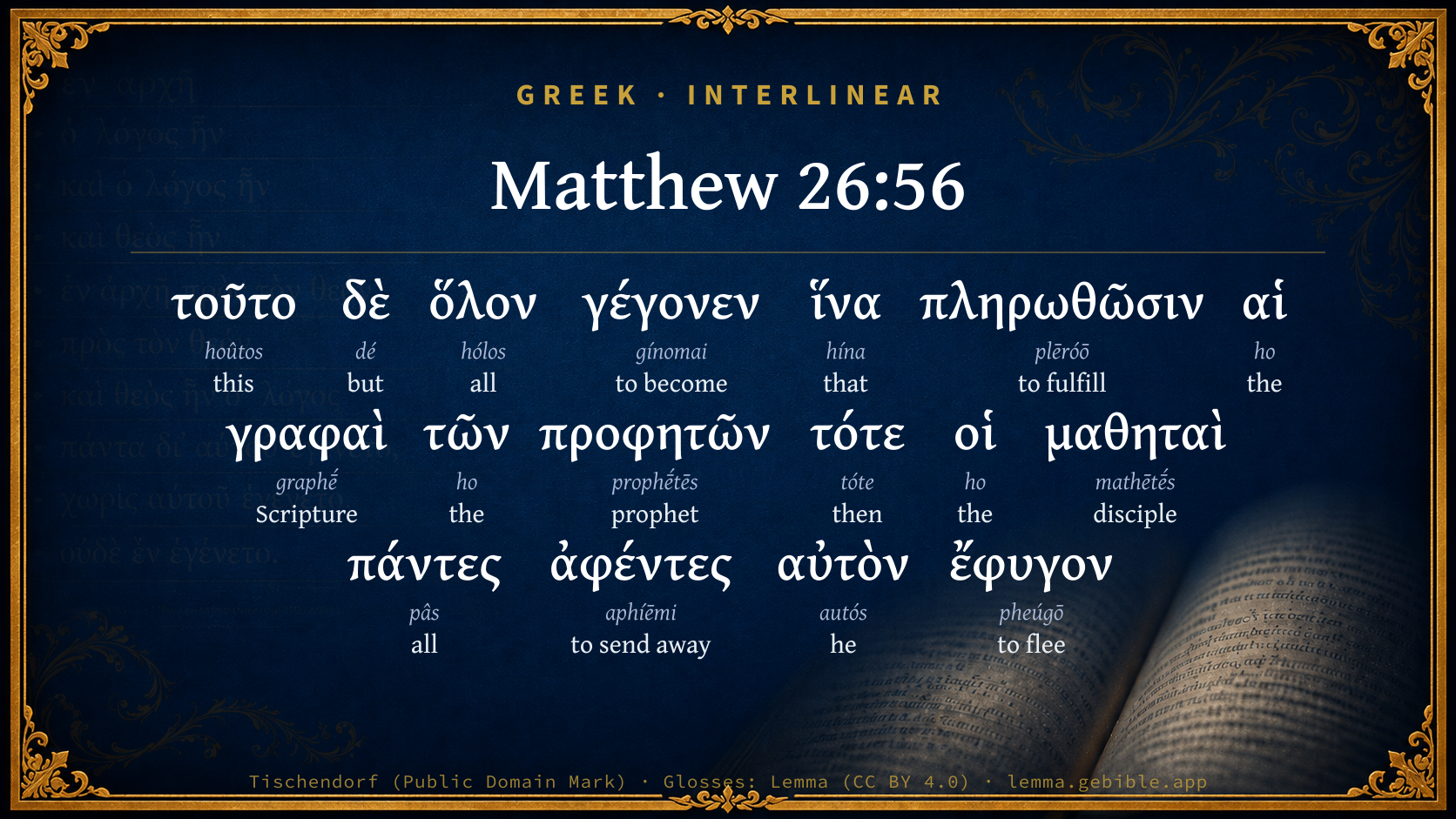
  1. τοῦτο hoûtos G3778 “this” Demonstrative pronoun, Nominative, Singular, Neuter
  2. δὲ dé G1161 “but” Conjunction
  3. ὅλον hólos G3650 “all” Adjective, Nominative, Singular, Neuter
  4. γέγονεν gínomai G1096 “to become” Verb, Perfect, Active, Indicative, 3rd person, Singular
  5. ἵνα hína G2443 “that” Conjunction
  6. πληρωθῶσιν plēróō G4137 “to fulfill” Verb, Aorist, Passive, Subjunctive, 3rd person, Plural
  7. αἱ ho G3588 “the” Article, Nominative, Plural, Feminine
  8. γραφαὶ graphḗ G1124 “Scripture” Noun, Nominative, Plural, Feminine
  9. τῶν ho G3588 “the” Article, Genitive, Plural, Masculine
  10. προφητῶν prophḗtēs G4396 “prophet” Noun, Genitive, Plural, Masculine
  11. τότε tóte G5119 “then” Adverb
  12. οἱ ho G3588 “the” Article, Nominative, Plural, Masculine
  13. μαθηταὶ mathētḗs G3101 “disciple” Noun, Nominative, Plural, Masculine
  14. πάντες pâs G3956 “all” Adjective, Nominative, Plural, Masculine
  15. ἀφέντες aphíēmi G863 “to send away” Verb, Aorist, Active, Participle, Nominative, Plural, Masculine
  16. αὐτὸν autós G846 “he” Personal pronoun, Accusative, Singular, Masculine

About this verse

These counts appear in no published source. They are computed here, from the morphology-tagged text and Lemma’s own curated glosses. What Lemma adds →

17
words
15
distinct lemmas
Gospels
section

Shared distinctive vocabulary

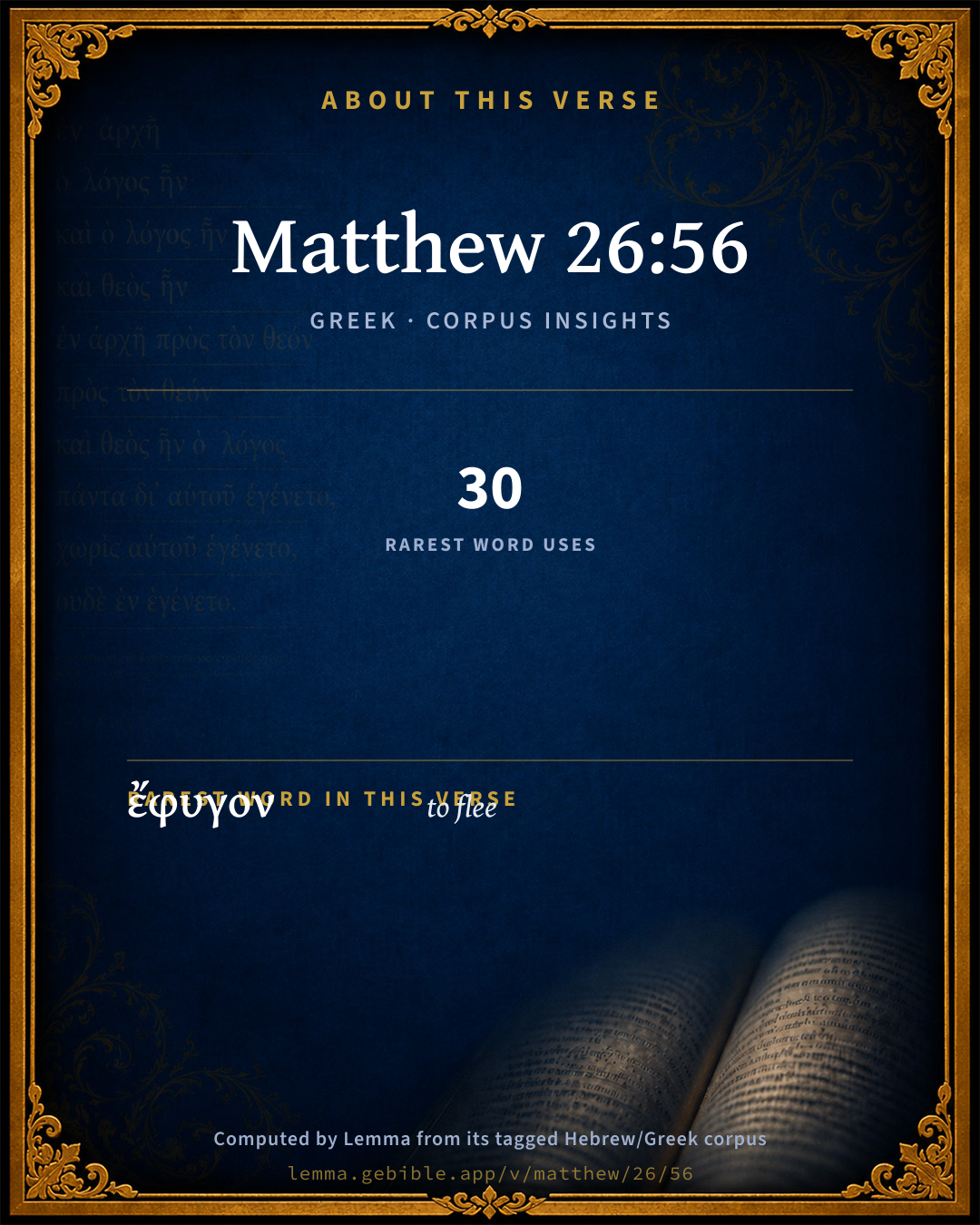
ἔφυγον to flee G5343 occurs in 30 verses of the Greek New Testament. Also found in:

Repetition

A word recurs within this verse:

Cross-references

15

Topical passages linked to Matthew 26:56 in the Treasury of Scripture Knowledge — connected by theme and wording, ordered by reader-vote popularity; previews shown in the World English Bible.

  • Zechariah 13:7 "Awake, sword, against my shepherd, And against the man who is close to me," says Yahweh of Hosts. Strike the shepherd, and the sheep will be scattered; And I will turn my hand against the little ones.
  • John 16:32 Behold, the time is coming, yes, and has now come, that you will be scattered, everyone to his own place, and you will leave me alone. Yet I am not alone, because the Father is with me.
  • Mark 14:50–52 They all left him, and fled.
  • Matthew 26:31 Then Jesus said to them, "All of you will be made to stumble because of me tonight, for it is written, 'I will strike the shepherd, and the sheep of the flock will be scattered.'
  • Matthew 26:54 How then would the Scriptures be fulfilled that it must be so?"
  • 2 Timothy 4:16 At my first defense, no one came to help me, but all left me. May it not be held against them.
  • Lamentations 4:20 The breath of our nostrils, the anointed of Yahweh, was taken in their pits; Of whom we said, Under his shadow we shall live among the nations.
  • Matthew 26:24 The Son of Man goes, even as it is written of him, but woe to that man through whom the Son of Man is betrayed! It would be better for that man if he had not been born."
  • John 18:15–16 Simon Peter followed Jesus, as did another disciple. Now that disciple was known to the high priest, and entered in with Jesus into the court of the high priest;
  • Acts 1:16 "Brothers, it was necessary that this Scripture should be fulfilled, which the Holy Spirit spoke before by the mouth of David concerning Judas, who was guide to those who took Jesus.
  • Daniel 9:26 After the sixty-two weeks the Anointed One shall be cut off, and shall have nothing: and the people of the prince who shall come shall destroy the city and the sanctuary; and the end of it shall be with a flood, and even to the end shall be war; desolations are determined.
  • Daniel 9:24 Seventy weeks are decreed on your people and on your holy city, to finish disobedience, and to make an end of sins, and to make reconciliation for iniquity, and to bring in everlasting righteousness, and to seal up vision and prophecy, and to anoint the most holy.
  • John 18:8–9 Jesus answered, "I told you that I AM. If therefore you seek me, let these go their way,"
  • Acts 2:23 him, being delivered up by the determined counsel and foreknowledge of God, you have taken by the hand of lawless men, crucified and killed;
  • Isaiah 44:26 who confirms the word of his servant, and performs the counsel of his messengers; who says of Jerusalem, She shall be inhabited; and of the cities of Judah, They shall be built, and I will raise up the waste places of it;

Cross-references courtesy of OpenBible.info (CC BY 4.0).

Commentary

Notes on Matthew 26:56 from classic Christian and Jewish commentators (each source and its license shown beneath its notes). The classic Christian expositions comment on the surrounding passage and are grouped to its opening verse, so a note may address several verses; the Jewish commentaries on the Tanakh (Rashi and others) are per-verse, so they appear only where the commentator wrote on this verse.

Lemma curates 59 commentaries, every one of them public domain or Creative Commons licensed, each selected and text-cleaned for this edition rather than reprinted as found. About our sources →

The Biblical Illustrator

Joseph S. Exell

Mat_26:56

Then all the disciples forsook Him and fled.

The causes, signs, evils, and cure of backsliding

I. Its causes.

1. Opposition and fear of injury from those who are the enemies of religion.

2. A too frequent and uniform conformity and intercourse with the world.

3. Self-confidence in spiritual gifts and attainments.

4. A neglect of the private duties of religion.

II. Its signs.

1. It is testified by signs which do not amount to that flagrant and public departure from the gospel which frequently is displayed.

(1) A relinquishment of public labour in the church;

(2) an irregular attendance upon public ordinances;

(3) a spirit of inattention and carelessness under these ordinances;

(4) an indulgence in social life of useless conversation.

2. Signs which do amount to a positive and public departure from the religion of the cross.

III. Its evils.

1. As they affect the individuals themselves.

2. As they affect the Church.

(1) They discourage others just setting forth in the way of religion;

(2) they lead others to sin;

(3) they cause mockery of religion.

IV. The cure.

1. Call to mind the times of former devotedness.

2. Contemplate the intense guilt of the act.

3. Resolve to forsake the transgression by which it has been brought about.

4. Connect all our convictions.and emotions with prayer for the influence of the Holy Spirit. (J. Parsons.)

Apostasy

Here we see four things.

I. Base ingratitude.

1. They had received special favours from Him.

2. They were under the greater obligation.

3. Tendency of gratitude to bind to benefactor.

II. Rash impulsiveness, probably roused by

(1) disappointment;

(2) alarm.

III. Involuntary influence. One fled, then all fled. This should

(1) act as incentive to become thoroughly sound in character;

(2) make us cautious as to associations we form.

IV. False policy. Doing wrong to save the body

(1) injures the soul;

(2) endangers it. Learn-

(a) importance of cherishing a practical impression of our obligations to Christ;

(b) of cultivating the habit of acting from intelligent conviction;

(c). of habitually realizing the principle, that the path of duty is the path of safety.. (Homilist.)

Fickle friends

The bees were haunting the flowering trees in crowds, humming among the branches, and gathering honey in the flowers. Said Gotthold, Here is an image of temporal prosperity, So long as there is blossom on the trees, and honey in the blossom, the bees will frequent them in crowds, and fill the place with their music; but when the blossom is over, and the honey gone, they too will disappear. The same happens in the world, among men. In the abodes of fortune and pleasure, friends will be found in plenty, but when fortune flys away, they depart along with it. Temporal gain is the worlds honey, and the allurement with which you may entice it whithersoever you will; but where the gain terminates, there likewise do the love and friendship of the world stop. For this reason let all good men be advised to fly to Christ crucified, who never forsakes in their distress those who truly seek Him.

The sin of apostasy

Disheartened by the extraordinary dangers and difficulties of their enterprize, a Roman army lost courage, and resolved on a retreat. The general reasoned with his soldiers. Expostulating with them, he appealed to their love of country, to their honour, and to their oaths. By all that could revive a fainting heart he sought to animate their courage and shake their disgraceful resolution. Much they trusted, admired, loved him; but his appeals were all in vain. They were not to be moved; and, carried away as by a panic, they faced round to retreat. At this juncture they were forcing a mountain-pass, and had just cleared a gorge where the road, between two stupendous rocks on one side and the foaming river on the other, was but a footpath broad enough for the step of a single man. As a last resort he laid himself down there, saying, If you will retreat, it is over this body you go, trampling me to death beneath your feet. No foot advanced. The flight was arrested. His soldiers could face the foe, but they could not mangle beneath their feet one who loved them, and who had often led their ranks to victory, sharing like a common soldier all the hardships of the campaign, and ever foremost in the fight. The sight was one to inspire them with decision. Hesitating no longer to advance, they wheeled round to resume their march; deeming it better to meet sufferings, and endure even death itself, than to trample under foot their devoted and patriotic leader. Their hearts recoiled from such an outrage. But for such as have named the name of Christ not to depart from iniquity, for such as have enlisted under His banner to go back to the world, for such as have renounced sin to return to its pleasures, involves a greater crime. A more touching spectacle bars our return. Jesus, as it were, lays Himself down on our path; nor can any become backsliders, and return to the practice and pleasure of sin, without trampling Him under their feet. (T. Guthrie, D. D.)

The Biblical Illustrator, edited by Joseph S. Exell (c. 1880s–1900s) — public domain. Text from a community e-Sword module.

Tyndale Open Study Notes

Tyndale Open Resources

26:56 It is not clear which of the Scriptures Jesus was alluding to—perhaps Isa 53, or perhaps the Old Testament theme of a suffering Messiah in general. • As Jesus had predicted earlier that evening, all the disciples deserted him (Matt 26:31-35).

Tyndale Open Study Notes — © Tyndale Open Resources, licensed CC BY-SA 4.0. Text via the HelloAO Bible API.

Bengel's Gnomon

Johann Albrecht Bengel

Mat 26:56. Τοῦτο δὲ ὅλον γέγονεν, but all this was done) St Matthew appears to have interwoven this periphrasis with our Lord’s words concerning the fulfilment of the Scriptures: cf. Mar 14:49.—αἱ γραφαὶ, the Scriptures) in the plural number. His Passion was the confluence of their fulfilments.[1157]

[1157] Luk 22:53, mentions another cause of so sudden a change on the part of the Jews, viz. the power of darkness—Harm., p. 532.

Bengel's Gnomon of the New Testament — English translation (T&T Clark, Edinburgh, 1860) — public domain. Text from a community e-Sword module.

Meyer's Critical & Exegetical Commentary

Heinrich August Wilhelm Meyer

Mat_26:56. Τοῦτο … προφητῶν] It is still Jesus who speaks, and who with these words closes His address. Comp. also Mar_14:19. In Luk_22:53 we find a somewhat different conclusion given. Erasmus, Jansen, Bengel, Fritzsche, de Wette, Schegg, Bleek, Weiss, Holtzmann, Hilgenfeld, regard the words in question as a remark by the evangelist (comp. Mat_1:22, Mat_21:4); but if that were so, we should have expected some specific quotation instead of such a general expression as at αἱ γραφαὶ τ. πρ., and what is more, our Lords words would thus be deprived of their proper conclusion, of that which contains the very point of His remarks. For the gist of the whole matter lay in this avowal of His conviction as the God-man that all that was now taking place was a carrying out of the divine purpose with regard to the fulfilling of the Scriptures, andthus the mystery of Mat_26:55 is solved.

τότε οἱ μαθηταὶ, κ.τ.λ.] Observe the πάντες. Not one of them stood his ground. Here was the verification of the words of Jesus, Mat_26:31; comp. Joh_16:32.

Meyer — Critical and Exegetical Commentary on the New Testament — English translation by Peter Christie, edited by Frederick Crombie (T&T Clark, 1880) — public domain. Text from a community e-Sword module.

Expositor's Greek Testament

ed. W. Robertson Nicoll

Mat 26:56 . τοῦτο δὲ , etc.: a formula of the evangelist, introducing another reference by Jesus to the prophecies in these terms, ἵνα πληρωθῶσιν , etc. Jesus reconciles Himself to the indignity in the manner of His arrest, as to the arrest itself, and all that it involved, by the thought that it was in His “cup” as described by the prophets. The prophetic picture of Messiah’s experience acted as a sedative to His spirit. τότε , then, when the apprehension had been effected, and meekly submitted to by Jesus. πάντες , Peter included. ἔφυγον , fled, to save themselves, since their Master could not be saved. This another bitter drop in the cup: absolute loneliness.

The Expositor's Greek Testament, edited by W. Robertson Nicoll (1897–1910) — public domain. Text from a community e-Sword module.

Adam Clarke's Commentary

Verse 56. But all this was done] This is probably the observation of the evangelist. See Clarke on Mt 2:23.

Then all the disciples forsook him and fled.] O what is man! How little is even his utmost sincerity to be depended on! Jesus is abandoned by all! - even zealous Peter and loving John are among the fugitives! Was ever master so served by his scholars? Was ever parent so treated by his children? Is there not as much zeal and love among them all as might make one martyr for God and truth? Alas! no. He had but twelve who professed inviolable attachment to him; one of these betrayed him, another denied him with oaths, and the rest run away and utterly abandon him to his implacable enemies! Are there not found among his disciples still,

1st. Persons who betray him and his cause?

2dly. Persons who deny him and his people?

3dly. Persons who abandon him, his people, his cause, and his truth?

Reader! dost thou belong to any of these classes?

Adam Clarke's Commentary on the Bible (1810–1826) — public domain. Text from a community e-Sword/MySword module.

Ellicott's Commentary for English Readers

(56) But all this was done.—Better, but all this has come to pass. The words, though they agree in form with those of Mar_1:22, are, as we see from Mar_14:49, not a comment of the Evangelist’s, but our Lord’s own witness to the disciples and the multitude, that the treachery and violence of which He was the victim were all working out a divine purpose, and (as in Mat_26:54) fulfilling the Scriptures in which that purpose had been shadowed forth.

Then all the disciples forsook him, and fled.—We read with a sorrowful surprise of this cowardly abandonment. Better things, we think, might have been expected of those who had professed their readiness to go with Him to prison and to death. Yet we may remember (1) the weariness and exhaustion which had overcome them, making the resolve and courage, to say the least, more difficult; and (2) that they had been told not to resist, and that flight might seem to them the only alternative to resistance. We have to fill up St. Matthew’s record with the strange episode of the “young man with a linen cloth cast about his naked body” of Mar_14:51, where see Note.

A Bible Commentary for English Readers, edited by Charles John Ellicott (1878–1897) — public domain. Text from a community e-Sword module.

The Cambridge Bible for Schools and Colleges

gen. ed. J. J. S. Perowne

56. all this was done, &c.] These are probably the words of Christ, and not a reflection by the Evangelist (cp. Mar_14:49); if so, they were, for most of the disciples, their Master’s last words.

The Cambridge Bible for Schools and Colleges (gen. ed. J. J. S. Perowne; Cambridge University Press, 1878–1918) — public domain. Text from a community e-Sword module.

John Gill's Exposition

And they that had laid hold on Jesus,.... Who were the band, and the captain, and the officers of the Jews, as Joh 18:12, or as the Jews themselves say (q), the elders of Jerusalem; who not only laid fast hold on him, but bound him; and that both for greater security of him, some of them perhaps knowing how he had made his escape from them formerly; or at least taking the hint from Judas, to hold him fast, and lead him away safely; and by way of reproach and contempt, thereby showing that he was a malefactor, and had done some crime worthy of bonds; and having him thus in fast and safe custody, they

led him away to Caiaphas, the high priest; who was high priest that year; for the priesthood was frequently changed in those times, and men were put into it by the Roman governor, through favour or bribery. The year before this, Simeon, or Simon ben Camhith, was high priest; and the year before that, Eleazar, the son of Ananus; and before him, Ishmael ben Phabi, who were all three, successively, made high priests by the Roman governor: as was also this Caiaphas, this year; and who by Josephus (r), and in the Talmud (s) likewise, is called Joseph. From whence he had his name Caiaphas, is not certain: Jerom (t) says, it signifies "a searcher", or "a sagacious person"; but may be better interpreted, he adds, "one that vomits at the mouth"; deriving the word, as I suppose, from "to vomit", and "the mouth"; See Gill on Mat 26:3. It was to the house, or palace of this man, the high priest, that Jesus was led,

where the Scribes and elders were assembled: a council was held about a week before this, in which Caiaphas assisted, and then gave counsel to the Jews, that it was expedient, that one man should die for the people, Joh 11:47, whether that was held at his house, or elsewhere, is not certain, very probably it might; however, it is clear from Mat 26:2, that two days ago, the chief priests, Scribes, and elders, were assembled together in his palace, to consult about putting Jesus to death; and here they were again met together on the same account, waiting to have him brought before them,

(q) Toldos Jesu, p. 16, 17. (r) Antiq. l. 18. c. 14. (s) T. Bab. Yoma, fol. 47. 1. (t) De Heb. nominibus, fol, 104. col. 4. Tom. 3.

John Gill's Exposition of the Whole Bible (1746–1763) — public domain (CC PDM 1.0). Text via the HelloAO Bible API.

Trapp's Complete Commentary

John Trapp

56 But all this was done, that the scriptures of the prophets might be fulfilled. Then all the disciples forsook him, and fled.

Ver. 56. That the Scriptures, &c.] Which yet were no more the cause of the Jews’ cruelty than Joseph was of the famine, than the astrologer is of the eclipse, or Tenterton steeple of the ebbing and flowing of the sea.

Then all the disciples forsook him and fled] Then, when there was no such need or danger to enforce them, Christ having capitulated with the enemy for their safety. They had leave to go free before; what stayed they for then? or why flee they now? This was the fruit and punishment of their former sleeping, Mat 26:43. Had they watched and prayed then, they had not now thus entered into temptation.

John Trapp, A Commentary or Exposition upon All the Books of the Old and New Testament (1647–1656) — public domain. Text from a community e-Sword module.

Haydock's Catholic Bible Commentary

All leaving him, fled away. Yet Peter and another soon followed after at a distance. St. Mark says (xiv. 51,) that a young man followed with nothing on but a loin cloth. Perhaps it was some one that upon the noise came hastily out of the neighbourhood; and when they catched hold on him, fled away naked. It is not known who he was. (Witham)

George Leo Haydock (1774–1849), Haydock's Catholic Family Bible and Commentary, 1859 edition — public domain. Excludes Psalms (Douay-Rheims chapter numbering differs from Protestant) and Deuterocanonical books (Catholic canon only).

Whedon's Commentary on the Bible

Daniel D. Whedon

56. But all this was done — Mark puts words somewhat similar to these into the mouth of our Lord; but it is plain that these are the words of the evangelist. No doubt our Lord expressed the sentiment which the evangelist expresses. All the disciples forsook him and fled — Forbidden to fight, and unable to aid their Master, nothing save flight seemed obvious to the disciples. Passive courage is far more difficult than action. In the moment of panic, it hardly occurred to them to walk by his side, and meet, if need be, the malefactor’s death. From Gethsemane the whole band proceeds back to the city, perhaps through the gate in front of the temple, and, if we trace its course aright, crossing the bridge of the Tyropoeon, reaches the palace of Caiaphas and Annas, on the northernmost part of Mount Zion, between the Armory and Millo. (See our plan of Ancient Jerusalem.)

Daniel D. Whedon (gen. ed.), Commentary on the Old and New Testaments (1874–1909) — public domain. Text from a community e-Sword module.

The Pulpit Commentary

All this was done (hath come to pass), etc. This is most probably part of Christ"s speech, not a remark of the evangelist. He repeats to the multitude what he had said to Peter (ver. 54, where see note), and what he had already intimated at the last Supper (vers. 24, 31). To quote the words of Stier, "Again and again he declares that one thing which, nevertheless, Christian theology perpetually refuses to learn from the supreme Teacher and Doctor. He holds firmly to the Scripture, whether speaking to the exasperated Jews or the docile disciples; he puts those to shame in their folly by proofs from Scripture, and strengthens these in their despondency by its consolatory promises. He appeals to Scripture in his vehement disputation with men, as he does in his solemn way of suffering to die for them; he confronts Satan with "It is written," and prays to the Father that the Scripture may be fulfilled." If Christ had been taken prematurely in the temple, and put to death by a tumultuary stoning, prophecy would not have been fulfilled, and his death would not have been the appointed sacrifice of the Lamb of God. Forsook him, and fled. As he had foretold (ver. 31). They saw their Master bound and helpless; they recognized that he would not deliver himself by heavenly aid, and, fearing to share his fate, they looked to their own safety and basely abandoned him in his hour of danger. Now occurred the incident mentioned only by St. Mark, (Mar_14:51) which is explained rightly by Edersheim (2:485, 544). Only Peter and John followed the officers to the high priest"s palace.

The Pulpit Commentary (1880–1919), ed. H.D.M. Spence-Jones & Joseph S. Exell — public domain. Text from a community e-Sword module.

Cambridge Greek Testament for Schools and Colleges

56. τοῦτο δὲ ὅλον γέγονεν κ.τ.λ. These are probably the words of Christ, and not a reflection by the Evangelist (cp. Mar 14:49); if so, they were, for most of the disciples, their Master’s last words.

For the tense of γέγονεν see notes, ch. Mat 1:22, Mat 21:4.

τότε, closely connected with the preceding words. If this was the fulfilment of prophecy, their interpretation was indeed mistaken. It was the death-blow to temporal hopes.

τότε … ἔφυγον. Note the beauty and nervous strength of this short clause. Each word has its special force and its true position. ἔφυγον ‘fled,’ as though by the capture of the leader the whole enterprise had failed. ‘Quantæ in periculis fugæ proximorum!’ (Cicero.)

Cambridge Greek Testament for Schools and Colleges (Cambridge University Press, 1896; 21 vols, various authors incl. Carr, Maclear, Plummer, Farrar, Lumby, Moule, M. R. James, Simcox) — public domain. Text from a community e-Sword module.

Alford’s Greek Testament

Henry Alford

56.] It is doubted whether these words are a continuation of our Lord’s speech, or a remark inserted by Matthew. The use of τοῦτο δὲ ὅλον γέγονεν in this Gospel would lead us to the latter conclusion: but when we reflect that thus our Lord’s speech would lose all its completeness, and that Mark gives in different words the speech going on to this same purport, we must I think decide for the other view. Besides, if the remark were Matthew’s, we should expect some particular citation, as is elsewhere his practice: see ch. 1:22; 21:4. Mark gives it elliptically, ἀλλʼ ἵνα πληρωθῶσιν αἱ γραφαί. The Passion and Death of Christ were especially ἡ τῶν γραφῶν πλήρωσις. In this they all found their central point. Compare his dying word on the Cross,—τετέλεσται,—with this his assertion. On the addition in Luke, see note there.

There is an admirable sermon of Schleiermacher (vol. ii. of the Berlin ed. of 1843, p. 104) on vv. 55, 56.

τότε οἱ μαθ.] Some of them did not flee far. Peter and John went after Him to the palace of the High-priest: John, ver. 15. On the additional circumstance in Mark, ver. 51, see note there. Chrys.’s remark is worth noting: ὅτε μὲν γὰρ κατεσχέθη, ἔμενον· ὅτε δὲ ἐφθέγξατο ταῦτα πρὸς τούς ὄχλους, ἔφυγον· εἶδον γὰρ λοιπόν, ὅτι οὐκ ἔτι διαφυγεῖν ἔνι, ἑκόντος ἑαυτὸν παραδόντος αὐτοῖς καὶ λέγοντος κατὰ τὰς γραφὰς τοῦτο γίνεσθαι.

Henry Alford, The Greek Testament (1849–1861) — public domain. Text from a community e-Sword module.

International Critical Commentary

(M) 56. And all this has come to pass that the Scriptures of the prophets might be fulfilled.] Mk. has simply: “But that the Scriptures might be fulfilled (you have arrested Me in this treacherous way).” Mt. supplies the ellipse by inserting the formula τοῦτο δὲ ὅλον γέγονεν (on which see Introduction, p. lxi), and so making an independent sentence.

(M) And all the disciples left Him, and fled.] Mk. has: “And they all left Him, and fled.” Mt. here omits Mk vv. 51-52; cf. Introduction, p. xviii.

International Critical Commentary — older volumes (1896–1929), various authors — public domain. Text from a community e-Sword module.

Lesson kit

Teaching starters — assembled from the data on this page, not authored interpretation. Every prompt links to the verse data it draws on. Edit before teaching.

Matthew, in the Gospels, opens this verse with 17 words (15 distinct Greek lemmas). Its most distinctive word is pheúgō (“to flee”). A historical commentator’s framing appears above. Read the whole chapter for the surrounding context.

Discussion questions

  1. How does “to flee” (pheúgō) shape what this verse is saying?
  2. How does Matthew 2:13, which shares the word «to flee», read alongside this verse?
  3. What does the repetition of “the” (3× in this one verse) do in this verse?
  4. These translations render this verse differently. What is at stake in choosing one wording over another?
  5. Compare how The Biblical Illustrator and Tyndale Open Study Notes read this verse. Where do they agree or differ?

Things to notice

Reading settings

Reading text

Shown beneath each verse's original-language words.

Old Testament
Old Testament edition

Read the OT as the Masoretic Hebrew (MT) or the Greek Septuagint (LXX).

English shown for the Greek Septuagint (in the Hebrew ↔ Greek comparison).

Comparing translations? Open the Compare panel on any verse page to stack up to four side by side.