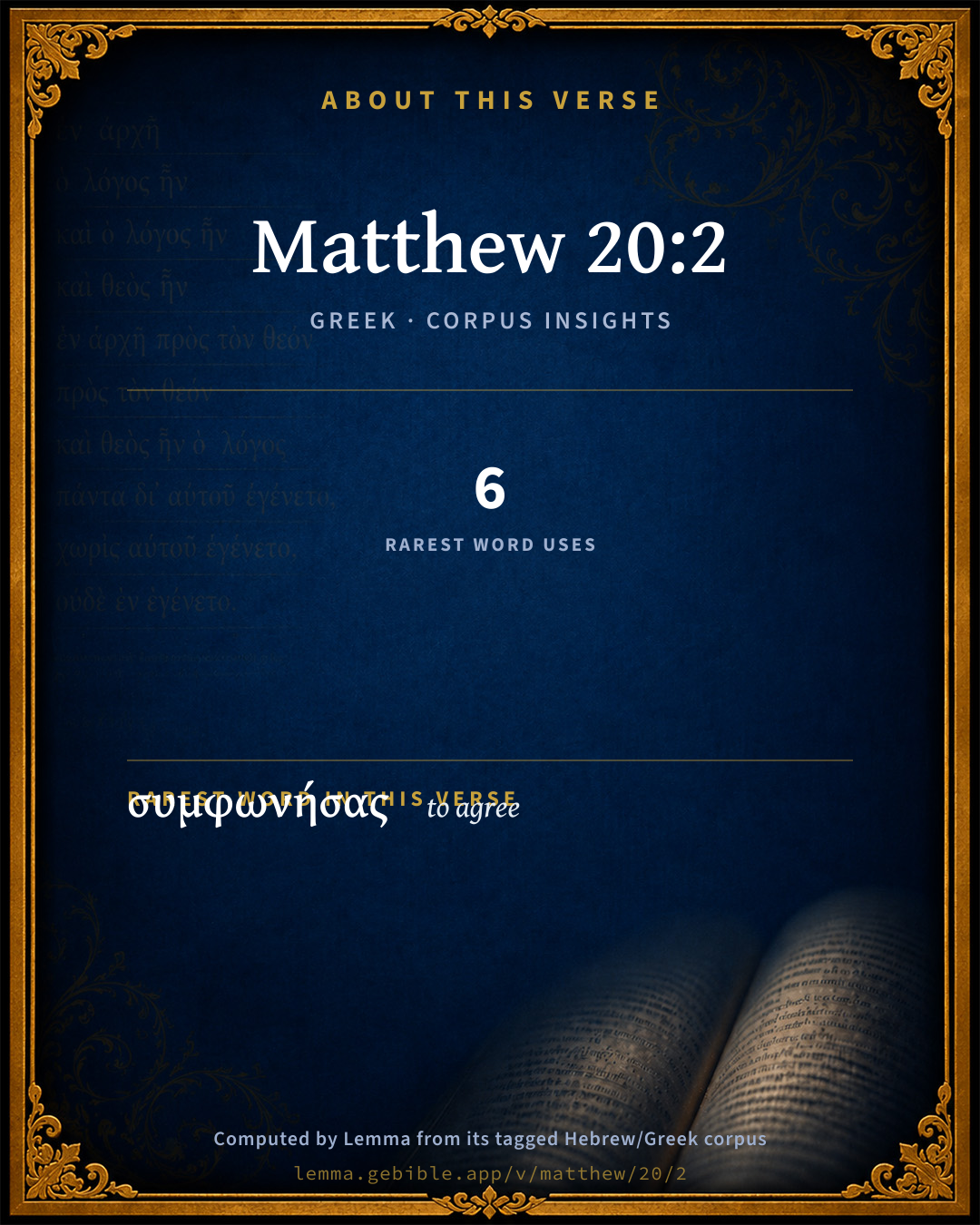
Matthew 20:2

Greek (Tischendorf 8th ed.) Matthew 20:2 appears in the Greek New Testament. The text above is from the Tischendorf 8th edition. Each word links to its Strong’s number and a concise gloss. Click any word for its full Thayer’s Greek Lexicon entry.
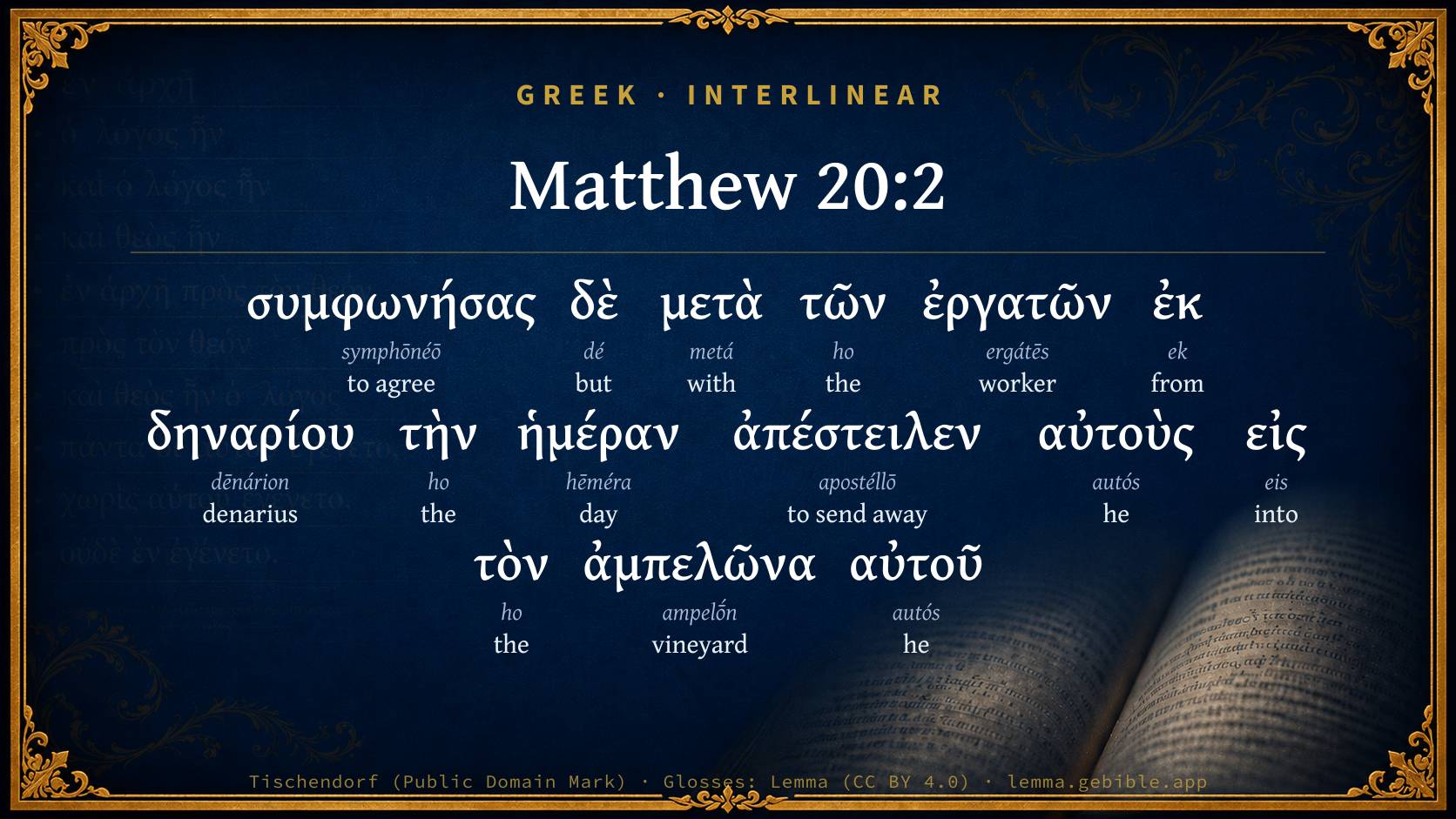
Download image
Cite this verse

Matthew 20:2 (World English Bible). Public Domain. Lemma interlinear Bible study tool, https://lemma.gebible.app/v/matthew/20/2.

Show BibTeX & RIS
BibTeX
RIS
English Translation
When he had agreed with the laborers for a denarius a day, he sent them into his vineyard.
World English Bible · Public Domain
Download a study sheet

One document with this verse’s original text, its word-by-word gloss line, the meaning frame, cross-references with their text, attributed commentary, and full source and license credits — printable, and it pastes into notes with its structure intact.

This verse Autodidact and up

Study sheet (.html) Plain text (.txt)

A passage Seminary Student

Up to 50 verses in one chapter. A passage sheet keeps up to 6 commentary sources and 12 cross-references per verse, in the order this page ranks them, and says so on the sheet whenever that leaves anything out. Ask for a single verse and you get the Autodidact verse sheet above.

Everything on this page stays free to read, with no account — the sheet is a download of what is already on screen, not access to it.

Want to remove ads? Support Godless Engineer
Compare translations 3

The same verse in 3 English versions, stacked beneath the original-language interlinear above. Click any original word for its lexicon entry.

Each is an independent rendering of the whole verse — the interlinear is not word-aligned to these translations.

Highlighted words mark where these versions differ — a whole-verse word diff, not a word-by-word alignment.

  • World English Bible Public Domain
    When he had agreed with the laborers for a denarius a day, he sent them into his vineyard.
  • King James Version Public Domain
    And when he had agreed with the labourers for a penny a day, he sent them into his vineyard.
  • unfoldingWord Literal Text CC BY-SA 4.0
    Now, having agreed with the workers for a denarius for the day, he sent them into his vineyard.

unfoldingWord Literal Text — © unfoldingWord, licensed CC BY-SA 4.0. Word-aligned USFM3 via Door43 (git.door43.org/unfoldingWord/en_ult).

Versions to compare (up to 4)

3 of 4 selected

Show all 19 translations

Every available English version of this verse, each an independent rendering of the whole verse.

  • World English Bible Public Domain
    When he had agreed with the laborers for a denarius a day, he sent them into his vineyard.
  • Berean Standard Bible Public Domain
    He agreed to pay them a denarius for the day and sent them into his vineyard.
  • Majority Standard Bible Public Domain
    He agreed to pay them a denarius for the day and sent them into his vineyard.
  • King James Version Public Domain
    And when he had agreed with the labourers for a penny a day, he sent them into his vineyard.
  • American Standard Version (1901) Public Domain
    And when he had agreed with the laborers for a shilling a day, he sent them into his vineyard.
  • Revised Version (1885) Public Domain
    And when he had agreed with the labourers for a penny a day, he sent them into his vineyard.
  • Geneva Bible (1599) Public Domain
    And he agreed with the labourers for a peny a day, and sent them into his vineyard.
  • Douay-Rheims (1899) Public Domain
    And having agreed with the labourers for a penny a day, he sent them into his vineyard.
  • Young's Literal Translation Public Domain
    and having agreed with the workmen for a denary a day, he sent them into his vineyard.
  • Literal Standard Version CC BY-SA 4.0
    and having agreed with the workmen for a denarius a day, he sent them into his vineyard.
  • Unlocked Literal Bible CC BY-SA 4.0
    After he had agreed with the workers for one denarius a day, he sent them into his vineyard.
  • unfoldingWord Literal Text CC BY-SA 4.0
    Now, having agreed with the workers for a denarius for the day, he sent them into his vineyard.
  • Darby Bible Public Domain
    And having agreed with the workmen for a denarius the day, he sent them into his vineyard.
  • World Messianic Bible Public Domain
    When he had agreed with the laborers for a denarius a day, he sent them into his vineyard.
  • Webster's Bible Public Domain
    And when he had agreed with the laborers for a penny a day, he sent them into his vineyard.
  • Free Bible Version CC BY-SA 4.0
    He agreed to pay the workers one denarius for the day, and sent them to work in his vineyard.
  • Bible in Basic English Public Domain
    And when he had made an agreement with the workmen for a penny a day, he sent them into his vine-garden.
  • Text-Critical English NT CC BY 4.0
    After agreeing with the workers that they would each receive a denarius for the day, he sent them into his vineyard.
  • Tyndale New Testament (1534) Public Domain
    And he agreed with the labourers for a peny a daye and sent them into his vyneyarde.

Literal Standard Version (2020), Covenant Press — licensed CC BY-SA 4.0. Text via the HelloAO Bible API (eBible.org). Unlocked Literal Bible (unfoldingWord) — licensed CC BY-SA 4.0. Text via the HelloAO Bible API (eBible.org). unfoldingWord Literal Text — © unfoldingWord, licensed CC BY-SA 4.0. Word-aligned USFM3 via Door43 (git.door43.org/unfoldingWord/en_ult). Free Bible Version, Dr. Jonathan Gallagher — licensed CC BY-SA 4.0. Text via the HelloAO Bible API (eBible.org).

Word by word

More ways to search: Search by grammar → Find every occurrence → Compare this word →

Practice this passage: Drill this verse → Learn its vocabulary →

συμφωνήσας
symphōnéō
G4856
“to agree”
Verb, Aorist, Active, Participle, Nominative, Singular, Masculine
Part of Speech
Verb
Tense
Aorist
Voice
Active
Mood
Participle
Case
Nominative
Number
Singular
Gender
Masculine
Full Thayer's Definition

Origin: from G4859

TDNT: 14:04,1

1. to agree together 2. to agree with one in making a bargain, to make an agreement, to bargain
  1. δὲ dé G1161 “but” Conjunction
  2. μετὰ metá G3326 “with” Preposition
  3. τῶν ho G3588 “the” Article, Genitive, Plural, Masculine
  4. ἐργατῶν ergátēs G2040 “worker” Noun, Genitive, Plural, Masculine
  5. ἐκ ek G1537 “from” Preposition
  6. δηναρίου dēnárion G1220 “denarius” Noun, Genitive, Singular, Neuter
  7. τὴν ho G3588 “the” Article, Accusative, Singular, Feminine
  8. ἡμέραν hēméra G2250 “day” Noun, Accusative, Singular, Feminine
  9. ἀπέστειλεν apostéllō G649 “to send away” Verb, Aorist, Active, Indicative, 3rd person, Singular
  10. αὐτοὺς autós G846 “he” Personal pronoun, Accusative, Plural, Masculine
  11. εἰς eis G1519 “into” Preposition
  12. τὸν ho G3588 “the” Article, Accusative, Singular, Masculine
  13. ἀμπελῶνα ampelṓn G290 “vineyard” Noun, Accusative, Singular, Masculine
  14. αὐτοῦ autós G846 “he” Personal pronoun, Genitive, Singular, Masculine

About this verse

These counts appear in no published source. They are computed here, from the morphology-tagged text and Lemma’s own curated glosses. What Lemma adds →

15
words
12
distinct lemmas
Gospels
section

Notable vocabulary

The rarest word here is συμφωνήσας to agree G4856 — appearing just 6 times in the whole Greek New Testament.

Shared distinctive vocabulary

συμφωνήσας to agree G4856 occurs in 6 verses of the Greek New Testament. Also found in:

Repetition

Words recur within this verse:

  • τῶν the G3588 ×3
  • αὐτοὺς he G846 ×2

Cross-references

18

Topical passages linked to Matthew 20:2 in the Treasury of Scripture Knowledge — connected by theme and wording, ordered by reader-vote popularity; previews shown in the World English Bible.

  • Exodus 19:5–6 Now therefore, if you will indeed obey my voice, and keep my covenant, then you shall be my own possession from among all peoples; for all the earth is mine;
  • Matthew 22:19 Show me the tax money." They brought to him a denarius.
  • Luke 10:35 On the next day, when he departed, he took out two denarii, and gave them to the host, and said to him, 'Take care of him. Whatever you spend beyond that, I will repay you when I return.'
  • 2 Timothy 3:15 From infancy, you have known the sacred writings which are able to make you wise for salvation through faith, which is in Christ Jesus.
  • Deuteronomy 5:27–30 Go you near, and hear all that Yahweh our God shall say: and speak you to us all that Yahweh our God shall speak to you; and we will hear it, and do it.
  • 1 Samuel 2:18 But Samuel ministered before Yahweh, being a child, girded with a linen ephod.
  • 1 Samuel 2:26 The child Samuel grew on, and increased in favor both with Yahweh, and also with men.
  • 1 Samuel 16:11–12 Samuel said to Jesse, Are here all your children? He said, There remains yet the youngest, and, behold, he is keeping the sheep. Samuel said to Jesse, Send and get him; for we will not sit down until he come here.
  • 1 Kings 3:6–11 Solomon said, You have shown to your servant David my father great loving kindness, according as he walked before you in truth, and in righteousness, and in uprightness of heart with you; and you have kept for him this great loving kindness, that you have given him a son to sit on his throne, as it is this day.
  • 1 Kings 18:12 It will happen, as soon as I am gone from you, that the Spirit of Yahweh will carry you I don't know where; and so when I come and tell Ahab, and he can't find you, he will kill me: but I your servant fear Yahweh from my youth.
  • 2 Chronicles 34:3 For in the eighth year of his reign, while he was yet young, he began to seek after the God of David his father; and in the twelfth year he began to purge Judah and Jerusalem from the high places, and the Asherim, and the engraved images, and the molten images.
  • Ecclesiastes 12:1 Remember also your Creator in the days of your youth, Before the evil days come, and the years draw near, When you will say, "I have no pleasure in them;"
  • Matthew 18:28 "But that servant went out, and found one of his fellow servants, who owed him one hundred denarii, and he grabbed him, and took him by the throat, saying, 'Pay me what you owe!'
  • Matthew 20:13 "But he answered one of them, 'Friend, I am doing you no wrong. Didn't you agree with me for a denarius?
  • Luke 1:15 For he will be great in the sight of the Lord, and he will drink no wine nor strong drink. He will be filled with the Holy Spirit, even from his mother's womb.
  • Revelation 6:6 I heard a voice in the midst of the four living creatures saying, "A choenix of wheat for a denarius, and three choenix of barley for a denarius! Don't damage the oil and the wine!"
  • 1 Samuel 3:1 The child Samuel ministered to Yahweh before Eli. The word of Yahweh was precious in those days; there was no frequent vision.
  • 1 Samuel 3:21 Yahweh appeared again in Shiloh; for Yahweh revealed himself to Samuel in Shiloh by the word of Yahweh.

Cross-references courtesy of OpenBible.info (CC BY 4.0).

Commentary

Notes on Matthew 20:2 from classic Christian and Jewish commentators (each source and its license shown beneath its notes). The classic Christian expositions comment on the surrounding passage and are grouped to its opening verse, so a note may address several verses; the Jewish commentaries on the Tanakh (Rashi and others) are per-verse, so they appear only where the commentator wrote on this verse.

Lemma curates 59 commentaries, every one of them public domain or Creative Commons licensed, each selected and text-cleaned for this edition rather than reprinted as found. About our sources →

Joseph Benson's Commentary

Mat 20:2-4. And when he had agreed with the labourers for a penny a day — “A denarius, or Roman penny, in value about seven and one half pence sterling, which it seems was the usual price of a day’s service among the Jews, as Tacitus tells us it was among the Romans, (Annal., Mat 1:17.) It is therefore justly mentioned, Rev 6:6, as a proof of the great scarcity of provisions, when a measure, or chœnix of wheat, which was the usual allowance to one man for a day, and was about an English quart, was sold at that price.” — Doddridge. He sent them, into his vineyard — Many obeyed the call given them by John the Baptist and the Lord Jesus at the first introduction of the gospel dispensation, and many have been called in childhood in every age of the church. He went out about the third hour, about nine, and saw others standing idle — Many were standing idle, and doing nothing either for the glory of God or the salvation of their own souls, in all parts of Judea, when the apostles were first sent forth, during the time of our Lord’s personal ministry, to call them to repentance, and to do works meet for repentance. And many young persons in every age and nation have been, and still are, standing idle in the same sense; and that in the market-place, as it were, offering themselves to be hired to any master that might be disposed to engage them: and too many have continually been, and still are, hired by Satan; and, like the prodigal in the parable, (who was sent into the fields to feed swine,) are daily employed in the drudgery of sin; or are engaged by the world, and occupied in the pursuits of its vanities; or by the flesh, in the filthy lusts of which they wallow, as swine in the mire. And said, Go ye also — As well as those who have been called before you, or are called at an earlier age: and whatsoever is right — Δικαιον, just, reasonable, I will give you. And they went their way — To their work, without any further, or more particular agreement, placing an entire confidence in the promise of the householder. Thus many were obedient to the call given by the apostles in their first mission, and to that given by the seventy disciples: for they returned to Jesus, saying, Lord, the very devils are subject to us through thy name. And many young persons in former ages have obeyed, and many in the present age now obey, the gospel, wherever it is preached with clearness and power.

Joseph Benson's Commentary on the Old and New Testaments (1811–1818) — public domain. Text from a community e-Sword module.

Bengel's Gnomon

Johann Albrecht Bengel

Mat 20:2. Συμφωνήσας, when he had agreed) He deals with the first labourers more by legal compact; with the latter, more by mere liberality, even in the hiring them, though He blames them for standing idle; see Mat 20:4; Mat 20:6-7. They make up for their previous idleness by their obedience, without stipulating for a fixed amount of wages. The day, divided into twelve hours, signifies not the whole duration of the world, nor that of the New Testament dispensation, which the life of a single labourer can never equal; neither, as it seems, does it represent the space of life given to each human being, in which one labours a longer and another a shorter time from his call to his death: although one who came before us might labour only one hour (i.e. the last), and another who comes after us may begin at the first; so that in this passage that saying should hold good, “In any hour is any hour;”[878]—But it represents the space of time from the first calling of the apostles to the ascension of Christ and the descent of the Paraclete. The denarius is that one amount of wages in the present and future life, equally offered to all, mentioned in ch. Mat 19:29; Mat 19:21; the difference of which, though corresponding with the difference of labours, is not only not apparent in this life, but frequently appears inverted: therefore the middle term, equality, is here assumed.[879] The evening is that time when each one is, or appears to be, much nearer the close than the commencement of his labours; and therefore, in the case of the disciples, the time then close at hand, immediately before the departure of our Lord. They cast their own evening and that of others into the same balance, who compare themselves with others. The labourers are all who are called, not only the apostles. The feeling of the discontented labourers concerning the whole day, resembles that of Peter, when he alluded, without sufficient discretion, to the difference between himself and that rich man. And every one is tempted by such a feeling towards those whom he most knows, and who are his equals. He who has a wider range of thought is liable to the same temptation with regard to those who are more remote.—μετὰ τῶν ἐργατῶν, with the labourers) The Householder makes an agreement with the labourers, and they (see Mat 20:13) with him. The one ensures the payment of the wages; the other shows what the labourer should be contented with.—ἐκ δηναρίου, for a denarius) This was a day’s wages, as it is commonly at present. The ἐκ (for) is not repeated in Mat 20:13.

[878] “Quâlibet horâ est quælibet hora.” In every hour whatever, there is the hour of some one or other [some hour or other, whatsoever that hour be]. Any hour of labour whatsoever is counted to the labourer as such, whensoever it be, whether at an earlier or later date. This seems to me Bengel’s meaning, though the words are rather ambiguous.—ED.

[879] Here again there is some obscurity. “Ideo medium, paritas. sumitur.” It seems to me to refer to His fixing on the denarius as a mean, merging the various diversities of reward answering to the diversities of labour, not now apparent, in the one common sum alike and equal to all.—ED.

Bengel's Gnomon of the New Testament — English translation (T&T Clark, Edinburgh, 1860) — public domain. Text from a community e-Sword module.

Meyer's Critical & Exegetical Commentary

Heinrich August Wilhelm Meyer

Mat_20:2. Ἐκ δηναρίου τὴν ἡμέραν] After he had agreed with the labourers, on the condition that he was to pay them a denarius per day. ἐκ does not denote the payment itself (which would have been expressed by the genitive, Mat_20:13), although ἐκ δηναρ. is that payment (Mat_27:7; Act_1:18); but it is intended to indicate that this payment was the thing, on the strength of which, as terms, the agreement was come to; comp. Kühner, II. 1, p. 399 f. τὴν ἡμέραν is the accusative, as further defining the terms of the agreement: in consideration of the day, so that a denarius was to be the wages for the (current) day during which they might work. As an accusative of time (which it is usually supposed to be), it would not correspond with συμφων. to which it belongs.

A denarius was the usual wages for a days work (Tob_5:14). See Wetstein.

Meyer — Critical and Exegetical Commentary on the New Testament — English translation by Peter Christie, edited by Frederick Crombie (T&T Clark, 1880) — public domain. Text from a community e-Sword module.

Expositor's Greek Testament

ed. W. Robertson Nicoll

Mat 20:2 . ἐκ δηναρίου : on the basis of a penny; the agreement sprang out of the offer, and acceptance, of a denarius as a day’s wage (so Meyer, Weiss, etc.). τὴν ἡμέραν = per diem , only a single day is contemplated in the parable.

The Expositor's Greek Testament, edited by W. Robertson Nicoll (1897–1910) — public domain. Text from a community e-Sword module.

Geneva Bible (1599)

Geneva Bible translators

Word for word, fell in time: it is a kind of speech taken from song.

Geneva Bible (1599) marginal notes — public domain. Text via Bolls.life.

Jamieson, Fausset & Brown

Robert Jamieson, A. R. Fausset & David Brown

And when he had agreed with the labourers for a penny--a usual day's hire.

he sent them into his vineyard.

Jamieson, Fausset & Brown — Commentary Critical and Explanatory on the Whole Bible (1871) — public domain (CC PDM 1.0). Text via the HelloAO Bible API.

Adam Clarke's Commentary

Verse 2. A penny] A Roman coin, as noted before, Mt 18:28, worth about seven-pence halfpenny or seven-pence three farthings of our money, and equal to the Greek drachma. This appears to have been the ordinary price of a day's labour at that time. See Tobit 5:14. In 1351 the price of labour was regulated in this country by parliament; and it is remarkable that "corn-weeders and hay-makers, without meat, drink, or other courtesy demanded," were to have one penny per day! In 1314 the pay of a chaplain to the Scotch bishops, who were then prisoners in England, was three halfpence per day. See Fleetwood's Chronicon Precios, p. 123, 129. This was miserable wages, though things at that time were so cheap that twenty-four eggs were sold for a penny, p. 72; a pair of shoes for four-pence, p. 71; a fat goose for two-pence halfpenny, p. 72; a hen for a penny, p. 72; eight bushels of wheat for two shillings, and a fat ox for six shillings and eight-pence! Ibid. In 1336, wheat per quarter, 2s.; a fat sheep 6d.; fat goose, 2d. and a pig, 1d.,p. 75.

Adam Clarke's Commentary on the Bible (1810–1826) — public domain. Text from a community e-Sword/MySword module.

Ellicott's Commentary for English Readers

(2) A penny a day.—Measured by its weight, the “penny—i.e., the Roman denarius, then the common standard of value in Palestine—was, as nearly as possible, sevenpence-halfpenny of our coinage. Its real equivalent, however, is to be found in its purchasing power, and, as the average price of the unskilled labour of the tiller of the soil, it may fairly be reckoned as equal to about half-a-crown of our present currency. It was, that is, in itself, an adequate and just payment.

A Bible Commentary for English Readers, edited by Charles John Ellicott (1878–1897) — public domain. Text from a community e-Sword module.

The Cambridge Bible for Schools and Colleges

gen. ed. J. J. S. Perowne

2. a penny] a denarius. See ch. Mat_18:28.

The Cambridge Bible for Schools and Colleges (gen. ed. J. J. S. Perowne; Cambridge University Press, 1878–1918) — public domain. Text from a community e-Sword module.

John Gill's Exposition

And when he had agreed with the labourers for a penny a day,.... These labourers were of that sort that were called , "hired for a day"; concerning whom is the following rule (q):

"he that is hired for a day, may demand it all the night; and he that is hired for a night may demand it all the day: he that is hired for hours, may demand it all the night, and all the day; he that is hired for a week, he that is hired for a month, he that is hired for a year, he that is hired for seven, if he goes out in the day, may demand all the day; and if he goes out in the night, he may demand it all the night, and all the day.''

And the wages of a day were usually "a penny"; which, if understood of a Roman penny, was seven pence halfpenny of our money. One of their canons runs thus (r):

"he that hires a labourer in the winter, to work with him in the summer, , "for a penny every day", and he gives him his hire; and, lo! his hire is alike to that in the winter, a "sela" every day, this is forbidden; because it looks as if he chose that time to lessen his wages; but if he says to him, work with me from this day, to such a time, "for a penny every day", though his hire is the same, a "sela" every day, this is lawful.''

By the penny a day agreed for with the labourers, may be meant external privileges; or the free promise made, whether to ministers, or private believers, of a sufficient supply of grace daily, that as their day is, their strength shall be; together with that of eternal life and happiness at last.

He sent them into his vineyard; to labour there: for none have any business there, but such who are called and sent by the owner of it; and where sons are sent, and work, as well as servants; see Mat 21:28.

(q) Misna Bava Metzia, c. 9. sect. 11. Maimen Hilch. Shericut, c. 11. sect. 2. (r) Maimon. Hilch. Milvah Ulavah, c. 7. sect. 12. Vid. T. Bab. Bava Bathra, fol. 86. 2. & 87. 1. & Gloss. in ib.

John Gill's Exposition of the Whole Bible (1746–1763) — public domain (CC PDM 1.0). Text via the HelloAO Bible API.

Trapp's Complete Commentary

John Trapp

2 And when he had agreed with the labourers for a penny a day, he sent them into his vineyard.

Ver. 2. For a penny a day] Not for eternal life (for this those murmuring merit mongers never had, who yet had their penny), but something (whatever it were) that gave the labourers good content; that it was for which each of them followed Christ, whether for food perishing, or enduring, Joh 6:27.

John Trapp, A Commentary or Exposition upon All the Books of the Old and New Testament (1647–1656) — public domain. Text from a community e-Sword module.

Albert Barnes' Notes on the Bible

A penny a day - The coin here referred to was a Roman coin, equal in value, at different periods, to 15 cents or 17 cents (7 1/2 d. to 8 1/2 d.) (circa 1880’s). The original denotes the Roman denarius δηνάριον dēnarion, a silver coin, which was originally equivalent to ten ases (a brass Roman coin), from which it gets its name. The consular denarius bore on one side a head of Rome, and an X or a star, to denote the value in ases, and a chariot with either two or four horses. At a later period the casts of different deities were on the obverse, and these were finally superseded by the heads of the Caesars. Many specimens of this coin have been preserved.

It was probably at that time the price of a day’s labor. See Tobit 5:14. This was the common wages of a Roman soldier. In England, before the discovery of the mines of gold and silver in South America, and consequently before money was plenty, the price of labor was about in proportion. In 1351 the price of labor was regulated by law, and was a penny a day; but provisions were of course proportionally cheap, and the avails of a man’s labor in articles of food were nearly as much as they are now.

Albert Barnes' Notes on the Bible (1834–1885) — public domain. Text from a community e-Sword/MySword module.

Haydock's Catholic Bible Commentary

The Roman penny, or denarius, was the 8th part of an ounce; which, at the rate of 5s. per ounce, is 7½d. It is put here for the usual hire of a day-labourer.

George Leo Haydock (1774–1849), Haydock's Catholic Family Bible and Commentary, 1859 edition — public domain. Excludes Psalms (Douay-Rheims chapter numbering differs from Protestant) and Deuterocanonical books (Catholic canon only).

Whedon's Commentary on the Bible

Daniel D. Whedon

2. Agreed with the labourers — Christ called Peter and the apostles, and sent them as labourers in his vineyard, early in the morning of the Christian dispensation. For a penny a day — A very exact price precisely stated. For Peter had, in the arithmetical spirit, asked in the last chapter, What shall we have therefore? (Mat_20:27,) and our Lord had informed him what his penny was. Mat_20:28-29. A denarius or penny is about fourteen cents. It was a liberal day’s wages.

Daniel D. Whedon (gen. ed.), Commentary on the Old and New Testaments (1874–1909) — public domain. Text from a community e-Sword module.

The Pulpit Commentary

When he had agreed with the labourers. With those first hired he makes a special agreement for the pay of the day"s work; with the others he acts differently. For a penny a day (ek hhnariou thran). The denarius (always translated "a penny" in our version) was a silver coin about equal in value to the French franc, but of course in its buying capacities worth in those days a great deal more. We learn from Tacitus ("Annal.," 1:17) that it was the usual pay of a Roman soldier. It was equivalent to the Greek drachma, which Tobit (5:14) offered to Azarias as daily wages. Our rendering of "a penny" conveys a very erroneous impression to unlearned hearers, both in this passage and in other places where it occurs.

HOMILIES BY R. TUCK Ver. 2. Fair labour agreements.

Van Lennep describes the Eastern customs to which our Lord alludes in this parable. "During the whole season when vineyards may be dug, the common workmen go very early in the morning to the sook, or marketplace of the village or city, where comestibles are sold. While "waiting to be hired," they take their morning cup of coffee, and eat a morsel of bread. The owners of vineyards come to the place and engage the number of labourers they need. These immediately go to the vineyard, and work there until a little while before the sun sets, which, according to Oriental time, is twelve o"clock, so that the "eleventh hour" means one hour before sunset. We have often seen men standing in the marketplace through the entire day without finding employment, and have repeatedly engaged them ourselves at noon for half a day"s job, and later for one or two hours" work in our garden. In such a case the price has to be particularly bargained for, but it is more often left to the generosity of the employer to give what bakshish he feels disposed." There is now a very grave danger, of which we need to be on our guard. Men are talking as if our Lord made himself an authority on social questions. The truth is, that he distinctly refused to bear any relation to social, political, and legal disputes. He revealed unknown or hidden truths to men; he resettled the great principles of morals; he quickened men with a new and Divine life; but he refused to guide in detail the applications of the principles he taught. In this parable, which seems to deal with the questions of capital and labour, the thing our Lord teaches is that every man is a free man, but if, voluntarily, he enters into engagements, he must loyally keep his engagements.

I THE MAN WHO HAS WORK TO OFFER MUST KEEP HIS ENGAGEMENTS. Religion does not need to come in and say that he who wants work done must offer fair terms for the doing of it. Common humanity and honesty demand that. No man has any right to "go beyond," "take advantage of," or "defraud" his neighbour in anything.

II THE MAN WHO HAS SKILL TO DO THE WORK MUST KEEP HIS ENGAGEMENTS. If he agrees for a penny a day, nothing can happen to make that unfair. He may make a new bargain tomorrow, but he must carry through his bargain today. Strikes are very often sinful repudiations of agreements. R.T.

The Pulpit Commentary (1880–1919), ed. H.D.M. Spence-Jones & Joseph S. Exell — public domain. Text from a community e-Sword module.

John Wesley's Explanatory Notes

The Roman penny was about seven pence halfpenny. [About thirteen and three quarter cents, American.] This was then the usual price of a day's labour.

John Wesley, Explanatory Notes Upon the Whole Bible (1754–1765) — public domain. Text via the GEBible commentary corpus.

Kretzmann's Popular Commentary

Paul E. Kretzmann

The hiring:

v. 2. And when he had agreed with the laborers for a penny a day, he sent them into his vineyard.

v. 3. And he went out about the third hour, and saw others standing idle in the market-place,

v. 4. and said unto them, Go ye also into the vineyard, and whatsoever is right I will give you. And they went their way.

v. 5. Again he went out about the sixth and ninth hour and did likewise.

v. 6. And about the eleventh hour he went out, and found others standing idle, and saith unto them, Why stand ye here all the day idle?

v. 7. They say unto him, Because no man hath hired us. He saith unto them, Go ye also into the vineyard; and whatsoever is right, that shall ye receive.

Some laborers he managed to find at early dawn, and he could hire them so that they were able to go to work at once, the Jewish working-day lasting from six in the morning to six in the evening. Mark well: The word "hire" is emphasized in the parable, since its point is also to bring out the necessity of being actively engaged in labor in the kingdom of God. For a denarius a day the householder hired the workmen; that was the usual day’s wage, about fifteen cents in American money, apparently small, until one considers that the value of money was much greater in those days than at the present time. The Roman soldiers received even less. The householder and the laborers agreed on the basis of a penny, or denarius ; he offered the sum, and they agreed, the contract thus becoming binding upon both parties Since they were now in his employ, he sent them out to his vineyard. Three hours later the householder fared forth again, at nine o’clock. At the market-place, the public square in the center of the town, where the unemployed workmen gathered and waited for some master to hire them, he found others standing without employment. In hiring these men, a definite coin or sum was not stipulated, his promise being merely that he would do the right and just thing by them; he would give them what he considered fair wages. Also you, he says; a fair number he had secured at the beginning of the day, but he could use more to advantage. These men agreed to the conditions and went out to work in the vineyard. At high noon and at three o’clock in the afternoon the same process was repeated, with the same contract agreed to in the same way. But the last hiring-trip of the day was especially noteworthy. It was five in the afternoon when it became evident that the work on hand ought to be finished that very evening and that a sufficient number of willing hands might be able to accomplish the task. So once more the master hiked himself to the market-place. There he found still others patiently standing. They were without employment, they had wanted work and had not been able to get it. With all possible haste he sends them into his vineyard: You go too, though it be so late. He specifies no reward, no wages. Willingness and speed were essential.

Paul E. Kretzmann, Popular Commentary of the Bible (1921–1924) — public domain. Text from a community e-Sword module.

The People's New Testament

B. W. Johnson

2. Agreed with the labourers for a penny a day. A denarius, about sixteen cents, the usual full price of a day's labor at that time. It would buy then more than a dollar will now.

B. W. Johnson's The People's New Testament with Notes (1889–1891) — public domain. Electronic text from the Christian Classics Ethereal Library (CCEL) ThML edition.

Cambridge Greek Testament for Schools and Colleges

2. ἐκ δηναρίου. ‘On the terms of a denarius,’ ἐκ indicates the point from which the bargaining proceeds, the starting point and so the basis of the compact. It is not = δηναρίου, Mat 20:13, genitive of price or rate of pay. A denarius was the ordinary day’s wage of a labourer, that of a common soldier was less, as we learn from Tac., Annal. I. 17: nec aliud levamentum quam si certis sub legibus militia iniretur, ut singulos denarios mererent.’ A ‘florin’ or a ‘half-crown’ would represent the meaning to English readers far more accurately than the ‘penny’ of the A.V. which gives a wholly wrong impression. See ch. Mat 18:28.

μετὰ τῶν ἐργατῶν. Later use of μετά. The classical construction is συμφωνεῖν τινί, or πρός τινα.

Cambridge Greek Testament for Schools and Colleges (Cambridge University Press, 1896; 21 vols, various authors incl. Carr, Maclear, Plummer, Farrar, Lumby, Moule, M. R. James, Simcox) — public domain. Text from a community e-Sword module.

Alford’s Greek Testament

Henry Alford

2.] ἐκ seems to point, as commonly in other references, at the source or foundation of the συμφωνία: see reff. This view is more probable than that which supposes μισθώσασθαι understood. Meyer remarks that the accus. τὴν ἡμέραν must not be regarded as one of time, which would not suit with συμφων. to which it belongs, but as one of secondary reference.

The denarius a day was the pay of a Roman soldier in Tiberius’ time, a few years before this parable was uttered (see Tacitus, Annal. i. 17). Polybius, ii. 15. 6 (but in illustrating the exceeding fertility and cheapness of the country), mentions that the charge for a day’s entertainment in the inns in Cisalpine Gaul was half an as, = 1/20th of the denarius. This we may therefore regard as liberal pay for the day’s work.

3,

Henry Alford, The Greek Testament (1849–1861) — public domain. Text from a community e-Sword module.

International Critical Commentary

2. And having agreed with the labourers at the rate of a denarius a day, he sent them into his vineyard.] For the denartus, cf. on 18:28. It was equivalent in value to the Greek drachma which Tobit received as his daily wage (5:14), and the word, like many other Latin terms, passed into Jewish use.

(L)

International Critical Commentary — older volumes (1896–1929), various authors — public domain. Text from a community e-Sword module.

Vincent's Word Studies in the New Testament

Marvin R. Vincent

For a penny [εκ δηναριου] . A denarius, the chief silver coin of the Romans at this time, and of the value of about seventeen cents. We must remember to reckon according to the rate of wages in that day. A denarius was regarded as good pay for a day's work. It was the pay of a Roman soldier in Christ 's time. In almost every case where the word occurs in the New Testament it is connected with the idea of a liberal or large amount. Compare Mt 18:28; Mr 6:37; Luk 7:41; Joh 12:5.

For a penny is, literally, out of or on the strength of a penny; the payment being that on the strength of which the agreement was made. The agreement arose out of the demand on the one hand and the promise on the other.

Marvin R. Vincent, Word Studies in the New Testament (1887–1900) — public domain. Text from a community e-Sword/MySword module.

Lesson kit

Teaching starters — assembled from the data on this page, not authored interpretation. Every prompt links to the verse data it draws on. Edit before teaching.

Matthew, in the Gospels, opens this verse with 15 words (12 distinct Greek lemmas). Its most distinctive word is symphōnéō (“to agree”). A historical commentator’s framing appears above. Read the whole chapter for the surrounding context.

Discussion questions

  1. The word symphōnéō carries the sense “to agree.” How does it shape the verse?
  2. Matthew 18:19 shares the word «to agree» with this verse. How do the two illuminate each other?
  3. “the” occurs 3× in this one verse. What is the effect of the repetition?
  4. The translations on this page render this verse differently — a whole-verse word diff, not a word-by-word alignment. What might account for the different wordings?
  5. Reading how Joseph Benson's Commentary and Bengel's Gnomon read this verse, where do the two commentators agree and where do they part?

Things to notice

Reading settings

Reading text

Shown beneath each verse's original-language words.

Old Testament
Old Testament edition

Read the OT as the Masoretic Hebrew (MT) or the Greek Septuagint (LXX).

English shown for the Greek Septuagint (in the Hebrew ↔ Greek comparison).

Comparing translations? Open the Compare panel on any verse page to stack up to four side by side.