
Matthew 15:36

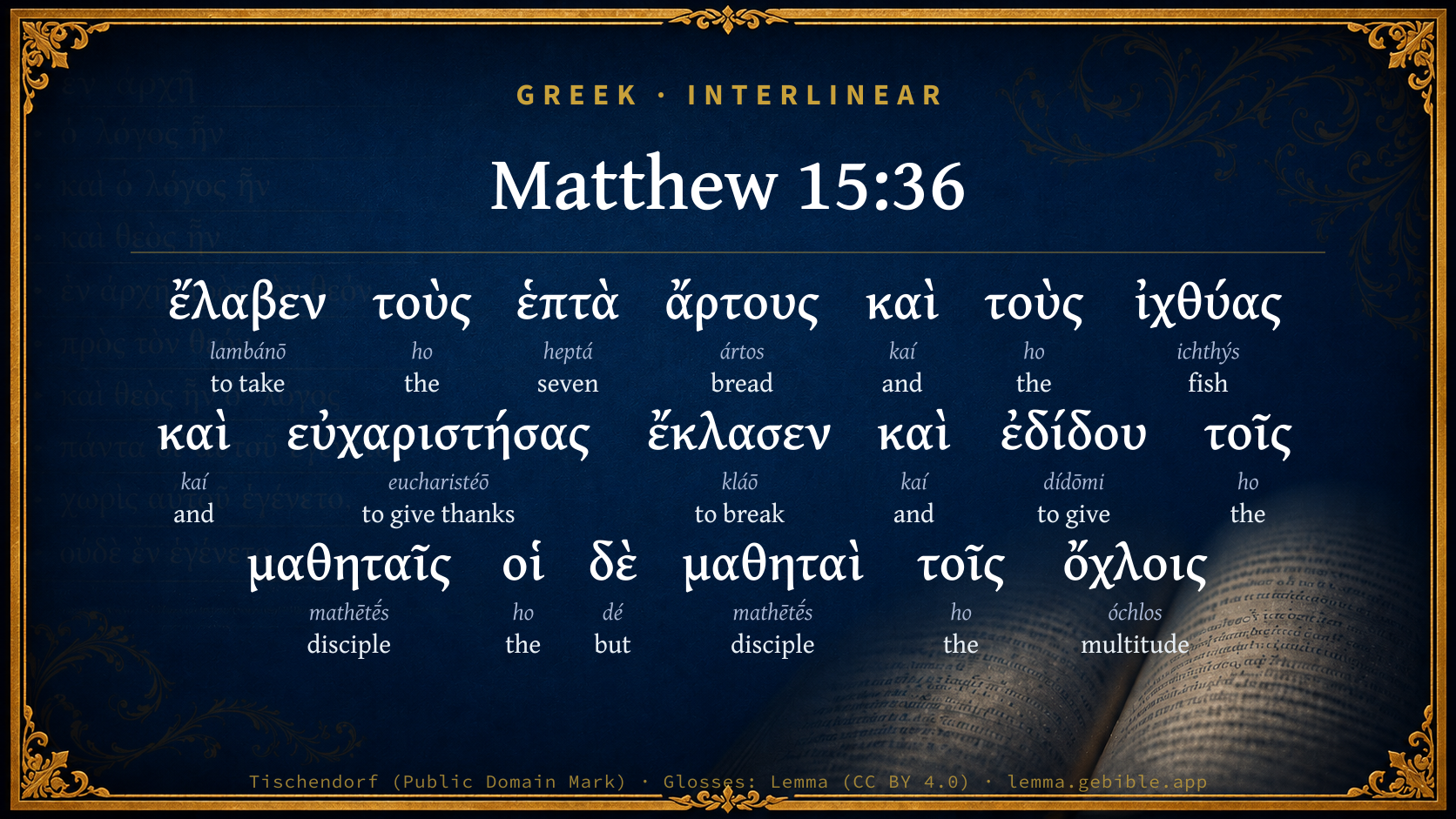
Greek (Tischendorf 8th ed.) Matthew 15:36 appears in the Greek New Testament. The text above is from the Tischendorf 8th edition. Each word links to its Strong’s number and a concise gloss. Click any word for its full Thayer’s Greek Lexicon entry.
Download image
Cite this verse

Matthew 15:36 (World English Bible). Public Domain. Lemma interlinear Bible study tool, https://lemma.gebible.app/v/matthew/15/36.

Show BibTeX & RIS
BibTeX
RIS
English Translation
and he took the seven loaves and the fish. He gave thanks and broke them, and gave to the disciples, and the disciples to the multitudes.
World English Bible · Public Domain
Highlights
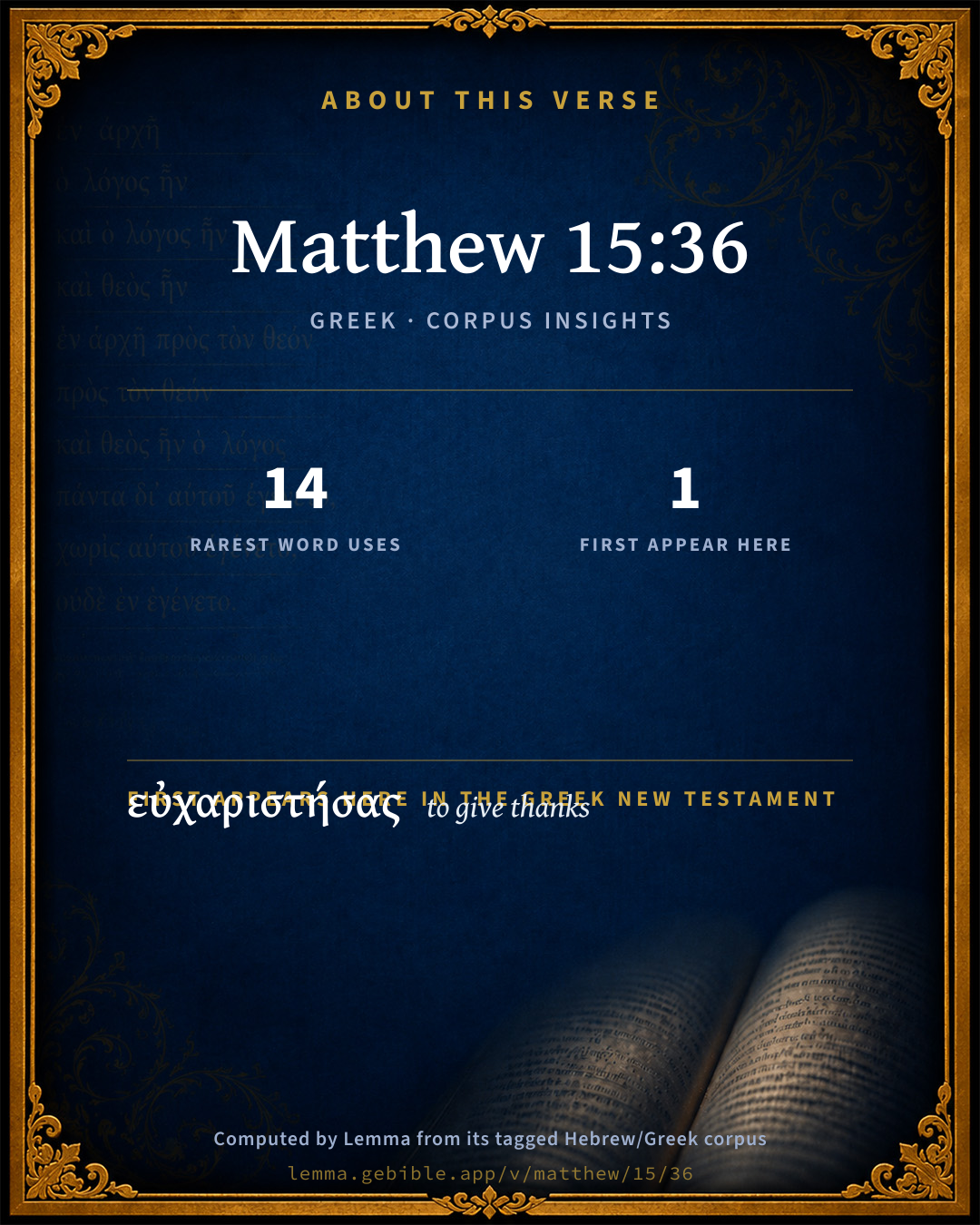
  • 1 first appearance in the Greek New Testament
Full analysis ↓
Download a study sheet

One document with this verse’s original text, its word-by-word gloss line, the meaning frame, cross-references with their text, attributed commentary, and full source and license credits — printable, and it pastes into notes with its structure intact.

This verse Autodidact and up

Study sheet (.html) Plain text (.txt)

A passage Seminary Student

Up to 50 verses in one chapter. A passage sheet keeps up to 6 commentary sources and 12 cross-references per verse, in the order this page ranks them, and says so on the sheet whenever that leaves anything out. Ask for a single verse and you get the Autodidact verse sheet above.

Everything on this page stays free to read, with no account — the sheet is a download of what is already on screen, not access to it.

Want to remove ads? Support Godless Engineer
Compare translations 3

The same verse in 3 English versions, stacked beneath the original-language interlinear above. Click any original word for its lexicon entry.

Each is an independent rendering of the whole verse — the interlinear is not word-aligned to these translations.

Highlighted words mark where these versions differ — a whole-verse word diff, not a word-by-word alignment.

  • World English Bible Public Domain
    and he took the seven loaves and the fish. He gave thanks and broke them, and gave to the disciples, and the disciples to the multitudes.
  • King James Version Public Domain
    And he took the seven loaves and the fishes, and gave thanks, and brake them, and gave to his disciples, and the disciples to the multitude.
  • unfoldingWord Literal Text CC BY-SA 4.0
    he took the seven loaves and the fish, and having given thanks, he broke and was giving to the disciples, and the disciples to the crowds.

unfoldingWord Literal Text — © unfoldingWord, licensed CC BY-SA 4.0. Word-aligned USFM3 via Door43 (git.door43.org/unfoldingWord/en_ult).

Versions to compare (up to 4)

3 of 4 selected

Show all 19 translations

Every available English version of this verse, each an independent rendering of the whole verse.

  • World English Bible Public Domain
    and he took the seven loaves and the fish. He gave thanks and broke them, and gave to the disciples, and the disciples to the multitudes.
  • Berean Standard Bible Public Domain
    Taking the seven loaves and the fish, He gave thanks and broke them. Then He gave them to the disciples, and the disciples gave them to the people.
  • Majority Standard Bible Public Domain
    Taking the seven loaves and the fish, He gave thanks and broke them. Then He gave them to His disciples, and the disciples gave them to the people.
  • King James Version Public Domain
    And he took the seven loaves and the fishes, and gave thanks, and brake them, and gave to his disciples, and the disciples to the multitude.
  • American Standard Version (1901) Public Domain
    and he took the seven loaves and the fishes; and he gave thanks and brake, and gave to the disciples, and the disciples to the multitudes.
  • Revised Version (1885) Public Domain
    and he took the seven loaves and the fishes; and he gave thanks and brake, and gave to the disciples, and the disciples to the multitudes.
  • Geneva Bible (1599) Public Domain
    And tooke the seuen loaues, and the fishes, and gaue thankes, and brake them, and gaue to his disciples, and the disciples to the multitude.
  • Douay-Rheims (1899) Public Domain
    And taking the seven loaves and the fishes, and giving thanks, he brake, and gave to his disciples, and the disciples to the people.
  • Young's Literal Translation Public Domain
    and having taken the seven loaves and the fishes, having given thanks, he did break, and gave to his disciples, and the disciples to the multitude.
  • Literal Standard Version CC BY-SA 4.0
    and having taken the seven loaves and the fishes, having given thanks, He broke, and gave to His disciples, and the disciples [gave] to the multitude.
  • Unlocked Literal Bible CC BY-SA 4.0
    He took the seven loaves and the fish, and after giving thanks, he broke the loaves and gave them to the disciples. The disciples gave them to the crowd.
  • unfoldingWord Literal Text CC BY-SA 4.0
    he took the seven loaves and the fish, and having given thanks, he broke and was giving to the disciples, and the disciples to the crowds.
  • Darby Bible Public Domain
    and having taken the seven loaves and the fishes, having given thanks, he broke [them] and gave [them] to his disciples, and the disciples to the crowd.
  • World Messianic Bible Public Domain
    and he took the seven loaves and the fish. He gave thanks and broke them, and gave to the disciples, and the disciples to the multitudes.
  • Webster's Bible Public Domain
    And he took the seven loaves and the fishes, and gave thanks, and broke them, and gave to his disciples, and the disciples to the multitude.
  • Free Bible Version CC BY-SA 4.0
    He took the seven loaves and the fish, and after blessing the food he broke it into pieces and gave it to the disciples, and the disciples gave it to the crowds.
  • Bible in Basic English Public Domain
    And he took the seven cakes of bread and the fishes; and having given praise, he gave the broken bread to the disciples, and the disciples gave it to the people.
  • Text-Critical English NT CC BY 4.0
    and taking the seven loaves and the fish, he gave thanks, broke them, and gave them to his disciples, and the disciples gave them to the crowd.
  • Tyndale New Testament (1534) Public Domain
    and toke the seven loves and the fysshes and gave thankes and brake them and gave to his disciples and the disciples gave them to the people.

Literal Standard Version (2020), Covenant Press — licensed CC BY-SA 4.0. Text via the HelloAO Bible API (eBible.org). Unlocked Literal Bible (unfoldingWord) — licensed CC BY-SA 4.0. Text via the HelloAO Bible API (eBible.org). unfoldingWord Literal Text — © unfoldingWord, licensed CC BY-SA 4.0. Word-aligned USFM3 via Door43 (git.door43.org/unfoldingWord/en_ult). Free Bible Version, Dr. Jonathan Gallagher — licensed CC BY-SA 4.0. Text via the HelloAO Bible API (eBible.org).

Word by word

More ways to search: Search by grammar → Find every occurrence → Compare this word →

Practice this passage: Drill this verse → Learn its vocabulary →

ἔκλασεν
kláō
G2806
“to break”
Verb, Aorist, Active, Indicative, 3rd person, Singular
Part of Speech
Verb
Tense
Aorist
Voice
Active
Mood
Indicative
Person
3rd person
Number
Singular
Full Thayer's Definition

Origin: a primary verb

TDNT: 15:06,4

1. to break a. used in the NT of the breaking of bread or communion
  1. ἔλαβεν lambánō G2983 “to take” Verb, Aorist, Active, Indicative, 3rd person, Singular
  2. τοὺς ho G3588 “the” Article, Accusative, Plural, Masculine
  3. ἑπτὰ heptá G2033 “seven” Adjective, Numeral (indeclinable)
  4. ἄρτους ártos G740 “bread” Noun, Accusative, Plural, Masculine
  5. καὶ kaí G2532 “and” Conjunction
  6. τοὺς ho G3588 “the” Article, Accusative, Plural, Masculine
  7. ἰχθύας ichthýs G2486 “fish” Noun, Accusative, Plural, Masculine
  8. καὶ kaí G2532 “and” Conjunction
  9. εὐχαριστήσας eucharistéō G2168 “to give thanks” Verb, Aorist, Active, Participle, Nominative, Singular, Masculine
  10. καὶ kaí G2532 “and” Conjunction
  11. ἐδίδου dídōmi G1325 “to give” Verb, Imperfect, Active, Indicative, 3rd person, Singular
  12. τοῖς ho G3588 “the” Article, Dative, Plural, Masculine
  13. μαθηταῖς mathētḗs G3101 “disciple” Noun, Dative, Plural, Masculine
  14. οἱ ho G3588 “the” Article, Nominative, Plural, Masculine
  15. δὲ dé G1161 “but” Conjunction
  16. μαθηταὶ mathētḗs G3101 “disciple” Noun, Nominative, Plural, Masculine
  17. τοῖς ho G3588 “the” Article, Dative, Plural, Masculine
  18. ὄχλοις óchlos G3793 “multitude” Noun, Dative, Plural, Masculine

About this verse

These counts appear in no published source. They are computed here, from the morphology-tagged text and Lemma’s own curated glosses. What Lemma adds →

19
words
12
distinct lemmas
Gospels
section

Notable vocabulary

The rarest word here is ἔκλασεν to break G2806 — appearing just 14 times in the whole Greek New Testament.

First appearance in Scripture

This word makes its first canonical appearance in the Greek New Testament here:

  • εὐχαριστήσας to give thanks G2168

Shared distinctive vocabulary

ἔκλασεν to break G2806 occurs in 14 verses of the Greek New Testament. Also found in:
Repetition

Words recur within this verse:

  • μαθηταῖς disciple G3101 ×2
  • τοὺς the G3588 ×5
  • καὶ and G2532 ×3

Cross-references

12

Topical passages linked to Matthew 15:36 in the Treasury of Scripture Knowledge — connected by theme and wording, ordered by reader-vote popularity; previews shown in the World English Bible.

  • Luke 22:19 He took bread, and when he had given thanks, he broke it, and gave to them, saying, "This is my body which is given for you. Do this in memory of me."
  • Romans 14:6 He who observes the day, observes it to the Lord; and he who does not observe the day, to the Lord he does not observe it. He who eats, eats to the Lord, for he gives God thanks. He who doesn't eat, to the Lord he doesn't eat, and gives God thanks.
  • John 6:11 Jesus took the loaves; and having given thanks, he distributed to the disciples, and the disciples to those who were sitting down; likewise also of the fish as much as they desired.
  • Acts 27:35 When he had said this, and had taken bread, he gave thanks to God in the presence of all, and he broke it, and began to eat.
  • 1 Corinthians 10:31 Whether therefore you eat, or drink, or whatever you do, do all to the glory of God.
  • 1 Timothy 4:3–4 forbidding marriage and commanding to abstain from foods which God created to be received with thanksgiving by those who believe and know the truth.
  • 1 Samuel 9:13 as soon as you are come into the city, you shall immediately find him, before he goes up to the high place to eat; for the people will not eat until he come, because he does bless the sacrifice; [and] afterwards they eat who are invited. Now therefore get you up; for at this time you shall find him.
  • Matthew 14:19 He commanded the multitudes to sit down on the grass; and he took the five loaves and the two fish, and looking up to heaven, he blessed, broke and gave the loaves to the disciples, and the disciples gave to the multitudes.
  • Matthew 26:26–27 As they were eating, Jesus took bread, gave thanks for it, and broke it. He gave to the disciples, and said, "Take, eat; this is my body."
  • Luke 22:17 He received a cup, and when he had given thanks, he said, "Take this, and share it among yourselves,
  • Luke 24:30 It happened, that when he had sat down at the table with them, he took the bread and gave thanks. Breaking it, he gave to them.
  • John 6:23 However boats from Tiberias came near to the place where they ate the bread after the Lord had given thanks.

Cross-references courtesy of OpenBible.info (CC BY 4.0).

Commentary

Notes on Matthew 15:36 from classic Christian and Jewish commentators (each source and its license shown beneath its notes). The classic Christian expositions comment on the surrounding passage and are grouped to its opening verse, so a note may address several verses; the Jewish commentaries on the Tanakh (Rashi and others) are per-verse, so they appear only where the commentator wrote on this verse.

Lemma curates 59 commentaries, every one of them public domain or Creative Commons licensed, each selected and text-cleaned for this edition rather than reprinted as found. About our sources →

Bengel's Gnomon

Johann Albrecht Bengel

Mat 15:36. Εὐχαριστήσας, having given thanks) It is right to give thanks even before food (see Act 27:35), and there it is the same as εὐλογία, or benediction, for it is an acknowledgment of the Divine blessing for the past and the future. Jesus referred everything to the Father, and here gave thanks for the loaves, and for the approaching satisfying of the people; cf. Joh 11:41.—εὐχαριστεῖν is a verb found fault with by Phrynichus,[703] but used also by Diodorus Siculus.[704]

[703] PHRYNICUS, a rhetorician and sophist of Bythinia, who flourished in the second century of the Christian æra.—(I. B.)

[704] DIODORUS SICULUS, an ancient Greek historian. Born at Agyrium in the first century after Christ.—(I. B.)

Bengel's Gnomon of the New Testament — English translation (T&T Clark, Edinburgh, 1860) — public domain. Text from a community e-Sword module.

Expositor's Greek Testament

ed. W. Robertson Nicoll

Mat 15:36 . εὐχαριστήσας , a late Greek word (“does not occur before Polybius in the sense of gratias agere ” Camb. N. T.), condemned by Phryn., who enjoins χάριν εἰδέναι instead (Lobeck, p. 18). Elsner dissents from the judgment of the ancient grammarians, citing instances from Demosthenes, etc.

The Expositor's Greek Testament, edited by W. Robertson Nicoll (1897–1910) — public domain. Text from a community e-Sword module.

John Gill's Exposition

And they did all eat, and were filled,.... Every one had a share of the provision, and that to full satisfaction; no one was overlooked and neglected, and everyone had as much as he could eat:

and they took up of the broken meat that was left, seven baskets full. The disciples, after they had distributed to everyone his portion, went round, and collected the remaining fragments, and filled seven baskets therewith, according to the number of the loaves which were broken; and so had a full return for the loaves and fishes they spared on this occasion.

John Gill's Exposition of the Whole Bible (1746–1763) — public domain (CC PDM 1.0). Text via the HelloAO Bible API.

Trapp's Complete Commentary

John Trapp

36 And he took the seven loaves and the fishes, and gave thanks, and brake them, and gave to his disciples, and the disciples to the multitude.

Ver. 36. And gave to his disciples] So confuting their unbelief, and confirming their faith for the future. And the like he doth for us every time we receive the sacrament of his Supper. He bespeaks us there, as he did peremptory Thomas, Joh 20:27.

And the disciples to the multitude] This is Christ’s course to this day; by the hands of his faithful ministers to deal forth his favours, to give his Holy Spirit, which is, to give all good things, Mat 7:11; cf. Luk 11:13, by the preaching of faith. This manna comes down from heaven in the dews of the ministry, Num 11:9; 1Pe 1:22. If our eyes see not our teachers, we cannot expect to hear the voice behind us, Isa 30:20.

John Trapp, A Commentary or Exposition upon All the Books of the Old and New Testament (1647–1656) — public domain. Text from a community e-Sword module.

Haydock's Catholic Bible Commentary

He gave thanks to his heavenly Father, for that providential care with which he supplies our wants, even miraculously, when necessary for us. Everywhere his goodness and attention to the wants of his children are manifested, but not more so in the manna of the desert, than in the fertility of the holy land. (Haydock)

George Leo Haydock (1774–1849), Haydock's Catholic Family Bible and Commentary, 1859 edition — public domain. Excludes Psalms (Douay-Rheims chapter numbering differs from Protestant) and Deuterocanonical books (Catholic canon only).

The Pulpit Commentary

He took. The account differs little from that on the former occasion. Gave thanks (eucaristhsav). This represents the blessing of the viands. Thanksgiving was a specially enjoined accompaniment of meals. The Talmud said, "He that enjoys.anything without an act of thanksgiving is as one that robs the Almighty." The blessing here was the efficient cause of the multiplication of the food. Without any fresh creation Jesus used the materials ready to his hands, and only increased them by his Almighty power. Brake them, and gave (eklase kai edidou). Looking to the tenses used, we should say that Jesus brake the viands once, and then kept continually giving of them to the twelve for the purpose of distribution. We do not read how the multitude was arranged in the present case. Possibly the locality did not admit of methodical division into ranks and companies, or, on the other hand, its natural terraces may have obviated the necessity for any such formal arrangement, the company falling naturally into convenient sections.

The mission of miracles of supply.

They were corrective of the influence that was actually produced by the miracles of healing. The differences in the spheres and the character of our Lord"s miracles is not sufficiently observed, he was no mere Eastern Hakim, with a wonderful panacea for all forms of bodily woe. He is too often spoken of as if this were his description. More importance needs to be given to our Lord"s walking the water, stilling the storm, raising the dead, and multiplying the food supplies. It is competent for any man to plead that the healing gift is, like the artistic gift, the special endowment of individuals; and Jesus was a Man with an unusual gift of the healing power. No such explanation can be found for the miracles of supply, or for the miracles of control over nature. And we shall come back upon the miracles of healing with new and worthier ideas when we have rightly apprehended the miracles of supply. We have seen, in the previous homily, that Christ"s doctoring work rather directed men"s attention to the "God of Israel" than to himself, "God manifest in the flesh.

I THE MIRACLES OF SUPPLY SET THE PERSON OF JESUS IN PROMINENCE. Illustrate by the effect of the wine making at Cana. That miracle "manifested forth his glory." Also by the other feeding of the thousands, which set Christ"s Person forth so prominently that the people wanted, then and there, to make him king. Miracles of supply are stranger things, more difficult to explain, and more impressively related to the individual, than miracles of healing. Forth teem miracles of supply men go, saving to their neighbours, "What think ye of Christ? whose Son is he?" Compare the remarkable direction of the thoughts of the disciples to the Person and mystery of Christ, when he came to them walking on the sea.

II THE MIRACLES OF SUPPLY SET THE SPIRITUAL CHARACTER OF THE WORK OF JESUS IN PROMINENCE. They belong to another and more suggestive region. Removal of disabilities may be a great thing, but renewal of life is greater. Food, to be taken into a man"s body, and turned into life, is a revelation of Christ"s higher relation to men. He is soul food; taken in by faith and love, he is turned into the soul"s life. "He that eateth me shall live by me. R.T.

The Pulpit Commentary (1880–1919), ed. H.D.M. Spence-Jones & Joseph S. Exell — public domain. Text from a community e-Sword module.

John Wesley's Explanatory Notes

He gave thanks, or blessed the food - That is, he praised God for it, and prayed for a blessing upon it.

John Wesley, Explanatory Notes Upon the Whole Bible (1754–1765) — public domain. Text via the GEBible commentary corpus.

McGarvey & Pendleton's Commentaries

J. W. McGarvey

J. W. McGarvey's The Fourfold Gospel [LXX. A. Third Withdrawal].

LXX. THIRD WITHDRAWAL FROM HEROD'S TERRITORY. Subdivision A. PHARISAIC LEAVEN. A BLIND MAN HEALED. (Magadan and Bethsaida. Probably Summer, A. D. 29.) aMATT. XV. 39-XVI. 12; bMARK VIII. 10-26.

b10 And straightway he entered into the boat with his disciples, aand came into the borders of Magadan. binto the parts of Dalmanutha. [It appears from the context that he crossed the lake to the west shore. Commentators, therefore, pretty generally think that Magadan is another form of the name Magdala, and that Dalmanutha was either another name for Magdala, or else a village near it.] a1 And the Pharisees and Sadducees bcame forth, and began to question with him, seeking of him a sign aand trying him [testing the strength of his miraculous power] asked him to show them a sign from heaven. [They rejected his miracles as signs of his Messiahship, the Pharisees holding that such signs could be wrought by Beelzebub. They therefore asked a sign from heaven such as only God could give, and such as he had accorded to Moses, Joshua, Samuel, and Elijah, or such as Joel foretold ( Joe_2:31). It is generally thought that the [406] Herodians were Sadducees of Galilee. If so, we note the beginning of their hostility recorded at Mark iii. 6, 1Co_1:22.] 4 An evil and adulterous generation seeketh after a sign; and bverily I say unto you, There shall no sign be given unto this generation. [i. e., none such as was demanded] bbut the sign of Jonah. [For comment on similar language, see pages 305-306. The resurrection or Jonah sign was a sign from heaven in the sense in which they used the words; that is, it was wrought directly by God, and not through man.] 13 And he left them, bAnd again entering into the boat departed to the other side. [I. e., from Magdala back again to the east shore, or rather, toward Bethsaida Julias, on the northeast shore.] a5 And the disciples came to the other side and forgot to take bread. band they had not in the boat with them more than one loaf. [This loaf was probably left over from the previous supply.] a6 Then Jesus said unto them, b15 And he charged them, saying, aTake heed and beware of the leaven of the Pharisees and Sadducees. Beware of the leaven of the Pharisees and of the Sadducees. band the leaven of Herod. [Leaven, which answered to our modern yeast, was a symbol of a secret, penetrating, pervasive influence, usually of a corrupting nature. The [407] influence of the Pharisees was that of formalism, hypocritical ostentation, and traditionalism; that of the Sadducees was sneering rationalistic unbelief, free thought and cunning worldliness, manifesting itself among the Herodians in political corruption. 16 And they reasoned one with another, aamong themselves, saying, We took bhave no bread. They thought that Jesus reproved them for their carelessness in forgetting to take bread, since that carelessness might lead them to be without bread on their journey. So his rebuke below indicates.] a8 And Jesus perceiving it said, bsaith, unto them, aO ye of little faith, why reason ye among yourselves, because ye have brought no bread? 9 Do ye not yet perceive, bneither understand? aneither remember the five loaves of the five thousand, and how many baskets [cophini, probably traveling baskets] ye took up? 10 Neither the seven loaves of the four thousand, and how many baskets [spurides, probably grain baskets or hampers] ye took up? 11 How is it that ye do not perceive that I spake not to you concerning bread? bhave ye your hearts hardened? 18 Having eyes, see ye not? and having ears, hear ye not? and do ye not remember? 19 When I brake the five loaves among the five thousand, how many baskets [cophini] full of broken pieces took ye up? They say unto him, Twelve. 20 And when the seven among the four thousand, how many basketfuls [spurides] of broken pieces took ye up? And they say unto him, Seven. 21 And he said unto them, Do ye not yet understand? aBut beware of the leaven of the Pharisees and Sadducees? 12 Then understood they how that he bade them not beware of the leaven of bread, but of the teaching of the Pharisees and Sadducees. [Jesus had resorted to metaphor because the word leaven better expressed his idea than did the word teaching. The formulated dogmas of the Pharisees were not so bad, but the subtle influence of their spirit and example corrupted [408] without warning, like a concealed grave. There are those to-day who are too skillful to be openly convicted of heterodox statements, but whose teaching, nevertheless, in its very essence and spirit, tends to infidelity.] b22 And they cometh unto Bethsaida. [Not the suburb of Capernaum, but Bethsaida Julias, a town on the east side of the Jordan, near where it flows into the Sea of Galilee. Jesus was proceeding northward toward Cæsarea Philippi.] And they bring to him a blind man, and beseech him to touch him. 23 And he took hold of the blind man by the hand, and brought him out of the village [Jesus increased the sympathy between himself and the man by separating him from the crowd. Our greatest blessing can only come to us after we have been alone with God]; and when he had spit on his eyes, and laid his hands upon him, he asked him, Seest thou aught? 24 And he looked up, and said, I see men; for I behold i them as trees, walking. 25 Then again he laid his hands again upon his eyes; and he looked steadfastly, and was restored, and saw all things clearly. [The man's eyes were probably sore, and Jesus made use of saliva to soften and soothe them. But it was our Lord's custom to give variety to the manifestation of his power, sometimes using one apparent auxiliary means, and sometimes another; and also healing instantly or progressively, as he chose, that the people might see that the healing was altogether a matter of his will. The man had evidently not been born blind, else he would not have been able to recognize men or trees by sight, for those not used to employ sight can not by it tell a circle from a square.] 26 And he sent him away to his home, saying, Do not even enter into the village. [The man, of course, lived in the village, and to send him home was to send him thither, but he was to go directly home and not spread the news through the town, for if he did the population would be at once drawn to Jesus, thus breaking up the privacy which he sought to maintain.] [409]

[FFG 406-409]

J. W. McGarvey (with Philip Y. Pendleton), Commentaries on the New Testament (The Fourfold Gospel, 1914; Acts; and the epistles) — public domain. Text from a community e-Sword/MySword module.

unfoldingWord translationNotes

Door43 World Missions Community

He took the seven loaves and the fish

"Jesus held the seven loaves and the fish in his hands"

he broke the loaves

"he tore the loaves"

gave them

"gave the bread and the fish"

they gathered

"the disciples gathered" or "some people gathered"

Those who ate

"The people who ate"

four thousand men

"4,000 men" (See: Numbers)

the region

"the area"

Magadan

This region is sometimes called "Magdala." (See: How to Translate Names)

translationWords

disciple

basket

unfoldingWord translationNotes — © Distant Shores Media and the Door43 World Missions Community, licensed CC BY-SA 4.0. Source: git.door43.org/Door43/en_tn.

Cambridge Greek Testament for Schools and Colleges

36. εὐχαριστήσας. εὐχαριστεῖν does not occur before Polybius in the sense of gratias agere. The decree in Demosth. de Cor. p. 257, where the word is found, (see Lob. Phryn. 18) is probably spurious. The classical expression is χάριν εἰδέναι.

τὸ περισσεῦον τῶν κλασμάτων. See ch. Mat 14:20. One side of the lesson is the lavishness of Providence. God gives even more than we require or ask for. But the leading thought is a protest against waste.

Cambridge Greek Testament for Schools and Colleges (Cambridge University Press, 1896; 21 vols, various authors incl. Carr, Maclear, Plummer, Farrar, Lumby, Moule, M. R. James, Simcox) — public domain. Text from a community e-Sword module.

International Critical Commentary

36. And took the seven loaves and the fishes, and having given thanks, He brake and was giving to the disciples, and the disciples to the multitudes.] Mk. has: “And having taken the seven loaves, having given thanks, He brake, and was giving to His disciples that they might distribute; and they distributed to the multitude. And they had a few little fishes: and having blessed them, He commanded (εἷπεν) also to distribute these.”

(M)

International Critical Commentary — older volumes (1896–1929), various authors — public domain. Text from a community e-Sword module.

Lesson kit

Teaching starters — assembled from the data on this page, not authored interpretation. Every prompt links to the verse data it draws on. Edit before teaching.

Matthew, in the Gospels, opens this verse with 19 words (12 distinct Greek lemmas). Its most distinctive word is kláō (“to break”). A historical commentator’s framing appears above. Read the whole chapter for the surrounding context.

Discussion questions

  1. What does “to break” (kláō) contribute to the verse as a whole?
  2. This is the first place “to give thanks” appears in Scripture (first appears here). What does its debut here establish?
  3. How does Matthew 14:19, which shares the word «to break», read alongside this verse?
  4. What does the repetition of “disciple” (2× in this one verse) do in this verse?
  5. The translations on this page render this verse differently — a whole-verse word diff, not a word-by-word alignment. What might account for the different wordings?
  6. Compare how Bengel's Gnomon and Expositor's Greek Testament read this verse. Where do they agree or differ?

Things to notice

  • 1 word makes its first canonical appearance in Scripture here.
  • These translations choose different wording for 11 words in this verse.
  • “disciple” occurs 2× in this single verse.
  • 12 distinct Greek lemmas span 19 words in this verse.

Reading settings

Reading text

Shown beneath each verse's original-language words.

Old Testament
Old Testament edition

Read the OT as the Masoretic Hebrew (MT) or the Greek Septuagint (LXX).

English shown for the Greek Septuagint (in the Hebrew ↔ Greek comparison).

Comparing translations? Open the Compare panel on any verse page to stack up to four side by side.