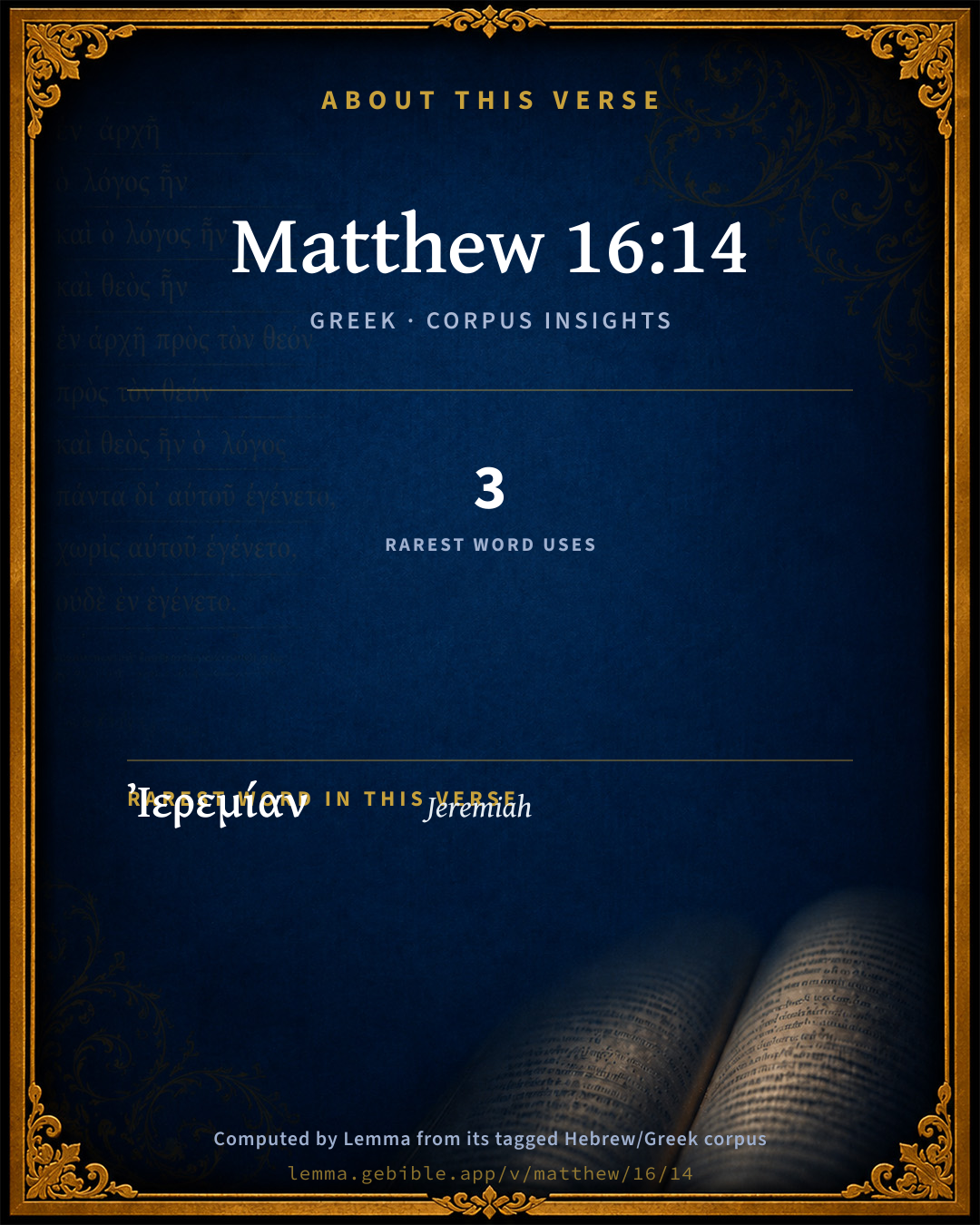
Matthew 16:14

Greek (Tischendorf 8th ed.) Matthew 16:14 appears in the Greek New Testament. The text above is from the Tischendorf 8th edition. Each word links to its Strong’s number and a concise gloss. Click any word for its full Thayer’s Greek Lexicon entry.
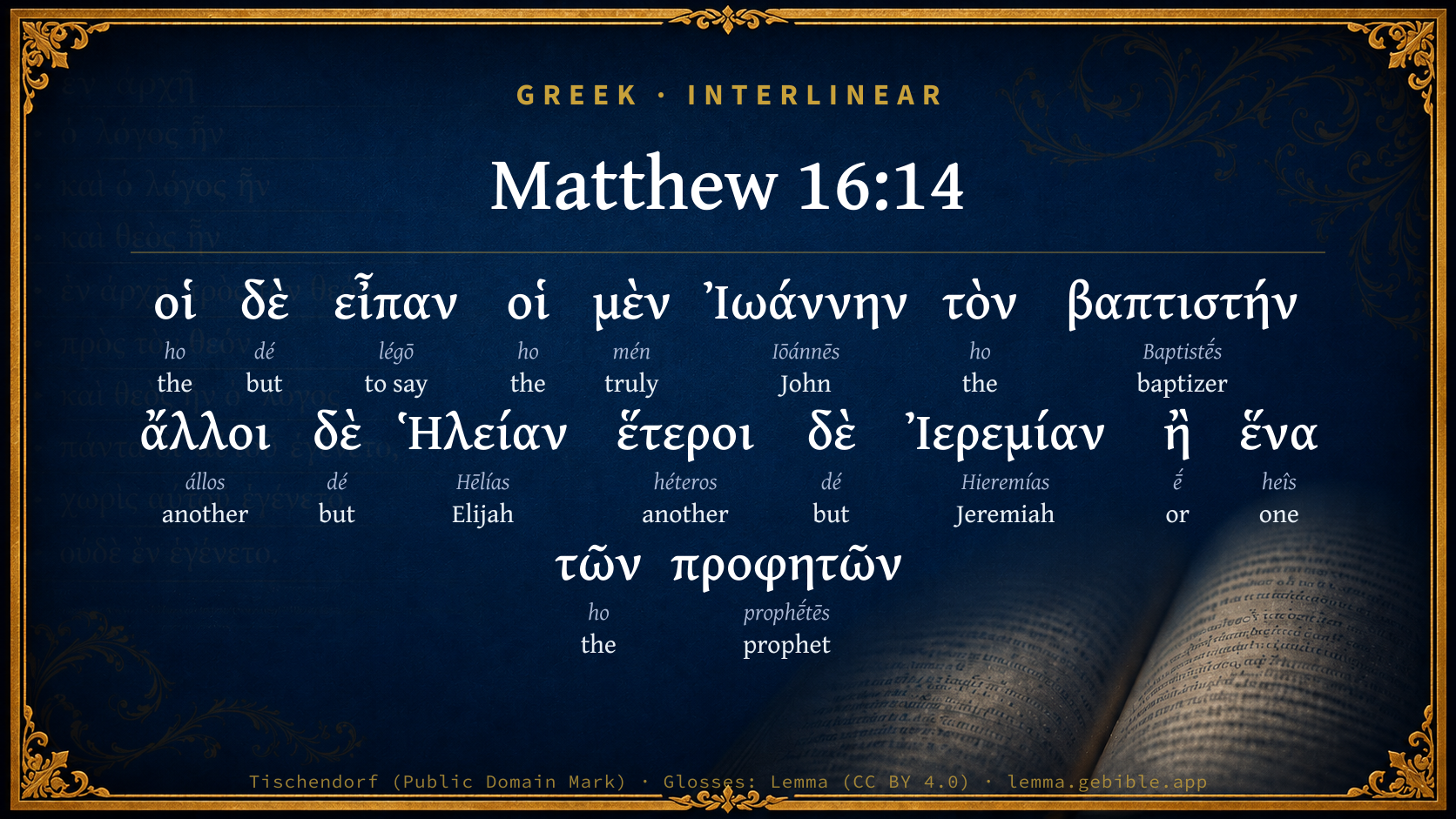
Download image
Cite this verse

Matthew 16:14 (World English Bible). Public Domain. Lemma interlinear Bible study tool, https://lemma.gebible.app/v/matthew/16/14.

Show BibTeX & RIS
BibTeX
RIS
English Translation
They said, "Some say John the Baptizer, some, Elijah, and others, Jeremiah, or one of the prophets."
World English Bible · Public Domain
Download a study sheet

One document with this verse’s original text, its word-by-word gloss line, the meaning frame, cross-references with their text, attributed commentary, and full source and license credits — printable, and it pastes into notes with its structure intact.

This verse Autodidact and up

Study sheet (.html) Plain text (.txt)

A passage Seminary Student

Up to 50 verses in one chapter. A passage sheet keeps up to 6 commentary sources and 12 cross-references per verse, in the order this page ranks them, and says so on the sheet whenever that leaves anything out. Ask for a single verse and you get the Autodidact verse sheet above.

Everything on this page stays free to read, with no account — the sheet is a download of what is already on screen, not access to it.

Want to remove ads? Support Godless Engineer
Compare translations 3

The same verse in 3 English versions, stacked beneath the original-language interlinear above. Click any original word for its lexicon entry.

Each is an independent rendering of the whole verse — the interlinear is not word-aligned to these translations.

Highlighted words mark where these versions differ — a whole-verse word diff, not a word-by-word alignment.

  • World English Bible Public Domain
    They said, "Some say John the Baptizer, some, Elijah, and others, Jeremiah, or one of the prophets."
  • King James Version Public Domain
    And they said, Some say that thou art John the Baptist: some, Elias; and others, Jeremias, or one of the prophets.
  • unfoldingWord Literal Text CC BY-SA 4.0
    And they said, “Some, John the Baptist; and some, Elijah; and others, Jeremiah, or one of the prophets.”

unfoldingWord Literal Text — © unfoldingWord, licensed CC BY-SA 4.0. Word-aligned USFM3 via Door43 (git.door43.org/unfoldingWord/en_ult).

Versions to compare (up to 4)

3 of 4 selected

Show all 19 translations

Every available English version of this verse, each an independent rendering of the whole verse.

  • World English Bible Public Domain
    They said, "Some say John the Baptizer, some, Elijah, and others, Jeremiah, or one of the prophets."
  • Berean Standard Bible Public Domain
    They replied, “Some say John the Baptist; others say Elijah; and still others, Jeremiah or one of the prophets.”
  • Majority Standard Bible Public Domain
    They replied, “Some say John the Baptist; others say Elijah; and still others, Jeremiah or one of the prophets.”
  • King James Version Public Domain
    And they said, Some say that thou art John the Baptist: some, Elias; and others, Jeremias, or one of the prophets.
  • American Standard Version (1901) Public Domain
    And they said, Some `say' John the Baptist; some, Elijah; and others, Jeremiah, or one of the prophets.
  • Revised Version (1885) Public Domain
    And they said, Some say John the Baptist; some, Elijah: and others, Jeremiah, or one of the prophets.
  • Geneva Bible (1599) Public Domain
    And they said, Some say, Iohn Baptist: and some, Elias: and others, Ieremias, or one of the Prophets.
  • Douay-Rheims (1899) Public Domain
    But they said: Some John the Baptist, and other some Elias, and others Jeremias, or one of the prophets.
  • Young's Literal Translation Public Domain
    and they said, `Some, John the Baptist, and others, Elijah, and others, Jeremiah, or one of the prophets.'
  • Literal Standard Version CC BY-SA 4.0
    And they said, “Some, John the Immerser, and others, Elijah, and others, Jeremiah, or one of the prophets.”
  • Unlocked Literal Bible CC BY-SA 4.0
    They said, “Some say John the Baptist; some, Elijah; and others, Jeremiah, or one of the prophets.”
  • unfoldingWord Literal Text CC BY-SA 4.0
    And they said, “Some, John the Baptist; and some, Elijah; and others, Jeremiah, or one of the prophets.”
  • Darby Bible Public Domain
    And they said, Some, John the baptist; and others, Elias; and others again, Jeremias or one of the prophets.
  • World Messianic Bible Public Domain
    They said, “Some say Yochanan the Immerser, some, Elijah, and others, Jeremiah or one of the prophets.”
  • Webster's Bible Public Domain
    And they said, Some say that thou art John the Baptist: some Elijah; and others, Jeremiah, or one of the prophets.
  • Free Bible Version CC BY-SA 4.0
    “Some say John the Baptist, some say Elijah, and others say Jeremiah or one of the other prophets,” they replied.
  • Bible in Basic English Public Domain
    And they said, Some say, John the Baptist; some, Elijah; and others, Jeremiah, or one of the prophets.
  • Text-Critical English NT CC BY 4.0
    They said, “Some say John the Baptist, others say Elijah, and others say that yoʋ are Jeremiah or one of the prophets.”
  • Tyndale New Testament (1534) Public Domain
    They saide some saye that thou arte Ihon Baptist some Helias some Ieremias or one of the prophetes.

Literal Standard Version (2020), Covenant Press — licensed CC BY-SA 4.0. Text via the HelloAO Bible API (eBible.org). Unlocked Literal Bible (unfoldingWord) — licensed CC BY-SA 4.0. Text via the HelloAO Bible API (eBible.org). unfoldingWord Literal Text — © unfoldingWord, licensed CC BY-SA 4.0. Word-aligned USFM3 via Door43 (git.door43.org/unfoldingWord/en_ult). Free Bible Version, Dr. Jonathan Gallagher — licensed CC BY-SA 4.0. Text via the HelloAO Bible API (eBible.org).

Word by word

More ways to search: Search by grammar → Find every occurrence → Compare this word →

Practice this passage: Drill this verse → Learn its vocabulary →

Ἰερεμίαν
Hieremías
G2408
“Jeremiah”
Noun, Accusative, Singular, Masculine
Part of Speech
Noun
Case
Accusative
Number
Singular
Gender
Masculine
Full Thayer's Definition

Origin: of hebrew origin H3414

TDNT: 3:218,*

Jeremiah = "whom Jehovah has appointed" 1. the son of Hilkiah of the priests that were in Anathoth. He was called very young (B.C. 2. to the prophetic office, and prophesied 42 years. He probably died in Egypt.
  1. οἱ ho G3588 “the” Article, Nominative, Plural, Masculine
  2. δὲ dé G1161 “but” Conjunction
  3. εἶπαν légō G3004 “to say” Verb, Aorist, Active, Indicative, 3rd person, Plural
  4. οἱ ho G3588 “the” Article, Nominative, Plural, Masculine
  5. μὲν mén G3303 “truly” Particle
  6. Ἰωάννην Iōánnēs G2491 “John” Noun, Accusative, Singular, Masculine
  7. τὸν ho G3588 “the” Article, Accusative, Singular, Masculine
  8. βαπτιστήν Baptistḗs G910 “baptizer” Noun, Accusative, Singular, Masculine
  9. ἄλλοι állos G243 “another” Adjective, Nominative, Plural, Masculine
  10. δὲ dé G1161 “but” Conjunction
  11. Ἡλείαν Hēlías G2243 “Elijah” Noun, Accusative, Singular, Masculine
  12. ἕτεροι héteros G2087 “another” Adjective, Nominative, Plural, Masculine
  13. δὲ dé G1161 “but” Conjunction
  14. ἢ ḗ G2228 “or” Particle
  15. ἕνα heîs G1520 “one” Adjective, Accusative, Singular, Masculine
  16. τῶν ho G3588 “the” Article, Genitive, Plural, Masculine
  17. προφητῶν prophḗtēs G4396 “prophet” Noun, Genitive, Plural, Masculine

About this verse

These counts appear in no published source. They are computed here, from the morphology-tagged text and Lemma’s own curated glosses. What Lemma adds →

18
words
13
distinct lemmas
Gospels
section

Notable vocabulary

The rarest word here is Ἰερεμίαν Jeremiah G2408 — appearing just 3 times in the whole Greek New Testament.

Shared distinctive vocabulary

Ἰερεμίαν Jeremiah G2408 occurs in 3 verses of the Greek New Testament. Also found in:

Repetition

Words recur within this verse:

Cross-references

11

Topical passages linked to Matthew 16:14 in the Treasury of Scripture Knowledge — connected by theme and wording, ordered by reader-vote popularity; previews shown in the World English Bible.

  • Mark 6:15 But others said, "It is Elijah." Others said, "It is the Prophet, or like one of the prophets."
  • Matthew 14:2 and said to his servants, "This is John the Baptizer. He is risen from the dead. That is why these powers work in him."
  • Malachi 4:5 Behold, I will send you Elijah the prophet before the great and terrible day of Yahweh comes.
  • Luke 9:18–19 It happened, as he was praying alone, that the disciples were with him, and he asked them, "Who do the multitudes say that I am?"
  • John 9:17 Therefore they asked the blind man again, "What do you say about him, because he opened your eyes?" He said, "He is a prophet."
  • John 7:12 There was much murmuring among the multitudes concerning him. Some said, "He is a good man." Others said, "Not so, but he leads the multitude astray."
  • Matthew 17:10 His disciples asked him, saying, "Then why do the scribes say that Elijah must come first?"
  • Mark 8:28 They told him, "John the Baptizer, and others say Elijah, but others: one of the prophets."
  • Luke 9:8 and by some that Elijah had appeared, and by others that one of the old prophets had risen again.
  • John 7:40–41 Many of the multitude therefore, when they heard these words, said, "This is truly the prophet."
  • John 1:21 They asked him, "What then? Are you Elijah?" He said, "I am not." "Are you the Prophet?" He answered, "No."

Cross-references courtesy of OpenBible.info (CC BY 4.0).

Commentary

Notes on Matthew 16:14 from classic Christian and Jewish commentators (each source and its license shown beneath its notes). The classic Christian expositions comment on the surrounding passage and are grouped to its opening verse, so a note may address several verses; the Jewish commentaries on the Tanakh (Rashi and others) are per-verse, so they appear only where the commentator wrote on this verse.

Lemma curates 59 commentaries, every one of them public domain or Creative Commons licensed, each selected and text-cleaned for this edition rather than reprinted as found. About our sources →

Tyndale Open Study Notes

Tyndale Open Resources

16:14 Some, such as Herod Antipas (14:1-2), thought Jesus was John the Baptist resurrected. • Elijah was expected as a forerunner to the Messiah (11:14; 17:10-12; Mal 3:1; 4:5-6). • Jeremiah or one of the other prophets: Some Jews expected Jeremiah to be raised (see 2 Maccabees 15:13-16). Jesus’ strong stand on sensitive matters (Matt 5:17; 15:1-20) may have led some to think Jesus was Jeremiah. Jesus was not yet understood as God’s Messiah.

Tyndale Open Study Notes — © Tyndale Open Resources, licensed CC BY-SA 4.0. Text via the HelloAO Bible API.

Bengel's Gnomon

Johann Albrecht Bengel

Mat 16:14. Οἱ μὲν—ἄλλοι δὲ—ἕτεροι δὲ, some—some—and others) It is not sufficient that we should know the various opinions of others, we ought ourselves to have a fixed faith, which then may make progress, even by the opinions of others, though vain in themselves.—Ἰωάννην—ἢ ἓνα τῶν προφητῶν, John—or one of the prophets) There is no need to refer this to the notion of a metempsychosis believed by the Pharisees; for they expected the return of Elias himself in person, who was not dead, or the resurrection of the others from the dead;[735] see ch. Mat 14:2: Luk 9:8; Luk 9:19.—ἸΕΡΕΜΊΑΝ, Jeremiah) who was at that time expected by the Jews.—ἕνα, one) i.e. some one indefinitely. They did not think that anything greater could come than they had already had. They did not compare Jesus with Moses.

[735] The suspicion they formed was not that the soul of Elijah or others had passed into the body of Jesus, according to the Pythagorean doctrine of metempsychosis, but an actual return of Elijah in person, or a resurrection of the others named.—ED.

Bengel's Gnomon of the New Testament — English translation (T&T Clark, Edinburgh, 1860) — public domain. Text from a community e-Sword module.

Meyer's Critical & Exegetical Commentary

Heinrich August Wilhelm Meyer

Mat_16:14 f. Ἰωάννην τὸν βαπτ.] Their opinion is similar to that of Antipas, Mat_14:2.

Ἠλίαν] These ἄλλοι cannot, therefore, have realized in the person of the Baptist that coming of Elias which was to precede the advent of the Messiah.

ἕτεροι δέ] a distinct class of opinion which, whatever may have been the subsequent view, was not at that time understood to be in any way connected with the expected coming of Elias. For ἕτερος, comp. note on 1Co_12:9; 1Co_15:40; 2Co_11:4; Gal_1:6. As forerunner of the Messiah they expected Jeremiah, who at that time was held in very high repute (Ewald, ad Apoc. XI. 3), or some other ancient prophet (risen from the dead). Bertholdt, Christol. p. 58 f.

ἢ ἕνα τῶν προφ.] where we are not to suppose ἄλλον to be understood (Fritzsche), but should rather regard the persons in question as intending to say (in a general way): it is εἷς τῶν προφ.! without mentioning any one in particular. For εἷς, see note on Mat_8:19.

ὑμεῖς δέ] from them He expected a very different kind of confession, and He was not disappointed.

Meyer — Critical and Exegetical Commentary on the New Testament — English translation by Peter Christie, edited by Frederick Crombie (T&T Clark, 1880) — public domain. Text from a community e-Sword module.

Expositor's Greek Testament

ed. W. Robertson Nicoll

Mat 16:14 . Reply of disciples : the general effect being: opinions of the people, favourable but crude, without religious definiteness and depth, with no promise of future outcome. Ἰωάν ., Ἠλίαν ., Ἱερεμ . Historic characters, recent or more ancient, redivivi that the utmost possible: unable to rise to the idea of a wholly new departure, or a greater than any character in past history; conservatism natural to the common mind. All three personages whose return might be expected; the Baptist to continue his work cut short by Herod, Elijah to prepare the way and day of the Lord (Mal 4:5 ), Jeremiah to bring back the ark, etc., which (2 Maccab. Mat 2:1-12 ) he had hid in a cave. Jeremiah is classed with the other well-known prophets ( ἢ ἕνα τ . π .), and the supporters of that hypothesis are called ἕτεροι , as if to distinguish them not merely numerically ( ἄλλοι ) but generically: a lower type who did not connect Jesus with Messiah in any way, even as forerunner, but simply thought of Him as one in whom the old prophetic charism had been revived.

The Expositor's Greek Testament, edited by W. Robertson Nicoll (1897–1910) — public domain. Text from a community e-Sword module.

Geneva Bible (1599)

Geneva Bible translators

As Herod thought.

Geneva Bible (1599) marginal notes — public domain. Text via Bolls.life.

Jamieson, Fausset & Brown

Robert Jamieson, A. R. Fausset & David Brown

And they said, Some say that thou art John the Baptist--risen from the dead. So that Herod Antipas was not singular in his surmise (Mat 14:1-2).

some, Elias--(Compare Mar 6:15).

and others, Jeremias--Was this theory suggested by a supposed resemblance between the "Man of Sorrows" and "the weeping prophet?"

or one of the prophets--or, as Luke (Luk 9:8) expresses it, "that one of the old prophets is risen again." In another report of the popular opinions which Mark (Mar 6:15) gives us, it is thus expressed, "That it is a prophet [or], as one of the prophets": in other words, That He was a prophetical person, resembling those of old.

Jamieson, Fausset & Brown — Commentary Critical and Explanatory on the Whole Bible (1871) — public domain (CC PDM 1.0). Text via the HelloAO Bible API.

Ellicott's Commentary for English Readers

(14) And they said, Some say that thou art John the Baptist.—The passage is of the greatest possible interest as one of the very few that indicate the impressions shaped into beliefs that were floating among the people as to our Lord’s character and mission. They were based, it will be seen in each case, upon a popular doctrine of transmigration, to which the Pharisees had given a place in their system of teaching. The great actors of the past were still in existence. They might, at any great national crisis, reappear to continue and complete their work. Each of the answers has a further special interest of its own. (1.) The identification of our Lord with the Baptist has already met us as coming from the lips of the tetrarch Antipas, adopted, but not originated, by him as explaining our Lord’s mighty works (Mat_14:2; Luk_9:7). (2.) The belief that Elijah had reappeared was of the same nature. He was expected as the forerunner of the Messiah (Mal_4:5). The imagination of the people had at first seen in the Baptist the reappearance of the Tishbite, but he, though working in the spirit and power of Elijah, had disclaimed the character which was thus ascribed to him, and it was natural that the imagination of the people should now turn to One who appeared to them as simply continuing his work. The character of our Lord’s recent miracles, corresponding as it did to that which was recorded as wrought by Elijah for the widow of Sarepta (1Ki_17:14), had probably strengthened that impression. (3.) The name of Jeremiah introduces a new train of legendary thought. The impression made by that prophet on the minds of men had led to something like a mythical after-growth. It was said that the spirit of Jeremiah had passed into Zechariah (see Note on Mat_27:9), and on that assumption another reappearance might well seem probable. He, it was believed, had hidden the ark, and the tabernacle, and the altar of incense in a cave in “the mountain where Moses climbed up and saw the heritage of God”—i.e., in Nebo, or Pisgah (2Ma_2:1-7)—and was expected to come and guide the people in the time “when God should gather His people together” to the place of concealment. He had appeared to Judas Maccabeus in a vision as “a man with grey hairs, and exceeding glorious,” and as the guardian prophet of the people, praying for them and for the Holy City, had given him a golden sword as the gift of God (2Ma_15:13-16). As the prophet who had foretold the new covenant and the coming of the Lord our Righteousness (Jer_23:6; Jer_31:31) he was identified, as thoroughly as Isaiah, with the Messianic expectations of the people. Something, we may add, there may have been in our Lord’s human aspect, as a Man of sorrows and acquainted with grief, which may have helped to suggest this identification with the prophet who was, above all others of the goodly company, a prophet of lamentations and tears and woe. (4.) The last conjecture was more vague and undefined, and was probably the resource of those who were impressed with wonder at our Lord’s words and works, and yet could not bring themselves to acknowledge Him as what He claimed to be. All the four conjectures, it will be seen, fell far short of the recognition of the Christ.

Interpreted in connection with the vision of Dan_7:13, the words of the question, “Whom do men say that I, the Son of Man, am?” did, in fact, assume His claim to be the Christ. But it remained to be seen whether the disciples had risen to their Lord’s meaning in thus speaking of Himself, and would, on their part, adopt that interpretation. The report which they made of the belief of others shows how little, at this time (whatever may have been the case earlier or later), He was regarded as the Messiah by the mass of the people.

A Bible Commentary for English Readers, edited by Charles John Ellicott (1878–1897) — public domain. Text from a community e-Sword module.

The Cambridge Bible for Schools and Colleges

gen. ed. J. J. S. Perowne

14. Jeremias] Named by St Matthew only. He is mentioned as a representative of the Prophets, because in the Jewish Canon the book of Jeremiah came first of the Prophets, following the books of Kings. See Lightfoot, on ch. Mat_27:9.

The Cambridge Bible for Schools and Colleges (gen. ed. J. J. S. Perowne; Cambridge University Press, 1878–1918) — public domain. Text from a community e-Sword module.

John Gill's Exposition

And they said, some say that thou art John the Baptist,.... It was the opinion of some of the Jews, that he was John the Baptist risen from the dead. This notion was spread, and prevailed in Herod's court, and he himself, at last, gave into it.

Some Elias; the Tishbite, because an extraordinary person was prophesied of by Malachi, under the name of Elias; and who was to come in his power and spirit before the great day of the Lord; and it being a prevailing notion with the Jews, that Elias was to come before the Messiah; See Gill on Mat 11:14 they concluded that he was now come:

and others Jeremias; this is omitted both by Mark and Luke; the reason why he is mentioned, is not because of what is said of him, in Jer 1:5 but because the Jews thought he was that prophet spoken of, in Deu 18:15 that should be raised up from among them, like unto Moses: and this is the sense of some of their writers (g): and in their very ancient writings a parallel is run between Moses and Jeremy (h).

"R. Judah, the son of R. Simon, opened Deu 18:18 thus: "as thee", this is Jeremiah, who was, as he, in reproofs; you will find all that is written of the one, is written of the other; one prophesied forty years, and the other prophesied forty years; the one prophesied concerning Judah and Israel, and the other prophesied concerning Judah and Israel; against the one those of his own tribe stood up, and against the other those of his own tribe stood up; the one was cast into a river, and the other into a dungeon; the one was delivered by means of an handmaid, and the other by the means of a servant; the one came with words of reproof, and the other came with words of reproof.''

Now they fancied, either that the soul of Jeremy was transmigrated into another body, or that he was risen from the dead.

Or one of the prophets; one of the ancient ones, as Hosea, or Isaiah, or some other: they could not fix upon the particular person who they thought was risen from the dead, and did these wondrous works among them. From the whole it appears, that these persons, whose different sentiments of Christ are here delivered, were not his sworn enemies, as the Scribes and Pharisees, who could never speak respectfully of him; saying, that he was a gluttonous man, a winebibber, a friend of publicans and sinners, a very wicked man, and far from being one, or like one of the prophets: they sometimes represent him as beside himself, and mad, yea, as being a Samaritan, and having a devil, as familiar with the devil, and doing his miracles by his assistance; but these were the common people, the multitude that followed Christ from place to place, and had a great opinion of him on account of his ministry, and miracles: wherefore, though they could not agree in their notions concerning him, yet each of them fix upon some person of note and worth, whom they took him for; they all looked upon him as a great and good man, and as a prophet, as John the Baptist was accounted by all the people, and as one of the chief of the prophets, as Elias and Jeremiah; and they that could not fix on any particular person, yet put him into the class of the prophets: but still they came short of the true knowledge of him; they did not know him to be a divine person, which his works and miracles proved him to be: nor to be that prophet Moses had spoken of, who was alone to be hearkened unto, though his ministry was a demonstration of it: nor that he was the Messiah, so much spoken of in prophecy, and so long expected by the Jewish nation, though he had all the characters of the Messiah meeting in him. The chief reason why they could not entertain such a thought of him, seems to be the mean figure he made in the world, being of a low extract, in strait circumstances of life, regarded only by the poorer sort; and there appearing nothing in him promising, that he should deliver them from the Roman yoke, and set up a temporal kingdom, which should be prosperous and flourishing, which was the notion of the Messiah that then generally obtained: and since they could not, by any means, allow of this character as belonging to Jesus, though otherwise they had an high opinion of him; hence they could not agree about him, but formed different sentiments of him; which is usually the case in everything, where the truth is not hit upon and received.

(g) Baal Hatturim in Deut. xviii. 15. R. Abraham Seba; Tzeror Hammor, fol. 127. 4. & 143. 4. (h) Pesikta Rabbati apud R. Abarbinel, Praefat. ad Jer. fol. 96. 2.

John Gill's Exposition of the Whole Bible (1746–1763) — public domain (CC PDM 1.0). Text via the HelloAO Bible API.

Trapp's Complete Commentary

John Trapp

14 And they said, Some say that thou art John the Baptist: some, Elias; and others, Jeremias, or one of the prophets.

Ver. 14. Some say that thou art John, &c.] His body they saw was not John’s, but they held then (and the Jews to this day hold) the Pythagorean transanimation, or passing of souls out of one body into another. So because they received not the love of the truth, God gave them up to the efficacy of error, even the better sort of them, 2Th 2:11: for there were those who held Christ neither the Baptist, nor Elias, but a drunkard, a demoniac, &c. Who now can think to escape variety of censures? And why should any stumble at the diversity of opinions touching Christ and his kingdom?

John Trapp, A Commentary or Exposition upon All the Books of the Old and New Testament (1647–1656) — public domain. Text from a community e-Sword module.

Haydock's Catholic Bible Commentary

Some say, &c. Herod thought that Christ was the Baptist, on account of his prodigies. (St. Matthew xiv. 2.) Others that he was Elias: 1st. because they expected he was about to return to them, according to the prophecy of Malachias; behold I will send you Elias; 2d. on account of the greatness of his miracles; 3d. on account of his invincible zeal and courage in the cause of truth and justice. Others again said he was Jeremias, either on account of his great sanctity, for he was sanctified in his mother’s womb; or, on account of his great charity and love for his brethren, as it was written of Jeremias: he is a lover of his brethren. Or, again, one of the prophets, viz. Isaias, or some other noted for eloquence; for it was the opinion of many of the Jews, as we read in St. Luke, that one of the ancient prophets had arisen again. (Denis the Carthusian)

George Leo Haydock (1774–1849), Haydock's Catholic Family Bible and Commentary, 1859 edition — public domain. Excludes Psalms (Douay-Rheims chapter numbering differs from Protestant) and Deuterocanonical books (Catholic canon only).

Whedon's Commentary on the Bible

Daniel D. Whedon

14. Some say — They might have said, Some say thou art the agent of Beelzebub. But none but the few malignant Pharisees said that; and they could not indoctrinate the people with so dark a calumny. On the heart of the masses Jesus had at least left a reverent impression of himself.

Jeremias — This prophet was held by the Jews to be the greatest of the prophetic class.

Daniel D. Whedon (gen. ed.), Commentary on the Old and New Testaments (1874–1909) — public domain. Text from a community e-Sword module.

The Pulpit Commentary

John the Baptist. This was the opinion of Herod Antipas, (Mat_14:1, Mat_14:2) who fancied that Christ was animated by the spirit of John the Baptist, or was actually that personage" revived; though it was noticed by others that John did no miracle, (Joh_10:41) and lived a life in contrast to that of Christ. (Mat_11:18, Mat_11:19) Elias; Elijah, who was taken up to heaven without dying, and was announced by Malachi (Mal_4:5) as destined to return before the appearance of Messiah. Jeremias. Some opined that he was Jeremiah, who was expected to come as a precursor of Messiah, (RAPC 2Est_2:18) and reveal the tabernacle, ark, and the altar of incense, which, according to the legend of RAPC 2Ma 2:4-7, he had hidden in Mount Nebo, "until the time that God gather his people again together, and receive them unto mercy." One of the prophets. One of the celebrated prophets of antiquity revived, restored to life again to prepare the way for the great consummation. The well known prediction of Moses (Deu_18:15) may have given rise to this idea. The four popular opinions here mentioned showed two facts that Jesus had a high reputation among his contemporaries, and that he was by none at this time regarded as the Messiah. Even those who, after certain of his marvellous works, had been ready to honour him with that title, soon cooled in their ardour, and, checked by his reserve and the slanders of the Pharisees, learned to see in him only a wonder-worker or a precursor of the expected Prince and Liberator.

The Pulpit Commentary (1880–1919), ed. H.D.M. Spence-Jones & Joseph S. Exell — public domain. Text from a community e-Sword module.

John Wesley's Explanatory Notes

Jeremiah, or one of the prophets - There was at that time a current tradition among the Jews, that either Jeremiah, or some other of the ancient prophets would rise again before the Messiah came.

John Wesley, Explanatory Notes Upon the Whole Bible (1754–1765) — public domain. Text via the GEBible commentary corpus.

The People's New Testament

B. W. Johnson

14. Some say that thou art John the Baptist. Who had been killed by Herod a few months before. That was one popular notion regarding him, circulating, no doubt, chiefly among those who had never seen him. Herod Antipas entertained it (chap. 14:1). Elias. It was very generally expected that Elijah was to return to the earth in connection with the Messiah's advent (Mal. 4:5). One of the prophets. The Jews believed that at the coming of the Messiah the prophets were to rise again.

B. W. Johnson's The People's New Testament with Notes (1889–1891) — public domain. Electronic text from the Christian Classics Ethereal Library (CCEL) ThML edition.

Cambridge Greek Testament for Schools and Colleges

14. Ἱερεμίαν. Named by St Matthew only. The mention of Jeremiah as representative of the Prophets is explained by Lightfoot (Hor. Hebr. Mat 27:9) by reference to a Talmudic treatise, according to which the book of Jeremiah came first of the Prophets, following the books of Kings.

Cambridge Greek Testament for Schools and Colleges (Cambridge University Press, 1896; 21 vols, various authors incl. Carr, Maclear, Plummer, Farrar, Lumby, Moule, M. R. James, Simcox) — public domain. Text from a community e-Sword module.

Alford’s Greek Testament

Henry Alford

14.] It is no contradiction to this verdict that some called him the Son of David (ch. 9:27; 12:23; 15:22); for either these were or were about to become His disciples, or are quoted as examples of rare faith, or as in ch. 12:23, it was the passing doubt on the minds of the multitude, not their settled opinion. The same may be said of Joh 7:26, Joh 7:31; Joh 4:42. On our Lord’s being taken for John the Baptist, see ch. 14:2, from which this would appear to be the opinion of the Herodians.

ἕνα τῶν προφ. = ὅτι προφ. τις τῶν ἀρχαίων ἀνέστη, Luk 9:19. It was not a metempsychosis, but a bodily resurrection which was believed. On Ἡλίαν, see note at ch. 11:14. Jeremiah was accounted by the Jews the first in the prophetic canon (Lightfoot on Mat 27:9).

Henry Alford, The Greek Testament (1849–1861) — public domain. Text from a community e-Sword module.

International Critical Commentary

14. And they said, Some (say) John the Baptist, but others Elijah, and others Jeremiah, or one of the prophets.] Mk. has: “And they spake to Him, saying that John the Baptist, and others Elijah, but others that one of the prophets.” Mt., as usual, omits Mk.’s ὅτι, and corrects εἷς into ἕνα to harmonise with the other accusatives. The insertion of Jeremiah shows acquaintance with Jewish belief in the possibility of the appearance of the illustrious dead; cf. 2 Mac 15:13ff. where Onias and Jeremiah appear to Judas Maccabee; 2 Est 2:18: “For thy help I will send My servants, Isaiah and Jeremiah.” For the expectation of Elijah, see on 11:14. Mt.’s οἱ μέν is intended to ease the Greek. For ἔτεροι in the third clause, see Blass, p. 179; Win.-Schm. p. 244.

(M)

International Critical Commentary — older volumes (1896–1929), various authors — public domain. Text from a community e-Sword module.

Lesson kit

Teaching starters — assembled from the data on this page, not authored interpretation. Every prompt links to the verse data it draws on. Edit before teaching.

Matthew, in the Gospels, opens this verse with 18 words (13 distinct Greek lemmas). Its most distinctive word is Hieremías (“Jeremiah”). A historical commentator’s framing appears above. Read the whole chapter for the surrounding context.

Discussion questions

  1. The word Hieremías carries the sense “Jeremiah.” How does it shape the verse?
  2. Matthew 2:17 shares the word «Jeremiah» with this verse. How do the two illuminate each other?
  3. “the” occurs 4× in this one verse. What is the effect of the repetition?
  4. The translations on this page render this verse differently — a whole-verse word diff, not a word-by-word alignment. What might account for the different wordings?
  5. Reading how Tyndale Open Study Notes and Bengel's Gnomon read this verse, where do the two commentators agree and where do they part?

Things to notice

Reading settings

Reading text

Shown beneath each verse's original-language words.

Old Testament
Old Testament edition

Read the OT as the Masoretic Hebrew (MT) or the Greek Septuagint (LXX).

English shown for the Greek Septuagint (in the Hebrew ↔ Greek comparison).

Comparing translations? Open the Compare panel on any verse page to stack up to four side by side.