Matthew 26:15

Greek (Tischendorf 8th ed.) Matthew 26:15 appears in the Greek New Testament. The text above is from the Tischendorf 8th edition. Each word links to its Strong’s number and a concise gloss. Click any word for its full Thayer’s Greek Lexicon entry.
Download image
Cite this verse

Matthew 26:15 (World English Bible). Public Domain. Lemma interlinear Bible study tool, https://lemma.gebible.app/v/matthew/26/15.

Show BibTeX & RIS
BibTeX
RIS
English Translation
and said, "What are you willing to give me, that I should deliver him to you?" They weighed out for him thirty pieces of silver.
World English Bible · Public Domain
Download a study sheet

One document with this verse’s original text, its word-by-word gloss line, the meaning frame, cross-references with their text, attributed commentary, and full source and license credits — printable, and it pastes into notes with its structure intact.

This verse Autodidact and up

Study sheet (.html) Plain text (.txt)

A passage Seminary Student

Up to 50 verses in one chapter. A passage sheet keeps up to 6 commentary sources and 12 cross-references per verse, in the order this page ranks them, and says so on the sheet whenever that leaves anything out. Ask for a single verse and you get the Autodidact verse sheet above.

Everything on this page stays free to read, with no account — the sheet is a download of what is already on screen, not access to it.

Want to remove ads? Support Godless Engineer
Compare translations 3

The same verse in 3 English versions, stacked beneath the original-language interlinear above. Click any original word for its lexicon entry.

Each is an independent rendering of the whole verse — the interlinear is not word-aligned to these translations.

Highlighted words mark where these versions differ — a whole-verse word diff, not a word-by-word alignment.

  • World English Bible Public Domain
    and said, "What are you willing to give me, that I should deliver him to you?" They weighed out for him thirty pieces of silver.
  • King James Version Public Domain
    And said unto them, What will ye give me, and I will deliver him unto you? And they covenanted with him for thirty pieces of silver.
  • unfoldingWord Literal Text CC BY-SA 4.0
    said, “What are you willing to give me, and I will hand him over to you?” And they weighed out 30 pieces of silver for him.

unfoldingWord Literal Text — © unfoldingWord, licensed CC BY-SA 4.0. Word-aligned USFM3 via Door43 (git.door43.org/unfoldingWord/en_ult).

Versions to compare (up to 4)

3 of 4 selected

Show all 19 translations

Every available English version of this verse, each an independent rendering of the whole verse.

  • World English Bible Public Domain
    and said, "What are you willing to give me, that I should deliver him to you?" They weighed out for him thirty pieces of silver.
  • Berean Standard Bible Public Domain
    and asked, “What are you willing to give me if I hand Him over to you?” And they set out for him thirty pieces of silver.
  • Majority Standard Bible Public Domain
    and asked, “What are you willing to give me if I hand Him over to you?” And they set out for him thirty pieces of silver.
  • King James Version Public Domain
    And said unto them, What will ye give me, and I will deliver him unto you? And they covenanted with him for thirty pieces of silver.
  • American Standard Version (1901) Public Domain
    and said, What are ye willing to give me, and I will deliver him unto you? And they weighed unto him thirty pieces of silver.
  • Revised Version (1885) Public Domain
    and said, What are ye willing to give me, and I will deliver him unto you? And they weighed unto him thirty pieces of silver.
  • Geneva Bible (1599) Public Domain
    And said, What will ye giue me, and I will deliuer him vnto you? and they appoynted vnto him thirtie pieces of siluer.
  • Douay-Rheims (1899) Public Domain
    And said to them: What will you give me, and I will deliver him unto you? But they appointed him thirty pieces of silver.
  • Young's Literal Translation Public Domain
    `What are ye willing to give me, and I will deliver him up to you?' and they weighed out to him thirty silverlings,
  • Literal Standard Version CC BY-SA 4.0
    “What are you willing to give me, and I will deliver Him up to you?” And they weighed out to him thirty pieces of silver,
  • Unlocked Literal Bible CC BY-SA 4.0
    and said, “What are you willing to give me to deliver him to you?” They weighed out thirty pieces of silver for him.
  • unfoldingWord Literal Text CC BY-SA 4.0
    said, “What are you willing to give me, and I will hand him over to you?” And they weighed out 30 pieces of silver for him.
  • Darby Bible Public Domain
    and said, What are ye willing to give me, and *I* will deliver him up to you? And they appointed to him thirty pieces of silver.
  • World Messianic Bible Public Domain
    and said, “What are you willing to give me if I deliver him to you?” So they weighed out for him thirty pieces of silver.
  • Webster's Bible Public Domain
    And said, What will ye give me, and I will deliver him to you? And they covenanted with him for thirty pieces of silver.
  • Free Bible Version CC BY-SA 4.0
    and asked them, “How much will you pay me for betraying Jesus to you?” They paid him thirty silver coins.
  • Bible in Basic English Public Domain
    What will you give me, if I give him up to you? And the price was fixed at thirty bits of silver.
  • Text-Critical English NT CC BY 4.0
    and said, “What are you willing to give me if I deliver him up to you?” So they set out for him thirty pieces of silver.
  • Tyndale New Testament (1534) Public Domain
    and sayd: what will ye geve me and I will deliver him vnto you? And they apoynted vnto him thirty peces of sylver.

Literal Standard Version (2020), Covenant Press — licensed CC BY-SA 4.0. Text via the HelloAO Bible API (eBible.org). Unlocked Literal Bible (unfoldingWord) — licensed CC BY-SA 4.0. Text via the HelloAO Bible API (eBible.org). unfoldingWord Literal Text — © unfoldingWord, licensed CC BY-SA 4.0. Word-aligned USFM3 via Door43 (git.door43.org/unfoldingWord/en_ult). Free Bible Version, Dr. Jonathan Gallagher — licensed CC BY-SA 4.0. Text via the HelloAO Bible API (eBible.org).

Word by word

More ways to search: Search by grammar → Find every occurrence → Compare this word →

Practice this passage: Drill this verse → Learn its vocabulary →

τριάκοντα
triákonta
G5144
“thirty”
Adjective, Numeral (indeclinable)
Part of Speech
Adjective · Numeral (indeclinable)
Full Thayer's Definition

Origin: the decade of G5140

TDNT: None

1. thirty
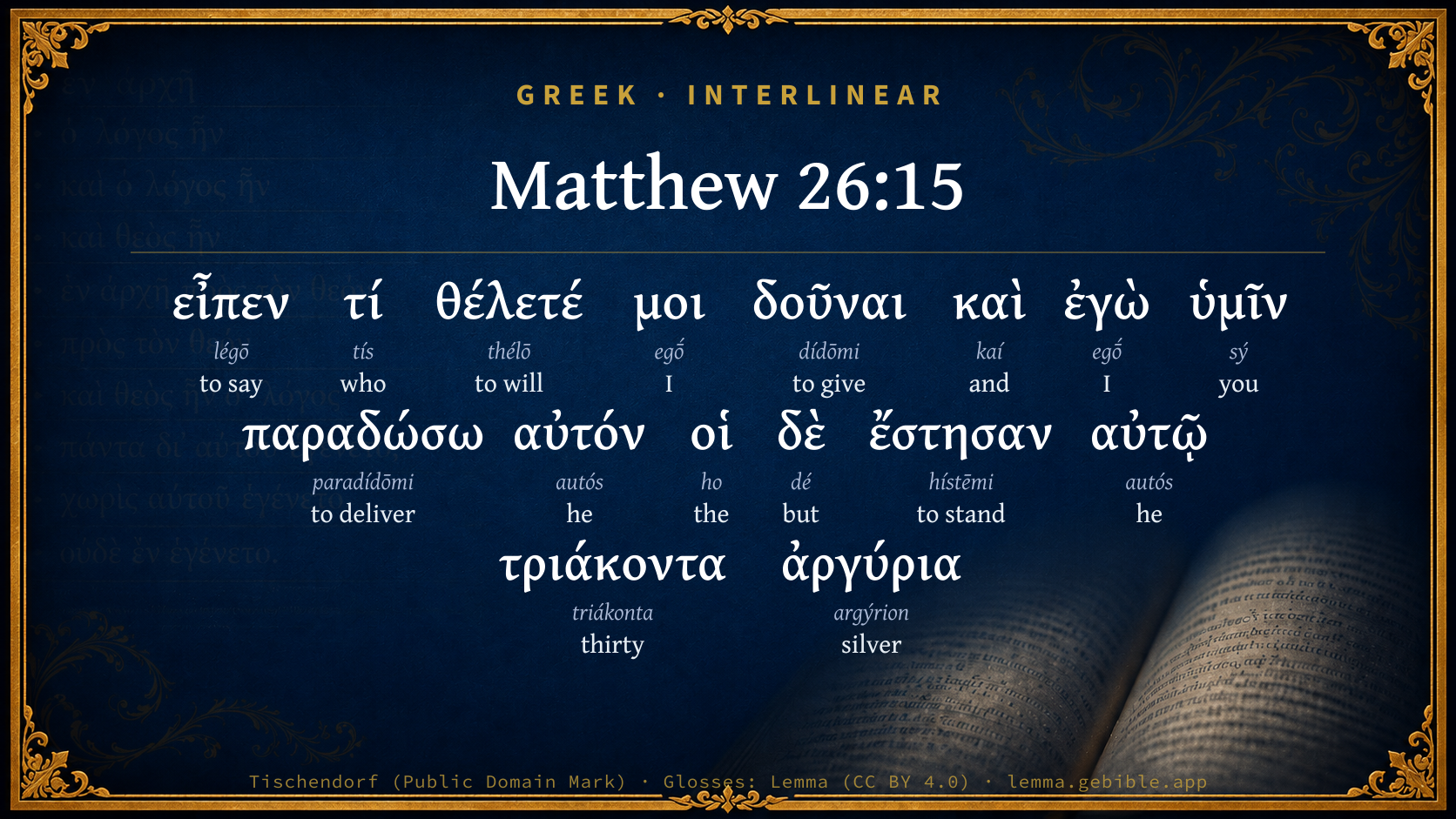
  1. εἶπεν légō G3004 “to say” Verb, Aorist, Active, Indicative, 3rd person, Singular
  2. τί tís G5101 “who” Interrogative pronoun, Accusative, Singular, Neuter
  3. θέλετέ thélō G2309 “to will” Verb, Present, Active, Indicative, 2nd person, Plural
  4. μοι egṓ G1473 “I” Personal pronoun, 1st person, Dative, Singular
  5. δοῦναι dídōmi G1325 “to give” Verb, Aorist, Active, Infinitive
  6. καὶ kaí G2532 “and” Conjunction
  7. ἐγὼ egṓ G1473 “I” Personal pronoun, 1st person, Nominative, Singular
  8. ὑμῖν sý G4771 “you” Personal pronoun, 2nd person, Dative, Plural
  9. παραδώσω paradídōmi G3860 “to deliver” Verb, Future, Active, Indicative, 1st person, Singular
  10. αὐτόν autós G846 “he” Personal pronoun, Accusative, Singular, Masculine
  11. οἱ ho G3588 “the” Article, Nominative, Plural, Masculine
  12. δὲ dé G1161 “but” Conjunction
  13. ἔστησαν hístēmi G2476 “to stand” Verb, Aorist, Active, Indicative, 3rd person, Plural
  14. αὐτῷ autós G846 “he” Personal pronoun, Dative, Singular, Masculine
  15. ἀργύρια argýrion G694 “silver” Noun, Accusative, Plural, Neuter

About this verse

These counts appear in no published source. They are computed here, from the morphology-tagged text and Lemma’s own curated glosses. What Lemma adds →

16
words
14
distinct lemmas
Gospels
section

Notable vocabulary

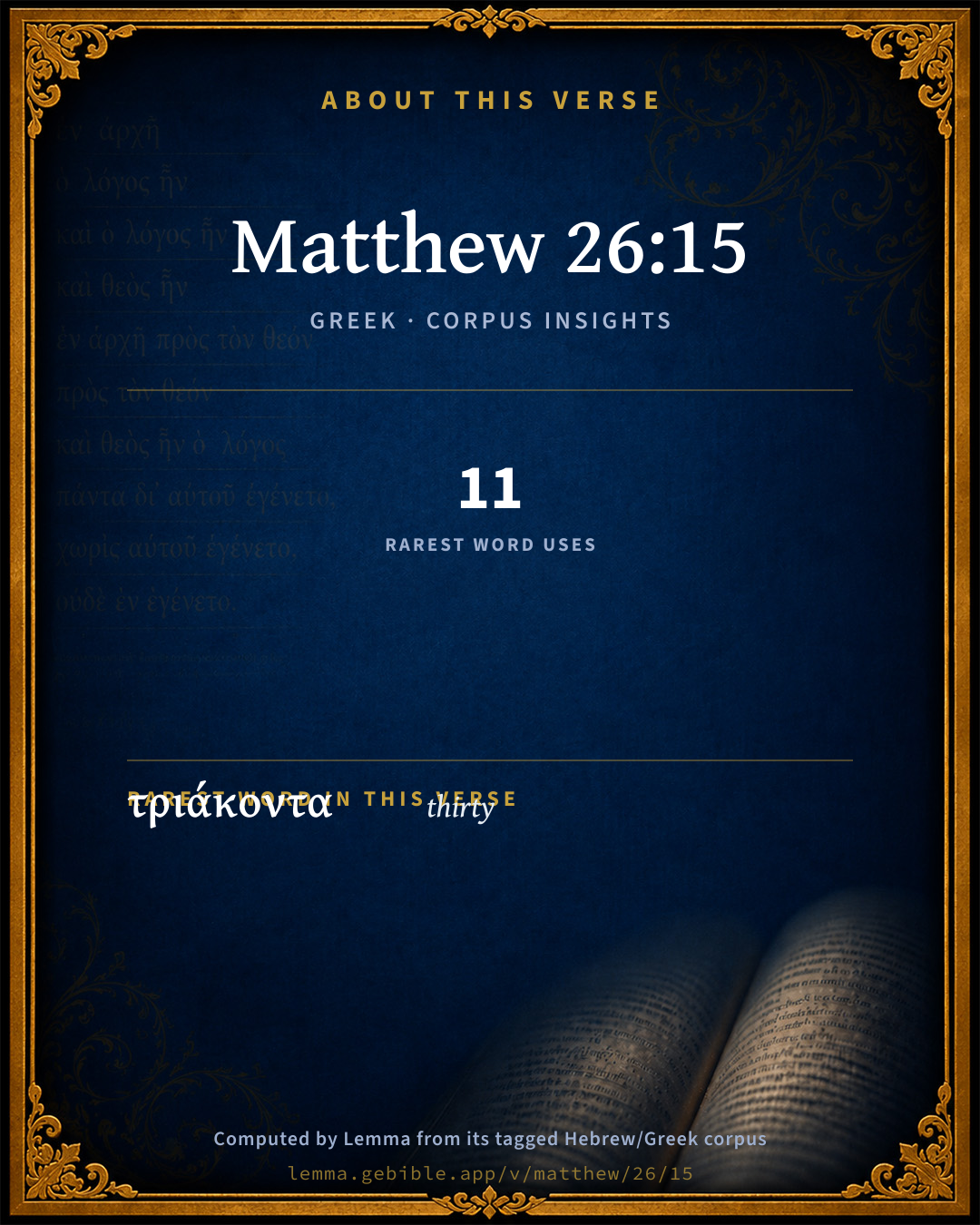
The rarest word here is τριάκοντα thirty G5144 — appearing just 11 times in the whole Greek New Testament.

Shared distinctive vocabulary

τριάκοντα thirty G5144 occurs in 11 verses of the Greek New Testament. Also found in:

Repetition

Words recur within this verse:

Cross-references

13

Topical passages linked to Matthew 26:15 in the Treasury of Scripture Knowledge — connected by theme and wording, ordered by reader-vote popularity; previews shown in the World English Bible.

  • Zechariah 11:12–13 I said to them, "If you think it best, give me my wages; and if not, keep them." So they weighed for my wages thirty pieces of silver.
  • Genesis 37:26–28 Judah said to his brothers, "What profit is it if we kill our brother and conceal his blood?
  • Exodus 21:32 If the bull gores a man-servant or a maid-servant, thirty shekels of silver shall be given to their master, and the ox shall be stoned.
  • 1 Timothy 6:9–10 But those who are determined to be rich fall into a temptation and a snare and many foolish and harmful lusts, such as drown men in ruin and destruction.
  • 2 Peter 2:3 In covetousness they will exploit you with deceptive words: whose sentence now from of old doesn't linger, and their destruction will not slumber.
  • Genesis 38:16 He turned to her by the way, and said, "Please come, let me come in to you:" for he didn't know that she was his daughter-in-law. She said, "What will you give me, that you may come in to me?"
  • Judges 16:5 The lords of the Philistines came up to her, and said to her, Entice him, and see in which his great strength lies, and by what means we may prevail against him, that we may bind him to afflict him: and we will each give you of us eleven hundred [pieces] of silver.
  • Judges 17:10 Micah said to him, Dwell with me, and be to me a father and a priest, and I will give you ten [pieces] of silver by the year, and a suit of clothing, and your food. So the Levite went in.
  • Judges 18:19–20 They said to him, Hold your peace, lay your hand on your mouth, and go with us, and be to us a father and a priest: is it better for you to be priest to the house of one man, or to be priest to a tribe and a family in Israel?
  • Matthew 27:3–5 Then Judas, who betrayed him, when he saw that Jesus was condemned, felt remorse, and brought back the thirty pieces of silver to the chief priests and elders,
  • Acts 1:18 Now this man obtained a field with the reward for his wickedness, and falling headlong, his body burst open, and all his intestines gushed out.
  • 1 Timothy 3:3 not a drinker, not violent, not greedy for money, but gentle, not quarrelsome, not covetous;
  • 2 Peter 2:14–15 having eyes full of adultery, and who can't cease from sin; enticing unsettled souls; having a heart trained in greed; children of cursing;

Cross-references courtesy of OpenBible.info (CC BY 4.0).

Commentary

Notes on Matthew 26:15 from classic Christian and Jewish commentators (each source and its license shown beneath its notes). The classic Christian expositions comment on the surrounding passage and are grouped to its opening verse, so a note may address several verses; the Jewish commentaries on the Tanakh (Rashi and others) are per-verse, so they appear only where the commentator wrote on this verse.

Lemma curates 59 commentaries, every one of them public domain or Creative Commons licensed, each selected and text-cleaned for this edition rather than reprinted as found. About our sources →

Bengel's Gnomon

Johann Albrecht Bengel

Mat 26:15. Ἔστησαν, they weighed out[1119]) The LXX. frequently render the Hebrew שקל (to weigh out, or pay) by ἽΣΤΗΥΙ, and in Zec 11:12, where the prediction occurs concerning these thirty pieces of silver, the very word ἜΣΤΗΣΑΝ is found.—ΤΡΙΆΚΟΝΤΑ ἈΡΓΎΡΙΑ, thirty pieces of silver) Such was the value of a slave, in Exo 21:32; that of a freeman was double.

[1119] In the original Gnomon no rendering is given for ἔστὴσαν. In his Harmony, Bengel renders it bieten—they tendered, or proffered; in his German Version schiessen—which seems to mean “they threw, counting it as they threw it.” Engl. Vers. has, “they covenanted with him for.”—(I. B.)

Beng. seems to take ἕστησαν in the sense “they weighed out to him.” So ἵστημι is found used in Homer’s Iliad xix. 247, xxii. 350) more than once; lit., I place in the balance, I poise.—ED.

Bengel's Gnomon of the New Testament — English translation (T&T Clark, Edinburgh, 1860) — public domain. Text from a community e-Sword module.

Expositor's Greek Testament

ed. W. Robertson Nicoll

Mat 26:15 . τί θέλετε , etc., what are ye willing to give me? Mary and Judas extreme opposites: she freely spending in love, he willing to sell his Master for money. What contrasts in the world and in the same small circle! The mercenary spirit of Judas is not so apparent in Mk. and Lk. κἀγὼ , etc.: καὶ introducing a co-ordinate clause, instead of a subordinate clause, introduced by ὥστε or ἵνα ; a colloquialism or a Hebraism: the traitor mean in style as in spirit. ἔστησαν , they placed (in the balance) = weighed out. Many interpret: they agreed = συνεφώνησαν . So Theophy.: “Not as many think, instead of ἐζυγοστάτησαν ”. This corresponds with Mk. and Lk., and the likelihood is that the money would not be paid till the work was done (Fritzsche). But Mt. has the prophecies ever in view, and uses here a prophetic word (Zec 11:12 , ἔστησαν τὸν μισθόν μου τρι . ἀργ ., Sept [137] ), indifferent as to the time when payment was made. Coined money was in use, but the shekels may have been weighed out in antique fashion by men careful to do an iniquitous thing in the most orthodox way. Or there may have been no weighing in the case, but only the use of an ancient form of speech after the practice had become obsolete (Field, Ot. Nor. ). The amount = about three or four pounds sterling, a small sum for such a service; too small thinks Meyer, who suggests that the real amount was not known, and that the sum was fixed in the tradition to suit prophecy.

[137] Septuagint.

The Expositor's Greek Testament, edited by W. Robertson Nicoll (1897–1910) — public domain. Text from a community e-Sword module.

Adam Clarke's Commentary

Verse 15. Thirty pieces of silver.] τριακοντα αργυρια, thirty silverlings; but στατηρας, staters, is the reading of the Codex Bezae, three copies of the Itala, Eusebius, and Origen sometimes; and στατηρας αργυριου, silver staters, is the reading of the famous Basil MS. No. 1, in Griesbach, and one copy of the Itala.

A stater was the same as the shekel, and worth about 3s. English money, according to Dean Prideaux: a goodly price for the Saviour of the world! Thirty staters, about 4l. 10s. the common price for the meanest slave! See Ex 21:32. The rabbins say, thirty selain of pure silver was the standard price for a slave, whether good or bad, male or female. See tract Erachin, fol. 14, and Shekalim, cap. 1. Each selaa weighed 384 barley-corns; the same number was contained in a shekel; and therefore the shekel and the selaa were the same. See Clarke on Ge 20:16, and See Clarke on Ex 38:24.

Adam Clarke's Commentary on the Bible (1810–1826) — public domain. Text from a community e-Sword/MySword module.

Ellicott's Commentary for English Readers

(15) They covenanted with him for thirty pieces of silver.—The reward was relatively a small one, apparently about the market-price of a common slave (Zec_11:12); but the chief priests (Caiaphas and his fellows) saw through the sordid baseness of the man, and, as if scorning both his Master and himself, gauged their reward accordingly.

A Bible Commentary for English Readers, edited by Charles John Ellicott (1878–1897) — public domain. Text from a community e-Sword module.

The Cambridge Bible for Schools and Colleges

gen. ed. J. J. S. Perowne

15. covenanted with him] Rather, weighed out for him; either literally or= “paid him.”

thirty pieces of silver] i. e. thirty silver shekels. St Matthew alone names the sum, which= 120 denarii. The shekel is sometimes reckoned at three shillings, but for the real equivalent in English money see note on Mat_26:7. Thirty shekels was the price of a slave (Exo_21:32); a fact which gives force to our Lord’s words, Mat_20:28, “The Son of man came … to minister (to be a slave), and to give his life a ransom for many.”

The Cambridge Bible for Schools and Colleges (gen. ed. J. J. S. Perowne; Cambridge University Press, 1878–1918) — public domain. Text from a community e-Sword module.

John Gill's Exposition

And said unto them,.... Though the words, "to them", are not in the original text, they are rightly supplied; as they are by the Vulgate Latin, Syriac, Arabic, Persic, and Ethiopic versions, and in Munster's Hebrew Gospel; and mean the chief priests to whom Judas went, and to whom he made the following proposal;

what will ye give me, and I will deliver him to you? They did not ask him to do it, he first made the motion; a barbarous and shocking one! to deliver his Lord and Master, with whom he had familiarly conversed, and from whom he had received so many favours, into the hands of those that hated him; nor was he concerned what they would do to him, or what would become of him, when in their hands: all his view, and what he was intent upon, was, what they would give him for doing it. They did not tempt him, by first offering him so much money, if he would betray him; but he himself first moves it to them, and tempts them with it to offer him an handsome reward: and it is to be observed, that he does not mention the name of Jesus, either because they might be talking of him, when he came into their company; or else as suiting his language to theirs, who, when they spake of him, usually said, "he", or "that man", or "this fellow". And in the same rude way Judas now treats his master:

and they covenanted with him for thirty pieces of silver; that is, thirty shekels of silver; for it is a rule with the Jews, that when mention is made in Scripture of pieces of silver, without expressing the species, shekels are meant: so Onkelos, and Jonathan ben Uzziel, in their Targums on Gen 20:16, render pieces of silver, by shekels of silver; so pieces of gold signify shekels of gold: thus the 1700 pieces of gold in Jdg 8:26, are, in the Septuagint, Arabic, and Vulgate Latin versions, called so many shekels of gold; and our version supplies the word "shekels" also, as it does in Ch2 9:15, and yet some learned men have asserted (m), that there were no shekels of gold among the Jews, though express mention is made of them in Ch1 21:25. The value of a shekel of gold, according to Brerewood (n), was, of our money, "fifteen shillings"; and some make it to come to a great deal more; to "one pound sixteen shillings and sixpence" sterling: had these thirty pieces been pieces, or shekels of gold, they would have amounted to a considerable sum of money; but they were pieces of silver, and not talents, or pounds, but shekels. The silver shekel had on one side stamped upon it the pot of manna, or, as others think, "a censer", or incense cup, with these words around it, in Samaritan letters, "shekel Israel", "the shekel of Israel"; and, on the other, "Aaron's rod" budding, with this inscription about it, "Jerusalem Hakedushah", "Jerusalem the holy" (o). As for the weight and value of it, R. Gedaliah says (p), we know by tradition that the holy shekel weighs 320 grains of barley of pure silver; and the same writer observes (q), that the "selah", or holy shekel, is four "denarii", or pence; that is, Roman pence, each being of the value of seven pence halfpenny of our money: and to this agrees what Josephus (r) says, that a "shekel" is a coin of the Hebrews, which contains four Attic drachms, or drams; and an Attic dram is of the same value with a Roman penny: so that one of these shekels was worth about "half a crown"; and it usually weighed half an ounce, as not only some Jewish writers affirm, who profess to have seen them, and weighed them themselves, as Jarchi (s), Gerundensis (t), Abarbinel (u), and Gedaliah ben Jechaiah (w); but other writers also, as Masius (x) Arias Montanus (y), Waserus (z) and Bishop Cumberland. Now thirty shekels of silver were the price of a servant, Exo 21:32. So (b) Maimonides observes, that the

"atonement of "servants", whether great or small, whether male or female, the fixed sum in the law is "thirty shekels of good silver", whether "the servant" is worth an hundred pound, or whether he is not worth but a farthing,''

and which was in value of our money about "three pounds fifteen shillings". This was the "goodly price", which Christ, who appeared in the form of a servant, was prized at, according to the prophecy in Zac 11:12, and which the high priests thought a very sufficient one; and the wretch Judas, as covetous as he was, was contented with.

(m) Waseras de numis Heb. l. 2. c. 3. (n) De numis Jud. c. 3. (o) Waser ib. & Ar. Montan. Ephron. sive de Siclo in Jud. Antiq. p. 126. Brerewood de ponder. & pret. vet. num. c. 1. (p) Shaishelet Hakabala, fol. (q) Ib. (r) Antiq. l. 3. c. 8. sect. 2. (s) Perush in Exod. xxi. 32. (t) Ad fin. Expos. in Pentateuch. (u) Comment. in 1 Reg. 7. fol. 221. 2. (w) Shalshelet Hahohala, fol. 72. 2. (x) In Joshua, 7. 21. p. 135. (y) De Siclo, ut supra. (in Jud. Antiq. p. 126) (z) De numis Heb. l. 2. c. 3. (b) Hilch. Niske Mammon. c. 11. sect. 1.

John Gill's Exposition of the Whole Bible (1746–1763) — public domain (CC PDM 1.0). Text via the HelloAO Bible API.

Trapp's Complete Commentary

John Trapp

15 And said unto them, What will ye give me, and I will deliver him unto you? And they covenanted with him for thirty pieces of silver.

Ver. 15. What will ye give me] Take beed and beware of covetousness, saith our Saviour, Luk 12:15; for it is "the root of all evil," saith Paul, 1Ti 6:10: a breach of the whole decalogue, as some divines have demonstrated and universal experience hath confirmed. These sordida poscinummia, as one calleth them, are still found everywhere: {a} such as will sell their souls to the devil with Ahab, not for seven years’ enjoyment of the Popedom, as some have done, but for a few paltry shillings, as Judas here did, or some other piddling profit. This our Saviour calleth the "mammon of iniquity," which is the next odious name to the devil himself. Δεινος και παντολμος της φιλοχρηματιας ερως. Isid. Pelus. Luk 16:9.

For thirty pieces of silver] "A goodly price," as the prophet in scorn and detestation calleth it. It was a known set price for the basest slave, Exo 21:32; Joe 3:3; Joe 3:6. For so small a sum sold this traitor so sweet a Master, as had not only admitted him into his company, but committed the bag to him, and let him want for nothing. Quid non mortalia pectora cogis, Auri sacra fames? (Virgil.) Look well to it. For as there were many Marys in one Caesar, so are there many Judases in the best. Let patrons especially look to it: for many of them are worse than Judas. He sold the head, they the members; he the sheep, they the shepherd: he but the body, they the souls, as that scarlet strumpet, Rev 18:13.

{a} See Mr Dike’s Caveat for the Covetous.

John Trapp, A Commentary or Exposition upon All the Books of the Old and New Testament (1647–1656) — public domain. Text from a community e-Sword module.

Haydock's Catholic Bible Commentary

What will you give me? The impious wretch did not betray his divine Master our of fear, but out of avarice. Of all passions the love of sordid lucre is the most vile; and the avaricious soul does not fear to plunge herself into the bottom of hell, for a trifling gain. There is no vestige of honour or justice, or probity, remaining in the heart of that man who is possessed with the love of base lucre; whose god is his money. The perfidious Judas, inebriated with this passion, while he thirsts after gain, sells with the most foolish impiety his Lord and his Master. (St. Leo the great) --- He sells him for the paltry consideration of thirty pieces of silver, about £3 15. the price of a common slave. See Exodus xxi. 32. It is probable that even the obdurate heart of Judas would not have betrayed his Master to the Jews, had he not expected that Jesus would escape from their hands on this occasion, as he had done at Nazareth, and in the temple.

The Pascal Supper.

George Leo Haydock (1774–1849), Haydock's Catholic Family Bible and Commentary, 1859 edition — public domain. Excludes Psalms (Douay-Rheims chapter numbering differs from Protestant) and Deuterocanonical books (Catholic canon only).

Whedon's Commentary on the Bible

Daniel D. Whedon

15. What will ye give — This is a true bargainer’s question. He is ready to betray his Master if he can get the pay for it. He has a man, a divine man, to sell, and he hucksters for his price. Luke says that “Satan had now entered into him.” He is driven by the fire of a hasty resentment, and led by the attractions of gain to seek a bribe for treason. He makes the advance, and tempts, the men who are wicked enough without any special seducing. Thus do men enact the part of Satan towards each other.

They covenanted — Luke says “they were glad.” They could now apprehend Jesus in a private way, and without the “uproar” mentioned in verse fifth.

Thirty pieces of silver — The ordinary price of a slave, being about fifteen dollars. Thus was verified the allusion of Zec_11:12 : “So they weighed for my price thirty pieces of silver.” The sum appears trifling for the treason, if we estimate it by the immense consequences. But, after all, the whole service Judas did was to inform the foes of Jesus where he might be found and taken without tumult, and guide them to the place.

Daniel D. Whedon (gen. ed.), Commentary on the Old and New Testaments (1874–1909) — public domain. Text from a community e-Sword module.

The Pulpit Commentary

What will ye give me, and I will deliver him unto you? There is no disguise in this vile question. Judas unblushingly reveals his base motive in offering such a bargain; and to enhance its value he, as it were, forces his personality into prominence; as if he had said, "I who am his trusted adherent, I who know all his haunts and habits, will do this thing." They covenanted with him; esthsan autw : they weighed unto him. The verb might mean "appointed;" constituerunt ei (Vulgate); and St. Mark has "promised," St. Luke "covenanted;" but there is no doubt that some money was at once paid to Judas, as he seems to have returned it (Mat_27:3) without any further interview with the Sanhedrin, though they may have given him a portion at once, and sent him the balance on the success of his attempt. Thirty pieces of silver; triakonta arguria . Thirty shekels of the sanctuary, equivalent to 15s. of our money. This was the legal price of a slave gored by an ox, (Exo_21:32) and must have been considered by the traitor but a poor reward for his crime. He found the rulers as covetous as himself, and disposed to treat both him and his Master with the utmost contempt. Christ had taken upon him the form of a bondservant, and was here reckoned as such. The transaction had been typically shadowed forth when another Judas sold his brother Joseph for twenty pieces of silver; (Gen_37:27, Gen_37:28) when Ahithophel gave counsel against David, his familiar friend; (2Sa 16) and when Zechariah wrote, "I said unto them, If ye think good, give me my price; and if not, forbear. So they weighed esthsan , Septuagint for my price thirty pieces of silver". (Zec_11:12) St. Matthew alone of the evangelists mentions the exact price agreed upon. It may have come naturally to the "publican" to observe the pecuniary aspect of the transaction.

The crime of Judas.

"What will ye give me, and I will deliver him unto you?" The sin of treachery is almost lost sight of in view of the exceeding meanness of his trying to make a little money out of the treachery. It is this that reveals the man, and shows the covetousness which, for Judas, was the worm at the root. Loyalties, reverences, and friendships were nothing to him if only he could make a little money. "The history of his base and appalling lapse is perfectly intelligible. He had joined the discipleship of Jesus, as the other apostles also did, in the hope of taking part in a political revolution, and occupying a distinguished place in an earthly kingdom. It is inconceivable that Jesus would have made him an apostle if there had not at one time been some noble enthusiasm in him, and some attachment to himself. That he was a man of superior energy and administrative ability may be inferred from the fact that he was made the purse bearer of the apostolic company. But there was a canker at the root of his character, which gradually absorbed all that was excellent in him, and became a tyrannical passion. It was the love of money. He fed it on the petty peculations which he practised on the small sums which Jesus received from his friends for the necessities of his company, and for distribution among the poor with whom he was daily mingling. He hoped to give it unrestrained gratification when he became chancellor of the exchequer in the new kingdom" (Stalker). Illustrate by the tiny mountain spring swelling into the flooding river; or by the taint in the blood producing a spot on the skin, this growing into a boil, then developing into a virulent, deadly carbuncle.

I THE CHIME OF JUDAS IN ITS FAINT BEGINNINGS. Self was more interesting than Christ. To get gave more pleasure than to serve. This was the trickle through the reservoir-bank which would grow into a flood. Safety lies in putting Christ first, and counting serving him best. The root wrong, was interest in the mere possession of money. To have money for use is healthy? to have money to possess breeds moral disease.

II THE CRIME OF JUDAS IN ITS STAGES OF GROWTH.

1. It fashioned unreasonable expectations.

2. It was annoyed by delay in their realization.

3. It was fostered by acts of petty unfaithfulness.

4. It made personal advantage appear to be the thing of supreme value.

III THE CRIME OF JUDAS PROVING TO BE FOLLY AS WELL AS CRIME. For it was the ruin of Judas, and the blasting of all the schemes on which he had set his heart. Covetous Judas ruined himself. R.T.

The Pulpit Commentary (1880–1919), ed. H.D.M. Spence-Jones & Joseph S. Exell — public domain. Text from a community e-Sword module.

John Wesley's Explanatory Notes

They bargained with him for thirty pieces of silver - (About three pounds fifteen shillings sterling; or sixteen dollars sixty- seven cents) the price of a slave, Exod. xxi, 32.

John Wesley, Explanatory Notes Upon the Whole Bible (1754–1765) — public domain. Text via the GEBible commentary corpus.

The People's New Testament

B. W. Johnson

15. What are ye willing to give me? He had deliberately decided. He probably knew of their wish to seize Jesus secretly, and that they would pay for a guide that would lead them where he rested at night. Thirty pieces of silver. The price was agreed upon and paid. The pieces were silver shekels, temple money. The whole would contain about the amount of silver in twenty dollars, perhaps equal in value to $120 now. It was a fulfillment of Zech. 11:12. Joseph was sold for twenty pieces of silver (Gen. 37:28).

B. W. Johnson's The People's New Testament with Notes (1889–1891) — public domain. Electronic text from the Christian Classics Ethereal Library (CCEL) ThML edition.

Cambridge Greek Testament for Schools and Colleges

15. κἀγώ. Here the form of the sentence is probably an example of colloquial simplicity, but the use of καὶ where in classical Greek the sentences would be joined by a consecutive (ὥστε) or final (ἵνα, ὅπως) particle, is a mark of Hebrew influence. Such sentences are connected by coordinate particles, and the relation between them is left to inference from the context.

ἔστησαν αὐτῷ τριάκοντα ἀργύρια. ‘Weighed out for him thirty pieces of silver.’ For this use of ἵστημι, cp. μὴ στήσῃς αὐτοῖς ταύτην τὴν ἁμαρτίαν, Act 7:60, and στατήρ, which, like its equivalent ‘shekel,’ originally meant ‘a weight.’

τριάκοντα ἀργύρια. ‘Thirty silver shekels.’ St Matthew alone names the sum, which = 120 denarii. The shekel is sometimes reckoned at three shillings, but for the real equivalent in English money see note on Mat 26:7. Thirty shekels was the price of a slave (Exo 21:32); a fact which gives force to our Lord’s words, ch. Mat 20:28, and to the passage there cited from Php 2:7-8.

Cambridge Greek Testament for Schools and Colleges (Cambridge University Press, 1896; 21 vols, various authors incl. Carr, Maclear, Plummer, Farrar, Lumby, Moule, M. R. James, Simcox) — public domain. Text from a community e-Sword module.

Alford’s Greek Testament

Henry Alford

15.] ἔστησαν may be either weighed out, or appointed. That the money was paid to Judas (ch. 27:3) is no decisive argument for the former meaning; for it may have been paid on the delivery of Jesus to the Sanhedrim. The συνέθεντο of Luke and ἐπηγγείλαντο of Mark would lead us to prefer the other.

τριάκοντα ἀργύρια] thirty shekels, = the price of the life of a servant, Exo 21:32. Between three and four pounds of our money. St. Matthew is the only Evangelist who mentions the sum. De Wette and others have supposed that the mention of thirty pieces of silver with the verb ἔστησαν, has arisen from the prophecy of Zechariah (ref.), which St. Matthew clearly has in view. The others have simply ἀργύριον. It is just possible that the thirty pieces may have been merely earnest-money: but a difficulty attends the supposition; if so, Judas would have been entitled to the whole on our Lord being delivered up to the Sanhedrim (for this was all he undertook to do); whereas we find (ch. 27:3) that, after our Lord’s condemnation, Judas brought only the thirty pieces back, and nothing more. See note there.

Henry Alford, The Greek Testament (1849–1861) — public domain. Text from a community e-Sword module.

International Critical Commentary

(M) 15. And said, What will you give me, and I will deliver Him to you ?] Mk. has simply: “In order that he might deliver Him to them.”

And they weighed out to him thirty pieces of silver.] Mk. has: “And they promised to give him silver.” Mt. alters, with a view to 27:9, where he quotes Zec 11:13. In the preceding verse, Zec 11:12, occur the words, ἔστησαν τὸν μισθόν μου τριάκοντα ἀργυροῦς. He therefore assimilates Mk.’s phrase to this passage.

International Critical Commentary — older volumes (1896–1929), various authors — public domain. Text from a community e-Sword module.

Vincent's Word Studies in the New Testament

Marvin R. Vincent

What will ye give? [τι θελετε μοι δουναι? ] Rather, What are ye willing to give me? It brings out the chaffering aspect of the transaction. So Rev.

They covenanted with him for [εστησαν αυτω] . But the meaning is, they weighed unto him; or, very literally, they placed for him (in the balance). Although coined shekels were in circulation, weighing appears to have been practiced, especially when considerable sums were paid out of the temple - treasury.

Thirty pieces of silver [τριακοντα αργυρια] . Matthew refers to Zec 11:12. These pieces were shekels of the sanctuary, of standard weight, and therefore heavier than the ordinary shekel. See on Mt 17:24. Reckoning the Jerusalem shekel at seventy - two cents, the sum would be twenty - one dollars and sixty cents. This was the price which, by the Mosaic law, a man was condemned to pay if his ox should gore a servant (Exo 21:32). Our Lord, the sacrifice for men, was paid for out of the temple - money, destined for the purchase of sacrifices. He who "took on him the firm of a servant" was sold at the legal price of a slave.

Marvin R. Vincent, Word Studies in the New Testament (1887–1900) — public domain. Text from a community e-Sword/MySword module.

Lesson kit

Teaching starters — assembled from the data on this page, not authored interpretation. Every prompt links to the verse data it draws on. Edit before teaching.

Matthew, in the Gospels, opens this verse with 16 words (14 distinct Greek lemmas). Its most distinctive word is triákonta (“thirty”). A historical commentator’s framing appears above. Read the whole chapter for the surrounding context.

Discussion questions

  1. The word triákonta carries the sense “thirty.” How does it shape the verse?
  2. Matthew 13:8 shares the word «thirty» with this verse. How do the two illuminate each other?
  3. “I” occurs 2× in this one verse. What is the effect of the repetition?
  4. These translations render this verse differently; the difference is in the English rendering, not the original. What questions does that raise?
  5. Reading how Bengel's Gnomon and Expositor's Greek Testament read this verse, where do the two commentators agree and where do they part?

Things to notice

Reading settings

Reading text

Shown beneath each verse's original-language words.

Old Testament
Old Testament edition

Read the OT as the Masoretic Hebrew (MT) or the Greek Septuagint (LXX).

English shown for the Greek Septuagint (in the Hebrew ↔ Greek comparison).

Comparing translations? Open the Compare panel on any verse page to stack up to four side by side.