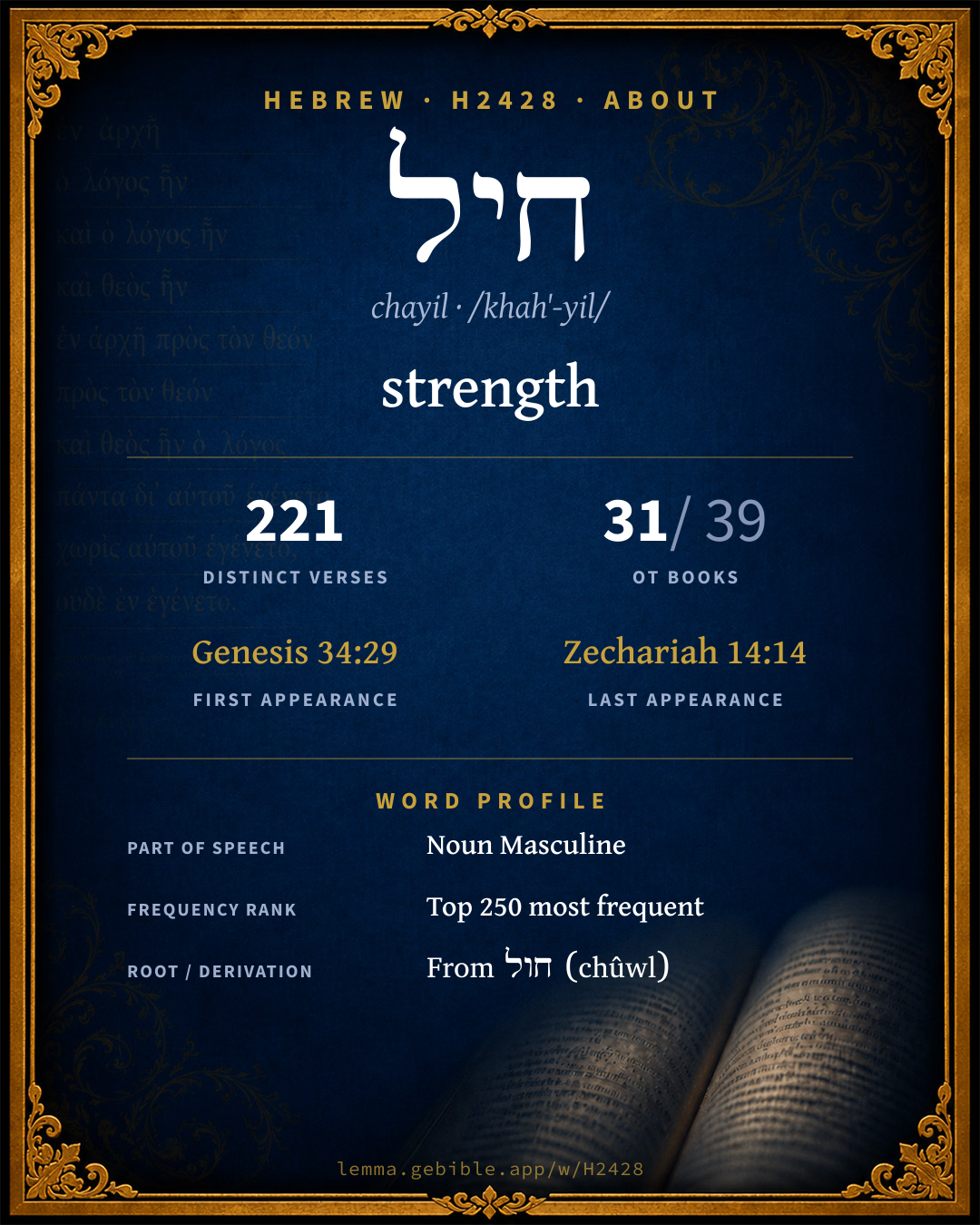
חַ֫יִל
strength
also: might, efficiency, wealth, army fuller range ↓
Full lexicon entry — Brown-Driver-Briggs (BDB)
From Brown-Driver-Briggs (BDB)
Where this word appears
See every Absolute-state word in the Hebrew Bible →
Grammar key — what these labels mean
Part of speech
- Noun
- A naming word — a person, place, thing, or idea.
Noun type
- Common
- A common noun — a general class of person, place, or thing (“king,” “city,” “water”), not a specific name.
- Proper
- A name of a specific person, place, or people (e.g. Abraham, Zion, Israel).
State
- Absolute
- The independent form of a noun, not bound to a following word.
- Construct
- A noun bound to a following noun in a possessive / “of” relationship (the construct chain).
Gender
- Masculine
- Grammatically masculine.
Number
- Singular
- One.
- Plural
- More than one (in Hebrew, generally three or more).
Grammatical forms
- Noun, Common, Masculine, Singular, Absolute 138 times (59%)
- Noun, Common, Masculine, Singular, Construct 74 times (32%)
- Noun, Common, Masculine, Plural, Absolute 20 times (9%)
- Noun, Proper 1 time (0%)
- Noun, Common, Masculine, Plural, Construct 1 time (0%)
Parsed forms decoded from the imported morphology (morphhb / Westminster Leningrad Codex — WLC text public domain, morphhb tagging CC BY 4.0), counted across 234 parsed occurrences — not distinct verses.
Page 1 of 2 — showing verses 1–200 of 221 distinct verses where H2428 appears, across 31 books. Click any verse to open its interlinear word-by-word view. Verse text shown in the World English Bible for context — . Each verse’s Hebrew form is shown with its reference; the English is not keyword-highlighted, since the data carries no word-level English alignment. Use “Compare translations” on any verse to read it across multiple English versions. This concordance covers the Hebrew Bible; Septuagint (Greek Old Testament) occurrences are not indexed here.
Genesis 2 verses
- Genesis 34:29 חֵילָ֤/ם n c ms cs + sfx pers 3mp and all their wealth. They took captive all their little ones and their wives, and took as plunder everything that was in the house.
- Genesis 47:6 חַ֔יִל n c ms The land of Egypt is before you. Make your father and your brothers dwell in the best of the land. Let them dwell in the land of Goshen. If you know any able men among them, then put them in charge of my cattle."
Exodus 7 verses
- Exodus 14:4 חֵיל֔/וֹ n c ms cs + sfx pers 3ms I will harden Pharaoh's heart, and he will follow after them; and I will get honor over Pharaoh, and over all his host; and the Egyptians shall know that I am Yahweh." They did so.
- Exodus 14:9 וְ/חֵיל֑/וֹ conj + n c ms cs + sfx pers 3ms The Egyptians pursued after them: all the horses and chariots of Pharaoh, his horsemen, and his army; and overtook them encamping by the sea, beside Pihahiroth, before Baal Zephon.
- Exodus 14:17 חֵיל֔/וֹ n c ms cs + sfx pers 3ms I, behold, I will harden the hearts of the Egyptians, and they shall go in after them: and I will get myself honor over Pharaoh, and over all his host, over his chariots, and over his horsemen.
- Exodus 14:28 חֵ֣יל n c ms cs The waters returned, and covered the chariots and the horsemen, even all Pharaoh's army that went in after them into the sea. There remained not so much as one of them.
- Exodus 15:4 וְ/חֵיל֖/וֹ conj + n c ms cs + sfx pers 3ms Pharaoh's chariots and his host has he cast into the sea; His chosen captains are sunk in the Red Sea.
- Exodus 18:21 חַ֜יִל n c ms Moreover you shall provide out of all the people able men, such as fear God: men of truth, hating unjust gain; and place such over them, to be rulers of thousands, rulers of hundreds, rulers of fifties, and rulers of tens.
- Exodus 18:25 חַ֨יִל֙ n c ms Moses chose able men out of all Israel, and made them heads over the people, rulers of thousands, rulers of hundreds, rulers of fifties, and rulers of tens.
Numbers 3 verses
- Numbers 24:18 חָֽיִל n c ms Edom shall be a possession, Seir also shall be a possession, [who were] his enemies; While Israel does valiantly.
- Numbers 31:9 חֵילָ֖/ם n c ms cs + sfx pers 3mp The children of Israel took captive the women of Midian and their little ones; and all their cattle, and all their flocks, and all their goods, they took for a prey.
- Numbers 31:14 הֶ/חָ֑יִל ptcl def.art + n c ms Moses was angry with the officers of the host, the captains of thousands and the captains of hundreds, who came from the service of the war.
Deuteronomy 5 verses
- Deuteronomy 3:18 חָֽיִל n c ms I commanded you at that time, saying, Yahweh your God has given you this land to possess it: you shall pass over armed before your brothers the children of Israel, all the men of valor.
- Deuteronomy 8:17 הַ/חַ֥יִל ptcl def.art + n c ms and [lest] you say in your heart, My power and the might of my hand has gotten me this wealth.
- Deuteronomy 8:18 חָ֑יִל n c ms But you shall remember Yahweh your God, for it is he who gives you power to get wealth; that he may establish his covenant which he swore to your fathers, as at this day.
- Deuteronomy 11:4 לְ/חֵ֨יל prep + n c ms cs and what he did to the army of Egypt, to their horses, and to their chariots; how he made the water of the Red Sea to overflow them as they pursued after you, and how Yahweh has destroyed them to this day;
- Deuteronomy 33:11 חֵיל֔/וֹ n c ms cs + sfx pers 3ms Bless, Yahweh, his substance, Accept the work of his hands: Smite through the loins of those who rise up against him, Of those who hate him, that they not rise again.
Joshua 4 verses
- Joshua 1:14 הַ/חַ֔יִל ptcl def.art + n c ms Your wives, your little ones, and your cattle, shall abide in the land which Moses gave you beyond the Jordan; but you shall pass over before your brothers armed, all the mighty men of valor, and shall help them;
- Joshua 6:2 הֶ/חָֽיִל ptcl def.art + n c ms Yahweh said to Joshua, Behold, I have given into your hand Jericho, and the king of it, and the mighty men of valor.
- Joshua 8:3 הַ/חַ֔יִל ptcl def.art + n c ms So Joshua arose, and all the people of war, to go up to Ai: and Joshua chose out thirty thousand men, the mighty men of valor, and sent them forth by night.
- Joshua 10:7 הֶ/חָֽיִל ptcl def.art + n c ms So Joshua went up from Gilgal, he, and all the people of war with him, and all the mighty men of valor.
Judges 7 verses
- Judges 3:29 חָ֑יִל n c ms They struck of Moab at that time about ten thousand men, every lusty man, and every man of valor; and there escaped not a man.
- Judges 6:12 הֶ/חָֽיִל ptcl def.art + n c ms The angel of Yahweh appeared to him, and said to him, Yahweh is with you, you mighty man of valor.
- Judges 11:1 חַ֔יִל n c ms Now Jephthah the Gileadite was a mighty man of valor, and he was the son of a prostitute: and Gilead became the father of Jephthah.
- Judges 18:2 חַ֜יִל n c ms The children of Dan sent of their family five men from their whole number, men of valor, from Zorah, and from Eshtaol, to spy out the land, and to search it; and they said to them, Go, search the land. They came to the hill-country of Ephraim, to the house of Micah, and lodged there.
- Judges 20:44 חָֽיִל n c ms There fell of Benjamin eighteen thousand men; all these [were] men of valor.
- Judges 20:46 חָֽיִל n c ms So that all who fell that day of Benjamin were twenty-five thousand men who drew the sword; all these [were] men of valor.
- Judges 21:10 הֶ/חָ֑יִל ptcl def.art + n c ms The congregation sent there twelve thousand men of the most valiant, and commanded them, saying, Go and strike the inhabitants of Jabesh Gilead with the edge of the sword, with the women and the little ones.
Ruth 3 verses
- Ruth 2:1 חַ֔יִל n c ms Naomi had a kinsman of her husband's, a mighty man of wealth, of the family of Elimelech, and his name was Boaz.
- Ruth 3:11 חַ֖יִל n c ms Now, my daughter, don't be afraid; I will do to you all that you say; for all the city of my people does know that you are a worthy woman.
- Ruth 4:11 חַ֣יִל n c ms All the people who were in the gate, and the elders, said, We are witnesses. Yahweh make the woman who has come into your house like Rachel and like Leah, which two built the house of Israel: and do you worthily in Ephrathah, and be famous in Bethlehem:
1 Samuel 9 verses
- 1 Samuel 2:4 חָֽיִל n c ms The bows of the mighty men are broken; Those who stumbled are girded with strength.
- 1 Samuel 9:1 חָֽיִל n c ms Now there was a man of Benjamin, whose name was Kish, the son of Abiel, the son of Zeror, the son of Becorath, the son of Aphiah, the son of a Benjamite, a mighty man of valor.
- 1 Samuel 10:26 הַ/חַ֕יִל ptcl def.art + n c ms Saul also went to his house to Gibeah; and there went with him the host, whose hearts God had touched.
- 1 Samuel 14:48 חַ֔יִל n c ms He did valiantly, and struck the Amalekites, and delivered Israel out of the hands of those who despoiled them.
- 1 Samuel 14:52 חַ֔יִל n c ms There was sore war against the Philistines all the days of Saul: and when Saul saw any mighty man, or any valiant man, he took him to him.
- 1 Samuel 16:18 חַ֜יִל n c ms Then answered one of the young men, and said, Behold, I have seen a son of Jesse the Bethlehemite, who is skillful in playing, and a mighty man of valor, and a man of war, and prudent in speech, and a comely person; and Yahweh is with him.
- 1 Samuel 17:20 וְ/הַ/חַ֗יִל conj + ptcl def.art + n c ms David rose up early in the morning, and left the sheep with a keeper, and took, and went, as Jesse had commanded him; and he came to the place of the wagons, as the host which was going forth to the fight shouted for the battle.
- 1 Samuel 18:17 חַ֔יִל n c ms Saul said to David, Behold, my elder daughter Merab, her will I give you as wife: only be valiant for me, and fight Yahweh's battles. For Saul said, Don't let my hand be on him, but let the hand of the Philistines be on him.
- 1 Samuel 31:12 חַיִל֮ n c ms all the valiant men arose, and went all night, and took the body of Saul and the bodies of his sons from the wall of Beth-shan; and they came to Jabesh, and burnt them there.
2 Samuel 10 verses
- 2 Samuel 2:7 חַ֔יִל n c ms Now therefore let your hands be strong, and be you valiant; for Saul your lord is dead, and also the house of Judah have anointed me king over them.
- 2 Samuel 11:16 חַ֖יִל n c ms It happened, when Joab kept watch on the city, that he assigned Uriah to the place where he knew that valiant men were.
- 2 Samuel 13:28 חָֽיִל n c ms Absalom commanded his servants, saying, Mark you now, when Amnon's heart is merry with wine; and when I tell you, Smite Amnon, then kill him; don't be afraid; haven't I commanded you? be courageous, and be valiant.
- 2 Samuel 17:10 חַ֗יִל חַ֖יִל n c ms n c ms Even he who is valiant, whose heart is as the heart of a lion, will utterly melt; for all Israel knows that your father is a mighty man, and those who are with him are valiant men.
- 2 Samuel 22:33 חָ֑יִל n c ms God is my strong fortress; He guides the perfect in his way.
- 2 Samuel 22:40 חַ֖יִל n c ms For you have girded me with strength to the battle; You have subdued under me those who rose up against me.
- 2 Samuel 23:20 חַ֛יִל n c ms Benaiah the son of Jehoiada, the son of a valiant man of Kabzeel, who had done mighty deeds, he killed the two [sons of] Ariel of Moab: he went down also and killed a lion in the midst of a pit in time of snow.
- 2 Samuel 24:2 הַ/חַ֣יִל ptcl def.art + n c ms The king said to Joab the captain of the host, who was with him, Go now back and forth through all the tribes of Israel, from Dan even to Beersheba, and number you the people, that I may know the sum of the people.
- 2 Samuel 24:4 הֶ/חָ֑יִל הַ/חַ֨יִל֙ ptcl def.art + n c ms ptcl def.art + n c ms Notwithstanding, the king's word prevailed against Joab, and against the captains of the host. Joab and the captains of the host went out from the presence of the king, to number the people of Israel.
- 2 Samuel 24:9 חַ֨יִל֙ n c ms Joab gave up the sum of the numbering of the people to the king: and there were in Israel eight hundred thousand valiant men who drew the sword; and the men of Judah were five hundred thousand men.
1 Kings 8 verses
- 1 Kings 1:42 חַ֛יִל n c ms While he yet spoke, behold, Jonathan the son of Abiathar the priest came: and Adonijah said, Come in; for you are a worthy man, and bring good news.
- 1 Kings 1:52 חַ֔יִל n c ms Solomon said, If he shall show himself a worthy man, there shall not a hair of him fall to the earth; but if wickedness be found in him, he shall die.
- 1 Kings 10:2 בְּ/חַיִל֮ prep + n c ms She came to Jerusalem with a very great train, with camels that bore spices, and very much gold, and precious stones; and when she was come to Solomon, she talked with him of all that was in her heart.
- 1 Kings 11:28 חָ֑יִל n c ms The man Jeroboam was a mighty man of valor; and Solomon saw the young man that he was industrious, and he gave him charge over all the labor of the house of Joseph.
- 1 Kings 15:20 הַ/חֲיָלִ֤ים ptcl def.art + n c mp Ben Hadad listened to king Asa, and sent the captains of his armies against the cities of Israel, and struck Ijon, and Dan, and Abel Beth Maacah, and all Chinneroth, with all the land of Naphtali.
- 1 Kings 20:1 חֵיל֔/וֹ n c ms cs + sfx pers 3ms Ben Hadad the king of Syria gathered all his host together; and there were thirty-two kings with him, and horses and chariots: and he went up and besieged Samaria, and fought against it.
- 1 Kings 20:19 וְ/הַ/חַ֖יִל conj + ptcl def.art + n c ms So these went out of the city, the young men of the princes of the provinces, and the army which followed them.
- 1 Kings 20:25 חַ֡יִל כַּ/חַיִל֩ n c ms prep det + n c ms and number you an army, like the army that you have lost, horse for horse, and chariot for chariot; and we will fight against them in the plain, and surely we shall be stronger than they. He listened to their voice, and did so.
2 Kings 15 verses
- 2 Kings 2:16 חַ֗יִל n c ms They said to him, See now, there are with your servants fifty strong men; let them go, we pray you, and seek your master, lest the Spirit of Yahweh has taken him up, and cast him on some mountain, or into some valley. He said, You shall not send.
- 2 Kings 5:1 חַ֖יִל n c ms Now Naaman, captain of the host of the king of Syria, was a great man with his master, and honorable, because by him Yahweh had given victory to Syria: he was also a mighty man of valor, [but he was] a leper.
- 2 Kings 6:14 וְ/חַ֣יִל conj + n c ms Therefore sent he there horses, and chariots, and a great host: and they came by night, and surrounded the city.
- 2 Kings 6:15 חַ֛יִל n c ms When the servant of the man of God was risen early, and gone forth, behold, a host with horses and chariots was round about the city. His servant said to him, Alas, my master! how shall we do?
- 2 Kings 7:6 חַ֣יִל n c ms For the Lord had made the host of the Syrians to hear a noise of chariots, and a noise of horses, even the noise of a great host: and they said one to another, Behold, the king of Israel has hired against us the kings of the Hittites, and the kings of the Egyptians, to come on us.
- 2 Kings 9:5 הַ/חַ֨יִל֙ ptcl def.art + n c ms When he came, behold, the captains of the host were sitting; and he said, I have an errand to you, captain. Jehu said, To which of us all? He said, To you, O captain.
- 2 Kings 11:15 הַ/חַ֗יִל ptcl def.art + n c ms Jehoiada the priest commanded the captains of hundreds who were set over the host, and said to them, Have her forth between the ranks; and him who follows her kill with the sword. For the priest said, Don't let her be slain in the house of Yahweh.
- 2 Kings 15:20 הַ/חַ֔יִל ptcl def.art + n c ms Menahem exacted the money of Israel, even of all the mighty men of wealth, of each man fifty shekels of silver, to give to the king of Assyria. So the king of Assyria turned back, and didn't stay there in the land.
- 2 Kings 24:14 הַ/חַ֗יִל ptcl def.art + n c ms He carried away all Jerusalem, and all the princes, and all the mighty men of valor, even ten thousand captives, and all the craftsmen and the smiths; none remained, save the poorest sort of the people of the land.
- 2 Kings 24:16 הַ/חַ֜יִל ptcl def.art + n c ms All the men of might, even seven thousand, and the craftsmen and the smiths one thousand, all of them strong and apt for war, even them the king of Babylon brought captive to Babylon.
- 2 Kings 25:1 חֵיל֛/וֹ n c ms cs + sfx pers 3ms It happened in the ninth year of his reign, in the tenth month, in the tenth day of the month, that Nebuchadnezzar king of Babylon came, he and all his army, against Jerusalem, and encamped against it; and they built forts against it round about.
- 2 Kings 25:5 חֵיל חֵיל֔/וֹ n c ms cs n c ms cs + sfx pers 3ms But the army of the Chaldeans pursued after the king, and overtook him in the plains of Jericho; and all his army was scattered from him.
- 2 Kings 25:10 חֵ֣יל n c ms cs All the army of the Chaldeans, who were [with] the captain of the guard, broke down the walls of Jerusalem round about.
- 2 Kings 25:23 הַ/חֲיָלִ֜ים ptcl def.art + n c mp Now when all the captains of the forces, they and their men, heard that the king of Babylon had made Gedaliah governor, they came to Gedaliah to Mizpah, even Ishmael the son of Nethaniah, and Johanan the son of Kareah, and Seraiah the son of Tanhumeth the Netophathite, and Jaazaniah the son of the Maacathite, they and their men.
- 2 Kings 25:26 הַ/חֲיָלִ֔ים ptcl def.art + n c mp All the people, both small and great, and the captains of the forces, arose, and came to Egypt; for they were afraid of the Chaldeans.
1 Chronicles 26 verses
- 1 Chronicles 5:18 חַיִל֒ n c ms The sons of Reuben, and the Gadites, and the half-tribe of Manasseh, of valiant men, men able to bear buckler and sword, and to shoot with bow, and skillful in war, were forty-four thousand seven hundred and sixty, that were able to go forth to war.
- 1 Chronicles 5:24 חַ֔יִל n c ms These were the heads of their fathers' houses: even Epher, and Ishi, and Eliel, and Azriel, and Jeremiah, and Hodaviah, and Jahdiel, mighty men of valor, famous men, heads of their fathers' houses.
- 1 Chronicles 7:2 חַ֖יִל n c ms The sons of Tola: Uzzi, and Rephaiah, and Jeriel, and Jahmai, and Ibsam, and Shemuel, heads of their fathers' houses, [to wit], of Tola; mighty men of valor in their generations: their number in the days of David was twenty-two thousand six hundred.
- 1 Chronicles 7:5 חֲיָלִ֑ים n c mp Their brothers among all the families of Issachar, mighty men of valor, reckoned in all by genealogy, were eighty-seven thousand.
- 1 Chronicles 7:7 חֲיָלִ֑ים n c mp The sons of Bela: Ezbon, and Uzzi, and Uzziel, and Jerimoth, and Iri, five; heads of fathers' houses, mighty men of valor; and they were reckoned by genealogy twenty-two thousand thirty-four.
- 1 Chronicles 7:9 חָ֑יִל n c ms They were reckoned by genealogy, after their generations, heads of their fathers' houses, mighty men of valor, twenty thousand two hundred.
- 1 Chronicles 7:11 חֲיָלִ֑ים n c mp All these were sons of Jediael, according to the heads of their fathers' [houses], mighty men of valor, seventeen thousand and two hundred, who were able to go forth in the host for war.
- 1 Chronicles 7:40 חֲיָלִ֔ים n c mp All these were the children of Asher, heads of the fathers' houses, choice and mighty men of valor, chief of the princes. The number of them reckoned by genealogy for service in war was twenty-six thousand men.
- 1 Chronicles 8:40 חַ֜יִל n c ms The sons of Ulam were mighty men of valor, archers, and had many sons, and sons' sons, one hundred fifty. All these were of the sons of Benjamin.
- 1 Chronicles 9:13 חֵ֔יל n c ms cs and their brothers, heads of their fathers' houses, one thousand seven hundred sixty; very able men for the work of the service of the house of God.
- 1 Chronicles 10:12 חַיִל֒ n c ms all the valiant men arose, and took away the body of Saul, and the bodies of his sons, and brought them to Jabesh, and buried their bones under the oak in Jabesh, and fasted seven days.
- 1 Chronicles 11:22 חַ֛יִל n c ms Benaiah the son of Jehoiada, the son of a valiant man of Kabzeel, who had done mighty deeds, he killed the two [sons of] Ariel of Moab: he went down also and killed a lion in the midst of a pit in time of snow.
- 1 Chronicles 11:26 הַ/חֲיָלִ֑ים ptcl def.art + n c mp Also the mighty men of the armies: Asahel the brother of Joab, Elhanan the son of Dodo of Bethlehem,
- 1 Chronicles 12:8 הַ/חַ֗יִל ptcl def.art + n c ms Of the Gadites there separated themselves to David to the stronghold in the wilderness, mighty men of valor, men trained for war, that could handle shield and spear; whose faces were like the faces of lions, and they were as swift as the roes on the mountains;
- 1 Chronicles 12:21 חַ֖יִל n c ms They helped David against the band of rovers: for they were all mighty men of valor, and were captains in the host.
- 1 Chronicles 12:25 חַ֨יִל֙ n c ms Of the children of Simeon, mighty men of valor for the war, seven thousand and one hundred.
- 1 Chronicles 12:28 חָ֑יִל n c ms and Zadok, a young man mighty of valor, and of his father's house twenty-two captains.
- 1 Chronicles 12:30 חַ֔יִל n c ms Of the children of Ephraim twenty thousand eight hundred, mighty men of valor, famous men in their fathers' houses.
- 1 Chronicles 26:6 חַ֖יִל n c ms Also to Shemaiah his son were sons born, who ruled over the house of their father; for they were mighty men of valor.
- 1 Chronicles 26:7 חָ֑יִל n c ms The sons of Shemaiah: Othni, and Rephael, and Obed, Elzabad, whose brothers were valiant men, Elihu, and Semachiah.
- 1 Chronicles 26:8 חַ֥יִל n c ms All these were of the sons of Obed-edom: they and their sons and their brothers, able men in strength for the service; sixty-two of Obed-edom.
- 1 Chronicles 26:9 חָ֖יִל n c ms Meshelemiah had sons and brothers, valiant men, eighteen.
- 1 Chronicles 26:30 חַ֜יִל n c ms Of the Hebronites, Hashabiah and his brothers, men of valor, one thousand seven hundred, had the oversight of Israel beyond the Jordan westward, for all the business of Yahweh, and for the service of the king.
- 1 Chronicles 26:31 חַ֖יִל n c ms Of the Hebronites was Jerijah the chief, even of the Hebronites, according to their generations by fathers' [houses]. In the fortieth year of the reign of David they were sought for, and there were found among them mighty men of valor at Jazer of Gilead.
- 1 Chronicles 26:32 חַ֗יִל n c ms His brothers, men of valor, were two thousand seven hundred, heads of fathers' [houses], whom king David made overseers over the Reubenites, and the Gadites, and the half-tribe of the Manassites, for every matter pertaining to God, and for the affairs of the king.
- 1 Chronicles 28:1 חָ֖יִל n c ms David assembled all the princes of Israel, the princes of the tribes, and the captains of the companies who served the king by division, and the captains of thousands, and the captains of hundreds, and the rulers over all the substance and possessions of the king and of his sons, with the officers, and the mighty men, even all the mighty men of valor, to Jerusalem.
2 Chronicles 21 verses
- 2 Chronicles 9:1 בְּ/חַ֣יִל prep + n c ms When the queen of Sheba heard of the fame of Solomon, she came to prove Solomon with hard questions at Jerusalem, with a very great train, and camels that bore spices, and gold in abundance, and precious stones: and when she was come to Solomon, she talked with him of all that was in her heart.
- 2 Chronicles 13:3 בְּ/חַ֨יִל֙ חָֽיִל prep + n c ms n c ms Abijah joined battle with an army of valiant men of war, even four hundred thousand chosen men: and Jeroboam set the battle in array against him with eight hundred thousand chosen men, who were mighty men of valor.
- 2 Chronicles 14:8 חַיִל֮ חָֽיִל n c ms n c ms Asa had an army that bore bucklers and spears, out of Judah three hundred thousand; and out of Benjamin, that bore shields and drew bows, two hundred eighty thousand: all these were mighty men of valor.
- 2 Chronicles 14:9 בְּ/חַ֨יִל֙ prep + n c ms There came out against them Zerah the Ethiopian with an army of a million troops, and three hundred chariots; and he came to Mareshah.
- 2 Chronicles 16:4 הַ/חֲיָלִ֤ים ptcl def.art + n c mp Ben Hadad listened to king Asa, and sent the captains of his armies against the cities of Israel; and they struck Ijon, and Dan, and Abel Maim, and all the store-cities of Naphtali.
- 2 Chronicles 16:8 לְ/חַ֧יִל prep + n c ms Weren't the Ethiopians and the Lubim a huge host, with chariots and horsemen exceeding many? yet, because you did rely on Yahweh, he delivered them into your hand.
- 2 Chronicles 17:2 חַ֔יִל n c ms He placed forces in all the fortified cities of Judah, and set garrisons in the land of Judah, and in the cities of Ephraim, which Asa his father had taken.
- 2 Chronicles 17:13 חַ֖יִל n c ms He had many works in the cities of Judah; and men of war, mighty men of valor, in Jerusalem.
- 2 Chronicles 17:14 חַ֔יִל n c ms This was the numbering of them according to their fathers' houses: Of Judah, the captains of thousands: Adnah the captain, and with him mighty men of valor three hundred thousand;
- 2 Chronicles 17:16 חָֽיִל n c ms and next to him Amasiah the son of Zichri, who willingly offered himself to Yahweh; and with him two hundred thousand mighty men of valor.
- 2 Chronicles 17:17 חַ֖יִל n c ms Of Benjamin: Eliada a mighty man of valor, and with him two hundred thousand armed with bow and shield;
- 2 Chronicles 23:14 הַ/חַ֗יִל ptcl def.art + n c ms Jehoiada the priest brought out the captains of hundreds who were set over the host, and said to them, Have her forth between the ranks; and whoever follows her, let him be slain with the sword: for the priest said, Don't kill her in the house of Yahweh.
- 2 Chronicles 24:24 חַ֨יִל֙ n c ms For the army of the Syrians came with a small company of men; and Yahweh delivered a very great host into their hand, because they had forsaken Yahweh, the God of their fathers. So they executed judgment on Joash.
- 2 Chronicles 25:6 חָ֖יִל n c ms He hired also one hundred thousand mighty men of valor out of Israel for one hundred talents of silver.
- 2 Chronicles 26:11 חַיִל֩ n c ms Moreover Uzziah had an army of fighting men, who went out to war by bands, according to the number of their reckoning made by Jeiel the scribe and Maaseiah the officer, under the hand of Hananiah, one of the king's captains.
- 2 Chronicles 26:12 חָ֔יִל n c ms The whole number of the heads of fathers' [houses], even the mighty men of valor, was two thousand and six hundred.
- 2 Chronicles 26:13 חָ֑יִל n c ms Under their hand was an army, three hundred thousand and seven thousand and five hundred, who made war with mighty power, to help the king against the enemy.
- 2 Chronicles 26:17 חָֽיִל n c ms Azariah the priest went in after him, and with him eighty priests of Yahweh, who were valiant men:
- 2 Chronicles 28:6 חָ֑יִל n c ms For Pekah the son of Remaliah killed in Judah one hundred twenty thousand in one day, all of them valiant men; because they had forsaken Yahweh, the God of their fathers.
- 2 Chronicles 32:21 חַ֨יִל֙ n c ms Yahweh sent an angel, who cut off all the mighty men of valor, and the leaders and captains, in the camp of the king of Assyria. So he returned with shame of face to his own land. When he was come into the house of his god, those who came forth from his own bowels killed him there with the sword.
- 2 Chronicles 33:14 חַ֛יִל n c ms Now after this he built an outer wall to the city of David, on the west side of Gihon, in the valley, even to the entrance at the fish gate; and he compassed Ophel about [with it], and raised it up to a very great height: and he put valiant captains in all the fortified cities of Judah.
Ezra 1 verse
Nehemiah 3 verses
- Nehemiah 2:9 חַ֖יִל n c ms Then I came to the governors beyond the River, and gave them the king's letters. Now the king had sent with me captains of the army and horsemen.
- Nehemiah 11:6 חָֽיִל n c ms All the sons of Perez who lived in Jerusalem were four hundred sixty-eight valiant men.
- Nehemiah 11:14 חַ֔יִל n c ms and their brothers, mighty men of valor, one hundred twenty-eight; and their overseer was Zabdiel, the son of Haggedolim.
Esther 2 verses
- Esther 1:3 חֵ֣יל n c ms cs in the third year of his reign, he made a feast to all his princes and his servants; the power of Persia and Media, the nobles and princes of the provinces, being before him;
- Esther 8:11 חֵ֨יל n c ms cs in which the king granted the Jews who were in every city to gather themselves together, and to stand for their life, to destroy, to kill, and to cause to perish, all the power of the people and province that would assault them, [their] little ones and women, and to take the spoil of them for a prey,
Job 6 verses
- Job 5:5 חֵילָֽ/ם n c ms cs + sfx pers 3mp Whose harvest the hungry eats up, And take it even out of the thorns; The snare gapes for their substance.
- Job 15:29 חֵיל֑/וֹ n c ms cs + sfx pers 3ms He shall not be rich, neither shall his substance continue, Neither shall their possessions be extended on the earth.
- Job 20:15 חַ֣יִל n c ms He has swallowed down riches, and he shall vomit them up again. God will cast them out of his belly.
- Job 20:18 כְּ/חֵ֥יל prep + n c ms cs That for which he labored he shall restore, and shall not swallow it down; According to the substance that he has gotten, he shall not rejoice.
- Job 21:7 חָֽיִל n c ms "Why do the wicked live, Become old, yes, and grow mighty in power?
- Job 31:25 חֵילִ֑/י n c ms cs + sfx pers 1cs If I have rejoiced because my wealth was great, And because my hand had gotten much;
Psalms 17 verses
- Psalms 18:32 חָ֑יִל n c ms The God who arms me with strength, and makes my way perfect?
- Psalms 18:39 חַ֭יִל n c ms For you have girded me with strength to the battle. You have subdued under me those who rose up against me.
- Psalms 33:16 חָ֑יִל n c ms There is no king saved by the multitude of a host. A mighty man is not delivered by great strength.
- Psalms 33:17 חֵ֝יל֗/וֹ n c ms cs + sfx pers 3ms A horse is a vain thing for safety, Neither does he deliver any by his great power.
- Psalms 49:6 חֵילָ֑/ם n c ms cs + sfx pers 3mp Those who trust in their wealth, And boast in the multitude of their riches--
- Psalms 49:10 חֵילָֽ/ם n c ms cs + sfx pers 3mp For he sees that wise men die; Likewise the fool and the senseless perish, And leave their wealth to others.
- Psalms 59:11 בְ֭/חֵילְ/ךָ prep + n c ms cs + sfx pers 2ms Don't kill them, or my people may forget. Scatter them by your power, and bring them down, Lord our shield.
- Psalms 60:12 חָ֑יִל n c ms Through God we shall do valiantly, For it is he who will tread down our adversaries.
- Psalms 62:10 חַ֤יִל n c ms Don't trust in oppression. Don't become vain in robbery. If riches increase, Don't set your heart on them.
- Psalms 73:12 חָֽיִל n c ms Behold, these are the wicked. Being always at ease, they increase in riches.
- Psalms 76:5 חַ֣יִל n c ms Valiant men lie plundered, They have slept their last sleep. None of the men of war can lift their hands.
- Psalms 84:7 מֵ/חַ֣יִל חָ֑יִל prep + n c ms n c ms They go from strength to strength. Everyone of them appears before God in Zion.
- Psalms 108:13 חָ֑יִל n c ms Through God, we will do valiantly. For it is he who will tread down our enemies.
- Psalms 110:3 חֵ֫ילֶ֥/ךָ n c ms cs + sfx pers 2ms Your people offer themselves willingly in the day of your power, in holy array. Out of the womb of the morning, you have the dew of your youth.
- Psalms 118:15 חָֽיִל n c ms The voice of rejoicing and salvation is in the tents of the righteous. "The right hand of Yahweh does valiantly.
- Psalms 118:16 חָֽיִל n c ms The right hand of Yahweh is exalted! The right hand of Yahweh does valiantly!"
- Psalms 136:15 וְ/חֵיל֣/וֹ conj + n c ms cs + sfx pers 3ms But overthrew Pharaoh and his host in the Red Sea; For his loving kindness endures forever:
Proverbs 5 verses
- Proverbs 12:4 חַ֭יִל n c ms A worthy woman is the crown of her husband, But a disgraceful wife is as rottenness in his bones.
- Proverbs 13:22 חֵ֣יל n c ms cs A good man leaves an inheritance to his children's children, But the wealth of the sinner is stored for the righteous.
- Proverbs 31:3 חֵילֶ֑/ךָ n c ms cs + sfx pers 2ms Don't give your strength to women, Nor your ways to that which destroys kings.
- Proverbs 31:10 חַ֭יִל n c ms Who can find a worthy woman? For her price is far above rubies.
- Proverbs 31:29 חָ֑יִל n c ms "Many women do noble things, But you excel them all."
Ecclesiastes 2 verses
- Ecclesiastes 10:10 וַ/חֲיָלִ֖ים conj + n c mp If the axe is blunt, and one doesn't sharpen the edge, then he must use more strength; but skill brings success.
- Ecclesiastes 12:3 הֶ/חָ֑יִל ptcl def.art + n c ms In the day when the keepers of the house shall tremble, And the strong men shall bow themselves, And the grinders cease because they are few, And those who look out of the windows are darkened,
Isaiah 8 verses
- Isaiah 5:22 חַ֖יִל n c ms Woe to those who are mighty to drink wine, And champions at mixing strong drink;
- Isaiah 8:4 חֵ֣יל n c ms cs For before the child shall have knowledge to cry, My father, and, My mother, the riches of Damascus and the spoil of Samaria shall be carried away before the king of Assyria.
- Isaiah 10:14 לְ/חֵ֣יל prep + n c ms cs and my hand has found as a nest the riches of the peoples; and as one gathers eggs that are forsaken, have I gathered all the earth: and there was none that moved the wing, or that opened the mouth, or chirped.
- Isaiah 30:6 חֵֽילֵ/הֶ֗ם n c mp cs + sfx pers 3mp The burden of the animals of the South. Through the land of trouble and anguish, from whence come the lioness and the lion, the viper and fiery flying serpent, they carry their riches on the shoulders of young donkeys, and their treasures on the humps of camels, to a people that shall not profit [them].
- Isaiah 43:17 חַ֣יִל n c ms who brings forth the chariot and horse, the army and the mighty man (they lie down together, they shall not rise; they are extinct, they are quenched as a wick):
- Isaiah 60:5 חֵ֥יל n c ms cs Then you shall see and be radiant, and your heart shall thrill and be enlarged; because the abundance of the sea shall be turned to you, the wealth of the nations shall come to you.
- Isaiah 60:11 חֵ֣יל n c ms cs Your gates also shall be open continually; they shall not be shut day nor night; that men may bring to you the wealth of the nations, and their kings led captive.
- Isaiah 61:6 חֵ֤יל n c ms cs But you shall be named the priests of Yahweh; men shall call you the ministers of our God: you shall eat the wealth of the nations, and in their glory shall you boast yourselves.
Jeremiah 29 verses
- Jeremiah 15:13 חֵילְ/ךָ֧ n c ms cs + sfx pers 2ms Your substance and your treasures will I give for a spoil without price, and that for all your sins, even in all your borders.
- Jeremiah 17:3 חֵילְ/ךָ֥ n c ms cs + sfx pers 2ms My mountain in the field, I will give your substance and all your treasures for a spoil, [and] your high places, because of sin, throughout all your borders.
- Jeremiah 32:2 חֵ֚יל n c ms cs Now at that time the king of Babylon's army was besieging Jerusalem; and Jeremiah the prophet was shut up in the court of the guard, which was in the king of Judah's house.
- Jeremiah 34:1 חֵיל֡/וֹ n c ms cs + sfx pers 3ms The word which came to Jeremiah from Yahweh, when Nebuchadnezzar king of Babylon, and all his army, and all the kingdoms of the earth that were under his dominion, and all the peoples, were fighting against Jerusalem, and against all the cities of it, saying:
- Jeremiah 34:7 וְ/חֵ֣יל conj + n c ms cs when the king of Babylon's army was fighting against Jerusalem, and against all the cities of Judah that were left, against Lachish and against Azekah; for these [alone] remained of the cities of Judah [as] fortified cities.
- Jeremiah 34:21 חֵ֚יל n c ms cs Zedekiah king of Judah and his princes will I give into the hand of their enemies, and into the hand of those who seek their life, and into the hand of the king of Babylon's army, who have gone away from you.
- Jeremiah 35:11 חֵ֣יל חֵ֣יל n c ms cs n c ms cs But it happened, when Nebuchadrezzar king of Babylon came up into the land, that we said, Come, and let us go to Jerusalem for fear of the army of the Chaldeans, and for fear of the army of the Syrians; so we dwell at Jerusalem.
- Jeremiah 37:5 וְ/חֵ֥יל conj + n c ms cs Pharaoh's army was come forth out of Egypt; and when the Chaldeans who were besieging Jerusalem heard news of them, they broke up from Jerusalem.
- Jeremiah 37:7 חֵ֣יל n c ms cs Thus says Yahweh, the God of Israel, Thus shall you tell the king of Judah, who sent you to me to inquire of me: Behold, Pharaoh's army, which is come forth to help you, shall return to Egypt into their own land.
- Jeremiah 37:10 חֵ֤יל n c ms cs For though you had struck the whole army of the Chaldeans who fight against you, and there remained but wounded men among them, yes would they rise up every man in his tent, and burn this city with fire.
- Jeremiah 37:11 חֵ֣יל חֵ֥יל n c ms cs n c ms cs It happened that, when the army of the Chaldeans was broken up from Jerusalem for fear of Pharaoh's army,
- Jeremiah 38:3 חֵ֥יל n c ms cs Thus says Yahweh, This city shall surely be given into the hand of the army of the king of Babylon, and he shall take it.
- Jeremiah 39:1 חֵיל/וֹ֙ n c ms cs + sfx pers 3ms It happened when Jerusalem was taken, (in the ninth year of Zedekiah king of Judah, in the tenth month, came Nebuchadrezzar king of Babylon and all his army against Jerusalem, and besieged it;
- Jeremiah 39:5 חֵיל n c ms cs But the army of the Chaldeans pursued after them, and overtook Zedekiah in the plains of Jericho: and when they had taken him, they brought him up to Nebuchadrezzar king of Babylon to Riblah in the land of Hamath; and he gave judgment on him.
- Jeremiah 40:7 הַ/חֲיָלִ֜ים ptcl def.art + n c mp Now when all the captains of the forces who were in the fields, even they and their men, heard that the king of Babylon had made Gedaliah the son of Ahikam governor in the land, and had committed to him men, and women, and children, and of the poorest of the land, of those who were not carried away captive to Babylon;
- Jeremiah 40:13 הַ/חֲיָלִ֖ים ptcl def.art + n c mp Moreover Johanan the son of Kareah, and all the captains of the forces who were in the fields, came to Gedaliah to Mizpah,
- Jeremiah 41:11 הַ/חֲיָלִ֖ים ptcl def.art + n c mp But when Johanan the son of Kareah, and all the captains of the forces who were with him, heard of all the evil that Ishmael the son of Nethaniah had done,
- Jeremiah 41:13 הַ/חֲיָלִ֖ים ptcl def.art + n c mp Now it happened that, when all the people who were with Ishmael saw Johanan the son of Kareah, and all the captains of the forces who were with him, then they were glad.
- Jeremiah 41:16 הַ/חֲיָלִ֣ים ptcl def.art + n c mp Then took Johanan the son of Kareah, and all the captains of the forces who were with him, all the remnant of the people whom he had recovered from Ishmael the son of Nethaniah, from Mizpah, after that he had killed Gedaliah the son of Ahikam, [to wit], the men of war, and the women, and the children, and the eunuchs, whom he had brought back from Gibeon:
- Jeremiah 42:1 הַ/חֲיָלִ֔ים ptcl def.art + n c mp Then all the captains of the forces, and Johanan the son of Kareah, and Jezaniah the son of Hoshaiah, and all the people from the least even to the greatest, came near,
- Jeremiah 42:8 הַ/חֲיָלִ֖ים ptcl def.art + n c mp Then called he Johanan the son of Kareah, and all the captains of the forces who were with him, and all the people from the least even to the greatest,
- Jeremiah 43:4 הַ/חֲיָלִ֛ים ptcl def.art + n c mp So Johanan the son of Kareah, and all the captains of the forces, and all the people, didn't obey the voice of Yahweh, to dwell in the land of Judah.
- Jeremiah 43:5 הַ/חֲיָלִ֔ים ptcl def.art + n c mp But Johanan the son of Kareah, and all the captains of the forces, took all the remnant of Judah, who were returned from all the nations where they had been driven, to sojourn in the land of Judah;
- Jeremiah 46:2 חֵ֨יל n c ms cs Of Egypt: concerning the army of Pharaoh Necoh king of Egypt, which was by the river Euphrates in Carchemish, which Nebuchadrezzar king of Babylon struck in the fourth year of Jehoiakim the son of Josiah, king of Judah.
- Jeremiah 46:22 בְ/חַ֣יִל prep + n c ms The sound of it shall go like the serpent; for they shall march with an army, and come against her with axes, as wood cutters.
- Jeremiah 48:14 חַ֖יִל n c ms How say you, We are mighty men, and valiant men for the war?
- Jeremiah 52:4 חֵיל/וֹ֙ n c ms cs + sfx pers 3ms It happened in the ninth year of his reign, in the tenth month, in the tenth day of the month, that Nebuchadrezzar king of Babylon came, he and all his army, against Jerusalem, and encamped against it; and they built forts against it round about.
- Jeremiah 52:8 חֵיל חֵיל֔/וֹ n c ms cs n c ms cs + sfx pers 3ms But the army of the Chaldeans pursued after the king, and overtook Zedekiah in the plains of Jericho; and all his army was scattered from him.
- Jeremiah 52:14 חֵ֣יל n c ms cs All the army of the Chaldeans, who were with the captain of the guard, broke down all the walls of Jerusalem round about.
Ezekiel 12 verses
- Ezekiel 17:17 בְ/חַ֨יִל prep + n c ms Neither shall Pharaoh with his mighty army and great company help him in the war, when they cast up mounds and build forts, to cut off many persons.
- Ezekiel 26:12 חֵילֵ֗/ךְ n c ms cs + sfx pers 2fs They shall make a spoil of your riches, and make a prey of your merchandise; and they shall break down your walls, and destroy your pleasant houses; and they shall lay your stones and your timber and your dust in the midst of the waters.
- Ezekiel 27:10 בְ/חֵילֵ֔/ךְ prep + n c ms cs + sfx pers 2fs Persia and Lud and Put were in your army, your men of war: they hanged the shield and helmet in you; they set forth your comeliness.
- Ezekiel 27:11 וְ/חֵילֵ֗ךְ conj + n Proper The men of Arvad with your army were on your walls round about, and valorous men were in your towers; they hanged their shields on your walls round about; they have perfected your beauty.
- Ezekiel 28:4 חָ֑יִל n c ms by your wisdom and by your understanding you have gotten you riches, and have gotten gold and silver into your treasures;
- Ezekiel 28:5 חֵילֶ֑/ךָ בְּ/חֵילֶֽ/ךָ n c ms cs + sfx pers 2ms prep + n c ms cs + sfx pers 2ms by your great wisdom [and] by your traffic have you increased your riches, and your heart is lifted up because of your riches;-
- Ezekiel 29:18 חֵיל֜/וֹ וּ/לְ/חֵיל/וֹ֙ n c ms cs + sfx pers 3ms conj + prep + n c ms cs + sfx pers 3ms Son of man, Nebuchadrezzar king of Babylon caused his army to serve a great service against Tyre: every head was made bald, and every shoulder was worn; yet had he no wages, nor his army, from Tyre, for the service that he had served against it.
About this entry
At a glance — auto-summarized from this page’s data, not written by a person. Every figure links to its source below. This summary describes the numbers; it doesn’t interpret them.
“strength” is the headline sense of the Hebrew noun חיל (chayil). Where the King James Version says “army,” newer translations reach for “valor” (unfoldingWord Literal Text); the renderings breakdown has the detail. It appears 221 verses across 31 books of the Hebrew Bible, among its common vocabulary. First canonically at Genesis 34:29, it enters the text early. Beyond “strength” it also covers “might”, “efficiency”, and “wealth” — see its full sense range. The sections below give every sense, occurrence, and version rendering.
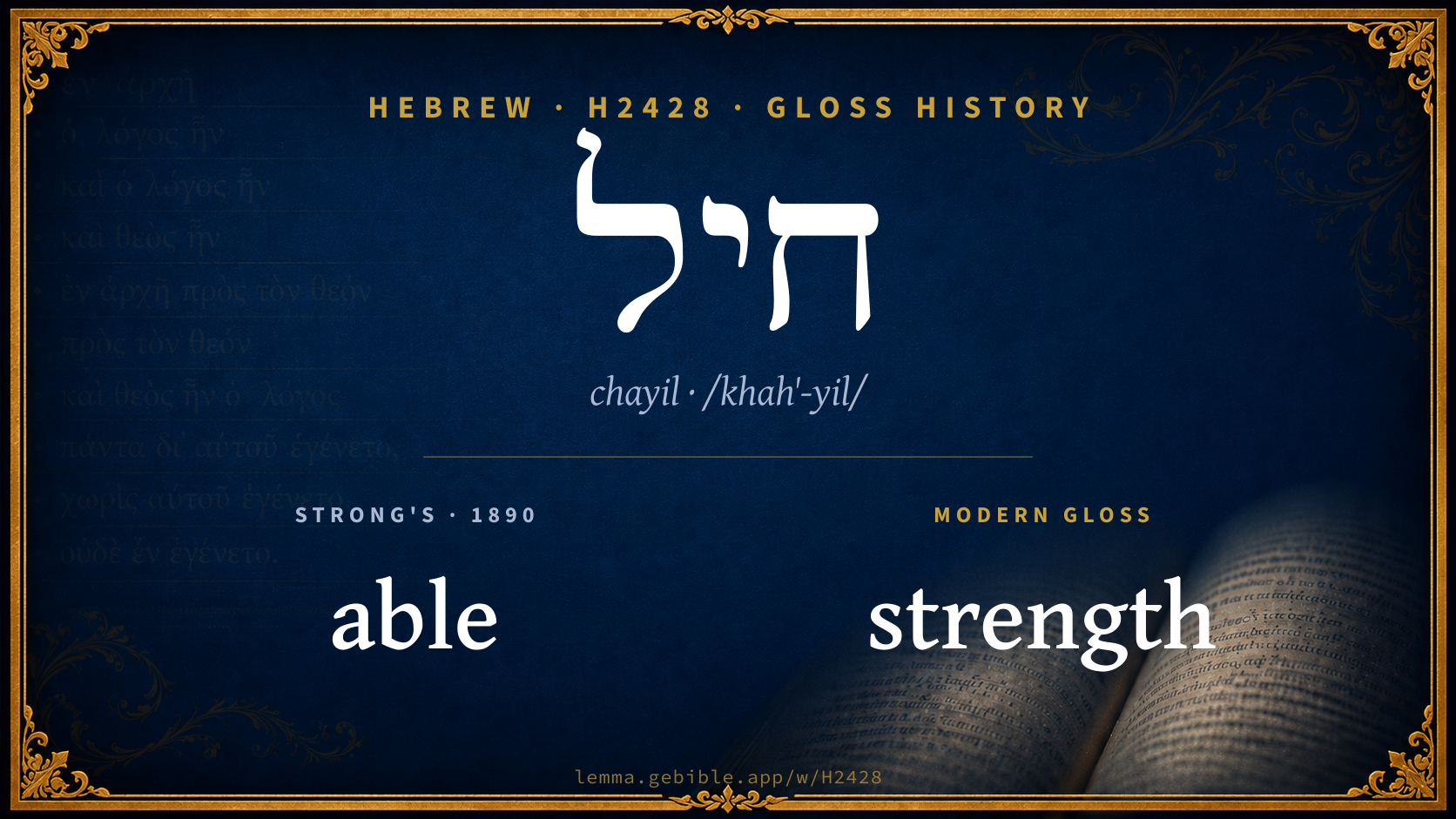
Gloss history
Strong's 1890 vs modern scholarship
About this word
Strong's H2428 catalogs a Hebrew word from the Hebrew Old Testament.
These counts are not copied from any lexicon or concordance. They are computed here, from the morphology-tagged Hebrew Old Testament. What Lemma adds →
- 221
- distinct verses
- The word appears in 221 distinct verses.
- 31 / 39
- OT books
- The word appears in 31 of 39 Old Testament books.
- #204
- by frequency
- Top 250 most frequent Hebrew words (rank 204 of 8,640 Hebrew words by occurrence).
View all 221 occurrences in the concordance →
Most concentrated in
- Jeremiah 29 verses 13%
- 1 Chronicles 26 verses 12%
- 2 Chronicles 21 verses 10%
By section of the Old Testament
By traditional corpus
Conventional, traditional groupings — biblical authorship is debated, so this is a traditional corpus grouping, not an authorship claim. Each share is this word’s portion of its verses in that division of the Hebrew canon. Each figure is a share of the word’s 221 distinct verses.
- Prophets (Nevi'im) 113 verses · 51%
- Writings (Ketuvim) 91 verses · 41%
- Torah (Pentateuch) 17 verses · 8%
How translations render this word
Counts come from each version’s own published word-to-Strong’s tagging or interlinear alignment — an approximate guide to how each version renders this word, not a word-level alignment the data otherwise carries. Because each total is that version’s own tagged count, the per-version totals vary from one another and need not match the appearance or distinct-verse counts above. These counts may also differ from a printed concordance because Lemma counts each distinctly tagged rendering and does not collapse phrase taggings into a single head-word total. This is a fixed set of word-tagged versions (KJV, ASV, BSB, ULT) and does not change with the reading translation you choose elsewhere. Each version’s license is shown beside its name below (and on Sources).
BDB lists this Strong’s number as 2 distinct words (homographs). Each count above pools all of them and is not split by sense — see the Senses section below. A low-frequency rendering may belong to a different one of those words, not the primary meaning.
- King James Version†: Army 35×, Valour 31×, Host 18×
- American Standard Version†: Army 30×, Valor 30×, Forces 13×
- Berean Standard Bible†: Army 72×, Valor 50×, Wealth 26×
- unfoldingWord Literal Text†: Valor 59×, Army 44×, Strength 28×
King James Version Public Domain
Renders H2428 across 238† tagged occurrences — most commonly:
Plus other, less common renderings. Plus 47 renderings that appear only once — usually multi-word phrases or single function words the recovered tagging swept in, not distinct renderings. Not rendered by a distinct English word in 5 further occurrences.
American Standard Version Public Domain
Renders H2428 across 237† tagged occurrences — most commonly:
Plus other, less common renderings. Plus 50 renderings that appear only once — usually multi-word phrases or single function words the recovered tagging swept in, not distinct renderings.
Berean Standard Bible Public Domain
Renders H2428 across 233† tagged occurrences — most commonly:
Plus other, less common renderings. Plus 32 renderings that appear only once — usually multi-word phrases or single function words the recovered tagging swept in, not distinct renderings. Not rendered by a distinct English word in 10 further occurrences.
unfoldingWord Literal Text CC BY-SA 4.0
Renders H2428 across 217† tagged occurrences — most commonly:
Plus other, less common renderings. Plus 18 renderings that appear only once — usually multi-word phrases or single function words the recovered tagging swept in, not distinct renderings.
7 senses and sub-senses in the full BDB
What do BDB’s symbols mean?
BDB uses these scholarly abbreviations:
| Symbol | Meaning |
|---|---|
| 𝔊 | the Septuagint (the ancient Greek translation, LXX) |
| 𝔙 | the Vulgate (the Latin translation) |
| 𝔖 | the Syriac version (the Peshitta) |
| 𝔗 | the Targum (the Aramaic translation) |
| ψ | the Psalms |
| √ | root (the underlying root or stem) |
| ‖ | parallel passage (a synonymous or contrasted parallel) |
| † | the dagger: every passage where the word occurs is cited |
The 7 senses and sub-senses the full Brown-Driver-Briggs lexicon distinguishes for this word, in lexicon order (not ranked by frequency), with BDB’s own verbatim wording and sub-sense lettering. Shown in Hebrew script with BDB’s own scholarly abbreviations. The condensed entry is in the Lexicon Entry tab. See also the Forms in the corpus table below.
- 1. strength, usually physical:
- a. seld. alone (chiefly poet.) 1 S 2:4 ψ 18:33, 40 = 2 S 22:33, 40; also גָּֽבְרוּ ח׳ Jb 21:7, cf. Ec 10:10; מֵחַיִל אֶל־חָ֑יִל ψ 84:8; בְּכֹחַ ח׳ 2 Ch 26:13; of virility Pr 31:3; of י׳’s power ψ 59:12; 110:3, cf. Hb 3:19; strength of horse ψ 33:17; fig. of product of vine and fig-tree Jo 2:22 (‖ פְּרִי). e.g. 1 Samuel 2:4
- b. of result or display of strength עשׂה ח׳ achieve might = do valiantly Nu 24:18 (JE), 1 S 14:48 ψ 60:14 = 108:14, 118:15, 16. e.g. Numbers 24:18
- c. often in phrases גִּבּוֹר(הַ)ח׳, גִּבּוֹרֵי(הַ)ח׳ hero(es) of strength, mighty man (men) of valour Jos 1:14 (D), 6:2; 8:3; 10:7 (all JE), Ju 6:12; 11:1; 1 S 9:1 16:18 1 K 11:28 2 K 5:1; 15:20; 24:14, 16 1 Ch 5:24; 7:2, 9; 8:40 + (very freq. in Ch), note especially הַגִּבּוֹרִים וכל גבורי ח׳ 28:1; also ג׳ ח׳ 2 Ch 13:3 (‖ ג׳ מלחמה); ג׳ (הַ)חֲיָלִים 1 Ch 7:5, 7, 11, 40; 11:26 (v. also גִּבּוֹר, p. 150); בֶּן־(הַ)ח׳, בְּנֵי(הַ)ח׳ Dt 3:18 Ju 18:2 + (v. בֵּן 8, p. 121); אִישׁ ח׳, אַנְשֵׁי ח׳ Ju 3:29; 20:44, 46 1 S 31:12; 2 S 11:16; 23:20; (Qr; Kt חי, on phr. בן־אישׁ חיל cf. Dr) = 1 Ch 11:22 (Kt חיל), 2 S 24:9 Na 2:4 Je 48:14 1 Ch 10:12 Ne 11:6 ψ 76:6; ironical א׳ ח׳ לִמְסֹךְ שֵׁבָר Is 5:22 (‖ גבורים לשׁתות יין); Ec 12:3 metaph. of legs. e.g. Joshua 1:14
- 2. ability, efficiency, often involving moral worth אַנְשֵׁי ח׳ Gn 47:6 (J), Ex 18:21, 25 (both E); of a woman אֵשֶׁת ח׳ Pr 12:4; 31:10 Ru 3:11; cf. 1 K 1:42, 52 (opp. רעה), and especially אַנְשֵׁי ח׳ יִרְאֵי אלהים אַנְשֵׁי אֱמֶת שׂנְאֵי בָּ֑צַע Ex 18:21 (E); עָשָׂה היל Pr 31:29 do worthily, efficiently, perhaps also Ru 4:11; late (with weakened meaning of גִּבּוֹר) גִּבּוֹרֵי חֵיל מְלֶאכֶת עֲבוֹדַת בֵּית הָאלהים 1 Ch 9:13, cf. אישׁ ח׳ בַּכֹּחַ לַעֲכֹדָה 26:8. So also 1 S 10:26 (read בְּנֵי ח׳, v. 𝔊 We Dr, men of worth, opp. בני בליעל v 27).for MT ח׳ force, band. e.g. Genesis 47:6
- 3. wealth Gn 34:29 Nu 31:9 (both P), Dt 8:17, 18; 33:11 Is 8:4; 10:14; 30:6 (‖ אוֹצְרֹתָם), 60:5 (‖ הֲמוֹן יָם), v 11; 61:6 Mi 4:13 Je 15:13; 17:3 (both ‖ אצרות), Zp 1:13 Ez 26:12; 28:4, 5(×2) Zc 14:14 Jb 5:5; 15:29; 20:15, 18; 31:25 ψ 49:7, 11; 62:11; 73:12 Pr 13:22. e.g. Genesis 34:29
- 4. force, army, very often Ex 14:4, 9, 17, 28 (all P), 15:4 (song), 1 S 17:20; 2 S 8:9 2 K 6:4, 15; 25:1, 5(×2), 10 2 Ch 13:3 (בְּחַיִל גִּבּוֹרֵי מלחמה), 14:7; 16:7; 23:14 +; so usually Jer.: Je 32:2; 34:1 +; freq. Ezek.: Ez 17:17; 27:10 +; Dn 11:7, 13, 25(×2), 26; = a band 1 S 10:26 (MT, but v. 2, ad fin.); of queen’s train ח׳ כָּבֵד 1 K 10:2 = 2 Ch 9:1; חֵיל כָּבֵד Is 36:2 = 2 K 18:17 (var. חַיִל) a powerful army (on form cf. Sta§ 194 c); also (late) חֵיל הַצָּבָא 1 Ch 20:1 2 Ch 26:13, חֵיל עָם Est 8:11; הֲמוֹן חֲיָלִים Dn 11:10; שַׂר־הח׳ 2 S 24:2 captain of the host, שָׂרֵי הח׳ v 4, 4; שָׂרֵי הַחֲיָלִים captains of armies (bands, divisions) 1 K 15:20 = 2 Ch 16:4, 2 K 25:23 Je 40:7, 13; 41:11, 13, 16; 42:1, 8; 43:4, 5; פִּקּוּדֵי החיל Nu 31:14 (P).—חֵילוֹ Ez 32:31 om. B Hi Co; for חֵילֵךְ Ez 27:11 read prob. a n.pr.loc., cf. Da; Co proposes חתלון (cf. 47:15; 48:1), HalMél. Epigr. 1874, 69 חלך = Cilicia, v. LagM i, 211. e.g. Exodus 14:4
Senses from the full Brown-Driver-Briggs lexicon (Brown, Driver, Briggs; Oxford 1906 — public domain), digitized via Sefaria, supplemented by the OpenScriptures HebrewLexicon (CC BY 4.0). Full attribution on Sources.
Word origin
I. n.m. 2 K 10:2 strength, efficiency, wealth, army;—abs. ח׳ Gn 47:6 +, חָ֑יִל ψ 60:14 +, חָ֑יִל ψ 60:14 +, חֵיל Is 36:2 2 K 18:17; cstr. חֵיל Ex 14:28 + (on ψ 10:10 v. חלכה); sf. חֵילִי Jb 31:25 + 2 times; חֵילְךָ Je 15:13 +; חֵילוֹ Ex 14:4 +, etc.; pl. חֲיָלִים 1 Ch 7:5 + 19 times; sf. חֵילֵיהֶם Is 30:6;—
I. v. sub I. II. חול supr.
— Brown-Driver-Briggs (Oxford 1906, public domain), digitized via Sefaria, supplemented by the OpenScriptures HebrewLexicon (CC BY 4.0). See Sources.
Derived from חול (chûwl) (H2342) — to writhe.
Jastrow Dictionary
A second Hebrew/Aramaic lexicon for comparison, covering Aramaic and post-biblical (Talmudic, Targumic, Midrashic) usage that the biblical-Hebrew BDB does not. Matched by lemma rather than by Strong’s number, so a lemma may carry more than one Jastrow headword (shown separately below), and the entries cover usage well beyond the Bible.
חַיִל
- , v. חַיִיל.—בְּרוֹר חַ׳, v. בְּרוֹר.
חֵיל I
- (חוּל, v. חַיִיל) surrounding, esp. Ḥel, a place within the fortification of the Temple. Midd. I, 5. Snh. 88ᵇ. Par. III, 11; Targ. Y. Num. XIX, 9; a. fr.
חִיל
- , Pa. חַיֵּיל, חַיֵּל (denom. of חֵילָא)
- 1. to strengthen. Targ. Job IV, 4. Ib. XVI, 5 (incorr. ed. אאח׳); a. e.
- 2. to serve. Targ. Num. IV, 23; a. e.
- 1. to be strengthened. Targ. Job VI, 16; a. fr.
- 2. to move into war, to gather together. Targ. Num. XXXI, 7. Targ. Job X, 17 (some ed. מתייחל׳, corr. acc.).
חֵיל II
- (v. חַיִל)
- 1. (adj.) strong. Targ. Job VIII, 2 Ms. (ed. רַבָּא). Keth. 62ᵃ דחיל מר כולי האי Ar. ed. Koh. (Var. דחֵילָא דמר; ed. דהכי) that you are so strong (that such is your strength).
- 2. (noun) strength. Targ. Job XX, 11 (ed. Lag. חִיּוּל׳; some ed. חֲיָיל׳). Targ. Prov. V, 10; a. fr.—Keth. 62ᵃ, v. supra. Y. B. Mets. IV, beg. 9ᶜ עד דהוה חֵילָךְ עלך while thou wast yet in thy strength (of manhood). Y. Yeb. IV, 6ᵇ לית בחֲיָילִי I cannot do it. B. Mets. 84ᵃ חילך לאורייתא give thy physical strength to the study of the Law; a. fr.—Trnsf. logical support, evidence, argument. Y. Pes. V, 32ᵃ top נסיב חֲיָילֵיה מן וכ׳ borrowed his argument from &c. Y. Maasr. I, 49ᵇ top; a. e.
- 3. army, host; service. Targ. Num. I, 3; a. fr.—Targ. Ps. LXVIII, 12 Ms. (ed. חֵילְוַת).—Pl. חֵילַיָּא, constr. חֵילֵי; חֵילְוָתָא, constr. חֵילְוַת. Targ. Ex. XII, 41. Targ. I Kings XXII, 19; a. fr.—Targ. Ps. XXXIII, 16; a. fr. Targ. II Esth. I, 4 ed. Amst. חֶלְוָתָא. Targ. Ps. XLIV, 10 ed. Lag. חֵילְוָתָנָא (oth. ed. חֵילְוָנָא, חַלְוָנָא).—Ḥull. 60ᵃ נפישן חֵילְוָותֵיה (not נפישי) his troops are too numerous.
A Dictionary of the Targumim, the Talmud Babli and Yerushalmi, and the Midrashic Literature (Marcus Jastrow; London, Luzac, 1903) — Public Domain. Digitized via Sefaria. Digitized via Sefaria. Full attribution on Sources.
Forms in the corpus
The 99 distinct written forms H2428 takes in the Hebrew Bible, most frequent first — each parse links to that state’s occurrences in the concordance. Hebrew forms include their vowel points and cantillation, so a single lemma takes many written forms.
The 60 most common forms are shown; 39 rarer forms follow in the full concordance.
Same root — word family
Other BDB entries built from the same root as H2428, grouped by Strong’s listed origin. These share a root / origin per the lexicon — not necessarily a shared meaning. Each links to that word’s own entry.
Derives from
Shares the same root
Derived from this word
Proper names from this root
People and places named from this root — a name, not an additional meaning of the word.
- חוילה Chăvîylâh H2341 Havilah
- חול Chûwl H2343 Hul
- חלחול Chalchûwl H2478 Halhul
- חילם Chêylâm H2431 Helam
- חילן Chîylên H2432 Hilen
- חלן Chêlôn H2497 Helon
Compare all same-root words → Showing 4 of 15 — not the complete family. 6 of the same-root words are proper names (people or places). They share a root, not necessarily a meaning.
Septuagint verse parallels
This word appears in 207 verses that also exist in the Greek Old Testament (Septuagint), out of the 221 Hebrew verses it occurs in. You can read those verses in Greek by switching the Old Testament edition to the Septuagint.
Read these verses in the Septuagint
- Genesis 34:29
- Exodus 14:4
- Numbers 24:18
- Deuteronomy 3:18
- Joshua 1:14
- Judges 3:29
- Ruth 2:1
- 1 Samuel 2:4
- 2 Samuel 2:7
- 1 Kings 1:42
- 2 Kings 2:16
- 1 Chronicles 5:18
This is a verse-level parallel only — the same verses exist in both the Hebrew and Greek Old Testaments. No word-level Hebrew↔Greek correspondence is claimed: the data carries no such alignment, so no Greek word is shown as this Hebrew word’s translation. Coverage is not total — the Septuagint omits the deuterocanon and renumbers the Psalms, so some Hebrew verses have no direct Greek parallel.