Isaiah 43:17

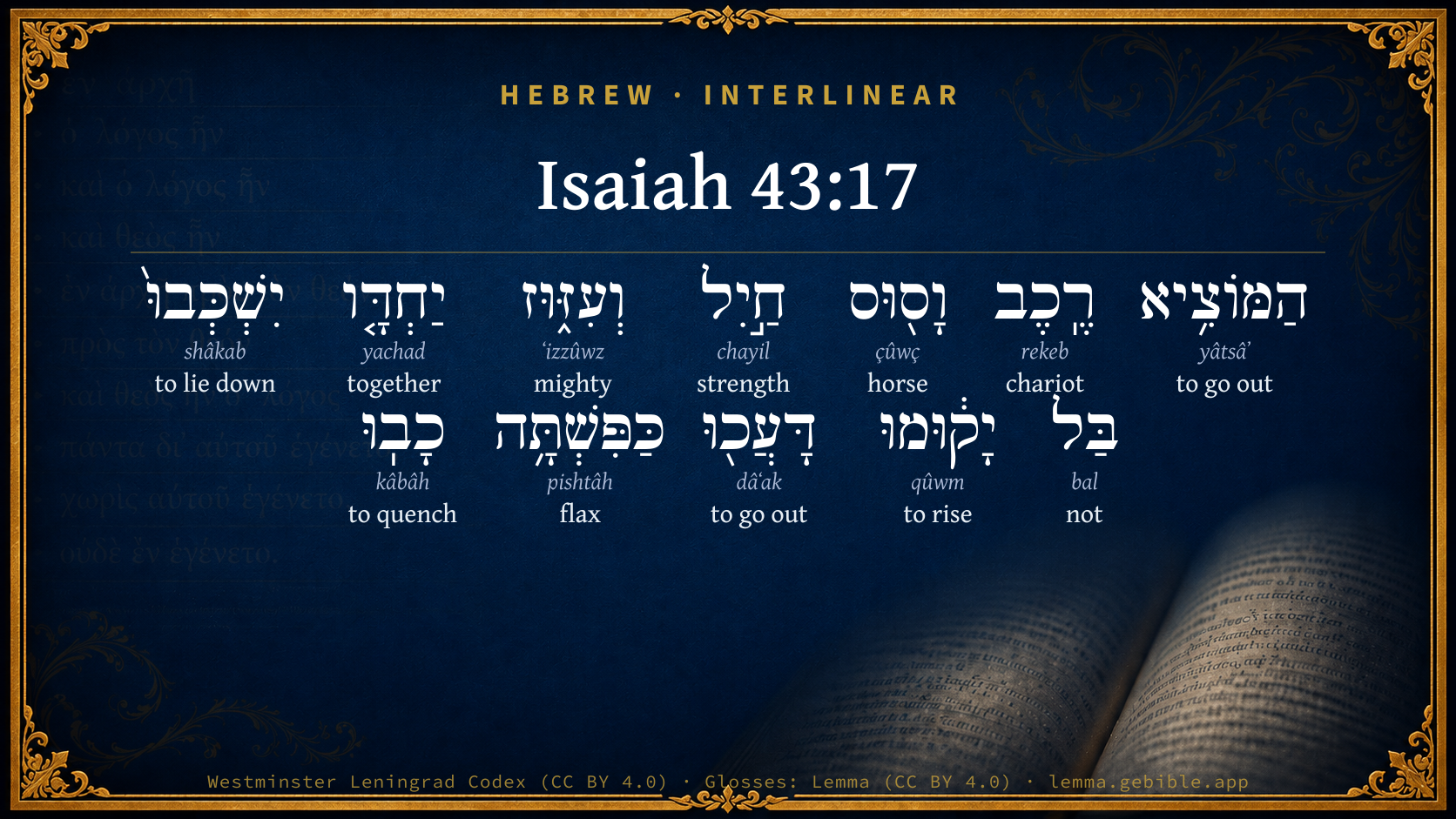
Hebrew (Westminster Leningrad Codex) Isaiah 43:17 appears in the Hebrew Old Testament. The text above is from the Westminster Leningrad Codex. Each word links to its Strong’s number, a concise gloss, and parsing drawn from the Open Scriptures Hebrew Bible morphology. Click any word for its full Brown-Driver-Briggs (BDB) entry.
Download image
Cite this verse

Isaiah 43:17 (World English Bible). Public Domain. Lemma interlinear Bible study tool, https://lemma.gebible.app/v/isaiah/43/17.

Show BibTeX & RIS
BibTeX
RIS
English Translation
who brings forth the chariot and horse, the army and the mighty man (they lie down together, they shall not rise; they are extinct, they are quenched as a wick):
World English Bible · Public Domain
Download a study sheet

One document with this verse’s original text, its word-by-word gloss line, the meaning frame, cross-references with their text, attributed commentary, and full source and license credits — printable, and it pastes into notes with its structure intact.

This verse Autodidact and up

Study sheet (.html) Plain text (.txt)

A passage Seminary Student

Up to 50 verses in one chapter. A passage sheet keeps up to 6 commentary sources and 12 cross-references per verse, in the order this page ranks them, and says so on the sheet whenever that leaves anything out. Ask for a single verse and you get the Autodidact verse sheet above.

Everything on this page stays free to read, with no account — the sheet is a download of what is already on screen, not access to it.

Want to remove ads? Support Godless Engineer
Compare translations 3

The same verse in 3 English versions, stacked beneath the original-language interlinear above. Click any original word for its lexicon entry.

Each is an independent rendering of the whole verse — the interlinear is not word-aligned to these translations.

Highlighted words mark where these versions differ — a whole-verse word diff, not a word-by-word alignment.

  • World English Bible Public Domain
    who brings forth the chariot and horse, the army and the mighty man (they lie down together, they shall not rise; they are extinct, they are quenched as a wick):
  • King James Version Public Domain
    Which bringeth forth the chariot and horse, the army and the power; they shall lie down together, they shall not rise: they are extinct, they are quenched as tow.
  • unfoldingWord Literal Text CC BY-SA 4.0
    the one having brought out chariot and horse, army and mighty — together they lay down, they did not arise; they flickered out, they quenched like a wick—

unfoldingWord Literal Text — © unfoldingWord, licensed CC BY-SA 4.0. Word-aligned USFM3 via Door43 (git.door43.org/unfoldingWord/en_ult).

Versions to compare (up to 4)

3 of 4 selected

Show all 18 translations

Every available English version of this verse, each an independent rendering of the whole verse.

  • World English Bible Public Domain
    who brings forth the chariot and horse, the army and the mighty man (they lie down together, they shall not rise; they are extinct, they are quenched as a wick):
  • Berean Standard Bible Public Domain
    who brings out the chariots and horses, the armies and warriors together, to lie down, never to rise again; to be extinguished, snuffed out like a wick:
  • Majority Standard Bible Public Domain
    who brings out the chariots and horses, the armies and warriors together, to lie down, never to rise again; to be extinguished, snuffed out like a wick:
  • King James Version Public Domain
    Which bringeth forth the chariot and horse, the army and the power; they shall lie down together, they shall not rise: they are extinct, they are quenched as tow.
  • American Standard Version (1901) Public Domain
    who bringeth forth the chariot and horse, the army and the mighty man (they lie down together, they shall not rise; they are extinct, they are quenched as a wick):
  • Revised Version (1885) Public Domain
    which bringeth forth the chariot and horse, the army and the power; they lie down together, they shall not rise; they are extinct, they are quenched as flax:
  • Geneva Bible (1599) Public Domain
    When hee bringeth out the charet and horse, the armie and the power lie together, and shall not rise: they are extinct, and quenched as towe.
  • Douay-Rheims (1899) Public Domain
    Who brought forth the chariot and the horse, the army and the strong: they lay down to sleep together, and they shall not rise again: they are broken as flax, and are extinct.
  • Young's Literal Translation Public Domain
    Who is bringing forth chariot and horse, A force, even a strong one: `Together they lie down -- they rise not, They have been extinguished, As flax they have been quenched.'
  • Literal Standard Version CC BY-SA 4.0
    Who is bringing forth chariot and horse, || A force, even a strong one: “They lie down together—they do not rise, || They have been extinguished, || They have been quenched as flax.”
  • Unlocked Literal Bible CC BY-SA 4.0
    who led out the chariot and horse, the army and the mighty host. They fell down together; they will never rise again; they are extinguished, quenched like a burning wick.)
  • unfoldingWord Literal Text CC BY-SA 4.0
    the one having brought out chariot and horse, army and mighty — together they lay down, they did not arise; they flickered out, they quenched like a wick—
  • Darby Bible Public Domain
    who bringeth forth chariot and horse, army and power -- they lie down together, they shall not rise; they are extinct, they are quenched as tow:
  • World Messianic Bible Public Domain
    who brings out the chariot and horse, the army and the mighty man (they lie down together, they shall not rise; they are extinct, they are quenched like a wick) says:
  • Webster's Bible Public Domain
    Who bringeth forth the chariot and horse, the army and the power; they shall lie down together, they shall not rise: they are extinct, they are quenched as tow.
  • Free Bible Version CC BY-SA 4.0
    the one who brought out a great army with its horses and chariots and laid them down, never to rise again, snuffed out like a burning wick.
  • Bible in Basic English Public Domain
    Who sends out the war-carriages and the horses, the army with all its force; they have come down, they will not get up again; like a feebly burning light they are put out.
  • JPS Tanakh (1917) Public Domain
    Who bringeth forth the chariot and horse, the army and the power — they lie down together, they shall not rise, they are extinct, they are quenched as a wick:

Literal Standard Version (2020), Covenant Press — licensed CC BY-SA 4.0. Text via the HelloAO Bible API (eBible.org). Unlocked Literal Bible (unfoldingWord) — licensed CC BY-SA 4.0. Text via the HelloAO Bible API (eBible.org). unfoldingWord Literal Text — © unfoldingWord, licensed CC BY-SA 4.0. Word-aligned USFM3 via Door43 (git.door43.org/unfoldingWord/en_ult). Free Bible Version, Dr. Jonathan Gallagher — licensed CC BY-SA 4.0. Text via the HelloAO Bible API (eBible.org).

Word by word

More ways to search: Search by grammar → Find every occurrence → Compare this word →

Practice this passage: Drill this verse → Learn its vocabulary →

וְעִזּ֑וּז
ʻizzûwz
H5808
“and · mighty”
Conjunction + Adjective, Adjective, Masculine, Singular, Absolute
Part of Speech
Conjunction + Adjective
Type
Adjective
Gender
Masculine
Number
Singular
State
Absolute
Full BDB Definition

Origin: from H5810

TWOT: 1596d

powerful, mighty
  1. הַמּוֹצִ֥יא yâtsâʼ H3318 “the · going out” Particle, Definite Article + Verb, Hiphil, Participle Active, Masculine, Singular, Absolute
  2. רֶֽכֶב rekeb H7393 “chariot” Noun, Common, Masculine, Singular, Absolute
  3. וָס֖וּס çûwç H5483 “and · horse” Conjunction + Noun, Common, Masculine, Singular, Absolute
  4. חַ֣יִל chayil H2428 “strength” Noun, Common, Masculine, Singular, Absolute
  5. יַחְדָּ֤ו yachad H3162 “together” Adverb
  6. יִשְׁכְּבוּ֙ shâkab H7901 “to lie down” Verb, Qal, Imperfect, 3rd Person, Masculine, Plural
  7. בַּל bal H1077 “not” Particle, Negative
  8. יָק֔וּמוּ qûwm H6965 “to rise” Verb, Qal, Imperfect, 3rd Person, Masculine, Plural
  9. דָּעֲכ֖וּ dâʻak H1846 “to go out” Verb, Qal, Perfect, 3rd Person, Common, Plural
  10. כַּפִּשְׁתָּ֥ה pishtâh H6594 “like/as the · flax” Preposition, Determined + Noun, Common, Feminine, Singular, Absolute
  11. כָבֽוּ kâbâh H3518 “to quench” Verb, Qal, Perfect, 3rd Person, Common, Plural

About this verse

These counts appear in no published source. They are computed here, from the morphology-tagged text and Lemma’s own curated glosses. What Lemma adds →

12
words
12
distinct lemmas
Prophets
section

Notable vocabulary

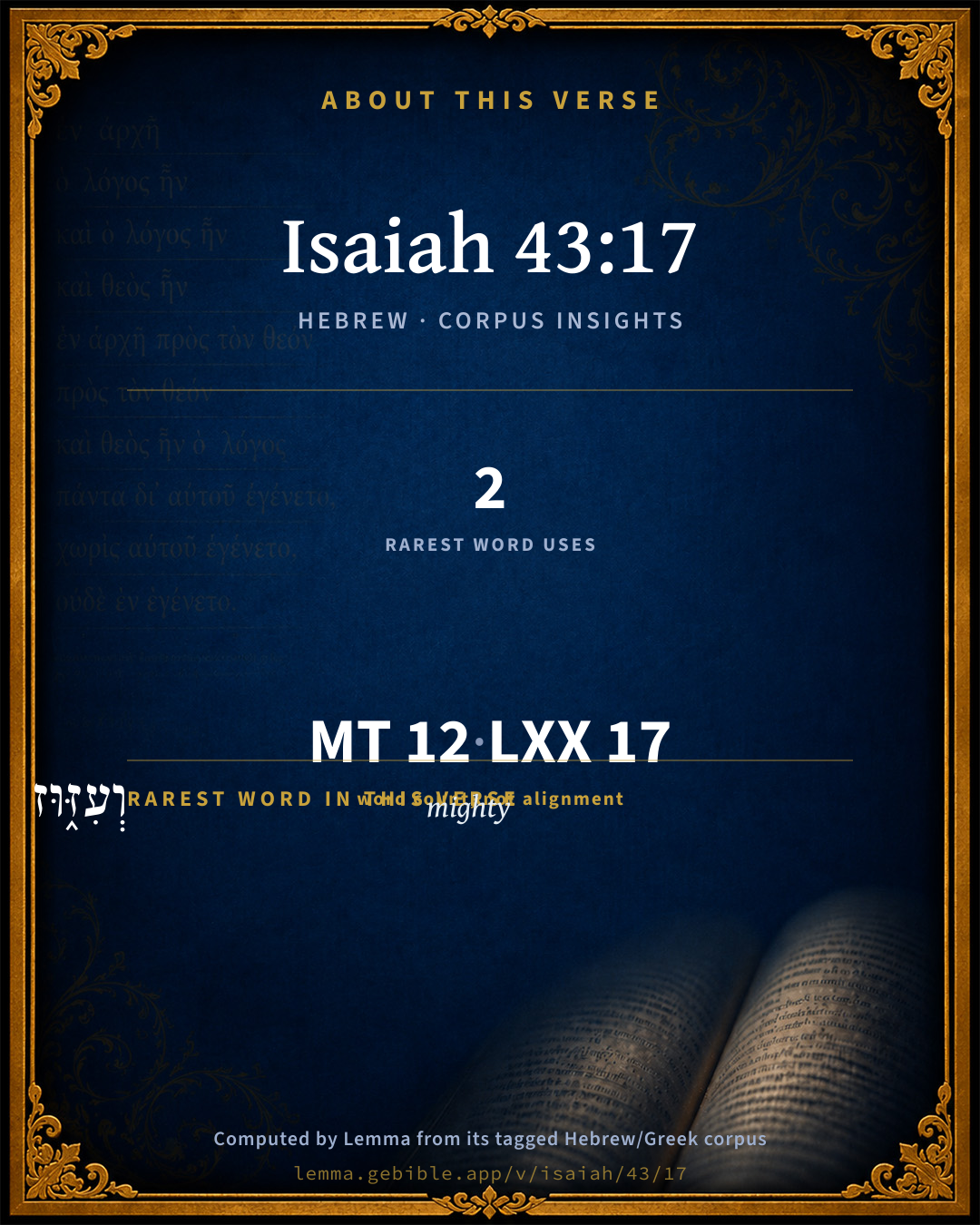
The rarest word here is וְעִזּ֑וּז mighty H5808 — appearing just 2 times in the whole Hebrew Bible.

Shared distinctive vocabulary

וְעִזּ֑וּז mighty H5808 occurs in 2 verses of the Hebrew Bible. Also found in:

Grammatical profile

  • 5 verbs
  • 4 nouns
  • 1 adjective
  • 1 adverb
  • 1 particle

Verb forms

  • הַמּוֹצִ֥יא Hiphil · Participle Active
  • יִשְׁכְּבוּ֙ Qal · Imperfect
  • יָק֔וּמוּ Qal · Imperfect
  • דָּעֲכ֖וּ Qal · Perfect
  • כָבֽוּ Qal · Perfect

Hebrew & Septuagint length

In English translation the verse runs 30 words from the Hebrew and 25 from the Septuagint (LXX English) — closely comparable.

A rough comparison of the two English renderings, which tokenize alike — not a word-level alignment.

Word counts can differ between the Hebrew and the Greek without any difference in meaning — e.g. the Hebrew direct-object marker אֵת has no separate Greek word, and Greek often adds the article ὁ.

In the original languages it is 12 Hebrew tokens and 17 Greek tokens — but the two are counted differently (Hebrew bundles its prefixes and suffixes into one token; the Greek is in lemma form), so that isn’t a like-for-like length.

Cross-references

11

Topical passages linked to Isaiah 43:17 in the Treasury of Scripture Knowledge — connected by theme and wording, ordered by reader-vote popularity; previews shown in the World English Bible.

  • Exodus 14:4–9 I will harden Pharaoh's heart, and he will follow after them; and I will get honor over Pharaoh, and over all his host; and the Egyptians shall know that I am Yahweh." They did so.
  • Isaiah 1:31 The strong will be like tinder, And his work like a spark. They will both burn together, And no one will quench them."
  • Psalms 76:5–6 Valiant men lie plundered, They have slept their last sleep. None of the men of war can lift their hands.
  • Psalms 118:12 They surrounded me like bees. They are quenched like the burning thorns. In the name of Yahweh I cut them off.
  • Ezekiel 38:8–18 After many days you shall be visited: in the latter years you shall come into the land that is brought back from the sword, that is gathered out of many peoples, on the mountains of Israel, which have been a continual waste; but it is brought forth out of the peoples, and they shall dwell securely, all of them.
  • Revelation 20:8–9 and he will come out to deceive the nations which are in the four corners of the earth, Gog and Magog, to gather them together to the war; the number of whom is as the sand of the sea.
  • Exodus 14:23–28 The Egyptians pursued, and went in after them into the midst of the sea: all of Pharaoh's horses, his chariots, and his horsemen.
  • Exodus 15:4 Pharaoh's chariots and his host has he cast into the sea; His chosen captains are sunk in the Red Sea.
  • Psalms 46:8–9 Come, see Yahweh's works, What desolations he has made in the earth.
  • Isaiah 14:20–22 You shall not be joined with them in burial, because you have destroyed your land, you have killed your people; the seed of evil-doers shall not be named forever.
  • Revelation 19:17–21 I saw an angel standing in the sun. He cried with a loud voice, saying to all the birds that fly in the sky, "Come! Be gathered together to the great supper of God,

Cross-references courtesy of OpenBible.info (CC BY 4.0).

Hebrew and Greek witnesses Masoretic Hebrew ↔ Greek Septuagint

The same verse in the two great witnesses to the Old Testament, shown verse-for-verse.

These are two independent witnesses, not word-aligned to each other, and the Septuagint is shown in lemma (dictionary) form.

Hebrew Isaiah 43:17 Masoretic · Westminster Leningrad Codex

הַמּוֹצִ֥יא רֶֽכֶב וָס֖וּס חַ֣יִל וְעִזּ֑וּז יַחְדָּ֤ו יִשְׁכְּבוּ֙ בַּל יָק֔וּמוּ דָּעֲכ֖וּ כַּפִּשְׁתָּ֥ה כָבֽוּ

who brings forth the chariot and horse, the army and the mighty man (they lie down together, they shall not rise; they are extinct, they are quenched as a wick):

World English Bible · Public Domain

Greek LXX Isaiah 43:17 Septuagint · lemma form

ὁ ἐκἄγω ἅρμα καί ἵππος καί ὄχλος ἰσχυρός ἀλλά κοιμάω καί οὐ ἀναἵστημι σβέννυμι ὡς λίνον σβέννυμι

who brought forth chariots and horse, and a mighty multitude: but they have lain down, and shall not rise: they are extinct, as quenched flax.

LXX2012 (modern English Septuagint) · Public Domain

Hebrew: Westminster Leningrad Codex (CC BY 4.0). Greek: Septuagint (public domain); English from LXX2012 (modern English Septuagint) (Public Domain). How the Septuagint differs from the Hebrew →

Targum (Aramaic paraphrase)

1

The Targum is the ancient Jewish Aramaic paraphrase of the Hebrew Scriptures — an interpretive translation, not the Hebrew text itself. Onkelos (literal) and Pseudo-Jonathan (expansive) render the Torah, and Jonathan the Prophets. Coverage is partial: where no permissively-licensed English translation exists for a verse, only the Aramaic is shown. This is verse-level text, not a word-by-word alignment to the Hebrew.

  1. Targum Jonathan Prophets (Joshua–Malachi)
    דְאַפֵיק רְתִיכִין וְסוּסְוָן מַשִׁרְיָן וְעַם סַגִי כַּחֲדָא אִתְבְּלָעוּ וְלָא קָמוּ דְעִיכוּ כְּבוּצָא עַמִי טְפוֹ:

    I who brought out the chariots, and horses, and a great host, yea, much people; they were swallowed up together, they did not rise, they were extinguished, they are extinct like the glimmering wick is extinguished.

    Targum Jonathan — Aramaic: “Mikraot Gedolot” (public domain). English: “Sefaria Community Translation” (CC0 1.0 (public-domain dedication)); “London "Chaldee Paraphrase," 1871” (public domain). Text via Sefaria.

Commentary

Notes on Isaiah 43:17 from classic Christian and Jewish commentators (each source and its license shown beneath its notes). The classic Christian expositions comment on the surrounding passage and are grouped to its opening verse, so a note may address several verses; the Jewish commentaries on the Tanakh (Rashi and others) are per-verse, so they appear only where the commentator wrote on this verse.

Lemma curates 59 commentaries, every one of them public domain or Creative Commons licensed, each selected and text-cleaned for this edition rather than reprinted as found. About our sources →

Trapp's Complete Commentary

John Trapp

Isa 43:17 Which bringeth forth the chariot and horse, the army and the power; they shall lie down together, they shall not rise: they are extinct, they are quenched as tow.

Ver. 17. Which bringeth forth the chariot and horse.] Or, Who brought forth the chariot and horse, the army and the power, viz, Pharaoh’s forces. {Exo 14:4; Exo 14:9; Exo 14:23}

They are quenched as tow.] {a} Heb., As a candlewick make of flax quickly quenched with water poured on it. See how easily God can confound his foes.

{a} Ut ellychnium extinguentur.

John Trapp, A Commentary or Exposition upon All the Books of the Old and New Testament (1647–1656) — public domain. Text from a community e-Sword module.

Geneva Bible (1599)

Geneva Bible translators

Pharaoh and his mighty army.

When he delivered his people out of Egypt.

Geneva Bible (1599) marginal notes — public domain. Text via Bolls.life.

Jamieson, Fausset & Brown

Robert Jamieson, A. R. Fausset & David Brown

the power--the might of the enemies host, every mighty warrior.

they shall lie down together--as Pharaoh's army sank "together" in a watery grave.

Jamieson, Fausset & Brown — Commentary Critical and Explanatory on the Whole Bible (1871) — public domain (CC PDM 1.0). Text via the HelloAO Bible API.

Ellicott's Commentary for English Readers

(17) Quenched as tow—i.e., as the wick of a lamp going out. (See Note on Isa_42:3.)

A Bible Commentary for English Readers, edited by Charles John Ellicott (1878–1897) — public domain. Text from a community e-Sword module.

The Cambridge Bible for Schools and Colleges

gen. ed. J. J. S. Perowne

17. which bringeth forth] i.e. allows them to come forth to their destruction (cf. Eze_38:4, where the same expression is used with regard to the expedition of Gog, king of Magog). The next words should be rendered simply chariot and horse (without art.).

the army and the power] Perhaps: army and warrior. The second word is found elsewhere only in Psa_24:8 (A.V. “mighty”) in apposition with the common word for “hero.” Here it may be used collectively.

they shall lie down] Better: they lie down.

quenched as tow] extinguished like a wick; the same words as in ch. Isa_42:3. The alternation of tenses in the original is noteworthy and very graphic. The participial construction first gives place to the descriptive impf., and this again to two perfects of completed action.

The Cambridge Bible for Schools and Colleges (gen. ed. J. J. S. Perowne; Cambridge University Press, 1878–1918) — public domain. Text from a community e-Sword module.

John Gill's Exposition

Remember ye not the former things,.... Just now referred to, the bringing of Israel out of Egypt, and through the Red sea, and the drowning of Pharaoh and his army in it; for though these things were worthy to be remembered with thankfulness and praise, and to the glory of God, and for the encouragement of faith, yet not in comparison of what was hereafter to be done; meaning, not the redemption from Babylon, unless as a type of spiritual and eternal redemption by Christ; for otherwise there were greater and more wonderful things done, when Israel were brought out of Egypt, than when they were brought out of Babylon; but the great salvation by the Messiah, which exceeds both the deliverances out of Egypt and Babylon, is meant:

neither consider the things of old; unless as figures of the new, but not to be put upon a foot with them, much less to the undervaluing of them, and indeed to be forgotten in comparison of them; see Jer 23:7. The Talmudists (q), by the "former" things, understand subjection to kingdoms; and, by the "things of old", the going out of Egypt; as they do by the "new thing", in the following verse, the war of Gog and Magog.

(q) T. Bab. Beracot, fol. 13. 1. T. Hieros. Beracot, fol. 4. 1.

John Gill's Exposition of the Whole Bible (1746–1763) — public domain (CC PDM 1.0). Text via the HelloAO Bible API.

Albert Barnes' Notes on the Bible

Which bringeth forth the chariot and horse - The reference here is, undoubtedly, to the occurrences which are recorded in Exo 14:4, following, when Pharaoh and his host are said to have followed the Israelites, but were all submerged in the sea. God is said to have brought them forth in accordance with the general statement so often made, that he controls and directs princes and nations (see the note at Isa 10:5-6).

They shall lie down together - They shall sink together to death, as Pharaoh and his army sunk together in a watery grave.

Thou didst blow with thy wind, the sea covered them:

They sank as lead in the mighty waters.

Exo 15:10

The depths have covered them:

They sank into the bottom as a stone.

Exo 15:5

They are extinct - They are destroyed, as the wick of a lamp is quenched suddenly when immersed in water. This is a striking figure, to denote the suddenness with which it was done, and the completeness of their destruction. As a flame is entirely put out when plunged beneath the water, so the whole host of the Egyptians were suddenly and completely destroyed in the Red Sea. The sentiment in this verse is, that God has power over the nations to control them; that it is one of his characteristics to lead on the enemies of his people to destruction; and that they are suddenly destroyed, and their hopes, and joys, and triumphs put out forever. If it was so in regard to the Egyptians, it will be also in regard to all his foes. And if this took place in regard to a nation, it shall also in regard to individual sinners who oppose themselves to God.

How oft is the candle of time wicked put out?

And how oft cometh their destruction upon them?

God distributeth sorrows in his anger.

They are as stubble before the wind,

And as chaff that the storm carrieth away.

Job 21:17-18

Albert Barnes' Notes on the Bible (1834–1885) — public domain. Text from a community e-Sword/MySword module.

Matthew Poole's English Annotations

Which bringeth forth the chariot and horse, the army and the power; or rather, Who brought forth the chariots, &c., i.e. Pharaoh, and his chariots, and homes, and army; as may be gathered from the next verse, where the things here mentioned are called former things, and things of old. They shall lie down together, they shall not rise; or, they did lie down together, (to wit, in the bottom of the sea,) they did not rise; they sank like lead, as it is said, Exo 15:10, and they never rose again to molest the Israelites, as God promised, Exo 14:13. These two Hebrew verbs are of the future tense, but that seems to be put for the preter tense, because the two following verbs, which treat of the same thing, and are added to explain these, are of the preter tense.

They are quenched as tow; as the wick of a candle when it is put into the water is wholly extinguished, and not the least spark of fire left, so were they utterly destroyed, and not one of them remained.

Matthew Poole's English Annotations on the Holy Bible (1683–1685) — public domain. Text from a community e-Sword/MySword module.

The Pulpit Commentary

Which bringeth forth the chariot and horse. Still the reference is to the events of the Exodus, whereof Israel is reminded, since "the redemption out of Egypt was a type and pledge of the deliverance to be looked for out of Babylon" (Delitzsch). God then "brought out" after Israel, to attack him, "chariot and horse, army and power;" but the result was their destruction. They shall lie down... they shall not rise; rather, they lie down... they do not rise (so Cheyne and Delitzsch). The future has here, as so often, the force of a present, the present being the praesens historicum. What the prophet describes in a few touches is the complete overthrow of Pharaoh"s host in the Red Sea, and the entire extinction of that life which had just before shown itself as "lusty and strong." Quenched as tow. (comp. Isa_42:3) The metaphor is not drawn from burning tow, which is not very readily extinguished, but from the wick of a lamp, which a single breath puts out.

The Pulpit Commentary (1880–1919), ed. H.D.M. Spence-Jones & Joseph S. Exell — public domain. Text from a community e-Sword module.

John Wesley's Explanatory Notes

The chariot - Pharaoh and his chariots and horses, and army. Lay down - In the bottom of the sea. They never rose again to molest the Israelites. Quenched - As the wick of a candle when it is put into the water, is extinguished.

John Wesley, Explanatory Notes Upon the Whole Bible (1754–1765) — public domain. Text via the GEBible commentary corpus.

J. A. Alexander on Isaiah

Joseph Addison Alexander

“The (one) bringing out chariot and horse, force and strength (literally, strong); together they shall lie, they shall not rise; they are extinct, like tow (or like a wick) they are quenched.” The construction is continued from the foregoing verse, and the first word agrees directly with Jehovah. Some understand the verse as having reference to a naval victory of Cyrus over the Chaldeans, others as relating to the destruction of Pharaoh and his host. It is no objection to the latter application that the verb is future, as it denotes not merely the act of lying down, but the state of lying still, and is therefore a poetical equivalent and parallel to shall not rise. That something long past is intended, may be gathered from the exhortation of the next verse.

Joseph Addison Alexander, The Prophecies of Isaiah (1846–1847; New York: Scribner, 1870–1878) — public domain. Text from a community e-Sword module.

Rashi

Rabbi Shlomo Yitzchaki (Rashi)

they were quenched Jonathan renders: Like flax they dimmed, they were quenched.

Rashi on the Tanakh — English translations: “The Judaica Press complete Tanach with Rashi, translated by A. J. Rosenberg” (CC BY 4.0); “Pentateuch with Rashi's commentary by M. Rosenbaum and A.M. Silbermann, 1929-1934” (public domain); “The Metsudah Tanach series, Lakewood, N.J” (CC BY 4.0); and “The Book of Joshua, Metsudah Publications, 1997” (CC BY 4.0). Text via Sefaria.

Ibn Ezra

Rabbi Abraham ibn Ezra

Which bringeth forth the chariot and horse, תיל ועזוז the great and powerful army on land; the army of the Chaldæans is meant, that went out to fight against the Persians.

דעכו It is Pual, and means they are extinct; comp. ידעך shall be put out (Prov. 20:20)

Ibn Ezra on the Tanakh — English translations: “Sefaria Community Translation” (CC0 1.0 (public-domain dedication)); “Yalkut, Sifsei Chachomim Chumash, Metsudah Publications, 2009” (CC BY 4.0); and “Commentary of Ibn Ezra on Isaiah - trans. by M. Friedlander, 1873” (public domain). Text via Sefaria.

Lesson kit

Teaching starters — assembled from the data on this page, not authored interpretation. Every prompt links to the verse data it draws on. Edit before teaching.

Isaiah, in the Prophets, opens this verse with 12 words (12 distinct Hebrew lemmas). Its most distinctive word is ʻizzûwz (“mighty”). A historical commentator’s framing appears above. Read the whole chapter for the surrounding context.

Discussion questions

  1. The word ʻizzûwz carries the sense “mighty.” How does it shape the verse?
  2. Psalms 24:8 shares the word «mighty» with this verse. How do the two illuminate each other?
  3. These translations render this verse differently. What is at stake in choosing one wording over another?
  4. The verb «הַמּוֹצִ֥יא» is Hiphil Participle Active. How does its form color the action?
  5. Reading how Trapp's Complete Commentary and Geneva Bible (1599) read this verse, where do the two commentators agree and where do they part?

Things to notice

Reading settings

Reading text

Shown beneath each verse's original-language words.

Old Testament
Old Testament edition

Read the OT as the Masoretic Hebrew (MT) or the Greek Septuagint (LXX).

English shown for the Greek Septuagint (in the Hebrew ↔ Greek comparison).

Comparing translations? Open the Compare panel on any verse page to stack up to four side by side.