
Judges 6:12

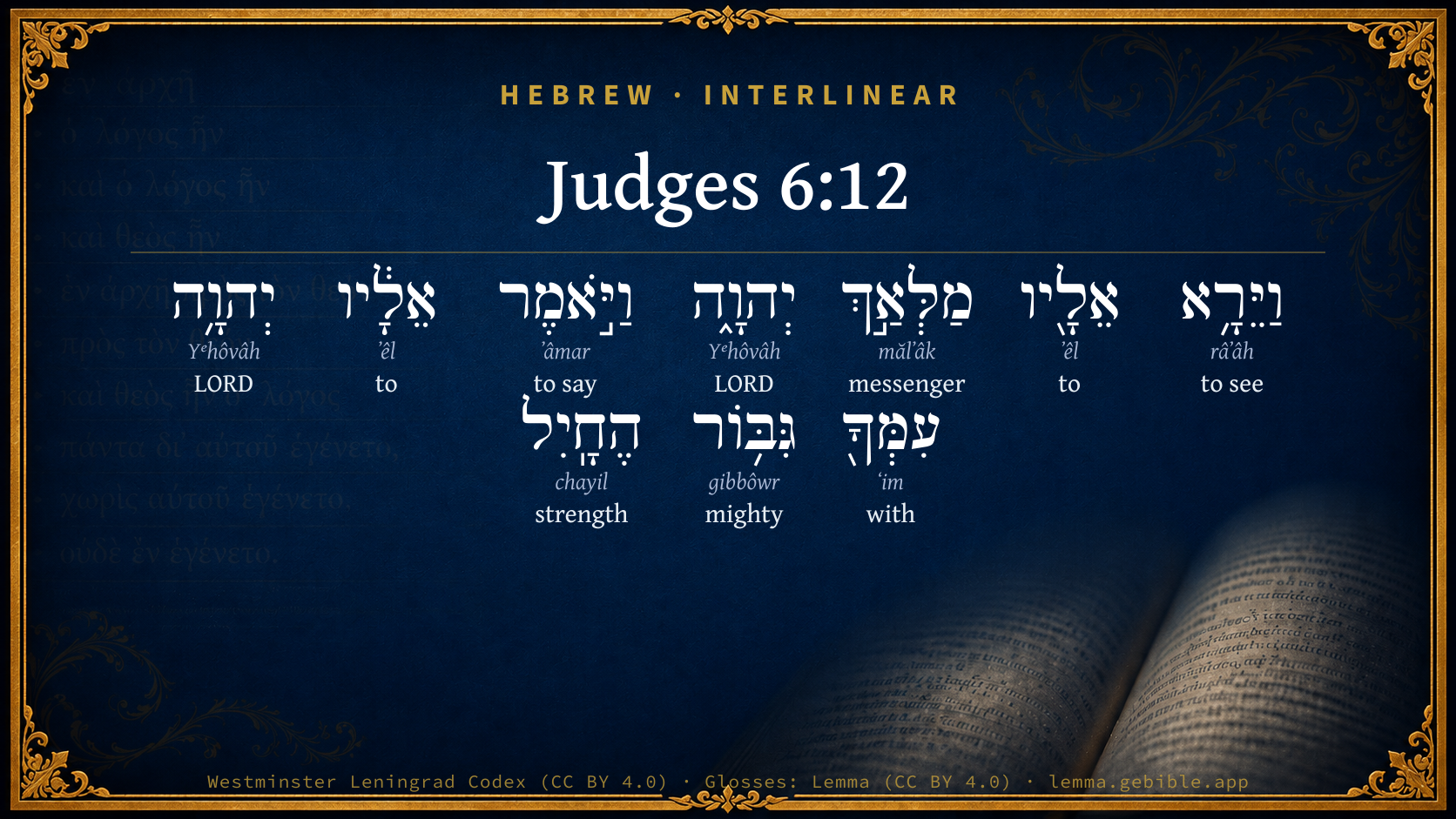
Hebrew (Westminster Leningrad Codex) Judges 6:12 appears in the Hebrew Old Testament. The text above is from the Westminster Leningrad Codex. Each word links to its Strong’s number, a concise gloss, and parsing drawn from the Open Scriptures Hebrew Bible morphology. Click any word for its full Brown-Driver-Briggs (BDB) entry.
Download image
Cite this verse

Judges 6:12 (World English Bible). Public Domain. Lemma interlinear Bible study tool, https://lemma.gebible.app/v/judges/6/12.

Show BibTeX & RIS
BibTeX
RIS
English Translation
The angel of Yahweh appeared to him, and said to him, Yahweh is with you, you mighty man of valor.
World English Bible · Public Domain
Download a study sheet

One document with this verse’s original text, its word-by-word gloss line, the meaning frame, cross-references with their text, attributed commentary, and full source and license credits — printable, and it pastes into notes with its structure intact.

This verse Autodidact and up

Study sheet (.html) Plain text (.txt)

A passage Seminary Student

Up to 50 verses in one chapter. A passage sheet keeps up to 6 commentary sources and 12 cross-references per verse, in the order this page ranks them, and says so on the sheet whenever that leaves anything out. Ask for a single verse and you get the Autodidact verse sheet above.

Everything on this page stays free to read, with no account — the sheet is a download of what is already on screen, not access to it.

Want to remove ads? Support Godless Engineer
Compare translations 3

The same verse in 3 English versions, stacked beneath the original-language interlinear above. Click any original word for its lexicon entry.

Each is an independent rendering of the whole verse — the interlinear is not word-aligned to these translations.

Highlighted words mark where these versions differ — a whole-verse word diff, not a word-by-word alignment.

  • World English Bible Public Domain
    The angel of Yahweh appeared to him, and said to him, Yahweh is with you, you mighty man of valor.
  • King James Version Public Domain
    And the angel of the LORD appeared unto him, and said unto him, The LORD is with thee, thou mighty man of valor.
  • unfoldingWord Literal Text CC BY-SA 4.0
    And the angel of Yahweh appeared to him and said to him, “Yahweh with you, warrior of valor!”

unfoldingWord Literal Text — © unfoldingWord, licensed CC BY-SA 4.0. Word-aligned USFM3 via Door43 (git.door43.org/unfoldingWord/en_ult).

Versions to compare (up to 4)

3 of 4 selected

Show all 18 translations

Every available English version of this verse, each an independent rendering of the whole verse.

  • World English Bible Public Domain
    The angel of Yahweh appeared to him, and said to him, Yahweh is with you, you mighty man of valor.
  • Berean Standard Bible Public Domain
    And the angel of the LORD appeared to Gideon and said, “The LORD is with you, O mighty man of valor.”
  • Majority Standard Bible Public Domain
    And the angel of the LORD appeared to Gideon and said, “The LORD is with you, O mighty man of valor.”
  • King James Version Public Domain
    And the angel of the LORD appeared unto him, and said unto him, The LORD is with thee, thou mighty man of valor.
  • American Standard Version (1901) Public Domain
    And the angel of Jehovah appeared unto him, and said unto him, Jehovah is with thee, thou mighty man of valor.
  • Revised Version (1885) Public Domain
    And the angel of the LORD appeared unto him, and said unto him, The LORD is with thee, thou mighty man of valour.
  • Geneva Bible (1599) Public Domain
    Then the Angel of the Lord appeared vnto him, and said vnto him, The Lord is with thee, thou valiant man.
  • Douay-Rheims (1899) Public Domain
    And an angel of the Lord came, and sat under an oak, that was in Ephra, and belonged to Joas the father of the family of Ezri. And when Gedeon his son was threshing and cleansing wheat by the winepress, to flee from Madian,
  • Young's Literal Translation Public Domain
    and the messenger of Jehovah appeareth unto him, and saith unto him, `Jehovah `is' with thee, O mighty one of valour.'
  • Literal Standard Version CC BY-SA 4.0
    and the Messenger of YHWH appears to him and says to him, “YHWH [is] with you, O mighty man of valor.”
  • Unlocked Literal Bible CC BY-SA 4.0
    The angel of Yahweh appeared to him and said to him, “Yahweh is with you, you strong warrior!”
  • unfoldingWord Literal Text CC BY-SA 4.0
    And the angel of Yahweh appeared to him and said to him, “Yahweh with you, warrior of valor!”
  • Darby Bible Public Domain
    And the angel of the LORD appeared to him and said to him, "The LORD is with you, you mighty man of valor."
  • World Messianic Bible Public Domain
    The LORD’s angel appeared to him, and said to him, “The LORD is with you, you mighty man of valor!”
  • Webster's Bible Public Domain
    And the angel of the LORD appeared to him, and said to him, The LORD is with thee, thou mighty man of valor.
  • Free Bible Version CC BY-SA 4.0
    The angel of the Lord appeared to him and said, “The Lord is with you, great man of courage!”
  • Bible in Basic English Public Domain
    And the angel of the Lord came before his eyes, and said to him, The Lord is with you, O man of war.
  • JPS Tanakh (1917) Public Domain
    And the angel of the LORD appeared unto him, and said unto him: 'The LORD is with thee, thou mighty man of valour.'

Literal Standard Version (2020), Covenant Press — licensed CC BY-SA 4.0. Text via the HelloAO Bible API (eBible.org). Unlocked Literal Bible (unfoldingWord) — licensed CC BY-SA 4.0. Text via the HelloAO Bible API (eBible.org). unfoldingWord Literal Text — © unfoldingWord, licensed CC BY-SA 4.0. Word-aligned USFM3 via Door43 (git.door43.org/unfoldingWord/en_ult). Free Bible Version, Dr. Jonathan Gallagher — licensed CC BY-SA 4.0. Text via the HelloAO Bible API (eBible.org).

Word by word

More ways to search: Search by grammar → Find every occurrence → Compare this word →

Practice this passage: Drill this verse → Learn its vocabulary →

גִּבּ֥וֹר
gibbôwr
H1368
“mighty of”
Adjective, Adjective, Masculine, Singular, Construct
Part of Speech
Adjective
Type
Adjective
Gender
Masculine
Number
Singular
State
Construct
Full BDB Definition

Origin: intensive from H1396

TWOT: 310b

strong, mighty (adjective) - strong man, brave man, mighty man (noun masculine)
  1. וַיֵּרָ֥א râʼâh H7200 “and · to see” Conjunction + Verb, Niphal, Sequential Imperfect, 3rd Person, Masculine, Singular
  2. אֵלָ֖יו ʼêl H413 “to · him” Preposition + Suffix, Personal, 3rd Person, Masculine, Singular
  3. מַלְּאַ֣ךְ mălʼâk H4397 “messenger of” Noun, Common, Masculine, Singular, Construct
  4. יְהוָ֑ה Yᵉhôvâh H3068 “LORD” Noun, Proper
  5. וַיֹּ֣אמֶר ʼâmar H559 “and · to say” Conjunction + Verb, Qal, Sequential Imperfect, 3rd Person, Masculine, Singular
  6. אֵלָ֔יו ʼêl H413 “to · him” Preposition + Suffix, Personal, 3rd Person, Masculine, Singular
  7. יְהוָ֥ה Yᵉhôvâh H3068 “LORD” Noun, Proper
  8. עִמְּךָ֖ ʻim H5973 “with · you” Preposition + Suffix, Personal, 2nd Person, Masculine, Singular
  9. הֶחָֽיִל chayil H2428 “the · strength” Particle, Definite Article + Noun, Common, Masculine, Singular, Absolute

About this verse

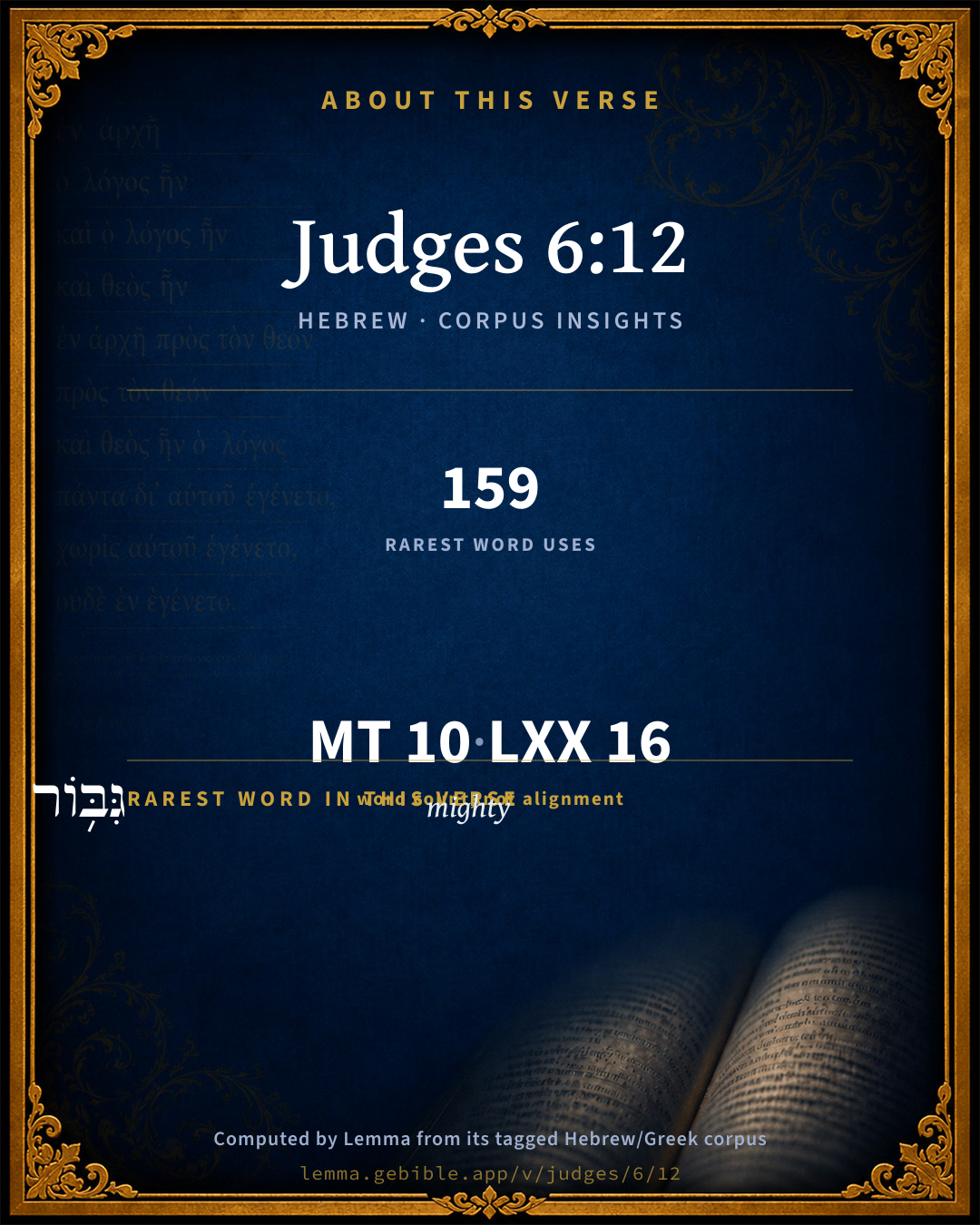
These counts appear in no published source. They are computed here, from the morphology-tagged text and Lemma’s own curated glosses. What Lemma adds →

10
words
8
distinct lemmas
Historical
section

Grammatical profile

  • 2 verbs
  • 4 nouns
  • 1 adjective
  • 3 prepositions

Verb forms

  • וַיֵּרָ֥א Niphal · Sequential Imperfect
  • וַיֹּ֣אמֶר Qal · Sequential Imperfect

Repetition

Words recur within this verse — often emphatic in Hebrew:

  • יְהוָ֑ה LORD H3068 ×2
  • אֵלָ֖יו to H413 ×2

Hebrew & Septuagint length

In English translation the verse runs 20 words from the Hebrew and 22 from the Septuagint (LXX English) — closely comparable.

A rough comparison of the two English renderings, which tokenize alike — not a word-level alignment.

Word counts can differ between the Hebrew and the Greek without any difference in meaning — e.g. the Hebrew direct-object marker אֵת has no separate Greek word, and Greek often adds the article ὁ.

In the original languages it is 10 Hebrew tokens and 16 Greek tokens — but the two are counted differently (Hebrew bundles its prefixes and suffixes into one token; the Greek is in lemma form), so that isn’t a like-for-like length.

Cross-references

11

Topical passages linked to Judges 6:12 in the Treasury of Scripture Knowledge — connected by theme and wording, ordered by reader-vote popularity; previews shown in the World English Bible.

  • Joshua 1:5 There shall not any man be able to stand before you all the days of your life. As I was with Moses, so I will be with you; I will not fail you, nor forsake you.
  • Luke 1:28 Having come in, the angel said to her, "Rejoice, you highly favored one! The Lord is with you. Blessed are you among women!"
  • Judges 2:18 When Yahweh raised them up judges, then Yahweh was with the judge, and saved them out of the hand of their enemies all the days of the judge: for it repented Yahweh because of their groaning by reason of those who oppressed them and vexed them.
  • Joshua 1:9 Haven't I commanded you? Be strong and of good courage; don't be afraid, neither be dismayed: for Yahweh your God is with you wherever you go.
  • Judges 13:3 The angel of Yahweh appeared to the woman, and said to her, See now, you are barren, and don't bear; but you shall conceive, and bear a son.
  • Exodus 3:12 He said, "Certainly I will be with you. This will be the token to you, that I have sent you: when you have brought forth the people out of Egypt, you shall serve God on this mountain."
  • Luke 1:11 An angel of the Lord appeared to him, standing on the right side of the altar of incense.
  • Acts 18:9–10 The Lord said to Paul in the night by a vision, "Don't be afraid, but speak and don't be silent;
  • Matthew 1:23 "Behold, the virgin shall be with child, And shall bring forth a son. They shall call his name Immanuel;" Which is, being interpreted, "God with us."
  • Matthew 28:20 teaching them to observe all things that I commanded you. Behold, I am with you always, even to the end of the age." Amen.
  • Ruth 2:4 Behold, Boaz came from Bethlehem, and said to the reapers, Yahweh be with you. They answered him, Yahweh bless you.

Cross-references courtesy of OpenBible.info (CC BY 4.0).

Hebrew and Greek witnesses Masoretic Hebrew ↔ Greek Septuagint

The same verse in the two great witnesses to the Old Testament, shown verse-for-verse.

These are two independent witnesses, not word-aligned to each other, and the Septuagint is shown in lemma (dictionary) form.

Hebrew Judges 6:12 Masoretic · Westminster Leningrad Codex

וַיֵּרָ֥א אֵלָ֖יו מַלְּאַ֣ךְ יְהוָ֑ה וַיֹּ֣אמֶר אֵלָ֔יו יְהוָ֥ה עִמְּךָ֖ גִּבּ֥וֹר הֶחָֽיִל

The angel of Yahweh appeared to him, and said to him, Yahweh is with you, you mighty man of valor.

World English Bible · Public Domain

Greek LXX Judges 6:12 Septuagint · lemma form

καί ὁράω αὐτός ὁ ἄγγελος κύριος καί εἶπον πρός αὐτός κύριος μετά σύ ἰσχυρός ὁ δύναμις

And the angel of the Lord appeared to him and said to him, The Lord is with you, you mighty in strength.

LXX2012 (modern English Septuagint) · Public Domain

On this verse, Trapp's Complete Commentary discusses the Septuagint’s reading. Read the note in Commentary ↓

Hebrew: Westminster Leningrad Codex (CC BY 4.0). Greek: Septuagint (public domain); English from LXX2012 (modern English Septuagint) (Public Domain). How the Septuagint differs from the Hebrew →

Targum (Aramaic paraphrase)

1

The Targum is the ancient Jewish Aramaic paraphrase of the Hebrew Scriptures — an interpretive translation, not the Hebrew text itself. Onkelos (literal) and Pseudo-Jonathan (expansive) render the Torah, and Jonathan the Prophets. Coverage is partial: where no permissively-licensed English translation exists for a verse, only the Aramaic is shown. This is verse-level text, not a word-by-word alignment to the Hebrew.

  1. Targum Jonathan Prophets (Joshua–Malachi)
    וְאִתְגְלֵי לֵיהּ מַלְאָכָא דַייָ וַאֲמַר לֵיהּ מֵימְרָא דַייָ בְּסַעְדָךְ גִבַּר חֵילָא:

    (no public-domain English translation for this verse)

    Targum Jonathan — Aramaic: “Mikraot Gedolot” (public domain). English: “Sefaria Community Translation” (CC0 1.0 (public-domain dedication)); “London "Chaldee Paraphrase," 1871” (public domain). Text via Sefaria.

Commentary

Notes on Judges 6:12 from classic Christian and Jewish commentators (each source and its license shown beneath its notes). The classic Christian expositions comment on the surrounding passage and are grouped to its opening verse, so a note may address several verses; the Jewish commentaries on the Tanakh (Rashi and others) are per-verse, so they appear only where the commentator wrote on this verse.

Lemma curates 59 commentaries, every one of them public domain or Creative Commons licensed, each selected and text-cleaned for this edition rather than reprinted as found. About our sources →

Trapp's Complete Commentary

John Trapp

Jdg 6:12 And the angel of the LORD appeared unto him, and said unto him, The LORD [is] with thee, thou mighty man of valour.

Ver. 12. And the angel appeared unto him.] As he was threshing. So God called Moses and David from following the ewes, Elisha from the ploughing, the apostles from fishing, washing, and mending their nets, &c. He usually appeared to the busy visions, like as Satan doth to the idle in manifold temptations.

Thou mighty man of valour.] The Septuagint renders it, "Even the Lord mighty in valour."

John Trapp, A Commentary or Exposition upon All the Books of the Old and New Testament (1647–1656) — public domain. Text from a community e-Sword module.

Joseph Benson's Commentary

Jdg 6:12. The Lord is with thee — That is, to guide and strengthen thee, to animate and support thee. He is with thee, giving thee a commission to go out against the enemies of Israel, communicating to thee all necessary qualifications for the execution of this commission, and assuring thee of success therein. The Chaldee interprets it, The Word of the Lord is thy help, “which shows,” says Dr. Dodd, “that the ancient Jews looked upon this angel as the Lord himself, which is confirmed by the Targum translation of the following verse. Is the Shechinah of the Lord our help? Whence then hath all this happened unto us? A paraphrase which shows that they took the Word of the Lord to be the same with the Shechinah of the Lord.” Thou mighty man of valour — To whom I have given courage and strength for the work to which I have called thee. Gideon, though a mighty man, could bring nothing to pass without the presence of God. But as that presence is enough to make any man mighty in valour, and to give him courage at any time, so it is all in all to our prosperity, whatever we do.

Joseph Benson's Commentary on the Old and New Testaments (1811–1818) — public domain. Text from a community e-Sword module.

Adam Clarke's Commentary

Verse 12. The Lord is with thee] "The WORD of the Lord is with thee, thou mighty man of valour." - Targum. It appears that Gideon had proved himself, on former occasions, to be a man of courage anti personal prowess; and this would naturally excite the confidence of his countrymen. God chooses for his work those instruments which, in the course of his operations in nature and providence, he has qualified for his purpose. The instruments thus chosen are generally unlikely, but they will be ever found the best qualified for the Divine employment.

Adam Clarke's Commentary on the Bible (1810–1826) — public domain. Text from a community e-Sword/MySword module.

Ellicott's Commentary for English Readers

(12) The Lord is with thee, thou mighty man of valour.—Three words in the Hebrew: Jehovah immekâ, Gibbor. It was once a salutation and a blessing. (Comp. Jos_1:5; Luk_1:28). The address seems to show that Gideon had already distinguished himself by bravery in war; it can hardly refer to the vigour with which he was wielding the flail. Only the second and third of the three epochs of his life are narrated; but we see from scattered glimpses that he and his brothers had possibly taken part already in some battle on Mount Tabor—possibly even (so scanty are all our details, and so little certain is the chronology) in the struggle against the Canaanites (Jdg_8:18; Jdg_4:6); that he was a man of kingly presence, and had a youthful son; that he had numerous slaves, and even an armour-bearer (Jdg_7:10; Jdg_8:20).

A Bible Commentary for English Readers, edited by Charles John Ellicott (1878–1897) — public domain. Text from a community e-Sword module.

The Cambridge Bible for Schools and Colleges

gen. ed. J. J. S. Perowne

12. The Lord is with thee] Cf. Jdg_6:16 : an assurance given to chosen instruments of God’s purpose, such as Jacob, Gen_28:15, Moses, Exo_3:12, Joshua, Jos_1:5. The Angel noticed the energy which Gideon put into his work; he was a strong man, like Jephthah Jdg_11:1. The winepress must have been situated near the terebinth.

The Cambridge Bible for Schools and Colleges (gen. ed. J. J. S. Perowne; Cambridge University Press, 1878–1918) — public domain. Text from a community e-Sword module.

John Gill's Exposition

And Gideon said to him, oh my Lord,.... Taking him not to be an angel, but some illustrious and eminent person:

if the Lord be with us, why then is all this befallen us? all these troubles and calamities through the oppression of the Midianites; for he understood what was said to him in the salutation, respecting not himself personally and privately, but the people of Israel; and he could not tell how to reconcile the Lord's being with them, and yet suffering such sad things to befall them they groaned under:

where be all his miracles which our fathers told us of, saying, did not the Lord bring us up from Egypt? when God was with his people, and brought them out of Egypt, he wrought miracles for them, whereby they were delivered out of their bondage; of this their fathers had assured them, but nothing of this kind was wrought for them now, and therefore there was no appearance of the Lord being with them, but all the contrary, as follows:

but now the Lord has forsaken us, and delivered us into the hand of the Midianites; and there was good reason for it, because they had forsaken the Lord, and worshipped the gods of the Amorites.

John Gill's Exposition of the Whole Bible (1746–1763) — public domain (CC PDM 1.0). Text via the HelloAO Bible API.

Albert Barnes' Notes on the Bible

Thou mighty man of valor - Known to God to be such, though as yet not known to be such either by himself or his countrymen (compare Luk 1:28, Luk 1:30).

Albert Barnes' Notes on the Bible (1834–1885) — public domain. Text from a community e-Sword/MySword module.

Haydock's Catholic Bible Commentary

Is. We should naturally translate, be with thee, if the answer of Gedeon did not shew (Calmet) that it is to be taken as an assertion, that the Lord was already reconciled to Israel, and had made choice of this valiant man to rescue his people from slavery, though he was not of the first nobility, ver. 15.

George Leo Haydock (1774–1849), Haydock's Catholic Family Bible and Commentary, 1859 edition — public domain. Excludes Psalms (Douay-Rheims chapter numbering differs from Protestant) and Deuterocanonical books (Catholic canon only).

Matthew Poole's English Annotations

i.e. Will assist thee against thine and mine enemies.

Thou mighty man of valour; to whom I have given strength and courage for this end.

Matthew Poole's English Annotations on the Holy Bible (1683–1685) — public domain. Text from a community e-Sword/MySword module.

Whedon's Commentary on the Bible

Daniel D. Whedon

12. The Lord is with thee, thou mighty man of valour — These inspiring words were designed to be a source of comfort and strength to Gideon. He is called a mighty hero, not because he has already distinguished himself by great deeds of valour, but in reference to what he is yet to do, all which was known to this Angel.

Daniel D. Whedon (gen. ed.), Commentary on the Old and New Testaments (1874–1909) — public domain. Text from a community e-Sword module.

The Pulpit Commentary

Appeared. Angels were not always visible when present. (see Num_22:31 2Sa_24:17 2Ki_6:19, etc.)

Vers. 12, 13. The paradox of the Divine presence.

It has ever been the case that spiritual blessing is hard to be realised in the absence of material prosperity. There is something almost ironical in the contrast between the assertion "Jehovah is with thee," and the actual condition of the person addressed. It was the more inconceivable because of the external nature of the religious sanctions and rewards of the age. Mosaicism abounds in material and temporal blessings. A natural question, then, for Gideon was, "Where are these?" There are many who think very similarly today. Are they right or are they wrong? If God be with a man ought he not to prosper? Notice first

I THE DIFFICULTY OF GIDEON. It was to reconcile the assurance of God"s presence with the signs of actual weakness and distress all around him. There is something very ingenuous in the identification of himself with his people. "Thee" is altered by him to "us." It is full of promise for the future of the hero. He knows of no blessing in which his country does not share. And that is the right temper in which to face all such problems. The glorious past of Israel rose up before his mind"s eye. How different from the days in which his lot had fallen! Had God any favour to his people? Why, then, this utter inaction? this absence of all miraculous intervention? If the old records were to be credited God had delivered his people with a "high hand and an outstretched arm;" now to all appearance the heavens had "withdrawn, and become astronomical." And yet how great and immediate the need for God"s help! Day by day deeds were wrought under the sun that could not be spoken of. So there are times in these days when crimes are committed, nascent movements of religious and secular moment are withered, and the dial of civilisation is set back. The great calamities of war, pestilence, earthquake, etc., seem to call to heaven, but it is silent. Is it indifferent? Has the hope of man been a dream?

II HOW IT MAY BE ANSWERED. Other things being equal, the blessing of God ought to make rich, and happy, and prosperous. But that is not its chief end in the present. It is first to make right. And God is in the seed as much as in the plant. He has many ways of fulfilling his premises. The blessing of Gideon was a potential one. It began even then in him, but it was to be communicated to others. It was as really a blessing for Israel as if the oppressor bad been driven from her borders, etc. Spiritual influences begin deeply, secretly, and mysteriously; but they are ere long known by their fruits. God was with Israel repentant in the moment of her repentance. And yet the external evils of her condition were as yet unchecked. God can be with a man in fulness of blessing and help, even when he is poor, and wretched, and helpless; but he will not continue so if he be obedient to the heavenly will. Spiritual blessing then should be expected to show itself, at least first, spiritually and inwardly; and an individual may be the holder of it vicariously for a nation or the race. M.

The Pulpit Commentary (1880–1919), ed. H.D.M. Spence-Jones & Joseph S. Exell — public domain. Text from a community e-Sword module.

John Wesley's Explanatory Notes

Is with thee - That is, will assist thee against thine enemies. Man of valour - To whom I have given strength and courage for this end.

John Wesley, Explanatory Notes Upon the Whole Bible (1754–1765) — public domain. Text via the GEBible commentary corpus.

Rashi

Rabbi Shlomo Yitzchaki (Rashi)

Adonoy is with you, man of supreme power. Since He infused you with such power.

Rashi on the Tanakh — English translations: “The Judaica Press complete Tanach with Rashi, translated by A. J. Rosenberg” (CC BY 4.0); “Pentateuch with Rashi's commentary by M. Rosenbaum and A.M. Silbermann, 1929-1934” (public domain); “The Metsudah Tanach series, Lakewood, N.J” (CC BY 4.0); and “The Book of Joshua, Metsudah Publications, 1997” (CC BY 4.0). Text via Sefaria.

Lesson kit

Teaching starters — assembled from the data on this page, not authored interpretation. Every prompt links to the verse data it draws on. Edit before teaching.

Judges, in the Historical, opens this verse with 10 words (8 distinct Hebrew lemmas). Its most distinctive word is gibbôwr (“mighty”). A historical commentator’s framing appears above. Read the whole chapter for the surrounding context.

Discussion questions

  1. How does “mighty” (gibbôwr) shape what this verse is saying?
  2. How does Joshua 1:5, which shares this passage’s theme, read alongside this verse?
  3. What does the repetition of “LORD” (2× in this one verse) do in this verse?
  4. These translations render this verse differently. What is at stake in choosing one wording over another?
  5. «וַיֵּרָ֥א» is a Niphal Sequential Imperfect verb. How does that grammatical form shape the action described?
  6. Compare how Trapp's Complete Commentary and Joseph Benson's Commentary read this verse. Where do they agree or differ?

Things to notice

Reading settings

Reading text

Shown beneath each verse's original-language words.

Old Testament
Old Testament edition

Read the OT as the Masoretic Hebrew (MT) or the Greek Septuagint (LXX).

English shown for the Greek Septuagint (in the Hebrew ↔ Greek comparison).

Comparing translations? Open the Compare panel on any verse page to stack up to four side by side.