1 Chronicles 9:13

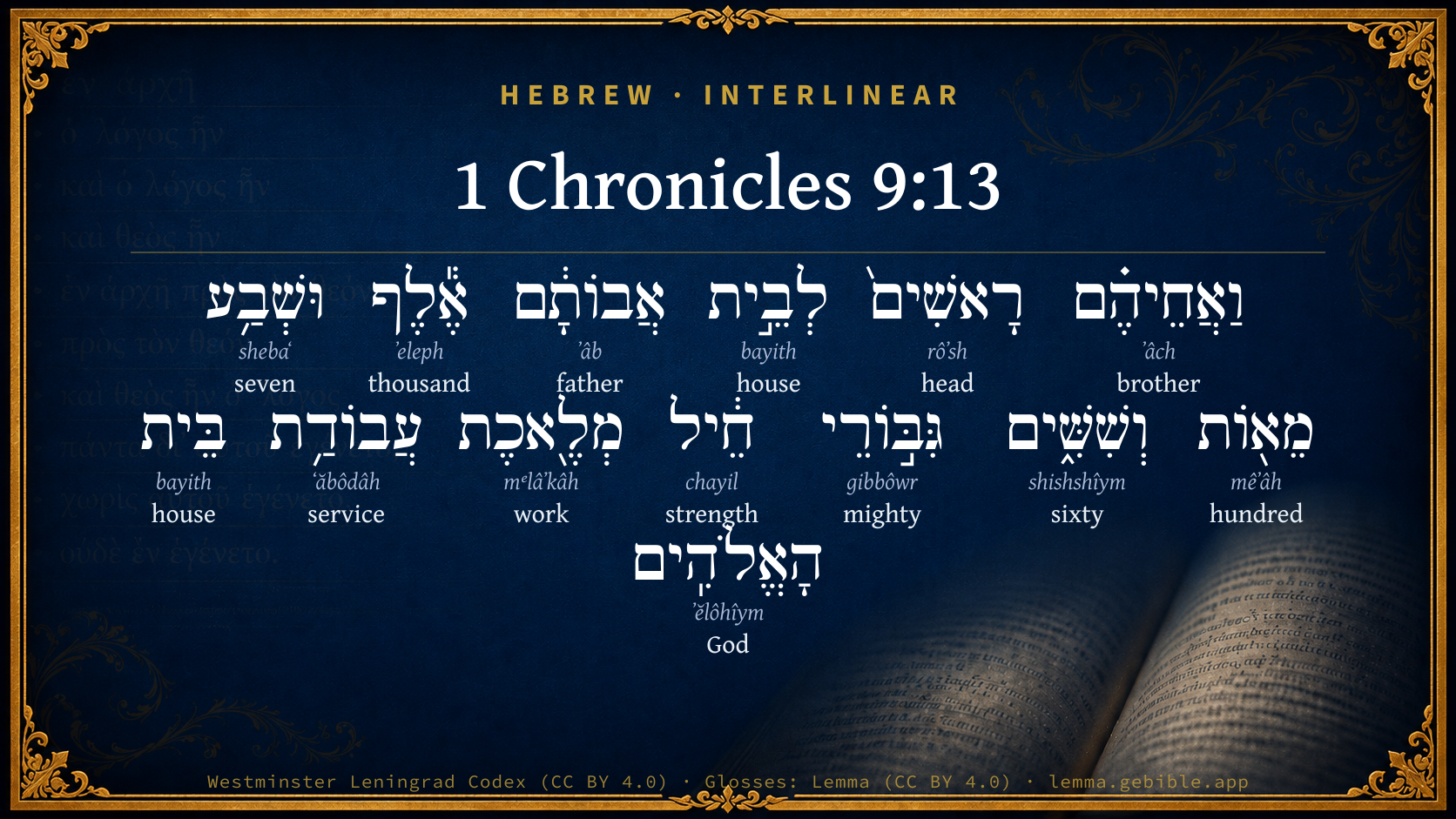
Hebrew (Westminster Leningrad Codex) 1 Chronicles 9:13 appears in the Hebrew Old Testament. The text above is from the Westminster Leningrad Codex. Each word links to its Strong’s number, a concise gloss, and parsing drawn from the Open Scriptures Hebrew Bible morphology. Click any word for its full Brown-Driver-Briggs (BDB) entry.
Download image
Cite this verse

1 Chronicles 9:13 (World English Bible). Public Domain. Lemma interlinear Bible study tool, https://lemma.gebible.app/v/1-chronicles/9/13.

Show BibTeX & RIS
BibTeX
RIS
English Translation
and their brothers, heads of their fathers' houses, one thousand seven hundred sixty; very able men for the work of the service of the house of God.
World English Bible · Public Domain
Download a study sheet

One document with this verse’s original text, its word-by-word gloss line, the meaning frame, cross-references with their text, attributed commentary, and full source and license credits — printable, and it pastes into notes with its structure intact.

This verse Autodidact and up

Study sheet (.html) Plain text (.txt)

A passage Seminary Student

Up to 50 verses in one chapter. A passage sheet keeps up to 6 commentary sources and 12 cross-references per verse, in the order this page ranks them, and says so on the sheet whenever that leaves anything out. Ask for a single verse and you get the Autodidact verse sheet above.

Everything on this page stays free to read, with no account — the sheet is a download of what is already on screen, not access to it.

Want to remove ads? Support Godless Engineer
Compare translations 3

The same verse in 3 English versions, stacked beneath the original-language interlinear above. Click any original word for its lexicon entry.

Each is an independent rendering of the whole verse — the interlinear is not word-aligned to these translations.

Highlighted words mark where these versions differ — a whole-verse word diff, not a word-by-word alignment.

  • World English Bible Public Domain
    and their brothers, heads of their fathers' houses, one thousand seven hundred sixty; very able men for the work of the service of the house of God.
  • King James Version Public Domain
    And their brethren, heads of the house of their fathers, a thousand and seven hundred and threescore; very able men for the work of the service of the house of God.
  • unfoldingWord Literal Text CC BY-SA 4.0
    and their brothers, heads of the house of their fathers, 1,760, warriors of valor for the work of the service of the house of God.

unfoldingWord Literal Text — © unfoldingWord, licensed CC BY-SA 4.0. Word-aligned USFM3 via Door43 (git.door43.org/unfoldingWord/en_ult).

Versions to compare (up to 4)

3 of 4 selected

Show all 18 translations

Every available English version of this verse, each an independent rendering of the whole verse.

  • World English Bible Public Domain
    and their brothers, heads of their fathers' houses, one thousand seven hundred sixty; very able men for the work of the service of the house of God.
  • Berean Standard Bible Public Domain
    and 1,760 of their relatives, the heads of their families, able men for the work of the service of the house of God.
  • Majority Standard Bible Public Domain
    and 1,760 of their relatives, the heads of their families, able men for the work of the service of the house of God.
  • King James Version Public Domain
    And their brethren, heads of the house of their fathers, a thousand and seven hundred and threescore; very able men for the work of the service of the house of God.
  • American Standard Version (1901) Public Domain
    and their brethren, heads of their fathers' houses, a thousand and seven hundred and threescore; very able men for the work of the service of the house of God.
  • Revised Version (1885) Public Domain
    and their brethren, heads of their fathers’ houses, a thousand and seven hundred and threescore; very able men for the work of the service of the house of God.
  • Geneva Bible (1599) Public Domain
    And their brethre the chiefe of the households of their fathers a thousand, seuen hundreth and three score valiant men, for the worke of the seruice of the house of God.
  • Douay-Rheims (1899) Public Domain
    And their brethren heads in their families re thousand seven hundred and threescore, very strong and able men for the work of the ministry in the house of God.
  • Young's Literal Translation Public Domain
    And their brethren, heads to the house of their fathers, a thousand and seven hundred and sixty, mighty in valour, `are' for the work of the service of the house of God.
  • Literal Standard Version CC BY-SA 4.0
    And their brothers, heads of the house of their fathers, [are] one thousand and seven hundred and sixty, mighty in valor, for the work of the service of the house of God.
  • Unlocked Literal Bible CC BY-SA 4.0
    Their relatives, who were leaders for their fathers' houses, numbered 1,760. They were very capable men in the work in the house of God.
  • unfoldingWord Literal Text CC BY-SA 4.0
    and their brothers, heads of the house of their fathers, 1,760, warriors of valor for the work of the service of the house of God.
  • Darby Bible Public Domain
    and their brethren, heads of their fathers' houses, a thousand and seven hundred and sixty; able men for the work of the service of the house of God.
  • World Messianic Bible Public Domain
    and their brothers, heads of their fathers’ houses, one thousand seven hundred sixty; they were very able men for the work of the service of God’s house.
  • Webster's Bible Public Domain
    And their brethren, heads of the house of their fathers, a thousand and seven hundred and sixty; very able men for the work of the service of the house of God.
  • Free Bible Version CC BY-SA 4.0
    The priests, who were family heads, totaled 1,760. They were strong and capable men who served in the house of God.
  • Bible in Basic English Public Domain
    And their brothers, heads of their families, a thousand and seven hundred and sixty: able men, doing the work of the house of God.
  • JPS Tanakh (1917) Public Domain
    and their brethren, heads of their fathers' houses, a thousand and seven hundred and threescore; very able men for the work of the service of the house of God.

Literal Standard Version (2020), Covenant Press — licensed CC BY-SA 4.0. Text via the HelloAO Bible API (eBible.org). Unlocked Literal Bible (unfoldingWord) — licensed CC BY-SA 4.0. Text via the HelloAO Bible API (eBible.org). unfoldingWord Literal Text — © unfoldingWord, licensed CC BY-SA 4.0. Word-aligned USFM3 via Door43 (git.door43.org/unfoldingWord/en_ult). Free Bible Version, Dr. Jonathan Gallagher — licensed CC BY-SA 4.0. Text via the HelloAO Bible API (eBible.org).

Word by word

More ways to search: Search by grammar → Find every occurrence → Compare this word →

Practice this passage: Drill this verse → Learn its vocabulary →

וְשִׁשִּׁ֑ים
shishshîym
H8346
“and · sixty”
Conjunction + Adjective, Cardinal number, Both, Plural, Absolute
Part of Speech
Conjunction + Adjective
Type
Cardinal number
Gender
Both
Number
Plural
State
Absolute
Full BDB Definition

Origin: multiple of H8337

TWOT: 2336c

sixty, three score
  1. וַאֲחֵיהֶ֗ם ʼâch H251 “and · brothers · their” Conjunction + Noun, Common, Masculine, Plural, Construct + Suffix, Personal, 3rd Person, Masculine, Plural
  2. רָאשִׁים֙ rôʼsh H7218 “heads” Noun, Common, Masculine, Plural, Absolute
  3. לְבֵ֣ית bayith H1004 “to/for · house of” Preposition + Noun, Common, Masculine, Singular, Construct
  4. אֲבוֹתָ֔ם ʼâb H1 “fathers · their” Noun, Common, Masculine, Plural, Construct + Suffix, Personal, 3rd Person, Masculine, Plural
  5. אֶ֕לֶף ʼeleph H505 “thousand” Adjective, Cardinal number, Both, Singular, Absolute
  6. וּשְׁבַ֥ע shebaʻ H7651 “and · seven” Conjunction + Adjective, Cardinal number, Feminine, Singular, Absolute
  7. מֵא֖וֹת mêʼâh H3967 “hundred” Adjective, Cardinal number, Both, Plural, Absolute
  8. גִּבּ֣וֹרֵי gibbôwr H1368 “mighty of” Adjective, Adjective, Masculine, Plural, Construct
  9. חֵ֔יל chayil H2428 “strength of” Noun, Common, Masculine, Singular, Construct
  10. מְלֶ֖אכֶת mᵉlâʼkâh H4399 “work of” Noun, Common, Feminine, Singular, Construct
  11. עֲבוֹדַ֥ת ʻăbôdâh H5656 “service of” Noun, Common, Feminine, Singular, Construct
  12. בֵּית bayith H1004 “house of” Noun, Common, Masculine, Singular, Construct
  13. הָאֱלֹהִֽים ʼĕlôhîym H430 “the · God(s)” Particle, Definite Article + Noun, Common, Masculine, Plural, Absolute

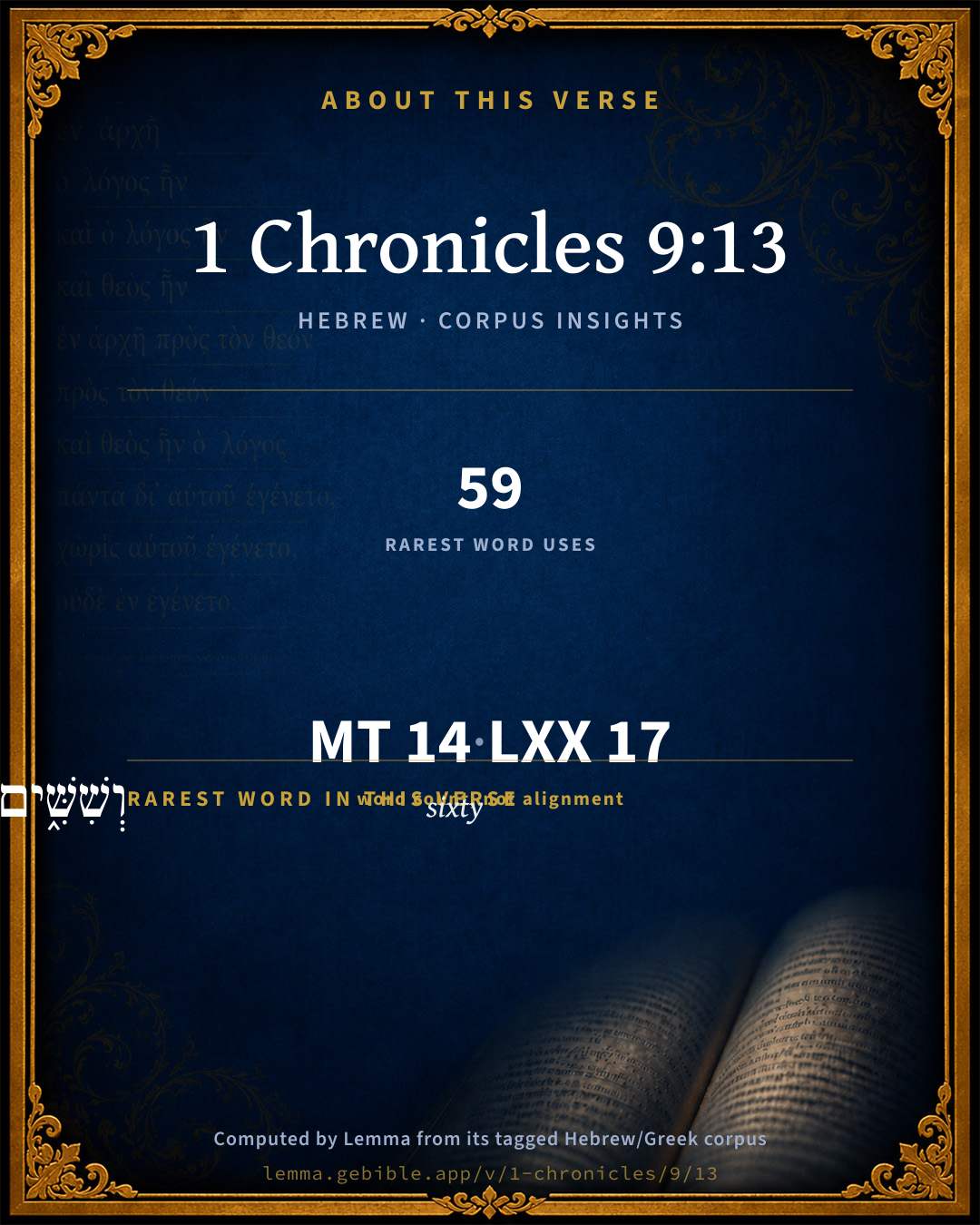
About this verse

These counts appear in no published source. They are computed here, from the morphology-tagged text and Lemma’s own curated glosses. What Lemma adds →

14
words
13
distinct lemmas
Historical
section

Shared distinctive vocabulary

וְשִׁשִּׁ֑ים sixty H8346 occurs in 56 verses of the Hebrew Bible. Also found in:

Grammatical profile

  • 9 nouns
  • 5 adjectives

Repetition

A word recurs within this verse — often emphatic in Hebrew:

  • לְבֵ֣ית house H1004 ×2

Hebrew & Septuagint length

In English translation the verse runs 27 words from the Hebrew and 26 from the Septuagint (LXX English) — closely comparable.

A rough comparison of the two English renderings, which tokenize alike — not a word-level alignment.

Word counts can differ between the Hebrew and the Greek without any difference in meaning — e.g. the Hebrew direct-object marker אֵת has no separate Greek word, and Greek often adds the article ὁ.

In the original languages it is 14 Hebrew tokens and 17 Greek tokens — but the two are counted differently (Hebrew bundles its prefixes and suffixes into one token; the Greek is in lemma form), so that isn’t a like-for-like length.

Cross-references

4

Topical passages linked to 1 Chronicles 9:13 in the Treasury of Scripture Knowledge — connected by theme and wording, ordered by reader-vote popularity; previews shown in the World English Bible.

  • 1 Chronicles 26:6 Also to Shemaiah his son were sons born, who ruled over the house of their father; for they were mighty men of valor.
  • 1 Chronicles 26:30 Of the Hebronites, Hashabiah and his brothers, men of valor, one thousand seven hundred, had the oversight of Israel beyond the Jordan westward, for all the business of Yahweh, and for the service of the king.
  • 1 Chronicles 26:32 His brothers, men of valor, were two thousand seven hundred, heads of fathers' [houses], whom king David made overseers over the Reubenites, and the Gadites, and the half-tribe of the Manassites, for every matter pertaining to God, and for the affairs of the king.
  • Nehemiah 11:14 and their brothers, mighty men of valor, one hundred twenty-eight; and their overseer was Zabdiel, the son of Haggedolim.

Cross-references courtesy of OpenBible.info (CC BY 4.0).

Hebrew and Greek witnesses Masoretic Hebrew ↔ Greek Septuagint

The same verse in the two great witnesses to the Old Testament, shown verse-for-verse.

These are two independent witnesses, not word-aligned to each other, and the Septuagint is shown in lemma (dictionary) form.

Hebrew 1 Chronicles 9:13 Masoretic · Westminster Leningrad Codex

וַאֲחֵיהֶ֗ם רָאשִׁים֙ לְבֵ֣ית אֲבוֹתָ֔ם אֶ֕לֶף וּשְׁבַ֥ע מֵא֖וֹת וְשִׁשִּׁ֑ים גִּבּ֣וֹרֵי חֵ֔יל מְלֶ֖אכֶת עֲבוֹדַ֥ת בֵּית הָאֱלֹהִֽים

and their brothers, heads of their fathers' houses, one thousand seven hundred sixty; very able men for the work of the service of the house of God.

World English Bible · Public Domain

Greek LXX 1 Chronicles 9:13 Septuagint · lemma form

καί ἀδελφός αὐτός ἄρχων οἶκος πατριά χίλιοι ἑπτακόσιοι ἑξήκοντα ἰσχυρός δύναμις εἰς ἐργασία λειτουργία οἶκος ὁ θεός

and their brethren, chiefs of their families, a thousand seven hundred and sixty, mighty men for the work of the ministration of the house of God.

LXX2012 (modern English Septuagint) · Public Domain

Hebrew: Westminster Leningrad Codex (CC BY 4.0). Greek: Septuagint (public domain); English from LXX2012 (modern English Septuagint) (Public Domain). How the Septuagint differs from the Hebrew →

Commentary

Notes on 1 Chronicles 9:13 from classic Christian and Jewish commentators (each source and its license shown beneath its notes). The classic Christian expositions comment on the surrounding passage and are grouped to its opening verse, so a note may address several verses; the Jewish commentaries on the Tanakh (Rashi and others) are per-verse, so they appear only where the commentator wrote on this verse.

Lemma curates 59 commentaries, every one of them public domain or Creative Commons licensed, each selected and text-cleaned for this edition rather than reprinted as found. About our sources →

Trapp's Complete Commentary

John Trapp

1Ch 9:13 And their brethren, heads of the house of their fathers, a thousand and seven hundred and threescore; very able men for the work of the service of the house of God.

Ver. 13. For the work of the service.] Or, Men of work for the service, &c., that is, able and apt for the work.

John Trapp, A Commentary or Exposition upon All the Books of the Old and New Testament (1647–1656) — public domain. Text from a community e-Sword module.

The Biblical Illustrator

Joseph S. Exell

1Ch_9:13

Very able men for the work of the service of the house of God.

Religious ability

We are not called to ecclesiastical statesmanship in this verse; we are called to the kind of work we can do best. There are very able doorkeepers, as well as very able preachers; there are very able administrators, as well as very able expositors: the one cannot do without the other. What we want in the house of God is ability--that is to say, faculty that can utilise all other men, penetrate into the meaning of all passing events, and tell exactly when work is to be done and when it is not to he attempted. Many are willing who are not able; many are able in nine particulars but fail in the tenth. Sometimes a whole number of talents is thrust away, because one talent--the talent of using the others--is wanting. (J. Parker, D. D.)

Obstructive forces

The era to which the statements of the text belong was, like every other era of the militant people of God, one that required men of ability--and it had them. In close connection with these statements, we read of them that they were men that had understanding of the times, to know what Israel ought to do; that they could order the battle array; that they were mighty men of valour, whose faces were like the faces of lions, and were as swift as the toes upon the mountains; and their deeds of personal prowess are stated in detail, showing that they were men of heroic blood and daring and achievement. Brawn and brain and blood stood in good stead in those ages of war and conquest, when the cleavage of swords and the thrust of spears and the might of muscle determined victory. Yet more than even this, does the Cause, in our day, call for. It calls, with profound beseeching, for the faith and the devotion of the majority, nay, of the whole body, of all who love it and love its Lord. After the battle of Solferino, one of the worlds decisive conflicts, when the line of battle extended for fifteen miles, Victor Emanuel concluded his order of the day in these words: Soldiers! in former battles I have often had occasion to mention the names of many among you in the order of the day; this time I put the whole army on the order of the day! The personal daring and deeds of every man made that battle the most memorable in modern warfare. When our Victor Emanuel can put the whole army in the order of the day the staid and suffering kingdom will come to victory. In our day there are patent obstructive forces to this end.

I. In the first place, we may notice that there is much unconsecrated ability which is due to Christ, but which is withheld from Him. His cause, as we have said, is committed to human instrumentality. He retains His own Divine efficiency in it, but He permits men to advance or to hinder it. Ordinarily, the power of the Church, in a given community, is in the ratio of the human influence and character which are allied to it. If the popular sentiment is decidedly in its favour, if the men and women who are able, intellectually, socially, pecuniarily, are unequivocally and spiritually Christian, the Church is easily progressive and controlling. But if the social leaders are divided in sentiment, and if the two parties are about equal in standing, in intelligence, in business and professional ability and in property, the kingdom is loaded with a serious disadvantage. Men form their opinions under the lead of other men. Social influence is powerful. The young look up to their seniors, to those who have had experience in affairs. The multitude are not independent thinkers and actors. And so, in this state of things, religion contends with odds against it. But human nature is not, of itself, in favour of religion. Human nature is not only unsanctified, but it is depraved. Men run downward naturally. So long as a moiety of those who have influence in the community are arrayed against personal religion, are even not practically and personally in its favour, the drift will be largely away from it. Religion needs the combined influence and example of all worthy people. Those who decline such support oppose an obstructive force to the progress and sway of the kingdom.

II. Not only have we a great amount of this concentrated ability, but that ability which is nominally consecrated to Christ is to a large extent inefficient. If the Church, such as it is in numbers, in ability, in social standing, were a compact, disciplined, working, spiritual force; if they were individually and collectively, able men for the service of the house of God, there would be the certainty of victory. But plainly it is not so. The nominal body of Christ, taken as a whole, cannot be relied on. The battle array shows a long, thin line, and therefore a weak one. We may take any department of our Christian work, and the report will be the same from each and all. Even public worship has scant attendance. If we should take our measure by the systematic endeavour of the Church to evangelise the parish, the showing, in the aggregate, would be no better. Now this inefficiency of great Churches, strong in numbers and character and resources, is an obstructive force to the progress end acceptance of real religion: it has a depressing influence on the Christian body and a repulsive effect on the world. We can readily see how different the popular impression would be were the whole Church engaged, with interest, with devotion, with the fervour of a passion, in its Christian enterprises. We are well aware that there are able and consecrated men and women who are faithful. The hope of the kingdom is in them: but the burdens of the kingdom are well-nigh insupportable by them. They need support; they need to-day the efficient aid of all those who are nominally consecrated to Christ. There is still another obstructive force.

III. We have to contend with misdirected ability. It may be consecrated and efficient, but it is unwisely used. It is of the guerilla order: Self-constituted, or constituted by the call of a single individual; not according to the general law. It consists in its disconnection with the army; it is irregular as to permanence. The semi-secular cause which they have espoused is made supreme. For that public worship is abandoned. The holy sacraments are supplanted by it. The devotional services of the Church are obliged to give way before gatherings for it. Devotion to Christ ranks lower than devotion to the cause. Now, what the Church needs for its efficiency, and what the world needs for its salvation, is the right use of all the misdirected ability of the workers. They should be called in from their petty guerilla undertakings to co-operation with the combined and disciplined army. No obstructive force should hinder the great work or postpone its final triumph. The effort that is now wasted is enough to give success to the one cause. The zeal spent in predatory excursions would insure victory to the Lords host.

IV. Further, in obstructive force is the influence of inconsistency. The Christian profession is of a strict order. Christian character is definitely marked. Disciples of Christ are separate from sinners. They belong to another kingdom. They should stand in their right and righteousness. They should command the respect and confidence of all other men. They should surround Christ as nobles surround their king. (B. Hart.)

The Biblical Illustrator, edited by Joseph S. Exell (c. 1880s–1900s) — public domain. Text from a community e-Sword module.

Joseph Benson's Commentary

1Ch 9:13. Able men — Hebrew, mighty men of valour; which is here mentioned as an excellent qualification for their place; because the priests might meet with great opposition in the discharge of their office, in the execution of the censures upon all impure persons without exception, and in preserving sacred things from violation by the touch of forbidden hands.

Joseph Benson's Commentary on the Old and New Testaments (1811–1818) — public domain. Text from a community e-Sword module.

Geneva Bible (1599)

Geneva Bible translators

To serve in the Temple, every one according to his office.

Geneva Bible (1599) marginal notes — public domain. Text via Bolls.life.

Adam Clarke's Commentary

Verse 13. And their brethren] What a prodigious number of ecclesiastics to perform the Divine service of one temple! no less than one thousand seven hundred and eighty able-bodied men! and this number is reckoned independently of the two hundred and twelve porters who served at the gates of the house of the Lord, 1Ch 9:22.

Adam Clarke's Commentary on the Bible (1810–1826) — public domain. Text from a community e-Sword/MySword module.

Ellicott's Commentary for English Readers

(13) And their brethren, heads of the house of their fathers.—We can hardly suppose so many as 1,760 priestly clans dwelling in the holy city. Either the phrase “heads of their father-houses” belongs to the last verse, and has been accidentally brought into its present position; or in this instance it means simply “heads of single families;” or “their brethren, heads of their (respective) clans,” refers to other father-houses not mentioned by name, and the number 1,760 refers to all the guilds and clans of 1Ch_9:10-13, and should be separated from the preceding phrase by a semicolon. This last explanation is probably right. The total number given in Neh_11:10-14 for the priests is 1,192. (See Note on 1Ch_9:9.)

Very able men.—See Margin, and 1Ch_7:9.

For the work.—“For” is wanting in the Hebrew. Perhaps “doers of” (Neh_11:13) has Mien out.

A Bible Commentary for English Readers, edited by Charles John Ellicott (1878–1897) — public domain. Text from a community e-Sword module.

The Cambridge Bible for Schools and Colleges

gen. ed. J. J. S. Perowne

13. heads of the house of their fathers] R.V. heads of their fathers’ houses.

a thousand and seven hundred and threescore] Only the five ‘courses’ of priests mentioned above (viz., Jedaiah, Jehoiarib, and Jachin, 1Ch_9:10, and Malchijah and Immer, 1Ch_9:12) seem to be included in this reckoning. Some commentators however regard Azariah (= Seraiah) in 1Ch_9:11 as the name of a new course, which after the Exile took the place of one of the old courses reckoned in 1Ch_24:7-18. If this be right we have here the sum of six courses.

In Neh_11:12-14 the number of the priests is given on a different plan; eight hundred and twenty-two “did the work of the house”; two hundred and forty-two were “chiefs of fathers’ houses”; an hundred and twenty-eight were “mighty men of valour.” The total falls far short of the thousand and seven hundred and threescore of Chron. We have not sufficient data on which to base any attempt at reconciling the two totals.

very able men] Render, mighty men of valour. The Heb. is the same as in Neh_11:14. Cp. 2Ch_26:17.

The Cambridge Bible for Schools and Colleges (gen. ed. J. J. S. Perowne; Cambridge University Press, 1878–1918) — public domain. Text from a community e-Sword module.

John Gill's Exposition

And Bakbakkar, Heresh, and Galal, and Mattaniah,.... Four more of the chief of the Levites, the pedigree of the last of which is traced up by Micah and Zichri to Asaph, the singer in the times of David, a descendant of Gershon, the first son of Levi; the first of these is thought by Hillerus (t) to be the same with Bakbukiah, Neh 11:17.

(t) Onamastic. Sacr. p. 401, 548.

John Gill's Exposition of the Whole Bible (1746–1763) — public domain (CC PDM 1.0). Text via the HelloAO Bible API.

Matthew Poole's English Annotations

Very able men, Heb. mighty men of valour; which is here noted as an excellent qualification for their place; because the priests might meet with great opposition and difficulty in the faithful discharge of their office, in the execution of the censures upon all impure persons without exception, and in preserving sacred things from violation by the touch of forbidden hands; of which see an eminent instance in Azariah, 2Ch 26:17, &c.

Matthew Poole's English Annotations on the Holy Bible (1683–1685) — public domain. Text from a community e-Sword/MySword module.

The Pulpit Commentary

Very able men.

In this Book of Chronicles praise is accorded, not only to great warriors, but also to scholars and ministers of religion. In this passage priests are described in language which would seem more appropriate to soldiers. They are termed "mighty men of valour," or valiant heroes, paraphrased in our version as "very able men" for the service of the house of the Lord. The employment of persons so highly qualified to render such service is very suggestive.

I GOD CAN MAKE USE OF THE FEEBLEST AND HUMBLEST INSTRUMENTS IN THE ACCOMPLISHMENT OF HIS PURPOSES. This should be remarked, lest any persons should consider themselves disqualified from serving God because, in their own judgment, not justly worthy to be termed "very able" or effective labourers.

II NO ABILITY IS TOO GOOD, OR EVEN GOOD ENOUGH, FOR GOD"S SERVICE. If responsible posts, influential professions, call for the services of men highly endowed and thoroughly furnished, shall we say that anything is good enough for the work of God? Remembering the honour of serving him, the difficulties peculiar to his service, let us rather seek to offer to him the best. There is abundant scope for intellectual vigour, mental acquisitions, tender sympathy, unsparing labours, and all other precious gifts, in the service of our redeeming God.

III Therefore, THE STRONG AND GIFTED SHOULD BE ESPECIALLY SUMMONED TO ENTER UPON THE WORK OF CHRIST; to come up "to the help of the Lord against the mighty." There is room for others; there is room for all; why not for such? If the temple ministrations offered scope for "very able men," what need is there for wise master-builders, capable pastors, stout-hearted labourers, valiant soldiers, in the work which is dear to the heart of God, and which has been commenced by the grace of the Divine Redeemer! To one and to all we would say, "The Lord has need of you. T.

Strong for God"s service.

Of certain men, otherwise unknown, this is the permanent historical record, "They were very able men for the work of the service of the house of God. " It is a description full of interest, and reminds us that

I GOD GIVES TO MEN THE NEEDED GIFTS FOR HIS WORK. For all his work in the world; but here we are specially reminded of his work in the Church and in Divine service. In older times we find Moses with the genius for order and rule, and Bezaleel with the genius for decoration, and Joshua with the genius for war, and David with the genius for song; and so on through each age we may go, marking the men endowed with gifts for pious services. Each apostle has his gift. Reformers, leaders, teachers, rise for their specific work in each age Augustine, Anselm, Bernard, Luther, Calvin, Pascal, Whitefield, etc. Ever and again God gives us "very able men for the work of the service of his house." And the greater and more prominent instances only affirm and assure the general truth that for all his work, be it greater or smaller in man"s esteem, God ever finds the men and endows with the gifts, and each may become, by the faithful culture of his gift, a "very able man" for God"s service. If he may he ought.

II THE GIFT IS OFTEN UNRECOGNIZED BY HIM WHO HAS IT. And so the Church loses much of the service she needs. Especially apply to the ministerial endowment. It is usually found associated with a modest and retiring disposition, and in self-diffidence many fail to believe in their own powers. And powers often lie dormant and unrecognized until circumstances of life secure their development. Men are often surprised by the discovery of hitherto unknown faculties. The men who push are seldom the men of real power. But the modesty of the highly endowed often prevents their gaining their due place and sphere. As an instance of unrecognized gifts, reference may be made to Dr. Guthrie, who, though so successful as a writer, only began to write for the press when he had reached middle life. We need a worthier apprehension of the truth that every renewed man is also an endowed man. In the light of it we may urge on each individual the duty of discovering his gift, and so cultivating and using it that he may prove a "very able man" for the work of the Lord. Exactly what Christ"s Church needs is "very able men," by endowment and culture, in all her departments of service; and we should have the faith that the endowments are given us, and we must secure the recognition and culture of them.

III THE CHURCH SHOULD DISCERN THE MEN WITH THE GIFTS. Compare the intense expression of Moses, "Would God that all the Lord"s people were prophets!" Sometimes jealousies of order and office blind our eyes so that we cannot see the gifts of others. Sometimes desire for the exclusive honour of place and work makes us wilfully put other men down. Sometimes the presentation of the gift informs which appear to us strange, leads to our making a false and unworthy estimate of the gift. The Church has often grievously erred in casting out from her midst "very able men for God"s service." They who watch for Divine endowments must be willing to recognize them in the great variety of forms in which they come to men. And all we really need to be assured of is the Divine stamp upon them. To refuse the men whom God has gifted is to be "found fighting against God.

Press the responsibility of all who are in Church offices which bring them into immediate contact with the people or the children. They should be ever looking for the "signs of power," and leading out those who may become "very able men for God"s work." And then press the responsibility that rests on the men who are found and proved strong, able for God"s work. Having "put their hand to the plough, they must not draw back." Life for them is full of noblest possibilities. They must be "faithful unto death," and win "the crown of life. R.T.

The Pulpit Commentary (1880–1919), ed. H.D.M. Spence-Jones & Joseph S. Exell — public domain. Text from a community e-Sword module.

John Wesley's Explanatory Notes

Able men - Hebrew. mighty men of valour: which is here noted as an excellent qualification for their place; because the priests might meet with great opposition in the discharge of their office, in the execution of the censures upon all impure persons without exception, and in preserving sacred things from violation by the touch of forbidden hands.

John Wesley, Explanatory Notes Upon the Whole Bible (1754–1765) — public domain. Text via the GEBible commentary corpus.

Keil & Delitzsch

C. F. Keil & F. Delitzsch

And Bakbakkar, Heresh, and Galal, and Mattaniah,.... Four more of the chief of the Levites, the pedigree of the last of which is traced up by Micah and Zichri to Asaph, the singer in the times of David, a descendant of Gershon, the first son of Levi; the first of these is thought by Hillerus (t) to be the same with Bakbukiah, Neh 11:17.

(t) Onamastic. Sacr. p. 401, 548.

Keil & Delitzsch — Biblical Commentary on the Old Testament (1861–1891) — public domain (CC PDM 1.0). Text via the HelloAO Bible API. (Old Testament only.)

Lesson kit

Teaching starters — assembled from the data on this page, not authored interpretation. Every prompt links to the verse data it draws on. Edit before teaching.

1 Chronicles, in the Historical, opens this verse with 14 words (13 distinct Hebrew lemmas). Its most distinctive word is shishshîym (“sixty”). A historical commentator’s framing appears above. Read the whole chapter for the surrounding context.

Discussion questions

  1. What does “sixty” (shishshîym) contribute to the verse as a whole?
  2. Genesis 5:15 shares the word «sixty» with this verse. How do the two illuminate each other?
  3. “house” occurs 2× in this one verse. What is the effect of the repetition?
  4. These translations render this verse differently; the difference is in the English rendering, not the original. What questions does that raise?
  5. Reading how Trapp's Complete Commentary and The Biblical Illustrator read this verse, where do the two commentators agree and where do they part?

Things to notice

Reading settings

Reading text

Shown beneath each verse's original-language words.

Old Testament
Old Testament edition

Read the OT as the Masoretic Hebrew (MT) or the Greek Septuagint (LXX).

English shown for the Greek Septuagint (in the Hebrew ↔ Greek comparison).

Comparing translations? Open the Compare panel on any verse page to stack up to four side by side.