
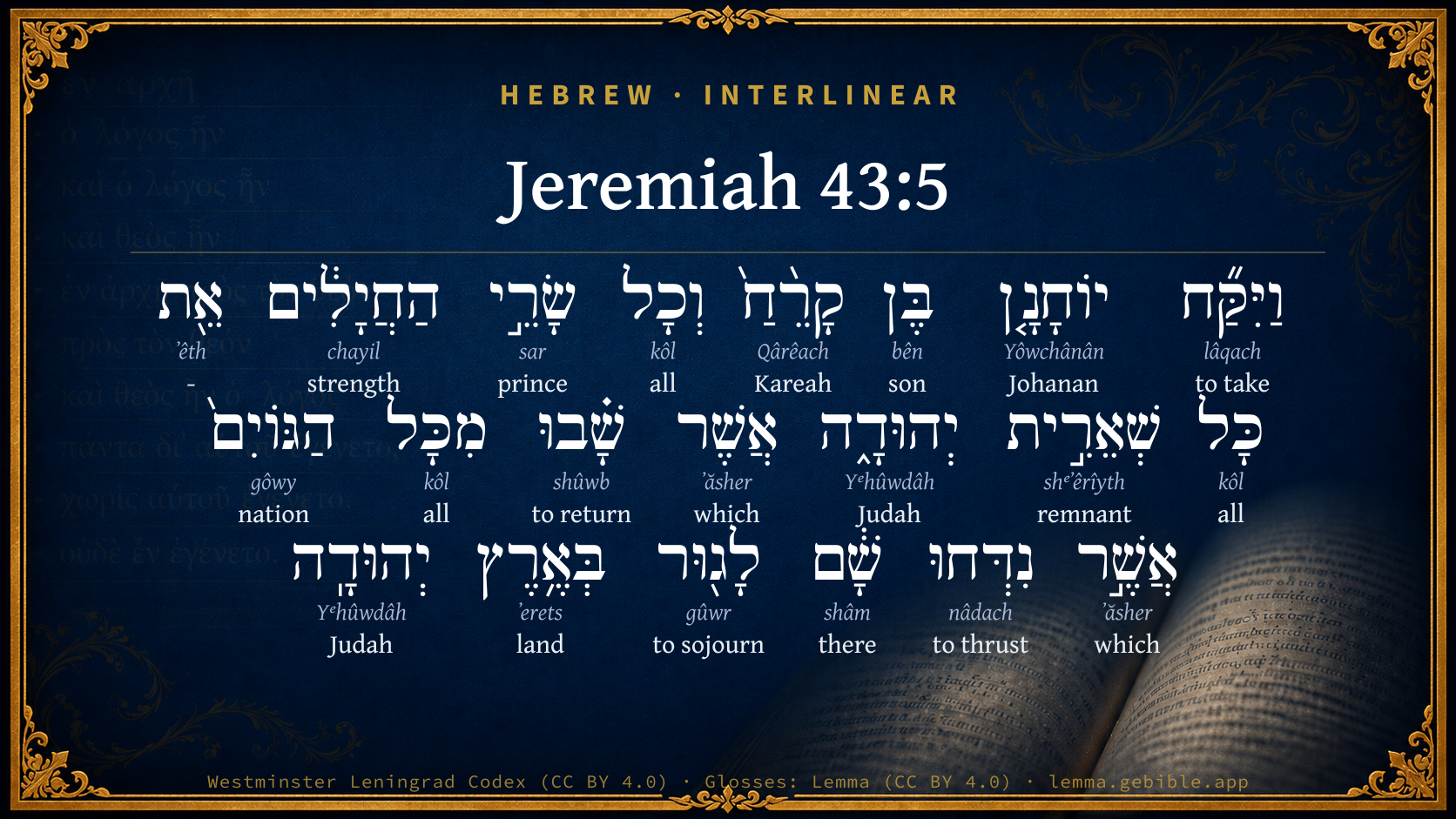
Jeremiah 43:5

Hebrew (Westminster Leningrad Codex) Jeremiah 43:5 appears in the Hebrew Old Testament. The text above is from the Westminster Leningrad Codex. Each word links to its Strong’s number, a concise gloss, and parsing drawn from the Open Scriptures Hebrew Bible morphology. Click any word for its full Brown-Driver-Briggs (BDB) entry.
Download image
Cite this verse

Jeremiah 43:5 (World English Bible). Public Domain. Lemma interlinear Bible study tool, https://lemma.gebible.app/v/jeremiah/43/5.

Show BibTeX & RIS
BibTeX
RIS
English Translation
But Johanan the son of Kareah, and all the captains of the forces, took all the remnant of Judah, who were returned from all the nations where they had been driven, to sojourn in the land of Judah;
World English Bible · Public Domain
Download a study sheet

One document with this verse’s original text, its word-by-word gloss line, the meaning frame, cross-references with their text, attributed commentary, and full source and license credits — printable, and it pastes into notes with its structure intact.

This verse Autodidact and up

Study sheet (.html) Plain text (.txt)

A passage Seminary Student

Up to 50 verses in one chapter. A passage sheet keeps up to 6 commentary sources and 12 cross-references per verse, in the order this page ranks them, and says so on the sheet whenever that leaves anything out. Ask for a single verse and you get the Autodidact verse sheet above.

Everything on this page stays free to read, with no account — the sheet is a download of what is already on screen, not access to it.

Want to remove ads? Support Godless Engineer
Compare translations 3

The same verse in 3 English versions, stacked beneath the original-language interlinear above. Click any original word for its lexicon entry.

Each is an independent rendering of the whole verse — the interlinear is not word-aligned to these translations.

Highlighted words mark where these versions differ — a whole-verse word diff, not a word-by-word alignment.

  • World English Bible Public Domain
    But Johanan the son of Kareah, and all the captains of the forces, took all the remnant of Judah, who were returned from all the nations where they had been driven, to sojourn in the land of Judah;
  • King James Version Public Domain
    But Johanan the son of Kareah, and all the captains of the forces, took all the remnant of Judah, that were returned from all nations, whither they had been driven, to dwell in the land of Judah;
  • unfoldingWord Literal Text CC BY-SA 4.0
    Johanan son of Kareah and all the army commanders took away all the remnant of Judah who had returned from all the nations where they had been scattered to live in the land of Judah.

unfoldingWord Literal Text — © unfoldingWord, licensed CC BY-SA 4.0. Word-aligned USFM3 via Door43 (git.door43.org/unfoldingWord/en_ult).

Versions to compare (up to 4)

3 of 4 selected

Show all 18 translations

Every available English version of this verse, each an independent rendering of the whole verse.

  • World English Bible Public Domain
    But Johanan the son of Kareah, and all the captains of the forces, took all the remnant of Judah, who were returned from all the nations where they had been driven, to sojourn in the land of Judah;
  • Berean Standard Bible Public Domain
    Instead, Johanan son of Kareah and all the commanders of the forces took the whole remnant of Judah, those who had returned to the land of Judah from all the nations to which they had been scattered,
  • Majority Standard Bible Public Domain
    Instead, Johanan son of Kareah and all the commanders of the forces took the whole remnant of Judah, those who had returned to the land of Judah from all the nations to which they had been scattered,
  • King James Version Public Domain
    But Johanan the son of Kareah, and all the captains of the forces, took all the remnant of Judah, that were returned from all nations, whither they had been driven, to dwell in the land of Judah;
  • American Standard Version (1901) Public Domain
    But Johanan the son of Kareah, and all the captains of the forces, took all the remnant of Judah, that were returned from all the nations whither they had been driven, to sojourn in the land of Judah;
  • Revised Version (1885) Public Domain
    But Johanan the son of Kareah, and all the captains of the forces, took all the remnant of Judah, that were returned from all the nations whither they had been driven to sojourn in the land of Judah;
  • Geneva Bible (1599) Public Domain
    But Iohanan the sonne of Kareah, and all the captaines of the hoste tooke all the remnant of Iudah, that were returned from al nations, whither they had bene driuen, to dwel in ye land of Iudah:
  • Douay-Rheims (1899) Public Domain
    But Johanan the son of Caree, and all the captains of the soldiers took all the remnant of Juda, that were returned out of all nations, to which they had before been scattered, to dwell in the land of Juda:
  • Young's Literal Translation Public Domain
    and Johanan son of Kareah, and all the heads of the forces, take all the remnant of Judah who have turned from all the nations whither they were driven to sojourn in the land of Judah,
  • Literal Standard Version CC BY-SA 4.0
    and Johanan son of Kareah, and all the heads of the forces, take all the remnant of Judah who have turned from all the nations to where they were driven to sojourn in the land of Judah,
  • Unlocked Literal Bible CC BY-SA 4.0
    Johanan son of Kareah and all the army commanders took away all the remnant of Judah who had returned from all the nations where they had been scattered to live in the land of Judah.
  • unfoldingWord Literal Text CC BY-SA 4.0
    Johanan son of Kareah and all the army commanders took away all the remnant of Judah who had returned from all the nations where they had been scattered to live in the land of Judah.
  • Darby Bible Public Domain
    but Johanan the son of Kareah, and all the captains of the forces, took all the remnant of Judah, that were returned from all nations whither they had been driven, to sojourn in the land of Judah;
  • World Messianic Bible Public Domain
    But Yochanan the son of Kareah and all the captains of the forces took all the remnant of Judah, who had returned from all the nations where they had been driven, to live in the land of Judah—
  • Webster's Bible Public Domain
    But Johanan the son of Kareah, and all the captains of the forces, took all the remnant of Judah, that had returned from all nations, whither they had been driven, to dwell in the land of Judah;
  • Free Bible Version CC BY-SA 4.0
    Instead, Johanan son of Kareah and all the army commanders took with them all who were left of the people of Judah, those who had returned to the country from all the nations where they had been scattered.
  • Bible in Basic English Public Domain
    But Johanan, the son of Kareah, and all the captains of the forces took all the rest of Judah who had come back into the land of Judah from all the nations where they had been forced to go;
  • JPS Tanakh (1917) Public Domain
    But Johanan the son of Kareah, and all the captains of the forces, took all the remnant of Judah, that were returned from all the nations whither they had been driven to sojourn in the land of Judah:

Literal Standard Version (2020), Covenant Press — licensed CC BY-SA 4.0. Text via the HelloAO Bible API (eBible.org). Unlocked Literal Bible (unfoldingWord) — licensed CC BY-SA 4.0. Text via the HelloAO Bible API (eBible.org). unfoldingWord Literal Text — © unfoldingWord, licensed CC BY-SA 4.0. Word-aligned USFM3 via Door43 (git.door43.org/unfoldingWord/en_ult). Free Bible Version, Dr. Jonathan Gallagher — licensed CC BY-SA 4.0. Text via the HelloAO Bible API (eBible.org).

Word by word

More ways to search: Search by grammar → Find every occurrence → Compare this word →

Practice this passage: Drill this verse → Learn its vocabulary →

קָרֵ֨חַ֙
Qârêach
H7143
“Kareah”
Noun, Proper
Part of Speech
Noun
Type
Proper
Full BDB Definition

Origin: from H7139

TWOT: None

Kareah = "bald" - father of Johanan and Jonathan who supported Gedaliah's authority and avenged his murder
  1. וַיִּקַּ֞ח lâqach H3947 “and · to take” Conjunction + Verb, Qal, Sequential Imperfect, 3rd Person, Masculine, Singular
  2. יוֹחָנָ֤ן Yôwchânân H3110 “Johanan” Noun, Proper
  3. בֶּן bên H1121 “son of” Noun, Common, Masculine, Singular, Construct
  4. וְכָל kôl H3605 “and · all of” Conjunction + Noun, Common, Masculine, Singular, Construct
  5. שָׂרֵ֣י sar H8269 “princes of” Noun, Common, Masculine, Plural, Construct
  6. הַחֲיָלִ֔ים chayil H2428 “the · forces” Particle, Definite Article + Noun, Common, Masculine, Plural, Absolute
  7. אֵ֖ת ʼêth H853 “-” Particle, Direct Object
  8. כָּל kôl H3605 “all of” Noun, Common, Masculine, Singular, Construct
  9. שְׁאֵרִ֣ית shᵉʼêrîyth H7611 “remnant of” Noun, Common, Feminine, Singular, Construct
  10. יְהוּדָ֑ה Yᵉhûwdâh H3063 “Judah” Noun, Proper
  11. אֲשֶׁר ʼăsher H834 “which” Particle, Relative
  12. שָׁ֗בוּ shûwb H7725 “to return” Verb, Qal, Perfect, 3rd Person, Common, Plural
  13. מִכָּל kôl H3605 “from · all of” Preposition + Noun, Common, Masculine, Singular, Construct
  14. הַגּוֹיִם֙ gôwy H1471 “the · nations” Particle, Definite Article + Noun, Common, Masculine, Plural, Absolute
  15. אֲשֶׁ֣ר ʼăsher H834 “which” Particle, Relative
  16. נִדְּחוּ nâdach H5080 “to thrust” Verb, Niphal, Perfect, 3rd Person, Common, Plural
  17. שָׁ֔ם shâm H8033 “there” Adverb
  18. לָג֖וּר gûwr H1481 “to sojourn” Preposition + Verb, Qal, Infinitive Construct
  19. בְּאֶ֥רֶץ ʼerets H776 “in/at · land of” Preposition + Noun, Common, Both, Singular, Construct
  20. יְהוּדָֽה Yᵉhûwdâh H3063 “Judah” Noun, Proper

About this verse

These counts appear in no published source. They are computed here, from the morphology-tagged text and Lemma’s own curated glosses. What Lemma adds →

21
words
17
distinct lemmas
Prophets
section

Notable vocabulary

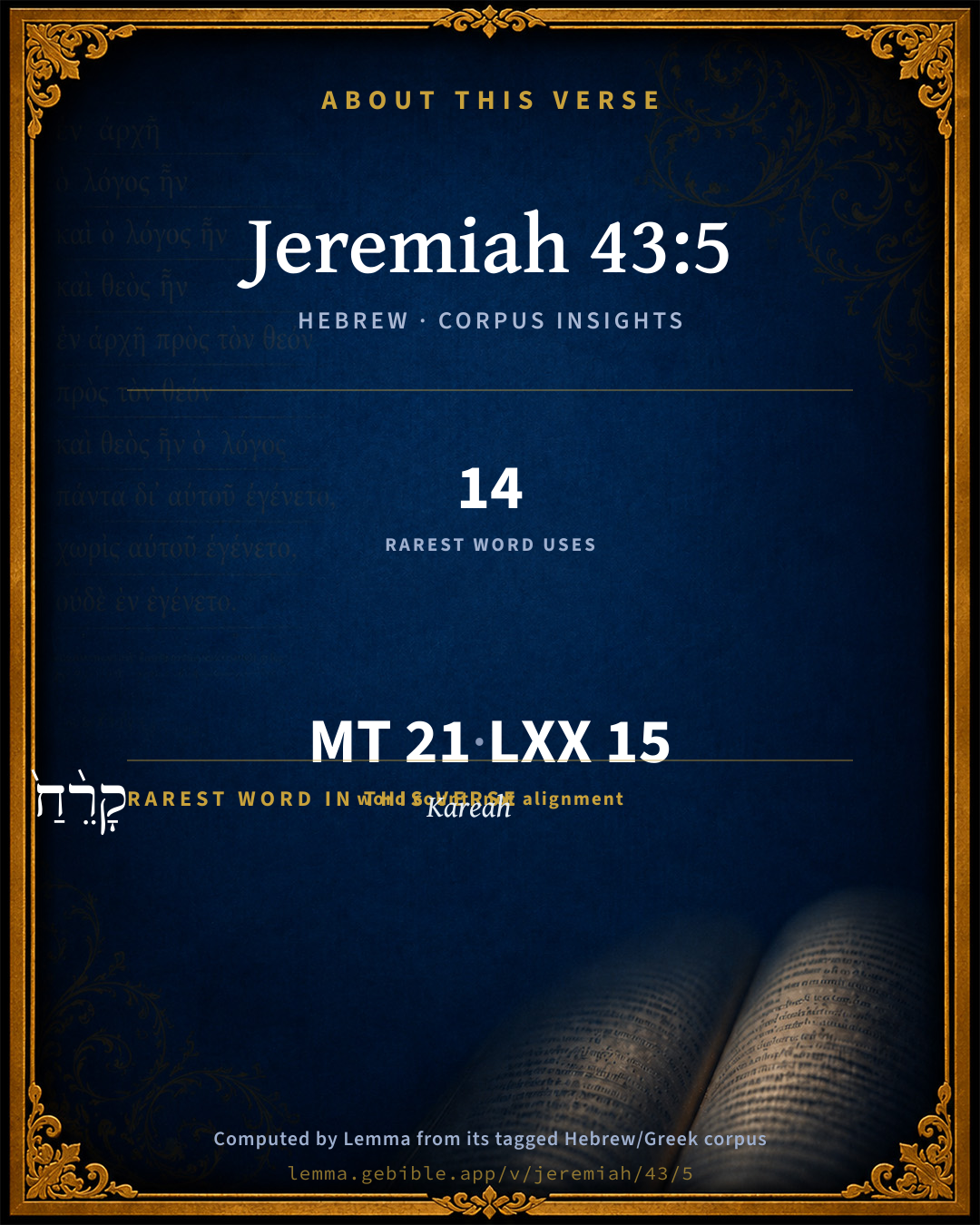
The rarest word here is קָרֵ֨חַ֙ Kareah H7143 — appearing just 14 times in the whole Hebrew Bible.

Shared distinctive vocabulary

קָרֵ֨חַ֙ Kareah H7143 occurs in 14 verses of the Hebrew Bible. Also found in:

Grammatical profile

  • 4 verbs
  • 13 nouns
  • 1 adverb
  • 3 particles

Verb forms

  • וַיִּקַּ֞ח Qal · Sequential Imperfect
  • שָׁ֗בוּ Qal · Perfect
  • נִדְּחוּ Niphal · Perfect
  • לָג֖וּר Qal · Infinitive Construct

Repetition

Words recur within this verse — often emphatic in Hebrew:

  • וְכָל all H3605 ×3
  • יְהוּדָ֑ה Judah H3063 ×2
  • אֲשֶׁר which H834 ×2

Hebrew & Septuagint length

In the original languages it is 21 Hebrew tokens and 15 Greek tokens — but the two are counted differently (Hebrew bundles its prefixes and suffixes into one token; the Greek is in lemma form), so that isn’t a like-for-like length.

Cross-references

3

Topical passages linked to Jeremiah 43:5 in the Treasury of Scripture Knowledge — connected by theme and wording, ordered by reader-vote popularity; previews shown in the World English Bible.

  • Jeremiah 40:11–12 Likewise when all the Jews who were in Moab, and among the children of Ammon, and in Edom, and who were in all the countries, heard that the king of Babylon had left a remnant of Judah, and that he had set over them Gedaliah the son of Ahikam, the son of Shaphan;
  • 1 Samuel 26:19 Now therefore, please let my lord the king hear the words of his servant. If it be Yahweh that has stirred you up against me, let him accept an offering: but if it be the children of men, cursed be they before Yahweh: for they have driven me out this day that I shouldn't cling to Yahweh's inheritance, saying, Go, serve other gods.
  • Jeremiah 41:15–16 But Ishmael the son of Nethaniah escaped from Johanan with eight men, and went to the children of Ammon.

Cross-references courtesy of OpenBible.info (CC BY 4.0).

Hebrew and Greek witnesses Masoretic Hebrew ↔ Greek Septuagint

The same verse in the two great witnesses to the Old Testament, shown verse-for-verse.

These are two independent witnesses, not word-aligned to each other, and the Septuagint is shown in lemma (dictionary) form.

Hebrew Jeremiah 43:5 Masoretic · Westminster Leningrad Codex

וַיִּקַּ֞ח יוֹחָנָ֤ן בֶּן קָרֵ֨חַ֙ וְכָל שָׂרֵ֣י הַחֲיָלִ֔ים אֵ֖ת כָּל שְׁאֵרִ֣ית יְהוּדָ֑ה אֲשֶׁר שָׁ֗בוּ מִכָּל הַגּוֹיִם֙ אֲשֶׁ֣ר נִדְּחוּ שָׁ֔ם לָג֖וּר בְּאֶ֥רֶץ יְהוּדָֽה

But Johanan the son of Kareah, and all the captains of the forces, took all the remnant of Judah, who were returned from all the nations where they had been driven, to sojourn in the land of Judah;

World English Bible · Public Domain

Greek LXX Structure differs

In the Septuagint, Jeremiah is about an eighth shorter than the Hebrew and arranges its material differently — the Oracles Against the Nations (Hebrew chapters 46–51) appear in the middle of the Greek book, after 25:13. Because the chapter and verse boundaries do not line up, a verse-for-verse comparison with the Hebrew is not shown.

A verse-for-verse comparison isn’t shown here because the chapters and verses don’t line up. Switch to the LXX edition with the MT / LXX toggle above to read the Greek directly.

Hebrew: Westminster Leningrad Codex (CC BY 4.0). Greek: Septuagint (public domain); English from a public-domain English Septuagint. How the Septuagint differs from the Hebrew →

Targum (Aramaic paraphrase)

1

The Targum is the ancient Jewish Aramaic paraphrase of the Hebrew Scriptures — an interpretive translation, not the Hebrew text itself. Onkelos (literal) and Pseudo-Jonathan (expansive) render the Torah, and Jonathan the Prophets. Coverage is partial: where no permissively-licensed English translation exists for a verse, only the Aramaic is shown. This is verse-level text, not a word-by-word alignment to the Hebrew.

  1. Targum Jonathan Prophets (Joshua–Malachi)
    וּדְבַר יוֹחָנָן בַּר קָרֵחַ וְכָל רַבָּנֵי חֵילְוָתָא יַת כָּל שְׁאָרָא דְבֵית יְהוּדָה דְתָבוּ מִכָּל עַמְמַיָא דְאִתְבַּדָרוּ לְתַמָן לְאִתּוֹתָבָא בְּאַרְעָא דְבֵית יְהוּדָה:

    (no public-domain English translation for this verse)

    Targum Jonathan — Aramaic: “Mikraot Gedolot” (public domain). English: “Sefaria Community Translation” (CC0 1.0 (public-domain dedication)); “London "Chaldee Paraphrase," 1871” (public domain). Text via Sefaria.

Commentary

Notes on Jeremiah 43:5 from classic Christian and Jewish commentators (each source and its license shown beneath its notes). The classic Christian expositions comment on the surrounding passage and are grouped to its opening verse, so a note may address several verses; the Jewish commentaries on the Tanakh (Rashi and others) are per-verse, so they appear only where the commentator wrote on this verse.

Lemma curates 59 commentaries, every one of them public domain or Creative Commons licensed, each selected and text-cleaned for this edition rather than reprinted as found. About our sources →

Trapp's Complete Commentary

John Trapp

Jer 43:5 But Johanan the son of Kareah, and all the captains of the forces, took all the remnant of Judah, that were returned from all nations, whither they had been driven, to dwell in the land of Judah;

Ver. 5. But Johanan … took all the remnant of Judah.] Whose preservation had been but a reservation to further mischief, a just punishment of their incorrigibleness.

John Trapp, A Commentary or Exposition upon All the Books of the Old and New Testament (1647–1656) — public domain. Text from a community e-Sword module.

Geneva Bible (1599)

Geneva Bible translators

As from the Moabites, Ammonites, and Edomites, Jer. 40:11.

Geneva Bible (1599) marginal notes — public domain. Text via Bolls.life.

Jamieson, Fausset & Brown

Robert Jamieson, A. R. Fausset & David Brown

remnant . . . returned from all nations-- (Jer 40:11-12).

Jamieson, Fausset & Brown — Commentary Critical and Explanatory on the Whole Bible (1871) — public domain (CC PDM 1.0). Text via the HelloAO Bible API.

John Calvin's Commentaries

The Prophet now gives us a narrative of what he had briefly touched upon. He then says that John and the rest of the leaders took the remnant of the people, who were there alive, and those who had returned from various countries; for many had become fugitives among the Moabites and the Idumeans, when they saw the city surrounded by the forces of King Nebuchadnezzar. Then they fled here and there, as it usually happens, and waited for the issue of the war. But after Nebuchadnezzar had departed, and a permission had been given to Gedaliah to collect what remained of the people and to place them in cities and towns, many returned into the land, now desolate; for they had dwelt with aliens, and had been miserably treated. As then they could not settle out of their own land nor find any quiet habitation, they returned, as it is usual with men reduced to want, who have no settled dwelling. They then returned, that they might live under the protection of Gedaliah.

Now the Prophet says, that they were taken by John and brought into. Egypt. This then was the way in which they shewed their obstinacy. We hence see how audacious must these leaders have been, that they hesitated not to go into Egypt, though it was shewn to be a fatal step. There was not indeed at that time any army of Nebuchadnezzar in Judea, though his vengeance might have been dreaded. And then, having fled to: Egypt, they might have been ill-treated there, and not hospitably received.: But we hence perceive, that when men once shake off the yoke of God, they are hurried on by a diabolical madness, so that there is nothing insurmountable to them. Had they been asked whether they acted rightly, they might have raised a thousand arguments as excuses; but when they followed their own propensity, they in a manner, so to speak, leaped over the clouds. Impiety then is always full of rashness and audacity. But as we see that the ungodly thus rush headlong into ruin, even when God pronounces a curse on their counsels and proceedings, let us learn to take encouragement ever to obey God; for he promises a joyful and blessed issue at all times when we follow the ways pointed out by him. John then and the other leaders of the forces took the remnant of the people

And then he shews how little those exiles consulted their own good, who had returned to dwell in the land of Judea; for they might have still rested in safety among the nations who had in kindness received them; but in Egypt God soon executed his judgments on the natives as well as on strangers. But they deserved such a reward, because they preferred to obey the command of the perverse and obstinate, rather than to obey the voice of God speaking by his Prophet.

John Calvin's Commentaries (1540-1563) — public domain. Text from the Calvin Translation Society English edition (1840s-50s) via the Christian Classics Ethereal Library (ccel.org). Calvin's coverage is partial (roughly two-thirds of the Bible); uncommented books and verses are honest gaps, never fabricated. The 19th-century editor's footnotes and remarks are omitted so the notes are faithfully Calvin's own voice.

John Gill's Exposition

But Johanan the son of Kareah, and all the captains of the forces,.... Who were united in their resolution to go into Egypt, contrary to the declared will of God:

took all the remnant of Judah, that were returned from all nations whither they had been driven, to dwell in the land of Judah; both such who were left in the land, when the rest were carried captive into Babylon, more particularly mentioned in Jer 43:6; and those, who upon the invasion of the land, and siege of Jerusalem, had fled to other countries, but now were returned from thence, in order to settle in it; having heard that a governor from among the Jews was appointed over it; as from Moab, Ammon, Edom, and other countries; see Jer 40:11; these, some of their own accord, others through persuasion, and others by force, went along with, or were taken and carried by the above captains into Egypt.

John Gill's Exposition of the Whole Bible (1746–1763) — public domain (CC PDM 1.0). Text via the HelloAO Bible API.

Albert Barnes' Notes on the Bible

All the remnant of Judah that were returned - In this way, the utter depopulation of the land was completed. Thus was fulfilled the predictions of Jer 24:8-10, and the sole hope of the nation now centered in the exiles at Babylon Jer 24:5-7.

Albert Barnes' Notes on the Bible (1834–1885) — public domain. Text from a community e-Sword/MySword module.

Matthew Poole's English Annotations

This resolution they presently put in practice. Though it is certain that Jeremiah and Baruch were not willing to go along with them, and probably that many of the people were not willing, yet these rebellious captains forced them all along with them, so as many of them were now a kind of prisoners to their own countrymen.

Matthew Poole's English Annotations on the Holy Bible (1683–1685) — public domain. Text from a community e-Sword/MySword module.

Whedon's Commentary on the Bible

Daniel D. Whedon

5. Remnant… returned from all nations — This language only describes the people in this company. It coming to be known that the administration of the Chaldeans was friendly and fostering, there was a tendency on the part of the people who had fled before the invading army and taken refuge among other peoples to return. Hence such a phrase as this of the text describes them much as “and all those who were still alive, having escaped the calamities of the time.”

Daniel D. Whedon (gen. ed.), Commentary on the Old and New Testaments (1874–1909) — public domain. Text from a community e-Sword module.

The Pulpit Commentary

All the remnant of Judah, that were returned from all nations. The specification is peculiar, as it seems to leave out of sight the most important part of the gathering at Mizpah, via. the "men, and women, and children, and those of the poor of the land" (Jer_40:7) the very persons who are mentioned just afterwards. Possibly there is some confusion in the text. "All nations" doubtless means especially Moab, Ammon, and Edom.

The Pulpit Commentary (1880–1919), ed. H.D.M. Spence-Jones & Joseph S. Exell — public domain. Text from a community e-Sword module.

Lesson kit

Teaching starters — assembled from the data on this page, not authored interpretation. Every prompt links to the verse data it draws on. Edit before teaching.

Jeremiah, in the Prophets, opens this verse with 21 words (17 distinct Hebrew lemmas). Its most distinctive word is Qârêach (“Kareah”). A historical commentator’s framing appears above. Read the whole chapter for the surrounding context.

Discussion questions

  1. The word Qârêach carries the sense “Kareah.” How does it shape the verse?
  2. How does 2 Kings 25:23, which shares the word «Kareah», read alongside this verse?
  3. What does the repetition of “all” (3× in this one verse) do in this verse?
  4. These translations render this verse differently; the difference is in the English rendering, not the original. What questions does that raise?
  5. «וַיִּקַּ֞ח» is a Qal Sequential Imperfect verb. How does that grammatical form shape the action described?
  6. Compare how Trapp's Complete Commentary and Geneva Bible (1599) read this verse. Where do they agree or differ?

Things to notice

Reading settings

Reading text

Shown beneath each verse's original-language words.

Old Testament
Old Testament edition

Read the OT as the Masoretic Hebrew (MT) or the Greek Septuagint (LXX).

English shown for the Greek Septuagint (in the Hebrew ↔ Greek comparison).

Comparing translations? Open the Compare panel on any verse page to stack up to four side by side.