
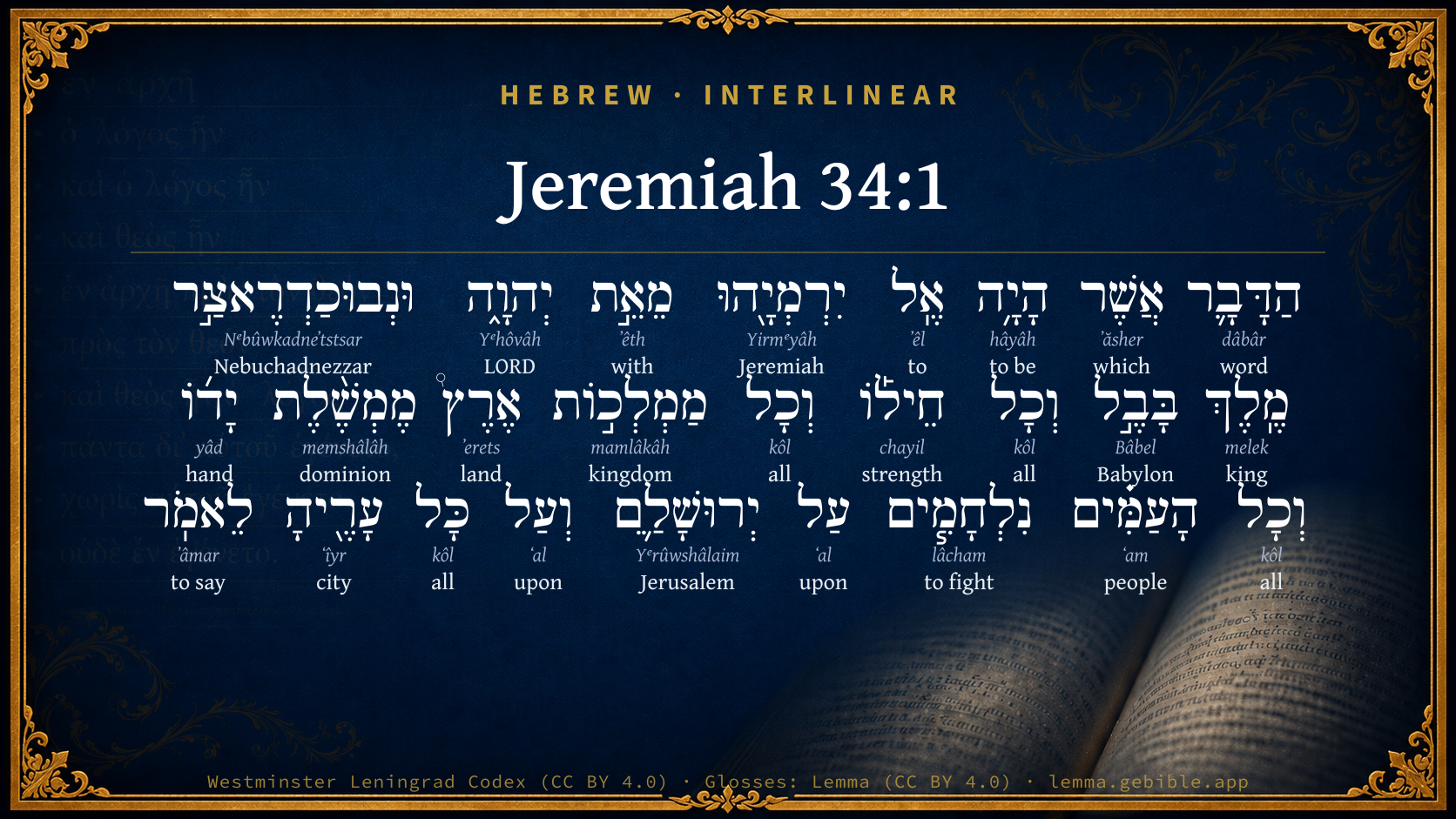
Jeremiah 34:1

Hebrew (Westminster Leningrad Codex) Jeremiah 34:1 appears in the Hebrew Old Testament. The text above is from the Westminster Leningrad Codex. Each word links to its Strong’s number, a concise gloss, and parsing drawn from the Open Scriptures Hebrew Bible morphology. Click any word for its full Brown-Driver-Briggs (BDB) entry.
Download image
Cite this verse

Jeremiah 34:1 (World English Bible). Public Domain. Lemma interlinear Bible study tool, https://lemma.gebible.app/v/jeremiah/34/1.

Show BibTeX & RIS
BibTeX
RIS
English Translation
The word which came to Jeremiah from Yahweh, when Nebuchadnezzar king of Babylon, and all his army, and all the kingdoms of the earth that were under his dominion, and all the peoples, were fighting against Jerusalem, and against all the cities of it, saying:
World English Bible · Public Domain
Download a study sheet

One document with this verse’s original text, its word-by-word gloss line, the meaning frame, cross-references with their text, attributed commentary, and full source and license credits — printable, and it pastes into notes with its structure intact.

This verse Autodidact and up

Study sheet (.html) Plain text (.txt)

A passage Seminary Student

Up to 50 verses in one chapter. A passage sheet keeps up to 6 commentary sources and 12 cross-references per verse, in the order this page ranks them, and says so on the sheet whenever that leaves anything out. Ask for a single verse and you get the Autodidact verse sheet above.

Everything on this page stays free to read, with no account — the sheet is a download of what is already on screen, not access to it.

Want to remove ads? Support Godless Engineer
Compare translations 3

The same verse in 3 English versions, stacked beneath the original-language interlinear above. Click any original word for its lexicon entry.

Each is an independent rendering of the whole verse — the interlinear is not word-aligned to these translations.

Highlighted words mark where these versions differ — a whole-verse word diff, not a word-by-word alignment.

  • World English Bible Public Domain
    The word which came to Jeremiah from Yahweh, when Nebuchadnezzar king of Babylon, and all his army, and all the kingdoms of the earth that were under his dominion, and all the peoples, were fighting against Jerusalem, and against all the cities of it, saying:
  • King James Version Public Domain
    The word which came unto Jeremiah from the LORD, when Nebuchadnezzar king of Babylon, and all his army, and all the kingdoms of the earth of his dominion, and all the people, fought against Jerusalem, and against all the cities thereof, saying,
  • unfoldingWord Literal Text CC BY-SA 4.0
    The word that came to Jeremiah from Yahweh, when Nebuchadnezzar king of Babylon and all of his army, together with all the kingdoms of the earth, the domains under his power, and all their people were waging war against Jerusalem and all of her cities, saying:

unfoldingWord Literal Text — © unfoldingWord, licensed CC BY-SA 4.0. Word-aligned USFM3 via Door43 (git.door43.org/unfoldingWord/en_ult).

Versions to compare (up to 4)

3 of 4 selected

Show all 18 translations

Every available English version of this verse, each an independent rendering of the whole verse.

  • World English Bible Public Domain
    The word which came to Jeremiah from Yahweh, when Nebuchadnezzar king of Babylon, and all his army, and all the kingdoms of the earth that were under his dominion, and all the peoples, were fighting against Jerusalem, and against all the cities of it, saying:
  • Berean Standard Bible Public Domain
    This is the word that came to Jeremiah from the LORD when Nebuchadnezzar king of Babylon, all his army, all the earthly kingdoms under his control, and all the other nations were fighting against Jerusalem and all its surrounding cities.
  • Majority Standard Bible Public Domain
    This is the word that came to Jeremiah from the LORD when Nebuchadnezzar king of Babylon, all his army, all the earthly kingdoms under his control, and all the other nations were fighting against Jerusalem and all its surrounding cities.
  • King James Version Public Domain
    The word which came unto Jeremiah from the LORD, when Nebuchadnezzar king of Babylon, and all his army, and all the kingdoms of the earth of his dominion, and all the people, fought against Jerusalem, and against all the cities thereof, saying,
  • American Standard Version (1901) Public Domain
    The word which came unto Jeremiah from Jehovah, when Nebuchadnezzar king of Babylon, and all his army, and all the kingdoms of the earth that were under his dominion, and all the peoples, were fighting against Jerusalem, and against all the cities thereof, saying:
  • Revised Version (1885) Public Domain
    The word which came unto Jeremiah from the LORD, when Nebuchadnezzar king of Babylon, and all his army, and all the kingdoms of the earth that were under his dominion, and all the peoples, fought against Jerusalem, and against all the cities thereof, saying:
  • Geneva Bible (1599) Public Domain
    The worde which came vnto Ieremiah from the Lord (when Nebuchad-nezzar King of Babel, and all his hoste, and all the kingdomes of the earth, that were vnder the power of his hand, and all people fought against Ierusalem, and against all the cites thereof) saying,
  • Douay-Rheims (1899) Public Domain
    The word that came to Jeremias from the Lord, (when Nabuchodonosor king of Babylon, and all his army, and all the kingdoms of the earth, that were under the power of his hand, and all the people fought against Jerusalem and against all the cities thereof,) saying:
  • Young's Literal Translation Public Domain
    The word that hath been unto Jeremiah from Jehovah -- and Nebuchadnezzar king of Babylon, and all his force, and all kingdoms of the land of the dominion of his hand, and all the peoples are fighting against Jerusalem, and against all its cities -- saying:
  • Literal Standard Version CC BY-SA 4.0
    The word that has been to Jeremiah from YHWH—and Nebuchadnezzar king of Babylon, and all his force, and all kingdoms of the land of the dominion of his hand, and all the peoples are fighting against Jerusalem, and against all its cities—saying:
  • Unlocked Literal Bible CC BY-SA 4.0
    The word that came to Jeremiah from Yahweh, when Nebuchadnezzar king of Babylon and all of his army, together with all the kingdoms of the earth, the domains under his power, and all their people were waging war against Jerusalem and all of her cities, saying:
  • unfoldingWord Literal Text CC BY-SA 4.0
    The word that came to Jeremiah from Yahweh, when Nebuchadnezzar king of Babylon and all of his army, together with all the kingdoms of the earth, the domains under his power, and all their people were waging war against Jerusalem and all of her cities, saying:
  • Darby Bible Public Domain
    The word that came to Jeremiah from Jehovah, when Nebuchadnezzar king of Babylon, and all his army, and all the kingdoms of the earth under his dominion, and all the peoples, fought against Jerusalem and against all the cities thereof, saying,
  • World Messianic Bible Public Domain
    The word which came to Jeremiah from the LORD, when Nebuchadnezzar king of Babylon, with all his army, all the kingdoms of the earth that were under his dominion, and all the peoples, were fighting against Jerusalem and against all its cities, saying:
  • Webster's Bible Public Domain
    The word which came to Jeremiah from the LORD, when Nebuchadnezzar king of Babylon, and all his army, and all the kingdoms of the earth of his dominion, and all the people fought against Jerusalem, and against all its cities, saying,
  • Free Bible Version CC BY-SA 4.0
    This is the Lord's message that came to Jeremiah when Nebuchadnezzar king of Babylon, all his army, along with troops from all the countries he ruled and other nations were attacking Jerusalem and all its nearby towns:
  • Bible in Basic English Public Domain
    The word which came to Jeremiah from the Lord, when Nebuchadrezzar, king of Babylon, and all his army, and all the kingdoms of the earth which were under his rule, and all the peoples, were fighting against Jerusalem and all its towns, saying,
  • JPS Tanakh (1917) Public Domain
    The word which came unto Jeremiah from the LORD, when Nebuchadrezzar king of Babylon, and all his army, and all the kingdoms of the land of his dominion, and all the peoples, fought against Jerusalem, and against all the cities thereof, saying:

Literal Standard Version (2020), Covenant Press — licensed CC BY-SA 4.0. Text via the HelloAO Bible API (eBible.org). Unlocked Literal Bible (unfoldingWord) — licensed CC BY-SA 4.0. Text via the HelloAO Bible API (eBible.org). unfoldingWord Literal Text — © unfoldingWord, licensed CC BY-SA 4.0. Word-aligned USFM3 via Door43 (git.door43.org/unfoldingWord/en_ult). Free Bible Version, Dr. Jonathan Gallagher — licensed CC BY-SA 4.0. Text via the HelloAO Bible API (eBible.org).

Word by word

More ways to search: Search by grammar → Find every occurrence → Compare this word →

Practice this passage: Drill this verse → Learn its vocabulary →

מֶמְשֶׁ֨לֶת
memshâlâh
H4475
“dominion of”
Noun, Common, Both, Singular, Construct
Part of Speech
Noun
Type
Common
Gender
Both
Number
Singular
State
Construct
Full BDB Definition

Origin: from H4474

TWOT: 1259c

rule, dominion, realm - rule, dominion, realm, domain - rule - rule, dominion (of God)
  1. הַדָּבָ֛ר dâbâr H1697 “the · word” Particle, Definite Article + Noun, Common, Masculine, Singular, Absolute
  2. אֲשֶׁר ʼăsher H834 “which” Particle, Relative
  3. הָיָ֥ה hâyâh H1961 “to be” Verb, Qal, Perfect, 3rd Person, Masculine, Singular
  4. אֶֽל ʼêl H413 “to” Preposition
  5. יִרְמְיָ֖הוּ Yirmᵉyâh H3414 “Jeremiah” Noun, Proper
  6. מֵאֵ֣ת ʼêth H854 “from · with” Preposition + Preposition
  7. יְהוָ֑ה Yᵉhôvâh H3068 “LORD” Noun, Proper
  8. וּנְבוּכַדְרֶאצַּ֣ר Nᵉbûwkadneʼtstsar H5019 “and · Nebuchadnezzar” Conjunction + Noun, Proper
  9. מֶֽלֶךְ melek H4428 “king of” Noun, Common, Masculine, Singular, Construct
  10. בָּבֶ֣ל Bâbel H894 “Babylon” Noun, Proper
  11. וְכָל kôl H3605 “and · all of” Conjunction + Noun, Common, Masculine, Singular, Construct
  12. חֵיל֡וֹ chayil H2428 “strength · his” Noun, Common, Masculine, Singular, Construct + Suffix, Personal, 3rd Person, Masculine, Singular
  13. וְכָל kôl H3605 “and · all of” Conjunction + Noun, Common, Masculine, Singular, Construct
  14. מַמְלְכ֣וֹת mamlâkâh H4467 “kingdoms of” Noun, Common, Feminine, Plural, Construct
  15. אֶרֶץ֩ ʼerets H776 “land” Noun, Common, Both, Singular, Absolute
  16. יָד֜וֹ yâd H3027 “hand · his” Noun, Common, Both, Singular, Construct + Suffix, Personal, 3rd Person, Masculine, Singular
  17. וְכָל kôl H3605 “and · all of” Conjunction + Noun, Common, Masculine, Singular, Construct
  18. הָעַמִּ֗ים ʻam H5971 “the · peoples” Particle, Definite Article + Noun, Common, Masculine, Plural, Absolute
  19. נִלְחָמִ֧ים lâcham H3898 “fighting” Verb, Niphal, Participle Active, Masculine, Plural, Absolute
  20. עַל ʻal H5921 “upon” Preposition
  21. יְרוּשָׁלִַ֛ם Yᵉrûwshâlaim H3389 “Jerusalem” Noun, Proper
  22. וְעַל ʻal H5921 “and · upon” Conjunction + Preposition
  23. כָּל kôl H3605 “all of” Noun, Common, Masculine, Singular, Construct
  24. עָרֶ֖יהָ ʻîyr H5892 “cities · her” Noun, Common, Feminine, Plural, Construct + Suffix, Personal, 3rd Person, Feminine, Singular
  25. לֵאמֹֽר ʼâmar H559 “to say” Preposition + Verb, Qal, Infinitive Construct

About this verse

These counts appear in no published source. They are computed here, from the morphology-tagged text and Lemma’s own curated glosses. What Lemma adds →

26
words
22
distinct lemmas
Prophets
section

Notable vocabulary

The rarest word here is מֶמְשֶׁ֨לֶת dominion H4475 — appearing just 15 times in the whole Hebrew Bible.

Shared distinctive vocabulary

מֶמְשֶׁ֨לֶת dominion H4475 occurs in 14 verses of the Hebrew Bible. Also found in:

Grammatical profile

  • 3 verbs
  • 18 nouns
  • 4 prepositions
  • 1 particle

Verb forms

  • הָיָ֥ה Qal · Perfect
  • נִלְחָמִ֧ים Niphal · Participle Active
  • לֵאמֹֽר Qal · Infinitive Construct

Repetition

Words recur within this verse — often emphatic in Hebrew:

Cross-references

12

Topical passages linked to Jeremiah 34:1 in the Treasury of Scripture Knowledge — connected by theme and wording, ordered by reader-vote popularity; previews shown in the World English Bible.

  • Jeremiah 1:15 For, behold, I will call all the families of the kingdoms of the north, says Yahweh; and they shall come, and they shall set everyone his throne at the entrance of the gates of Jerusalem, and against all the walls of it round about, and against all the cities of Judah.
  • 2 Kings 25:1–9 It happened in the ninth year of his reign, in the tenth month, in the tenth day of the month, that Nebuchadnezzar king of Babylon came, he and all his army, against Jerusalem, and encamped against it; and they built forts against it round about.
  • Jeremiah 32:2 Now at that time the king of Babylon's army was besieging Jerusalem; and Jeremiah the prophet was shut up in the court of the guard, which was in the king of Judah's house.
  • Daniel 2:37–38 You, O king, are king of kings, to whom the God of heaven has given the kingdom, the power, and the strength, and the glory;
  • 2 Chronicles 36:12–17 and he did that which was evil in the sight of Yahweh his God; he didn't humble himself before Jeremiah the prophet [speaking] from the mouth of Yahweh.
  • Jeremiah 27:5–7 I have made the earth, the men and the animals that are on the surface of the earth, by my great power and by my outstretched arm; and I give it to whom it seems right to me.
  • Jeremiah 34:7 when the king of Babylon's army was fighting against Jerusalem, and against all the cities of Judah that were left, against Lachish and against Azekah; for these [alone] remained of the cities of Judah [as] fortified cities.
  • Jeremiah 39:1–3 It happened when Jerusalem was taken, (in the ninth year of Zedekiah king of Judah, in the tenth month, came Nebuchadrezzar king of Babylon and all his army against Jerusalem, and besieged it;
  • Jeremiah 52:4–11 It happened in the ninth year of his reign, in the tenth month, in the tenth day of the month, that Nebuchadrezzar king of Babylon came, he and all his army, against Jerusalem, and encamped against it; and they built forts against it round about.
  • Daniel 4:1 Nebuchadnezzar the king, to all the peoples, nations, and languages, who dwell in all the earth: Peace be multiplied to you.
  • Daniel 4:22 it is you, O king, that are grown and become strong; for your greatness is grown, and reaches to the sky, and your dominion to the end of the earth.
  • Daniel 5:19 and because of the greatness that he gave him, all the peoples, nations, and languages trembled and feared before him: whom he would he killed, and whom he would he kept alive; and whom he would he raised up, and whom he would he put down.

Cross-references courtesy of OpenBible.info (CC BY 4.0).

Hebrew and Greek witnesses Masoretic Hebrew ↔ Greek Septuagint

The same verse in the two great witnesses to the Old Testament, shown verse-for-verse.

These are two independent witnesses, not word-aligned to each other, and the Septuagint is shown in lemma (dictionary) form.

Hebrew Jeremiah 34:1 Masoretic · Westminster Leningrad Codex

הַדָּבָ֛ר אֲשֶׁר הָיָ֥ה אֶֽל יִרְמְיָ֖הוּ מֵאֵ֣ת יְהוָ֑ה וּנְבוּכַדְרֶאצַּ֣ר מֶֽלֶךְ בָּבֶ֣ל וְכָל חֵיל֡וֹ וְכָל מַמְלְכ֣וֹת אֶרֶץ֩ מֶמְשֶׁ֨לֶת יָד֜וֹ וְכָל הָעַמִּ֗ים נִלְחָמִ֧ים עַל יְרוּשָׁלִַ֛ם וְעַל כָּל עָרֶ֖יהָ לֵאמֹֽר

The word which came to Jeremiah from Yahweh, when Nebuchadnezzar king of Babylon, and all his army, and all the kingdoms of the earth that were under his dominion, and all the peoples, were fighting against Jerusalem, and against all the cities of it, saying:

World English Bible · Public Domain

Greek LXX Structure differs

In the Septuagint, Jeremiah is about an eighth shorter than the Hebrew and arranges its material differently — the Oracles Against the Nations (Hebrew chapters 46–51) appear in the middle of the Greek book, after 25:13. Because the chapter and verse boundaries do not line up, a verse-for-verse comparison with the Hebrew is not shown.

A verse-for-verse comparison isn’t shown here because the chapters and verses don’t line up. Switch to the LXX edition with the MT / LXX toggle above to read the Greek directly.

On this verse, The Cambridge Bible for Schools and Colleges discusses the Septuagint’s reading. Read the note in Commentary ↓

Hebrew: Westminster Leningrad Codex (CC BY 4.0). Greek: Septuagint (public domain); English from a public-domain English Septuagint. How the Septuagint differs from the Hebrew →

Targum (Aramaic paraphrase)

1

The Targum is the ancient Jewish Aramaic paraphrase of the Hebrew Scriptures — an interpretive translation, not the Hebrew text itself. Onkelos (literal) and Pseudo-Jonathan (expansive) render the Torah, and Jonathan the Prophets. Coverage is partial: where no permissively-licensed English translation exists for a verse, only the Aramaic is shown. This is verse-level text, not a word-by-word alignment to the Hebrew.

  1. Targum Jonathan Prophets (Joshua–Malachi)
    פִּתְגַם נְבוּאָה הֲוָה עִם יִרְמְיָה מִן קֳדָם יְיָ וּנְבוּכַדְרֶאצַר מַלְכָּא דְבָבֶל וְכָל מַשִׁרְיָתֵיהּ וְכָל מַלְכְּוַת אַרְעָא שׁוּלְטַן יְדֵיהּ וְכָל עַמְמַיָא מַגִיחִין קְרָבָא עַל יְרוּשְׁלֵם וְעַל כָּל קִרְוָהָא לְמֵימָר:

    (no public-domain English translation for this verse)

    Targum Jonathan — Aramaic: “Mikraot Gedolot” (public domain). English: “Sefaria Community Translation” (CC0 1.0 (public-domain dedication)); “London "Chaldee Paraphrase," 1871” (public domain). Text via Sefaria.

Commentary

Notes on Jeremiah 34:1 from classic Christian and Jewish commentators (each source and its license shown beneath its notes). The classic Christian expositions comment on the surrounding passage and are grouped to its opening verse, so a note may address several verses; the Jewish commentaries on the Tanakh (Rashi and others) are per-verse, so they appear only where the commentator wrote on this verse.

Lemma curates 59 commentaries, every one of them public domain or Creative Commons licensed, each selected and text-cleaned for this edition rather than reprinted as found. About our sources →

Matthew Henry's Commentary

This prophecy concerning Zedekiah was delivered to Jeremiah, and by him to the parties concerned, before he was shut up in the prison, for we find this prediction here made the ground of his commitment, as appears by the recital of some passages out of it, Jer 32:4. Observe,

I. The time when this message was sent to Zedekiah; it was when the king of Babylon, with all his forces, some out of all the kingdoms of the earth that were within his jurisdiction, fought against Jerusalem and the cities thereof (Jer 34:1), designing to destroy them, having often plundered them. The cities that now remained, and yet held out, are named (Jer 34:7), Lachish and Azekah. This intimates that things were now brought to the last extremity, and yet Zedekiah obstinately stood it out, his heart being hardened to his destruction.

II. The message itself that was sent to him. 1. Here is a threatening of wrath. He is told that again which he had been often told before, that the city shall be taken by the Chaldeans and burnt with fire (Jer 34:2), that he shall himself fall into the enemy's hands, shall be made a prisoner, shall be brought before that furious prince Nebuchadnezzar, and be carried away captive into Babylon (Jer 34:3); yet Ezekiel prophesied that he should not see Babylon; nor did he, for his eyes were put out, Eze 12:13. This Zedekiah brought upon himself from God by his other sins and from Nebuchadnezzar by breaking his faith with him. 2. Here is a mixture of mercy. He shall die a captive, but he shall not die by the sword he shall die a natural death (Jer 34:4); he shall end his days with some comfort, shall die in peace, Jer 34:5. He never had been one of the worst of the kings, but we are willing to hope that what evil he had done in the sight of the Lord he repented of in his captivity, as Manasseh had done, and it was forgiven to him; and, God being reconciled to him, he might truly be said to die in peace, Note, A man may die in a prison and yet die in peace. Nay, he shall end his days with some reputation, more than one would expect, all things considered. He shall be buried with the burnings of his fathers, that is, with the respect usually shown to their kings, especially those that had done good in Israel. It seems, in his captivity he had conducted himself so well towards his own people that they were willing to do him this honour, and towards Nebuchadnezzar that he suffered it to be done. If Zedekiah had continued in his prosperity, perhaps he would have grown worse and would have departed at last without being desired; but his afflictions wrought such a change in him that his death was looked upon as a great loss. It is better to live and die penitent in a prison than to live and die impenitent in a palace. They will lament thee, saying, Ah lord! an honour which his brother Jehoiakim had not, Jer 22:18. The Jews say that they lamented thus over him, Alas! Zedekiah is dead, who drank the dregs of all the ages that went before him, that is, who suffered for the sins of his ancestors, the measure of iniquity being filled up in his days. They shall thus lament him, saith the Lord, for I have pronounced the word; and what God hath spoken shall without fail be made good.

III. Jeremiah's faithfulness in delivering this message. Though he knew it would be ungrateful to the king, and might prove, as indeed it did, dangerous to himself (for he was imprisoned for it), yet he spoke all these words to Zedekiah, Jer 34:6. It is a mercy to great men to have those about them that will deal faithfully with them, and tell them the evil consequences of their evil courses, that they may reform and live.

Matthew Henry's Commentary on the Whole Bible (1708–1710) — public domain (CC PDM 1.0). Text via the HelloAO Bible API.

Adam Clarke's Commentary

CHAPTER XXXIV

This chapter contains two prophecies: the first, delivered

during the siege of Jerusalem, predicts to Zedekiah the taking

and burning of the city, with his own peaceful death and

honourable burial, 1-7.

The second was delivered when the Chaldeans had for some time

broken up the siege. It reproves the Jews for their conduct

towards their brethren of the poorer sort, whom they released,

by a solemn covenant, from bondage, in the extremity of their

danger; but compelled to return to it when they thought that

danger over, 8-11.

For this God threatens them with the sword, pestilence, and

famine; and with the return of the Chaldeans, who should take

the city, destroy it and the other cities by fire, and make an

utter desolation of the whole land of Judea, 12-22.

NOTES ON CHAP. XXXIV

Verse 1. The word which came unto Jeremiah] This discourse was delivered in the tenth year of the reign of Zedekiah. The chapter contains two discourses; one, Jer 34:1-7, which concerns the taking of the city, and Zedekiah's captivity and death; the other, Jer 34:8-22, which is an invective against the inhabitants of Jerusalem for having Hebrew male and female slaves. These, having been manumitted at the instance of the prophet, were afterwards brought back by their old masters, and put in the same thraldom; for which God threatens them with severe judgments.

Nebuchadnezzar-and all his army, and all the kingdoms of the earth of his dominion] That is, his army was composed of soldiers gathered out of Babylon, and out of all his tributary dominions: one hundred and twenty provinces.

Adam Clarke's Commentary on the Bible (1810–1826) — public domain. Text from a community e-Sword/MySword module.

The Cambridge Bible for Schools and Colleges

gen. ed. J. J. S. Perowne

1. The narrative portion of the work which we may ascribe to Baruch here recommences after a partial suspension. As Jeremiah was still at liberty (Jer_34:6), his utterance must have preceded the temporary raising of the siege owing to the threatened approach of the Egyptian army (See on Jer_32:1).

This subsection may be summarized as follows. (i) Jer_34:1-3. Jeremiah is bidden to tell Zedekiah that the result of Nebuchadnezzar’s invasion now taking place will be that the city shall be burned, and the king taken captive to Babylon. (ii) Jer_34:4-7. Zedekiah shall however die in peace with the customary funeral rites and mourning. At the time when Jeremiah spoke thus, two cities only besides the capital remained untaken.

Nebuchadnezzar … and all the peoples] The LXX reading is briefer, omitting “the kingdoms of … and all the peoples,” and probably gives the original form of the v.

1–7. Prophecy of the burning of the city and the captivity of Zedekiah.

The Cambridge Bible for Schools and Colleges (gen. ed. J. J. S. Perowne; Cambridge University Press, 1878–1918) — public domain. Text from a community e-Sword module.

Trapp's Complete Commentary

John Trapp

Jer 34:1 The word which came unto Jeremiah from the LORD, when Nebuchadnezzar king of Babylon, and all his army, and all the kingdoms of the earth of his dominion, and all the people, fought against Jerusalem, and against all the cities thereof, saying,

Ver. 1. The word that came to Jeremiah from the Lord.] Still he voucheth his author for more authority sake. And this is held to be his sixteenth sermon.

And all the kingdoms of the earth of his dominion.] For never any monarch was master of the whole earth.

John Trapp, A Commentary or Exposition upon All the Books of the Old and New Testament (1647–1656) — public domain. Text from a community e-Sword module.

Joseph Benson's Commentary

Jer 34:1. The word which came unto Jeremiah from the Lord, when Nebuchadnezzar, &c., fought against Jerusalem — The siege was begun in the ninth year of Zedekiah, the tenth month and tenth day of the month, which answers to the latter end of our December. See Jer 52:4. Blaney thinks the prophet received this revelation a month or two after the siege was begun, or toward the latter end of Zedekiah’s ninth year; namely, during the interval between the raising the siege of Jerusalem by Nebuchadnezzar and his return to that city, after having repulsed the king of Egypt, who was coming to the succour of Zedekiah, Jer 37:5. Jeremiah, it appears, was not at this time in prison: see Jer 34:4; Jer 34:14-15, of that chapter. And against all the cities thereof — The lesser cities of Judea, which were subject to Jerusalem, as their metropolis, called elsewhere the daughters of Judah by way of distinction from the mother city.

Joseph Benson's Commentary on the Old and New Testaments (1811–1818) — public domain. Text from a community e-Sword module.

The Pulpit Commentary

This chapter must be taken in connection with Jer 35. The whole section consists of three passages, introduced with a superscription in the same form, but otherwise unrelated. It serves to finish off the earlier prophetic portion of the book, Jer 36 opening a series of narratives. The first passage (Jer_34:1-7) is virtually a postscript to Jer 32 Jer 33; it apparently contains the prophecy referred to in Jer_32:3-5 as the cause of Jeremiah"s imprisonment. The same prophecy recurs in a shorter form in Jer_37:17, and, by comparing the context of this passage with Jer_32:1, etc., we are enabled to infer that the original prophecy was uttered at the renewal of the siege of Jerusalem by the Chaldeans, who had withdrawn for a time on the news of the approach of Pharaoh"s army.

All the kingdoms of the earth; etc.; rather, of the land. The accumulation of phrases is to convey the composite character of the Chaldean army. And against all the cities thereof; i.e. the fortified cities which still held out against Lachish and Azekah, if no more. (Jer 7)

Vers. 1-7. A king"s doom.

Jeremiah reveals to King Zedekiah his approaching doom. The invader is already occupying the land and coming up before the walls of Jerusalem (ver. 7). It is now too late to escape, resistance is vain, the doom is certain. What a terrible scene is that in the royal palace when the mournful prophet stands up to deliver his message to the terror-stricken monarch! Such events are rare in history. Yet the general truths on which the message of Jeremiah depended are eternal and clear to all who will see them. We have no prophet to tell us of the exact nature and date of our future judgments. But we know the principles of God"s government and can apply them to ourselves. We know that God is just and must punish sin; we know that "the wages of sin is death." Therefore, though no voice sounds in our ears, the sentence is virtually pronounced every day we sin, and hangs over us continually until our sin is forgiven.

I THE DOOM.

1. The city is to be destroyed. She has shared the king"s sin, therefore she must share his punishment. The destruction of Jerusalem was especially a blow to Zedekiah. They who have most can lose most. Jerusalem was a favoured city the greater, therefore, was the guilt of her apostasy, and the heavier must be her doom. Past favours are no charms against future judgments.

2. The king shall not escape. (Ver. 3) Rank is no safeguard against the judgment of Heaven. God will call kings to account. So all who have accepted responsible posts will have to answer for their conduct in them. Zedekiah would find his sufferings aggravated by being a witness to the triumph of Nebuchadnezzar. Shame, remorse, mental anguish, are to the sensitive worse penalties than bodily torture.

II THE MITIGATION. The doom is not utter. "In wrath God remembers mercy." God never delights to punish, never gives one blow more than is absolutely necessary; does not hate, but pities and grieves for the victim. So Zedekiah"s life is to be spared, and he is to receive a measure of honour in his captivity. There are degrees of punishment in the Divine execution of justice some will be beaten with fray stripes, some with many. (Luk_12:47, Luk_12:48) In this fact we may see the hope of mercy to the penitent, for God does not wholly cast a soul off. The shadows fall thick, but the darkness is not that of midnight. When trouble comes we are too ready to complain if we do not fall into despair. We should look for mitigating circumstances, those rifts in the clouds that tell of the mercy not yet wholly gone, and give hopes of light after the storm is over. But it is foolish for any to take spiritual comfort to himself for the future life in such thoughts as these, for we may well fear that the lightest doom then will be unspeakably terrible. The refuge we are to seek is not in that poor mitigation, but in the full forgiveness and perfect salvation of Christ now offered to the worst men, even to those over whom hangs the heaviest threat of doom. (Heb_7:25)

HOMILIES BY S. CONWAY Vers. 1-7. The Lord, the prophet, and the king.

It is a sad scene that these verses bring before us.

I THE LORD SEEKING TO SAVE THE LOST. This was the intent of the prophet"s being charged with his message to King Zedekiah. If it were possible to save him, the Lord would do so, and, therefore, sent his servant again and yet again. Not lightly will the Lord let any evil doer go his own way.

II THE PROPHET FAITHFULLY DISCHARGING A TERRIBLE DUTY. It was terrible every way.

1. In itself. To have to be the bearer of such evil tidings, and to one unprepared and unwilling to give heed to them. How much pleasanter to prophesy smooth things than these evil ones!

2. To his influence as a prophet. Men would desire to disbelieve him, and at length would as they had done persuade themselves that they might do so. A whole atmosphere of unbelief and dislike would surround him and shut up men"s ears and hearts against him.

3. To his personal safety. Of course nothing but enmity was to be expected from such messages as these, and the prophet reaped the harvest to the full. They sought his life again and again, and wrought him all the ill they could (cf. subsequent chapters). And yet the prophet of God faithfully went through with his commission. Here is the test of fidelity, not in speaking that which men expect of you and will praise you for, but in speaking, when needful, that which men hate to hear. Can we lay claim to aught of such fidelity as this?

III THE KING INFATUATED BY EVIL COUNSELS. There is reason to believe that, left to himself, he would have hearkened to the prophet. But those around him persuaded him to disregard all that the prophet said. Hence this opportunity of salvation for himself and for his people was put away. For had he obeyed, the threatening would not have been carried out. (Jer_18:8-12) But his heart was hardened by the deceitfulness of sin. In face of that, no fidelity, no evidence, no earnestness of appeal, no pleading, no voice of conscience, could prevail. He was joined to his idols. Because sentence against an evil work is not executed speedily, therefore the heart of man is set in him steadfastly to do evil. Pray that from all such hardness of heart and contempt of God"s Word and commandment, the Lord would deliver us. C.

HOMILIES BY S. CONWAY Vers. 1-7. The Lord, the prophet, and the king.

It is a sad scene that these verses bring before us.

I THE LORD SEEKING TO SAVE THE LOST. This was the intent of the prophet"s being charged with his message to King Zedekiah. If it were possible to save him, the Lord would do so, and, therefore, sent his servant again and yet again. Not lightly will the Lord let any evil doer go his own way.

II THE PROPHET FAITHFULLY DISCHARGING A TERRIBLE DUTY. It was terrible every way.

1. In itself. To have to be the bearer of such evil tidings, and to one unprepared and unwilling to give heed to them. How much pleasanter to prophesy smooth things than these evil ones!

2. To his influence as a prophet. Men would desire to disbelieve him, and at length would as they had done persuade themselves that they might do so. A whole atmosphere of unbelief and dislike would surround him and shut up men"s ears and hearts against him.

3. To his personal safety. Of course nothing but enmity was to be expected from such messages as these, and the prophet reaped the harvest to the full. They sought his life again and again, and wrought him all the ill they could (cf. subsequent chapters). And yet the prophet of God faithfully went through with his commission. Here is the test of fidelity, not in speaking that which men expect of you and will praise you for, but in speaking, when needful, that which men hate to hear. Can we lay claim to aught of such fidelity as this?

III THE KING INFATUATED BY EVIL COUNSELS. There is reason to believe that, left to himself, he would have hearkened to the prophet. But those around him persuaded him to disregard all that the prophet said. Hence this opportunity of salvation for himself and for his people was put away. For had he obeyed, the threatening would not have been carried out. (Jer_18:8-12) But his heart was hardened by the deceitfulness of sin. In face of that, no fidelity, no evidence, no earnestness of appeal, no pleading, no voice of conscience, could prevail. He was joined to his idols. Because sentence against an evil work is not executed speedily, therefore the heart of man is set in him steadfastly to do evil. Pray that from all such hardness of heart and contempt of God"s Word and commandment, the Lord would deliver us. C. of the prophet, which, as the event proved, were perfectly sound; and "he who might have kept the fragments of the kingdom together, and maintained for some generations longer the worship of Jehovah, brought its final ruin on his country, destruction on the temple, death to his family, and a cruel torment and a miserable captivity on himself." And there are other recorded instances of his lack of moral strength. His allowing the rich men and all those who, contrary to the Law, had held their, brethren as bondslaves, to enslave them once more, notwithstanding that in the most solemn way they had covenanted with God not to do so; then his treatment of the Prophet Jeremiah, all showed, not so much that he was wicked, as that he was weak. Cruelly imprisoned by his enemies, the king sent for the prophet and placed him in gentler captivity in the court of his own palace. But there assailed by the angry accusations of the prophet"s foes, the king yielded, and let them cast him into a horrible pit, where, had he been long left, he must have miserably perished. Conscience, stirred up by the remonstrance of a faithful servant, led the king to interpose again for his relief, and to have him remitted to his prison in the king"s court. There Zedekiah treated him kindly; when the famine was raging in the city, he procured bread for him; he asked his prayers, and held long and frequent converse with him, but was all the while in abject fear lest the nobles should discover what their conversation had been about, and ha prevailed upon the prophet to condescend to an evasion of the truth in order not to betray him, poor weak king that he was (Jer 38). Altogether wise was the counsel the prophet gave, but the king would and he would not. He did not know his own mind. But events moved on. The city was captured. The king and his household endeavoured to escape, were caught, carried before Nebuchadnezzar; his children were crucified in his presence; then his eyes were put out; and, loaded with fetters, he was dragged across the weary desert to Babylon, where he lived in misery until the Lord visited him (Jer_32:5) that is, until the Lord mercifully sent death to put an end to all his woe. It is a pitiful story, but one that teaches much concerning this instability of character which was this poor monarch"s ruin.

II WHAT THIS HISTORY SUGGESTS AS TO SUCH CHARACTER. It suggests:

1. Its nature. That it is a halting perpetually between two opinions a condition of perpetual indecision! You never know where to find such men, or can be sure as to what they will do. They promise so well; they turn out so ill. Like a chip on a stream, driven, tossed, turned hither and thither, entangled, engulfed at last so is such a man. In secular matters it is ruin, in spiritual it is more disastrous still.

2. Its results. What a miserable man this Zedekiah must have been! And so are all such. The debtor"s pillow is proverbially a restless one, because of its wretchedness. Yet more so is that of the man who has no will of his own. And what Sorrow he brings upon others! He drags them down into the same vortex in which he is himself swallowed up. What ruin is wrought by such men in all the circles to which they belong!

3. Its cause. Want of a guiding principle in life. Without this, having no fixed rules, secular life is ruined. But in things spiritual this endeavour to serve God and mammon, this divided heart, is absolutely fatal. In such men the surrender to Christ has never been thorough and complete. They are as the seed on the stony ground.

4. Its cure. Living under the abiding realization of the presence of Christ. In armies that have begun to waver, the approach, the word, the eye of their leader has rallied them again and won them victory. So if, when tempted to waver, we feel the eye of Christ on us, we shall be firm. Therefore let him be the Lord of your souls. C.

The Pulpit Commentary (1880–1919), ed. H.D.M. Spence-Jones & Joseph S. Exell — public domain. Text from a community e-Sword module.

The Preacher's Complete Homiletical Commentary

Joseph S. Exell (gen. ed.)

CRITICAL AND EXEGETICAL NOTES:—1. Chronology of the Chapter. Section I., Jer_34:1-7, is in subject connected with chap. Jer_32:1-5. These verses, however, seem slightly to antedate that chapter, for observe the words (Jer_34:2), “Go and speak to Zedekiah,” implying that Jeremiah had not yet been imprisoned; whereas in Jer_32:2, Jeremiah is “shut up in the court of the prison.” This section must date at the very beginning of the Chaldean invasion, and follows closely upon the records in chap. 21 (see notes in loc). Further observe, in Jer_34:7, that Lachish and Azekah—strong cities of defence—were as yet not captured by the Chaldeans; and these (urges Dr. Payne Smith), lying in the plain towards Egypt, must be taken before the Chaldees could march upon Jerusalem, as otherwise an Egyptian army might collect under their cover and fall upon the Chaldeans. Zedekiah was, therefore, at this time in a position for making good terms with Nebuchadnezzar. Thus the date is early in the 9th year of Zedekiah’s reign—the date when the Chaldean army approached Jerusalem. Section II., Jer_34:8–end, shows that the bond servants were released as the siege drew imminent; but when—in the summer of the same year—the Chaldeans were drawn aside temporally from the siege by the arrival of the Egyptian army to the rescue of the Jews (Jer_34:21), their masters at once forced the liberated slaves back again into their service.

2. National Affairs.—See above on Chronology of chapter. Jeremiah had informed Zedekiah, through his messenger, of the approaching Chaldean siege (see on chap. 21); the siege is now begun, and Jeremiah goes to him in person and appeals to him to submit (Jer_34:2-3). Before, however, the Chaldeans had taken the fortified cities of the plain (for they were still warring against them, Jer_34:7), and hence at the very commencement of the siege of Jerusalem, the king “made a covenant with all the people” to liberate their servants, hoping to inspire these servants with patriotic attachment to defend the city against the Chaldean army. But, immediately the Egyptian army appeared, these servants were forced back again into bondage.

3. Contemporary History.—See on chap. 21 and 32; also compare chap. Jer_37:5-10.

4. Geographical References.—Jer_34:7. “Lachish and Azekah.” See 2Ch_11:5-9. Both in the lowlands of Judah, to the south-west of Jerusalem. “Lachish” was a strong defensive town (Jos_10:31-33), afterwards fortified and garrisoned by Rehoboam; it lay between Phœnecia and Egypt; reoccupied by the Jews after their captivity (Neh_11:30); its exact site not known. “Azekah” (see 1Sa_17:1; and Jos_10:10-11). Also situate in the plain towards Egypt from Jerusalem, but its present site is not known.

5. Manners and Customs.—Jer_34:8-9. “Proclaim liberty unto man-servant and maid-servant.” According to Jewish laws a Hebrew bondservant, having served for six years, had to be set free on the seventh (Exo_21:2; Deu_15:12). The last year of Zedekiah’s reign was the Sabbatical year (Vide supra, National Affairs). Jer_34:5. “Burn odours for thee:” spices burned upon piles of faggots customary at royal funerals (2Ch_16:14; 2Ch_21:19).

Jer_34:18. “Cut the calf in twain and passed between the parts.” It was customary, on entering into a covenant, for the contracting parties to slay and divide an animal, and pass between the parts, indicating their deserving and readiness to be so treated if they violated the contract (Gen_15:10-17).

6. Literary Criticisms.—Jer_34:1. “Kingdoms of the earth of His dominion.” No art. before אֶרֶץ and lit. “all the kingdoms of land the dominion of his hand,” i.e. land subject to his hand.

Jer_34:5. “With the burnings of thy fathers.” Many MSS. have וּכְמִשְׂרְפוֹת, according to the burnings, not וּבְ, with.

Jer_34:17. “Will make you to be removed,” &c.; “for a removing” (Margin), “for a horror” (Naegelsbach), “give you up to agitation” (Henderson). Vide note on chap. Jer_29:18.

TOPICAL SURVEY OF CHAPTER 34

Section

Jer_34:1-7.

Zedekiah’s opportunity and its alternative issue.

Section

Jer_34:8-22.

The people’s perfidy and punishment.

Topics:

Vers. Jer_34:8-11.

Hypocritical repentance distinguished from true conversion.

Topics:

Jer_34:15-16.

Violation of the law of liberty.

Jer_34:1-7. OPPORTUNITY AND ITS ISSUES

The statements in these verses, that Zedekiah should “die in peace” and be honoured with royal obsequies, seem at variance with history. Explanation—

I. Inevitable events. Jer_34:2-3 are declared as irrevocable facts. Zedekiah was Nebuchadnezzar’s vassal, sworn to obedience and allegiance to the king of Babylon. Instead of fidelity to Babylon he had courted Egyptian succour, and conspired with petty neighbouring kings (Jer_27:2-3) against Nebuchadnezzar. Incensed at this conspiracy, the king of Babylon was now besieging Jerusalem. Zedekiah must now face his royal master. From this there was no escape. And Jer_34:3 specifies the inevitable incidents: 1. Capture; 2. Brought face to face with the conqueror; 3. Carried into Babylon.

II. Mitigating assurances. Jer_34:4-5 offer an alleviating picture: 1. Life spared of a violent end; 2. Royal honours at death; 3. Reverent lamentations of his nation in exile.

III. Opportunity and its alternative issues. For so must we regard these verses. The “mitigating assurances” are not pledged absolutely but conditionally.

1. The final opportunity offered. “Go speak to Zedekiah” (Jer_34:2-3). This message left him in no doubt as to the result of the Chaldean siege, although the Egyptians came to the succour of Jerusalem. This absolute message of what should befal the city and the king ought to have shown Zedekiah the wisdom of propitiating Nebuchadnezzar by his voluntary submission and surrender of the city.

2. Conditional ameliorations promised. For in this sense we must read Jer_34:4-5. The condition on which these ameliorations are pledged is this: “Yet hear the word of the Lord, O Zedekiah;” it is an appeal to “heed” the message; and means, bow to God’s purposes, submit to the Babylonian yoke, for God so designs it shall be.

The ameliorations promised are these: Obey and submit, and thy life shall be spared, thou shalt die in peace at Jerusalem, and be buried with royal honours in the sepulchre of thy fathers; for, doubtless, Nebuchadnezzar would have preserved Zedekiah as his reigning vassal had he been still submissive to Babylon.

IV. The historic sequel. Zedekiah refused his opportunity, was taken face to face with Nebuchadnezzar; “his eyes beheld the eyes of the king of Babylon;” and then his sons and nobles were slain before him; following this harrowing spectacle, he himself was deprived of sight; he was dragged to Babylon in chains, and there cast into prison where he languished till his death (chap. Jer_52:10-11). Comp. Homily on chap. Jer_32:1-5.

Jer_34:8-22. PERFIDY AND PUNISHMENT

Zedekiah summoned his people to a general release of the bond servants of Jerusalem. This act was according to—

I. Covenant obligations (Jer_34:13-15). A Levitical law enacted that owners of slaves of Hebrew blood should set them free after six years’ service (Exo_21:2). Later, this law was extended to females (Deu_15:12). Parents could sell their children into this limited slavery, which was no more than a modern apprenticeship (Exo_21:7; Neh_5:5), and the poor could so sell themselves. It was a contract of service, absolutely restricted in duration.

On no plea could owners of slaves refuse the liberty which was their divine right at the end of their period of service. And God had enacted that, at the close of the contracted term, masters should send their slaves away generously provided with necessaries and comforts (Deu_15:14). This contract arrangement made—

1. Servants faithful. 2. Masters considerate. 3. Class relationships mutually helpful and safe.

II. Prudential observance. The king, disobedient to God’s messages through Jeremiah, would not be likely now to act from any religious or conscientious motive in his covenant with the people to proclaim liberty (Jer_34:8-9). His policy was to bind the freedmen to the defence of the besieged city.

Albeit, “the people who entered into the covenant” (Jer_34:10) may have responded under a sense of danger, for the enemy was near their gates; and may even have risen to something of patriotic enthusiasm; but the motive was not religious. There was no reverence for God in their act, neither magnanimity to their slaves.

1. Good acts may have bad motives. 2. A godless heart is not likely to prompt noble purposes.

III. Execrable perfidy. Scarcely had the slaves been set free than the Egyptian forces appeared against the Chaldean besiegers and drew Nebuchadnezzar for awhile off from the siege (Jer_34:21). Elate with mad joy, the masters at once forced back their servants into renewed bondage, thus violating all faith and outraging every instinct of generosity (Jer_34:10-11; Jer_34:16).

1. To break faith with man is villanous in itself. 2. It engenders worst feelings in those who are wronged. 3. It invokes the dire displeasure of God; for “with what measure ye mete it shall be measured to you again.”

IV. Parallel punishment (Jer_34:17-22). Ye were “brought out of the house of bondmen” in Egypt; why destroy the bridge for others over which you passed yourselves?

1. God’s awful liberation of wrong-doers. “Behold, I proclaim a liberty for you” (Jer_34:17): abandon you as your Guardian and Lord.

2. Sinners’ appalling doom. “I will make you to be removed” (Jer_34:17); i.e., “to be a horror” (see Lit. Crit.)

Then follow definite declarations of misery: national disaster (Jer_34:19-20); royal degradation and woe (Jer_34:21); ruin on the land (Jer_34:22). Having deceived their slaves with a vain hope of liberty, so they now deceived themselves, in thinking themselves saved from the Chaldeans because they had temporarily withdrawn. God will “liberate” them from all further connection with Him, to pass under the terrible bondage of other taskmasters. The breakers of covenants with God will be cut in pieces, as the calf between whose parts they passed. Doom swiftly came. “I will repay, saith the Lord!”

Jer_34:8-11. HYPOCRITICAL REPENTANCE DISTINGUISHED FROM TRUE CONVERSION

i. The occasion may be the same in both; i.e., external distress (comp. e.g. Isa_28:19; 1Co_11:32; Tit_2:12).

ii. The inward disposition entirely differs. In false penitence the mind and heart remain unchanged; in true conversion man turns inwardly with pain and sorrow from evil and to God.

iii. The duration is the test of its character. False penitence lasts as long as the outward need; true repentance is a permanent condition of the heart; and, notwithstanding single backslidings, advances to a more complete subjugation of the old self.—Naegelsbach.

Hypocrites, when they show repentance, do it—

i. Not from faith, but from fear of distress and danger, in which they are at the time.

ii. They do not cease all disobedience to God, but only make some ethical reforms, as here in observing the jubilee year, as if there were no other reforms to be made.

iii. They specially select such lines of conduct as are ostentatious; as will attract public attention and win regard; as in this act of manumission of the slaves, which would loose the rabble, make a great noise and show.

iv. Meanwhile there are none, or few thoughts of faith, love, fear of God, hope, and thanksgiving.

v. Such penitence does not last long, but as soon as the distress finds a hole the devotion goes with it.—Cramer.

“As Zedekiah and the inhabitants of Jerusalem, on finding themselves besieged, set at liberty their Hebrew servants, and pretended they would observe the law of God; but afterwards, imagining they had nothing to fear, changed their minds, and made slaves of their brethren; thus sinners pretend to humble themselves, and seem disposed to repentance, while they are threatened and the danger is near; but as soon as their fears are over, they break their promises and return to their sins. Jeremiah’s reproaches and threatenings of the Jews for their impious and unjust proceedings show that a repentance and a reformation which is but of short duration, instead of pacifying God, only provokes Him the more; and that those who violate His covenant and their own promises shall not escape the punishment which their infidelity and hypocrisy deserve.”—Ostervald.

“Like the detested tribe

Of ancient Pharisees, beneath the mask

Of clamorous piety, what numbers veil

Contaminated, vicious hearts! How many

In the devoted temple of their God,

With hypocritic eye, from which the tear

Of penitential anguish seems to flow,

Pour forth their vows, and by affected zeal

Pre-eminent devotion boast; while vice

Within the guilty breast rankles unseen!”

—Hayes.

“Hypocrisy, detest her as we may

(And no man’s hatred ever wronged her yet),

May claim this merit still: that she admits

The worth of that she mimics with such care,

And thus gives virture indirect applause.”

—Cowper.

“No man’s condition is so base as his,

None more accursed than he; for man esteems

Him hateful ’cause he seems not what he is;

God hates him ’cause he is not what he seems.”

—Quarles.

VIOLATION OF THE LAW OF LIBERTY

“Ye had done right in My sight, in proclaiming liberty every man to his neighbour; but ye turned and polluted My name” (Jer_34:15-16).

Cicero, when commending humanity and kindness towards servants, urged, Let them not be treated as slaves, but as those who are hired (Off. i.)

These Jews, in neglecting the legal manumission of their servants, and holding them in unjust bondage, in vain complained of oppression by the Chaldeans or Assyrians; for they themselves were acting the tyrant’s part. But we recoil from enduring the sufferings we inflict. Here observe that God—

I. Recalls their history and experience (Jer_34:13). Hence for—

1. Their own freedom from tyranny they were indebted to God’s gratuitous mercy and mighty power.

2. Their experience of such Divinely secured liberty should have led them to cherish the freedom of their dependants. It was God’s will that they whom He had redeemed should retain the blessings of freedom; and, that a memorial might exist amongst them, of both their own bondage and emancipation, He covenanted with them that servitude should be temporary.

II. Reproves the national neglect of His law.

1. They knew this Divine law, yet held back liberty from their bond servants (Jer_34:14; Jer_34:18). Note how our Lord condemns such disobedience (Luk_12:4).

2. Though they had at length set their bondmen free, it was not in voluntary recognition of God’s established law, but in obedience to an edict of Zedekiah. Observe the word in Jer_34:10, “they obeyed”—reluctantly, but perforce. Where God’s word is clearly made known, there is no excuse for neglecting it (Isa_45:19). But its neglect is consequent upon our “hearkening not, nor inclining our ear” (Jer_34:14).

III. Commends their present observance of the covenant. “Ye were now (lit., to-day) turned, and had done right” (Jer_34:15).

1. Though reformation came tardily, yet God approved it when effected. “To-day,” after so long a time; yet ye “turned.”

2. Right deeds are pleasing to God, per se, apart from the motives of their doers. He approves fidelity and righteousness wherever He sees them, even though He who searcheth the heart sees there is no love of righteousness there. Jewels are precious things even though worn by the vulgar. But God commended their temporary repentance and reformation only to show how detestable was their falsity in doing insincerely what they did, and returning so quickly to iniquitous oppression.

IV. Denounces their base hypocrisy of heart. “Ye made a covenant before Me in the house” &c. (Jer_34:15).

1. Their after conduct only exhibited their falsity in making the “covenant.” Their intentions went not with their vows made before God. All they did therefore, in His house, was a pretence; they acted a lie before God. They trifled with God!

2. To use the solemnities of religion insincerely is guiltiest profanation. “Ye polluted My name” (Jer_34:16). It was evident that they were lost to all sanctity of feeling and shame for their baseness and wrong, that they could thus abuse an oath made before God, taking “God’s name” in vain, and defile God’s temple, by acting a lie within its solemn precincts.

Notes—

1. Their promptitude in manumitting their slaves was generously commended by God; but by doing this in bad faith they treated God with mockery.

2. It is an intolerable profanation of God’s name when thus falsely appealed to; it is perjury allied to sacrilege.

3. Rebellion against God becomes even more base when a pretence is made of obedience and reform, as these men perfidiously acted in giving liberty to their slaves, and then forcing them into subjection so soon afterwards.

4. To this perjury and profanity was added inhumanity; for they “brought them into subjection” (Jer_34:16), the word meaning to employ force. It was an act of unbridled tyranny. And “he shall have justice without mercy that showeth no mercy.”

The Preacher's Complete Homiletical Commentary (gen. ed. Joseph S. Exell; Funk & Wagnalls, c. 1892) — public domain (pre-1929). A full-Bible homiletical/sermon-outline anthology covering 65 of 66 books (2 John is absent from the source module). Text from a community e-Sword module.

Keil & Delitzsch

C. F. Keil & F. Delitzsch

The message to Zedekiah is regarded by Hitzig, Ewald, Graf, Ngelsbach, etc. as a supplement to Jer 32:1., and as giving, in its complete form, the prophecy to which Jer 32:3. was referred, as the reason of the confinement of Jeremiah in the court of the prison. Certainly it is so far true that Jeremiah, in Jer 34:2-5, expresses himself more fully regarding the fate of King Zedekiah at the fall of Jerusalem into the hands of the Chaldeans than in Jer 32:3-5; Jer 21:3., and Jer 37:17; but we are not warranted in drawing the inference that this message forms a historical appendix or supplement to Jer 32:3., and was the occasion or reason of Jeremiah's imprisonment. See, on the contrary, the remarks on Jer 32:3. It is not given here as an appendix to explain the reason of the prophet's imprisonment, but as a prophecy from which we may see how King Zedekiah was forewarned, from the very beginning of the siege, of what its issue would be, that he might frame his conduct accordingly. Nor does it belong to the period when Nebuchadnezzar, after beating off the Egyptians who had come to the relief of the beleaguered city, had returned to the siege of Jerusalem, but to the earliest period of the siege, when Zedekiah might still cherish the hope of defeating and driving off the Chaldeans through the help of the Egyptians. - According to Jer 34:1, the word of the Lord came to Jeremiah when "Nebuchadnezzar and," i.e., with, "all his host, and all the kingdoms of the land of the dominion of his hand, and all the nations, were fighting against Jerusalem and all her towns." The words are multiplied to represent the strength of the Chaldean army, so as to deepen the impression of overpowering might, against which resistance is vain. The army consists of men drawn from all the kingdoms of the territory he rules, and of all nations. ארץ ממשׁלת means the same as ארץ ממשׁלתּו, Jer 51:28, the territory over which his dominion, which includes many kingdoms, extends. The lxx have omitted "all the nations" as superfluous. See a like conglomeration of words in a similar description, Eze 26:7. "All her towns" are the towns of Judah which belong to Jerusalem; see Jer 19:15. According to Jer 34:7, the strong towns not yet taken are meant, especially those strongly fortified, Lachish and Azekah in the plain (Jos 15:39, Jos 15:35), the former of which is shown still under the name Um Lakhis, while the latter is to be sought for in the vicinity of Socho; see on Jos 10:3, Jos 10:10, and Ch2 11:9. - Jeremiah is to say to the king:

Jer 34:2-7

"Thus saith Jahveh: Behold, I will deliver this city into the hand of the king of Babylon, that he may burn it with fire. Jer 34:3. And thou shalt not escape from his hand, but shalt certainly be seized and delivered into his hand; and thine eyes shall see the eyes of the king of Babylon, and his mouth shall speak with thy mouth, and thou shalt go to Babylon. Jer 34:4. But hear the word of Jahveh, O Zedekiah, king of Judah. Thus saith Jahveh concerning thee: Thou shalt not die by the sword. Jer 34:5. In peace shalt thou die; and as with the burnings of thy fathers, the former kings who were before thee, so shall they make a burning for thee, and they shall wail for thee, [crying,] 'Alas, lord!' for I have spoken the word, saith Jahveh. - On Jer 34:2, Jer 34:3, cf. Jer 32:3-5. "But hear," Jer 34:4, introduces an exception to what has been said before; but the meaning of Jer 34:4, Jer 34:5 is disputed. They are usually understood in this say: Zedekiah shall be carried into exile to Babylon, but shall not be killed with the sword, or executed, but shall die a peaceful death, and be buried with royal honours. But C. B. Michaelis, Venema, Hitzig, and Graf take the words as an exception that will occur, should Zedekiah follow the advice given him to deliver himself up to the king of Babylon, instead of continuing the struggle. Then what is denounced in Jer 34:3 will not happen; Zedekiah shall not be carried away to Babylon, but shall die as king in Jerusalem. This view rests on the hypothesis that the divine message has for its object to induce the king to submit and give up himself (cf. Jer 38:17.). But this supposition has no foundation; and what must be inserted, as the condition laid before Zedekiah, "if thou dost willingly submit to the king of Babylon," is quite arbitrary, and incompatible with the spirit of the word, "But hear the word of Jahveh," for in this case Jer 34:4 at least would require to run, "Obey the word of Jahveh" (שׁמע בּדבר ), as Jer 38:20. To take the words שׁמע דברin the sense, "Give ear to the word, obey the word of Jahveh," is not merely inadmissible grammatically, but also against the context; for the word of Jahveh which Zedekiah is to hear, gives no directions as to how he is to act, but is simply an intimation as to what the end of his life shall be: to change or avert this does not stand in his power, so that we cannot here think of obedience or disobedience. The message in Jer 34:4, Jer 34:5 states more in detail what that was which lay before Zedekiah: he shall fall into the hands of the king of Babylon, be carried into exile in Babylon, yet shall not die a violent death through the sword, but die peacefully, and be buried with honour - not, like Jehoiakim, fall in battle, and be left unmourned and unburied (Jer 22:18.). This intimation accords with the notices given elsewhere as to the end of Zedekiah (Jer 32:5; Jer 39:5-7). Although Zedekiah died a prisoner in Babylon (Jer 52:11), yet his imprisonment would not necessarily be an obstacle in the way of an honourable burial after the fashion of his fathers. When Jehoiachin, after an imprisonment of thirty-seven years, was raised again to royal honours, then also might there be accorded not merely a tolerably comfortable imprisonment to Zedekiah himself, but to the Jews also, at his death, the permission to bury their king according to their national custom. Nor is anything to be found elsewhere contrary to this view of the words. The supposition that Zedekiah caused the prophet to be imprisoned on account of this message to him, which Ngelsbach has laboured hard to reconcile with the common acceptation of the passage, is wholly devoid of foundation in fact, and does not suit the time into which this message falls; for Jeremiah was not imprisoned till after the time when the Chaldeans were obliged for a season to raise the siege, on the approach of the Egyptians, and that, too, not at the command of the king, but by the watchman at the gate, on pretence that he was a deserter. "Thou shalt die in peace," in contrast with "thou shalt die by the sword," marks a peaceful death on a bed of sickness in contrast with execution, but not (what Graf introduces into the words) in addition, his being deposited in the sepulchre of his fathers. "With the burnings of thy fathers," etc., is to be understood, according to Ch2 16:14; Ch2 21:19, of the burning of aromatic spices in honour of the dead; for the burning of corpses was not customary among the Hebrews: see on Ch2 16:14. On "alas, lord!" see Jer 22:18. This promise is strengthened by the addition, "for I have spoken the word," where the emphasis lies on the אני: I the Lord have spoken the word, which therefore shall certainly be fulfilled. - In Jer 34:6, Jer 34:7 it is further remarked in conclusion, that Jeremiah addressed these words to the king during the siege of Jerusalem, when all the cities of Judah except Lachish and Azekah were already in the power of the Chaldeans. ערי is not in apposition to ערי יהוּדה, but belongs to נשׁארוּ: "they were left among the towns of Judah as strong cities;" i.e., of the strong cities of Judah, they alone had not yet been conquered.

Keil & Delitzsch — Biblical Commentary on the Old Testament (1861–1891) — public domain (CC PDM 1.0). Text via the HelloAO Bible API. (Old Testament only.)

Lange's Commentary on the Holy Scriptures

C. Historical Appendix to Jer_32:1-5

(Jer_34:1-7)

From the introductory words to chh. 32 and 33 we perceive that the event, which is here narrated (Jer_34:1-7), falls in the 10th year of Zedekiah, since the conference, in consequence of which Jeremiah was confined in the court of the prison (Jer_32:3), must be that of which we have an account in this passage. Both passages agree almost verbatim in the announcement of the fate impending on the king and the city (comp. Jer_32:3-5 with Jer_34:2-3); especially is the phrase “ thy mouth shall speak to His mouth, thine eyes shall see His eyes ” peculiar to both. What is said in Jer_34:4-5 of the fate of Zedekiah is found in a condensed form in Jer_32:5 in the words, “ and there shall he be until I visit him.” The concluding words of Jer_32:5 “ though ye fight, etc.,” are not found in Jeremiah 34. (comp. rems. on Jer_32:1-5).—Jer_34:1-7 is therefore evidently the special report, written by Jeremiah himself of his conference with Zedekiah. In consequence of this conference he was thrown back into the court, notwithstanding his favorable announcement to Zedekiah, Jer_34:4-5. The king might have expected something better from, the prophet, as he approached when not called for. It was after this return to the court that Jeremiah received the revelation contained in chh. 32. and 33. The event narrated in Jer_34:1-7 also precedes these two chapters in the order of time. The report of it, perhaps written by the prophet immediately after the interview, is however, as a brief isolated passage, added as an appendix. It is evident that the conversation with Zedekiah did not long precede the facts related in chh 32, 33, from the circumstance that the confinement of Jeremiah in the court, which is spoken of in Jer_32:3 as a consequence of the conversation, was properly a remanding to prison. If then the first confinement, as appears from Jer_37:17-21, especially Jer_34:21, falls in the last period of the siege, after the return of the Chaldeans from their diversion against the Egyptians (B. C. 687), the second incarceration cannot be placed earlier, but must be ascribed to a somewhat later date of the same year.

Jer_34:1-7

1The word which came unto Jeremiah from the .Lord [Jehovah] when [or while] Nebuchadnezzar king of Babylon, and all his army, and all the kingdoms of the 1 earth, of [subject to, lit., the dominion of His hand] His dominion, and all the 2people, fought against Jerusalem, and against all the cities thereof, saying, Thus saith the Lord, the God of Israel: Go and speak to Zedekiah king of Judah, and tell him, Thus saith the Lord; Behold, I will give this city into the hand of the king of 3Babylon, and he shall burn it with fire: And thou shalt not escape out of his hand, but shalt surely be taken, and delivered into his hand; and thine eyes shall behold the eyes of the king of Babylon, and he shall speak with thee mouth to mouth,2 and 4thou shalt go to Babylon. Yet [only] hear the word of the Lord, O Zedekiah king5of Judah; Thus saith the Lord of thee, Thou shalt not die by the sword: But thou shalt die in peace; and with the burnings3 of thy fathers the former kings which were before thee, so shall they burn odors4 for thee; and they will lament thee, saying, Ah [alas] lord! for I have pronounced the word [spoken a word], saith6the Lord. Then Jeremiah the prophet spake all these words unto Zedekiah king7of Judah in Jerusalem. When [while] the king of Babylon’s army [power] fought against Jerusalem, and against all the cities of Judah that were left, against Lachish, and against Azekah: for these defenced cities remained of the cities of Judah.

EXEGETICAL AND CRITICAL

During the siege (Jer_34:1) Jeremiah receives command to go and announce to king Zedekiah that the city will be given into the hands of the king of Babylon and burned (Jer_34:2). Zedekiah himself will be captured, brought before the king, and carried to Babylon (Jer_34:3). Yet he will not perish by the sword (Jer_34:4), but die in peace and be interred with royal honors, after the traditional manner (Jer_34:6). Jeremiah executed his commission punctually (Jer_34:5) at the time when Jerusalem and the still uncaptured fortified cities of Lachish and Azekah were being besieged (Jer_34:7).

Jer_34:1-5. The word … saith Jehovah. The style in Jer_34:1-2 bears the character of great diffuseness, such as is peculiar to Jeremiah in the later period of his ministry. Hence such phrases as all the people, Jer_34:1, and tell him, Jer_34:2, which strictly taken are superfluous, need not surprise us.—Of the dominion of his hand. This addition is a restriction and definition of the earth; not all kingdoms of the earth, but of the earth in so far as it was the “dominion of his hand.” Comp. Jer_51:28; 1Ki_9:19.—Go, etc. Two questions here present themselves which it is not easy to answer. 1. How is the conference with Zedekiah here narrated connected with the other mentioned in Jer_32:3; Jer 37:17? 2. What relation does that bear which is said in Jer_34:4-5 of Zedekiah’s end, to the other declarations concerning it (Jer_39:5-7; Jer_52:9-11; 2Ki_25:6-7)? These two questions seem to be heterogeneous. There is, however, a close connection between them, for which reason we investigate the second question here instead of at Jer_34:4-5.

Are the words of the prophet in Jer_34:2-5 to be understood in a good sense for Zedekiah, or as a menace? All depends on the understanding of the sentence yet hear, etc., Jer_34:4. Venema, Chr. B. Michaelis, Hitzig and Graf are of opinion that this sentence proposes an exceptional case, viz., in case Zedekiah obeys the command to give himself up to the Chaldeans the threatening pronounced against him in Jer_34:3 will not be fulfilled, but he will die in quiet possession of his throne. The reasons urged for this explanation are: The pleasant prospect, which in Jer_34:4-5 is placed before Zedekiah, would contradict the elsewhere constantly repeated exhortation to surrender himself; it would also be otherwise too favorable. Here it is presupposed that Jer_34:5 can be understood only of the quiet possession of the throne and of a peaceful end and honorable interment, which Zedekiah will receive as the reigning king. Aside from Jer_34:4 a, this explanation would certainly be possible. It is, however, also possible to understand Jer_34:5 as an antithesis to “thou shalt not die by the sword,” not a violent death in battle, but a natural, peaceful end. This might be, even if Zedekiah died a prisoner (comp. Jer_52:11), as imprisonment is not necessarily a hinderance to the usual funeral obsequies. The Jews were generally well treated while in captivity,—many of them enjoyed the favor of the rulers, and excited the envy of the natives by their preferment, and most of them were undesirous of returning to their native land.—Jehoiachin was elevated to royal honors after twenty-seven years, confinement (Jer_52:31). Why may not Zedekiah have been kept in mild imprisonment and permission have been given to the Jews after his death to bury their king according to the custom of their country? This appears to be the only possible explanation, as the sentence “Thus saith the Lord of thee,” Jer_34:4 b, cannot be other than a summary of the word of God, which, according to Jer_34:4 a, Zedekiah is to hear. I leave out of account that the other explanation would require “Listen to” or “Heed” the word, and also a designation of the divine word to which Zedekiah is to listen. But it would be indispensable that “hear the word,” etc., should be plainly designated as a condition, and what follows as a consequence of the condition’s being fulfilled. As the words now read Jer_34:4 b can be taken only as the word which Zedekiah is to hear. Jer_34:4 a then expresses no condition, but in Jer_34:4-5 a restriction or more exact definition (not a continuation, as Hitzig supposed), is added to Jer_34:3. In Jer_34:3 it was said that Zedekiah should be captured and taken to Babylon. Jer_34:4-5 mitigate this harsh sentence, adding that he shall not die by violence there, but in peace and be buried with royal honors. Thus rendered, the passage harmonizes with the other intimations, which are given with respect to the end of the king: Jer_32:5; Jer_39:5-7; Jer_52:9-11; 2Ki_25:6-7. Is then this declaration adapted to excite the anger of the king? Though the first part of it is gloomy, the second presents some points of comfort. The terrible fate which befel the tyrant Jehoiakim (the words “will lament thee,” Jer_34:5, are in evident contrast to Jer_22:18) will not be Zedekiah’s. His fate, when the severest crisis is past, will take a (relatively) better turn; he will at least enjoy a respectful treatment as a prisoner, and indeed again receive honor after death. Zedekiah is thus relatively favored. Should he for this have the prophet confined, as must have been the case if the conference reported here be identical with that mentioned in Jer_32:3? According to chh. 37 and 38., where the whole history of the relations between Zedekiah and the prophet is related according to its main features, the former confined the latter in the court only with benevolent intentions. In the first instance the court of the guard was assigned as a mitigation in contrast to the terrible detention he had suffered in the prison of Jonathan, the Scribe (Jer_37:20). Afterwards the court of the guard was again assigned him out of kindness, after his still more terrible confinement in the pit (Jer_38:13). Chh. 37 and 38 make the general impression that Zedekiah kept the prophet in custody only on account of the princes. I Had it not been for these he would have given him his entire freedom (comp. Jer_38:5). It should, moreover, be observed that according to Jer_34:2 Jeremiah seeks the king freely, while according to chh. 37 sq. this scarcely seems possible. Then we have reports of two conferences of Jeremiah with the king. On the first he is brought from strict confinement in the house of Jonathan (Jer_37:17), on the second he is brought after his deliverance from the pit (Jer_38:14). The fear, which Jeremiah expresses on this latter occasion, shows that he had no desire to present himself before the king. Thus it appears as if the different accounts of Jeremiah’s conferences with Zedekiah would not agree, especially does a confinement in the court of the guard as a punishment, according to Jer_32:3, seem to agree neither with chh. 37 and 38 nor with Jer_34:2-5. Meanwhile as the apparent want of agreement itself excludes the idea of an interpolation, and as there is nothing in the language which betrays a strange hand, we are forced to the hypothesis that in Jer_32:1-5 and Jer_34:1-5 we have an account of a conference of Zedekiah with Jeremiah which is distinct from the two narrated in. Jer_37:17-20 and Jer_38:14-16. From the words “with thou not certainly put me to death,” Jer_38:15, it is clear that Jeremiah did not expect a very kindly disposition on the part of the king. It is conceivable that the court was assigned him as a place of punishment, when after a voluntary visit to the king (comp. Jer_22:1), he was dismissed with the ungracious words “back into the court!” Although, as we have shown, the words in Jer_34:4-5 are relatively favorable to the king, yet he may have expected something better of the prophet when he appeared uncalled for and have accordingly become indignant at the essentially invariable prediction of the capture of the city and his own imprisonment. If it is asked what was the object of this address to the king, not occasioned by the king but commanded by God, it is surprising that the prophet does not say what the fate of the city will be in case of voluntary submission (comp. Jer_38:17). He does not, however, say fully what will be the fate of the king in case of stubborn refusal to surrender. Nothing is here said of Zedekiah’s children together with the princes of Israel being killed before his eyes, of his own eyes being put out (Jer_52:10), or of his wives being given to the Babylonian princes (Jer_38:21-23). This lack of an alternative distinguishes the present passage from Jer_21:9; Jer_38:2; Jer_38:17.

This passage reads like an unconditional sentence, in which, however, it is expressly remarked that this still severe sentence is yet to be regarded as a mitigation. (Comp. Jer_34:4-5 with Jer_22:18). It accordingly seems probable that this passage, together with the prophecy closely connected with it in chh. 32 and 33, belongs to the period indicated in Jer_38:28, i. e. to the period after the last exhortation which the prophet addressed to Zedekiah conditionally. Now a simple announcement is made to him of what will take place. The possibility that Zedekiah may yet tread the path of deliverance so often pointed out to him, is no longer thought of. It is still a great favor that the full terrible reality is not yet disclosed to him. He doubtless owed this as well as the relative mildness of his sentence to the good-will he had manifested towards the prophet. It certainly seems, as remarked above, that this announcement of his sentence, by the prophet who comes before him uncalled-for, first irritated him towards the latter, on which supposition the words, “Wherefore dost thou prophesy?” in Jer_32:3, would be explained.

And with the burnings of thy fathers. The burning of the dead was not a Jewish custom. Burning alive only occurs as a punishment, Lev_20:14; Lev_21:9 coll. Isa_7:25—and there is a trace of burning corpses in time of pestilence in Amo_6:10 (if משׂרבּו=מסרבּו). At any rate in the present passage it is the burning of spices which is meant, 2Ch_16:14; 2Ch_21:19. With this also will agree the dative of the pronoun and the form of the verb. Comp. the verb with the accusative of the thing and the dative of the person for whom the sacrifice is burned. Exo_30:20; Lev_7:5; 2Ch_13:11. [Calvin says, that to prevent putrefaction, the bodies of the dead were dried by a slow fire, but only at the burial of kings.—S. R. A.]

For I have spoken a word. Not merely breath, but a word which is spirit, life, power has the Lord uttered. (Comp. Deut. 22:47; Psa_33:4; Psa_119:160; Pro_30:5; Isa_40:8; Isa_55:10-11; Jer_23:29). The expression “I have spoken,” without “word,” is found with special frequency in Eze_5:13; Eze_5:15; Eze_5:17; Eze_17:21; Eze_17:24, etc.

Jer_34:6-7. Then Jeremiah … cities of Judah. The performance of the task is mentioned as a proof that Jeremiah had the courage to appear before the king with a message, which was by no means such as he wished to hear in a time of severe affliction.—Lachish and Azekah were both situated in the Sephela, the low country in the south-western part of the tribe of Judah (Jer. 15:33, 35, 39). They were both fortified by Rehoboam (2Ch_11:9). Lachish was besieged by Sennacherib (2Ki_18:14; 2Ki_18:17; 2Ki_19:8; Isa_36:2; Isa_37:8). [“This celebrated siege is supposed by Layard to be depicted on certain slabs disinterred from the ruins of Nineveh.”—Cowles].—Fortified cities cannot well be taken as in apposition to cities of Judah, because this addition would either be superfluous or would give the wrong thought that unfortified cities were still left. It cannot also well be attached as a definition to remained: nam hæc oppida ex oppidis Judæ munita supererant (Rosenmueller). It is not credible that there were no other fortified cities besides these. It can only be in apposition to these; these, as fortified cities, were still left. The reason of their remaining is thus expressed, and this reason was the strength of their fortifications.

Footnotes:

[1]Jer_34:1.—The article is wanting before אֶרֶץ, as in Jer_3:2; Jer_14:18.

[2]Jer_34:3.—[Literally: thy mouth shall speak with his mouth].

[3]Jer_34:5.—[Henderson says twenty-eight MSS., with the 70., Arab., Syr., Vulg., read like the burnings.—S. R. A.]

[4]Jer_34:5.—[Some render: light the funeral fire, but comp. Exeg. rems.—S. R. A.]

Lange's Commentary on the Holy Scriptures (Critical, Doctrinal, and Homiletical), ed. John Peter Lange, English translation edited by Philip Schaff (1864–1880) — public domain. Text from a community e-Sword module.

The Annotated Bible

Arno C. Gaebelein

CHAPTER 34:1-7

Jeremiah Warns Zedekiah

The besieging army was before the walls of Jerusalem when the prophet is commanded to go to the king and tell him that the city will soon be burned. He announced also Zedekiah’s fate. He could not escape, but would be delivered into the hands of the king of Babylon. He would see Nebuchadnezzar eye to eye, speak with him mouth to mouth, and then be taken to Babylon. Ezekiel said he should not see Babylon Eze 12:13. Both statements are true. He saw the king as a prisoner at Riblah and there his eyes were put out 2Ki 25:6-30, and then he was taken away to Babylon. Yet he was not to die by the sword, but in peace. And Jeremiah discharged faithfully his message.

Arno C. Gaebelein, The Annotated Bible (1913–1922) — public domain. Text from a community e-Sword module.

Tyndale Open Study Notes

Tyndale Open Resources

34:1–39:18 This section begins with the prediction of Jerusalem’s fall and Zedekiah’s captivity (34:1-7); the fulfillment of that prediction comes toward the end (39:1-10). These messages underline the truth that the old covenant had been irreparably broken, especially by those kings descended from David who should have been most committed to maintaining it.

34:1-7 The Lord encouraged Zedekiah, even though he was a weak leader who lacked courage. The message contains judgment and a promise.

Tyndale Open Study Notes — © Tyndale Open Resources, licensed CC BY-SA 4.0. Text via the HelloAO Bible API.

Geneva Bible (1599)

Geneva Bible translators

Who commonly of Jeremiah was called Nebuchadrezzar, and of others Nebuchadnezzar.

Geneva Bible (1599) marginal notes — public domain. Text via Bolls.life.

John Calvin's Commentaries

It is no wonder, nor ought it to be deemed useless, that the Prophet so often repeats the same things, for we know how great was the hardness of the people with whom he had to do. Here, then, he tells us that he was sent to King Zedekiah when the city was besieged by Nebuchadnezzar and his whole army. The Prophet mentions the circumstances, by which we may understand how formidable that siege was, for Nebuchadnezzar had not brought a small force, but had armed many and various people. Hence the Prophet here expressly mentions the kingdoms of the earth and the nations who were, under his dominion

Zedekiah was then the king at Jerusalem, and there remained two other cities safe, as we shall hereafter see; but it is evident how unequal he must have been to contend with an army so large and powerful. Nebuchadnezzar was a monarch; the kingdom of Israel had been cut off, which far exceeded in number the kingdom of Judah; and he had subdued all the neighboring nations. Such a siege then ought to have immediately taken away from the Jews every hope of deliverance; and yet the Prophet shews that the king was as yet resolute, and there was still a greater obstinacy among the people. But Zedekiah was not overbearing; we find that he was not so proud and so cruel as tyrants are wont to be: as then he was not of a ferocious disposition, we hence see how great must have been the pride of the whole people, and also their perverseness against God, when they made the king to be so angry with the Prophet. Yet the state of things as described ought to have subdued his passion; for as ungodly men are elevated by prosperity, so they ought to be humbled when oppressed with adversity. The king himself, as well as the people, were reduced to the greatest extremities, and yet they would not be admonished by God’s Prophet; and hence it is expressly said in 2 Chronicles 36:16, that Zedekiah did not regard the word of the Prophet, though he spoke from the mouth of the Lord, by whom he had been sent.

The sum of this prophecy is as follows: — He first says that the word was given him by Jehovah; and secondly, he points out the time, for what reason we have already stated. For if he had reproved Zedekiah when there was peace and quietness, and when there was no fear of danger, the king might have been easily excited, as it is usual, against the Prophet. But when he saw the city surrounded on every side by so large and powerful an army, — when he saw collected so many from the kingdoms of the earth, — so many nations, that he could hardly muster up the thousandth part of the force of his enemies, wthat he could not and would not, notwithstanding all this, submit to God and acknowledge his vengeance just, — this was an instance of extreme blindness, and a proof that he was become as it were estranged in mind. But God had thus blinded him, because his purpose was, as it is said elsewhere, to bring an extreme punishment on the people. The blindness, then, and the madness of the king, was an evidence of God’s wrath towards the whole people; for Zedekiah might have appeased God if he had repented. It was then God’s will that he should have been of an intractable disposition, in order that he might by such perverseness and obstinacy bring on himself utter ruin.

He mentions Nebuchadnezzar and his whole army; he afterwards describes the army more particularly, with all the kingdoms under his dominion, and all nations When Jerusalem was in this condition, the Prophet was sent to the king. The substance of the message follows, even that the city was doomed to destruction, because God had resolved to deliver it into the hand of the enemy. This was a very sad message to Zedekiah. Hypocrites, we know, seek flatteries in their calamities; while God spares them they will not bear to be reproved, and they reject wise counsels, and even become exasperated when God’s Prophets exhort them to repent. But when God begins to smite them, they wish all to partake of their misfortunes; and then also they accuse God’s servants of cruelty, as though they insulted their misery by setting their sins before them.

This is what we are taught by daily experience. When any one of the common people, at the time when God does not chasten them either by disease or poverty, or any other adversity, is admonished, the petulant answer is, “What do you mean? in what respect am I worthy of blame? I am conscious of no evil.” Thus hypocrites boast as long as God bears with them, and though his kindness spares them. But when any adversity happens to them, when any one is laid on his bed, when another is bereaved of a son or a wife, or in any way visited with afltietion, — if then God’s judgment is set before them, they think that a grievous wrong is done to them: “What! have I not evils enough without any addition? I expected comfort from God’s servants, but they exaggerate my calamities.” In short, hypocrites are never in a fit condition to receive God’s reproofs.

There is then no doubt but that Jeremiah knew that his message would be intolerable to King Zedekiah, and to his people. However, he boldly declared, as we shall see, what God had committed to him. And we further perceive how stupid and hardened Zedekiah must have been, for he hesitated not to cast God’s Prophet into prison, even at the time when things were come into extremity. It was the same thing as though God with a stretched out arm and a drawn sword had shewn himself to be his enemy; yet he ceased not to manifest his rage against God; and as he could do nothing worse, he cast God’s servant into prison; and though he did this, not so much through the impulse of his own mind as that of others, he yet could not have been excused from blame.

John Calvin's Commentaries (1540-1563) — public domain. Text from the Calvin Translation Society English edition (1840s-50s) via the Christian Classics Ethereal Library (ccel.org). Calvin's coverage is partial (roughly two-thirds of the Bible); uncommented books and verses are honest gaps, never fabricated. The 19th-century editor's footnotes and remarks are omitted so the notes are faithfully Calvin's own voice.

Ellicott's Commentary for English Readers

XXXIV.

(1) When Nebuchadnezzar king of Babylon . . .—The prophecy that follows is probably a fuller statement of that in Jer_32:3-4, and delivered shortly before it, being referred to there as the cause of his imprisonment. In the form of the name Nebuchadnezzar (n instead of r, as in Jer_24:1; Jer_25:1), we may probably trace the hand of a later transcriber. The same hand is, perhaps, traceable in the accumulation of substantives after the manner of Dan_3:7; Dan_5:19.

A Bible Commentary for English Readers, edited by Charles John Ellicott (1878–1897) — public domain. Text from a community e-Sword module.

John Gill's Exposition

The word which came unto Jeremiah from the Lord,.... This prophecy came to Jeremiah, and was delivered by him, when he was at liberty, and before his imprisonment, and was the occasion of it, as appears from Jer 32:2; compared with Jer 34:2; the prophecies not standing in the proper order in which they were given out; for the prophecy, in this first part of the chapter at least, was delivered out before that in the thirty second chapter:

when Nebuchadnezzar king of Babylon, and all his army, and all the kingdoms of the earth of his dominion, and all the people, fought against Jerusalem; when this mighty monarch appeared before Jerusalem with a numerous army, consisting of Chaldeans, the natives of his own kingdom, and with the auxiliary troops of each the kingdoms he had subdued and made tributary to him, even people of almost every nation under the heavens; and invested it, and laid siege to it, and lay against it:

and against all the cities thereof; the rest of the cities of Judah, which were as daughters of Jerusalem, the metropolis or mother city:

saying; as follows:

John Gill's Exposition of the Whole Bible (1746–1763) — public domain (CC PDM 1.0). Text via the HelloAO Bible API.

Albert Barnes' Notes on the Bible

People - Peoples, i. e., tribes, races, under the rule of one man.

Albert Barnes' Notes on the Bible (1834–1885) — public domain. Text from a community e-Sword/MySword module.

Haydock's Catholic Bible Commentary

Came, in the 11th year of Sedecias, before the Chaldeans returned to their siege, chap. xxxvii. 4.

George Leo Haydock (1774–1849), Haydock's Catholic Family Bible and Commentary, 1859 edition — public domain. Excludes Psalms (Douay-Rheims chapter numbering differs from Protestant) and Deuterocanonical books (Catholic canon only).

Matthew Poole's English Annotations

The revelation of the will of God to Jeremiah, to be published to the people during the time of the siege. The seven first verses are plainly a distinct prophecy from that in the latter part of the chapter. It was (as some think) for this sermon that the prophet was imprisoned (for in this prophecy the sermons are much disordered in the placing of them); so as this, showing the cause for which the king imprisoned him, is set after others, Jer 32, which were during the time of his imprisonment.

Matthew Poole's English Annotations on the Holy Bible (1683–1685) — public domain. Text from a community e-Sword/MySword module.

Dummelow's Commentary on the Holy Bible

J. R. Dummelow

Jeremiah's Eighteenth Prophecy (Reign of Zedekiah). The Fate of Zedekiah. The Treatment of Hebrew Slaves

Early in the campaign of Nebuchadnezzar, whose scheme of conquest included all the region as far as Egypt inclusive, the policy urged by Jeremiah was that Zedekiah should make the best terms he could. In this chapter we seem to have a sort of abbreviated memorandum of the conditional promise, which in that case the prophet was commissioned to announce to Zedekiah, viz. peace followed by kingly obsequies. The condition, here omitted, is expressed in Jer_38:17.

The laws as to the limitation of the length of servitude in the case of Hebrew slaves (Exo_21:2; Lev_25:39-55) had apparently fallen out of use with many Jews, especially in the country parts. Very possibly the arrival of many of the wealthier Jews at Jerusalem from the country to escape the invading army made the laxity on their part more conspicuous by contrast. The agreement here spoken of seems to have been brought about in view of the impending danger of invasion, in resisting which the slaves, if enfranchised, might be more willing to co-operate. But when the Babylonian army withdrew, for a short time (Jer_37:5) to meet the Egyptian forces, which they believed to be threatening them, the masters basely cancelled their agreement.

1-7. Capture and burning of Jerusalem foretold.

3. Thine eyes shall behold.. the king, etc.] i.e. at Riblah, before being blinded and carried to Babylon: see Jer_39:7; Jer_52:9, and cp. Jer_32:4; Eze_12:13.

5. Shall they burn odours] RV 'Shall they make a burning': see details in 2Ch_16:14.

7. Against Lachish, and against Azekah] in SW. of Judah near the border of Egypt. Nebuchadnezzar would not venture to advance into that country on his career of conquest, leaving these fortresses untaken.

8-22. The masters of Hebrew slaves to be punished for their cruel treatment of them.

13. Out of the house of bondmen] The point is that Israel's position at the time when the covenant was made, as having themselves been delivered from Egyptian slavery, should have taught them better.

17. The people shall no longer as hitherto be under God's protection as His servants, but be thrown by Him on their own resources, and so exposed to their perils.

18. Cut the calf in twain] For such mode of ratifying a covenant see on Gen_15:8.

21. Which are gone up from you] i.e. which have raised the siege for the time.

J. R. Dummelow, A Commentary on the Holy Bible (Macmillan, 1909) — public domain. Text from a community e-Sword module.

Whedon's Commentary on the Bible

Daniel D. Whedon

1. People — Literally, peoples; suggesting the extent of the Chaldean monarchy, and perhaps also the heterogeneousness of the army of Nebuchadnezzar, made up of unassimilated and, perhaps, half conquered tribes.

All the cities thereof — See Jer_19:15. The towns and villages immediately about Jerusalem.

Fought — Literally, are fighting.

Daniel D. Whedon (gen. ed.), Commentary on the Old and New Testaments (1874–1909) — public domain. Text from a community e-Sword module.

John Wesley's Explanatory Notes

The captivity of king Zedekiah, and the city, ver. 1-7. The princes and people by solemn covenant, according to the law, dismiss their bond servants, but the Babylonians leaving the siege, they reassume them, ver. 8-11. For this God threatens a return of the enemy, and the destruction of Jerusalem, ver. 12-22.

John Wesley, Explanatory Notes Upon the Whole Bible (1754–1765) — public domain. Text via the GEBible commentary corpus.

Kretzmann's Popular Commentary

Paul E. Kretzmann

Of The Captivity of Zedekiah

v. 1. The word which came unto Jeremiah from the Lord, when Nebuchadnezzar, king of Babylon, and all his army, and all the kingdoms of the earth of his dominion, literally, "all the kingdoms of the country of the rule of his hand," and all the people, the heaping of these expressions denoting the overwhelming power of His army, against which all resistance was useless, fought against Jerusalem and against all the cities thereof, the cities of Judah, which were considered tributary to the capital, saying,

v. 2. Thus saith the Lord, the God of Israel, Go and speak to Zedekiah, king of Judah, and tell him, Thus saith the Lord, Behold, I will give this city into the hand of the king of Babylon, delivering it according to His supreme will and purpose, and he shall burn it with fire;

v. 3. and thou shalt not escape out of his hand, as he afterwards attempted to do, 2Ki 25:4-6, but shalt surely be taken and delivered into his hand; and thine eyes shall behold the eyes of the king of Babylon, and he shall speak with thee mouth to mouth, and thou shalt go to Babylon. Jer 32:3-5.

v. 4. Yet hear the word of the Lord, who was ever ready to show mercy even in the midst of His punishments, O Zedekiah, king of Judah, Thus saith the Lord of thee, Thou shalt not die by the sword, not be subject to a violent death,

v. 5. but thou shalt die in peace, depart this life by a natural death; and with the burnings of thy fathers, the former kings which were before thee, so shall they burn odors for thee, after the custom of burning aromatic spices, which was observed for the kings and the members of the royal family; and they will lament thee, saying, Ah, lord; or, Alas, master; for I have pronounced the word, saith the Lord. So it was not to be his fate to die in battle like Jehoiakim and to remain unlamented and unburied. Jer 22:18-19.

v. 6. Then Jeremiah, the prophet, spake all these words unto Zedekiah, king of Judah, in Jerusalem,

v. 7. when the king of Babylon’s army fought against Jerusalem and against all the cities of Judah that were left, which had not been reduced in previous campaigns, against Lachish and against Azekah, two cities in the lowlands toward the southwest, on the border of the Philistine territory; for these defensed cities remained of the cities of Judah. As the Lord here showed mercy to Zedekiah, so He is ever full of compassion toward His children, for He remembers that they are dust.

Paul E. Kretzmann, Popular Commentary of the Bible (1921–1924) — public domain. Text from a community e-Sword module.

unfoldingWord translationNotes

Door43 World Missions Community

The word that came to Jeremiah from Yahweh, when Nebuchadnezzar ... her cities, saying: "Yahweh

This idiom "The word that came to Jeremiah from Yahweh" is used to introduce a special message from God. See how you translated a similar phrase in Jeremiah 7:1, and make any changes as needed. AT: "This is the message that Yahweh gave to Jeremiah when Nebuchadnezzar ... her cities. He said, 'Yahweh" or "When Nebuchadnezzar ... her cities, Yahweh spoke this message to Jeremiah: 'Yahweh" (See: Idiom)

to Jeremiah

It is not clear why Jeremiah is referring to himself by name in this chapter. There is no need to translate using first person. (See: First, Second, or Third Person)

waging war

"fighting"

all of her cities

This refers to all the towns around Jerusalem. (See: Metonymy)

to give this city

See how you translated this in Jeremiah 32:28

into the hand of the king of Babylon

Here the word "hand" is a metonym for the control that the hand exercises. AT: "under the control of the king of Babylon" (See: Metonymy)

You will not escape from his hand

Here the word "hand" is a metonym for the control that the hand exercises. AT: "You will not escape from his control" (See: Metonymy)

you will certainly be seized and given

This can be translated in active form. AT: "the Babylonians will certainly seize you and give you" (See: Active or Passive)

translationWords

word of God

Jeremiah

Yahweh

Nebuchadnezzar

king

Babylon

kingdom

power

people group

Jerusalem

God

Israel

Zedekiah

kingdom of Judah

seize

hand

unfoldingWord translationNotes — © Distant Shores Media and the Door43 World Missions Community, licensed CC BY-SA 4.0. Source: git.door43.org/Door43/en_tn.

Lesson kit

Teaching starters — assembled from the data on this page, not authored interpretation. Every prompt links to the verse data it draws on. Edit before teaching.

Jeremiah, in the Prophets, opens this verse with 26 words (22 distinct Hebrew lemmas). Its most distinctive word is memshâlâh (“dominion”). A historical commentator’s framing appears above. Read the whole chapter for the surrounding context.

Discussion questions

  1. What does “dominion” (memshâlâh) contribute to the verse as a whole?
  2. How does Genesis 1:16, which shares the word «dominion», read alongside this verse?
  3. What does the repetition of “all” (4× in this one verse) do in this verse?
  4. The translations on this page render this verse differently — a whole-verse word diff, not a word-by-word alignment. What might account for the different wordings?
  5. «הָיָ֥ה» is a Qal Perfect verb. How does that grammatical form shape the action described?
  6. Compare how Matthew Henry's Commentary and Adam Clarke's Commentary read this verse. Where do they agree or differ?

Things to notice

Reading settings

Reading text

Shown beneath each verse's original-language words.

Old Testament
Old Testament edition

Read the OT as the Masoretic Hebrew (MT) or the Greek Septuagint (LXX).

English shown for the Greek Septuagint (in the Hebrew ↔ Greek comparison).

Comparing translations? Open the Compare panel on any verse page to stack up to four side by side.