Ezekiel 37:10

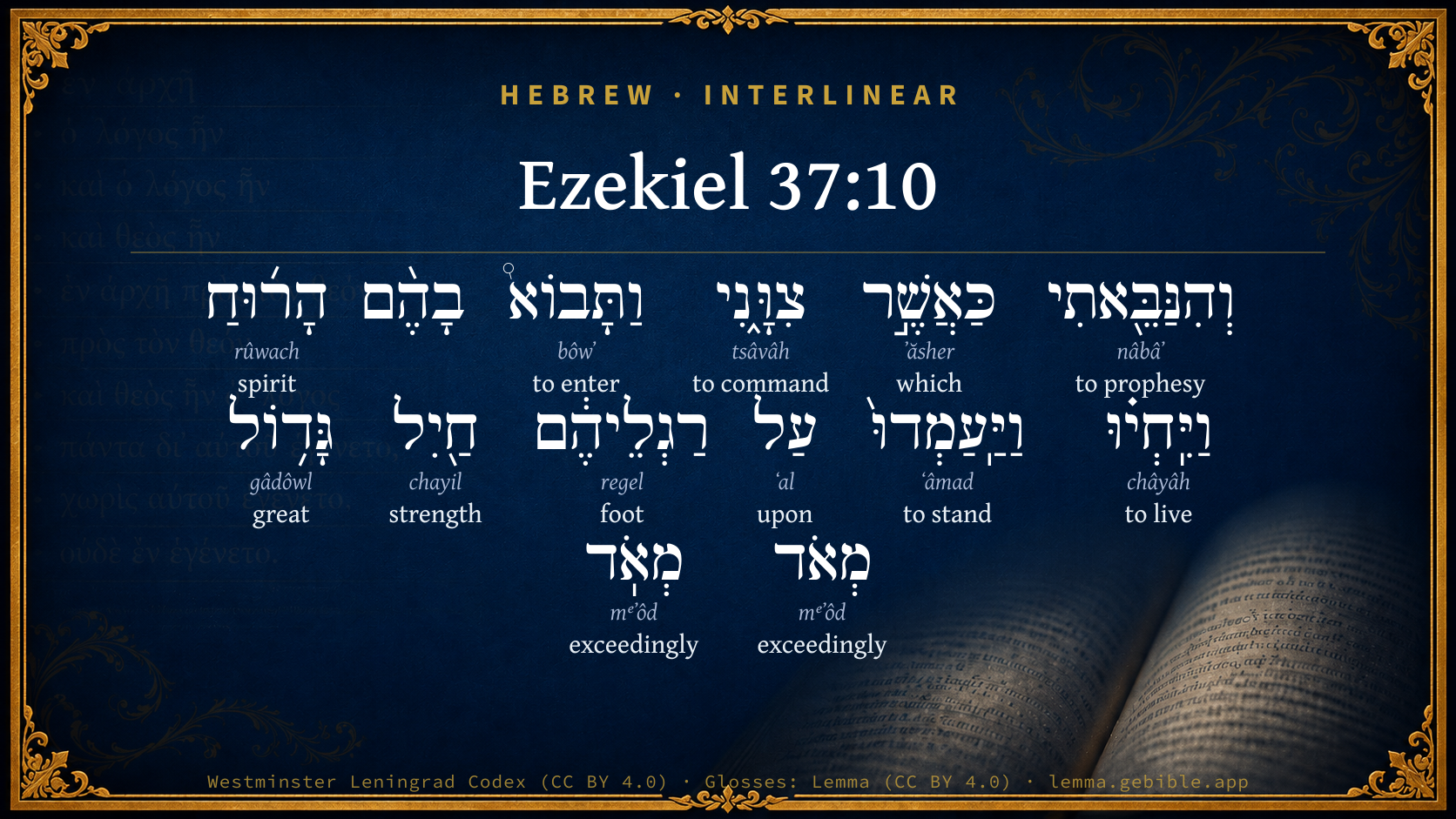
Hebrew (Westminster Leningrad Codex) Ezekiel 37:10 appears in the Hebrew Old Testament. The text above is from the Westminster Leningrad Codex. Each word links to its Strong’s number, a concise gloss, and parsing drawn from the Open Scriptures Hebrew Bible morphology. Click any word for its full Brown-Driver-Briggs (BDB) entry.
Download image
Cite this verse

Ezekiel 37:10 (World English Bible). Public Domain. Lemma interlinear Bible study tool, https://lemma.gebible.app/v/ezekiel/37/10.

Show BibTeX & RIS
BibTeX
RIS
English Translation
So I prophesied as he commanded me, and the breath came into them, and they lived, and stood up on their feet, an exceeding great army.
World English Bible · Public Domain
Download a study sheet

One document with this verse’s original text, its word-by-word gloss line, the meaning frame, cross-references with their text, attributed commentary, and full source and license credits — printable, and it pastes into notes with its structure intact.

This verse Autodidact and up

Study sheet (.html) Plain text (.txt)

A passage Seminary Student

Up to 50 verses in one chapter. A passage sheet keeps up to 6 commentary sources and 12 cross-references per verse, in the order this page ranks them, and says so on the sheet whenever that leaves anything out. Ask for a single verse and you get the Autodidact verse sheet above.

Everything on this page stays free to read, with no account — the sheet is a download of what is already on screen, not access to it.

Want to remove ads? Support Godless Engineer
Compare translations 3

The same verse in 3 English versions, stacked beneath the original-language interlinear above. Click any original word for its lexicon entry.

Each is an independent rendering of the whole verse — the interlinear is not word-aligned to these translations.

Highlighted words mark where these versions differ — a whole-verse word diff, not a word-by-word alignment.

  • World English Bible Public Domain
    So I prophesied as he commanded me, and the breath came into them, and they lived, and stood up on their feet, an exceeding great army.
  • King James Version Public Domain
    So I prophesied as he commanded me, and the breath came into them, and they lived, and stood up upon their feet, an exceeding great army.
  • unfoldingWord Literal Text CC BY-SA 4.0
    So I prophesied as I was commanded; the breath came into them and they lived. Then they stood on their feet, a very great army.

unfoldingWord Literal Text — © unfoldingWord, licensed CC BY-SA 4.0. Word-aligned USFM3 via Door43 (git.door43.org/unfoldingWord/en_ult).

Versions to compare (up to 4)

3 of 4 selected

Show all 18 translations

Every available English version of this verse, each an independent rendering of the whole verse.

  • World English Bible Public Domain
    So I prophesied as he commanded me, and the breath came into them, and they lived, and stood up on their feet, an exceeding great army.
  • Berean Standard Bible Public Domain
    So I prophesied as He had commanded me, and the breath entered them, and they came to life and stood on their feet—a vast army.
  • Majority Standard Bible Public Domain
    So I prophesied as He had commanded me, and the breath entered them, and they came to life and stood on their feet—a vast army.
  • King James Version Public Domain
    So I prophesied as he commanded me, and the breath came into them, and they lived, and stood up upon their feet, an exceeding great army.
  • American Standard Version (1901) Public Domain
    So I prophesied as he commanded me, and the breath came into them, and they lived, and stood up upon their feet, an exceeding great army.
  • Revised Version (1885) Public Domain
    So I prophesied as he commanded me; and the breath came into them, and they lived, and stood up upon their feet, an exceeding great army.
  • Geneva Bible (1599) Public Domain
    So I prophecied as hee had commanded me: and the breath came into them, and they liued, and stood vp vpon their feete, an exceeding great armie.
  • Douay-Rheims (1899) Public Domain
    And I prophesied as he had commanded me: and the spirit came into them, and they lived: and they stood up upon their feet, an exceeding great army.
  • Young's Literal Translation Public Domain
    And I have prophesied as He commanded me, and the Spirit cometh into them, and they live, and stand on their feet -- a very very great force.
  • Literal Standard Version CC BY-SA 4.0
    And I have prophesied as He commanded me, and the Spirit comes into them, and they live, and stand on their feet—a very, very great force.
  • Unlocked Literal Bible CC BY-SA 4.0
    So I prophesied as I was commanded; the breath came into them and they lived. Then they stood on their feet, a very great army.
  • unfoldingWord Literal Text CC BY-SA 4.0
    So I prophesied as I was commanded; the breath came into them and they lived. Then they stood on their feet, a very great army.
  • Darby Bible Public Domain
    And I prophesied as he had commanded me, and the breath came into them, and they lived, and stood up upon their feet, an exceeding great army.
  • World Messianic Bible Public Domain
    So I prophesied as he commanded me, and the breath came into them, and they lived, and stood up on their feet, an exceedingly great army.
  • Webster's Bible Public Domain
    So I prophesied as he commanded me, and the breath came into them, and they lived, and stood up upon their feet, an exceeding great army.
  • Free Bible Version CC BY-SA 4.0
    So I prophesied just as he had ordered me, and the breath went into the bodies, and they came back to life and stood up, a huge army!
  • Bible in Basic English Public Domain
    And I gave the word at his orders, and breath came into them, and they came to life and got up on their feet, a very great army.
  • JPS Tanakh (1917) Public Domain
    So I prophesied as He commanded me, and the breath came into them, and they lived, and stood up upon their feet, an exceeding great host.

Literal Standard Version (2020), Covenant Press — licensed CC BY-SA 4.0. Text via the HelloAO Bible API (eBible.org). Unlocked Literal Bible (unfoldingWord) — licensed CC BY-SA 4.0. Text via the HelloAO Bible API (eBible.org). unfoldingWord Literal Text — © unfoldingWord, licensed CC BY-SA 4.0. Word-aligned USFM3 via Door43 (git.door43.org/unfoldingWord/en_ult). Free Bible Version, Dr. Jonathan Gallagher — licensed CC BY-SA 4.0. Text via the HelloAO Bible API (eBible.org).

Word by word

More ways to search: Search by grammar → Find every occurrence → Compare this word →

Practice this passage: Drill this verse → Learn its vocabulary →

וְהִנַּבֵּ֖אתִי
nâbâʼ
H5012
“and · to prophesy”
Conjunction + Verb, Hithpael, Perfect, 1st Person, Common, Singular
Part of Speech
Conjunction + Verb
Stem
Hithpael
Form
Perfect
Person
1st Person
Gender
Common
Number
Singular
Full BDB Definition

Origin: a primitive root

TWOT: 1277

to prophesy - (Niphal) - to prophesy - under influence of divine spirit - of false prophets - (Hithpael) - to prophesy - under influence of divine spirit - of false prophets
  1. כַּאֲשֶׁ֣ר ʼăsher H834 “like/as · which” Preposition + Particle, Relative
  2. צִוָּ֑נִי tsâvâh H6680 “to command · me” Verb, Piel, Perfect, 3rd Person, Masculine, Singular + Suffix, Personal, 1st Person, Common, Singular
  3. וַתָּבוֹא֩ bôwʼ H935 “and · to enter” Conjunction + Verb, Qal, Sequential Imperfect, 3rd Person, Feminine, Singular
  4. הָר֜וּחַ rûwach H7307 “the · spirit” Particle, Definite Article + Noun, Common, Both, Singular, Absolute
  5. וַיִּֽחְי֗וּ châyâh H2421 “and · to live” Conjunction + Verb, Qal, Sequential Imperfect, 3rd Person, Masculine, Plural
  6. וַיַּֽעַמְדוּ֙ ʻâmad H5975 “and · to stand” Conjunction + Verb, Qal, Sequential Imperfect, 3rd Person, Masculine, Plural
  7. עַל ʻal H5921 “upon” Preposition
  8. רַגְלֵיהֶ֔ם regel H7272 “feet · their” Noun, Common, Feminine, Dual, Construct + Suffix, Personal, 3rd Person, Masculine, Plural
  9. חַ֖יִל chayil H2428 “strength” Noun, Common, Masculine, Singular, Absolute
  10. גָּד֥וֹל gâdôwl H1419 “great” Adjective, Adjective, Masculine, Singular, Absolute
  11. מְאֹד mᵉʼôd H3966 “exceedingly” Adverb
  12. מְאֹֽד mᵉʼôd H3966 “exceedingly” Adverb

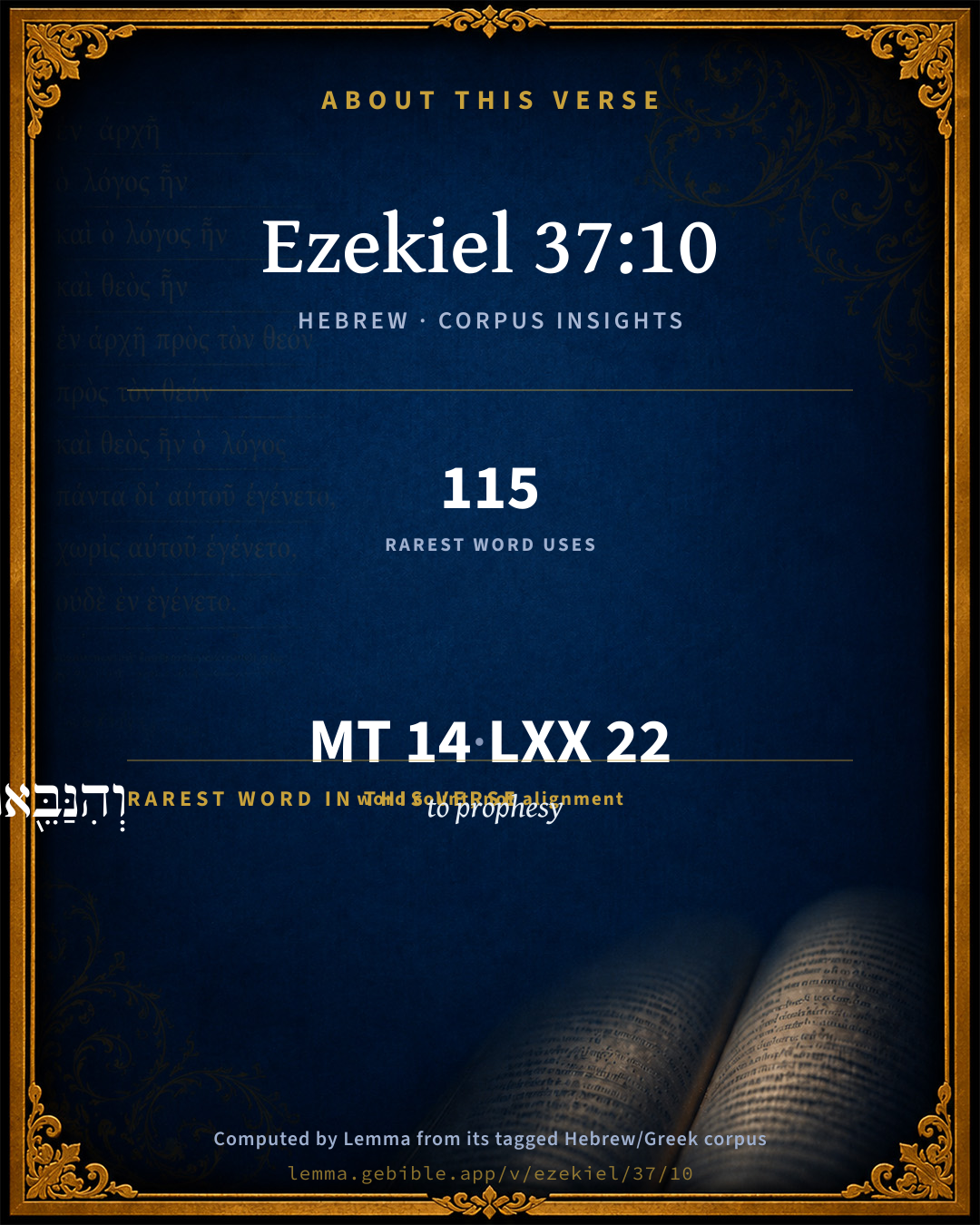
About this verse

These counts appear in no published source. They are computed here, from the morphology-tagged text and Lemma’s own curated glosses. What Lemma adds →

14
words
12
distinct lemmas
Prophets
section

Grammatical profile

  • 5 verbs
  • 3 nouns
  • 1 adjective
  • 2 prepositions
  • 2 adverbs
  • 1 particle

Verb forms

  • וְהִנַּבֵּ֖אתִי Hithpael · Perfect
  • צִוָּ֑נִי Piel · Perfect
  • וַתָּבוֹא֩ Qal · Sequential Imperfect
  • וַיִּֽחְי֗וּ Qal · Sequential Imperfect
  • וַיַּֽעַמְדוּ֙ Qal · Sequential Imperfect

Repetition

A word recurs within this verse — often emphatic in Hebrew:

  • מְאֹד exceedingly H3966 ×2

Hebrew & Septuagint length

In English translation the verse runs 26 words from the Hebrew and 25 from the Septuagint (LXX English) — closely comparable.

A rough comparison of the two English renderings, which tokenize alike — not a word-level alignment.

Word counts can differ between the Hebrew and the Greek without any difference in meaning — e.g. the Hebrew direct-object marker אֵת has no separate Greek word, and Greek often adds the article ὁ.

In the original languages it is 14 Hebrew tokens and 22 Greek tokens — but the two are counted differently (Hebrew bundles its prefixes and suffixes into one token; the Greek is in lemma form), so that isn’t a like-for-like length.

Cross-references

3

Topical passages linked to Ezekiel 37:10 in the Treasury of Scripture Knowledge — connected by theme and wording, ordered by reader-vote popularity; previews shown in the World English Bible.

  • Revelation 11:11 After the three and a half days, the breath of life from God entered into them, and they stood on their feet. Great fear fell on those who saw them.
  • Psalms 104:30 You send forth your Spirit: they are created. You renew the face of the ground.
  • Revelation 20:4–5 I saw thrones, and they sat on them, and judgment was given to them. I saw the souls of those who had been beheaded for the testimony of Jesus, and for the word of God, and such as didn't worship the beast nor his image, and didn't receive the mark on their forehead and on their hand. They lived, and reigned with Christ for the thousand years.

Cross-references courtesy of OpenBible.info (CC BY 4.0).

Hebrew and Greek witnesses Masoretic Hebrew ↔ Greek Septuagint

The same verse in the two great witnesses to the Old Testament, shown verse-for-verse.

These are two independent witnesses, not word-aligned to each other, and the Septuagint is shown in lemma (dictionary) form.

Hebrew Ezekiel 37:10 Masoretic · Westminster Leningrad Codex

וְהִנַּבֵּ֖אתִי כַּאֲשֶׁ֣ר צִוָּ֑נִי וַתָּבוֹא֩ בָהֶ֨ם הָר֜וּחַ וַיִּֽחְי֗וּ וַיַּֽעַמְדוּ֙ עַל רַגְלֵיהֶ֔ם חַ֖יִל גָּד֥וֹל מְאֹד מְאֹֽד

So I prophesied as he commanded me, and the breath came into them, and they lived, and stood up on their feet, an exceeding great army.

World English Bible · Public Domain

Greek LXX Ezekiel 37:10 Septuagint · lemma form

καί προφητεύω καθότι ἐντέλλομαι ἐγώ καί εἰςἔρχομαι εἰς αὐτός ὁ πνεῦμα καί ζάω καί ἵστημι ἐπί ὁ πούς αὐτός συναγωγή πολύς σφόδρα

So I prophesied as he commanded me, and the breath entered into them, and they lived, and stood upon their feet, a very great congregation.

LXX2012 (modern English Septuagint) · Public Domain

Hebrew: Westminster Leningrad Codex (CC BY 4.0). Greek: Septuagint (public domain); English from LXX2012 (modern English Septuagint) (Public Domain). How the Septuagint differs from the Hebrew →

Targum (Aramaic paraphrase)

1

The Targum is the ancient Jewish Aramaic paraphrase of the Hebrew Scriptures — an interpretive translation, not the Hebrew text itself. Onkelos (literal) and Pseudo-Jonathan (expansive) render the Torah, and Jonathan the Prophets. Coverage is partial: where no permissively-licensed English translation exists for a verse, only the Aramaic is shown. This is verse-level text, not a word-by-word alignment to the Hebrew.

  1. Targum Jonathan Prophets (Joshua–Malachi)
    וְאִתְנַבֵּיתִי כְּמָא דִי פַּקְדַנִי וְעָלַת בְּהוֹן רוּחָא וְיִחְיוּ וְקָמוּ עַל רִגְלֵיהוֹן מַשִׁרְיָן סַגִיאָן לַחֲדָא לַחֲדָא:

    (no public-domain English translation for this verse)

    Targum Jonathan — Aramaic: “Mikraot Gedolot” (public domain). English: “Sefaria Community Translation” (CC0 1.0 (public-domain dedication)); “London "Chaldee Paraphrase," 1871” (public domain). Text via Sefaria.

Commentary

Notes on Ezekiel 37:10 from classic Christian and Jewish commentators (each source and its license shown beneath its notes). The classic Christian expositions comment on the surrounding passage and are grouped to its opening verse, so a note may address several verses; the Jewish commentaries on the Tanakh (Rashi and others) are per-verse, so they appear only where the commentator wrote on this verse.

Lemma curates 59 commentaries, every one of them public domain or Creative Commons licensed, each selected and text-cleaned for this edition rather than reprinted as found. About our sources →

Trapp's Complete Commentary

John Trapp

Eze 37:10 So I prophesied as he commanded me, and the breath came into them, and they lived, and stood up upon their feet, an exceeding great army.

Ver. 10. And the breath came into them.] De foras, from without: as at first they were infused by God, so they are still. This Augustine sometime and for some length of time doubted about, and was therefore censured boldly, but unadvisedly, by one Vincentius Victor, as Chemnitius relateth it.

And they lived, and stood up upon their feet.] As life will show itself by sense and motion. Live things will be stirring. Arida etiam peccatorum cords Deus gratis vitali vegetabit.

John Trapp, A Commentary or Exposition upon All the Books of the Old and New Testament (1647–1656) — public domain. Text from a community e-Sword module.

Jamieson, Fausset & Brown

Robert Jamieson, A. R. Fausset & David Brown

Such honor God gives to the divine word, even in the mouth of a man. How much more when in the mouth of the Son of God! (Joh 5:25-29). Though this chapter does not directly prove the resurrection of the dead, it does so indirectly; for it takes for granted the future fact as one recognized by believing Jews, and so made the image of their national restoration (so Isa 25:8; Isa 26:19; Dan 12:2; Hos 6:2; Hos 13:14; compare Note, see on Eze 37:12).

Jamieson, Fausset & Brown — Commentary Critical and Explanatory on the Whole Bible (1871) — public domain (CC PDM 1.0). Text via the HelloAO Bible API.

John Gill's Exposition

So I prophesied as he commanded me,.... The second time he prophesied to the wind, as he had done to the bones, as he was ordered: and the issue of it was,

and breath came into them; or, "the spirit"; a spirit of courage in the Jews, to go up to their own land; the Spirit of life from Christ, which will enter into the witnesses slain, and revive them; and into the Jews in the latter day, and convert them; and which enters into dead sinners, and quickens them; and this he does while ministers are preaching the Gospel to them; see Rev 11:11,

and then lived; as men do spiritually, when the Spirit of God has produced a principle of spiritual life in them; they live by faith on Christ, in union and fellowship with him; they live in newness of life, and a holy life and conversation; and shall live and reign with Christ upon the first resurrection, and for evermore:

and stood up upon their feet, an exceeding great army; as the Jews did when they returned from the Babylonish captivity; they were many, and in a posture of defence; and as they will be in the latter day, when converted, Hos 1:10, and as the number of the saints will be upon the first resurrection, Rev 7:9, so when men are quickened by the Spirit of God, "they stand upon their feet"; they stand in the grace of God, and on the foundation Christ; they stand by faith in him, and in the doctrine of faith, and in the house of God; and they stand firm against all their enemies: they are an "army"; they are in a military state; fighting against sin, Satan, and the world; and though few in comparison of others, yet considered by themselves are very numerous; and as they will appear when the Jews will be converted, and the fulness of the Gentiles brought in; and especially when they will be all gathered together at the coming of Christ.

John Gill's Exposition of the Whole Bible (1746–1763) — public domain (CC PDM 1.0). Text via the HelloAO Bible API.

Matthew Poole's English Annotations

I prophesied: see Eze 37:7.

The breath, Heb. the spirit; the spirit of life, or the soul, Gen 2:7.

Came; entered, took up its abode. They lived; presently discovered that they did live.

Stood up; rose with strength, able to support themselves.

Army; a power, so the Hebrew, or army of strong, courageous, and well-ordered soldiers. The phrase in the Hebrew is very full; a power, or great host, very, very great. Thus they rise, that the prophet and we might know how safe they would be in themselves, and how terrible to their enemies.

Matthew Poole's English Annotations on the Holy Bible (1683–1685) — public domain. Text from a community e-Sword/MySword module.

The Pulpit Commentary

An exceeding great army. This harmonizes with the feature in the vision which describes the bones as those of slain men, while also it may be viewed as foreshadowing the future destiny of Israel. "The bones of the slain on the field of battle, having been brought together, clothed with flesh, and a new life breathed into them, now they stand up, not as "a mixed multitude," but as "an exceeding great army" prepared to take their part in the wars of Jehovah under new and happier conditions" (Plumptre). (On the phrase, "to stand upon the feet," comp. Eze_2:1; Rev_11:11)

The Pulpit Commentary (1880–1919), ed. H.D.M. Spence-Jones & Joseph S. Exell — public domain. Text from a community e-Sword module.

John Wesley's Explanatory Notes

And the breath - The spirit of life, or the soul, Gen. ii, 7.

John Wesley, Explanatory Notes Upon the Whole Bible (1754–1765) — public domain. Text via the GEBible commentary corpus.

Lesson kit

Teaching starters — assembled from the data on this page, not authored interpretation. Every prompt links to the verse data it draws on. Edit before teaching.

Ezekiel, in the Prophets, opens this verse with 14 words (12 distinct Hebrew lemmas). Its most distinctive word is nâbâʼ (“to prophesy”). A historical commentator’s framing appears above. Read the whole chapter for the surrounding context.

Discussion questions

  1. What does “to prophesy” (nâbâʼ) contribute to the verse as a whole?
  2. Revelation 11:11 shares this passage’s theme. How do the two illuminate each other?
  3. “exceedingly” occurs 2× in this one verse. What is the effect of the repetition?
  4. These translations render this verse differently. What is at stake in choosing one wording over another?
  5. The verb «וְהִנַּבֵּ֖אתִי» is Hithpael Perfect. How does its form color the action?
  6. Reading how Trapp's Complete Commentary and Jamieson, Fausset & Brown read this verse, where do the two commentators agree and where do they part?

Things to notice

Reading settings

Reading text

Shown beneath each verse's original-language words.

Old Testament
Old Testament edition

Read the OT as the Masoretic Hebrew (MT) or the Greek Septuagint (LXX).

English shown for the Greek Septuagint (in the Hebrew ↔ Greek comparison).

Comparing translations? Open the Compare panel on any verse page to stack up to four side by side.