Daniel 11:26

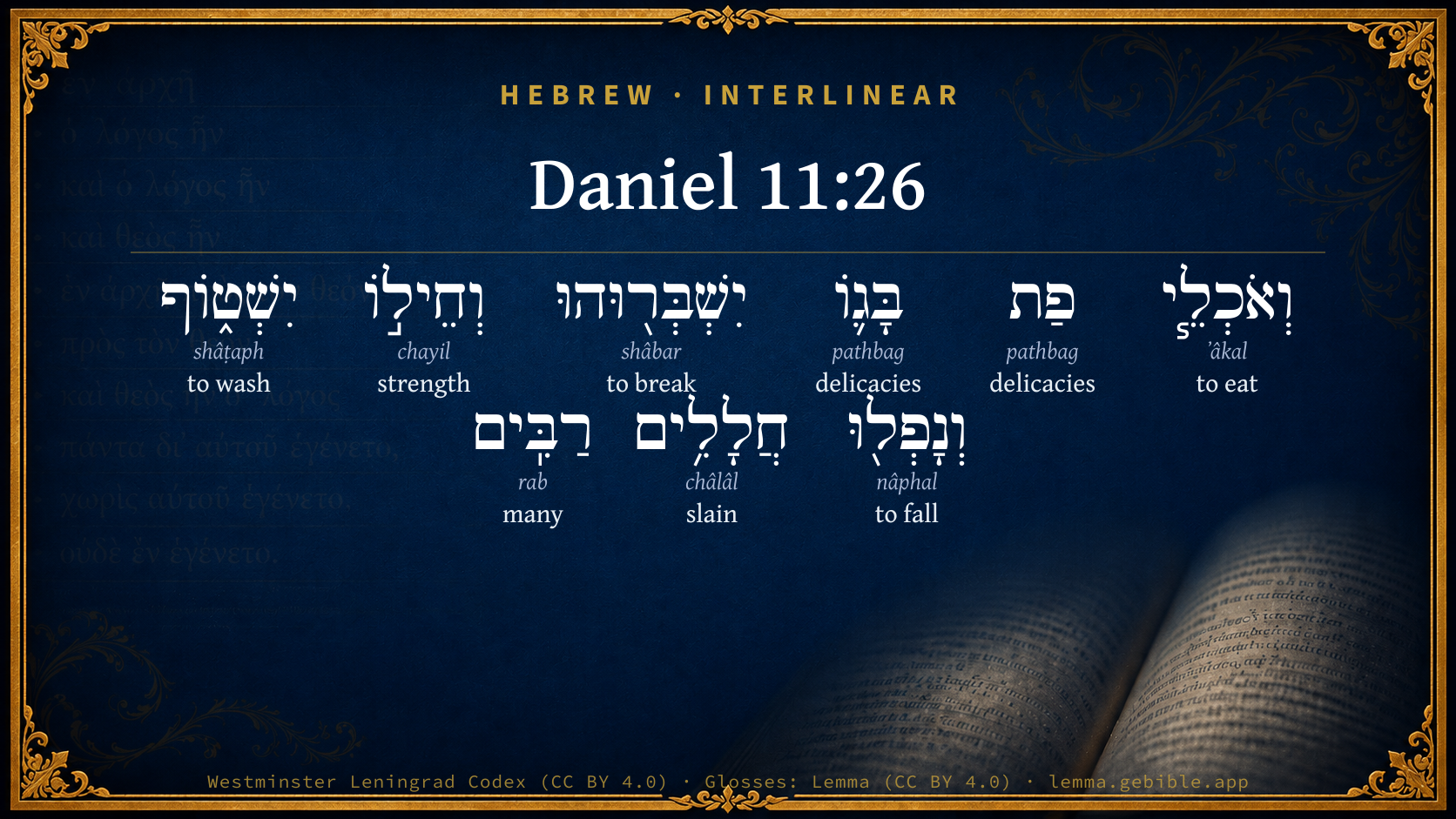
Hebrew (Westminster Leningrad Codex) Daniel 11:26 appears in the Hebrew Old Testament. The text above is from the Westminster Leningrad Codex. Each word links to its Strong’s number, a concise gloss, and parsing drawn from the Open Scriptures Hebrew Bible morphology. Click any word for its full Brown-Driver-Briggs (BDB) entry.
Download image
Cite this verse

Daniel 11:26 (World English Bible). Public Domain. Lemma interlinear Bible study tool, https://lemma.gebible.app/v/daniel/11/26.

Show BibTeX & RIS
BibTeX
RIS
English Translation
Yes, they who eat of his dainties shall destroy him, and his army shall overflow; and many shall fall down slain.
World English Bible · Public Domain
Download a study sheet

One document with this verse’s original text, its word-by-word gloss line, the meaning frame, cross-references with their text, attributed commentary, and full source and license credits — printable, and it pastes into notes with its structure intact.

This verse Autodidact and up

Study sheet (.html) Plain text (.txt)

A passage Seminary Student

Up to 50 verses in one chapter. A passage sheet keeps up to 6 commentary sources and 12 cross-references per verse, in the order this page ranks them, and says so on the sheet whenever that leaves anything out. Ask for a single verse and you get the Autodidact verse sheet above.

Everything on this page stays free to read, with no account — the sheet is a download of what is already on screen, not access to it.

Want to remove ads? Support Godless Engineer
Compare translations 3

The same verse in 3 English versions, stacked beneath the original-language interlinear above. Click any original word for its lexicon entry.

Each is an independent rendering of the whole verse — the interlinear is not word-aligned to these translations.

Highlighted words mark where these versions differ — a whole-verse word diff, not a word-by-word alignment.

  • World English Bible Public Domain
    Yes, they who eat of his dainties shall destroy him, and his army shall overflow; and many shall fall down slain.
  • King James Version Public Domain
    Yea, they that feed of the portion of his meat shall destroy him, and his army shall overflow: and many shall fall down slain.
  • unfoldingWord Literal Text CC BY-SA 4.0
    Even those who eat his fine food will break him. His army will be swept away, and many will fall down slain.

unfoldingWord Literal Text — © unfoldingWord, licensed CC BY-SA 4.0. Word-aligned USFM3 via Door43 (git.door43.org/unfoldingWord/en_ult).

Versions to compare (up to 4)

3 of 4 selected

Show all 18 translations

Every available English version of this verse, each an independent rendering of the whole verse.

  • World English Bible Public Domain
    Yes, they who eat of his dainties shall destroy him, and his army shall overflow; and many shall fall down slain.
  • Berean Standard Bible Public Domain
    Those who eat from his provisions will seek to destroy him; his army will be swept away, and many will fall slain.
  • Majority Standard Bible Public Domain
    Those who eat from his provisions will seek to destroy him; his army will be swept away, and many will fall slain.
  • King James Version Public Domain
    Yea, they that feed of the portion of his meat shall destroy him, and his army shall overflow: and many shall fall down slain.
  • American Standard Version (1901) Public Domain
    Yea, they that eat of his dainties shall destroy him, and his army shall overflow; and many shall fall down slain.
  • Revised Version (1885) Public Domain
    Yea, they that eat of his meat shall destroy him, and his army shall overflow: and many shall fall down slain.
  • Geneva Bible (1599) Public Domain
    Yea, they that feede of the portion of his meate, shall destroy him: and his armie shall ouerflowe: and many shall fall, and be slaine.
  • Douay-Rheims (1899) Public Domain
    And they that eat bread with him, shall destroy him, and his army shall be overthrown: and many shall fall down slain.
  • Young's Literal Translation Public Domain
    and those eating his portion of food destroy him, and his force overfloweth, and fallen have many wounded.
  • Literal Standard Version CC BY-SA 4.0
    and those eating his portion of food destroy him, and his force overflows, and many wounded have fallen.
  • Unlocked Literal Bible CC BY-SA 4.0
    Even those who eat his fine food will try to destroy him. His army will be swept away like a flood, and many of them will fall killed.
  • unfoldingWord Literal Text CC BY-SA 4.0
    Even those who eat his fine food will break him. His army will be swept away, and many will fall down slain.
  • Darby Bible Public Domain
    And they that eat of his delicate food shall break him, and his army shall be dissolved; and many shall fall down slain.
  • World Messianic Bible Public Domain
    Yes, those who eat of his delicacies will destroy him, and his army will be swept away. Many will fall down slain.
  • Webster's Bible Public Domain
    Yes, they that feed of the portion of his provisions shall destroy him, and his army shall overflow: and many shall fall down slain.
  • Free Bible Version CC BY-SA 4.0
    Those closest to him will destroy him. His army will be wiped out—many will fall in battle.
  • Bible in Basic English Public Domain
    And his fears will overcome him and be the cause of his downfall, and his army will come to complete destruction, and a great number will be put to the sword.
  • JPS Tanakh (1917) Public Domain
    Yea, they that eat of his food shall destroy him, and his army shall be swept away; and many shall fall down slain.

Literal Standard Version (2020), Covenant Press — licensed CC BY-SA 4.0. Text via the HelloAO Bible API (eBible.org). Unlocked Literal Bible (unfoldingWord) — licensed CC BY-SA 4.0. Text via the HelloAO Bible API (eBible.org). unfoldingWord Literal Text — © unfoldingWord, licensed CC BY-SA 4.0. Word-aligned USFM3 via Door43 (git.door43.org/unfoldingWord/en_ult). Free Bible Version, Dr. Jonathan Gallagher — licensed CC BY-SA 4.0. Text via the HelloAO Bible API (eBible.org).

Word by word

More ways to search: Search by grammar → Find every occurrence → Compare this word →

Practice this passage: Drill this verse → Learn its vocabulary →

פַת
pathbag
H6598
“delicacies of”
Noun, Common, Masculine, Singular, Construct
Part of Speech
Noun
Type
Common
Gender
Masculine
Number
Singular
State
Construct
Full BDB Definition

Origin: of Persian origin

TWOT: 1851

portion of food for king, delicacies
  1. וְאֹכְלֵ֧י ʼâkal H398 “and · eating” Conjunction + Verb, Qal, Participle Active, Masculine, Plural, Construct
  2. בָּג֛וֹ pathbag H6598 “delicacies · his” Noun, Common, Masculine, Singular, Construct + Suffix, Personal, 3rd Person, Masculine, Singular
  3. יִשְׁבְּר֖וּהוּ shâbar H7665 “to break · him” Verb, Qal, Imperfect, 3rd Person, Masculine, Plural + Suffix, Personal, 3rd Person, Masculine, Singular
  4. וְחֵיל֣וֹ chayil H2428 “and · strength · his” Conjunction + Noun, Common, Masculine, Singular, Construct + Suffix, Personal, 3rd Person, Masculine, Singular
  5. יִשְׁט֑וֹף shâṭaph H7857 “to wash” Verb, Qal, Imperfect, 3rd Person, Masculine, Singular
  6. וְנָפְל֖וּ nâphal H5307 “and · to fall” Conjunction + Verb, Qal, Sequential Perfect, 3rd Person, Common, Plural
  7. חֲלָלִ֥ים châlâl H2491 “slain” Adjective, Adjective, Masculine, Plural, Absolute
  8. רַבִּֽים rab H7227 “many” Adjective, Adjective, Masculine, Plural, Absolute

About this verse

These counts appear in no published source. They are computed here, from the morphology-tagged text and Lemma’s own curated glosses. What Lemma adds →

9
words
8
distinct lemmas
Prophets
section

Notable vocabulary

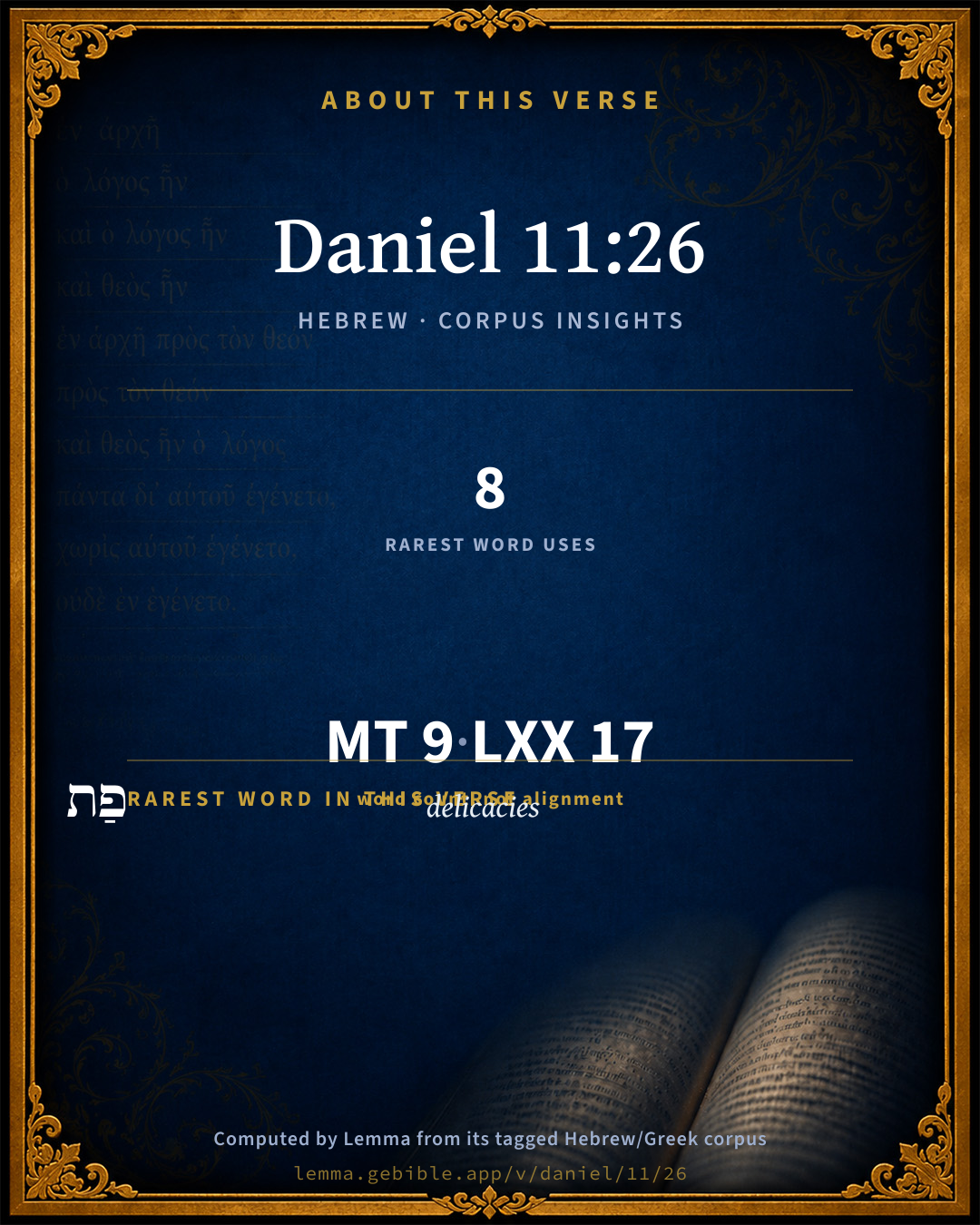
The rarest word here is פַת delicacies H6598 — appearing just 8 times in the whole Hebrew Bible.

Shared distinctive vocabulary

פַת delicacies H6598 occurs in 6 verses of the Hebrew Bible. Also found in:

Grammatical profile

  • 4 verbs
  • 3 nouns
  • 2 adjectives

Verb forms

  • וְאֹכְלֵ֧י Qal · Participle Active
  • יִשְׁבְּר֖וּהוּ Qal · Imperfect
  • יִשְׁט֑וֹף Qal · Imperfect
  • וְנָפְל֖וּ Qal · Sequential Perfect

Repetition

A word recurs within this verse — often emphatic in Hebrew:

  • פַת delicacies H6598 ×2

Hebrew & Septuagint length

In English translation the verse runs 21 words from the Hebrew and 26 from the Septuagint (LXX English) — closely comparable.

A rough comparison of the two English renderings, which tokenize alike — not a word-level alignment.

Word counts can differ between the Hebrew and the Greek without any difference in meaning — e.g. the Hebrew direct-object marker אֵת has no separate Greek word, and Greek often adds the article ὁ.

In the original languages it is 9 Hebrew tokens and 17 Greek tokens — but the two are counted differently (Hebrew bundles its prefixes and suffixes into one token; the Greek is in lemma form), so that isn’t a like-for-like length.

Cross-references

11

Topical passages linked to Daniel 11:26 in the Treasury of Scripture Knowledge — connected by theme and wording, ordered by reader-vote popularity; previews shown in the World English Bible.

  • Daniel 11:10 His sons shall war, and shall assemble a multitude of great forces, which shall come on, and overflow, and pass through; and they shall return and war, even to his fortress.
  • John 13:18 I don't speak concerning all of you. I know whom I have chosen. But that the Scripture may be fulfilled, 'He who eats bread with me has lifted up his heel against me.'
  • 2 Samuel 4:2–12 [Ish-bosheth], Saul's son, [had] two men who were captains of bands: the name of the one was Baanah, and the name of the other Rechab, the sons of Rimmon the Beerothite, of the children of Benjamin (for Beeroth also is reckoned to Benjamin:
  • 2 Kings 8:14 Then he departed from Elisha, and came to his master; who said to him, What said Elisha to you? He answered, He told me that you would surely recover.
  • 2 Kings 10:6–9 Then he wrote a letter the second time to them, saying, If you be on my side, and if you will listen to my voice, take the heads of the men your master's sons, and come to me to Jezreel by tomorrow this time. Now the king's sons, being seventy persons, were with the great men of the city, who brought them up.
  • Psalms 41:9 Yes, my own familiar friend, in whom I trusted, Who ate bread with me, Has lifted up his heel against me.
  • Daniel 11:22 The overwhelming forces shall be overwhelmed from before him, and shall be broken; yes, also the prince of the covenant.
  • Daniel 11:40 At the time of the end shall the king of the south contend with him; and the king of the north shall come against him like a whirlwind, with chariots, and with horsemen, and with many ships; and he shall enter into the countries, and shall overflow and pass through.
  • Micah 7:5–6 Don't trust in a neighbor. Don't put confidence in a friend. With the woman lying in your embrace, Be careful of the words of your mouth!
  • Matthew 26:23 He answered, "He who dipped his hand with me in the dish, the same will betray me.
  • Mark 14:20 He answered them, "It is one of the twelve, he who dips with me in the dish.

Cross-references courtesy of OpenBible.info (CC BY 4.0).

Hebrew and Greek witnesses Masoretic Hebrew ↔ Greek Septuagint

The same verse in the two great witnesses to the Old Testament, shown verse-for-verse.

These are two independent witnesses, not word-aligned to each other, and the Septuagint is shown in lemma (dictionary) form.

Hebrew Daniel 11:26 Masoretic · Westminster Leningrad Codex

וְאֹכְלֵ֧י פַת בָּג֛וֹ יִשְׁבְּר֖וּהוּ וְחֵיל֣וֹ יִשְׁט֑וֹף וְנָפְל֖וּ חֲלָלִ֥ים רַבִּֽים

Yes, they who eat of his dainties shall destroy him, and his army shall overflow; and many shall fall down slain.

World English Bible · Public Domain

Greek LXX Daniel 11:26 Septuagint · lemma form

καί κατα ἀναἁλίσκω αὐτός μέριμνα αὐτός καί ἀποστρέφω αὐτός καί παραἔρχομαι καί κατασύρω καί πίπτω τραυματίας πολύς

and they shall eat his provisions, and shall crush him, and he shall carry away armies as with a flood, and many shall fall down slain.

LXX2012 (modern English Septuagint) · Public Domain

On this verse, The Cambridge Bible for Schools and Colleges discusses the Septuagint’s reading. Read the note in Commentary ↓

Hebrew: Westminster Leningrad Codex (CC BY 4.0). Greek: Septuagint (public domain); English from LXX2012 (modern English Septuagint) (Public Domain). How the Septuagint differs from the Hebrew →

Commentary

Notes on Daniel 11:26 from classic Christian and Jewish commentators (each source and its license shown beneath its notes). The classic Christian expositions comment on the surrounding passage and are grouped to its opening verse, so a note may address several verses; the Jewish commentaries on the Tanakh (Rashi and others) are per-verse, so they appear only where the commentator wrote on this verse.

Lemma curates 59 commentaries, every one of them public domain or Creative Commons licensed, each selected and text-cleaned for this edition rather than reprinted as found. About our sources →

Trapp's Complete Commentary

John Trapp

Dan 11:26 Yea, they that feed of the portion of his meat shall destroy him, and his army shall overflow: and many shall fall down slain.

Ver. 26. Yea, they that feed of the portion of his meat.] His own courtiers, captains, and pensioners, corrupted by Antiochus, betrayed Philometor. See /Apc 1Ma 1:16-20. In trust I have oft found treason, said Queen Elizabeth.

John Trapp, A Commentary or Exposition upon All the Books of the Old and New Testament (1647–1656) — public domain. Text from a community e-Sword module.

Geneva Bible (1599)

Geneva Bible translators

Declaring that his soldiers shall brast out and venture their life to slay and to be slain for the safeguard of their prince.

Signifying his princes and the chief about him.

Geneva Bible (1599) marginal notes — public domain. Text via Bolls.life.

Jamieson, Fausset & Brown

Robert Jamieson, A. R. Fausset & David Brown

they that feed of . . . his meat--those from whom he might naturally have looked for help, his intimates and dependents (Psa 41:9; Joh 13:18); his ministers and guardians.

his army shall overflow--Philometer's army shall be dissipated as water. The phrase is used of overflowing numbers, usually in a victorious sense, but here in the sense of defeat, the very numbers which ordinarily ensure victory, hastening the defeat through mismanagement.

many shall fall down slain--(1 Maccabees 1:18, "many fell wounded to death"). Antiochus, when he might have slain all in the battle near Pelusium, rode around and ordered the enemy to be taken alive, the fruit of which policy was, he soon gained Pelusium and all Egypt [DIODORUS SICULUS, 26.77].

Jamieson, Fausset & Brown — Commentary Critical and Explanatory on the Whole Bible (1871) — public domain (CC PDM 1.0). Text via the HelloAO Bible API.

Adam Clarke's Commentary

Verse 26. Yea, they that feed of the portion of his meat] This is the proof of what has been last noted, that the intrigues of Antiochus, corrupting the ministers and officers of Ptolemy, were the cause of all the disasters that felt on the Egyptian king. They that fed of the portion of his meat - who were in his confidence and pay, and possessed the secrets of the state, betrayed him; and these were the means of destroying him and his army, so that he was defeated, as was before observed.

Adam Clarke's Commentary on the Bible (1810–1826) — public domain. Text from a community e-Sword/MySword module.

John Calvin's Commentaries

The angel predicted, yesterday, that Ptolemy should not stand forth in battle, through the treachery of his own adherents. He now expresses the kind of treachery, for his chief courtiers or counselors should be the authors of this perfidy. He opposes the common soldiers to their leaders, for in the second clause, he shews how the soldiers should discharge their duty without sparing either their life or their blood. We now understand the Holy Spirit’s intention in this verse, for he says the authors of this perfidy should not be ordinary men, but the chief among the counselors. They are said to eat at the king’s table, as in the first chapter we saw how a portion was given to Daniel, and to his companions, from the royal food at the king’s table. Thus he shews how dishonorable this perfidy was, as they eat at his table, and were his intimate companions. They shall destroy him, says he, and his army shall be overwhelmed He shews that many were prepared for this duty, who would boldly and freely expose their lives to danger for their king’s safety and their country’s defense, but many should fall wounded He signifies that there should be a great slaughter in his army, and the issue of the battle would not be according to his wish, because his generals would not preserve their fidelity to their sovereign. By this example the angel describes to us the ordinary situation of kings. They choose their counselors not by their honesty, but by the mere appearance of congeniality in their affections and tastes. If a king is avaricious, or cunning, or cruel, or sensual, he desires to have friends and attendants who will not check either his avarice or his craftiness, his cruelty or his lust. Hence they deserve the conduct which they receive, and experience treachery from those whom they ought not to treat with so much honor, if they considered themselves in duty bound to God and to their people. It now follows,-

John Calvin's Commentaries (1540-1563) — public domain. Text from the Calvin Translation Society English edition (1840s-50s) via the Christian Classics Ethereal Library (ccel.org). Calvin's coverage is partial (roughly two-thirds of the Bible); uncommented books and verses are honest gaps, never fabricated. The 19th-century editor's footnotes and remarks are omitted so the notes are faithfully Calvin's own voice.

Ellicott's Commentary for English Readers

(26) They that feed.—The context points to treachery. The false companions of the southern king betray him to the enemy; he is broken, the hostile army pours in, and many are slain. This has been referred to the second campaign of Antiochus in Egypt; however, history is silent of any treachery against Physcon. St. Jerome remarks: “Nostri secundum superiorem sensum interpretantur omnia de Antichristo qui nasciturus est de populo Judœorum, et de Babylone venturus, primum superaturus est regem Egypti, qui est unus de tribus cornibus.”

A Bible Commentary for English Readers, edited by Charles John Ellicott (1878–1897) — public domain. Text from a community e-Sword module.

The Cambridge Bible for Schools and Colleges

gen. ed. J. J. S. Perowne

26. And they that eat of his delicacies (Dan_1:5) shall break him] some of his courtiers will be his ruin. For the expression, cf. 1Ki_2:7, ‘those that eat of thy table’; break, as Dan_11:20. The allusion may be to Eulaeus and Lenaeus, at whose ill-advised suggestion it was that Philometor was first led to think of reconquering Syria, and the former of whom, after the battle of Pelusium, persuaded the king to abandon his country. Ptolemy Macron, also, the very capable (Polyb. xxvii. 12) governor of Cyprus (though this was perhaps later), deserted to Antiochus (2Ma_10:13).

and his army shall overflow] i.e. Antiochus’ army. But the pronouns from Dan_11:25 b refer all to Philometor: the verb should therefore probably be vocalized as a passive (יִשָּׁטֵף) and his army (Philometor’s) shall be flooded (or swept) away; the word, as Dan_11:22.

and many shall fall down slain] cf. 1Ma_1:18, ‘and many fell down slain’ (also of Antiochus’ victories in Egypt), where the Greek (except in the tense) is exactly the same as in LXX. and Theod. here.

The Cambridge Bible for Schools and Colleges (gen. ed. J. J. S. Perowne; Cambridge University Press, 1878–1918) — public domain. Text from a community e-Sword module.

John Gill's Exposition

Yea, they that feed of the portion of his meat shall destroy him,.... Those of his own household, his familiar friends, his courtiers and counsellors, and the generals of his army; his destruction, or the loss of the battle, was owing either to the bad counsels they gave him, or to their desertion of him, being corrupted by Antiochus:

and his army shall overflow: that is, the army of Antiochus, like a mighty inundation of water, which carries all before it, should overflow, or bear down and destroy, the army of Ptolemy, and overrun all Egypt, as it did, as before related; no more resistance being to be made to it than to a rapid flood of water:

and many shall fall down slain: of the army of the king of Egypt. The account given of this affair in the Apocrypha:

"18 And made war against Ptolemee king of Egypt: but Ptolemee was afraid of him, and fled; and many were wounded to death. 19 Thus they got the strong cities in the land of Egypt and he took the spoils thereof.'' (1 Maccabees 1)

Josephus says (x), that Antiochus,

"being with a great army at Pelusium, and circumventing Ptolemy Philometor by fraud, seized on Egypt; and being in the parts near to Memphis, and taking it, he hastened to Alexandria to besiege it, and got Ptolemy, reigning there, into his hands.''

(x) Antiqu. l. 12. c. 5, sect. 2.

John Gill's Exposition of the Whole Bible (1746–1763) — public domain (CC PDM 1.0). Text via the HelloAO Bible API.

Albert Barnes' Notes on the Bible

Yea, they that feed of the portion of his meat shall destroy him - They of his own family; they who are nourished at his table; they who are his cabinet counselors, and professed and confidential friends. The meaning is, that they would prove treacherous and unfaithful. This is by no means improbable. Antiochus was powerful, and had seized upon Pelusium, and upon Memphis, and upon the fairest portions of Egypt. He was also in possession of the person of the lawful king, and had a fair prospect of subduing the whole country. In these circumstances, nothing would be more natural than that the very inmates of the palace - the persons around the reigning king - should begin to doubt whether he could hold out, and should be disposed to make terms with the invader.

And his army shall overflow - The connection here requires us to understand this of the army of the king of Egypt. The meaning seems to be, that his forces would be great, and would spread themselves out like overflowing waters, but that not withstanding this many of them would be slain.

And many shall fall down slain - In battle. Not withstanding the army would be numerous, and would, as it were, spread over the land, still it would not be sufficient to keep out the invaders, but many of them would fall in the field. The account in 1 Macc. 1:18 is, that “Ptolemy was afraid of him (Antiochus) and fled; and many were wounded to death.”

Albert Barnes' Notes on the Bible (1834–1885) — public domain. Text from a community e-Sword/MySword module.

Haydock's Catholic Bible Commentary

Slain. This was the perfidious policy of Epiphanes, who expected that the two brothers would destroy each other, so that he might easily seize Egypt, of which he kept the key, retaining the city of Pelusium. They were however reconciled, and reigned together. The Scripture often represents that as done which is only intended.

George Leo Haydock (1774–1849), Haydock's Catholic Family Bible and Commentary, 1859 edition — public domain. Excludes Psalms (Douay-Rheims chapter numbering differs from Protestant) and Deuterocanonical books (Catholic canon only).

Matthew Poole's English Annotations

His most familiar friends and confidants shall be false and treacherous to him, for he shall he overthrown with a great slaughter, as when Nilus overflows the country, for there was the battle, between Mount Casius and Pelusium.

Matthew Poole's English Annotations on the Holy Bible (1683–1685) — public domain. Text from a community e-Sword/MySword module.

The Pulpit Commentary

Yea, they that feed of the portion of his meat shall destroy him, and his army shall overflow: and many shall fall down slain. The Septuagint rendering here is different, "And his cares shall consume him and turn him away, and he shall pass by (and shall hiss, katasuriei); and many shall fall down wounded." Paulus Tellensis renders katasuriei by (nigrooph), "shall overflow," as if he had read katareusetai, or perhaps katasurei, though it does not exactly represent the Hebrew. Theodotion is liker the Massoretic, "And they eat his provisions, and shall break him to pieces; and he shall overflow powers, and many shall fall wounded." The account of the invasion of Egypt by Epiphanes occurs in RAPC 1Ma 1:18. The Septuagint translator, appears to have read, instead of wOgbAtP ylekaOw (veochlay path-bago), wytgad Wlkaw (veachloo dageothav). There would seem also to have been some confusion between lyhi (heel), "strength," and dlh (halach), "to go." The Peshitta rendering is, "They that eat his meat shall destroy him, and his army shall be dispersed, and many shall fall wounded." The Vulgate is closely related to this. This refers to the treachery which was alleged to have been at work and to have caused the overthrow of Philometor in his contest with his uncle. The version of the Septuagint is more picturesque, and more in accordance with facts. Cares might well devour Ptolemy Philometor treachery in his army and his brother occupying his throne. Certainly he was defeated, turned asae, and was compelled to accompany the victor as a prisoner, while Egypt was wasted (katasurei)

The Pulpit Commentary (1880–1919), ed. H.D.M. Spence-Jones & Joseph S. Exell — public domain. Text from a community e-Sword module.

John Wesley's Explanatory Notes

Yea - His most familiar friends and confidants; for he shall be overthrown with a great slaughter, as when the Nile overflows the country.

John Wesley, Explanatory Notes Upon the Whole Bible (1754–1765) — public domain. Text via the GEBible commentary corpus.

Rashi

Rabbi Shlomo Yitzchaki (Rashi)

his food Heb. פַּת־בָּגוֹ, his food; one who takes a portion from his table.

Rashi on the Tanakh — English translations: “The Judaica Press complete Tanach with Rashi, translated by A. J. Rosenberg” (CC BY 4.0); “Pentateuch with Rashi's commentary by M. Rosenbaum and A.M. Silbermann, 1929-1934” (public domain); “The Metsudah Tanach series, Lakewood, N.J” (CC BY 4.0); and “The Book of Joshua, Metsudah Publications, 1997” (CC BY 4.0). Text via Sefaria.

Lesson kit

Teaching starters — assembled from the data on this page, not authored interpretation. Every prompt links to the verse data it draws on. Edit before teaching.

Daniel, in the Prophets, opens this verse with 9 words (8 distinct Hebrew lemmas). Its most distinctive word is pathbag (“delicacies”). A historical commentator’s framing appears above. Read the whole chapter for the surrounding context.

Discussion questions

  1. How does “delicacies” (pathbag) shape what this verse is saying?
  2. How does Daniel 1:5, which shares the word «delicacies», read alongside this verse?
  3. What does the repetition of “delicacies” (2× in this one verse) do in this verse?
  4. These translations render this verse differently; the difference is in the English rendering, not the original. What questions does that raise?
  5. «וְאֹכְלֵ֧י» is a Qal Participle Active verb. How does that grammatical form shape the action described?
  6. Compare how Trapp's Complete Commentary and Geneva Bible (1599) read this verse. Where do they agree or differ?

Things to notice

Reading settings

Reading text

Shown beneath each verse's original-language words.

Old Testament
Old Testament edition

Read the OT as the Masoretic Hebrew (MT) or the Greek Septuagint (LXX).

English shown for the Greek Septuagint (in the Hebrew ↔ Greek comparison).

Comparing translations? Open the Compare panel on any verse page to stack up to four side by side.