
Esther 8:11

Hebrew (Westminster Leningrad Codex) Esther 8:11 appears in the Hebrew Old Testament. The text above is from the Westminster Leningrad Codex. Each word links to its Strong’s number, a concise gloss, and parsing drawn from the Open Scriptures Hebrew Bible morphology. Click any word for its full Brown-Driver-Briggs (BDB) entry.
Download image
Cite this verse

Esther 8:11 (World English Bible). Public Domain. Lemma interlinear Bible study tool, https://lemma.gebible.app/v/esther/8/11.

Show BibTeX & RIS
BibTeX
RIS
English Translation
in which the king granted the Jews who were in every city to gather themselves together, and to stand for their life, to destroy, to kill, and to cause to perish, all the power of the people and province that would assault them, [their] little ones and women, and to take the spoil of them for a prey,
World English Bible · Public Domain
Download a study sheet

One document with this verse’s original text, its word-by-word gloss line, the meaning frame, cross-references with their text, attributed commentary, and full source and license credits — printable, and it pastes into notes with its structure intact.

This verse Autodidact and up

Study sheet (.html) Plain text (.txt)

A passage Seminary Student

Up to 50 verses in one chapter. A passage sheet keeps up to 6 commentary sources and 12 cross-references per verse, in the order this page ranks them, and says so on the sheet whenever that leaves anything out. Ask for a single verse and you get the Autodidact verse sheet above.

Everything on this page stays free to read, with no account — the sheet is a download of what is already on screen, not access to it.

Want to remove ads? Support Godless Engineer
Compare translations 3

The same verse in 3 English versions, stacked beneath the original-language interlinear above. Click any original word for its lexicon entry.

Each is an independent rendering of the whole verse — the interlinear is not word-aligned to these translations.

Highlighted words mark where these versions differ — a whole-verse word diff, not a word-by-word alignment.

  • World English Bible Public Domain
    in which the king granted the Jews who were in every city to gather themselves together, and to stand for their life, to destroy, to kill, and to cause to perish, all the power of the people and province that would assault them, [their] little ones and women, and to take the spoil of them for a prey,
  • King James Version Public Domain
    Wherein the king granted the Jews which were in every city to gather themselves together, and to stand for their life, to destroy, to slay and to cause to perish, all the power of the people and province that would assault them, both little ones and women, and to take the spoil of them for a prey,
  • unfoldingWord Literal Text CC BY-SA 4.0
    that the king gave to the Jews who were in every city, city by city: to gather and to stand for their life, to annihilate, and to slaughter, and to destroy any strength of a people or province that would attack them, children and women, and plunder their spoil;

unfoldingWord Literal Text — © unfoldingWord, licensed CC BY-SA 4.0. Word-aligned USFM3 via Door43 (git.door43.org/unfoldingWord/en_ult).

Versions to compare (up to 4)

3 of 4 selected

Show all 18 translations

Every available English version of this verse, each an independent rendering of the whole verse.

  • World English Bible Public Domain
    in which the king granted the Jews who were in every city to gather themselves together, and to stand for their life, to destroy, to kill, and to cause to perish, all the power of the people and province that would assault them, [their] little ones and women, and to take the spoil of them for a prey,
  • Berean Standard Bible Public Domain
    By these letters the king permitted the Jews in each and every city the right to assemble and defend themselves, to destroy, kill, and annihilate all the forces of any people or province hostile to them, including women and children, and to plunder their possessions.
  • Majority Standard Bible Public Domain
    By these letters the king permitted the Jews in each and every city the right to assemble and defend themselves, to destroy, kill, and annihilate all the forces of any people or province hostile to them, including women and children, and to plunder their possessions.
  • King James Version Public Domain
    Wherein the king granted the Jews which were in every city to gather themselves together, and to stand for their life, to destroy, to slay and to cause to perish, all the power of the people and province that would assault them, both little ones and women, and to take the spoil of them for a prey,
  • American Standard Version (1901) Public Domain
    wherein the king granted the Jews that were in every city to gather themselves together, and to stand for their life, to destroy, to slay, and to cause to perish, all the power of the people and province that would assault them, `their' little ones and women, and to take the spoil of them for a prey,
  • Revised Version (1885) Public Domain
    wherein the king granted the Jews which were in every city to gather themselves together, and to stand for their life, to destroy, to slay, and to cause to perish, all the power of the people and province that would assault them, their little ones and women, and to take the spoil of them for a prey,
  • Geneva Bible (1599) Public Domain
    Wherein the King graunted the Iewes (in what cities so euer they were) to gather theselues together, and to stand for their life, and to roote out, to slay and to destroy al the power of the people and of the prouince that vexed them, both children and women, and to spoyle their goods:
  • Douay-Rheims (1899) Public Domain
    And the king gave orders to them, to speak to the Jews in every city, and to command them to gather themselves together, and to stand for their lives, and to kill and destroy all their enemies with their wives and children and all their houses, and to take their spoil.
  • Young's Literal Translation Public Domain
    that the king hath given to the Jews who `are' in every city and city, to be assembled, and to stand for their life, to cut off, to slay, and to destroy the whole force of the people and province who are distressing them, infants and women, and their spoil to seize.
  • Literal Standard Version CC BY-SA 4.0
    that the king has given to the Jews who [are] in each and every city, to be assembled, and to stand for their life, to cut off, to slay, and to destroy the whole force of the people and province who are distressing them, infants and women, and their spoil to seize.
  • Unlocked Literal Bible CC BY-SA 4.0
    The king gave to the Jews who were in every city permission to gather together and to make a stand to protect their lives: To annihiliate, to kill, and to destroy any armed force from any people or province that might attack them, children and women included, or to plunder their possessions.
  • unfoldingWord Literal Text CC BY-SA 4.0
    that the king gave to the Jews who were in every city, city by city: to gather and to stand for their life, to annihilate, and to slaughter, and to destroy any strength of a people or province that would attack them, children and women, and plunder their spoil;
  • Darby Bible Public Domain
    [stating] that the king granted the Jews that were in every city to gather themselves together, and to stand for their life, to destroy, to slay, and to cause to perish, all the power of the people and province that might assault them, [their] little ones and women, and to [take] the spoil of them for a prey,
  • World Messianic Bible Public Domain
    In those letters, the king granted the Jews who were in every city to gather themselves together and to defend their lives—to destroy, to kill, and to cause to perish all the power of the people and province that would assault them, their little ones and women, and to plunder their possessions,
  • Webster's Bible Public Domain
    In which the king granted the Jews who were in every city to assemble, and to stand for their life, to destroy, to slay, and to cause to perish, all the power of the people and province that would assault them, both little ones and women, and to take the spoil of them for a prey,
  • Free Bible Version CC BY-SA 4.0
    The letters from the king authorized the Jews in every city to gather together in self-defense, and to destroy, kill, and annihilate any armed group of a people or province that might attack them, including women and children, and to confiscate their possessions.
  • Bible in Basic English Public Domain
    In these letters the king gave authority to the Jews in every town to come together and make a fight for their lives, and to send death and destruction on the power of any people in any part of the kingdom attacking them or their children or their women, and to take their goods from them by force,
  • JPS Tanakh (1917) Public Domain
    that the king had granted the Jews that were in every city to gather themselves together, and to stand for their life, to destroy, and to slay, and to cause to perish, all the forces of the people and province that would assault them, their little ones and women, and to take the spoil of them for a prey,

Literal Standard Version (2020), Covenant Press — licensed CC BY-SA 4.0. Text via the HelloAO Bible API (eBible.org). Unlocked Literal Bible (unfoldingWord) — licensed CC BY-SA 4.0. Text via the HelloAO Bible API (eBible.org). unfoldingWord Literal Text — © unfoldingWord, licensed CC BY-SA 4.0. Word-aligned USFM3 via Door43 (git.door43.org/unfoldingWord/en_ult). Free Bible Version, Dr. Jonathan Gallagher — licensed CC BY-SA 4.0. Text via the HelloAO Bible API (eBible.org).

Word by word

More ways to search: Search by grammar → Find every occurrence → Compare this word →

Practice this passage: Drill this verse → Learn its vocabulary →

הַצָּרִ֥ים
tsûwr
H6696
“the · besieging”
Particle, Definite Article + Verb, Qal, Participle Active, Masculine, Plural, Absolute
Part of Speech
Particle + Verb
Stem
Qal
Form
Participle Active
Gender
Masculine
Number
Plural
State
Absolute
Full BDB Definition

Origin: a primitive root

TWOT: 1898 , 1899 , 1900

to bind, besiege, confine, cramp - (Qal) - to confine, secure - to shut in, beseige - to shut up, enclose - (Qal) to show hostility to, be an adversary, treat as foe - (Qal) to form, fashion, delineate
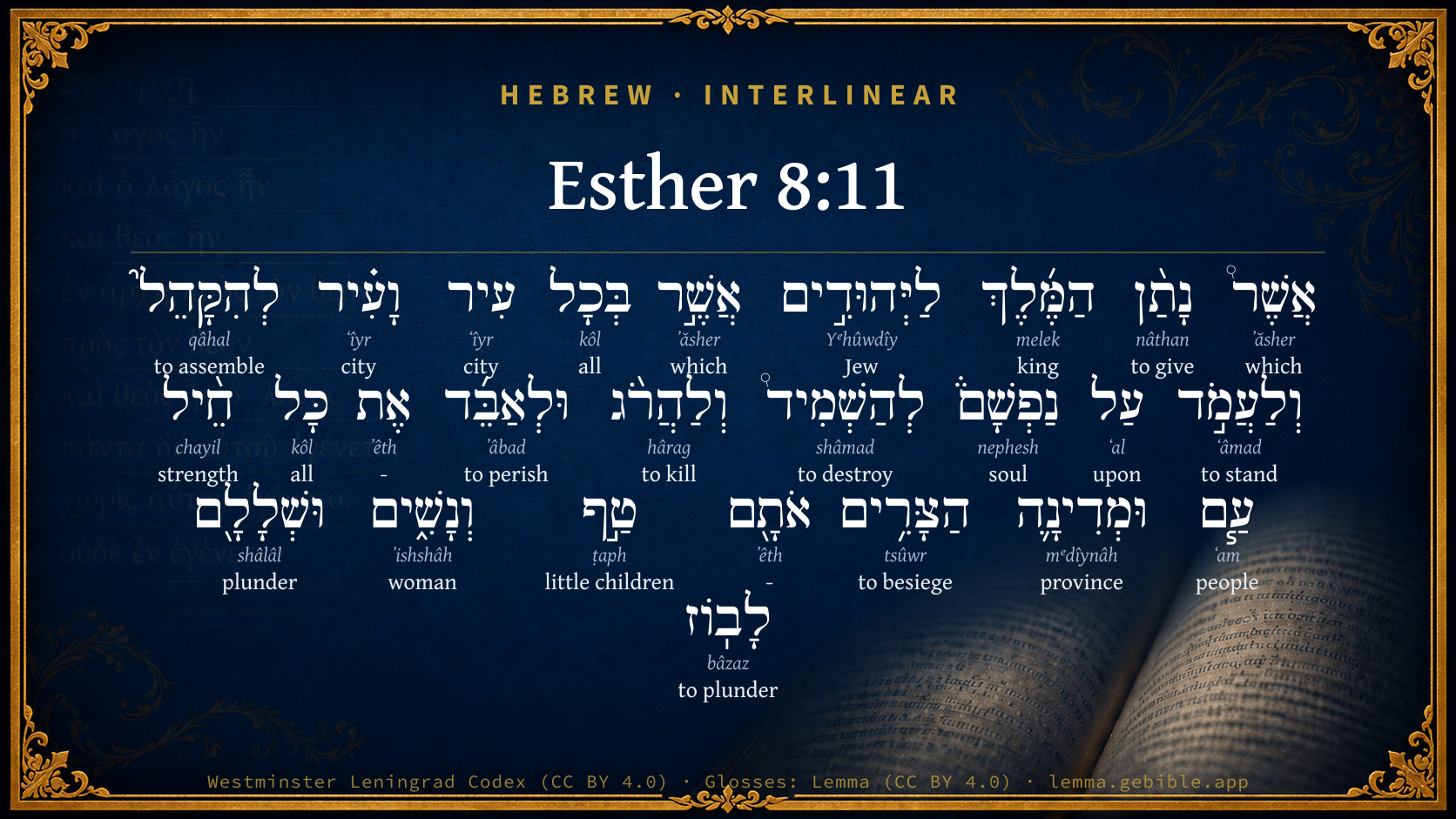
  1. אֲשֶׁר֩ ʼăsher H834 “which” Particle, Relative
  2. נָתַ֨ן nâthan H5414 “to give” Verb, Qal, Perfect, 3rd Person, Masculine, Singular
  3. הַמֶּ֜לֶךְ melek H4428 “the · king” Particle, Definite Article + Noun, Common, Masculine, Singular, Absolute
  4. לַיְּהוּדִ֣ים Yᵉhûwdîy H3064 “to/for the · Jews” Preposition, Determined + Noun, Gentilic, Masculine, Plural, Absolute
  5. אֲשֶׁ֣ר ʼăsher H834 “which” Particle, Relative
  6. בְּכָל kôl H3605 “in/at · all of” Preposition + Noun, Common, Masculine, Singular, Construct
  7. עִיר ʻîyr H5892 “city” Noun, Common, Feminine, Singular, Absolute
  8. וָעִ֗יר ʻîyr H5892 “and · city” Conjunction + Noun, Common, Feminine, Singular, Absolute
  9. לְהִקָּהֵל֮ qâhal H6950 “to assemble” Preposition + Verb, Niphal, Infinitive Construct
  10. וְלַעֲמֹ֣ד ʻâmad H5975 “and · to stand” Conjunction + Preposition + Verb, Qal, Infinitive Construct
  11. עַל ʻal H5921 “upon” Preposition
  12. נַפְשָׁם֒ nephesh H5315 “soul · their” Noun, Common, Both, Singular, Construct + Suffix, Personal, 3rd Person, Masculine, Plural
  13. לְהַשְׁמִיד֩ shâmad H8045 “to destroy” Preposition + Verb, Hiphil, Infinitive Construct
  14. וְלַהֲרֹ֨ג hârag H2026 “and · to kill” Conjunction + Preposition + Verb, Qal, Infinitive Construct
  15. וּלְאַבֵּ֜ד ʼâbad H6 “and · to perish” Conjunction + Preposition + Verb, Piel, Infinitive Construct
  16. אֶת ʼêth H853 “-” Particle, Direct Object
  17. כָּל kôl H3605 “all of” Noun, Common, Masculine, Singular, Construct
  18. חֵ֨יל chayil H2428 “strength of” Noun, Common, Masculine, Singular, Construct
  19. עַ֧ם ʻam H5971 “people” Noun, Common, Masculine, Singular, Absolute
  20. וּמְדִינָ֛ה mᵉdîynâh H4082 “and · province” Conjunction + Noun, Common, Feminine, Singular, Absolute
  21. אֹתָ֖ם ʼêth H853 “- · them” Particle, Direct Object + Suffix, Personal, 3rd Person, Masculine, Plural
  22. טַ֣ף ṭaph H2945 “little children” Noun, Common, Masculine, Singular, Absolute
  23. וְנָשִׁ֑ים ʼishshâh H802 “and · women” Conjunction + Noun, Common, Feminine, Plural, Absolute
  24. וּשְׁלָלָ֖ם shâlâl H7998 “and · plunder · their” Conjunction + Noun, Common, Masculine, Singular, Construct + Suffix, Personal, 3rd Person, Masculine, Plural
  25. לָבֽוֹז bâzaz H962 “to plunder” Preposition + Verb, Qal, Infinitive Construct

About this verse

These counts appear in no published source. They are computed here, from the morphology-tagged text and Lemma’s own curated glosses. What Lemma adds →

26
words
22
distinct lemmas
Historical
section

Shared distinctive vocabulary

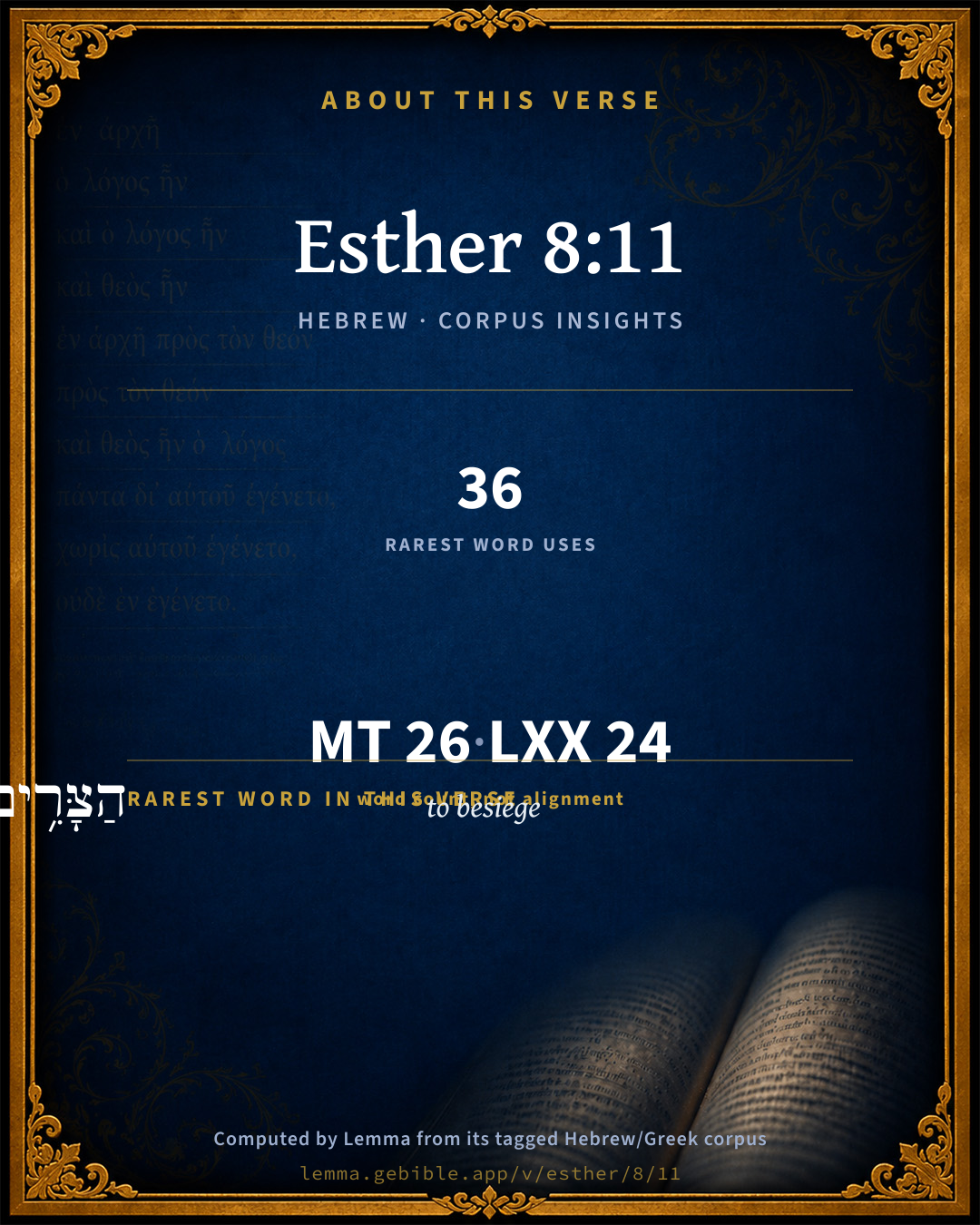
הַצָּרִ֥ים to besiege H6696 occurs in 36 verses of the Hebrew Bible. Also found in:

Grammatical profile

  • 8 verbs
  • 13 nouns
  • 1 preposition
  • 4 particles

Verb forms

  • נָתַ֨ן Qal · Perfect
  • לְהִקָּהֵל֮ Niphal · Infinitive Construct
  • וְלַעֲמֹ֣ד Qal · Infinitive Construct
  • לְהַשְׁמִיד֩ Hiphil · Infinitive Construct
  • וְלַהֲרֹ֨ג Qal · Infinitive Construct
  • וּלְאַבֵּ֜ד Piel · Infinitive Construct
  • הַצָּרִ֥ים Qal · Participle Active
  • לָבֽוֹז Qal · Infinitive Construct

Repetition

Words recur within this verse — often emphatic in Hebrew:

  • בְּכָל all H3605 ×2
  • עִיר city H5892 ×2
  • אֲשֶׁר֩ which H834 ×2

Hebrew & Septuagint length

In English translation the verse runs 58 words from the Hebrew and 30 from the Septuagint (LXX English) — the Septuagint runs noticeably shorter here. See the side-by-side →

A rough comparison of the two English renderings, which tokenize alike — not a word-level alignment.

Word counts can differ between the Hebrew and the Greek without any difference in meaning — e.g. the Hebrew direct-object marker אֵת has no separate Greek word, and Greek often adds the article ὁ.

In the original languages it is 26 Hebrew tokens and 24 Greek tokens — but the two are counted differently (Hebrew bundles its prefixes and suffixes into one token; the Greek is in lemma form), so that isn’t a like-for-like length.

Cross-references

8

Topical passages linked to Esther 8:11 in the Treasury of Scripture Knowledge — connected by theme and wording, ordered by reader-vote popularity; previews shown in the World English Bible.

  • Esther 3:13 Letters were sent by posts into all the king's provinces, to destroy, to kill, and to cause to perish, all Jews, both young and old, little children and women, in one day, even on the thirteenth [day] of the twelfth month, which is the month Adar, and to take the spoil of them for a prey.
  • Psalms 37:14–15 The wicked have drawn out the sword, and have bent their bow, To cast down the poor and needy, To kill those who are upright in the way.
  • Psalms 146:6–9 Who made heaven and earth, The sea, and all that is in them; Who keeps truth forever;
  • Ezekiel 39:10 so that they shall take no wood out of the field, neither cut down any out of the forests; for they shall make fires of the weapons; and they shall plunder those who plundered them, and rob those who robbed them, says the Lord Yahweh.
  • Esther 9:2–16 the Jews gathered themselves together in their cities throughout all the provinces of the king Ahasuerus, to lay hand on such as sought their hurt: and no man could withstand them; for the fear of them was fallen on all the peoples.
  • Psalms 137:8 Daughter of Babylon, doomed to destruction, He will be happy who rewards you, As you have served us.
  • Psalms 68:3 But let the righteous be glad. Let them rejoice before God. Yes, let them rejoice with gladness.
  • Isaiah 10:6 I will send him against a profane nation, and against the people of my wrath will I give him a charge, to take the spoil, and to take the prey, and to tread them down like the mire of the streets.

Cross-references courtesy of OpenBible.info (CC BY 4.0).

Hebrew and Greek witnesses Masoretic Hebrew ↔ Greek Septuagint

The same verse in the two great witnesses to the Old Testament, shown verse-for-verse.

Here the Septuagint runs noticeably shorter than the Hebrew — LXX2012 (modern English Septuagint) 30 words vs World English Bible 58. A rough length comparison of the two English translations, not a word-level alignment — read both below.

These are two independent witnesses, not word-aligned to each other, and the Septuagint is shown in lemma (dictionary) form.

Hebrew Esther 8:11 Masoretic · Westminster Leningrad Codex

אֲשֶׁר֩ נָתַ֨ן הַמֶּ֜לֶךְ לַיְּהוּדִ֣ים אֲשֶׁ֣ר בְּכָל עִיר וָעִ֗יר לְהִקָּהֵל֮ וְלַעֲמֹ֣ד עַל נַפְשָׁם֒ לְהַשְׁמִיד֩ וְלַהֲרֹ֨ג וּלְאַבֵּ֜ד אֶת כָּל חֵ֨יל עַ֧ם וּמְדִינָ֛ה הַצָּרִ֥ים אֹתָ֖ם טַ֣ף וְנָשִׁ֑ים וּשְׁלָלָ֖ם לָבֽוֹז

in which the king granted the Jews who were in every city to gather themselves together, and to stand for their life, to destroy, to kill, and to cause to perish, all the power of the people and province that would assault them, [their] little ones and women, and to take the spoil of them for a prey,

World English Bible · Public Domain

Greek LXX Esther 8:11 Septuagint · lemma form

ὡς ἐπιτάσσω αὐτός χράομαι ὁ νόμος αὐτός ἐν πᾶς πόλις βοηθέω τε ἑαυτοῦ καί χράομαι ὁ ἀντίδικος αὐτός καί ὁ ἀντικεῖμαι αὐτός ὡς βούλομαι

wherein he charged them to use their own laws in every city, and to help each other, and to treat their adversaries, and those who attacked them, as they pleased,

LXX2012 (modern English Septuagint) · Public Domain

On this verse, The Cambridge Bible for Schools and Colleges discusses the Septuagint’s reading. Read the note in Commentary ↓

Hebrew: Westminster Leningrad Codex (CC BY 4.0). Greek: Septuagint (public domain); English from LXX2012 (modern English Septuagint) (Public Domain). How the Septuagint differs from the Hebrew →

Commentary

Notes on Esther 8:11 from classic Christian and Jewish commentators (each source and its license shown beneath its notes). The classic Christian expositions comment on the surrounding passage and are grouped to its opening verse, so a note may address several verses; the Jewish commentaries on the Tanakh (Rashi and others) are per-verse, so they appear only where the commentator wrote on this verse.

Lemma curates 59 commentaries, every one of them public domain or Creative Commons licensed, each selected and text-cleaned for this edition rather than reprinted as found. About our sources →

Trapp's Complete Commentary

John Trapp

Est 8:11 Wherein the king granted the Jews which [were] in every city to gather themselves together, and to stand for their life, to destroy, to slay, and to cause to perish, all the power of the people and province that would assault them, [both] little ones and women, and [to take] the spoil of them for a prey,

Ver. 11. Wherein the king granted the Jews] The slaughter, therefore, that they made of their enemies was not unlawful; because, 1. They were armed with authority. 2. In their own necessary defence.

To gather themselves together] Which till now they might not do, lest it should seem a riot or rebellion. Conquerors use to disarm and disperse those whom they have vanquished, ut sit

Una salus victis, nullam spirare salutem,

that they may not make headway and shake off the yoke.

And to stand for their life] Life is a precious mercy, such as all creatures make much of, from the highest angel to the lowest worm. See the sweetness of it, 1Ki 20:32 Jer 39:18; Jer 45:5; Ecc 9:4; Job 2:4. Quis vitam non vult? Who does not wish life? saith Austin. Joseph is yet alive, saith Jacob, Gen 45:26. This was more joy to him than all his honour. A man is bound to sacrifice all he hath to the service of his life, and to die in the defence of it; to kill another rather than to be killed by another. If it be the defence of a man’s own life which the king himself attempteth, violently and iniuriously, to take away, in such a case ordinarily it shall be lawful for a subject to defend himself, although the death of the prince follow thereupon, saith Suarez. In the defence of himself and his friends, it may be lawful for a private person to lay hands upon his lawful prince that setteth upon him without cause, saith another casuist. Only such an act as this must not proceed out of hatred or desire of revenge, but out of right self-love and pure necessity; adhibita magna inculpatae tutelae moderatione, as the lawyers call it, using great moderation of harmless defence.

To destroy, and to slay, and to cause to perish] Mordecai maketh use of the selfsame terms that Haman had done, Est 3:13, that all men might know that his commission was altogether as large as the

others, and that they would vim vi repellere, force to repell force, stand upon their guard, slay all such as should seek their lives, and fight stoutly, pro aris et soris. for the altars and their limbs. This, saith Cicero, is:

Lex non scripta sed nata; ad quam non docti, sed facti; non iustituti, sed imbuti sumus, &c., Law is not written but born, at someone, not taught, but done, not established but absorbed, that which uncorrupted nature teacheth every man (Cic. pro Milone).

Both little ones and women] This seemeth spoken in terrorem, in fear that the enemy might forbear to meddle, if not for their own sakes, yet for their wives and children, whom many hold more dear to

themselves than their own lives. But the text may be better read thus: To destroy, to slay, and to cause to perish all the power of the people and province that would assault them, their little ones and women.

And to take the spoil of them for a prey] This also would work much with those that had estates to lose: for money is the monarch of this present world; and many had as leave part with their blood as

their goods.

John Trapp, A Commentary or Exposition upon All the Books of the Old and New Testament (1647–1656) — public domain. Text from a community e-Sword module.

Joseph Benson's Commentary

Est 8:11. To stand for their life — To fight for the defence of their lives, against all that should seek to destroy them. To cause to perish the power of the people, &c. — Either governors or governed, without any exception either of age, dignity, or sex. Both little ones and women — Which is here added, to strike the greater terror into their enemies; and according to the laws and customs of that kingdom, whereby children were punished for their parents’ offences: yet we read nothing, in the execution of this decree, of the slaughter of women or children; nor is it probable they would kill their innocent children, who were so indulgent to their families as not to meddle with the spoil.

Joseph Benson's Commentary on the Old and New Testaments (1811–1818) — public domain. Text from a community e-Sword module.

Tyndale Open Study Notes

Tyndale Open Resources

8:11 The king’s decree did not permit the Jewish people to start a war but to defend themselves and plunder the property of those who attacked them (reversing the decree in 3:13). • The phrase kill, slaughter, and annihilate is an ironic repetition of the words in Haman’s original edict (3:13; see also 9:5).

Tyndale Open Study Notes — © Tyndale Open Resources, licensed CC BY-SA 4.0. Text via the HelloAO Bible API.

Geneva Bible (1599)

Geneva Bible translators

That is, to defend themselves against all that would assail them.

Geneva Bible (1599) marginal notes — public domain. Text via Bolls.life.

Jamieson, Fausset & Brown

Robert Jamieson, A. R. Fausset & David Brown

the king granted the Jews . . . to stand for their life . . . to slay . . . all . . . that would assault them--The fixed and unalterable character claimed for Persian edicts often placed the king in a very awkward dilemma; for, however bitterly he might regret things done in a moment of haste and thoughtlessness, it was beyond even his power to prevent the consequences. This was the reason on account of which the king was laid under a necessity not to reverse, but to issue a contradictory edict; according to which it was enacted that if, pursuant to the first decree, the Jews were assaulted, they might, by virtue of the second, defend themselves and even slay their enemies. However strange and even ridiculous this mode of procedure may appear, it was the only one which, from the peculiarities of court etiquette in Persia, could be adopted. Instances occur in sacred (Dan 6:14), no less than profane, history. Many passages of the Bible attest the truth of this, particularly the well-known incident of Daniel's being cast into the den of lions, in conformity with the rash decree of Darius, though, as it afterwards appeared, contrary to the personal desire of that monarch. That the law of Persia has undergone no change in this respect, and the power of the monarch not less immutable, appear from many anecdotes related in the books of modern travellers through that country.

Jamieson, Fausset & Brown — Commentary Critical and Explanatory on the Whole Bible (1871) — public domain (CC PDM 1.0). Text via the HelloAO Bible API.

Adam Clarke's Commentary

Verse 11. To destroy, to slay, and to cause to perish] The same words as in Haman's decree: therefore the Jews had as much authority to slay their enemies, as their enemies had to slay them.

Little ones and women] This was the ordinary custom, to destroy the whole family of those convicted of great crimes; and whether this was right or wrong, it was the custom of the people, and according to the laws. Besides, as this edict was to give the Jews the same power against their enemies as they had by the former decree against them, and the women and children were there included; consequently they must be included here.

Adam Clarke's Commentary on the Bible (1810–1826) — public domain. Text from a community e-Sword/MySword module.

Ellicott's Commentary for English Readers

(11) To stand for their life.—It will be noticed that, so far at any rate as the edict authorises, the Jews are not permitted to take the initiative, but merely to stand on the defensive. As it was, it was risking civil war in all the cities of the empire, though the results were considerably lessened by numbers of people taking the hint obviously presented by the second edict. “Many of the people of the land became Jews, for the fear of the Jews came upon them.”

Take the spoil of them.—We find that when the storm actually came, the Jews declined to take advantage of this part of the edict.

A Bible Commentary for English Readers, edited by Charles John Ellicott (1878–1897) — public domain. Text from a community e-Sword module.

The Cambridge Bible for Schools and Colleges

gen. ed. J. J. S. Perowne

11. The LXX. express the permission in much gentler form, viz. ‘to defend themselves and to treat their adversaries and foes as they please.’ But the author of the Book evidently means to bring out forcibly the fact that the parts which by the first decree had been assigned respectively to the Jews and their foes are now reversed.

The Cambridge Bible for Schools and Colleges (gen. ed. J. J. S. Perowne; Cambridge University Press, 1878–1918) — public domain. Text from a community e-Sword module.

John Gill's Exposition

Upon one day, in all the provinces of King Ahasuerus, namely, upon the thirteenth day of the twelfth month, which is the month Adar. The day appointed and fixed in the former letters for the destruction of the Jews, Est 3:13.

.

Esther 8:13

est 8:13

est 8:13

est 8:13The copy of the writing, for a commandment to be given in every province, was published to all people,.... A copy of the letters sent to the governors of provinces; the sum and substance of them was published by an herald, or fixed in public places, that all might know the contents thereof; and take care not to assault the Jews, as it would be to their peril:

and that the Jews should be ready against that day to avenge themselves on their enemies; Abendana thinks this is to be restrained to those that were of the seed of Amalek, who were their principal enemies; but no doubt it includes all that should rise up against them.

John Gill's Exposition of the Whole Bible (1746–1763) — public domain (CC PDM 1.0). Text via the HelloAO Bible API.

Albert Barnes' Notes on the Bible

This fresh decree allowed the Jews to stand on their defense, and to kill all who attacked them. It has been pronounced incredible that any king would thus have sanctioned civil war in all the great cities of his empire; but some even of the more skeptical critics allow that “Xerxes” might not improbably have done so.

Albert Barnes' Notes on the Bible (1834–1885) — public domain. Text from a community e-Sword/MySword module.

Haydock's Catholic Bible Commentary

Spoil. This was retaliating, as they were to have been treated in like manner. (Calmet) --- Such were the barbarous customs of the country. (Haydock) --- It might not still be lawful thus to involve the innocent with the guilty, though the king did not ill in allowing the Jews to stand up in their own defence, 2 Kings xxi. 6. Some think that they were only to prevent the execution of the former edict, which could not be revoked. See chap. iii. (Calmet) --- A form of trial was observed, chap. xvi. 20. (Menochius)

George Leo Haydock (1774–1849), Haydock's Catholic Family Bible and Commentary, 1859 edition — public domain. Excludes Psalms (Douay-Rheims chapter numbering differs from Protestant) and Deuterocanonical books (Catholic canon only).

Matthew Poole's English Annotations

To stand for their life; to stand up and fight for the de fence of their lives against all that should seek to destroy them.

All the power of the people; either governors or governed, without any exception, either of age, dignity, or sex, as it follows.

Both little ones and women; which is here added, because it was put into the former decree; and to strike the greater terror into their enemies; and according to the laws and customs of this kingdom, whereby children were punished for their parents’ offences; which also in some cases was allowed and practised in sacred story. Yet we read nothing in the execution of this decree of the slaughter of women or children, nor is it probable that they would kill their innocent children, who were so indulgent to their families, as not to meddle with the spoil.

Matthew Poole's English Annotations on the Holy Bible (1683–1685) — public domain. Text from a community e-Sword/MySword module.

Whedon's Commentary on the Bible

Daniel D. Whedon

11. The king granted the Jews… to stand for their life — But would not the Jews have defended themselves without any such order from the king? They could expect nothing but death at the worst, and every human instinct would have prompted them to have fought with all energy for their lives and their families. True; but without special grant from the king they would not have been allowed to arm and prepare themselves for self-defence at all. Any movement looking to a general preparation to stand on the defensive would have been watched by the rulers of the provinces, and crushed at its very inception as an act of treason. A spasmodic defence with empty hands would have accomplished nothing; but the king’s decree gave the Jews authority to arm themselves with the sword. Est_9:5. Observe, the Jews were not authorized by this second edict to take the offensive, and destroy whom they would, but only to defend themselves when any would assault them. There would be no slaughter at all if their enemies did not first attack the Jews. This again obviates the objection often urged against the credibility of this history, that no king would have authorized such a civil war throughout all his dominions. The probability was, that when the Jews were thus permitted to arm themselves and stand on the defensive, there would be no conflict at all. But the result showed that so bitter was the hatred of the heathen towards the Jews, that in many parts of the empire they endeavoured, in spite of all the danger, to destroy the Jewish population. The result was the slaughter of seventy-five thousand men, (Est_9:16,) besides those that fell in Shushan. All arguments based on an assumption of what ordinary rulers would have done or would not have done are futile and foolish when dealing with such a king as Xerxes.

Little ones and women — These would hardly be expected to assault the Jews, but Mordecai would make his letters as broad and comprehensive as those of Haman. Compare Est_3:13. This clause authorized the Jews to carry their vengeance to the wives and children of those who assaulted them, for their enemies would not spare the Jewish wife and child.

Daniel D. Whedon (gen. ed.), Commentary on the Old and New Testaments (1874–1909) — public domain. Text from a community e-Sword module.

The Pulpit Commentary

Wherein the king granted. Rather, "that the king granted." Mordecai sent "letters," which said "that the king granted to the Jews to gather themselves together," etc. To gather themselves together. Union is strength. If all the Jews of a province were allowed to collect and band themselves together, they would at once be a formidable body. Scattered in the various towns and villages, they might easily have been overpowered. To stand for their life. The Jews have sometimes been spoken of as the aggressors on the actual 13th of Adar, but there is no evidence to support this view. The edict clearly only allowed them to stand on the defensive. Of course, when fighting once began, both sides did their worst. In repelling attack the Jews had the same liberty to destroy, to slay, and to cause to perish as their adversaries. (Est_3:13) Little ones. Rather, "families." Take the spoil of them for a prey. i.e. "seize their property." The earlier edict had given the same permission to the Jews" enemies. (Est_3:13)

The Pulpit Commentary (1880–1919), ed. H.D.M. Spence-Jones & Joseph S. Exell — public domain. Text from a community e-Sword module.

John Wesley's Explanatory Notes

To stand - To fight for the defense of their lives against all that should seek to destroy them. The power - Either governors or governed, without any exception either of age, dignity, or sex, Both little ones and women - Which is here added, to strike the greater terror into their enemies; and according to the laws and customs of this kingdom; whereby children were punished for their parents offenses: yet we read nothing in the execution of this decree of the slaughter of women or children, nor is it probable, they would kill their innocent children, who were so indulgent to their families, as not to meddle with the spoil.

John Wesley, Explanatory Notes Upon the Whole Bible (1754–1765) — public domain. Text via the GEBible commentary corpus.

Rashi

Rabbi Shlomo Yitzchaki (Rashi)

and to take their spoils for plunder as was written in the first [letters], but they”—upon the spoils they did not lay their hands,” for they showed everyone that it was not done for the sake of money.

Rashi on the Tanakh — English translations: “The Judaica Press complete Tanach with Rashi, translated by A. J. Rosenberg” (CC BY 4.0); “Pentateuch with Rashi's commentary by M. Rosenbaum and A.M. Silbermann, 1929-1934” (public domain); “The Metsudah Tanach series, Lakewood, N.J” (CC BY 4.0); and “The Book of Joshua, Metsudah Publications, 1997” (CC BY 4.0). Text via Sefaria.

Lesson kit

Teaching starters — assembled from the data on this page, not authored interpretation. Every prompt links to the verse data it draws on. Edit before teaching.

Esther, in the Historical, opens this verse with 26 words (22 distinct Hebrew lemmas). Its most distinctive word is tsûwr (“to besiege”). The Greek Septuagint runs shorter here. A historical commentator’s framing appears above. Read the whole chapter for the surrounding context.

Discussion questions

  1. How does “to besiege” (tsûwr) shape what this verse is saying?
  2. How does Exodus 23:22, which shares the word «to besiege», read alongside this verse?
  3. What does the repetition of “all” (2× in this one verse) do in this verse?
  4. The Septuagint runs shorter here than the Hebrew. What might account for the difference?
  5. These translations render this verse differently. What is at stake in choosing one wording over another?
  6. «נָתַ֨ן» is a Qal Perfect verb. How does that grammatical form shape the action described?
  7. Compare how Trapp's Complete Commentary and Joseph Benson's Commentary read this verse. Where do they agree or differ?

Things to notice

Reading settings

Reading text

Shown beneath each verse's original-language words.

Old Testament
Old Testament edition

Read the OT as the Masoretic Hebrew (MT) or the Greek Septuagint (LXX).

English shown for the Greek Septuagint (in the Hebrew ↔ Greek comparison).

Comparing translations? Open the Compare panel on any verse page to stack up to four side by side.