
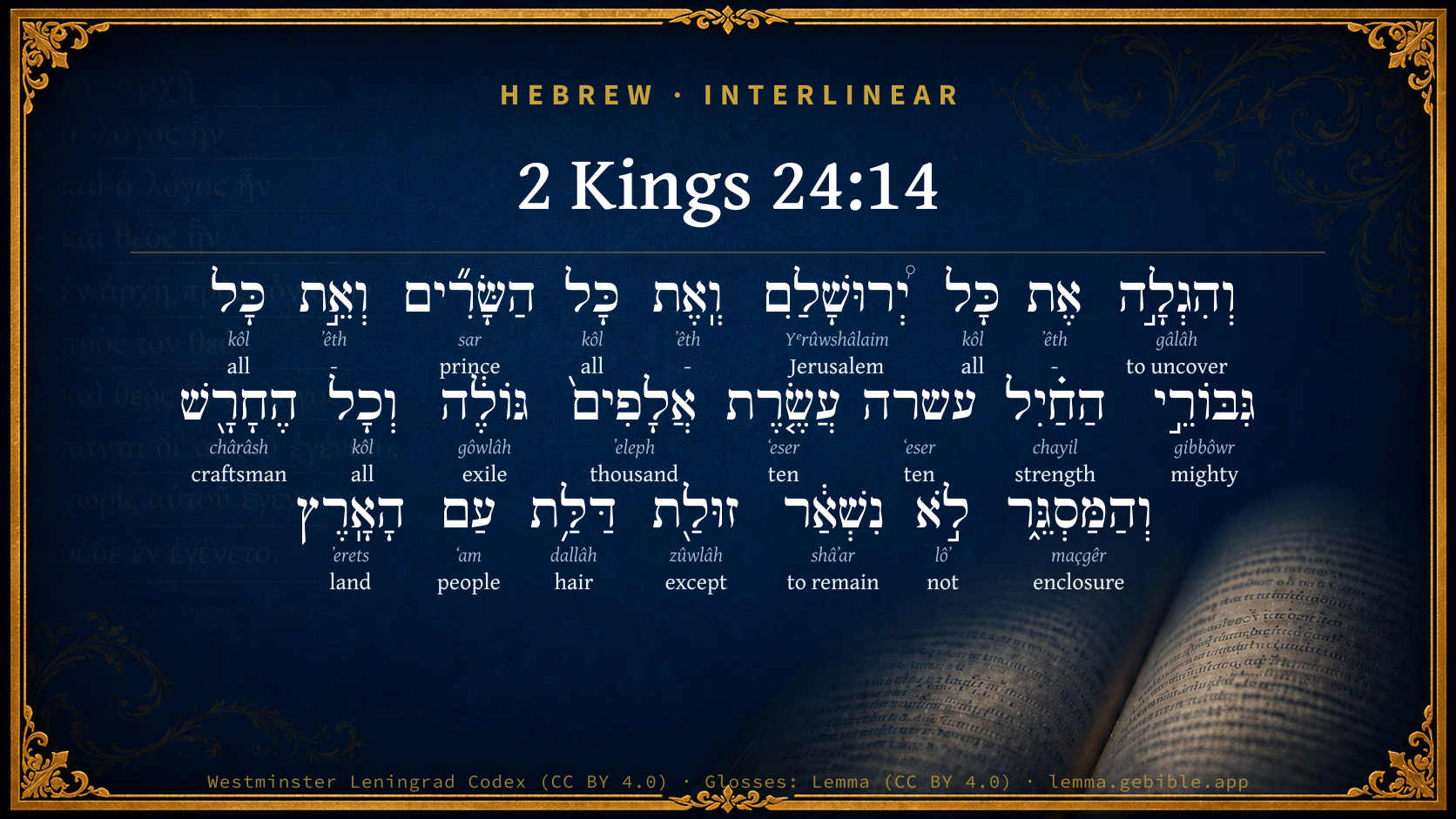
2 Kings 24:14

Hebrew (Westminster Leningrad Codex) 2 Kings 24:14 appears in the Hebrew Old Testament. The text above is from the Westminster Leningrad Codex. Each word links to its Strong’s number, a concise gloss, and parsing drawn from the Open Scriptures Hebrew Bible morphology. Click any word for its full Brown-Driver-Briggs (BDB) entry.
Download image
Cite this verse

2 Kings 24:14 (World English Bible). Public Domain. Lemma interlinear Bible study tool, https://lemma.gebible.app/v/2-kings/24/14.

Show BibTeX & RIS
BibTeX
RIS
English Translation
He carried away all Jerusalem, and all the princes, and all the mighty men of valor, even ten thousand captives, and all the craftsmen and the smiths; none remained, save the poorest sort of the people of the land.
World English Bible · Public Domain
Highlights
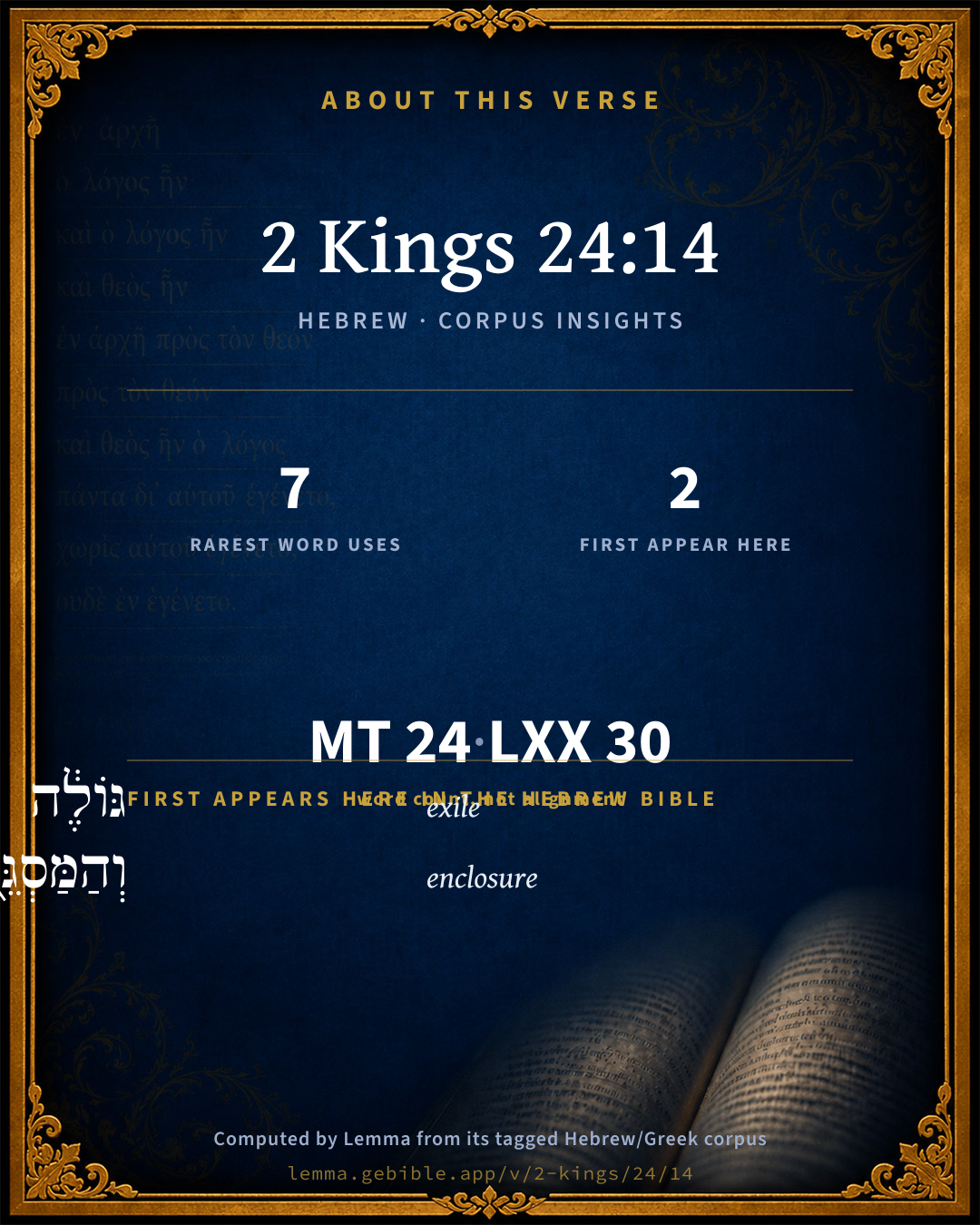
  • 2 first appearances in the Hebrew Bible
Full analysis ↓
Download a study sheet

One document with this verse’s original text, its word-by-word gloss line, the meaning frame, cross-references with their text, attributed commentary, and full source and license credits — printable, and it pastes into notes with its structure intact.

This verse Autodidact and up

Study sheet (.html) Plain text (.txt)

A passage Seminary Student

Up to 50 verses in one chapter. A passage sheet keeps up to 6 commentary sources and 12 cross-references per verse, in the order this page ranks them, and says so on the sheet whenever that leaves anything out. Ask for a single verse and you get the Autodidact verse sheet above.

Everything on this page stays free to read, with no account — the sheet is a download of what is already on screen, not access to it.

Want to remove ads? Support Godless Engineer
Compare translations 3

The same verse in 3 English versions, stacked beneath the original-language interlinear above. Click any original word for its lexicon entry.

Each is an independent rendering of the whole verse — the interlinear is not word-aligned to these translations.

Highlighted words mark where these versions differ — a whole-verse word diff, not a word-by-word alignment.

  • World English Bible Public Domain
    He carried away all Jerusalem, and all the princes, and all the mighty men of valor, even ten thousand captives, and all the craftsmen and the smiths; none remained, save the poorest sort of the people of the land.
  • King James Version Public Domain
    And he carried away all Jerusalem, and all the princes, and all the mighty men of valor, even ten thousand captives, and all the craftsmen and smiths: none remained, save the poorest sort of the people of the land.
  • unfoldingWord Literal Text CC BY-SA 4.0
    And he exiled all of Jerusalem and all of the commanders and all of the mighty of valor, exiling 10,000 and every craftsman and smith. One was not left except the poor of the people of the land.

unfoldingWord Literal Text — © unfoldingWord, licensed CC BY-SA 4.0. Word-aligned USFM3 via Door43 (git.door43.org/unfoldingWord/en_ult).

Versions to compare (up to 4)

3 of 4 selected

Show all 18 translations

Every available English version of this verse, each an independent rendering of the whole verse.

  • World English Bible Public Domain
    He carried away all Jerusalem, and all the princes, and all the mighty men of valor, even ten thousand captives, and all the craftsmen and the smiths; none remained, save the poorest sort of the people of the land.
  • Berean Standard Bible Public Domain
    He carried into exile all Jerusalem—all the commanders and mighty men of valor, all the craftsmen and metalsmiths—ten thousand captives in all. Only the poorest people of the land remained.
  • Majority Standard Bible Public Domain
    He carried into exile all Jerusalem—all the commanders and mighty men of valor, all the craftsmen and metalsmiths—ten thousand captives in all. Only the poorest people of the land remained.
  • King James Version Public Domain
    And he carried away all Jerusalem, and all the princes, and all the mighty men of valor, even ten thousand captives, and all the craftsmen and smiths: none remained, save the poorest sort of the people of the land.
  • American Standard Version (1901) Public Domain
    And he carried away all Jerusalem, and all the princes, and all the mighty men of valor, even ten thousand captives, and all the craftsmen and the smiths; none remained, save the poorest sort of the people of the land.
  • Revised Version (1885) Public Domain
    And he carried away all Jerusalem, and all the princes, and all the mighty men of valour, even ten thousand captives, and all the craftsmen and the smiths; none remained, save the poorest sort of the people of the land.
  • Geneva Bible (1599) Public Domain
    And he caryed away all Ierusalem, and all the princes, and all the strong men of warre, euen ten thousande into captiuitie, and all the workemen, and cunning men: so none remained sauing the poore people of the lande.
  • Douay-Rheims (1899) Public Domain
    And he carried away all Jerusalem, and all the princes, and all the valiant men of the army, to the number of ten thousand into captivity: and every artificer and smith: and none were left, but the poor sort of the people of the land.
  • Young's Literal Translation Public Domain
    And he hath removed all Jerusalem, and all the chiefs, and all the mighty ones of valour -- ten thousand `is' the removal -- and every artificer and smith, none hath been left save the poor of the people of the land.
  • Literal Standard Version CC BY-SA 4.0
    And he has removed all Jerusalem, and all the chiefs, and all the mighty men of valor—ten thousand [is] the expulsion—and every craftsman and smith; none has been left except the poor of the people of the land.
  • Unlocked Literal Bible CC BY-SA 4.0
    He took into exile all Jerusalem, all the leaders, and all the fighting men, ten thousand captives, and all the craftsmen and the smiths. No one was left except the poorest people in the land.
  • unfoldingWord Literal Text CC BY-SA 4.0
    And he exiled all of Jerusalem and all of the commanders and all of the mighty of valor, exiling 10,000 and every craftsman and smith. One was not left except the poor of the people of the land.
  • Darby Bible Public Domain
    And he carried away all Jerusalem, and all the princes, and all the mighty men of valour, ten thousand captives, and all the craftsmen and smiths: none remained but the poorest sort of the people of the land.
  • World Messianic Bible Public Domain
    He carried away all Jerusalem, and all the princes, and all the mighty men of valor, even ten thousand captives, and all the craftsmen and the smiths. No one remained except the poorest people of the land.
  • Webster's Bible Public Domain
    And he carried away all Jerusalem, and all the princes, and all the mighty men of valor, even ten thousand captives, and all the artificers, and smiths: none remained, save the poorest sort of the people of the land.
  • Free Bible Version CC BY-SA 4.0
    He deported all of Jerusalem, all the commanders and experienced soldiers, all the craftsmen and metal-workers, a total of ten thousand prisoners. Only the very poor people of the land were left.
  • Bible in Basic English Public Domain
    And he took away all the people of Jerusalem and all the chiefs and all the men of war, ten thousand prisoners; and all the expert workmen and the metal-workers; only the poorest sort of the people of the land were not taken away.
  • JPS Tanakh (1917) Public Domain
    And he carried away all Jerusalem, and all the princes, and all the mighty men of valour, even ten thousand captives, and all the craftsmen and the smiths; none remained, save the poorest sort of the people of the land.

Literal Standard Version (2020), Covenant Press — licensed CC BY-SA 4.0. Text via the HelloAO Bible API (eBible.org). Unlocked Literal Bible (unfoldingWord) — licensed CC BY-SA 4.0. Text via the HelloAO Bible API (eBible.org). unfoldingWord Literal Text — © unfoldingWord, licensed CC BY-SA 4.0. Word-aligned USFM3 via Door43 (git.door43.org/unfoldingWord/en_ult). Free Bible Version, Dr. Jonathan Gallagher — licensed CC BY-SA 4.0. Text via the HelloAO Bible API (eBible.org).

Word by word

More ways to search: Search by grammar → Find every occurrence → Compare this word →

Practice this passage: Drill this verse → Learn its vocabulary →

וְהַמַּסְגֵּ֑ר
maçgêr
H4525
“and · the · enclosure”
Conjunction + Particle, Definite Article + Noun, Common, Masculine, Singular, Absolute
Part of Speech
Conjunction + Particle + Noun
Type
Common
Gender
Masculine
Number
Singular
State
Absolute
Full BDB Definition

Origin: from H5462

TWOT: 1462c

a shutting up, locksmith, smith, dungeon, enclosure, builder of bulwarks - locksmith, smith - dungeon
  1. וְהִגְלָ֣ה gâlâh H1540 “and · to uncover” Conjunction + Verb, Hiphil, Perfect, 3rd Person, Masculine, Singular
  2. אֶת ʼêth H853 “-” Particle, Direct Object
  3. כָּל kôl H3605 “all of” Noun, Common, Masculine, Singular, Construct
  4. יְ֠רוּשָׁלִַם Yᵉrûwshâlaim H3389 “Jerusalem” Noun, Proper
  5. וְֽאֶת ʼêth H853 “and · -” Conjunction + Particle, Direct Object
  6. כָּל kôl H3605 “all of” Noun, Common, Masculine, Singular, Construct
  7. הַשָּׂרִ֞ים sar H8269 “the · princes” Particle, Definite Article + Noun, Common, Masculine, Plural, Absolute
  8. וְאֵ֣ת ʼêth H853 “and · -” Conjunction + Particle, Direct Object
  9. כָּל kôl H3605 “all of” Noun, Common, Masculine, Singular, Construct
  10. גִּבּוֹרֵ֣י gibbôwr H1368 “mighty of” Adjective, Adjective, Masculine, Plural, Construct
  11. הַחַ֗יִל chayil H2428 “the · strength” Particle, Definite Article + Noun, Common, Masculine, Singular, Absolute
  12. עשרה ʻeser H6235 “ten” Adjective, Cardinal number, Masculine, Singular, Absolute
  13. עֲשֶׂ֤רֶת ʻeser H6235 “ten” Adjective, Cardinal number, Masculine, Singular, Construct
  14. אֲלָפִים֙ ʼeleph H505 “thousand” Adjective, Cardinal number, Both, Plural, Absolute
  15. גּוֹלֶ֔ה gôwlâh H1473 “exile” Verb, Qal, Participle Active, Masculine, Singular, Absolute
  16. וְכָל kôl H3605 “and · all of” Conjunction + Noun, Common, Masculine, Singular, Construct
  17. הֶחָרָ֖שׁ chârâsh H2796 “the · craftsman” Particle, Definite Article + Noun, Common, Masculine, Singular, Absolute
  18. לֹ֣א lôʼ H3808 “not” Particle, Negative
  19. נִשְׁאַ֔ר shâʼar H7604 “to remain” Verb, Niphal, Perfect, 3rd Person, Masculine, Singular
  20. זוּלַ֖ת zûwlâh H2108 “except” Preposition
  21. דַּלַּ֥ת dallâh H1803 “hair of” Noun, Common, Feminine, Singular, Construct
  22. עַם ʻam H5971 “people of” Noun, Common, Masculine, Singular, Construct
  23. הָאָֽרֶץ ʼerets H776 “the · land” Particle, Definite Article + Noun, Common, Both, Singular, Absolute

About this verse

These counts appear in no published source. They are computed here, from the morphology-tagged text and Lemma’s own curated glosses. What Lemma adds →

24
words
18
distinct lemmas
Historical
section

Notable vocabulary

The rarest word here is וְהַמַּסְגֵּ֑ר enclosure H4525 — appearing just 7 times in the whole Hebrew Bible.

First appearance in Scripture

These words make their first canonical appearance in the Hebrew Bible here:

  • גּוֹלֶ֔ה exile H1473
  • וְהַמַּסְגֵּ֑ר enclosure H4525

Shared distinctive vocabulary

וְהַמַּסְגֵּ֑ר enclosure H4525 occurs in 7 verses of the Hebrew Bible. Also found in:

Grammatical profile

  • 3 verbs
  • 12 nouns
  • 4 adjectives
  • 1 preposition
  • 4 particles

Verb forms

  • וְהִגְלָ֣ה Hiphil · Perfect
  • גּוֹלֶ֔ה Qal · Participle Active
  • נִשְׁאַ֔ר Niphal · Perfect

Repetition

Words recur within this verse — often emphatic in Hebrew:

Hebrew & Septuagint length

In English translation the verse runs 39 words from the Hebrew and 35 from the Septuagint (LXX English) — closely comparable.

A rough comparison of the two English renderings, which tokenize alike — not a word-level alignment.

Word counts can differ between the Hebrew and the Greek without any difference in meaning — e.g. the Hebrew direct-object marker אֵת has no separate Greek word, and Greek often adds the article ὁ.

In the original languages it is 24 Hebrew tokens and 30 Greek tokens — but the two are counted differently (Hebrew bundles its prefixes and suffixes into one token; the Greek is in lemma form), so that isn’t a like-for-like length.

Cross-references

12

Topical passages linked to 2 Kings 24:14 in the Treasury of Scripture Knowledge — connected by theme and wording, ordered by reader-vote popularity; previews shown in the World English Bible.

  • Jeremiah 52:28 This is the people whom Nebuchadrezzar carried away captive: in the seventh year three thousand twenty-three Jews;
  • 2 Kings 25:12 But the captain of the guard left of the poorest of the land to work the vineyards and fields.
  • 2 Kings 24:16 All the men of might, even seven thousand, and the craftsmen and the smiths one thousand, all of them strong and apt for war, even them the king of Babylon brought captive to Babylon.
  • 2 Chronicles 36:9–10 Jehoiachin was eight years old when he began to reign; and he reigned three months and ten days in Jerusalem: and he did that which was evil in the sight of Yahweh.
  • Jeremiah 39:10 But Nebuzaradan the captain of the guard left of the poor of the people, who had nothing, in the land of Judah, and gave them vineyards and fields at the same time.
  • Jeremiah 40:7 Now when all the captains of the forces who were in the fields, even they and their men, heard that the king of Babylon had made Gedaliah the son of Ahikam governor in the land, and had committed to him men, and women, and children, and of the poorest of the land, of those who were not carried away captive to Babylon;
  • Jeremiah 52:16 But Nebuzaradan the captain of the guard left of the poorest of the land to be vineyard keepers and farmers.
  • Ezekiel 1:1–2 Now it happened in the thirtieth year, in the fourth [month], in the fifth [day] of the month, as I was among the captives by the river Chebar, that the heavens were opened, and I saw visions of God.
  • 1 Samuel 23:19–22 Then came up the Ziphites to Saul to Gibeah, saying, Doesn't David hide himself with us in the strongholds in the wood, in the hill of Hachilah, which is on the south of the desert?
  • Jeremiah 24:1–5 Yahweh shown me, and, behold, two baskets of figs set before the temple of Yahweh, after that Nebuchadrezzar king of Babylon had carried away captive Jeconiah the son of Jehoiakim, king of Judah, and the princes of Judah, with the craftsmen and smiths, from Jerusalem, and had brought them to Babylon.
  • Jeremiah 29:2 (after that Jeconiah the king, and the queen-mother, and the eunuchs, [and] the princes of Judah and Jerusalem, and the craftsmen, and the smiths, were departed from Jerusalem),
  • Ezekiel 17:14 that the kingdom might be base, that it might not lift itself up, but that by keeping his covenant it might stand.

Cross-references courtesy of OpenBible.info (CC BY 4.0).

Hebrew and Greek witnesses Masoretic Hebrew ↔ Greek Septuagint

The same verse in the two great witnesses to the Old Testament, shown verse-for-verse.

These are two independent witnesses, not word-aligned to each other, and the Septuagint is shown in lemma (dictionary) form.

Hebrew 2 Kings 24:14 Masoretic · Westminster Leningrad Codex

וְהִגְלָ֣ה אֶת כָּל יְ֠רוּשָׁלִַם וְֽאֶת כָּל הַשָּׂרִ֞ים וְאֵ֣ת כָּל גִּבּוֹרֵ֣י הַחַ֗יִל עשרה עֲשֶׂ֤רֶת אֲלָפִים֙ גּוֹלֶ֔ה וְכָל הֶחָרָ֖שׁ וְהַמַּסְגֵּ֑ר לֹ֣א נִשְׁאַ֔ר זוּלַ֖ת דַּלַּ֥ת עַם הָאָֽרֶץ

He carried away all Jerusalem, and all the princes, and all the mighty men of valor, even ten thousand captives, and all the craftsmen and the smiths; none remained, save the poorest sort of the people of the land.

World English Bible · Public Domain

Greek LXX 2 Kings 24:14 Septuagint · lemma form

καί ἀποοἰκίζω ὁ ἰερουσαλήμ καί πᾶς ὁ ἄρχων καί ὁ δυνατός ἰσχύς αἰχμαλωσία δέκα χιλιάς αἰχμαλωτίζω καί πᾶς τέκτων καί ὁ συνκλείω καί οὐ ὑπολείπω πλήν ὁ πτωχός ὁ γῆ

And he carried away the inhabitants of Jerusalem, and all the captains, and the mighty men, taking captive ten thousand prisoners, and every artificer and smith: and only the poor of the land were left.

LXX2012 (modern English Septuagint) · Public Domain

Hebrew: Westminster Leningrad Codex (CC BY 4.0). Greek: Septuagint (public domain); English from LXX2012 (modern English Septuagint) (Public Domain). How the Septuagint differs from the Hebrew →

Targum (Aramaic paraphrase)

1

The Targum is the ancient Jewish Aramaic paraphrase of the Hebrew Scriptures — an interpretive translation, not the Hebrew text itself. Onkelos (literal) and Pseudo-Jonathan (expansive) render the Torah, and Jonathan the Prophets. Coverage is partial: where no permissively-licensed English translation exists for a verse, only the Aramaic is shown. This is verse-level text, not a word-by-word alignment to the Hebrew.

  1. Targum Jonathan Prophets (Joshua–Malachi)
    וְאַגְלֵי יַת כָּל יְרוּשְׁלֵם וְיַת כָּל רַבְרְבַיָא וְיַת כָּל גִבָּרֵי חֵילָא עַסְרָא אַלְפִין בְּגָלוּתָא וְכָל אוּמָנַיָא וְתַרְעַיָא לָא אִשְׁתְּאַר אֱלָהֵין חֲשִׁיכֵי עַמָא דְאַרְעָא:

    (no public-domain English translation for this verse)

    Targum Jonathan — Aramaic: “Mikraot Gedolot” (public domain). English: “Sefaria Community Translation” (CC0 1.0 (public-domain dedication)); “London "Chaldee Paraphrase," 1871” (public domain). Text via Sefaria.

Commentary

Notes on 2 Kings 24:14 from classic Christian and Jewish commentators (each source and its license shown beneath its notes). The classic Christian expositions comment on the surrounding passage and are grouped to its opening verse, so a note may address several verses; the Jewish commentaries on the Tanakh (Rashi and others) are per-verse, so they appear only where the commentator wrote on this verse.

Lemma curates 59 commentaries, every one of them public domain or Creative Commons licensed, each selected and text-cleaned for this edition rather than reprinted as found. About our sources →

Trapp's Complete Commentary

John Trapp

2Ki 24:14 And he carried away all Jerusalem, and all the princes, and all the mighty men of valour, [even] ten thousand captives, and all the craftsmen and smiths: none remained, save the poorest sort of the people of the land.

Ver. 14. And he carried away all Jerusalem,] i.e., The greater and better part of the people: among the rest, Mordecai the Benjamite the son of Jair, {Est 2:5-6} and Ezekiel the priest, the son of Buzi, {Eze 1:2-3} who therefore calls it his "captivity" or deportation. {Eze 40:1}

And all the craftsmen and smiths.] The like craft useth the devil, when he endeavoureth to take out of the way such as are zealous and active, valiant for God’s truth, and violent for his kingdom. {a}

{a} A Lapide.

John Trapp, A Commentary or Exposition upon All the Books of the Old and New Testament (1647–1656) — public domain. Text from a community e-Sword module.

Albert Barnes' Notes on the Bible

The entire number of the captives was not more than 11,000. They consisted of three classes:

(1) the “princes” or “mighty of the land,” i. e., courtiers, priests, elders, and all who had any position or dignity - in number 3,000 (compare 2Ki 24:14, 2Ki 24:16).

(2) the “mighty men of valor” or “men of might,” i. e., the soldier class, who were 7,000. And

(3) craftsmen or artisans, who numbered 1,000. The word here translated “craftsmen” denotes artisans in stone, wood, or metal, and thus includes our “masons, carpenters, and smiths.” The word translated “smiths” means strictly “lock-smiths.”

The object of carrying off these persons was twofold:

(1) it deprived the conquered city of those artisans who were of most service in war; and

(2) it gave the conqueror a number of valuable assistants in the construction of his buildings and other great works.

The Assyrian monarchs frequently record their removal of the skilled artisans from a conquered country. The population of the ancient city has been calculated, from its area, at 15,000. The remnant left was therefore about 5000 or 6,000.

Albert Barnes' Notes on the Bible (1834–1885) — public domain. Text from a community e-Sword/MySword module.

Joseph Benson's Commentary

2Ki 24:14. He carried away all Jerusalem — That is, the inhabitants of Jerusalem; not simply all, but the best and most considerable part, as the following words explain and restrain it. Even ten thousand captives — Which are more particularly reckoned up 2Ki 24:16, where there are seven thousand mighty men, and a thousand smiths; and those mentioned 2Ki 24:15 make up the other two thousand. Craftsmen and smiths — Who might furnish them with new arms, and thereby give him fresh trouble.

Joseph Benson's Commentary on the Old and New Testaments (1811–1818) — public domain. Text from a community e-Sword module.

Keil & Delitzsch

C. F. Keil & F. Delitzsch

Beside these treasures, he carried away captive to Babylon the cream of the inhabitants of Jerusalem, not only the most affluent, but, as is evident from Jer 24:1-10, the best portion in a moral respect. In Kg2 24:14 the number of those who were carried off is simply given in a general form, according to its sum-total, as 10,000; and then in Kg2 24:15, Kg2 24:16 the details are more minutely specified. "All Jerusalem" is the whole of the population of Jerusalem, which is first of all divided into two leading classes, and then more precisely defined by the clause, "nothing was left except the common people," and reduced to the cream of the citizens. The king, queen-mother, and king's wives being passed over and mentioned for the first time in the special list in Kg2 24:15, there are noticed here כּל־השּׂרים and החיל גּבּורי כּל, who form the first of the leading classes. By the שׂרים are meant, according to Kg2 24:15, the סריסים, chamberlains, i.e., the officials of the king's court in general, and by הארץ אוּלי ("the mighty of the land") all the heads of the tribes and families of the nation that were found in Jerusalem; and under the last the priests and prophets, who were also carried away according to Jer 29:1, with Ezekiel among them (Eze 1:1), are included as the spiritual heads of the people. The החיל גּבּורי are called החיל אנשׁי in Kg2 24:16; their number was 7000. The persons intended are not warriors, but men of property, as in Kg2 15:20. The second class of those who ere carried away consisted of כּל־החרשׁ, all the workers in stone, metal, and wood, that is to say, masons, smiths, and carpenters; and המּסגּר, the locksmiths, including probably not actual locksmiths only, but makers of weapons also. There is no need for any serious refutation of the marvellous explanation given of מסגּר by Hitzig (on Jer 24:1), who derives it from מס and גּר, and supposes it to be an epithet applied to the remnant of the Canaanites, who had been made into tributary labourers, although it has been adopted by Thenius and Graf, who make them into artisans of the foreign socagers. עם־הארץ דּלּת = דלּת־הארץ (Kg2 25:12), the poor people of the land, i.e., the lower portion of the population of Jerusalem, from whom Nebuchadnezzar did not fear any rebellion, because they possessed nothing (Jer 39:10), i.e., neither property (money nor other possessions), nor strength and ability to organize a revolt. The antithesis to these formed by the מלחמה עשׂי מ גּבּורים, the strong or powerful men, who were in a condition to originate and carry on a war; for this category includes all who were carried away, not merely the thousand workmen, but also the seven thousand החיל אנשׁי, and the king's officers and the chiefs of the nation, whose number amounted to two thousand, since the total number of the exiles was then thousand. There is no special allusion to warriors or military, because in the struggle for the rescue of the capital and the kingdom from destruction every man who could bear arms performed military service, so that the distinction between warriors and non-warriors was swept away, and the actual warriors are swallowed up in the ten thousand. Babel is the country of Babylonia, or rather the Babylonian empire.

Keil & Delitzsch — Biblical Commentary on the Old Testament (1861–1891) — public domain (CC PDM 1.0). Text via the HelloAO Bible API. (Old Testament only.)

Tyndale Open Study Notes

Tyndale Open Resources

24:14-16 In addition to Jehoiachin, the prophet Ezekiel was also taken into captivity (Ezek 1:1). Throughout the book of Ezekiel, events in Ezekiel’s life are dated in terms of the years since Jehoiachin had been taken captive. • The 10,000 taken captive by Nebuchadnezzar likely includes 7,000 . . . troops, 1,000 craftsmen and artisans, and a number of administrative officials and leading citizens of Jerusalem. In any case, 10,000 is probably a round figure (see also Jer 52:28).

Tyndale Open Study Notes — © Tyndale Open Resources, licensed CC BY-SA 4.0. Text via the HelloAO Bible API.

Adam Clarke's Commentary

Verse 14. He carried away all Jerusalem] That is, all the chief men, the nobles, and artificers. Among these there were of mighty men seven thousand; of craftsmen and smiths, one thousand.

Adam Clarke's Commentary on the Bible (1810–1826) — public domain. Text from a community e-Sword/MySword module.

Ellicott's Commentary for English Readers

(14) All Jerusalem.—Limited by what follows, and meaning the most important part of the population.

The princes—i.e., the nobles, e.g., the grandees of the court, some of the priests (Eze_1:1), and the heads of the clans.

The mighty men of valour.—This is probably right. Thenius and Bähr prefer to understand the men of property and the artisans, as in 2Ki_15:20.

All the craftsmen and smiths.—The former were workers in wood, stone, and metal, i.e., carpenters, masons, and smiths. (Comp. Gen_4:22.) The “smiths” (properly, “they who shut”) answer to what we should call locksmiths. They were makers of bolts and bars for doors and gates (Jer_24:1; Jer_29:2). It is obvious that by deporting “the craftsmen and smiths” the king of Babylon made further outbreaks impossible (comp. 1Sa_13:19.) Kimchi’s explanation of “smiths” is a curiosity of exegesis. He makes of them “learned persons, who shut other people’s mouths, and propose riddles which nobody else can guess.” Hitzig and Thenius derive the word (masgçr) from mas, “levy,” and gçr, “alien,” so that it would originally mean “statute labourers,” “Canaanites compelled to work for the king;” and afterwards, as here, “manual labourers” in general. But such a compound term in Hebrew would be very surprising.

The poorest sort.—Those who had neither property nor handicraft. (Comp. Jer_39:10.)

A Bible Commentary for English Readers, edited by Charles John Ellicott (1878–1897) — public domain. Text from a community e-Sword module.

The Cambridge Bible for Schools and Colleges

gen. ed. J. J. S. Perowne

14. he carried away all Jerusalem] The policy of Nebuchadnezzar was to remove out of the way all those who might be able to organize and plan a revolt when he and his army had departed. Hence all the people of rank, of wealth, and of skill as handicraftsmen are deported, and only the poorest folk left, who had neither knowledge nor means for doing more than work of drudgery. The total number of captives was 10,000. In verse 16 the numbers of some classes are specified, the ‘men of might’ were 7000, and the craftsmen 1000, which leaves 2000 for the royal household and their retainers, and the princes and the others who are spoken of in the general phrase as ‘strong and apt for war’. Such men it would have been dangerous to leave behind. In this captivity the prophet Ezekiel was included. See Eze_1:3.

The Cambridge Bible for Schools and Colleges (gen. ed. J. J. S. Perowne; Cambridge University Press, 1878–1918) — public domain. Text from a community e-Sword module.

John Gill's Exposition

And all the men of might, even seven thousand,.... The particulars of the 10,000 carried captive are here given; 7000 of which were the principal men of the land:

and craftsmen and smiths one thousand; which made 8000:

all that were strong, and apt for war; of these consisted the other 2000; so Abarbinel reckons them; but, according to the Jewish chronologer (t), which Jarchi and other Jewish commentators follow, the 7000 were out of the tribe of Benjamin and the rest of the tribes, and the 3000 out of the tribe of Judah, which are supposed to be those Jeremiah speaks of, Jer 52:28,

even them the king of Babylon brought captive to Babylon; among these were Ezekiel the prophet, and Mordecai, the uncle of Esther.

(t) Seder Olam Rabba, c. 25.

John Gill's Exposition of the Whole Bible (1746–1763) — public domain (CC PDM 1.0). Text via the HelloAO Bible API.

Haydock's Catholic Bible Commentary

All; the chief men, chap. xxv. 18. Ezechiel and Mardocheus were in the number. --- Engraver. The first term means a workman in wood, stone, &c.; the latter seems to designate a mason, smith, or garrison-soldier; (Calmet) or one expert in making camps; (Sa) an engineer. (Tirinus) --- St. Jerome explains it of one who enchases jewels in gold. (Menochius) --- Hecateus and Demetrius (ap. Jos.[Josephus?] and Clement of Alexandria) mention this transportation. (Du Hamel)

George Leo Haydock (1774–1849), Haydock's Catholic Family Bible and Commentary, 1859 edition — public domain. Excludes Psalms (Douay-Rheims chapter numbering differs from Protestant) and Deuterocanonical books (Catholic canon only).

Matthew Poole's English Annotations

All Jerusalem, i.e. the inhabitants of Jerusalem; not simply all, but the best and most considerable part, as the following words explain and restrain it.

Ten thousand captives; which are more particularly reckoned up, 2Ki 24:16, where there are seven thousand mighty men, and a thousand smiths; and those mentioned 2Ki 24:15 make up the other two thousand.

All the craftsmen and smiths; which might furnish them with new arms, and thereby give him fresh trouble.

Matthew Poole's English Annotations on the Holy Bible (1683–1685) — public domain. Text from a community e-Sword/MySword module.

Whedon's Commentary on the Bible

Daniel D. Whedon

14. Ten thousand captives — According to Jer_52:28, they numbered three thousand and twenty-three. See note on 2Ki_25:21. Numerically this must have been only a small part of the entire Jewish population, which in David’s time numbered five hundred thousand warriors, so that the poorest sort of the people, from whom rebellion and trouble were not expected, were more than the captives; but these latter were the might and flower of the nation, and might, therefore, well be called all Jerusalem. The mass of those left were people of the land, country people, dwelling outside of Jerusalem; and no doubt by reason of the numerous wars this part of the population had become greatly diminished since the time of David. The craftsmen and smiths would be especially serviceable to Nebuchadnezzar on the great works which he contemplated at his capital.

Daniel D. Whedon (gen. ed.), Commentary on the Old and New Testaments (1874–1909) — public domain. Text from a community e-Sword module.

The Pulpit Commentary

And he carried away all Jerusalem. The expression has to be limited by what follows. "All Jerusalem" means all that was important in the population of Jerusalem all the upper classes, the "princes" and "nobles," all the men trained to the use of arms, and all the skilled craftsmen and artisans of the city. The poor and weak and unskilled were left. The number deported, according to our author, was either ten or eleven thousand. The whole population of the ancient city has been calculated from its area at fifteen thousand. The largest estimate of the population of the modern city is seventeen thousand. And all the princes. The sarim, or "princes," are not males of the blood royal, but the nobles, or upper classes of Jerusalem. (comp. Jer_25:18 Jer_26:10-16, etc.) And all the mighty men of valori.e. "all the trained troops" (Ewald); not "all the men of wealth," as Bahr renderseven ten thousand captives. As the soldiers are reckoned below (ver. 16) at seven thousand, and the craftsmen at one thousand, the upper-class captives would seem to have been two thousand; unless, indeed, the "craftsmen" are additional to the ten thousand, in which Case the upper-class captives would have numbered three thousand, and the prisoners have amounted altogether to eleven thousand. And all the craftsmen and smiths. Ewald understands "the military workmen and siege engineers" to be intended ("History of Israel," vol. 4. p. 263, note 9); but the term vrj in Hebrew includes all workers in stone, metal, or wood (Gen_4:22; Isa_44:12; 1Ki_7:14) and there is nothing to limit it here to military craftsmen. It was an Oriental practice to weaken a state by the deportation of all the stronger elements of its population. None remained, save the poorest sort of the people of the land. These words must be taken with some latitude. There are still "princes" in Jerusalem under Zedekiah, (Jer_38:4, Jer_38:25, Jer_38:27) and courtiers of rank, (Jer_38:7) and "captains of forces", (Jer_40:7) and "men of war". (Jer_52:7) But the bulk of the inhabitants now left behind in Jerusalem were poor and of small account.

The Pulpit Commentary (1880–1919), ed. H.D.M. Spence-Jones & Joseph S. Exell — public domain. Text from a community e-Sword module.

John Wesley's Explanatory Notes

All - Not simply all, but the best and most considerable part, as the following words explain it. Captives - Which are more particularly reckoned up, ver. 16, where there are seven thousand mighty men, and a thousand smiths; and those mentioned ver. 15, make up the other two thousand. Craftsmen and smiths - Who might furnish them with new arms, and thereby give him fresh trouble.

John Wesley, Explanatory Notes Upon the Whole Bible (1754–1765) — public domain. Text via the GEBible commentary corpus.

Rashi

Rabbi Shlomo Yitzchaki (Rashi)

Craftsmen and gatekeepers. [Targum] Yonoson rendered the craftsmen and the sentries of the gates. But, our Rabbis said that these were great Torah scholars, that when one would begin [to speak], all remained silent [=חרש], as it is written, “Be silent before Me, O islands.” ”מסגר” [is one who] all sit before him and learn from him, as it is stated, ”And he will open, and no one will close, and he will close, and no one will open.”

Rashi on the Tanakh — English translations: “The Judaica Press complete Tanach with Rashi, translated by A. J. Rosenberg” (CC BY 4.0); “Pentateuch with Rashi's commentary by M. Rosenbaum and A.M. Silbermann, 1929-1934” (public domain); “The Metsudah Tanach series, Lakewood, N.J” (CC BY 4.0); and “The Book of Joshua, Metsudah Publications, 1997” (CC BY 4.0). Text via Sefaria.

Lesson kit

Teaching starters — assembled from the data on this page, not authored interpretation. Every prompt links to the verse data it draws on. Edit before teaching.

2 Kings, in the Historical, opens this verse with 24 words (18 distinct Hebrew lemmas). Its most distinctive word is maçgêr (“enclosure”). A historical commentator’s framing appears above. Read the whole chapter for the surrounding context.

Discussion questions

  1. The word maçgêr carries the sense “enclosure.” How does it shape the verse?
  2. 2 words make their first appearance in Scripture here. What does this debut establish?
  3. How does 2 Kings 24:16, which shares the word «enclosure», read alongside this verse?
  4. What does the repetition of “all” (4× in this one verse) do in this verse?
  5. The translations on this page render this verse differently — a whole-verse word diff, not a word-by-word alignment. What might account for the different wordings?
  6. «וְהִגְלָ֣ה» is a Hiphil Perfect verb. How does that grammatical form shape the action described?
  7. Compare how Trapp's Complete Commentary and Albert Barnes' Notes on the Bible read this verse. Where do they agree or differ?

Things to notice

Reading settings

Reading text

Shown beneath each verse's original-language words.

Old Testament
Old Testament edition

Read the OT as the Masoretic Hebrew (MT) or the Greek Septuagint (LXX).

English shown for the Greek Septuagint (in the Hebrew ↔ Greek comparison).

Comparing translations? Open the Compare panel on any verse page to stack up to four side by side.