
2 Chronicles 17:2

Hebrew (Westminster Leningrad Codex) 2 Chronicles 17:2 appears in the Hebrew Old Testament. The text above is from the Westminster Leningrad Codex. Each word links to its Strong’s number, a concise gloss, and parsing drawn from the Open Scriptures Hebrew Bible morphology. Click any word for its full Brown-Driver-Briggs (BDB) entry.
Download image
Cite this verse

2 Chronicles 17:2 (World English Bible). Public Domain. Lemma interlinear Bible study tool, https://lemma.gebible.app/v/2-chronicles/17/2.

Show BibTeX & RIS
BibTeX
RIS
English Translation
He placed forces in all the fortified cities of Judah, and set garrisons in the land of Judah, and in the cities of Ephraim, which Asa his father had taken.
World English Bible · Public Domain
Download a study sheet

One document with this verse’s original text, its word-by-word gloss line, the meaning frame, cross-references with their text, attributed commentary, and full source and license credits — printable, and it pastes into notes with its structure intact.

This verse Autodidact and up

Study sheet (.html) Plain text (.txt)

A passage Seminary Student

Up to 50 verses in one chapter. A passage sheet keeps up to 6 commentary sources and 12 cross-references per verse, in the order this page ranks them, and says so on the sheet whenever that leaves anything out. Ask for a single verse and you get the Autodidact verse sheet above.

Everything on this page stays free to read, with no account — the sheet is a download of what is already on screen, not access to it.

Want to remove ads? Support Godless Engineer
Compare translations 3

The same verse in 3 English versions, stacked beneath the original-language interlinear above. Click any original word for its lexicon entry.

Each is an independent rendering of the whole verse — the interlinear is not word-aligned to these translations.

Highlighted words mark where these versions differ — a whole-verse word diff, not a word-by-word alignment.

  • World English Bible Public Domain
    He placed forces in all the fortified cities of Judah, and set garrisons in the land of Judah, and in the cities of Ephraim, which Asa his father had taken.
  • King James Version Public Domain
    And he placed forces in all the fenced cities of Judah, and set garrisons in the land of Judah, and in the cities of Ephraim, which Asa his father had taken.
  • unfoldingWord Literal Text CC BY-SA 4.0
    And he placed a force in all the unassailable cities of Judah, and he placed garrisons in the land of Judah and in the cities of Ephraim, which Asa his father had captured.

unfoldingWord Literal Text — © unfoldingWord, licensed CC BY-SA 4.0. Word-aligned USFM3 via Door43 (git.door43.org/unfoldingWord/en_ult).

Versions to compare (up to 4)

3 of 4 selected

Show all 18 translations

Every available English version of this verse, each an independent rendering of the whole verse.

  • World English Bible Public Domain
    He placed forces in all the fortified cities of Judah, and set garrisons in the land of Judah, and in the cities of Ephraim, which Asa his father had taken.
  • Berean Standard Bible Public Domain
    He stationed troops in every fortified city of Judah and put garrisons in the land of Judah and in the cities of Ephraim that his father Asa had captured.
  • Majority Standard Bible Public Domain
    He stationed troops in every fortified city of Judah and put garrisons in the land of Judah and in the cities of Ephraim that his father Asa had captured.
  • King James Version Public Domain
    And he placed forces in all the fenced cities of Judah, and set garrisons in the land of Judah, and in the cities of Ephraim, which Asa his father had taken.
  • American Standard Version (1901) Public Domain
    And he placed forces in all the fortified cities of Judah, and set garrisons in the land of Judah, and in the cities of Ephraim, which Asa his father had taken.
  • Revised Version (1885) Public Domain
    And he placed forces in all the fenced cities of Judah, and set garrisons in the land of Judah, and in the cities of Ephraim, which Asa his father had taken.
  • Geneva Bible (1599) Public Domain
    And he put garisons in all the strong cities of Iudah, and set bandes in the lande of Iudah and in the cities of Ephraim, which Asa his father had taken.
  • Douay-Rheims (1899) Public Domain
    And he placed numbers of soldiers in all the fortified cities of Juda. And he put garrisons in the land of Juda, and in the cities of Ephraim, which Asa his father had taken.
  • Young's Literal Translation Public Domain
    and putteth a force in all the fenced cities of Judah, and putteth garrisons in the land of Judah, and in the cities of Ephraim that Asa his father had captured.
  • Literal Standard Version CC BY-SA 4.0
    and puts a force in all the fortified cities of Judah, and puts garrisons in the land of Judah, and in the cities of Ephraim that his father Asa had captured.
  • Unlocked Literal Bible CC BY-SA 4.0
    He placed forces in all the fortified cities of Judah, and set garrisons in the land of Judah and in the cities of Ephraim, which Asa his father had captured.
  • unfoldingWord Literal Text CC BY-SA 4.0
    And he placed a force in all the unassailable cities of Judah, and he placed garrisons in the land of Judah and in the cities of Ephraim, which Asa his father had captured.
  • Darby Bible Public Domain
    And he placed forces in all the fortified cities of Judah, and set garrisons in the land of Judah, and in the cities of Ephraim that Asa his father had taken.
  • World Messianic Bible Public Domain
    He placed forces in all the fortified cities of Judah, and set garrisons in the land of Judah and in the cities of Ephraim, which Asa his father had taken.
  • Webster's Bible Public Domain
    And he placed forces in all the fortified cities of Judah, and set garrisons in the land of Judah, and in the cities of Ephraim, which Asa his father had taken.
  • Free Bible Version CC BY-SA 4.0
    He assigned troops to every fortified city of Judah and placed garrisons throughout Judah and in the towns of Ephraim that his father Asa had captured.
  • Bible in Basic English Public Domain
    He put forces in all the walled towns of Judah, and responsible chiefs in the land of Judah and in the towns of Ephraim, which Asa his father had taken.
  • JPS Tanakh (1917) Public Domain
    And he placed forces in all the fortified cities of Judah, and set garrisons in the land of Judah, and in the cities of Ephraim, which Asa his father had taken.

Literal Standard Version (2020), Covenant Press — licensed CC BY-SA 4.0. Text via the HelloAO Bible API (eBible.org). Unlocked Literal Bible (unfoldingWord) — licensed CC BY-SA 4.0. Text via the HelloAO Bible API (eBible.org). unfoldingWord Literal Text — © unfoldingWord, licensed CC BY-SA 4.0. Word-aligned USFM3 via Door43 (git.door43.org/unfoldingWord/en_ult). Free Bible Version, Dr. Jonathan Gallagher — licensed CC BY-SA 4.0. Text via the HelloAO Bible API (eBible.org).

Word by word

More ways to search: Search by grammar → Find every occurrence → Compare this word →

Practice this passage: Drill this verse → Learn its vocabulary →

נְצִיבִים֙
nᵉtsîyb
H5333
“garrisons”
Noun, Common, Masculine, Plural, Absolute
Part of Speech
Noun
Type
Common
Gender
Masculine
Number
Plural
State
Absolute
Full BDB Definition

Origin: from H5324

TWOT: 1398b

set over, something placed, pillar, prefect, garrison, post - pillar - prefect, deputy
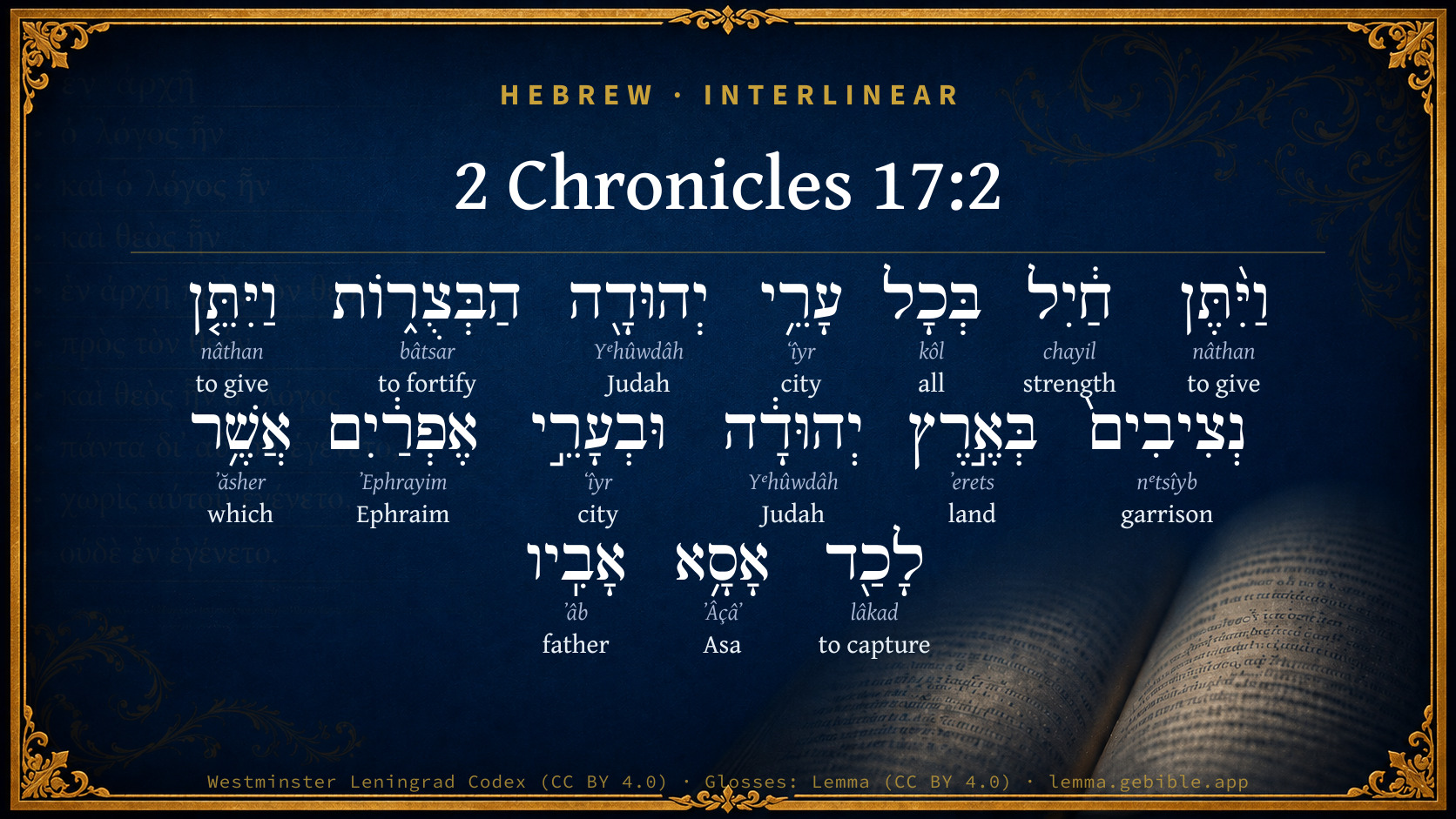
  1. וַיִּ֨תֶּן nâthan H5414 “and · to give” Conjunction + Verb, Qal, Sequential Imperfect, 3rd Person, Masculine, Singular
  2. חַ֔יִל chayil H2428 “strength” Noun, Common, Masculine, Singular, Absolute
  3. בְּכָל kôl H3605 “in/at · all of” Preposition + Noun, Common, Masculine, Singular, Construct
  4. עָרֵ֥י ʻîyr H5892 “cities of” Noun, Common, Feminine, Plural, Construct
  5. יְהוּדָ֖ה Yᵉhûwdâh H3063 “Judah” Noun, Proper
  6. הַבְּצֻר֑וֹת bâtsar H1219 “the · fortified” Particle, Definite Article + Adjective, Adjective, Feminine, Plural, Absolute
  7. וַיִּתֵּ֤ן nâthan H5414 “and · to give” Conjunction + Verb, Qal, Sequential Imperfect, 3rd Person, Masculine, Singular
  8. בְּאֶ֣רֶץ ʼerets H776 “in/at · land of” Preposition + Noun, Common, Both, Singular, Construct
  9. יְהוּדָ֔ה Yᵉhûwdâh H3063 “Judah” Noun, Proper
  10. וּבְעָרֵ֣י ʻîyr H5892 “and · in/at · cities of” Conjunction + Preposition + Noun, Common, Feminine, Plural, Construct
  11. אֶפְרַ֔יִם ʼEphrayim H669 “Ephraim” Noun, Proper
  12. אֲשֶׁ֥ר ʼăsher H834 “which” Particle, Relative
  13. לָכַ֖ד lâkad H3920 “to capture” Verb, Qal, Perfect, 3rd Person, Masculine, Singular
  14. אָסָ֥א ʼÂçâʼ H609 “Asa” Noun, Proper
  15. אָבִֽיו ʼâb H1 “father · his” Noun, Common, Masculine, Singular, Construct + Suffix, Personal, 3rd Person, Masculine, Singular

About this verse

These counts appear in no published source. They are computed here, from the morphology-tagged text and Lemma’s own curated glosses. What Lemma adds →

16
words
13
distinct lemmas
Historical
section

Notable vocabulary

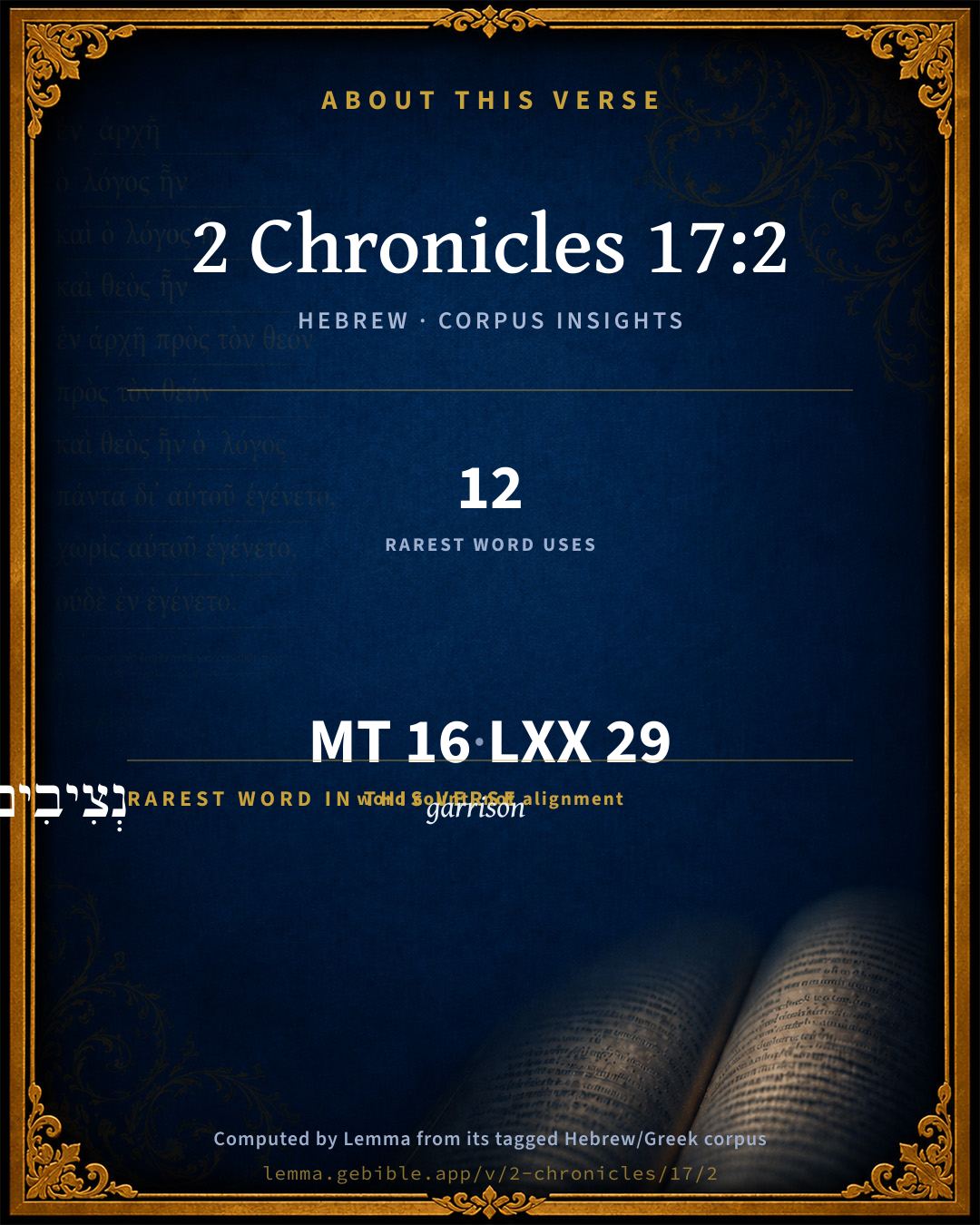
The rarest word here is נְצִיבִים֙ garrison H5333 — appearing just 12 times in the whole Hebrew Bible.

Shared distinctive vocabulary

נְצִיבִים֙ garrison H5333 occurs in 11 verses of the Hebrew Bible. Also found in:

Grammatical profile

  • 3 verbs
  • 11 nouns
  • 1 adjective
  • 1 particle

Verb forms

  • וַיִּ֨תֶּן Qal · Sequential Imperfect
  • וַיִּתֵּ֤ן Qal · Sequential Imperfect
  • לָכַ֖ד Qal · Perfect

Repetition

Words recur within this verse — often emphatic in Hebrew:

  • וַיִּ֨תֶּן to give H5414 ×2
  • עָרֵ֥י city H5892 ×2
  • יְהוּדָ֖ה Judah H3063 ×2

Hebrew & Septuagint length

In English translation the verse runs 30 words from the Hebrew and 32 from the Septuagint (LXX English) — closely comparable.

A rough comparison of the two English renderings, which tokenize alike — not a word-level alignment.

Word counts can differ between the Hebrew and the Greek without any difference in meaning — e.g. the Hebrew direct-object marker אֵת has no separate Greek word, and Greek often adds the article ὁ.

In the original languages it is 16 Hebrew tokens and 29 Greek tokens — but the two are counted differently (Hebrew bundles its prefixes and suffixes into one token; the Greek is in lemma form), so that isn’t a like-for-like length.

Cross-references

3

Topical passages linked to 2 Chronicles 17:2 in the Treasury of Scripture Knowledge — connected by theme and wording, ordered by reader-vote popularity; previews shown in the World English Bible.

  • 2 Chronicles 15:8 When Asa heard these words, and the prophecy of Oded the prophet, he took courage, and put away the abominations out of all the land of Judah and Benjamin, and out of the cities which he had taken from the hill-country of Ephraim; and he renewed the altar of Yahweh, that was before the porch of Yahweh.
  • 2 Chronicles 11:5 Rehoboam lived in Jerusalem, and built cities for defense in Judah.
  • 2 Chronicles 11:11–12 He fortified the strongholds, and put captains in them, and stores of food, and oil and wine.

Cross-references courtesy of OpenBible.info (CC BY 4.0).

Hebrew and Greek witnesses Masoretic Hebrew ↔ Greek Septuagint

The same verse in the two great witnesses to the Old Testament, shown verse-for-verse.

These are two independent witnesses, not word-aligned to each other, and the Septuagint is shown in lemma (dictionary) form.

Hebrew 2 Chronicles 17:2 Masoretic · Westminster Leningrad Codex

וַיִּ֨תֶּן חַ֔יִל בְּכָל עָרֵ֥י יְהוּדָ֖ה הַבְּצֻר֑וֹת וַיִּתֵּ֤ן נְצִיבִים֙ בְּאֶ֣רֶץ יְהוּדָ֔ה וּבְעָרֵ֣י אֶפְרַ֔יִם אֲשֶׁ֥ר לָכַ֖ד אָסָ֥א אָבִֽיו

He placed forces in all the fortified cities of Judah, and set garrisons in the land of Judah, and in the cities of Ephraim, which Asa his father had taken.

World English Bible · Public Domain

Greek LXX 2 Chronicles 17:2 Septuagint · lemma form

καί δίδωμι δύναμις ἐν πᾶς ὁ πόλις ἰουδά ὁ ὀχυρός καί καταἵστημι ἡγέομαι ἐν πᾶς ὁ πόλις ἰουδά καί ἐν πόλις ἐφράιμ ὅς προ καταλαμβάνω ασα ὁ πατήρ αὐτός

And he put garrisons in all the strong cities of Juda, and appointed captains in all the cities of Juda, and in the cities of Ephraim, which Asa his father had taken.

LXX2012 (modern English Septuagint) · Public Domain

Hebrew: Westminster Leningrad Codex (CC BY 4.0). Greek: Septuagint (public domain); English from LXX2012 (modern English Septuagint) (Public Domain). How the Septuagint differs from the Hebrew →

Commentary

Notes on 2 Chronicles 17:2 from classic Christian and Jewish commentators (each source and its license shown beneath its notes). The classic Christian expositions comment on the surrounding passage and are grouped to its opening verse, so a note may address several verses; the Jewish commentaries on the Tanakh (Rashi and others) are per-verse, so they appear only where the commentator wrote on this verse.

Lemma curates 59 commentaries, every one of them public domain or Creative Commons licensed, each selected and text-cleaned for this edition rather than reprinted as found. About our sources →

Trapp's Complete Commentary

John Trapp

2Ch 17:2 And he placed forces in all the fenced cities of Judah, and set garrisons in the land of Judah, and in the cities of Ephraim, which Asa his father had taken.

Ver. 2. And he placed forces.] See 2Ch 17:19.

John Trapp, A Commentary or Exposition upon All the Books of the Old and New Testament (1647–1656) — public domain. Text from a community e-Sword module.

The Biblical Illustrator

Joseph S. Exell

2Ch_17:2

And set garrisons in the laud of Judah, and in the cities of Ephraim.

Defences

It is concerning Jehoshaphat, king of Judah, this is said. He was a good king (see 2Ch_17:1-6). The one kingdom of Solomon was now disrupted into two. The northern kingdom, known as the kingdom of Israel, was specially given to idolatry, to Baal-worshipping. Along the somewhat irregular line separating the two kingdoms, Asa, the father of Jehoshaphat, had set fortified cities to resist the perpetual incursions of the Baal-worshipping northern kingdom. On coming to the throne, Jehoshaphat immediately saw that these fenced, fortified cities were in good repair, that their garrisons were strong. A young man I knew had charge of the woollen-room in a great wholesale house. His companion clerks were wild, roistering, dissipated, profane fellows. He was of necessity in the perpetual atmosphere of bad speech and profanity. It seemed to him sometimes very hard to withstand it all. What did he do? He did spiritually precisely what Jehoshaphat did physically: he stood his ground. He fortified and kept garrisoned his defences. Years afterward I saw that same man in high and prosperous place. He had won the confidence of his employers. Take you example of Jehoshaphat: place your fenced cities, set your garrisons. What sort of fortified and garrisoned cities ought we to set along the frontiers of our lives, that we may maintain them against encroaching evil?

I. I think the fortified and garrisoned city of a distinct plan for life. What do I propose to do with my life? That ought to be a question clearly conceived, and distinctly answered by every one of us. I have certain resources--time, talent, education, moral consciousness, etc. All sorts of sudden contingencies spring up in experience. All sorts of moral questions constantly occur. Shall I do this or that? Shall I enter into this or that business? Shall I allow myself in this or that pleasure, indulgence? They are at once met and, decided by the simple presence of the plan. This is Christs suggestion of moral plan: Seek ye first the kingdom of God and His righteousness.

II. I think there ought to be such city, fortified and garrisoned, of an ennobling love. Jehoshaphat loved Jehovah better than the Baalim, therefore he could stand out against the Baalim. A high, pure love can always hold out against lower ones. The highest, holiest love is that for Christ.

III. I think there ought to be such city, fortified and garrisoned, of quick volition. Temporising, to save oneself from brave and instant choice of the right, is useless. It breaks down defences, scatters garrisons. In Thomas Carlyles Sartor Resartus there is a very wonderful chapter on the Everlasting No. There is a place where this everlasting no ought, even thunderously, to be uttered. That place is precisely where the tempting, urgent wrong begins to solicit.

IV. I think there ought to be such city, fortified and garrisoned, of the daily prayer. (W. Hoyt, D.D.)

The Biblical Illustrator, edited by Joseph S. Exell (c. 1880s–1900s) — public domain. Text from a community e-Sword module.

Joseph Benson's Commentary

2Ch 17:2. And set garrisons in the cities which Asa had taken — We do not read of any cities which Asa took; but Abijah his father possessed himself of several, which Asa kept and took for his own, 2Ch 13:19. And, it appears, Jehoshaphat put such forces in them as might secure them to himself.

Joseph Benson's Commentary on the Old and New Testaments (1811–1818) — public domain. Text from a community e-Sword module.

Adam Clarke's Commentary

Verse 2. The cities of Ephraim] This conquest from the kingdom of Israel is referred to, 2Ch 15:8; but when it was made we do not know.

Adam Clarke's Commentary on the Bible (1810–1826) — public domain. Text from a community e-Sword/MySword module.

Ellicott's Commentary for English Readers

(2) And he placed forces.—Comp. 2Ch_11:12.

The fenced cities.—‘Arê ha-bĕtsûrôth. (Comp. 2Ch_11:5 sqq., 2Ch_14:6-7.)

And set garrisons.—Placed military posts or prefects (netsîbîm). (1Ch_11:16; 2Ch_11:11.) Syriac, “appointed rulers.”

The cities of Ephraim . . . had taken.—See on 2Ch_15:8.

A Bible Commentary for English Readers, edited by Charles John Ellicott (1878–1897) — public domain. Text from a community e-Sword module.

The Cambridge Bible for Schools and Colleges

gen. ed. J. J. S. Perowne

2. the cities of Ephraim] Cp. 2Ch_15:8.

The Cambridge Bible for Schools and Colleges (gen. ed. J. J. S. Perowne; Cambridge University Press, 1878–1918) — public domain. Text from a community e-Sword module.

John Gill's Exposition

And he placed forces in all the fenced cities of Judah,.... A considerable number of soldiers, to defend them should they be attacked:

and set garrisons in the land of Judah: on the frontiers and borders of it, to protect it:

and in the cities of Ephraim; soldiers to keep garrison there:

which Asa his father had taken; see Ch2 15:8.

John Gill's Exposition of the Whole Bible (1746–1763) — public domain (CC PDM 1.0). Text via the HelloAO Bible API.

Haydock's Catholic Bible Commentary

Num., who were kept on foot; probably as in the days of David.

George Leo Haydock (1774–1849), Haydock's Catholic Family Bible and Commentary, 1859 edition — public domain. Excludes Psalms (Douay-Rheims chapter numbering differs from Protestant) and Deuterocanonical books (Catholic canon only).

Whedon's Commentary on the Bible

Daniel D. Whedon

2. Cities of Ephraim, which Asa… had taken — Compare the note on 2Ch_15:8.

Daniel D. Whedon (gen. ed.), Commentary on the Old and New Testaments (1874–1909) — public domain. Text from a community e-Sword module.

The Pulpit Commentary

He placed forces; literally, he gave (Gen_1:17) forces, or a force, or host, or army: lyij (Exo_14:28; 2Sa_24:2) And set garrisons; again literally, he gave garrisons ( i.e. either the persons "set over," prefects or officers, (1Ki_4:19) or the military garrison itself "stationed". (1Sa_10:5 1Sa_13:3) A village in Judah also had the name Nezeb. (Jos_15:45) In the cities of Ephraim. (see 2Ch_15:8)

The Pulpit Commentary (1880–1919), ed. H.D.M. Spence-Jones & Joseph S. Exell — public domain. Text from a community e-Sword module.

Lesson kit

Teaching starters — assembled from the data on this page, not authored interpretation. Every prompt links to the verse data it draws on. Edit before teaching.

2 Chronicles, in the Historical, opens this verse with 16 words (13 distinct Hebrew lemmas). Its most distinctive word is nᵉtsîyb (“garrison”). A historical commentator’s framing appears above. Read the whole chapter for the surrounding context.

Discussion questions

  1. The word nᵉtsîyb carries the sense “garrison.” How does it shape the verse?
  2. Genesis 19:26 shares the word «garrison» with this verse. How do the two illuminate each other?
  3. “to give” occurs 2× in this one verse. What is the effect of the repetition?
  4. The translations on this page render this verse differently — a whole-verse word diff, not a word-by-word alignment. What might account for the different wordings?
  5. The verb «וַיִּ֨תֶּן» is Qal Sequential Imperfect. How does its form color the action?
  6. Reading how Trapp's Complete Commentary and The Biblical Illustrator read this verse, where do the two commentators agree and where do they part?

Things to notice

Reading settings

Reading text

Shown beneath each verse's original-language words.

Old Testament
Old Testament edition

Read the OT as the Masoretic Hebrew (MT) or the Greek Septuagint (LXX).

English shown for the Greek Septuagint (in the Hebrew ↔ Greek comparison).

Comparing translations? Open the Compare panel on any verse page to stack up to four side by side.