
Jeremiah 41:11

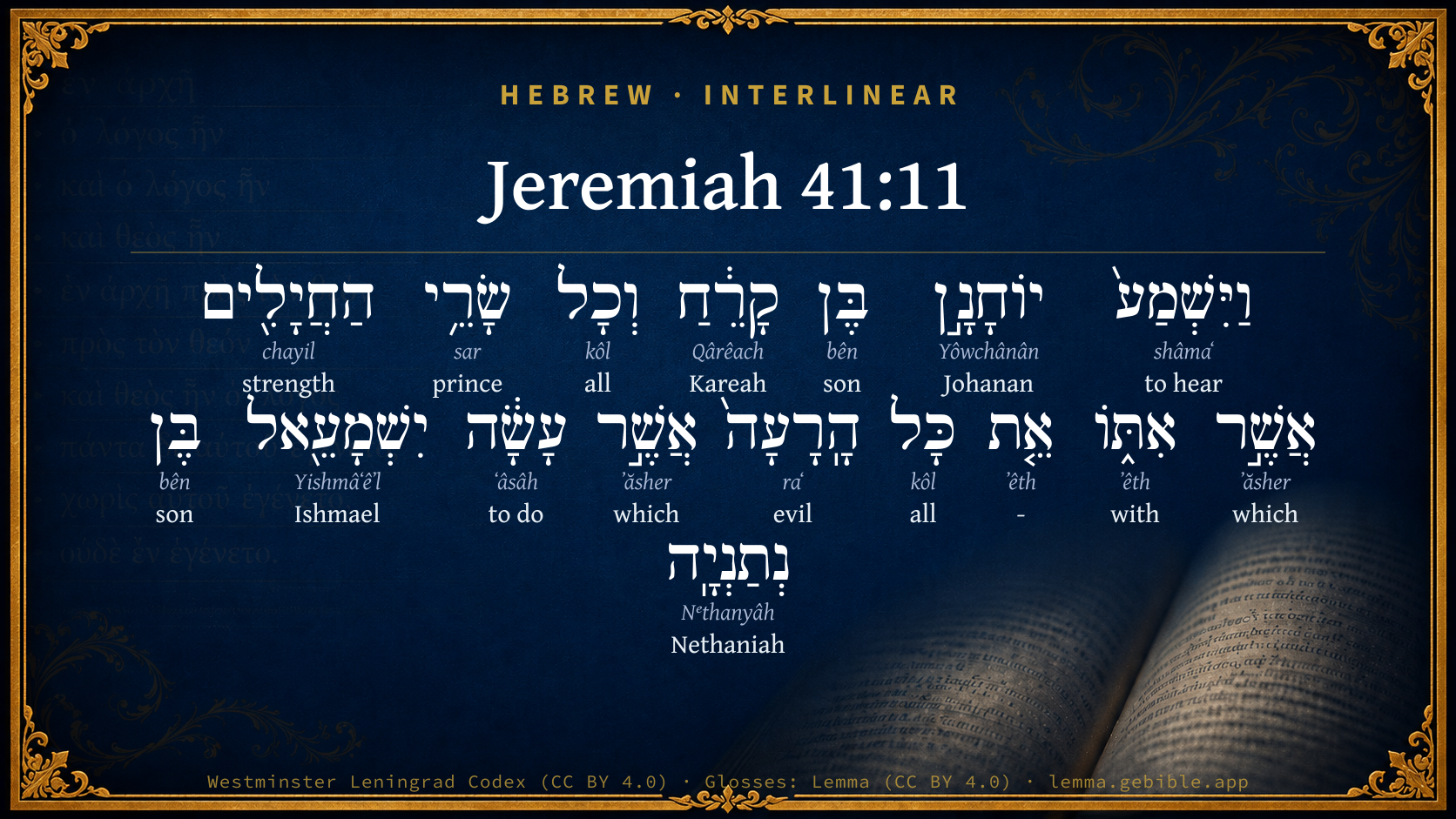
Hebrew (Westminster Leningrad Codex) Jeremiah 41:11 appears in the Hebrew Old Testament. The text above is from the Westminster Leningrad Codex. Each word links to its Strong’s number, a concise gloss, and parsing drawn from the Open Scriptures Hebrew Bible morphology. Click any word for its full Brown-Driver-Briggs (BDB) entry.
Download image
Cite this verse

Jeremiah 41:11 (World English Bible). Public Domain. Lemma interlinear Bible study tool, https://lemma.gebible.app/v/jeremiah/41/11.

Show BibTeX & RIS
BibTeX
RIS
English Translation
But when Johanan the son of Kareah, and all the captains of the forces who were with him, heard of all the evil that Ishmael the son of Nethaniah had done,
World English Bible · Public Domain
Download a study sheet

One document with this verse’s original text, its word-by-word gloss line, the meaning frame, cross-references with their text, attributed commentary, and full source and license credits — printable, and it pastes into notes with its structure intact.

This verse Autodidact and up

Study sheet (.html) Plain text (.txt)

A passage Seminary Student

Up to 50 verses in one chapter. A passage sheet keeps up to 6 commentary sources and 12 cross-references per verse, in the order this page ranks them, and says so on the sheet whenever that leaves anything out. Ask for a single verse and you get the Autodidact verse sheet above.

Everything on this page stays free to read, with no account — the sheet is a download of what is already on screen, not access to it.

Want to remove ads? Support Godless Engineer
Compare translations 3

The same verse in 3 English versions, stacked beneath the original-language interlinear above. Click any original word for its lexicon entry.

Each is an independent rendering of the whole verse — the interlinear is not word-aligned to these translations.

Highlighted words mark where these versions differ — a whole-verse word diff, not a word-by-word alignment.

  • World English Bible Public Domain
    But when Johanan the son of Kareah, and all the captains of the forces who were with him, heard of all the evil that Ishmael the son of Nethaniah had done,
  • King James Version Public Domain
    But when Johanan the son of Kareah, and all the captains of the forces that were with him, heard of all the evil that Ishmael the son of Nethaniah had done,
  • unfoldingWord Literal Text CC BY-SA 4.0
    But Johanan son of Kareah and all the army commanders with him heard of all the harm that Ishmael son of Nethaniah had done.

unfoldingWord Literal Text — © unfoldingWord, licensed CC BY-SA 4.0. Word-aligned USFM3 via Door43 (git.door43.org/unfoldingWord/en_ult).

Versions to compare (up to 4)

3 of 4 selected

Show all 18 translations

Every available English version of this verse, each an independent rendering of the whole verse.

  • World English Bible Public Domain
    But when Johanan the son of Kareah, and all the captains of the forces who were with him, heard of all the evil that Ishmael the son of Nethaniah had done,
  • Berean Standard Bible Public Domain
    When Johanan son of Kareah and all the commanders of the armies with him heard of all the crimes that Ishmael son of Nethaniah had committed,
  • Majority Standard Bible Public Domain
    When Johanan son of Kareah and all the commanders of the armies with him heard of all the crimes that Ishmael son of Nethaniah had committed,
  • King James Version Public Domain
    But when Johanan the son of Kareah, and all the captains of the forces that were with him, heard of all the evil that Ishmael the son of Nethaniah had done,
  • American Standard Version (1901) Public Domain
    But when Johanan the son of Kareah, and all the captains of the forces that were with him, heard of all the evil that Ishmael the son of Nethaniah had done,
  • Revised Version (1885) Public Domain
    But when Johanan the son of Kareah, and all the captains of the forces that were with him, heard of all the evil that Ishmael the son of Nethaniah had done,
  • Geneva Bible (1599) Public Domain
    But when Iohanan the sonne of Kareah, and all the captaines of the hoste that were with him, heard of all the euill that Ishmael the sonne of Nethaniah had done,
  • Douay-Rheims (1899) Public Domain
    But Johanan the son of Caree, and all the captains of the fighting men that were with him, heard of the evil that Ismahel the son of Nathanias had done.
  • Young's Literal Translation Public Domain
    And hear doth Johanan son of Kareah, and all the heads of the forces that `are' with him, of all the evil that Ishmael son of Nethaniah hath done,
  • Literal Standard Version CC BY-SA 4.0
    And Johanan son of Kareah, and all the heads of the forces that [are] with him, hear of all the evil that Ishmael son of Nethaniah has done,
  • Unlocked Literal Bible CC BY-SA 4.0
    But Johanan son of Kareah and all the army commanders with him heard of all the harm that Ishmael son of Nethaniah had done.
  • unfoldingWord Literal Text CC BY-SA 4.0
    But Johanan son of Kareah and all the army commanders with him heard of all the harm that Ishmael son of Nethaniah had done.
  • Darby Bible Public Domain
    And Johanan the son of Kareah, and all the captains of the forces that were with him, heard of all the evil that Ishmael the son of Nethaniah had done;
  • World Messianic Bible Public Domain
    But when Yochanan the son of Kareah, and all the captains of the forces who were with him, heard of all the evil that Ishmael the son of Nethaniah had done,
  • Webster's Bible Public Domain
    But when Johanan the son of Kareah, and all the captains of the forces that were with him, heard of all the evil that Ishmael the son of Nethaniah had done.
  • Free Bible Version CC BY-SA 4.0
    Johanan and all the army commanders of the armies with him found out about all of Ishmael's crimes.
  • Bible in Basic English Public Domain
    But when Johanan, the son of Kareah, and all the captains of the armed forces who were with him, had news of all the evil which Ishmael, the son of Nethaniah, had done,
  • JPS Tanakh (1917) Public Domain
    But when Johanan the son of Kareah, and all the captains of the forces that were with him, heard of all the evil that Ishmael the son of Nethaniah had done,

Literal Standard Version (2020), Covenant Press — licensed CC BY-SA 4.0. Text via the HelloAO Bible API (eBible.org). Unlocked Literal Bible (unfoldingWord) — licensed CC BY-SA 4.0. Text via the HelloAO Bible API (eBible.org). unfoldingWord Literal Text — © unfoldingWord, licensed CC BY-SA 4.0. Word-aligned USFM3 via Door43 (git.door43.org/unfoldingWord/en_ult). Free Bible Version, Dr. Jonathan Gallagher — licensed CC BY-SA 4.0. Text via the HelloAO Bible API (eBible.org).

Word by word

More ways to search: Search by grammar → Find every occurrence → Compare this word →

Practice this passage: Drill this verse → Learn its vocabulary →

קָרֵ֔חַ
Qârêach
H7143
“Kareah”
Noun, Proper
Part of Speech
Noun
Type
Proper
Full BDB Definition

Origin: from H7139

TWOT: None

Kareah = "bald" - father of Johanan and Jonathan who supported Gedaliah's authority and avenged his murder
  1. וַיִּשְׁמַע֙ shâmaʻ H8085 “and · to hear” Conjunction + Verb, Qal, Sequential Imperfect, 3rd Person, Masculine, Singular
  2. יוֹחָנָ֣ן Yôwchânân H3110 “Johanan” Noun, Proper
  3. בֶּן bên H1121 “son of” Noun, Common, Masculine, Singular, Construct
  4. וְכָל kôl H3605 “and · all of” Conjunction + Noun, Common, Masculine, Singular, Construct
  5. שָׂרֵ֥י sar H8269 “princes of” Noun, Common, Masculine, Plural, Construct
  6. הַחֲיָלִ֖ים chayil H2428 “the · forces” Particle, Definite Article + Noun, Common, Masculine, Plural, Absolute
  7. אֲשֶׁ֣ר ʼăsher H834 “which” Particle, Relative
  8. אִתּ֑וֹ ʼêth H854 “with · him” Preposition + Suffix, Personal, 3rd Person, Masculine, Singular
  9. אֵ֤ת ʼêth H853 “-” Particle, Direct Object
  10. כָּל kôl H3605 “all of” Noun, Common, Masculine, Singular, Construct
  11. הָֽרָעָה֙ raʻ H7451 “the · evil” Particle, Definite Article + Noun, Common, Feminine, Singular, Absolute
  12. אֲשֶׁ֣ר ʼăsher H834 “which” Particle, Relative
  13. עָשָׂ֔ה ʻâsâh H6213 “to do” Verb, Qal, Perfect, 3rd Person, Masculine, Singular
  14. יִשְׁמָעֵ֖אל Yishmâʻêʼl H3458 “Ishmael” Noun, Proper
  15. בֶּן bên H1121 “son of” Noun, Common, Masculine, Singular, Construct
  16. נְתַנְיָֽה Nᵉthanyâh H5418 “Nethaniah” Noun, Proper

About this verse

These counts appear in no published source. They are computed here, from the morphology-tagged text and Lemma’s own curated glosses. What Lemma adds →

17
words
14
distinct lemmas
Prophets
section

Notable vocabulary

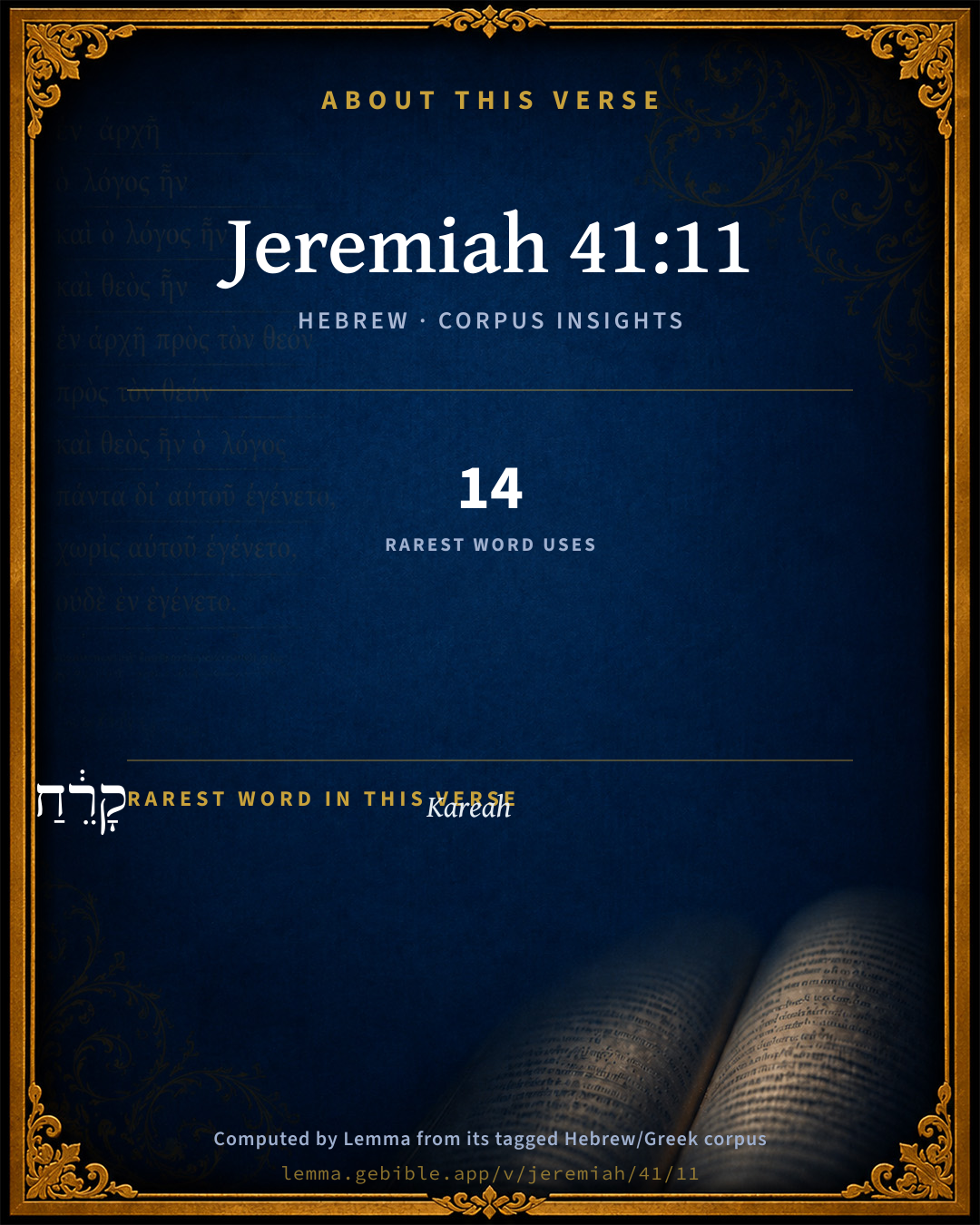
The rarest word here is קָרֵ֔חַ Kareah H7143 — appearing just 14 times in the whole Hebrew Bible.

Shared distinctive vocabulary

קָרֵ֔חַ Kareah H7143 occurs in 14 verses of the Hebrew Bible. Also found in:

Grammatical profile

  • 2 verbs
  • 11 nouns
  • 1 preposition
  • 3 particles

Verb forms

  • וַיִּשְׁמַע֙ Qal · Sequential Imperfect
  • עָשָׂ֔ה Qal · Perfect

Repetition

Words recur within this verse — often emphatic in Hebrew:

  • בֶּן son H1121 ×2
  • וְכָל all H3605 ×2
  • אֲשֶׁ֣ר which H834 ×2

Cross-references

7

Topical passages linked to Jeremiah 41:11 in the Treasury of Scripture Knowledge — connected by theme and wording, ordered by reader-vote popularity; previews shown in the World English Bible.

  • Jeremiah 40:7–8 Now when all the captains of the forces who were in the fields, even they and their men, heard that the king of Babylon had made Gedaliah the son of Ahikam governor in the land, and had committed to him men, and women, and children, and of the poorest of the land, of those who were not carried away captive to Babylon;
  • Jeremiah 40:13–16 Moreover Johanan the son of Kareah, and all the captains of the forces who were in the fields, came to Gedaliah to Mizpah,
  • Jeremiah 41:2–3 Then arose Ishmael the son of Nethaniah, and the ten men who were with him, and struck Gedaliah the son of Ahikam the son of Shaphan with the sword, and killed him, whom the king of Babylon had made governor over the land.
  • Jeremiah 41:7 It was so, when they came into the midst of the city, that Ishmael the son of Nethaniah killed them, [and cast them] into the midst of the pit, he, and the men who were with him.
  • Jeremiah 42:1 Then all the captains of the forces, and Johanan the son of Kareah, and Jezaniah the son of Hoshaiah, and all the people from the least even to the greatest, came near,
  • Jeremiah 42:3 that Yahweh your God may show us the way in which we should walk, and the thing that we should do.
  • Jeremiah 43:2–5 then spoke Azariah the son of Hoshaiah, and Johanan the son of Kareah, and all the proud men, saying to Jeremiah, You speak falsely: Yahweh our God has not sent you to say, You shall not go into Egypt to sojourn there;

Cross-references courtesy of OpenBible.info (CC BY 4.0).

Hebrew and Greek witnesses Masoretic Hebrew ↔ Greek Septuagint

The same verse in the two great witnesses to the Old Testament, shown verse-for-verse.

These are two independent witnesses, not word-aligned to each other, and the Septuagint is shown in lemma (dictionary) form.

Hebrew Jeremiah 41:11 Masoretic · Westminster Leningrad Codex

וַיִּשְׁמַע֙ יוֹחָנָ֣ן בֶּן קָרֵ֔חַ וְכָל שָׂרֵ֥י הַחֲיָלִ֖ים אֲשֶׁ֣ר אִתּ֑וֹ אֵ֤ת כָּל הָֽרָעָה֙ אֲשֶׁ֣ר עָשָׂ֔ה יִשְׁמָעֵ֖אל בֶּן נְתַנְיָֽה

But when Johanan the son of Kareah, and all the captains of the forces who were with him, heard of all the evil that Ishmael the son of Nethaniah had done,

World English Bible · Public Domain

Greek LXX Structure differs

In the Septuagint, Jeremiah is about an eighth shorter than the Hebrew and arranges its material differently — the Oracles Against the Nations (Hebrew chapters 46–51) appear in the middle of the Greek book, after 25:13. Because the chapter and verse boundaries do not line up, a verse-for-verse comparison with the Hebrew is not shown.

A verse-for-verse comparison isn’t shown here because the chapters and verses don’t line up. Switch to the LXX edition with the MT / LXX toggle above to read the Greek directly.

Hebrew: Westminster Leningrad Codex (CC BY 4.0). Greek: Septuagint (public domain); English from a public-domain English Septuagint. How the Septuagint differs from the Hebrew →

Targum (Aramaic paraphrase)

1

The Targum is the ancient Jewish Aramaic paraphrase of the Hebrew Scriptures — an interpretive translation, not the Hebrew text itself. Onkelos (literal) and Pseudo-Jonathan (expansive) render the Torah, and Jonathan the Prophets. Coverage is partial: where no permissively-licensed English translation exists for a verse, only the Aramaic is shown. This is verse-level text, not a word-by-word alignment to the Hebrew.

  1. Targum Jonathan Prophets (Joshua–Malachi)
    וּשְׁמַע יוֹחָנָן בַּר קָרֵחַ וְכָל רַבָּנֵי חֵילְוָתָא דִי עִמֵיהּ יַת כָּל בִּישָׁתָא דַעֲבַד יִשְׁמָעֵאל בַּר נְתַנְיָה:

    (no public-domain English translation for this verse)

    Targum Jonathan — Aramaic: “Mikraot Gedolot” (public domain). English: “Sefaria Community Translation” (CC0 1.0 (public-domain dedication)); “London "Chaldee Paraphrase," 1871” (public domain). Text via Sefaria.

Commentary

Notes on Jeremiah 41:11 from classic Christian and Jewish commentators (each source and its license shown beneath its notes). The classic Christian expositions comment on the surrounding passage and are grouped to its opening verse, so a note may address several verses; the Jewish commentaries on the Tanakh (Rashi and others) are per-verse, so they appear only where the commentator wrote on this verse.

Lemma curates 59 commentaries, every one of them public domain or Creative Commons licensed, each selected and text-cleaned for this edition rather than reprinted as found. About our sources →

Matthew Henry's Commentary

It would have been well if Johanan, when he gave information to Gedaliah of Ishmael's treasonable design, though he could not obtain leave to kill Ishmael and to prevent it that way, yet had staid with Gedaliah; for he, and his captains, and their forces, might have been a life-guard to Gedaliah and a terror to Ishmael, and so have prevented the mischief without the effusion of blood: but, it seems they were out upon some expedition, perhaps no good one, and so were out of the way when they should have been upon the best service. Those that affect to ramble are many times out of their place when they are most needed. However, at length they hear of all the evil that Ishmael had done (Jer 41:11), and are resolved to try an after-game, which we have an account of in these verses. 1. We heartily wish Johanan could have taken revenge upon the murderers, but he prevailed only to rescue the captives. Those that had shed so much blood, it was a pity but their blood should have been shed; and it is strange that vengeance suffered them to live; yet it did. Johanan gathered what forces he could and went to fight with Ishmael (Jer 41:12), upon notice of the murders he had committed (for though he concealed it for a time, Jer 41:4, yet murder will out) and which way he was gone; he pursued him, and overtook him by the great pool of Gibeon, which we read of, Sa2 2:13. And, upon his appearing with such a force, Ishmael's heart failed him, his guilty conscience flew in his face, and he durst not stand his ground against an enemy that was something like a match for him. The most cruel are often the most cowardly. The poor captives were glad when they saw Johanan and the captains that were with him, looking upon them as their deliverers (Jer 41:13), and they immediately found a way to wheel about and come over to them (Jer 41:14), Ishmael not offering to detain them when he saw Johanan. Note, Those that would be helped must help themselves. These captives staid not till their conquerors were beaten, but took the first opportunity to make their escape, as soon as they saw their friends appear and their enemies thereby disheartened. Ishmael quitted his pray to save his life, and escaped with eight men, Jer 41:15. it seems, two of his ten men, that were his banditti or assassins (spoken of Jer 41:1), either deserted him or were killed in the engagement; but he made the best of his way to the Ammonites, as a perfect renegado, that had quite abandoned all relation to the commonwealth of Israel, though he was of the seed royal, and we hear no more of him. 2. We heartily wish that Johanan, when he had rescued the captives, would have sat down quietly with them, and governed them peaceably, as Gedaliah did; but, instead of that, he is for leading them into the land of Egypt, as Ishmael would have led them into the land of the Ammonites; so that though he got the command over them in a better way than Ishmael did, and honestly enough, yet he did not use it much better. Gedaliah, who was of a meek and quiet spirit, was a great blessing to them; but Johanan, who was of a fierce and restless spirit, was set over them for their hurt, and to complete their ruin, even after they were, as they thought, redeemed. Thus did God still walk contrary to them. (1.) The resolution of Johanan and the captains was very rash; nothing would serve them but they would go to enter into Egypt (Jer 41:17), and, in order to that, they encamped for a time in the habitation of Chimham, by Bethlehem, David's city. Probably it was some land which David gave to Chimham, the son of Barzillai, which, though it returned to David's family at the year of the Jubilee, yet still bore the name of Chimham. Here Johanan made his headquarters, steering his course towards Egypt, either from a personal affection to that country or an ancient national confidence in the Egyptians for help in distress. Some of the mighty men of war, it seems had escaped; those he took with him, and the women and children, whom he had recovered from Ishmael, who were thus emptied from vessel to vessel, because they were yet unchanged. (2.) The reason for this resolution was very frivolous. They pretended that they were afraid of the Chaldeans, that they would come and do I know not what with them, because Ishmael had killed Gedaliah, Jer 41:18. I cannot think they really had any apprehensions of danger upon this account; for, though it is true that the Chaldeans had cause enough to resent the murder of their viceroy, yet they were not so unreasonable, or unjust, as to revenge it upon those who appeared so vigorously against the murderers. But they only make use of this as a sham to cover that corrupt inclination of their unbelieving ancestors, which was so strong in them, to return into Egypt. Those will justly lose their comfort in real fears that excuse themselves in sin with pretended fears.

Matthew Henry's Commentary on the Whole Bible (1708–1710) — public domain (CC PDM 1.0). Text via the HelloAO Bible API.

Trapp's Complete Commentary

John Trapp

Jer 41:11 But when Johanan the son of Kareah, and all the captains of the forces that [were] with him, heard of all the evil that Ishmael the son of Nethaniah had done,

Ver. 11. But when Jehanan the son of Kareah, and all the captains, heard of all the evil.] Ishmael did what he could to conceal the wickedness till he had gotten away with his prize; but rumour outran him, even

“ Fama, malum quo non aliud velocius ullum. ”

John Trapp, A Commentary or Exposition upon All the Books of the Old and New Testament (1647–1656) — public domain. Text from a community e-Sword module.

Whedon's Commentary on the Bible

Daniel D. Whedon

JOHANAN’S EXPEDITION TO AVENGE GEDALIAH’S DEATH, Jer_41:11-18.

11. Johanan — The friend of Gedaliah, who had warned him of this plot.

Daniel D. Whedon (gen. ed.), Commentary on the Old and New Testaments (1874–1909) — public domain. Text from a community e-Sword module.

Keil & Delitzsch

C. F. Keil & F. Delitzsch

- Jer 41:11. When Johanan and the rest of the captains heard of what had taken place in Mizpah, they marched out with all their men to fight Ishmael, and came on him at the great water at Gibeon, i.e., by the pool at Gibeon which is mentioned Sa2 2:13, one of the large receptacles for water which are still found there; see on Sa2 2:13. Gibeon, now called el Jib (see on Jos 9:3), was situated only about two miles north from Mizpah; from which we may conclude that it was soon known what had happened, and the captains quickly assembled their men and marched after Ishmael.

Keil & Delitzsch — Biblical Commentary on the Old Testament (1861–1891) — public domain (CC PDM 1.0). Text via the HelloAO Bible API. (Old Testament only.)

Tyndale Open Study Notes

Tyndale Open Resources

41:11-12 Johanan and his companions learned of Gedaliah’s death in time to attack Ishmael’s party at the pool near Gibeon, which was only a few miles south of Mizpah.

Tyndale Open Study Notes — © Tyndale Open Resources, licensed CC BY-SA 4.0. Text via the HelloAO Bible API.

Geneva Bible (1599)

Geneva Bible translators

Which had been captains under Zedekiah.

Geneva Bible (1599) marginal notes — public domain. Text via Bolls.life.

Jamieson, Fausset & Brown

Robert Jamieson, A. R. Fausset & David Brown

Johanan--the friend of Gedaliah who had warned him of Ishmael's treachery, but in vain (Jer 40:8, Jer 40:13).

Jamieson, Fausset & Brown — Commentary Critical and Explanatory on the Whole Bible (1871) — public domain (CC PDM 1.0). Text via the HelloAO Bible API.

The Cambridge Bible for Schools and Colleges

gen. ed. J. J. S. Perowne

11–18. See introd. summary to the section.

The Cambridge Bible for Schools and Colleges (gen. ed. J. J. S. Perowne; Cambridge University Press, 1878–1918) — public domain. Text from a community e-Sword module.

John Gill's Exposition

But when Johanan the son of Kareah,.... The same that is mentioned Jer 40:8; and who had informed Gedaliah of Ishmael's designs against him, but he would not believe him:

and all the captains of the forces that were with him; his brother Jonathan, Seraiah, the sons of Ephai, and Jezaniah, Jer 40:8;

heard of all the evil that Ishmael the son of Nethaniah had done; in murdering Gedaliah, and those that were with him, destroying seventy other persons he had decoyed, and carrying captive the rest of the people at Mizpah; for though Ishmael kept all this a secret as much as he could, for fear of these forces, and that he might get off clear to Ammon; yet, by some means or another, these captains came to hear of it, who, probably, were not at a great distance from Mizpah.

John Gill's Exposition of the Whole Bible (1746–1763) — public domain (CC PDM 1.0). Text via the HelloAO Bible API.

Haydock's Catholic Bible Commentary

Johanan. He and the rest of the fugitives thus shewed that they were clean. (Worthington)

George Leo Haydock (1774–1849), Haydock's Catholic Family Bible and Commentary, 1859 edition — public domain. Excludes Psalms (Douay-Rheims chapter numbering differs from Protestant) and Deuterocanonical books (Catholic canon only).

The Pulpit Commentary

Vers. 11-18. Rescue of the captives from Ishmael, and plan for taking flight to Egypt.

Vers. 11-15. The devil a bad paymaster.

These verses record the pursuit and overthrow of Ishmael. He had sold himself to work all manner of wickedness. What had he not been guilty of? And now we hear the last of him. He is seen in flight to Ammon, whence he came out, escaping with his life, but stripped of all his captives and his plunder. He had taken a world of trouble, incurred a load of guilt, filled his soul with evil, dishonoured his name forever. And this was what came of it all. Every one of his purposes, plans, hopes, all his toil and villainy, all his apparent success, utterly lost and gone. He is one out of many more proofs of the miserable wages of sin. Now

I IT IS EVER SO. Men may go on in sin for a long time, and be undisturbed save by conscience; may find their sin very pleasant and very gainful, and they may seem to escape with utter impunity; but the visitation of God comes upon them, sometimes here in this life, certainly, if not here, hereafter. The Bible history, the world, are full of proofs of this.

II BUT MEN CANNOT BE GOT TO BELIEVE THIS. Else why do they persist in evil ways?

III WHY IS IT THAT THEY WILL NOT BELIEVE? They do not wish to believe. Sentence against evil work is not executed speedily, sometimes not at all here in this world in any visible way.

IV WHY, THEN, DOES NOT GOD DEAL DIFFERENTLY WITH SIN? Because his purpose is to foster trust and love, neither of which could find place in a system of prompt and visible punishments such as some would desire.

V DOES GOD, THEN, DO NOTHING TO CHECK THE SINNER AND TO ENCOURAGE THE OBEDIENT? Yes; much.

1. He causes the way of transgressors to be hard. Loss of peace, of hope, of Divine favour, of purity, of strength, of sympathy with and from the good, often of present and visible good; conscience is deadened, and the soul perishes. Besides this, there are frequent direct judgments sent.

2. On the other hand, he orders that in keeping of his commandments there is great reward. "His ways are ways of pleasantness, and all his paths are peace." It is related how an aged couple in the vicinity of London, who in the early part of life were poor, but who by the blessing of God upon their industry enjoyed a comfortable independency in their old age, were called upon by a Christian minister, who solicited their contributions to a charity. The old lady was disposed to make out some excuse, and to answer in the negative, both for her husband and for herself, and therefore replied, "Why, sir, we have lost a deal by religion since we began; my husband knows that very well." And being wishful to obtain her husband"s consent to the assertion, she said, "Have we not, Thomas?" Thomas, after a long and solemn pause, replied, "Yes, Mary, we have lost a deal by our religion! I have lost a deal by my religion. Before I got religion, Mary, I had got a water pail in which I carried water; and that, you know, I lost many years ago. And then I had an old slouched hat, a patched old coat, and mended shoes and stockings; but I have lost them also long ago. And, Mary, you know that, poor as I was, I had a habit of getting drunk and quarrelling with you; and that, you know, I have lost. And then I had a burdened conscience and a wicked heart, and then I had ten thousand guilty feelings and fears; but all are lost, completely lost, and like a millstone east into the deep sea. Before we got religion, Mary; you had a washing tray, in which you washed for hire, and God Almighty blessed your industry; but since we got religion you have lost your washing tray. And you had a gown and bonnet much the worse for wear, though they were all you had to wear; but you have lost them long ago. And you had many an aching heart concerning me at times; but those you happily have lost. And I could even wish that you had lost as much as I have lost, and even more; for what we lose by our religion will be our eternal gain." We need not add that the preacher did not go away without substantial proof of the sincerity of what had been said in his hearing. And to all those who like the rich man in the parable (Luke 16), who asked that one from the dead might be sent to warn his five brethren, the same answer may be given, "They have Moses and the prophets," and we may add, in our day, far more than these; "if they hear not them, neither will they be persuaded, though one rose from the dead. C.

The Pulpit Commentary (1880–1919), ed. H.D.M. Spence-Jones & Joseph S. Exell — public domain. Text from a community e-Sword module.

Kretzmann's Popular Commentary

Paul E. Kretzmann

The Preparations to Emigrate to Egypt

v. 11. But when Johanan, the son of Kareah, and all the captains of the forces that were with him, who had warned Gedaliah against Ishmael, heard of all the evil that Ishmael, the son of Nethaniah, had done,

v. 12. then they took all the men, quickly summoning them upon receiving the sad news, and went to fight with Ishmael, the son of Nethaniah, and found him by the great waters that are in Gibeon, only a few miles northeast of Mizpah. The disposing of the seventy slain men and the gathering of the people of the city to be deported had clearly delayed Ishmael to such an extent that he could not get away in time.

v. 13. Now it came to pass that, when all the people which were with Ishmael saw Johanan, the son of Kareah, and all the captains of the forces that were with him, then they were glad, for the prospect of being sold into slavery was not pleasant.

v. 14. So all the people that Ishmael had carried away captive from Mizpah cast about, they came around, they circled back, and returned and went unto Johanan, the son of Kareah, they took this opportunity of joining the forces of their deliverer, since Ishmael was now engaged in defending himself against Johanan’s attack.

v. 15. But Ishmael, the son of Nethaniah, escaped from Johanan, upon the latter’s determined attack, with eight men and went to the Ammonites, two of his men evidently having fallen in the fight.

v. 16. Then took Johanan, the son of Kareah, and all the captains of the forces that were with him all the remnant of the people whom he had recovered from Ishmael, the son of Nethaniah, rescuing them out of his hand, from Mizpah, after that he had slain Gedaliah, the son of Ahikam, even mighty men of war, and the women, and the children, and the eunuchs, the special servants of the harem, whom he had brought again from Gibeon;

v. 17. and they departed and dwelt in the habitation of Chimham, a khan or caravansary, where large companies of travelers stopped for the night, which is by Bethlehem, to go to enter into Egypt,

v. 18. because of the Chaldeans; for they were afraid of them because Ishmael, the son of Nethaniah, had slain Gedaliah, the son of Ahikam, whom the king of Babylon made governor in the land, they feared that they would be implicated in Ishmael’s treason or in some way be held responsible for it. It would have been far better, since they had a good conscience in the matter, had they laid the facts in the case before the Chaldean authorities and cleared themselves. As it was, their removal from Judea placed them under the suspicion of the Babylonians. Fear often dictates a wrong course, even where people are altogether innocent.

Paul E. Kretzmann, Popular Commentary of the Bible (1921–1924) — public domain. Text from a community e-Sword module.

unfoldingWord translationNotes

Door43 World Missions Community

Johanan ... Kareah

See how you translated these men's names in Jeremiah 40:13. (See: How to Translate Names)

Ishmael son of Nethaniah ... found him

Here "Ishmael" represents himself and all of his men. AT: "Ishmael and his men ... found them" (See: Synecdoche)

translationWords

commander

Gibeon

unfoldingWord translationNotes — © Distant Shores Media and the Door43 World Missions Community, licensed CC BY-SA 4.0. Source: git.door43.org/Door43/en_tn.

Lesson kit

Teaching starters — assembled from the data on this page, not authored interpretation. Every prompt links to the verse data it draws on. Edit before teaching.

Jeremiah, in the Prophets, opens this verse with 17 words (14 distinct Hebrew lemmas). Its most distinctive word is Qârêach (“Kareah”). A historical commentator’s framing appears above. Read the whole chapter for the surrounding context.

Discussion questions

  1. How does “Kareah” (Qârêach) shape what this verse is saying?
  2. 2 Kings 25:23 shares the word «Kareah» with this verse. How do the two illuminate each other?
  3. “son” occurs 2× in this one verse. What is the effect of the repetition?
  4. These translations render this verse differently. What is at stake in choosing one wording over another?
  5. The verb «וַיִּשְׁמַע֙» is Qal Sequential Imperfect. How does its form color the action?
  6. Reading how Matthew Henry's Commentary and Trapp's Complete Commentary read this verse, where do the two commentators agree and where do they part?

Things to notice

Reading settings

Reading text

Shown beneath each verse's original-language words.

Old Testament
Old Testament edition

Read the OT as the Masoretic Hebrew (MT) or the Greek Septuagint (LXX).

English shown for the Greek Septuagint (in the Hebrew ↔ Greek comparison).

Comparing translations? Open the Compare panel on any verse page to stack up to four side by side.