
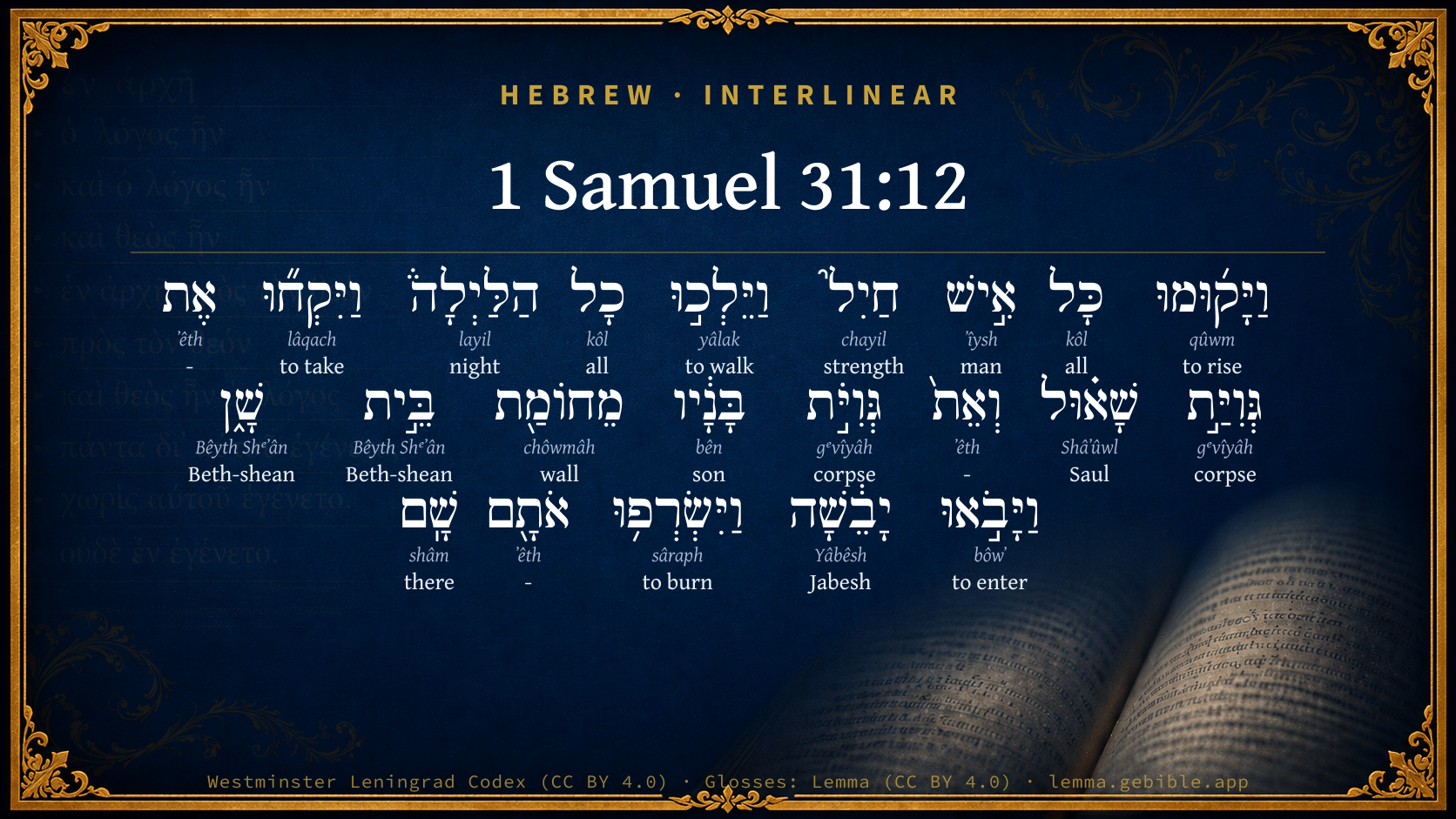
1 Samuel 31:12

Hebrew (Westminster Leningrad Codex) 1 Samuel 31:12 appears in the Hebrew Old Testament. The text above is from the Westminster Leningrad Codex. Each word links to its Strong’s number, a concise gloss, and parsing drawn from the Open Scriptures Hebrew Bible morphology. Click any word for its full Brown-Driver-Briggs (BDB) entry.
Download image
Cite this verse

1 Samuel 31:12 (World English Bible). Public Domain. Lemma interlinear Bible study tool, https://lemma.gebible.app/v/1-samuel/31/12.

Show BibTeX & RIS
BibTeX
RIS
English Translation
all the valiant men arose, and went all night, and took the body of Saul and the bodies of his sons from the wall of Beth-shan; and they came to Jabesh, and burnt them there.
World English Bible · Public Domain
Download a study sheet

One document with this verse’s original text, its word-by-word gloss line, the meaning frame, cross-references with their text, attributed commentary, and full source and license credits — printable, and it pastes into notes with its structure intact.

This verse Autodidact and up

Study sheet (.html) Plain text (.txt)

A passage Seminary Student

Up to 50 verses in one chapter. A passage sheet keeps up to 6 commentary sources and 12 cross-references per verse, in the order this page ranks them, and says so on the sheet whenever that leaves anything out. Ask for a single verse and you get the Autodidact verse sheet above.

Everything on this page stays free to read, with no account — the sheet is a download of what is already on screen, not access to it.

Want to remove ads? Support Godless Engineer
Compare translations 3

The same verse in 3 English versions, stacked beneath the original-language interlinear above. Click any original word for its lexicon entry.

Each is an independent rendering of the whole verse — the interlinear is not word-aligned to these translations.

Highlighted words mark where these versions differ — a whole-verse word diff, not a word-by-word alignment.

  • World English Bible Public Domain
    all the valiant men arose, and went all night, and took the body of Saul and the bodies of his sons from the wall of Beth-shan; and they came to Jabesh, and burnt them there.
  • King James Version Public Domain
    All the valiant men arose, and went all night, and took the body of Saul and the bodies of his sons from the wall of Bethshan, and came to Jabesh, and burnt them there.
  • unfoldingWord Literal Text CC BY-SA 4.0
    And all of the men of valor arose and went all of the night and took the corpse of Saul and the corpses of his sons from the wall of Beth Shan. And they came Jabesh, and they burned them there.

unfoldingWord Literal Text — © unfoldingWord, licensed CC BY-SA 4.0. Word-aligned USFM3 via Door43 (git.door43.org/unfoldingWord/en_ult).

Versions to compare (up to 4)

3 of 4 selected

Show all 18 translations

Every available English version of this verse, each an independent rendering of the whole verse.

  • World English Bible Public Domain
    all the valiant men arose, and went all night, and took the body of Saul and the bodies of his sons from the wall of Beth-shan; and they came to Jabesh, and burnt them there.
  • Berean Standard Bible Public Domain
    all their men of valor set out, journeyed all night, and retrieved the bodies of Saul and his sons from the wall of Beth-shan. When they arrived at Jabesh, they burned the bodies there.
  • Majority Standard Bible Public Domain
    all their men of valor set out, journeyed all night, and retrieved the bodies of Saul and his sons from the wall of Beth-shan. When they arrived at Jabesh, they burned the bodies there.
  • King James Version Public Domain
    All the valiant men arose, and went all night, and took the body of Saul and the bodies of his sons from the wall of Bethshan, and came to Jabesh, and burnt them there.
  • American Standard Version (1901) Public Domain
    all the valiant men arose, and went all night, and took the body of Saul and the bodies of his sons from the wall of Beth-shan; and they came to Jabesh, and burnt them there.
  • Revised Version (1885) Public Domain
    all the valiant men arose, and went all night, and took the body of Saul and the bodies of his sons from the wall of Beth-shan; and they came to Jabesh, and burnt them there.
  • Geneva Bible (1599) Public Domain
    Then they arose (as many as were strong men) and went all night, and tooke the body of Saul, and the bodies of his sonnes, from the wall of Beth-shan, and came to Iabesh, and burnt them there,
  • Douay-Rheims (1899) Public Domain
    All the most valiant men arose, and walked all the night, and took the body of Saul, and the bodies of his sons, from the wall of Bethsan: and they came to Jabes Galaad, and burnt them there:
  • Young's Literal Translation Public Domain
    and all the men of valour arise, and go all the night, and take the body of Saul, and the bodies of his sons, from the wall of Beth-Shan, and come in to Jabesh, and burn them there,
  • Literal Standard Version CC BY-SA 4.0
    and all the men of valor arise, and go all the night, and take the body of Saul, and the bodies of his sons, from the wall of Beth-Shan, and come to Jabesh, and burn them there,
  • Unlocked Literal Bible CC BY-SA 4.0
    all the fighting men arose and went all night and took the body of Saul and the bodies of his sons from the wall of Beth Shan. They went to Jabesh and burned them there.
  • unfoldingWord Literal Text CC BY-SA 4.0
    And all of the men of valor arose and went all of the night and took the corpse of Saul and the corpses of his sons from the wall of Beth Shan. And they came Jabesh, and they burned them there.
  • Darby Bible Public Domain
    all the valiant men arose and went all night, and took the body of Saul and the bodies of his sons from the wall of Beth-shan, and came to Jabesh, and burned them there.
  • World Messianic Bible Public Domain
    all the valiant men arose, went all night, and took the body of Saul and the bodies of his sons from the wall of Beth Shan; and they came to Jabesh and burned them there.
  • Webster's Bible Public Domain
    All the valiant men arose, and went all night, and took the body of Saul, and the bodies of his sons from the wall of Beth-shan, and came to Jabesh, and burnt them there.
  • Free Bible Version CC BY-SA 4.0
    all their strong warriors set out, traveled all night, and took down the bodies of Saul and his sons from the wall of Beth-shan. When they got back to Jabesh, they burned the bodies there.
  • Bible in Basic English Public Domain
    All the fighting men got up and, travelling all night, took Saul's body and the bodies of his sons from the wall of Beth-shan; and they came to Jabesh and had them burned there.
  • JPS Tanakh (1917) Public Domain
    all the valiant men arose, and went all night, and took the body of Saul and the bodies of his sons from the wall of Beth-shan; and they came to Jabesh, and burnt them there.

Literal Standard Version (2020), Covenant Press — licensed CC BY-SA 4.0. Text via the HelloAO Bible API (eBible.org). Unlocked Literal Bible (unfoldingWord) — licensed CC BY-SA 4.0. Text via the HelloAO Bible API (eBible.org). unfoldingWord Literal Text — © unfoldingWord, licensed CC BY-SA 4.0. Word-aligned USFM3 via Door43 (git.door43.org/unfoldingWord/en_ult). Free Bible Version, Dr. Jonathan Gallagher — licensed CC BY-SA 4.0. Text via the HelloAO Bible API (eBible.org).

Word by word

More ways to search: Search by grammar → Find every occurrence → Compare this word →

Practice this passage: Drill this verse → Learn its vocabulary →

גְּוִיַּ֣ת
gᵉvîyâh
H1472
“corpse of”
Noun, Common, Feminine, Singular, Construct
Part of Speech
Noun
Type
Common
Gender
Feminine
Number
Singular
State
Construct
Full BDB Definition

Origin: prolonged for H1465

TWOT: 326d

a body (of living creatures) - a corpse, carcass, dead body
  1. וַיָּק֜וּמוּ qûwm H6965 “and · to rise” Conjunction + Verb, Qal, Sequential Imperfect, 3rd Person, Masculine, Plural
  2. כָּל kôl H3605 “all of” Noun, Common, Masculine, Singular, Construct
  3. אִ֣ישׁ ʼîysh H376 “man of” Noun, Common, Masculine, Singular, Construct
  4. חַיִל֮ chayil H2428 “strength” Noun, Common, Masculine, Singular, Absolute
  5. וַיֵּלְכ֣וּ yâlak H3212 “and · to walk” Conjunction + Verb, Qal, Sequential Imperfect, 3rd Person, Masculine, Plural
  6. כָל kôl H3605 “all of” Noun, Common, Masculine, Singular, Construct
  7. הַלַּיְלָה֒ layil H3915 “the · night” Particle, Definite Article + Noun, Common, Masculine, Singular, Absolute
  8. וַיִּקְח֞וּ lâqach H3947 “and · to take” Conjunction + Verb, Qal, Sequential Imperfect, 3rd Person, Masculine, Plural
  9. אֶת ʼêth H853 “-” Particle, Direct Object
  10. שָׁא֗וּל Shâʼûwl H7586 “Saul” Noun, Proper
  11. וְאֵת֙ ʼêth H853 “and · -” Conjunction + Particle, Direct Object
  12. גְּוִיֹּ֣ת gᵉvîyâh H1472 “corpses of” Noun, Common, Feminine, Plural, Construct
  13. בָּנָ֔יו bên H1121 “sons · his” Noun, Common, Masculine, Plural, Construct + Suffix, Personal, 3rd Person, Masculine, Singular
  14. מֵחוֹמַ֖ת chôwmâh H2346 “from · wall of” Preposition + Noun, Common, Feminine, Singular, Construct
  15. בֵּ֣ית Bêyth Shᵉʼân H1052 “Beth-shean” Noun, Proper
  16. שָׁ֑ן Bêyth Shᵉʼân H1052 “Beth-shean” Noun, Proper
  17. וַיָּבֹ֣אוּ bôwʼ H935 “and · to enter” Conjunction + Verb, Qal, Sequential Imperfect, 3rd Person, Masculine, Plural
  18. יָבֵ֔שָׁה Yâbêsh H3003 “Jabesh · toward” Noun, Proper + Suffix, Demonstrative
  19. וַיִּשְׂרְפ֥וּ sâraph H8313 “and · to burn” Conjunction + Verb, Qal, Sequential Imperfect, 3rd Person, Masculine, Plural
  20. אֹתָ֖ם ʼêth H853 “- · them” Particle, Direct Object + Suffix, Personal, 3rd Person, Masculine, Plural
  21. שָֽׁם shâm H8033 “there” Adverb

About this verse

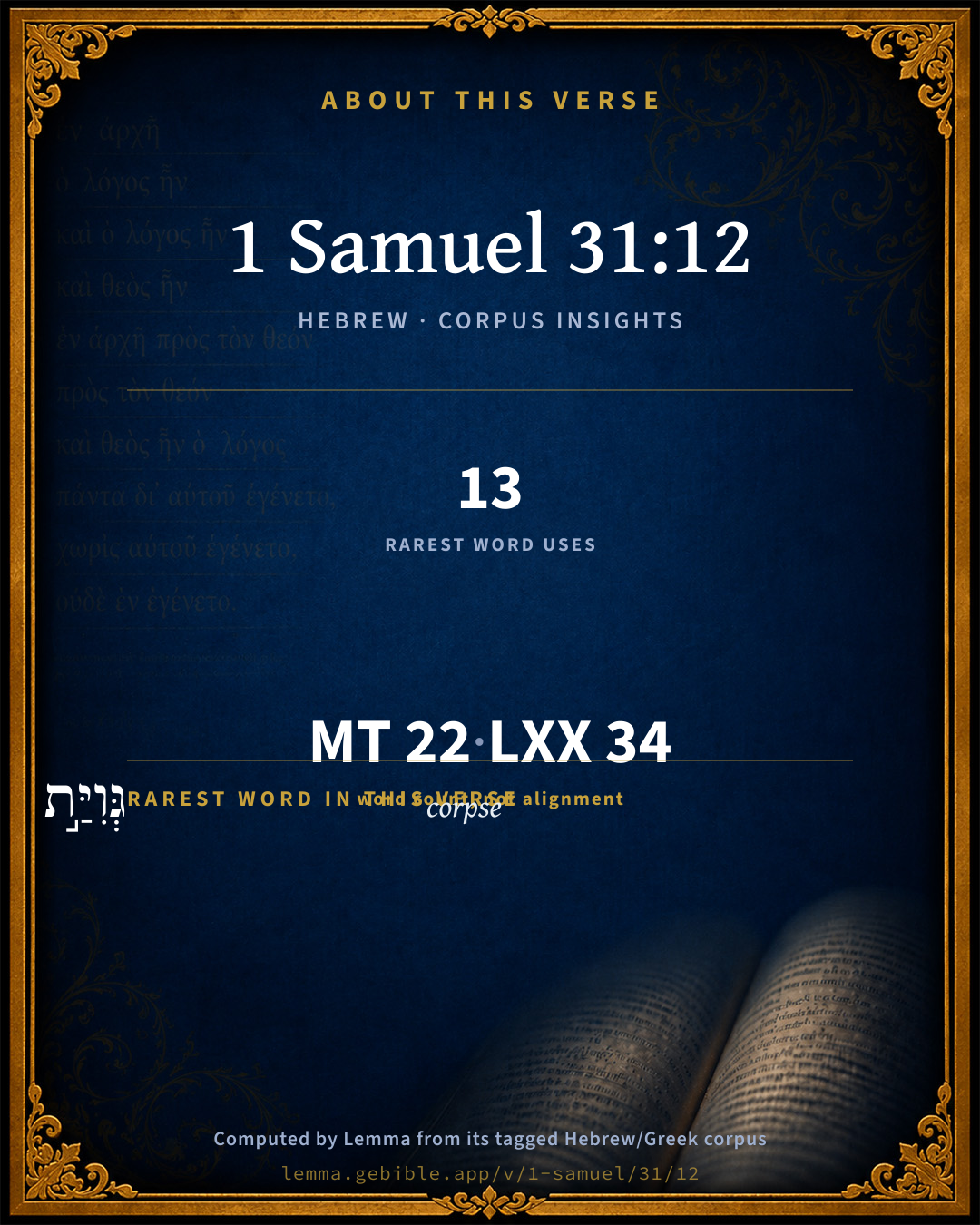
These counts appear in no published source. They are computed here, from the morphology-tagged text and Lemma’s own curated glosses. What Lemma adds →

22
words
17
distinct lemmas
Historical
section

Notable vocabulary

The rarest word here is גְּוִיַּ֣ת corpse H1472 — appearing just 13 times in the whole Hebrew Bible.

Shared distinctive vocabulary

גְּוִיַּ֣ת corpse H1472 occurs in 11 verses of the Hebrew Bible. Also found in:

Grammatical profile

  • 5 verbs
  • 13 nouns
  • 1 adverb
  • 3 particles

Verb forms

  • וַיָּק֜וּמוּ Qal · Sequential Imperfect
  • וַיֵּלְכ֣וּ Qal · Sequential Imperfect
  • וַיִּקְח֞וּ Qal · Sequential Imperfect
  • וַיָּבֹ֣אוּ Qal · Sequential Imperfect
  • וַיִּשְׂרְפ֥וּ Qal · Sequential Imperfect

Repetition

Words recur within this verse — often emphatic in Hebrew:

  • כָּל all H3605 ×2
  • גְּוִיַּ֣ת corpse H1472 ×2
  • בֵּ֣ית Beth-shean H1052 ×2

Hebrew & Septuagint length

In English translation the verse runs 35 words from the Hebrew and 41 from the Septuagint (LXX English) — closely comparable.

A rough comparison of the two English renderings, which tokenize alike — not a word-level alignment.

Word counts can differ between the Hebrew and the Greek without any difference in meaning — e.g. the Hebrew direct-object marker אֵת has no separate Greek word, and Greek often adds the article ὁ.

In the original languages it is 22 Hebrew tokens and 34 Greek tokens — but the two are counted differently (Hebrew bundles its prefixes and suffixes into one token; the Greek is in lemma form), so that isn’t a like-for-like length.

Cross-references

4

Topical passages linked to 1 Samuel 31:12 in the Treasury of Scripture Knowledge — connected by theme and wording, ordered by reader-vote popularity; previews shown in the World English Bible.

  • 2 Chronicles 16:14 They buried him in his own tombs, which he had hewn out for himself in the city of David, and laid him in the bed which was filled with sweet odors and various kinds [of spices] prepared by the perfumers' are: and they made a very great burning for him.
  • Jeremiah 34:5 you shall die in peace; and with the burnings of your fathers, the former kings who were before you, so shall they make a burning for you; and they shall lament you, [saying], Ah Lord! for I have spoken the word, says Yahweh.
  • 2 Samuel 2:4–7 The men of Judah came, and there they anointed David king over the house of Judah. They told David, saying, The men of Jabesh Gilead were those who buried Saul.
  • Amos 6:10 "When a man's relative carries him, even he who burns him, to bring bodies out of the house, and asks him who is in the innermost parts of the house, 'Is there yet any with you?' And he says, 'No;' then he will say, 'Hush! Indeed we must not mention the name of Yahweh.'

Cross-references courtesy of OpenBible.info (CC BY 4.0).

Hebrew and Greek witnesses Masoretic Hebrew ↔ Greek Septuagint

The same verse in the two great witnesses to the Old Testament, shown verse-for-verse.

These are two independent witnesses, not word-aligned to each other, and the Septuagint is shown in lemma (dictionary) form.

Hebrew 1 Samuel 31:12 Masoretic · Westminster Leningrad Codex

וַיָּק֜וּמוּ כָּל אִ֣ישׁ חַיִל֮ וַיֵּלְכ֣וּ כָל הַלַּיְלָה֒ וַיִּקְח֞וּ אֶת גְּוִיַּ֣ת שָׁא֗וּל וְאֵת֙ גְּוִיֹּ֣ת בָּנָ֔יו מֵחוֹמַ֖ת בֵּ֣ית שָׁ֑ן וַיָּבֹ֣אוּ יָבֵ֔שָׁה וַיִּשְׂרְפ֥וּ אֹתָ֖ם שָֽׁם

all the valiant men arose, and went all night, and took the body of Saul and the bodies of his sons from the wall of Beth-shan; and they came to Jabesh, and burnt them there.

World English Bible · Public Domain

Greek LXX 1 Samuel 31:12 Septuagint · lemma form

καί ἀναἵστημι πᾶς ἀνήρ δύναμις καί πορεύομαι ὅλος ὁ νύξ καί λαμβάνω ὁ σῶμα σαούλ καί ὁ σῶμα ιωναθαν ὁ υἱός αὐτός ἀπό τεῖχος βαιθσαν καί φέρω αὐτός εἰς ιαβις καί κατακαίω αὐτός ἐκεῖ

And they rose up, even every man of might, and marched all night, and took the body of Saul and the body of Jonathan his son from the wall of Baethsam; and they bring them to Jabis, and burn them there.

LXX2012 (modern English Septuagint) · Public Domain

Hebrew: Westminster Leningrad Codex (CC BY 4.0). Greek: Septuagint (public domain); English from LXX2012 (modern English Septuagint) (Public Domain). How the Septuagint differs from the Hebrew →

Targum (Aramaic paraphrase)

1

The Targum is the ancient Jewish Aramaic paraphrase of the Hebrew Scriptures — an interpretive translation, not the Hebrew text itself. Onkelos (literal) and Pseudo-Jonathan (expansive) render the Torah, and Jonathan the Prophets. Coverage is partial: where no permissively-licensed English translation exists for a verse, only the Aramaic is shown. This is verse-level text, not a word-by-word alignment to the Hebrew.

  1. Targum Jonathan Prophets (Joshua–Malachi)
    וְקָמוּ כָּל גְבַר גִבַּר וַאֲזַלוּ כָּל לֵילְיָא וּנְסִיבוּ יַת גוּפָא דְשָׁאוּל וְיַת גוּפֵי בְּנוֹהִי מִשׁוּרָא דְבֵית שָׁן וַאֲתוֹ לְיָבֵשׁ וּקְלוֹ עֲלֵיהוֹן כְּמָא דְקָלַן עַל מַלְכַיָא תַּמָן:

    (no public-domain English translation for this verse)

    Targum Jonathan — Aramaic: “Mikraot Gedolot” (public domain). English: “Sefaria Community Translation” (CC0 1.0 (public-domain dedication)); “London "Chaldee Paraphrase," 1871” (public domain). Text via Sefaria.

Commentary

Notes on 1 Samuel 31:12 from classic Christian and Jewish commentators (each source and its license shown beneath its notes). The classic Christian expositions comment on the surrounding passage and are grouped to its opening verse, so a note may address several verses; the Jewish commentaries on the Tanakh (Rashi and others) are per-verse, so they appear only where the commentator wrote on this verse.

Lemma curates 59 commentaries, every one of them public domain or Creative Commons licensed, each selected and text-cleaned for this edition rather than reprinted as found. About our sources →

Trapp's Complete Commentary

John Trapp

1Sa 31:12 All the valiant men arose, and went all night, and took the body of Saul and the bodies of his sons from the wall of Bethshan, and came to Jabesh, and burnt them there.

Ver. 12. And went all night.] To rescue his dead body, as he had marched all night to rescue them from the Ammonites.

And burnt them there.] Erant enim putrida corpora, plena vermibus, saith Vatablus; for their bodies were now putrified, by hanging long in the sun and air, full of vermin. They burnt them therefore with sweet odours, as 2Ch 16:14, and as was usual with the heathens, as may be seen in Virgil -

“ Ingentem struxere pyram, &c. ” - Aen., lib. vi.

John Trapp, A Commentary or Exposition upon All the Books of the Old and New Testament (1647–1656) — public domain. Text from a community e-Sword module.

Tyndale Open Study Notes

Tyndale Open Resources

31:12 burned the bodies: Cremation was rare. It is possible the bodies were burned because decomposition had already set in.

Tyndale Open Study Notes — © Tyndale Open Resources, licensed CC BY-SA 4.0. Text via the HelloAO Bible API.

Jamieson, Fausset & Brown

Robert Jamieson, A. R. Fausset & David Brown

valiant men arose, and went all night, and took the body of Saul and the bodies of his sons--Considering that Beth-shan is an hour and a half's distance, and by a narrow upland passage, to the west of the Jordan (the whole being a journey from Jabesh-gilead of about ten miles), they must have made all haste to travel thither to carry off the headless bodies and return to their own side of the Jordan in the course of a single night.

burnt them--This was not a Hebrew custom. It was probably resorted to on this occasion to prevent all risk of the Beth-shanites coming to disinter the royal remains for further insult.

Next: (2 Samuel) Introduction

Jamieson, Fausset & Brown — Commentary Critical and Explanatory on the Whole Bible (1871) — public domain (CC PDM 1.0). Text via the HelloAO Bible API.

Adam Clarke's Commentary

Verse 12. And burnt them there.] It has been denied that the Hebrews burnt the bodies of the dead, but that they buried them in the earth, or embalmed them, and often burnt spices around them, c. These no doubt were the common forms of sepulture, but neither of these could be conveniently practiced in the present case. They could not have buried them about Beth-shan without being discovered and as to embalming, that was most likely out of all question, as doubtless the bodies were now too putrid to bear it. They therefore burnt them, because there was no other way of disposing of them at that time so as to do them honour; and the bones and ashes they collected, and buried under a tree or in a grove at Jabesh.

Adam Clarke's Commentary on the Bible (1810–1826) — public domain. Text from a community e-Sword/MySword module.

Ellicott's Commentary for English Readers

(12) And burnt them there.—This “burning the corpse” was never the custom in Israel, and was restricted to criminals convicted of a crime of the deepest dye (Lev_20:14). The Jews in all cases buried their dead. The Chaldee therefore interpret the words relating this act of the men of Jabesh-Gilead, in the case of Saul and the princes, as referring to the solemn burning of spices, a ceremony which was afterwards performed at the burial of some of the kings of Judah. (See 2Ch_16:14; 2Ch_21:19; Jer_34:5.) But the language used in these cases is different; here it is expressly stated that “they burnt them.” The reason for their thus acting is clear. The mutilated trunks had been exposed for some days to the air, and the flesh was no doubt in a state of putrefaction. The flesh here only was burned. The bones (see next verse) were reverently and lovingly preserved, and laid to rest beneath the friendly shade of the great tamarisk tree of Jabesh.

A Bible Commentary for English Readers, edited by Charles John Ellicott (1878–1897) — public domain. Text from a community e-Sword module.

The Cambridge Bible for Schools and Colleges

gen. ed. J. J. S. Perowne

12. burnt them] Cremation was not a Hebrew practice, but in the present case was probably adopted to avoid the possibility of further insult to the bodies, if the Philistines should take Jabesh. The condensed account in Chronicles omits the mention of the burning.

The Cambridge Bible for Schools and Colleges (gen. ed. J. J. S. Perowne; Cambridge University Press, 1878–1918) — public domain. Text from a community e-Sword module.

John Gill's Exposition

All the valiant men arose,.... Of the city of Jabeshgilead, fired with indignation at the Philistines' ill usage of Saul and the bodies of his sons:

and went all night; not only for secrecy, but for haste:

and took the body of Saul and the bodies of his sons from the wall of Bethshan, and came to Jabesh; brought them with them thither, the Philistines either having no knowledge of it, or not daring to oppose them:

and burnt them there: that is, the flesh of them, for the bones they buried, as in Sa1 31:13; and this they did, contrary to the common usage of the country, which was not to burn; but this they did, that if the Philistines should come to recover them, they would not be able to do it: though the Targum is,

"they burnt over them, as they burn over their kings there;''they made a burning for them of spices over them; or of their beds, and other household goods, as Kimchi and Ben Melech observe, though they prefer the other sense; see Ch2 16:14 perhaps the true reason might be, because they were putrid and infectious.

John Gill's Exposition of the Whole Bible (1746–1763) — public domain (CC PDM 1.0). Text via the HelloAO Bible API.

Albert Barnes' Notes on the Bible

burnt them - Burning was not the usual mode of sepulture among the Hebrews. But in this case from a pious desire to disguise the mutilation of the headless corpses, and exempt them from any possible future insult, the men of Jabesh burned the bodies, yet so as to preserve the bones 1Sa 31:13; 2Sa 21:12.

Albert Barnes' Notes on the Bible (1834–1885) — public domain. Text from a community e-Sword/MySword module.

Haydock's Catholic Bible Commentary

Burnt them, or the flesh, reserving the ashes and bones to be buried, as was customary among the Greeks (Homer, Greek: ps.) and Romans: -----Sed cænam funeris hœres

Negliget iratus quod rem curtaveris; urnæ

Ossa inodora dabit. (Persius. vi.)

See Amos vi. 10. Jonathan insinuates, that they burnt over the bodies aromatic spices.

George Leo Haydock (1774–1849), Haydock's Catholic Family Bible and Commentary, 1859 edition — public domain. Excludes Psalms (Douay-Rheims chapter numbering differs from Protestant) and Deuterocanonical books (Catholic canon only).

Matthew Poole's English Annotations

Burnt their flesh, after the manner.

Matthew Poole's English Annotations on the Holy Bible (1683–1685) — public domain. Text from a community e-Sword/MySword module.

Whedon's Commentary on the Bible

Daniel D. Whedon

12. Burnt them — Such disposal of the bodies of the dead was not a custom among the Israelites, but has been accounted for in the present case on the supposition that these bodies were mutilated and already putrid, so that they could not receive honourable burial; and there was danger that the Philistines, finding the bodies stolen from the wall of Beth-shan, would hasten to recapture them, and do them some greater dishonour.

Daniel D. Whedon (gen. ed.), Commentary on the Old and New Testaments (1874–1909) — public domain. Text from a community e-Sword module.

The Pulpit Commentary

Vers. 12, 13. They burnt them. Cremation, though highly honourable among classical nations, is here mentioned for the first time in Holy Scripture, and was probably resorted to on this occasion to insure the bodies of Saul and his sons against further maltreatment, as, if buried, the Philistines might have made the attempt to get them again into their power. Some suppose that the burning of the dead was afterwards practised by the Jews, and quote in its favour 2Ch_16:14; Isa_33:12; Jer_31:40 Jer_34:5; Amo_6:10, but these passages bear a different interpretation. After the exile, interment was the sole method of disposing of the dead among the Jews, and in the Talmud cremation is condemned as a heathen practice. The burial of the bones of Saul and his sons proves that their bodies here were really burnt. Under a tree. Hebrew, "under the tamarisk," the famous tree of that species at Jabesh. It was under one tamarisk that Saul commanded the massacre of the priests, (1Sa_22:6) and now his bones are placed in rest beneath another.

Perhaps the people remembered the king"s fondness for trees. For the final fate of these relics see 2Sa_21:12-14. They fasted seven days. (Gen_1:10) The time of mourning was thirty days for Aaron (Num_20:29) and for Moses. (Deu_34:8) The Talmudic rule is strict mourning for seven days, less strict for the next twenty-three, in all thirty; and for a father or mother mourning was continued for a year. The fasting was mourning of the strictest kind, and proves that the people of Jabesh-Gilead honored to the utmost their deliverer.

The Pulpit Commentary (1880–1919), ed. H.D.M. Spence-Jones & Joseph S. Exell — public domain. Text from a community e-Sword module.

John Wesley's Explanatory Notes

Took the body, &c. - This they did, not only out of a concern, for the honour of Israel, and the crown of Israel, but out of gratitude to Saul, for his zeal and forwardness to rescue them from the Ammonites.

John Wesley, Explanatory Notes Upon the Whole Bible (1754–1765) — public domain. Text via the GEBible commentary corpus.

Scofield Reference Notes

C. I. Scofield

burnt Contra. 2Ch 16:14.

The Scofield Reference Bible (1917 edition), notes by C. I. Scofield — public domain. Text from a community e-Sword module.

Rashi

Rabbi Shlomo Yitzchaki (Rashi)

And burned them there. [Targum renders,] "And they burned for them as they burn for the kings there." As we learned: We perform the burning [ritual] at [the burial of] kings, and it is not [considered] an Amorite custom.

Rashi on the Tanakh — English translations: “The Judaica Press complete Tanach with Rashi, translated by A. J. Rosenberg” (CC BY 4.0); “Pentateuch with Rashi's commentary by M. Rosenbaum and A.M. Silbermann, 1929-1934” (public domain); “The Metsudah Tanach series, Lakewood, N.J” (CC BY 4.0); and “The Book of Joshua, Metsudah Publications, 1997” (CC BY 4.0). Text via Sefaria.

Lesson kit

Teaching starters — assembled from the data on this page, not authored interpretation. Every prompt links to the verse data it draws on. Edit before teaching.

1 Samuel, in the Historical, opens this verse with 22 words (17 distinct Hebrew lemmas). Its most distinctive word is gᵉvîyâh (“corpse”). A historical commentator’s framing appears above. Read the whole chapter for the surrounding context.

Discussion questions

  1. The word gᵉvîyâh carries the sense “corpse.” How does it shape the verse?
  2. How does Genesis 47:18, which shares the word «corpse», read alongside this verse?
  3. What does the repetition of “all” (2× in this one verse) do in this verse?
  4. The translations on this page render this verse differently — a whole-verse word diff, not a word-by-word alignment. What might account for the different wordings?
  5. «וַיָּק֜וּמוּ» is a Qal Sequential Imperfect verb. How does that grammatical form shape the action described?
  6. Compare how Trapp's Complete Commentary and Tyndale Open Study Notes read this verse. Where do they agree or differ?

Things to notice

Reading settings

Reading text

Shown beneath each verse's original-language words.

Old Testament
Old Testament edition

Read the OT as the Masoretic Hebrew (MT) or the Greek Septuagint (LXX).

English shown for the Greek Septuagint (in the Hebrew ↔ Greek comparison).

Comparing translations? Open the Compare panel on any verse page to stack up to four side by side.