
Judges 18:2

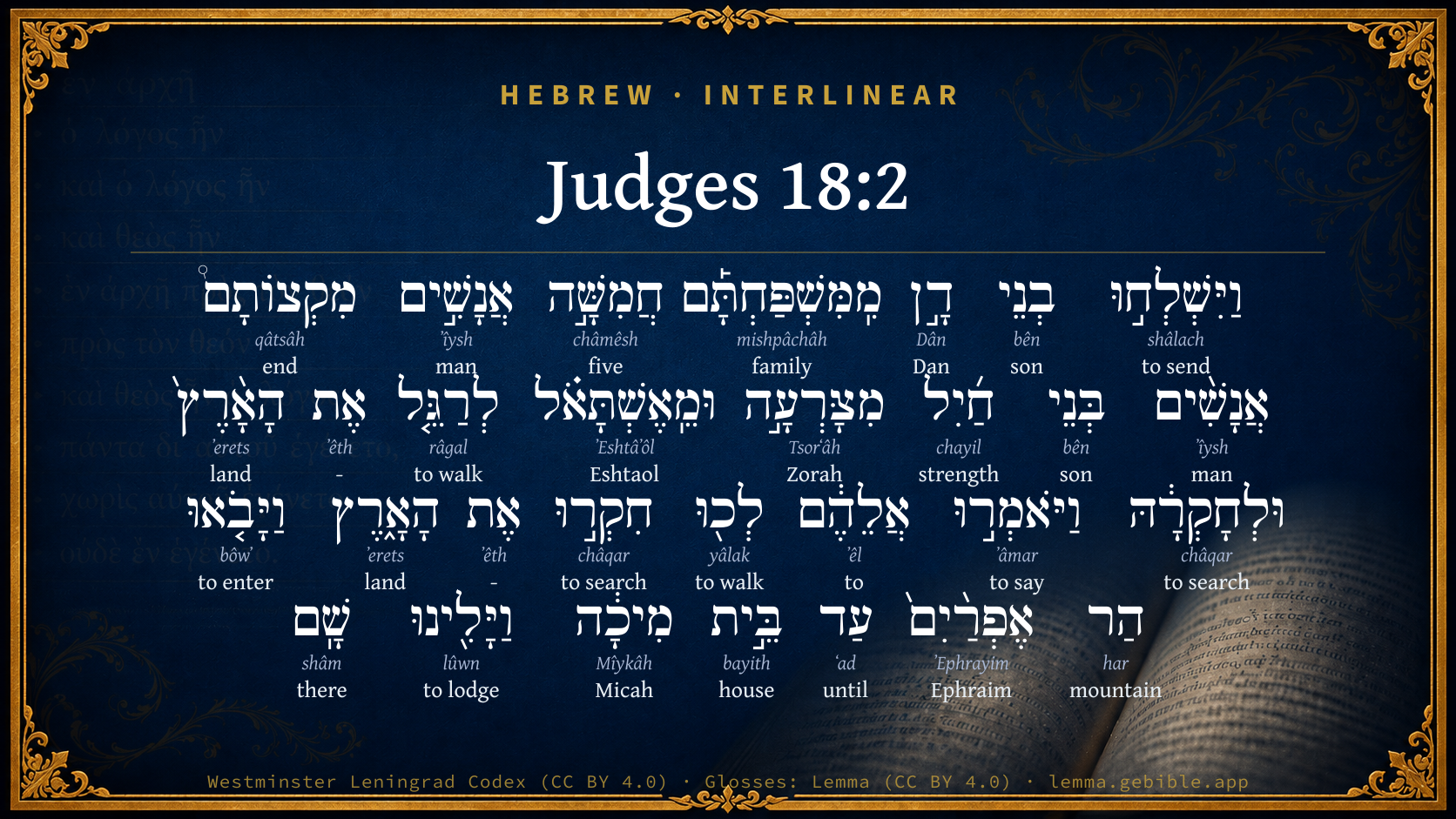
Hebrew (Westminster Leningrad Codex) Judges 18:2 appears in the Hebrew Old Testament. The text above is from the Westminster Leningrad Codex. Each word links to its Strong’s number, a concise gloss, and parsing drawn from the Open Scriptures Hebrew Bible morphology. Click any word for its full Brown-Driver-Briggs (BDB) entry.
Download image
Cite this verse

Judges 18:2 (World English Bible). Public Domain. Lemma interlinear Bible study tool, https://lemma.gebible.app/v/judges/18/2.

Show BibTeX & RIS
BibTeX
RIS
English Translation
The children of Dan sent of their family five men from their whole number, men of valor, from Zorah, and from Eshtaol, to spy out the land, and to search it; and they said to them, Go, search the land. They came to the hill-country of Ephraim, to the house of Micah, and lodged there.
World English Bible · Public Domain
Download a study sheet

One document with this verse’s original text, its word-by-word gloss line, the meaning frame, cross-references with their text, attributed commentary, and full source and license credits — printable, and it pastes into notes with its structure intact.

This verse Autodidact and up

Study sheet (.html) Plain text (.txt)

A passage Seminary Student

Up to 50 verses in one chapter. A passage sheet keeps up to 6 commentary sources and 12 cross-references per verse, in the order this page ranks them, and says so on the sheet whenever that leaves anything out. Ask for a single verse and you get the Autodidact verse sheet above.

Everything on this page stays free to read, with no account — the sheet is a download of what is already on screen, not access to it.

Want to remove ads? Support Godless Engineer
Compare translations 3

The same verse in 3 English versions, stacked beneath the original-language interlinear above. Click any original word for its lexicon entry.

Each is an independent rendering of the whole verse — the interlinear is not word-aligned to these translations.

Highlighted words mark where these versions differ — a whole-verse word diff, not a word-by-word alignment.

  • World English Bible Public Domain
    The children of Dan sent of their family five men from their whole number, men of valor, from Zorah, and from Eshtaol, to spy out the land, and to search it; and they said to them, Go, search the land. They came to the hill-country of Ephraim, to the house of Micah, and lodged there.
  • King James Version Public Domain
    And the children of Dan sent of their family five men from their coasts, men of valor, from Zorah, and from Eshtaol, to spy out the land, and to search it; and they said unto them, Go, search the land: who when they came to mount Ephraim, to the house of Micah, they lodged there.
  • unfoldingWord Literal Text CC BY-SA 4.0
    And the sons of Dan sent from their clan five men, men from their borders, sons of valor from Zorah and from Eshtaol, to spy on the land and to examine it. And they said to them, “Go, examine the land.” And they entered the hill country of Ephraim, to the house of Micah, and they lodged there.

unfoldingWord Literal Text — © unfoldingWord, licensed CC BY-SA 4.0. Word-aligned USFM3 via Door43 (git.door43.org/unfoldingWord/en_ult).

Versions to compare (up to 4)

3 of 4 selected

Show all 18 translations

Every available English version of this verse, each an independent rendering of the whole verse.

  • World English Bible Public Domain
    The children of Dan sent of their family five men from their whole number, men of valor, from Zorah, and from Eshtaol, to spy out the land, and to search it; and they said to them, Go, search the land. They came to the hill-country of Ephraim, to the house of Micah, and lodged there.
  • Berean Standard Bible Public Domain
    So the Danites sent out five men from their clans, men of valor from Zorah and Eshtaol, to spy out the land and explore it. “Go and explore the land,” they told them. The men entered the hill country of Ephraim and came to the house of Micah, where they spent the night.
  • Majority Standard Bible Public Domain
    So the Danites sent out five men from their clans, men of valor from Zorah and Eshtaol, to spy out the land and explore it. “Go and explore the land,” they told them. The men entered the hill country of Ephraim and came to the house of Micah, where they spent the night.
  • King James Version Public Domain
    And the children of Dan sent of their family five men from their coasts, men of valor, from Zorah, and from Eshtaol, to spy out the land, and to search it; and they said unto them, Go, search the land: who when they came to mount Ephraim, to the house of Micah, they lodged there.
  • American Standard Version (1901) Public Domain
    And the children of Dan sent of their family five men from their whole number, men of valor, from Zorah, and from Eshtaol, to spy out the land, and to search it; and they said unto them, Go, search the land. And they came to the hill-country of Ephraim, unto the house of Micah, and lodged there.
  • Revised Version (1885) Public Domain
    And the children of Dan sent of their family five men from their whole number, men of valour, from Zorah, and from Eshtaol, to spy out the land, and to search it; and they said unto them, Go, search the land: and they came to the hill country of Ephraim, unto the house of Micah, and lodged there.
  • Geneva Bible (1599) Public Domain
    Therefore the children of Dan sent of their familie, fiue men out of their coastes, euen men expert in warre, out of Zorah and Eshtaol, to viewe the lande and search it out, and saide vnto them, Goe, and search out the lande. Then they came to mount Ephraim to the house of Michah and lodged there.
  • Douay-Rheims (1899) Public Domain
    So the children of Dan sent five most valiant men of their stock and family from Saraa and Esthaol, to spy out the land, and to view it diligently: and they said to them: Go, and view the land. They went on their way, and when they came to mount Ephraim, they went into the house of Michas, and rested there:
  • Young's Literal Translation Public Domain
    And the sons of Dan send, out of their family, five men of them, men, sons of valour, from Zorah, and from Eshtaol, to traverse the land, and to search it, and they say unto them, `Go, search the land;' and they come into the hill-country of Ephraim, unto the house of Micah, and lodge there.
  • Literal Standard Version CC BY-SA 4.0
    And the sons of Dan send, out of their family, five of their men—men, sons of valor—from Zorah, and from Eshtaol, to traverse the land, and to search it, and they say to them, “Go, search the land”; and they come into the hill-country of Ephraim, to the house of Micah, and lodge there.
  • Unlocked Literal Bible CC BY-SA 4.0
    The people of Dan sent five men from the whole number of their tribe, men who were experienced warriors from Zorah and from Eshtaol, to scout the land on foot, and to look it over. They said to them, “Go and look over the land.” They came to the hill country of Ephraim, to the house of Micah, and they spent the night there.
  • unfoldingWord Literal Text CC BY-SA 4.0
    And the sons of Dan sent from their clan five men, men from their borders, sons of valor from Zorah and from Eshtaol, to spy on the land and to examine it. And they said to them, “Go, examine the land.” And they entered the hill country of Ephraim, to the house of Micah, and they lodged there.
  • Darby Bible Public Domain
    So the Danites sent five able men from the whole number of their tribe, from Zorah and from Esh'ta-ol, to spy out the land and to explore it; and they said to them, "Go and explore the land." And they came to the hill country of E'phraim, to the house of Micah, and lodged there.
  • World Messianic Bible Public Domain
    The children of Dan sent five men of their family from their whole number, men of valor, from Zorah and from Eshtaol, to spy out the land and to search it. They said to them, “Go, explore the land!” They came to the hill country of Ephraim, to the house of Micah, and lodged there.
  • Webster's Bible Public Domain
    And the children of Dan sent of their family five men from their borders, men of valor, from Zorah, and from Eshtaol, to explore the land, and to search it; and they said to them, Go, search the land: who when they came to mount Ephraim, to the house of Micah, they lodged there.
  • Free Bible Version CC BY-SA 4.0
    So the Danites chose from among their tribes five leading men who came from the towns of Zorah and Eshtaol to scout out the land and explore it. “Go and explore the land,” they told them. When the men came to the hill country of Ephraim, they arrived at Micah's house where they spent the night.
  • Bible in Basic English Public Domain
    So the children of Dan sent five men from among their number, strong men, from Zorah and from Eshtaol, to take a look at the land and make a search through it; and they said to them, Go and make a search through the land; and they came to the hill-country of Ephraim, to the house of Micah, where they made a stop for the night.
  • JPS Tanakh (1917) Public Domain
    And the children of Dan sent of their family five men from their whole number, men of valour, from Zorah, and from Eshtaol, to spy out the land, and to search it; and they said unto them: 'Go, search the land'; and they came to the hill-country of Ephraim, unto the house of Micah, and lodged there.

Literal Standard Version (2020), Covenant Press — licensed CC BY-SA 4.0. Text via the HelloAO Bible API (eBible.org). Unlocked Literal Bible (unfoldingWord) — licensed CC BY-SA 4.0. Text via the HelloAO Bible API (eBible.org). unfoldingWord Literal Text — © unfoldingWord, licensed CC BY-SA 4.0. Word-aligned USFM3 via Door43 (git.door43.org/unfoldingWord/en_ult). Free Bible Version, Dr. Jonathan Gallagher — licensed CC BY-SA 4.0. Text via the HelloAO Bible API (eBible.org).

Word by word

More ways to search: Search by grammar → Find every occurrence → Compare this word →

Practice this passage: Drill this verse → Learn its vocabulary →

וּמֵֽאֶשְׁתָּאֹ֗ל
ʼEshtâʼôl
H847
“and · from · Eshtaol”
Conjunction + Preposition + Noun, Proper
Part of Speech
Conjunction + Preposition + Noun
Type
Proper
Full BDB Definition

Origin: probably from H7592

TWOT: None

Eshtaol = "entreaty" - a Danite city located within Judah
  1. וַיִּשְׁלְח֣וּ shâlach H7971 “and · to send” Conjunction + Verb, Qal, Sequential Imperfect, 3rd Person, Masculine, Plural
  2. בְנֵי bên H1121 “sons of” Noun, Common, Masculine, Plural, Construct
  3. דָ֣ן Dân H1835 “Dan” Noun, Proper
  4. מִֽמִּשְׁפַּחְתָּ֡ם mishpâchâh H4940 “from · family · their” Preposition + Noun, Common, Feminine, Singular, Construct + Suffix, Personal, 3rd Person, Masculine, Plural
  5. חֲמִשָּׁ֣ה châmêsh H2568 “five” Adjective, Cardinal number, Masculine, Singular, Absolute
  6. אֲנָשִׁ֣ים ʼîysh H376 “men” Noun, Common, Masculine, Plural, Absolute
  7. מִקְצוֹתָם֩ qâtsâh H7098 “from · ends · their” Preposition + Noun, Common, Both, Plural, Construct + Suffix, Personal, 3rd Person, Masculine, Plural
  8. אֲנָשִׁ֨ים ʼîysh H376 “men” Noun, Common, Masculine, Plural, Absolute
  9. בְּנֵי bên H1121 “sons of” Noun, Common, Masculine, Plural, Construct
  10. חַ֜יִל chayil H2428 “strength” Noun, Common, Masculine, Singular, Absolute
  11. מִצָּרְעָ֣ה Tsorʻâh H6881 “from · Zorah” Preposition + Noun, Proper
  12. לְרַגֵּ֤ל râgal H7270 “to walk” Preposition + Verb, Piel, Infinitive Construct
  13. אֶת ʼêth H853 “-” Particle, Direct Object
  14. הָאָ֨רֶץ֙ ʼerets H776 “the · land” Particle, Definite Article + Noun, Common, Both, Singular, Absolute
  15. וּלְחָקְרָ֔הּ châqar H2713 “and · to search · her” Conjunction + Preposition + Verb, Qal, Infinitive Construct + Suffix, Personal, 3rd Person, Feminine, Singular
  16. וַיֹּאמְר֣וּ ʼâmar H559 “and · to say” Conjunction + Verb, Qal, Sequential Imperfect, 3rd Person, Masculine, Plural
  17. אֲלֵהֶ֔ם ʼêl H413 “to · them” Preposition + Suffix, Personal, 3rd Person, Masculine, Plural
  18. לְכ֖וּ yâlak H3212 “walk” Verb, Qal, Imperative, 2nd Person, Masculine, Plural
  19. חִקְר֣וּ châqar H2713 “search” Verb, Qal, Imperative, 2nd Person, Masculine, Plural
  20. אֶת ʼêth H853 “-” Particle, Direct Object
  21. הָאָ֑רֶץ ʼerets H776 “the · land” Particle, Definite Article + Noun, Common, Both, Singular, Absolute
  22. וַיָּבֹ֤אוּ bôwʼ H935 “and · to enter” Conjunction + Verb, Qal, Sequential Imperfect, 3rd Person, Masculine, Plural
  23. הַר har H2022 “mountain of” Noun, Common, Masculine, Singular, Construct
  24. אֶפְרַ֨יִם֙ ʼEphrayim H669 “Ephraim” Noun, Proper
  25. עַד ʻad H5704 “until” Preposition
  26. בֵּ֣ית bayith H1004 “house of” Noun, Common, Masculine, Singular, Construct
  27. מִיכָ֔ה Mîykâh H4318 “Micah” Noun, Proper
  28. וַיָּלִ֖ינוּ lûwn H3885 “and · to lodge” Conjunction + Verb, Qal, Sequential Imperfect, 3rd Person, Masculine, Plural
  29. שָֽׁם shâm H8033 “there” Adverb

About this verse

These counts appear in no published source. They are computed here, from the morphology-tagged text and Lemma’s own curated glosses. What Lemma adds →

30
words
25
distinct lemmas
Historical
section

Notable vocabulary

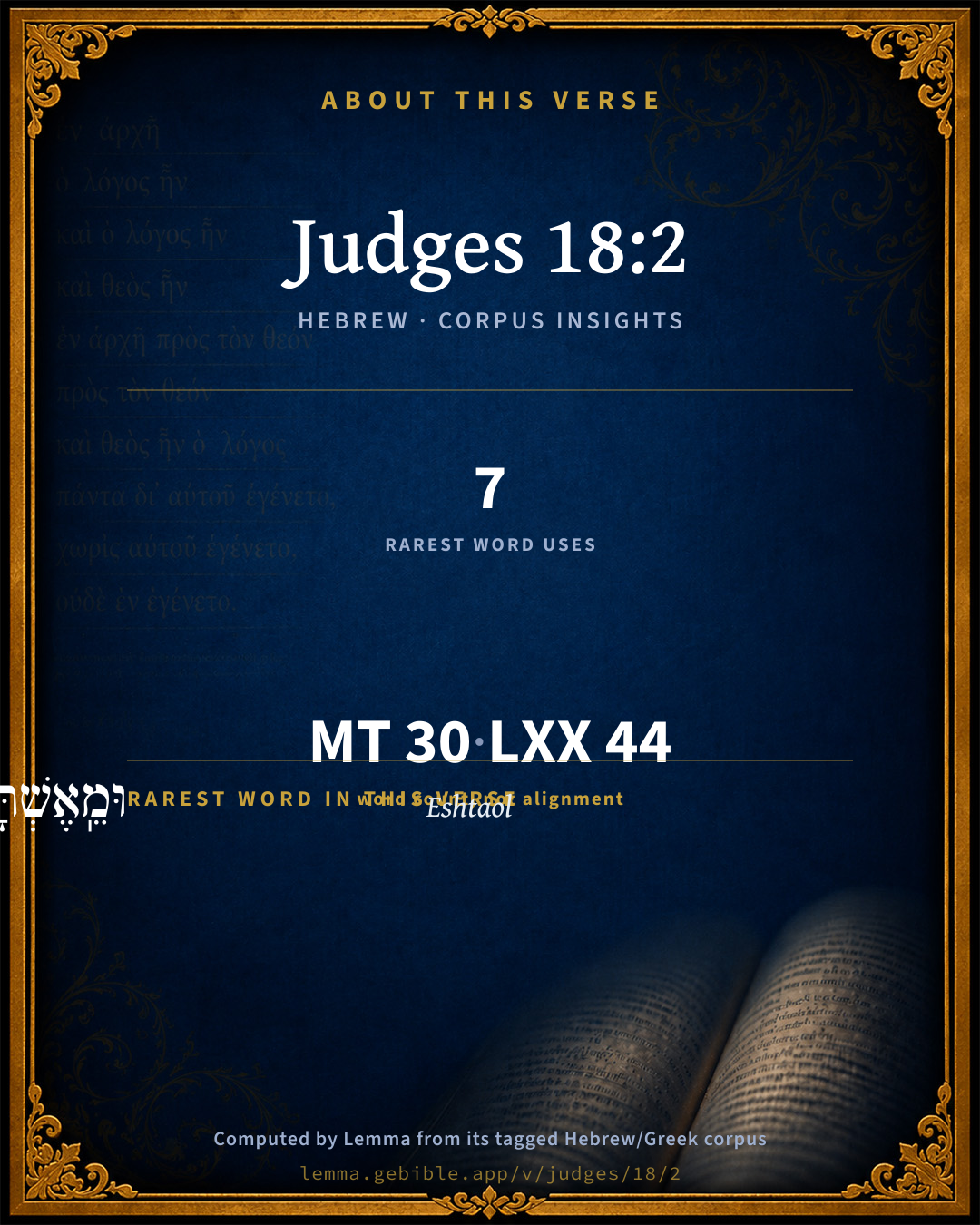
The rarest word here is וּמֵֽאֶשְׁתָּאֹ֗ל Eshtaol H847 — appearing just 7 times in the whole Hebrew Bible.

Shared distinctive vocabulary

וּמֵֽאֶשְׁתָּאֹ֗ל Eshtaol H847 occurs in 7 verses of the Hebrew Bible. Also found in:

Grammatical profile

  • 8 verbs
  • 16 nouns
  • 1 adjective
  • 2 prepositions
  • 1 adverb
  • 2 particles

Verb forms

  • וַיִּשְׁלְח֣וּ Qal · Sequential Imperfect
  • לְרַגֵּ֤ל Piel · Infinitive Construct
  • וּלְחָקְרָ֔הּ Qal · Infinitive Construct
  • וַיֹּאמְר֣וּ Qal · Sequential Imperfect
  • לְכ֖וּ Qal · Imperative
  • חִקְר֣וּ Qal · Imperative
  • וַיָּבֹ֤אוּ Qal · Sequential Imperfect
  • וַיָּלִ֖ינוּ Qal · Sequential Imperfect

Repetition

Words recur within this verse — often emphatic in Hebrew:

  • בְנֵי son H1121 ×2
  • אֲנָשִׁ֣ים man H376 ×2
  • הָאָ֨רֶץ֙ land H776 ×2
  • וּלְחָקְרָ֔הּ to search H2713 ×2

Hebrew & Septuagint length

In English translation the verse runs 55 words from the Hebrew and 57 from the Septuagint (LXX English) — closely comparable.

A rough comparison of the two English renderings, which tokenize alike — not a word-level alignment.

Word counts can differ between the Hebrew and the Greek without any difference in meaning — e.g. the Hebrew direct-object marker אֵת has no separate Greek word, and Greek often adds the article ὁ.

In the original languages it is 30 Hebrew tokens and 44 Greek tokens — but the two are counted differently (Hebrew bundles its prefixes and suffixes into one token; the Greek is in lemma form), so that isn’t a like-for-like length.

Cross-references

14

Topical passages linked to Judges 18:2 in the Treasury of Scripture Knowledge — connected by theme and wording, ordered by reader-vote popularity; previews shown in the World English Bible.

  • Judges 13:25 The Spirit of Yahweh began to move him in Mahaneh-dan, between Zorah and Eshtaol.
  • Joshua 2:1 Joshua the son of Nun sent out of Shittim two men as spies secretly, saying, Go, view the land, and Jericho. They went and came into the house of a prostitute whose name was Rahab, and lay there.
  • Numbers 13:17 Moses sent them to spy out the land of Canaan, and said to them, Go up this way by the South, and go up into the hill-country:
  • Judges 18:8 They came to their brothers to Zorah and Eshtaol: and their brothers said to them, What [say] you?
  • Judges 18:11 There set forth from there of the family of the Danites, out of Zorah and out of Eshtaol, six hundred men girt with weapons of war.
  • Genesis 42:9 Joseph remembered the dreams which he dreamed about them, and said to them, "You are spies! You have come to see the nakedness of the land."
  • Joshua 17:15–18 Joshua said to them, If you are a great people, go up to the forest, and cut down for yourself there in the land of the Perizzites and of the Rephaim; since the hill-country of Ephraim is too narrow for you.
  • Joshua 19:41 The border of their inheritance was Zorah, and Eshtaol, and Irshemesh,
  • Judges 13:2 There was a certain man of Zorah, of the family of the Danites, whose name was Manoah; and his wife was barren, and didn't bear.
  • Judges 16:31–17:1 Then his brothers and all the house of his father came down, and took him, and brought him up, and buried him between Zorah and Eshtaol in the burying-place of Manoah his father. He judged Israel twenty years.
  • Judges 19:1 It happened in those days, when there was no king in Israel, that there was a certain Levite sojourning on the farther side of the hill-country of Ephraim, who took to him a concubine out of Bethlehem Judah.
  • Judges 19:18 He said to him, We are passing from Bethlehem Judah to the farther side of the hill-country of Ephraim; from there am I, and I went to Bethlehem Judah: and I am [now] going to the house of Yahweh; and there is no man who takes me into his house.
  • Proverbs 20:18 Plans are established by advice; By wise guidance you wage war!
  • Luke 14:31 Or what king, as he goes to encounter another king in war, will not sit down first and consider whether he is able with ten thousand to meet him who comes against him with twenty thousand?

Cross-references courtesy of OpenBible.info (CC BY 4.0).

Hebrew and Greek witnesses Masoretic Hebrew ↔ Greek Septuagint

The same verse in the two great witnesses to the Old Testament, shown verse-for-verse.

These are two independent witnesses, not word-aligned to each other, and the Septuagint is shown in lemma (dictionary) form.

Hebrew Judges 18:2 Masoretic · Westminster Leningrad Codex

וַיִּשְׁלְח֣וּ בְנֵי דָ֣ן מִֽמִּשְׁפַּחְתָּ֡ם חֲמִשָּׁ֣ה אֲנָשִׁ֣ים מִקְצוֹתָם֩ אֲנָשִׁ֨ים בְּנֵי חַ֜יִל מִצָּרְעָ֣ה וּמֵֽאֶשְׁתָּאֹ֗ל לְרַגֵּ֤ל אֶת הָאָ֨רֶץ֙ וּלְחָקְרָ֔הּ וַיֹּאמְר֣וּ אֲלֵהֶ֔ם לְכ֖וּ חִקְר֣וּ אֶת הָאָ֑רֶץ וַיָּבֹ֤אוּ הַר אֶפְרַ֨יִם֙ עַד בֵּ֣ית מִיכָ֔ה וַיָּלִ֖ינוּ שָֽׁם

The children of Dan sent of their family five men from their whole number, men of valor, from Zorah, and from Eshtaol, to spy out the land, and to search it; and they said to them, Go, search the land. They came to the hill-country of Ephraim, to the house of Micah, and lodged there.

World English Bible · Public Domain

Greek LXX Judges 18:2 Septuagint · lemma form

καί ἀποστέλλω ὁ υἱός δαν ἀπό δῆμος αὐτός πέντε ἀνήρ υἱός δύναμις ἀπό σαραα καί ἀπό εσθαολ ὁ κατασκέπτομαι ὁ γῆ καί ἐξιχνιάζω αὐτός καί εἶπον πρός αὐτός πορεύομαι καί ἐξιχνιάζω ὁ γῆ καί ἔρχομαι ἕως ὄρος ἐφράιμ ἕως οἶκος μιχαιας καί αὐλίζω ἐκεῖ

And the sons of Dan sent from their families five men of valour, from Saraa and from Esthaol, to spy out the land and to search it; and they said to them, Go and search out the land. And they came as far as the mount of Ephraim to the house of Michaias and they lodged there,

LXX2012 (modern English Septuagint) · Public Domain

Hebrew: Westminster Leningrad Codex (CC BY 4.0). Greek: Septuagint (public domain); English from LXX2012 (modern English Septuagint) (Public Domain). How the Septuagint differs from the Hebrew →

Targum (Aramaic paraphrase)

1

The Targum is the ancient Jewish Aramaic paraphrase of the Hebrew Scriptures — an interpretive translation, not the Hebrew text itself. Onkelos (literal) and Pseudo-Jonathan (expansive) render the Torah, and Jonathan the Prophets. Coverage is partial: where no permissively-licensed English translation exists for a verse, only the Aramaic is shown. This is verse-level text, not a word-by-word alignment to the Hebrew.

  1. Targum Jonathan Prophets (Joshua–Malachi)
    וּשְׁלֵחוּ בְנֵי דָן מִזַרְעֲיַתְהוֹן חַמְשָׁא גוּבְרִין מִקְצַתְהוֹן גַבְרִין בְּנֵי חֵילָא מִצָרְעָה וּמֵאֶשְׁתָּאוֹל לְאַלָלָא יַת אַרְעָא וּלְמִבְדְקָא וַאֲמַרוּ לְהוֹן אֶזִילוּ בְּדוּקוּ יַת אַרְעָא וַאֲתוֹ לְטוּרָא דְבֵית אֶפְרַיִם עַד בֵּית מִיכָה וּבָתוּ תַמָן:

    (no public-domain English translation for this verse)

    Targum Jonathan — Aramaic: “Mikraot Gedolot” (public domain). English: “Sefaria Community Translation” (CC0 1.0 (public-domain dedication)); “London "Chaldee Paraphrase," 1871” (public domain). Text via Sefaria.

Commentary

Notes on Judges 18:2 from classic Christian and Jewish commentators (each source and its license shown beneath its notes). The classic Christian expositions comment on the surrounding passage and are grouped to its opening verse, so a note may address several verses; the Jewish commentaries on the Tanakh (Rashi and others) are per-verse, so they appear only where the commentator wrote on this verse.

Lemma curates 59 commentaries, every one of them public domain or Creative Commons licensed, each selected and text-cleaned for this edition rather than reprinted as found. About our sources →

Trapp's Complete Commentary

John Trapp

Jdg 18:2 And the children of Dan sent of their family five men from their coasts, men of valour, from Zorah, and from Eshtaol, to spy out the land, and to search it; and they said unto them, Go, search the land: who when they came to mount Ephraim, to the house of Micah, they lodged there.

Ver. 2. To the house of Micah, they lodged there.] He was a wealthy man, it seems, and gave them entertainment. But what a rich man was Pythias, who could entertain a million of men, even Xerxes’s whole army, for three days together! And yet this great rich man died a beggar, whatever Micah did.

John Trapp, A Commentary or Exposition upon All the Books of the Old and New Testament (1647–1656) — public domain. Text from a community e-Sword module.

Joseph Benson's Commentary

Jdg 18:2-5. They lodged there — Not in the same house, but near it. They knew the voice of the young man — Having been acquainted with him before he came to live with Micah. Ask counsel, we pray thee, of God — By thine ephod and teraphim, or image, which they knew he had. This and the following verse show that this sanctuary of Micah was dedicated to the true God, and not to idols. But how ignorant were these Danites, to suppose God would be consulted here as well as in his house at Shiloh!

Joseph Benson's Commentary on the Old and New Testaments (1811–1818) — public domain. Text from a community e-Sword module.

Geneva Bible (1599)

Geneva Bible translators

For the portion which Joshua gave them, was not sufficient for all their tribe.

Geneva Bible (1599) marginal notes — public domain. Text via Bolls.life.

Adam Clarke's Commentary

Verse 2. Five men - men of valour] The Hebrew word חיל chayil has been applied to personal prowess, to mental energy, and to earthly possessions. They sent those in whose courage, judgment, and prudence, they could safely confide.

Adam Clarke's Commentary on the Bible (1810–1826) — public domain. Text from a community e-Sword/MySword module.

Ellicott's Commentary for English Readers

(2) From their coasts.—Literally, their ends (Gen_19:4; 1Ki_12:31). Some explain it to mean “from their whole number.”

Men of valour.—Literally, sons of force (Jdg_21:10).

To spy out the land.—As in Jos_2:1.

They came to mount Ephraim.—It would have been an easier journey to pass along the Shephelah, but that was mainly in the hands of the original inhabitants.

To the house of Micah.—There is no necessity for the supposition that they did not actually lodge in the house, or, at any rate, in the khan which doubtless formed part of the settlement. The centre of a new and gorgeous worship was sure to have places around it where those could lodge who came to consult the pesel-ephod (see Jdg_18:18), just as even the ordinary synagogues had lodgings for wayfarers.

A Bible Commentary for English Readers, edited by Charles John Ellicott (1878–1897) — public domain. Text from a community e-Sword module.

The Cambridge Bible for Schools and Colleges

gen. ed. J. J. S. Perowne

2. The repetitions in this verse (of their family, of their whole number; five, men, men of valour; to search it, search the land) point to a combination of the two narratives, of which the beginning can be traced in ch. 17.

The Cambridge Bible for Schools and Colleges (gen. ed. J. J. S. Perowne; Cambridge University Press, 1878–1918) — public domain. Text from a community e-Sword module.

John Gill's Exposition

And the children of Dan sent of their family five men,.... According to Abarbinel one out of a family, as Moses sent one out of a tribe to spy the land; and so there must be five families concerned in this affair:

from their coasts, men of valour from Zorah, and from Eshtaol, to spy out the land, and to search it; these men were sent from the borders of the tribe, the extreme parts of it, as the word may signify, where perhaps they were the most pressed and overcrowded: Zorah and Eshtaol are particularly mentioned, and were the first cities in their lot, and were the coast of their inheritance; see Gill on Jos 19:41 some take the phrase rendered "from their coasts" to signify persons of extreme meanness, men of the lowest class among them; but the above mentioned writers interpret it to a quite contrary sense, by "Katzinim", princes, such as Moses sent to spy the land; and this better agrees with the next clause, "men of valour": and the word used signifies not only magnanimity and fortitude of mind, but wealth and riches; and these were sent not to spy the land of Canaan, but such places as fell to this tribe, but were possessed by the Canaanites; and their errand was to observe in what condition they were, and whether fit for their purpose, and easy to obtain, and how they might get the possession of any of them:

and they said unto them, search the land; and see if some convenient place cannot be found out to enlarge their inheritance, and give them more room and liberty for their families, now pent up, and a pasturage for their flocks and herds:

who when they came to Mount Ephraim; which lay upon the borders of them:

to the house of Micah, they lodged there; that is, when they were come near to the house of Micah, as Kimchi and Ben Melech interpret it, they took up their lodging in the neighbourhood of it, perhaps at a public house or inn; for the sense is not, that they lodged in Micah's house, for after this we read of their turning into it, as in the next verse. According to Bunting (r), this place was twenty four miles from Zorah and Eshtaol, from whence these men came.

(r) Travels of the Patriarchs, &c. p. 112.

John Gill's Exposition of the Whole Bible (1746–1763) — public domain (CC PDM 1.0). Text via the HelloAO Bible API.

Albert Barnes' Notes on the Bible

This identity of locality with the scene of Samson’s birth and death indicates that both narratives are drawn from the same source, probably the annals of the tribe of Dan.

Albert Barnes' Notes on the Bible (1834–1885) — public domain. Text from a community e-Sword/MySword module.

Haydock's Catholic Bible Commentary

Family. Hebrew, "From their extremity." Which may denote such as came to hand, (Calmet) or princes, (De Dieu) or people of mean appearance, (Castalion) unless we explain it "from their coasts," with Montanus, Protestants, &c. (Haydock)

George Leo Haydock (1774–1849), Haydock's Catholic Family Bible and Commentary, 1859 edition — public domain. Excludes Psalms (Douay-Rheims chapter numbering differs from Protestant) and Deuterocanonical books (Catholic canon only).

Matthew Poole's English Annotations

Of their family; which shows that it was but one, though a large family, which was engaged in this expedition. Eshtaol; of which see Jos 19:41; Jdg 13:2,25.

They lodged there; not in the same house, but near it, as appears from the next verse, in a neighbouring place.

Matthew Poole's English Annotations on the Holy Bible (1683–1685) — public domain. Text from a community e-Sword/MySword module.

The Pulpit Commentary

They came to Mount Ephraim. (Jud_1:17:1, 8) The hill country of Ephraim would be on their way to the north from Eshtaol. They would naturally avoid the plain where the Amorites and Philistines were strong.

The Pulpit Commentary (1880–1919), ed. H.D.M. Spence-Jones & Joseph S. Exell — public domain. Text from a community e-Sword module.

John Wesley's Explanatory Notes

There - Not in the same house, but near it.

John Wesley, Explanatory Notes Upon the Whole Bible (1754–1765) — public domain. Text via the GEBible commentary corpus.

Keil & Delitzsch

C. F. Keil & F. Delitzsch

To spy out and explore the land for the object mentioned, the Danites sent out five brave men "out of their (the Danites') ends," i.e., from their whole body (vid., Kg1 12:31; Kg1 13:33, and the commentary on Gen 19:4). They came up to the mountains of Ephraim, and as far as Micah's house, where they passed the night.

Keil & Delitzsch — Biblical Commentary on the Old Testament (1861–1891) — public domain (CC PDM 1.0). Text via the HelloAO Bible API. (Old Testament only.)

Lesson kit

Teaching starters — assembled from the data on this page, not authored interpretation. Every prompt links to the verse data it draws on. Edit before teaching.

Judges, in the Historical, opens this verse with 30 words (25 distinct Hebrew lemmas). Its most distinctive word is ʼEshtâʼôl (“Eshtaol”). A historical commentator’s framing appears above. Read the whole chapter for the surrounding context.

Discussion questions

  1. What does “Eshtaol” (ʼEshtâʼôl) contribute to the verse as a whole?
  2. How does Joshua 15:33, which shares the word «Eshtaol», read alongside this verse?
  3. What does the repetition of “son” (2× in this one verse) do in this verse?
  4. These translations render this verse differently. What is at stake in choosing one wording over another?
  5. «וַיִּשְׁלְח֣וּ» is a Qal Sequential Imperfect verb. How does that grammatical form shape the action described?
  6. Compare how Trapp's Complete Commentary and Joseph Benson's Commentary read this verse. Where do they agree or differ?

Things to notice

Reading settings

Reading text

Shown beneath each verse's original-language words.

Old Testament
Old Testament edition

Read the OT as the Masoretic Hebrew (MT) or the Greek Septuagint (LXX).

English shown for the Greek Septuagint (in the Hebrew ↔ Greek comparison).

Comparing translations? Open the Compare panel on any verse page to stack up to four side by side.