
Psalms 33:17

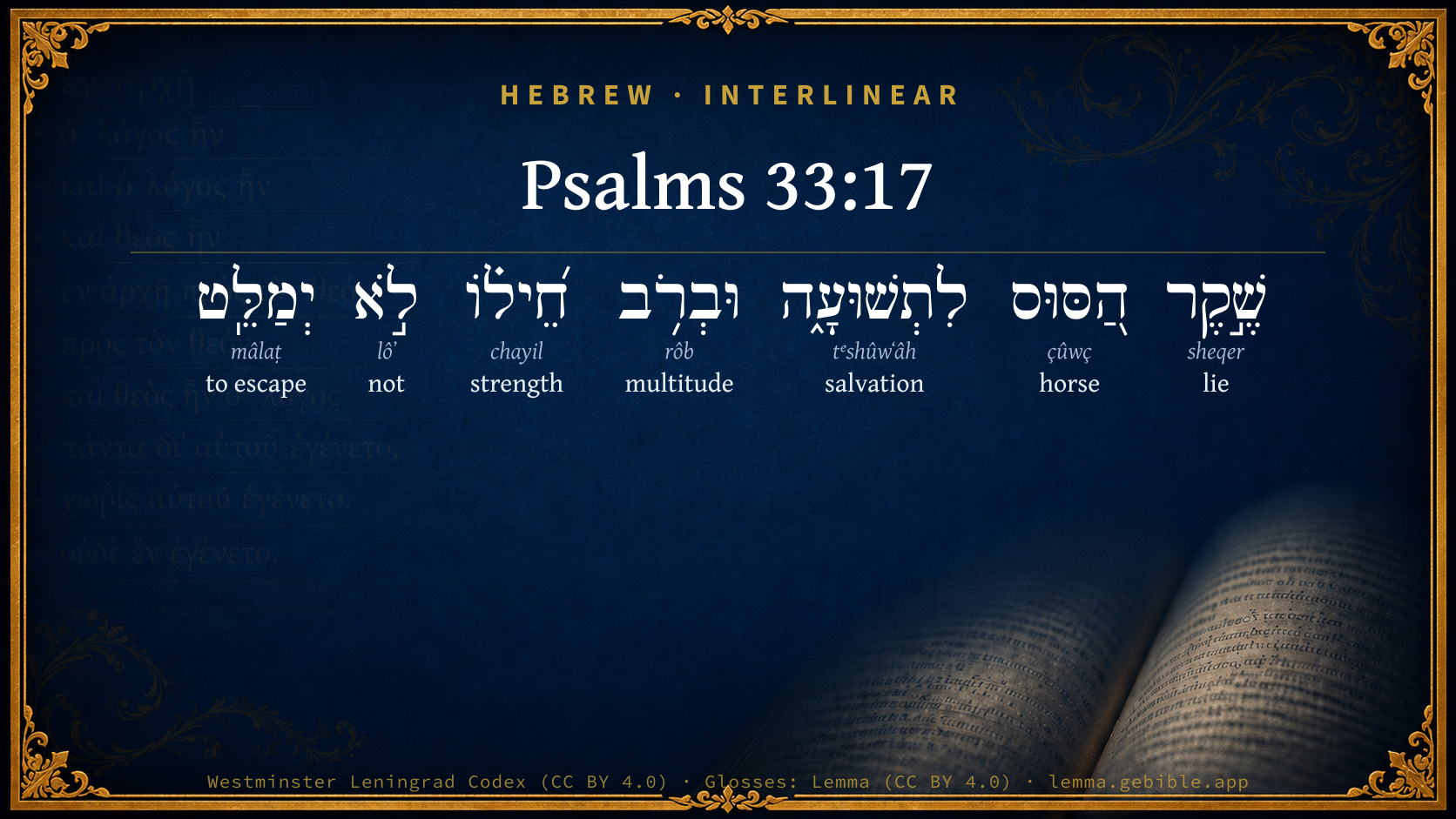
Hebrew (Westminster Leningrad Codex) Psalms 33:17 appears in the Hebrew Old Testament. The text above is from the Westminster Leningrad Codex. Each word links to its Strong’s number, a concise gloss, and parsing drawn from the Open Scriptures Hebrew Bible morphology. Click any word for its full Brown-Driver-Briggs (BDB) entry.
Download image
Cite this verse

Psalms 33:17 (World English Bible). Public Domain. Lemma interlinear Bible study tool, https://lemma.gebible.app/v/psalms/33/17.

Show BibTeX & RIS
BibTeX
RIS
English Translation
A horse is a vain thing for safety, Neither does he deliver any by his great power.
World English Bible · Public Domain
Download a study sheet

One document with this verse’s original text, its word-by-word gloss line, the meaning frame, cross-references with their text, attributed commentary, and full source and license credits — printable, and it pastes into notes with its structure intact.

This verse Autodidact and up

Study sheet (.html) Plain text (.txt)

A passage Seminary Student

Up to 50 verses in one chapter. A passage sheet keeps up to 6 commentary sources and 12 cross-references per verse, in the order this page ranks them, and says so on the sheet whenever that leaves anything out. Ask for a single verse and you get the Autodidact verse sheet above.

Everything on this page stays free to read, with no account — the sheet is a download of what is already on screen, not access to it.

Want to remove ads? Support Godless Engineer
Compare translations 3

The same verse in 3 English versions, stacked beneath the original-language interlinear above. Click any original word for its lexicon entry.

Each is an independent rendering of the whole verse — the interlinear is not word-aligned to these translations.

Highlighted words mark where these versions differ — a whole-verse word diff, not a word-by-word alignment.

  • World English Bible Public Domain
    A horse is a vain thing for safety, Neither does he deliver any by his great power.
  • King James Version Public Domain
    An horse is a vain thing for safety: neither shall he deliver any by his great strength.
  • unfoldingWord Literal Text CC BY-SA 4.0
    The horse a falsehood for salvation, and by its great strength, it does not deliver.

unfoldingWord Literal Text — © unfoldingWord, licensed CC BY-SA 4.0. Word-aligned USFM3 via Door43 (git.door43.org/unfoldingWord/en_ult).

Versions to compare (up to 4)

3 of 4 selected

Show all 18 translations

Every available English version of this verse, each an independent rendering of the whole verse.

  • World English Bible Public Domain
    A horse is a vain thing for safety, Neither does he deliver any by his great power.
  • Berean Standard Bible Public Domain
    A horse is a vain hope for salvation; even its great strength cannot save.
  • Majority Standard Bible Public Domain
    A horse is a vain hope for salvation; even its great strength cannot save.
  • King James Version Public Domain
    An horse is a vain thing for safety: neither shall he deliver any by his great strength.
  • American Standard Version (1901) Public Domain
    A horse is a vain thing for safety; Neither doth he deliver any by his great power.
  • Revised Version (1885) Public Domain
    An horse is a vain thing for safety: neither shall he deliver any by his great power.
  • Geneva Bible (1599) Public Domain
    A horse is a vaine helpe, and shall not deliuer any by his great strength.
  • Douay-Rheims (1899) Public Domain
    Vain is the horse for safety: neither shall he be saved by the abundance of his strength.
  • Young's Literal Translation Public Domain
    A false thing `is' the horse for safety, And by the abundance of his strength He doth not deliver.
  • Literal Standard Version CC BY-SA 4.0
    A false thing [is] the horse for safety, || And he does not deliver || By the abundance of his strength.
  • Unlocked Literal Bible CC BY-SA 4.0
    A horse is a false hope for victory; in spite of his great strength, he cannot rescue.
  • unfoldingWord Literal Text CC BY-SA 4.0
    The horse a falsehood for salvation, and by its great strength, it does not deliver.
  • Darby Bible Public Domain
    The horse is a vain thing for safety; neither doth he deliver by his great power.
  • World Messianic Bible Public Domain
    A horse is a vain thing for safety, neither does he deliver any by his great power.
  • Webster's Bible Public Domain
    A horse is a vain thing for safety: neither shall he deliver any by his great strength.
  • Free Bible Version CC BY-SA 4.0
    Don't deceive yourself: a warhorse can't give you victory—even its incredible strength won't save you.
  • Bible in Basic English Public Domain
    A horse is a false hope; his great power will not make any man free from danger.
  • JPS Tanakh (1917) Public Domain
    A horse is a vain thing for safety; neither doth it afford escape by its great strength.

Literal Standard Version (2020), Covenant Press — licensed CC BY-SA 4.0. Text via the HelloAO Bible API (eBible.org). Unlocked Literal Bible (unfoldingWord) — licensed CC BY-SA 4.0. Text via the HelloAO Bible API (eBible.org). unfoldingWord Literal Text — © unfoldingWord, licensed CC BY-SA 4.0. Word-aligned USFM3 via Door43 (git.door43.org/unfoldingWord/en_ult). Free Bible Version, Dr. Jonathan Gallagher — licensed CC BY-SA 4.0. Text via the HelloAO Bible API (eBible.org).

Word by word

More ways to search: Search by grammar → Find every occurrence → Compare this word →

Practice this passage: Drill this verse → Learn its vocabulary →

About this verse

These counts appear in no published source. They are computed here, from the morphology-tagged text and Lemma’s own curated glosses. What Lemma adds →

7
words
7
distinct lemmas
Wisdom
section

Shared distinctive vocabulary

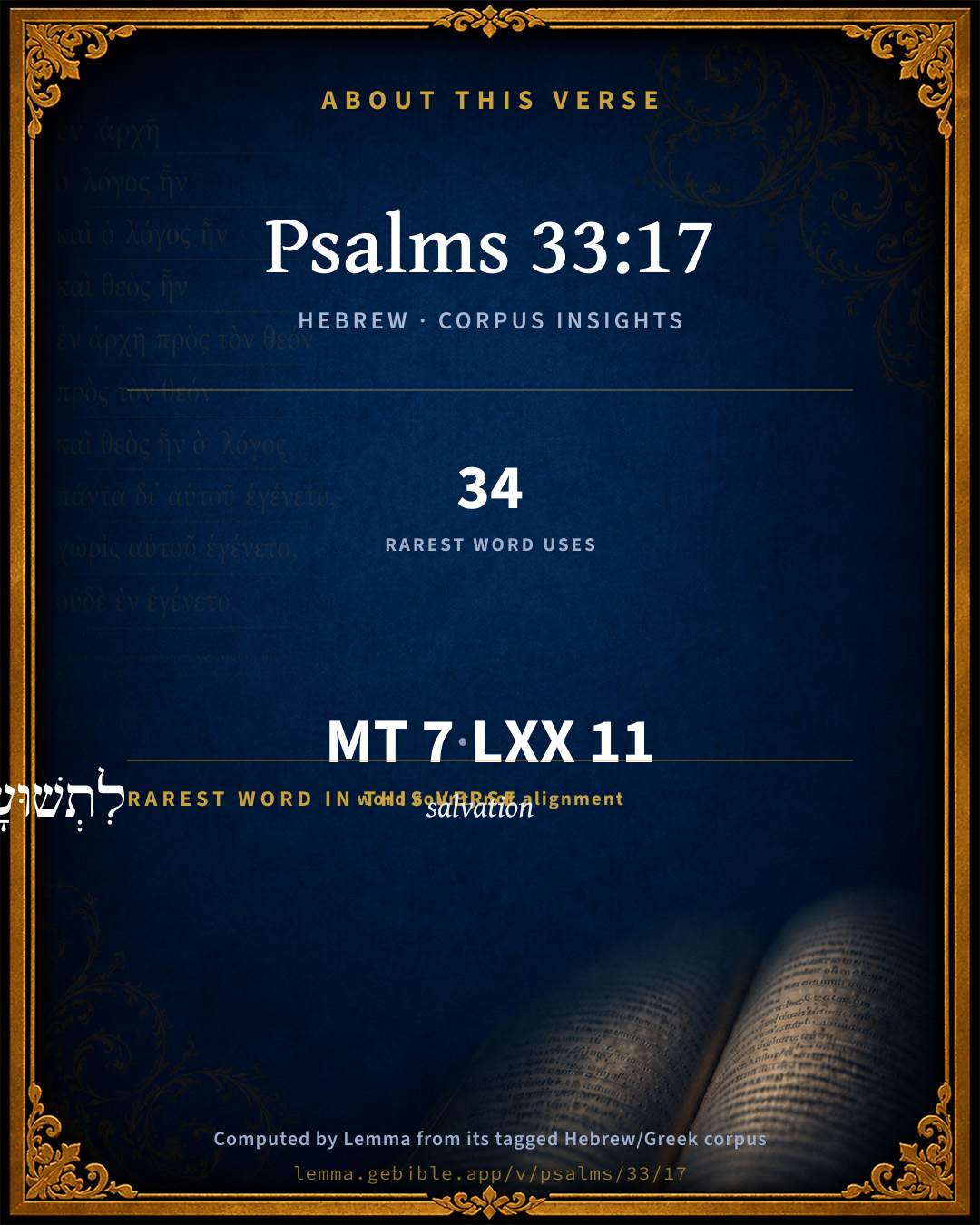
לִתְשׁוּעָ֑ה salvation H8668 occurs in 32 verses of the Hebrew Bible. Also found in:

Grammatical profile

  • 1 verb
  • 5 nouns
  • 1 particle

Verb forms

  • יְמַלֵּֽט Piel · Imperfect

Hebrew & Septuagint length

In English translation the verse runs 17 words from the Hebrew and 17 from the Septuagint (LXX English) — the same length.

A rough comparison of the two English renderings, which tokenize alike — not a word-level alignment.

Word counts can differ between the Hebrew and the Greek without any difference in meaning — e.g. the Hebrew direct-object marker אֵת has no separate Greek word, and Greek often adds the article ὁ.

In the original languages it is 7 Hebrew tokens and 11 Greek tokens — but the two are counted differently (Hebrew bundles its prefixes and suffixes into one token; the Greek is in lemma form), so that isn’t a like-for-like length.

Cross-references

9

Topical passages linked to Psalms 33:17 in the Treasury of Scripture Knowledge — connected by theme and wording, ordered by reader-vote popularity; previews shown in the World English Bible.

  • Proverbs 21:31 The horse is prepared for the day of battle; But victory is with Yahweh.
  • Psalms 20:7 Some trust in chariots, and some in horses, But we trust the name of Yahweh our God.
  • Psalms 147:10 He doesn't delight in the strength of the horse. He takes no pleasure in the legs of a man.
  • Job 39:19–25 "Have you given the horse might? Have you clothed his neck with a quivering mane?
  • Isaiah 30:16 but you said, No, for we will flee on horses; therefore shall you flee: and, We will ride on the swift; therefore shall those who pursue you be swift.
  • Hosea 14:3 Assyria can't save us. We won't ride on horses; Neither will we say any more to the work of our hands, 'Our gods!' For in you the fatherless finds mercy."
  • Judges 4:15 Yahweh confused Sisera, and all his chariots, and all his host, with the edge of the sword before Barak; and Sisera alighted from his chariot, and fled away on his feet.
  • 2 Kings 7:6–7 For the Lord had made the host of the Syrians to hear a noise of chariots, and a noise of horses, even the noise of a great host: and they said one to another, Behold, the king of Israel has hired against us the kings of the Hittites, and the kings of the Egyptians, to come on us.
  • Ecclesiastes 9:11 I returned, and saw under the sun, that the race is not to the swift, nor the battle to the strong, neither yet bread to the wise, nor yet riches to men of understanding, nor yet favor to men of skill; but time and chance happen to them all.

Cross-references courtesy of OpenBible.info (CC BY 4.0).

Hebrew and Greek witnesses Masoretic Hebrew ↔ Greek Septuagint

The same verse in the two great witnesses to the Old Testament, shown verse-for-verse.

You’re reading Greek Psalm 32 (Hebrew Psalm 33). The Septuagint counts the superscription, so verse numbers can differ from the Hebrew — chapter-level alignment, not verse-by-verse. Numbering follows Rahlfs.

These are two independent witnesses, not word-aligned to each other, and the Septuagint is shown in lemma (dictionary) form.

Hebrew Psalms 33:17 Masoretic · Westminster Leningrad Codex

שֶׁ֣קֶר הַ֭סּוּס לִתְשׁוּעָ֑ה וּבְרֹ֥ב חֵ֝יל֗וֹ לֹ֣א יְמַלֵּֽט

A horse is a vain thing for safety, Neither does he deliver any by his great power.

World English Bible · Public Domain

Greek LXX Greek Psalm 32:17 Septuagint · lemma form

ψευδής ἵππος εἰς σωτηρία ἐν δέ πλῆθος δύναμις αὐτός οὐ σώζω

A horse is vain for safety; neither shall he be delivered by the greatness of his power.

LXX2012 (modern English Septuagint) · Public Domain

Hebrew: Westminster Leningrad Codex (CC BY 4.0). Greek: Septuagint (public domain); English from LXX2012 (modern English Septuagint) (Public Domain). How the Septuagint differs from the Hebrew →

Commentary

Notes on Psalms 33:17 from classic Christian and Jewish commentators (each source and its license shown beneath its notes). The classic Christian expositions comment on the surrounding passage and are grouped to its opening verse, so a note may address several verses; the Jewish commentaries on the Tanakh (Rashi and others) are per-verse, so they appear only where the commentator wrote on this verse.

Lemma curates 59 commentaries, every one of them public domain or Creative Commons licensed, each selected and text-cleaned for this edition rather than reprinted as found. About our sources →

Trapp's Complete Commentary

John Trapp

Psa 33:17 An horse [is] a vain thing for safety: neither shall he deliver [any] by his great strength.

Ver. 17. An horse is a vain thing] And yet a warlike creature, full of terror {See Trapp on "Psa 32:9"} and so swift in service, that the Persians dedicated him to the sun (Pausan.). See Job 41:20 Pro 21:31, {See Trapp on "Job 41:20"} {See Trapp on "Pro 21:31"}

John Trapp, A Commentary or Exposition upon All the Books of the Old and New Testament (1647–1656) — public domain. Text from a community e-Sword module.

The Treasury of David

Charles H. Spurgeon

Ver. 17. An horse is a vain thing for safety. Military strength among the Orientals lay much in horses and scythed chariots, but the psalmist calls them a lie, a deceitful confidence. Surely the knight upon his gallant steed may be safe, either by valour or by flight? Not so, his horse shall bear him into danger or crush him with its fall. Neither shall he deliver any by his great strength. Thus the strongest defences are less than nothing when most needed. God only is to be trusted and adored. Sennacherib with all his calvary is not a match for one angel of the Lord, Pharaoh's horses and chariots found it vain to pursue the Lord's anointed, and so shall all the leaguered might of earth and hell find themselves utterly defeated when they rise against the Lord and his chosen.

Ver. 17. An horse. If the strength of horses be of God, or be his gift Job 39:19, then trust not in the strength of horses: use the strength of horses, but do not trust the strength of horses. If you trust the strength which God hath given to horses, you make them your god. How often doth God forbid trusting in the strength of horses, as knowing that we are apt to trust in anything that is strong, though but a beast. An horse is a vain thing for safety: neither shall he deliver any by his great strength. As if God had said, you think a horse can save you, but know he is a vain thing. And when the psalmist saith, "A horse is a vain thing, "he doth not mean it of a weak horse, but of a horse of the greatest strength imaginable; such a horse is a vain thing to save a man, neither can he deliver any by his strength; and therefore the Lord, when he promised great deliverances to his people, lest they should expect it by the strength of horses, saith Ho 1:7, "I will save them by the Lord their God, and will not save them by bow, nor by sword, nor by battle, by horses, nor by horsemen; "as if he had told them, do not look after creature strength to be saved by; a horse will be a vain thing to save you, and I can save you effectually without horses, and I will. Joseph Caryl.

Ver. 17-20. Man is sensible of his want of earthly blessings, and will never cease, with excessive care, diligence, and vexation, to hunt after them, till he come to know that God will provide for him. When one hath great friends which they are known to lean upon, we say of them, such need take no care, they know such and such will see to them. On the contrary, come to one who knows no end of toiling and caring, ask him, Why will you thus tire yourself out? He will answer, I must needs do it, I have none but myself to trust to. So Christ followeth his disciples' carefulness to this door, their unbelief, which did not let them consider our heavenly Father cared for them. No present estate, though never so great, can free the heart from distraction, because it is subject to decay and vanishing; we shall never cast the burden of care off our own shoulders, till we learn by faith to cast it upon the Lord, whose eye is over us for good. He will never renounce carnal supports who make not God the stay of his soul for outward things. He will trust in the abundance of his riches, wisdom, friends, or strength, that makes not God his strength. The heart of man, being aware of his inability to sustain himself if he be not underset, will seek out some prop, true or false, sound or rotten, to lean unto. They will go down to Egypt for help, and stay on horses, and trust in chariots, because they are many, and in horsemen because they are very strong, who look not to the Holy One of Israel, and seek not the Lord. John Ball.

Ver. 17-20. See Psalms on "Ps 33:17" for further information.

Ver. 17-20. See Psalms on "Ps 33:17" for further information.

Ver. 17-20. See Psalms on "Ps 33:17" for further information.

Charles H. Spurgeon's The Treasury of David (1869–1885) — public domain. Psalms only. Text from a community e-Sword/MySword module.

J. A. Alexander on Psalms

Joseph Addison Alexander

17. (Psa 33:17) A lie (is) the horse for salvation, and by the greatness of his strength he shall not deliver. This is a mere specification of the general statement in the sixteenth verse. The horse meant is the war-horse, and is singled out as one of the elements of military strength in which the ancients were especially disposed to trust. See above, on Psa 20:8 (7), and compare Isa 31:1-3. A lie, a falsehood, i.e. something which deceives and disappoints the confidence reposed in it. The deliverance and salvation here referred to are deliverance and salvation from the perils of war.

Joseph Addison Alexander, The Psalms Translated and Explained (1850) — public domain. Text from a community e-Sword module.

Jamieson, Fausset & Brown

Robert Jamieson, A. R. Fausset & David Brown

On the war horse (compare Job 39:19-25).

a vain thing--a lie, which deceives us.

Jamieson, Fausset & Brown — Commentary Critical and Explanatory on the Whole Bible (1871) — public domain (CC PDM 1.0). Text via the HelloAO Bible API.

Adam Clarke's Commentary

Verse 17. A horse is a vain thing for safety] Even the horse, with all his fleetness, is no sure means of escape from danger: the lion or the tiger can overtake him or he may stumble, fall, and destroy his rider.

Adam Clarke's Commentary on the Bible (1810–1826) — public domain. Text from a community e-Sword/MySword module.

John Calvin's Commentaries

17. A horse is a deceitful thing for safety. In this verse, the Psalmist, by the figure synecdoche under the name of horse, is to be understood as meaning any kind of help. The sense is, that in general those who conceive that their life is well protected by earthly means, are commonly disappointed at the very crisis of danger, and are miserably beguiled to their utter undoing, so that God therein clearly shows them their folly. It is true, that kings are not armed with the sword in vain, nor is the use of horses superfluous, nor are the treasures and resources which God furnishes to defend men’s lives unnecessary, provided a right method of employing them be observed. But as the greater part of men the more they are surrounded with human defences, withdraw themselves the farther from God, and by a false imagination persuade themselves that they are in a haven safe from all disturbance, God acts most justly in disappointing this madness. This is the reason why his gifts often pass away without effect, because the world, by separating them from the giver, is also justly deprived of his blessing.

John Calvin's Commentaries (1540-1563) — public domain. Text from the Calvin Translation Society English edition (1840s-50s) via the Christian Classics Ethereal Library (ccel.org). Calvin's coverage is partial (roughly two-thirds of the Bible); uncommented books and verses are honest gaps, never fabricated. The 19th-century editor's footnotes and remarks are omitted so the notes are faithfully Calvin's own voice.

Ellicott's Commentary for English Readers

(17) Safety.—Better, victory. (Comp. Hab_3:8.) The allusion is to the war-horse.

A Bible Commentary for English Readers, edited by Charles John Ellicott (1878–1897) — public domain. Text from a community e-Sword module.

The Cambridge Bible for Schools and Colleges

gen. ed. J. J. S. Perowne

17. A horse—to the Israelites cavalry seemed the most formidable part of an army—is but a vain thing—lit. a lie, a delusion—for safety—for victory (Psa_21:1): neither can it give escape by the greatness of its power: it cannot even secure its rider’s escape in case of defeat. Cp. Pro_21:31.

The Cambridge Bible for Schools and Colleges (gen. ed. J. J. S. Perowne; Cambridge University Press, 1878–1918) — public domain. Text from a community e-Sword module.

John Gill's Exposition

A horse is a vain thing for safety,.... Though it is prepared for the day of battle, and is a very warlike creature, and of great service in war, yet safety only is of the Lord, Pro 21:31; this is put for all kinds of military preparations which men are apt to trust in, but should not, for they are "a lie" (i), as the horse is here said to be; that is, deceives and disappoints when trusted to; in like manner the olive is said "to lie", Hab 3:17; when hope of fruit from it is disappointed; so "fundus mendax" in Horace (k);

neither shall he deliver any by his great strength; in the time of battle; either by fighting for him, or fleeing with him.

(i) "mendacium", Pagninus, Montanus; "fallax", V. L. (k) Epod. l. 1. Ode 16. ver. 45. Carmin. l. 3. Ode 1. v. 30. "Spem mentita seges", ib. Epist. l. 1. ep. 7. v. 87.

John Gill's Exposition of the Whole Bible (1746–1763) — public domain (CC PDM 1.0). Text via the HelloAO Bible API.

Albert Barnes' Notes on the Bible

An horse - The reference here is undoubtedly to the war-horse. See the notes at Psa 20:7.

Is a vain thing - literally, is a “lie.” That is, he cannot be confided in.

For safety - For securing safety in battle. He is liable to be stricken down, or to become wild and furious so as to be beyond the control of his rider; and however strong or fleet he may be, or however well he may be “broken,” yet none of these things make it certain that the rider will be safe. God is the only being in whom perfect confidence can be reposed.

Neither shall he deliver any by his great strength - Safety cannot be found in his mere “strength,” however great that may be. These illustrations are all designed to lead the mind to the great idea that safety is to be found in God alone, Psa 33:18-19.

Albert Barnes' Notes on the Bible (1834–1885) — public domain. Text from a community e-Sword/MySword module.

Matthew Poole's English Annotations

An horse; though he be strong, Job 39:19, &c., and fit for battle, Pro 21:31; or for flight, if need requires. And so this is put for all warlike provisions; of which horses were and are a very considerable part.

A vain thing, Heb. a lie, because it promiseth that help and safety which it cannot give.

Matthew Poole's English Annotations on the Holy Bible (1683–1685) — public domain. Text from a community e-Sword/MySword module.

Whedon's Commentary on the Bible

Daniel D. Whedon

17. A horse—The most formidable and fleet of all war animals west of the Indus.

Daniel D. Whedon (gen. ed.), Commentary on the Old and New Testaments (1874–1909) — public domain. Text from a community e-Sword module.

The Pulpit Commentary

A horse is a vain thing for safety; literally, the horse; i.e. the species, horse, is not to be depended on for safety it is "a vain thing," quite unable to secure victory, or even escape, to those who trust in it. The use of the horse in war seems certainly to be implied here as familiar to the writer, whence it is rightly concluded that he must have lived later than the time of David. Solomon was the first Israelite king who enrolled a chariot and a cavalry force. (1Ki_10:26) Neither shall he deliver any by his great strength. (On the "great strength" of the horse, see Job_39:19 Psa_147:10)

The Pulpit Commentary (1880–1919), ed. H.D.M. Spence-Jones & Joseph S. Exell — public domain. Text from a community e-Sword module.

John Wesley's Explanatory Notes

An horse - Though he be strong and fit for battle, or for flight, if need requires. And so this is put for all warlike provisions. Vain things - Hebrew. a lie; because it promises that help and safety which it cannot give.

John Wesley, Explanatory Notes Upon the Whole Bible (1754–1765) — public domain. Text via the GEBible commentary corpus.

Lesson kit

Teaching starters — assembled from the data on this page, not authored interpretation. Every prompt links to the verse data it draws on. Edit before teaching.

Psalms, in the Wisdom, opens this verse with 7 words (7 distinct Hebrew lemmas). Its most distinctive word is tᵉshûwʻâh (“salvation”). A historical commentator’s framing appears above. Read the whole chapter for the surrounding context.

Discussion questions

  1. How does “salvation” (tᵉshûwʻâh) shape what this verse is saying?
  2. Judges 15:18 shares the word «salvation» with this verse. How do the two illuminate each other?
  3. The translations on this page render this verse differently — a whole-verse word diff, not a word-by-word alignment. What might account for the different wordings?
  4. The verb «יְמַלֵּֽט» is Piel Imperfect. How does its form color the action?
  5. Reading how Trapp's Complete Commentary and The Treasury of David read this verse, where do the two commentators agree and where do they part?

Things to notice

Reading settings

Reading text

Shown beneath each verse's original-language words.

Old Testament
Old Testament edition

Read the OT as the Masoretic Hebrew (MT) or the Greek Septuagint (LXX).

English shown for the Greek Septuagint (in the Hebrew ↔ Greek comparison).

Comparing translations? Open the Compare panel on any verse page to stack up to four side by side.