
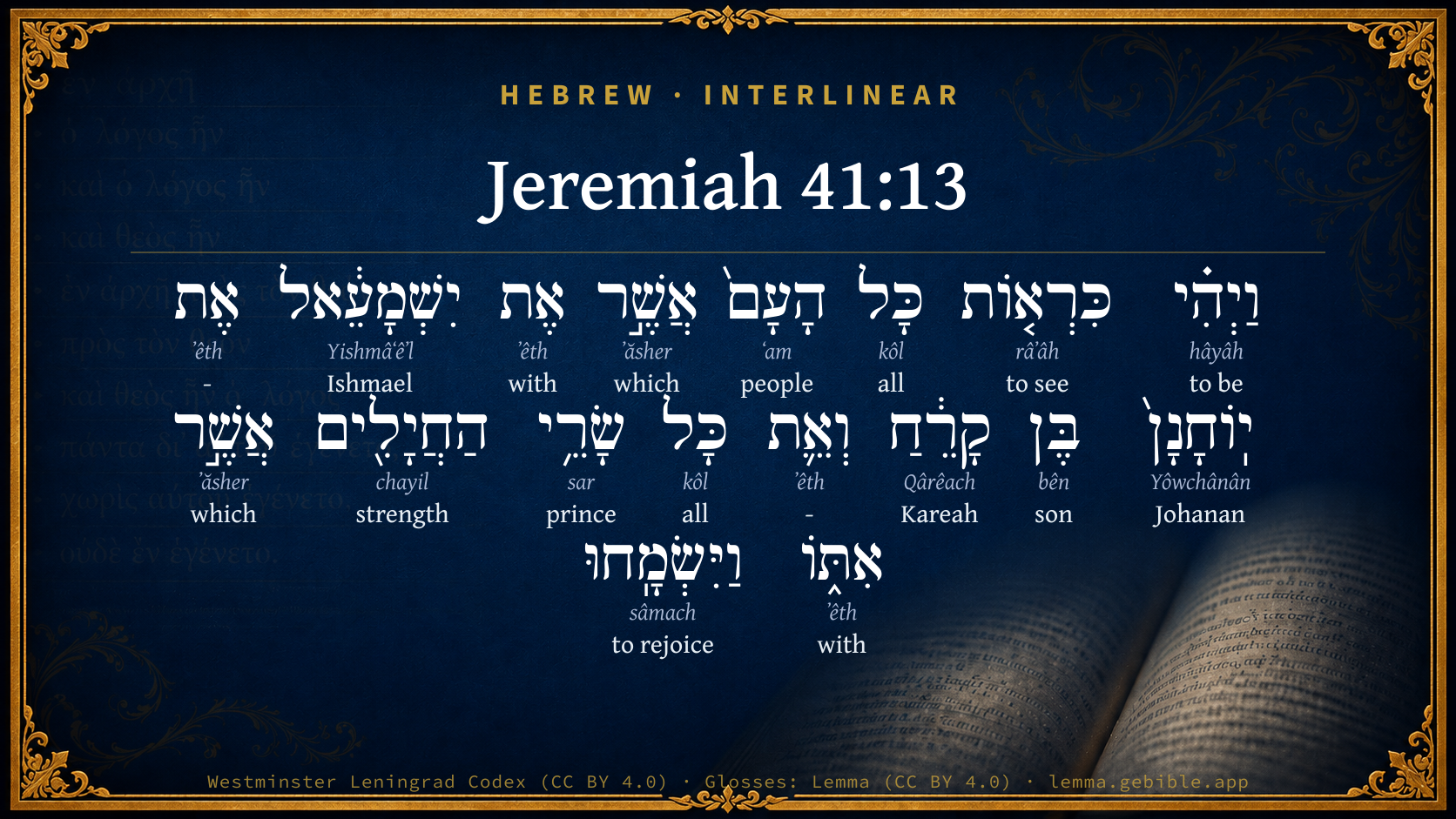
Jeremiah 41:13

Hebrew (Westminster Leningrad Codex) Jeremiah 41:13 appears in the Hebrew Old Testament. The text above is from the Westminster Leningrad Codex. Each word links to its Strong’s number, a concise gloss, and parsing drawn from the Open Scriptures Hebrew Bible morphology. Click any word for its full Brown-Driver-Briggs (BDB) entry.
Download image
Cite this verse

Jeremiah 41:13 (World English Bible). Public Domain. Lemma interlinear Bible study tool, https://lemma.gebible.app/v/jeremiah/41/13.

Show BibTeX & RIS
BibTeX
RIS
English Translation
Now it happened that, when all the people who were with Ishmael saw Johanan the son of Kareah, and all the captains of the forces who were with him, then they were glad.
World English Bible · Public Domain
Download a study sheet

One document with this verse’s original text, its word-by-word gloss line, the meaning frame, cross-references with their text, attributed commentary, and full source and license credits — printable, and it pastes into notes with its structure intact.

This verse Autodidact and up

Study sheet (.html) Plain text (.txt)

A passage Seminary Student

Up to 50 verses in one chapter. A passage sheet keeps up to 6 commentary sources and 12 cross-references per verse, in the order this page ranks them, and says so on the sheet whenever that leaves anything out. Ask for a single verse and you get the Autodidact verse sheet above.

Everything on this page stays free to read, with no account — the sheet is a download of what is already on screen, not access to it.

Want to remove ads? Support Godless Engineer
Compare translations 3

The same verse in 3 English versions, stacked beneath the original-language interlinear above. Click any original word for its lexicon entry.

Each is an independent rendering of the whole verse — the interlinear is not word-aligned to these translations.

Highlighted words mark where these versions differ — a whole-verse word diff, not a word-by-word alignment.

  • World English Bible Public Domain
    Now it happened that, when all the people who were with Ishmael saw Johanan the son of Kareah, and all the captains of the forces who were with him, then they were glad.
  • King James Version Public Domain
    Now it came to pass, that when all the people which were with Ishmael saw Johanan the son of Kareah, and all the captains of the forces that were with him, then they were glad.
  • unfoldingWord Literal Text CC BY-SA 4.0
    Then it happened that when all the people who were with Ishmael saw Johanan son of Kareah and all the army commanders who were with him, they were very happy.

unfoldingWord Literal Text — © unfoldingWord, licensed CC BY-SA 4.0. Word-aligned USFM3 via Door43 (git.door43.org/unfoldingWord/en_ult).

Versions to compare (up to 4)

3 of 4 selected

Show all 18 translations

Every available English version of this verse, each an independent rendering of the whole verse.

  • World English Bible Public Domain
    Now it happened that, when all the people who were with Ishmael saw Johanan the son of Kareah, and all the captains of the forces who were with him, then they were glad.
  • Berean Standard Bible Public Domain
    When all the people with Ishmael saw Johanan son of Kareah and all the commanders of the army with him, they rejoiced,
  • Majority Standard Bible Public Domain
    When all the people with Ishmael saw Johanan son of Kareah and all the commanders of the army with him, they rejoiced,
  • King James Version Public Domain
    Now it came to pass, that when all the people which were with Ishmael saw Johanan the son of Kareah, and all the captains of the forces that were with him, then they were glad.
  • American Standard Version (1901) Public Domain
    Now it came to pass that, when all the people that were with Ishmael saw Johanan the son of Kareah, and all the captains of the forces that were with him, then they were glad.
  • Revised Version (1885) Public Domain
    Now it came to pass that when all the people which were with Ishmael saw Johanan the son of Kareah, and all the captains of the forces that were with him, then they were glad.
  • Geneva Bible (1599) Public Domain
    Nowe when all the people whom Ishmael caryed away captiue, sawe Iohanan the sonne of Kareah, and all the captaines of the hoste, that were with him, they were glad.
  • Douay-Rheims (1899) Public Domain
    And when all the people that were with Ismahel, had seen Johanan the son of Caree, and all the captains of the fighting men that were with him, they rejoiced.
  • Young's Literal Translation Public Domain
    And it cometh to pass, when all the people who `are' with Ishmael see Johanan son of Kareah, and all the heads of the forces who `are' with him, that they rejoice.
  • Literal Standard Version CC BY-SA 4.0
    And it comes to pass, when all the people who [are] with Ishmael see Johanan son of Kareah, and all the heads of the forces who [are] with him, that they rejoice.
  • Unlocked Literal Bible CC BY-SA 4.0
    Then it happened that when all the people who were with Ishmael saw Johanan son of Kareah and all the army commanders who were with him, they were very happy.
  • unfoldingWord Literal Text CC BY-SA 4.0
    Then it happened that when all the people who were with Ishmael saw Johanan son of Kareah and all the army commanders who were with him, they were very happy.
  • Darby Bible Public Domain
    And it came to pass when all the people that were with Ishmael saw Johanan the son of Kareah, and all the captains of the forces that were with him, then they were glad.
  • World Messianic Bible Public Domain
    Now when all the people who were with Ishmael saw Yochanan the son of Kareah, and all the captains of the forces who were with him, then they were glad.
  • Webster's Bible Public Domain
    Now it came to pass, that when all the people who were with Ishmael saw Johanan the son of Kareah, and all the captains of the forces that were with him, then they were glad.
  • Free Bible Version CC BY-SA 4.0
    When Ishmael's prisoners saw Johanan and all the army commanders with him, they were happy.
  • Bible in Basic English Public Domain
    Now when all the people who were with Ishmael saw Johanan, the son of Kareah, and all the captains of the forces with him, then they were glad.
  • JPS Tanakh (1917) Public Domain
    Now it came to pass, that when all the people that were with Ishmael saw Johanan the son of Kareah, and all the captains of the forces that were with him, then they were glad.

Literal Standard Version (2020), Covenant Press — licensed CC BY-SA 4.0. Text via the HelloAO Bible API (eBible.org). Unlocked Literal Bible (unfoldingWord) — licensed CC BY-SA 4.0. Text via the HelloAO Bible API (eBible.org). unfoldingWord Literal Text — © unfoldingWord, licensed CC BY-SA 4.0. Word-aligned USFM3 via Door43 (git.door43.org/unfoldingWord/en_ult). Free Bible Version, Dr. Jonathan Gallagher — licensed CC BY-SA 4.0. Text via the HelloAO Bible API (eBible.org).

Word by word

More ways to search: Search by grammar → Find every occurrence → Compare this word →

Practice this passage: Drill this verse → Learn its vocabulary →

קָרֵ֔חַ
Qârêach
H7143
“Kareah”
Noun, Proper
Part of Speech
Noun
Type
Proper
Full BDB Definition

Origin: from H7139

TWOT: None

Kareah = "bald" - father of Johanan and Jonathan who supported Gedaliah's authority and avenged his murder
  1. וַיְהִ֗י hâyâh H1961 “and · to be” Conjunction + Verb, Qal, Sequential Imperfect, 3rd Person, Masculine, Singular
  2. כִּרְא֤וֹת râʼâh H7200 “like/as · to see” Preposition + Verb, Qal, Infinitive Construct
  3. כָּל kôl H3605 “all of” Noun, Common, Masculine, Singular, Construct
  4. הָעָם֙ ʻam H5971 “the · people” Particle, Definite Article + Noun, Common, Masculine, Singular, Absolute
  5. אֲשֶׁ֣ר ʼăsher H834 “which” Particle, Relative
  6. אֶת ʼêth H854 “with” Preposition
  7. יִשְׁמָעֵ֔אל Yishmâʻêʼl H3458 “Ishmael” Noun, Proper
  8. אֶת ʼêth H853 “-” Particle, Direct Object
  9. יֽוֹחָנָן֙ Yôwchânân H3110 “Johanan” Noun, Proper
  10. בֶּן bên H1121 “son of” Noun, Common, Masculine, Singular, Construct
  11. וְאֵ֛ת ʼêth H853 “and · -” Conjunction + Particle, Direct Object
  12. כָּל kôl H3605 “all of” Noun, Common, Masculine, Singular, Construct
  13. שָׂרֵ֥י sar H8269 “princes of” Noun, Common, Masculine, Plural, Construct
  14. הַחֲיָלִ֖ים chayil H2428 “the · forces” Particle, Definite Article + Noun, Common, Masculine, Plural, Absolute
  15. אֲשֶׁ֣ר ʼăsher H834 “which” Particle, Relative
  16. אִתּ֑וֹ ʼêth H854 “with · him” Preposition + Suffix, Personal, 3rd Person, Masculine, Singular
  17. וַיִּשְׂמָֽחוּ sâmach H8055 “and · to rejoice” Conjunction + Verb, Qal, Sequential Imperfect, 3rd Person, Masculine, Plural

About this verse

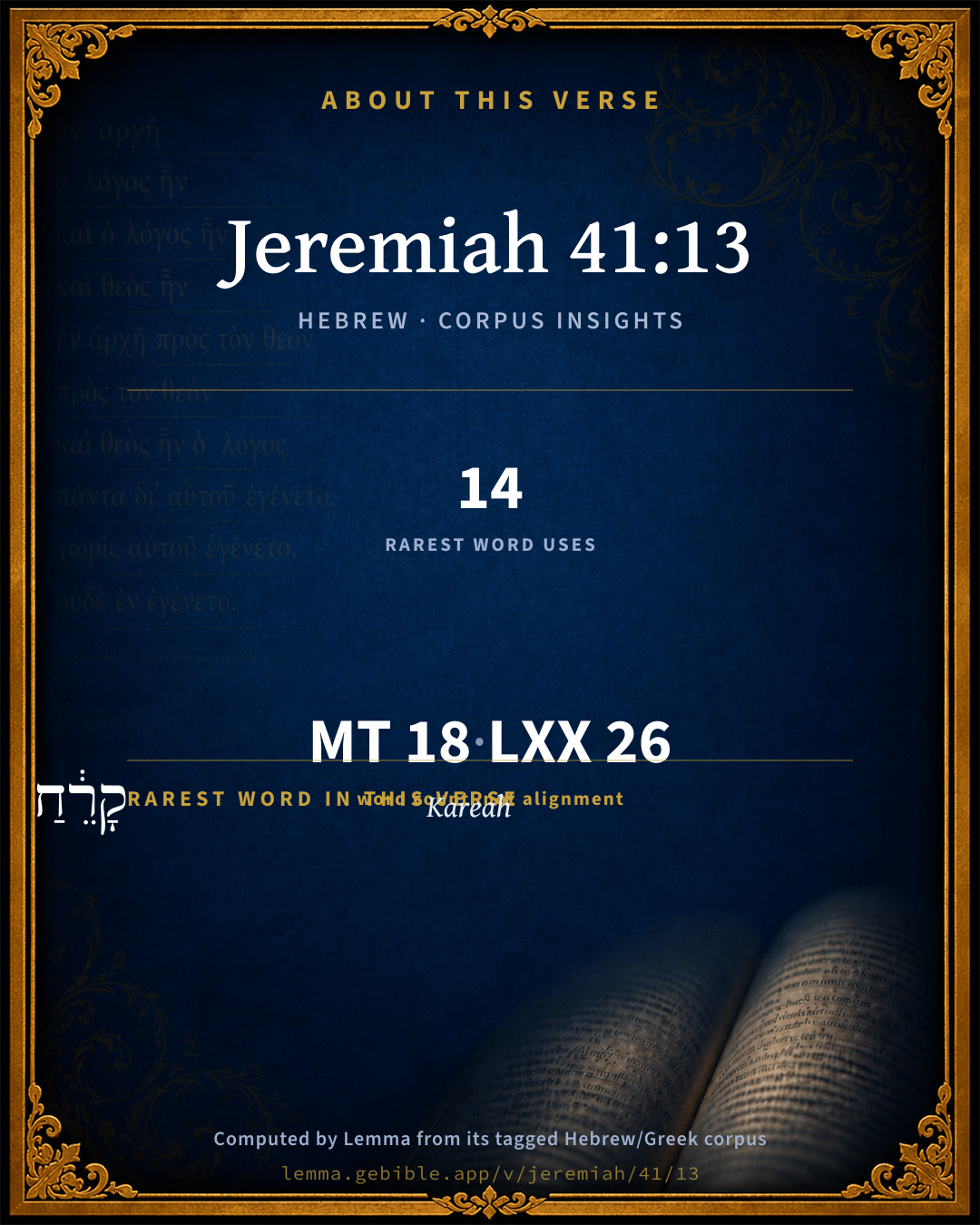
These counts appear in no published source. They are computed here, from the morphology-tagged text and Lemma’s own curated glosses. What Lemma adds →

18
words
14
distinct lemmas
Prophets
section

Notable vocabulary

The rarest word here is קָרֵ֔חַ Kareah H7143 — appearing just 14 times in the whole Hebrew Bible.

Shared distinctive vocabulary

קָרֵ֔חַ Kareah H7143 occurs in 14 verses of the Hebrew Bible. Also found in:

Grammatical profile

  • 3 verbs
  • 9 nouns
  • 2 prepositions
  • 4 particles

Verb forms

  • וַיְהִ֗י Qal · Sequential Imperfect
  • כִּרְא֤וֹת Qal · Infinitive Construct
  • וַיִּשְׂמָֽחוּ Qal · Sequential Imperfect

Repetition

Words recur within this verse — often emphatic in Hebrew:

  • כָּל all H3605 ×2
  • אֲשֶׁ֣ר which H834 ×2
  • אֶת with H854 ×2

Hebrew & Septuagint length

In the original languages it is 18 Hebrew tokens and 26 Greek tokens — but the two are counted differently (Hebrew bundles its prefixes and suffixes into one token; the Greek is in lemma form), so that isn’t a like-for-like length.

Hebrew and Greek witnesses Masoretic Hebrew ↔ Greek Septuagint

The same verse in the two great witnesses to the Old Testament, shown verse-for-verse.

These are two independent witnesses, not word-aligned to each other, and the Septuagint is shown in lemma (dictionary) form.

Hebrew Jeremiah 41:13 Masoretic · Westminster Leningrad Codex

וַיְהִ֗י כִּרְא֤וֹת כָּל הָעָם֙ אֲשֶׁ֣ר אֶת יִשְׁמָעֵ֔אל אֶת יֽוֹחָנָן֙ בֶּן קָרֵ֔חַ וְאֵ֛ת כָּל שָׂרֵ֥י הַחֲיָלִ֖ים אֲשֶׁ֣ר אִתּ֑וֹ וַיִּשְׂמָֽחוּ

Now it happened that, when all the people who were with Ishmael saw Johanan the son of Kareah, and all the captains of the forces who were with him, then they were glad.

World English Bible · Public Domain

Greek LXX Structure differs

In the Septuagint, Jeremiah is about an eighth shorter than the Hebrew and arranges its material differently — the Oracles Against the Nations (Hebrew chapters 46–51) appear in the middle of the Greek book, after 25:13. Because the chapter and verse boundaries do not line up, a verse-for-verse comparison with the Hebrew is not shown.

A verse-for-verse comparison isn’t shown here because the chapters and verses don’t line up. Switch to the LXX edition with the MT / LXX toggle above to read the Greek directly.

Hebrew: Westminster Leningrad Codex (CC BY 4.0). Greek: Septuagint (public domain); English from a public-domain English Septuagint. How the Septuagint differs from the Hebrew →

Targum (Aramaic paraphrase)

1

The Targum is the ancient Jewish Aramaic paraphrase of the Hebrew Scriptures — an interpretive translation, not the Hebrew text itself. Onkelos (literal) and Pseudo-Jonathan (expansive) render the Torah, and Jonathan the Prophets. Coverage is partial: where no permissively-licensed English translation exists for a verse, only the Aramaic is shown. This is verse-level text, not a word-by-word alignment to the Hebrew.

  1. Targum Jonathan Prophets (Joshua–Malachi)
    וַהֲוָה כַּד חֲזָא כָּל עַמָא דְעִם יִשְׁמָעֵאל יַת יוֹחָנָן בַּר קָרֵחַ וְיַת כָּל רַבָּנֵי חֵילְוָתָא דִי עִמֵיהּ וְחַדִיאוּ:

    (no public-domain English translation for this verse)

    Targum Jonathan — Aramaic: “Mikraot Gedolot” (public domain). English: “Sefaria Community Translation” (CC0 1.0 (public-domain dedication)); “London "Chaldee Paraphrase," 1871” (public domain). Text via Sefaria.

Commentary

Notes on Jeremiah 41:13 from classic Christian and Jewish commentators (each source and its license shown beneath its notes). The classic Christian expositions comment on the surrounding passage and are grouped to its opening verse, so a note may address several verses; the Jewish commentaries on the Tanakh (Rashi and others) are per-verse, so they appear only where the commentator wrote on this verse.

Lemma curates 59 commentaries, every one of them public domain or Creative Commons licensed, each selected and text-cleaned for this edition rather than reprinted as found. About our sources →

Trapp's Complete Commentary

John Trapp

Jer 41:13 Now it came to pass, [that] when all the people which [were] with Ishmael saw Johanan the son of Kareah, and all the captains of the forces that [were] with him, then they were glad.

Ver. 13. Then they were glad.] God, when he pleaseth, can suddenly, and beyond all hope, exhilarate men in the midst of miseries, and give deliverance. The like hereunto befell the poor Christian captives when Hunniades had overthrown Mesites, the Turkish general. {a}

{a} Ibid., 269.

John Trapp, A Commentary or Exposition upon All the Books of the Old and New Testament (1647–1656) — public domain. Text from a community e-Sword module.

Jamieson, Fausset & Brown

Robert Jamieson, A. R. Fausset & David Brown

glad--at the prospect of having a deliverer from their captivity.

Jamieson, Fausset & Brown — Commentary Critical and Explanatory on the Whole Bible (1871) — public domain (CC PDM 1.0). Text via the HelloAO Bible API.

Ellicott's Commentary for English Readers

(13) They were glad.—The words are significant as implying the popularity of Gedaliah, and the joy of those who had been under him at seeing the prospect of his murder being avenged. They at once took refuge with the leader of the avenging party.

A Bible Commentary for English Readers, edited by Charles John Ellicott (1878–1897) — public domain. Text from a community e-Sword module.

John Gill's Exposition

Now it came to pass, that, when all the people which were with Ishmael,.... That is, those which he had brought captives from Mizpah; not those that came with him thither:

saw Johanan the son of Kareah, and all the captains of the forces that were with him, they were glad; looking upon them as their deliverers; hoping by their means to be preserved from being carried captives to the king of Ammon.

John Gill's Exposition of the Whole Bible (1746–1763) — public domain (CC PDM 1.0). Text via the HelloAO Bible API.

Matthew Poole's English Annotations

To see a probability of their escape out of the hands of this bloody man, who had slain so many of their brethren.

Matthew Poole's English Annotations on the Holy Bible (1683–1685) — public domain. Text from a community e-Sword/MySword module.

Keil & Delitzsch

C. F. Keil & F. Delitzsch

When those who had been carried off by Ishmael saw these captains, they were glad, since they had followed their captor merely because they were forced to do so. They all turned, and went over to Johanan; but Ishmael escaped from Johanan, with eight men, - having thus lost two in the fight with Johanan, - and went to the Ammonites.

Keil & Delitzsch — Biblical Commentary on the Old Testament (1861–1891) — public domain (CC PDM 1.0). Text via the HelloAO Bible API. (Old Testament only.)

unfoldingWord translationNotes

Door43 World Missions Community

Then it happened that

This phrase is used here to mark an important event in the story. If your language has a way for doing this, you could consider using it here.

when all the people who were with Ishmael

Here "people" refers to those whom Ishmael and his men had captured.

whom Ishmael had captured

Here "Ishmael" represents himself and all of his men. AT: "whom Ishmael and his men had captured" (See: Synecdoche)

unfoldingWord translationNotes — © Distant Shores Media and the Door43 World Missions Community, licensed CC BY-SA 4.0. Source: git.door43.org/Door43/en_tn.

Lesson kit

Teaching starters — assembled from the data on this page, not authored interpretation. Every prompt links to the verse data it draws on. Edit before teaching.

Jeremiah, in the Prophets, opens this verse with 18 words (14 distinct Hebrew lemmas). Its most distinctive word is Qârêach (“Kareah”). A historical commentator’s framing appears above. Read the whole chapter for the surrounding context.

Discussion questions

  1. The word Qârêach carries the sense “Kareah.” How does it shape the verse?
  2. 2 Kings 25:23 shares the word «Kareah» with this verse. How do the two illuminate each other?
  3. “all” occurs 2× in this one verse. What is the effect of the repetition?
  4. These translations render this verse differently; the difference is in the English rendering, not the original. What questions does that raise?
  5. The verb «וַיְהִ֗י» is Qal Sequential Imperfect. How does its form color the action?
  6. Reading how Trapp's Complete Commentary and Jamieson, Fausset & Brown read this verse, where do the two commentators agree and where do they part?

Things to notice

Reading settings

Reading text

Shown beneath each verse's original-language words.

Old Testament
Old Testament edition

Read the OT as the Masoretic Hebrew (MT) or the Greek Septuagint (LXX).

English shown for the Greek Septuagint (in the Hebrew ↔ Greek comparison).

Comparing translations? Open the Compare panel on any verse page to stack up to four side by side.