
Jeremiah 41:16

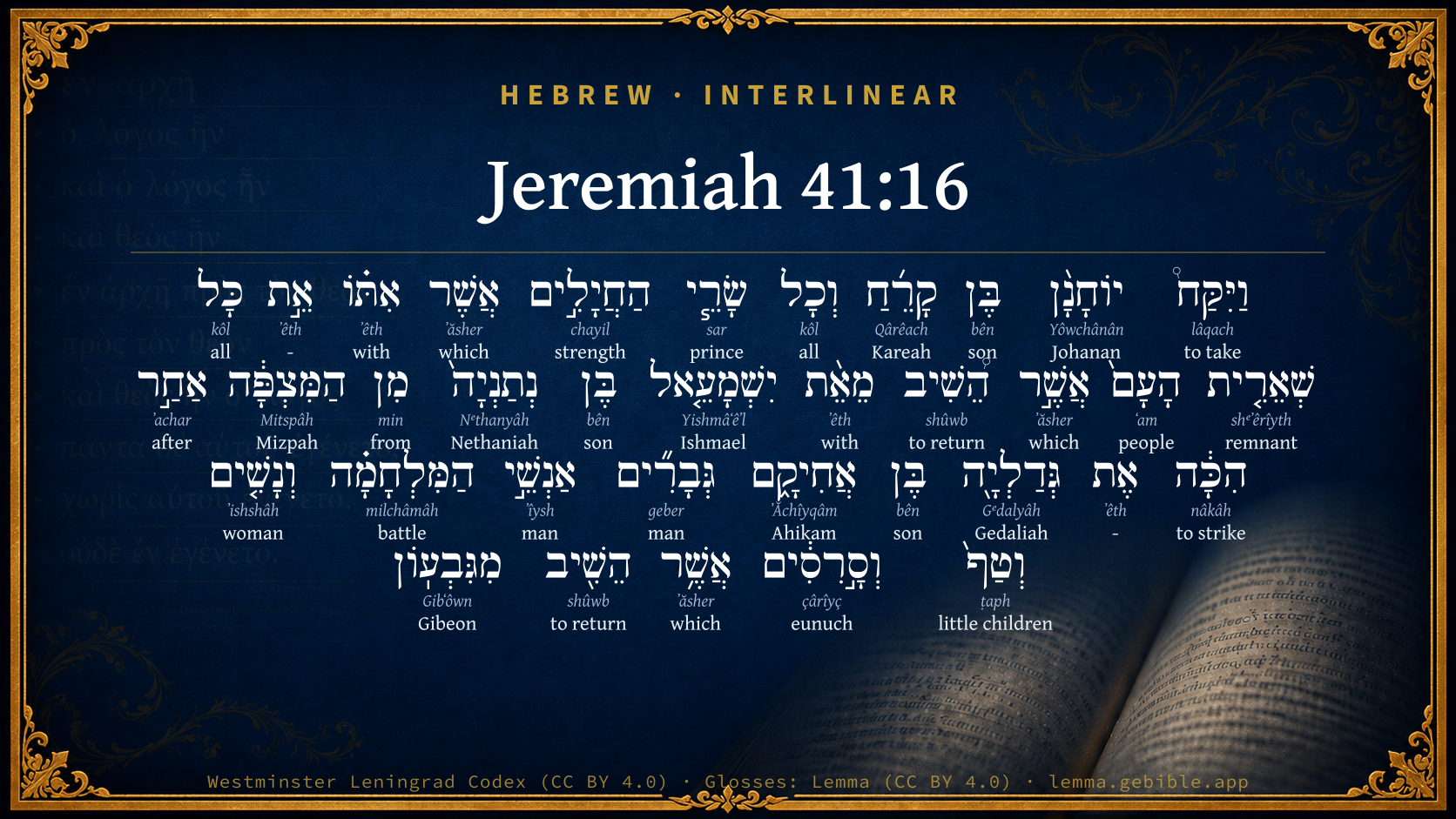
Hebrew (Westminster Leningrad Codex) Jeremiah 41:16 appears in the Hebrew Old Testament. The text above is from the Westminster Leningrad Codex. Each word links to its Strong’s number, a concise gloss, and parsing drawn from the Open Scriptures Hebrew Bible morphology. Click any word for its full Brown-Driver-Briggs (BDB) entry.
Download image
Cite this verse

Jeremiah 41:16 (World English Bible). Public Domain. Lemma interlinear Bible study tool, https://lemma.gebible.app/v/jeremiah/41/16.

Show BibTeX & RIS
BibTeX
RIS
English Translation
Then took Johanan the son of Kareah, and all the captains of the forces who were with him, all the remnant of the people whom he had recovered from Ishmael the son of Nethaniah, from Mizpah, after that he had killed Gedaliah the son of Ahikam, [to wit], the men of war, and the women, and the children, and the eunuchs, whom he had brought back from Gibeon:
World English Bible · Public Domain
Download a study sheet

One document with this verse’s original text, its word-by-word gloss line, the meaning frame, cross-references with their text, attributed commentary, and full source and license credits — printable, and it pastes into notes with its structure intact.

This verse Autodidact and up

Study sheet (.html) Plain text (.txt)

A passage Seminary Student

Up to 50 verses in one chapter. A passage sheet keeps up to 6 commentary sources and 12 cross-references per verse, in the order this page ranks them, and says so on the sheet whenever that leaves anything out. Ask for a single verse and you get the Autodidact verse sheet above.

Everything on this page stays free to read, with no account — the sheet is a download of what is already on screen, not access to it.

Want to remove ads? Support Godless Engineer
Compare translations 3

The same verse in 3 English versions, stacked beneath the original-language interlinear above. Click any original word for its lexicon entry.

Each is an independent rendering of the whole verse — the interlinear is not word-aligned to these translations.

Highlighted words mark where these versions differ — a whole-verse word diff, not a word-by-word alignment.

  • World English Bible Public Domain
    Then took Johanan the son of Kareah, and all the captains of the forces who were with him, all the remnant of the people whom he had recovered from Ishmael the son of Nethaniah, from Mizpah, after that he had killed Gedaliah the son of Ahikam, [to wit], the men of war, and the women, and the children, and the eunuchs, whom he had brought back from Gibeon:
  • King James Version Public Domain
    Then took Johanan the son of Kareah, and all the captains of the forces that were with him, all the remnant of the people whom he had recovered from Ishmael the son of Nethaniah, from Mizpah, after that he had slain Gedaliah the son of Ahikam, even mighty men of war, and the women, and the children, and the eunuchs, whom he had brought again from Gibeon:
  • unfoldingWord Literal Text CC BY-SA 4.0
    Johanan son of Kareah and all the army commanders with him took from Mizpah all the people who had been rescued from Ishmael son of Nethaniah. This was after Ishmael had killed Gedaliah son of Ahikam. Johanan and his companions took the strong men, the fighting men, the women and children, and the eunuchs who had been rescued at Gibeon.

unfoldingWord Literal Text — © unfoldingWord, licensed CC BY-SA 4.0. Word-aligned USFM3 via Door43 (git.door43.org/unfoldingWord/en_ult).

Versions to compare (up to 4)

3 of 4 selected

Show all 18 translations

Every available English version of this verse, each an independent rendering of the whole verse.

  • World English Bible Public Domain
    Then took Johanan the son of Kareah, and all the captains of the forces who were with him, all the remnant of the people whom he had recovered from Ishmael the son of Nethaniah, from Mizpah, after that he had killed Gedaliah the son of Ahikam, [to wit], the men of war, and the women, and the children, and the eunuchs, whom he had brought back from Gibeon:
  • Berean Standard Bible Public Domain
    Then Johanan son of Kareah and all the commanders of the armies with him took the whole remnant of the people from Mizpah whom he had recovered from Ishmael son of Nethaniah after Ishmael had killed Gedaliah son of Ahikam: the soldiers, women, children, and court officials he had brought back from Gibeon.
  • Majority Standard Bible Public Domain
    Then Johanan son of Kareah and all the commanders of the armies with him took the whole remnant of the people from Mizpah whom he had recovered from Ishmael son of Nethaniah after Ishmael had killed Gedaliah son of Ahikam: the soldiers, women, children, and court officials he had brought back from Gibeon.
  • King James Version Public Domain
    Then took Johanan the son of Kareah, and all the captains of the forces that were with him, all the remnant of the people whom he had recovered from Ishmael the son of Nethaniah, from Mizpah, after that he had slain Gedaliah the son of Ahikam, even mighty men of war, and the women, and the children, and the eunuchs, whom he had brought again from Gibeon:
  • American Standard Version (1901) Public Domain
    Then took Johanan the son of Kareah, and all the captains of the forces that were with him, all the remnant of the people whom he had recovered from Ishmael the son of Nethaniah, from Mizpah, after that he had slain Gedaliah the son of Ahikam, `to wit', the men of war, and the women, and the children, and the eunuchs, whom he had brought back from Gibeon:
  • Revised Version (1885) Public Domain
    Then took Johanan the son of Kareah, and all the captains of the forces that were with him, all the remnant of the people whom he had recovered from Ishmael the son of Nethaniah, from Mizpah, after that he had slain Gedaliah the son of Ahikam, even the men of war, and the women, and the children, and the eunuchs, whom he had brought again from Gibeon:
  • Geneva Bible (1599) Public Domain
    Then tooke Iohanan the sonne of Kareah, and all the captaines of the hoste that were with him, all the remnant of the people, whom Ishmael the sonne of Nethaniah had caried away captiue from Mizpah, (after that he had slaine Gedaliah the sonne of Ahikam) euen the strong men of warre, and the women, and the children, and the eunuches, whom hee had brought againe from Gibeon:
  • Douay-Rheims (1899) Public Domain
    Then Johanan the son of Caree, and all the captains of the soldiers that were with him, took all the remnant of the people whom they had recovered from Ismahel the son of Nathanias, from Masphath, after that he had slain Godolias the son of Ahicam: valiant men for war, and the women, and the children, and the eunuchs, whom he had brought back from Gabaon:
  • Young's Literal Translation Public Domain
    And Johanan son of Kareah, and all the heads of the forces who `are' with him, take all the remnant of the people whom he hath brought back from Ishmael son of Nethaniah, from Mizpah -- after he had smitten Gedaliah son of Ahikam -- mighty ones, men of war, and women, and infants, and eunuchs, whom he had brought back from Gibeon,
  • Literal Standard Version CC BY-SA 4.0
    And Johanan son of Kareah, and all the heads of the forces who [are] with him, take all the remnant of the people whom he has brought back from Ishmael son of Nethaniah, from Mizpah—after he had struck Gedaliah son of Ahikam—mighty ones, men of war, and women, and infants, and eunuchs, whom he had brought back from Gibeon,
  • Unlocked Literal Bible CC BY-SA 4.0
    Johanan son of Kareah and all the army commanders with him took from Mizpah all the people who had been rescued from Ishmael son of Nethaniah. This was after Ishmael had killed Gedaliah son of Ahikam. Johanan and his companions took the strong men, the fighting men, the women and children, and the eunuchs who had been rescued at Gibeon.
  • unfoldingWord Literal Text CC BY-SA 4.0
    Johanan son of Kareah and all the army commanders with him took from Mizpah all the people who had been rescued from Ishmael son of Nethaniah. This was after Ishmael had killed Gedaliah son of Ahikam. Johanan and his companions took the strong men, the fighting men, the women and children, and the eunuchs who had been rescued at Gibeon.
  • Darby Bible Public Domain
    Then Johanan the son of Kareah, and all the captains of the forces that were with him, took all the remnant of the people whom he had recovered from Ishmael the son of Nethaniah, from Mizpah, after he had slain Gedaliah the son of Ahikam, the mighty men of war, and the women, and the children, and the eunuchs, whom he had brought again from Gibeon;
  • World Messianic Bible Public Domain
    Then Yochanan the son of Kareah and all the captains of the forces who were with him took all the remnant of the people whom he had recovered from Ishmael the son of Nethaniah, from Mizpah, after he had killed Gedaliah the son of Ahikam—the men of war, with the women, the children, and the eunuchs, whom he had brought back from Gibeon.
  • Webster's Bible Public Domain
    Then Johanan the son of Kareah, and all the captains of the forces that were with him, took all the remnant of the people whom he had recovered from Ishmael the son of Nethaniah, from Mizpeh, after that he had slain Gedaliah the son of Ahikam, even mighty men of war, and the women, and the children, and the eunuchs, whom he had brought again from Gibeon.
  • Free Bible Version CC BY-SA 4.0
    Then Johanan and all the army commanders with him took charge of the survivors from Mizpah he'd rescued from Ishmael in Gibeon—the soldiers, women, children, and court officials that Ishmael had taken prisoner after he'd killed Gedaliah.
  • Bible in Basic English Public Domain
    Then Johanan, the son of Kareah, and all the captains of the forces who were with him, took all the rest of the people whom Ishmael, the son of Nethaniah, had made prisoners, after he had put to death Gedaliah, the son of Ahikam, the people from Mizpah, that is, the men of war and the women and the children and the unsexed servants, whom he had taken back with him from Gibeon:
  • JPS Tanakh (1917) Public Domain
    Then took Johanan the son of Kareah, and all the captains of the forces that were with him, all the remnant of the people whom he had recovered from Ishmael the son of Nethaniah, from Mizpah, after that he had slain Gedaliah the son of Ahikam, the men, even the men of war, and the women, and the children, and the officers, whom he had brought back from Gibeon;

Literal Standard Version (2020), Covenant Press — licensed CC BY-SA 4.0. Text via the HelloAO Bible API (eBible.org). Unlocked Literal Bible (unfoldingWord) — licensed CC BY-SA 4.0. Text via the HelloAO Bible API (eBible.org). unfoldingWord Literal Text — © unfoldingWord, licensed CC BY-SA 4.0. Word-aligned USFM3 via Door43 (git.door43.org/unfoldingWord/en_ult). Free Bible Version, Dr. Jonathan Gallagher — licensed CC BY-SA 4.0. Text via the HelloAO Bible API (eBible.org).

Word by word

More ways to search: Search by grammar → Find every occurrence → Compare this word →

Practice this passage: Drill this verse → Learn its vocabulary →

קָרֵ֜חַ
Qârêach
H7143
“Kareah”
Noun, Proper
Part of Speech
Noun
Type
Proper
Full BDB Definition

Origin: from H7139

TWOT: None

Kareah = "bald" - father of Johanan and Jonathan who supported Gedaliah's authority and avenged his murder
  1. וַיִּקַּח֩ lâqach H3947 “and · to take” Conjunction + Verb, Qal, Sequential Imperfect, 3rd Person, Masculine, Singular
  2. יוֹחָנָ֨ן Yôwchânân H3110 “Johanan” Noun, Proper
  3. בֶּן bên H1121 “son of” Noun, Common, Masculine, Singular, Construct
  4. וְכָל kôl H3605 “and · all of” Conjunction + Noun, Common, Masculine, Singular, Construct
  5. שָׂרֵ֧י sar H8269 “princes of” Noun, Common, Masculine, Plural, Construct
  6. הַחֲיָלִ֣ים chayil H2428 “the · forces” Particle, Definite Article + Noun, Common, Masculine, Plural, Absolute
  7. אֲשֶׁר ʼăsher H834 “which” Particle, Relative
  8. אִתּ֗וֹ ʼêth H854 “with · him” Preposition + Suffix, Personal, 3rd Person, Masculine, Singular
  9. אֵ֣ת ʼêth H853 “-” Particle, Direct Object
  10. כָּל kôl H3605 “all of” Noun, Common, Masculine, Singular, Construct
  11. שְׁאֵרִ֤ית shᵉʼêrîyth H7611 “remnant of” Noun, Common, Feminine, Singular, Construct
  12. הָעָם֙ ʻam H5971 “the · people” Particle, Definite Article + Noun, Common, Masculine, Singular, Absolute
  13. אֲשֶׁ֣ר ʼăsher H834 “which” Particle, Relative
  14. הֵ֠שִׁיב shûwb H7725 “to return” Verb, Hiphil, Perfect, 3rd Person, Masculine, Singular
  15. מֵאֵ֨ת ʼêth H854 “from · with” Preposition + Preposition
  16. יִשְׁמָעֵ֤אל Yishmâʻêʼl H3458 “Ishmael” Noun, Proper
  17. בֶּן bên H1121 “son of” Noun, Common, Masculine, Singular, Construct
  18. נְתַנְיָה֙ Nᵉthanyâh H5418 “Nethaniah” Noun, Proper
  19. מִן min H4480 “from” Preposition
  20. הַמִּצְפָּ֔ה Mitspâh H4709 “the · Mizpah” Particle, Definite Article + Noun, Proper
  21. אַחַ֣ר ʼachar H310 “after” Preposition
  22. הִכָּ֔ה nâkâh H5221 “to strike” Verb, Hiphil, Perfect, 3rd Person, Masculine, Singular
  23. אֶת ʼêth H853 “-” Particle, Direct Object
  24. גְּדַלְיָ֖ה Gᵉdalyâh H1436 “Gedaliah” Noun, Proper
  25. בֶּן bên H1121 “son of” Noun, Common, Masculine, Singular, Construct
  26. אֲחִיקָ֑ם ʼĂchîyqâm H296 “Ahikam” Noun, Proper
  27. גְּבָרִ֞ים geber H1397 “men” Noun, Common, Masculine, Plural, Absolute
  28. אַנְשֵׁ֣י ʼîysh H376 “men of” Noun, Common, Masculine, Plural, Construct
  29. הַמִּלְחָמָ֗ה milchâmâh H4421 “the · battle” Particle, Definite Article + Noun, Common, Feminine, Singular, Absolute
  30. וְנָשִׁ֤ים ʼishshâh H802 “and · women” Conjunction + Noun, Common, Feminine, Plural, Absolute
  31. וְטַף֙ ṭaph H2945 “and · little children” Conjunction + Noun, Common, Masculine, Singular, Absolute
  32. וְסָ֣רִסִ֔ים çârîyç H5631 “and · eunuchs” Conjunction + Noun, Common, Masculine, Plural, Absolute
  33. אֲשֶׁ֥ר ʼăsher H834 “which” Particle, Relative
  34. הֵשִׁ֖יב shûwb H7725 “to return” Verb, Hiphil, Perfect, 3rd Person, Masculine, Singular
  35. מִגִּבְעֽוֹן Gibʻôwn H1391 “from · Gibeon” Preposition + Noun, Proper

About this verse

These counts appear in no published source. They are computed here, from the morphology-tagged text and Lemma’s own curated glosses. What Lemma adds →

36
words
28
distinct lemmas
Prophets
section

Notable vocabulary

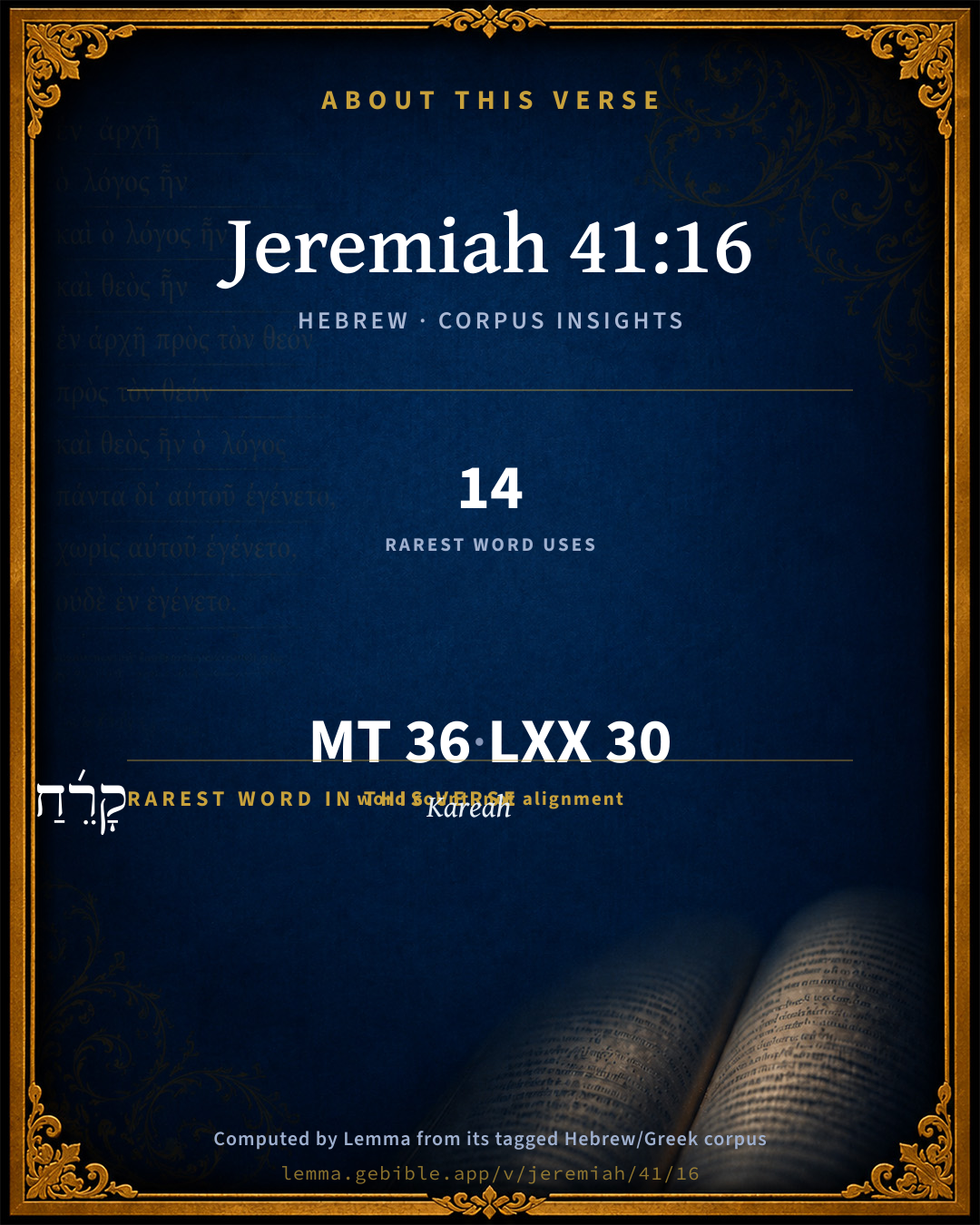
The rarest word here is קָרֵ֜חַ Kareah H7143 — appearing just 14 times in the whole Hebrew Bible.

Shared distinctive vocabulary

קָרֵ֜חַ Kareah H7143 occurs in 14 verses of the Hebrew Bible. Also found in:

Grammatical profile

  • 4 verbs
  • 23 nouns
  • 4 prepositions
  • 5 particles

Verb forms

  • וַיִּקַּח֩ Qal · Sequential Imperfect
  • הֵ֠שִׁיב Hiphil · Perfect
  • הִכָּ֔ה Hiphil · Perfect
  • הֵשִׁ֖יב Hiphil · Perfect

Repetition

Words recur within this verse — often emphatic in Hebrew:

  • בֶּן son H1121 ×3
  • וְכָל all H3605 ×2
  • הֵ֠שִׁיב to return H7725 ×2
  • אֲשֶׁר which H834 ×3
  • אִתּ֗וֹ with H854 ×2

Hebrew & Septuagint length

In the original languages it is 36 Hebrew tokens and 30 Greek tokens — but the two are counted differently (Hebrew bundles its prefixes and suffixes into one token; the Greek is in lemma form), so that isn’t a like-for-like length.

Cross-references

3

Topical passages linked to Jeremiah 41:16 in the Treasury of Scripture Knowledge — connected by theme and wording, ordered by reader-vote popularity; previews shown in the World English Bible.

  • Jeremiah 42:8 Then called he Johanan the son of Kareah, and all the captains of the forces who were with him, and all the people from the least even to the greatest,
  • Jeremiah 43:4–7 So Johanan the son of Kareah, and all the captains of the forces, and all the people, didn't obey the voice of Yahweh, to dwell in the land of Judah.
  • Jeremiah 41:10 Then Ishmael carried away captive all the residue of the people who were in Mizpah, even the king's daughters, and all the people who remained in Mizpah, whom Nebuzaradan the captain of the guard had committed to Gedaliah the son of Ahikam; Ishmael the son of Nethaniah carried them away captive, and departed to go over to the children of Ammon.

Cross-references courtesy of OpenBible.info (CC BY 4.0).

Hebrew and Greek witnesses Masoretic Hebrew ↔ Greek Septuagint

The same verse in the two great witnesses to the Old Testament, shown verse-for-verse.

These are two independent witnesses, not word-aligned to each other, and the Septuagint is shown in lemma (dictionary) form.

Hebrew Jeremiah 41:16 Masoretic · Westminster Leningrad Codex

וַיִּקַּח֩ יוֹחָנָ֨ן בֶּן קָרֵ֜חַ וְכָל שָׂרֵ֧י הַחֲיָלִ֣ים אֲשֶׁר אִתּ֗וֹ אֵ֣ת כָּל שְׁאֵרִ֤ית הָעָם֙ אֲשֶׁ֣ר הֵ֠שִׁיב מֵאֵ֨ת יִשְׁמָעֵ֤אל בֶּן נְתַנְיָה֙ מִן הַמִּצְפָּ֔ה אַחַ֣ר הִכָּ֔ה אֶת גְּדַלְיָ֖ה בֶּן אֲחִיקָ֑ם גְּבָרִ֞ים אַנְשֵׁ֣י הַמִּלְחָמָ֗ה וְנָשִׁ֤ים וְטַף֙ וְסָ֣רִסִ֔ים אֲשֶׁ֥ר הֵשִׁ֖יב מִגִּבְעֽוֹן

Then took Johanan the son of Kareah, and all the captains of the forces who were with him, all the remnant of the people whom he had recovered from Ishmael the son of Nethaniah, from Mizpah, after that he had killed Gedaliah the son of Ahikam, [to wit], the men of war, and the women, and the children, and the eunuchs, whom he had brought back from Gibeon:

World English Bible · Public Domain

Greek LXX Structure differs

In the Septuagint, Jeremiah is about an eighth shorter than the Hebrew and arranges its material differently — the Oracles Against the Nations (Hebrew chapters 46–51) appear in the middle of the Greek book, after 25:13. Because the chapter and verse boundaries do not line up, a verse-for-verse comparison with the Hebrew is not shown.

A verse-for-verse comparison isn’t shown here because the chapters and verses don’t line up. Switch to the LXX edition with the MT / LXX toggle above to read the Greek directly.

On this verse, Keil & Delitzsch discusses the Septuagint’s reading. Read the note in Commentary ↓

Hebrew: Westminster Leningrad Codex (CC BY 4.0). Greek: Septuagint (public domain); English from a public-domain English Septuagint. How the Septuagint differs from the Hebrew →

Targum (Aramaic paraphrase)

1

The Targum is the ancient Jewish Aramaic paraphrase of the Hebrew Scriptures — an interpretive translation, not the Hebrew text itself. Onkelos (literal) and Pseudo-Jonathan (expansive) render the Torah, and Jonathan the Prophets. Coverage is partial: where no permissively-licensed English translation exists for a verse, only the Aramaic is shown. This is verse-level text, not a word-by-word alignment to the Hebrew.

  1. Targum Jonathan Prophets (Joshua–Malachi)
    וּדְבַר יוֹחָנָן בַּר קָרֵחַ וְכָל רַבָּנֵי חֵילְוָתָא דִי עִמֵיהּ יַת כָּל שְׁאָרָא דְעַמָא דַאֲתִיב מִלְוַת יִשְׁמָעֵאל בַּר נְתַנְיָה מִן מִצְפַּיָא בָּתַר דִי קְטַל יַת גְדַלְיָה בַּר אֲחִיקָם גַבְרִין גַבְרֵי עָבְדֵי קְרָבָא וּנְשַׁיָא וְטַפְלָא וְרַבְרְבַיָא דִי אֲתִיב מִגִבְעוֹן:

    (no public-domain English translation for this verse)

    Targum Jonathan — Aramaic: “Mikraot Gedolot” (public domain). English: “Sefaria Community Translation” (CC0 1.0 (public-domain dedication)); “London "Chaldee Paraphrase," 1871” (public domain). Text via Sefaria.

Commentary

Notes on Jeremiah 41:16 from classic Christian and Jewish commentators (each source and its license shown beneath its notes). The classic Christian expositions comment on the surrounding passage and are grouped to its opening verse, so a note may address several verses; the Jewish commentaries on the Tanakh (Rashi and others) are per-verse, so they appear only where the commentator wrote on this verse.

Lemma curates 59 commentaries, every one of them public domain or Creative Commons licensed, each selected and text-cleaned for this edition rather than reprinted as found. About our sources →

Trapp's Complete Commentary

John Trapp

Jer 41:16 Then took Johanan the son of Kareah, and all the captains of the forces that [were] with him, all the remnant of the people whom he had recovered from Ishmael the son of Nethaniah, from Mizpah, after [that] he had slain Gedaliah the son of Ahikam, [even] mighty men of war, and the women, and the children, and the eunuchs, whom he had brought again from Gibeon:

Ver. 16. Then took Johanan all the remnant.] This evil act of theirs doth quite overturn the glory of the former; while against the ancient command of God, the covenant made with the Chaldees, and the consent of the prophets, they will needs down to Egypt, to lean upon that broken reed that never did them good, but evil.

John Trapp, A Commentary or Exposition upon All the Books of the Old and New Testament (1647–1656) — public domain. Text from a community e-Sword module.

Joseph Benson's Commentary

Jer 41:16-18. Then took Johanan and the captains, all the remnant of the people, &c. — It would have been a happy thing, if Johanan, when he had rescued the captives, would have sat quietly down with them, in the land of Judah, and governed them peaceably as Gedaliah did; but, instead of that, he is for leading them into the land of Egypt, as Ishmael would have led them into the land of the Ammonites; so that, though he got the command of them in a better way than Ishmael did, yet he did not use it much better. Gedaliah, who was of a meek and quiet spirit, was a great blessing to them; but Johanan, who was of a fierce and restless disposition, seems to have been permitted to get the command of them for their hurt, and to complete their ruin, even after they were, as they thought, redeemed. Thus did God still walk contrary to them, and thus did evil still pursue this sinful people. And they departed and dwelt in the habitation of Chimham — The same parcel of ground, probably, that David gave to Chimham, the son of Barzillai: see 2Sa 19:38-40. Here Johanan made his headquarters, steering his course toward Egypt, either from a personal affection to that country, or an ancient national confidence in the Egyptians for help in distress. Because of the Chaldeans — As the person, whom Nebuchadnezzar had made governor in the land, was slain, it was not unreasonable for them to think that Nebuchadnezzar would consider the murder of him as an affront done to himself; and though Johanan had no hand in that villanous act, yet he did not know but the king of Babylon, being unacquainted with all the parties among the Jews, might look upon all that remained in the country as guilty, and might revenge the murder of his deputy governor upon them all. He therefore chooses for them a habitation, from whence they might, in a short time, go down into Egypt, which was Johanan’s design, as we shall read in the next chapter.

Joseph Benson's Commentary on the Old and New Testaments (1811–1818) — public domain. Text from a community e-Sword module.

Keil & Delitzsch

C. F. Keil & F. Delitzsch

After the escape of Ishmael, it was to be feared that the Chaldeans would avenge the murder of the governor, and make the Jews who remained atone for the escape of the murderer by executing them or carrying them away to Babylon. Accordingly, Johanan and the other captains determined to withdraw to Egypt with the men, women, and children that had been carried off by Ishmael; these they conducted first to Bethlehem, where they encamped for the purpose of deliberating as to the rest of the journey, and taking due precautions. The account given in Jer 41:16 is clumsily expressed, especially the middle portion, between "whom he had brought back" and "the son of Ahikam;" and in this part the words "from Mizpah" are particularly troublesome in breaking the connection: "whom he (Johanan) had brought back from Ishmael the son of Nethaniah, from Mizpah, after he (Ishmael) had slain Gedaliah," while it is more correctly stated in the second relative clause, "whom he had brought back from Gibeon." Hitzig and Graf accordingly suppose that, originally, instead of אשׁר השׁיב מאת, there stood in the text אשׁר שׁבה, "whom he (Ishmael) had led captive from Mizpah, after he had slain Gedaliah." Thus the whole becomes clear. Against this conjecture there only stands the fact that the lxx translate οὕς ἀπέστρεψεν ἀπὸ ̓Ισμαήλ; they must thus have read אשׁר השׁיב מאת, and omitted merely המּצפּה as unsuited to the passage. However, the error may be even older than the lxx, and השׁיב מאת may easily have arisen through a scribe having glanced at the words אשׁר השׁיב of the last clause. The words from "men" to "chamberlains" form the more exact specification of the general expression "all the remnant of the people:" "men, viz., men of war, women (including the king's daughters, Jer 40:10), and children and chamberlains" (סריסים, guardians and servants of the female members of the royal family).

Keil & Delitzsch — Biblical Commentary on the Old Testament (1861–1891) — public domain (CC PDM 1.0). Text via the HelloAO Bible API. (Old Testament only.)

Tyndale Open Study Notes

Tyndale Open Resources

41:16 Johanan had with him a variety of important people, including soldiers, women, children, and court officials.

Tyndale Open Study Notes — © Tyndale Open Resources, licensed CC BY-SA 4.0. Text via the HelloAO Bible API.

Jamieson, Fausset & Brown

Robert Jamieson, A. R. Fausset & David Brown

men of war--"The men of war," stated in Jer 41:3 to have been slain by Ishmael, must refer to the military about Gedaliah's person; "the men of war" here to those not so.

eunuchs--The kings of Judah had adopted the bad practice of having harems and eunuchs from the surrounding heathen kingdoms.

Jamieson, Fausset & Brown — Commentary Critical and Explanatory on the Whole Bible (1871) — public domain (CC PDM 1.0). Text via the HelloAO Bible API.

Adam Clarke's Commentary

Verse 16. The women, - children, and the eunuchs] These were all most probably, persons who belonged to the palace and harem of Zedekiah: some of them his own concubines and their children.

Adam Clarke's Commentary on the Bible (1810–1826) — public domain. Text from a community e-Sword/MySword module.

John Calvin's Commentaries

The Prophet now shews, that though some kind of virtue appeared in John the son of Kareah, he was not yet of a right mind. He was an energetic and a discreet man, but he discovered his unbelief, when he led the remnant of the people into Egypt, while the Prophet was forbidding such a thing. He already knew that this was not lawful, but his obstinacy was two-fold more, when the Prophet repudiated his project, as we shall see. This passage then teaches us, that though the leaders of the forces, who had put Ishmael to flight, and avenged his perfidy, were men of courage, and shewed regard for the public good, they were destitute of faith: there was thus wanting in them the chief thing, that is piety and the fear of God.

Then the Prophet says, that John and the rest took the remnant of the people whom they had recovered from Ishmael, from Mizpah, not that they were recovered from that place, but that Ishmael had brought the unhappy people captives from Mizpah, as we have seen; but they had all been recovered at Gibeon, according to what is said at the end of the verse. But he says that they were valiant men, גברים, geberim, (he so calls them on account of their courage, for an explanation follows,) and men of war, המלחמה אנשי, anushi emelecheme. He then calls them valiant or brave, and afterwards he explains what that virtue was, even because they were warlike men. He says further, that there were women mixed with them, and children, and eunuchs, who once lived in the king’s court; and as we have before seen, there were among them the king’s daughters. Gedaliah then had collected together a considerable number of men, not only from the lower orders, but also from the higher class, whose wealth and rank were not common while the kingdom was standing.

John Calvin's Commentaries (1540-1563) — public domain. Text from the Calvin Translation Society English edition (1840s-50s) via the Christian Classics Ethereal Library (ccel.org). Calvin's coverage is partial (roughly two-thirds of the Bible); uncommented books and verses are honest gaps, never fabricated. The 19th-century editor's footnotes and remarks are omitted so the notes are faithfully Calvin's own voice.

Ellicott's Commentary for English Readers

(16) Mighty men of war . . .—These were apparently such as had escaped the massacre of Jer_41:2. In the women, the children, and the eunuchs we find the survivors of the king’s harem. Ebed-melech may well have been among the latter.

A Bible Commentary for English Readers, edited by Charles John Ellicott (1878–1897) — public domain. Text from a community e-Sword module.

The Cambridge Bible for Schools and Colleges

gen. ed. J. J. S. Perowne

16. from Mizpah] But it was not from Mizpah, but from the neighbourhood of Gibeon that they had been recovered. Therefore with Hitzig (followed by later commentators) read all the remnant of the people whom Ishmael … had carried away captive from Mizpah. A similarity between the two Hebrew verbs has evidently been the cause of the confusion.

even the men of war] probably a gloss.

The Cambridge Bible for Schools and Colleges (gen. ed. J. J. S. Perowne; Cambridge University Press, 1878–1918) — public domain. Text from a community e-Sword module.

John Gill's Exposition

Then took Johanan the son of Kareah, and all the captains of the forces that were with him,.... After Ishmael had made his escape, whom they did not think fit to pursue, and the people had committed themselves to their care and protection; and having brought them to Mizpah again, they took them from thence, as follows:

all the remnant of the people whom he had recovered from Ishmael the son of Nethaniah from Mizpah, after that he had slain Gedaliah the son of Ahikam: those whom he had rescued from Ishmael, and had returned to Mizpah, be persuaded to go with him from thence; who are more particularly described, as follows:

even mighty men of war, and the women, and the children, and the eunuchs, whom he had brought again from Gibeon; or "men, even men of war" (q); warlike men, soldiers; by which it appears that Ishmael must have more than ten men with him when he came to Mizpah, as well to do what he did there, as likewise to carry away such a number of captives, among which were mighty men, men of war, some of whom he had slain, besides women and children, to which are added eunuchs, not mentioned before, such as the king of Judah had in his court; see Jer 38:7; but these were of no account with the Chaldeans; and therefore they left them behind with the poor of the land; perhaps Ebedmelech might be among them, whose safety and protection is promised, because of his kindness to Jeremiah, Jer 39:15. The Targum calls them princes: these were brought back by Johanan from Gibeon, where he met with Ishmael, to Mizpah; from whence they had been carried, and whom he took from thence again.

(q) "mares, viros belli", Schmidt; "nempe vires bellatores", Piscator.

John Gill's Exposition of the Whole Bible (1746–1763) — public domain (CC PDM 1.0). Text via the HelloAO Bible API.

Haydock's Catholic Bible Commentary

CHAPTER XLI.

Eunuchs; officers of Sedecias, who had escaped, chap. xl. 9.

George Leo Haydock (1774–1849), Haydock's Catholic Family Bible and Commentary, 1859 edition — public domain. Excludes Psalms (Douay-Rheims chapter numbering differs from Protestant) and Deuterocanonical books (Catholic canon only).

Whedon's Commentary on the Bible

Daniel D. Whedon

16. Mighty men of war — In Jer_41:3 it is related that Ishmael “slew… the men of war.” That must refer to those who were about the person of Gedaliah; this, to other soldiers Johanan had been able to make prisoners. Among the eunuchs who are here mentioned, probably, may have been Ebed-melech.

Daniel D. Whedon (gen. ed.), Commentary on the Old and New Testaments (1874–1909) — public domain. Text from a community e-Sword module.

Lesson kit

Teaching starters — assembled from the data on this page, not authored interpretation. Every prompt links to the verse data it draws on. Edit before teaching.

Jeremiah, in the Prophets, opens this verse with 36 words (28 distinct Hebrew lemmas). Its most distinctive word is Qârêach (“Kareah”). A historical commentator’s framing appears above. Read the whole chapter for the surrounding context.

Discussion questions

  1. The word Qârêach carries the sense “Kareah.” How does it shape the verse?
  2. How does 2 Kings 25:23, which shares the word «Kareah», read alongside this verse?
  3. What does the repetition of “son” (3× in this one verse) do in this verse?
  4. These translations render this verse differently. What is at stake in choosing one wording over another?
  5. «וַיִּקַּח֩» is a Qal Sequential Imperfect verb. How does that grammatical form shape the action described?
  6. Compare how Trapp's Complete Commentary and Joseph Benson's Commentary read this verse. Where do they agree or differ?

Things to notice

Reading settings

Reading text

Shown beneath each verse's original-language words.

Old Testament
Old Testament edition

Read the OT as the Masoretic Hebrew (MT) or the Greek Septuagint (LXX).

English shown for the Greek Septuagint (in the Hebrew ↔ Greek comparison).

Comparing translations? Open the Compare panel on any verse page to stack up to four side by side.