
Jeremiah 40:7

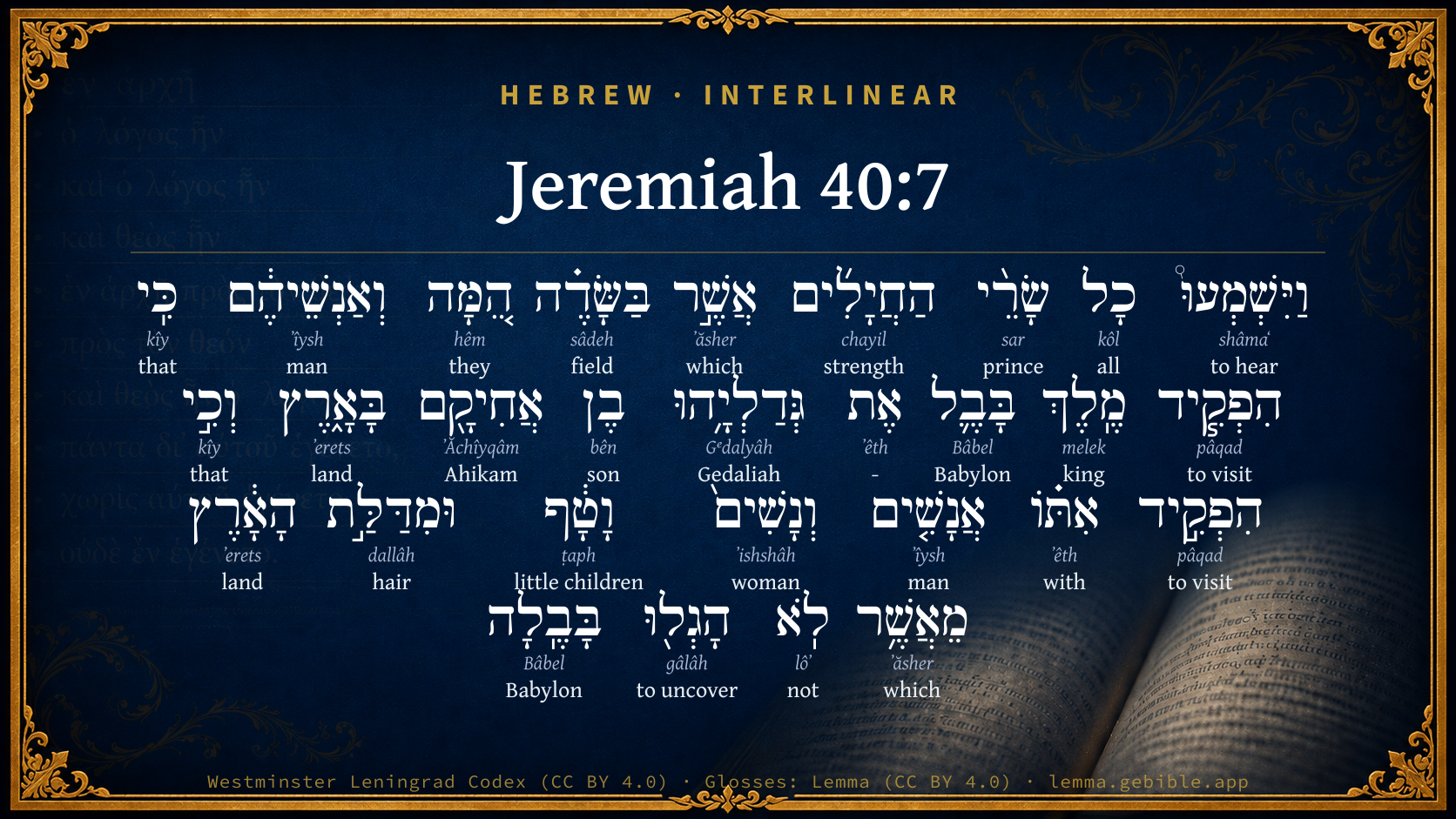
Hebrew (Westminster Leningrad Codex) Jeremiah 40:7 appears in the Hebrew Old Testament. The text above is from the Westminster Leningrad Codex. Each word links to its Strong’s number, a concise gloss, and parsing drawn from the Open Scriptures Hebrew Bible morphology. Click any word for its full Brown-Driver-Briggs (BDB) entry.
Download image
Cite this verse

Jeremiah 40:7 (World English Bible). Public Domain. Lemma interlinear Bible study tool, https://lemma.gebible.app/v/jeremiah/40/7.

Show BibTeX & RIS
BibTeX
RIS
English Translation
Now when all the captains of the forces who were in the fields, even they and their men, heard that the king of Babylon had made Gedaliah the son of Ahikam governor in the land, and had committed to him men, and women, and children, and of the poorest of the land, of those who were not carried away captive to Babylon;
World English Bible · Public Domain
Download a study sheet

One document with this verse’s original text, its word-by-word gloss line, the meaning frame, cross-references with their text, attributed commentary, and full source and license credits — printable, and it pastes into notes with its structure intact.

This verse Autodidact and up

Study sheet (.html) Plain text (.txt)

A passage Seminary Student

Up to 50 verses in one chapter. A passage sheet keeps up to 6 commentary sources and 12 cross-references per verse, in the order this page ranks them, and says so on the sheet whenever that leaves anything out. Ask for a single verse and you get the Autodidact verse sheet above.

Everything on this page stays free to read, with no account — the sheet is a download of what is already on screen, not access to it.

Want to remove ads? Support Godless Engineer
Compare translations 3

The same verse in 3 English versions, stacked beneath the original-language interlinear above. Click any original word for its lexicon entry.

Each is an independent rendering of the whole verse — the interlinear is not word-aligned to these translations.

Highlighted words mark where these versions differ — a whole-verse word diff, not a word-by-word alignment.

  • World English Bible Public Domain
    Now when all the captains of the forces who were in the fields, even they and their men, heard that the king of Babylon had made Gedaliah the son of Ahikam governor in the land, and had committed to him men, and women, and children, and of the poorest of the land, of those who were not carried away captive to Babylon;
  • King James Version Public Domain
    Now when all the captains of the forces which were in the fields, even they and their men, heard that the king of Babylon had made Gedaliah the son of Ahikam governor in the land, and had committed unto him men, and women, and children, and of the poor of the land, of them that were not carried away captive to Babylon;
  • unfoldingWord Literal Text CC BY-SA 4.0
    Now some commanders of Judean soldiers who were still in the countryside—they and their men—heard that the king of Babylon had made Gedaliah son of Ahikam governor over the land. They also heard that he had put him in charge of the men, women, and children who were the poorest people in the land, those who had not been exiled to Babylon.

unfoldingWord Literal Text — © unfoldingWord, licensed CC BY-SA 4.0. Word-aligned USFM3 via Door43 (git.door43.org/unfoldingWord/en_ult).

Versions to compare (up to 4)

3 of 4 selected

Show all 18 translations

Every available English version of this verse, each an independent rendering of the whole verse.

  • World English Bible Public Domain
    Now when all the captains of the forces who were in the fields, even they and their men, heard that the king of Babylon had made Gedaliah the son of Ahikam governor in the land, and had committed to him men, and women, and children, and of the poorest of the land, of those who were not carried away captive to Babylon;
  • Berean Standard Bible Public Domain
    When all the commanders and men of the armies in the field heard that the king of Babylon had appointed Gedaliah son of Ahikam over the land and that he had put him in charge of the men, women, and children who were the poorest of the land and had not been exiled to Babylon,
  • Majority Standard Bible Public Domain
    When all the commanders and men of the armies in the field heard that the king of Babylon had appointed Gedaliah son of Ahikam over the land and that he had put him in charge of the men, women, and children who were the poorest of the land and had not been exiled to Babylon,
  • King James Version Public Domain
    Now when all the captains of the forces which were in the fields, even they and their men, heard that the king of Babylon had made Gedaliah the son of Ahikam governor in the land, and had committed unto him men, and women, and children, and of the poor of the land, of them that were not carried away captive to Babylon;
  • American Standard Version (1901) Public Domain
    Now when all the captains of the forces that were in the fields, even they and their men, heard that the king of Babylon had made Gedaliah the son of Ahikam governor in the land, and had committed unto him men, and women, and children, and of the poorest of the land, of them that were not carried away captive to Babylon;
  • Revised Version (1885) Public Domain
    Now when all the captains of the forces which were in the fields, even they and their men, heard that the king of Babylon had made Gedaliah the son of Ahikam governor in the land, and had committed unto him men, and women, and children, and of the poorest of the land, of them that were not carried away captive to Babylon;
  • Geneva Bible (1599) Public Domain
    Nowe when all the captaines of the hoste, which were in the fieldes, euen they and their men heard, that the King of Babel had made Gedaliah the sonne of Ahikam gouernour in the land, and that he had committed vnto him, men, and women, and children, and of the poore of the lande, that were not caried away captiue to Babel,
  • Douay-Rheims (1899) Public Domain
    And when all the captains of the army that were scattered through the countries, they and their companions, had heard that the king of Babylon had made Godolias the son of Ahicam governor of the country, and that he had committed unto him men and women, and children, and of the poor of the land, them that had not been carried away captive to Babylon:
  • Young's Literal Translation Public Domain
    And all the heads of the forces that `are' in the field hear, they and their men, that the king of Babylon hath appointed Gedaliah son of Ahikam over the land, and that he hath charged him `with' men, and women, and infants, and of the poor of the land, of those who have not been removed to Babylon;
  • Literal Standard Version CC BY-SA 4.0
    And all the heads of the forces that [are] in the field hear, they and their men, that the king of Babylon has appointed Gedaliah son of Ahikam over the land, and that he has charged him [with] men, and women, and infants, and of the poor of the land, of those who have not been removed to Babylon;
  • Unlocked Literal Bible CC BY-SA 4.0
    Now some commanders of Judean soldiers who were still in the countryside—they and their men—heard that the king of Babylon had made Gedaliah son of Ahikam governor over the land. They also heard that he had put him in charge of the men, women, and children who were the poorest people in the land, those who had not been exiled to Babylon.
  • unfoldingWord Literal Text CC BY-SA 4.0
    Now some commanders of Judean soldiers who were still in the countryside—they and their men—heard that the king of Babylon had made Gedaliah son of Ahikam governor over the land. They also heard that he had put him in charge of the men, women, and children who were the poorest people in the land, those who had not been exiled to Babylon.
  • Darby Bible Public Domain
    And all the captains of the forces that were in the fields, they and their men, heard that the king of Babylon had appointed Gedaliah the son of Ahikam over the land, and had committed unto him men, and women, and children, and of the poor of the land, of them that had not been carried away captive to Babylon.
  • World Messianic Bible Public Domain
    Now when all the captains of the forces who were in the fields, even they and their men, heard that the king of Babylon had made Gedaliah the son of Ahikam governor in the land, and had committed to him men, women, children, and of the poorest of the land, of those who were not carried away captive to Babylon,
  • Webster's Bible Public Domain
    Now when all the captains of the forces who were in the fields, even they and their men, heard that the king of Babylon had made Gedaliah the son of Ahikam governor in the land, and had committed to him men, and women, and children, and of the poor of the land, of them that were not carried away captive to Babylon;
  • Free Bible Version CC BY-SA 4.0
    The Judean army commanders and their men who were still in the field found out that the king of Babylon had appointed Gedaliah son of Ahikam as governor of the country and had put him in charge of the poorest people of the country—the men, women, and children who hadn't been exiled to Babylon.
  • Bible in Basic English Public Domain
    Now when it came to the ears of all the captains of the forces who were in the field, and their men, that the king of Babylon had made Gedaliah, the son of Ahikam, ruler in the land, and had put under his care the men and women and children, all the poorest of the land, those who had not been taken away to Babylon;
  • JPS Tanakh (1917) Public Domain
    Now when all the captains of the forces that were in the fields, even they and their men, heard that the king of Babylon had made Gedaliah the son of Ahikam governor in the land, and had committed unto him men, and women, and children, and of the poorest of the land, of them that were not carried away captive to Babylon;

Literal Standard Version (2020), Covenant Press — licensed CC BY-SA 4.0. Text via the HelloAO Bible API (eBible.org). Unlocked Literal Bible (unfoldingWord) — licensed CC BY-SA 4.0. Text via the HelloAO Bible API (eBible.org). unfoldingWord Literal Text — © unfoldingWord, licensed CC BY-SA 4.0. Word-aligned USFM3 via Door43 (git.door43.org/unfoldingWord/en_ult). Free Bible Version, Dr. Jonathan Gallagher — licensed CC BY-SA 4.0. Text via the HelloAO Bible API (eBible.org).

Word by word

More ways to search: Search by grammar → Find every occurrence → Compare this word →

Practice this passage: Drill this verse → Learn its vocabulary →

וּמִדַּלַּ֣ת
dallâh
H1803
“and · from · hair of”
Conjunction + Preposition + Noun, Common, Feminine, Singular, Construct
Part of Speech
Conjunction + Preposition + Noun
Type
Common
Gender
Feminine
Number
Singular
State
Construct
Full BDB Definition

Origin: from H1802

TWOT: 433c

hair, threads, thrum (threads of warp hanging in loom) - poor (usually collective of helpless people) - (TWOT) poorest, lowest
  1. וַיִּשְׁמְעוּ֩ shâmaʻ H8085 “and · to hear” Conjunction + Verb, Qal, Sequential Imperfect, 3rd Person, Masculine, Plural
  2. כָל kôl H3605 “all of” Noun, Common, Masculine, Singular, Construct
  3. שָׂרֵ֨י sar H8269 “princes of” Noun, Common, Masculine, Plural, Construct
  4. הַחֲיָלִ֜ים chayil H2428 “the · forces” Particle, Definite Article + Noun, Common, Masculine, Plural, Absolute
  5. אֲשֶׁ֣ר ʼăsher H834 “which” Particle, Relative
  6. בַּשָּׂדֶ֗ה sâdeh H7704 “in/at the · field” Preposition, Determined + Noun, Common, Masculine, Singular, Absolute
  7. הֵ֚מָּה hêm H1992 “they” Pronoun, Personal, 3rd Person, Masculine, Plural
  8. וְאַנְשֵׁיהֶ֔ם ʼîysh H376 “and · men · their” Conjunction + Noun, Common, Masculine, Plural, Construct + Suffix, Personal, 3rd Person, Masculine, Plural
  9. כִּֽי kîy H3588 “that” Conjunction
  10. הִפְקִ֧יד pâqad H6485 “to visit” Verb, Hiphil, Perfect, 3rd Person, Masculine, Singular
  11. מֶֽלֶךְ melek H4428 “king of” Noun, Common, Masculine, Singular, Construct
  12. בָּבֶ֛ל Bâbel H894 “Babylon” Noun, Proper
  13. אֶת ʼêth H853 “-” Particle, Direct Object
  14. גְּדַלְיָ֥הוּ Gᵉdalyâh H1436 “Gedaliah” Noun, Proper
  15. בֶן bên H1121 “son of” Noun, Common, Masculine, Singular, Construct
  16. אֲחִיקָ֖ם ʼĂchîyqâm H296 “Ahikam” Noun, Proper
  17. בָּאָ֑רֶץ ʼerets H776 “in/at the · land” Preposition, Determined + Noun, Common, Both, Singular, Absolute
  18. וְכִ֣י kîy H3588 “and · that” Conjunction + Conjunction
  19. הִפְקִ֣יד pâqad H6485 “to visit” Verb, Hiphil, Perfect, 3rd Person, Masculine, Singular
  20. אִתּ֗וֹ ʼêth H854 “with · him” Preposition + Suffix, Personal, 3rd Person, Masculine, Singular
  21. אֲנָשִׁ֤ים ʼîysh H376 “men” Noun, Common, Masculine, Plural, Absolute
  22. וְנָשִׁים֙ ʼishshâh H802 “and · women” Conjunction + Noun, Common, Feminine, Plural, Absolute
  23. וָטָ֔ף ṭaph H2945 “and · little children” Conjunction + Noun, Common, Masculine, Singular, Absolute
  24. הָאָ֔רֶץ ʼerets H776 “the · land” Particle, Definite Article + Noun, Common, Both, Singular, Absolute
  25. מֵאֲשֶׁ֥ר ʼăsher H834 “from · which” Preposition + Particle, Relative
  26. לֹֽא lôʼ H3808 “not” Particle, Negative
  27. הָגְל֖וּ gâlâh H1540 “to uncover” Verb, Hophal, Perfect, 3rd Person, Common, Plural
  28. בָּבֶֽלָה Bâbel H894 “Babylon · toward” Noun, Proper + Suffix, Demonstrative

About this verse

These counts appear in no published source. They are computed here, from the morphology-tagged text and Lemma’s own curated glosses. What Lemma adds →

29
words
23
distinct lemmas
Prophets
section

Notable vocabulary

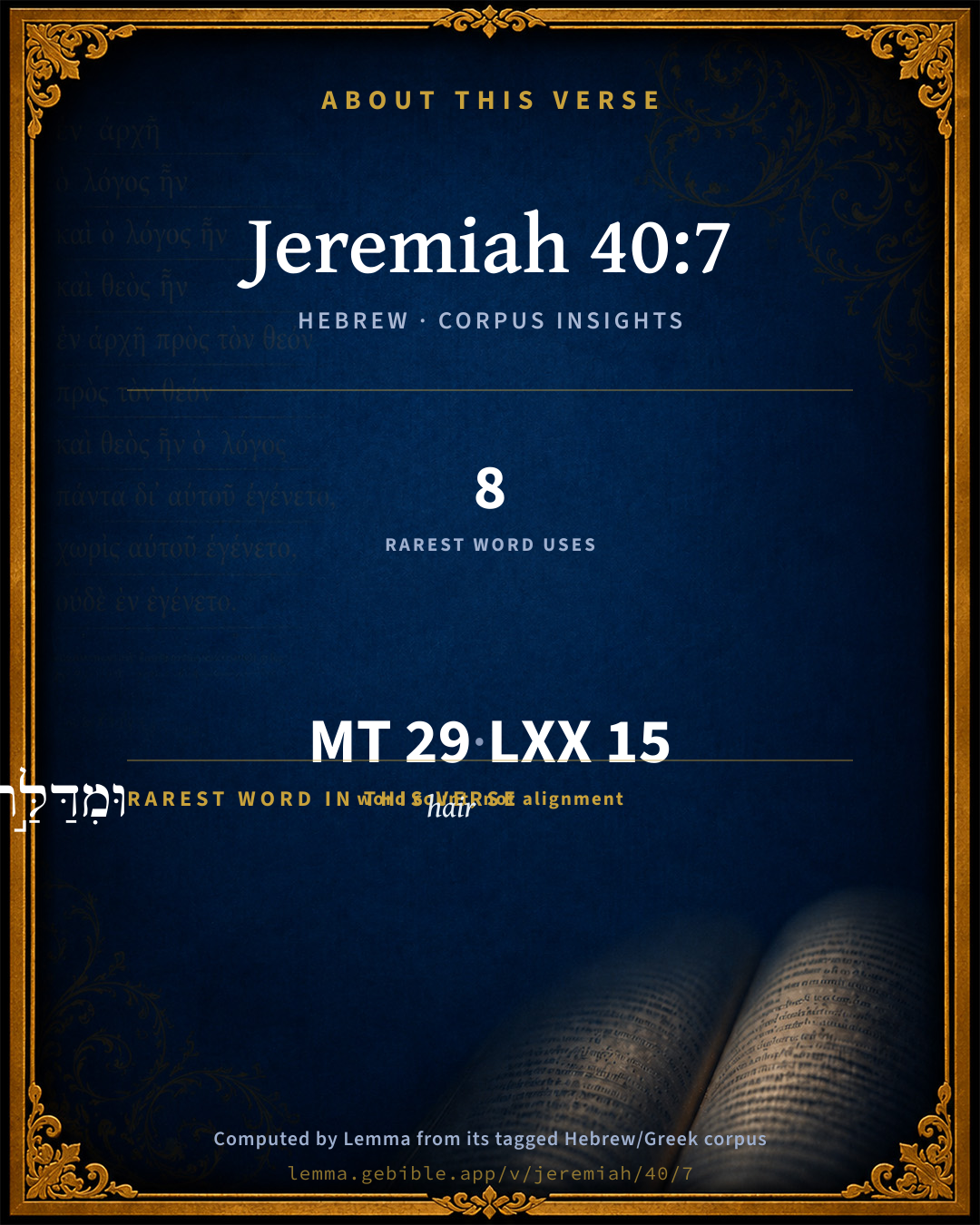
The rarest word here is וּמִדַּלַּ֣ת hair H1803 — appearing just 8 times in the whole Hebrew Bible.

Shared distinctive vocabulary

וּמִדַּלַּ֣ת hair H1803 occurs in 8 verses of the Hebrew Bible. Also found in:

Grammatical profile

  • 4 verbs
  • 17 nouns
  • 1 pronoun
  • 1 preposition
  • 2 conjunctions
  • 4 particles

Verb forms

  • וַיִּשְׁמְעוּ֩ Qal · Sequential Imperfect
  • הִפְקִ֧יד Hiphil · Perfect
  • הִפְקִ֣יד Hiphil · Perfect
  • הָגְל֖וּ Hophal · Perfect

Repetition

Words recur within this verse — often emphatic in Hebrew:

  • וְאַנְשֵׁיהֶ֔ם man H376 ×2
  • הִפְקִ֧יד to visit H6485 ×2
  • בָּבֶ֛ל Babylon H894 ×2
  • בָּאָ֑רֶץ land H776 ×2
  • אֲשֶׁ֣ר which H834 ×2
  • כִּֽי that H3588 ×2

Hebrew & Septuagint length

In the original languages it is 29 Hebrew tokens and 15 Greek tokens — but the two are counted differently (Hebrew bundles its prefixes and suffixes into one token; the Greek is in lemma form), so that isn’t a like-for-like length.

Cross-references

6

Topical passages linked to Jeremiah 40:7 in the Treasury of Scripture Knowledge — connected by theme and wording, ordered by reader-vote popularity; previews shown in the World English Bible.

  • Jeremiah 39:10 But Nebuzaradan the captain of the guard left of the poor of the people, who had nothing, in the land of Judah, and gave them vineyards and fields at the same time.
  • 2 Kings 25:4 Then a breach was made in the city, and all the men of war [fled] by night by the way of the gate between the two walls, which was by the king's garden (now the Chaldeans were against the city round about); and [the king] went by the way of the Arabah.
  • 2 Kings 25:22–26 As for the people who were left in the land of Judah, whom Nebuchadnezzar king of Babylon had left, even over them he made Gedaliah the son of Ahikam, the son of Shaphan, governor.
  • Jeremiah 39:4 It happened that, when Zedekiah the king of Judah and all the men of war saw them, then they fled, and went forth out of the city by night, by the way of the king's garden, through the gate between the two walls; and he went out toward the Arabah.
  • Ezekiel 33:24–29 Son of man, they who inhabit those waste places in the land of Israel speak, saying, Abraham was one, and he inherited the land: but we are many; the land is given us for inheritance.
  • Ezekiel 45:16 All the people of the land shall give to this offering for the prince in Israel.

Cross-references courtesy of OpenBible.info (CC BY 4.0).

Hebrew and Greek witnesses Masoretic Hebrew ↔ Greek Septuagint

The same verse in the two great witnesses to the Old Testament, shown verse-for-verse.

These are two independent witnesses, not word-aligned to each other, and the Septuagint is shown in lemma (dictionary) form.

Hebrew Jeremiah 40:7 Masoretic · Westminster Leningrad Codex

וַיִּשְׁמְעוּ֩ כָל שָׂרֵ֨י הַחֲיָלִ֜ים אֲשֶׁ֣ר בַּשָּׂדֶ֗ה הֵ֚מָּה וְאַנְשֵׁיהֶ֔ם כִּֽי הִפְקִ֧יד מֶֽלֶךְ בָּבֶ֛ל אֶת גְּדַלְיָ֥הוּ בֶן אֲחִיקָ֖ם בָּאָ֑רֶץ וְכִ֣י הִפְקִ֣יד אִתּ֗וֹ אֲנָשִׁ֤ים וְנָשִׁים֙ וָטָ֔ף וּמִדַּלַּ֣ת הָאָ֔רֶץ מֵאֲשֶׁ֥ר לֹֽא הָגְל֖וּ בָּבֶֽלָה

Now when all the captains of the forces who were in the fields, even they and their men, heard that the king of Babylon had made Gedaliah the son of Ahikam governor in the land, and had committed to him men, and women, and children, and of the poorest of the land, of those who were not carried away captive to Babylon;

World English Bible · Public Domain

Greek LXX Structure differs

In the Septuagint, Jeremiah is about an eighth shorter than the Hebrew and arranges its material differently — the Oracles Against the Nations (Hebrew chapters 46–51) appear in the middle of the Greek book, after 25:13. Because the chapter and verse boundaries do not line up, a verse-for-verse comparison with the Hebrew is not shown.

A verse-for-verse comparison isn’t shown here because the chapters and verses don’t line up. Switch to the LXX edition with the MT / LXX toggle above to read the Greek directly.

On this verse, Lange's Commentary on the Holy Scriptures discusses the Septuagint’s reading. Read the note in Commentary ↓

Hebrew: Westminster Leningrad Codex (CC BY 4.0). Greek: Septuagint (public domain); English from a public-domain English Septuagint. How the Septuagint differs from the Hebrew →

Targum (Aramaic paraphrase)

1

The Targum is the ancient Jewish Aramaic paraphrase of the Hebrew Scriptures — an interpretive translation, not the Hebrew text itself. Onkelos (literal) and Pseudo-Jonathan (expansive) render the Torah, and Jonathan the Prophets. Coverage is partial: where no permissively-licensed English translation exists for a verse, only the Aramaic is shown. This is verse-level text, not a word-by-word alignment to the Hebrew.

  1. Targum Jonathan Prophets (Joshua–Malachi)
    וּשְׁמָעוּ כָּל רַבָּנֵי חֵילְוָתָא דִי בְּחַקְלָא אִינוּן וְגַבְרֵיהוֹן אֲרֵי מַנִי מַלְכָּא דְבָבֶל יַת גְדַלְיָה בַר אֲחִיקָם בְּאַרְעָא וַאֲרֵי מַנֵי עִמֵיהּ גַבְרַיָא וּנְשַׁיָא וְטַפְלָא וּמֵחֲשִׁיכֵי עַמָא דְאַרְעָא מִדְלָא אִתְגְלִיאוּ לְבָּבֶל:

    (no public-domain English translation for this verse)

    Targum Jonathan — Aramaic: “Mikraot Gedolot” (public domain). English: “Sefaria Community Translation” (CC0 1.0 (public-domain dedication)); “London "Chaldee Paraphrase," 1871” (public domain). Text via Sefaria.

Commentary

Notes on Jeremiah 40:7 from classic Christian and Jewish commentators (each source and its license shown beneath its notes). The classic Christian expositions comment on the surrounding passage and are grouped to its opening verse, so a note may address several verses; the Jewish commentaries on the Tanakh (Rashi and others) are per-verse, so they appear only where the commentator wrote on this verse.

Lemma curates 59 commentaries, every one of them public domain or Creative Commons licensed, each selected and text-cleaned for this edition rather than reprinted as found. About our sources →

Matthew Henry's Commentary

We have in these verses,

I. A bright sky opening upon the remnant of the Jews that were left in their own land, and a comfortable prospect given them of some peace and quietness after the many years of trouble and terror with which they had been afflicted. Jeremiah indeed had never in his prophecies spoken of any such good days reserved for the Jews immediately after the captivity; but Providence seemed to raise and encourage such an expectation, and it would be to that miserable people as life from the dead. Observe the particulars.

1. Gedaliah, one of themselves, is made governor in the land, by the king of Babylon, Jer 40:7. To show that he designed to make and keep them easy he did not give this commission to one of the princes of Babylon, but to one of their brethren, who, they might be sure, would seek their peace. He was the son of Ahikam, the son of Shaphan, one of the princes. We read of his father (Jer 26:24) that he took Jeremiah's part against the people. He seems to have been a man of great wisdom and a mild temper, and under whose government the few that were left might have been very happy. The king of Babylon had a good opinion of him and reposed a confidence in him, for to him he committed all that were left behind.

2. There is great resort to him from all parts, and all those that were now the Jews of the dispersion came and put themselves under his government and protection. (1.) The great men that had escaped the Chaldeans by force came and quietly submitted to Gedaliah, for their own safety and common preservation. Several are here named, Jer 40:8. They came with their men, their servants, their soldiers, and so strengthened one another; and the king of Babylon had such a good opinion of Gedaliah his delegate that he was not at all jealous of the increase of their numbers, but rather pleased with it. (2.) The poor men that had escaped by flight into the neighbouring countries of Moab, Ammon, and Edom, were induced by the love they bore to their own land to return to it again as soon as they heard that Gedaliah was in authority there, Jer 40:11, Jer 40:12. Canaan itself would be an unsafe unpleasant country if there were no government nor governors there, and those that loved it dearly would not come back to it till they heard there were. It would be a great reviving to those that were dispersed to come together again, to those that were dispersed into foreign countries to come together in their own country, to those that were under strange kings to be under a governor of their own nation. See here in wrath God remembered mercy, and yet admitted some of them upon a further trial of their obedience.

3. The model of this new government is drawn up and settled by an original contract, which Gedaliah confirmed with an oath, a solemn oath (Jer 40:9): He swore to them and to their men, it is probably according to the warrant and instructions he had received from the king of Babylon, who empowered him to give them these assurances. (1.) They must own the property of their lands to be in the Chaldeans. "Come" (says Gedaliah), "fear not to serve the Chaldeans. Fear not the sin of it." Though the divine law had forbidden them to make leagues with the heathen, yet the divine sentence had obliged them to yield to the king of Babylon. "Fear not the reproach of it, and the disparagement it will be to your nation; it is what God has brought you to, has bound you to, and it is no disgrace to any to comply with him. Fear not the consequences of it, as if it would certainly make you and yours miserable; no, you will find the king of Babylon not so hard a landlord as you apprehend him to be; if you will but live peaceably, peaceably you shall live; disturb not the government, and it will not disturb you. Serve the king of Babylon and it shall be well with you." If they should make any difficulty of doing personal homage, or should be apprehensive of danger when the Chaldeans should come among them, Gedaliah, probably by instruction from the king of Babylon, undertakes upon all occasions to act for them, and make their application acceptable to the king (Jer 40:10): "As for me, behold, I will dwell at Mizpah, to serve the Chaldeans, to do homage to them in the name of the whole body if there be occasion, to receive orders, and to pay them their tribute when the come to us." All that passes between them and the Chaldeans shall pass through his hand; and, if the Chaldeans put such a confidence in him, surely his own countrymen may venture to do it. Gedaliah is willing thus to give them the assurance of an oath that he will do his part in protecting them, but, being apt to err (as many good men are) on the charitable side, he did not require an oath from them that they would be faithful to him, else the following mischief might have been prevented. However, protection draws allegiance though it be not sworn, and by joining in with Gedaliah they did, in effect, consent to the terms of government, that they should serve the king of Babylon. But, (2.) Though they own the property of their lands to be in the Chaldeans, yet, upon that condition, they shall have the free enjoyment of them and all the profits of them (Jer 40:10): "Gather you wine and summer fruits, and take them for your own use; put them in your vessels, to be laid up for winter-store, as those do that live in a land of peace and hope to eat the labour of your hand, nay, the labour of other people's hands, for you reap what they sowed." Or perhaps they were the spontaneous products of that fertile soil, for which none had laboured. And accordingly we find (Jer 40:12) that they gathered wine and summer fruits very much, such as were at present upon the ground, for their corn-harvest was over some time before Jerusalem was taken. While Gedaliah was in care for the public safety he left them to enjoy the advantages of the public plenty, and, for aught that appears, demanded no tribute from them; for he sought not his own profit, but the profit of many.

II. Here is a dark cloud gathering over this infant state, and threatening a dreadful storm. How soon is this hopeful prospect blasted! For when God begins in judgment he will make an end. It is here intimated to us, 1. That Baalis the king of the Ammonites had a particular spite at Gedaliah, and was contriving to take him off, either out of malice to the nation of the Jews, whose welfare he hated the thought of, or a personal pique against Gedaliah, Jer 40:14. Some make Baalis to signify the queen-mother of the king of the Ammonites, or queen-dowager, as if she were the first mover of the bloody and treacherous design. One would have thought this little remnant might be safe when the great king of Babylon protected it; and ye it is ruined by the artifices of this petty prince or princess. happy are those that have the King of kings of their side, who can take the wise in their own craftiness; for the greatest earthly king cannot with all his power secure us against fraud and treachery. 2. That he employed Ishmael, the son of Nethaniah, as the instrument of his malice, instigated him to murder Gedaliah, and, that he might have a fair opportunity to do it, directed him to go and enrol himself among his subjects and promise him fealty. Nothing could be more barbarous than the design itself, nor more base than the method of compassing it. How wretchedly is human nature corrupted and degenerated (even in those that pretend to the best blood) when it is capable of admitting the thought of such abominable wickedness! Ishmael was of the seed royal, and would therefore be easily tempted to envy and hate one that set up for a governor in Judah, who was not, as he was, of David's line, though he had ever so much of David's spirit. 3. That Johanan, a brisk and active man, having got scent of this plot, informed Gedaliah of it, yet taking it for granted he could not but know of it before, the proofs of the matter being so very plain: Dost thou certainly know? surely thou dost, Jer 40:14. He gave him private intelligence of it (Jer 40:15), hoping he would then take the more notice of it. He proffered his service to prevent it, by taking off Ishmael, whose very name was ominous to all the seed of Isaac: I will slay him. Wherefore should he slay thee? Herein he showed more courage and zeal than sense of justice; for, if it be lawful to kill for prevention, who then can be safe, since malice always suspects the worst? 4. That Gedaliah, being a man of sincerity himself, would by no means give credit to the information given him of Ishmael's treachery. He said, Thou speakest falsely of Ishmael. Herein he discovered more good humour than discretion, more of the innocency of the dove than the wisdom of the serpent. Princes become uneasy to themselves and all about them when they are jealous. Queen Elizabeth said that she would believe no more evil of her people than a mother would believe of her own children; yet many have been ruined by being over-confident of the fidelity of those about them.

Matthew Henry's Commentary on the Whole Bible (1708–1710) — public domain (CC PDM 1.0). Text via the HelloAO Bible API.

The Cambridge Bible for Schools and Colleges

gen. ed. J. J. S. Perowne

7. all the captains of the forces] the various leaders of bands among the Jews, who would keep out of the way during the presence of the Babylonian forces and until they found what was likely to be the condition of the country and the nature of the new government.

7–9. Abbreviated from 2Ki_25:23 f.

6. Mizpah] on a hill (Neby Samwil) 4½ miles N.W. of Jerusalem.

Chs. Jer_40:7 to Jer_41:3. Gedaliah is slain by Ishmael

Schmidt (Enc. Bibl. 238 b), on grounds which, when examined, appear quite insufficient, rejects this and the following section (Jer_40:7 to Jer_41:18). Even Du. on the other hand accepts it as in the main an extract from Baruch’s memoirs, adding that it forms one of the most remarkable and interesting accounts in the O.T. Difficulties in the narrative as it stands will be mentioned in the notes. The section may be summarized as follows. (i) Jer_40:7-12. On Gedaliah’s being made governor of those left in the land, Ishmael and other captains came to him and received an assurance that, if they were loyal to Babylon, they should receive protection. He exhorts them to occupy themselves in gathering the produce of the land. The same is thereupon done by many Jews who now return from taking refuge in neighbouring countries. (ii) Jer_40:13-16. Johanan warns Gedaliah that Baalis, king of Ammon, had instigated Ishmael to kill him, and asks permission to slay the latter. Gedaliah refuses to believe the charge. (iii) Jer_41:1-3. Ishmael, accompanied by ten men, goes to Mizpah, and after being entertained by Gedaliah, murders him and all Jews and Chaldaeans who were with him.

The Cambridge Bible for Schools and Colleges (gen. ed. J. J. S. Perowne; Cambridge University Press, 1878–1918) — public domain. Text from a community e-Sword module.

Trapp's Complete Commentary

John Trapp

Jer 40:7 Now when all the captains of the forces which [were] in the fields, [even] they and their men, heard that the king of Babylon had made Gedaliah the son of Ahikam governor in the land, and had committed unto him men, and women, and children, and of the poor of the land, of them that were not carried away captive to Babylon;

Ver. 7. Now when all the captains of the forces that were in the fields.] The dispersed Jews, with their captains and centurions, such as had lain lurking during the siege, or had fled when Zedekias did, and escaped.

Heard that the king of Babylon had made Gedaliah.] Whom they knew to be a pious and prudent man; and would be a father unto them instead of a king. Nebuchadnezzar might have set a Babylonian governor, who would have ruled them with rigour. But God, in mercy to his poor people, moved him to make choice of this man, famous for his mildness and integrity; to whom therefore they resort, but not all for the same good end, as the sequel showed; for Ishmael was a very Judas.

John Trapp, A Commentary or Exposition upon All the Books of the Old and New Testament (1647–1656) — public domain. Text from a community e-Sword module.

Joseph Benson's Commentary

Jer 40:7-10. Now when all the captains of the forces heard, &c., they came to Gedaliah — By the taking of Jerusalem the Chaldeans made a complete conquest of Judea; whereupon that part of the Jewish army which had escaped destruction dispersed themselves into several parts of the country. And Gedaliah sware unto them — They might reasonably suspect that the Chaldeans would have a jealous eye upon any conflux of people to Jerusalem, especially military men, and therefore might be somewhat suspicious of him, who was the Chaldean deputy governor; the securing them from fears on that account was the cause of Gedaliah’s giving them this voluntary oath; saying, Fear not to serve the Chaldeans — The same advice Jeremiah had formerly given to the Jews, Jer 27:11. As for me, I will dwell at Mizpah, to serve the Chaldeans — I keep my residence here, a place upon the frontiers, that I may be ready to obey any orders that the king of Babylon sends me by his servants. But ye, gather ye wine, and summer-fruits, and oil — But do you live in the country, and gather such fruits as the country affords, and do not fear being spoiled of them; but do as ye used to do in the times of the greatest peace and security. Wine and oil are here put by a metonymy for grapes and olives. It was now about the month of August, which was the proper season for gathering in the summer-fruits in that country.

Joseph Benson's Commentary on the Old and New Testaments (1811–1818) — public domain. Text from a community e-Sword module.

Lange's Commentary on the Holy Scriptures

4. The gathering of the people under Gedaliah

Jer_40:7-16

7Now when all the captains of the forces7 which were in the fields, even they and their men, heard that the king of Babylon had made Gedaliah the son of Ahikam governor in the land, and had committed unto8 him men and women, and children, and of the poor9 of the land, of them that were not carried away captive to Babylon; 8then they came to Gedaliah to Mizpah, even10 Ishmael the son of Nethaniah, and Johanan and Jonathan11 the sons of Kareah, and Seraiah the son of Tanhumeth, and the sons of Ephai the Netophathite, and Jezaniah the son of a [the] Maachathite, 9they and their men. And Gedaliah the son of Ahikam the son of Shaphan sware unto them and to their men, saying, Fear not to serve the Chaldeans: dwell 10in the land, and serve the king of Babylon, and it shall be well with you. As for me, behold, I will dwell at Mizpah, to serve the Chaldeans,12 which will come unto us: but ye, gather ye wine, and summer fruits, and oil, and put them in your 11vessels, and dwell in your cities that ye have taken. Likewise when all the Jews that were in Moab, and among the Ammonites, and in Edom, and that were in all countries, heard that the king of Babylon had left a remnant13 of Judah, and that 12he had set over them Gedaliah the son of Ahikam the son of Shaphan; Even all the Jews returned out of all the places whither they were driven, and came to the land of Judah, to Gedaliah, unto Mizpah, and gathered wine and summer fruits 13very much. Moreover Johanan the son of Kareah, and all the captains of the14forces that were in the fields, came to Gedaliah to Mizpah, and said unto him, Dost thou certainly know that Baalis the king of the Ammonites hath sent Ishmael the son of Nethaniah to slay thee?14 But Gedaliah the son of Ahikam believed 15them not. Then Johanan the son of Kareah spake to Gedaliah in Mizpah secretly, saying, Let me go, I pray thee, and I will slay Ishmael the son of Nethaniah, and no man shall know it; wherefore should he slay thee, that all the Jews which are gathered unto thee should be scattered and the remnant in Judah 16perish? But Gedaliah the son of Ahikam said unto Johanan the son of Kareah, Thou shalt not do this thing:15 for thou speakest falsely of Ishmael.

EXEGETICAL AND CRITICAL

The leaders of the scattered bands roving through the country, who had managed to escape the Chaldean forces, assembled to Gedaliah in Mizpah on the news that he had been set by Nebuchadnezzar over the country (Jer_40:7-8). Gedaliah, after promising them on oath on his part protection and support, urges them to collect whatever the land contains of the necessaries of life and willingly to serve the Chaldeans (Jer_40:9-10). The dispersed Jews from the neighboring countries also gathered about Gedaliah (Jer_40:11-12). It however came to be rumored that one of those band-leaders, Ishmael, the son of Nethaniah, of the royal stock, had been incited by Baalis, king of the Ammonites, to murder Gedaliah. The rest of the band-leaders, therefore, warned Gedaliah of Ishmael, but Gedaliah believed them not (Jer_40:13-14). One of the leaders, Johanan the son of Kareah, even offered to murder Ishmael secretly. Gedaliah, however, would not permit it, declaring the suspicion prevailing against Ishmael to be based on a lie (Jer_40:15-16).

Jer_40:7-8. Now when all … their men. These two verses are also found in 2Ki_25:23 in an abridged form.—This Ishmael was, according to Jer_41:1, of royal lineage, which partly explains his enmity to Gedaliah. The other persons named are otherwise altogether unknown.—Who the sons of the Netophathite were (the place belonged to Bethlehem, comp. 1Ch_2:54; 1Ch_9:16; Neh_7:26; Ezr_2:22) is as little known as what the proper name of the Maachathite was (Maachah a province of Syria on the northeastern borders of Palestine, Deu_3:14; Jos_12:5 coll. 2Sa_10:6; 2Sa_10:8; Raumer, Paläst., S. 226, 7). Comp. rems, on Jer_42:1.

Jer_40:9-12. And Gedaliah … fruits very much. Jer_40:9 is also found in 2Ki_25:24, reproduced with the noteworthy alteration, “to be the servants of the Chaldeans” instead of “to serve the Chaldeans.” The former expression however (we should expect at least “servants of the king of the Chaldeans”) corresponds neither to the usage of the prophets, nor the connection of the passage. Remarkably also the LXX. translate here: μῆ φοβηθῆτε ἀπὸ προσώπου τῶν παίδων τῶν Χαλδαίων, while in 2Ki_25:24 they have μὴ φοβεῖσθε πάροδον τῶν Χαλδαίων.—What Gedaliah has sworn to them is, according to Jer_40:10 a, that he would stand in Mizpah before the Chaldeans, who would come to them. He means by this that he would be the medium of intercourse with the Chaldean ambassadors, officers, soldiers, etc., and would represent the interest of the country with them (comp. Jer_15:1). The Jews on their part are to care for their sustenance by collecting the fruits still to be found in the country (it was now autumn, comp. Jer_52:12; Jer_41:1). In the desolated and plundered land this was naturally a matter of the highest importance. The collected supplies they were to preserve in the cities which, according to their own choice, they had taken into their possession. On the news that Nebuchadnezzar had left of the Jewish people, as it were a remnant of root in their land, and over this feeble remnant had appointed Gedaliah overseer, the dispersed Jews also returned from the neighboring lands, in order to gather around Gedaliah in Mizpah, who must thus have been a persona grata.

Jer_40:13-16. Moreover Johanan … of Ishmael. Whether Baalis, king of the Ammonites, had any special hatred towards the person of Gedaliah, or whether he wished to destroy the Jews’ last point of cohesion and crystalization, is uncertain. His making use of Ishmael may have been due to the personal jealousy of this man, who as a prince royal (Jer_41:1) regarded Gedaliah’s post of honor as properly belonging to him. The plan became known. The captains came to Mizpah (in the fields is not a thoughtless repetition from Jer_40:7, but indicates that the bands were still essentially the same, namely, free corps roving through the country) to warn Gedaliah. He, however, did not believe them. And when Johanan alone in secret conference offered to kill Ishmael, he directly forbade him, declaring the accusation to be a lie.

DOCTRINAL AND ETHICAL

1. On Jer_40:1-3. “Although the calamity, which has come upon Jerusalem, is great and terrible, God does not allow such evil to befal it that good will not result from it, as the Chaldean captain not obscurely intimates, that he has made a fair beginning in the knowledge of the true God. For he confesses, first, that the God of the prophet is a lord; secondly, that He knows future things; thirdly, that He causes His servants to proclaim these beforehand; fourthly, that God has conducted the war and done everything; fifthly, that He was displeased with the sinful manners of the people (among which idolatry was the worst); sixthly, that He has punished their disobedience to His word.” Cramer.

2. On Jer_40:4. “The friendliness, shown to the prophet, appears to proceed from men, but it comes from God. For God’s works are all made so that they are hidden among the creatures; for as He conceals His wisdom in the creation of heaven and earth, as He hides His kindness in the fruits of the earth, so also He disguises His help in the king of Babylon. For God executes. His works now by rational and anon by irrational creatures. As when He fed Elijah by the widow and by the ravens and by the angels (1Ki_17:3 sqq.; 14 sqq. and Jer_19:5). For all are His instruments.” Cramer.

3. On Jer_40:2-3. “Nebusaradan attestatione sua comprobat et confirmat veritatem ac certitudinem prædictionum prophetæ. Unde haud inscite colligi conjicique potest, quod Satrapa ille Babylonicus præditus fuerit agnitione veri Dei eâque salvatus. Et sic Deus subinde aliquos ex Magnatibus ad sui agnitionem et æternam salutem traducit (Psalms 68). Potest istud exemplum ἐλεγκτικῶς obverti absoluto Calvinianorum decreto.” Förster.

4. On Jer_40:5. “In this, that Jeremiah preferred remaining in the country to going to Babylon, it strikes me further—that a discreet man, who knows the world and his heart and the true interest of God’s cause—is as much as possible contented, and does not think to better himself by going further. He is willing to remain at court unknown, and at any rate he would rather be taken away than go away.—The advice, which Solomon gives, is verified, ‘Stand not in the place of great men.’ We are a generation of the cross, and our symbol is ‘an evil name and little understood.’ ” Zinzendorf.

5. On Jer_40:5. In Babylonia honor and a comfortable life invited the prophet, in Judea danger, dishonor and need in the desolated country. In Babylonia a respectable field of labor was opened to him among the great mass of his people, in Judea he had only rabble and condottieri about him. Jeremiah, however, was not a bad patriot, as many accused him of being. By remaining in Judea he showed that the import of his prophecies, apparently friendly to the Chaldeans and hostile to the Jews, had proceeded from the purest love to his people and his fatherland. Thus he imitated Moses, of whom it is written in Heb_11:25, that he chose rather to suffer affliction with the people of God than to enjoy the pleasures of sin for a season. The holy ground of the fatherland bound him to it, and in addition—if he went, who was to take spiritual oversight of the poor forsaken remnant, to proclaim the word of God and bestow on them consolation and admonition? Those who were in Babylon had Ezekiel. And could not the Lord raise up other prophets for them? So he remained with the sheep, who had no shepherd. Jeremiah had not sought his own through his whole life, nor did he here.

6. On Jer_40:7 sqq. “Human reason, and indeed nature shows, that in worldly government men cannot be without a head. For as the been cannot be without a queen, or the sheep without a shepherd, so no large number of people can exist without a head and government. God has wisely ordered it, and we should be thankful for the authorities.” Cramer.

7. On Jer_40:11 sqq. We may well perceive in this “remnant of Judah” a fulfilment of the prophecy in Isa_6:11 sqq.: “Then said I, Lord, how long? And he answered, Until the cities be wasted without inhabitant, and the houses without man, and the land be utterly desolate, and Jehovah have removed men far away, and great is the forsaking in the midst of the land. And if a tenth remains in it, this again must be removed. Yet as the terebinth and the oak, in which when they are felled, a ground-stock still remains, so is its stock a holy scion.”

8. On Jer_40:13 sqq. Gedaliah, in whom not only Nebuchadnezzar, but also his people, had confidence, must have been a noble man, to whom it was difficult to think evil of his neighbor. “Those who are of a pious disposition, cannot believe so much evil, as is told of people. But we must not trust too much, for the world is full of falseness (Wisd. 37:3). He who believes too easily, will be often deceived, and he who believes no one is also deceived. Therefore is he indeed a happy man, who can preserve the golden mean.” Cramer.

9. On Jer_40:13 sqq. “Misfortune is like the waves of the sea; when one is broken another follows, and the end of one trouble is the beginning of others.” Cramer.

10. On Jer_41:1-3. “Judas’s kiss and Jacob’s brethren are very common in the world and take after their grandfather Cain, who spake kindly to Abel and yet had blood-thirsty thoughts (Gen_4:8). Yea, they take after their father, the devil, who is a murderous spirit (Joh_8:44), and disguises himself as an angel of light (2Co_11:14).” Cramer.

11. On Jer_41:1 sqq. “Similia perfidiæ exempla (simulatæ fraternitatis): 2Sa_13:24; 2Sa_20:9 sq. Quadrat etiam huc historia nuptiarum Parisiensium celebratum 1572 mense Augusto.” Förster.

12. On Jer_41:4 sqq.

“Murder and avarice love to go with each other,

And one crime is often a prolific mother.”—Cramer.

13. On Jer_41:16 sqq. It is very remarkable that even this last centre and rendezvous of the unfortunate people must be destroyed. It might be supposed that with the destruction of the city and deportation of the people the judgments would have terminated. It seems as if the deed of Ishmael and the removal of the remnant to Egypt transcended the measure of punishment fixed by Jehovah, for the Lord did not send Ishmael, and the removal to Egypt He directly forbade. And yet it seems that only by Ishmael’s act and the flight to Egypt could the land obtain its Sabbath rest, which is spoken of in Lev_26:34-35.

14. On Jer_42:1-6. “Had not Johanan and his people asked for advice, but gone directly to Egypt, their sin would not have been so great. They feigned, however, submission to the will of God, while they yet adhered to their own will. It is a common fault for people to ask advice while they are firmly resolved what they will do. For they inquire not to learn what is right, but only to receive encouragement to do what they wish. If we advise them according to their inclination they take our advice, if not, they reject it.—We must be on our guard when we appeal to God’s decision, that we do not previously decide for ourselves. For thus we fall into hypocrisy, which is the most fatal intoxication and blindness.” Heim and Hoffman, The Major Prophets. [“Those will justly lose their comfort in real fears, that excuse themselves in sin with pretended fears.” Henry.—S. R. A.]

15. On Jer_42:7. After the murder of Gedaliah the anger of Nebuchadnezzar seemed inevitable. But the Lord, to whom nothing is impossible (Jer_32:17), promises to perform a miracle, and restore Israel to new prosperity in their land if they will give Him the honor and trust in Him. Nebuchadnezzar’s heart is indeed in His hand. If this is not acknowledged and Nebuchadnezzar more feared than the Lord, their sin is then against the first commandment.

16. On Jer_42:13 sqq. “God reminds His people of the favor with which He adopted them as His people, which was the most sacred obligation to obedience; that Egypt was to them a land of destruction, a forbidden land, as indeed all confidence in human aid is forbidden to those who would live by faith, which was known to them from the history of their fathers and all the prophets. It is a great sin to deem one’s self safer under the protection of man than under that of God. It is incomprehensible, how blind unbelief makes people, so that the Jews have not yet learned the truth in the destruction of Jerusalem and the temple of God.” Heim and Hoffman. “Fides futurorum certa est ex præcedentibus.” Tertull. “Venient hæc quoque sicut ista venerunt.” Augustin.—Förster.

17. On Jer_43:2 sqq. “Hypocrites forsooth do not wish to be regarded as rejecting and setting themselves in opposition to God’s word, or accusing God of falsehood. For then is all the world pious, and no one refuses to be submissive to the dear Lord. God is truly God and remains so. It is only against this parson Jeremiah that they must act he lies, he is not sent, his ruling and preaching cannot be endured.” Cramer.

18. On Jer_43:3. “Observe the old diabolical trick: when preachers practice God’s word and their office with zeal, the world understands how to baptize it with another name and call it personal interest, as even here Baruch must bear the blame, as if he only wished to vent his anger on them and be contrary,” Cramer.

19. On Jer_43:6. The ancients here examine the question why Jeremiah accompanied the people to Egypt and take occasion to discuss the 1 Comm. de fuga ministrorum with reference to Augustin. Epist. 150 ad Honorar. With respect to Jeremiah, it is clear that he did all in his power to avert the journey to Egypt. After the whole people, however, were once on their way it was impossible for him and Baruch to remain alone in the deserted country. They were obliged to go with their flock. The more these were wandering, the more need they had of the shepherds. Thus, even if they were not compelled, they had to go with them. It seems, however, to follow from the expression וַיִַּקּח, Jer_43:5, that no choice was given them. The people wished to have the prophet with them. In no case can we say that Jeremiah fled, for according to his own prophecy, he knew that he was going to meet ruin in Egypt.

20. On Jer_43:8-13. At the present day when we wish to convey to posterity the account of some accomplished fact, or the prediction of some fact to be accomplished (ex. gr. a last testament), we take paper and ink, write it down, seal it, have it subscribed by witnesses and preserve it in the registrar’s or recorder’s office. In ancient times they took a simpler and surer way. Jacob and Laban simply erected a heap of stones (Genesis 31), the two and a half tribes (Joshua 22) built an altar on the bank of the Jordan. As long as the heap and the altar were standing, the record was transmitted from generation to generation for what object these stone witnesses were set up, and thus, that which it was desired to convey to posterity lived in the memory of men. Jeremiah also knows how to use ink and pen (Jeremiah 32), but here he returns once more to the old manner of preserving archives. He simply places great stones in the clay, declaring what they signify, viz., that here, on this spot, Nebuchadnezzar’s tent shall stand. Whether the Egyptians and Jews then believed him or not, is of no consequence. The record of these stones and their meaning at any rate remained alive, and the Lord’s word was thus safely preserved till the day of its fulfilment.

HOMILETICAL AND PRACTICAL

1. On Jer_40:1-12; Jer_41:1-3; Jer_42:1-16. Israel, the chosen nation, is in its destinies a type of human life in general. Consider only the exodus from Egypt. So also the destinies of the people of Israel, after the destruction of Jerusalem by Nebuchadnezzar, are pretypical. For 1. The deportation of the whole people in chains and fetters is a type of our universal human misery, from which no one (not even Jeremiah) is free. 2. The fate of Gedaliah and the journey to Egypt is a type of the insufficiency of all mere human help. 3. As the Jews after Gedaliah’s murder, so men at all times, find protection and deliverance in the Lord alone.

2. On Jer_40:1-6. The Christian in the tumult of the world. 1. He is regarded externally like others. 2. The eye of the Lord watches with special care over him, so that (a) not a hair of his head is bent, (b) all his wants are provided for. 3. He, however, on his part directs all his efforts to the kingdom of God and His righteousness, and will not be turned aside from this either by the violence or the friendliness of the world.

3. On Jer_40:7 to Jer_41:3. Gedaliah’s fate an example of what befals even the most noble in times of deep corruption. 1. They enjoy general confidence. 2. They are incapable of attributing extreme wickedness to men. 3. They become a sacrifice to their confidence. 4. They are therefore not in a condition to stay the divine judgments.

4. On Jer_42:1-16. What is the surest way of coming to the right conclusion in difficult cases? 1. To inquire of the Lord. 2. To obey unconditionally the direction which the Lord communicates. [“We must still in faith pray to be guided by a spirit of wisdom in our hearts, and the hints of Providence.” Henry.—S. R. A.]

5. On Jer_43:1-7. Characteristic example of the artfulness of the human heart: the Jews inquire of the Lord and promise to obey His direction (Jer_42:20). But when the direction does not accord with their wish, they at once declare it to be supposititious, not from the Lord. The prophet must be a liar, an alleged enemy has incited him. But what was long previously determined in the heart is obstinately brought to execution. [“Those that are resolved to contradict the great ends of the ministry, are industrious to bring a bad name upon it. It is well for persons who are thus misrepresented that their witness is in heaven, and their record on high.” Henry.—S. R. A.].

6. On Jer_43:8-13. The ways of the Lord are wonderful. Israel flees before Nebuchadnezzar far away to Egypt. But there they are not safe. The Lord causes it to be proclaimed to them that at the entrance of the king’s palace at Tahpanhes Nebuchadnezzar’s tent shall stand. Now indeed there is a brick-kiln there, in the clay of which Jeremiah is to place stones, the foundation stones, as it were, for the Chaldean king’s pavilion. Thus the Lord lays the germs of future events, and whatever He prepares in secret He reveals in His own time to the glory of His wisdom, omniscience and omnipotence.

Footnotes:

[7]Jer_40:7.—חֲיָלִים. The word is found in the sense of “riches” in Isa_30:6. In the sense of “forces, bands,” it occurs only in Jeremiah (Jer_40:13; Jer_41:11; Jer_41:13; Jer_41:16; Jer_42:1; Jer_42:8; Jer_43:4-5), and in later books (1Ki_15:20; 2Ki_25:23; 2Ki_25:26; Ecc_10:10; 1Ch_7:5-7; Dan_11:10). By the addition of אֲשֶׁר בַּשָּׂדֶה these bands are distinguished from the main forces of the regular army in the capital.

[8]Jer_40:7.—הִפְקִיד אִתּוֹ This Hiphil denotes not only inspicientem, but also inspiciendum facere: Jer_41:10; Jer_36:20; Jer_37:21; Psa_31:6; Isa_10:28; 2Ch_12:10, in which case he to whom the inspectio is committed is designated in various ways by לְ, by אֵת, by בְּיָד or עַליָּד

[9]Jer_40:7.—ומדלת. Comp. Jer_39:10; 2Ki_25:12. The partitive מִן expresses that not all the “poor of the land” were left behind, which also follows from Jer_52:15 coll. 16. In the following מִן before אֲשֶׁר there is a sort of attraction, and it is therefore not to be emphasized, as it would then signify that Gedaliah was not set as inspector over all the remaining people.

[10]Jer_40:8.—The Vau is explicative=and indeed. Comp. Naegelsb. Gr., § 111, 1.

[11]Jer_40:8.—2Ki_25:23 has only “Johanan son of Kareah.” The words “and the sons of Ephai” are also omitted, so that “the Netophathite” is referred to Tanhumeth. Instead of יֲזנְיָה finally we read there יַאֲזַנְיָה. From these alterations it follows that the present text is the original. For the similarity of the names Johanan and Jonathan, which appears more in writing than in speaking, as well as the obscurity of the name עכָּי (which according to the Chethibh is to be spoken עוֹכַּי, according to the Keri עֵיכַּי Comp. עֵיכָּה, Gen_25:4; Isa_60:6; 1Ch_2:46-47) well explains the omission of these words, while their insertion in the text appears in the highest degree improbable.

[12]Jer_40:10.—[“Literally, to stand at the face of the Chaldeans: to be their representative, and to do their will, and also to mediate with them in your behalf (Hitzig).” Wordsworth.—S. R. A.]

[13]Jer_40:11.—נָתַן שִׁאֵרִית. Comp. Jer_44:7; Gen_45:7; 2Sa_14:7.

[14]Jer_40:14.—לְהַכֹּתְךָ נֶפֶֹשׁ. Comp. Gen_37:21; Deu_19:6; Deu_19:11; Deu_27:25; Naegelsb. Gr., § 70, f.

[15]Jer_40:16.—אַל־תַּעַשׂ. The Keri would read תַּעֲשֵׂה (comp. on this form Olsh., § 240, a Anm.), unnecessarily. Comp. Jer_39:12; Gen_22:12; Job_13:20.

Lange's Commentary on the Holy Scriptures (Critical, Doctrinal, and Homiletical), ed. John Peter Lange, English translation edited by Philip Schaff (1864–1880) — public domain. Text from a community e-Sword module.

Tyndale Open Study Notes

Tyndale Open Resources

40:7-12 The new government was organized under Gedaliah, who belonged to a family of high rank. His grandfather Shaphan had taken King Josiah the scroll of the law that sparked reformation (2 Kgs 22:10). Gedaliah’s father, Ahikam, had held a high post in Jehoiakim’s close circle of officials, and he had saved Jeremiah’s life (Jer 26:24).

40:7-8 News spread swiftly among the Judean guerrilla bands and the poor people who were left behind about Gedaliah’s appointment as governor. A small group of guerrilla leaders arranged to meet with Gedaliah in order to gain a better understanding of the new governor’s plans.

Tyndale Open Study Notes — © Tyndale Open Resources, licensed CC BY-SA 4.0. Text via the HelloAO Bible API.

Geneva Bible (1599)

Geneva Bible translators

Which were scattered abroad for fear of the Chaldeans.

Geneva Bible (1599) marginal notes — public domain. Text via Bolls.life.

Jamieson, Fausset & Brown

Robert Jamieson, A. R. Fausset & David Brown

captains . . . in the fields--The leaders of the Jewish army had been "scattered" throughout the country on the capture of Zedekiah (Jer 52:8), in order to escape the notice of the Chaldeans.

Jamieson, Fausset & Brown — Commentary Critical and Explanatory on the Whole Bible (1871) — public domain (CC PDM 1.0). Text via the HelloAO Bible API.

John Calvin's Commentaries

Mention has been before made of Gedaliah. We have seen that the Prophet was once rescued from death through his kindness, for he interposed for him when almost all with one consent doomed the holy Prophet to death. And God bestowed on him no common honor, that while he was seeking nothing, Nebuchadnezzar should set him as governor over the land. He did not, indeed, enjoy power for any length of time; but it was yet God’s will to extend his hand to the pious man, so that he might have, at least for a time, some evidence of his favor. He was at length, as we shall see, killed by treachery.

The Prophet now tells us, that the leaders of the forces, before scattered together with their troops, were now come to him. When the Prophet says that they were in the field, I do not think as some, that they were those who fled when the city was taken. But probably they were those who were forced to flee from the cities at the first entrance of the Chaldean army. Nor does it seem probable that they escaped, when all the companions of the king were overtaken and caught in the plain of Jericho, as we have already seen. I then think that they were those who had been scattered here and there, having deserted the cities committed to them at the first approach of their enemies. As then they had been wanderers from their own country and exiles, they now returned to Gedaliah. By saying that the leaders of the forces had heard, he does not mean that they had now an army, but that they had been set over cities and towns in Judea together with their troops.

John Calvin's Commentaries (1540-1563) — public domain. Text from the Calvin Translation Society English edition (1840s-50s) via the Christian Classics Ethereal Library (ccel.org). Calvin's coverage is partial (roughly two-thirds of the Bible); uncommented books and verses are honest gaps, never fabricated. The 19th-century editor's footnotes and remarks are omitted so the notes are faithfully Calvin's own voice.

Ellicott's Commentary for English Readers

(7) Now when all the captains of the forces.—A new section of the history begins, ending with the murder of Gedaliah and its sequel. in Jer_41:18. The commanders of the armies that had fought against the invader in the open country found it hopeless to continue the struggle after the capture of Jerusalem. What were they to do? The king of Babylon had, by appointing Gedaliah, himself a prince of Judah, shown a disposition to treat the conquered people leniently. Could they do better than apply to him for protection?

A Bible Commentary for English Readers, edited by Charles John Ellicott (1878–1897) — public domain. Text from a community e-Sword module.

John Gill's Exposition

Now when all the captains of the forces which were in the fields,.... Not the captains of the king of Babylon's forces, but the captains of the king of Judah's forces; who either during the siege had lurked in the fields and villages, not daring to fall upon the Chaldean army, or attempt to raise the siege; or rather who fled with Zedekiah from Jerusalem, when the city was taken, and who deserted him, when he was apprehended, and shifted for themselves, and were dispersed about in the country, where they continued for some little time: but when

they and their men; their servants, or rather the common soldiers that were under them:

heard that the king of Babylon had made Gedaliah the son of Ahikam governor in the land; his viceroy or deputy governor in the land of Judea; being a prince of considerable note among the Jews, and in high favour with the king of Babylon:

and had committed unto him men, and women, and children, and of the poor of the land, of them that were not carried away captive unto Babylon; even as many men, women, children, and poor, as were left in the land, and not carried captive; these were all committed to the care of this prince, to rule over and govern them; to keep them in subjection to the king of Babylon; to employ them in cultivating the land, from whence some profit might arise to the conqueror and new proprietor of it.

John Gill's Exposition of the Whole Bible (1746–1763) — public domain (CC PDM 1.0). Text via the HelloAO Bible API.

Albert Barnes' Notes on the Bible

The men would be the old and infirm: the women those whose husbands and protectors had perished in the wars (e. g. Jer 41:10). The word children includes all the inferior members of a household.

Albert Barnes' Notes on the Bible (1834–1885) — public domain. Text from a community e-Sword/MySword module.

Haydock's Catholic Bible Commentary

Captains, who had fled from Sedecias, and effected their escape. (Josephus, Antiquities x. 11.)

George Leo Haydock (1774–1849), Haydock's Catholic Family Bible and Commentary, 1859 edition — public domain. Excludes Psalms (Douay-Rheims chapter numbering differs from Protestant) and Deuterocanonical books (Catholic canon only).

Whedon's Commentary on the Bible

Daniel D. Whedon

7. Captains… in the fields — The Jewish army had dispersed, and many of the leaders had taken refuge in the country immediately surrounding. Familiar as they were with the country, they had no difficulty in finding places of concealment and safety. The list of these captains in the following verse is not necessarily exhaustive, but representative.

Daniel D. Whedon (gen. ed.), Commentary on the Old and New Testaments (1874–1909) — public domain. Text from a community e-Sword module.

The Pulpit Commentary

Vers. 7-12. The Jewish fugitives resort to Gedaliah, who promises them protection as long as they are loyal to Babylon.

In the fields; rather, in the field; i.e. in the open country, as opposed to the towns. Men, and women, and children. Old and worn out men, helpless widows, and fatherless children. Royal princesses were among them. (Jer_41:10)

Vers. 7-12. The duties of adversity and their reward.

I THE DUTIES.

1. Submission. We are not required to yield before avoidable troubles; but finding some to be irresistible, we are to learn the wisdom and obligation of bending to them without further demur. The captains were no cowards; they had fought and had lost. Their resistance against the inevitable was a mistake; continued resistance after defeat would have been nothing but folly. Submission is much easier when we remember that the trouble is in accordance with the will of a God who is always wise, fair, and merciful,

2. Industry. Gedaliah advised the people to set to work at their regular avocations. "But ye, gather ye wine, and summer fruits, and oil, and put them in your vessels," etc. (ver. 10). It is difficult for a dispirited, humiliated, poverty striken people to settle down to quiet, earnest work. Nevertheless, their duty and their happiness lie in their doing so:

(1) their duty, for adversity is no excuse for indolence; and

(2) their happiness, because

(a) the fruits of their labour would be a beginning of a return to prosperity and wealth, and

(b) in the very exercise of work they would find a solace and a refreshment.

There is nothing so weak or so injurious as an idle brooding over trouble. Be up. and doing! And though the work is irksome at first, it will prove itself a great healer of distress.

II THE REWARD.

1. A healthy influence over others. The example of the quiet condition of the remnant of Jews in their native country attracted fugitives to return from the neighbouring countries (ver. 11). Their action was a confirmation of the wisdom of their brethren. A man"s behaviour under great trial is keenly observed. If he do well then, he may be the means of influencing others as he can never influence them under ordinary circumstances. Thus he may find consolation for his sorrow in the enlargement of his service to his fellow men.

2. The successful issue of industry. The Jews reaped an unusually abundant grape and fruit harvest (ver. 12). "They that sow in tears shall reap in joy." If we complain and despair under distress, we have no right to expect a happy issue out of it. But patient endurance and diligent attention to duty may make us reasonably expect brighter days in the future. Borne with these accompaniments, trouble often reveals itself as less terrible than our fears. When distress comes, we imagine that it has blighted every tree in the orchard and every grape in the vineyard, and so we neglect what consolation we might have in those fruits of patient industry which might still be given to us. Let us remember that during the sad seventy years, and even just after the horrors of the Chaldean invasion, the Jews could gather "wine and summer fruits very much.

Vers. 7-12. "That we may be godly and quietly governed.

These verses are an illustration of men"s desire for such government. In the disorder and confusion of the times, men were looking out for some settled rule. Companies of armed men were camping about, only waiting for some sign to indicate to whose standard they should repair. That which they wanted seemed to be found in Gedaliah. Hence they go to him (ver. 8). The incident here recorded suggests, in regard to government generally

I THE COMMON CONSENT OF MEN AS TO ITS NECESSITY. It was not merely one company of the scattered Jews that were on the look out for a leader, but all the companies, and not the men only, but their officers also. And in every collection of human beings, however they group themselves, however casually they may have been thrown together, if they have to dwell and to work together the choosing of a leader, one who shall rule them, is a never disregarded need.

II THE PRINCIPLES ON WHICH THIS CONSENT RESTS. They are such as these:

1. There can be no well being strength, peace, happiness without order.

2. No order without law.

3. No law without a lawgiver, and a law upholder, i.e. a government. It may be monarchical, an oligarchy, a republic, a democracy, only in some way law must be expressed and upheld. Because men feel that this last is necessary to the first, men will ever seek after government, good, if possible, but any is felt to be better than none. Anarchy is so much misery. Thus do men reason in regard to their temporal affairs.

III THE EXCEPTION WHICH MEN MAKE TO THIS CONSENT. It is strange that there should be exception, but there is. We find it when we look at men"s spiritual affairs. Government there is as necessary as in that which is temporal indeed, far more so, considering the far greater value of the interests at stake. And yet men will not have it. Each seeks to do that which is right in his own eyes. What would be ruin in regard to their secular affairs they deem to be no great harm in things that are spiritual. We see this anarchy at times in the things of the Church. If the Church of Christ is to do her work and glorify her Lord, there must be unity, cohesion, subordination, obedience. But these words, and yet more the things they represent, are hateful to not a few. And so the paralysis that has come over large sections of the Church. The prince of this world knows the force and value of the maxim, Divide et impera, and he has sought all too successfully to do the one that he may attain to the other. And so in the individual sphere of the soul. The one rightful ruler is God, speaking by his vicegerent conscience. All our sin and misery is owing to our disregard of this rule. The world is so mournful a world because it is so sinful a world. Loyal obedience is our life and health and peace. And because we refuse this, we are weak and sad, as well as sinful.

IV THE DIVINE METHODS OF BRINGING THIS EXCEPTION TO AN END. For he will bring it to an end, glory be to his Name. He must reign till he hath put all things under his feet. And he thus works to this end:

1. By powerful instructors. Conscience. His providence, shown now in blessing, now in stern judgment. His Word, in which his law is laid down.

2. By bringing to bear the most mighty of motives. Love, which rises at the cross of Christ. Hope of his acceptance and reward. Fear of his awful displeasure and doom.

3. By his Spirit striving ever with men. C.

Vers. 7-12. The difficulties of a governor.

To govern a country is never an easy task; but how difficult it must be when the work is that of reconstruction! Gedaliah has to begin, as it were, at the beginning. One of his first difficulties is to know exactly what he has to deal with. There are turbulent as well as peaceful dements, bands of free-lances, who, now that the Chaldean has gone, make their appearance before the governor to see what the prospect may be. Another difficulty is that of inspiring confidence. Those who have just been plundered may be excused for apprehensions lest they should soon be plundered again. On the other hand, Gedaliah was better off than the king who had just been dethroned. The latter vainly held on to a tottering building, whose very foundations were going, while the former was free from the pernicious elements which so long had made all government in the land an abomination. With all his difficulties, Gedaliah had some encouragements. There appears to have been a general gathering to him as a centre. Most men generally tend to the point where there are the greatest prospects of social order, security, and stability. Y.

The Pulpit Commentary (1880–1919), ed. H.D.M. Spence-Jones & Joseph S. Exell — public domain. Text from a community e-Sword module.

Keil & Delitzsch

C. F. Keil & F. Delitzsch

Return of those who had been dispersed: they gather round Gedaliah. - Whilst the country and its capital were being conquered, many of the men of war had dispersed here and there through the land, and fled for refuge to regions difficult of access, where they could not be reached by the Chaldeans; others had even escaped into the territory of the Moabites, Ammonites, and Edomites. When these heard that now, after the destruction of Jerusalem and the carrying away of the captives, the king of Babylon had appointed Gedaliah as governor over the few people who had been left behind in the country, they returned from their several places of refuge, and came to Mizpah to Gedaliah, who promised them protection and safety, on condition that they would recognise the authority of the king of Babylon and peaceably cultivate the soil. שׂרי חילים, "leaders of the forces, captains." בּשׂדה, "in the country," as opposed to the city; שׂדה, "fields," as in Jer 17:3. אנשׁיהם, "their men," the troops under the captains. כּי הפקיד אתּו, "that he had committed to his oversight and care." "Men," viz., old, weak, infirm men; "women and children," whose husbands and fathers had perished; "and some of the poor of the country, of those who had not been carried captive to Babylon" (מן partitive), i.e., the poor and mean people whom the Chaldeans had left behind in the country (Jer 39:10).

Jer 40:8-12

These captains came to Mizpah, namely (ו explicative), Ishmael the son of Nethaniah (according to Jer 41:1, the grandson of Elishama, and of royal blood), Johanan and Jonathan the sons of Kareah (cf. Jer 40:13 and Jer 41:11, Jer 41:16; Jer 42:1.; the name Jonathan is omitted in Kg2 25:23; see on this passage), Seraiah the son of Tanhumeth, and the sons of Ephai the Netophathite (from Netophah in the vicinity of Bethlehem, Ch1 2:54; Ezr 2:22), Jezaniah (יזניהוּ; but in Kg2 25:23 יאזניהוּ), the Maachathite, from Maachah, a district in Syria near Hermon, Deu 3:14; Jos 12:5. These men, who had borne arms against the Chaldeans, were concerned for their safety when they returned into the country. Gedaliah sware to them, i.e., promised them on oath, "Be not afraid to serve the Chaldeans; remain in the country and serve the king of Babylon, and it shall be well with you. And as for me, behold, I shall remain at Mizpah to stand before the Chaldeans who will come to us," i.e., as lieutenant of the king of Babylon, to represent you before the Chaldean officers and armies, to maintain your rights and interests, so that you may be able to settle down where you choose, without anxiety, and cultivate the land. "And as for yourselves, father ye wine and fruit (קיץ, see on Sa2 16:1) and oil, and put them in your vessels." אסף is used of the ingathering of the fruits of the ground. It was during the fifth or sixth month (Kg2 25:8), the end of July or beginning of August, that grapes, figs, and olives became ripe; and these had grown so plentifully in comparison with the small number of those who had returned, that they could gather sufficient for their wants. "And dwell in your cities, cities which ye seize," i.e., which you shall take possession of. Jer 40:11. Those Jews also who had fled, during the war, into the neighbouring countries of Moab, Ammon, Edom, etc., returned to Judah when they learned that the king of Babylon had left a remnant, and placed Gedaliah over them; they came to Mizpah and Gedaliah, who appointed them places to dwell in, and they gathered much wine and fruit, i.e., made a rich vintage and fruit harvest. נתן שׁארית, "to give a remainder," as it were to leave a remainder ('הותיר שׁ'( redniamer, Jer 44:7, or 'שׂוּם שׁ, Gen 45:7).

Keil & Delitzsch — Biblical Commentary on the Old Testament (1861–1891) — public domain (CC PDM 1.0). Text via the HelloAO Bible API. (Old Testament only.)

Kretzmann's Popular Commentary

Paul E. Kretzmann

Gedaliah Made Governor And Threatened By The Jews

v. 7. Now, when all the captains of the forces which were in the fields, the leaders of the Jewish army who had fled to hide themselves in remote and inaccessible places of the land, even they and their men, heard that the king of Babylon had made Gedaliah, the son of Ahikam, governor in the land and had committed unto him men and women and children and of the poor of the land, of them that were not carried away captive to Babylon, 39:10, the lowliest of the whole country, those who had formerly been treated with contempt by the wealthy and noble,

v. 8. then they came to Gedaliah to Mizpah, even Ishmael, the son of Nethaniah, of royal lineage, 41:1, and Johanan and Jonathan, the sons of Kareah, and Seraiah, the son of Tan-humeth, and the sons of Ephai, the Ne-tophathite, of a town in Judah not far from Bethlehem, and Jezaniah, the son of a Ma-achathite, Maachah being a province of Syria on the northern border of Palestine, they and their men.

v. 9. And Gedaliah, the son of Ahikam, the son of Shaphan, sware unto them and to their men, saying, Fear not to serve the Chaldeans, or, as 2Ki 25:24 has it, to be the servants of the Chaldeans; dwell in the land and serve the king of Babylon, readily acknowledging his overlord-ship, and it shall be well with you.

v. 10. As for me, behold, I will dwell at Mizpah, to serve the Chaldeans which will come unto us, cheerfully recognizing the authority of the governors, or satraps, representing the Babylonian government, and governing his actions accordingly; but ye, gather ye wine and summer-fruits and oil, for it was now about midsummer and therefore time for the fruits to ripen, and put them in your vessels, and dwell in your cities that ye have taken. He skillfully put it so as if they were to enjoy the fruits of the land for themselves alone, in order to reduce the resentful attitude of the Jews, lest the idea of tribute-money make them rebellious at once.

v. 11. Likewise, when all the Jews that were in Moab and among the Ammonites and in Edom, and that were in all the countries, where-over they had found refuge at the approach of the Chaldean army, heard that the king of Babylon had left a remnant of Judah, and that he had set over them Gedaliah, the son of Ahikam, the son of Shaphan,

v. 12. even all the Jews returned out of all places whither they were driven and came to the land of Judah, to Gedaliah, who was charged with taking care of them and providing dwelling-places for them, unto Mizpah, and gathered wine and summer-fruits very much, the harvest being all the more plentiful since there were comparatively few people left in the land.

v. 13. Moreover, Johanan, the son of Kareah, and all the captains of the forces that were in the fields, those who had managed to escape the vigilance of the Chaldean invaders in remote parts of the land, came to Gedaliah to Mizpah

v. 14. and said unto him, Dost thou certainly know that Baalis, the king of the Ammonites, who may have harbored plans to put himself into possession of the entire country by one bold stroke, hath sent Ishmael, the son of Nethaniah, to slay thee? But Gedaliah, the son of Ahikam, believed him not. He was generous and unsuspecting, but not wise.

v. 15. Then Johanan, the son of Kareah, spake to Gedaliah in Mizpah secretly, saying, Let me go, I pray thee, and I will slay Ishmael, the son of Nethaniah, and no man shall know it, the jealous and ambitious rival, who envied Gedaliah his position of governor, would thus have been removed without tumult. Wherefore should he slay thee, that all the Jews which are gathered unto thee, with some semblance of order, should be scattered and the remnant in Judah perish? The confusion which was bound to follow the removal of Gedaliah was sure to result in great harm to the country, possibly to the undoing of all the labor bestowed upon its restoration by Gedaliah.

v. 16. But Gedaliah, the son of Ahikam, said unto Johanan, the son of Kareah, Thou shall not do this thing, remove Ishmael by assassination; for thou speakest falsely of Ishmael, which does not mean that he accused Johanan of lying, but that he declared the rumor concerning his intentions to be false. It is one of the mysteries of providence that the Lord sometimes permits the righteous, in spite of warning, to rush to their destruction.

Paul E. Kretzmann, Popular Commentary of the Bible (1921–1924) — public domain. Text from a community e-Sword module.

unfoldingWord translationNotes

Door43 World Missions Community

Now

This marks a new part of the story.

those who had not been exiled to Babylon

This can be translated in active form. AT: "those whom the enemy soldiers had not sent to Babylon" (See: Active or Passive)

Ishmael ... Nethaniah ... Johanan ... Jonathan ... Kareah ... Seraiah ... Tanhumeth ... Ephai ... Jaazaniah

These are the names of men. (See: How to Translate Names)

Netophathite ... Maakathite

people from the regions of Netophah and Maakah

translationWords

govern

exile

Mizpah

unfoldingWord translationNotes — © Distant Shores Media and the Door43 World Missions Community, licensed CC BY-SA 4.0. Source: git.door43.org/Door43/en_tn.

Lesson kit

Teaching starters — assembled from the data on this page, not authored interpretation. Every prompt links to the verse data it draws on. Edit before teaching.

Jeremiah, in the Prophets, opens this verse with 29 words (23 distinct Hebrew lemmas). Its most distinctive word is dallâh (“hair”). A historical commentator’s framing appears above. Read the whole chapter for the surrounding context.

Discussion questions

  1. How does “hair” (dallâh) shape what this verse is saying?
  2. Genesis 41:19 shares the word «hair» with this verse. How do the two illuminate each other?
  3. “man” occurs 2× in this one verse. What is the effect of the repetition?
  4. These translations render this verse differently. What is at stake in choosing one wording over another?
  5. The verb «וַיִּשְׁמְעוּ֩» is Qal Sequential Imperfect. How does its form color the action?
  6. Reading how Matthew Henry's Commentary and The Cambridge Bible for Schools and Colleges read this verse, where do the two commentators agree and where do they part?

Things to notice

Reading settings

Reading text

Shown beneath each verse's original-language words.

Old Testament
Old Testament edition

Read the OT as the Masoretic Hebrew (MT) or the Greek Septuagint (LXX).

English shown for the Greek Septuagint (in the Hebrew ↔ Greek comparison).

Comparing translations? Open the Compare panel on any verse page to stack up to four side by side.