2 Chronicles 26:12

Hebrew (Westminster Leningrad Codex) 2 Chronicles 26:12 appears in the Hebrew Old Testament. The text above is from the Westminster Leningrad Codex. Each word links to its Strong’s number, a concise gloss, and parsing drawn from the Open Scriptures Hebrew Bible morphology. Click any word for its full Brown-Driver-Briggs (BDB) entry.
Download image
Cite this verse

2 Chronicles 26:12 (World English Bible). Public Domain. Lemma interlinear Bible study tool, https://lemma.gebible.app/v/2-chronicles/26/12.

Show BibTeX & RIS
BibTeX
RIS
English Translation
The whole number of the heads of fathers' [houses], even the mighty men of valor, was two thousand and six hundred.
World English Bible · Public Domain
Download a study sheet

One document with this verse’s original text, its word-by-word gloss line, the meaning frame, cross-references with their text, attributed commentary, and full source and license credits — printable, and it pastes into notes with its structure intact.

This verse Autodidact and up

Study sheet (.html) Plain text (.txt)

A passage Seminary Student

Up to 50 verses in one chapter. A passage sheet keeps up to 6 commentary sources and 12 cross-references per verse, in the order this page ranks them, and says so on the sheet whenever that leaves anything out. Ask for a single verse and you get the Autodidact verse sheet above.

Everything on this page stays free to read, with no account — the sheet is a download of what is already on screen, not access to it.

Want to remove ads? Support Godless Engineer
Compare translations 3

The same verse in 3 English versions, stacked beneath the original-language interlinear above. Click any original word for its lexicon entry.

Each is an independent rendering of the whole verse — the interlinear is not word-aligned to these translations.

Highlighted words mark where these versions differ — a whole-verse word diff, not a word-by-word alignment.

  • World English Bible Public Domain
    The whole number of the heads of fathers' [houses], even the mighty men of valor, was two thousand and six hundred.
  • King James Version Public Domain
    The whole number of the chief of the fathers of the mighty men of valor were two thousand and six hundred.
  • unfoldingWord Literal Text CC BY-SA 4.0
    All the number of the heads of the fathers according to the mighty ones of strength, 2,600.

unfoldingWord Literal Text — © unfoldingWord, licensed CC BY-SA 4.0. Word-aligned USFM3 via Door43 (git.door43.org/unfoldingWord/en_ult).

Versions to compare (up to 4)

3 of 4 selected

Show all 18 translations

Every available English version of this verse, each an independent rendering of the whole verse.

  • World English Bible Public Domain
    The whole number of the heads of fathers' [houses], even the mighty men of valor, was two thousand and six hundred.
  • Berean Standard Bible Public Domain
    The total number of family leaders of the mighty men of valor was 2,600.
  • Majority Standard Bible Public Domain
    The total number of family leaders of the mighty men of valor was 2,600.
  • King James Version Public Domain
    The whole number of the chief of the fathers of the mighty men of valor were two thousand and six hundred.
  • American Standard Version (1901) Public Domain
    The whole number of the heads of fathers' `houses', even the mighty men of valor, was two thousand and six hundred.
  • Revised Version (1885) Public Domain
    The whole number of the heads of fathers’ houses, even the mighty men of valour, was two thousand and six hundred.
  • Geneva Bible (1599) Public Domain
    The whole nomber of the chiefe of the families of the valiant men were two thousande and sixe hundreth.
  • Douay-Rheims (1899) Public Domain
    And the whole number of the chiefs by the families of valiant men were two thousand six hundred.
  • Young's Literal Translation Public Domain
    The whole number of heads of the fathers of the mighty ones of valour `is' two thousand and six hundred;
  • Literal Standard Version CC BY-SA 4.0
    The whole number of heads of the fathers of the mighty men of valor [is] two thousand and six hundred;
  • Unlocked Literal Bible CC BY-SA 4.0
    The whole number of the leaders of the families who led the mighty men was 2,600.
  • unfoldingWord Literal Text CC BY-SA 4.0
    All the number of the heads of the fathers according to the mighty ones of strength, 2,600.
  • Darby Bible Public Domain
    The whole number of the chief fathers of the mighty men of valour was two thousand six hundred.
  • World Messianic Bible Public Domain
    The whole number of the heads of fathers’ households, even the mighty men of valor, was two thousand six hundred.
  • Webster's Bible Public Domain
    The whole number of the chief of the fathers of the mighty men of valor were two thousand and six hundred.
  • Free Bible Version CC BY-SA 4.0
    The total number of family leaders was 2,600 fighting men.
  • Bible in Basic English Public Domain
    The heads of families, the strong men of war, were two thousand, six hundred.
  • JPS Tanakh (1917) Public Domain
    The whole number of the heads of fathers' houses, even the mighty men of valour, was two thousand and six hundred.

Literal Standard Version (2020), Covenant Press — licensed CC BY-SA 4.0. Text via the HelloAO Bible API (eBible.org). Unlocked Literal Bible (unfoldingWord) — licensed CC BY-SA 4.0. Text via the HelloAO Bible API (eBible.org). unfoldingWord Literal Text — © unfoldingWord, licensed CC BY-SA 4.0. Word-aligned USFM3 via Door43 (git.door43.org/unfoldingWord/en_ult). Free Bible Version, Dr. Jonathan Gallagher — licensed CC BY-SA 4.0. Text via the HelloAO Bible API (eBible.org).

Word by word

More ways to search: Search by grammar → Find every occurrence → Compare this word →

Practice this passage: Drill this verse → Learn its vocabulary →

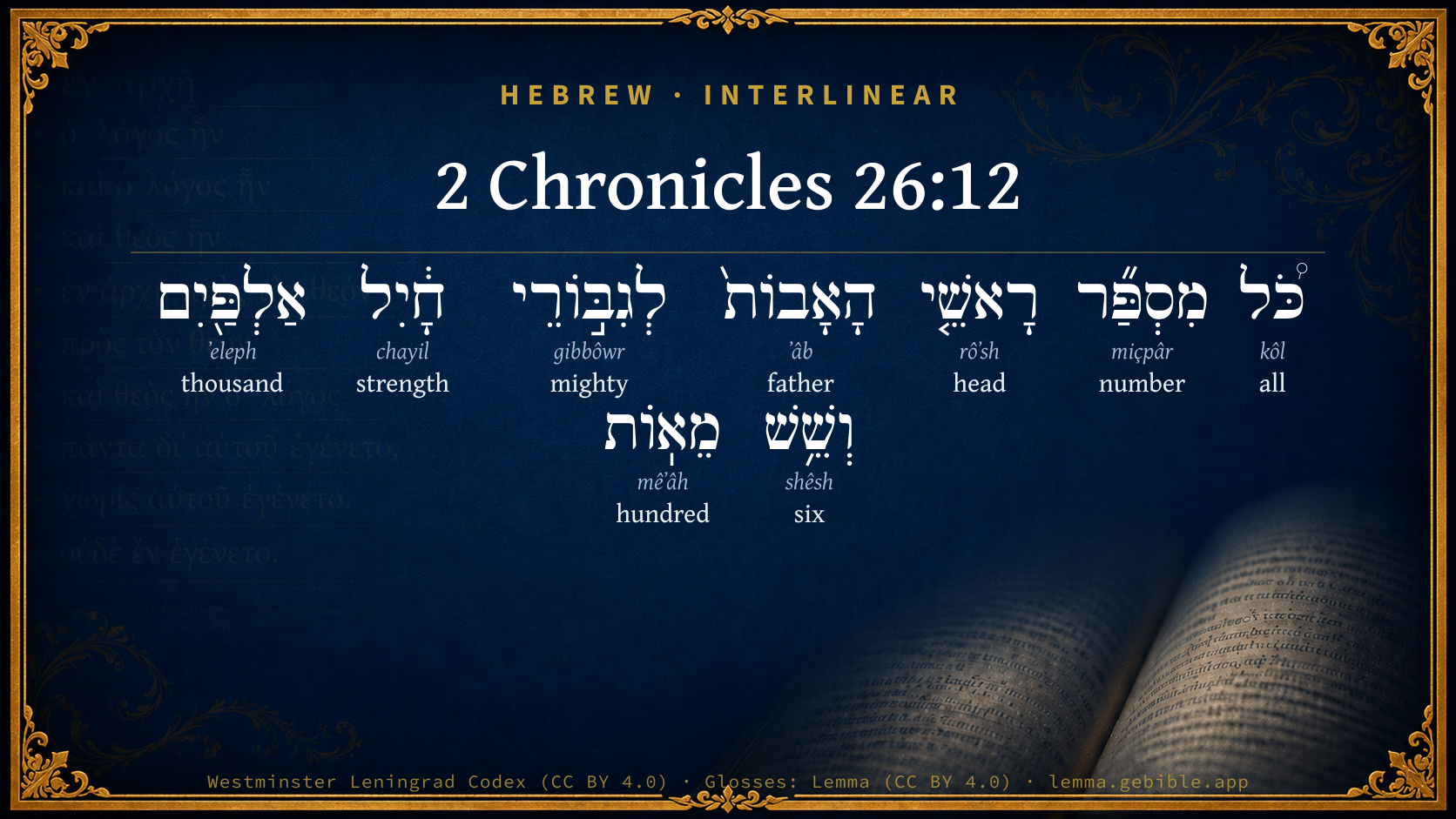
מִסְפַּ֞ר
miçpâr
H4557
“number of”
Noun, Common, Masculine, Singular, Construct
Part of Speech
Noun
Type
Common
Gender
Masculine
Number
Singular
State
Construct
Full BDB Definition

Origin: from H5608

TWOT: 1540e

number, tale - number - number - innumerable (with negative) - few, numerable (alone) - by count, in number, according to number (with preposition) - recounting, relation
  1. כֹּ֠ל kôl H3605 “all of” Noun, Common, Masculine, Singular, Construct
  2. רָאשֵׁ֤י rôʼsh H7218 “heads of” Noun, Common, Masculine, Plural, Construct
  3. הָאָבוֹת֙ ʼâb H1 “the · fathers” Particle, Definite Article + Noun, Common, Masculine, Plural, Absolute
  4. לְגִבּ֣וֹרֵי gibbôwr H1368 “to/for · mighty of” Preposition + Adjective, Adjective, Masculine, Plural, Construct
  5. חָ֔יִל chayil H2428 “strength” Noun, Common, Masculine, Singular, Absolute
  6. אַלְפַּ֖יִם ʼeleph H505 “thousand” Adjective, Cardinal number, Both, Plural, Absolute
  7. וְשֵׁ֥שׁ shêsh H8337 “and · six” Conjunction + Adjective, Cardinal number, Feminine, Singular, Absolute
  8. מֵאֽוֹת mêʼâh H3967 “hundred” Adjective, Cardinal number, Both, Plural, Absolute

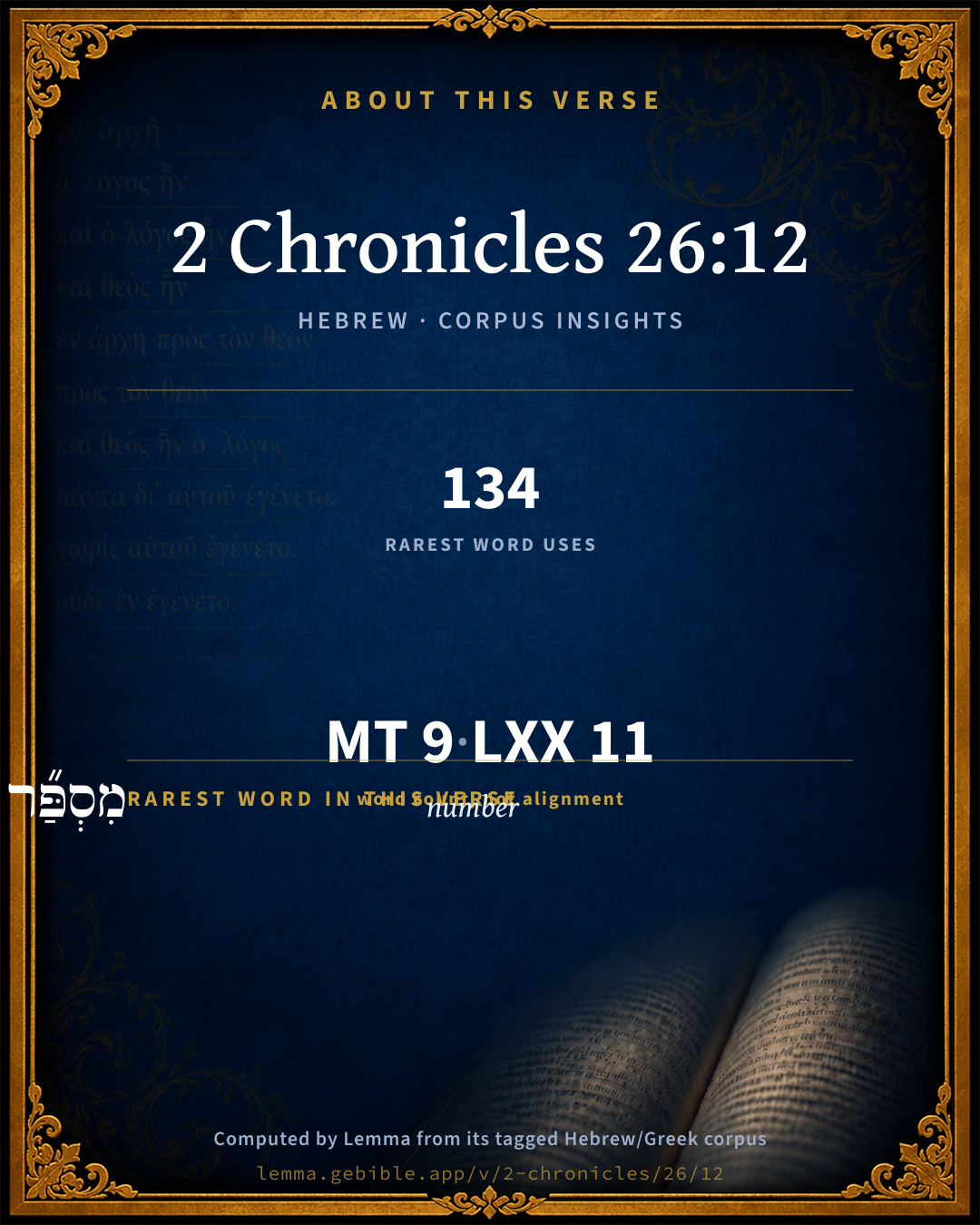
About this verse

These counts appear in no published source. They are computed here, from the morphology-tagged text and Lemma’s own curated glosses. What Lemma adds →

9
words
9
distinct lemmas
Historical
section

Grammatical profile

  • 5 nouns
  • 4 adjectives

Hebrew & Septuagint length

In English translation the verse runs 21 words from the Hebrew and 19 from the Septuagint (LXX English) — closely comparable.

A rough comparison of the two English renderings, which tokenize alike — not a word-level alignment.

Word counts can differ between the Hebrew and the Greek without any difference in meaning — e.g. the Hebrew direct-object marker אֵת has no separate Greek word, and Greek often adds the article ὁ.

In the original languages it is 9 Hebrew tokens and 11 Greek tokens — but the two are counted differently (Hebrew bundles its prefixes and suffixes into one token; the Greek is in lemma form), so that isn’t a like-for-like length.

Hebrew and Greek witnesses Masoretic Hebrew ↔ Greek Septuagint

The same verse in the two great witnesses to the Old Testament, shown verse-for-verse.

These are two independent witnesses, not word-aligned to each other, and the Septuagint is shown in lemma (dictionary) form.

Hebrew 2 Chronicles 26:12 Masoretic · Westminster Leningrad Codex

כֹּ֠ל מִסְפַּ֞ר רָאשֵׁ֤י הָאָבוֹת֙ לְגִבּ֣וֹרֵי חָ֔יִל אַלְפַּ֖יִם וְשֵׁ֥שׁ מֵאֽוֹת

The whole number of the heads of fathers' [houses], even the mighty men of valor, was two thousand and six hundred.

World English Bible · Public Domain

Greek LXX 2 Chronicles 26:12 Septuagint · lemma form

πᾶς ὁ ἀριθμός ὁ πατριάρχης ὁ δυνατός εἰς πόλεμος δισχίλιοι ἑξακόσιοι

The whole number of the chiefs of families of the mighty men of war was two thousand six hundred;

LXX2012 (modern English Septuagint) · Public Domain

Hebrew: Westminster Leningrad Codex (CC BY 4.0). Greek: Septuagint (public domain); English from LXX2012 (modern English Septuagint) (Public Domain). How the Septuagint differs from the Hebrew →

Commentary

Notes on 2 Chronicles 26:12 from classic Christian and Jewish commentators (each source and its license shown beneath its notes). The classic Christian expositions comment on the surrounding passage and are grouped to its opening verse, so a note may address several verses; the Jewish commentaries on the Tanakh (Rashi and others) are per-verse, so they appear only where the commentator wrote on this verse.

Lemma curates 59 commentaries, every one of them public domain or Creative Commons licensed, each selected and text-cleaned for this edition rather than reprinted as found. About our sources →

Trapp's Complete Commentary

John Trapp

2Ch 26:12 The whole number of the chief of the fathers of the mighty men of valour [were] two thousand and six hundred.

Ver. 12. Were two thousand and six hundred.] All these were commanders. What a huge host then had he! for we may not think that here - as was said of Alcibiades’s army - they were all leaders, no learners.

John Trapp, A Commentary or Exposition upon All the Books of the Old and New Testament (1647–1656) — public domain. Text from a community e-Sword module.

Geneva Bible (1599)

Geneva Bible translators

Of the chief officers of the king’s house, or of the captains and sergeants for war.

Geneva Bible (1599) marginal notes — public domain. Text via Bolls.life.

Ellicott's Commentary for English Readers

(12) Chief of the fathers.—Heads of the families, or father-houses.

Of the mighty men of valour.—To wit, the mighty men of valour, in apposition with heads of the families. The army was marshalled, as of old, according to clans, or houses, the heads of which are here distinguished as “valiant heroes.”

A Bible Commentary for English Readers, edited by Charles John Ellicott (1878–1897) — public domain. Text from a community e-Sword module.

The Cambridge Bible for Schools and Colleges

gen. ed. J. J. S. Perowne

12. the chief of the fathers of the mighty men] R.V. the heads of fathers’ houses, even the mighty men.

were two thousand] R.V. was two thousand.

The Cambridge Bible for Schools and Colleges (gen. ed. J. J. S. Perowne; Cambridge University Press, 1878–1918) — public domain. Text from a community e-Sword module.

John Gill's Exposition

And Uzziah prepared for them throughout all the host,.... For every soldier in the army:

shields and spears; defensive and offensive weapons, the one to cover and protect their bodies, the other to push and pierce their enemies:

and helmets, and habergeons; the first of these were a covering for the head in the day of battle, and the other coats of mail, to defend the body:

and bows; to shoot arrows out of:

and slings to cast stones; at which the Benjaminites formerly were very expert.

John Gill's Exposition of the Whole Bible (1746–1763) — public domain (CC PDM 1.0). Text via the HelloAO Bible API.

The Pulpit Commentary

Of the mighty men of valour. The "of" here is incorrect; the former sub-stautive is not necessarily in construct state, and this word has the prefix of the preposition l; nor is the rendering "valour" for our Hebrew text lyij so likely a rendering as that found in the foregoing verse, "host." Render, The whole number of the chief of the fathers in the mighty men of the host was, etc. So in the next verse. "with mighty power" will be better rendered "with the strength of a host. "

The Pulpit Commentary (1880–1919), ed. H.D.M. Spence-Jones & Joseph S. Exell — public domain. Text from a community e-Sword module.

Lesson kit

Teaching starters — assembled from the data on this page, not authored interpretation. Every prompt links to the verse data it draws on. Edit before teaching.

2 Chronicles, in the Historical, opens this verse with 9 words (9 distinct Hebrew lemmas). Its most distinctive word is miçpâr (“number”). A historical commentator’s framing appears above. Read the whole chapter for the surrounding context.

Discussion questions

  1. How does “number” (miçpâr) shape what this verse is saying?
  2. The translations on this page render this verse differently — a whole-verse word diff, not a word-by-word alignment. What might account for the different wordings?
  3. Compare how Trapp's Complete Commentary and Geneva Bible (1599) read this verse. Where do they agree or differ?

Things to notice

Reading settings

Reading text

Shown beneath each verse's original-language words.

Old Testament
Old Testament edition

Read the OT as the Masoretic Hebrew (MT) or the Greek Septuagint (LXX).

English shown for the Greek Septuagint (in the Hebrew ↔ Greek comparison).

Comparing translations? Open the Compare panel on any verse page to stack up to four side by side.