
Isaiah 60:5

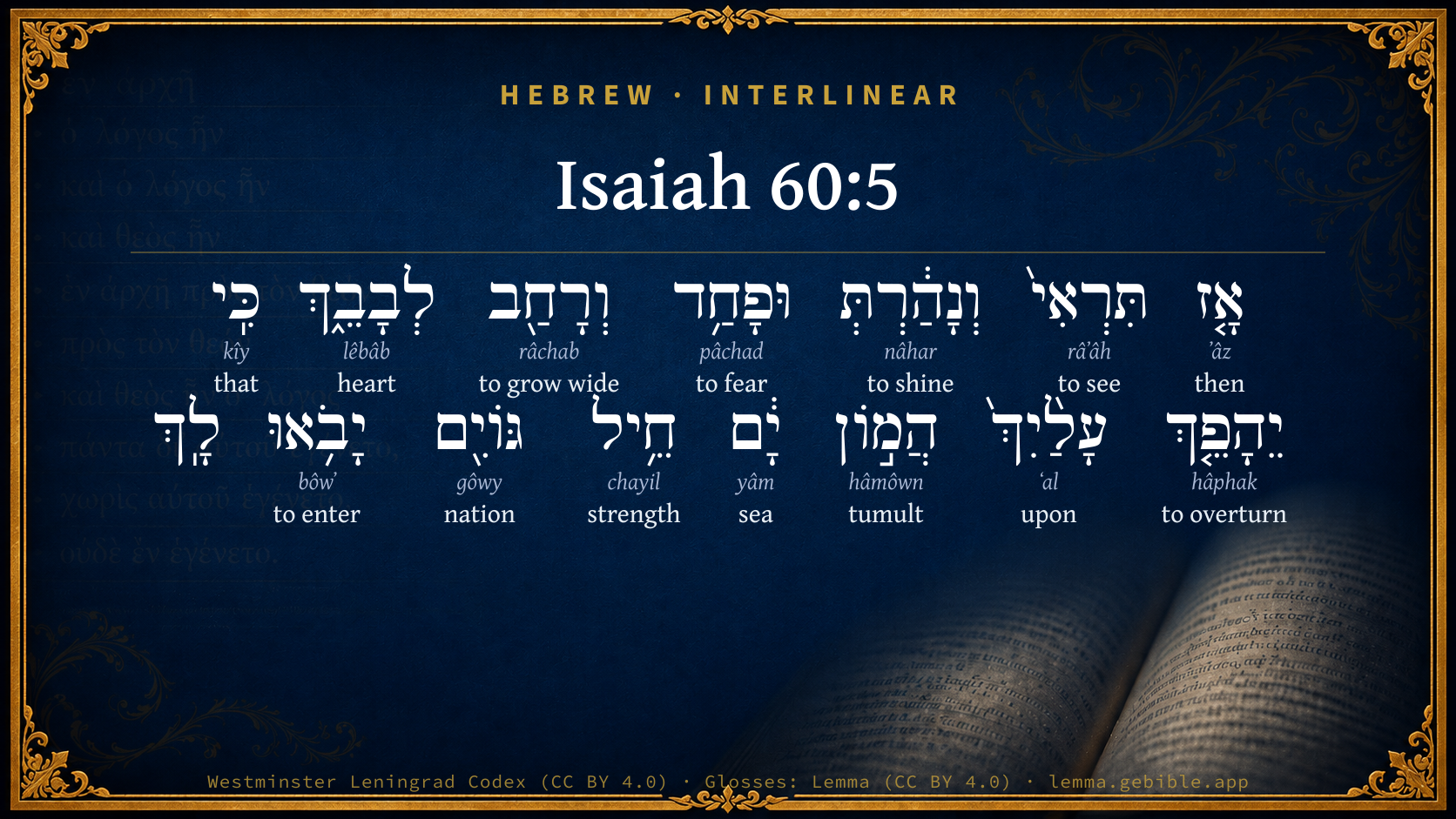
Hebrew (Westminster Leningrad Codex) Isaiah 60:5 appears in the Hebrew Old Testament. The text above is from the Westminster Leningrad Codex. Each word links to its Strong’s number, a concise gloss, and parsing drawn from the Open Scriptures Hebrew Bible morphology. Click any word for its full Brown-Driver-Briggs (BDB) entry.
Download image
Cite this verse

Isaiah 60:5 (World English Bible). Public Domain. Lemma interlinear Bible study tool, https://lemma.gebible.app/v/isaiah/60/5.

Show BibTeX & RIS
BibTeX
RIS
English Translation
Then you shall see and be radiant, and your heart shall thrill and be enlarged; because the abundance of the sea shall be turned to you, the wealth of the nations shall come to you.
World English Bible · Public Domain
Download a study sheet

One document with this verse’s original text, its word-by-word gloss line, the meaning frame, cross-references with their text, attributed commentary, and full source and license credits — printable, and it pastes into notes with its structure intact.

This verse Autodidact and up

Study sheet (.html) Plain text (.txt)

A passage Seminary Student

Up to 50 verses in one chapter. A passage sheet keeps up to 6 commentary sources and 12 cross-references per verse, in the order this page ranks them, and says so on the sheet whenever that leaves anything out. Ask for a single verse and you get the Autodidact verse sheet above.

Everything on this page stays free to read, with no account — the sheet is a download of what is already on screen, not access to it.

Want to remove ads? Support Godless Engineer
Compare translations 3

The same verse in 3 English versions, stacked beneath the original-language interlinear above. Click any original word for its lexicon entry.

Each is an independent rendering of the whole verse — the interlinear is not word-aligned to these translations.

Highlighted words mark where these versions differ — a whole-verse word diff, not a word-by-word alignment.

  • World English Bible Public Domain
    Then you shall see and be radiant, and your heart shall thrill and be enlarged; because the abundance of the sea shall be turned to you, the wealth of the nations shall come to you.
  • King James Version Public Domain
    Then thou shalt see, and flow together, and thine heart shall fear, and be enlarged; because the abundance of the sea shall be converted unto thee, the forces of the Gentiles shall come unto thee.
  • unfoldingWord Literal Text CC BY-SA 4.0
    Then you will see and be radiant, and your heart will fear and broaden, for the abundance of the sea will be turned to you; the wealth of the nations will come to you.

unfoldingWord Literal Text — © unfoldingWord, licensed CC BY-SA 4.0. Word-aligned USFM3 via Door43 (git.door43.org/unfoldingWord/en_ult).

Versions to compare (up to 4)

3 of 4 selected

Show all 18 translations

Every available English version of this verse, each an independent rendering of the whole verse.

  • World English Bible Public Domain
    Then you shall see and be radiant, and your heart shall thrill and be enlarged; because the abundance of the sea shall be turned to you, the wealth of the nations shall come to you.
  • Berean Standard Bible Public Domain
    Then you will look and be radiant, and your heart will tremble and swell with joy, because the riches of the sea will be brought to you, and the wealth of the nations will come to you.
  • Majority Standard Bible Public Domain
    Then you will look and be radiant, and your heart will tremble and swell with joy, because the riches of the sea will be brought to you, and the wealth of the nations will come to you.
  • King James Version Public Domain
    Then thou shalt see, and flow together, and thine heart shall fear, and be enlarged; because the abundance of the sea shall be converted unto thee, the forces of the Gentiles shall come unto thee.
  • American Standard Version (1901) Public Domain
    Then thou shalt see and be radiant, and thy heart shall thrill and be enlarged; because the abundance of the sea shall be turned unto thee, the wealth of the nations shall come unto thee.
  • Revised Version (1885) Public Domain
    Then thou shalt see and be lightened, and thine heart shall tremble and be enlarged; because the abundance of the sea shall be turned unto thee, the wealth of the nations shall come unto thee.
  • Geneva Bible (1599) Public Domain
    Then thou shalt see and shine: thine heart shall be astonied and enlarged, because the multitude of the sea shalbe conuerted vnto thee, and the riches of the Gentiles shall come vnto thee.
  • Douay-Rheims (1899) Public Domain
    Then shalt thou see, and abound, and thy heart shall wonder and be enlarged, when the multitude of the sea shall be converted to thee, the. strength of the Gentiles shall come to thee.
  • Young's Literal Translation Public Domain
    Then thou seest, and hast become bright, And thine heart hath been afraid and enlarged, For turn unto thee doth the multitude of the sea, The forces of nations do come to thee.
  • Literal Standard Version CC BY-SA 4.0
    Then you see, and have become bright, || And your heart has been afraid and enlarged, || For the multitude of the sea turn to you, || The forces of nations come to you.
  • Unlocked Literal Bible CC BY-SA 4.0
    Then you will look and be radiant, and your heart shall rejoice and overflow, because the abundance of the sea will be poured out to you, the wealth of the nations will come to you.
  • unfoldingWord Literal Text CC BY-SA 4.0
    Then you will see and be radiant, and your heart will fear and broaden, for the abundance of the sea will be turned to you; the wealth of the nations will come to you.
  • Darby Bible Public Domain
    Then thou shalt see, and shalt be brightened, and thy heart shall throb, and be enlarged; for the abundance of the sea shall be turned unto thee, the wealth of the nations shall come unto thee.
  • World Messianic Bible Public Domain
    Then you shall see and be radiant, and your heart will thrill and be enlarged; because the abundance of the sea will be turned to you. The wealth of the nations will come to you.
  • Webster's Bible Public Domain
    Then thou shalt see, and flow together, and thy heart shall fear, and be enlarged; because the abundance of the sea shall be converted to thee, the forces of the Gentiles shall come to thee.
  • Free Bible Version CC BY-SA 4.0
    Then you will see and shine brilliantly, your heart will beat wildly for joy, for the riches that cross the sea, the wealth of the nations, will be brought to you.
  • Bible in Basic English Public Domain
    Then you will see, and be bright with joy, and your heart will be shaking with increase of delight: for the produce of the sea will be turned to you, the wealth of the nations will come to you.
  • JPS Tanakh (1917) Public Domain
    Then thou shalt see and be radiant, and thy heart shall throb and be enlarged; because the abundance of the sea shall be turned unto thee, the wealth of the nations shall come unto thee.

Literal Standard Version (2020), Covenant Press — licensed CC BY-SA 4.0. Text via the HelloAO Bible API (eBible.org). Unlocked Literal Bible (unfoldingWord) — licensed CC BY-SA 4.0. Text via the HelloAO Bible API (eBible.org). unfoldingWord Literal Text — © unfoldingWord, licensed CC BY-SA 4.0. Word-aligned USFM3 via Door43 (git.door43.org/unfoldingWord/en_ult). Free Bible Version, Dr. Jonathan Gallagher — licensed CC BY-SA 4.0. Text via the HelloAO Bible API (eBible.org).

Word by word

More ways to search: Search by grammar → Find every occurrence → Compare this word →

Practice this passage: Drill this verse → Learn its vocabulary →

וְנָהַ֔רְתְּ
nâhar
H5102
“and · to shine”
Conjunction + Verb, Qal, Sequential Perfect, 2nd Person, Feminine, Singular
Part of Speech
Conjunction + Verb
Stem
Qal
Form
Sequential Perfect
Person
2nd Person
Gender
Feminine
Number
Singular
Full BDB Definition

Origin: a primitive root

TWOT: 1316 , 1315

to shine, beam, light, burn - (Qal) to beam, be radiant - to flow, stream - (Qal) to flow, stream
  1. אָ֤ז ʼâz H227 “then” Adverb
  2. תִּרְאִי֙ râʼâh H7200 “to see” Verb, Qal, Imperfect, 2nd Person, Feminine, Singular
  3. וּפָחַ֥ד pâchad H6342 “and · to fear” Conjunction + Verb, Qal, Sequential Perfect, 3rd Person, Masculine, Singular
  4. וְרָחַ֖ב râchab H7337 “and · to grow wide” Conjunction + Verb, Qal, Sequential Perfect, 3rd Person, Masculine, Singular
  5. לְבָבֵ֑ךְ lêbâb H3824 “heart · her” Noun, Common, Masculine, Singular, Construct + Suffix, Personal, 3rd Person, Feminine, Singular
  6. כִּֽי kîy H3588 “that” Conjunction
  7. יֵהָפֵ֤ךְ hâphak H2015 “to overturn” Verb, Niphal, Imperfect, 3rd Person, Masculine, Singular
  8. עָלַ֨יִךְ֙ ʻal H5921 “upon · you” Preposition + Suffix, Personal, 2nd Person, Feminine, Singular
  9. הֲמ֣וֹן hâmôwn H1995 “tumult of” Noun, Common, Masculine, Singular, Construct
  10. יָ֔ם yâm H3220 “sea” Noun, Common, Masculine, Singular, Absolute
  11. חֵ֥יל chayil H2428 “strength of” Noun, Common, Masculine, Singular, Construct
  12. גּוֹיִ֖ם gôwy H1471 “nations” Noun, Common, Masculine, Plural, Absolute
  13. יָבֹ֥אוּ bôwʼ H935 “to enter” Verb, Qal, Imperfect, 3rd Person, Masculine, Plural

About this verse

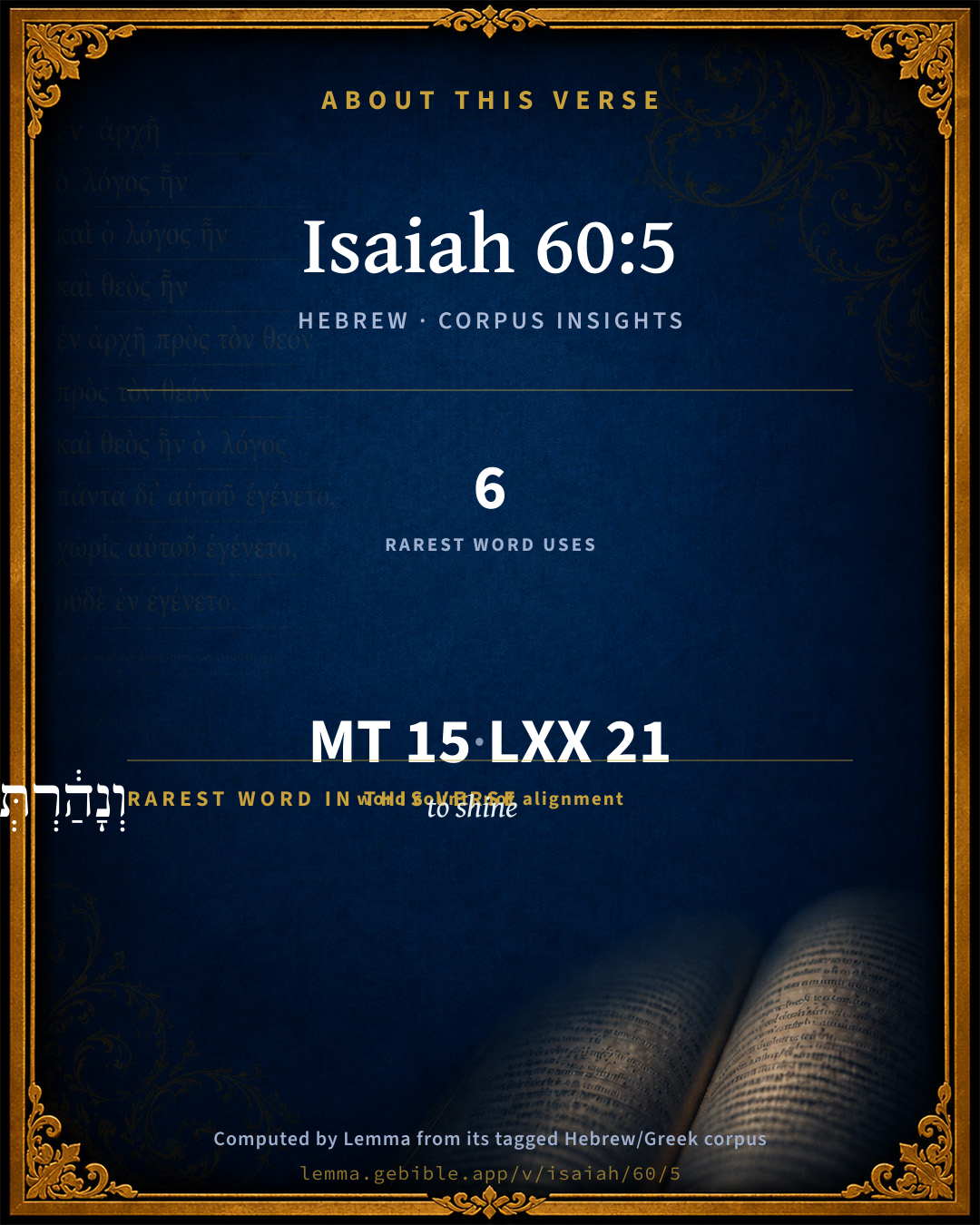
These counts appear in no published source. They are computed here, from the morphology-tagged text and Lemma’s own curated glosses. What Lemma adds →

15
words
14
distinct lemmas
Prophets
section

Notable vocabulary

The rarest word here is וְנָהַ֔רְתְּ to shine H5102 — appearing just 6 times in the whole Hebrew Bible.

Shared distinctive vocabulary

וְנָהַ֔רְתְּ to shine H5102 occurs in 6 verses of the Hebrew Bible. Also found in:

Grammatical profile

  • 6 verbs
  • 5 nouns
  • 2 prepositions
  • 1 conjunction
  • 1 adverb

Verb forms

  • תִּרְאִי֙ Qal · Imperfect
  • וְנָהַ֔רְתְּ Qal · Sequential Perfect
  • וּפָחַ֥ד Qal · Sequential Perfect
  • וְרָחַ֖ב Qal · Sequential Perfect
  • יֵהָפֵ֤ךְ Niphal · Imperfect
  • יָבֹ֥אוּ Qal · Imperfect

Hebrew & Septuagint length

In English translation the verse runs 35 words from the Hebrew and 36 from the Septuagint (LXX English) — closely comparable.

A rough comparison of the two English renderings, which tokenize alike — not a word-level alignment.

Word counts can differ between the Hebrew and the Greek without any difference in meaning — e.g. the Hebrew direct-object marker אֵת has no separate Greek word, and Greek often adds the article ὁ.

In the original languages it is 15 Hebrew tokens and 21 Greek tokens — but the two are counted differently (Hebrew bundles its prefixes and suffixes into one token; the Greek is in lemma form), so that isn’t a like-for-like length.

Cross-references

20

Topical passages linked to Isaiah 60:5 in the Treasury of Scripture Knowledge — connected by theme and wording, ordered by reader-vote popularity; previews shown in the World English Bible.

  • Isaiah 61:6 But you shall be named the priests of Yahweh; men shall call you the ministers of our God: you shall eat the wealth of the nations, and in their glory shall you boast yourselves.
  • Isaiah 23:18 Her merchandise and her hire shall be holiness to Yahweh: it shall not be treasured nor laid up; for her merchandise shall be for those who dwell before Yahweh, to eat sufficiently, and for durable clothing.
  • 1 Samuel 2:1 Hannah prayed, and said: My heart exults in Yahweh; My horn is exalted in Yahweh; My mouth is enlarged over my enemies; Because I rejoice in your salvation.
  • Psalms 34:5 They looked to him, and were radiant. Their faces shall never be covered with shame.
  • Psalms 96:7–9 Ascribe to Yahweh, you families of nations, Ascribe to Yahweh glory and strength.
  • Psalms 98:7–9 Let the sea roar with its fullness; The world, and those who dwell therein.
  • Isaiah 24:14–15 These shall lift up their voice, they shall shout; for the majesty of Yahweh they cry aloud from the sea.
  • Isaiah 54:2 Enlarge the place of your tent, and let them stretch forth the curtains of your habitations; don't spare: lengthen your cords, and strengthen your stakes.
  • Isaiah 60:11 Your gates also shall be open continually; they shall not be shut day nor night; that men may bring to you the wealth of the nations, and their kings led captive.
  • Jeremiah 33:9 [This city] shall be to me for a name of joy, for a praise and for a glory, before all the nations of the earth, which shall hear all the good that I do to them, and shall fear and tremble for all the good and for all the peace that I procure to it.
  • Hosea 1:10–11 Yet the number of the children of Israel will be as the sand of the sea, which can't be measured nor numbered; and it will come to pass that, in the place where it was said to them, 'You are not my people,' they will be called 'sons of the living God.'
  • Hosea 3:5 Afterward the children of Israel shall return, and seek Yahweh their God, and David their king, and shall come with trembling to Yahweh and to his blessings in the last days.
  • Acts 10:45 They of the circumcision who believed were amazed, as many as came with Peter, because the gift of the Holy Spirit was also poured out on the Gentiles.
  • Acts 11:17 If then God gave to them the same gift as us, when we believed in the Lord Jesus Christ, who was I, that I could withstand God?"
  • Acts 24:17 Now after some years, I came to bring gifts for the needy to my nation, and offerings;
  • Romans 11:25 For I don't desire, brothers, to have you ignorant of this mystery, so that you won't be wise in your own conceits, that a partial hardening has happened to Israel, until the fullness of the Gentiles has come in,
  • Romans 15:26 For it has been the good pleasure of Macedonia and Achaia to make a certain contribution for the poor among the saints who are at Jerusalem.
  • 2 Corinthians 6:1–13 Working together, we entreat also that you not receive the grace of God in vain,
  • 2 Corinthians 10:15 not boasting beyond proper limits in other men's labors, but having hope that as your faith grows, we will be abundantly enlarged by you in our sphere of influence,
  • Revelation 21:26 and they shall bring the glory and the honor of the nations into it so that they may enter.

Cross-references courtesy of OpenBible.info (CC BY 4.0).

Hebrew and Greek witnesses Masoretic Hebrew ↔ Greek Septuagint

The same verse in the two great witnesses to the Old Testament, shown verse-for-verse.

These are two independent witnesses, not word-aligned to each other, and the Septuagint is shown in lemma (dictionary) form.

Hebrew Isaiah 60:5 Masoretic · Westminster Leningrad Codex

אָ֤ז תִּרְאִי֙ וְנָהַ֔רְתְּ וּפָחַ֥ד וְרָחַ֖ב לְבָבֵ֑ךְ כִּֽי יֵהָפֵ֤ךְ עָלַ֨יִךְ֙ הֲמ֣וֹן יָ֔ם חֵ֥יל גּוֹיִ֖ם יָבֹ֥אוּ לָֽךְ

Then you shall see and be radiant, and your heart shall thrill and be enlarged; because the abundance of the sea shall be turned to you, the wealth of the nations shall come to you.

World English Bible · Public Domain

Greek LXX Isaiah 60:5 Septuagint · lemma form

τότε ὁράω καί φοβέω καί ἐκἵστημι ὁ καρδία ὅτι μεταβάλλω εἰς σύ πλοῦτος θάλασσα καί ἔθνος καί λαός καί ἥκω σύ

Then shall you see, and fear, and be amazed in your heart; for the wealth of the sea shall come round to you, and of nations and peoples; and herds of camels shall come to you,

LXX2012 (modern English Septuagint) · Public Domain

On this verse, Albert Barnes' Notes on the Bible discusses the Septuagint’s reading. Read the note in Commentary ↓

Hebrew: Westminster Leningrad Codex (CC BY 4.0). Greek: Septuagint (public domain); English from LXX2012 (modern English Septuagint) (Public Domain). How the Septuagint differs from the Hebrew →

Targum (Aramaic paraphrase)

1

The Targum is the ancient Jewish Aramaic paraphrase of the Hebrew Scriptures — an interpretive translation, not the Hebrew text itself. Onkelos (literal) and Pseudo-Jonathan (expansive) render the Torah, and Jonathan the Prophets. Coverage is partial: where no permissively-licensed English translation exists for a verse, only the Aramaic is shown. This is verse-level text, not a word-by-word alignment to the Hebrew.

  1. Targum Jonathan Prophets (Joshua–Malachi)
    בְּכֵן תֶּחֱזִין וּתְנַהֲרִין וְתִדְחֵלִין וְיִפְתִּי לִבִּיךְ בְּדַחֲלַת חֶטְאִין אֲרֵי יִתְחֲלֵיף לִיךְ עוֹתַר מַעַרְבָא נִכְסֵי פַּלְחֵי כּוֹכְבַיָא יִתְעֲלוּן לְגַוִיךְ:

    Then thou shalt see and be enlightened, and thou shalt be struck with awe, and thine heart shall be enlarged on account of the terror of sinners, for the riches of the west shall be transferred unto thee; the treasures of the nations shall be brought unto thee.

    Targum Jonathan — Aramaic: “Mikraot Gedolot” (public domain). English: “Sefaria Community Translation” (CC0 1.0 (public-domain dedication)); “London "Chaldee Paraphrase," 1871” (public domain). Text via Sefaria.

Commentary

Notes on Isaiah 60:5 from classic Christian and Jewish commentators (each source and its license shown beneath its notes). The classic Christian expositions comment on the surrounding passage and are grouped to its opening verse, so a note may address several verses; the Jewish commentaries on the Tanakh (Rashi and others) are per-verse, so they appear only where the commentator wrote on this verse.

Lemma curates 59 commentaries, every one of them public domain or Creative Commons licensed, each selected and text-cleaned for this edition rather than reprinted as found. About our sources →

Trapp's Complete Commentary

John Trapp

Isa 60:5 Then thou shalt see, and flow together, and thine heart shall fear, and be enlarged; because the abundance of the sea shall be converted unto thee, the forces of the Gentiles shall come unto thee.

Ver. 5. Then thou shalt see and flow together.] Or, Thou shalt break forth as a river; or, Thou shalt shine. {a}

And thy heart shall fear.] At first, at least, to see such a confluence of people unto thee.

And be enlarged.] With joy, upon better consideration.

Because the abundance of the sea,] i.e., The multitude of the islanders, and such as dwell by the sea side, which are noted for the worst of men, whence the proverb, Maritimi mores. Such are we Britons.

{a} נהר tam de lumine quam de flumine dicitur.

John Trapp, A Commentary or Exposition upon All the Books of the Old and New Testament (1647–1656) — public domain. Text from a community e-Sword module.

The Biblical Illustrator

Joseph S. Exell

Isa_60:5-8

Then thou shalt see

The glory of the millennial Church

Wealth, Commerce and Agriculture are three great interests and powers on earthen trinity of forces which have in all ages engrossed mankind.

Each one of the three will have its representatives in that vast multitude who are to ask the way to Zion with their faces thitherward. (J. R. Macduff, D. D.)

The enlargement of the Church

We are likewise told how the Church shall be affected with this increase of her numbers and enlargement of her borders.

1. She will be in a transport of joy upon this account (Isa_60:5).

2. There will be a mixture of fear with this joy. Thine heart shall fear, as though it were a thing unlawful to join with the Gentiles, etc.

3. She shall be enlarged with Love, so as to leave room for all the Gentile converts.

4. She shall be struck with surprise and wonder, saying, Who are these that fly? etc. (E. Erskine.)

The Biblical Illustrator, edited by Joseph S. Exell (c. 1880s–1900s) — public domain. Text from a community e-Sword module.

Tyndale Open Study Notes

Tyndale Open Resources

60:5-7 Zion’s losses from warfare will be restored by the wealth of many lands; foreign nations will be eager to make a contribution (60:11; 61:6; 66:12; see Rev 21:26).

Tyndale Open Study Notes — © Tyndale Open Resources, licensed CC BY-SA 4.0. Text via the HelloAO Bible API.

Geneva Bible (1599)

Geneva Bible translators

For joy, as the heart is drawn in for sorrow.

Geneva Bible (1599) marginal notes — public domain. Text via Bolls.life.

Jamieson, Fausset & Brown

Robert Jamieson, A. R. Fausset & David Brown

see-- (Isa 60:4), namely, the bringing back of thy sons.

flow together--rather, "overflow with joy" [LOWTH]; or, from a different Hebrew root, "be bright with joy" [GESENIUS] (Job 3:4).

fear--rather, beat with the agitation of solemn joy at the marvellous sight [HORSLEY] (Jer 33:9).

be enlarged--swell with delight. Grief, on the contrary, contracts the heart.

abundance of . . . sea--the wealth of the lands beyond the sea, as in Solomon's time, the type of the coming reign of the Prince of peace.

converted--rather, "be turned," instead of being turned to purposes of sin and idolatry.

forces--rather, "riches."

Jamieson, Fausset & Brown — Commentary Critical and Explanatory on the Whole Bible (1871) — public domain (CC PDM 1.0). Text via the HelloAO Bible API.

Adam Clarke's Commentary

Verse 5. Then thou shalt see - "Then shalt thou fear"] For תראי tirai, thou shalt see, as ours and much the greater number of the translators, ancient and modern, render it, forty MSS. (ten ancient) of Kennicott's, and twenty-eight of De Rossi's, with one ancient of my own, and the old edition of 1488, have תיראי tirai, thou shalt fear: the true reading, confirmed by the perfect parallelism of the sentences: the heart ruffled and dilated in the second line answering to the fear and joy expressed in the first. The Prophet Jeremiah, Jer 33:9, has the same natural and elegant sentiment: -

"And this city shall become to me a name of joy;

A praise and an honour for all the nations of the earth;

Which shall hear all the good that I do unto them:

And they shall fear, and they shall tremble, at all the

goodness

And at all the prosperity that I procure unto her."

And David: -

"I will praise thee, for I am fearfully and wonderfully made."

Ps 139:14.

His tibi me rebus quaedam divina voluptas

Percipit atque horror.

LUCRET. iii. 28.

Recenti mens trepidat metu,

Plenoque Bacchi pectore turbidum

Laetatur.

HOR. Carm. ii. 19. l. 5. - L.

Adam Clarke's Commentary on the Bible (1810–1826) — public domain. Text from a community e-Sword/MySword module.

Ellicott's Commentary for English Readers

(5) Then thou shalt see.—A various reading adopted by many commentators gives thou shalt Jear.

Thine heart shall fear . . .—Literally, shall throb, as with an awe-stricken joy at the marvellous prosperity, but that throb of awe is followed by the expansion of ecstatic joy.

The abundance of the sea—i.e., the riches of the Western isles, with which the new Jerusalem was to be filled, as Tyre and Zidon had been of old. (Eze_27:1-25).

A Bible Commentary for English Readers, edited by Charles John Ellicott (1878–1897) — public domain. Text from a community e-Sword module.

The Cambridge Bible for Schools and Colleges

gen. ed. J. J. S. Perowne

5. and flow together] See ch. Isa_2:2. But the right translation is that of R.V. and be lightened (cf. Psa_34:5). The two verbs are identical in form but belong to distinct roots.

thine heart shall fear] Lit., shall throb, obviously from joy, as in Jer_33:9. These are perhaps the only two instances where the word is so used. Usually it means to tremble from fear.

and be enlarged] Psa_119:32.

the abundance of the sea] “Abundance” is lit. “tumult”; it often means “multitude” (see ch. Isa_5:13 f., Isa_13:4, Isa_33:3), but in late usage it acquires the sense of “wealth” (Ecc_5:9; Psa_37:16). The wealth of the sea is not the produce of the sea, but seaborne wealth, the wealth of maritime nations.

shall be converted unto thee] shall be turned to thee (R.V.). The stream of commerce shall be diverted from its old channels and flow to Zion.

the forces of the Gentiles] the riches of nations. Cf. Hag_2:7 (R.V. “the desirable things of all nations”).

The Cambridge Bible for Schools and Colleges (gen. ed. J. J. S. Perowne; Cambridge University Press, 1878–1918) — public domain. Text from a community e-Sword module.

John Gill's Exposition

Then thou shalt see, and flow together,.... That is, when thou seest thy sons and daughters flocking to thee from all parts, there will be a flow of joy in thee, like the stream of a river; or thine heart will beat and flutter within thee, through surprise and joy, when thou seest such a numerous company gathered unto thee. Some render it, "then thou shall fear", as Aben Ezra (u), or be surprised at the sight; and others the next clause, "thou shall be enlightened" (w); that is, shall see, being enlightened, and shall increase in light and knowledge more and more; or "shine" (x), in great splendour and glory:

and thine heart shall fear, and be enlarged; shall fear the Lord and his goodness, and be enlarged with love to him, his truths and ordinances, and his people; and particularly shall be enlarged to receive in the most cordial manner those that flock unto her:

because the abundance of the Sea shall be converted unto thee: by which some understand the riches of the sea, that which is got out of it, or got upon it, in trading by it, this shall be converted to the use of the church and people of God; but rather an abundance of seafaring men is here meant, who shall be converted at this time, in which the grace of God will the more appear, as they are generally a very wicked and profligate set of men; or the inhabitants of the islands of the sea, such as Great Britain and others; or the sea may intend the several nations of the world, as waters do many people, nations, and kindreds, Rev 17:15 and so it may denote a large abundance of converted persons everywhere, and more especially in the western parts of the world, in the European parts; since it is very common in Scripture to describe the western part of the world by the sea, the Mediterranean sea lying west of Judea.

The forces of the Gentiles shall come unto thee; or their armies, every army of them; the soldiery will be converted, as well as the seafaring men, who are for the most part also exceeding wicked; not only kings will become real Christians, but their armies will be so too, their generals, officers, and common soldiers; and when this is once the case, woe to the whore of Rome! these will hate her, and burn her flesh with fire; these are the seven angels that shall come out of the temple, the church of God, to whom they have joined themselves, with the vials of God's wrath, and shall pour them upon the antichristian states; see Rev 15:7.

(u) "Tum timebis", Vitringa. (w) "iiluminaberis", Vatablus. (x) "Splendebis", Munster, Montanus, Calvin; "et lucebis", Cocceius, So Ben Melech interprets the word.

John Gill's Exposition of the Whole Bible (1746–1763) — public domain (CC PDM 1.0). Text via the HelloAO Bible API.

Albert Barnes' Notes on the Bible

Then shalt thou see - Lowth renders this, ‘Then shalt thou fear and overflow with joy;’ and supposes that it refers to the agitation and anxiety of mind attending the scene, and to the joy consequent on the numerous conversions. His authority for this change is, that forty manuscripts (two of them ancient) have תיראי, ‘thou shalt fear,’ instead of תראי tı̂re'ı̂y, ‘thou shalt see.’ But though the change is of a single letter, there is not sufficient authority to make it, nor does the sense require it. The Vulgate, Septuagint, Chaldee, Syiac, Arabic, and Castellio, all render it in accordance with the present reading of the Hebrew text. The idea is, that Jerusalem would look with deep interest on the great multitude that would be converted to her, and that the effect would be to cause the heart to overflow with joy.

And flow together - This translation, it is believed, by no means conveys the true sense of the passage. Indeed, it is difficult to make sense of the translation. It is true that the Hebrew word נהר nâhar, means “to flow, to flow together”; whence the word נהר nâhâr, ‘river.’ But it may be used in the sense of flowing, or overflowing with joy; or it may seem to shine, to be bright, the same as נוּר nûr (Gesenius); and thence to be cheered, to rejoice, as when the countenance is bright and cheerful (compare Job 3:4). Taylor (Hebrew Concordance) renders it, ‘And be enlightened, or have the light flow upon thee.’ The true idea is, doubtless, that of rejoicing; denoting the happiness which will always exist in the church when many are seen to come and give themselves to God.

And thine heart shall fear - The heart shall be ruffled, agitated, deeply excited by the view of the numbers that are converted, and by the evidence thus furnished of the divine favor and presence. The effect of numerous simultaneous conversions in a revival of religion, is always to produce awe and reverence. There is a conviction that God is near, and that this is his work; and a deep veneration produced by the demonstrations of his power which does not exist in other circumstances. This effect is described also by Jeremiah, Jer 33:9 : ‘And they shall fear and tremble for all the goodness and for all the prosperity that I shall procure unto her’ (Jerusalem).

And be enlarged - Shall be swelled or filled with joy.

Because the abundance of the sea - Margin, ‘Noise of the sea shall be turned unto thee.’ Lowth and Noyes render it, ‘The riches of the sea.’ So the Septuagint, Πλοῦτος θαλάσσης Ploutos thalassēs. The Chaldee renders it, ‘There shall be transferred to thee the wealth of the west’ (מערבא עיתר ‛ôtar ma‛arebâ'). The Hebrew word המון hămôn properly denotes a noise or sound; as of rain, of the raging of the ocean, or of a multitude of people. Then it denotes a multitude or crowd of people itself Isa 13:4; Isa 33:3; Dan 10:6; a host or army Jdg 4:7; Dan 11:11-13; a multitude of waters Jer 10:13; Jer 51:16. It then denotes a multitude of possessions; a vast amount of wealth Psa 37:16; Ecc 5:9. Here it may refer either to the multitude of the people that dwelt on the islands of the sea, or to their wealth that would be brought and devoted to Zion. As various kinds of property are immediately specified, it seems most natural to refer it to that; and then the idea is, that the wealth possessed by lands beyond the sea, or surrounded by the sea, would be devoted to the church of God. It will be remembered, that nearly all the wealth that was imported by Solomon and others to Judea came from beyond sea, and that it was natural to speak of such places as abounding in riches. The idea is, that the wealth of all those distant lands would be consecrated to the church - an idea denoting its great prosperity and glory when all lands should come under the influence of the truth.

Shall be converted - Hebrew, ‘Shall be turned.’ Instead of being employed in idolatry and sin; in purposes of pleasure and mere magnificence, it shall be turned to a different purpose.

The forces of the Gentiles - Margin, ‘wealth.’ The margin has undoubtedly the correct interpretation. The word used here (חיל chayil, construct חיל chēyil), usually, indeed, denotes strength, might, valor; an army, forces, host; but it also means riches, wealth Gen 24:29; Deu 8:17-18; Rth 4:11; Job 20:15. The Septuagint renders the passage, ‘The riches of the sea, and of the nations, and of the people will come over to thee.’ The sense is, that the wealth of the pagan world would be consecrated to the service of the church. To some extent, this has been the case, No small part of the great wealth of the Roman empire was I devoted to the service of the Christian church; and the wealth of what was then Pagan Europe, and of what was then Pagan and unknown America, has been, to a considerable extent, devoted to the Redeemer. The time will come when the wealth of India, of China, of Africa, and of the entire world, shall be devoted to the service of God, in a manner far more decided than has yet occurred in the most favored Christian lands.

Albert Barnes' Notes on the Bible (1834–1885) — public domain. Text from a community e-Sword/MySword module.

Haydock's Catholic Bible Commentary

Wonder. Hebrew and Septuagint in St. Jerome, "fear." This sensation is often mixed with joy, Matthew xxviii. 8. --- Thee. No such nations joined the Jews, as they did the Church.

George Leo Haydock (1774–1849), Haydock's Catholic Family Bible and Commentary, 1859 edition — public domain. Excludes Psalms (Douay-Rheims chapter numbering differs from Protestant) and Deuterocanonical books (Catholic canon only).

Matthew Poole's English Annotations

Then shalt thou see, viz. with a great deal of delight, the multitudes of thy children running to thee.

Flow together; as when one river meeting with another and joining waters, run sweetly together, as one and the same river: this notes the abundance of their united joys and delights; or they shall flock together to behold such an amazing sight.

Thine heart shall fear; as standing amazed to see such multitudes come in to the Lord Christ; See Poole "Isa 44:1", See Poole "Isa 44:2", &c.; as it were surprised with it, as those Ac 2 7, or overwhelmed with the joyful sight, as Jacob was with the tidings of Joseph, Gen 45:26, and those of the circumcision that were with Act 10:45; such a mixture of fear and joy you have expressed Jer 33:9; the sense is much the same with Isa 49:18.

Be enlarged, both with joy and love; joy within at the coming in of the Gentiles, and this outwardly expressed in the enlargedness of love and charity towards them. Fear doth properly contract the heart, therefore this expression intimates it to be a fear mixed with such an affection as will dilate it.

The abundance of the sea; either the islands of the sea, viz. the nations, as before, a metonymy of the subject, shall turn to thee, in religion or affection; they that formerly so much hated thee (they that live by the sea-coasts being usually noted for the worst of men) shall now love thee: or the wealth and traffic of those that trade by sea, the riches of the merchant; and so possibly the prophet may allude to Psa 72:10, for Tarshish is sometimes taken for the sea, as hath been before showed: see on 1Ki 10:22.

Shall be converted unto thee; thy traders shall not so much convert their riches to their own use as to thine.

The forces; or, wealth; thou shalt not have only the wealth, but the strength of the nations, to stand by thee, which hath also an eye, as in the type, to that readiness and willingness that would be in the nations to help them out of Babylon.

Matthew Poole's English Annotations on the Holy Bible (1683–1685) — public domain. Text from a community e-Sword/MySword module.

Whedon's Commentary on the Bible

Daniel D. Whedon

5. Thou shalt see — Or, fear; it matters little which, in its ultimate meaning. (The Hebrew word is uncertain.) Both meanings may come in play — crowds so great coming into view may occasion surprise, yes, even fear. The heart of renewed Zion shall throb with wonder and joy at the sight of the abundance of western maritime nations converted to God; at the sight of the wealth and treasure pouring in for the Lord’s service.

Daniel D. Whedon (gen. ed.), Commentary on the Old and New Testaments (1874–1909) — public domain. Text from a community e-Sword module.

The Pulpit Commentary

Vers. 5-9. The second stanza. Zion"s wealth.

Thine heart shall fear; rather, shall throb; "beat with excitement." Because the abundance of the sea shall be converted unto thee; i.e. the maritime commerce, which has hitherto enriched other nations, shall be turned thy way and be at thy disposal. The forces of the Gentiles; rather, the riches of the Gentiles as in Isa_8:4 Isa_10:14 Isa_30:6 Isa_61:6. Details of the riches fellow in vers. 6-9.

The Pulpit Commentary (1880–1919), ed. H.D.M. Spence-Jones & Joseph S. Exell — public domain. Text from a community e-Sword module.

John Wesley's Explanatory Notes

See - With delight the multitudes of thy children running to thee. Flow - They shall flock together to behold such an amazing sight. Fear - Or stand amazed. Enlarged - Both with joy, and love. The abundance - The islands of the sea, the nations, shall turn to thee in religion, and affection. The forces - Or wealth.

John Wesley, Explanatory Notes Upon the Whole Bible (1754–1765) — public domain. Text via the GEBible commentary corpus.

Keil & Delitzsch

C. F. Keil & F. Delitzsch

When this takes place, Zion will be seized with the greatest delight, mingled with some trembling. "Then wilt thou see and shine, and thine heart will tremble and expand; for the abundance of the sea will be turned to thee, the wealth of the nations cometh to thee." It is a disputed question whether the proper reading is תּראי, תּראי, or תּיראי - all three point to יר) - or תּראי, from ראה. The last is favoured by the lxx, Targ., Syr., Jerome, Saad., and all the earlier Jewish commentators except AE, and is also the Masoretic reading; for the Masora finalis (f. 1, col. 6) observes that this רתאי is the only instance of such a form from ראה (differing therefore from תיראי in Zep 3:15, where we also find the readings תיראי and תראי); and there is a note in the margin of the Masora, חטף לית, to the effect that this תראי is the only one with chateph, i.e., Sheva. Moreover, תּראי (thou shalt see) is the more natural reading, according to Isa 66:14 and Zac 10:7; more especially as ירא is not a suitable word to use (like pâchad and râgaz in Jer 33:9) in the sense of trembling for joy (compare, on the contrary, ירע, Isa 15:4, and רהה in Isa 44:8). The true rendering therefore is, "Then wilt thou see and shine," i.e., when thou seest this thou wilt thine, thy face will light up with joy; nâhar as in Psa 34:6. Luther render it, "Then wilt thou see thy desire, and break out," viz., into shouting; Jerome, on the contrary, has, "Thou wilt overflow, i.e., thou wilt be inundated with waters coming suddenly like rivers."

The impression produced by this revolution is so overpowering, that Zion's heart trembles; yet at the same time it is so elevating, that the straitened heart expands (ורחב, a figure quite unknown to the classical languages, although they have angor and angustia; the lxx renders it καὶ ἐκστήση, after the reading ורהב in Chayug, and Isaac Nathan in his Concordance, entitled נתיב מיר): for hămōn yâm, i.e., everything of value that is possessed by islands and coast lands (hâmōm, groaning, a groaning multitude, more especially of possessions, Psa 37:16, etc.), is brought to her; and chēl gōyim, the property, i.e., (looking at the plural of the predicate which follows; cf., Hag 2:7) the riches (gold, silver, etc., Zac 14:14) of the heathen, are brought into her, that she may dispose of them to the glory of her God.

Keil & Delitzsch — Biblical Commentary on the Old Testament (1861–1891) — public domain (CC PDM 1.0). Text via the HelloAO Bible API. (Old Testament only.)

J. A. Alexander on Isaiah

Joseph Addison Alexander

“Then shalt thou see (or fear) and brighten up (or overflow), and thy heart shall throb and swell; because (or when) the abundance of the sea shall be turned upon thee, the strength of nations shall come unto thee.” This translation exhibits the points of agreement as well as of difference among interpreters in reference to this verse. All agree that it describes a great and joyful change to be produced by the accession of the Gentiles to the church or chosen people, and the effect of this enlargement on the latter. The form of the first verb is ambiguous. If rendered ‘fear’, it may denote the painful sensation which often attends sudden joy, and which is certainly described in the next clause. A fine parallel is quoted from Lucretius: His tibi me rebus quaedam divina voluptas percipit atque horror. The other meaning is sanctioned by all the ancient versions, and preferred by many of the best interpreters. ‘Upon’ can hardly be a simple substitute for ‘to’, but is rather intended to suggest the same idea as when we speak of gifts or favors being showered or lavished on a person. This force of the particle is well expressed in Lowth’s translation, ‘when the riches of the sea shall be poured in upon thee,’ but with too little regard to the proper meaning of the Hebrew verb. The next clause is a repetition of the same thought, but without a figure. The most natural interpretation of the verse is that which makes it a promise of indefinite enlargement, comprehending both the persons and the riches of the nations. Even literally understood, the promise is intelligible and most welcome to the philanthropic Christian, as affording means for the diffusion of the truth and the conversion of the world.

Joseph Addison Alexander, The Prophecies of Isaiah (1846–1847; New York: Scribner, 1870–1878) — public domain. Text from a community e-Sword module.

Rashi

Rabbi Shlomo Yitzchaki (Rashi)

Then you shall see and be radiant Heb. וְנָהַרְתָּ, from נְהוֹרָה, [Aramaic for light,] then you shall see and be radiant [from Jonathan].

and your heart shall be startled and become enlarged And your heart shall wonder and become enlarged.

for the abundance of the west shall be turned over to you for the abundance of the west shall be turned over to you [after Jonathan].

the wealth of the nations The possessions of the nations [after Jonathan].

Rashi on the Tanakh — English translations: “The Judaica Press complete Tanach with Rashi, translated by A. J. Rosenberg” (CC BY 4.0); “Pentateuch with Rashi's commentary by M. Rosenbaum and A.M. Silbermann, 1929-1934” (public domain); “The Metsudah Tanach series, Lakewood, N.J” (CC BY 4.0); and “The Book of Joshua, Metsudah Publications, 1997” (CC BY 4.0). Text via Sefaria.

Ibn Ezra

Rabbi Abraham ibn Ezra

Then. When kings come unto thee and bring thee thy children. תראי Thou shalt fear, like a man that trembles when help comes to him suddenly, or anything he did not anticipate; this is usually the case with a person who finds something.

ונהרת And thou wilt run hither and thither.

And thine heart shall fear and be enlarged. Anxiety will be mixed with the rejoicing, which is indicated by the words: And thine heart shall be enlarged. This is the opposite of צרה straits, distress.

The reason of the joy will be Because the abundance of the sea, etc. The verse may also be explained thus: Thou shalt fear because of the great multitude that will flow unto thee.

חיל גוים The forces of the nations. The land armies.

Ibn Ezra on the Tanakh — English translations: “Sefaria Community Translation” (CC0 1.0 (public-domain dedication)); “Yalkut, Sifsei Chachomim Chumash, Metsudah Publications, 2009” (CC BY 4.0); and “Commentary of Ibn Ezra on Isaiah - trans. by M. Friedlander, 1873” (public domain). Text via Sefaria.

Lesson kit

Teaching starters — assembled from the data on this page, not authored interpretation. Every prompt links to the verse data it draws on. Edit before teaching.

Isaiah, in the Prophets, opens this verse with 15 words (14 distinct Hebrew lemmas). Its most distinctive word is nâhar (“to shine”). A historical commentator’s framing appears above. Read the whole chapter for the surrounding context.

Discussion questions

  1. How does “to shine” (nâhar) shape what this verse is saying?
  2. Psalms 34:5 shares the word «to shine» with this verse. How do the two illuminate each other?
  3. These translations render this verse differently; the difference is in the English rendering, not the original. What questions does that raise?
  4. The verb «תִּרְאִי֙» is Qal Imperfect. How does its form color the action?
  5. Reading how Trapp's Complete Commentary and The Biblical Illustrator read this verse, where do the two commentators agree and where do they part?

Things to notice

Reading settings

Reading text

Shown beneath each verse's original-language words.

Old Testament
Old Testament edition

Read the OT as the Masoretic Hebrew (MT) or the Greek Septuagint (LXX).

English shown for the Greek Septuagint (in the Hebrew ↔ Greek comparison).

Comparing translations? Open the Compare panel on any verse page to stack up to four side by side.