
2 Chronicles 17:14

Hebrew (Westminster Leningrad Codex) 2 Chronicles 17:14 appears in the Hebrew Old Testament. The text above is from the Westminster Leningrad Codex. Each word links to its Strong’s number, a concise gloss, and parsing drawn from the Open Scriptures Hebrew Bible morphology. Click any word for its full Brown-Driver-Briggs (BDB) entry.
Download image
Cite this verse

2 Chronicles 17:14 (World English Bible). Public Domain. Lemma interlinear Bible study tool, https://lemma.gebible.app/v/2-chronicles/17/14.

Show BibTeX & RIS
BibTeX
RIS
English Translation
This was the numbering of them according to their fathers' houses: Of Judah, the captains of thousands: Adnah the captain, and with him mighty men of valor three hundred thousand;
World English Bible · Public Domain
Download a study sheet

One document with this verse’s original text, its word-by-word gloss line, the meaning frame, cross-references with their text, attributed commentary, and full source and license credits — printable, and it pastes into notes with its structure intact.

This verse Autodidact and up

Study sheet (.html) Plain text (.txt)

A passage Seminary Student

Up to 50 verses in one chapter. A passage sheet keeps up to 6 commentary sources and 12 cross-references per verse, in the order this page ranks them, and says so on the sheet whenever that leaves anything out. Ask for a single verse and you get the Autodidact verse sheet above.

Everything on this page stays free to read, with no account — the sheet is a download of what is already on screen, not access to it.

Want to remove ads? Support Godless Engineer
Compare translations 3

The same verse in 3 English versions, stacked beneath the original-language interlinear above. Click any original word for its lexicon entry.

Each is an independent rendering of the whole verse — the interlinear is not word-aligned to these translations.

Highlighted words mark where these versions differ — a whole-verse word diff, not a word-by-word alignment.

  • World English Bible Public Domain
    This was the numbering of them according to their fathers' houses: Of Judah, the captains of thousands: Adnah the captain, and with him mighty men of valor three hundred thousand;
  • King James Version Public Domain
    And these are the numbers of them according to the house of their fathers: Of Judah, the captains of thousands; Adnah the chief, and with him mighty men of valor three hundred thousand.
  • unfoldingWord Literal Text CC BY-SA 4.0
    And these were their mustering according to the house of their fathers: for Judah, chiefs of thousands, Adnah the chief, and with him mighty ones of strength, 300,000;

unfoldingWord Literal Text — © unfoldingWord, licensed CC BY-SA 4.0. Word-aligned USFM3 via Door43 (git.door43.org/unfoldingWord/en_ult).

Versions to compare (up to 4)

3 of 4 selected

Show all 18 translations

Every available English version of this verse, each an independent rendering of the whole verse.

  • World English Bible Public Domain
    This was the numbering of them according to their fathers' houses: Of Judah, the captains of thousands: Adnah the captain, and with him mighty men of valor three hundred thousand;
  • Berean Standard Bible Public Domain
    These are their numbers according to the houses of their fathers: From Judah, the commanders of thousands: Adnah the commander, and with him 300,000 mighty men of valor;
  • Majority Standard Bible Public Domain
    These are their numbers according to the houses of their fathers: From Judah, the commanders of thousands: Adnah the commander, and with him 300,000 mighty men of valor;
  • King James Version Public Domain
    And these are the numbers of them according to the house of their fathers: Of Judah, the captains of thousands; Adnah the chief, and with him mighty men of valor three hundred thousand.
  • American Standard Version (1901) Public Domain
    And this was the numbering of them according to their fathers' houses: Of Judah, the captains of thousands: Adnah the captain, and with him mighty men of valor three hundred thousand;
  • Revised Version (1885) Public Domain
    And this was the numbering of them according to their fathers’ houses: of Judah, the captains of thousands; Adnah the captain, and with him mighty men of valour three hundred thousand:
  • Geneva Bible (1599) Public Domain
    And these are the nombers of them after the house of their fathers, In Iudah were captaines of thousands, Adnah the captaine, and with him of valiant men three hundreth thousande.
  • Douay-Rheims (1899) Public Domain
    Of whom this is the number of the houses and families of every one: in Juda captains of the army, Ednas the chief, and with him three hundred thousand most valiant men.
  • Young's Literal Translation Public Domain
    And these `are' their numbers, for the house of their fathers: Of Judah, heads of thousands, Adnah the head, and with him mighty ones of valour, three hundred chiefs.
  • Literal Standard Version CC BY-SA 4.0
    And these [are] their numbers, for the house of their fathers—of Judah, heads of thousands: Adnah the head, and with him three hundred thousand mighty men of valor;
  • Unlocked Literal Bible CC BY-SA 4.0
    These were their divisions listed by the name of their fathers' houses: From Judah, the commanders of thousands; Adnah the commander, and with him 300,000 fighting men;
  • unfoldingWord Literal Text CC BY-SA 4.0
    And these were their mustering according to the house of their fathers: for Judah, chiefs of thousands, Adnah the chief, and with him mighty ones of strength, 300,000;
  • Darby Bible Public Domain
    And these are the numbers of them according to their fathers' houses. Of Judah the captains of thousands: Adnah the captain, and with him three hundred thousand mighty men of valour;
  • World Messianic Bible Public Domain
    This was the numbering of them according to their fathers’ houses: From Judah, the captains of thousands: Adnah the captain, and with him three hundred thousand mighty men of valor;
  • Webster's Bible Public Domain
    And these are the numbers of them according to the house of their fathers: of Judah, the captains of thousands; Adnah the chief, and with him mighty men of valor three hundred thousand.
  • Free Bible Version CC BY-SA 4.0
    This is a count of them, according to their family lines: from Judah, the commanders of thousands: Adnah the commander, and 300,000 mighty warriors with him;
  • Bible in Basic English Public Domain
    This is the number of them, listed by their families, the captains of thousands of Judah: Adnah, the captain, and with him three hundred thousand men of war;
  • JPS Tanakh (1917) Public Domain
    And this was the numbering of them according to their fathers' houses: of Judah, the captains of thousands: Adnah the captain, and with him mighty men of valour three hundred thousand;

Literal Standard Version (2020), Covenant Press — licensed CC BY-SA 4.0. Text via the HelloAO Bible API (eBible.org). Unlocked Literal Bible (unfoldingWord) — licensed CC BY-SA 4.0. Text via the HelloAO Bible API (eBible.org). unfoldingWord Literal Text — © unfoldingWord, licensed CC BY-SA 4.0. Word-aligned USFM3 via Door43 (git.door43.org/unfoldingWord/en_ult). Free Bible Version, Dr. Jonathan Gallagher — licensed CC BY-SA 4.0. Text via the HelloAO Bible API (eBible.org).

Word by word

More ways to search: Search by grammar → Find every occurrence → Compare this word →

Practice this passage: Drill this verse → Learn its vocabulary →

עַדְנָ֣ה
ʻAdnâh
H5734
“Adnah”
Noun, Proper
Part of Speech
Noun
Type
Proper
Full BDB Definition

Origin: from H5727

TWOT: None

Adnah = "pleasure" - a Manassite who deserted from Saul and joined David at Ziklag - a captain in charge of over 300,000 men of Judah in the time of Jehoshaphat
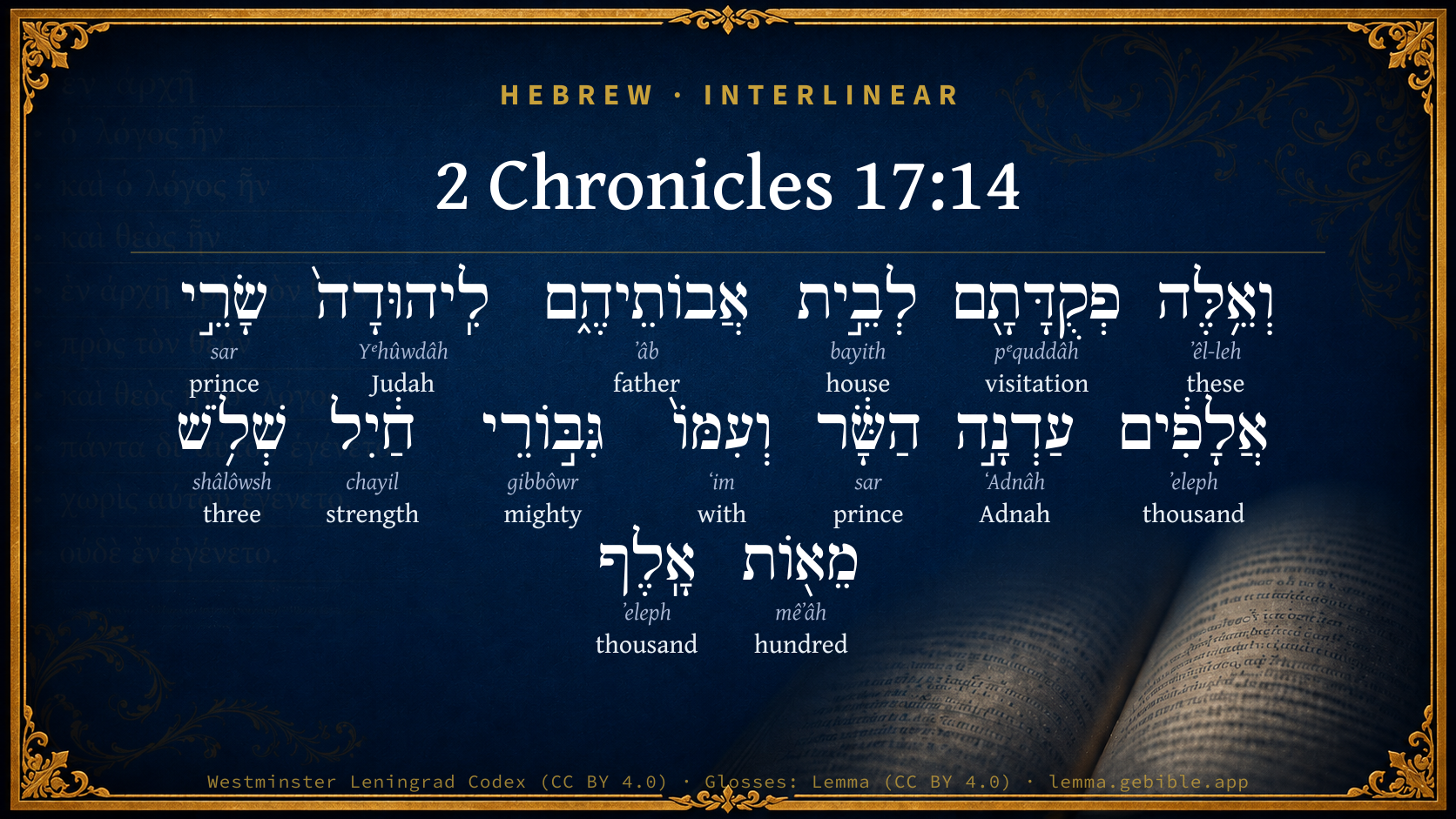
  1. וְאֵ֥לֶּה ʼêl-leh H428 “and · these” Conjunction + Pronoun, Demonstrative, Common, Plural
  2. פְקֻדָּתָ֖ם pᵉquddâh H6486 “visitation · their” Noun, Common, Feminine, Singular, Construct + Suffix, Personal, 3rd Person, Masculine, Plural
  3. לְבֵ֣ית bayith H1004 “to/for · house of” Preposition + Noun, Common, Masculine, Singular, Construct
  4. אֲבוֹתֵיהֶ֑ם ʼâb H1 “fathers · their” Noun, Common, Masculine, Plural, Construct + Suffix, Personal, 3rd Person, Masculine, Plural
  5. לִֽיהוּדָה֙ Yᵉhûwdâh H3063 “to/for · Judah” Preposition + Noun, Proper
  6. שָׂרֵ֣י sar H8269 “princes of” Noun, Common, Masculine, Plural, Construct
  7. אֲלָפִ֔ים ʼeleph H505 “thousand” Adjective, Cardinal number, Both, Plural, Absolute
  8. הַשָּׂ֔ר sar H8269 “the · prince” Particle, Definite Article + Noun, Common, Masculine, Singular, Absolute
  9. וְעִמּוֹ֙ ʻim H5973 “and · with · him” Conjunction + Preposition + Suffix, Personal, 3rd Person, Masculine, Singular
  10. גִּבּ֣וֹרֵי gibbôwr H1368 “mighty of” Adjective, Adjective, Masculine, Plural, Construct
  11. חַ֔יִל chayil H2428 “strength” Noun, Common, Masculine, Singular, Absolute
  12. שְׁלֹ֥שׁ shâlôwsh H7969 “three” Adjective, Cardinal number, Feminine, Singular, Absolute
  13. מֵא֖וֹת mêʼâh H3967 “hundred” Adjective, Cardinal number, Both, Plural, Absolute
  14. אָֽלֶף ʼeleph H505 “thousand” Adjective, Cardinal number, Both, Singular, Absolute

About this verse

These counts appear in no published source. They are computed here, from the morphology-tagged text and Lemma’s own curated glosses. What Lemma adds →

15
words
13
distinct lemmas
Historical
section

Notable vocabulary

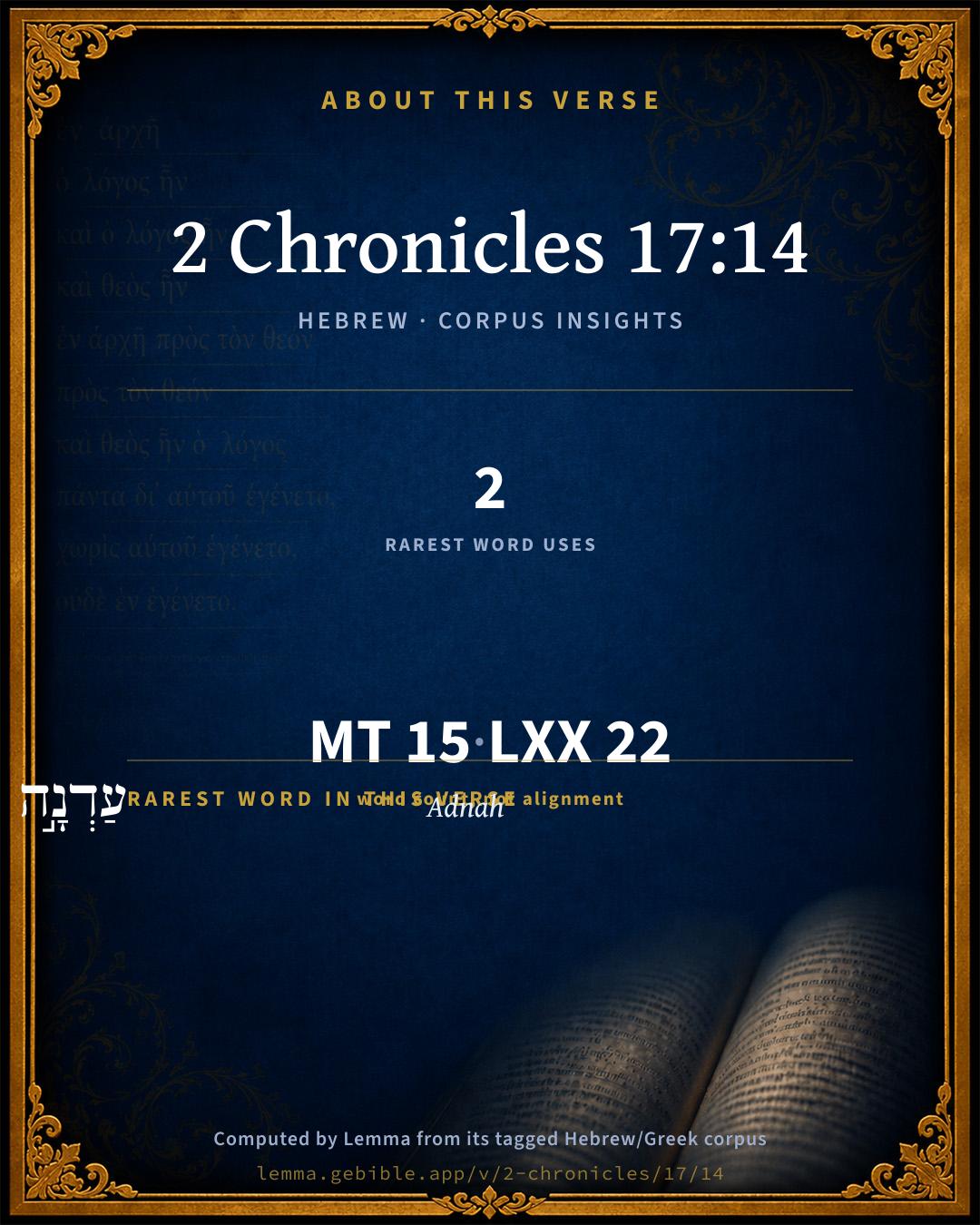
The rarest word here is עַדְנָ֣ה Adnah H5734 — appearing just 2 times in the whole Hebrew Bible.

Shared distinctive vocabulary

עַדְנָ֣ה Adnah H5734 occurs in 2 verses of the Hebrew Bible. Also found in:

Grammatical profile

  • 8 nouns
  • 5 adjectives
  • 1 pronoun
  • 1 preposition

Repetition

Words recur within this verse — often emphatic in Hebrew:

  • שָׂרֵ֣י prince H8269 ×2
  • אֲלָפִ֔ים thousand H505 ×2

Hebrew & Septuagint length

In English translation the verse runs 30 words from the Hebrew and 33 from the Septuagint (LXX English) — closely comparable.

A rough comparison of the two English renderings, which tokenize alike — not a word-level alignment.

Word counts can differ between the Hebrew and the Greek without any difference in meaning — e.g. the Hebrew direct-object marker אֵת has no separate Greek word, and Greek often adds the article ὁ.

In the original languages it is 15 Hebrew tokens and 22 Greek tokens — but the two are counted differently (Hebrew bundles its prefixes and suffixes into one token; the Greek is in lemma form), so that isn’t a like-for-like length.

Cross-references

9

Topical passages linked to 2 Chronicles 17:14 in the Treasury of Scripture Knowledge — connected by theme and wording, ordered by reader-vote popularity; previews shown in the World English Bible.

  • Genesis 12:2 I will make of you a great nation. I will bless you, and make your name great. You will be a blessing.
  • Genesis 13:16 I will make your offspring as the dust of the earth, so that if a man can number the dust of the earth, then your seed may also be numbered.
  • Genesis 15:5 Yahweh brought him outside, and said, "Look now toward the sky, and count the stars, if you are able to count them." He said to Abram, "So shall your seed be."
  • Numbers 1:2 "Take a census of all the congregation of the children of Israel, by their families, by their fathers' houses, according to the number of the names, every male, one by one;
  • Numbers 1:18 They assembled all the congregation together on the first day of the second month; and they declared their ancestry by their families, by their fathers' houses, according to the number of the names, from twenty years old and upward, one by one.
  • 2 Chronicles 11:1 When Rehoboam was come to Jerusalem, he assembled the house of Judah and Benjamin, one hundred eighty thousand chosen men, who were warriors, to fight against Israel, to bring the kingdom again to Rehoboam.
  • 2 Chronicles 13:3 Abijah joined battle with an army of valiant men of war, even four hundred thousand chosen men: and Jeroboam set the battle in array against him with eight hundred thousand chosen men, who were mighty men of valor.
  • 2 Chronicles 14:8 Asa had an army that bore bucklers and spears, out of Judah three hundred thousand; and out of Benjamin, that bore shields and drew bows, two hundred eighty thousand: all these were mighty men of valor.
  • 2 Chronicles 26:13 Under their hand was an army, three hundred thousand and seven thousand and five hundred, who made war with mighty power, to help the king against the enemy.

Cross-references courtesy of OpenBible.info (CC BY 4.0).

Hebrew and Greek witnesses Masoretic Hebrew ↔ Greek Septuagint

The same verse in the two great witnesses to the Old Testament, shown verse-for-verse.

These are two independent witnesses, not word-aligned to each other, and the Septuagint is shown in lemma (dictionary) form.

Hebrew 2 Chronicles 17:14 Masoretic · Westminster Leningrad Codex

וְאֵ֥לֶּה פְקֻדָּתָ֖ם לְבֵ֣ית אֲבוֹתֵיהֶ֑ם לִֽיהוּדָה֙ שָׂרֵ֣י אֲלָפִ֔ים עַדְנָ֣ה הַשָּׂ֔ר וְעִמּוֹ֙ גִּבּ֣וֹרֵי חַ֔יִל שְׁלֹ֥שׁ מֵא֖וֹת אָֽלֶף

This was the numbering of them according to their fathers' houses: Of Judah, the captains of thousands: Adnah the captain, and with him mighty men of valor three hundred thousand;

World English Bible · Public Domain

Greek LXX 2 Chronicles 17:14 Septuagint · lemma form

καί οὗτος ἀριθμός αὐτός κατά οἶκος πατριά αὐτός ὁ ἰουδά χιλίαρχος εδνας ὁ ἄρχων καί μετά αὐτός υἱός δυνατός δύναμις τριακόσιοι χιλίας

And this is their number according to the houses of their fathers; even the captains of thousands in Juda were, Ednas the chief, and with him mighty men of strength three hundred thousand.

LXX2012 (modern English Septuagint) · Public Domain

Hebrew: Westminster Leningrad Codex (CC BY 4.0). Greek: Septuagint (public domain); English from LXX2012 (modern English Septuagint) (Public Domain). How the Septuagint differs from the Hebrew →

Commentary

Notes on 2 Chronicles 17:14 from classic Christian and Jewish commentators (each source and its license shown beneath its notes). The classic Christian expositions comment on the surrounding passage and are grouped to its opening verse, so a note may address several verses; the Jewish commentaries on the Tanakh (Rashi and others) are per-verse, so they appear only where the commentator wrote on this verse.

Lemma curates 59 commentaries, every one of them public domain or Creative Commons licensed, each selected and text-cleaned for this edition rather than reprinted as found. About our sources →

Ellicott's Commentary for English Readers

(14) And these . . . their fathers.—And this is their muster (or census), according to their father-houses (clans), 1Ch_24:3. The warriors were marshalled in the army according to clans, so that men of the same stock fought side by side with their kindred. Perhaps in the original document this heading was followed by a much more detailed scheme of names and divisions than that which the text presents.

Of Judah.—To Judah (belonged) captains of thousands, viz., the three enumerated in 2Ch_17:14-16 : Adnah, Jehohanan, and Amasiah. They were the principal officers, or generals, of the entire forces of Judah.

Adnah the chief—To wit, the captain Adnah. That Adnah was commander-in-chief is implied by his being named first, and his corps being the largest.

A Bible Commentary for English Readers, edited by Charles John Ellicott (1878–1897) — public domain. Text from a community e-Sword module.

Trapp's Complete Commentary

John Trapp

2Ch 17:14 And these [are] the numbers of them according to the house of their fathers: Of Judah, the captains of thousands; Adnah the chief, and with him mighty men of valour three hundred thousand.

Ver. 14. Three hundred thousand.] These were under his command and at hand, to come whensoever the king would.

John Trapp, A Commentary or Exposition upon All the Books of the Old and New Testament (1647–1656) — public domain. Text from a community e-Sword module.

Geneva Bible (1599)

Geneva Bible translators

Hebrew, in his hand.

Geneva Bible (1599) marginal notes — public domain. Text via Bolls.life.

Jamieson, Fausset & Brown

Robert Jamieson, A. R. Fausset & David Brown

HIS GREATNESS, CAPTAINS, AND ARMIES. (Ch2 17:12-19)

these are the numbers--The warriors were arranged in the army according to their fathers houses. The army of Jehoshaphat, commanded by five great generals and consisting of five unequal divisions, comprised one million one hundred and sixty thousand men, without including those who garrisoned the fortresses. No monarch, since the time of Solomon, equalled Jehoshaphat in the extent of his revenue, in the strength of his fortifications, and in the number of his troops.

Next: 2 Chronicles Chapter 18

Jamieson, Fausset & Brown — Commentary Critical and Explanatory on the Whole Bible (1871) — public domain (CC PDM 1.0). Text via the HelloAO Bible API.

Adam Clarke's Commentary

Verse 14. Adnah, the chief] He was generalissimo of all this host. These are the numbers of the five battalions: under Adnah, three hundred thousand; Jehohanan, two hundred and eighty thousand, Amasiah, two hundred thousand; Eliada, two hundred thousand; Jehozabad, one hundred and eighty thousand; in all, one million one hundred and sixty thousand.

Adam Clarke's Commentary on the Bible (1810–1826) — public domain. Text from a community e-Sword/MySword module.

The Cambridge Bible for Schools and Colleges

gen. ed. J. J. S. Perowne

14. these are the numbers of them] R.V. this was the numbering of them.

the house of their fathers] R.V. their fathers’ houses.

Adnah the chief] R.V. Adnah the captain; cp. 2Ch_17:15, Jehohanan the captain.

14–19 (no parallel in 1 Kin.). The Number of Jehoshaphat’s Army

The numbers here given, if they are to be literally understood, must be pronounced impossibly high, especially since they are represented as exclusive of the garrisons in Judah, and perhaps as representing the forces stationed in Jerusalem itself (2Ch_17:13). Cp. note on 2Ch_14:8.

The Cambridge Bible for Schools and Colleges (gen. ed. J. J. S. Perowne; Cambridge University Press, 1878–1918) — public domain. Text from a community e-Sword module.

John Gill's Exposition

And these are the numbers of them, according to the house of their fathers,.... Both of the tribe of Judah and of Benjamin: and first

of Judah, the captains of thousands; some had 1000 men under them, and some one hundred:

Adnah the chief; he was the principal commander or general of them:

and with him mighty men of valour, three hundred thousand; such a number was under his command.

John Gill's Exposition of the Whole Bible (1746–1763) — public domain (CC PDM 1.0). Text via the HelloAO Bible API.

Albert Barnes' Notes on the Bible

The captains of thousands; Adnah the chief - literally, “princes of thousands, Adnah the prince.” The writer does not mean that Adnah (or Johohanan, 2Ch 17:15) was in any way superior to the other “princes,” but only that he was one of them.

Three hundred thousand - This number. and those which follow in 2Ch 17:15-18, have been with good reason regarded as corrupt by most critics. For:

(1) They imply a minimum population of 1,480 to the square mile, which is more than three times greater than that of any country in the known world (circa 1880’s).

(2) they produce a total just double that of the next largest estimate of the military force of Judah, the 580, 000 of 2Ch 14:8.

(3) they are professedly a statement, not of the whole military force, but of the force maintained at Jerusalem (2Ch 17:13; compare 2Ch 17:19).

It is probable that the original numbers have been lost, and that the loss was suppplied by a scribe, who took 2Ch 14:8 as his basis.

Albert Barnes' Notes on the Bible (1834–1885) — public domain. Text from a community e-Sword/MySword module.

Haydock's Catholic Bible Commentary

CHAPTER XVII.

Ednas was the chief of the five generals, who had under their command 1,160,000, (C.) besides the garrison soldiers, v. 19. H. --- So great power and riches had not been seen in Juda since the days of Solomon. C. --- They were not all on duty at the same time, but were able to bear arms (M.) when called out.

George Leo Haydock (1774–1849), Haydock's Catholic Family Bible and Commentary, 1859 edition — public domain. Excludes Psalms (Douay-Rheims chapter numbering differs from Protestant) and Deuterocanonical books (Catholic canon only).

Whedon's Commentary on the Bible

Daniel D. Whedon

14. Three hundred thousand — The numbers in this verse and the four verses following are generally regarded as corrupt. “They imply,” observes the writer last quoted, “a minimum population of 1480 to the square mile, which is more than three times greater than that of any country in the known world. It is probable that the original numbers have been lost, and the loss supplied by a scribe who took 2Ch_14:8, as his basis.”

Daniel D. Whedon (gen. ed.), Commentary on the Old and New Testaments (1874–1909) — public domain. Text from a community e-Sword module.

The Pulpit Commentary

This verse, with the following four, gives us the names of five captains, chiefs, princes, or military officers for the kingdom"s service, with the numbers of the troops they severally commanded. The numbers of them (see note under; (1Ch_23:11) Hebrew, The better English rendering to carry at once the signification would be, The muster of them, etc. The captains the chief, In both cases the Hebrew is the familiar word for" prince" (rc); in the former without article, in the latter with article. The numbers of this and following four verses are not only absolutely unreliable, but in themselves impossible. According to the house of their fathers; i.e. the quotation is drawn from an army catalogue, arranged carefully by fathers" houses. (Num_1:18, Num_1:22, etc.)

The Pulpit Commentary (1880–1919), ed. H.D.M. Spence-Jones & Joseph S. Exell — public domain. Text from a community e-Sword module.

Scofield Reference Notes

C. I. Scofield

three hundred thousand

(See Scofield "1Co 10:8").

The Scofield Reference Bible (1917 edition), notes by C. I. Scofield — public domain. Text from a community e-Sword module.

unfoldingWord translationNotes

Door43 World Missions Community

These were their divisions listed by the name of their fathers' houses

This can be stated in active form. AT: "The divisions by the name of their fathers' houses were as follows" (See: Active or Passive)

the commanders of thousands

The phrase "commander of thousands" is probably an official title for a military officer. Possible meanings are 1) the word "thousands" represent the exact amount of soldiers that these commanders led. AT: "the commanders of 1,000 soldiers" or 2) the word translated as "thousands" does not represent an exact number, but is the name of a large military division. AT: "the commanders of large military divisions" (See: Numbers)

Adnah ... Jehohanan ... Amasiah son of Zichri

(See: How to Translate Names)

300,000 ... 280,000 ... 200,000

"three hundred thousand ... two hundred and eighty thousand ... two hundred thousand" (See: Numbers)

translationWords

ancestor

house

commander

servant

Yahweh

unfoldingWord translationNotes — © Distant Shores Media and the Door43 World Missions Community, licensed CC BY-SA 4.0. Source: git.door43.org/Door43/en_tn.

Lesson kit

Teaching starters — assembled from the data on this page, not authored interpretation. Every prompt links to the verse data it draws on. Edit before teaching.

2 Chronicles, in the Historical, opens this verse with 15 words (13 distinct Hebrew lemmas). Its most distinctive word is ʻAdnâh (“Adnah”). A historical commentator’s framing appears above. Read the whole chapter for the surrounding context.

Discussion questions

  1. How does “Adnah” (ʻAdnâh) shape what this verse is saying?
  2. How does 1 Chronicles 12:20, which shares the word «Adnah», read alongside this verse?
  3. What does the repetition of “prince” (2× in this one verse) do in this verse?
  4. The translations on this page render this verse differently — a whole-verse word diff, not a word-by-word alignment. What might account for the different wordings?
  5. Compare how Ellicott's Commentary for English Readers and Trapp's Complete Commentary read this verse. Where do they agree or differ?

Things to notice

Reading settings

Reading text

Shown beneath each verse's original-language words.

Old Testament
Old Testament edition

Read the OT as the Masoretic Hebrew (MT) or the Greek Septuagint (LXX).

English shown for the Greek Septuagint (in the Hebrew ↔ Greek comparison).

Comparing translations? Open the Compare panel on any verse page to stack up to four side by side.