Judges 3:29

Hebrew (Westminster Leningrad Codex) Judges 3:29 appears in the Hebrew Old Testament. The text above is from the Westminster Leningrad Codex. Each word links to its Strong’s number, a concise gloss, and parsing drawn from the Open Scriptures Hebrew Bible morphology. Click any word for its full Brown-Driver-Briggs (BDB) entry.
Download image
Cite this verse

Judges 3:29 (World English Bible). Public Domain. Lemma interlinear Bible study tool, https://lemma.gebible.app/v/judges/3/29.

Show BibTeX & RIS
BibTeX
RIS
English Translation
They struck of Moab at that time about ten thousand men, every lusty man, and every man of valor; and there escaped not a man.
World English Bible · Public Domain
Download a study sheet

One document with this verse’s original text, its word-by-word gloss line, the meaning frame, cross-references with their text, attributed commentary, and full source and license credits — printable, and it pastes into notes with its structure intact.

This verse Autodidact and up

Study sheet (.html) Plain text (.txt)

A passage Seminary Student

Up to 50 verses in one chapter. A passage sheet keeps up to 6 commentary sources and 12 cross-references per verse, in the order this page ranks them, and says so on the sheet whenever that leaves anything out. Ask for a single verse and you get the Autodidact verse sheet above.

Everything on this page stays free to read, with no account — the sheet is a download of what is already on screen, not access to it.

Want to remove ads? Support Godless Engineer
Compare translations 3

The same verse in 3 English versions, stacked beneath the original-language interlinear above. Click any original word for its lexicon entry.

Each is an independent rendering of the whole verse — the interlinear is not word-aligned to these translations.

Highlighted words mark where these versions differ — a whole-verse word diff, not a word-by-word alignment.

  • World English Bible Public Domain
    They struck of Moab at that time about ten thousand men, every lusty man, and every man of valor; and there escaped not a man.
  • King James Version Public Domain
    And they slew of Moab at that time about ten thousand men, all lusty, and all men of valor; and there escaped not a man.
  • unfoldingWord Literal Text CC BY-SA 4.0
    And they struck Moab at that time, about 10,000 men. Each robust and each a man of strength, but not one escaped.

unfoldingWord Literal Text — © unfoldingWord, licensed CC BY-SA 4.0. Word-aligned USFM3 via Door43 (git.door43.org/unfoldingWord/en_ult).

Versions to compare (up to 4)

3 of 4 selected

Show all 18 translations

Every available English version of this verse, each an independent rendering of the whole verse.

  • World English Bible Public Domain
    They struck of Moab at that time about ten thousand men, every lusty man, and every man of valor; and there escaped not a man.
  • Berean Standard Bible Public Domain
    At that time they struck down about ten thousand Moabites, all robust and valiant men. Not one of them escaped.
  • Majority Standard Bible Public Domain
    At that time they struck down about ten thousand Moabites, all robust and valiant men. Not one of them escaped.
  • King James Version Public Domain
    And they slew of Moab at that time about ten thousand men, all lusty, and all men of valor; and there escaped not a man.
  • American Standard Version (1901) Public Domain
    And they smote of Moab at that time about ten thousand men, every lusty man, and every man of valor; and there escaped not a man.
  • Revised Version (1885) Public Domain
    And they smote of Moab at that time about ten thousand men, every lusty man, and every man of valour; and there escaped not a man.
  • Geneva Bible (1599) Public Domain
    And they slewe of the Moabites the same time about ten thousand men, all fed men, and all were warriours, and there escaped not a man.
  • Douay-Rheims (1899) Public Domain
    But they slew of the Moabites at that time, about ten thousand, all strong and Valiant men: none of them could escape.
  • Young's Literal Translation Public Domain
    And they smite Moab at that time, about ten thousand men, all robust, and every one a man of valour, and not a man hath escaped,
  • Literal Standard Version CC BY-SA 4.0
    And they strike Moab at that time, about ten thousand men, all robust, and everyone a man of valor, and no man has escaped,
  • Unlocked Literal Bible CC BY-SA 4.0
    At that time they killed about ten thousand men of Moab, and all were strong and capable men. Not one escaped.
  • unfoldingWord Literal Text CC BY-SA 4.0
    And they struck Moab at that time, about 10,000 men. Each robust and each a man of strength, but not one escaped.
  • Darby Bible Public Domain
    And they killed at that time about ten thousand of the Moabites, all strong, able-bodied men; not a man escaped.
  • World Messianic Bible Public Domain
    They struck at that time about ten thousand men of Moab, every strong man and every man of valor. No man escaped.
  • Webster's Bible Public Domain
    And they slew of Moab at that time about ten thousand men, all lusty, and all men of valor: and there escaped not a man.
  • Free Bible Version CC BY-SA 4.0
    Then they attacked the Moabites and killed around 10,000 of their best and strongest fighting men. Not a single one escaped.
  • Bible in Basic English Public Domain
    At that time they put about ten thousand men of Moab to the sword, every strong man and every man of war; not a man got away.
  • JPS Tanakh (1917) Public Domain
    And they smote of Moab at that time about ten thousand men, every lusty man, and every man of valour; and there escaped not a man.

Literal Standard Version (2020), Covenant Press — licensed CC BY-SA 4.0. Text via the HelloAO Bible API (eBible.org). Unlocked Literal Bible (unfoldingWord) — licensed CC BY-SA 4.0. Text via the HelloAO Bible API (eBible.org). unfoldingWord Literal Text — © unfoldingWord, licensed CC BY-SA 4.0. Word-aligned USFM3 via Door43 (git.door43.org/unfoldingWord/en_ult). Free Bible Version, Dr. Jonathan Gallagher — licensed CC BY-SA 4.0. Text via the HelloAO Bible API (eBible.org).

Word by word

More ways to search: Search by grammar → Find every occurrence → Compare this word →

Practice this passage: Drill this verse → Learn its vocabulary →

שָׁמֵ֖ן
shâmên
H8082
“fat”
Adjective, Adjective, Masculine, Singular, Absolute
Part of Speech
Adjective
Type
Adjective
Gender
Masculine
Number
Singular
State
Absolute
Full BDB Definition

Origin: from H8080

TWOT: 2410a

fat, rich, robust - fat, rich (of food) - stout, robust (of men)
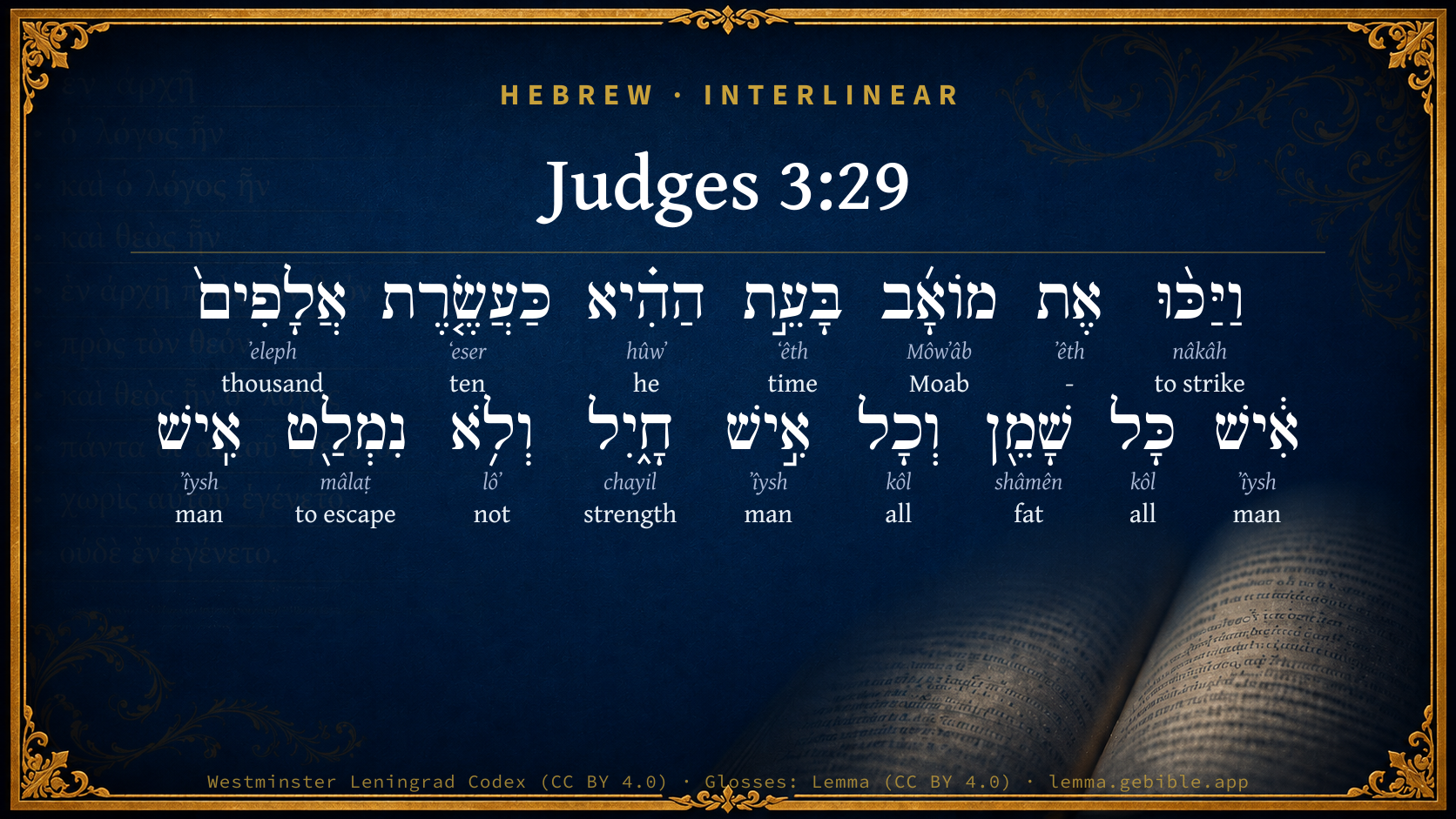
  1. וַיַּכּ֨וּ nâkâh H5221 “and · to strike” Conjunction + Verb, Hiphil, Sequential Imperfect, 3rd Person, Masculine, Plural
  2. אֶת ʼêth H853 “-” Particle, Direct Object
  3. מוֹאָ֜ב Môwʼâb H4124 “Moab” Noun, Proper
  4. בָּעֵ֣ת ʻêth H6256 “in/at the · time” Preposition, Determined + Noun, Common, Both, Singular, Absolute
  5. הַהִ֗יא hûwʼ H1931 “the · he” Particle, Definite Article + Pronoun, Personal, 3rd Person, Feminine, Singular
  6. כַּעֲשֶׂ֤רֶת ʻeser H6235 “like/as · ten” Preposition + Adjective, Cardinal number, Masculine, Singular, Construct
  7. אֲלָפִים֙ ʼeleph H505 “thousand” Adjective, Cardinal number, Both, Plural, Absolute
  8. אִ֔ישׁ ʼîysh H376 “man” Noun, Common, Masculine, Singular, Absolute
  9. כָּל kôl H3605 “all of” Noun, Common, Masculine, Singular, Construct
  10. וְכָל kôl H3605 “and · all of” Conjunction + Noun, Common, Masculine, Singular, Construct
  11. אִ֣ישׁ ʼîysh H376 “man of” Noun, Common, Masculine, Singular, Construct
  12. חָ֑יִל chayil H2428 “strength” Noun, Common, Masculine, Singular, Absolute
  13. וְלֹ֥א lôʼ H3808 “and · not” Conjunction + Particle, Negative
  14. נִמְלַ֖ט mâlaṭ H4422 “to escape” Verb, Niphal, Perfect, 3rd Person, Masculine, Singular
  15. אִֽישׁ ʼîysh H376 “man” Noun, Common, Masculine, Singular, Absolute

About this verse

These counts appear in no published source. They are computed here, from the morphology-tagged text and Lemma’s own curated glosses. What Lemma adds →

16
words
13
distinct lemmas
Historical
section

Notable vocabulary

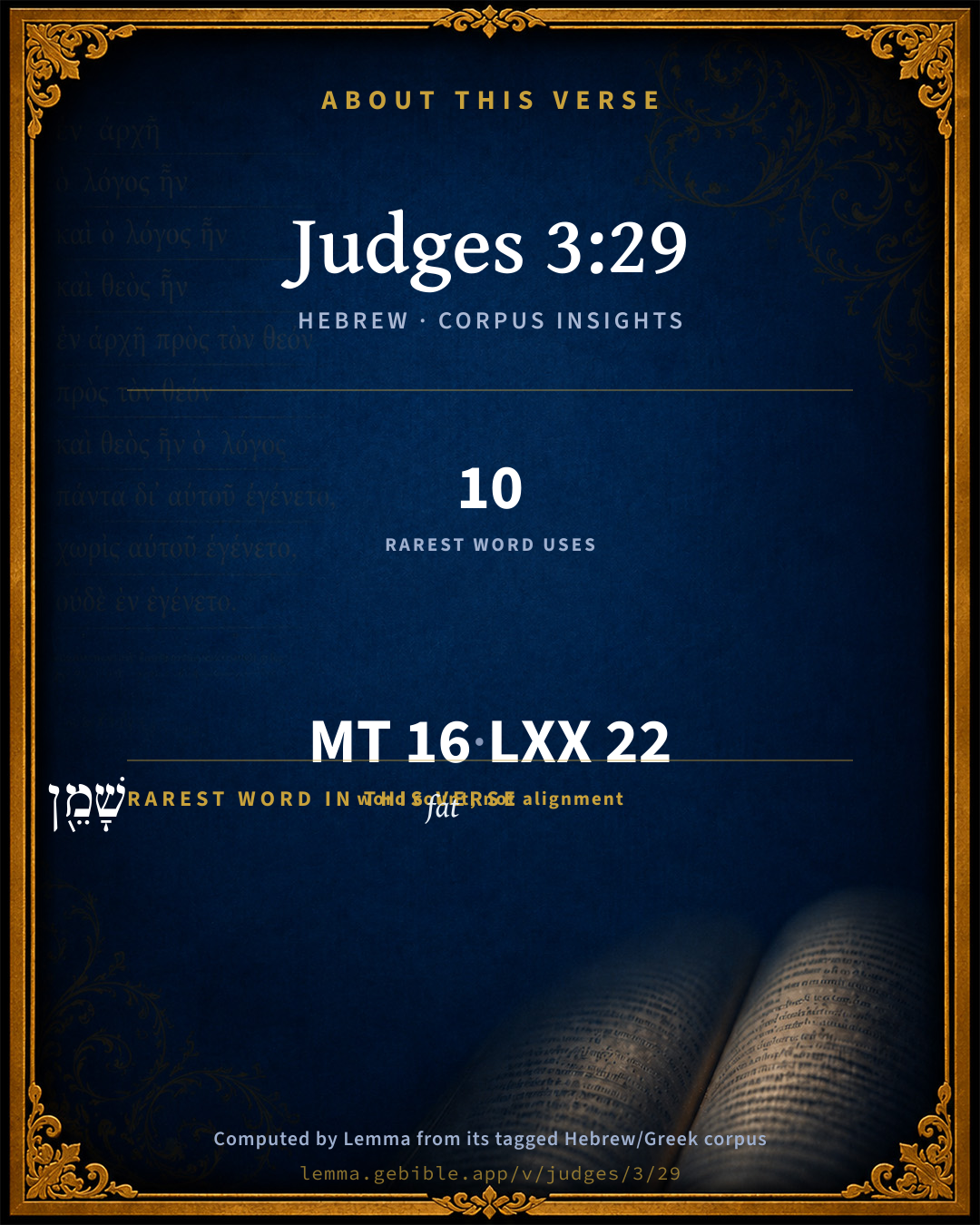
The rarest word here is שָׁמֵ֖ן fat H8082 — appearing just 10 times in the whole Hebrew Bible.

Shared distinctive vocabulary

שָׁמֵ֖ן fat H8082 occurs in 10 verses of the Hebrew Bible. Also found in:

Grammatical profile

  • 2 verbs
  • 8 nouns
  • 3 adjectives
  • 1 pronoun
  • 2 particles

Verb forms

  • וַיַּכּ֨וּ Hiphil · Sequential Imperfect
  • נִמְלַ֖ט Niphal · Perfect

Repetition

Words recur within this verse — often emphatic in Hebrew:

  • אִ֔ישׁ man H376 ×3
  • כָּל all H3605 ×2

Hebrew & Septuagint length

In English translation the verse runs 25 words from the Hebrew and 23 from the Septuagint (LXX English) — closely comparable.

A rough comparison of the two English renderings, which tokenize alike — not a word-level alignment.

Word counts can differ between the Hebrew and the Greek without any difference in meaning — e.g. the Hebrew direct-object marker אֵת has no separate Greek word, and Greek often adds the article ὁ.

In the original languages it is 16 Hebrew tokens and 22 Greek tokens — but the two are counted differently (Hebrew bundles its prefixes and suffixes into one token; the Greek is in lemma form), so that isn’t a like-for-like length.

Cross-references

4

Topical passages linked to Judges 3:29 in the Treasury of Scripture Knowledge — connected by theme and wording, ordered by reader-vote popularity; previews shown in the World English Bible.

  • Deuteronomy 32:15 But Jeshurun grew fat, and kicked: You have grown fat, you are grown thick, you are become sleek; Then he forsook God who made him, Lightly esteemed the Rock of his salvation.
  • Judges 3:17 He offered the tribute to Eglon king of Moab: now Eglon was a very fat man.
  • Job 15:27 Because he has covered his face with his fatness, And gathered fat on his loins.
  • Psalms 17:10 They close up their callous hearts. With their mouth they speak proudly.

Cross-references courtesy of OpenBible.info (CC BY 4.0).

Hebrew and Greek witnesses Masoretic Hebrew ↔ Greek Septuagint

The same verse in the two great witnesses to the Old Testament, shown verse-for-verse.

These are two independent witnesses, not word-aligned to each other, and the Septuagint is shown in lemma (dictionary) form.

Hebrew Judges 3:29 Masoretic · Westminster Leningrad Codex

וַיַּכּ֨וּ אֶת מוֹאָ֜ב בָּעֵ֣ת הַהִ֗יא כַּעֲשֶׂ֤רֶת אֲלָפִים֙ אִ֔ישׁ כָּל שָׁמֵ֖ן וְכָל אִ֣ישׁ חָ֑יִל וְלֹ֥א נִמְלַ֖ט אִֽישׁ

They struck of Moab at that time about ten thousand men, every lusty man, and every man of valor; and there escaped not a man.

World English Bible · Public Domain

Greek LXX Judges 3:29 Septuagint · lemma form

καί πατάσσω ὁ μωαβ ἐν ὁ ἡμέρα ἐκεῖνος ὡσεί δέκα χιλιάς ἀνήρ πᾶς λιπαρός καί πᾶς ἀνήρ δύναμις καί οὐ διασώζω ἀνήρ

And they struck Moab on that day about ten thousand men, every lusty person and every mighty man; and not a man escaped.

LXX2012 (modern English Septuagint) · Public Domain

Hebrew: Westminster Leningrad Codex (CC BY 4.0). Greek: Septuagint (public domain); English from LXX2012 (modern English Septuagint) (Public Domain). How the Septuagint differs from the Hebrew →

Targum (Aramaic paraphrase)

1

The Targum is the ancient Jewish Aramaic paraphrase of the Hebrew Scriptures — an interpretive translation, not the Hebrew text itself. Onkelos (literal) and Pseudo-Jonathan (expansive) render the Torah, and Jonathan the Prophets. Coverage is partial: where no permissively-licensed English translation exists for a verse, only the Aramaic is shown. This is verse-level text, not a word-by-word alignment to the Hebrew.

  1. Targum Jonathan Prophets (Joshua–Malachi)
    וּקְטַלוּ יַת מוֹאָב בְּעִדָנָא הַהִיא כְּעַסְרָא אַלְפִין גַבְרָא כָּל אֵימְתָן וְכָל גְבַר גִבַּר חֵילָא וְלָא אִישְׁתְּזֵיב אֱנָשׁ:

    (no public-domain English translation for this verse)

    Targum Jonathan — Aramaic: “Mikraot Gedolot” (public domain). English: “Sefaria Community Translation” (CC0 1.0 (public-domain dedication)); “London "Chaldee Paraphrase," 1871” (public domain). Text via Sefaria.

Commentary

Notes on Judges 3:29 from classic Christian and Jewish commentators (each source and its license shown beneath its notes). The classic Christian expositions comment on the surrounding passage and are grouped to its opening verse, so a note may address several verses; the Jewish commentaries on the Tanakh (Rashi and others) are per-verse, so they appear only where the commentator wrote on this verse.

Lemma curates 59 commentaries, every one of them public domain or Creative Commons licensed, each selected and text-cleaned for this edition rather than reprinted as found. About our sources →

Trapp's Complete Commentary

John Trapp

Jdg 3:29 And they slew of Moab at that time about ten thousand men, all lusty, and all men of valour; and there escaped not a man.

Ver. 29. All lusty.] Heb., Fat and succulent. Tremellius rendereth it, Opulent, wealthy. These were those Lurdaines or Lord-Danes, that did eat of the fat and drink of the sweet, while the poor Israelites, their vassals, were forced to take hard on.

And there escaped not a man.] Ne ignifer quidem relictus est.

John Trapp, A Commentary or Exposition upon All the Books of the Old and New Testament (1647–1656) — public domain. Text from a community e-Sword module.

Whedon's Commentary on the Bible

Daniel D. Whedon

29. About ten thousand men — The slaughter of these picked troops did not, probably, occur in one day, but in the course of this short, sharp, and decisive campaign. It was not customary to take prisoners in the battles of those days.

All lusty — Fat, stout, robust men. The Moabite warriors seem to have been, like their king, (Jdg_3:17,) large, corpulent men.

As this is the last mention of Ehud, it is proper here to inquire into the moral character of that act which made him prominent in the delivery of Israel. It is both superfluous and unwarrantable to say, as some do, that Ehud’s deed was done under a special impulse or inspiration from the Almighty. There is nothing in the narrative to justify such an opinion. It is not even said that the Spirit of the Lord came upon Ehud; nor does it follow that because God raised him up to deliver Israel, Divine Wisdom directed and approved all the measures he used in order to effect that object. Least of all is it supposable that Ehud’s acts in this case, whether in themselves censurable or not, are a precedent and worthy example for all times and all circumstances.

But let it once be noted that Eglon and the Moabites were now accursed of God, and ripe for judgment, and that Ehud both knew this fact and also that he himself was the divinely chosen minister of vengeance, and there is no need of criticising the morality of his deed, or of justifying it by a supposed special impulse of the Spirit. Jdg_3:15; Jdg_3:28 contain sufficient evidence to show that Ehud understood his divine commission as deliverer of Israel, and that the Moabitish oppression was about to be broken. Beyond this we do not suppose God gave him any special revelations or commands, but left him to the choice of such measures and plans of conquest as his own judgment and skill might devise. Viewed in this light, the murder of Eglon was as justifiable as the slaughter of the ten thousand Moabites. Jdg_3:29. Ehud’s deed was but the first stroke of Divine judgment that fell on the idolatrous kingdom, and may be compared to the slaughter of Agag by the hand of Samuel. 1Sa_15:33. Samuel’s act was an after stroke of judgment, done to complete the curse of Amalek: Ehud’s was the first stroke, and so had more of the character of a stratagem of war. The acts of violence, barbarity, treachery, and deception common in war can never be justified on subjective grounds. So far as they are a part of war itself, they are not to be judged singly and apart from the moral issues involved in the war. Their apology or justification, if any is asked for, is to be found in that which justified the war itself. Compare the note on Jael’s deed at the close of chap. 4.

Daniel D. Whedon (gen. ed.), Commentary on the Old and New Testaments (1874–1909) — public domain. Text from a community e-Sword module.

Geneva Bible (1599)

Geneva Bible translators

Or, strong, and big bodied.

Geneva Bible (1599) marginal notes — public domain. Text via Bolls.life.

Adam Clarke's Commentary

Verse 29. All lusty, and all men of valour] Picked, chosen troops, which Eglon kept among the Israelites to reduce and overawe them.

Adam Clarke's Commentary on the Bible (1810–1826) — public domain. Text from a community e-Sword/MySword module.

Ellicott's Commentary for English Readers

(29) At that time.—Apparently in the first surprise of the Moabite forces and garrisons.

All lusty.—Literally, every fat man and every soldier of strength, the word being the same as that used in Jdg_3:17 to describe the fatness of Eglon. The choice of the word seems to be dictated by a certain grim sense of humour. “The narrative ends, as it had begun, with its half-humorous allusion to the well-fed carcases of those who, corpulent like their chief, lay dead along the shore of the river.” (Stanley.)

A Bible Commentary for English Readers, edited by Charles John Ellicott (1878–1897) — public domain. Text from a community e-Sword module.

The Cambridge Bible for Schools and Colleges

gen. ed. J. J. S. Perowne

29. ten thousand] A round number, Jdg_1:4 n. The Moabites who formed the army of occupation were all picked men.

The Cambridge Bible for Schools and Colleges (gen. ed. J. J. S. Perowne; Cambridge University Press, 1878–1918) — public domain. Text from a community e-Sword module.

John Gill's Exposition

So Moab was subdued that day under the hand of Israel,.... Or the Moabites were broken, as the Targum, that is, their forces in the land of Israel; for the land of Moab itself was not subdued and brought into subjection to the Israelites; but they were so weakened by this stroke upon them, that they could not detain the Israelites under their power any longer:

and the land had rest fourscore years; eighty years, which, according to Ben Gersom, are to be reckoned from the beginning of their servitude, and that the rest properly was but sixty two years, and so both rest and servitude were eighty years, as R. Isaiah; and, according to Abarbinel, the rest was from the death of Othniel; and our Bishop Usher (o) reckons this eightieth year from the former rest restored to it by Othniel; but others (p) are of opinion that there were several judges at a time in several parts of the land, and that the land was at rest in one part when there was war in another; and so that at this time it was only the eastern part of the land that had rest, while the western parts were distressed by the Philistines, and the northern parts by Jabin king of Canaan, as in Jdg 3:31.

(o) Annal. Vet. Test. p. 42. (p) Marsham. Canon. Chron. p. 306, 307. Patrick in loc. Vid. Lampe Eccl. Hist. l. 1. c. 5. p. 21, 22.

John Gill's Exposition of the Whole Bible (1746–1763) — public domain (CC PDM 1.0). Text via the HelloAO Bible API.

Haydock's Catholic Bible Commentary

Strong. Hebrew literally, "the fatness," denoting what is most excellent, Psalm xxi. 30., and lxxvii. 31. (Calmet) --- Eglon would have his chief nobility and most valiant soldiers round his person. (Haydock)

George Leo Haydock (1774–1849), Haydock's Catholic Family Bible and Commentary, 1859 edition — public domain. Excludes Psalms (Douay-Rheims chapter numbering differs from Protestant) and Deuterocanonical books (Catholic canon only).

Keil & Delitzsch

C. F. Keil & F. Delitzsch

Thus they smote at that time about 10,000 Moabites, all fat and powerful men, i.e., the whole army of the enemy in Jericho and on this side of the Jordan, not letting a man escape. The expression "at that time" seems to imply that they did not destroy this number in one single engagement, but during the whole course of the war.

Keil & Delitzsch — Biblical Commentary on the Old Testament (1861–1891) — public domain (CC PDM 1.0). Text via the HelloAO Bible API. (Old Testament only.)

Rashi

Rabbi Shlomo Yitzchaki (Rashi)

All horrific [lit. corpulent]. Every man awe inspiring.

Rashi on the Tanakh — English translations: “The Judaica Press complete Tanach with Rashi, translated by A. J. Rosenberg” (CC BY 4.0); “Pentateuch with Rashi's commentary by M. Rosenbaum and A.M. Silbermann, 1929-1934” (public domain); “The Metsudah Tanach series, Lakewood, N.J” (CC BY 4.0); and “The Book of Joshua, Metsudah Publications, 1997” (CC BY 4.0). Text via Sefaria.

Lesson kit

Teaching starters — assembled from the data on this page, not authored interpretation. Every prompt links to the verse data it draws on. Edit before teaching.

Judges, in the Historical, opens this verse with 16 words (13 distinct Hebrew lemmas). Its most distinctive word is shâmên (“fat”). A historical commentator’s framing appears above. Read the whole chapter for the surrounding context.

Discussion questions

  1. What does “fat” (shâmên) contribute to the verse as a whole?
  2. Genesis 49:20 shares the word «fat» with this verse. How do the two illuminate each other?
  3. “man” occurs 3× in this one verse. What is the effect of the repetition?
  4. These translations render this verse differently. What is at stake in choosing one wording over another?
  5. The verb «וַיַּכּ֨וּ» is Hiphil Sequential Imperfect. How does its form color the action?
  6. Reading how Trapp's Complete Commentary and Whedon's Commentary on the Bible read this verse, where do the two commentators agree and where do they part?

Things to notice

Reading settings

Reading text

Shown beneath each verse's original-language words.

Old Testament
Old Testament edition

Read the OT as the Masoretic Hebrew (MT) or the Greek Septuagint (LXX).

English shown for the Greek Septuagint (in the Hebrew ↔ Greek comparison).

Comparing translations? Open the Compare panel on any verse page to stack up to four side by side.