
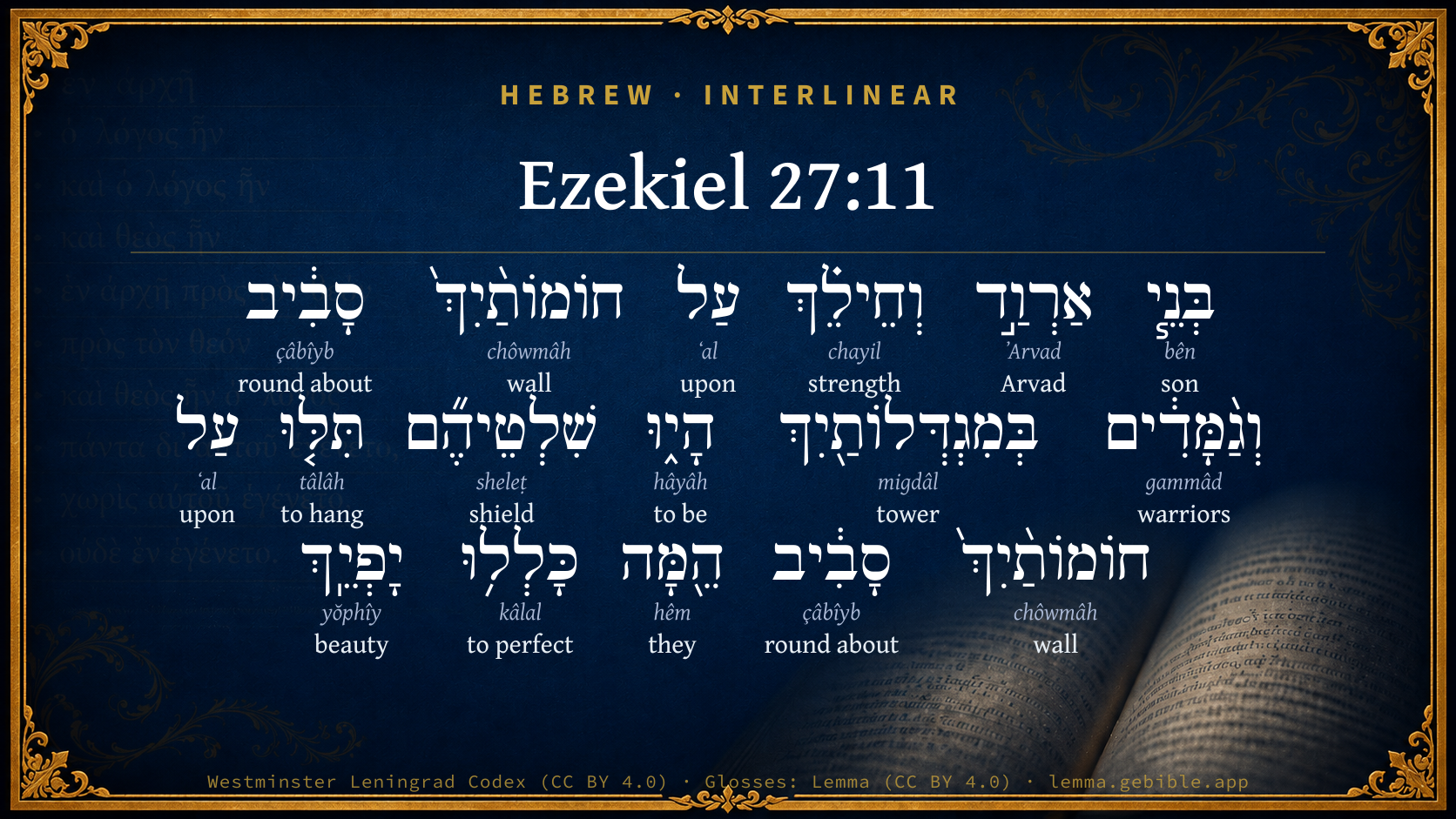
Ezekiel 27:11

Hebrew (Westminster Leningrad Codex) Ezekiel 27:11 appears in the Hebrew Old Testament. The text above is from the Westminster Leningrad Codex. Each word links to its Strong’s number, a concise gloss, and parsing drawn from the Open Scriptures Hebrew Bible morphology. Click any word for its full Brown-Driver-Briggs (BDB) entry.
Download image
Cite this verse

Ezekiel 27:11 (World English Bible). Public Domain. Lemma interlinear Bible study tool, https://lemma.gebible.app/v/ezekiel/27/11.

Show BibTeX & RIS
BibTeX
RIS
English Translation
The men of Arvad with your army were on your walls round about, and valorous men were in your towers; they hanged their shields on your walls round about; they have perfected your beauty.
World English Bible · Public Domain
Highlights
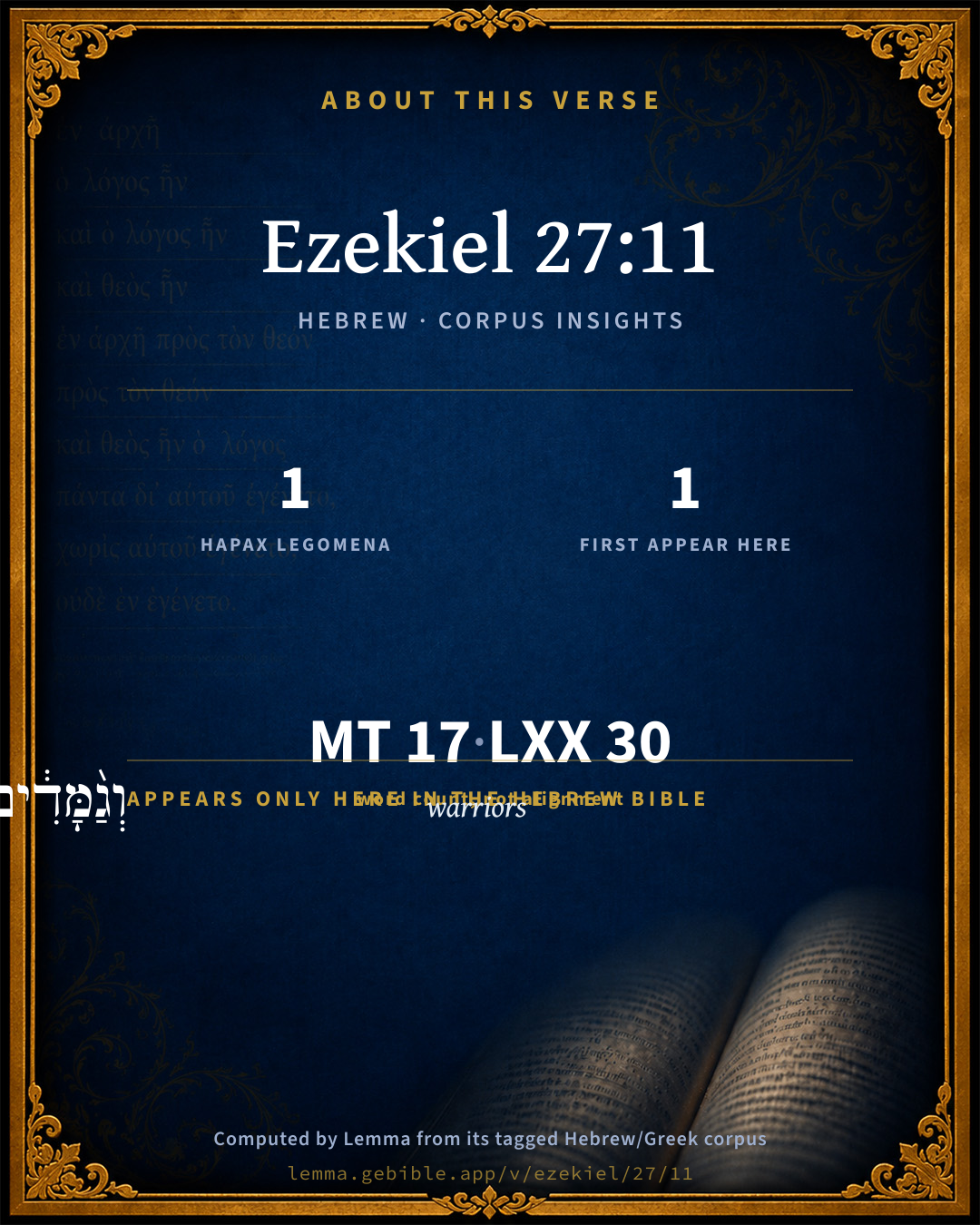
  • 1 hapax legomenon — only here in the Hebrew Bible
  • 1 first appearance in the Hebrew Bible
Full analysis ↓
Download a study sheet

One document with this verse’s original text, its word-by-word gloss line, the meaning frame, cross-references with their text, attributed commentary, and full source and license credits — printable, and it pastes into notes with its structure intact.

This verse Autodidact and up

Study sheet (.html) Plain text (.txt)

A passage Seminary Student

Up to 50 verses in one chapter. A passage sheet keeps up to 6 commentary sources and 12 cross-references per verse, in the order this page ranks them, and says so on the sheet whenever that leaves anything out. Ask for a single verse and you get the Autodidact verse sheet above.

Everything on this page stays free to read, with no account — the sheet is a download of what is already on screen, not access to it.

Want to remove ads? Support Godless Engineer
Compare translations 3

The same verse in 3 English versions, stacked beneath the original-language interlinear above. Click any original word for its lexicon entry.

Each is an independent rendering of the whole verse — the interlinear is not word-aligned to these translations.

Highlighted words mark where these versions differ — a whole-verse word diff, not a word-by-word alignment.

  • World English Bible Public Domain
    The men of Arvad with your army were on your walls round about, and valorous men were in your towers; they hanged their shields on your walls round about; they have perfected your beauty.
  • King James Version Public Domain
    The men of Arvad with thine army were upon thy walls round about, and the Gammadims were in thy towers: they hanged their shields upon thy walls round about; they have made thy beauty perfect.
  • unfoldingWord Literal Text CC BY-SA 4.0
    The men of Arvad and Helek in your army were on your walls surrounding you, and the people of Gammad were in your towers. They hung up their shields on your walls all around you! They completed your beauty.

unfoldingWord Literal Text — © unfoldingWord, licensed CC BY-SA 4.0. Word-aligned USFM3 via Door43 (git.door43.org/unfoldingWord/en_ult).

Versions to compare (up to 4)

3 of 4 selected

Show all 18 translations

Every available English version of this verse, each an independent rendering of the whole verse.

  • World English Bible Public Domain
    The men of Arvad with your army were on your walls round about, and valorous men were in your towers; they hanged their shields on your walls round about; they have perfected your beauty.
  • Berean Standard Bible Public Domain
    Men of Arvad and Helech manned your walls all around, and the men of Gammad were in your towers. They hung their shields around your walls; they perfected your beauty.
  • Majority Standard Bible Public Domain
    Men of Arvad and Helech manned your walls all around, and the men of Gammad were in your towers. They hung their shields around your walls; they perfected your beauty.
  • King James Version Public Domain
    The men of Arvad with thine army were upon thy walls round about, and the Gammadims were in thy towers: they hanged their shields upon thy walls round about; they have made thy beauty perfect.
  • American Standard Version (1901) Public Domain
    The men of Arvad with thine army were upon thy walls round about, and valorous men were in thy towers; they hanged their shields upon thy walls round about; they have perfected thy beauty.
  • Revised Version (1885) Public Domain
    The men of Arvad with thine army were upon thy walls round about, and the Gammadim were in thy towers: they hanged their shields upon thy walls round about; they have perfected thy beauty.
  • Geneva Bible (1599) Public Domain
    The men of Aruad with thine armie were vpon thy walles round about, and the Gammadims were in thy towres: they hanged their shields vpon thy walles round about: they haue made thy beautie perfite.
  • Douay-Rheims (1899) Public Domain
    The men of Arad were with thy army upon thy walls round about: the Pygmeans also that were in thy towers, hung up their quivers on thy walls round about: they perfected thy beauty.
  • Young's Literal Translation Public Domain
    The sons of Arvad, and thy force, `Are' on thy walls round about, And short swordsmen in thy towers have been, Their shields they have hung up on thy walls round about, They -- they have perfected thy beauty.
  • Literal Standard Version CC BY-SA 4.0
    The sons of Arvad, and your force, || [Are] on your walls all around, || And short swordsmen have been in your towers, || They have hung up their shields on your walls all around, || They have perfected your beauty.
  • Unlocked Literal Bible CC BY-SA 4.0
    The men of Arvad and Helek in your army were on your walls surrounding you, and the people of Gammad were in your towers. They hung up their shields on your walls all around you! They completed your beauty.
  • unfoldingWord Literal Text CC BY-SA 4.0
    The men of Arvad and Helek in your army were on your walls surrounding you, and the people of Gammad were in your towers. They hung up their shields on your walls all around you! They completed your beauty.
  • Darby Bible Public Domain
    The children of Arvad with thine army were upon thy walls round about, and the Gammadim were on thy towers: they hanged their shields upon thy walls round about; they made thy beauty perfect.
  • World Messianic Bible Public Domain
    The men of Arvad with your army were on your walls all around, and valiant men were in your towers. They hung their shields on your walls all around. They have perfected your beauty.
  • Webster's Bible Public Domain
    The men of Arvad with thy army were upon thy walls on all sides, and the Gammadims were in thy towers: they hung their shields upon thy walls on every side; they have made thy beauty perfect.
  • Free Bible Version CC BY-SA 4.0
    Men of Arvad and Helech defended all your city walls, while those from Gammad protected your towers. They hung their shields all around your walls. They made you so successful.
  • Bible in Basic English Public Domain
    The men of Arvad in your army were on your walls, and were watchmen in your towers, hanging up their arms on your walls round about; they made you completely beautiful.
  • JPS Tanakh (1917) Public Domain
    The men of Arvad and Helech were upon thy walls round about, and the Gammadim were in thy towers; they hanged their shields upon thy walls round about; they have perfected thy beauty.

Literal Standard Version (2020), Covenant Press — licensed CC BY-SA 4.0. Text via the HelloAO Bible API (eBible.org). Unlocked Literal Bible (unfoldingWord) — licensed CC BY-SA 4.0. Text via the HelloAO Bible API (eBible.org). unfoldingWord Literal Text — © unfoldingWord, licensed CC BY-SA 4.0. Word-aligned USFM3 via Door43 (git.door43.org/unfoldingWord/en_ult). Free Bible Version, Dr. Jonathan Gallagher — licensed CC BY-SA 4.0. Text via the HelloAO Bible API (eBible.org).

Word by word

More ways to search: Search by grammar → Find every occurrence → Compare this word →

Practice this passage: Drill this verse → Learn its vocabulary →

וְגַ֨מָּדִ֔ים
gammâd
H1575
“and · warriors”
Conjunction + Noun, Proper
Part of Speech
Conjunction + Noun
Type
Proper
Full BDB Definition

Origin: from the same as H1574

TWOT: None

brave men, warriors, valorous men
  1. בְּנֵ֧י bên H1121 “sons of” Noun, Common, Masculine, Plural, Construct
  2. אַרְוַ֣ד ʼArvad H719 “Arvad” Noun, Proper
  3. וְחֵילֵ֗ךְ chayil H2428 “and · strength” Conjunction + Noun, Proper
  4. עַל ʻal H5921 “upon” Preposition
  5. חוֹמוֹתַ֨יִךְ֙ chôwmâh H2346 “walls · your” Noun, Common, Feminine, Plural, Construct + Suffix, Personal, 2nd Person, Feminine, Singular
  6. סָבִ֔יב çâbîyb H5439 “round about” Noun, Common, Both, Singular, Absolute
  7. בְּמִגְדְּלוֹתַ֖יִךְ migdâl H4026 “in/at · towers · your” Preposition + Noun, Common, Both, Plural, Construct + Suffix, Personal, 2nd Person, Feminine, Singular
  8. הָי֑וּ hâyâh H1961 “to be” Verb, Qal, Perfect, 3rd Person, Common, Plural
  9. שִׁלְטֵיהֶ֞ם sheleṭ H7982 “shields · their” Noun, Common, Masculine, Plural, Construct + Suffix, Personal, 3rd Person, Masculine, Plural
  10. תִּלּ֤וּ tâlâh H8518 “to hang” Verb, Piel, Perfect, 3rd Person, Common, Plural
  11. עַל ʻal H5921 “upon” Preposition
  12. חוֹמוֹתַ֨יִךְ֙ chôwmâh H2346 “walls · your” Noun, Common, Feminine, Plural, Construct + Suffix, Personal, 2nd Person, Feminine, Singular
  13. סָבִ֔יב çâbîyb H5439 “round about” Noun, Common, Both, Singular, Absolute
  14. הֵ֖מָּה hêm H1992 “they” Pronoun, Personal, 3rd Person, Masculine, Plural
  15. כָּלְל֥וּ kâlal H3634 “to perfect” Verb, Qal, Perfect, 3rd Person, Common, Plural
  16. יָפְיֵֽךְ yŏphîy H3308 “beauty · your” Noun, Common, Masculine, Singular, Construct + Suffix, Personal, 2nd Person, Feminine, Singular

About this verse

These counts appear in no published source. They are computed here, from the morphology-tagged text and Lemma’s own curated glosses. What Lemma adds →

17
words
14
distinct lemmas
Prophets
section

Notable vocabulary

1 hapax legomenon — a word that appears only here in the entire Hebrew Bible:

  • וְגַ֨מָּדִ֔ים warriors H1575

First appearance in Scripture

This word makes its first canonical appearance in the Hebrew Bible here:

  • וְגַ֨מָּדִ֔ים warriors H1575

Shared distinctive vocabulary

אַרְוַ֣ד Arvad H719 occurs in 2 verses of the Hebrew Bible. Also found in:

Grammatical profile

  • 3 verbs
  • 11 nouns
  • 1 pronoun
  • 2 prepositions

Verb forms

  • הָי֑וּ Qal · Perfect
  • תִּלּ֤וּ Piel · Perfect
  • כָּלְל֥וּ Qal · Perfect

Repetition

Words recur within this verse — often emphatic in Hebrew:

  • עַל upon H5921 ×2
  • חוֹמוֹתַ֨יִךְ֙ wall H2346 ×2
  • סָבִ֔יב round about H5439 ×2

Hebrew & Septuagint length

In English translation the verse runs 34 words from the Hebrew and 31 from the Septuagint (LXX English) — closely comparable.

A rough comparison of the two English renderings, which tokenize alike — not a word-level alignment.

Word counts can differ between the Hebrew and the Greek without any difference in meaning — e.g. the Hebrew direct-object marker אֵת has no separate Greek word, and Greek often adds the article ὁ.

In the original languages it is 17 Hebrew tokens and 30 Greek tokens — but the two are counted differently (Hebrew bundles its prefixes and suffixes into one token; the Greek is in lemma form), so that isn’t a like-for-like length.

Cross-references

1

Topical passages linked to Ezekiel 27:11 in the Treasury of Scripture Knowledge — connected by theme and wording, ordered by reader-vote popularity; previews shown in the World English Bible.

  • Ezekiel 27:3–4 and tell Tyre, you who dwell at the entry of the sea, who are the merchant of the peoples to many isles, thus says the Lord Yahweh: You, Tyre, have said, I am perfect in beauty.

Cross-references courtesy of OpenBible.info (CC BY 4.0).

Hebrew and Greek witnesses Masoretic Hebrew ↔ Greek Septuagint

The same verse in the two great witnesses to the Old Testament, shown verse-for-verse.

These are two independent witnesses, not word-aligned to each other, and the Septuagint is shown in lemma (dictionary) form.

Hebrew Ezekiel 27:11 Masoretic · Westminster Leningrad Codex

בְּנֵ֧י אַרְוַ֣ד וְחֵילֵ֗ךְ עַל חוֹמוֹתַ֨יִךְ֙ סָבִ֔יב וְגַ֨מָּדִ֔ים בְּמִגְדְּלוֹתַ֖יִךְ הָי֑וּ שִׁלְטֵיהֶ֞ם תִּלּ֤וּ עַל חוֹמוֹתַ֨יִךְ֙ סָבִ֔יב הֵ֖מָּה כָּלְל֥וּ יָפְיֵֽךְ

The men of Arvad with your army were on your walls round about, and valorous men were in your towers; they hanged their shields on your walls round about; they have perfected your beauty.

World English Bible · Public Domain

Greek LXX Ezekiel 27:11 Septuagint · lemma form

υἱός αράδιος καί ὁ δύναμις σύ ἐπί ὁ τεῖχος σύ φύλαξ ἐν ὁ πύργος σύ εἰμί ὁ φαρέτρα αὐτός κρεμάζω ἐπί ὁ ὁρμή σύ κύκλος οὗτος τελειόω σύ ὁ κάλλος

The sons of the Aradians and your army were upon the walls; there were guards in your towers: they hung their quivers on your battlements round about; these completed your beauty.

LXX2012 (modern English Septuagint) · Public Domain

On this verse, John Gill's Exposition discusses the Septuagint’s reading. Read the note in Commentary ↓

Hebrew: Westminster Leningrad Codex (CC BY 4.0). Greek: Septuagint (public domain); English from LXX2012 (modern English Septuagint) (Public Domain). How the Septuagint differs from the Hebrew →

Targum (Aramaic paraphrase)

1

The Targum is the ancient Jewish Aramaic paraphrase of the Hebrew Scriptures — an interpretive translation, not the Hebrew text itself. Onkelos (literal) and Pseudo-Jonathan (expansive) render the Torah, and Jonathan the Prophets. Coverage is partial: where no permissively-licensed English translation exists for a verse, only the Aramaic is shown. This is verse-level text, not a word-by-word alignment to the Hebrew.

  1. Targum Jonathan Prophets (Joshua–Malachi)
    בְּנֵי אַרְוַד וְכָל מַשִׁרְיָתִיךְ עַל שׁוּרָךְ סְחוֹר סְחוֹר וְאַף קַפּוּטְקָאֵי בְּמִגְדָלֵיךְ הֲווֹ שִׁלְטֵיהוֹן תְּלוֹ עַל שׁוּרֵךְ סְחוֹר סְחוֹר אִינוּן שַׁכְלִילוּ שׁוּפְּרִיךְ:

    (no public-domain English translation for this verse)

    Targum Jonathan — Aramaic: “Mikraot Gedolot” (public domain). English: “Sefaria Community Translation” (CC0 1.0 (public-domain dedication)); “London "Chaldee Paraphrase," 1871” (public domain). Text via Sefaria.

Commentary

Notes on Ezekiel 27:11 from classic Christian and Jewish commentators (each source and its license shown beneath its notes). The classic Christian expositions comment on the surrounding passage and are grouped to its opening verse, so a note may address several verses; the Jewish commentaries on the Tanakh (Rashi and others) are per-verse, so they appear only where the commentator wrote on this verse.

Lemma curates 59 commentaries, every one of them public domain or Creative Commons licensed, each selected and text-cleaned for this edition rather than reprinted as found. About our sources →

Trapp's Complete Commentary

John Trapp

Eze 27:11 The men of Arvad with thine army [were] upon thy walls round about, and the Gammadims were in thy towers: they hanged their shields upon thy walls round about; they have made thy beauty perfect.

Ver. 11. And the Gammadims.] These were not pigmies, as the Vulgate rendereth it; nor Medes, as Symmachus; nor Cappadocians, as the Chaldee paraphrast; but Syrians of a city called Gamalla, whereof see Pliny. {a}

{a} Nat. Hist., lib. ii. cap. 91.

John Trapp, A Commentary or Exposition upon All the Books of the Old and New Testament (1647–1656) — public domain. Text from a community e-Sword module.

Tyndale Open Study Notes

Tyndale Open Resources

27:11 Helech is Cilicia, the area around Tarsus on the northeast shore of the Mediterranean. • The location of Gammad is less certain, but it may have been in northern Syria.

Tyndale Open Study Notes — © Tyndale Open Resources, licensed CC BY-SA 4.0. Text via the HelloAO Bible API.

Geneva Bible (1599)

Geneva Bible translators

That is, they of Cappadocia, or Pygmies and dwarfs, which were so called, because that out of the high towers they seemed little.

Geneva Bible (1599) marginal notes — public domain. Text via Bolls.life.

Jamieson, Fausset & Brown

Robert Jamieson, A. R. Fausset & David Brown

Gammadims--rather, as the Tyrians were Syro-Phœnicians, from a Syriac root, meaning daring, "men of daring" [LUDOVICUS DE DIEU]. It is not likely the keeping of watch "in the towers" would have been entrusted to foreigners. Others take it from a Hebrew root, "a dagger," or short sword (Jdg 3:16), short-swordsmen."

Jamieson, Fausset & Brown — Commentary Critical and Explanatory on the Whole Bible (1871) — public domain (CC PDM 1.0). Text via the HelloAO Bible API.

Adam Clarke's Commentary

Verse 11. The Gammadims were in thy towers] Some think these were a people of Phoenicia; others, that tutelar images are meant; others, that the word expresses strong men, who acted as guards. The Vulgate reads Pygmaei, the pygmies, who were fabled to be a little people of a cubit in height, from גמד gomed. a cubit; and are are told that this little people were celebrated for their wars with the cranes; but nothing of this kind can enter into this description. Probably a people inhabiting the promontories of Phoenicia are here intended; and their hanging their shields upon the walls is a proof that soldiers are meant, and persons of skill and prowess too.

Adam Clarke's Commentary on the Bible (1810–1826) — public domain. Text from a community e-Sword/MySword module.

Ellicott's Commentary for English Readers

(11) The Gammadims were in thy towers.—No people of this name is known, and it is extremely unlikely that the responsible posts upon the watch-towers would have been entrusted to foreigners. The word occurs only here, and is probably not a proper name, but should be translated brave men.

A Bible Commentary for English Readers, edited by Charles John Ellicott (1878–1897) — public domain. Text from a community e-Sword module.

The Cambridge Bible for Schools and Colleges

gen. ed. J. J. S. Perowne

11. with thine army] It is scarcely possible to render: men of Arvad, they were thine army. Some proper name seems required: the men of Arvad and of … Cornill conjectures Hethlon (Eze_47:15, Eze_48:1), others, Cilicia.

the Gammadims] A proper name is certainly to be expected, but no place, Gammad, is known. Some have suggested “they of Gomer,” but an adj. is not formed from Gomer; Corn., Zemarites, Gen_10:18. Others take the word as an appellative: brave warriors.

The Cambridge Bible for Schools and Colleges (gen. ed. J. J. S. Perowne; Cambridge University Press, 1878–1918) — public domain. Text from a community e-Sword module.

John Gill's Exposition

Tarshish was thy merchant by reason of the multitude of all kind of riches,.... Some understand this of the sea, which is sometimes called Tarshish; so Jarchi and Kimchi interpret it here: and the Targum,

"from the sea, or they of the sea bring merchandise into the midst of thee:''

that is, those who lived upon the coasts, or on the isles, of the Mediterranean sea. The Septuagint, Vulgate Latin, and Arabic versions, render it the Carthaginians, who were a colony of the Tyrians, and no doubt traded with them; but it seems most likely, with others, to intend Tartessus in Spain, a place not far from that where Cadiz now stands; a country which abounded with riches, and with the following things:

with silver, iron, tin, and lead, they traded in thy fairs; Pliny (t) says, that almost all Spain abounded in metals of lead, iron, brass, silver, and gold; which takes in the several things here mentioned, excepting tin; and that the Spaniards might have from our Cornwall, which they might import into Tyre: though the Phoenicians carried on a commerce with our isle of Britain themselves, whither they came for tin, and disposed of other goods they brought with them. Gussetius (u) observes, that the word does not signify the place of trade and traffic, as it is commonly rendered; but respects the goods traded in, and the manner of trafficking with them, by way of "exchange", as the word should be rendered; and the sense is, that the things before mentioned were what they gave in exchange, battered, and "left", with the Tyrians, for other goods they took of them; and so it is to be understood in all the following places where the word is used. So Ben Melech says it is expressive of merchandise.

(t) Nat. Hist. l. 3. c. 3. (u) Ebr. Comment. p. 594, 595.

John Gill's Exposition of the Whole Bible (1746–1763) — public domain (CC PDM 1.0). Text via the HelloAO Bible API.

Haydock's Catholic Bible Commentary

The Pygmeans. That is, strong and valiant men. In Hebrew Gammadim. (Challoner) --- He does not speak of those fabulous men hardly a cubit high. Gomed signifying a "cubit," has caused them to be styled so here. Septuagint, "guards;" or Symmachus, "Medes." Ezechiel (xxxviii. 6.) speaks of the Gomerim.

George Leo Haydock (1774–1849), Haydock's Catholic Family Bible and Commentary, 1859 edition — public domain. Excludes Psalms (Douay-Rheims chapter numbering differs from Protestant) and Deuterocanonical books (Catholic canon only).

Matthew Poole's English Annotations

Arvad: see Eze 27:8.

With thine army; mixed with other hired soldiers, made up these military forces.

Upon thy walls round about; kept guard upon the walls.

The Gammadims; some say pigmies or dwarfs, because the Hebrew word is a cubit; but the whole story of such cubit-men is fabulous. Others think it is men bold and courageous, and the word of Syriac origin and sense, and so fitly expressing the temper of Syrian or Syrophoenician soldiers. Or else, the men who name from Gammade, a town of Phoenicia. Or possibly, such as came from Aneon, another town of Phoenice; and this town had its name from its situation on a piece of land that resembles the cubit, Greek, Αγκως, and in the Hebrew, נוסר

In thy towers; which were many, erected for strength and defence.

Hanged their shields upon thy walls: by this it appears these towers were also public armories, whence they fetched arms when needful, and where they laid them up when no further use of them.

Made thy beauty perfect; added much to her beauty, a well-armed state being among states as beautiful as a proper well-armed soldier among men.

Matthew Poole's English Annotations on the Holy Bible (1683–1685) — public domain. Text from a community e-Sword/MySword module.

Whedon's Commentary on the Bible

Daniel D. Whedon

11. Arvad — See Eze_27:8.

The Gammadim — R.V., margin, “valorous men.” No land or city of Gammad is known. Perhaps, as has been suggested, this was a technical term for the select corps of the Tyrian army — like the “Immortals” of the Persians or the “Old Guard” of Napoleon.

Daniel D. Whedon (gen. ed.), Commentary on the Old and New Testaments (1874–1909) — public domain. Text from a community e-Sword module.

The Pulpit Commentary

(For Arvad, see Ver. 8.) Gammadim. The LXX translates "guards" (fulakev); the Vulgate, Pygmies, probably as connecting the name with Gamad (equivalent to "a cubit"). The Targum gives "watchmen;" Gesenius, "warriors:" Hitzig, "deserters." The name probably indicates that they were the flower of the Tyrian army the life-guards (like the "Immortals" of the Persians) of the merchant-city. On the whole, we must leave the problem as one that we have no data for solving. The grouping with Arvad, however, suggests a Syrian or Phoenician tribe. They hanged their shields. The custom seems to have been specially Phoenician. Solomon introduced it at Jerusalem. (Son_4:4) The sight of the walls thus decorated, the shields being sometimes gilt or painted, must have been sufficiently striking to warrant Ezekiel"s phrase that thus the beauty of the city was "made perfect" by it. The custom reappears in RAPC 1Ma 4:57.

The Pulpit Commentary (1880–1919), ed. H.D.M. Spence-Jones & Joseph S. Exell — public domain. Text from a community e-Sword module.

John Wesley's Explanatory Notes

With - Mixed with other hired soldiers. The Gammadim - Probably men of Gammade, a town of Phoenicia.

John Wesley, Explanatory Notes Upon the Whole Bible (1754–1765) — public domain. Text via the GEBible commentary corpus.

Rashi

Rabbi Shlomo Yitzchaki (Rashi)

The children of Arvad and your army [Heb. וְחֵילֵךּ,] the rest of the army of people who dwell within you.

and Gammadim Jonathan rendered: and also Cappadocians. I heard in the name of Rabbi Menachem that because they dive into the sea as far as the deep and estimate (גֹמְדֵי) the cubits of its depth, they are called Gammadim. Others explain that they are dwarfs and fit into the measure of a cubit.

their quivers [Heb. שִּׁלֻטֵיהֶם,] These are the quivers in which they would put arrows, like (Jer. 51:11): “Polish the arrows, fill the quivers (הַשְּׁלָטִים),” cuyvrin[e] in Old French, quivers.

they heaped [Heb. תִּלוּ,] many heaps upon heaps (תִּלֵי תִּלִים).

Rashi on the Tanakh — English translations: “The Judaica Press complete Tanach with Rashi, translated by A. J. Rosenberg” (CC BY 4.0); “Pentateuch with Rashi's commentary by M. Rosenbaum and A.M. Silbermann, 1929-1934” (public domain); “The Metsudah Tanach series, Lakewood, N.J” (CC BY 4.0); and “The Book of Joshua, Metsudah Publications, 1997” (CC BY 4.0). Text via Sefaria.

Lesson kit

Teaching starters — assembled from the data on this page, not authored interpretation. Every prompt links to the verse data it draws on. Edit before teaching.

Ezekiel, in the Prophets, opens this verse with 17 words (14 distinct Hebrew lemmas). Its most distinctive word is gammâd (“warriors”). A historical commentator’s framing appears above. Read the whole chapter for the surrounding context.

Discussion questions

  1. What does “warriors” (gammâd) contribute to the verse as a whole?
  2. This verse holds 1 word here found nowhere else in the Hebrew Bible. What might the rare word draw attention to?
  3. The word “warriors” first appears here in Scripture. What is being introduced at this debut?
  4. Ezekiel 27:8 shares the word «Arvad» with this verse. How do the two illuminate each other?
  5. “upon” occurs 2× in this one verse. What is the effect of the repetition?
  6. These translations render this verse differently. What is at stake in choosing one wording over another?
  7. The verb «הָי֑וּ» is Qal Perfect. How does its form color the action?
  8. Reading how Trapp's Complete Commentary and Tyndale Open Study Notes read this verse, where do the two commentators agree and where do they part?

Things to notice

  • 1 word in this verse appears nowhere else in the Hebrew Bible.
  • 1 word makes its first canonical appearance in Scripture here.
  • This verse counts 17 Hebrew ↔ 30 Greek words.
  • These translations choose different wording for 20 words in this verse.
  • “upon” occurs 2× in this single verse.

Reading settings

Reading text

Shown beneath each verse's original-language words.

Old Testament
Old Testament edition

Read the OT as the Masoretic Hebrew (MT) or the Greek Septuagint (LXX).

English shown for the Greek Septuagint (in the Hebrew ↔ Greek comparison).

Comparing translations? Open the Compare panel on any verse page to stack up to four side by side.