
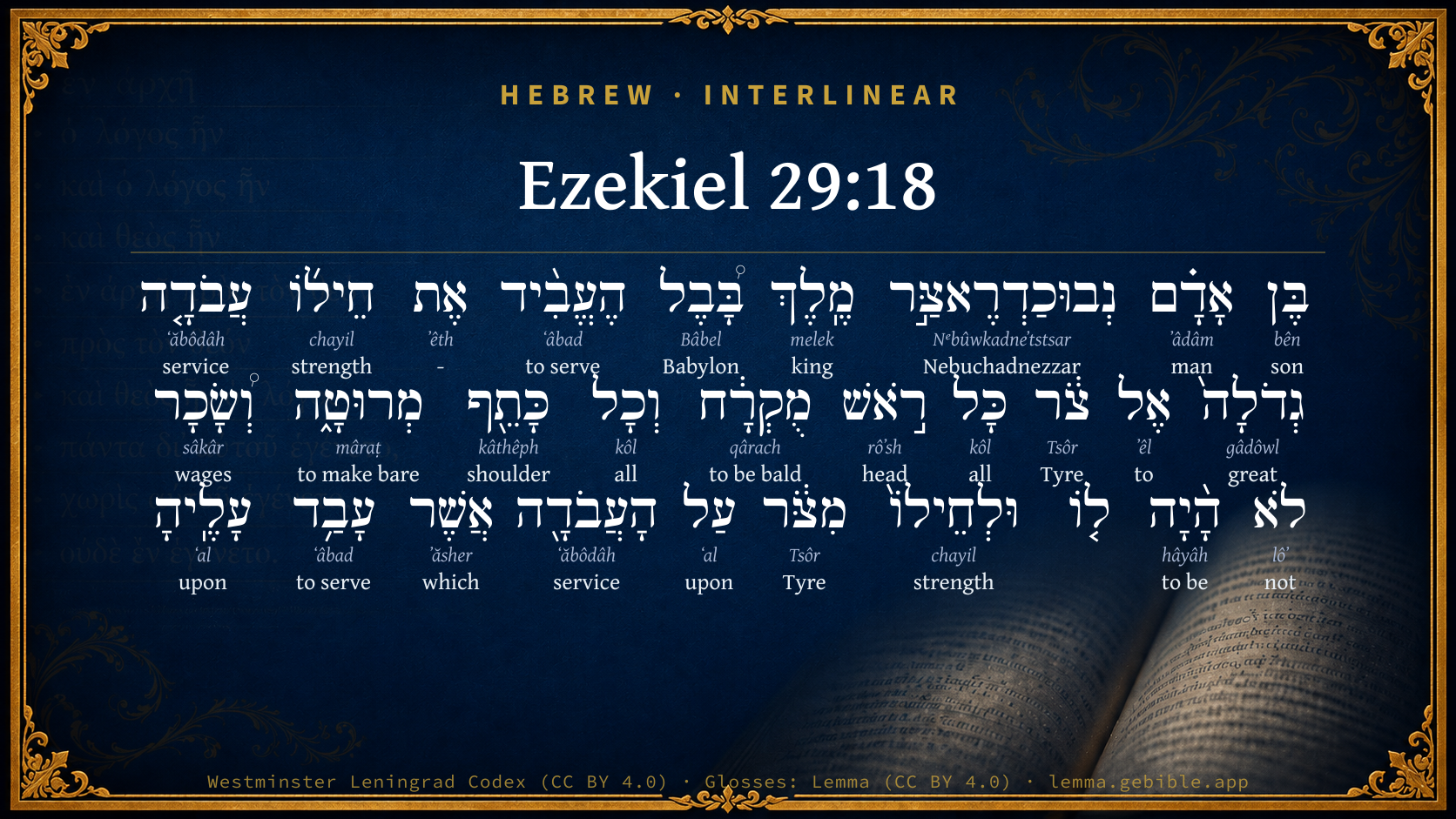
Ezekiel 29:18

Hebrew (Westminster Leningrad Codex) Ezekiel 29:18 appears in the Hebrew Old Testament. The text above is from the Westminster Leningrad Codex. Each word links to its Strong’s number, a concise gloss, and parsing drawn from the Open Scriptures Hebrew Bible morphology. Click any word for its full Brown-Driver-Briggs (BDB) entry.
Download image
Cite this verse

Ezekiel 29:18 (World English Bible). Public Domain. Lemma interlinear Bible study tool, https://lemma.gebible.app/v/ezekiel/29/18.

Show BibTeX & RIS
BibTeX
RIS
English Translation
Son of man, Nebuchadrezzar king of Babylon caused his army to serve a great service against Tyre: every head was made bald, and every shoulder was worn; yet had he no wages, nor his army, from Tyre, for the service that he had served against it.
World English Bible · Public Domain
Download a study sheet

One document with this verse’s original text, its word-by-word gloss line, the meaning frame, cross-references with their text, attributed commentary, and full source and license credits — printable, and it pastes into notes with its structure intact.

This verse Autodidact and up

Study sheet (.html) Plain text (.txt)

A passage Seminary Student

Up to 50 verses in one chapter. A passage sheet keeps up to 6 commentary sources and 12 cross-references per verse, in the order this page ranks them, and says so on the sheet whenever that leaves anything out. Ask for a single verse and you get the Autodidact verse sheet above.

Everything on this page stays free to read, with no account — the sheet is a download of what is already on screen, not access to it.

Want to remove ads? Support Godless Engineer
Compare translations 3

The same verse in 3 English versions, stacked beneath the original-language interlinear above. Click any original word for its lexicon entry.

Each is an independent rendering of the whole verse — the interlinear is not word-aligned to these translations.

Highlighted words mark where these versions differ — a whole-verse word diff, not a word-by-word alignment.

  • World English Bible Public Domain
    Son of man, Nebuchadrezzar king of Babylon caused his army to serve a great service against Tyre: every head was made bald, and every shoulder was worn; yet had he no wages, nor his army, from Tyre, for the service that he had served against it.
  • King James Version Public Domain
    Son of man, Nebuchadrezzar king of Babylon caused his army to serve a great service against Tyrus: every head was made bald, and every shoulder was peeled: yet had he no wages, nor his army, for Tyrus, for the service that he had served against it:
  • unfoldingWord Literal Text CC BY-SA 4.0
    “Son of man, Nebuchadnezzar the king of Babylon stationed his army to do hard work against Tyre. Every head was rubbed until it was made bald, and every shoulder was made raw. Yet he and his army received no payment from Tyre for the hard work that he carried out against it.

unfoldingWord Literal Text — © unfoldingWord, licensed CC BY-SA 4.0. Word-aligned USFM3 via Door43 (git.door43.org/unfoldingWord/en_ult).

Versions to compare (up to 4)

3 of 4 selected

Show all 18 translations

Every available English version of this verse, each an independent rendering of the whole verse.

  • World English Bible Public Domain
    Son of man, Nebuchadrezzar king of Babylon caused his army to serve a great service against Tyre: every head was made bald, and every shoulder was worn; yet had he no wages, nor his army, from Tyre, for the service that he had served against it.
  • Berean Standard Bible Public Domain
    “Son of man, Nebuchadnezzar king of Babylon caused his army to labor strenuously against Tyre. Every head was made bald and every shoulder made raw. But he and his army received no wages from Tyre for the labor they expended on it.
  • Majority Standard Bible Public Domain
    “Son of man, Nebuchadnezzar king of Babylon caused his army to labor strenuously against Tyre. Every head was made bald and every shoulder made raw. But he and his army received no wages from Tyre for the labor they expended on it.
  • King James Version Public Domain
    Son of man, Nebuchadrezzar king of Babylon caused his army to serve a great service against Tyrus: every head was made bald, and every shoulder was peeled: yet had he no wages, nor his army, for Tyrus, for the service that he had served against it:
  • American Standard Version (1901) Public Domain
    Son of man, Nebuchadrezzar king of Babylon caused his army to serve a great service against Tyre: every head was made bald, and every shoulder was worn; yet had he no wages, nor his army, from Tyre, for the service that he had served against it.
  • Revised Version (1885) Public Domain
    Son of man, Nebuchadrezzar king of Babylon caused his army to serve a great service against Tyre: every head was made bald, and every shoulder was peeled: yet had he no wages, nor his army, from Tyre, for the service that he had served against it:
  • Geneva Bible (1599) Public Domain
    Sonne of man, Nebuchad-nezzar King of Babel caused his armie to serue a great seruice against Tyrus: euery head was made balde, and euery shoulder was made bare: yet had he no wages, nor his armie for Tyrus, for the seruice that he serued against it.
  • Douay-Rheims (1899) Public Domain
    Son of man, Nabuchodonosor king of Babylon hath made his army to undergo hard service against Tyre: every head was made bald, and every shoulder was peeled: and there hath been no reward given him, nor his army for Tyre, for the service that he rendered me against
  • Young's Literal Translation Public Domain
    `Son of man, Nebuchadrezzar king of Babylon, Hath caused his force to serve a great service against Tyre, Every head `is' bald -- every shoulder peeled, And reward he had none, nor his force, out of Tyre, For the service that he served against it.
  • Literal Standard Version CC BY-SA 4.0
    “Son of man, Nebuchadnezzar king of Babylon, || Has caused his force to serve a great service against Tyre, || Every head [is] bald—every shoulder peeled, || And neither he, nor his force, had reward out of Tyre, || For the service that he served against it.
  • Unlocked Literal Bible CC BY-SA 4.0
    “Son of man, Nebuchadnezzar the king of Babylon stationed his army to do hard work against Tyre. Every head was rubbed until it was made bald, and every shoulder was made raw. Yet he and his army received no payment from Tyre for the hard work that he carried out against it.
  • unfoldingWord Literal Text CC BY-SA 4.0
    “Son of man, Nebuchadnezzar the king of Babylon stationed his army to do hard work against Tyre. Every head was rubbed until it was made bald, and every shoulder was made raw. Yet he and his army received no payment from Tyre for the hard work that he carried out against it.
  • Darby Bible Public Domain
    Son of man, Nebuchadrezzar king of Babylon caused his army to do hard service against Tyre; every head was made bald, and every shoulder was peeled: yet had he from Tyre no wages, nor his army, for the service that he had served against it.
  • World Messianic Bible Public Domain
    “Son of man, Nebuchadnezzar king of Babylon caused his army to serve a great service against Tyre. Every head was made bald, and every shoulder was worn; yet he had no wages, nor did his army, from Tyre, for the service that he had served against it.
  • Webster's Bible Public Domain
    Son of man, Nebuchadrezzar king of Babylon caused his army to serve a great service against Tyre: every head was made bald, and every shoulder was peeled: yet had he no wages, nor his army, for Tyre, for the service that he had served against it:
  • Free Bible Version CC BY-SA 4.0
    “Son of man, Nebuchadnezzar king of Babylon made his army work really hard in the siege against Tyre. The soldiers had their hair worn off their heads, and their shoulders rubbed raw. However, he and his army didn't gain any benefit from Tyre for all the work they did in attacking it.
  • Bible in Basic English Public Domain
    Son of man, Nebuchadrezzar, king of Babylon, made his army do hard work against Tyre, and the hair came off every head and every arm was rubbed smooth: but he and his army got no payment out of Tyre for the hard work which he had done against it.
  • JPS Tanakh (1917) Public Domain
    'Son of man, Nebuchadrezzar king of Babylon caused his army to serve a great service against Tyre; every head was made bald, and every shoulder was peeled; yet had he no wages, nor his army, from Tyre, for the service that he had served against it;

Literal Standard Version (2020), Covenant Press — licensed CC BY-SA 4.0. Text via the HelloAO Bible API (eBible.org). Unlocked Literal Bible (unfoldingWord) — licensed CC BY-SA 4.0. Text via the HelloAO Bible API (eBible.org). unfoldingWord Literal Text — © unfoldingWord, licensed CC BY-SA 4.0. Word-aligned USFM3 via Door43 (git.door43.org/unfoldingWord/en_ult). Free Bible Version, Dr. Jonathan Gallagher — licensed CC BY-SA 4.0. Text via the HelloAO Bible API (eBible.org).

Word by word

More ways to search: Search by grammar → Find every occurrence → Compare this word →

Practice this passage: Drill this verse → Learn its vocabulary →

מֻקְרָ֔ח
qârach
H7139
“bald”
Verb, Hophal, Participle Passive, Masculine, Singular, Absolute
Part of Speech
Verb
Stem
Hophal
Form
Participle Passive
Gender
Masculine
Number
Singular
State
Absolute
Full BDB Definition

Origin: a primitive root

TWOT: 2069

to be bald, make bald - (Qal) to make bald, make a baldness - (Niphal) to make oneself bald - (Hiphil) to make oneself bald - (Hophal) to make bald
  1. בֶּן bên H1121 “son of” Noun, Common, Masculine, Singular, Construct
  2. אָדָ֗ם ʼâdâm H120 “man” Noun, Common, Masculine, Singular, Absolute
  3. נְבוּכַדְרֶאצַּ֣ר Nᵉbûwkadneʼtstsar H5019 “Nebuchadnezzar” Noun, Proper
  4. מֶֽלֶךְ melek H4428 “king of” Noun, Common, Masculine, Singular, Construct
  5. בָּ֠בֶל Bâbel H894 “Babylon” Noun, Proper
  6. הֶעֱבִ֨יד ʻâbad H5647 “to serve” Verb, Hiphil, Perfect, 3rd Person, Masculine, Singular
  7. אֶת ʼêth H853 “-” Particle, Direct Object
  8. חֵיל֜וֹ chayil H2428 “strength · his” Noun, Common, Masculine, Singular, Construct + Suffix, Personal, 3rd Person, Masculine, Singular
  9. עֲבֹדָ֤ה ʻăbôdâh H5656 “service” Noun, Common, Feminine, Singular, Absolute
  10. גְדֹלָה֙ gâdôwl H1419 “great” Adjective, Adjective, Feminine, Singular, Absolute
  11. אֶל ʼêl H413 “to” Preposition
  12. צֹ֔ר Tsôr H6865 “Tyre” Noun, Proper
  13. כָּל kôl H3605 “all of” Noun, Common, Masculine, Singular, Construct
  14. רֹ֣אשׁ rôʼsh H7218 “head” Noun, Common, Masculine, Singular, Absolute
  15. וְכָל kôl H3605 “and · all of” Conjunction + Noun, Common, Masculine, Singular, Construct
  16. כָּתֵ֖ף kâthêph H3802 “shoulder” Noun, Common, Feminine, Singular, Absolute
  17. מְרוּטָ֑ה mâraṭ H4803 “made bare” Verb, Qal, Participle Passive, Feminine, Singular, Absolute
  18. וְ֠שָׂכָר sâkâr H7939 “and · wages” Conjunction + Noun, Common, Masculine, Singular, Absolute
  19. לֹא lôʼ H3808 “not” Particle, Negative
  20. הָ֨יָה hâyâh H1961 “to be” Verb, Qal, Perfect, 3rd Person, Masculine, Singular
  21. וּלְחֵילוֹ֙ chayil H2428 “and · to/for · strength · his” Conjunction + Preposition + Noun, Common, Masculine, Singular, Construct + Suffix, Personal, 3rd Person, Masculine, Singular
  22. מִצֹּ֔ר Tsôr H6865 “from · Tyre” Preposition + Noun, Proper
  23. עַל ʻal H5921 “upon” Preposition
  24. הָעֲבֹדָ֖ה ʻăbôdâh H5656 “the · service” Particle, Definite Article + Noun, Common, Feminine, Singular, Absolute
  25. אֲשֶׁר ʼăsher H834 “which” Particle, Relative
  26. עָבַ֥ד ʻâbad H5647 “to serve” Verb, Qal, Perfect, 3rd Person, Masculine, Singular
  27. עָלֶֽיהָ ʻal H5921 “upon · her” Preposition + Suffix, Personal, 3rd Person, Feminine, Singular

About this verse

These counts appear in no published source. They are computed here, from the morphology-tagged text and Lemma’s own curated glosses. What Lemma adds →

29
words
22
distinct lemmas
Prophets
section

Notable vocabulary

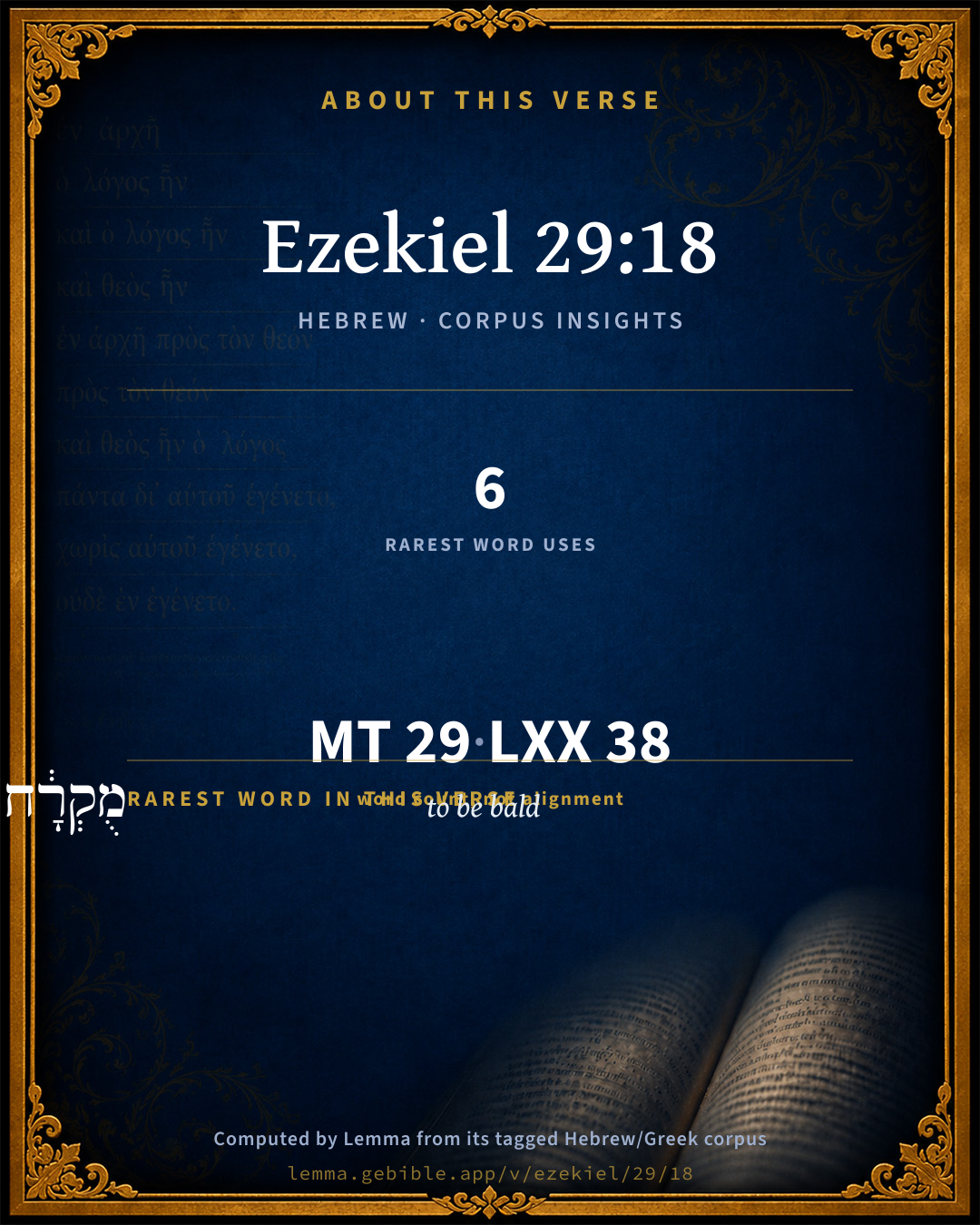
The rarest word here is מֻקְרָ֔ח to be bald H7139 — appearing just 6 times in the whole Hebrew Bible.

Shared distinctive vocabulary

מֻקְרָ֔ח to be bald H7139 occurs in 5 verses of the Hebrew Bible. Also found in:

Grammatical profile

  • 5 verbs
  • 16 nouns
  • 1 adjective
  • 4 prepositions
  • 3 particles

Verb forms

  • הֶעֱבִ֨יד Hiphil · Perfect
  • מֻקְרָ֔ח Hophal · Participle Passive
  • מְרוּטָ֑ה Qal · Participle Passive
  • הָ֨יָה Qal · Perfect
  • עָבַ֥ד Qal · Perfect

Repetition

Words recur within this verse — often emphatic in Hebrew:

  • הֶעֱבִ֨יד to serve H5647 ×2
  • חֵיל֜וֹ strength H2428 ×2
  • עֲבֹדָ֤ה service H5656 ×2
  • צֹ֔ר Tyre H6865 ×2
  • כָּל all H3605 ×2
  • עַל upon H5921 ×2

Hebrew & Septuagint length

In English translation the verse runs 46 words from the Hebrew and 48 from the Septuagint (LXX English) — closely comparable.

A rough comparison of the two English renderings, which tokenize alike — not a word-level alignment.

Word counts can differ between the Hebrew and the Greek without any difference in meaning — e.g. the Hebrew direct-object marker אֵת has no separate Greek word, and Greek often adds the article ὁ.

In the original languages it is 29 Hebrew tokens and 38 Greek tokens — but the two are counted differently (Hebrew bundles its prefixes and suffixes into one token; the Greek is in lemma form), so that isn’t a like-for-like length.

Cross-references

4

Topical passages linked to Ezekiel 29:18 in the Treasury of Scripture Knowledge — connected by theme and wording, ordered by reader-vote popularity; previews shown in the World English Bible.

  • Jeremiah 27:6 Now have I given all these lands into the hand of Nebuchadnezzar the king of Babylon, my servant; and the animals of the field also have I given him to serve him.
  • Jeremiah 25:9 behold, I will send and take all the families of the north, says Yahweh, and [I will send] to Nebuchadrezzar the king of Babylon, my servant, and will bring them against this land, and against the inhabitants of it, and against all these nations round about; and I will utterly destroy them, and make them an astonishment, and a hissing, and perpetual desolations.
  • Ezekiel 26:7–12 For thus says the Lord Yahweh: Behold, I will bring on Tyre Nebuchadrezzar king of Babylon, king of kings, from the north, with horses, and with chariots, and with horsemen, and a company, and much people.
  • Jeremiah 48:37 For every head is bald, and every beard clipped: on all the hands are cuttings, and on the loins sackcloth.

Cross-references courtesy of OpenBible.info (CC BY 4.0).

Hebrew and Greek witnesses Masoretic Hebrew ↔ Greek Septuagint

The same verse in the two great witnesses to the Old Testament, shown verse-for-verse.

These are two independent witnesses, not word-aligned to each other, and the Septuagint is shown in lemma (dictionary) form.

Hebrew Ezekiel 29:18 Masoretic · Westminster Leningrad Codex

בֶּן אָדָ֗ם נְבוּכַדְרֶאצַּ֣ר מֶֽלֶךְ בָּ֠בֶל הֶעֱבִ֨יד אֶת חֵיל֜וֹ עֲבֹדָ֤ה גְדֹלָה֙ אֶל צֹ֔ר כָּל רֹ֣אשׁ מֻקְרָ֔ח וְכָל כָּתֵ֖ף מְרוּטָ֑ה וְ֠שָׂכָר לֹא הָ֨יָה ל֤וֹ וּלְחֵילוֹ֙ מִצֹּ֔ר עַל הָעֲבֹדָ֖ה אֲשֶׁר עָבַ֥ד עָלֶֽיהָ

Son of man, Nebuchadrezzar king of Babylon caused his army to serve a great service against Tyre: every head was made bald, and every shoulder was worn; yet had he no wages, nor his army, from Tyre, for the service that he had served against it.

World English Bible · Public Domain

Greek LXX Ezekiel 29:18 Septuagint · lemma form

υἱός ἄνθρωπος ναβουχοδονοσορ βασιλεύς βαβυλών καταδουλόω αὐτός ὁ δύναμις δουλεία μέγας ἐπί τύρος πᾶς κεφαλή φαλακρός καί πᾶς ὦμος μαδάω καί μισθός οὐ γίγνομαι αὐτός καί ὁ δύναμις αὐτός ἐπί τύρος καί ὁ δουλεία ὅς δουλεύω ἐπί αὐτός

Son of man, Nabuchodonosor king of Babylon caused his army to serve a great service against Tyre; every head was bald, and every shoulder peeled; yet there was no reward to him or to his army serving against Tyre, nor for the service wherewith they served against it.

LXX2012 (modern English Septuagint) · Public Domain

Hebrew: Westminster Leningrad Codex (CC BY 4.0). Greek: Septuagint (public domain); English from LXX2012 (modern English Septuagint) (Public Domain). How the Septuagint differs from the Hebrew →

Targum (Aramaic paraphrase)

1

The Targum is the ancient Jewish Aramaic paraphrase of the Hebrew Scriptures — an interpretive translation, not the Hebrew text itself. Onkelos (literal) and Pseudo-Jonathan (expansive) render the Torah, and Jonathan the Prophets. Coverage is partial: where no permissively-licensed English translation exists for a verse, only the Aramaic is shown. This is verse-level text, not a word-by-word alignment to the Hebrew.

  1. Targum Jonathan Prophets (Joshua–Malachi)
    בַּר אָדָם נְבוּכַדְרֶאצַר מַלְכָּא דְבָבֶל אַפְלַח יַת מַשִׁרְיָתֵיהּ פּוּלְחַן רַב עַל כָּל סְעַר רֵישׁ נַתֵּר וְכָל כְתַף אִתְמְרַט וַאֲגָר לָא הֲוָה לֵיהּ וּלְמַשִׁרְיָתֵיהּ מִצוֹר עַל פּוּלְחָנָא דְאַפְלַח עֲלָהּ:

    (no public-domain English translation for this verse)

    Targum Jonathan — Aramaic: “Mikraot Gedolot” (public domain). English: “Sefaria Community Translation” (CC0 1.0 (public-domain dedication)); “London "Chaldee Paraphrase," 1871” (public domain). Text via Sefaria.

Commentary

Notes on Ezekiel 29:18 from classic Christian and Jewish commentators (each source and its license shown beneath its notes). The classic Christian expositions comment on the surrounding passage and are grouped to its opening verse, so a note may address several verses; the Jewish commentaries on the Tanakh (Rashi and others) are per-verse, so they appear only where the commentator wrote on this verse.

Lemma curates 59 commentaries, every one of them public domain or Creative Commons licensed, each selected and text-cleaned for this edition rather than reprinted as found. About our sources →

Trapp's Complete Commentary

John Trapp

Eze 29:18 Son of man, Nebuchadrezzar king of Babylon caused his army to serve a great service against Tyrus: every head [was] made bald, and every shoulder [was] peeled: yet had he no wages, nor his army, for Tyrus, for the service that he had served against it:

Ver. 18. To serve a great service.] For thirteen years together, as saith Josephus.

Every head was made bald,] sc., By continual carrying, upon their heads and shoulders, earth, wood, and stones - for which they were much laughed at by the Tyrian soldiers - to fill up that strait of the sea which separated Tyre from the continent, before it could be taken.

Yet had he no wages.] The Tyrians, when they saw they could hold out no longer, had sent much of their wealth away to Carthage and other places; much of it also they cast into the seat saith Lyra; so that Nebuchadnezzar, at his entrance, found nothing but a bare rock, - saith Jerome, out of an old Assyrian chronicle.

John Trapp, A Commentary or Exposition upon All the Books of the Old and New Testament (1647–1656) — public domain. Text from a community e-Sword module.

Tyndale Open Study Notes

Tyndale Open Resources

29:18-20 Nebuchadnezzar’s campaign against Tyre (chs 26–28) had required a great deal of effort on the Babylonians’ part for very little return in plunder. But the Lord considers his workers worthy of their hire, so to compensate them for all their work, he would reward them with the land of Egypt.

Tyndale Open Study Notes — © Tyndale Open Resources, licensed CC BY-SA 4.0. Text via the HelloAO Bible API.

Geneva Bible (1599)

Geneva Bible translators

Signifying that Nebuchadnezzar had more pains than profit, by the taking of Tyre.

He took great pains at the siege of Tyre, and his army was sore handled.

Geneva Bible (1599) marginal notes — public domain. Text via Bolls.life.

Jamieson, Fausset & Brown

Robert Jamieson, A. R. Fausset & David Brown

every head . . . bald, . . . shoulder . . . peeled--with carrying baskets of earth and stones for the siege works.

no wages . . . for the service--that is, in proportion to it and the time and labor which he expended on the siege of Tyre. Not that he actually failed in the siege (JEROME expressly states, from Assyrian histories, that Nebuchadnezzar succeeded); but, so much of the Tyrian resources had been exhausted, or transported to her colonies in ships, that little was left to compensate Nebuchadnezzar for his thirteen year's siege.

Jamieson, Fausset & Brown — Commentary Critical and Explanatory on the Whole Bible (1871) — public domain (CC PDM 1.0). Text via the HelloAO Bible API.

Adam Clarke's Commentary

Verse 18. Caused his army to serve a great service against Tyrus] He was thirteen years employed in the siege. See Joseph. Antiq. lib. x. c. 11. In this siege his soldiers endured great hardships. Being continually on duty, their heads became bald by wearing their helmets; and their shoulders bruised and peeled by carrying baskets of earth to the fortifications, and wood, c., to build towers, &c.

Yet had he no wages, nor his army] The Tyrians, finding it at last impossible to defend their city, put all their wealth aboard their vessels, sailed out of the port, and escaped for Carthage and thus Nebuchadnezzar lost all the spoil of one of the richest cities in the world.

Adam Clarke's Commentary on the Bible (1810–1826) — public domain. Text from a community e-Sword/MySword module.

Ellicott's Commentary for English Readers

(18) Yet had he no wages.—The siege of Tyre is here represented as a service to God, for which Nebuchadnezzar had not yet received his reward. This is quite in accordance with the whole Scriptural representation of that monarch, as a man raised up to execute God’s judgments. He was himself unconscious of this, and yet did that which had been foretold—a striking instance that “there is a God in history.” It has been argued from this verse, and from the fact that there is no especial mention in history of the result of the siege of Tyre, that Nebuchadnezzar failed in its capture; but all that is meant is that he failed to obtain any considerable booty thereby, the Tyrians having abundant warning and opportunity to convey away their valuables by sea. This St. Jerome expressly asserts to have been done by them, and he further describes the method of the capture of the city by the same means afterwards used by Alexander, that of building a mole from the mainland to the island; thus explaining how in the besieging army “every head was made bald, and every shoulder was peeled” by the bearing of burdens for the structure. Berosus expressly testifies that Nebuchadnezzar “conquered all Syria and Phœnicia” (Jos. c. Ap., i. 21); and Josephus also cites Philostratus, Megasthenes, and Diocles as mentioning Nebuchadnezzar’s exploits and the siege of Tyre in a way which, while they do not directly mention, yet certainly imply the capture of the city (ibid., and Antt. x. 11, § 1). Besides, it is inconceivable that Ezekiel, who long survived that siege, should have left that prophecy on record if the event was otherwise than as he predicted.

A Bible Commentary for English Readers, edited by Charles John Ellicott (1878–1897) — public domain. Text from a community e-Sword module.

The Cambridge Bible for Schools and Colleges

gen. ed. J. J. S. Perowne

18. On spelling of Nebuchadnezzar cf. Eze_26:7, Eze_30:10.

every head made bald] Not by the length of time but by the hard service, the rubbing of the armour or the burdens borne on head and shoulder. Arabic poets refer to the baldness caused by the headpieces. The siege of Tyre lasted thirteen years, but while this is well attested history is silent as to the issue of the siege. Whatever the issue was Neb. and his army did not reap adequate reward from it—he had no wages for his service done for Jehovah.

The Cambridge Bible for Schools and Colleges (gen. ed. J. J. S. Perowne; Cambridge University Press, 1878–1918) — public domain. Text from a community e-Sword module.

John Gill's Exposition

Son of man, Nebuchadrezzar king of Babylon,.... The same with Nebuchadnezzar; he goes by both names in Scripture, nor is the difference very great:

caused his army to serve a great service against Tyrus; in besieging it thirteen years (c) before he was able to take it; during which time his army suffered much hardship, was greatly fatigued and wearied, by the various military works they were engaged in, to carry on the siege so long a time:

every head was made bald, and every shoulder was peeled: the heads of the soldiers became bald with wearing their helmets so long, or carrying baskets of earth and timber upon them, to make mounts with; and the skin of their shoulders was peeled off, either with their armour, or by carrying burdens on them for the above purpose; or, as Jerom says, from the Assyrian annals, to make a causeway to join the island to the continent, that so they might come at it with their battering rams, and demolish it:

yet hath he no wages; nor his army, for Tyrus; for besieging it; for, as the same Jerom observes when the Tyrians found that the city was like to be taken by him, their gold and silver, and whatsoever was valuable that was with them, they put on and sent it to other islands; or, as others say, that when Tyre on the continent, which was what Nebuchadnezzar besieged, was about to be taken, the inhabitants transplanted their riches to the island at some distance, where new Tyre was afterwards built; however, what with the consumption of their riches during this thirteen years' siege, and the removing their effects to other places before the taking of the city there was scarce anything left for the plunder of king of Babylon's army, so that he and that had nothing to requite them:

for the service that he had served against it: it must have cost him a great deal of money to support such a numerous army for so long a time, as well as the siege was very toilsome and laborious; and yet, when the city was taken, there was nothing found in it to answer this expense and labour.

(c) Hist. Physic. spud Joseph. adv. Aplon, l. 1. c. 21.

John Gill's Exposition of the Whole Bible (1746–1763) — public domain (CC PDM 1.0). Text via the HelloAO Bible API.

Haydock's Catholic Bible Commentary

Peeled, with carrying machines of war and burdens for thirteen years. --- No reward worth the labour. The new city surrendered upon terms, (Calmet) or the citizens shipped off their most valuable goods, and retired to Carthage, &c. God gives a temporal reward for moral virtues, (St. Jerome) even to infidels. (Worthington) --- Thus he rewarded the ancient Romans, and the midwives. (St. Augustine, City of God v. 12.; and St. Thomas Aquinas, [Summa Theologiae] i. 2. q. 114. a. 10.) --- They had no intention of pleasing God, (Calmet) or of directing their labours for his service. (Haydock)

George Leo Haydock (1774–1849), Haydock's Catholic Family Bible and Commentary, 1859 edition — public domain. Excludes Psalms (Douay-Rheims chapter numbering differs from Protestant) and Deuterocanonical books (Catholic canon only).

Matthew Poole's English Annotations

His army: the army, the inferior officers, and principal commanders, it is like, were weary of the siege, and might advise the raising it; but the authority, presence, and immovable resolution of the king kept them on still, and made them hold out.

A great service; it was service to the justice of God in punishing the Tyrians by the ambition of Nebuchadnezzar, who would not endure any thing to stand against him. It was great service, both for hardness of work, heaviness of burdens, and unreasonable length of the siege, thirteen years together.

Every head was made bald; either age, or sicknesses, (which often make men bald,) or continued wearing of the helmets, spoiled the best heads of hair amongst them; or perhaps it noteth the weeping bargain they had, though they mastered Tyre, where they got no booty; and both Nebuchadnezzar and his army might shave their heads, in token of mourning for their loss, rather than crown their heads with garlands of joy for gaining of the city.

Every shoulder was peeled; either clothes wore out, they had scarce any to their backs in so long a siege, or galled and blistered with carrying burdens, stones, timber, iron, and earth for fortifications, and to make a passage from the continent to Tyre; which sores, when healed, left scabs or dead skin that peeled off.

He had no wages; for though Tyre was very rich when first besieged, no doubt very much wealth was carried away by shipping at the beginning and during the siege, which none could prevent, very much spent and wasted in the siege, and what was left preserved by articles of surrender; for most conclude that it was delivered on composition, and the conqueror had only victory for his pains and charge.

Matthew Poole's English Annotations on the Holy Bible (1683–1685) — public domain. Text from a community e-Sword/MySword module.

The Pulpit Commentary

Nebuchadnezzar, etc. The words carry us to the close of the thirteen years" siege of Tyro referred to in the notes on Eze 28, and enable us to refer the commencement of that siege to the fourteenth year of Jehoiachin"s captivity, circ. B.C. 586, two years after the destruction of Jerusalem. This agrees with the report of the Tyrian Annals given by Josephus ("Contra Apion," 1:21), who gives the names of the kings of Tyro from Ithobal to Hirom, in the fourteenth year of whose reign Cyrus became King of Persia. Josephus, however, gives the seventh, in. stead of the seventeenth, year of Nebuchadnezzar as the date of the beginning of the siege. Here the point dwelt on is not the success of the siege, but its comparative failure. The labors and sufferings of the besiegers had been immense. Jerome (in loc.) states (not, however, giving his authority) that these labors consisted mainly in the attempt to fill up the strait between the island-city and the mainland with masses of stone and rubbish. These were carried on the heads and shoulders of the troops, and the natural result was that the former lost their hair and the latter their skin, and the whole army was in a miserable plight. And after all, the king had no wages for his labors. The city indeed, was taken, but the inhabitants made their escape by sea, with their chief possessions, and the hopes of spoil were disappointed.

The Pulpit Commentary (1880–1919), ed. H.D.M. Spence-Jones & Joseph S. Exell — public domain. Text from a community e-Sword module.

John Wesley's Explanatory Notes

Caused - The army, and commanders were weary of the siege, but the immovable resolution of the king kept them on. A great service - It was service to the justice of God. It was great service both for hardness of work, heaviness of burdens, and length of the siege, thirteen years together. Made bald - Through age, or sicknesses, or continued wearing of helmets. Peeled - Galled with carrying burdens. No wages - For though Tyre was very rich, when first besieged, much wealth was carried away during the siege, much spent and wasted in the siege, and what was left, preserved by articles of surrender.

John Wesley, Explanatory Notes Upon the Whole Bible (1754–1765) — public domain. Text via the GEBible commentary corpus.

Rashi

Rabbi Shlomo Yitzchaki (Rashi)

made his army serve [a great work against Tyre] [Heb. צוּר אֵל, usually to here means] against Tyre, [in] a great work.

every head the men of his forces

became bald and every shoulder, etc. As is the custom with those who besiege a city many days and toil and weary themselves with carrying burdens of wood and stones. He captured Tyre in the twenty third [year] of his reign, as we find in Seder Olam (ad loc.). מֻקְרָח means calvo in Italian, bald.

sore [Heb. מְרוּטָה,] pelee in Old French, peeled.

yet he had no reward After they had plundered its booty, the sea rose and washed it away from them, because it was decreed on it and on its booty to be lost in the sea.

Rashi on the Tanakh — English translations: “The Judaica Press complete Tanach with Rashi, translated by A. J. Rosenberg” (CC BY 4.0); “Pentateuch with Rashi's commentary by M. Rosenbaum and A.M. Silbermann, 1929-1934” (public domain); “The Metsudah Tanach series, Lakewood, N.J” (CC BY 4.0); and “The Book of Joshua, Metsudah Publications, 1997” (CC BY 4.0). Text via Sefaria.

Lesson kit

Teaching starters — assembled from the data on this page, not authored interpretation. Every prompt links to the verse data it draws on. Edit before teaching.

Ezekiel, in the Prophets, opens this verse with 29 words (22 distinct Hebrew lemmas). Its most distinctive word is qârach (“to be bald”). A historical commentator’s framing appears above. Read the whole chapter for the surrounding context.

Discussion questions

  1. The word qârach carries the sense “to be bald.” How does it shape the verse?
  2. How does Leviticus 21:5, which shares the word «to be bald», read alongside this verse?
  3. What does the repetition of “to serve” (2× in this one verse) do in this verse?
  4. The translations on this page render this verse differently — a whole-verse word diff, not a word-by-word alignment. What might account for the different wordings?
  5. «הֶעֱבִ֨יד» is a Hiphil Perfect verb. How does that grammatical form shape the action described?
  6. Compare how Trapp's Complete Commentary and Tyndale Open Study Notes read this verse. Where do they agree or differ?

Things to notice

Reading settings

Reading text

Shown beneath each verse's original-language words.

Old Testament
Old Testament edition

Read the OT as the Masoretic Hebrew (MT) or the Greek Septuagint (LXX).

English shown for the Greek Septuagint (in the Hebrew ↔ Greek comparison).

Comparing translations? Open the Compare panel on any verse page to stack up to four side by side.