Jeremiah 15:13

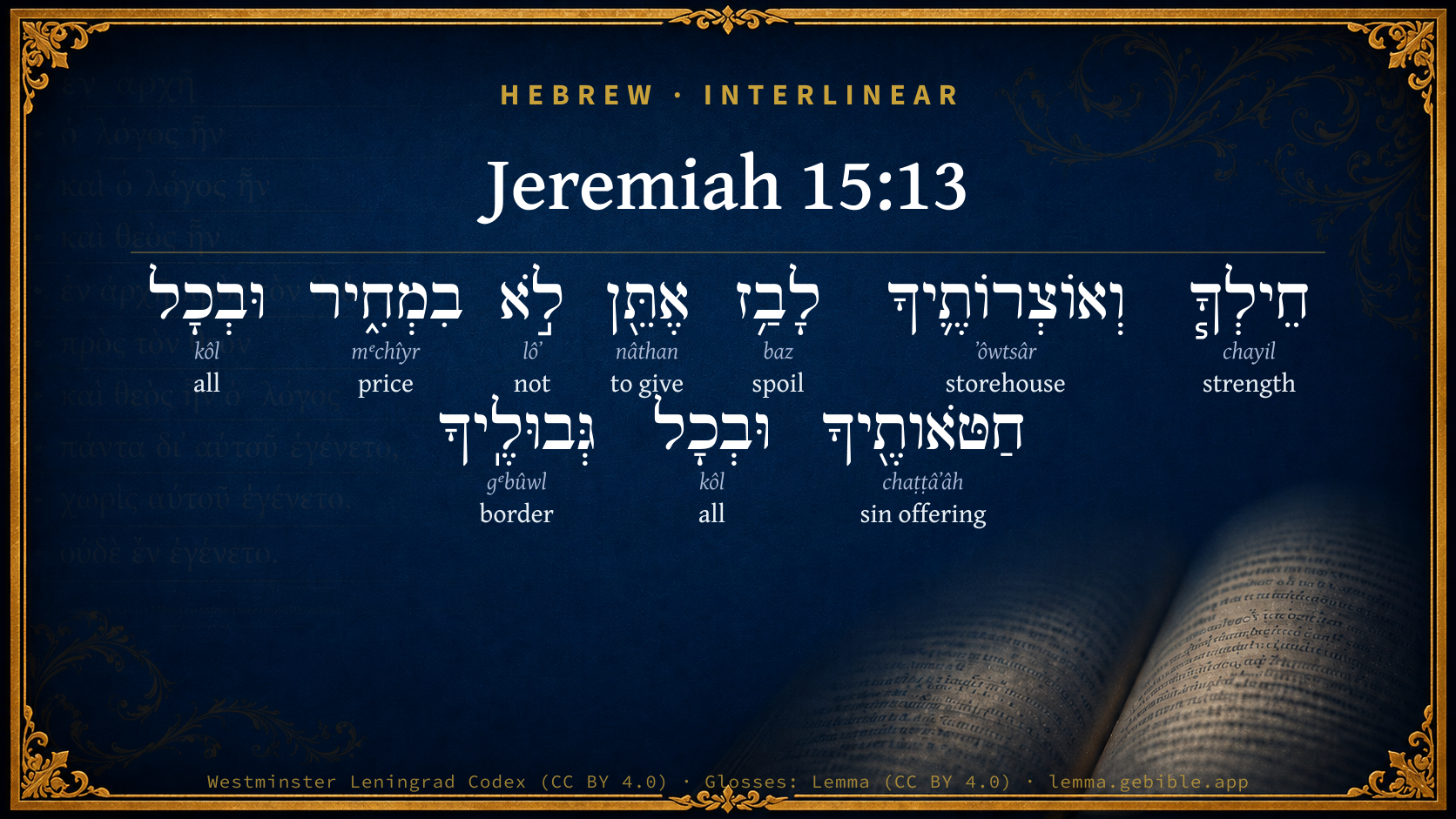
Hebrew (Westminster Leningrad Codex) Jeremiah 15:13 appears in the Hebrew Old Testament. The text above is from the Westminster Leningrad Codex. Each word links to its Strong’s number, a concise gloss, and parsing drawn from the Open Scriptures Hebrew Bible morphology. Click any word for its full Brown-Driver-Briggs (BDB) entry.
Download image
Cite this verse

Jeremiah 15:13 (World English Bible). Public Domain. Lemma interlinear Bible study tool, https://lemma.gebible.app/v/jeremiah/15/13.

Show BibTeX & RIS
BibTeX
RIS
English Translation
Your substance and your treasures will I give for a spoil without price, and that for all your sins, even in all your borders.
World English Bible · Public Domain
Download a study sheet

One document with this verse’s original text, its word-by-word gloss line, the meaning frame, cross-references with their text, attributed commentary, and full source and license credits — printable, and it pastes into notes with its structure intact.

This verse Autodidact and up

Study sheet (.html) Plain text (.txt)

A passage Seminary Student

Up to 50 verses in one chapter. A passage sheet keeps up to 6 commentary sources and 12 cross-references per verse, in the order this page ranks them, and says so on the sheet whenever that leaves anything out. Ask for a single verse and you get the Autodidact verse sheet above.

Everything on this page stays free to read, with no account — the sheet is a download of what is already on screen, not access to it.

Want to remove ads? Support Godless Engineer
Compare translations 3

The same verse in 3 English versions, stacked beneath the original-language interlinear above. Click any original word for its lexicon entry.

Each is an independent rendering of the whole verse — the interlinear is not word-aligned to these translations.

Highlighted words mark where these versions differ — a whole-verse word diff, not a word-by-word alignment.

  • World English Bible Public Domain
    Your substance and your treasures will I give for a spoil without price, and that for all your sins, even in all your borders.
  • King James Version Public Domain
    Thy substance and thy treasures will I give to the spoil without price, and that for all thy sins, even in all thy borders.
  • unfoldingWord Literal Text CC BY-SA 4.0
    Your wealth and your treasures I will give for plunder, with no price, because of all your sins, and throughout your territories.

unfoldingWord Literal Text — © unfoldingWord, licensed CC BY-SA 4.0. Word-aligned USFM3 via Door43 (git.door43.org/unfoldingWord/en_ult).

Versions to compare (up to 4)

3 of 4 selected

Show all 18 translations

Every available English version of this verse, each an independent rendering of the whole verse.

  • World English Bible Public Domain
    Your substance and your treasures will I give for a spoil without price, and that for all your sins, even in all your borders.
  • Berean Standard Bible Public Domain
    Your wealth and your treasures I will give up as plunder, without charge for all your sins within all your borders.
  • Majority Standard Bible Public Domain
    Your wealth and your treasures I will give up as plunder, without charge for all your sins within all your borders.
  • King James Version Public Domain
    Thy substance and thy treasures will I give to the spoil without price, and that for all thy sins, even in all thy borders.
  • American Standard Version (1901) Public Domain
    Thy substance and thy treasures will I give for a spoil without price, and that for all thy sins, even in all thy borders.
  • Revised Version (1885) Public Domain
    Thy substance and thy treasures will I give for a spoil without price, and that for all thy sins, even in all thy borders.
  • Geneva Bible (1599) Public Domain
    Thy substance and thy treasures wil I giue to be spoyled without gaine, and that for all thy sinnes euen in all thy borders.
  • Douay-Rheims (1899) Public Domain
    Thy riches and thy treasures I will give unto spoil for nothing, because of all thy sins, even in all thy borders.
  • Young's Literal Translation Public Domain
    Thy strength and thy treasures For a prey I do give -- not for price, Even for all thy sins, and in all thy borders.
  • Literal Standard Version CC BY-SA 4.0
    I give your strength and your treasures for a prey—not for price, || Even for all your sins, and in all your borders.
  • Unlocked Literal Bible CC BY-SA 4.0
    I will give to your enemies your wealth and treasures as free plunder. I will do this because of all your sins committed within all your borders.
  • unfoldingWord Literal Text CC BY-SA 4.0
    Your wealth and your treasures I will give for plunder, with no price, because of all your sins, and throughout your territories.
  • Darby Bible Public Domain
    Thy substance and thy treasures will I give to the spoil without price, and that for all thy sins, and in all thy borders;
  • World Messianic Bible Public Domain
    I will give your substance and your treasures for a plunder without price, and that for all your sins, even in all your borders.
  • Webster's Bible Public Domain
    Thy substance and thy treasures will I give to the spoil without price, and that for all thy sins, even in all thy borders.
  • Free Bible Version CC BY-SA 4.0
    I will give away your wealth and valuable possessions for free. They will become plunder for your enemies because of all the sins you committed throughout your country.
  • Bible in Basic English Public Domain
    I will give your wealth and your stores to your attackers, without a price, because of all your sins, even in every part of your land.
  • JPS Tanakh (1917) Public Domain
    Thy substance and thy treasures will I give for a spoil without price, and that for all thy sins, even in all thy borders.

Literal Standard Version (2020), Covenant Press — licensed CC BY-SA 4.0. Text via the HelloAO Bible API (eBible.org). Unlocked Literal Bible (unfoldingWord) — licensed CC BY-SA 4.0. Text via the HelloAO Bible API (eBible.org). unfoldingWord Literal Text — © unfoldingWord, licensed CC BY-SA 4.0. Word-aligned USFM3 via Door43 (git.door43.org/unfoldingWord/en_ult). Free Bible Version, Dr. Jonathan Gallagher — licensed CC BY-SA 4.0. Text via the HelloAO Bible API (eBible.org).

Word by word

More ways to search: Search by grammar → Find every occurrence → Compare this word →

Practice this passage: Drill this verse → Learn its vocabulary →

בִמְחִ֑יר
mᵉchîyr
H4242
“in/at · price”
Preposition + Noun, Common, Masculine, Singular, Absolute
Part of Speech
Preposition + Noun
Type
Common
Gender
Masculine
Number
Singular
State
Absolute
Full BDB Definition

Origin: from an unused root meaning to buy

TWOT: 1185c

price, hire - price - hire, reward, gain
  1. חֵילְךָ֧ chayil H2428 “strength · your” Noun, Common, Masculine, Singular, Construct + Suffix, Personal, 2nd Person, Masculine, Singular
  2. וְאוֹצְרוֹתֶ֛יךָ ʼôwtsâr H214 “and · storehouses · your” Conjunction + Noun, Common, Masculine, Plural, Construct + Suffix, Personal, 2nd Person, Masculine, Singular
  3. לָבַ֥ז baz H957 “to/for · spoil” Preposition + Noun, Common, Masculine, Singular, Absolute
  4. אֶתֵּ֖ן nâthan H5414 “to give” Verb, Qal, Imperfect, 1st Person, Common, Singular
  5. לֹ֣א lôʼ H3808 “not” Particle, Negative
  6. וּבְכָל kôl H3605 “and · in/at · all of” Conjunction + Preposition + Noun, Common, Masculine, Singular, Construct
  7. חַטֹּאותֶ֖יךָ chaṭṭâʼâh H2403 “sin offerings · your” Noun, Common, Feminine, Plural, Construct + Suffix, Personal, 2nd Person, Masculine, Singular
  8. וּבְכָל kôl H3605 “and · in/at · all of” Conjunction + Preposition + Noun, Common, Masculine, Singular, Construct
  9. גְּבוּלֶֽיךָ gᵉbûwl H1366 “borders · your” Noun, Common, Masculine, Plural, Construct + Suffix, Personal, 2nd Person, Masculine, Singular

About this verse

These counts appear in no published source. They are computed here, from the morphology-tagged text and Lemma’s own curated glosses. What Lemma adds →

10
words
9
distinct lemmas
Prophets
section

Notable vocabulary

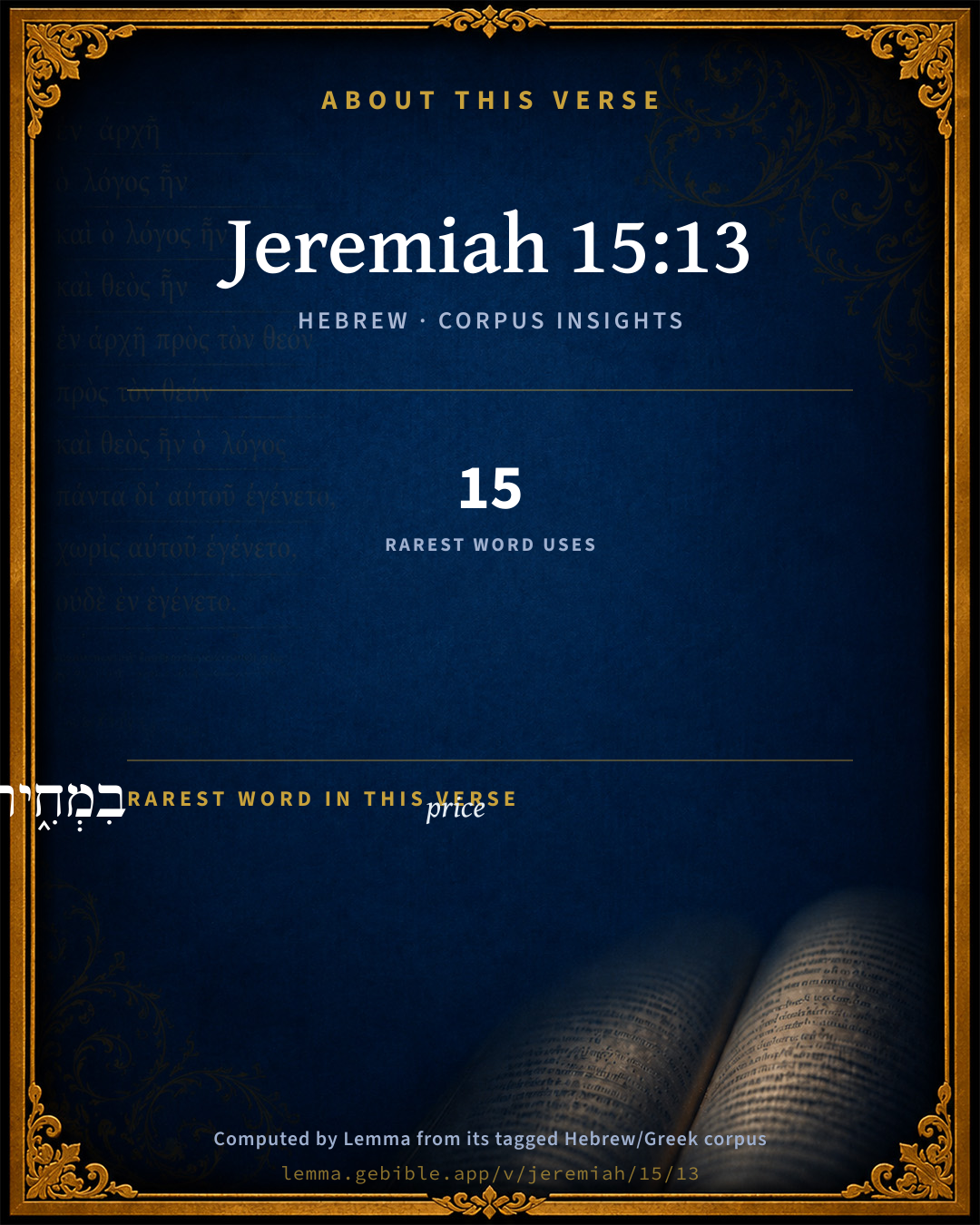
The rarest word here is בִמְחִ֑יר price H4242 — appearing just 15 times in the whole Hebrew Bible.

Shared distinctive vocabulary

בִמְחִ֑יר price H4242 occurs in 15 verses of the Hebrew Bible. Also found in:

Grammatical profile

  • 1 verb
  • 8 nouns
  • 1 particle

Verb forms

  • אֶתֵּ֖ן Qal · Imperfect

Repetition

A word recurs within this verse — often emphatic in Hebrew:

  • וּבְכָל all H3605 ×2

Cross-references

6

Topical passages linked to Jeremiah 15:13 in the Treasury of Scripture Knowledge — connected by theme and wording, ordered by reader-vote popularity; previews shown in the World English Bible.

  • Jeremiah 17:3 My mountain in the field, I will give your substance and all your treasures for a spoil, [and] your high places, because of sin, throughout all your borders.
  • Psalms 44:12 You sell your people for nothing, And have gained nothing from their sale.
  • Isaiah 52:3 For thus says Yahweh, You were sold for nothing; and you shall be redeemed without money.
  • Jeremiah 20:5 Moreover I will give all the riches of this city, and all the gains of it, and all the precious things of it, yes, all the treasures of the kings of Judah will I give into the hand of their enemies; and they shall make them a prey, and take them, and carry them to Babylon.
  • Isaiah 52:5 Now therefore, what do I here, says Yahweh, seeing that my people is taken away for nothing? those who rule over them do howl, says Yahweh, and my name continually all the day is blasphemed.
  • Jeremiah 15:8 Their widows are increased to me above the sand of the seas; I have brought on them against the mother of the young men a destroyer at noonday: I have caused anguish and terrors to fall on her suddenly.

Cross-references courtesy of OpenBible.info (CC BY 4.0).

Hebrew and Greek witnesses Masoretic Hebrew ↔ Greek Septuagint

The same verse in the two great witnesses to the Old Testament, shown verse-for-verse.

These are two independent witnesses, not word-aligned to each other, and the Septuagint is shown in lemma (dictionary) form.

Hebrew Jeremiah 15:13 Masoretic · Westminster Leningrad Codex

חֵילְךָ֧ וְאוֹצְרוֹתֶ֛יךָ לָבַ֥ז אֶתֵּ֖ן לֹ֣א בִמְחִ֑יר וּבְכָל חַטֹּאותֶ֖יךָ וּבְכָל גְּבוּלֶֽיךָ

Your substance and your treasures will I give for a spoil without price, and that for all your sins, even in all your borders.

World English Bible · Public Domain

Greek LXX Structure differs

In the Septuagint, Jeremiah is about an eighth shorter than the Hebrew and arranges its material differently — the Oracles Against the Nations (Hebrew chapters 46–51) appear in the middle of the Greek book, after 25:13. Because the chapter and verse boundaries do not line up, a verse-for-verse comparison with the Hebrew is not shown.

A verse-for-verse comparison isn’t shown here because the chapters and verses don’t line up. Switch to the LXX edition with the MT / LXX toggle above to read the Greek directly.

On this verse, John Gill's Exposition discusses the Septuagint’s reading. Read the note in Commentary ↓

Hebrew: Westminster Leningrad Codex (CC BY 4.0). Greek: Septuagint (public domain); English from a public-domain English Septuagint. How the Septuagint differs from the Hebrew →

Targum (Aramaic paraphrase)

1

The Targum is the ancient Jewish Aramaic paraphrase of the Hebrew Scriptures — an interpretive translation, not the Hebrew text itself. Onkelos (literal) and Pseudo-Jonathan (expansive) render the Torah, and Jonathan the Prophets. Coverage is partial: where no permissively-licensed English translation exists for a verse, only the Aramaic is shown. This is verse-level text, not a word-by-word alignment to the Hebrew.

  1. Targum Jonathan Prophets (Joshua–Malachi)
    נִכְסֵיכוֹן וּבֵית גִנְזֵיכוֹן לְבִזָא אֶמְסַר לָא בְּדָמִין בְּחוֹבִין דַהֲוֵיתוּן פָּלְחִין לְטַעֲוָתָא וּבְכָל תְּחוּמֵיכוֹן:

    (no public-domain English translation for this verse)

    Targum Jonathan — Aramaic: “Mikraot Gedolot” (public domain). English: “Sefaria Community Translation” (CC0 1.0 (public-domain dedication)); “London "Chaldee Paraphrase," 1871” (public domain). Text via Sefaria.

Commentary

Notes on Jeremiah 15:13 from classic Christian and Jewish commentators (each source and its license shown beneath its notes). The classic Christian expositions comment on the surrounding passage and are grouped to its opening verse, so a note may address several verses; the Jewish commentaries on the Tanakh (Rashi and others) are per-verse, so they appear only where the commentator wrote on this verse.

Lemma curates 59 commentaries, every one of them public domain or Creative Commons licensed, each selected and text-cleaned for this edition rather than reprinted as found. About our sources →

Trapp's Complete Commentary

John Trapp

Jer 15:13 Thy substance and thy treasures will I give to the spoil without price, and [that] for all thy sins, even in all thy borders.

Ver. 13. Thy substance and thy treasure.] This is spoken by an apostrophe to the people, who are here told again what to trust to for their national sins.

John Trapp, A Commentary or Exposition upon All the Books of the Old and New Testament (1647–1656) — public domain. Text from a community e-Sword module.

Joseph Benson's Commentary

Jer 15:13-14. Here God turns his speech from the prophet to the people. Thy substance and thy treasures will I give to the spoil — All thy riches and precious things shall be spoiled: there shall be no price taken for the redemption of them. For all thy sins in all thy borders — All parts of the country, even those which lay most remote, had contributed to the national guilt, and all shall be brought to account. And I will make thee to pass with thine enemies, &c. — They shall stay in their own country till they see their estates and all their property ruined, and then they shall be carried into captivity, to spend the remains of a miserable life in slavery. And all this is the fruit of God’s wrath; for a fire, says he, is kindled in mine anger, which shall burn upon you — And, if not extinguished in time, will burn to eternity.

Joseph Benson's Commentary on the Old and New Testaments (1811–1818) — public domain. Text from a community e-Sword module.

Whedon's Commentary on the Bible

Daniel D. Whedon

13, 14. These verses are repeated in Jer_17:3-4.

Thy substance — Jeremiah’s, as representing the people. The general meaning of the verses last preceding is substantially as follows: God will take care of his servant, and will give him deliverance from the strait place in which he now is, and will even cause the enemy to supplicate him. (Jer_15:11.) As one proof of this, he mentions the improbability that the Chaldean power will relent, (Jer_15:12,) and so the prophetical character of Jeremiah will be vindicated by his words coming fearfully true. And still further extending the thought, he says (Jer_15:13) that the substance of the people is to be cast away as worthless, because of their sins.

Daniel D. Whedon (gen. ed.), Commentary on the Old and New Testaments (1874–1909) — public domain. Text from a community e-Sword module.

Tyndale Open Study Notes

Tyndale Open Resources

15:13-14 It is not clear whether the Lord was speaking of Jeremiah’s or of Judah’s future. If Jeremiah’s, this prediction was fulfilled after the fall of Jerusalem (586 BC), when Jeremiah and Baruch were taken to Egypt against their will (see chs 41–44). If it refers to Judah’s future, the prediction was fulfilled in the fall of Jerusalem and the Exile.

Tyndale Open Study Notes — © Tyndale Open Resources, licensed CC BY-SA 4.0. Text via the HelloAO Bible API.

Geneva Bible (1599)

Geneva Bible translators

Or, ransom.

Geneva Bible (1599) marginal notes — public domain. Text via Bolls.life.

Jamieson, Fausset & Brown

Robert Jamieson, A. R. Fausset & David Brown

Thy substance . . . sins--Judea's, not Jeremiah's.

without price--God casts His people away as a thing worth naught (Psa 44:12). So, on the contrary, Jehovah, when about to restore His people, says, He will give Egypt, &c., for their "ransom" (Isa 43:3).

even in all thy borders--joined with "Thy substance . . . treasures, as also with "all thy sins," their sin and punishment being commensurate (Jer 17:3).

Jamieson, Fausset & Brown — Commentary Critical and Explanatory on the Whole Bible (1871) — public domain (CC PDM 1.0). Text via the HelloAO Bible API.

Adam Clarke's Commentary

Verse 13. Thy substance - will I give to the spoil without price] Invaluable property shall be given up to thy adversaries. Or, without price - thou shalt have nothing for it in return.

Adam Clarke's Commentary on the Bible (1810–1826) — public domain. Text from a community e-Sword/MySword module.

John Calvin's Commentaries

But, there is a difference among interpreters as to the word גבול gebul. I indeed allow that it means a border: but Jeremiah, as I think, when he intended to state things that are different, made use of different forms of speech; but as the construction is the same, I see not how the word can mean the borders of the land. I hence think that it is to be taken here metaphorically for counsels; as though he had said, “On account of all thy wicked deeds and on account of all thy ends, that is, of all thy counsels, I will make thy wealth and thy treasures a plunder.” For true is that saying of the heathen poet,

There is something where thou goest and to which thou levellest thy bow.

When we undertake any buiness, we have some end in view. Then the Prophet calls their adulteries, frauds, rapines, violencies and murders, wicked deeds; but he calls their counsels, borders, such counsels as they craftily took, by which they manifested their depravity and baseness.

Then, in the first place, he declares that God would be a just avenger against their wicked deeds, and against all the ends which the Jews had proposed to themselves; and at the same time he points out and mentions the kind of punishment they were to have, — that the Lord would give for a plunder all their wealth and treasures, and that without exchanging; some read, “without price,” and consider the meaning to be, — that the Jews would be so worthless, that no one would buy them: but this is too refined. I doubt not but that the Prophet intimates, that whatever the Jews possessed would become a prey to their enemies, so that it would be taken away from them without any price or bartering; as though he had said, “Your enemies will freely plunder all that you have without any permission from you, and will regard as their own, even by the right of victory, whatever ye think you have so laid up as never to be taken away.” He afterwards adds —

John Calvin's Commentaries (1540-1563) — public domain. Text from the Calvin Translation Society English edition (1840s-50s) via the Christian Classics Ethereal Library (ccel.org). Calvin's coverage is partial (roughly two-thirds of the Bible); uncommented books and verses are honest gaps, never fabricated. The 19th-century editor's footnotes and remarks are omitted so the notes are faithfully Calvin's own voice.

Ellicott's Commentary for English Readers

(13) Thy substance and thy treasures . . .—Assuming the words to stand in their right place, we must look on them as addressed to Jeremiah as the intercessor, and therefore the representative, of his people. If we admit a dislocation, of which there seem many signs, we may connect them with Jer_15:5-6, and then they are spoken to Jerusalem. The recurrence of the words in Jer_17:3-4, as addressed to the mountain of the plain, i.e., Zion, makes this probable.

Without price.—As in Psa_44:12; Isa_52:3, this implies the extremest abandonment. The enemies of Israel were to have an easy victory, for which they would not have to pay the usual price of blood; nor did God, on His side, demand from them any payment for the victory He bestowed. He gave away His people as men give that which they count worthless.

A Bible Commentary for English Readers, edited by Charles John Ellicott (1878–1897) — public domain. Text from a community e-Sword module.

The Cambridge Bible for Schools and Colleges

gen. ed. J. J. S. Perowne

13, 14. For these vv. which, as addressed to the people, break harshly into the dialogue between Jehovah and the prophet, and are most likely an insertion from Jer_17:3 f., see notes there.

The Cambridge Bible for Schools and Colleges (gen. ed. J. J. S. Perowne; Cambridge University Press, 1878–1918) — public domain. Text from a community e-Sword module.

John Gill's Exposition

And I will make thee to pass with thine enemies,.... Not Jeremiah, but the Jews, to whom these words are continued. The meaning is, that they should go along with the Chaldeans out of their own land into theirs:

into a land which thou knowest not; the land of Babylon; and there is another reading of the words in the margin, "I will cause thee to serve thine enemies (o), in a land that thou knowest not"; which is followed by the Targum, Septuagint, Syriac, and Arabic versions. Some render the words, "I will bring thine enemies from, or through, a land that thou knowest not" (p); the place from whence they came, and those through which they came, being at a great distance:

for a fire is kindled in mine anger, which shall burn upon you; meaning the wrath of God, compared to fire, which was kindled and excited by their sins, and which would continue upon them until it had destroyed them.

(o) "et servire faciam". (p) "Et adducam inimicos tuos de terra quam nescis", V. L. "et transire faciam hostes tuos per terram quam nescis", De Dieu; so Cocceius.

John Gill's Exposition of the Whole Bible (1746–1763) — public domain (CC PDM 1.0). Text via the HelloAO Bible API.

Albert Barnes' Notes on the Bible

Jeremiah is personally addressed in the verse, because he stood before God as the intercessor, representing the people.

(1) God would give Judah’s treasures away for nothing; implying that He did not value them.

(2) the cause of this contempt is Judah’s sins.

(3) this is justified by Judah having committed them throughout her whole land.

Albert Barnes' Notes on the Bible (1834–1885) — public domain. Text from a community e-Sword/MySword module.

Matthew Poole's English Annotations

All thy riches and precious things shall be spoiled, I will have no regard. saith God, to loss or gain in it, or there shall be no price taken for the redemption of them; for what shall be done shall be by me done for all the sins which thou hast been guilty of in all the parts of the country.

Matthew Poole's English Annotations on the Holy Bible (1683–1685) — public domain. Text from a community e-Sword/MySword module.

The Pulpit Commentary

Vers. 13, 14. Thy substance, etc. These verses form an unlooked-for digression. The prophet has been in a state of profound melancholy, and the object of Jehovah is to rouse him from it. In Vers. 11, 12, the most encouraging assurances have been given him. Suddenly comes the overwhelming declaration contained in Vers. 13, 14. And when we look closely at these verses, two points strike us, which make it difficult to conceive that Jeremiah intended them to stand here. First, their contents are not at all adapted to Jeremiah, and clearly belong to the people of Judah; and next, they are repeated, with some variations, in Jer_17:3, Jer_17:4. It should also be observed that the Septuagint (which omits Jer_17:1-4) only gives them here, which seems to indicate an early opinion that the passage only ought to occur once in the Book of Jeremiah, though the Septuagint translator failed to choose the right position for it. Without price; literally, not for a price. In the parallel passage there is another reading, "thy high places," which forms part of the next clause. Hitzig and Graf suppose this to be the original reading, the Hebrew letters having been partly effaced and then misread, after which "not" was prefixed to make sense. However this may be, the present reading is unintelligible, if we compare Isa_52:3, where Jehovah declares that his people were sold for nothing, i.e. were given up entirely to the enemy, without any compensating advantage to Jehovah. And that for all thy sins, even, etc.; literally, and in all thy sins and in all thy borders. The text is certainly difficult. Externally a parallelism exists between the two halves of the clause, and one is therefore tempted to render literally. As this will not make sense, however, we are forced either to render as the Authorized Version, or to suppose that the text is not accurately preserved. The parallel passage has a different but not a more intelligible reading. Ewald omits "and" in both halves of the clause, which slightly diminishes the awkwardness. And I will make thee to pass, etc. The natural rendering of the Hebrew is, "And I will make thine enemies to pass," etc., which clearly cannot be the prophet"s meaning. The parallel passage (Jer_17:4) has, "And I will make thee to serve thine enemies," etc.; and so the Septuagint, the Syriac, the Targum, and many manuscripts here. For a fire is kindled in mine anger; a reminiscence of Deu_32:22, suggesting that the judgment described in the Song of Moses is about to fall upon Judah.

The Pulpit Commentary (1880–1919), ed. H.D.M. Spence-Jones & Joseph S. Exell — public domain. Text from a community e-Sword module.

John Wesley's Explanatory Notes

The substance - All thy precious things shall be spoiled, there shall be no price taken for the redemption of them.

John Wesley, Explanatory Notes Upon the Whole Bible (1754–1765) — public domain. Text via the GEBible commentary corpus.

unfoldingWord translationNotes

Door43 World Missions Community

General Information:

In these verse, Yahweh speaks to the nation of Israel as if it were one person.

wealth and treasures

The words "wealth" and "treasures" mean the same thing and refer to anything that people consider to be valuable. (See: Doublet)

plunder

things that you steal from a city after conquering it

all your sins committed

This can be written in active form. AT: "all of the sins you have committed" (See: Active or Passive)

within all your borders

"throughout your country"

a land that you do not know

"to a land that is strange to you"

for a fire will ignite, kindled in my wrath against you

The wrath of God is spoken of as if it were a destructive fire. AT: "I will destroy you because I am very angry with you" (See: Metaphor)

for a fire will ignite, kindled in my wrath against you

Here Yahweh speaks of his wrath as if it were a fire. AT: "for my wrath is like a fire that I will kindle against you" or "for I will come against you in my wrath, and my wrath will be like a burning fire" (See: Metaphor)

kindled

to light a fire

translationWords

sin

know

fire

wrath

unfoldingWord translationNotes — © Distant Shores Media and the Door43 World Missions Community, licensed CC BY-SA 4.0. Source: git.door43.org/Door43/en_tn.

Rashi

Rabbi Shlomo Yitzchaki (Rashi)

Your wealth An expression of money.

and your treasures He is addressing Israel.

and for all your sins And because of all your sins, this will befall you.

and throughout all your boundaries For you erected idols in all of them.

Rashi on the Tanakh — English translations: “The Judaica Press complete Tanach with Rashi, translated by A. J. Rosenberg” (CC BY 4.0); “Pentateuch with Rashi's commentary by M. Rosenbaum and A.M. Silbermann, 1929-1934” (public domain); “The Metsudah Tanach series, Lakewood, N.J” (CC BY 4.0); and “The Book of Joshua, Metsudah Publications, 1997” (CC BY 4.0). Text via Sefaria.

Lesson kit

Teaching starters — assembled from the data on this page, not authored interpretation. Every prompt links to the verse data it draws on. Edit before teaching.

Jeremiah, in the Prophets, opens this verse with 10 words (9 distinct Hebrew lemmas). Its most distinctive word is mᵉchîyr (“price”). A historical commentator’s framing appears above. Read the whole chapter for the surrounding context.

Discussion questions

  1. The word mᵉchîyr carries the sense “price.” How does it shape the verse?
  2. How does Deuteronomy 23:18, which shares the word «price», read alongside this verse?
  3. What does the repetition of “all” (2× in this one verse) do in this verse?
  4. These translations render this verse differently; the difference is in the English rendering, not the original. What questions does that raise?
  5. «אֶתֵּ֖ן» is a Qal Imperfect verb. How does that grammatical form shape the action described?
  6. Compare how Trapp's Complete Commentary and Joseph Benson's Commentary read this verse. Where do they agree or differ?

Things to notice

Reading settings

Reading text

Shown beneath each verse's original-language words.

Old Testament
Old Testament edition

Read the OT as the Masoretic Hebrew (MT) or the Greek Septuagint (LXX).

English shown for the Greek Septuagint (in the Hebrew ↔ Greek comparison).

Comparing translations? Open the Compare panel on any verse page to stack up to four side by side.